



Abstract
Recent work historicises and theoretically refines the concept of prefigurative politics. Yet disagreements over the question of whether or how it is politically effective remain. What roles does prefiguration play in strategies of transformation, and what implications does it have for understandings of strategy? The article begins to answer this question by tracking the concept’s use, from discussions of left strategy in the 1960s, a qualifier of new social movements in the 1980s–1990s, its application to protest events in the 2000s, to its contemporary proliferation of meanings. This contextualises reflections on the changing arguments about the roles of prefiguration in social movement strategy. Based on literature about strategy, three essential categories of applied movement strategy are identified: reproduction, mobilisation and coordination. Prefigurative dynamics are part of all three, showing that the reproduction of movements is strategically significant, while the coordination of movements can take various ‘prefigurative’ forms.
Introduction
The concepts of prefigurative politics and prefiguration refer to the future-oriented construction of political alternatives, or of attempts to reflect political goals or values in social movement processes. Increasingly, the term animates discussion of political action and is part of debates and theories around anarchism, utopia, social change and imagined futures. Recent work has made progress in reviewing the theoretical claims and contexts of prefiguration and applying it to diverse empirical phenomena. Yet fundamental disagreements over the question of whether or how prefiguration is politically effective have long accompanied the concept. Sidestepping this either/or question, what roles does prefiguration play in strategies of social and political transformation, and what might analysing the term mean for wider understandings of movement strategy?
Prefigurative politics is a concept that has come to capture important political tendencies. A shift towards broadly anti-authoritarian, horizontal, participatory style of organising in the Left is often understood as prefigurative: network-based, informally organised mobilisations have become normal (Flesher Fominaya, 2014; Srnicek and Williams, 2015). Major recent social movements are regularly labelled as prefigurative: the alter-globalisation movement, the Social Forums and the anti-austerity and new democracy movements of 2010–2013, where micro-societies in city squares comprising complex divisions of labour and consensus-based participation ‘prefigured’ the alternatives sought (see Flesher Fominaya, 2014). An upswell of social and solidarity economy initiatives, consumer movements, sustainable communities and other ‘everyday political’ practices and projects are also regularly called prefigurative (e.g. Forno and Graziano, 2014; Schlosberg and Craven, 2019). None of the practices of these groups or projects are new, but prefiguration refers to a set of processes that appear increasingly important that are poorly accounted for literature on political participation and social movements. Each of these tendencies has been critiqued by academics or activists as being politically naïve, ineffective, apolitical or non-strategic.
The debates reach far beyond the term itself and are fundamental for political studies. Influential work from scholars as diverse as John Holloway (2010), Erik Olin Wright (2010) and J.K. Gibson-Graham (2006) identify economic arrangements and social practices that supplant dominant capitalist forms as part of a Left political strategy. Academic interest in alternative projects links to interests in new types of political action, the possibility for sustainable transformations and their potential foreshadowing of new social forms. Thus, a substantial vocabulary signals preoccupation with similar phenomena across several disciplines, including terms such as ‘urban laboratories’; ‘socio-technical niches’; ‘real’, ‘everyday’ and ‘working’ utopias; and interest in free, ‘safe’ and alternative spaces. A very broad and generative set of debates identify dynamics, which are sometimes labelled prefiguration, as important politically; but asking how and in what circumstances is to ask the question of what prefigurative strategy might look like.
Beyond its new empirical and theoretical purchase and resonances with other major debates in political studies, it is clear that for some activists and critical scholars, prefigurative politics holds strategic promise. Slogans about ‘being the change’ are strikingly ubiquitous in popular culture. Prefiguration is presented as an approach to political strategy that simultaneously offers hope, political efficacy and moral legitimacy (e.g. Wainwright, 2016), even while its detractors have persistently contrasted prefiguration with strategy and effectiveness. The medium-term political context for these critical scholars and activists – a crisis of legitimacy in neoliberalism, and mass uncertainty about prospects characterised by increased risk, forecasts of environmental or public health apocalypse, the normalisation of precarious labour and personal debt and the rise of the far-right – makes the notion of prefiguration, rooted in a rhetorically compelling orientation towards political futures, appealing. Yet, despite this, and the variety of claims about what prefiguration is for, there has been little sustained discussion of the roles prefiguration plays in strategy, or how they vary from, complement or detract from more institutionalised forms of political action. Given the regularity with which it is invoked in contemporary discussions of politics, it is time that claims and critiques about strategy were systematically addressed.
Arguments about strategy play a central role in the literature on and around prefigurative politics, yet the literature on movement strategy has tended to ignore them. To summarise briefly, recent perspectives have challenged the viewing of strategies and tactics of movements as defined by structures of opportunity; instead emphasising agency, deliberation, choice and rational interactions in ‘fields’ or ‘arenas’ (e.g. Fligstein and McAdam, 2012; Jasper, 2015). In some definitions, strategy is simply the selection of tactics, which shifts the problem towards what can be considered tactical. Others have begun to advocate a still more dynamic approach which seeks to understand the evolution of tactical approaches, processes of interpretation and learning, the cultural work that movements do in challenging orthodoxies and the routinised character of strategic activity (Doherty and Hayes, 2019). I return to these perspectives below.
The article begins by providing an overview of the academic trajectory of the term over time from the 1960s to 2020, considering the changing approaches towards goal-directed action or ‘strategies’ it is used to illustrate. 1 It then turns to focus directly on the question, considering and evaluating the variety of things prefiguration is understood to be for, in practical terms, and enumerating critiques of its effectiveness.
It is argued that the argument about whether prefiguration is efficacious strategically or not should be sidelined, considering instead the practices and processes that it is considered part of. Prefiguration regularly plays roles across different components of strategically relevant social movement activity identified in existing definitions of strategy (e.g. Ganz, 2000), described in shorthand as reproduction, mobilisation and coordination, often through processes that are underplayed and underappreciated by both academics and activists. My argument is that work on applied movement strategies must better acknowledge the activity of movements beyond mobilisation understood narrowly, such as the processes by which collective actors are formed, performed and reproduced (e.g. Stall and Stoecker, 1998), and, as critics of prefigurative politics insist – how they coordinate (e.g. Srnicek and Williams, 2015). Considering these three spheres of activity as necessary and complementary components of applied ‘strategy’ helps evaluate the meaning and transformative capacity of prefiguration.
Prefigurative Politics, 1968–2020: Left Strategies, Social Movements and Activist Orientations
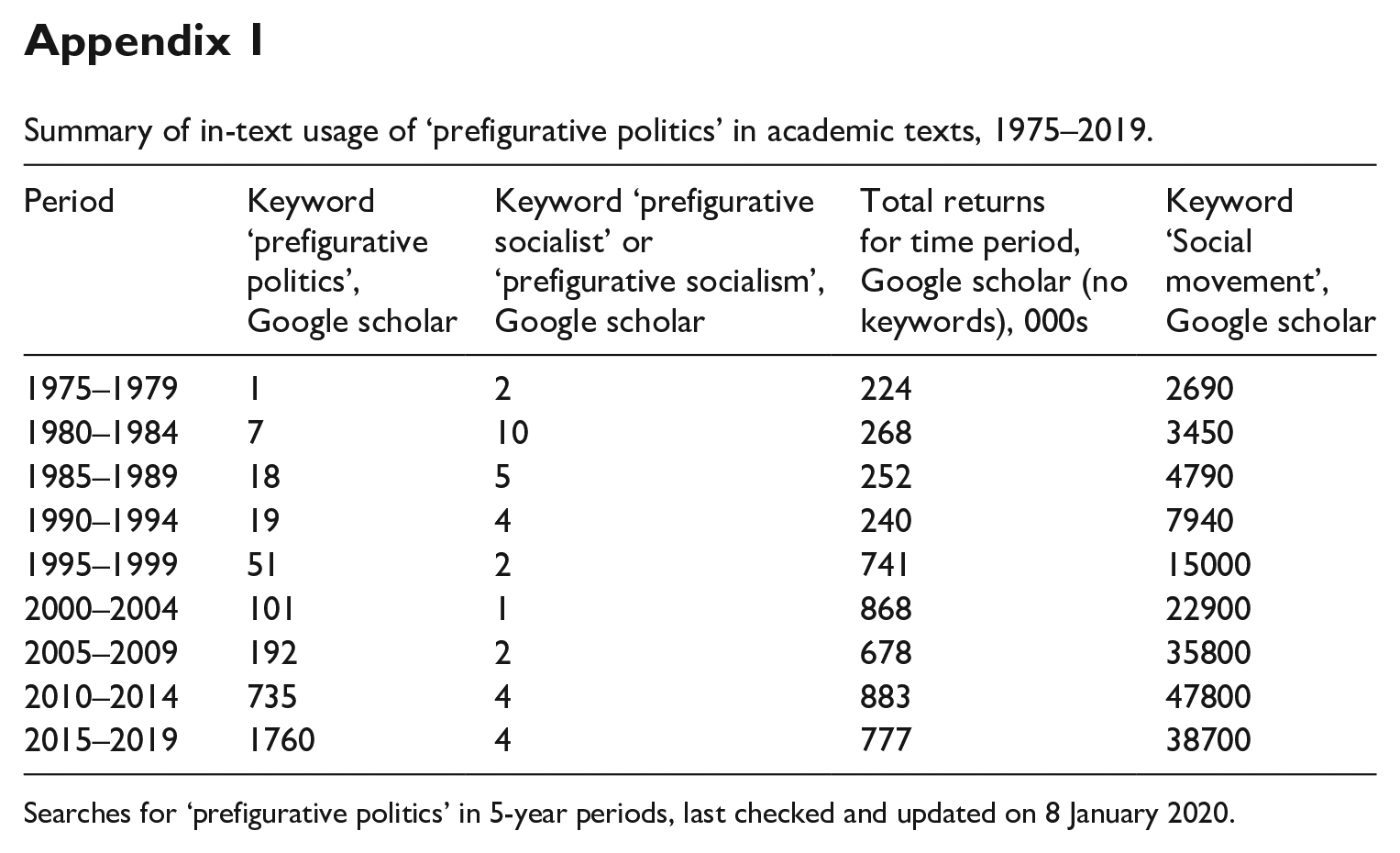
The theoretical context of prefigurative politics has recently been reviewed in a variety of fruitful ways (e.g. Gordon, 2018; Raekstad and Gradin, 2020; Swain, 2019). The next section contributes to understandings of the context and background to prefigurative politics through providing a historically systematic genealogy of the term itself used since its emergence in a sequence of phases, drawing out the core claims about strategy (Appendix 1). 2
Emergence and Antecedents, 1968–1980: Boggs, Gramsci, Gorz and Counter-Hegemonic Projects of ‘Prefigurative Socialism’
Carl Boggs is widely credited with coining the concept prefigurative politics. Yet Boggs was simply the first to formally define this particular variant on a term which was used interchangeably by several authors with similar formulations such as prefigurative socialism and prefiguration. Boggs’ definition has been disproportionately important in subsequent scholarship and in its treatment of strategy.
Boggs published two similar articles in 1977. Both deal with socialist political strategy. Prefigurative politics is defined in the first, and most cited piece, as ‘the embodiment, within the ongoing political practice of a movement, of those forms of social relations, decision-making, culture, and human experience that are the ultimate goal’ (Boggs, 1977a: 100). In both pieces, Boggs uses the term interchangeably with prefigurative communism and prefiguration, both of which were actually already in mainstream use (see below), and his reference to ‘movement’ is meant in a broader sense of a transformative tendency on the Left rather than contemporary formulations which exclude institutional political forms such as unions or parties. Prefiguration is part of an already familiar strategic dilemma which Boggs thinks the Left faces, that of:
how to effectively combine two distinct sets of tasks–the instrumental, which includes above all the struggle to conquer and maintain political power [through the state], and the prefigurative, which expresses the ultimate ends of the revolutionary process itself: popular self-emancipation, collective social and authority relations, socialist democracy (Boggs, 1977b: 359).
Prefiguration is persistently counterposed with political effectiveness, instrumentalism, and strategies of taking state power, which are treated as equivalent in meaning. Prefiguration is important to Boggs because Leninist political strategy sacrifices revolutionary goals and suppresses revolutionary consciousness through its hierarchical and bureaucratic structures as in the USSR, and even Italian communism, towards which Boggs is more sympathetic, still forsakes an ethic of active participation in institutions in favour of prioritising electoral gains. The problem, for Boggs, is that prefiguration and instrumentalism/efficacy are understood as a zero-sum game, each detracting from another; a trope which has repeated ever since (Swain, 2019: 2).
Yet Carl Boggs was only one among a number of writers who used similar phrasing to describe socialist political strategies from at least as early as the late 1960s. Andre Gorz (1968), shortly after the Paris uprisings, claims that prefiguration serves an important purpose in linking everyday activity to ultimate goals and building momentum towards them. Intermediary objectives should be sought which ‘make evident the necessity for the transition to socialism, to prefigure it in certain concrete aspects, to set in motion the revolutionary process without necessarily taking socialism as its explicit short-term aim’ (Gorz, 1968: 52). The party, therefore, ‘prefigures the proletarian State’ (Gorz, 1968: 58), must ‘aspire to being at once the memory and the prefiguration of struggles more advanced than those which are possible at a given moment’ (Gorz, 1968: 52) and ‘prefigures revolutionary power and symbolizes its possibility’ (Gorz, 1968: 64). For Gorz (and similarly for Magri, 1970), prefiguration or the verb to prefigure described revolutionary strategy and was not contrasted with taking state power, but was part of a process of radical transformation. It was a way of bringing about radical and sweeping change, not a contrasting approach to doing politics that might detract from it – a perspective I advocate returning to below.
Contemporaries of Boggs who used similar language – the verb or simple noun form (to prefigure, or prefiguration), or as a qualifier, as in ‘prefigurative socialist’ – did not attribute the term to Boggs, because it was already part of conversations about Left strategy. Some of this work discussed the ways in which socialism might be prefigured by other processes and how one might identify these incipient socialist forms in order to encourage them. Prefigurative socialism is also used to refer to how local government, workplaces or worker cooperatives may become counter-institutions run on socialist principles. This was seen to encourage particular kinds of identities and consciousness, as either a simultaneous or alternative strategy to seizing state power and then imposing socialism from above. Here, it merged with the notions of ‘local socialism’ and ‘municipal socialism’, referring to the Labour Party of Great Britain’s radical metropolitan councils in Sheffield, Manchester and London, terms which have their own subsequent life beyond prefiguration (recently revived by Davina Cooper, 2017). Finally, Sheila Rowbotham et al. (1979) were regularly mentioned in discussions of prefigurative socialism in the 1980s and 1990s as reference points for their discussion of prefigurative politics and feminism in Beyond the Fragments.
In summary, the concept of prefigurative politics, normally attributed to Boggs, was at the point of its emergence indistinguishable from a broader discussion of ‘prefiguration’ and ‘prefigurative socialism’ which was about revolutionary left strategy (Boggs, Gorz, Magri), or British local government as a strategic site for exploring, imagining and promoting socialist forms during Thatcherism. A broad point that united Boggs with the tradition on local prefigurative governance was the idea that prefigurative strategy was an ‘alternative’ to what in both cases was seen as the main left strategy of taking state power – quite different to Gorz and Magri. Developments in the use of the term prefigurative politics have drawn selectively on these early formulations and have tended to ignore the contributions of Gorz and Magri, defining the territory for later discussions of prefigurative strategy.
Phase 1, 1977–1989: Socialist Strategy and Institutional Alternatives
The following three sub-sections or ‘phases’ provide a chronological overview of the term’s evolution, seeking to explain its rise and proliferation in current meanings. Of the academic texts published between 1977 and 1989 which mention prefigurative politics, nine are about the American New Left, six are discussions of socialist or communist strategy, mainly theoretical; and five are primarily about socialist forms of social services, local government or criminology. Two mention second-wave feminism, and one each mention the peace movement, the anti-apartheid and the ecology movements as prefigurative. Several studies have remained important since. Two are discussed above: Carl Boggs’ articles in 1977 and Sheila Rowbotham et al. (1979). Aside from these, four articles by Wini Breines and her monograph Community and Organisation in the New Left (1989 [1982]) are noteworthy. Her contribution is to characterise Students for a Democratic Society as prefigurative through its rejection of ‘organisation’ in the form of representation, centralisation and permanent structures (Breines, 1989 [1982]: 51). Creating community was about organising in a way that emphasised means, values and process, but was still teleological: ‘the political means of achieving these goals had to be consonant’ (Breines, 1989 [1982]: 53). Breines describes the practical projects and counter-institutions organised by the New Left as one of their key contributions:
[They] began to serve functions, provide services, and exercise some minor power in a manner that ‘embodied’ the future society. Later free universities, alternate and underground newspapers, affinity groups and communes developed out of the notion that the left had to create institutions and social relations that embodied its values (Breines, 1989 [1982]: 52–53).
Breines, although sympathetic towards New Left organising, does not follow Boggs in drawing a strong distinction between the strategy of taking power and prefiguration (as does Epstein, 1991, see below), rather she describes a ‘dialectic’ between community and organisation.
Phase 2, 1990–1999: New Social Movements and Collective Identity
During the early years of the concept, as shown above, the collectives supposed to undertake prefigurative strategies were parties, states and local government as much as social movements; this was reversed in the 1990s. Despite increasing usage, the period saw stagnation in the use of prefigurative politics to discuss ‘local socialist’ initiatives (only four from 64) or left-wing theory (three examples). In contrast, half are about ‘new social movements’ in this period: eighteen pieces cover feminism, seven were about peace, five about the New Left and four were about civil rights or other movements primarily concerning race. Ten pieces were about social movement theory generally.
Barbara Epstein and Alberto Melucci are important through this period as commentators on new social movements and for their emphasis on culture, part of the wider cultural turn in the social sciences, which for some authors could be contrasted with a ‘strategic’ emphasis – or as something to be balanced, where culture and identity needed to be recognised as political and strategic to be recognised as mattering (e.g. Cohen, 1985). For Epstein (1991), this entailed much discussion of ‘cultural politics’ – the sense of community, camaraderie and emotional expression of anti-nuclear protests, and she debates the significance of post-structuralist thinkers such as Ernesto Laclau and Chantel Mouffe alongside those of Gramsci, with whom she has closer affinity. She notes that the North American tradition of direct action sometimes eschewed strategy and clear goals, where action in itself was celebrated (e.g. Epstein, 1991: 268). Prefigurative politics slips between several meanings, but generally is taken to mean something which is moral, cultural and expressive but which can be productively combined with strategic currents (see argument below). Melucci (1996), probably the most sophisticated and continuously influential of the new social movement theorists and of the cultural turn in social movement studies, promoted the idea that many new social movements were not, or not only agonistic but also developed new ideas, norms and practices, and that the imaginative and temporal dimensions of political activity were very important. Prefiguration holds a presence through discussion of the spaces and groupings that are part of his analysis and plays a central role in movements’ challenges to dominant cultural codes, although the concept appears only occasionally. In this phase, the term was also used in the context of important collections of social movement theory (Morris and Mueller, 1992) and of free spaces (Polletta, 1999). Also important is a discussion of gender and community organising (Stall and Stoecker, 1998), where the authors highlight the significance of relationships and community that underpins social movements:
The community is more than just the informal backstage relationships between movement members, or the foundation for social movement action. It sustains the movement potential during the hard times, when the movement itself may be in abeyance [. . .] provides for the social reproduction needs of movement participants, providing things as basic as child care so parents can participate in movement events [and] provides a free space where members can practice ‘prefigurative politics’ attempting to create on a small scale the type of world they are struggling for (Stall and Stoecker, 1998: 729–730).
Echoing and echoed subsequently by much literature on gender and political organising, and on ‘social reproduction theory’ (Federici, 2012), Stall and Stoecker point out that these communities are often taken as given, invisibilising this often gendered work, but that they must be organised and mobilised (Federici, 2012: 730). These ideas are similar and central to many of the contribution prefigurative politics has made to understandings of strategy since.
Phase 3, 2000–2009: Alter-Globalisation, Alternative Media and the ‘New Anarchism’
During the 1990s prefigurative politics moved from referring directly to an alternative strategy to becoming a concept for distinguishing new social movements from ‘old’, and for movement theories that emphasised culture, identity and gender. Normally, as during the 1980s, emphasis on these characteristics is validated by highlighting that they are part of a strategy. Yet they are now less often presented as an alternative emphasis or strategy as during the 1980s and more often strategically relevant characteristics that underpin strategic collective action. Moving into the 2000s, prefiguration remains a concept for labelling social movements, but the movements it refers to are changing rapidly. Just as new social movement activity were arguably declining in prominence, so too is the use of prefigurative politics to label them. The first 5 years, 2000–2004, are a period of flux, with feminism remaining the most significant single movement to which prefigurative politics is applied, and other new social movements making up a significant portion. Yet the early wave of work on anti-globalisation and anarchist organising account for much use of the concept in the time period 2005–2009. The alter-globalisation movement becomes the most important single movement for discussions of prefiguration (26 texts). Anarchism becomes prominent in these discussions, largely via David Graeber’s (2002) article ‘The New Anarchists’. Partly this is about the popularisation of direct action (see Franks, 2003).
There is also a shift in the time period towards analysis of protest events rather than movements, and increasingly, of types of activism rather than movements, which broadens the phenomena which are labelled as prefigurative. This is evident in the new attention in the second half of the decade towards practices of music or around food, cultural politics, literature and theatre and anarchist practice–which is often about political orientations rather than movements, ways of engaging rather than collective engagement, and interestingly, mirrors the alter-globalisation movement and its literature’s focus on summits and counter-summits. Key work includes Jeffrey Juris (2008), Marina Sitrin (2006), Marianne Maeckelbergh (2009) and Uri Gordon (2008). Finally, there is some resurgence in discussion of left theory, but largely dominated by anarchist ideas, which seem to entirely replace Gramsci as an influence on the term in this period. Some of the strongest claims during this period are made about what Yates (2015) calls ‘means-ends equivalence’, where controversial claims are made about goals and, hence, strategy, being literally and entirely collapsed into movement activity: the means are the ends (e.g. Graeber, 2002; Maeckelbergh 2009).
Phase 4, 2010–2019: Mainstreaming: From Movements to Protest Events and Activist Orientations
The 5-year period between 2010 and 2014 represents by far the largest increase in mentions of the concept (about 500 more than between 2005 and 2009), and in proportion (receiving about five times more mentions than the previous 5 years). It subsequently more than doubles again between 2015 and 2019. For the first time since the 1970s and 1980s there were dedicated articles and book chapters to the topic. It also reappeared in major books in social movement studies (e.g. Flesher Fominaya, 2014).
The first 5 years of this period of mainstreaming seem driven both by proliferation across many sub-disciplines, but also by something of a further reclaiming of the notion by anarchist studies. One-fifth of pieces in the time period 2010–2014 are directly about anarchist theory as well as praxis, where prefigurative strategic orientations might be contrasted with Leninist or Trotskyist traditions. Few authors discuss anarchism as a movement where prefiguration arises, but tend to characterise it as an orientation or position (e.g. Springer et al., 2012), again a contrast with earlier work. The 5 years see a continuation in the decline since the 1990s in the numbers of concrete movements where the concept is applied. The most common are Occupy (13% of pieces) and the alter-globalisation movement (8%). There is a rise in work from geography or which looks at space, overlapping with anarchist studies. For the first time since Breines and Epstein, prefiguration appears characterised as a dominant orientation in the movements of the time, most obviously in the square occupations movements (e.g. Van de Sande, 2013). There are continued references to environmental protest, everyday environmentalism and ecologically oriented grassroots initiatives, and to the application of the concept to space, mainly through discussions of occupations and in looking at ‘free spaces’. There is vast further uptake in the use of the concept by those outside social movements studies and in many cases outside of the social sciences, covering areas or topics such as the politics of art, theatrical practice, community work, alternative libraries, consumption, philosophy, critical theory, translation, community psychology and computer games studies. In the latest time period, it has also returned to feature more prominently in a number of articles or books, with increasing numbers of articles which make concrete analytical claims and attempt to develop a conceptual framework for prefiguration (see, in particular, Cooper, 2017; Jeffrey and Dyson, 2016; Polletta and Hoban, 2016; Raekstad and Gradin, 2020; Wagner-Pacifici and Ruggero, 2019; Yates, 2015, and two recent pieces in this journal by Dan Swain, 2019; Uri Gordon, 2018). I briefly frame these contributions as the current theoretical context before returning to discuss the broader question of the strategies of prefigurative politics.
The first useful job done by this newer and more conceptually rich literature has been to identify theoretical contexts of prefiguration in a way that is complementary to this review (which focuses on prefigurative politics named as such), noting that the intellectual history of the Left, and a broader set of ideas, have important resonances with one or more of the key meanings of prefigurative politics. Thus, Uri Gordon (2018) traces relevant temporal tropes in Christian theology (see also Swain, 2019), anarchist theory and Ernst Bloch’s theory of utopia for debating the risks and opportunities of different forms of means-ends equivalence. The intellectual debt of anarchism, building on arguments such as David Graeber and others (see Phase 3) is noted also by Van de Sande (2013) and Raekstad and Gradin (2020), but they usefully compare this tradition to Marxist tendencies including the work of Antonio Negri.
Another set of contributions has focused on identifying different modalities of prefiguration. Yates (2015) shows that prefiguration has tended to refer to two potentially disparate phenomena that are united by a specific orientation towards the future: ‘building alternatives’ – practical initiatives and alternative projects; and a form of doing political action where the goals are important in shaping the processes utilised in pursuing them, the ‘means-ends equivalence’. He advocates collapsing this distinction into five practices which help differentiate prefigurative politics from subcultural or individual lifestyle practices (see Note 1). While literature still predominantly uses the concept to label different elements of political action, the analytical contributions mainly focus on attempting to make sense of claims about means-ends equivalences (see Franks, 2003; Gordon, 2018; Swain, 2019) and have rarely unpacked the implications of prefiguration understood as building alternatives. Distinctive arguments here interrogate temporality in prefigurative politics (Gordon, 2018; Jeffrey and Dyson, 2016; Swain, 2019; Wagner-Pacifici and Ruggero, 2019), where work has both attempted to clarify the relationship between the present and future suggested by its use (Jeffrey and Dyson, 2016) and considers the implications for movement goals (Swain, 2019: 10; Van de Sande 2013: 232; Yates 2015: 15–18). Wagner-Pacifici and Ruggero (2019: 19), for example, persuasively argue that ‘to talk of prefiguration is to necessarily talk of temporality [. . .] In the case of Occupy Philadelphia, multiple versions of prefigurative approaches to time and history vied for control across multiple levels of action, interaction, and organizing’. While temporalities are a relatively new and explicit focus, space and scale have long featured in debates about prefiguration. Prefigurative politics is socially and territorially bounded but its political significance is premised on its potential expansion in terms of generalisability, extension or extrapolation in space and time (Yates, 2015). Prefiguration links the particular, local and present moment to alternative worlds and the future via imagination and practice. Yet there are a great many potential trajectories of influence carried under the rubric of ‘scaling up’ (e.g. Smith et al., 2016), which sometimes becomes itself simply another way of posing the question of how prefiguration can be politically effective.
Finally, important contributions have been made in diverse applications to particular contexts and new themes, especially those outside of the global North. Davina Cooper’s (2017) discussions of prefiguring local states, Jeffrey and Dyson’s (2016) study of do-it-yourself initiatives in India, Baker’s (2016) account of prefigurative subtitling in Egypt and mass strikes in Guadaloupe (Bonilla, 2010) demonstrate the range of application possible and the continued diversity in meanings attached to the concept. And the term has become important in activist debates, intersecting with academic contributions in some interesting cases (e.g. Razsa and Kurnik, 2012; Raekstad and Gradin, 2020). Yet, there is still disproportionate work on prefiguration that focuses on decision-making and direct action, and on informally organised and anti-authoritarian left-wing movements in the global North – raising questions for future research about whether and how other types of left-wing groups, right wing movements and collectives other than social movements are in any way prefigurative, and how.
In sum, there has been significant uptake in the concept and proliferation beyond social movements and the disciplines of sociology and political science in the last 40 years, in which approaches towards the concept have evolved. This, in turn, has meant that claims about prefigurative strategy have shifted. Increasingly, it is used to describe a political orientation towards action rather than a label for particular types of movements as was the case in the 1990s, or to describe an overall Left strategy as was the case in the 1970s and 1980s. Recently, its use to describe activism per se rather than to qualify movements as prefigurative or not has revived the central debate explicitly, that of understanding its role in strategy and effective collective action. I now turn to this issue.
The Roles Prefigurative Politics Plays in Applied Strategies of Social and Political Transformation: Reproduction, Mobilisation and Coordination
The main debate prefiguration has formed part of throughout the time periods outlined above circulate around whether, or how, it is ‘strategic’, where strategy is a word used for making claims about what activity is and is not effective. Recent work makes a strong case that prefiguration is, after all, politically sensible (e.g. Maeckelbergh, 2011; Swain, 2019; Wagner-Pacifici and Ruggero, 2019). Nevertheless, there remains little dialogue between positions which are critical and those which consider prefiguration to be politically very important. This section addresses that challenge by enumerating the various potential functions of prefigurative politics, then identifying where they may fit in three broad analytical categories that are widely understood to be necessary for movement strategy: reproduction, mobilisation and coordination (Remoco for short). This formulation presents a set of obvious practices and processes that are well-appreciated – the reproduction of resources needed to act; the tactics that are mobilised; and the orientations towards goals of coordination. It is also used to identify less well-documented processes informed by the literature on prefiguration, such as reproduction of collective action that involves experimentation, the building of relationships necessary for collective action, the mobilisation of less-recognised tactics such as building alternative institutions, and the way that forms of coordination are empowered by a collective and are distributed across activity, often taking place in a routinised and intuitive way. Building on this, it is argued that disagreement about political strategy and prefiguration often boils down to under-valuing or taking for granted either reproduction or coordination; or to disagreement about priorities. Before outlining the Remoco formulation of social movement strategy it is worth indexing the critiques in a broader discussion of how prefigurative strategy – if something sufficiently distinctive can be discerned as such – has become so controversial.
Critiques of Prefigurative Politics as a Political Orientation or Strategic Priority
Prefiguration is now generally used to refer to one, another, or both of the practices around (1) building alternative initiatives or practices for an anticipated changed world, or (2) a similarly future-oriented political orientation where the ‘means’ reflect ‘ends’ (Yates, 2015). But there are other terms that refer to these dynamics, which means that some critiques and enthusiastic celebrations of prefiguration focus on only one of these phenomena at a time, while others combine both (see Note 1). Common fears about prefiguration, therefore, circulate around prefiguration, for example, being (1) too localised, small-scale and focused on the present (Gordon, 2018: 2) and being too easily co-opted by existing actors (Jeffrey and Dyson, 2016), on the one hand, or (2) as fetishising process (Cornell, 2011 [2009]; Polletta and Hoban, 2016), alienating newcomers (Polletta and Hoban, 2016) and being too closely associated with identity and self-expression, on the other (cf. Raekstad and Gradin, Chapter 7). Similar critiques exist that do not use the term prefiguration, but which target lifestyle politics, anarchism, ‘everyday’ politics and ‘folk’ politics. In each case, there is an implicit sense of what would be effective or ‘strategic’ approaches to social change, and sometimes an explicit rejoinder that differentiates prefiguration as somehow beyond conventional understandings of strategy. At worst, positions on prefiguration and strategy act as a proxy for making empirically unverified claims about what social movement activity matters.
Nick Srnicek and Alex Williams’ (2015) assessment of contemporary Anglo-American social movement politics is illustrative. They influentially critique folk politics: a ‘common pattern’ characterised by political activism ‘falling short of achieving goals or of achieving effects beyond the “minimal”’ (Srnicek and Alex Williams, 2015: 6). They describe the problem through a series of oppositions – folk politics:
typically remains reactive rather than initiating actions, ignores long-term strategic goals in favour of tactics [. . .] prefers practices that are often inherently fleeting, chooses the familiarities of the past over the unknowns of the future and expresses itself as a predilection for the voluntarist and spontaneous over the institutional [. . .] there is a preference for the everyday over the structural, valorising personal experience over systematic thinking, for feeling over thinking [. . .] and for the ethical over the political (Srnicek and Alex Williams, 2015: 11).
Folk politics captures anxieties about prefigurative politics that are identified in the sections above, reflecting a long-term trend since Boggs (1977a, 1977b) for associating these characteristics with one pole of a dichotomy, most regularly with movements or tactics that were ‘expressive’ or ‘cultural’ as opposed to strategic, instrumental, institutionally oriented and ‘structural’ (see phases 1–4 above). Prefigurative movements prioritised community over organisation (Breines, 1989) where ‘culture is a substitute for strategy’ (Epstein, 1991: 18). In most of these cases, the debate is about political efficacy: prefigurative politics was framed as a politics of no demands, goals or ideology (see Graeber, 2002). While for Graeber (2002) and Maeckelbergh (2009, 2011), this is a strategy in itself, for critics it indicates an abdication of the possibility of real change. Srnicek and Williams go on to say:
At its best, prefigurative politics attempts to embody utopian impulses in bringing the future into concrete existence today. Yet at its worst, an insistence on prefiguration becomes a dogmatic assertion that the means must match the ends, accompanied by ignorance of the structural forces set against it (Srnicek and Alex Williams, 2015: 28).
The disagreements are hard to tease out because both positions are somewhat extreme, with critiques of prefiguration tending to create a straw man of political action that is naïve, insular or divisive (as Raekstad and Gradin (2020) explain), while its strongest supporters often suggest that prefiguration, despite its contested and broad character, is a strategy in its own right – a very strong claim which would suggest unusual coordination and unity among participants about their goals and their activity.
It is helpful to directly consider the concept of social movement strategy. The dictionary definition of strategy is ‘The art or practice of planning the future direction or outcome of something; the formulation or implementation of a plan, scheme, or course of action, esp. of a long-term or ambitious nature’ (OED, 2019). This latter qualification is often used in distinguishing strategy from tactics, yet it remains defined by its relation to them: tactics being ‘the means and plan to win a single campaign (one battle) and strategy as the plan of how to win the struggle (the war)’ (Nepstad and Vinthagen, 2012: 282). Both definitions, similar to influential discussions of ‘strategic action’ (e.g. Fligstein and McAdam, 2012; Jasper, 2015) emphasise rational planning, leadership and decision-making, and treat strategy as being composed of tactics – which raises problems, because what constitutes ‘tactics’ or is considered irrelevant movement activity is also an open question. Marshall Ganz also strongly emphasises teleology, while reminding that resources are necessary for this collective action:
Strategy is the conceptual link we make between the places, the times and ways we mobilize and deploy our resources, and the goals we hope to achieve [. . .] Strategy is how we turn what we have into what we need-by translating our resources into the power to achieve purpose (Ganz, 2000).
Throughout, and in debates on prefiguration and strategy, there is slippage between strategy itself – the plans, and an applied strategy – the programme of political activity that may or may not have strategic characteristics, and is sometimes used to simply mean effective political action. My argument will be that prefigurative processes may play one or several roles in an applied strategy – though it is rare that all the components of this applied strategy would be prefigurative.
Five functions typically associated with prefiguration might potentially play roles in such a conception of applied social movement strategy. For some authors, prefiguring alternative institutions and practices is considered part of a process of substituting or supplanting institutions (Cooper, 2017; Holloway, 2010; Wright, 2010). The purpose of building alternatives may be to transform a state, a set of practices or a norm. For others, it is about experimentation, innovation and learning, including setting an example or inspiring others (e.g. Gordon, 2008, Van de Sande, 2013), capturing the key trope important for new social movement theory that movements are innovative and generative of new social forms, ideas and ways of life (Habermas, 1981; Melucci, 1996). A third function is that prefiguration may be of use in otherwise preparing or resourcing collective actors (e.g. Cornell, 2011 [2009]), picking up on the claims that prefigurative alternatives are sites of socialisation, collective identity formation and care for activists, mentioned in literature on social movements and gender (Federici, 2012; Stall and Stoecker 1998), and on ‘free’ or ‘safe spaces’ (e.g. Futrell and Simi, 2004; Polletta, 1999). A fourth function suggested in the literature is that prefiguration is a way of directly achieving something in the here and now, perhaps rejecting compromise, delay or negotiation via a third party – as in work that discusses immediacy (Gordon, 2018; Jeffrey and Dyson, 2016; Swain, 2019) and direct action (e.g. Franks, 2003; Graeber, 2002; Juris, 2008). For an overlapping group of authors, finally prefiguration is a mode of doing activism that pays attention to the micropolitics of political activity which is intrinsically and perhaps morally better than the alternative because it symbolises a distinction from the ‘old left’ or the Leninist or Trotskyist left where means are justified by the ends (e.g. Breines, 1989 [1982]; Epstein, 1991; Gordon, 2008). 3
There is no reason to think that any of these specific functions are inefficacious in and of themselves, yet critiques tend to derive from the anxiety that one of these functions might entirely replace a programme of Left strategic politics, and may therefore be insufficient. Strong advocates of prefiguration, meanwhile, emphasise the first function, although as Wright (2010) argues, it is difficult to imagine the wholesale replacement of important institutions without accompanying confrontation and rupture. I argue that these arguments are best addressed by avoiding the binary language of strategy (see Harding, 2015) and dividing the political purposes attributed to prefiguration into three analytically distinct (but not always empirically distinguishable) categories. These capture the different types of politically relevant social movement activity mentioned in the definition by Ganz (2000) of ‘how we turn what we have into what we need-by translating our resources into the power to achieve purpose’: reproduction (of resources and the movement, understood broadly), mobilisation (tactics, again understood broadly) and coordination (the marshalling or direction of activity towards political goals) (Remoco).
Reproduction
The fundamental category of strategic social movement activity identified in Ganz’s definition is resources. I interpret this as the social and political reproduction of resources, skills, relationships and counter-power that movements need in order to be capable of acting collectively. Reproduction refers to the maintenance of resources including and beyond those widely recognised in resource mobilisation literature. It refers to making movement organisations and communities work properly. This not only includes the ongoing production and performances of social movement organisations, but also of the prefigurative movement infrastructures, institutions and ‘alternatives’, which resource movements, allow learning, or may supplant orthodox practices or institutions. It also refers to the reproduction of routine, quotidian, unglamorous and ‘latent’ resources which are not only necessary for movements, they also constitute movements: practices included under the rubric of collective identity (Melucci, 1996) and which include social ties, counter-culture and caring for the movement community (Stall and Stoecker, 1998). From using spreadsheets to maintain member lists, booking rooms, messaging comrades, liaising with legal observers, the working relationships and friendships that constitute the fabric of collective action itself, activism requires huge amounts of labour generally overlooked and undervalued by researchers and activists, just as similar tasks are undervalued in wider society (see Federici, 2012). Yet, without the reproduction of movements, there are almost no possibilities for mobilisation and insurgency outside of one-off demonstrations, because there are no resources to mobilise, and the plans for changing society that are produced are unrealistic, utopian or grandstanding. This is one way in which the process of reproduction is part of strategy, but it is important to realise that these categories are mutually complementary – particularly as arguments about prefigurative activity normally treat political action as a zero-sum game. In other words, while movements need to be ‘reproduced’ in order to mobilise, empower leaders, make demands and create change, it runs both ways, and reproduction of movements is also achieved through mobilisation and coordination. Demonstrations and marches may help build or maintain a movement, as Melucci (1996) reminds, the ‘visible’ character of movement organising – feeds ‘latent’ movement activity as well as vice versa – and coordination helps participants remember why they are there and why they are needed. Where prefiguration figures in reproduction is obvious, but the strategic functions above of resourcing movements, getting something done in the here and now and, potentially, considering the micropolitics of organising itself are all regularly part of movement reproduction, and so might be part of any applied social movement strategy.
Mobilisation
The category mobilisation is used here to mean processes of deploying social movement resources. But it not only refers to the narrow sense of mobilisation: persuading people to participate politically as a collective through widely recognised tactics. It refers to any exercise of the power and capacity (that needs to be constantly reproduced) aimed towards a specified end (when it is coordinated) – such as the prefigurative tactics of creating new institutions or a mass recruitment drive. Just like reproduction, mobilisation involves practices that are done repetitively – for some activists, they are not always explicitly and individually intentionally ‘political’ in that they are simply what you do when you are an activist or engaging in conflictual collective action. But mobilisation changes the conditions of possibility either through creating something new or engaging in a new form of interaction with opponents or allies, as opposed to maintaining existing power and reproducing the resources needed to wage struggles. Without mobilisation, movements do not change anything – they simply reproduce themselves or come up with pie-in-the-sky plans that cannot be coordinated around. Prefigurative political functions thus have several potential roles in mobilisation. Most obviously, prefigurative mobilisation might include setting up the new alternative practical projects that may build oppositional culture or have some other practical purpose (e.g. anti-fascist gymnasiums, seed swaps, power-mapping training courses, feminist music festivals and publishing houses). Mobilisation therefore might include all five of the prefigurative political functions identified above, potentially being part of supplanting existing institutions by alternatives; some experimentation, innovation and learning in the process of either protesting or building alternatives; and the mobilisation of these alternatives might help prepare or resource collective actors in other ways. It might also involve mobilising, building or growing in a way that is micropolitically aligned with the values of the activism; and finally it might allow something to be directly achieved or established in the here and now which is of use for the movement such as through direct action or by creating a useful movement project.
Coordination
Coordination is the imagining, marshalling, planning and guiding of forces in a particular direction or towards a particular end. Coordination, then, refers to practices or effects of this direct or emergent planning, leadership, coordination, envisioning and imagination. The distinction between direct and emergent coordination is important for debates about prefigurative strategy. Typically, and historically, coordination has been understood as involving (the black box of) actors directly exercising their agency (similar to Jasper, 2015), while a more detailed version would depict forums of leaders deliberating over courses of action which they could subsequently marshal as representatives, leaders or generals. There are two reasons why this is a stylised and incomplete caricature: the first is that it elides the processes through which decision-making is made, negotiations achieved and courses of action are undertaken. 4 There are many ways in which groups, populations, actors and resources are coordinated which do not take place through direct processes of leadership and planning, but which happen through improvised alliances, emergent opportunities and provisional goals, improvised activity, and where goals and the action are understood quite different by the different participants. Planning, leadership and coordination could even be an emergent property of an ecology of organisations, infrastructures and projects, although it is unclear how this might arise in any unambiguously productive way without some of the actors involved actively leading, planning or coordinating through communicating and acting together. Yet, at the same time, and as critiques of prefigurative politics remind us, without explicit coordination, movements do not have an agenda, so may struggle to force opponents to accede to demands, identify opportunities or resources and force change to happen through connecting up mobilisations. Literature on prefigurative politics tends to downplay direct coordination. Prefiguration is widely understood to be about political possibility, imagination and anticipation: it is about acting in a way that contains some emergent element of coordination within it. It highlights the important point that processes of reproduction and mobilisation often happen independently of established leaders, and ‘leaderless’ movements often carry out highly successful mobilisations. But at other times, this position is taken too far: it is denied that coordination is necessary at all because of the autotelic ‘ends’ that are contained within practices or ‘means’. Thus, claims that with prefiguration the means are literally the ends suggest that there is no need to directly coordinate because the activity itself prefigures the values or goals of the actor. This is misleading. Random outcomes which are sometimes positive might be expected with this approach, but significant, complex and sustained social change is unlikely, a conclusion which echoes reservations about the ‘immediacy’ of some activism (Gordon, 2018; Srnicek and Williams, 2015).
The second, less controversial way in which prefiguration is about coordination is that the first political function of prefiguration about the substitution or supplanting of dominant institutions with alternatives suggests itself as a plan for radical social change in a way that none of the other functions do (Boggs, 1977a, 1977b; Gorz, 1968). Since the 1980s this strategic logic has rarely been invoked explicitly, yet even its strongest advocates generally recognised that it is not an entire strategy in and of itself (Wright, 2010). Most authors suggest that prefiguration is usually best combined with, and coordinated with, conflict and struggle, which Wright convincingly presents as necessary to force elites to accept new settlements which usually threaten entrenched interests. 5 Furthermore, as with reproduction and mobilisation, coordination is distributed across all three categories of strategic process (Doherty and Hayes, 2019). As Stall and Stoecker (1998: 730) point out, leadership is produced, mobilised and empowered by those who are not leaders. Participants in social movements also act together intuitively, routinely and often without obvious moments of direct and explicit planning.
Reproduction, Mobilisation and Coordination as a Way of Making Sense of Strategic Disagreements
Some persistent disagreements about prefiguration and strategy can be addressed by appreciating the specific roles that prefigurative politics may play in an applied movement strategy, and not over-claiming about the sufficiency of prefiguration as an entire movement strategy in itself. Other disagreements can be seen as debates over what should be prioritised among the practices of both prefigurative and non-prefigurative politics. Critiques tend to derive from the anxiety that elements of reproduction or the less traditional tactics of prefigurative mobilisation might entirely replace Left strategy, or displace traditional tactics and direct coordination. Where the argument is that prefigurative activity may be too localised, small-scale and focused on the present – perhaps when significant energy is expended on creating a ‘free space’ – it is about anxiety that coordination and more traditional mobilisation forms are missing – a fear that in some cases is justified (see Srnicek and Williams, 2015). Where arguments are that prefigurative initiatives are too easily co-opted by existing actors, and insufficiently ambitious, it is similarly an anxiety that coordination is missing or not sufficiently direct – or that mobilisation is taking place and being glorified as its own end. Where the concerns are about fetishising process, alienating newcomers and being too closely associated with identity and self-expression, this may in part be a specific anxiety that subcultural tendencies in reproduction will prevent the possibility of mobilisation (e.g. making recruiting other people difficult) or create difficulties in coordination (e.g. that differences between different elements of a potential alliance make it difficult to work towards shared goals). Again, they may also be due to worries that coordination is not taking place, or that it is insufficient or poorly thought out. Disagreements often rest on a worry that an applied movement strategy is neglecting one of the three components, or is misguided in its approach to them.
These are all reasonable concerns, and arguments about how best to coordinate, who should coordinate and how to do so in the most politically efficacious and legitimate way possible are necessary partly because they guide the type of reproduction or mobilisation undertaken. But critiques are made too often of particular practices, tactics and priorities, without giving any benefit of the doubt to practitioners’ understanding of what they are doing. When discussion about prefiguration takes a strategy or not-strategic, either/or character – whether that opposes the small versus the grand, local versus the state or international, individual versus collective, micropolitical soundness versus pure pragmatism – debate polarises such that each side effectively glosses over the essential significance of the existing power base and its everyday reproduction; or the development of this power base and its deployment in mobilisation; or the essential political imagination, marshalling and planning of coordination. The risk is that everybody in a movement spends a lot of time demobilising others; the opportunity is to work out what is missing in a general strategy towards shared goals, and trying to address them.
Finally, it is likely that as political opportunities widen or close, and as the community mobilised by movements changes, the possibility of imagining and coordinating significant change also shifts. In certain political moments and for certain movements it is easy to neglect one part of an applied strategy. Thus, it might sometimes feel like movements are too weak to coordinate or to dare to even imagine, it might feel like they have no power if they are not exercising that power through mobilising and some reproduction work might feel a frustrating use of energy when that collective energy is scarce. Here, the open-ended nature of prefiguration appear to often be inspiring. The intersections and mutual dependency between dynamics of reproduction, mobilisation and coordination may be taken as a reminder that there are many ways to productively contribute towards a movement. Yet it is the ways in which these efforts are combined: building, growing, imagining and coordinating with others towards shared goals, that offer the greatest challenges. Future work on strategy in and outside academia should focus on reviewing and imagining different approaches to coordination, mobilisation and reproduction across diverse and usually non-bureaucratic groups, networks and identities, whether these are emergent, dependent on some centralised or organised forms, or hybrid.
Conclusion
In the period between the 1970s and the present the concept of prefigurative politics has become prominent in the social sciences, and strikingly polyvalent. The term’s trajectory means that the strategic logic of prefigurative politics – the most vexing puzzle in the literature and for activists – is also ambiguous and multifaceted. Strategy is not a term that is particularly useful without qualification. The history of prefigurative politics as a concept shows it to be associated with particular forms of organising (usually taking state power) and its use often involves a normative assumption that efficacy and efficiency according to certain (unnamed) goals and criteria are the most fundamental and legitimate principles determining action. Yet prefigurative politics, reflecting its diverse interpretations, is part of many plausible political ‘projects’ that may in many cases lead to progressive outcomes. This can be highlighted in part by showing that they are usually play roles or are part of processes which together make up an applied social movement strategy. The implications of this are that it would be misguided to dismiss them out of hand unless they are claiming to be politically transformative in and of themselves – very few orientations or sets of activity should make such a claim. The Remoco formulation aims to highlight that social movement transformation always involves different processes, many of which are ‘latent’, invisible, under-theorised and assigned little value either in activist circles or by academics, certainly compared with the work of coordination (which is where activist academics often view their own role).
The research puzzle should therefore no longer be whether prefiguration is strategic, but (1) how different ‘strategic’ projects and priorities are negotiated within movements, and to what effect; (2) how interactions with opponents and allies lead to shifts in strategic priorities and projects; and (3) how and where combining strategic elements has been successful for movements. These questions entail thinking about coalition and goals creatively, to better resolve the problem of coordination and building power for an increasingly fragmented and non-aligned Left with a historically unprecedented plurality of protest orientations and desired outcomes. Probably, the answer either that activists should trust in an ‘ecology’ of movements which will organically and naturally develop coherent direction for counter-power to be leveraged, or that a cadre or formal ‘party’ should lead, are both unrealistic and too controversial to be worth taking seriously, which suggests that an approach to coordination lying between formalised processes of representation, leadership, planning and execution – and spontaneous, independent and mutually complementary forms of collective action, would be the most promising approach.
Panning out, the multifaceted strategic logic of prefigurative politics highlights the need to unpack some of the central assumptions underpinning literature on social movement strategy, with some implications for models of political action and collective agency themselves. In addressing this, looking beyond standard bureaucratic actors such as the social movement organisation, and the standard activity repertoires, for example, the traditional public demonstration will be increasingly important.
Footnotes
Appendix
Summary of in-text usage of ‘prefigurative politics’ in academic texts, 1975–2019.
| Period | Keyword ‘prefigurative politics’, Google scholar | Keyword ‘prefigurative socialist’ or ‘prefigurative socialism’, Google scholar | Total returns for time period, Google scholar (no keywords), 000s | Keyword ‘Social movement’, Google scholar |
|---|---|---|---|---|
| 1975–1979 | 1 | 2 | 224 | 2690 |
| 1980–1984 | 7 | 10 | 268 | 3450 |
| 1985–1989 | 18 | 5 | 252 | 4790 |
| 1990–1994 | 19 | 4 | 240 | 7940 |
| 1995–1999 | 51 | 2 | 741 | 15000 |
| 2000–2004 | 101 | 1 | 868 | 22900 |
| 2005–2009 | 192 | 2 | 678 | 35800 |
| 2010–2014 | 735 | 4 | 883 | 47800 |
| 2015–2019 | 1760 | 4 | 777 | 38700 |
Searches for ‘prefigurative politics’ in 5-year periods, last checked and updated on 8 January 2020.
Acknowledgements
Part of this work was conducted during a funded Hallsworth fellowship at the University of Manchester. My thanks to the fellowship, to the Department of Sociology and the Sustainable Consumption Institute at the University of Manchester and to Kevin Gillan and Dan Welch for comments on an earlier draft of this paper. Thanks also to the organisers and participants of two workshops: ‘Prefiguration in Contemporary Activism’ at the University of Manchester in 2014, and ‘Practices of Material Participation’ at the University of Siegen in 2017. All errors are my own.
Declaration of Conflicting Interests
The author(s) declared no potential conflicts of interest with respect to the research, authorship and/or publication of this article.
Funding
The author(s) received no financial support for the research, authorship, and/or publication of this article.
