



Abstract
Can country leaders improve citizens’ ethnic outgroup views by changing ethnic representation in government? Years of pressure from the international community calling for leaders to make particularly their cabinets more ethnically representative seems to suggest that ethnic representation—conceptualized as descriptive and substantive representation and ministerial cooperation—is key to improving citizens’ outgroup views. I argue that increasing ethnic representation influences majority and minority citizens differently; minority citizens’ outgroup views will become more favorable, while majority citizens’ views will worsen. Using a pre-registered vignette experiment with ethnic Albanians and Macedonians in North Macedonia, I show that ethnic representation does not provide the improvements in outgroup relations that many have hoped. Both groups’ affect toward and perceptions of the cabinet change somewhat, but increasing ethnic representation does not improve overall outgroup attitudes. These results suggest that ethnic representation alone does not lead to more productive interethnic relationships.
Ethnic representation in government is increasing. The last several decades have seen a substantial uptick in three forms of ethnic cabinet representation: the number of cabinet ministers from minority ethnic groups, government benefits provided to minority groups, and elite cooperation between ethnic groups (Francois et al., 2015). This secular trend toward increased ethnic cabinet representation has been explained in the following two main ways: (1) pressure from international organizations and (2) leader re-election strategies. Both of these explanations rely on ethnic minority cabinet representation improving citizens’ interethnic relations. Yet, this assumption remains untested. Does ethnic cabinet representation improve citizens’ views of outgroups?
The Organization for the Security and Cooperation of Europe (OSCE) is a powerful international player in promoting ethnic cabinet representation. Their 2012 Ljubljana guidelines are a standard by which many international organizations evaluate countries’ ethnic inclusion. These guidelines proclaim that “States should strive for adequate representation of the diverse groups in their society . . . in all relevant structures of public administration,” stating further that “affirmative action for the allocation of cabinet posts” (OSCE, 2012: 46) is a key best-practice for country leaders to follow. In the OSCE’s (2012: 46) mind, the purpose of ethnic cabinet representation is for “everyone to have adequate opportunities to effectively participate in democratic decision-making”. By encouraging numerical representation, favorable policies, and elite cooperation with ethnic minorities, citizens will have their voices heard and develop “a sense of shared belonging” (OSCE, 2012: 18) with ethnic outgroup citizens. Pressure from the international community along these lines often results in leaders engaging in ethnic accommodation of minority groups, with the international community hoping that citizens’ views about the outgroup will improve as a result (Hartzell and Hoddie, 2003; Rothchild, 1997; Sisk, 1996).
At the same time, country leaders have their own motivations for promoting ethnic cabinet representation that involve citizens. Leaders need to develop coalitions in order to win re-election, and allocating influence and patronage through the cabinet is a simple way to do this in ethnically divided societies (Arriola, 2009; Chandra, 2004). Here, cabinet representation functions as a credible commitment to provide benefits to minority ethnic groups in return for political support (O’Brochta, 2020). Leaders hope that benefits from an ethnically representative cabinet will prompt citizens to improve their opinion of not only the leader, but of the majority ethnic group as a whole for two reasons. First, improving interethnic relations means improved country stability, which is necessary for the majority group to avoid citizen-led coups and civil unrest (Francois et al., 2015). Second, if overall ethnic relations improve as a result of providing representation, then majority ethnic group politicians can enjoy continued support from traditionally hostile minority citizens without needing to distribute as many influence or patronage benefits.
Both scenarios provide rationales for country leaders increasing ethnic minority cabinet representation, and both scenarios rely to varying extents on the hope and promise that increased ethnic cabinet representation will improve citizen outgroup relations. Previous literature focuses on how elites use divisive rhetoric to exacerbate ethnic tensions and potentially to provoke civil conflict (Kaufman, 1996; Kifordu, 2011; Somer, 2001; van Dijk, 1992). While it has received significantly less attention, a calming effect of elite actions has also been posited. “If elites from the majority group approach minorities in a spirit of flexibility, inclusiveness, and tolerance, the odds are that tensions can be defused” (Hislope, 1998: 141; see also Steen and Kuklys, 2010). In either case, existing literature predominately considers the influence of elite rhetoric without taking into account how actual country leader decisions about ethnic representation impact citizens. This could be due to the fact that most existing work examines ethnic representation in legislatures. I study ethnic cabinet representation because country leaders’ have significant power to alter it.
Citizen responses to ethnic representation matter because they fundamentally shape a country’s political environment. Elite responses are also important, but ethnic intolerance persists unless it is addressed directly among citizens. Not only can citizens collectively organize, demanding changes in the amount of ethnic representation, but ethnic representation has wide-reaching micro-level consequences. First, citizens emotionally respond to ethnic cabinet representation. Anger and discontent make citizens more wary of the cabinet and make it more difficult for the cabinet to effectively address citizen concerns. In addition, ethnic cabinet representation can change citizens’ perceptions of the cabinet and its ability to represent them, slowing down policy implementation and leading to calls that the cabinet is out-of-touch with citizen views. Finally, ethnic cabinet representation may influence citizens’ outgroup attitudes—the ways they think about and interact with outgroup citizens. Worsening outgroup attitudes are a key factor increasing ethnic tensions and making the entire political system more ethnically polarized. Getting the ethnic representational balance wrong in terms of numerical diversity, policy priorities, or elite cooperation can have disastrous consequences. Arnesen and Peters (2018) show that members of the public strongly associate government legitimacy with coethnic representation (see also Clayton et al., 2019). If the government fails to provide ethnic representation and government legitimacy decreases, a host of negative outcomes including intergroup violence and civil conflict are more likely to result (Lieberman and Singh, 2012).
Does ethnic minority representation improve citizens’ views of the ethnic outgroup? I argue that citizens’ views improve when the amount of coethnic representation increases. This is because increased coethnic representation provides perceived benefits to coethnic citizens, which leads them to develop a favorable view of ethnic outgroups. When ethnic minority representation increases, minority citizens’ will, therefore, react favorably and improve their views of the outgroup. However, majority citizens’ views worsen because their perceived benefits decrease. I test these hypotheses by manipulating three key features of ethnic cabinet representation: descriptive representation, substantive representation, and cooperation among ministers. 1 Using a pre-registered, hypothetical vignette experiment with realistic attributes fielded among ethnic Albanians and Macedonians in North Macedonia, I show that ethnic representation does not provide the improvements in outgroup relations that many have hoped. Representation among ethnic minority Albanians slightly improved Albanian affect toward the cabinet and perceptions about the cabinet. At the same time, increasing Albanian representation provoked some backlash from ethnic Macedonians. Ministerial cooperation provided the most promising improvements in affect toward and perceptions of the cabinet, but even so, outgroup attitudes were largely unchanged. The findings suggest that ethnic representation does not have a wide-ranging impact on outgroup attitudes and, therefore, ethnic representation seems not to provide a particularly meaningful solution to citizen ethnic tensions. As a result, policy practitioners may want to re-examine ethnic cabinet representation as a solution to reduce citizen ethnic tensions and to determine if there are certain conditions under which ethnic representation is more likely to be effective.
Theory
Citizens have long memories. Long-standing institutional discrimination, periods of ethnic conflict, and political and economic inequalities all play large roles in determining citizens’ views of outgroups (Baldwin and Huber, 2010; Canelas and Gisselquist, 2018; Cederman et al., 2011; Charnysh, 2015; Dinas et al., 2021; Homola et al., 2020; Miodownik and Nir, 2016; Ostby, 2008). Each of these factors is important, but country leaders have relatively a little power to alter institutional history without a great deal of time and a broad base of support.
What country leaders do have control over are political appointments, and cabinet ministers represent the most important and influential appointments in government (Blondel and Muller-Rommel, 1993; Laver and Shepsle, 1994). The purpose of a cabinet is to facilitate resource delivery to citizens. Cabinets do this work by writing budgets, drafting legislation, managing the bureaucracy, and interacting with the legislature. In this way, cabinets are an intermediary between citizens and the various types of resources that the government provides to citizens. Cabinet representation is an important tool that leaders have to engender productive relationships among ethnic outgroups. While cabinet representation itself cannot address historical inequities, cabinet representation is a strong short-term signal about how political elites view relationships between ethnic outgroups.
Citizens primarily interact with cabinet ministers indirectly, receiving information about cabinet business through media sources. Because citizens’ knowledge of the cabinet is limited (Fortunato and Stevenson, 2013b), citizens use informational cues to form perceptions about who is on the cabinet and how well the cabinet is working (Fortunato and Stevenson, 2013a). 2 The specific names of individual cabinet ministers are substantially less important than citizens’ understandings of the amount and type of representation that the cabinet provides.
In this context, the key factor that can change citizen perceptions of the outgroup is the relative perceived benefit that they derive from a particular cabinet (Carlson, 2015; Koter, 2013; Stokes et al., 2013). Relative benefit involves citizens comparing the amount of benefit they perceive that they receive to the benefit received by others. In societies where ethnicity is a salient social cleavage, relative benefits are most naturally evaluated along ethnic lines (Chandra, 2004). This makes sense because benefits are frequently divided along ethnic lines (Habyarimana et al., 2007; Van der Meer and Tolsma, 2014). Many cabinet programs or initiatives target certain ethnic groups, ethnic groups often coalesce into political parties, and discrimination primarily occurs on the basis of ethnicity. With political and social systems set-up around ethnic cleavages, citizens compare themselves with members of ethnic outgroups.
I adopt two conventions regarding the ways in which ethnic representation influences citizen attitudes. First, I evaluate majority and minority citizens separately because of historical differences in how these groups have been treated. 3 Minority ethnic groups see periods of ethnic dominance followed by relatively small perceived concessions as relatively minor steps toward ethnic representation (Bahry et al., 2005; Barnes and Saxton, 2019; Howell and Fagan, 1988). However, majority groups perceive their losses as more severe because the status quo is that they have a monopoly on government representation (King and Samii, 2018). This has been shown to prompt a backlash effect wherein minority groups perceive a small amount of benefit, whereas majority groups perceive a large amount of loss (Boyer et al., 2020; Fisher et al., 2015; Krook, 2015; McConnaughy et al., 2010; Villarreal, 2002).
Second, in line with most prior work on ethnic representation, I examine perceived benefits for majority and minority groups while altering the amount of minority group representation. Increasing ethnic cabinet representation means providing cabinet representation to minority groups, so my theoretical argument and experimental set-up describe how the minority group is included in the cabinet.
I argue that relative perceived benefits influence citizens’ views of the outgroup through perceived gains and losses. When citizens perceive that their group is losing relative benefits—relative deprivation, these losses produce a strong negative emotional response (Kahneman and Tversky, 1979). Emotional responses impact generalized decision-making (Johnson and Tversky, 1983; Schwarz, 2000). That is, experiencing a negative emotion infuses that emotion into information processing and changes an individual’s social judgments (Andrade and Ariely, 2009; Forgas, 1995; Lerner et al., 2015). In ethnically divided societies, outgroup relations are one of the most salient social judgments. Hence, citizens’ negative emotional responses to losing perceived benefits translate to more negative assessments of ethnic outgroups.
Similarly, when citizens perceive their group’s relative benefits increasing—they are in a domain of gain, they generate positive emotional responses. The effects of these positive emotions are also generalized to encompass all forms of decision-making (Fredrickson, 2001). Citizens, therefore, respond more favorably to the outgroup when they experience a domain of gain (Gubler et al., 2015; Hewstone and Brown, 1986; Mironova and Whitt, 2014).
When citizens assess the relative benefits they receive from the cabinet, I argue that they use the following three highly visible cabinet features as informational cues: descriptive representation, substantive representation, and ministerial cooperation (Andre and Depauw, 2017; Boggild, 2020; Celis and Mazur, 2012; Pitkin, 1967). Leaders have a relatively high degree of control over the ministerial appointment process, policies adopted by the cabinet, and the cabinet climate, therefore enabling them to influence cabinet descriptive and substantive representation and ministerial cooperation with the hope of improving ethnic outgroup views.
Descriptive representation refers to the number of cabinet ministers from a particular ethnic group. International organizations seeking increased ethnic cabinet representation often look to descriptive representation as a key method of improving outgroup attitudes. I frame descriptive representation in the conventional way by providing citizens with information about increasing the number of minority ethnic group cabinet ministers. Minority citizens, whose descriptive representation increases, are in a state of gain, resulting in more favorable impressions toward the majority ethnic group (Feddes et al., 2015; Pantoja and Segura, 2003; Tougas and Veilleux, 1988). Political integration in this way can foster a common identity, reduce ethnic prejudice, and improve outgroup attitudes by making minority group members feel included in government decision-making (Banducci et al., 2004; Brown and Hewstone, 2005; Gaertner and Dovidio, 2000; Hewstone and Brown, 1986; Ruiz-Rufino, 2013; Tezcur and Gurses, 2017).
Conversely, majority citizens perceive lost cabinet representation when minority groups are included (Childs and Krook, 2006, 2009; Clayton et al., 2019; Crowley, 2004; Hawkesworth, 2003). In this state of loss, majority citizens develop negative outgroup attitudes (Casellas and Wallace, 2015; Gay, 2002; Schildkraut, 2017; Ulbig, 2007).
Hypothesis 1. Increasing minority descriptive representation improves minority and worsens majority citizens’ views of the outgroup.
Substantive representation is the perception that citizens will benefit in some tangible way from policies and other government decisions (Childs and Krook, 2009; Heath et al., 2005). Leaders hoping to use the cabinet as a way to improve outgroup attitudes by delivering patronage benefits rely on substantive representation. Both the presence of substantive representation and the exact change in policy, budget, or government decision-making matter. For minority citizens, substantive representation provides a higher form of equality than does descriptive representation (Gay, 2002; Krook, 2015; Mansbridge, 1999; Tate, 2003). Minority friendly policies indicate that the majority group is not thinking about ethnic representation as something that can be addressed by making token appointments to provide perceived inclusion (Arnesen et al., 2019; Cameron et al., 1996; Lublin, 1999). Thus, both majority and minority groups should perceive the benefits from substantive representation at least to the extent that they perceive benefits from descriptive representation: higher for minority group members and lower for majority group members. These perceptions of benefits again lead to states of gain or loss that influence views of the outgroup.
Hypothesis 2. Increasing minority substantive representation improves minority and worsens majority citizens’ views of the outgroup.
Citizens tend to dislike governments that they perceive as dysfunctional (Font et al., 2015; Hibbing and Theiss-Morse, 2002). Ethnic representation often results in dysfunction because ministers are unable to cooperate with one another (Cheeseman, 2011; Cheeseman and Tendi, 2010; Spears, 2000; Sriram and Zahar, 2009), though this is not always the case (Whiting and Bauchowitz, 2020). I conceptualize cooperation as going beyond policy related dissent and look at the more fundamental property of ministers being able to work together. 4 All citizens perceive benefits from increased cooperation because otherwise the government would not be able to function in order to provide any benefits to anyone. Cooperation is mostly about representational quality: on paper, a cabinet may be descriptively and substantively diverse, while still lacking meaningful interaction between outgroup ministers. Both majority and minority groups must come together for cooperation to occur, so both groups are in domains of gain when cooperation occurs.
Hypothesis 3. Increasing ministerial cooperation improves citizens’ views of the outgroup.
Table 1 presents my empirical expectations, keeping in mind that I alter minority group descriptive and substantive representation as well as changing the level of ministerial cooperation.
Citizens’ Views of the Outgroup.

↑ indicates improved citizens’ views of the outgroup; ↓ indicates worsened citizens’ views of the outgroup.
Case Selection and Design
To test these hypotheses, I implement a hypothetical vignette experiment with citizens in North Macedonia (henceforth, Macedonia). Cabinets are not randomly constructed, so I cannot rely on observational data to measure how citizens respond to changes in cabinet representation. A vignette experiment allows me to independently manipulate each of the three factors I argue influence citizens’ views of the outgroup: descriptive representation, substantive representation, and ministerial cooperation.
Case Selection
An appropriate case to implement a vignette experiment testing my hypotheses needs to fulfill three criteria. First, ethnicity needs to be clearly defined and unambiguous. In many country contexts, tribes, clans, or castes make alliances or feel represented by groups that are not their own. While this proxy representation is important, it makes it difficult to clearly link ethnic representation with changed outgroup views. Second, the minority ethnic group needs to have faced a history of discrimination. This is the typical experience of minority groups, but there are some country contexts where the minority group has consistently been influential in government. Third, the minority group needs to be large enough to practically field an experiment.
Macedonia is one country context that meets all three conditions (see Hislope, 1998). The country is a developing parliamentary democracy that is beginning the process of accession to the European Union (Ceka, 2018). There are two main ethnic groups: majority Macedonians and minority Albanians who represent 25% of the population and are primarily concentrated near the border with neighboring Albania.
Ethnic relations between Albanians and Macedonians have historically been challenging. Following independence from the Soviet Union in 1991, the cabinet included both Macedonians and Albanians. Despite descriptive representation, Albanian ministers lacked meaningful political power (Hislope, 2003). The 1999 Kosovo War left many Albanian refugees fleeing to Macedonia and underscored the limited voice that Albanians had in the Macedonian government. Macedonians felt threatened by the influx of Albanians as well as perceived attacks on their ethnic identity from Serbia and Bulgaria (Brunnbauer, 2002; Ceka, 2018). In 2001, Albanian nationalists demanding increased political representation began an armed conflict against the Macedonian army. The conflict ended with relatively limited casualties in the 2001 Ohrid Agreement.
The Ohrid Agreement promised to fix representational inequality in government. Ethnic tensions did, however, continue to persist post-Ohrid (Piacentini, 2019). Despite some international pressure to improve ethnic relations, it took a corruption scandal in 2016 that ushered in a new governing coalition for the Macedonian government to devote serious attention to Albanian representation (Crowther, 2017).
In 2020, when this study was conducted, the government had made efforts to address several substantive issues important to Albanians (Stewart, 2019). Albanians retained descriptive representation in the cabinet, but a growing ethnic Macedonian nationalist movement advocated for eliminating Albanian representation entirely (Kelly, 2019). The 2016 corruption scandal resulted in some improvements to substantive representation for both Albanians and Macedonians, but progress was slow. Most voters preferred ethnic parties, though some traditionally ethnic Macedonian parties are starting to reach out to and to attract Albanian voters (Tahiri, 2016). Even when both descriptive and substantive representation are in place, interethnic cooperation remains difficult (Reka, 2008).
Macedonia is an ideal case to conduct an experiment about ethnic representation because descriptive and substantive representation and ministerial cooperation have all occurred to some extent in the past, and there is a clear delineation between ethnic groups. Hence, the hypothetical vignettes presented to survey respondents are realistic and are grounded in historical context. Furthermore, the ethnic dynamics in Macedonia are largely similar to those in other post-Communist countries. See the Supplemental Online Appendix (OA) 1 for more details about the historical context.
Design
This hypothetical vignette experiment was conducted by Ipsos on their quarterly, face-to-face omnibus survey in February 2020. 5 Ipsos oversampled Albanians in order to collect 784 responses equally divided between Albanians and Macedonians. 6
Since the experiment was conducted as part of an omnibus panel, respondents had already provided basic demographic information—including ethnicity—so that this information was not asked during the survey, eliminating priming effects. Survey questions, including the vignettes, were translated and back-translated into Albanian and Macedonian by native speakers. Particular care was paid to ensuring that the meaning of each word was the same in the Albanian and Macedonian surveys. Ethnic Albanian respondents were always interviewed in Albanian by ethnic Albanians and vice versa.
Each respondent was presented with a hypothetical vignette about the cabinet consisting of four attributes block randomized on ethnicity. These attributes include descriptive and substantive representation and ministerial cooperation. 7 While the vignette experiment was hypothetical, the attributes were realistic and were constructed based on historical context (see OA.1).
I measure descriptive representation by providing information about the number of Albanian ministers in the cabinet (ProfileDescriptive) relative to a total of 25 ministers, the average size of the Macedonian cabinet. The percentage of Albanian ministers in the Macedonian cabinet has ranged from 23% to 46% since 2001. I include four different levels of representation. Six Albanian ministers (24%) is a typical amount of Albanian representation, whereas 10 ministers (40%) is an extreme case of over-representation. There is a frequent discussion of completely or almost completely excluding Albanians from the cabinet; cases with 0 and 1 Albanian ministers reflect this political discourse.
Substantive representation (ProfileSubstantive) is a dichotomous treatment with a condition where the cabinet increases funding for Albanian issues and a condition where no substantive representation is provided. I focus on increased funding as a measure of substantive representation because the cabinet is tasked with proposing budget legislation and government funding is hotly contested in Macedonia. The exact wording of the treatment reflects the fact that cabinet ministers set budget priorities, not individual budget line items (see OA.1). The control condition with no substantive representation acts mostly as filler, providing no new information.
I measure cooperation in two ways. First, I develop an item that specifically refers to ethnic cooperation among ministers (ProfileCooperation). This dichotomous treatment indicates either that ministers are proactively working together to achieve consensus or that cabinet communication has devolved into interethnic fights. 8 I also include information about the Albanian ministers’ political party membership. Albanian ethnic parties are common in Macedonia, as are Macedonian nationalist parties. The Social Democratic Alliance (SDSM) is a major party consisting mostly of ethnic Macedonians that is trying to attract ethnic Albanian members. I create a dichotomous treatment (ProfileSDSM) where one Albanian minister is from the SDSM and a control with no Albanian SDSM ministers. The treatment suggests that both the Macedonian leaders of the SDSM and the Albanian minister have some common ground along which to work because they are from the same political party. Since the vast majority of Albanian politicians belong to ethnic Albanian parties, the number of Albanian SDSM ministers is only either one or zero regardless of the total number of Albanian ministers. When there are zero Albanian SDSM ministers, respondents will assume that Albanians are members of ethnic Albanian parties. Ethnic Albanian parties have frequently joined coalitions with both major Macedonian parties.
Several combinations of these attributes are not logically consistent (e.g. zero ethnic Albanian ministers from several Albanian parties). These vignettes were eliminated. This practice reduces the probability that respondents react to the implausibility of the vignette and provide unexpected responses, while also having the side benefit of keeping the number of vignettes much smaller than those in most vignette experiments. Respondents were shown a single vignette, meaning that there were no anchoring effects, respondent fatigue, or other issues associated with repeating vignette experiments multiple times. To ensure that respondents fully read and understood the vignette, survey enumerators displayed the vignette on a tablet computer and provided sufficient time for respondents to carefully read it. OA.6 discusses a manipulation check suggesting that respondents did, in fact, take the treatment. The text of the vignette is displayed below with the randomized attributes and their levels in brackets: Imagine a cabinet that contains 25 ministers with an ethnic Macedonian Prime Minister. Of the 25 cabinet ministers, [ProfileDescriptive: 0, 1, 6, 10] are ethnic Albanians. [ProfileSDSM: 1-One Albanian minister is from the Social Democratic Alliance (SDSM), the rest are from several Albanian parties.; 0-The Albanian ministers are from several Albanian parties.] [ProfileSubstantive: 1-The cabinet has already passed legislation to increase funding for Albanian issues.; 0-The composition of the cabinet has received a lot of attention from the media.] [ProfileCooperation: 1-Ministers work well together and have reformed the way the cabinet operates to emphasize forming a consensus when making decisions.; 0-Ministers stick up for their ethnic background and are unwilling to compromise when making decisions that impact their ethnic group.]
I conceptualized citizens’ views of the outgroup in the following three ways: overall outgroup attitudes, cabinet affect, and cabinet perceptions. These three measures speak to the impact that ethnic representation may have on different types of outgroup views.
International organizations hope that pushing country leaders to increase ethnic representation will improve overall outgroup attitudes—how citizens view the outgroup. I measured overall outgroup attitudes as a combination of trust in non-coethnics (Trust; Kasara, 2013; Letki, 2008; Oberg et al., 2011; Stolle et al., 2008) and perceived equality between different ethnic groups (Equality; Jackman, 1977; McIntosh et al., 1995). 9 I also attempted to discern whether respondents improve outgroup attitudes by eliminating traditional in- and outgroup boundaries and forming a shared group (Gaertner and Dovidio, 2000) or whether individuals fail to see themselves as sharing a common identity (One Group). Finally, I asked some common measures of social distance, including willingness to have an outgroup neighbor (Neighbor) and willingness to talk to outgroup members (Talk Outgroup).
Even absent ethnic representation improving overall outgroup attitudes, ethnic representation can still have a positive impact on citizens’ views of outgroups. I first focused on citizens’ affective (or emotional) responses to the cabinet. Ethnic groups need to feel represented in the cabinet in order to improve outgroup attitudes (Cheeseman, 2011; Hanni, 2017; Spears, 2000; Tezcur and Gurses, 2017). I asked four questions about respondents’ emotional reactions to the cabinet profiles: their Enthusiasm, Anger, Hopefulness, and Resentfulness.
After asking about cabinet affect, I moved to more direct questions about cabinet perceptions. These questions asked citizens to evaluate the cabinet profile, to determine their perceived benefit from the cabinet, and to attribute that perceived benefit to members of the cabinet itself. I asked how well citizens believe the cabinet represents their interests (Cabinet Represents), how much they trust the cabinet (Cabinet Trust), and whether the cabinet promotes positive relationships among ethnic groups (Cabinet Model). These questions were similar to the overall outgroup attitudes questions, but ask respondents to think specifically about the cabinet. By asking these questions, I am able to discern whether respondents improved their perceptions about the cabinet even if these perceptions did not end up influencing overall outgroup attitudes.
There are a number of potential mechanisms that connect ethnic cabinet representation to citizens’ views of the outgroup. In general, citizens may be wary of the ability of the cabinet to represent their interests, regardless of the level of ethnic representation. Citizens often express that political elites work for their own benefit and rarely deliver benefits to their constituents. If survey respondents feel this way, then ethnic representation is unlikely to have much of an effect. I asked whether respondents believed that an ethnically inclusive cabinet would only result in intra-elite cooperation with no benefit for society (Minister Personal).
Feelings of relative deprivation may work in the opposite way, heightening negative reactions to low levels of descriptive and substantive representation. When respondents feel relatively deprived by a given level of cabinet representation, their views of the outgroup become even worse because they perceive themselves in an extreme domain of loss. I assess this by asking the extent to which respondents were satisfied with the amount of representation they received (Represent Satisfied).
Finally, substantive representation means different things to different respondents. Citizens can be substantively represented when their community receives benefits or when public policies improve their lives. Yet, it is more difficult to track these benefits compared to direct financial transfers. Hence, respondents who prefer direct financial transfers may have stronger reactions to increased substantive representation. Benefit Them asks whether respondents think that the cabinet will directly benefit their welfare, while Benefit Financially asks whether respondents expect to receive financial benefits from the cabinet.
Empirical Strategy
I split the sample into Albanian and Macedonian respondents and run the analysis separately for each group. I estimate the average marginal component effect (AMCE) for each profile attribute. I add dummy variables for ProfileSubstantive, ProfileCooperation, and ProfileSDSM, and I make ProfileDescriptive a factor with levels 0, 1, 6, and 10. These are the four independent variables of interest in the analysis.
For the results presented in the main text, I normalize all dependent variables to be between 0 and 1, where 0 is a low and 1 is a high level of the variable, and I run linear models with robust standard errors. To create the cabinet affect dependent variables—one each for pleasant, unpleasant, mixed, and weak, I use latent profile analysis and seven types of factor analysis on respondents answers to the Enthusiasm, Anger, Hopefulness, and Resentfulness questions (Gubler and Karpowitz, 2019). Here, pleasant and unpleasant affect refer to positive and negative emotional responses, respectively, whereas weak affect indicates the absence of a strong emotional response and mixed affect the presence of both strong pleasant and unpleasant affect (Yoo, 2010). In the main text, I present the cabinet affect classification from the minimum residual Barlett score. Details about the classification procedure and the other classification methods are in OA.3.
I include several sets of control variables in these models to improve the precision of resulting estimates. Demographic controls include Female, Age, Married, Education, and Household Size. I also include controls for geographic region and living in Urban areas. Finally, I include several pre-treatment attitude questions including frequency of watching the News, belief that all Macedonians have Equal Opportunities (Bonilla-Silva and Dietrich, 2011), tendency to follow the rules (Authoritarian; Bizumic and Duckitt, 2018), and political Knowledge.
In the “Results” section, I present marginal effects plots based on the linear regression models with robust standard errors. The Supplemental Online Appendix includes the full model tables (OA.4), results from logistic and ordered logistic regressions (OA.5), a number of pre-registered robustness checks including an interaction with ethnic Macedonian nationalist party membership (OA.6), and attribute interaction effects (OA.7).
Results
I present marginal effects plots for each hypothesis sequentially, focusing first on the effect of descriptive representation on cabinet affect, cabinet perceptions, and outgroup attitudes before moving to substantive representation and ministerial cooperation.
Backlash Effects from Descriptive Representation
Hypothesis 1 stated that increasing minority representation would improve minority citizens’ views of the outgroup and worsen majority citizens’ views. This hypothesis is closely related to how the international community pressures country leaders to diversify their cabinets with the hope of improving outgroup attitudes. Thus, my expectation is that adding Albanian cabinet ministers will improve Albanians’ outgroup views and worsen Macedonians’ outgroup views. Figure 1 shows the marginal effects for adding 1 or 10 Albanians to a 25-member cabinet. Zero Albanian ministers is the reference level. The marginal effects for six Albanian ministers are in between the results for 1 and 10 and are included in the full results in OA.4.
10
Marginal effects are displayed on the

Descriptive Representation.
Starting with cabinet affect, Macedonian respondents reacted predictably to the presence of 10 Albanian ministers, significantly increasing unpleasant cabinet affect. At the same time, fewer Macedonian respondents experienced mixed affect. Thus, over-representation of Albanians did generate affective reactions in line with the expectations for Hypothesis 1. Albanians’ cabinet affect did not change compared to the baseline condition of zero Albanian ministers. At least for cabinet affect, increasing descriptive representation has a backlash effect without any compensating positive attitudes from the minority group. 11
Moving to perceptions about the cabinet, Albanians reacted negatively to the cabinet with a single Albanian minister and felt that this cabinet was significantly less representative than a cabinet with no Albanian ministers. The marginal effects for cabinet representation with 1 or 10 ministers are indistinguishable. Descriptive representation may simply act to ethnicize perceptions of the cabinet, provoking this counter-intuitive reaction from Albanians.
Descriptive representation had similarly mixed results when examining overall outgroup attitudes. Macedonians perceived higher equality and were significantly more likely to be willing to talk to outgroup members when there was only one Albanian minister in the cabinet. Albanians felt that cabinets with 10 Albanian ministers create an environment where the country is a collection of individuals, not a single group. Here, Macedonians exhibited a backlash effect resulting from descriptive representation, and Albanians again seemed to indicate that increasing ethnic cabinet representation made ethnicity more salient and divided Albanians and Macedonians further.
Finally, moving to the additional mechanism questions, Macedonians were significantly less satisfied with the representation they received in the cabinet when there were 10 Albanian ministers, but Albanians’ feelings of representation did not significantly improve. Macedonians and Albanians reacted in opposite ways to whether ministers were working for themselves or for the good of the country as the number of Albanian ministers increased. Macedonians felt that increasing Albanian representation led to ministers working for only their own benefit, whereas Albanians felt that increasing Albanian representation meant that ministers were working for the good of the country. This item provides support for Hypothesis 1; increasing coethnic representation increased feelings that ministers were working for the good of the country, at least among the minority ethnic group.
These results are in line with linear hypothesis tests comparing the point estimates for each level of Albanian descriptive representation (see OA.5). Macedonians exhibited a backlash effect when there were 10 Albanian ministers, feeling that such a cabinet was less representative and less trustworthy than a cabinet with a single Albanian minister. Albanians felt that the cabinet with 10Albanian ministers was more of a model for their behavior than was a cabinet with only one Albanian minister. Macedonians were significantly less satisfied with their level of representation when there were 10 Albanians compared to only 1, and Albanians were more satisfied when there were 10 Albanians compared to only 1.
Clearly, Hypothesis 1 is at best partially supported. Macedonians exhibited some backlash to increased Albanian representation, and Albanians’ attitudes only slightly improved. It is certainly not the case that increasing descriptive representation universally improves citizens’ views of the outgroup or even improves said views on balance, as those in the international community pushing for increased ethnic representation or even country leaders themselves might hope.
No Effect of Substantive Representation
Moving to substantive representation, Figure 2 substantive displays marginal effects plots for the dichotomous substantive representation treatment, where point estimates and confidence intervals indicate the marginal effect for respondents receiving the treatment relative to the control condition. As with descriptive representation, Hypothesis 2 states that increasing minority substantive representation will improve minority citizens’ views of the outgroup and worsen majority citizens’ views.
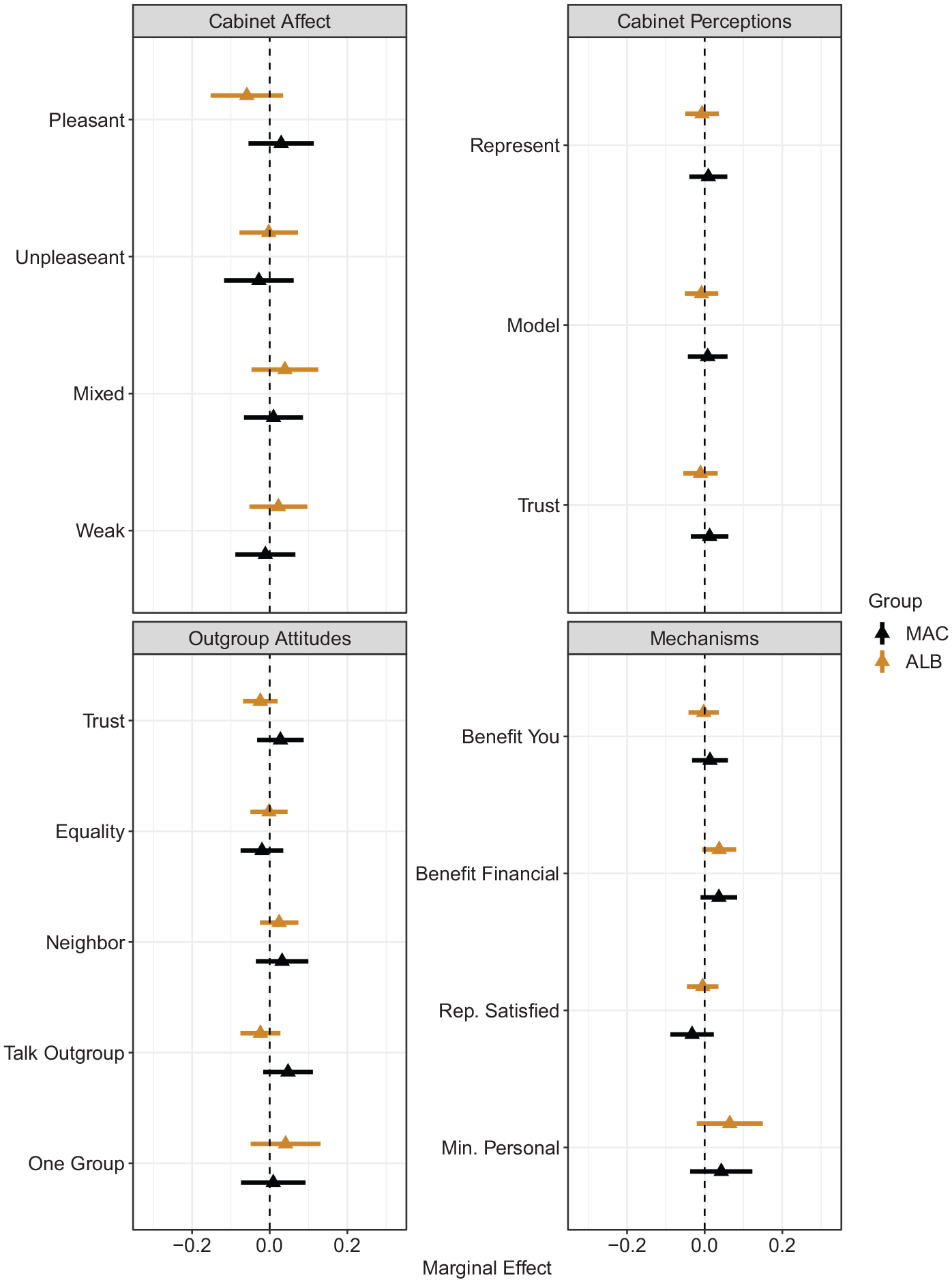
Substantive Representation.
Neither Macedonians nor Albanians reacted to substantive representation: cabinet affect was unchanged, cabinet perceptions were unchanged, and overall outgroup attitudes were unchanged. Interestingly, Albanians believed that substantive representation would lead to them benefiting financially. This is the expected mechanism: Albanians perceived that they will receive financial benefits and they then attributed these benefits to the cabinet and its collection of Albanian and Macedonian ministers. Thus, Albanians do receive the treatment and perceive the expected benefit, but the attribution piece is missing. Albanians’ opinions about the cabinet do not improve and neither do their outgroup attitudes. It is more difficult to account for substantive representation and to identify the individual or group of ministers who provided these financial resources, especially compared to the ease with which one can figure out the number of coethnic cabinet ministers. The attribution problem may be one reason why Hypothesis 2 is not supported.
Cooperation Helps Somewhat
Finally, Figure 3 displays the marginal effects for the SDSM and Cooperation treatments relative to each of their control conditions. I argue in Hypothesis 3 that cooperation of either variety should improve citizens’ views of the outgroup.

Cooperation.
Starting with cabinet affect, Macedonians did not differentiate between cabinets with ministerial cooperation and those without. Albanians felt significantly more pleasant and significantly less unpleasant about the cooperative cabinet, in line with Hypothesis 3. Macedonians exhibited a backlash effect when there was an Albanian SDSM minister, significantly decreasing pleasant affect as Albanians significantly decreased unpleasant affect. Cooperation does not universally promote positive affect as Hypothesis 3 expects.
Cabinet perceptions among Macedonians were unchanged when ministers cooperated with each other. Albanians’ did not react to the cooperation treatment, but did increase trust in the cabinet and their perception that the cabinet was a model for interethnic behavior when there was an Albanian SDSM minister.
Although these results about ministerial cooperation are somewhat promising, neither Macedonians nor Albanians translated their changed affect or cabinet perceptions into improved outgroup attitudes. The only significant effect of either the cooperation treatment or the SDSM Albanian minister on outgroup attitudes was on Albanians’ perceptions of Macedonian citizens as one group instead of a collection of individuals. Albanians significantly improved their feeling that all Macedonian citizens are one group when there was an Albanian SDSM minister, not just ministers from Albanian ethnic parties.
Moving to the mechanism questions, Macedonians believed that they would benefit financially from cooperation, they were more satisfied with their representation when cooperation occurred, and they thought that ministers were working for the good of the country when they cooperated. Albanians were not influenced by ministerial cooperation in these ways. Interestingly, Albanians believed that having an Albanian SDSM minister led to ministers working more for their own benefit and not for the good of the country. Thus, while an Albanian SDSM minister made Albanians think of citizens as a single group, it also prompted them to believe that the ministers were working for themselves. The likely explanation for this curious finding is that the SDSM is perceived as a multi-ethnic party—hence, treating citizens as a single group—but the SDSM is politically not aligned with Albanian interests.
Cooperation has mixed effects. The cooperation treatment positively impacted Albanians and Macedonians, but only in certain cases. Even though affect and the mechanism questions change in the expected direction, the cooperation treatment had no effect on cabinet perceptions or overall outgroup attitudes. The presence of an Albanian SDSM minister provoked some Macedonian backlash and limited improved attitudes for Albanians. Thus, Hypothesis 3 remains partially supported for some outcomes of interest and not for overall outgroup attitudes.
The size of the significant effects are moderate, though substantively meaningful. For example, adding an Albanian SDSM minister increases Albanians’ perceptions that ministers are working for their own benefit by about 10%, while it reduces Macedonians’ perceptions by about 5%. That the composition of the cabinet contributes this much to citizens perceptions of the cabinet is noteworthy.
Discussion and Conclusion
This study suggests that ethnic cabinet representation alone is not a solution to improve citizens’ views of the outgroup. Of my three hypotheses about forms of perceived benefit that may influence said views, only ministerial cooperation showed promise for improving outgroup affect and perceptions of the cabinet, but cooperation did not impact outgroup attitudes. Majority respondents exhibited some backlash effects to descriptive representation, and these backlash effects were not compensated for by improved responses among minority individuals. Substantive representation had no effect on outgroup views. King and Samii (2018) examine ethnic recognition and find a complementary result, suggesting that ethnic cabinet representation may be effective in certain circumstances, but that it is not a universal solution for reducing citizen ethnic tensions.
The results in this study rely on a realistic hypothetical vignette experiment in Macedonia. As mentioned earlier, the international community and leaders in many countries are working to implement ethnic representation, hoping that it will improve citizens’ views of ethnic outgroups. While Macedonia’s clearly defined ethnic groups make it an attractive site for an experiment, the implications about the efficacy of ethnic representation on improving citizens’ outgroup views are more broadly generalizable. Representation is a core feature of government, and political scientists have long studied the ways in which political representation can be effective. This article contributes to this literature by examining how citizens respond to government representation. Much related work compares consociationalism and centripetalism as methods of elite inclusion that are thought to also impact citizen attitudes (Reilly, 2012). Here, I show that citizen responses to grand coalition cabinets where minority groups are clearly defined are limited, corroborating recent findings that consociationalism’s effectiveness may be situation dependent (e.g. Wilson, 2020). I explore a movement toward centripetalism through the multi-ethnic SDSM party, but the Macedonian case is one where multi-ethnic party competition has not fully developed. Further promoting the development of multi-ethnic parties alongside traditional power-sharing structures may provide a way to ensure that ethnic minority issues are represented while, at the same time, encouraging multi-ethnic electoral cooperation (Bogaards, 2019).
Future research would do well to replicate the design of this study in other country contexts. The Macedonia case is one with prior, though relatively limited, interethnic violence and acrimonious ethnic relations. Increasing ethnic representation in contexts without such a history of ethnic tensions may have a more substantial impact on public outgroup views. At the same time, the need to reduce ethnic tensions is likely highest in post conflict settings. In addition, one motivation in Macedonia for increasing ethnic representation and reducing ethnic tensions is the prospect of European Union accession. While there is also substantial internal pressure for improved ethnic representation, the effectiveness of international organizations in encouraging or potentially pressuring country leaders to prioritize ethnic representation deserves further attention.
The experimental results initially appear to run counter to leaders’ incentives for engaging in ethnic representation. I present some evidence that ethnic representation may not improve citizen responses because minority groups are suspicious of cabinet appointees. In a traditional patronage story, citizens elect representatives who provide them with patronage benefits. Although leaders and citizens enter into a credible commitment to exchange political support for patronage benefits, it is much more difficult for citizens to exit the bargain. Citizens only have the ability to vote out the country leader, they cannot remove an appointed cabinet minister from his or her post.
Therefore, while leaders can increase ethnic representation, the results suggest that their ability to effectively shape ethnic relations using this mechanism is limited. If government legitimacy is also influenced by ethnic representation as Arnesen and Peters (2018) find, how can leaders reduce ethnic tensions and improve citizens’ relationships with government? First, while ethnic representation may not improve citizen ethnic relationships, it could impact ethnic relationships among political elites. Exposure to and forming relationships with outgroup elites could serve as a way for political elites to become key figures in efforts to improve citizen ethnic relations.
From a normative perspective, just because ethnic representation may not on its own be a solution to citizen ethnic tensions does not mean that leaders should avoid ethnic representation. Additional research is needed to examine how ethnic representation can be part of a larger strategy to reduce ethnic tensions. This study tests the often repeated advice that country leaders can meaningfully improve citizen ethnic relations by implementing ethnic representation. In the Macedonian context and when treated as its own strategy, the results generate a call for scholars and practitioners to carefully examine the conditions under which ethnic representation successfully reduces citizen ethnic tensions and how lessons from these contexts can be applied to cases like Macedonia.
Supplemental Material
sj-pdf-1-psx-10.1177_00323217211019834 – Supplemental material for Citizen Responses to Ethnic Representation
Supplemental material, sj-pdf-1-psx-10.1177_00323217211019834 for Citizen Responses to Ethnic Representation by William O’Brochta in Political Studies
Footnotes
Acknowledgements
The author thanks the Editor and Reviewers, Sarah Brierley, George Ofosu, Sunita Parikh, Guillermo Rosas, Ivica Sokolovski and Ipsos Macedonia, Margit Tavits, and especially Deniz Aksoy and Joshua Gubler for their comments and help on this project.
Declaration of Conflicting Interests
The author(s) declared no potential conflicts of interest with respect to the research, authorship, and/or publication of this article.
Funding
The author(s) disclosed receipt of the following financial support for the research, authorship, and/or publication of this article: The Weidenbaum Center on the Economy, Government, and Public Policy provided funding for this project.

Supplemental Material
Additional supplementary information may be found with the online version of this article. OA.1: Survey Details OA.2: Randomization and Balance Checks OA.3: Affect Toward the Cabinet Classification OA.4: Results for Plots in Main Text OA.5: Ordered Logistic and Logistic Specifications OA.6: Robustness Checks OA.7: Interaction Models
Notes
Author biography
References
Supplementary Material
Please find the following supplemental material available below.
For Open Access articles published under a Creative Commons License, all supplemental material carries the same license as the article it is associated with.
For non-Open Access articles published, all supplemental material carries a non-exclusive license, and permission requests for re-use of supplemental material or any part of supplemental material shall be sent directly to the copyright owner as specified in the copyright notice associated with the article.
