



Abstract
This article examines two outcomes of demobilization in post-revolutionary contexts, democratic transition and counter-revolution. Complementing elite-driven approaches, we argue that the way demobilization ends is conditional upon the capacity of challengers to promote enduring alliances. Following a paired controlled comparison, we analyse two cases, Egypt and Tunisia and processes of alliance building and fragmentation preceding the 2013 coup d’Etat in Egypt, and the adoption of a new Constitution in 2014 in Tunisia. Data from semi-structured and in-depth interviews were collected through fieldwork in multiple localities of Egypt and Tunisia between 2011 and 2019. Results show that the fragmentation of the challengers’ coalition in post-revolutionary Egypt contributed to a counter-revolution while, in Tunisia, challengers’ alliances rooted in the pre-revolutionary period lasted throughout the phase of demobilization and supported a democratic transition. We conclude by discussing some alliance-based mechanisms accounting for a democratic transition: intergroup trust-building, brokerage and ideological boundary deactivation.
Introduction
Waves of contention end in highly varied and contingent ways. As argued by Koopmans (2004: 36): the range of possible endings is principally unlimited and includes regime replacement through revolution, civil war or foreign intervention, repression, elite closure, reform, institutionalization, co-optation, altered conflict and alliance structures, a new balance of electoral power and changes in government incumbency, or any combination of these.
The analysis of waves of contention has long informed the literature on contentious politics and is an important area of study in several fields of social sciences including social movements, ethnic conflicts, civil wars and civil resistance (Beissinger, 2002; Koopmans, 2004; Tarrow, 1989; Tilly and Tarrow, 2015). Under this framework, however, the ways processes of demobilization unfold, and the factors associated with different outcomes of demobilization, have been studied far less systematically than the emergence of protests and processes of mobilization and factors associated with the rise of contention (see however Davenport, 2015). Nonetheless, events occurring in Tunisia and Egypt after the 2010–2011 uprisings demonstrate that an understanding of how processes of demobilization occur is important. This is especially true for post-revolutionary political transitions, as repression and violence which may occur in such a phase can often be amplified, further unsettling the political context and eventually contributing to an authoritarian backlash.
In this article, we focus on the process of demobilization and two opposed outcomes of such a phase that may occur in post-authoritarian contexts: governments’ democratic transition and governments’ counter-revolution. We examine the process of demobilization which followed the peak of the 2010–2011 protests in Egypt and Tunisia and, in particular, we investigate the role of challengers’ networks in shaping the two different outcomes. We examine bottom-up processes that may integrate existing accounts on democratization and counter-revolutions focused on elite-driven approaches. We share Geddes’ (2011) argument that transitions from personalist dictatorships are seldom initiated by regime insiders; instead, popular opposition, strikes, and demonstrations often force dictators to consider allowing multiparty elections (Bratton and van de Walle, 1997). [. . .] The process of transition from personalized dictatorship should not be modelled as an elite-led bargain.
By drawing on the literature of contentious politics, we propose two types of bottom-up mechanisms that may explain divergent outcomes of demobilization. First, we discuss broad mechanisms of alliance building. We argue that the way demobilization ends and the way interactions between authorities and challengers stabilize, either within a democratic framework or a counter-revolution, are conditional upon the capacity of challengers to promote enduring alliances throughout the phase of demobilization. While alliances among challengers are crucial to sustain revolutionary coalitions during the phase of mobilization, their durability will support the transition to democratic rules. In contrast, fragmentation of challengers’ pre-revolutionary coalitions during processes of demobilization will contribute to a counter-revolution, profiting from challengers’ divisions. Second, we discuss the specific mechanisms that contribute to explaining why alliances may favour a democratic transition. We contend that alliances imply the presence of actors bridging across different factions, high levels of trust, and ideological boundary deactivation as well as shared ideologies and frames which may all support alliance building.
Our empirical analysis focuses on the Egyptian and Tunisian case studies. We follow the comparative method of controlled comparison and select these two countries as case points of different trajectories of processes of demobilization. Despite many similarities shared by the two countries until early 2013 (Hassan et al., 2020: 555), in Tunisia a democratic transition culminated in the new Constitution, adopted on 14 January 2014. Conversely, in Egypt a military junta carried out a coup in July 2013. To understand such different outcomes, we investigate the alliances by challengers, especially during the phase of demobilization. The latter occurred between December 2010 to January 2011 when protests in the two countries peaked, and July 2013 to January 2014 when, respectively, the coup d’Etat took place in Egypt and a new Constitution was adopted in Tunisia. 1 The empirical analysis uses data from semi-structured and in-depth interviews collected through several rounds of fieldwork in multiple localities of Egypt and Tunisia between 2011 and 2019. Results show that the new elites in Tunisia were able to build upon long-lasting alliances already rooted in the pre-revolutionary period. Trade unions, civil society organizations and previously banned political parties such as Ennhada all played a crucial role in building a comprehensive alliance that lasted throughout the post-revolutionary period. Such alliances supported the transition to democracy and the application of a new constitution in the post-revolutionary period (Durac, 2019; Hassan et al., 2020; Zemni, 2016). In contrast, major actors in Egypt who had loosely come together with a shared interest in opposing Mubarak, including the Muslim Brotherhood and the secular groups which were part of the revolutionary coalition that existed before 2011, ended up dividing into narrow partisanships, leading to a process of fragmentation in post-revolutionary Egypt that did not allow the formation of long-lasting alliances (Ketchley, 2017: 2). This provided fertile grounds for an authoritarian backlash and a counter-revolution which culminated in the 2013 coup.
Ultimately, we argue that, in addition to elite-driven dynamics of democratic transition, bottom-up processes play a fundamental role in democratic transitions, which occur when challengers’ coalitions are able to endure beyond any success reached during the peak of protests.
Demobilization in Post-Revolutionary Settings
Demobilization characterizes the decline of the protest wave, and involves a reduction of contentious action following the shrinking of resources available to challengers for collective claims-making. Demobilization definitively ends once interactions between challengers and elites stabilize, implying more predictable routinized interactions between challengers and governments (Tilly and Tarrow, 2015: 120). The decline of contention is associated with the ‘convergence on a new equilibrium in which neither party can hope to make substantial gains by continuing to raise the stakes of contention’ (Koopmans, 2004: 38). In post-revolutionary settings, such equilibrium may result in a democratic transition. However, it may also result in a counter-revolution, defined as ‘collective and reactive efforts to defend the status quo and its varied range of dominant elites against a credible threat to overturn them from below’ (Slater and Rush Smith, 2016: 1475). Counter-revolution also brings political order with it to the degree that it aims to preserve the status quo. 2
Scholars who have examined processes of demobilization within contentious politics have highlighted a variety of factors affecting the way demobilization ends. They are mostly focused on the changes in attitudes and actions by elites and challengers, making up the main actors in contentious dynamics. On the elites’ side, demobilization is affected by the strategies that elites use in response to challengers’ claims. Elites’ decisions affecting demobilization processes include the degree of reforms conceded, coupled with the level of repression used (della Porta, 1995; Tarrow, 1989). Pacts and compromise among and within elites are crucial during the processes of demobilization, positively impacting on the emergence of sustainable democracies (Kadivar, 2018: 391). On the challengers’ side, demobilization may be affected by individual exhaustion from participating in protests, including the emotional distress of protesters (Tilly and Tarrow, 2015) or by the challengers resorting to violent tactics, including the use of political violence, or by their involvement in institutional actions (della Porta, 1995; Tarrow, 1989). Furthermore, demobilization outcomes are affected by the degree to which challengers establish enduring structures to maintain their solidarity (Tilly and Tarrow, 2007: 97). Alliances do facilitate the development of shared identities, enabling groups with different views to establish shared meanings for collective actions that need to be undertaken (Kadivar, 2013).
Among accounts of the two specific outcomes of demobilization that we consider, democratization and counter-revolution, elite-driven approaches have mostly dominated in comparison to bottom up perspectives. 3 Concerning democratization, this has occurred within the transitology literature especially since the publication of O’Donnell and Schmitter’s (1986) hugely influential ‘Transitions from Authoritarian Rule’ (see Netterstrøm, 2016: 397). The literature on democratization emphasizes institutional factors related to the role of regimes and elites in driving processes of democratization (Kapstein and Converse, 2008). Among such factors, scholars have examined the compromises that elites are able to make, the distribution of power between competing elites, the intervening role of the military in politics, and the influence of regional and international actors or brokerage among the elites (Haggard and Kaufman, 2012; Higley and Burton, 1989). With reference to the events following the Arab Uprising, scholars have shown that inter-elite trust emerging in the aftermath of the 2010–2011 protests in Tunisia was a key promoter of the successful democratic transition (Hassan et al., 2020).
As was seen for processes of democratization, elite-driven approaches have prevailed in explaining counter-revolutions. Authors have explained counter-revolutions by linking them to international allies and pressures emphasizing the international tendency to attempt to overturn revolution (Bisley, 2004). According to Allinson (2019), one strategy the counter-revolution in Egypt relied on was the integration of the post-Nasser Egyptian ruling elite with Gulf financial, and US security, networks. Others argue that, in the Egyptian case, antecedent military politicization gave military personnel more prominence than party apparatchiks in the political arena, making a military-led counter-revolution more likely to occur (Slater and Rush Smith, 2016: 1478).
Bottom-up approaches to democratization have been also investigated. Studies have examined popular mobilization involving working-class uprisings (Rueschemeyer et al., 1992), alliances among workers, urban poor and peasants (Wood, 2000), intellectuals (Kurzman, 2008), ordinary people and civil society (Bermeo, 2003). Popular mobilization can undermine elites’ power by weakening its legitimacy and support, as was the case in South Africa during the apartheid system (Schock, 2005), by changing international alliances, or inducing a counter-elite favouring political negotiations (Wood, 2000). Scholarship on civil resistance has also shown the impact of nonviolent campaigns on democratization (Celestino and Gleditsch, 2013; Chenoweth and Stephan, 2012). Other research suggests that unarmed collective actions is consequential for contentious democratization (Kadivar and Ketchley, 2018).
There is less research on challengers’ role in shaping counter-revolutions (see however Celestino and Gleditsch (2013) who argue that violent direct action makes transitions to new autocracies relatively more likely). We advance this line of research and provide insights into the role of challengers’ alliances in shaping processes of democratization as well as counter-revolution. In the following section we illustrate how enduring alliances among challengers (or their absence) in the post-revolutionary periods may play a crucial role in the stabilization of challengers-elites interactions, conditioning the way they unfold, either to a democratic transition or into a counter-revolution.
Enduring Alliances or Fragmentation: A Hypothesis
To keep up long-lasting alliances and mutual solidarity is a difficult task for challengers. Sustainable alliances are hard to accomplish, especially for actors with diverse characteristics, interests and identities. Furthermore, in non-democratic contexts, challenging groups are discouraged from building ties and relationships with each other due to the high risks associated with alliance-building processes. Long-term alliances imply mutual trust, recognition and solidarity, all features that are difficult to find in former-authoritarian contexts undergoing post-revolutionary transition. At most, challengers may converge on specific and single issues, a strategy that does not grant long-term sustainability as it does not rely on shared feelings, final goals and commitments (Melucci, 1996).
Whether alliances endure or not depends on various factors, including actors’ characteristics and resources (see Edwards and McCarthy, 2004). Organizations with high levels of material and/or symbolic resources, such as status and popular legitimacy, may be less likely to engage in alliance building as they do not need to resort to alliances to gain additional resources (Diani, 2015: 17-18; 50–51). Divergences in tactics, the attempt to strengthen one’s own specific organizational profile, or that of securing a niche, are all obstacles to enduring alliance building among groups.
Despite the difficulties in building long-term alliances, scholarly evidence shows how their structure is particularly important, in post-authoritarian contexts, for the consolidation of opposition forces driving political processes in emerging African democracies (LeBas, 2011). As argued by Kadivar (2018: 392–393): unarmed popular campaigns that mobilize over a long period of time generate an organizational structure that provides a leadership cadre for the new regime, forges links between the government and society, and strengthens checks on the power of the post-transition government [. . .] The duration of mobilization matters for the durability of post-transition democracies, because popular campaigns typically require a solid organizational infrastructure to survive under repressive conditions (Andrews, 2001).
In post-revolutionary settings, challengers may try to build alliances and in doing so find a common terrain of shared objectives overcoming divergent interests, and possible reciprocal distrust. Alliance building among challengers are processes through which groups exchange different types of resources in pursuit of a common goal. This occurs as challengers realize they cannot afford to pursue their goals in total autonomy. The ultimate importance of alliances lies in their increased capacity to promote actions which are more likely to attract public attention, to be perceived as worthy, and to gain political legitimacy (Diani, 2015: 25, 50).
Fragmentation, in contrast, results from internal competition and polarization among challengers. Fragmentation may result from negative coalitions that can be defined as fractured elites lacking consensus over fundamental policy issues, and a weak commitment to democratic ends (Beissinger, 2013). In the case of urban civic revolutionary coalitions (namely, regime change induced by rapid, leaderless, and socially diverse protest movements), movements are prone to break down in the wake of regime change (Berman, 2015). As argued by Berman (2015), this fragmentation becomes manifest in dysfunctional politics, as each fragment lays claim to the legacy of the revolution and the right to a dominating role in a new political order. Challengers become more and more autonomous from one another, drawing on different sources of support and a focus on diverging goals and tactics. Fragmentation, competition and polarization are all processes likely to constrain the formation of broad collective identities, blurring any common understanding of collective actions. These processes imply boundary reactivation among single groups who focus on their own specific interests and identities, a typical mechanism associated with phases of demobilization (Tilly and Tarrow, 2015). Under such circumstances, fragmentation hinders the long-term coalition building that is necessary for a democratic transition, contributing instead to paving the way for a backlash to repression (see also Kadivar, 2018: 395). Ultimately, when a fractured coalition of challengers fills the post-revolution political vacuum, a counter-revolution may follow.
Our hypothesis therefore posits that the final outcomes of a process of demobilization are conditioned by the presence of long-lasting alliances among challengers. We contend that in a post-revolutionary setting, the fragmentation of challengers’ networks and pre-revolutionary coalitions will tend to promote a counter-revolution. In contrast, when challengers are capable of establishing enduring alliances, we expect that the institutionalization and legitimization of challenger’s alliances, and/or their support of the new elites, will contribute to political concessions and a transition to democracy (see Figure 1). 4
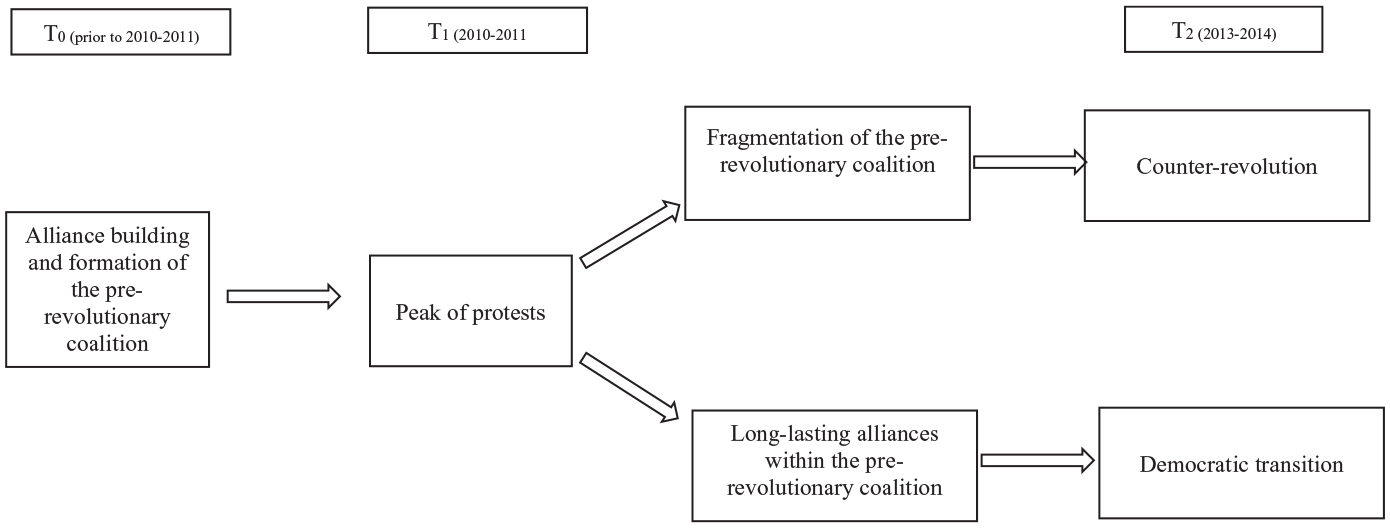
The Moderating Effect of Alliances on Trajectories of Demobilization in Post-Revolutionary Settings.
Data and Methods
Case Selection: Controlled Comparison
To empirically explore our hypothesis, we focus on Egypt and Tunisia before, during and after the 2010–2011 protests. In selecting these countries, we followed the comparative method of paired controlled comparison. This method implies the intentional selection of two or more instances of a well-specified phenomenon that resemble each other in every respect but one (Slater and Ziblatt, 2013). Egypt and Tunisia were similar in various aspects before the 2010–2011 protests, thus enabling us to assume a certain number of rather constant background variables. Both countries had Sunni Muslim majorities, a history of secular governments and few oil resources. Also both countries were marked by costly food, unequal incomes, and high levels of youth unemployment (Achcar, 2013). Moreover, in both countries the 2010–2011 protesters drew upon pre-existing networks and fractures. 5 The 2008 protests in the textile industry of Mahalla al-Kubra in Egypt had been characterized by wildcat strikes not being supported by the official trade union, the Egyptian Federation of Trade Unions (EFTU), the only recognized trade union in Egypt during Mubarak’s regime. Social Islamic organizations and assistance networks had also enabled individuals to become active participants in political life in Egypt (Wickham, 2002). Furthermore, in Egypt, organizations such as Kifaya (Enough!), a network striving for reforms and change – including organizations such as Journalists for Change, Doctors for Change, Youth for Change, Workers for Change, Artists for Change – and the April 6th Youth Movement (A6YM) were also active prior and during the Arab Spring (Beinin and Vairel, 2011). In 2005 some members of the Muslim Brotherhood in Alexandria and supporters of the Revolutionary Socialists also formed the National Alliance for Change and unions within universities. The same activists were later among those who took part in anti-police riots that broke out after the murder of the young activist Khaled Said in Alexandria in 2010 by a police officer. In turn, in Tunisia, the local chapters of the major trade union, UGTT, had been central during the local protests that occurred in 2008 in the Gafsa mining basin (Beinin and Vairel, 2011). In Tunisia, next to UGTT, despite the political repression under both Ben Ali and Bourguiba regimes, the Tunisian Association of Democratic Women (ATFD) also played an important role in the opposition to the regime throughout the nineties and the new millennium. Legalized in 1989, the ATFD focused its struggle against Ben Ali’s state feminism, against Islamism and rising conservatism (Debuysere, 2018). The ATFD supported several protests which were sometimes undertaken in cooperation with UGTT. These included those in Gafsa in 2008, despite women being largely underrepresented in the UGTT leadership roles (Debuysere, 2018). There were other parallels between the two countries in the aftermath of the uprisings, until early 2013. They held free elections, assemblies were charged with drafting new constitutions and Islamist parties won elections and assumed office (Hassan et al., 2020: 555).
However, the two countries clearly showed divergent profiles after 2013. We will interpret such changes by examining one major difference observed in the two countries, that is, the type of networks and alliances built by challengers.
Paying particular attention to the timing and sequence of actions, we try to avoid the risk of endogeneity implied by a possible reverse causality given the high degree of interdependence of the actions and reactions involved. To do this, we examine the events at different time points in the empirical process (t0, t1, t2 . . . tn). We therefore analyse the effects of protests observed at: t1 which corresponds to December 2010 in Tunisia, and January 2011 in Egypt, on counter-revolution/democratic transition observed at t2, corresponding to the military coup in Egypt in July 2013, and the passage of the new constitution in Tunisia in January 2014 (see Figure 1). We explore the differences in the outcomes of demobilization observed in Egypt and Tunisia in light of the processes of long-term alliance building or fragmentation established by challengers in the two countries. While coalitions had already emerged between t0 and t1, we focus in particular on their developments during the period between t1 and t2.
Data Sources
We rely on extensive fieldwork in both Egypt and Tunisia. Fieldwork in Egypt was conducted within the remits of a broad research project by the second author, analysing Popular Committees and Independent Trade Unions in Egypt before and in the aftermath of the 2011 uprisings (Acconcia, 2018). The specific data draws on fieldwork notes and on 58 semi-structured interviews carried out in Cairo and Mahalla el-Kubra with activists, workers and ordinary citizens involved in various groups.
The empirical evidence on Tunisia draws on various sources: first, data was collected within the framework of a broader research project, undertaken by the third author during fieldwork between February and May 2017. Data from the 2017 fieldwork consisted of 18 semi-structured interviews with selected participants across the popular neighbourhoods of Ben Arous and Yasminette, in the suburbs of Greater Tunis, together with other eight in-depth interviews carried out in the neighbourhood of Medinat Jedida with Tunisian youth. The Tunisian case study further draws on extracts from 100 interviews with women, undertaken between January and February 2011 in Kasserine (Zouhour and Nour) and Thala (Chennaoui and Baraket, 2011). 6 In addition to data deriving from this fieldwork, the second and fourth author conducted ten semi-structured interviews with Tunisian activists in Tunis and Sfax between April and July 2019. As for Egypt, the interviews in Tunisia were all focused on the pre and post-revolutionary periods.
Further methodological details on fieldwork activities in Egypt and Tunisia are included in the Supplemental online methodological appendix.
Alliance-Based Mechanisms of Demobilization in the Aftermath of the 2010-2011 Protests
Egypt: The Fragmentation of Challengers’ Networks and the Counter-Revolution
Protests which erupted in January 2011 in Egypt were the product of large cross-class coalitions, in which young people and students joined middle-class professionals, government employees, workers, housewives and the unemployed. The coalition was supported by the presence of a variety of organized actors, such as the Muslim Brotherhood, CSOs including Kifaya (Enough!), a network striving for reforms and change and the April 6th Youth Movement (A6YM) (Abdelrahman, 2013; Beinin and Vairel, 2011).
The pre-revolutionary coalition was largely based on common targets on single issues e.g. protests against police violence and anti-Mubarak sentiments (Clarke, 2014). The lack of broader shared solidarities beyond these single issues marked the presence of a negative coalition (Beissinger, 2013). Muslim Brothers’ supporters and secular activists, for example participants within the Kifaya! movement, were already divided long before the 2011 uprisings in Egypt. A Kifaya activist who took part in Tahrir Square demonstrations explained that: It is true that there was a participation within the Kifaya movement (2005) of some individuals within the Brotherhood and a common need to denounce Hosni Mubarak’s repressive regime and his hereditary succession’ attempts. However, we have always fought very different struggles.
7
Those divisions were even clearer after the 2011 protests. The revolutionary coalition that pre-existed the ousting of Mubarak – involving the Muslim Brothers, the army and many secular groups – had definitely split by the end of 2011. Each group followed its own political track in the post-revolutionary period, consequently undermining Egypt’s possible democratic transition. The Egyptian army tolerated the authoritarian regime of Mubarak as long as it was not detrimental to its corporate interests (Kandil, 2012). In the circumstances of the 2011 uprisings, the military personnel briefly adopted the Muslim Brotherhood as a ‘civilian partner’ (Abdelrahman, 2015), later consolidating its powers. Among the major reasons for such a split was the ‘Muslim Brothers’ attempts to “electoralize” contention and restrict a democratic transition to a process of negotiation, transaction and electioneering’ (Ketchley, 2017: 81–89). The Muslim Brothers thought that no strong alliance with other partners was necessary to perform well in the November 2011 elections. According to a young activist who took part in Tahrir Square demonstrations, the ‘Muslim Brotherhood left the youth of Tahrir alone in the streets in order to take part in elections and party politics paving the way for a marginal repertoire of street action’. 8 Some attempts of alliance building had indeed been proposed through the establishment of the Democratic Alliance, founded in the summer of 2011, and composed of Freedom and Justice, the political party of the Muslim Brothers, and various other actors, such as some activists among the liberals and some old fashion leftist parties (e.g. Tagammu, Karama). However, this was a short-lived experience and it vanished after the 2011–2012 parliamentary elections. The major basis on which such short-term alliance was built was a common fear of a possible backlash of authoritarian rules: ‘At the 2012 presidential elections I decided to vote for Morsi not because he was my candidate but just because I did not want to see the Mubarak regime coming back’, 9 an activist who took part in Tahrir Square demonstrations said. Many opposition forces actually complained against the risk that the Muslim Brothers would control seat allocation in the 2011–2012 parliamentary elections (Ketchley, 2017: 88), as it eventually turned out. Furthermore, the supporters of the Muslim Brotherhood mobilized throughout 2012 in order to oversee the electoral procedures for the Constitutional referendum (December 2012) and to protect the Presidential Palace of Heliopolis during the clashes following the presidential decree (November 2012). Moreover, protesters became reliant on a ‘focal day’ (Friday prayers) to coordinate contention, and this had negative implications for coalition building (Ketchley and Barrie, 2019).
Mobilization continued in 2013, on the occasion of the attacks on the Muslim Brotherhood headquarters (Moqattam, Manyal and Mansour Street) between June 30 and July 9, 2013. Our interviewees mentioned that some members of the Muslim Brotherhood, recalling previous experiences of collaboration, were actually willing to hold discussions with other political parties between 2012 and 2013 in an attempt to build a political coalition with the Secular forces. 10 ‘We tried to include other opposition forces within the Constituent Assembly. They were fragmented and stubborn. They tried to block the system, then they left the Assembly’, 11 a supporter of the Muslim Brotherhood who took part in Tahrir Square and Rab’a Square protests explained. All the secular political groups of the post-revolutionary period clearly showed a deep-rooted reluctance to trust the political ideology and leadership of the Muslim Brotherhood. Secular groups lacked trust in the army as well: ‘The army is implementing the counter-revolution. However, our democracy should be better than the Western systems in which citizens are forced to choose among two candidates who do not represent the grassroots’ demands’, 12 a supporter of the Revolutionary Socialists highlighted. The political objective of secular groups had been more focused on trying to ‘bridge the gap between the tactics of new mobilizations and the more traditional methods of older social movement labour and rural organizing’, 13 a unionized worker in Mahalla al-Kubra stated. In particular, many of the secular oppositional groups aimed to join the textile workers’ protesters of Mahalla al-Kubra and Cairo’s protesters or workers’ and agricultural workers’ strikes with cyber-activism.
The army broke solidarity ties with protesters right after the initial strategy of fraternization in early 2011 (Ketchley, 2017). This change in strategy became clear in November 2011 in the Muhammad Mahmoud Street clashes and in May 2012 outside the Defence Ministry in Abbesiyya, when peaceful protesters were killed by soldiers. There were allegations of torture, forced virginity testing and repressive policing of street mobilization and labour agitation (Ketchley, 2017: 75–77). To restore order, the army was ready, overtly or furtively, to activate the police in order to defend the political elite. This renewed the alliance between the army and the police, or rather, between the Interior and the Defence Ministries, which was not as strong during Mubarak’s time. The alliance clearly surfaced during the rise of the 2013 anti-Muslim Brotherhood protests. This coincided with the split of the revolutionary coalition, as the secular forces of the Tamarod (Rebel), a petition campaign against the first ever elected president, a member of the Muslim Brotherhood, Mohammed Morsi, broke ranks from Islamist forces asking for Morsi’s resignation. With more than 461 worker protests between January and May 2013 (Alexander and Bassiouny, 2014), the Egyptian secularist opposition pushed the military elite to be concerned about the consequences of the Muslim Brotherhood’s neoliberal policies. ‘The Tamarod campaign unified the opposition’s cliques: resentful citizens, public bureaucracy, the leaderless oppositions, families close to the National Democratic Party (NDP) and mercenaries’,
14
an activist who took part in Tahrir Square demonstrations explained. These forces felt threatened by the winners of the 2012 presidential elections, the Muslim Brothers and their candidate Mohamed Morsi, and their depiction as violent terrorists was advanced by the army and national TV channels, arguing that they were not true and consistent democrats (Acconcia, 2018). The Tamarod movement further contributed to preparing the terrain for cementing the counter-revolution as it generated cross-class support for a process of political stabilization (Slater and Rush Smith, 2016: 1476). This started with the authorities’ 2013 ban on the Popular Committees, a strategic move to completely deactivate the mobilization of the Islamists. According to our interviewees, the law banning the Popular Committees was first attempted by the authorities to identify the supporters of the Muslim Brotherhood, so as to later arrest or control them following approval of the anti-terrorist law. The ban ended up putting all the activities promoted by the Egyptian Islamist civil society since 2011 under strict control. Interviewed activists who took part in Tahrir Square demonstrations stated that ‘The martial law gave to the police the right to kill. It allowed to a certain extent the society as a whole to be engaged in arbitrary actions’.
15
‘The police can arbitrarily arrest, torture and violate human rights’,
16
a supporter of the Muslim Brotherhood who took part in Rab’a Square demonstrations explained. On 30 June 2013, a huge demonstration took place in Tahrir Square. It was supported by the police, the judiciary, the Coptic Church, the public and many private media. Former NDP politicians, the elders among Socialists and Liberals and intellectuals also participated. The demonstration was triggered by the Tamarod campaign. As an activist who took part in Tahrir Square demonstrations said: Many Egyptian followed Tamarod but we do not have to confuse Tamarod with the Coalition of Revolutionary Youth. In their public interventions, Tamarod supported the army interferences. The revolutionaries would never have supported the police and a military coup, even if backed by the crowd.
17
Within 48 hours, President Mohammed Morsi was asked to resign. On 3 July, he was arrested by the Presidential Guard and detained for months in a secret location without clear charges. The military coup took place on 3 July 2013 and engineered a restoration. The backlash to repression entailed a protest law criminalizing opposition, the killing of 3000 protesters in 2014, as well as the detention of those who instigated the mobilization against Mubarak (Ketchley, 2017: 3–7). The Muslim Brotherhood, however, did not want a violent confrontation with the army.
18
Instead, they organized peaceful demonstrations, marches and flash-mobs throughout the country. In Cairo this happened in Rab’a al-Adawiya (Medinat Nasser) and al-Nahda (Giza); and peaceful protests were organized in Minya (Meidan Palace), Assyut (Meidan Omar Akram), Alexandria and Suez (Meidan Arbain). Under such circumstances, the Brotherhood: turned increasingly to the activist base of the Islamist movement to act as ‘police’ – attacking demonstrators [from other factions], and in some areas taking over functions of maintaining law and order. These moves [. . .] inspired fears of both the collapse of public security and the emergence of a state of Islamist militias (Alexander and Bassiouny, 2014: 282).
As for the allegations that the Muslim Brotherhood used violence towards the demonstrators, this has been constantly debated by the Secular and Leftist groups, some of which witnessed sporadic cases of violence. 19
On 14 August 2013, repressive events escalated, followed by a sharp decline in popular participation (Grimm and Harders, 2018: 7). The security forces attacked the Rab’a al-Adawiya and al-Nahda’s encampments. Hundreds of people were killed or disappeared during these days. 20 Those events clearly revealed the aggressive nature of the military-police takeover, paving the way for a less popular image of the Egyptian army, as confirmed by the very low turn-outs of the 2014 election, and again at the 2015 and 2018 ballots. Since the restoration of a military regime, no forms of dissent have been tolerated. All forms of political activism, including youth and leftist groups, and political pluralism, were heavily suppressed. Public markets were closed, street vendors expelled and buildings in Cairo’s downtown area were cleansed. The political leaders of the Muslim Brotherhood were stigmatized as full-fledged terrorists. All the Brotherhoods’ charities, including hospitals, non-governmental organisations (NGOs), associations and media outlets were either closed down or faced noticeable levels of repression, and the removal of former management. The Society of the Muslim Brotherhood, its political party the FJP and the coalition defending the Morsi government’s legitimacy were outlawed by the Egyptian courts. Islamist movements within the universities were heavily repressed (especially on the Al-Azhar and Ayn Shamps campuses in Spring 2014). As a Revolutionary Socialist activist who took part in Tahrir Square demonstrations argued after the military coup, ‘the alliance between the police and the army was instilling a sense of vendetta against the Islamists’. 21
Tunisia: Alliance Building and Democratic Transition
Compared to Egypt, Tunisian Islamist factions had less influence in professional and workers’ unions (Ayari, 2009; Chouikha and Geisser, 2010; Geisser and Gobe, 2007). Nonetheless, in the years prior to the 2010 protests, some leaders of the main Islamist party Ennahda, outlawed and repressed during the 1990s, had already joined secular political parties and trade unions. This was especially the case within the largest Tunisian trade union, the UGTT (Union Générale Tunisienne du Travail), which, unlike trade unions in Egypt, did not play a significant role in orchestrating protests and popular mobilization in the years preceding the 2011 uprisings (Ketchley and Barrie, 2019; Pilati et al., 2019).
Likewise, the Tunisian ATFD had cooperated with the UGTT during the 2008 workers’ strikes in the Gafsa region, engaging also with Islamist opposition groups supporting the strikes (Debuysere, 2018: 10). This legitimized the ATFD, enabling the organization to engage as a key actor in the subsequent uprisings and political transition. These cross-group interactions, occurring in the pre-revolutionary period, contributed to building personal ties and mutual trust among non-government affiliated and opposition actors, a crucial step for strengthening alliances during the post-revolution transition period (Hassan et al., 2020: 565). Arguably, pre-revolution efforts by both Islamists and secularists in overcoming their mutual ‘distrust’ were functional in paving the way for the later elite compromise in Tunisia (Stepan, 2012: 92).
Despite the high levels of control and restriction imposed by the Ben Ali regime, Tunisian civil society had been covertly active in creating spaces to advocate for socio-political and economic rights under the regime. The 18 October Coalition for Rights and Freedoms of the pre-revolutionary Tunisia, for example, comprised of different secularist and Islamist opposition forces, was key in facilitating cooperation during the formation of the Constituent Assembly following the 2011 uprisings. The pre-existence of covert associations was evident when, following the ousting of Ben Ali, the law was changed to make it possible to form independent civil society organizations. More than 4,000 of these organizations registered in just a few months, many of which had already been existing in secret (Feuer, 2015).
At the first elections of the Tunisian Constituent Assembly in 2011, over 100 parties stood for election, representing the ample spectrum of ideologies of contestation to the old regime. These ranged from centrist, leftist, and environmentalist parties to the nationalist and pan-Arab fringes marginalized within the old regime ranks, to the Islamist factions outlawed during the Ben Ali rule. The elections were won by the Islamist party Ennahda that had to form a coalition with two other parties to reach a parliamentary majority: the social democrats of Ettakol and the centrists of CPR. This coalition was known as the ‘Troika’.
The formation of the first post-revolution government could have led to a similar opposition fragmentation process as that in Egypt. However, post-revolutionary events unfolded differently and fragmentation did not occur. The diverse coalition of Tunisian protesters that had deposed Ben Ali in January 2011 clashed over support and opposition to the Islamist-led Troika government (Berman, 2015). Motivated by growing popular antagonism towards the new government’s inability to recuperate a worsening economic recession, in 2013 a group of secular activists took inspiration from the growing Tamarod movement in Egypt to mobilize popular sentiment against the Islamist-led government. Initially mobilized over Facebook, the Tunisian Tamarod movement was mainly formed and led by disenfranchised and unemployed educated youth in Tunis’s suburbs and other major inland cities. 22 Adding to the Troika’s inability to face price hikes, rising inflation and a downturn in investments, the government had to face mounting public anger following the assassinations of three political opposition leaders – Mohamed Lotfi Nagdh in October 2012, Chokri Belaid in February 2013, and Mohamed Brahmi in July 2013. The assassinations were reportedly carried out by Salafi jihadists, as destabilizing actions against Ennahda’s rule. As the Egyptian Tamarod movement radicalized, aiming to oust Muslim Brotherhood president Mohamed Morsi, the Tunisian version of the movement similarly advocated for the removal of the elected Islamist-led government as an appropriate solution to transit Tunisia out of the post-revolution political and economic impasse. Protesters against Ennahda’s rule channelled the same disruptive repertoires of protest, sit-ins and demonstrations learned during the 2011 uprisings, operating outside the official routes of politics. As stated by a young textile worker, UGTT member and local organizer in Medinat Jdida (Greater Tunis), ‘we won’t trust Islamists to take over. Tunisia is a progressive country. The revolution did not mean ‘choose between a return to dictatorship and religious oppression’’. 23
When the Egyptian military staged a coup supported by a section of the Egyptian civil society to oust president Morsi, the Tunisian Tamarod movement initially supported the coup, encouraging a similar intervention in Tunisia to curtail the Islamists’ rise to power. However, the bloody repression perpetrated by the Egyptian army against pro-Morsi demonstrators soon made Tunisian opposition revert to its long-held position that the army should not intervene in politics, perceived as a threat to the State’s secular assets (Holmes and Koehler, 2020: 67). After the August 2013 massacre in Rab’a Square, the violent crackdown that followed the military takeover of power in Egypt warned Tunisian secularists about the dangers of military intervention. The Tunisian Tamarod movement decided to adopt more institutional forms of political actions, opting for parliamentary involvement and representation through opposition parties, cherishing the culture of non-violence reinvigorated in the 2011 uprisings. This, however, was not the only element that helped mitigate radical political contestation within the new arising political order. As argued by Boubekeur (2016), the negative example of the Egyptian counter-revolutionary backlash was coupled with the emergence of ‘bargained competition’ among secularists and Islamists. A political process aimed at avoiding further destabilization by steering towards a post-revolutionary settlement with old regime elites, and a national pacification process paved the way for the rise of a moderate conservative coalition in the Nidaa Tounes party (Call of Tunisia) led by Beji Caid Essebsi, former minister under Ben Ali’s rule (Boubekeur, 2016: 108).
The principle of ‘bargained competition’ dominated the process of political compromise that began in August 2013. Known as the Tunisian National Dialogue, this process focused on overcoming the political impasse reached by the Troika government but also sought to prevent the re-establishment of authoritarian mechanisms of State authority so vehemently challenged by the 2010 uprisings. The National Dialogue was led by the so-called Quartet of civil society organizations: the UGTT, the Tunisian Order of Lawyers, the Tunisian confederation of Industry, Trade, and Handicrafts (UTICA), and the Tunisian Human Rights League. Due to its pre-revolution history of mild opposition, the UGTT had the moral leverage to pressure the competing elite camps, Ennahda in particular, to negotiate power (Hassan et al., 2020: 568).
The Quartet was not the only actor to provide a framework for coalition liaising among different sectors of the population. Another example of coalition building in the aftermath of the 2011 uprisings was the Coalition for Tunisian Women (CTW), a network of 22 feminist associations advocating for human rights, especially women’s rights. This coalition bore upon pre-revolutionary ties and included the Tunisian Association of Democratic Women (TADW) which, since its constitution in 1989, was active against both Ben Ali’s State-promoted feminism, and against rising conservatism promoted by Islamist fields (Debuysere, 2018). 24 Female journalists and bloggers played a key role in the 2011 protests in Tunisia. In an interview with Amal Dhafouli, a 34 years old activist in Sidi Bouzid, she argues that ‘I am independent but I collaborated a lot with the UGTT and other civil society organizations [. . .] Women were during the revolution and until today one of the drivers of social movements in the regions’. In the post-revolutionary period, between 2011 and 2014, CTW focused on the mobilization of women during electoral campaigns, advocating for women’s equality in the new Tunisian Constitution, stressing the need for educational, health, welfare, social and cultural rights for Tunisian women, especially in deprived and marginalized regions. 25 ‘Between 2011 and 2014, I have been working extensively with TADW, an association within CTW, focusing on education to democratic principles and against women discriminations’, a CTW activist who took part in protests in Tunis argued. 26 CTW progressively decreased its activities among grassroots feminist associations, opting for increasing its institutional engagement in the Parliament and with the Presidential Council, proving crucial in bridging ties with political actors in the post-revolutionary period. 27 Within the Tunisian Islamist party Ennahda, several members had previously engaged in advocating for women’s rights and had been involved in informal discussions with CTW on specific issues. As two CTW activists who took part in protests in Tunis stated, ‘We met on several occasions with Ennahda members. However, they are still very conservative compared to our progressive views’. 28 ‘We discussed with the Islamists because the Tunisian political environment is less polarized than elsewhere’. 29 Due to growing levels of mistrust between Ennahda and CTW feminist activists, especially after the Tamarod campaign in 2013, and the murder of the Tunisian trade unionist Chokri Belaid in February 2013, the level of cooperation between CTW and the Tunisian Islamist activists constantly decreased. 30 However, despite this and the difference in ideological stances, the fact that CTW and Ennahda activists did engage with each other at different times during the post-revolutionary phase of early democratic consolidating transition is evidence of the existence of trust building arenas and long-term alliance building between elites, activists and all the diverse actors who were both part of the pre-revolutionary coalition, resulting in compromise that is often necessary to avoid authoritarian nostalgia. Interactions between CTW and Ennahda continued even after 2014, within the workings of the Individual Freedoms and Equality Committee, formed in 2017. Their collaboration was evident in the reform of the Tunisian penal code, 31 especially during the debate on Law 58 on violence against women, approved in 2017. 32 As two CTW activists who took part in protests in Tunis stated, ‘We worked with individual female members of Ennahda because they were receptive on the topic of violence against women’. 33 ‘Ennahda had a more moderate political agenda compared to the Muslim Brotherhood in Egypt and this helped for building up a dialogue with us’. 34 Alliance building between CTW and Ennahda was recently constrained by many divergent positions, as indicated by several CTW activists. ‘On the reforms of the inheritance legislation [discussed in 2019], we have very different opinions compared to Ennahda female members’. 35 And other two CTW activists added: ‘Nowadays, the collaboration between CTW and Islamist activists is very low and not visible’. 36 ‘One of the reasons for our mistrust is related to the continuous funding that Islamists receive from abroad’. 37
Mechanisms Related to Alliance Building and Fragmentation
Our analysis of processes of alliance building and fragmentation suggests that alliances surviving during the post-revolutionary period favour democratic transition through a number of social mechanisms (Tilly and Tarrow, 2015). First, they indicate the importance of trust building processes. During the transition period, high levels of reciprocal distrust within the Egyptian pre-revolutionary coalition emerged. Opposition forces complained about the risk that the Muslim Brothers would control seat allocation in the 2011–2012 parliamentary elections (Ketchley, 2017: 88). Furthermore, as our interviews suggest, all the secular political groups of the post-revolutionary period clearly showed a deep-rooted reluctance to trust the political ideology and leadership of the Muslim Brotherhood. Secular groups lacked trust in the army as well. Low levels of trust among members of the pre-revolutionary coalition apparently contributed to the fragmentation of the coalition itself in the post-revolutionary period, a process that was instead mitigated in the Tunisian case. Here, inter-elite trust in the post-revolutionary period was high (Hassan et al., 2020). While protesters did not fully trust Ennahda–particularly when the Tunisian version of the Tamarod movement advocated for the removal of the elected Islamist-led government – they engaged in processes of intergroup trust building. Thanks to the presence of some members of Ennahda who had engaged in advocating for women’s rights and had been involved in informal discussions with the Coalition for Tunisian Women (CTW), reciprocal trust increased and fostered interactions among Ennahda and CTW. Interactions between CTW and Ennahda continued even after 2014.
A second mechanism that helps explain why long-lasting alliances favour democratic transition is the presence of a few brokers who became central in establishing links among challengers’ organizations. Through overlapping memberships or ties with multiple groups, brokers can build cross-sectional alliances among groups themselves, despite their different interests, objectives and ideologies. In other words, brokers produce new connections between previously unconnected individuals and groups (Tilly and Tarrow, 2015: 31). This had been the case of the Quartet in Tunisia which played the role of ‘coalition broker’ between secular and religious factions in Tunisia through the promotion of the National Dialogue process since August 2013. As mentioned, the UGTT had the moral leverage to pressure the competing elite camps, Ennahda in particular, to negotiate power (Hassan et al., 2020: 568). Likewise, the Coalition for Tunisian Women (CTW) was crucial in bridging ties with political actors in the post-revolutionary period, including Ennahda. Several individuals were also central brokers, liaising with different organizations, like Sana Ben Achour, who was a member of TAWD and of the Tunisian Human Rights League, one of the Quartet organizations.
A final mechanism that possibly explains why long-lasting alliances favour democratic transition is ideological boundary deactivation. Long-term alliances are based on actors who engage in actions motivated by issues that go beyond pure interest in pursuing single themes and that are sustained by shared collective identities. The pre-revolutionary coalition in Egypt was largely based on targeting single issues e.g. protests against police violence and anti-Mubarak sentiments (Clarke, 2014). Once that objective had been reached, members of the Egyptian pre-revolutionary coalition followed their own paths and specific interests. As explained, this involved the establishment of the Democratic Alliance, founded in Egypt during the summer of 2011, by Freedom and Justice, the political party of the Muslim Brotherhood. Various other actors were also included, such as some activists among the liberals and some old fashion leftist parties (e.g. Tagammu, Karama). However, this was a short-lived experience. Likewise, the army broke solidarity ties with protesters right after the initial strategy of fraternization in early 2011 (Ketchley, 2017). Our results do not enable us to discuss the presence of a shared collective identity and ideological boundary deactivation among actors of the pre and post-revolutionary coalition in the Tunisian case. Several authors, however, argue that the ruling elite used a hegemonic discourse on ‘tunisianité’ that may have supported alliances among challengers in Tunisia (Zemni, 2016). ‘Tunisianité’ may have contributed to creating consent for the ruling classes and to constituting a master frame capable of resonating with all different opposing views among challengers, thus deactivating their reciprocal boundaries. This is in line with those studies suggesting the role of ideological congruence as a crucial factor in fostering alliances (Croteau and Hicks, 2003).
While we cannot assess the relative weight of each mechanism identified, we believe that each contributes to clarifying why the construction of long-lasting alliances favours democratic transition. None of them implies the presence of long-lasting alliance building in itself, but all of them promote long lasting alliance building, especially if they occur together (for a similar argument see Tilly, 2004: 132). In particular, trust and a sense of community can co-exist, as other studies focused on organizational dynamics in repressive contexts have shown (Bashri, 2020: 8). In turn, the sense of community promotes boundary deactivation between specific groups and the construction of shared collective identities. Future studies may, however, investigate identity dynamics more broadly as our empirical evidence falls short in this regard. Furthermore, bridging actors may certainly contribute to increasing the levels of trust between groups that may have previously distrusted each other. This was particularly discussed with reference to the case of CTW and its interactions with Ennahda. As we have shown, CTW distrusted Ennahda initially. Due to the personal ties that feminists of the CTW had built with some members of Ennahda, and their role as brokers, CTW and Ennhada eventually built durable relationships that lasted at least until 2017.
Conclusion
This article aimed to address processes of demobilization in post-revolutionary contexts, seeking to clarify when the outcomes of demobilization are associated with processes of counter-revolution and when, in contrast, they lead to a concession of reforms and a democratic transition. Drawing on the Egyptian and the Tunisian events, we analysed processes of alliance building and fragmentation in relation to the 2010-2011 Arab Spring protests and their aftermath, up to the military coup of July 2013 in Egypt, and the drafting of the new constitution in January 2014 in Tunisia. Our work aimed to complement studies focused on institutional arrangements and elite-driven approaches with a study on bottom-up processes leading to counter-revolutions or democratic transitions. In particular, we examined the role of long-term alliance formation among challengers.
Drawing on qualitative data from interviews held both in Tunisia and Egypt, the analysis confirms the significant role of long-term alliances in shaping different outcomes of demobilization. While the literature on contentious politics often focuses on the role of alliance-building during the phase of mobilization, our contribution shows that the consolidation of challenger’s coalitions is critical in shaping the process of demobilization.
Our article discussed broad mechanisms of alliance-building. Furthermore, in line with those studies on coalition formation among social movement organizations (McCammon and Campbell, 2002), we discussed the mechanisms of trust, brokerage and ideological boundary deactivation, highlighting why alliances may favour a democratic transition.
We conclude that, in post-revolutionary settings, counter-revolution may take place when revolutionary coalitions are not able to build long-lasting alliances that cut across the specific interests and the peculiarities of individual groups. In Egypt, old regime actors capitalized on a divided political field to undermine alliances between secularists and Islamists, and to ultimately re-capture state institutions. In Tunisia, in contrast the revolutionary coalition, rooted in pre-revolutionary settings, lasted longer and included both secularist and Islamist actors. It was then able to promote conciliation leading to the 2014 new Tunisian Constitution. Democratic transition, in this case, also occurred as a result of civil society organizations’ ability to engage with a variety of actors, including political parties. This highlights the positive role of popular uprisings in supporting processes of democratization.
Supplemental Material
sj-docx-1-psx-10.1177_00323217211034050 – Supplemental material for Protest Demobilization In Post-Revolutionary Settings: Trajectories To Counter-Revolution And To Democratic Transition
Supplemental material, sj-docx-1-psx-10.1177_00323217211034050 for Protest Demobilization In Post-Revolutionary Settings: Trajectories To Counter-Revolution And To Democratic Transition by Katia Pilati, Giuseppe Acconcia, David Leone Suber and Henda Chennaoui in Political Studies
Footnotes
Acknowledgements
We thank the two anonymous reviewers for their helpful and constructive suggestions which allowed us to strengthen our arguments.
Declaration of Conflicting Interests
The author(s) declared no potential conflicts of interest with respect to the research, authorship, and/or publication of this article.
Funding
The author(s) received no financial support for the research, authorship, and/or publication of this article.

Supplementary Information
Additional Supplementary Information may be found with the online version of this article.
Data sources
Fifty-eight semi-structured interviews conducted in Cairo and Mahalla al-Kubra (Egypt) between 2011 and 2015. Thirty-six semi-structured and in-depth interviews in Ben Arous, MedinatJedida and Yasminette, in the suburbs of Greater Tunis (Tunisia) conducted between February and May 2017 and between April and July 2019. Face-to-face interviews to women, in Kasserine (Zouhour and Nour) and Thala, Tunisia.
Notes
Author Biographies
References
Supplementary Material
Please find the following supplemental material available below.
For Open Access articles published under a Creative Commons License, all supplemental material carries the same license as the article it is associated with.
For non-Open Access articles published, all supplemental material carries a non-exclusive license, and permission requests for re-use of supplemental material or any part of supplemental material shall be sent directly to the copyright owner as specified in the copyright notice associated with the article.
