




Abstract
In recent years, a progressive “cancel culture” in society, right-wing politicians and commentators claim, has silenced alternative perspectives, ostracized contrarians, and eviscerated robust intellectual debate, with college campuses at the vanguard of this development. These arguments can be dismissed as rhetorical dog whistles devoid of substantive meaning, myths designed to fire up the MAGA faithful, outrage progressives, and distract from urgent real-world problems. Given heated contention, however, something more fundamental may be at work. To understand this phenomenon, the opening section defines the core concept and theorizes that perceptions of this phenomenon are likely to depend upon how far individual values fit the dominant group culture. Within academia, scholars most likely to perceive “silencing” are mismatched or non-congruent cases, where they are “fish-out-of-water.” The next section describes how empirical survey evidence is used to test this prediction within the discipline of political science. Data are derived from a global survey, the World of Political Science, 2019, involving almost 2500 scholars studying or working in over 100 countries. The next section describes the results. The conclusion summarizes the key findings and considers their broader implications. Overall, the evidence confirms the “fish-out-of-water” congruence thesis. As predicted, in post-industrial societies, characterized by predominately liberal social cultures, like the US, Sweden, and UK, right-wing scholars were most likely to perceive that they faced an increasingly chilly climate. By contrast, in developing societies characterized by more traditional moral cultures, like Nigeria, it was left-wing scholars who reported that a cancel culture had worsened. This contrast is consistent with Noelle-Neumann’s spiral of silence thesis, where mainstream values in any group gradually flourish to become the predominant culture, while, due to social pressures, dissenting minority voices become muted. The ratchet effect eventually muffles contrarians. The evidence suggests that the cancel culture is not simply a rhetorical myth; scholars may be less willing to speak up to defend their moral beliefs if they believe that their views are not widely shared by colleagues or the wider society to which they belong.
Heated battles about the so-called “cancel culture” in Western societies and on college campuses have intensified in recent years following allegations of morally offensive words and deeds, many involving claims of racism and ethnocentrism, anti-Semitism and Islamophobia, sexual harassment and abuse, misogyny and agism, and homophobia and transphobia. Cases are exemplified in American popular entertainment by notorious cause célèbres, such as O.J. Simpson, Roseanne Barr, and Michael Jackson. The phenomenon has claimed scalps among well-known media celebrities (like the comedian Louis C.K.), leading politicians (e.g. former Senator Al Franken), authors (J.K. Rowling), books (Dr Seuss), and corporate executives (such as Roger Ailes at Fox News). It has been blamed for book deals being torn up, editors and journalists demoted or fired, and public intellectuals attacked.
But do claims about a growing “cancel culture” curtailing free speech on college campuses reflect a pervasive myth, fueled by angry partisan rhetoric, or do these arguments reflect social reality? To understand this phenomenon, the opening section unpacks the core concept, reviews normative debates, and considers explanations of this phenomenon. The study theorizes that perceptions of being “silenced” in academia will depend primarily upon whether individual scholars hold moral values which are congruent with the group, community, or society. Figure 1 depicts a simple typology where the dominant culture in society (on the horizontal axis) is compared with the dominant ideological values of the individual (on the vertical axis). The heuristic model, elaborated more fully later, illustrates the key relationships. Perceptions of “silencing” are predicted by congruence theory to be greatest in mismatched cases, or “fish-out-of-water.”
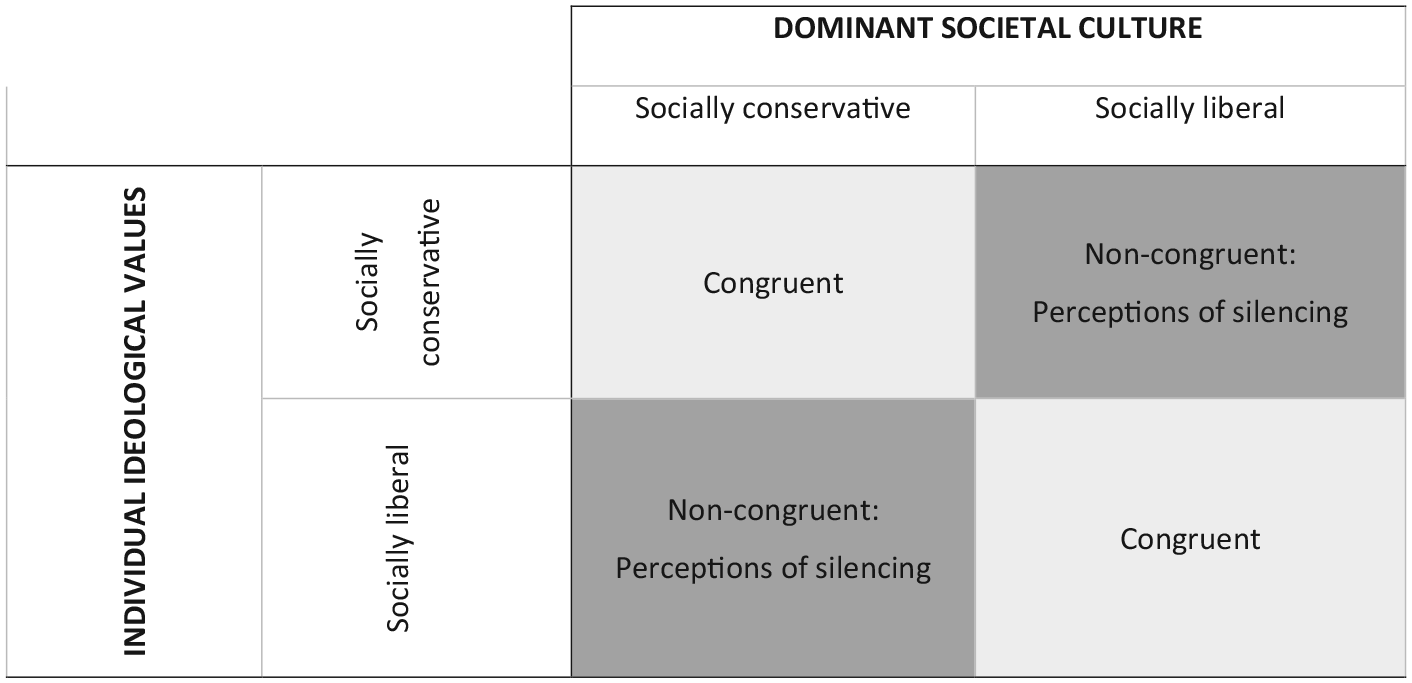
Heuristic Typology in Congruence Theory.
This argument draws upon several previous accounts. The classic “spiral of silence” thesis provides a useful starting point. Elisabeth Noelle-Neumann (1974, 1984) theorized that perceptions of being in the majority or minority in opinions within any group affects processes of interpersonal communications, especially the open expression of attitudes and beliefs about deeply polarizing moral issues. Social pressures from the group, both implicit (unspoken) cues and explicit viewpoints, are predicted to influence the willingness to speak out with confidence or to be more reticent. Consequently, extreme heterodox claims—such as Holocaust deniers, defenders of the Ku Klux Klan, supporters of apartheid, or Flat Earthers—gradually come to be “silenced” within a group, meaning regarded as crackpot ideas beyond the boundaries of legitimate scientific deliberation and serious ethical debate. Given cultural shifts over time, however, the point at which moral beliefs come to seem either appropriate or unacceptable to the group—and the parameters of appropriate expression and behavior which flow from these views—is the subject of heated free speech wars (Riley, 2021).
But what shapes the dominant cultural values within groups—and in communities or societies more generally? Scheufle and Moy (2000) reviewed numerous studies of the spiral of silence thesis and concluded that cross-cultural contextual differences are key factors in predicting willingness to speak out. The extensive body of literature on modernization theories develops this insight further. A wealth of cross-national survey research has demonstrated how social cultures are transformed by processes of the human and economic development (Inglehart, 1977, 1990, 1997, 2018; Norris and Inglehart, 2003, 2004, 2019; Welzel, 2014) Modernization theory suggests that the dominant culture in poorer societies usually remains deeply socially conservative on many moral values, such as those concerning the importance of religion, respect for traditional sexual social norms, gender equality, marriage and the family, and the importance of largely fixed social identities based on sex and gender, race and ethnicity, class and caste, nativism and nationalism. By contrast, cultures in post-industrial societies have gradually become far more socially liberal toward many moral issues, endorsing more fluid sexual and gender identities, support for LGBTQ (lesbian, gay, bisexual, transgender and queer or questioning) rights and same sex marriage, acceptance of ethnic diversity and support for racial justice, and related progressive values. These types of views are likely to predominate among younger and highly educated populations in Western societies, characteristic of college communities as well as users most actively posting in online platforms. Social interactions among networks of like-minded digital activists are particularly likely to reinforce group values, with short-form formats like Twitter tending to extremes, incivility and lack of nuance, and fueling the politics of moral outrage (Bouvier and Machin, 2021; Ng, 2020). Consequently, in this environment, scholars holding socially conservative moral values are likely to feel that their views are not merely attacked, but also “silenced,” meaning excluded from serious consideration on campus in everything from reading lists to event speakers, seminar discussions, and lecture halls. At the same time, however, the spiral of silence is not simply one-directional. Congruence theory predicts that if the broader societal culture matters, in deeply conservative developing societies where traditional values prevail, it is liberal scholars who are most likely to feel silenced and thus unable to express their personal moral beliefs openly without social penalty. And, indeed, this is what the survey evidence in this study suggests.
Debate about this phenomenon is heated, voluminous, and ultra-partisan, but plausible evidence has been scarce. “Silenced” views, by definition, are the classic case of the dog which did not bark. In America, right-wing spokespersons have weaponized the claim. Liberals, pushing back, skeptical about the dog’s existence, suggest that the very existence of the public argument demonstrates its falsity. To move forwards, the next section of this study outlines several testable propositions arising from congruence theory and describes the cross-national survey evidence which was collected among around 2500 scholars within the discipline of political science in over 100 countries. The study develops a “Cancel Culture Index” measuring how respondents perceived changes in selected indicators of academic life during the previous 5 years, such as “pressures to be politically correct.” The next section describes how these perceptions are broken down by the left–right position of scholars and the dominant liberal or conservative social culture, classified by the type of post-industrial or developing society.
The conclusion summarizes the key findings and considers their broader implications. The results confirm that in post-industrial societies, characterized by predominately liberal social cultures, like the US, Sweden, and the UK, right-wing political scientists are most likely to perceive that they face a growing chilly climate in academia. By contrast, in developing societies, characterized by more traditional cultures toward moral issues, such as religion or homosexuality, like Nigeria, it is liberal scholars who report that a cancel culture had worsened in colleges and universities. Further evidence needs to be collected to substantiate the argument more fully. But this observation is consistent with Noelle-Neumann (1974, 1984) spiral of silence thesis, where talk about mainstream values gradually flourishes to become the predominant opinion in public debate, while the other side eventually becomes subdued and mute. The ratchet effect eventually silences or “cancels” contrarians.
Concepts, Normative Debates, and Analytical Theories about the Cancel Culture
Cancel culture can and has been understood in many ways (Duarte et al., 2015; Simpson and Srinivasan, 2018). Some feel that the term has become so over-loaded in partisan rhetoric as a catch-all term of abuse for stuff people do not like, and so confused and contradictory in popular usage, that it cannot and should not be redeemed. Rather than being abandoned, however, it is beholden upon social scientists to develop more precise scientific conceptualization of everyday terms which allow operationalization and measurement of complex social phenomenon.
In this study, the term “cancel culture” is defined as collective strategies by activists using social pressures to achieve cultural ostracism of targets (someone or something) accused of offensive words or deeds.
The core idea is far from novel; for example, Nathaniel Hawthorne’s The Scarlet Letter depicted how a young beautiful woman in 1640 Puritan Boston, Hester Bryne, was required to wear a letter “A” as a symbol of adultery and shame. Similarly, contemporary activists use collective expressions of opprobrium and outrage over speech or actions judged morally inappropriate and offensive. Targets were often powerful public figures like Harvey Weinstein and Jeffrey Epstein widely regarded as transgressing acceptable moral standards of conduct, especially concerning controversial allegations of serial sexual misconduct, yet who appeared for many, many years above the reach of the law. The practice took off in recent years among decentralized networks of like-minded digital activists mobilizing around progressive social causes and coalescing around common viral hashtag exemplified by #MeToo and #BlackLivesMatter (Romano, 2020). But what starts on Twitter does not necessarily stay on Twitter. Viral online posts with accusations against famous celebrity icons spark extensive coverage in legacy mass media, like cable TV, talk radio, and op-ed commentary.
Civil society activists use informal social pressures designed to sanction and ostracize powerful individuals directly, holding them accountable to society, such as by damaging reputations, derailing careers, denying access to public platforms, and establishing grounds for legal prosecutions. The broader and more indirect goals of this strategy are to share collective expressions of moral outrage, mobilize public opinion, and demand actions from decision makers. Some of the best-known cases originated with progressive liberals, such as campaigns which have sought to trigger official hearings, legal prosecutions, or regulatory reforms which strengthen penalties for sexual misconduct in the workplace, revise processes handling sexual harassment in the military, address sexual abuse in the Catholic church, and implement independent oversight of complaints against the police. But the strategy has subsequently been emulated by people of any and all ideological stripes and persuasions (Romano, 2021). For example, right-wing digital activists and media commentators have fueled conspiracy theories attacking the moral behavior of liberal icons, such as Hillary Clinton, Barack Obama, George Soros, and Bill Gates, as well as mobilizing support for US state lawmakers seeking to ban teaching of critical race theory, the Hungarian government’s restrictions on homosexuality, and UK Conservative government legislation tightening protection of free speech in higher education. Major companies like Facebook and Twitter have also responded to digital activism on their platforms by revising acceptable use policies and organizational procedures governing Internet contents and users, for example, concerning bans on the dissemination of misinformation and disinformation, incitement to violence, and hate speech.
Normative Arguments
Heated controversies about the pros and cons of canceling have rapidly intensified and moved from margin to mainstream debate in recent years. Can campaigns of public shaming and social exclusion be regarded normatively as an appropriate tactic? Deep divisions are evident between those who claim that this gives a voice to marginalized groups that were previously voiceless, a technique of civil resistance holding powerful figures to account, and others who point out its dangers for silencing free speech and open debate (Riley, 2021).
On one hand, this strategy can be arguably justified as an effective tool mobilizing networked collectivity to achieve social justice and cultural change by marginalized groups who are powerless to obtain legal redress or public apology (Clark, 2020). In this view, “cancelling” can be seen as a choice to withdraw attention from someone or something regarded as morally offensive. It is a form of social pressure for those violating what are regarded as ethical standards. These types of discursive practices are exemplified by the “#MeToo” boycotts directed against powerful sexual predators alleged to have committed harassment, rape, and even pedophilia (Mendes et al., 2018). Black Lives Matter digital activists also employ public shaming when calling out the authors of racist textbooks, fatal cases of police violence in communities of color, racial stereotypes used to sell consumer products, and university departments lacking diversity (Tynes et al., 2016). In an era of rapidly changing moral standards and heightened cultural sensitivities around the construction of social identities, it can be argued that powerful figures in the public eye should be held accountable for their words and actions (or inactions). From this perspective, public shaming has a legitimate role through criticizing the use of derogatory and offensive language like racial or homophobic slurs, highlighting the unacceptable abuse of power, such as sexual harassment, or criticizing engagement in practices of cultural appropriation.
On the other hand, however, conservative and liberal critics argue that the practice has gone too far, especially on college campuses, so that it now threatens classical liberal values of free speech and open debate from diverse perspectives. The process may start with legitimate criticism of cases attracting widespread moral disapproval, like outing serial sexual abusers, but critics caution that is a slippery slope silencing a variety of unpopular perspectives, including racist, anti-Semitic, misogynistic, Islamophobic, transphobic, and xenophobic views (Duarte et al., 2015; Simpson and Srinivasan, 2018). As the tumbrils have rolled downhill, like revolutions eventually eating their own, the process may ultimately undermine tolerance of contrarians, generate groupthink, and reinforce the risks of confirmation bias in social science, thereby stifling intellectual debate, ideological diversity, and academic freedom on college campuses. As exemplified in On Liberty by John Stuart Mill (1859), liberalism champions tolerance of non-conformity and defends freedom of speech, even for, or indeed especially for, especially for the expression of deeply unpopular and contrarian opinions. Only by questioning dogma and the conventional wisdom, he argued, can we become aware of our own prior values and beliefs. In his public writings and speeches, Mill defended many controversial causes of his time, from Fenians, plotting an armed uprising designed to end British rule in Ireland to suffragettes demanding women’s rights to vote. Lack of political and ideological diversity is also thought to undermine the validity of social science by limiting the research agenda, strengthening dangers of implicit confirmation bias (Duarte et al., 2015).
Conservatives claim that recent years have seen growing silencing of contrarian voices challenging the liberal hegemony in many cultural spaces, but especially in the academy, thereby limiting freedom of speech, increasing social pressures for ideological conformity, reinforcing intellectual exclusion, group-think bubbles, “Us–Them” segregation, academic intolerance, and self-censorship. Lukianoff and Haidt (2018) regard this trend on campus as a sanctimonious “coddling” of student minds, where emotional discomfort is seen as equivalent to physical harm, with colleges failing to cultivate resilience in a hostile world. Williams (2016) argues that lack of academic freedom is detrimental for scientific progress, as researchers are unable to investigate all perspectives. Former Education Secretary, Betsy DeVos, accused liberal faculty members of forcing their views upon students, telling them what to think, with indoctrination replacing education (Jaschik, 2017). Conservatives commonly claim that academic life is now dominated by scholars with progressive liberal or left-wing values, with only a tiny minority of university scholars supporting Trump (Swartz, 2020). Intolerance of dissenting views, especially among the progressive “far-left,” it is argued, silences conservative perspectives, brainwashing students into “politically correct” views. This is illustrated by President Trump’s (2020) Mount Rushmore speech, claiming the mantle of shared conservative victimhood and denigrating the out-of-touch progressive intellectual elites: One of their (the left’s) political weapons is “cancel culture”—driving people from their jobs, shaming dissenters, and demanding total submission from anyone who disagrees. This is the very definition of totalitarianism, and it is completely alien to our culture and our values, and it has absolutely no place in the United States of America.
He used similar claims when he accepted his party’s nomination during the 2020 Republican National Convention “The goal of cancel culture is to make decent Americans live in fear of being fired, expelled, shamed, humiliated and driven from society as we know it.” (Gomez, 2020) The president advocated “patriotic education” about American history, alleging “decades of left-wing indoctrination in our schools.” The message resonated with his followers; warnings that “radical leftwing.” Democrats would annul conservative patriots, rename beloved monuments, and attack commemorative statues was repeated by a series of primetime speakers at the 2020 Republican National Convention (Gomez, 2020). This led to intense culture wars over critical race theory, a school of legal thought which conservative commentators falsely claimed was being widely taught to children in American schools. By mid-2021, GOP lawmakers in 22 states introduced bills, passed in five states, seeking to ban its inclusion in the curriculum (Adams et al., 2021).
But concern about cancel culture is not confined to conservatives nor to Americans; as expressed in the infamous letter in Harper’s Magazine (2020), it has also been endorsed by diverse public intellectuals, such as Martin Amis, Gloria Steinem, J.K. Rowling, Salman Rushdie, Margaret Atwood, and Noam Chomsky: Our cultural institutions are facing a moment of trial. Powerful protests for racial and social justice are leading to overdue demands for police reform, along with wider calls for greater equality and inclusion across our society, not least in higher education, journalism, philanthropy, and the arts. But this needed reckoning has also intensified a new set of moral attitudes and political commitments that tend to weaken our norms of open debate and toleration of differences in favor of ideological conformity.
This phenomenon has attracted most attention in the US, but similar concerns echo elsewhere. The UK’s ‘Equality and Human Rights Commission’ (2019) has published new guidelines for universities designed to protect free speech. A report by Adekoya et al. (2020), drawing on a YouGov survey of faculty in the social sciences and humanities, concluded that UK universities face growing threats to academic freedom. This called attention to “structural discrimination,” with progressive social norms arising from the predominance of left-wing scholars, generating a chilly climate of intolerance for the small minority challenging these views. The report quoted examples of actions restricting unorthodox thinkers and viewpoint diversity, include events restricting speakers, cases of staff facing disciplinary actions or dismissal, and the abuse or harassment toward contrarians expressing views on contested subjects, such as the issues of gender, race, and ethnicity. A survey of British students reported similar perceptions of liberal bias in universities and a reluctance by conservative students to express themselves for fear of disagreement with their peers (Turner, 2019). The UK parliament has debated government proposals for the Higher Education (Freedom of Speech) Bill.
Analytical Theories Explaining Perceptions of a Cancel Culture
The debate raises two key questions. Has a “cancel culture” gradually become widespread in several Western societies, especially on college campuses, as often claimed by conservatives? If so, what explains this phenomenon? Several factors in modern societies have been proposed to account for this development (Gross and Fosse, 2007; Gross and Simmons, 2012; Shields and Dunn, 2016). This study theorizes that perceptions of a “cancel culture” in academia will depend in large part upon the congruence of the ideological values of individual scholars with the dominant culture in their society. Perceptions of “silencing” are predicted to be greatest in mismatched non-congruent cases, or “fish-out-of-water,” as depicted earlier in Figure 1.
The building blocks for this argument draw upon insights derived from several well-established theoretical perspectives, including Noelle-Neumann’s (1974) “spiral of silence” thesis about processes of group communications, modernization theories of cultural change concerning the balance of liberal and conservative moral values in society (Inglehart, 1997; Norris and Inglehart, 2019), and also the social characteristics of digital networks (Ng, 2020).
Group Communications
Congruence theory suggests that perceptions of group opinion affect processes of communications and feelings of being able to either express personal views with confidence or else being reluctant to speak out. This argument draws upon Elisabeth Noelle-Neumann’s (1974, 1984) classic concept of a “spiral of silence”. According to this argument, on moral issues where the balance of opinion is deeply divided within a group, people’s perceptions of other people’s views in the group influence their willing to express their own opinions. In particular, those holding what are seen as minority views within the group are predicted to be more reluctant to express their attitudes and beliefs openly in discussions, for fear of violating prevalent group norms, risks of social isolation and because some conformists without strong opinions may take their information cues from what many others think. By contrast, ideological majorities are believed to openly defend their views, confident that they will receive collective affirmation. As a result of this process, the “spiral of silence” thesis suggests that the trajectory of existing shifts in public opinion and cultural values in any society are reinforced and even accelerated by processes of online communications and interpersonal discussion. Those believing that many others hold similar views within a group feel emboldened to speak up openly in meetings, debates or online social networks; they are convinced that their beliefs and attitudes are so popular that they will be adopted eventually by everyone. By contrast, those holding what they perceive as unpopular opinions within the group will feel more hesitant to engage in the conversation, so they withdraw and fall silent. The majority may actively seek to persuade others to adopt their views, like deliberative processes seeking consensus in a jury room. But Noelle-Neumann emphasized that the effects are also likely to be unintentional, where self-censorship arises from many social pressures for the unorthodox to conform with the majority views, such as fear of causing offense, the wish to avoid engaging in conflict on controversial issues, and risks of group disapproval, isolation, and loss of respect. Caution about rocking the boat can be expected to be strongest on controversial, sensitive, and polarizing topics, such as those concerning issues of sex and sexuality, gender identity, and sexism, racism, and ethnic or religious identities. As a result of this process, support for what is perceived to be the majority view appears stronger and more publicly visible in deliberative discussions than it actually is, thereby ratcheting group opinion toward accepting the majority view. By contrast, commitment to the minority argument appears weaker in popularity, generating a self-fulfilling prophecy. Silence in conversations is regarded as a sign of acquiescence. As they appear to lose ground, heterodox minorities may come to doubt the certainty of their own opinions and decide to conform with the mainstream view. This process may provide insights which help to explain the contemporary phenomenon of the “cancel culture,” particularly why social conservatives in the United States feel that their voices are often not heard or their views respected as a progressive orthodoxy prevails in academic debates.
Modernization Theories of Cultural Change
But the “spiral of silence” thesis seeks to account for universal processes of human interaction and thus it cannot, by itself, explain the perceived rise of the cancel culture in academia today. The process of self-censorship reinforces the dynamics of public opinion change—but it cannot explain why different cultural views are predominant in different groups and societies. Scheufle and Moy (2000) review the literature on the spiral of silence thesis and conclude that empirical research has often arrived at inconclusive or mixed results in large part because of cross-cultural differences. Drawing upon this insight, the second premise of congruence theory emphasizes that whether the dominant moral culture in any society reflects conservative or liberal values is systematically associated with long-term processes of societal modernization and cultural change. A wealth of cross-national and time-series survey data, including seven waves of the European/World Values Surveys conducted in more than 100 societies during the last four decades, has demonstrated that conservative values usually persist as the majority view of social morality in many poorer developing countries (Inglehart, 1977, 1990, 1997, 2018; Norris and Inglehart, 2003, 2004, 2019; Welzel, 2014) This is exemplified by a range of traditional attitudes, beliefs, and values toward social and moral issues, such as approving of the strict division of sex roles for women and men, the importance of binary gender identities and traditional forms of sexual behavior and child-rearing within marriage, disapproval of homosexuality and transgender lifestyles and LGBTQ rights, strong adherence to religious values, practices, and beliefs, mistrust toward other peoples and places, and deference toward authority.
By contrast, substantial cross-national survey evidence indicates that the balance of public opinion on a wide range of issues has gradually shifted in a more socially liberal and progressive direction to become the majority view in public opinion in many affluent post-industrial societies. This culture shift has gone furthest among the younger generation (hence students) and college educated populations (hence professors; Inglehart, 1997; Welzel, 2014). Social attitudes toward moral issues have typically become more favorable toward LGBTQ rights and fluid gender and sexual identities, secular rather than religious values and practices, and support for principles of gender equality, ethnic diversity, climate change, and racial justice. In many advanced industrialized societies, modernization theory suggests, due to long-term processes of demographic turnover and growing levels of college education, these types of progressive liberal values have gradually risen in popularity since the 1960s and 1970s to become mainstream beliefs today (Inglehart, 2018). The loss of hegemonic status by social conservatives is thought to have triggered resentment and anxiety, heightening social intolerance, partisan polarization, and rising support for authoritarian populist leaders and parties (Norris and Inglehart, 2019). In this context, therefore, particularly in colleges and universities dominated by younger, highly educated populations, those holding socially conservative moral values toward issues like sexism and racism are likely to feel that their views are not merely in the minority, but also “silenced”—like irrational beliefs by flat-earthers, holocaust deniers, or those claiming alien abduction—meaning excluded from rational discourse.
The Role of Information Technology
Finally, the role of information technology is often blamed for the rise of a cancel culture (Ng, 2020). Studies of online communications have attributed the intensification of culture wars to the rise of activists connected through digital social networks, exemplified by Twitter (Bouvier and Machin, 2021). Digital media have expanded opportunities for collective expression and online mobilization among like-minded networks of progressive and conservative activists, with the politics of outrage thought to be constantly reinforced by filter bubbles and echo chambers among like-minded souls on platforms like Twitter and Facebook. Patterns of social media use can be expected to amplify the reach, and expand the voice, of the younger generation on college campuses and beyond, who are typically among the most liberal and progressive sectors in society. The Pew Center reports that compared with US adults, Twitter users (particularly the most prolific) are much more likely to be younger and well-educated, as well as identifying as Democrats and being more liberal than the public on issues of race, gender and immigration (Wojcik and Hughes, 2019). At the same time, however, while potentially facilitating cancel culture strategies among digital activists, social media does not operate alone in this regard. Online Tweets are amplified to the broader public through interpersonal communications, elite rhetoric like leadership speeches, as well as journalists and commentators working in traditional news media. Culture wars have been intensified by right-wing commentators on cable stations like Fox News and talk radio in America, and a similar function played by conservative newspapers in the UK. Moreover, the timing of the Internet provides a poor fit to explain the rise of a cancel culture; after all, the World Wide Web using graphical browsers and early message boards was born in 1995, followed by Facebook and Twitter about a decade later. This development was decades before the rise of popular agitation about a “cancel culture” in the last few years. Although not directly tested empirically in this study, the role of digital media can therefore be theorized to reflect and reinforce cancelation practices by digital activists, rather than functioning as an independent driver of this phenomenon.
Congruence Theory
Accordingly, these arguments can be combined in congruence theory to provide insights into the debate about a cancel culture in academia and to develop empirically testable propositions. The spiral of silence thesis suggests the importance of social pressures to conform with mainstream views within any group. Modernization theory suggests that important the predominant liberal culture on college campuses in post-industrial societies can be expected to encourage the minority of conservative scholars to be reticent about expressing their authentic moral beliefs, especially in debates about socially sensitive issues like trans rights, the use of racist language, or allegations of sexual abuse. This process thereby gradually reinforces liberal predominance and heightens feelings of resentment, victimhood, and status anxiety among social conservatives rejecting these principles. In socially conservative developing societies, however, such as in Nigeria, Saudi Arabia, or Afghanistan, where conventional values continue to prevail on issues, such as the importance of religion, sex roles, marriage and the traditional family, nationalism and economic growth, by contrast, the minority of scholars holding more liberal or progressive social values are likely to feel that they are out-of-step with mainstream views, making them more unwilling to speak up for fear of social sanctions. In addition, digital communications are likely to facilitate and strengthen this social phenomenon, again especially in post-industrial societies, where active use of platforms like Twitter is most widespread. Persistent digital divides continue to demarcate rich and poor societies, along with use of online communications concentrated among the younger generation and college graduates. But given limitations in the available survey data, the role of information technology, while a likely accelerant, is not examined empirically in this study as an independent driver of the cancel culture.
Evidence for “The Dog Which Didn’t Bark”
Despite the wealth of popular commentary, does systematic empirical evidence support the claim of a pervasive “cancel culture” taking hold of academic life in many countries? And, if so, does congruence theory provide insights into the communication processes underlying this phenomenon? Establishing evidence for these claims is far from straightforward. Difficulties arise because by their very nature, practices of voluntary self-censorship are similar to non-events, akin to Conan Doyle’s infamous dog which did not bark. Much popular speculation and rhetoric is politically driven. Some partisan complaints about the cancel culture can be dismissed as rhetorical talking points.
More persuasive support comes from citing specific cases of intolerance and silencing on college campuses: speakers shouted down, events canceled, Twitter outrage trending, faculty disciplined, and so on. It can be argued, however, that the plural of anecdotal cases is not data. There is always the problem of the “dog which did not bark,” for example, it is unclear how to count many events not canceled, even if genuinely unpopular and controversial. Beyond a few headline stories, due to the confidentiality of employment records it would not be possible to trace how many scholars have not been appointed, awarded tenure, or have lost their jobs directly because of their political views. News about celebrity cases may distort our understanding of the frequency of canceling practices and cherry-pick well-known cases to confirm prior expectations. Court cases of workplace discrimination could be monitored and counted, but laws usually cover issues, such as age, gender, sexual orientation, race, religion, national origins, or disabilities, not ideological viewpoints. Scholars may not bring legal appeals, not least due to the difficulties of proof of discrimination, uncertain rewards, and the fear of reputational damage from the process.
Within certain legal and ethical constraints, like field experimental designs concerning bank loans for black applicants, could potentially assess the success rate of job applicants invited for interview who are similar in all other regards after manipulating certain demographic characteristics, for example, by randomly assigning characteristics listed on curriculum vitae, such as their nationality, ethnicity, gender, or age. It would be difficult to do so, however, using this process when manipulating their ideological stance or political leanings.
Surveys of scholars can also be employed. Examining authentic attitudes and perceptions of a cancel culture using direct questions, however, encounters the long-standing challenge of trying to elicit truthful and authentic responses to questions on sensitive topics that are at odds with predominant social norms. A social desirability bias could mask the expression of genuine attitudes. One potential approach could be to monitor tolerance toward people holding divergent ideological or partisan views, for example, by asking scholars who they would not like to appoint as colleagues in their department, including people of a different left-right ideological viewpoint among a list of groups for comparison based on race/ethnicity, religion, age, sexual orientation, or gender. But even with confidential surveys, this is open to potential response bias arising from asking directly about sensitive issues and forms of behavior, such as by generating many non-responses or “Don’t Know” answers, where authentic attitudes are disguised out of fear of potential social sanctions, or even legal retribution where expressions of discrimination violate equal opportunity laws and university regulations. Another approach would be to ask scholars to report their direct personal experience of ideological discrimination, for example, whether they believe that they have not been appointed, promoted, or published based on their own political views, but this fails to account for self-censorship practices. In addition, in a cross-national survey, without prior benchmarks, neither of these approaches would allow us to monitor any changes over time in ideological tolerance. In future research, list experiments, using item-count techniques with indirect survey questions, could help in this regard (Li and Van den Noortgate 2019).
Therefore, it remains difficult, but also important to establish reliable evidence to test whether specific cases of academic bias against conservative scholars highlighted today in the media are anything more than isolated instances or whether, as a general tendency, drawing upon their own personal experiences, right-wing academics in Western societies perceive growing restrictions on academic freedom, pressures to be politically correct, and silencing of diverse perspectives in higher education. And whether left-wing scholars living and working in traditional cultures in developing societies share similar perceptions. Accordingly, drawing upon these arguments, several testable propositions arising from the cancel culture thesis can be identified. Survey data are then used to examine empirical evidence for these claims within the discipline of political science drawing upon the World of Political Science, 2019 (WPS-19), a large-scale cross-national survey with a common questionnaire collecting information from 2446 scholars studying or working in 102 countries. 1 The logic of the argument suggests several propositions open to testing with this dataset.
The Ideological Identities of Political Scientists
The first (albeit weaker) test of the cancel culture thesis concerns the claim that progressive left-wing ideological values and beliefs predominate among college faculty in the United States and elsewhere. Claims of a liberal hegemony among the professoriate reflect a long-standing concern with most surveys conducted in America and similar post-industrial societies. Paul Lazarsfeld’s and Thielens (1958) pioneering book, The Academic Mind, based on a large-scale representative survey of American social scientists, was the first to demonstrate that scholars tended to be more sympathetic to liberal or left-wing values than the general population. The radical era of heated college and university politics during the 1960s and early 1970s triggered further research into the political beliefs and values of college and university professors, with the findings confirming the pervasive liberal tilt of the academy. This was documented by Everett Carll Ladd and Seymour Martin Lipset’s (1976) The Divided Academy, reporting that about 46% of professors in their survey identified themselves as left or liberal, 27% were middle of the road, while 28% were conservative. Social scientists were found to be further left than most other disciplines. Moreover, this pattern was not confined to American campuses, as similar skews were found by Albert Halsey and Martin Trow’s (1971) The British Academics.
A decade ago, Gross and Simmons (2007) updated the evidence with another large-scale survey of the American professoriate, demonstrating that conservatives and Republican identifiers remain relatively rare among faculty in US universities, especially in the social sciences, although most scholars held moderate middle-of-the-road views. More recently, Shields and Dunn (2016) reviewed five major US surveys of academics conducted since 2000 and concluded that the percentage of self-identified conservatives was found to range between 5% and 15% in the social sciences and 4%–8% in the humanities. In Europe, as well, analysis of the European Social Survey pooled data by Van de Werfhorst (2019) suggests that professors in 31 European countries are usually more liberal and left-leaning than other equivalent professions like lawyers, architects, and physicians, although the political values and attitudes of academics on issues, such as economic redistribution and EU integration are far from homogeneous. Therefore, for many decades a series of previous surveys analyzing the sociology of the academy in several post-industrial societies has reported a pervasive liberal-left skew in the values, attitudes, and beliefs of college faculty. This proposition can be tested using the WPS-19 survey to determine the self-identified position of political scientists measured across a 10-point left–right ideological scale.
Reported Experience of Worsening Academic Freedoms
But confirmation of a progressive left-wing bias on Western campuses does not necessarily imply a lack of tolerance for pluralistic debate, “left-wing indoctrination,” or the silencing of contrarian views, as right-wing commentators claim. After all, a wealth of social psychological research suggests that conservatives and people holding relatively right-wing political beliefs tend to be more politically intolerant than liberals and people holding relatively left-wing political beliefs (Sibley and Duckitt, 2008).
The test of the cancel culture thesis adopted by this study concerns whether this phenomenon is thought to have got better or worse in recent years, based on reported personal experiences by left- and right-wing scholars. For example, in Western societies, are conservatives more likely than liberals to report that they have experienced growing restrictions on academic freedom of speech, pressures for ideological conformity, and the enforcement of politically correct speech. Perceptual measures also have important limitations, after all the majority of liberal faculty may well be unaware of any hegemonic bias, and, even if acknowledged, they may downplay this as a serious problem. But, as a minority on campus, conservative scholars can be expected to be more likely to perceive this phenomenon if they have direct experience. Moreover, perceptions are vital for the social construction of reality, and thus scholars’ personal beliefs about discrimination and intolerance, their behaviors when teaching, assessing colleagues for promotion, or reviewing publications, and practices of self-censorship in intellectual debates, even if they have little or no basis in reality. Accordingly, this study compares reported experience of changes in whether several conditions are thought to be getting better or worse among self-identified conservative and liberal scholars in political science, controlling for the types of society.
Mediating Conditions: Cross-National Comparisons
Another limitation with the available evidence is that few cross-national surveys of scholars monitoring their experience and views and have been conducted in developing countries or globally. Congruence theory suggest that the perceptions of being silenced will vary for cultural majorities and minorities depending upon the dominant culture in society, groups or local communities, and this should be evident through global cross-national comparisons. In particular, right-wing scholars can be expected to perceive “silencing” in colleges and universities located in affluent post-industrial societies where liberal cultural values predominate—especially in the United States, where most studies have been conducted. These countries have seen intensified polarization and deepening political battles in the cleavage over conservative versus liberal values, with the cultural backlash exemplified deep divisions over by the Trump presidency in the US and by battles between leavers and remainers over Brexit in the UK. A wealth of survey evidence presented in Norris and Inglehart (2019) suggests that socially liberal values toward cultural issues, such as gender equality, secularization, and homosexuality, have advanced most among the younger generation and the most educated social sectors in affluent post-industrial societies. By contrast, many poorer developing societies in the rest of the world are characterized more socially conservative values, which continue to predominate in more traditional cultures. On this basis, a chilly climate of perceived intolerance toward conservative viewpoints may be expected to be most evident where there is liberal hegemony in colleges and universities located in the United States, as well as in similar affluent post-industrial societies in Western Europe and Australasia. By contrast, however, liberal scholars advocating secular values, feminist views or LGBTQ rights may well feel that they are silenced in socially conservative campuses more common in traditional cultures located in developing societies like Nigeria, South Africa, or Egypt. This proposition can be tested by breaking down the analysis to compare the predictors in the US (where debate about the cancel culture has been most heated), in the pooled sample of 23 varied post-industrial societies, and in 78 diverse developing countries.
To summarize, for all these reasons, congruence theory predicts that personal experience and perceptions of a worsening “cancel culture” may be expected to vary among scholars of political science according to their (1) left–right ideological identities and (2) the type of socially liberal or conservative culture which predominates in the post-industrial or developing society where they live, study, and work. The congruent cases, where individual values match the dominant cultural values in society, are expected to express minimal concern about a cancel culture, and indeed to be likely to deny the existence of this phenomenon. But such perceptions are predicted to be strongest among the non-congruent cases, whether left-wingers in traditional social cultures or right-wingers in liberal social cultures.
Survey Data and Measures
Building upon the Lazarsfeld survey tradition in the sociology of knowledge, empirical data to explore these issues can be examined from a new global survey of scholars in the discipline of political science, the WPS-19 (Norris, 2020). Gross and Simmons (2007) report that the liberal skew among scholars is more evident among social scientists rather than other disciplines. Moreover, the phenomenon of a cancel culture involves controversies about many politically sensitive issues, especially inequalities of power and status associated with race and gender, so the profession of political science is a particular appropriate discipline to test the core arguments.
The World of Political Science, 2019 survey provides a representative profile of the political science profession across the world (Norris, 2020). Invitations asking political scientists to participate were distributed through social media notifications (Facebook, emails, and Twitter), the European Consortium for Political Research (ECPR) Newsletter list and the International Political Science Association (IPSA) lists, and through several national associations (Canadian Political Science Association (CPSA) Political Studies Association (PSA) of the UK, Australian PSA, and Russia). Overall, 2446 respondents completed the survey from 3 February to 7 April 2019 among political scientists studying or working in 102 countries. In total, about half (1245 responses) were from political scientists studying or working in 23 affluent post-industrial societies (including the US, Europe, and Australasia).
The WPS survey gathered information through an online Qualtrics questionnaire about multiple dimensions of professional life and work, including role priorities, social background characteristics, national origins, qualifications, thematic subfield of expertise, and methodological skills. The survey also included a battery of 22 items monitoring direct experience of changes in the profession during the last 5 years, which is important as the selected items were interspersed with many others, reducing any potential cueing and framing effects. Respondents were asked: Academic life is often thought to be in a state of change. Using the following scale, based on your experience, please indicate whether you think the quality of the following aspects of academic life have changed over the last five years.
Potential responses in this battery of items were measured on a 5-point scale and recoded as follows: Got a lot better (1), got somewhat better (2), no change (3), got somewhat worse (4), and got a lot worse (5). 2 The questions are therefore designed to tap into experiential judgments and perceptions about the direction of change. The list included both positive and negative types of changes, to avoid potential affirmative response bias.
The concept of a “cancel culture” was defined earlier as collective practices by activists using social pressures to ostracize someone or something alleged to have violated perceived moral standards. The change battery included three items selected as proxy or indirect measures of this underlying concept, based on reported perceptions based on the direct experience of respondents. These are asked whether, in their experience, each of the following aspects of academic life had got better, no change, or got worse, using the 5-point scale:
i. “Respect for open debate from diverse perspectives.”
ii. “Pressures to be ‘politically correct.’”
iii. “Academic freedom to teach and research.”
The items can be seen as valid proxy indicators of perceptions about several claims in the “cancel culture” thesis, including that college campuses have seen more intolerance of pluralistic debate and less respect for opposing viewpoints, growing pressures to conform with prevalent “politically correct” forms of expression and behavior in higher education, as well as diminished academic autonomy for individual academics in their teaching and research.
The correlation of these three items was tested for reliability, generating a moderately strong relationship (Cronbach’s alpha = 0.598), suggesting that they could be combined to create a single consistent scale. The three recoded variables were summed to create a Cancel Culture Index, standardized to a 100-point continuous scale for ease of interpretation, where a higher score reflect perceptions that academic freedom, pressures to be politically correct, and respect for open debate had worsened during recent years. The multivariate analysis examines the impact of ideology on the Cancel Culture Index after adding controls for cohort of birth and gender, in successive models for developing societies, among those living, studying, and working in post-industrial societies, and in the US alone, where it is often thought that the cancel culture has advanced furthest. We can look into responses in more detail by data visualizations illustrating contrasts and similarities among left- and right-wing scholars on each of the separate items in the index. We can also compare the experiences of more left- and right-wing political scientists in ten countries with at least 70 respondents per nation.
Results of the Analysis
A Left-wing Academic Culture?
As a first step, is there systematic evidence for a “liberal,” “progressive,” or a “leftwing” skew in the ideological identities of political scientists across the world? 3 This is commonly claimed in political arguments about the “silencing” of conservative or right-wing voices on campus, such as President Trump’s claims of “left-wing indoctrination” of students, supporting suspicions about the dismissal of legitimate challenges from alternative viewpoints. The underlying assumption is that political scientists cannot be neutral, so that their personal values and political attitudes will be reflected in their teaching and research. There are obviously many ways to gauge ideological values and beliefs, such as developing a scale by asking about positions on a range of controversial issues, such as attitudes toward LGBTQ rights, religion, racial justice, or economic inequality. For consistency with the long tradition established by several previous major studies of academia, the survey monitored ideological identities. This is also the most consistent approach for cross-national comparisons, where the salient issues, and thus the meaning of specific items, may vary from one place to another. Respondents were asked where they would place themselves on the following question: “Generally speaking, how would you usually describe yourself?” Responses from 1788 political scientists were collected through a sliding scale in the questionnaire ranging from most left-wing (0) to most right-wing (10). The self-identified scale position was subsequently categorized into four categories: “Far-left” (0–1), moderate left (2–4), moderate right (5–8), and far-right (9–10). For subsequent analysis, this was simplified by dichotomizing the scale into left (0–5) and right (6–10).
Figure 2 illustrates the distribution of how political scientists worldwide and in the US identified their own position across the left–right ideological scale. Overall, the distribution displayed a normal curve with a positive left-wing skew, replicating a pattern observed in previous studies of social science faculty (Gross and Simmons, 2007). The mean score for all respondents worldwide was 4.53 on the 0–10 left–right scale. In total, the majority of political scientists (58%) around the globe saw themselves as located in the moderate left of the ideological spectrum, while another 14% positioned themselves on the “far left.” The ideological imbalance of the discipline should not be exaggerated, however; just over one quarter (27%) of political scientists worldwide placed themselves as moderate right, although at the same time very few respondents (only 2%) saw themselves as “far right.”
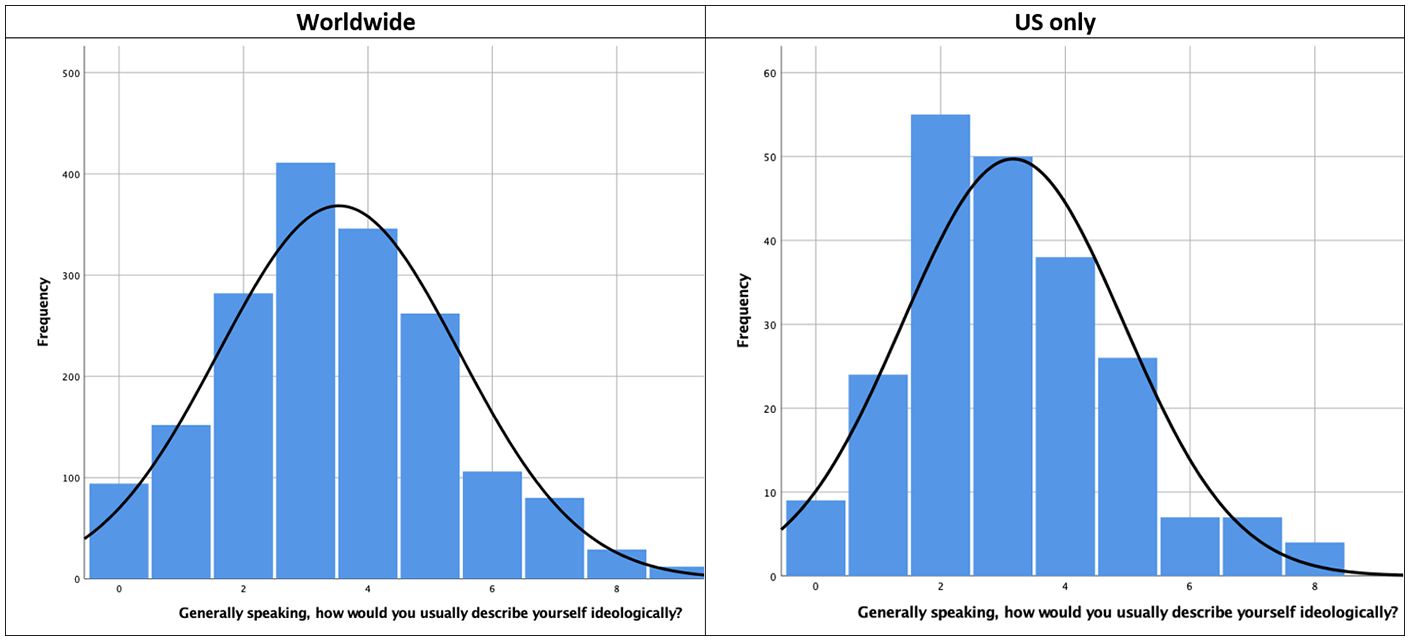
Distribution of Left–Right Identities among Political Scientists.
In comparison, when the sample was confined to political scientists currently studying or working in the United States (irrespective of their country of origin or citizenship), the positive skew toward left-wing identification strengthened. The mean score in the US sample was 3.16 on the 0–10 left–right scale. Two-thirds of American political scientists (65%) saw themselves as moderate left on the ideological scale, which an additional small group (15%) located themselves as far-left. By contrast, overall one fifth (20%) saw themselves as moderate right, but almost no respondents saw themselves as “far right.” To this extent, the first proposition is confirmed in the WPS data; many surveys since Lazarsfeld’s (1958) original study have reported a moderate left-wing or liberal skew among the American academy (Gross and Simmons, 2007). As Shields and Dunn (2016) observed: “Progressives rule higher education. Their rule is not absolute. But conservatives are scarcer in academic than in just about any other major profession.” The new data confirm this pattern among political scientists working both in US universities and also globally. This underscores the common complaint by conservatives that their voices are relatively under-represented in political science, especially in America. Lack of intellectual diversity can be problematic within the discipline, especially in controversial areas, such as the politics of race, gender, power, and inequality, limiting alternative perspectives questioning the prevailing normative values and empirical theories embedded in the mainstream research agenda. Several explanations of this long-standing phenomenon are possible, including the socialization effects of higher education on ideological values, the reinforcement effects of self-recruitment, and the role of discrimination in appointments and promotions.
This provides only a partial and incomplete test of the cancel culture thesis, however, as an ideological skew in higher education (especially a persistent academic culture) does not necessarily imply growing intolerance for alternative values and beliefs, or practices limiting intellectual debate and pluralism. This leads toward the more critical propositions for this study: on the basis of their personal experiences, do many political scientists feel that restrictions on academic freedom of speech, pressures for ideological conformity, and politically correct speech have worsened in recent years? And, given the ideological imbalance in the discipline, and their minority status, are right-wing political scientists most likely to agree with these statements in liberal cultures, but not in conservative cultures?
Multivariate regression examines the impact of the 10-point left–right ideological identity scale on the Cancel Culture Index. The simple ordinary least squares (OLS) models control for age and gender, for the reasons discussed earlier. To consider whether this phenomenon differs by the type of society, as may be expected by broader cultural shifts accompanying societal development, Model A is restricted to 193 respondents studying or working in the US (where the cancel culture is often thought to be most evident), Model B includes 1023 respondents in 23 post-industrial societies (in North America, Western Europe, and Australasia), while Model C includes the pooled sample of 487 scholars in 78 developing countries worldwide.
Table 1 shows the results of the analysis. The successive models confirm that left–right ideological identity is a significant and consistent predictor of the Cancel Culture Index. The effect of ideology is stronger in the US than in all post-industrial societies; as illustrated in Figure 3, American scholars on the moderate right and far-right report experiencing worsening pressures to be politically correct, limits on academic freedom, and in lack of respect for open debate. This reflects progressive predominance and the minority status of conservative scholars within the discipline, observed earlier. Moreover, this was not simply another case of American exceptionalism; in the pooled sample across all the post-industrial countries, as predicted, more right-wing political scientists reported that, in their own experience, the cancel culture had worsened in recent years.
Predicting Scores on the Cancel Culture Index.
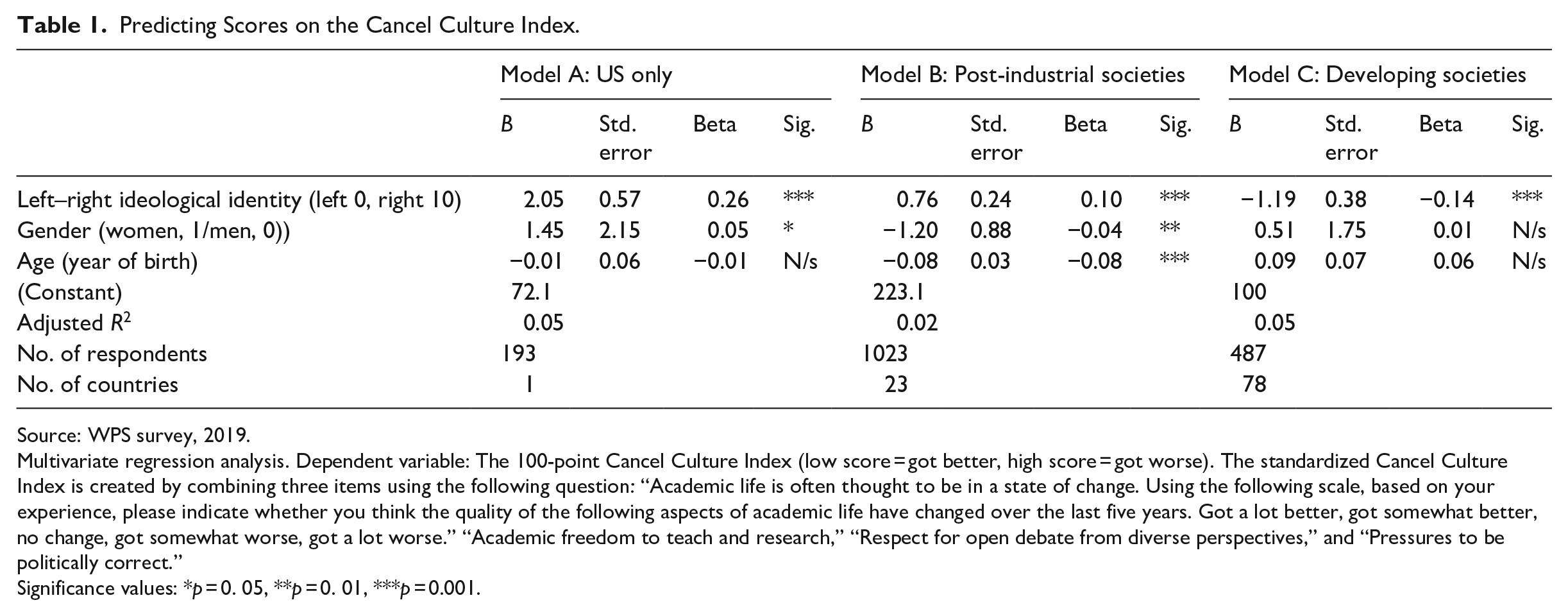
Source: WPS survey, 2019.
Multivariate regression analysis. Dependent variable: The 100-point Cancel Culture Index (low score = got better, high score = got worse). The standardized Cancel Culture Index is created by combining three items using the following question: “Academic life is often thought to be in a state of change. Using the following scale, based on your experience, please indicate whether you think the quality of the following aspects of academic life have changed over the last five years. Got a lot better, got somewhat better, no change, got somewhat worse, got a lot worse.” “Academic freedom to teach and research,” “Respect for open debate from diverse perspectives,” and “Pressures to be politically correct.”
Significance values: *p = 0. 05, **p = 0. 01, ***p = 0.001.
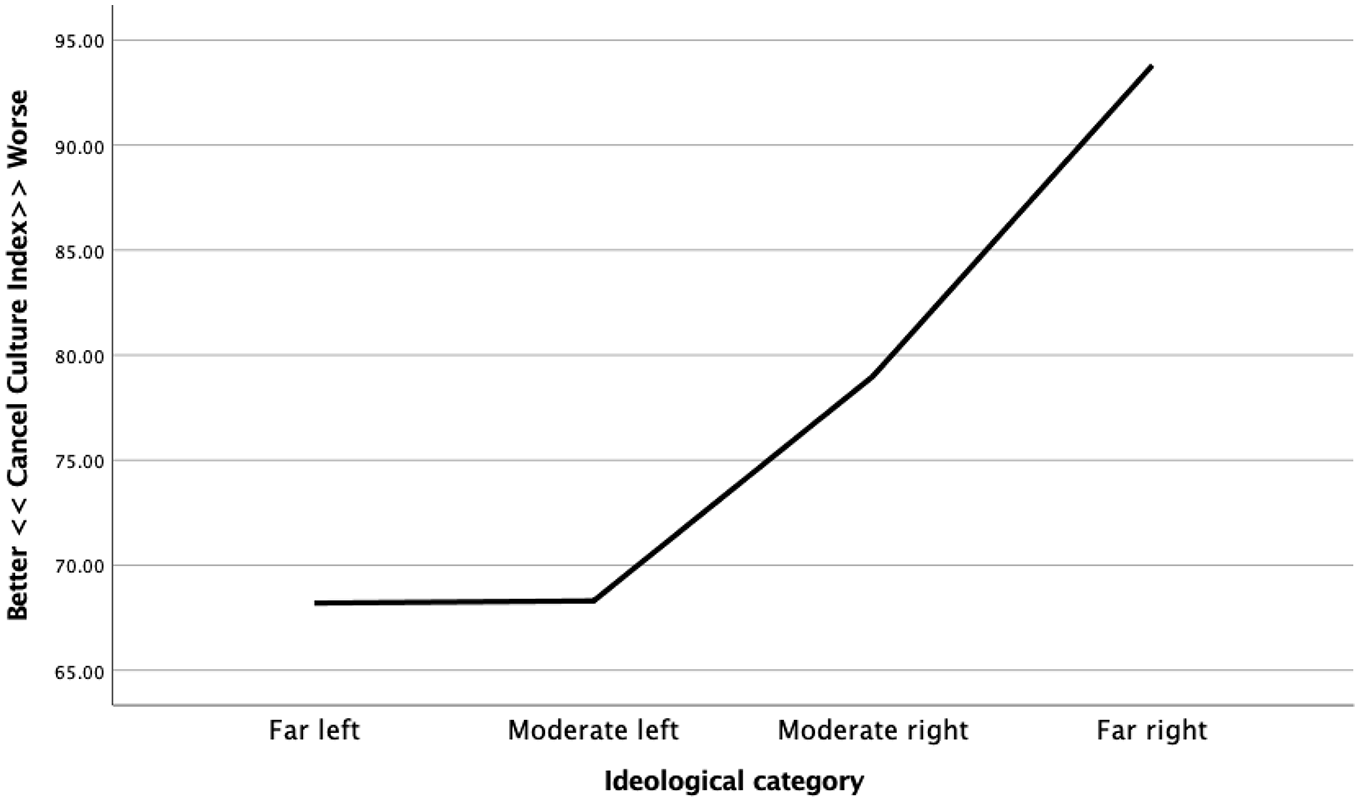
Experience of Changes in the Cancel Culture Index by Left–Right Identity, the US Only.
Most importantly for congruence theory, however, in the pooled sample of political scientists in developing societies, the sign of the coefficient in this relationship reverses to become negative, meaning that those on the left thought that, in their own experience, the cancel culture had worsened in higher education. These societal contrasts are important for their implications when generalizing about this phenomenon, challenging claims of Western “universalism.” In terms of the other background demographic characteristics, in the US, women political scientists were also significantly more likely than men to believe that the cancel culture had got worse, but there was no different by age. In Model B, comparing scholars in post-industrial societies, however, both men and the older generations were significantly more likely to believe that the cancel culture had worsened.
Experience of Respect for Open Debate
To understand this further, the analysis can be disaggregated to look at each of the indicators in the summary index. Figure 4 illustrates the distribution of assessments that respect for open debate from diverse perspectives in academic life has changed for better or worse during the prior 5 years. Agreement gets to the heart of the cancel culture thesis by implying an erosion of tolerance for intellectual diversity and more closed minds on campus. Overall, the distribution based on the global sample shows a normal curve (mean = 3.16 on the 1–5 scale), with the plurality view suggesting no change in the quality of open debate over time. In total, almost as many political scientists reported on the basis of their own experience that open debate had improved as that it had worsened. If the distribution is broken down by the dichotomous measure of left–right ideological identity, however, some modest differences can be observed. Left-wing faculties were more likely to feel that the quality of debate had not changed in their experience in recent years. By contrast, on the basis of their own experience, right-wing faculties were slightly more likely to perceive that open debate has got a lot worse over time. The contrasts by ideology proved modest in size, however, and differences should not be exaggerated.
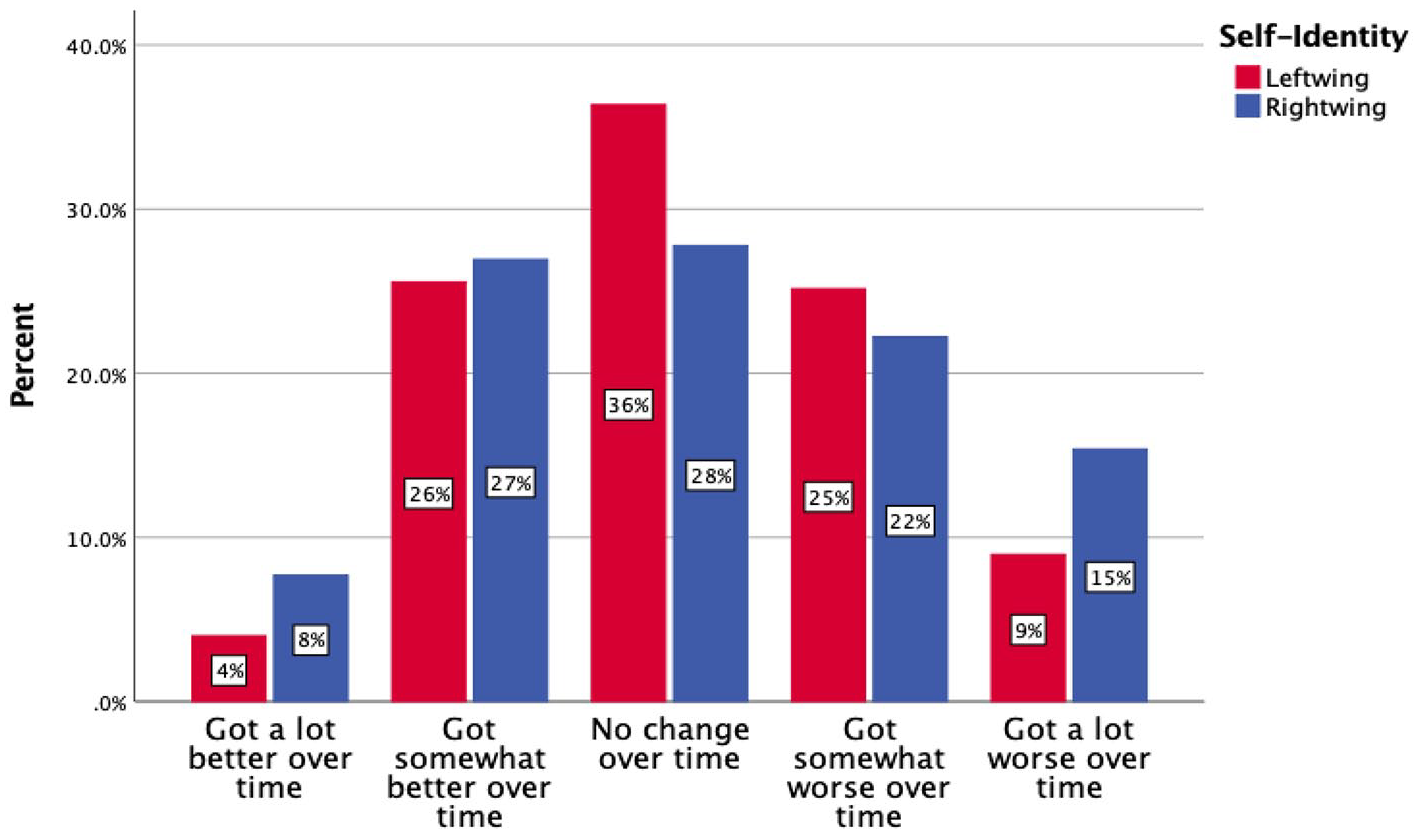
Experience that Respect for Open Debate in Academic Life Has Changed for Better or Worse by Left–Right Identity.
Experience of Pressures to be Politically Correct
Figure 5 shows how perceptions that pressures to be “politically correct” in academic life are perceived to have altered during recent years. This concept refers to conformity toward predominant group norms, a form of self-censorship of authentic words and actions designed to fit in socially and avoid opprobrium. On this issue, there was clearer evidence for concern—and in this case, one shared on both sides of the ideological spectrum. Again, in the global sample the largest plurality of respondents (39%) reported that in their own experience there had been no change over time. But overall one third said that these pressures had worsened “somewhat/a lot” (36%) in their experience, clearly outweighed the proportion feeling more positively that these pressures had got “somewhat/a lot” better (15%). Contrasts were also observed when broken down by left–right ideology. More of those on the right thought that these pressures had got “somewhat/a lot” worse (60%), more than those on the left (45%). By comparison, 42% of political scientists on the left perceived no change in these pressures to conform, in their experience, compared with 20% of their colleagues on the right.

Experience that Pressure to be “Politically Correct” in Academic Life Has Changed for Better or Worse by Left–Right Identity.
Experience of Academic Freedom
Figure 6 examines the distribution toward the last indicator under comparison: experience of academic freedom to teach and research. Of course, this does not specify the reasons for any perceived change, with restrictions which may arise from practices associated with a “cancel culture,” or alternatively from broader structural developments and job dissatisfaction, due to the growth of bureaucratic control and managerialism in university administration, the casualization of employment and weakening of tenure security in academic careers, growing pressures to teach, and/or restrictions on academic freedom more generally in societies experiencing democratic backsliding, such as Hungary and Turkey. Nevertheless, the question provides an important indicator of the quality of intellectual life and feelings of autonomy in the profession. Here in the pooled global sample, the largest plurality of political scientists (47%) thought that, in their experience, academic freedom had deteriorated “somewhat/a ‘lot.” Another third reported no change, while a fifth responded that freedom had improved “somewhat/a lot” (20%). On this issue, however, contrary to expectations, in the polled overall sample those on the left proved more negative than those on the right; almost half of those on the left (49%) thought academic freedom had deteriorated “somewhat/a lot,” compared with 39% of those on the right.
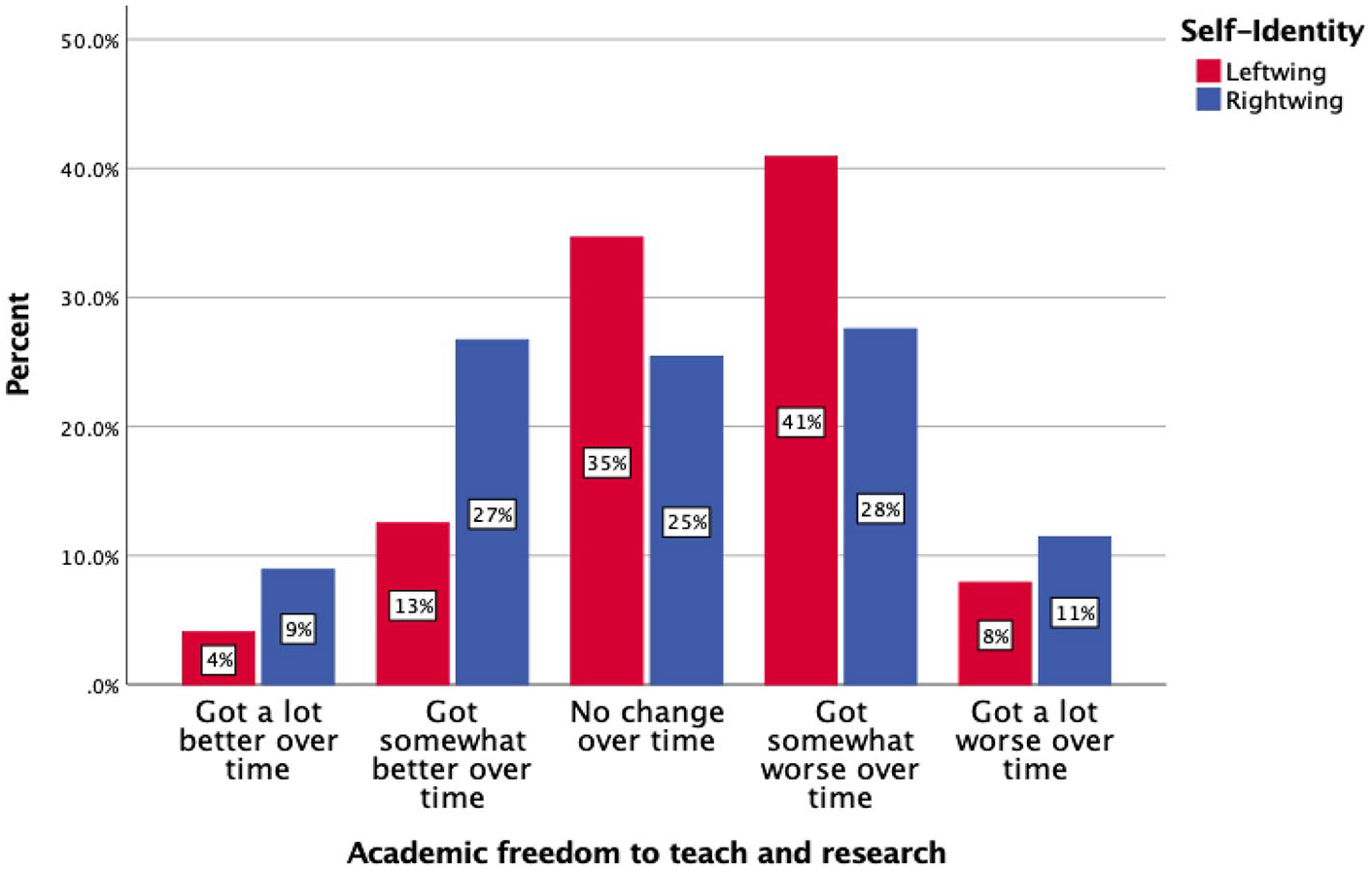
Experience that Academic Freedom to Teach and Research Has Changed for Better or Worse by Left–Right Identity.
Cross-National Comparisons
Ideally, analyzing the results to match more fine-grained analysis of groups, communities, or national societies would be ideal to see how far these patterns varied. For example, are differences between left and right observed in the US another case of American exceptionalism—or do they reflect general patterns found in comparable European societies? In many nations, unfortunately we have too few respondents for reliable analysis, especially in developing societies where political science is not widely taught as a separate discipline. But the survey includes ten diverse countries with a minimum of at least 70 respondents.
As shown in Figure 7, in fact remarkably similar responses can be observed in a range of post-industrial societies—especially in the Anglo-American democracies which share similar historical traditions and systems of higher education. Thus, the US pattern, where those on the right report worse experiences of the cancel culture, is clearly reflected in the cases of Canada, Australia, the UK—and also in the Western European cases of Germany, Italy, and the Netherlands, as well as Russia and (to a lesser extent) Sweden. The main exception is Nigeria—where there are no significant differences between left and right. Not surprisingly, responses to the question about reported experiences of pressures to be politically correct show a similar distribution, with greater experience of this reported by right-wing scholars in all the countries except Nigeria. Clearly, there is room for further research into several possible reasons for this, but far larger samples would be needed to analyze this with any degree of reliability at country level (Figures 8).
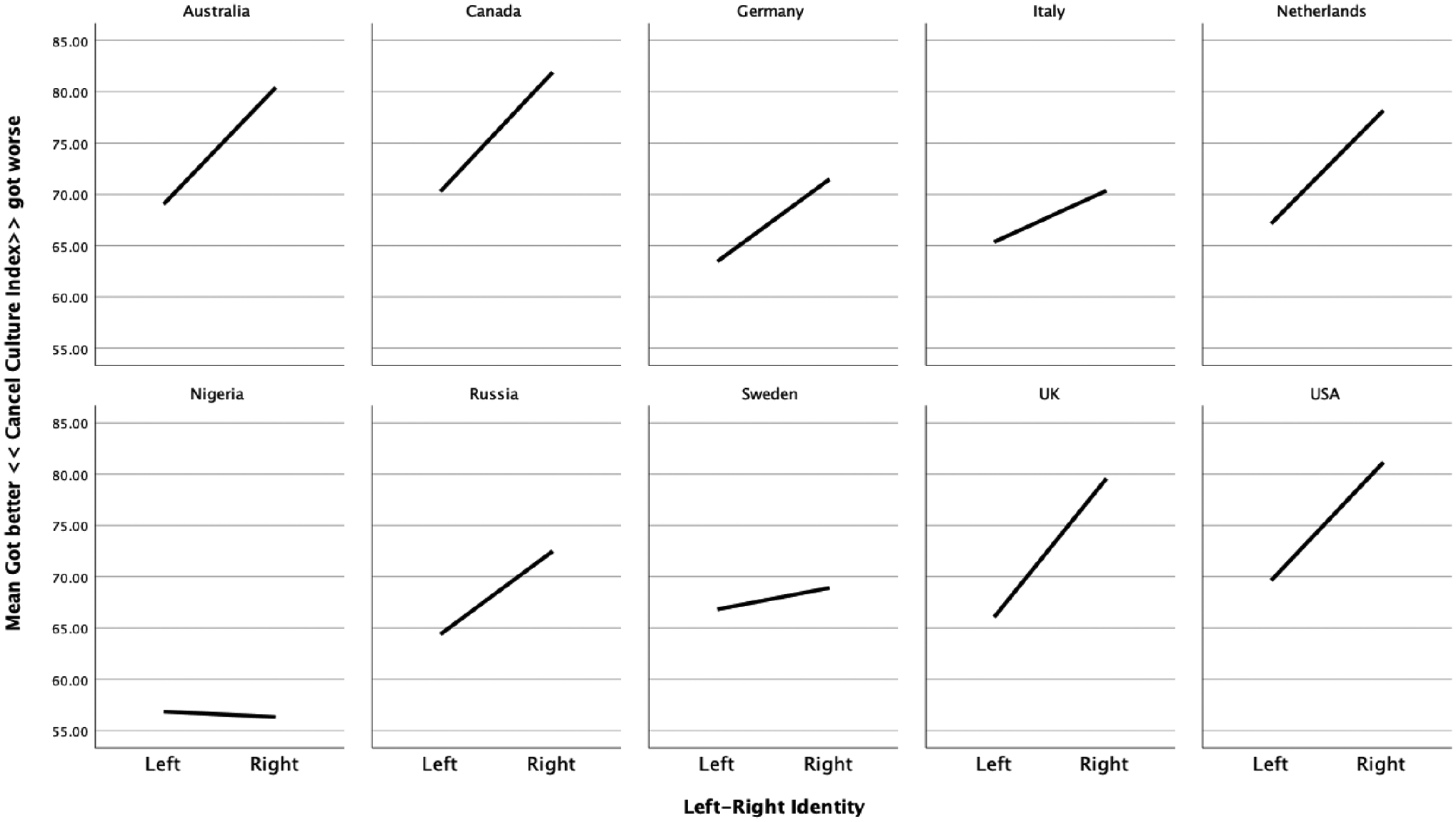
Experience of Changes in the Cancel Culture Index by Left–Right Identity, 10 Societies.

Experience of Pressures to be Politically Correct by Left–Right Identity, 10 Societies.
Conclusion and Discussion
Heated debates about the cancel culture have intensified in recent years as part of deepening ideological and value cleavages dividing progressive liberals and social conservatives. Of course, the public outing of heretics and dissenters from the orthodox path is nothing new, as exemplified by the fanatical prosecution of religious non-conformists, the medieval punishment by stocks and pillory in the town square, or the notorious Salem witch trials. Contemporary media speculation about the shaming of celebrities and leading public figures in the worlds of popular entertainment, publishing, and politics, as well as colleges and universities, encapsulated in the “cancel culture” label, has generated more political heat than intellectual light. Yet there are genuine grounds for concern in academia if a cancel culture has evolved, as critics charge, from the legitimate criticism of perceived offensive words and deeds to become a wave eroding tolerance of dissent, stifling free speech, and enforcing orthodoxy among professors, administrators, and students. Despite intense speculation, and beyond specific anecdotes, little evidence has been demonstrated that this has occurred and, if so, even less is known about what explains this development.
This study draws upon the classic “spiral of silence” thesis (Noelle- Neumann, 1974, 1984) to explain how interpersonal communications work within a group or local community like a college campus or the academic profession, where majority voices are amplified, and minority voices quietened, due to fear of loss of popular approval, social status, or power. The pressures to conform with popular sentiments on polarized issues of racism and sexism is expected to be strengthened where the balance of opinion is strongly skewed. Thus, the theory suggests that conservative voices on liberal campuses are likely to self-censor the expression of their authentic views, while liberals are likely to proclaim their opinions with confidence.
But this context is also expected to vary according to the dominant culture in any society. The study draws on modernization theory (Inglehart, 1997, 2018) updated with the cultural backlash thesis (Norris and Inglehart, 2019). Due to processes of demographic turnover in contemporary post-industrial societies, modernization theory suggests that the long “arc of history” on social issues has gradually tipped in a more liberal direction since the 1960s, especially the balance of public opinion in Western societies among younger, highly educated sectors of society on core values associated with social identity politics. This development has generated a resentful and angry backlash among older social conservatives in Western societies, fearing their loss of hegemonic status, electoral power, and cultural predominance. Yet at the same time, the climate of public opinion in developing societies remains more traditional on moral issues, such as the importance of religion, maintaining a clear division of roles for women and men, and fixed binary gender and sexual identities. Thus, in this context, congruence theory suggests, liberal academics are likely to been silenced by predominant mores in highly conservative societies.
Several key findings providing confirmation of these arguments can be highlighted from the analysis of the global cross-national survey data.
First, as predicted from the series of previous surveys of academics in the US and other Western societies, the WPS survey data confirmed the left-wing skew in the discipline of political science. The extent of the imbalance should not be exaggerated, however, as the majority of scholars described their position on the ideology scale as moderately left-wing on the political spectrum, rather than far-left. Overall, a substantial minority—around one quarter of political scientists worldwide—also identified as moderately right-wing. The left-wing predominance observed in the discipline was stronger in the US than worldwide.
Yet this long-standing imbalance in the personal ideological leanings in the profession is far from sufficient, by itself, to settle the heated debate about the effects of the liberal/left hegemony on issues of academic freedom of expression, intellectual tolerance, and social pressures for contrarians to conform with progressive values. Not least because the liberal skew is far from new; instead, it has been repeatedly observed in academic surveys over many decades. The evidence presented in this study generated a summary Cancel Culture Index, reflecting experience of growing restrictions on academic freedom of speech, pressures for ideological conformity, and the enforcement of politically correct speech during recent years.
The results of the models confirmed the significant effects of left–right self-identified ideology, which consistently predicted scores on this Cancel Culture Index, after controlling for age and gender, both of which may be expected to influence social values. Most importantly for congruence theory, however, the direction of the effects varied according to the type of society under comparison. Models suggest that in the United States, and in almost two dozen comparable post-industrial societies, self-identified right-wing political scientists were most likely to report personal experience of a worsening cancel culture. By contrast, among those studying and working in universities and colleges in the 78 developing societies, characterized by predominately socially conservative cultures, it was the self-identified left-wing scholars who reported a worsening cancel culture.
The contrasts in perceptions and reported experiences about the indicators of a cancel culture observed between left- and right-wing scholars living and working in developing and post-industrial societies are consistent with congruency theory, as well as arguments presented in the cultural backlash thesis advanced by Norris and Inglehart (2019), and in the process of group communications proposed by Elisabeth Noelle-Neumann’s (1974, 1984) classic concept of a “spiral of silence.” For fear of social isolation or loss of status, academics may be hesitant to express authentic opinions on sensitive issues like sexism and racism contrary to prevalent moral standards held by the majority of the academic community, producing self-censorship in the expression of unpopular views. The more that individuals feel that their opinion reflects majority beliefs and prevalent moral standards within their group, however, the more willing they become to voice their views in group discourse, without fearing the penalty of social sanctions or loss of career advancement.
Finally, when the indicators in the composite index were disaggregated into their component parts, some important contrasts were observed. Left-wing faculties are more likely than those on the right to believe that there has been little or no change in respect for open academic debate and pressures to be politically correct. Given the predominance of progressive liberalism on college campuses, those on the left may be unaware of the experience of more conservative colleagues—and may deny that there is a problem based on their personal experiences—while intense polarization over issues of identity politics may also make them unsympathetic to these claims. By contrast, however, a broader consensus can be observed among political science scholars about experiencing deteriorations in academic freedom to teach and research, which may reflect broader structural changes in higher education, as much as ideological shifts.
Further Research
The survey which is the basis of this study builds upon a long tradition developed in the sociology of the academy. Most previous work on these issues has focused on scholars in higher education working in the US and in similar affluent Western societies. One advantage of the WPS survey is that this expands the comparisons worldwide, and thus facilitates insights into different types of cultures. Nevertheless, the survey data considered in this study are limited in several ways, so some important qualifications should be emphasized. This evidence is suggestive but much further research is needed to investigate more fully the reasons for the cross-cultural differences, ideally including academic surveys conducted across diverse academic disciplines and with larger national samples in a wider range of countries. Several qualifications should be noted.
First, the observed societal contrasts could be attributed to several other potential explanations, such as the role of levels of freedom of expression, rates of democratization, the type of regime in each society; the degree of polarization of ideological positions and the role of political partisanship; the impact of long-standing cultural and religious traditions in world regions; and structural contrasts in the institutions and policies governing freedom of expression in higher education. A substantial research agenda utilizing multiple methods and datasets could advance our understanding of this phenomenon.
In addition, there are important issues of measurement validity. The WPS survey asks scholars about their ideological identities and their direct experience of changes in the profession, but the latter cannot be separated in practice from perceptions of the academy. Perceptions, by themselves, are important for the social construction of reality. If scholars report that they feel social pressures to conform with certain moral values which are thought to be held by the majority of their group, and if survey respondents say that they avoid expressing their authentic beliefs in academic discussions to avoid risks of social ostracism, then, unless there is convincing evidence otherwise, we should take them at their word.
Further survey measures would also be useful, moreover, to explore reported and direct experience of different aspects of the cancel culture in more depth, for example, whether conservatives felt that they had failed to be appointed or promoted because of their political views, whether they had been involved in organizing any public events which had subsequently been canceled, or whether they have ever felt uncomfortable speaking up in faculty meetings or the class room because of their values. Larger national survey samples, especially of scholars working in diverse developing countries with different cultural traditions, would also be invaluable to pursue the cross-national comparisons. Repeating the survey in subsequent years would allow researchers to explore trends over time. Finally, the WPS survey is restricted to the discipline of political science. It is unclear whether similar generalizations can be observed in related social science fields, such as sociology, economics, and social psychology, as well as in the humanities and natural sciences. Equivalent survey data facilitating comparisons across academia could explore disciplinary contrasts.
Overall, however, therefore, congruence theory suggests that to avoid social isolation on college campuses, and risk potential loss of professional status and opportunities, in post-industrial societies, right-wing scholars holding traditional moral beliefs are likely to feel pressures to conform with liberal social values both within the academy and more broadly in society. Well-documented processes of long-term generational cultural change in many Western societies mean that the proportion of those holding traditionally socially conservative values has gradually reached a tipping point in recent decades (Norris and Inglehart, 2019). In advanced industrialized societies, social conservatives have gradually shifted from hegemonic status in earlier decade to becoming a minority viewpoint today, especially on college campuses, as well as more broadly in society. In this cultural context, the reported experience of a chilly climate in academia among right-wing scholars seems to reflect the classic spiral of silence phenomenon. But this is not, as commonly assumed, a universal pattern around the world. In many developing countries, congruence theory suggests that socially traditional values held by conservative scholars are likely to be far more in tune with the majority culture in their society. But in these countries, college professors and students holding liberal moral views, such as those supporting secular values, tolerance of homosexuality, and feminist beliefs challenging traditional norms of marriage and the family, are likely to feel pressures to conform with the predominant conservative social norms and moral values in the classroom and common room, as well as in society more generally. In short, some discuss claims about a cancel culture on the grounds that much media commentary and political rhetoric uses the term to mobilize support in on-going culture wars. But rather than casually dismissing this phenomenon as just partisan hot-air (“If the other side claim it is a problem, then it must be just another lie”), or, even worse, confidently seeking to settle the matter by generalizing based on personal anecdote (“But I have never felt ‘canceled’”), it may be wiser to take the core claims seriously and apply scientific evidence seeking to understand the underlying reasons driving this debate.
Footnotes
Acknowledgements

Declaration of Conflicting Interests
The author(s) declared no potential conflicts of interest with respect to the research, authorship, and/or publication of this article.
Funding
The author(s) received no financial support for the research, authorship, and/or publication of this article.