



Abstract
The study of populist attitudes has thus far drawn heavily on ideational definitions of populism, focussing almost exclusively on attitudes related to dimensions such as people-centredness and anti-elitism. However, these accounts have largely ignored other approaches to populism, especially the discursive-performative school which see populism as something that is communicated and done by political actors. We argue that when studying populist attitudes, these approaches are not mutually exclusive. In this article, we develop a novel measure of attitudes towards populist communication and consider how these interact with populist ideational attitudes. Testing our measures on the Australian case, we demonstrate that attitudes towards populist communication exist independently of populist ideational attitudes, and that they have a significant effect on voting behaviour and on attitudes related to the ideational approach. Therefore, we argue that studies of populist attitudes need to take attitudes towards populist communication into account in future work.
If there is one phenomenon that has captured the attention of political scientists in recent years, it is surely populism. Following the twin 2016 shocks of the election of Donald Trump and the outcome of the Brexit referendum, the already sizeable literature on populism has grown exponentially, with the analysis of new cases, significant conceptual development and new methodologies being applied to the phenomenon. Indeed, this growth has been so significant that one can now credibly speak of ‘populism studies’ as a distinct subfield.
Arguably, the most significant area of study to emerge in recent years in populism studies has been the body of work on populist attitudes. While traditionally research on populism has analysed so-called ‘supply-side’ aspects of the phenomenon, focussing on populist leaders, parties and movements, the populist attitudes literature instead focusses on ‘demand-side’ explanations of the phenomenon, specifically examining how citizens may hold populist views, and how this may (or may not) correlate with their electoral behaviour. These insights are (usually) garnered via large-scale surveys. The assumption underlying this literature is that populism is an ideational phenomenon – that is, a set of beliefs, however ‘thin’ or underdeveloped, about the relationship between ‘the people’ and ‘the elite’. Whether individuals hold these attitudes ‘latently’ – that is, unconsciously and thus allegedly waiting for ‘activation’ from such populist actors – or consciously is still a matter of debate (Hawkins et al., 2018b).
It is understandable why the ideational approach to populism has served as the basis for the burgeoning populist attitudes literature – it is arguably the most widely used and hegemonic in the academic literature on the topic, and an understanding of populism as a particular type of worldview, set of beliefs or ideology accords very well with the notion of political attitudes more broadly. Yet this approach has its limits: it is unable to provide answers as to why individuals with populist attitudes would vote for populist parties or candidates beyond the weak assumption of ‘thin’ ideological overlap. For example, such approaches overlook the potential effect of populism’s communicative, performative and discursive appeal, which are central in a significant amount of the literature on the phenomenon (Laclau, 2005; Moffitt, 2016; Ostiguy, 2017; Stavrakakis, 2017), as well as preferences for particular modes of political representation, which again have been cited as core to understanding populism (Roberts, 2015; Urbinati, 2019; Werner and Giebler, 2019).
In this light, this article argues that measures of populist attitudes can and should consider populism’s communicative appeal. We argue that it is useful to analyse how existing measures of populist attitudes (which we call ‘populist ideational attitudes’, in line with the ideational approach favoured by the extant literature) interact with measures of preferences for a populist mode of discourse, communication or style (which we call ‘attitudes towards populist communication’), with the view towards gaining a more cohesive and holistic picture of how populist attitudes operate in future studies. In order to do this, we fielded an online survey of 1049 Australians asking them questions not only about their populist ideational attitudes in line with work done elsewhere by authors associated with the ‘Team Populism’ project (Castanho Silva et al., 2018; Hawkins et al., 2018a) but also adding original items to tap attitudes towards populist communication. 1 In doing so, we test whether attitudes towards populist communication exist distinctly to populist ideational attitudes, if and how they correlate with one another, whether such attitudes correlate with voting for a populist party and how attitudes towards populist communication correlate with education levels and generational cohorts.
The article is structured as follows. We first provide an overview of the extant literature on measuring populist ideational attitudes, before turning to the literature on populist communication, and explaining how these literatures can be brought into discussion with one another. Second, we outline our hypotheses around attitudes towards populist communication. Third, we discuss our methodological strategy, research design, data and the choice of Australia as our case. The fourth section, our results and analysis, shows that attitudes towards populist communication are distinct from populist ideational attitudes, that attitudes towards populist communication have a weak or no correlation with the three subdimensions of populist ideational attitudes, that attitudes towards populist communication can strengthen populist ideational attitudes when it comes to the likelihood of voting for a populist radical right party and that higher levels of education lead to lower agreement with attitudes towards populist communication. Finally, in our concluding section, we summarise our findings and discuss their wider implications for the literature on populist attitudes.
Understanding and Measuring Populism
Populism is one of the most contested concepts in political science. This may partially be due to the global reach of the concept and the different contexts within which it is found. The scholarship covers Western Europe (Albertazzi and McDonnell, 2008; Mudde, 2007: 3–4), Eastern Europe (Mudde, 2000; Rupnik, 2007), North America (Harrison, 1995; Kazin, 1998), Latin America (Weyland, 1999, 2001) and Asia (Kenny, 2017, 2018). What exactly populism is and how best to conceptualise it has been debated for decades (Rooduijn, 2019), and the focus of the scholarship historically was on concept building and classification (Canovan, 1999; Hawkins, 2009; Moffitt, 2016; Moffitt and Tormey, 2014; Weyland, 2001), analysing parties and movements (Albertazzi and McDonnell, 2005; Goodwin and Milazzo, 2015) or assessing who votes for these parties and candidates (Arzheimer, 2009; Ivarsflaten, 2008; Lubbers et al., 2002). While there remains significant debate about whether populism is best understood as an ideology (Mudde, 2004; Stanley, 2008), a political style (Moffitt, 2016), a form of charismatic leadership (Kenny, 2018) or a type of discourse (Hawkins, 2009; Laclau, 2005), scholars largely agree that populism contains some basic features, namely, a central divide between ‘the people’ and ‘the elite’.
From these different frameworks, the ideational approach has arguably become the orthodoxy in mainstream studies of the phenomenon. According to Mudde (2010: 1175), populism is a ‘a thin-centred ideology that considers society to be ultimately separated into two homogeneous and antagonistic groups, “the pure people” versus “the corrupt elite” which views politics as an expression of the volonté générale: the general will of the people’ (see also Hawkins, 2010; Stanley, 2008). The thin-centred nature of populism is why Mudde and Kaltwasser (2017: 21) suggest that populism only addresses ‘a limited set of issues’, and that ‘almost all populist actors combine populism with one or more other ideologies, so-called host ideologies’. While left-wing populists will often incorporate some form of socialism into their ideology, nationalism (particularly in its exclusionary, nativist form) is the most common addition for right-wing populists. The dominance of the ideational approach to populism is significant for a number of reasons, but most notable of these for the purposes of the populist attitudes literature is that it leads scholars to focus on demand-side explanations of the phenomenon.
There has long been interest in the relationship between voter attitudes and populist parties and candidates, but these analyses have mainly focussed on specific sets of attitudes related to the study of the populist radical right. For example, such studies have focussed on attitudes to immigration, Islam or other issues critical to the nativist frame, which is part of the populist radical right’s ideological profile (see, for example, Ivarsflaten, 2008; Oesch, 2008). What is new in the study of populism is the focus on political attitudes, which are said to relate to the core dimensions of the concept, at least as conceptualised by the ideational school.
Recent demand-side analyses can be traced to the work of Hawkins and Riding (2010), Stanley (2011), Hawkins et al. (2012) and Elchardus and Spruyt (2012), all of which start from the ‘thin-centred ideology’ framework of Mudde (2007), but it was the work of Akkerman et al. (2014), which propelled the study of populist attitudes forward. Developing a set of 14 questions which attempted to tap populist attitudes in the Netherlands, they demonstrated that it was ‘possible to measure populist attitudes at the individual level in a theoretically consistent and empirically robust manner’ (Akkerman et al., 2014: 1343–1344). They also found ‘a significant and positive correlation between populist attitudes and the intention to vote for populist political parties’ (Akkerman et al., 2014: 1344).
In the years since, numerous studies have attempted to replicate, improve upon or expand upon this foundational work (Bernhard and Hänggli, 2018; Castanho Silva et al., 2019). Some of these are especially noteworthy. The large group of scholars coming together under the banner of ‘Team Populism’ have built on the work of Akkerman et al. (2014) to produce what they perceive to be an improved scale for measuring populist attitudes (Castanho Silva et al., 2018; Hawkins et al., 2018a). Another significant study comes from Van Hauwaert and Van Kessel (2018), who sought to ‘come to a closer understanding of the motives and attitudes underlying populist party support’ (Van Hauwaert and Van Kessel, 2018: 71). Beyond providing further evidence of a correlation between attitudes and vote intention, more significantly they provided ‘evidence that issue positions play an important role in the support for populist parties’ (Van Hauwaert and Van Kessel, 2018: 86).
Attitudes towards Populist Communication
Despite its significant development in the space of only a few years, what is strikingly absent in the existing work on populist attitudes is an attempt to engage with the other central conceptual approach to populism in the broader literature: ‘the discursive-performative approach’ (Moffitt, 2020), which draws together those authors who see populism as a discursive, performative or communicative phenomenon. For example, some authors working in this tradition see populism as a discourse that seeks to pitch ‘the people’ against ‘the elite’, and examines the ways in which this construction takes place and how conflicts around the meaning of these signifiers play out. Here, authors either follow the seminal work of Laclau (2005; see, for example, De Cleen and Stavrakakis, 2017; Mouffe, 2018; Panizza, 2005; Stavrakakis et al., 2017b) or the more empirically grounded critical discourse analysis–inspired work of Wodak (2015), which has paid attention to the linguistic and communicative features and effects of populism. What unites these discursive scholars is their focus on populism as a distinct type of language that has important effects on how political identity – and politics more broadly – operates.
Several scholars have gone beyond the strictly linguistic/verbal level in examining populism as a particular mode of political communication, and have extended their definition in order to take into account non-verbal, stylistic and aesthetic aspects of the phenomenon. For example, Ostiguy (2017: 77) has argued that populism should be seen as the ‘flaunting of the low’ in politics, claiming that we must pay attention to ‘issues of accent, levels of language, body language, gestures, and ways of dressing’ in examining the phenomenon. Elsewhere, Moffitt (2016) has defined populism as a distinct ‘political style’ – that is, a particular repertoire of mediated performance – that is comprised of an appeal to ‘the people’ versus ‘the elite’ and includes ‘bad manners’ as well as the performance of crisis, breakdown or threat. Taken together, these different approaches provide the conceptual tools for broadly making sense of populism as a particular mode of political communication.
So why have such aspects of populism remained unexamined in the literature on populist attitudes thus far? To some extent, this situation is understandable: the literature on populist attitudes tends to draw exclusively on ideational definitions of populism, seeing it as a particular worldview, ideology or set of attitudes that citizens, parties and politicians can hold, whereas the discursive-performative camp see populism as something that is done and expressed by political actors. In this regard, we might roughly say that the former focusses on the ‘demand’, whereas the latter primarily focusses on the ‘supply’ of populism. 2 More so, there are methodological divides between the literatures: while the populist attitudes literature is primarily quantitative, the work on the discursive-performative dimensions on populism has remained almost exclusively qualitative, particularly utilising methods of discourse analysis.
Our contention is that these approaches are not necessarily mutually exclusive. Instead, measures of populist attitudes should be able to take into account populism’s communicative appeal (and on the flipside, scholars working on the communicative dimensions of populism should be able to take measures of populist attitudes seriously as an indicator of the ‘demand’ for populism). Thus, by examining how existing measures of populist attitudes interact with measures of preferences for a populist mode of communication, we can gain a potentially fuller picture of how populist attitudes operate, and of how constituent parts of the attitude measures correlate with one another.
This is a useful endeavour for several reasons. First, it allows us to measure not only ‘latent’ attitudes about how society should operate (as per the ideational approach) but also attitudes about how political representatives should act and present themselves (as per the communicative approach). This would go some way to explaining why those with populist attitudes are attracted to particular political actors beyond their ideological contiguity, which of course is important, but not the whole story. Second, it allows us to examine how and where these approaches interact on a subconstruct level – for example, do our communicative measures interact differently with Manichean, anti-elite or people-centred attitudes? If so, what does this tell us – are attitudes towards populist communication ‘actually’ populist, or only relate to particular subdimensions of the phenomenon? Third, while our aim in this article is not to construct a new ‘best-practice’ definition and measure of populism that takes in all available approaches, it may provide some starting steps for future work on populist attitudes that is able to take in plural theoretical traditions, which is an important goal for bridge-building across the distinct approaches in populism studies. 3
Hypotheses
As follows from the above discussion, our first hypothesis is thus that attitudes towards populist communication are distinct from populist ideational attitudes. The reason for this is that adherence to an ideology – even a ‘thin’ one – is a far greater commitment, in terms of shaping a particular worldview, as compared to holding preferences towards a particular style or mode of communication. One can imagine being drawn towards the communication style of a populist politician (‘I like the way they act’) without necessarily committing to their wider ideology (‘I believe what they believe’). Such an approach can help us understand when ostensibly ‘non-populist’ politicians adopt populist communication tropes selectively to appeal to a particular audience (Mondon, 2013; Snow and Moffitt, 2012). On the flipside, it is also possible to imagine how a populist ideational attitude need not necessarily be attached to a positive attitude towards populist communication: one may see the central divide in society as being between ‘the people’ and ‘the elite’, but not particularly appreciate the coarse language and behaviour of populists like Donald Trump or Rodrigo Duterte.
This being said, while these attitudes may be distinct, they are likely to be positively associated with one another. The reason for this is straightforward: citizens who hold a populist worldview will also probably hold attitudes that favour populist communication from their representatives. Those who believe the world is divided between ‘the people’ and ‘the elite’ will likely also prefer political representatives who act in ways that stress this divide, such as speaking in the name of ‘the people’, utilising vernacular associated with ‘the people’ and targeting ‘the elite’. In short, we believe that those with populist ideational attitudes will prefer political representatives who act and speak utilising a populist communication style, thus holding a positive attitude towards populist communication.
This leads to our third hypothesis, which is that voters who score highly on attitudes related to the ideational and communicative approach to populism are more likely to vote for a populist party. Our argument is that if we wish to understand populism as a mechanism that affects voting behaviour, it is insufficient to merely rely on measuring attitudes associated with the ideational approach, as this presupposes to some extent that political actors have little influence on the decisions that voters make. To put it another way: assuming that those with populist ideational attitudes will ‘automatically’ vote for a populist party or candidate ignores the large literature on the role of political representation in preference and political identity formation (Disch, 2011; Saward, 2010), and the literature that stresses the importance of particular leaders and candidates (Laclau, 2005; Moffitt, 2016; Weyland, 2001, 2017). As such, measuring attitudes towards populist communication together with populist ideational attitudes can help us understand reasons why those with populist ideational attitudes would be attracted to voting for particular candidates and parties. In light of this, when both populist ideational attitudes and attitudes towards populist communication are high, we should see a higher likelihood to vote for a populist party than if only one set of attitudes is high.
What about the relationship between attitudes towards populist communication and demographic factors? While it has become customary for the media to report the line that voters who support populist parties and candidates are ‘losers of globalisation’ or part of some ‘working class revolt’, there is little evidence to support such claims. Time and again the scholarship has shown a weak relationship between income and populist voting (Mols and Jetten, 2017; Norris, 2005). As others have argued, we suggest that populist attitudes should have explanatory power in explaining populist voting behaviour, and this should be evident across income bands and social class (Arzheimer, 2009; Ivarsflaten, 2008; Mudde, 2007; Norris and Inglehart, 2018). However, Norris and Inglehart (2018) suggest that education and generational cohorts may be critical cleavages in who supports populist parties, as well as who finds the communication style of populist political actors appealing.
There are two central reasons for the educational effect. First, the communication style of populist candidates should appeal to those who view their identity as different to the more highly educated (particularly the university-educated). Here, we hypothesise that the rejection of particular communicative norms in terms of the way that politicians are purportedly ‘supposed’ to act will appeal to those who may not identify with the educational and cultural institutions associated with ‘the elite’. Drawing on the work of Moffitt (2016), there seems to be a significant and substantial gulf between the populist political style and the technocratic style of political communication favoured by many politicians today – and that the ‘bad manners’, anti-political correctness stance and crisis-mongering style of populists will appeal to those who feel culturally locked out of the spheres of power.
Second, the significance of education rather than class is particularly important in the Australian context: in Australia, a combination of labour market factors – including but not limited to the resources boom provided by Australia’s coal and iron ore industries, a strong construction sector and a high minimum wage by international standards – have led to a situation where postsecondary education is not a prerequisite nor proxy for accruing significant financial success. Workers such as miners and self-employed ‘tradies’ often enjoy salaries similar or more than educated white-collar professionals. As such, cultural divides played on by populist candidates in Australia are often less about socio-economic factors related to income, and more about socio-cultural factors, with academics, universities and the so-called ‘inner city latte-sipping elite’ targets of populists’ ire (Moffitt, 2017).
We also suggest that there will be a generational cohort effect. According to Norris and Inglehart (2018: 36), ‘Inter-generational differences arise from the historical experiences of given birth cohorts which anchor their attitudes and values’. They argue that younger citizens have attitudes, which are more socially liberal than older generational cohorts, and are thus less likely to hold populist ideational values, which are generally opposed to liberal attitudes. Given that there has been no other empirical study (to our knowledge) that has explored attitudes towards populist communication, we suggest there is likely to be a similar cohort effect when it comes to these attitudes, where younger generational cohorts are less likely to favour a political communication style associated with populists than older generational cohorts.
Methods, Data, Research Design and Case
As the research on populist attitudes has expanded, research on which items are best able to tap attitudes to populism has become an important strand of the scholarship (Castanho Silva et al., 2018, 2019). 4 For the purposes of our study, in order to measure populist ideational attitudes, we largely followed the advice of ‘Team Populism’ encapsulated in the work of Castanho Silva et al. (2018), as shown in Table 1, which revolve around the three populist subdimensions of anti-elite attitudes, people-centred attitudes and a Manichean worldview. Of the populism items we used, four were exactly the same as the suggestions in Castanho Silva et al. (2018), two were amended slightly from Castanho Silva et al. (2018) and three items were derived from Akkerman et al. (2014). 5 To measure attitudes towards populist communication, we added three original items. We indicate in Table 1 which of the three underlying subdimensions of populism each item should theoretically belong to; however, we test this further along in our factor analysis.
Populist Survey Items and Their Sources.
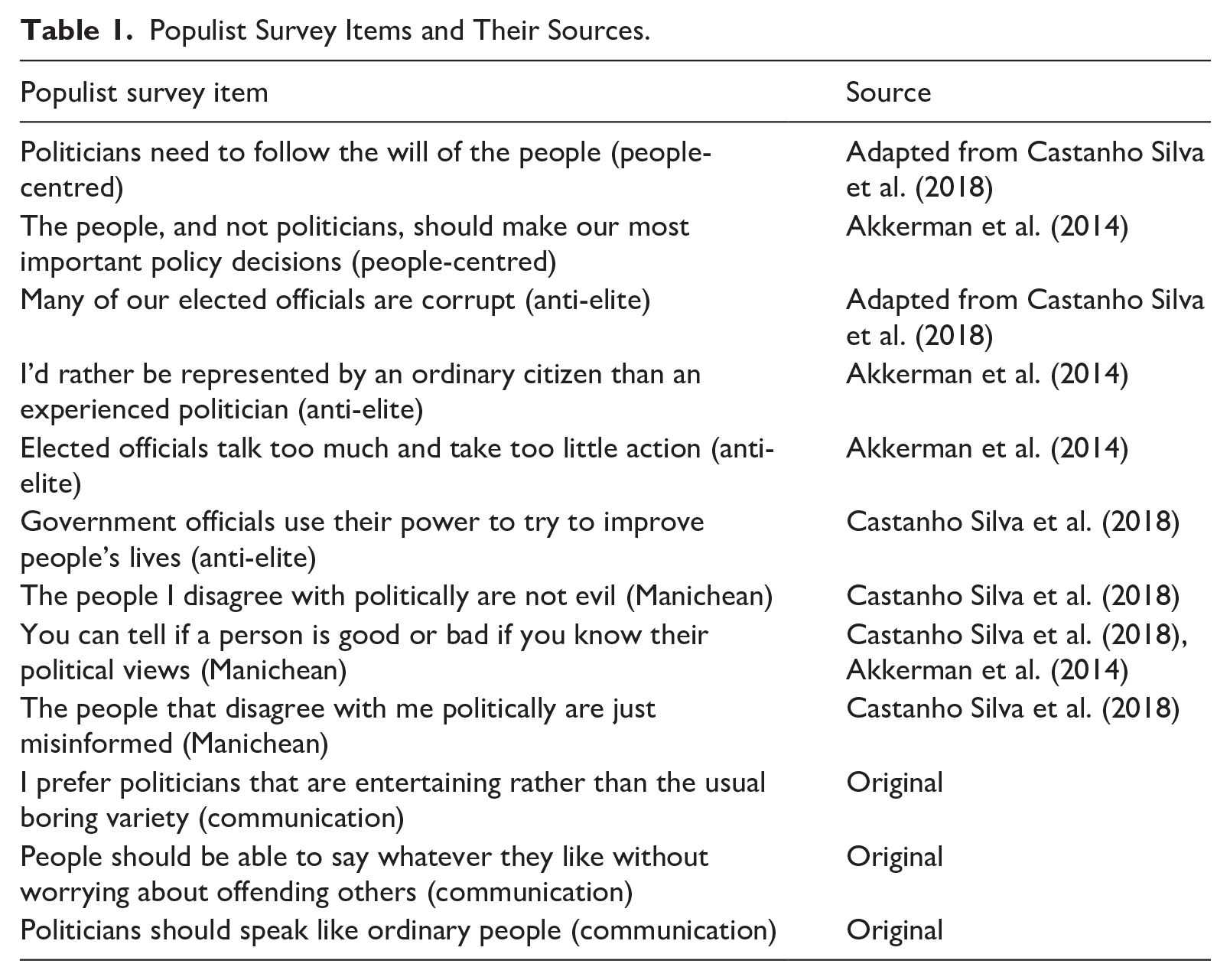
Given that this, to our knowledge, is the first time that attitudes towards populist communication have been conceptualised and measured, we relied on definitions of populism in the extant discursive-performative literature to develop our questions. We sought to discard questions that overlapped with already-existing ideational measures (e.g. discursive-performative scholars agree with ideational scholars on the divide between ‘the people’ and ‘the elite’ under populism) and instead focussed on developing measures that directly captured populism’s communicative and performative aspects, drawing specifically on the works of Jagers and Walgrave (2007), Moffitt (2016) and Ostiguy (2017). We also sought to develop measures that could be coherently translated from their supply-side conceptualisation to a demand-side measure. 6 Here, we asked questions about whether respondents preferred politicians who were entertaining compared to ‘the usual boring variety’, which sought to capture populism’s disruptive and media-centric political style; whether politicians should speak ‘like ordinary people’, which sought to capture populism’s alleged connection to and descriptive or symbolic resemblance of ‘the people’, as well as their communicative distance from ‘regular politicians’; and whether politicians should worry about offending people or whether they should ‘say whatever they like’, which sought to capture populism’s lack of adherence to discursive norms and their perceived heightened emotional appeal. While we do not claim these questions capture attitudes towards populist communication in toto, we believe that they proceed carefully from the literature on the topic, and can hopefully be refined and developed in future studies, just as occurred with ideational measures of populism.
In order to test our hypotheses, we fielded our questions as part of the Australian cooperative election study that also contained questions regarding a range of demographic characteristics as well as respondents’ political preferences and behaviours. This survey was fielded in May 2019 through YouGov Australia, who provided a non-probability sample based on their panel of volunteer survey respondents. Our sample was stratified by gender, age and region, and consists of 1049 respondents. 7 To test H1, that attitudes towards populist communication are distinct from those to populist ideology, we use principal axis factoring with promax (oblique) rotation. The principal axis factoring extracts the factors that best explain the covariance between the variables and the promax rotation allows for the interpretation of the results as it shows how the variables are weighted for each factor but does not optimise correlation between the factors. If our hypothesis is correct, the three populist communication items should load exclusively on one factor. We investigate the effect of populist communication and ideational attitudes on voting as well as the relationship between education, generational cohort and attitudes towards populist communication using standard regression models.
Australia is a good case to test this theory for a number of reasons. First, a prototypical populist radical right parties is present in the party system – Pauline Hanson’s One Nation. Formerly known just as One Nation, the fortunes of the party have fluctuated since the 1990s, but despite a decade and a half of poor performance, the party has regained a foothold in the Australian party system, and over the last 20 years has had in excess of 30 elected representatives in state and federal parliaments (Kefford, 2018). 8 Second, Australia is a multiparty system and this is important as we can test whether any of the sets of attitudes correlate with supporting a populist or non-populist party. This is useful as it can help us untangle whether voters supporting these parties are potentially voting this way because of dissatisfaction with the other parties, the system or because they hold populist attitudes. Given Australia’s use of compulsory voting, this is particularly important. Third, Australia is a suitable case for examining attitudes towards populist communication: as Moffitt (2017: 122) has argued, ‘populism has been relatively “mainstreamed” and diffused’ in Australia as a particular mode of political communication, with ‘appeals to “the low”’, ‘strong leadership and “ballsiness”’ (Moffitt, 2017: 135), political incorrectness and plain-spokenness being relatively common and celebrated as part of Australia’s political culture. 9 As such, it is a suitable environment for considering how widely distributed attitudes towards populist communication are, whether these are associated with populist ideational attitudes and whether such attitudes are only associated with populist voting or are rather evident across a wider group of voters.
The Role of Attitudes towards Populist Communication: The Analysis
In the first step of our analysis, we focus on the populist attitudes of the 1049 Australian respondents. We ran an unrestricted principal axis factoring analysis, which is a type of factor analysis that seeks the lowest number of factors – meaning clusters of variables – as possible, trying to account for as much of the correlation between the variables but without minimising the correlation between the factors. In this analysis, we include the populist ideational and communication variables as well as six items that measure anti-mainstream party attitudes and anti-mainstream media attitudes, which, although conceptually different, are related to populism. As is standard, we deem factors with an eigenvalue greater than 1 as significant, and Table 2 shows that this analysis results in five such factors. 10 They are ordered by their eigenvalue, meaning by how distinctly the survey items load onto the respective factor.
Principal Axis Factoring for Australian’s Populist Attitudes.
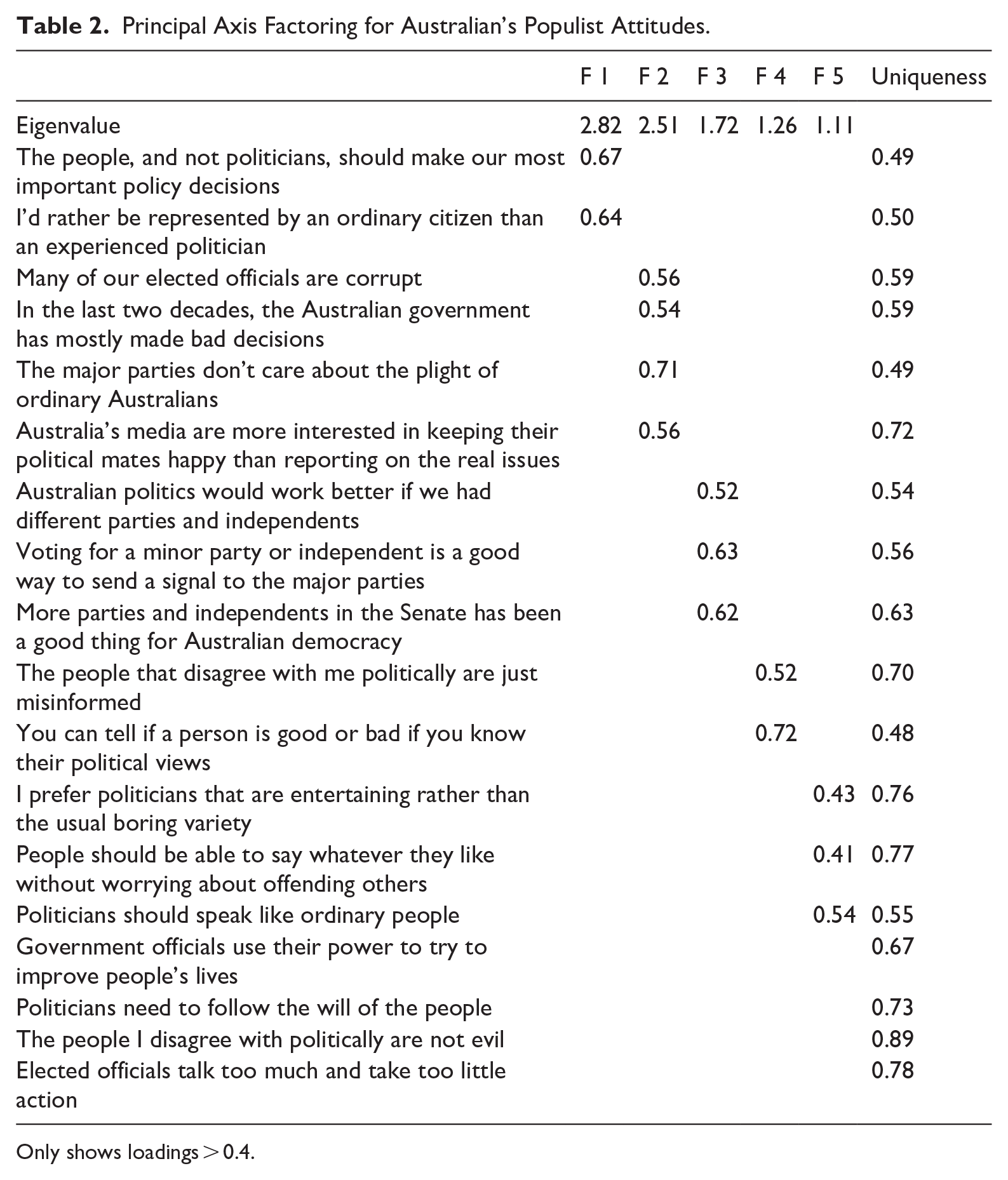
Only shows loadings > 0.4.
These results confirm our H1, that attitudes towards populist communication are distinct from those to populist ideology. All three populist communication items load on factor 5 and none of the populist ideology items load on the same factors. At the same time, we find three expected populist ideational factors: Factor 1 includes those items referring to a people-centred style of representation, factor 2 entails anti-elite sentiments and factor 4 includes those attitudes that speak to a Manichean outlook. Interestingly, factor 3 creates a cluster of variables that might be specific to the Australian majoritarian system, as it includes those items that refer to anti-mainstream party attitudes and preferences for minor parties. As this does not fall under the strict definition of populism, we will exclude factor 3 in the remainder of the analysis. Four other items do not load sufficiently on either of the factors and are subsequently excluded as well. Among these items is the statement regarding the will of the people, which should theoretically be connected to people-centredness but empirically loads onto multiple factors weakly. Descriptive statistics for the four populism factors can be found in Table A3 and Figure A1 in the Supplemental Appendix.
To test H2, that attitudes to populist communication and populist ideational attitudes are related, we calculated the factors’ scores by averaging the respondents’ values for the items in each factor and then correlate the four scores. This analysis shows that we cannot reject the null hypothesis of H2 as all factors correlate at a statistically significant level (p < 0.001), but that the theorised connection between the populism factors is weak (see Table A1 in the Supplemental Appendix for all results). The relative strongest correlation for the populist communication score is with people-centredness (corr = 0.35), followed by the correlation with anti-elite attitudes (corr = 0.24) and weakest with Manichean outlook (corr = 0.11). These weak correlations are a first indication that research on populist attitudes might be missing an important component if it neglects the role of populist communication. It also indicates, in line with our theoretical discussion, that one can hold positive views towards a populist style of communication without making the stronger commitment to holding populist ideational attitudes – that is, having a populist ideology.
To further test the unique contribution of the four factors, we conducted a confirmatory factor analysis using a structural equation model (see Table A2 in Supplemental Appendix). We tested the contribution of our four factors for the underlying concept of populism and found that all factors contribute. While the people-centredness and anti-elite factors, unsurprisingly given our general knowledge of populist attitudes, contribute the most to the underlying populism concept, populist communication contributes more than the Manichean outlook factor. These results are further confirmed using Item Response Theory to measure the contribution of the four factors for the latent populism concept (see Figures A2 and A3 in the Supplemental Appendix).
In the next step of our analysis, we further investigate the role of attitudes towards populist communication by testing H3, which hypothesises that this factor has an effect on populist radical right voting and strengthens the effects of populist ideology. Thus, we use a logit regression model to predict the respondent’s probability to vote for One Nation, the main Australian populist radical right party. 11 We first assess the effect of our four populism dimensions independently and then run models interacting each populist ideational subdimension with attitudes towards populist communication to test whether the latter indeed strengthens the former. In all models, we include a range of demographics as control variables. Table 3 shows four models with the results presented as odds ratios (ORs), which indicate a positive effect if the values are greater than 1 and a negative effect for values smaller than 1.
Predicting One Nation Vote with Populist Attitudes.
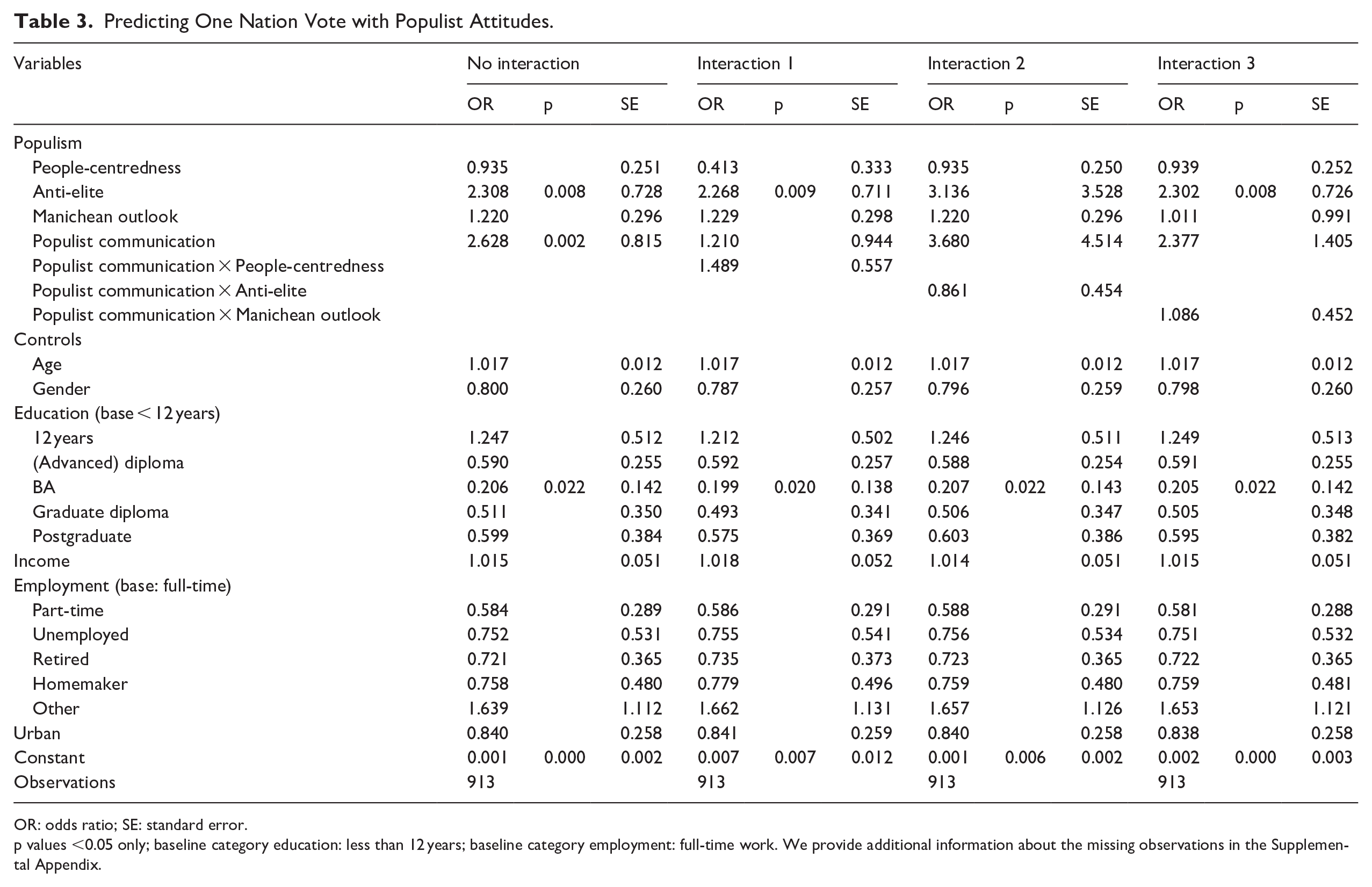
OR: odds ratio; SE: standard error.
p values <0.05 only; baseline category education: less than 12 years; baseline category employment: full-time work. We provide additional information about the missing observations in the Supplemental Appendix.
The first model in Table 3 shows that both anti-elite attitudes and attitudes towards populist communication increase the likelihood of our Australian respondents voting for the populist radical right One Nation party. The other two populist ideology subdimensions, on the contrary, do not seem to have such an effect. At the same time, the results in Table 3 also show that once we interact attitudes towards populist communication with the ideational dimensions, the main effect of the former also loses its significance and all interactions appear as non-significant as well. Thus, we can conclude that while populist communication indeed has an effect on populist radical right voting, it does not strengthen the effect of the ideational dimensions.
The strong and independent effect of attitudes towards populist communication is confirmed when we combine the three ideational attitude dimensions into one dimension by averaging all items that load onto people-centredness, anti-elite and Manichean outlook. Table 4 compares the results and shows that both the combined ideational populism and the populist communication dimension have a significant effect on the likelihood for One Nation voting and that the effects are of the same size. Yet again, the interaction is not significant. Thus, we reject H3, that populist communication increases the effect of populist ideational attitudes, but find that attitudes towards populist communication independently contribute to the explanation of populist radical right voting. 12 This, again, stresses the importance of including populist communication in attitudinal research.
Predicting One Nation Voting with Populist Ideational and Communication Dimensions.
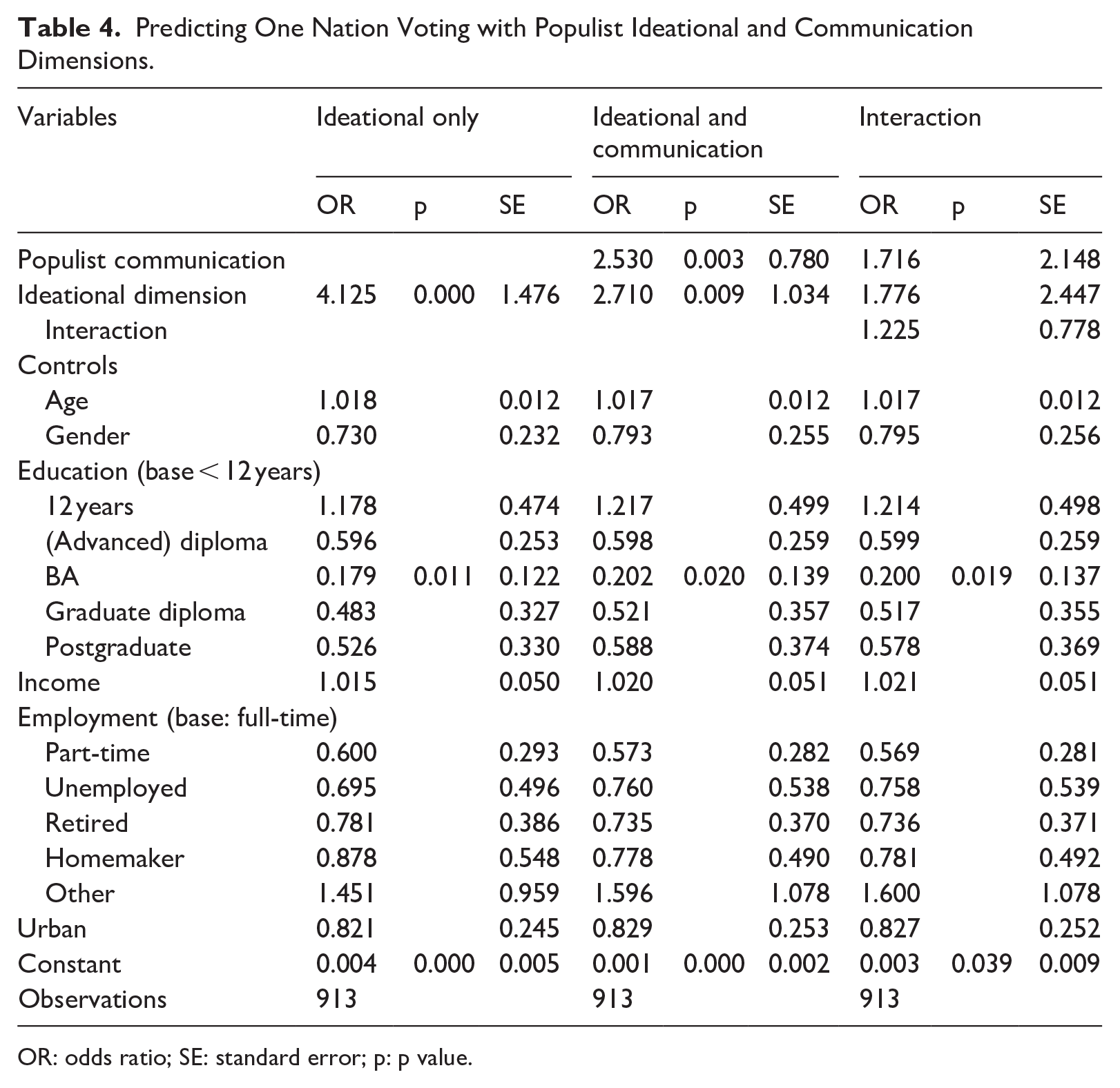
OR: odds ratio; SE: standard error; p: p value.
In the final step of our analysis, we test H4 and H5, investigating whether attitudes towards populist communication are as similarly dependent on respondents’ education level and generational cohort as has been previously theorised to be important (Norris and Inglehart, 2018). To test this, we run four models that each test one of our populism dimensions and use the respondents’ education level and generational cohort 13 as our main independent variable. Furthermore, we add gender, income and urban residency as demographic controls, as well as satisfaction with democracy and respondents’ party choice as common political correlates of populist attitudes. 14 We use simple ordinary least squares (OLS) regressions to analyse their relationship with the populist dimensions.
Table 5 confirms that higher levels of education are indeed connected to lower attitudes towards populist communication, in particular for the two groups with university degrees (BAs and postgraduate studies). Thus, we find evidence in line with our H4. We find very similar results for people-centredness and anti-elite attitudes, which also fit with the broader literature on education (Ivarsflaten and Stubager, 2012; Norris and Inglehart, 2018). Only the agreement to the Manichean outlook is an outlier. Education has no effect on this populist dimension, but those respondents with the highest education levels have a slightly higher agreement to the Manichean outlook than those with the lowest level of education.
Education, Generations and Populist Attitudes in Australia.
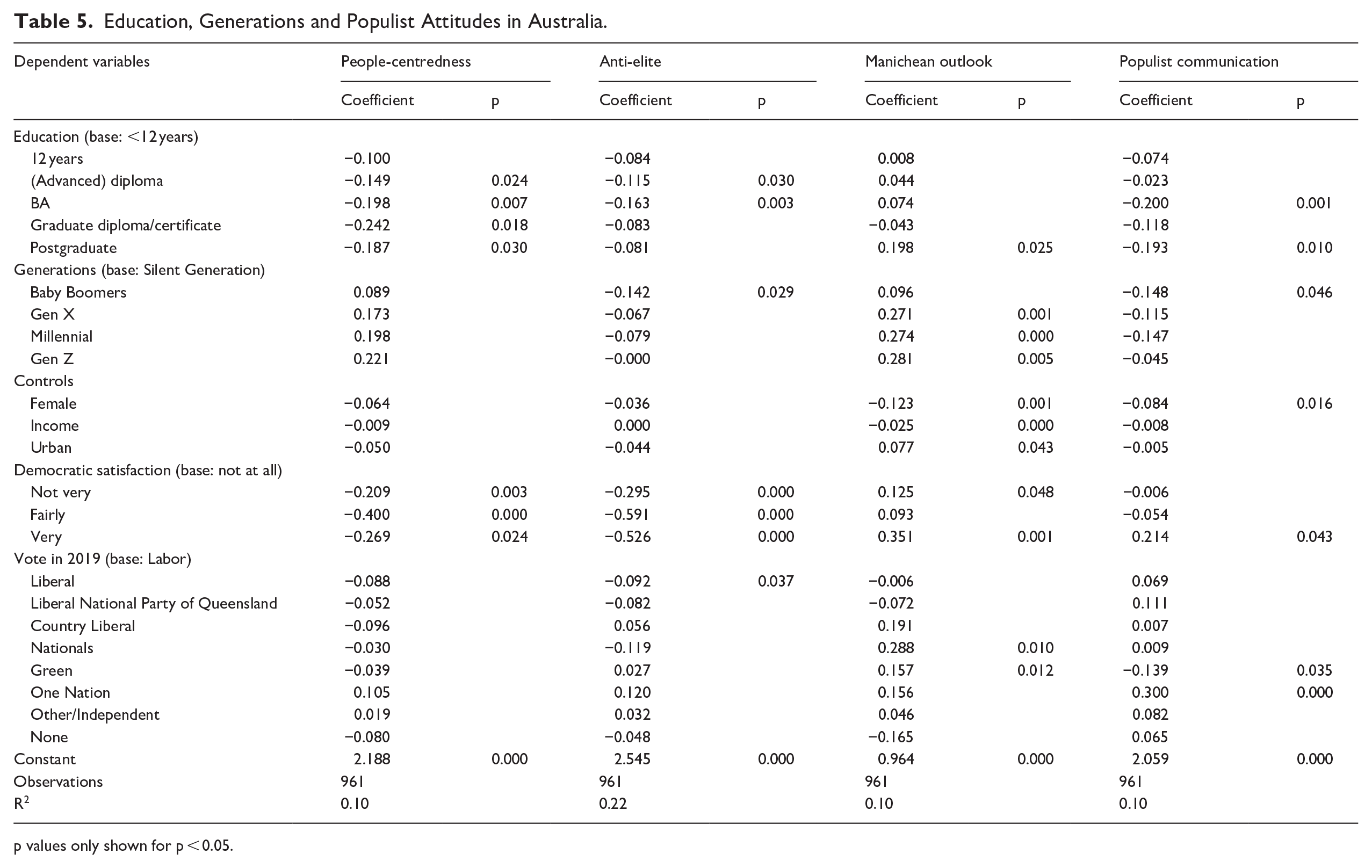
p values only shown for p < 0.05.
When investigating H5 regarding generational difference, we do not find the theorised specificities of particular generations. None of the younger generations are more or less people-centred than the Silent Generation. For anti-elite attitudes, we see that Baby Boomers are slightly less anti-elite than the Silent Generation. When we change the model to leave Baby Boomers as the reference category, the results confirm that there is a difference between this and the younger generations. Table 5 also shows that there are few generational differences in terms of attitudes towards populist communication, with younger generations being slightly less populist on this dimension. When we use Baby Boomers as a reference, there are no differences between them and the younger generations. Thus, there seems little indication that populism is a generational cleavage in Australia, either on an ideational or communicative attitudinal dimension.
The Manichean outlook measure also does not support this theory, as all generations but the Baby Boomers score higher than the Silent Generation (again when changing the reference category), with Gen X (coefficient = 0.19, p = 0.000), Millennials (coefficient = 0.19, p = 0.000) and Gen Z (coefficient = 0.20, p = 0.011) all having stronger Manichean outlooks than Baby Boomers. Similar patterns in the independent variables connected to the Manichean outlook can be found in the effect of satisfaction with democracy and voting behaviour, particularly in the case of Greens voters. Generally, we would not expect more satisfied respondents or Greens voters to have attitudes associated with populism. However, given that the subdimension of Manichean outlook is primarily about certainty in one’s political views as ‘correct’, and opponents’ views as both objectively and morally wrong, we suspect here that Greens voters’ certainty about their views (particularly on the topic of climate change) may play into this.
The same may be said for higher educated respondents, who may similarly feel that they have more certainty in their views due to being able to corral more ‘evidence-based’ rationales for their beliefs. 15 When it comes to those with a Manichean outlook who are also ‘very satisfied’ with how democracy works in Australia, we suspect that the combination of Australia’s preferential voting system together with its increasingly wide array of minor parties and independents may mean that respondents may feel that their views, even if they are Manichean, are fairly represented in Australian democracy.
Interestingly, those who were very satisfied with democracy in Australia had a significantly higher attitudes towards populist communication than those with who were not at all satisfied with democracy. While this initially puzzled us, we suspect that the relatively ‘mainstreamed’ status of populism as a mode of political communication and style in Australia (as noted by Moffitt, 2017) may contribute to this: if one prefers political representatives that speak plainly, are entertaining and who purport to say whatever they like in the name of ‘the people’, you are well-served in the Australian political landscape, which may contribute to satisfaction with Australian democracy.
Conclusion
The literature on populist attitudes is a burgeoning area of the scholarship for those studying populism. While most published work focusses on understanding attitudes linked to the ideational approach, this article is the first to explore the ways that attitudes towards populist communication affect voting behaviour, including how they interact with populist ideational attitudes. We have demonstrated that attitudes towards populist communication are significant in the Australian case in a number of ways. First, we have shown that attitudes towards populist communication exist independently of populist ideational attitudes. This is notable and suggests that measures related to populist communication should be incorporated into, or at least considered in, future analyses of populist attitudes. This may take the form of how the measures have been explored here, whereby ideational attitudes and attitudes towards populist communication are considered separately and with regard to how they interact, or potentially in the form of an ‘expanded’ measure of populism that takes in both ideational and stylistic dimensions – something that has not been our intention to construct here, but is a possible way forward. Our preliminary analysis, necessarily restricted by the availability of these data in only one country, indicates that attitudes towards populist communication make an independent contribution to the measurement of latent populism attitudes. Our measure also provides a pilot for scholars working in the discursive-performative tradition of populism who wish to undertake further analyses in the growing area of populist attitudes, without necessarily embracing an ideational understanding of the phenomenon. Second, we demonstrated that attitudes towards populist communication correlated to at least some of the expected demographic and behavioural variables as had been previously theorised to be linked to populism. In particular, respondents with non-university education levels scored highly on the measures related to populist communication, while other demographic variables such as income and gender were not significant predictors of holding higher attitudes towards populist communication. Third, we found that attitudes towards populist communication have a strong independent effect on populist radical right voting, even when tested against a combined ideational dimension. However, we do not find interaction effects with the populist ideational attitudes. This opens up significant space for theorising the linkages between ideology and communication when it comes to populism. Finally, we do not find evidence among Australian respondents that populist attitudes form a clear divide between the generations or that young people are particularly anti-populist.
One particularly surprising finding from this study is the correlation between those who hold high attitudes towards populist communication and satisfaction with democracy. Whether this is somewhat or entirely unique to Australia or whether this would change in future Australian surveys is a puzzle worth exploring. Australia’s brand of politics certainly provides a fertile ground for populists, but this finding suggests that it also satisfies the appetite of those who are attracted to populist communication. The potential empirical and theoretical insights that could be derived from further unpacking this puzzle are worthy of further attention. This would provide some clues as to whether populist communication on the supply side may actually have a positive effect on democratic satisfaction, and whether this varies across different contexts and political cultures. Another potential avenue for future research is exploring how attitudes towards populist communication correlate with not just income or education but relative deprivation. There is good reason to assume that those who feel their ‘group’ is worse off compared to others may be more likely to not only provide support for populist ideas, but populist communication from their representatives as well. A final potential path for future research is exploring how attitudes towards populist communication may interact differently for voters for populist left and populist right parties. While we have indications here about their effect on populist radical right voting, Australia does not have a populist left party, so it would be valuable to test such measures in a context where both party types are present to consider if they are associated with one side of the ideological divide more than the other.
Inevitably, there will be criticisms of the items we have used to explore attitudes towards populist communication or how generalisable these findings are to other advanced democracies – critique that we very much welcome. In this light, we suggest that if a similar process of clarification and refinement is undertaken in regard to attitudes towards populist communication as has happened with populist ideational attitudes (see, for example, Van Hauwaert et al., 2019), populism studies would be stronger for it. The focus on a single case here means that there will always be limitations to how generalisable our findings will be to other advanced democracies. Nonetheless, given the global nature of populism, we argue that the empirical and theoretical findings presented here are significant for scholars interested in the phenomenon, whether they are interested in populism in North America, South America, Europe or Asia, and we hope to see future studies that build on this initial exploratory study.
Footnotes
Declaration of Conflicting Interests
The author(s) declared no potential conflicts of interest with respect to the research, authorship, and/or publication of this article.
Funding
The author(s) disclosed receipt of the following financial support for the research, authorship, and/or publication of this article: The authors would like to thank the Australian Research Council for their generous support and declare the following funding from the Australian Research Council that has supported this project: Kefford (DE190100210) and Moffitt (DE190101127). Moffitt would also like to thank the Marianne and Marcus Wallenberg Foundation for project funding (project MMW.20180035).

Supplementary Information
Additional Supplementary Information may be found with the online version of this article.
1. Additional information for Analysis 1. Table A1a: Correlation table of populism items (see table 1) with significances. Table A1b: Correlation table with significances for populism factors. Confirmatory factor analysis for 4 factors. Table A2: Confirmatory factor analysis for underlying populism construct. 2. Descriptive statistics for the four populism dimensions as well as additional populist ideational dimension and overall populist score. Table A3: Descriptive statistics. Figure A1: Box plots for populism dimensions. 3. Missing data in voting model. 4. Item Response Theory: Contribution of populist communication to an overall populism score. Figure A2: Test Information for the whole populism score. Figure A3: Contribution of the communication dimension to the populism score. 5. Replication of voting model with overall populism score. Table A4: Radical right voting and ideational vs overall populism scores. 6. Marginal effect plots for interactions in table 3.
Notes
Author Biographies
References
Supplementary Material
Please find the following supplemental material available below.
For Open Access articles published under a Creative Commons License, all supplemental material carries the same license as the article it is associated with.
For non-Open Access articles published, all supplemental material carries a non-exclusive license, and permission requests for re-use of supplemental material or any part of supplemental material shall be sent directly to the copyright owner as specified in the copyright notice associated with the article.
