



Abstract
Decades of evidence point to the vital role of parents in shaping their children’s partisan leanings, particularly concerning mainstream parties. And yet the contours of intergenerational influence remain quite obscured. For instance, scholars disagree on when social learning in the household occurs (childhood vs adolescence) and about who is the dominant socializer (mother vs father). Data from a long-term German household panel survey allow for a fine-grained examination of intergenerational influence processes over time. We model the partisan preferences of 18-year-olds as a function of their mothers’ and fathers’ own contemporaneous and past partisan preferences. Our intergenerational inquiry reveals that mothers dominate socialization during childhood while influence in late adolescence is more evenly distributed between mothers and fathers. We also find that mothers have an advantage over fathers in communicating center-left party preferences. These findings have implications for our understanding of socialization, partisanship, and democratic stability.
Recent decades have witnessed the diminishing popularity of mainstream political parties in many advanced democracies (Colombo and Dinas, 2022; Dalton, 1998). Furthermore, the decline of mainstream parties has come in tandem with the rise of new electoral competitors, most notably far-right anti-establishment populists (Arzheimer, 2018). These are critical developments, largely because moderate, centrist political parties are understood to be essential features of stable democratic systems. While scholars have channeled vigorous energy into understanding support for new political parties, we believe that these electoral trends elevate the importance of understanding how people develop attachments to mainstream parties.
With a renewed focus on what factors drive support for centrist political parties, an essential line of inquiry is the development of partisanship early in life. When young individuals feel connected to political parties, such affiliations tend to be relatively stable across the life course in Europe and the United States (Converse and Dupeux, 1962; Sears and Valentino, 1997). Much of our understanding of how young people learn about and situate themselves in relation to politics stems from classical research on political behavior, which tells us that partisanship is rooted in the family (Easton and Dennis, 1967). We build on this stylized fact to gain fresh insight into the sources of mainstream partisanship. This seems especially relevant to modern developments since the movement away from established center-left and center-right parties stems partly from new generations exhibiting divergent partisan patterns from past cohorts (Bacovsky, 2021; Henn et al., 2005). Thus, further exploring how political socialization at home operates in the modern era is essential. 1
We focus our attention on gaining insights into aspects of household political influence that previous studies have not explored. Notably, existing work has not pinpointed the ages at which young people are most open to parental partisan influence. Some theories emphasize effects in the “formative” years of childhood (Abendschön and Tausendpfund, 2017; Goetzmann, 2017). Others point to adolescence—also known as the “impressionable” years—as prime time for household socialization (Jennings et al., 2009; Peterson, 1983). Moreover, the relative roles of mothers and fathers, particularly at different points in a young person’s life, are unclear. We leverage long-term household panel data from Germany to tease out the diverse effects of family socialization on young citizens’ partisan leanings. These data allow us to model a person’s party choice at 18 as a function of their parents’ answers about their own partisanship from the current year (when the young person turns 18), as well as the 12 previous years. This provides contemporary influence measures and household partisan history dating back over a decade to offer insight into the impressionable years in comparison to the formative years. By leveraging the data in this manner, we are able to look back into an individual’s upbringing in an uncommonly detailed way, establish how deep the partisan roots run, and how they are best nurtured (see Bacovsky and Fitzgerald, 2021 for a similar approach). 2
Through our analysis, we find evidence in support of both formative years and impressionable years theories of political socialization. Eighteen-year-olds’ party choices reflect the contemporaneous partisan preferences of their parents. Yet, also find that parents’ past party support at different phases of a young person’s development significantly influences the next generation’s partisanship, and that these effects vary by the parent involved. Notably, influence by fathers is nearly entirely contemporaneous; 18-year-olds tend to get their partisan cues in real-time from their fathers. The maternal influence is concurrent in some instances, but mothers dominate partisan socialization during their offspring’s childhood. This finding supports a well-established canon of the literature, highlighting the role of mothers in the early socialization of children (Bao et al., 1999; Jaspers et al., 2008).
We also find some evidence that the socialization of left-leaning partisanship operates differently than that of right-leaning partisanship. The primary distinction is that mothers are more successful at engendering support for the center-left in their children, while fathers tend to dominate center-right partisanship influence. This analysis sheds light on previously obscured processes of household partisan influence.
Family as a Source of Partisanship
Interactions within social networks shape the political behavior of individuals in a range of ways across an array of national contexts (Boonen, 2019; Fitzgerald and Curtis, 2012; Huckfeldt, 1979, 1983; Lazarsfeld et al., 1944; Weatherford, 1982; Zuckerman et al., 2007). Based on data from the United Kingdom, Pattie and Johnston (2000) observe that “people who talk together vote together.” Regular social interactions lead to shared partisanship, and the effect is so powerful that it can produce party identification switches among members of neighborhood networks (Johnston and Pattie, 2005; Pattie and Johnston, 2000). Similar effects have been shown in Germany (Kohler, 2005), Switzerland (Fitzgerald, 2011), Mexico, and Brazil (Baker et al., 2020). The influence of social networks on producing shared preferences is based on the premise that individuals prefer to avoid cognitive dissonance (Festinger, 1962). Discussants within the same social networks adjust their attitudes to correspond with their alters (Huckfeldt and Sprague, 1988, 1991).
Decades of past work also demonstrate that families are the paramount actors in this social environment. Family is a significant factor in the shaping of political attitudes because parents present clear examples that the offspring can emulate (Hess and Torney, 1967; Hooghe and Boonen, 2015; Jennings et al., 2009; Percheron and Jennings, 1981; Rico and Jennings, 2016; Westholm and Niemi, 1992). Although not without its challengers (see, e.g. Dinas, 2014), a wealth of research points to the profound effects of parental household factors on the formation of people’s basic orientations toward political parties in many country contexts (Abendschön and Tausendpfund, 2017; Bacovsky and Fitzgerald, 2021; Beck and Jennings, 1982; Converse, 1969; Davies, 1965; Easton and Dennis, 1967; Jennings and Niemi, 1968; Jennings et al., 2009; Ventura, 2001).
When Does Influence Take Place?
And yet, while the argument that families play a significant role in fostering young people’s political attitudes is accepted, the debate over the when of familial influence is far from settled. In the past 60 years of scholarship, two major schools of thought have emerged: (1) the formative years model, and (2) the impressionable years model. The formative years model builds on research in developmental psychology, which shows that children develop their concepts of sociality by the age of 12, and parents play a crucial role in fostering this process (Burman, 2016). Erikson (1959, 1963, 1968) and Erikson and Erikson (1998) argue that the school age is essential for forming a child’s sociopolitical attachments. During this period, children frequently seek their most immediate role models, namely parents, to learn and emulate social roles. Barrett (2013) observes that children develop attitudes toward specific groups (ergo, their social identity) very early on, having solid political orientations by the time they enter first grade (Van Deth et al., 2011). Similarly, both Abendschön and Tausendpfund (2017) and Goetzmann (2017) indicate that children are politically socialized early on in their families and that even education cannot overcome this effect. Rudimentary understanding of party identification is included in this bundle of early political socialization (Lignier and Pagis, 2017).
However, not everyone in the discipline agrees that the crux of political socialization takes place during childhood and early adolescence. This opposition rests mainly on the argument that children and young adolescents cannot make the cognitive links necessary for forming political preferences and that scholarship should focus on adolescents instead (Peterson, 1983; Peterson and Somit, 1982). Although Beck and Jennings (1975, 1982) and Jennings et al. (2009) agree that parents matter in the process of political socialization, studying the mechanisms in later adolescence is generally preferred. Similarly, Fox and Lawless (2014) focus on the effects of experiences in high school and college in their research on the gender gap in political ambition.
Relative Effects of Mothers and Fathers
The debate over the most propitious moments for partisanship to sink in is lively and ongoing, even among those who subscribe to a socialization-based understanding of political attitude formation. However, our scope goes beyond merely looking at the when of family influence. Our argument can also contribute to the who of partisanship socialization. Parents are not a singular unit. Indeed, the presence of two parental figures—most often a mother and a father—impacts the nature and form of socialization.
Researchers find that mothers play an influential role in shaping their children’s partisan choices across a range of countries (Beck and Jennings, 1975; Coffé and Voorpostel, 2010; Jennings and Niemi, 1974; Wernli, 2007; Zuckerman et al., 2007), most notably toward mainstream parties in multiparty systems (Fitzgerald, 2011). The reasoning offered for the relative weightiness of mothers’ influence has traditionally been about time spent together and emotional closeness (Acock and Bengtson, 1978; Degner and Dalege, 2013; Jaspers et al., 2008; Jennings and Langton, 1969; Van Ditmars, 2022; Zuckerman et al., 2007).
In contrast, more recent work suggests that there are no significant differences between mothers and fathers in terms of influence strength today, perhaps due to modern fathers’ more hands-on parenting compared with previous generations (Meeusen and Boonen, 2022). Collectively, these works motivate questions about the timing of maternal and paternal influence that have not yet been explored. For instance, if mother–child closeness is the key to maternal impact, we might expect a more significant effect of mothers earlier in life. We might also find that these parental differences have become less visible across the years.
Beyond the simple dichotomy of which parent exerts the most politically relevant influence over a family’s next generation, some existing work adds nuance to the picture. For instance, studies suggest that mothers and fathers socialize their children differently. Differential influence effects between mothers and fathers have been found for the formation of prejudice (O’Bryan et al., 2004) and political values (Meeusen and Boonen, 2022). These works suggest that mothers and fathers effectively transmit distinct kinds of messages, which are likely to influence the partisan choices of their children.
Influence on the Left versus Right
We find these qualitative differences between maternal and paternal effects intriguing. They further guide our thinking about how mothers and fathers might transmit partisanship of the ideological left and right. Left-leaning partisanship tends to emphasize collectivism, while right-leaning partisans are more aligned with an individualist mind-set (Feldman, 1988). Therefore, mothers may be more significant in fostering affiliation with left-leaning parties and movements. Boonen (2019) finds that strong party support among mothers is more influential than that of fathers in shaping support for the Socialist Party in Belgium, while fathers are more influential on adolescents’ support for the Christian Democrats. Meeusen and Boonen (2022) find that mothers—relative to fathers—are more effective in transmitting Green party support and less influential in transmitting center-right support in Belgium. Additional work buttresses this expectation. Mothers tend to emphasize pro-social behaviors in interactions with their children, while fathers focus more on independence (Kosterman et al., 2004; Power and Shanks, 1989).
Van Ditmars (2022) argues that socialization studies must distinguish between the left and right, as distinct processes can be found, particularly in relation to gender. She finds that mothers have a slight lead over fathers in transmitting left-leaning ideology in Germany. This echoes classic work on German partisanship that identifies distinct patterns of family influence on the left versus the right (Baker, 1974). Yet, all these studies use contemporaneous data that do not facilitate observation of household influence as it unfolds while a child grows up. More broadly, much work on political influence within families collapses left and right into a single “agreement” measure. While this decision has its benefits in certain studies, it prevents investigation of how such processes may differ across partisan objects (see, e.g. Jennings et al., 2009; Murray and Mulvaney, 2012).
Our Approach
Taking these works together, we develop a strategy of disaggregating household political influence to a greater degree than other studies have done. The classical approach to studying political socialization is to look at youth and their parents at one point in time, collapse parents into a single unit (or only study one parent), and collapse left and right into measures of parent–child agreement. In contrast, we model parental influence over time, we model mothers’ and fathers’ characteristics individually, and we examine left-leaning partisanship in comparison to right-leaning partisanship in terms of how they develop. These choices allow us to test theories associated with when political influence takes place, who is doing the influencing, and what are the objects of influence.
Of course, careful scholarship requires attention to competing bodies of theory. A sharp counterpoint to the socialization hypotheses discussed above proposes that observed intergenerational partisan correlations are the function of spurious relationships rather than causal processes. This argument resonates strongly among scholars who subscribe to the rational choice model of political attitude formation, albeit not exclusively (see, e.g. Achen, 2002; Downs, 1957; Gerber and Green, 1998). At the core of this argument is the assertion that people share their parents’ partisan preferences because of their shared interests. These individuals use parents’ partisan cues to establish which party they should sensibly support in the context of their rational self-interest, and they form or perhaps update their party preferences based on the reception of this parental information. Our models account for this possibility, leveraging information on household socioeconomic status. We also engage theories that emphasize how large-scale social events that characterize “the times” shape the political views of all household members (see Sears and Brown, 2013; Sears and Valentino, 1997). To do this, we include contextual controls associated with the timing of each survey wave.
To summarize our expectations: per the “formative years” hypothesis, we predict that political influence occurs when individuals are relatively young. We also expect that mothers will have more impact than fathers on young children and that mothers will have more influence on the political left than the right. We expect these results to be robust to controls for socioeconomic status and contextual controls.
Data and Methodology
Our study is based on German survey data. Germany is a valuable case study for our research for several reasons. The party system carries essential properties that make the case highly informative in the broader context of comparative politics: (1) diversity of party offerings, with dominant center-left and center-right parties; and (2) stability of the party system. German political behavior is also quite similar to its fellow advanced democracies in its levels of partisan affective polarization (Reiljan, 2020), levels and stability of political interest (Prior, 2010), and levels of partisanship (Dassonneville and Hooghe, 2018). We reason that our findings will be generalizable to other Western European democracies. And yet Germany’s history of inter-war electoral tumult and the recent—though modest—decline in support for its mainstream parties make it an especially important political system to understand.
On the practical side, Germany is a valuable case study due to the unparalleled German Socioeconomic Panel Survey (GSOEP). The GSOEP survey provides 35 years of panel data. The survey has been conducted annually since 1984, and each member living in the household is interviewed. Young people start participating in the survey at the age of 17. Here, we study their political party support at the age of 18: the voting age and the age of majority in Germany. We work with 1678 observations that span 1984–2019. 3 The parents of our research subjects have been surveyed individually for many past years, providing insight into the dynamics of household partisanship surrounding each young person while they were growing up. In a recent publication, we refer to this mode of analysis as the “retrospective family context” approach (Bacovsky and Fitzgerald, 2021). It allows researchers to peer backward in time in a granular way to view the history of parental partisanship in a youth’s household. 4
Our dependent variable, which we utilize to examine how parental partisan support at different stages of a person’s life affects their partisanship at the age of 18, is based on the following survey question: “Many people in Germany lean towards one party in the long term, even if they occasionally vote for another party. Do you lean towards a particular party?” If so, then the respondent identifies the party they support most.
Our dependent variable is dichotomous and coded on a 0, 1 scale for a party X at time t. Value “0” means an 18-year-old respondent does not support party X, while “1” means they do. Included in the “0” category are those who state that they do not support any party and those who support a different (non-X) party. 5 Our analysis focuses on support for the main center-left party, the Social Democrats (SPD), and the main center-right party, the Christian Democrats/Christian Socialists (CDU/CSU). 6 We model support for these parties separately, in line with past work on household/social partisan influence (Baker et al., 2020; Visser and Mirabile, 2004; Zuckerman et al., 2007).
Our key independent variables, which measure party support among young respondents’ parents, are operationalized similarly. For each parent, we record whether they support a particular party (X = 1) or not (X = 0). 7 We include in our models parental partisanship at time t (when the respondent is 18 years old) to assess the contemporaneous correlation between a young person supporting party X and their parents supporting the same party. We then include parental party support at t − 4 to gain insight into the effect of parental party support when the respondent was a younger teen (age 14), t − 8 to measure parental partisanship during a young person’s tween/late childhood years (age 10), and we include parental partisanship at t − 12 to gain insight into parental partisanship during the childhood years (age 6). We base these lags on existing research on human development, which distinguishes between childhood (ages 6–12) and adolescence (ages 13–19) (see Burman, 2016; Piaget, 1972).
To address factors external to the family, we include a series of control variables derived from alternative theories of party support. Resource-based theories underscore the importance of income for guiding party choice (Bartels, 1986; de Vries et al., 2013; Han, 2016; Peterson, 2016). Therefore, we control for Household income. 8 Party support is also highest around the time of elections (Gelman and King, 1993), so we include a dichotomous variable that denotes whether a particular survey wave takes place during a federal election year. As noted in our introductory section, support for any political party has declined in recent years. Hence, we include a time variable that denotes the actual year of the relevant survey wave. Finally, contextual studies demonstrate that a party’s strength in an area can shape people’s partisan leanings (Noelle-Neumann, 1993; Pattie and Johnston, 2000). Therefore, we include a measure of the percent of the vote the relevant party received in the most recent federal election.
We use logit models with standard errors clustered by household identification numbers to address the household nature of the sample (some of our young respondents are siblings). To simplify the interpretation of the logit coefficients, we use the Clarify package to calculate the predicted change in probability of supporting a particular party when shifting a particular independent variable from its minimum to its maximum value (Tomz et al., 2003). We present these in our tables in the column beneath the ∆ symbol and in the text where relevant.
Results
We present two tables, each containing two models of partisan support of 18 year-olds. Table 1 examines contemporaneous patterns. It displays the estimates of parental party support at time t on their child’s party support at time t. Mothers and fathers shape a young person’s choice to support the center-left (C/L) SPD and the center-right (C/R) CDU. Per these models, mothers are more influential than fathers, but their role is stronger on the left than on the right. Indeed, relative to fathers, mothers tend to dominate influence on the left by a sizable margin; the probability that an 18-year-old, whose mother supports the SPD is 0.420 points more likely to do so (on a 0–1 scale) than an 18-year-old, who does not support the SPD. In contrast, fathers have a slight advantage over mothers on the right. We also note that parental influence on the left is stronger overall than on the right. 9 We see in these models that factors associated with household socioeconomic status and broader societal context do not have measurable effects on party support among 18-year-olds.
Parents’ Contemporaneous Partisan Support and 18-Year-Old’s Partisan Support.
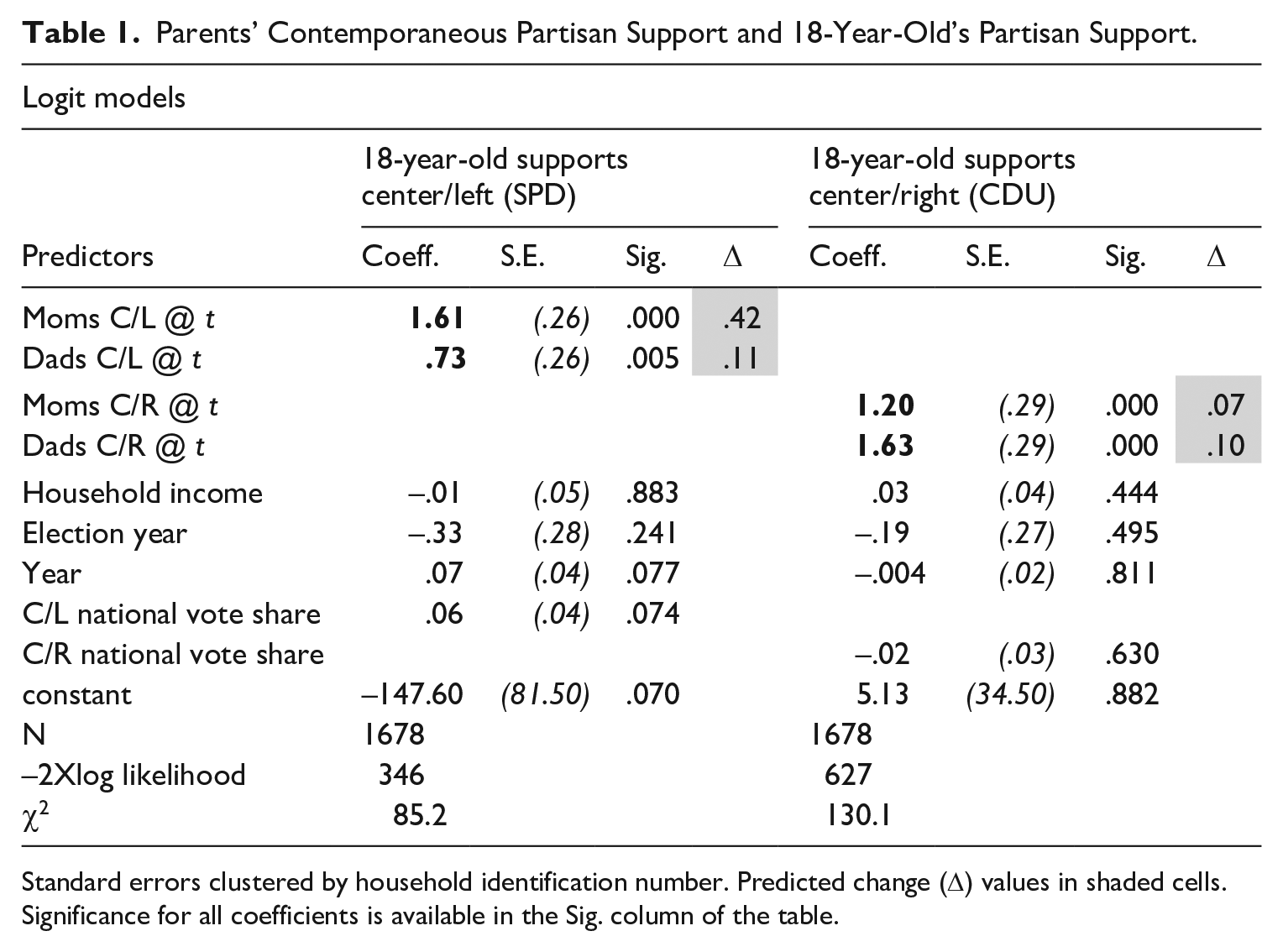
Standard errors clustered by household identification number. Predicted change (Δ) values in shaded cells. Significance for all coefficients is available in the Sig. column of the table.
These first models begin to help us understand patterns associated with who is the most relevant parent and how right and left-leaning influence looks different when comparing mothers and fathers. To advance the analysis, we supply a second pair of models that include lagged parental partisanship measures. Each model contains eight parental independent variables: four associated with mothers and four associated with fathers. For each parent these are: (1) contemporaneous party support (at time t); (2) a 4-year lag back to when the child was 14 years old (a look back into the teen years); (3) an 8-year lag back to when the child was 10 years old (a peek into late childhood years); and (4) a 12-year lag back to when the child was 6 years old (into the early childhood years).
In Table 2, we see evidence of both contemporaneous and rooted correlations, signaling that young people learn from their parents both in their late teens and in childhood. This result supports both formative and impressionable years’ models, with the bulk of the influence in evidence showing parent-child similarity when the youth is 18-years old. And yet the picture is more complex than previous studies demonstrate. All of the visible effects in the childhood years come from mothers. The probability that a young person whose mother supported the SPD when they were 6 years old is 0.030 points greater (on a 0–1 scale) to do so when they are 18 as compared with those whose mothers did not support the SPD when they were six. 10 The estimate for CDU support is the same in magnitude as it is for the SPD. By looking backward into the family political history, we can provide this uncommon insight into the differential timing of maternal and paternal effects. 11
Parents’ Historical Partisan Support and 18-Year-Old’s Partisan Support.

Standard errors clustered by household identification number. Predicted change (Δ) values in shaded cells. Significance for all coefficients is available in the Sig. column of the table.
Unlike the contemporaneous models in Table 1, Table 2 reveals detailed left-right distinctions. By parsing out influence at different ages by including lagged measures of parents’ partisan orientations, we can see that contemporaneous effects are starkly divided by parent. Mothers are the main influencers on the left, while fathers dominate contemporaneous influence on the right. Without the deconstructed modeling we put forth that disaggregates the data into present vs past, mother versus father, and left versus right, these patterns would remain obscured. We also note that these results are robust to the controls for household income and various contextual factors, none of which is statistically significant in these models.
To visualize these results, we use the predicted change figures per Clarify to compare lagged and contemporaneous effects for the left and right parties. Figure 1 displays these patterns, in which circular markers denote maternal influence and triangular markers denote paternal effects. Empty markers represent nonsignificant estimates; filled-in markers signal statistical significance at the 0.95 level. Vertical lines represent 95% confidence intervals. These figures show the differential effects by a young person’s age, by mothers in comparison to fathers, and by left versus right partisan object. We see that effects in childhood and late adolescence are moments of especially powerful parental influence. Furthermore, while the maternal role is evident during childhood when it comes to both the SPD (C/L) and the CDU (C/R), there is a distribution of labor in the contemporaneous period, with mothers having an impact on left-leaning choice and fathers having an impact on right-leaning partisanship. We discuss these findings below.
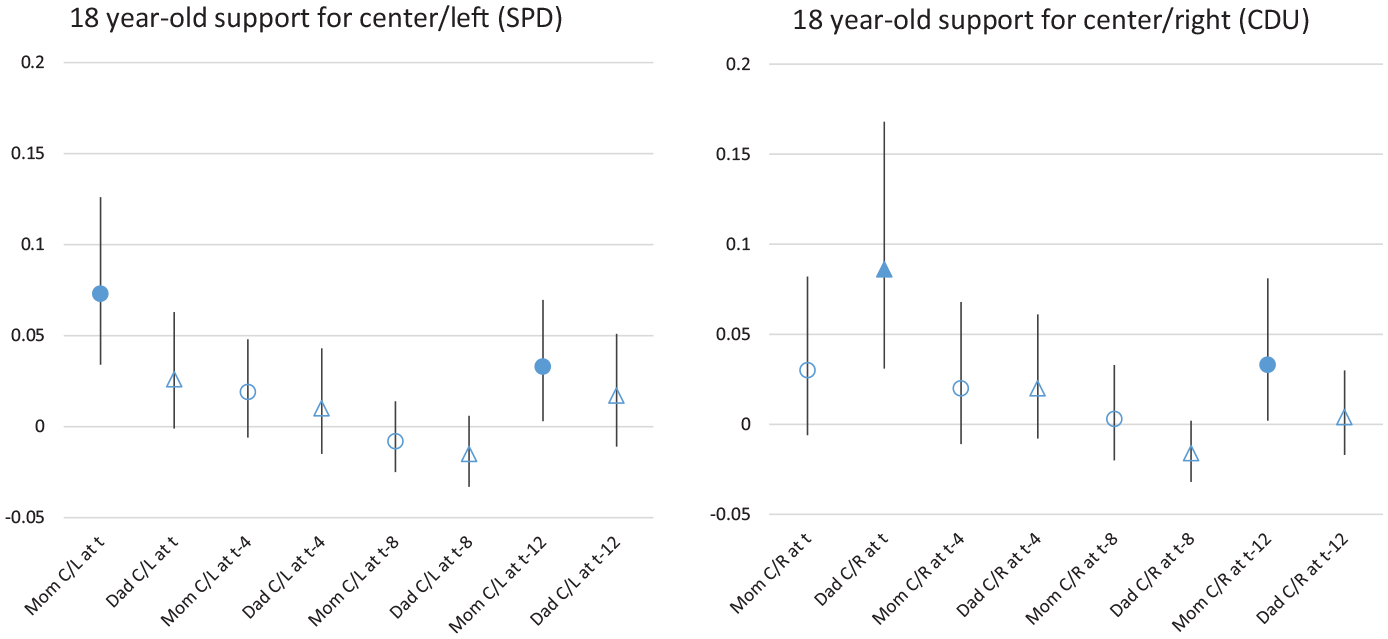
Predicted Change in Party Support Based on Mothers’ and Fathers’ Partisanship.
Discussion and Conclusion
For both intellectual and real-world reasons, it is vital to unpack political influences within families. As young people come of age and orient themselves to their democratic systems, they are shaped by household factors that—when aggregated through elections—establish governing patterns for years to come. While a great deal of research provides insight into how political learning occurs, some aspects of these processes have remained obscured. This is in large part due to the rarity of the kind of detailed, long-term survey data necessary to test various theories. In our study, we leverage a dataset and an approach that in combination make it possible to advance our collective knowledge in three main ways. We have disaggregated the household environment along the lines of timing (the age at which the effect is most evident), between parents (simultaneously measuring maternal and paternal party preferences), and across the ideological spectrum (modeling support for both the center-left and the center-right). In doing so, we show that political influence occurs during both childhood and adolescence. We expand earlier qualitative studies suggesting that partisanship is one of the variables that can be socialized early in a child’s life (see Lignier and Pagis, 2017) We also illustrate that mothers (relative to fathers) dominate during childhood. And finally, we find that left-leaning partisanship is the influential terrain of mothers while fathers primarily transmit right-learning partisanship. These results are robust to the inclusion of controls associated with household economic status and sociopolitical contexts, demonstrating the strength of the socialization pathway to partisanship development.
In light of these findings, we reflect critically on what else might account for our results. In comparing concomitant and historical patterns of similarity between youth and their parents, we must take seriously processes of reverse influence, through which young people exert influence on their parents. In particular, the prospect of reverse influence might complicate our interpretation of contemporaneous findings (at time t) since it is conceivable that when a young person comes of age, “trickle-up” influence from children to parents may occur (McDevitt and Chaffee, 2002). We note, however, that in a comparative analysis across Swiss parties, Fitzgerald (2011) finds that trickle-up influence through which young people influence their parents’ party choices over time only operates for nonmainstream parties (and not for mainstream parties). 12 Additional research on the possibility of the effects being conditional on genders of parents and offspring and their respective left-right ideology would be especially useful in further unpacking the trickle-up relationship.
We should also consider whether these results are bound in terms of time or place. One possible way to interpret our findings concerning the relative roles of mothers and fathers is that the image of a stronger maternal impact is out of date and is therefore decreasing in relevance. As gender roles have shifted over time, perhaps mothers’ influence on children is waning and fathers’ influence is increasing. While we think this is possible, we do not find evidence of this trend in our robustness tests (available from the authors). Across the waves of the GSOEP data, 13 there is no evidence that mothers’ effects (either contemporaneous or historical) have diminished across the survey years. Similarly, there is no evidence that fathers’ effects have strengthened. Yet, as more young people in GSOEP households come of age, this will be subject to further testing.
With respect to the potential for space-bound findings, we think that the German patterns exhibited here are likely to travel to other countries. As noted above, Germany’s party system and political behavior align with most Western European countries. Furthermore, a survey of the sizable literature on household influence demonstrates a high level of similarity across countries regarding how young people develop politically and learn from their parents. We, therefore, think it quite reasonable to expect that the findings presented in this article also shed light on household influence in other democratic countries. However, we acknowledge that certain aspects might vary by national context. For instance, Jennings (1984) finds that intergenerational similarities are more substantial on the left than on the right in six of the eight countries he studies (Germany is among these six). We take this to suggest that there are likely outliers, the study of which would help scholars to refine further our understanding of the nexus between intimate household learning and external objects and conditions that may moderate these family dynamics.
When thinking more carefully about the utility of focusing on the German case, we consider it especially illustrative of intergenerational stability. Moreover, it is a case where support for the center-left SPD is found to be more stable over time than support for the center-right CDU/CSU (Kroh and Selb, 2009). When viewed in light of our findings that mothers dominate center-left influence, we think there is an opportunity for further theoretical development. Maternal influence may engender more resilient partisanship than paternal influence. This reasoning aligns with our understanding of mothers as sources of political stability within families, as they are more likely to support centrist parties and less likely to adopt support for new parties over time (Fitzgerald, 2011; Immerzeel et al., 2015). In addition, existing work on how young people learn their values from their mothers (Power and Shanks, 1989) supports such a proposition. Indeed, we believe that the insights generated by this study will provide some understanding of why the German multiparty system remains so stable, even in this era of partisan instability. Further analysis in this vein is required to understand these household patterns and their implications more fully.
In broad, political terms, our findings suggest that center-left and center-right partisanship may develop differently. This logic finds support in the comparative parties’ literature in the mass party tradition (see, e.g. De Deken, 1999). The nature of social democratic parties connects them to their natural constituencies: the working-class and trade unions (Marlière, 1999: 4). The trade unions themselves were essential for bringing workers together and forming a unified identity (Cohen, 2013; Darlington, 2013). Furthermore, union membership also helped unify the varying ideologies that resulted from the post-WWII diversity of membership (Upchurch and Taylor, 2016).
Some of the most detailed research on the politics of labor unions comes from the United Kingdom. Eagles (1995), Pattie and Johnston (1999, 2000), and Johnston and Pattie (2005) illustrate the strong connection between the British Labour Party and strong labor and union identity in many British neighborhoods. 14 In Germany, Baker (1974) finds that SPD partisanship’s transmission within families is connected to broader social, political, and socioeconomic structures in a way that distinguishes family influence on the left as compared with the right. We reason that the process of center-left parties’ emergence out of highly structured and homogeneous social groupings may help reinforce parental cues and maintain their influence over time and that this process is consistent for center-left parties across various country settings. Research on interpersonal influence in Mexico and Brazil corroborates the patterns we observe: left-leaning partisanship transmits more effectively than right-leaning partisanship (Baker et al., 2020). Again, parental gender may play a role here, as we find a trend that cuts across the mother–father and left-right divides: mothers’ effects are most substantial on the left, and fathers’ effects are stronger on the right (when contemporary and lagged effects are combined). Together, these findings suggest that party support develops through a range of complex processes, such that the nature of partisanship is not so easy to characterize.
Considering how these results connect back to large-scale trends in partisan support and electoral behavior, the strength of social learning in childhood augurs continued societal support for mainstream parties across generations. To the extent that partisanship involves loyalty, attachment, and family ties, it should remain relatively robust and stable over time. We find through our robustness tests that the effect of lagged parental influence has not waned over time. If partisanship were exclusively characterized as instrumental and thus hinging on contemporaneous cues and immediate interests, it would be less likely to remain stable from one decade to the next and one generation to the next. Our findings do not support this reasoning. As neighborhoods, voluntary associations, and other institutions of societal integration and cohesion become less central social structures than they once were, the family persists as an important social context that progressively shapes new generations of democratic partisans and citizens.
Supplemental Material
sj-docx-1-psx-10.1177_00323217221133643 – Supplemental material for Young Citizens’ Party Support: The “When” and “Who” of Political Influence within Families
Supplemental material, sj-docx-1-psx-10.1177_00323217221133643 for Young Citizens’ Party Support: The “When” and “Who” of Political Influence within Families by Jennifer Fitzgerald and Pavel Bacovsky in Political Studies
Footnotes
Acknowledgements
The authors are grateful for feedback from discussants and participants in panels sponsored by the Midwest Political Science Association, the Centre for Political Science Research at KU-Leuven, and the Youth & Society Study at Örebro University. Erik Amnå, Håkan Stattin, Marc Hooghe, and Jennifer Wolak provided valuable comments. The authors also thank the anonymous reviewers and the Political Studies Editors for their very helpful questions and suggestions.
Declaration of Conflicting Interests
The author(s) declared no potential conflicts of interest with respect to the research, authorship, and/or publication of this article.
Funding
The author(s) received no financial support for the research, authorship, and/or publication of this article.

Supplemental Material
Additional Supplemental Material may be found with the online version of this article.
Contents
Table A1. Pairwise Correlations for Party Support among Family Members. Table A2. Table 1 Replicated With Parental Combined Party Support. Table A3. Table 2 Replicated With Parental Combined Party Support. Table A4. Panel A: Table 2 Replicated With Staggered Lags, Center-Left. Table A4. Panel B: Table 2 Replicated With Staggered Lags, Center-Right. Table A5. Parents’ Historical Effects Using More Lagged Independent Variables (Every Other Year). Table A6. Table 1 Replicated With Parental Age. Table A7. Table 2 Replicated With Parental Age.
Notes
Author Biographies
References
Supplementary Material
Please find the following supplemental material available below.
For Open Access articles published under a Creative Commons License, all supplemental material carries the same license as the article it is associated with.
For non-Open Access articles published, all supplemental material carries a non-exclusive license, and permission requests for re-use of supplemental material or any part of supplemental material shall be sent directly to the copyright owner as specified in the copyright notice associated with the article.
