




Abstract
In this article, we argue that many contemporary challenges to democracy can be traced back to how political organizations compete for attention. We begin with the idea that these organizations appeal for attention both by mobilizing their own members, and also through media that reaches a wider audience, such as social media and mass media. But since many organizations are competing for the limited attention of this wider audience, they all have an incentive to send “too many” and “too sensational” messages. This overwhelms the audience and leads to polarization and populism. Our article describes the conditions necessary for this “tragedy of the commons” to occur and also reviews empirical evidence demonstrating that these conditions are met. We find that social media is not a necessary condition for the model, but does accelerate it. We conclude that Elinor Ostrom’s theories of the commons are important for understanding political communication.
Every politician wants to engage the public more honestly, but every political party would rather win on a 20% turnout than lose on an 80% turnout. There is a big [cultural] challenge that we have . . . where, ok, we’ve created these new digital spaces, and they are privatized. They have some kind of a public role. A lot of journalists are on them, a lot of people are on them: those conversations do ultimately matter. And I think so much of our struggle is around how we analogize what those spaces are, right? Elon Musk, I think because he is a creature of the internet, and bored, sees it as the public square. Of course it’s not. Is it a chatroom? Is it a bulletin board at a coffee shop? How we analogize it, the stories we tell about what Twitter actually is, what all of these digital spaces is, is actually a really big and hard conversation because it’s not intuitive. Those analogies do a lot of work.
Introduction
Populism and polarization are frequently labeled the defining challenges of contemporary democracy. Much of the blame for both has been left at the door of social media (Bak-Coleman et al., 2021; Benkler et al., 2017; Bimber and de Zúñiga, 2020; Chambers, 2021; Dryzek et al., 2019; Forestal, 2020; Franklin-Fowler et al., 2021; Illing and Gershberg, 2022; Klein, 2020; Mason, 2018; Nguyen, 2021; Tufekci, 2017; Vaidhyanathan, 2018; Van Aelst et al., 2017). However, in this article, we argue that social media has only exacerbated an underlying problem. This deeper problem is created by the way political organizations communicate. Most political organizations need public attention in order to succeed. But since public attention is limited, they must compete for it. This competition leads to a flood of sensationalist messages, which can overwhelm people’s capacity to pay attention. The end result is that most people will disengage from politics, and those that remain will become more polarized. This parallels the problems often encountered in natural resources, particularly in common pool resources (CPRs). We argue that this means the “public sphere” (Habermas, 1989) is subject to a tragedy of the commons (Hardin, 1968; Ostrom, 1990).
The goals of this article are to explain theoretically why this tragedy of the commons—henceforth TOTC—occurs, and to review the evidence for whether it occurs in practice. By doing this, we add to existing explanations of populism (Berman, 2021; De Vreese et al., 2018; Engesser et al., 2017; Mudde, 2019; Norris and Inglehart, 2019; Waisbord, 2018) and polarization (Guess, 2021; Guess et al., 2020; Klein, 2020; Levendusky, 2013; Mason, 2018; Munger et al., 2020). We also link these phenomena to the literature on mediatization and agenda-setting (Bennett and Pfetsch, 2018; Couldry and Hepp, 2013; Esser and Strömbäck, 2014; Green-Pedersen and Walgrave, 2014; Van Aelst and Walgrave, 2017). This delivers additional original conclusions. In particular, it highlights how social media accelerates and extends the tragedy (Benkler, 2006; Blumler and Coleman, 2010; Farrer et al., 2017; Guess, 2021; Jungherr et al., 2020; Matz et al., 2017; Rathje et al., 2021), but is not entirely responsible for it in the first place.
We begin with the idea that for actors on the political stage, attracting the audience’s attention is crucial for success (Barberá et al., 2019; Binderkrantz et al., 2020; Chadwick et al., 2018; Esser and Strömbäck, 2014; Halpin et al., 2020; Jones and Baumgartner, 2005; King et al., 2017; Van Aelst et al., 2017). They need it to fundraise, they need it to influence policy, and they need it to win elections. While it may be going too far to say that “all publicity is good publicity”; it is true that for most political organizations—parties, interest groups, and social movements (Farrer, 2017; Fraussen and Halpin, 2018)—public attention is vital.
Yet it is also limited. Most people are not avid followers of politics (Converse, 1964; Downs, 1957; Krupnikov and Ryan, 2022; Prior, 2020; Zaller, 1992), and even those who are, have only a finite cognitive budget of attention (Fisher et al., 2018; Franck, 2019; Lang and Bailey, 2015; Ocasio, 2011; Prior, 2020; Simon, 1971; Wang et al., 2014). If this budget is overwhelmed, their attention will be degraded and harder to access in the future. In economic theory, this makes attention a “rivalrous” resource. 3
This rivalry sets two processes in motion, each gradually affecting people based on their prior interest in politics. First, for people who only follow politics occasionally, it works almost like the boy who cried wolf. When confronted by too many and too sensational appeals for their attention, these people become alienated and disengaged. This contributes to the growing divide between the interested and disinterested (Groenendyk and Krupnikov, 2022; Krupnikov and Ryan, 2022; Prior, 2020), as well as to the alienation necessary for populism to thrive (Berman, 2021; Blumler and Coleman, 2010; De Vreese et al., 2018; Mudde, 2019; Norris and Inglehart, 2019). Second, among those who follow politics more regularly, the arms race of sensational stories can galvanize in-group favoritism and out-group hostility (Aalberg et al., 2012; Chadwick et al., 2018; Iyengar et al., 2019; Klein, 2020; Mason, 2018; Rathje et al., 2021; Zingher and Flynn, 2018). This means an increase in affective polarization (Bakker et al., 2021; Iyengar et al., 2019; Mason, 2018), despite the centripetal logic of the median voter (Downs, 1957).
The first section of this article explains why political organizations employ communication strategies that lead to this result. Of course, communication strategies are multifaceted, involving micro-level decisions about slogans, messages, mediums, framing, and content (Franklin-Fowler et al., 2021). However, our focus is on one aspect of these strategies: whether political organizations emphasize communicating with their own pre-existing supporters or communicating with the broader public. The former strategy involves solicited, unmediated communications that reach the more receptive “inner concentric circles” of activists and members. The latter strategy includes communications like speeches and events that can reach wider concentric circles of audiences, usually mediated through news organizations (Achury et al., 2020; Coppock et al., 2016; Donges and Jarren, 2014; Edgerly et al., 2016; Franklin-Fowler et al., 2021; Halpin et al., 2020; Lavigne, 2021; Shi et al., 2017). This distinction translates to the excludable “private” and non-excludable “common” pastures of Hardin’s (1968) original TOTC. Organizations have an incentive to harvest the attention of the wider concentric circles of audiences first, before another organization with an overlapping circle does so. This leads to more messages, and more sensational messages, being sent to these audiences, leading to attention degradation.
In a second section of the article, we show how this TOTC is accelerated and extended by social media (Aldrich et al., 2016; Barberá et al., 2019; Boulianne et al., 2020; Dean, 2003, 2019; Dommett and Temple, 2017, Highfield and Bruns, 2015). First, social media has transformed the gatekeeping function of journalists. Their role is still crucial, but they are now incentivized to place less emphasis on objectivity and verification (Barnard, 2018; Chadwick, 2017; Esser and Strömbäck, 2014; Shoemaker and Vos, 2009; Soroka, 2012). Second, social media affords individuals the chance to re-share political communications within their own excludable networks (Chambers, 2021; Papacharissi, 2010; Papacharissi and de Fatima Oliveira, 2012), and so the TOTC no longer simply undermines the “public sphere”—it reaches into organizations’ private spheres, and undermines those too. These factors worsen the TOTC, but they did not create the dynamic (Jungherr et al., 2020; Nickerson and Rogers, 2014).
The original TOTC (Hardin, 1968) aimed to show that the problem of population growth had no technical solution. Similarly, we aim to show that the problems of alienation and polarization are without technological solution. 4 They can be exacerbated by technologies, but the public sphere was not exactly thriving even before social media (Blumler and Coleman, 2010; Susen, 2011). Competition for public attention may appear to be a sign of democratic health. But it can lead to problems for democratic society in the long run, as the “public sphere” is filled with mistrust and extremism. While this may be the goal of autocrats (Tufekci, 2017), it has negative consequences for democracy (Dryzek et al., 2019; Forestal, 2020; Habermas, 1989; Hardt and Negri, 2009; Van Aelst et al., 2017; Webster, 2011). We conclude that the ideas of Elinor Ostrom (1990) have important applications to political communication. Ostrom’s ideas about community-based CPR governance help address this critical issue (Bouchet et al., 2019; Dardot and Laval, 2014; Gangadharan et al., 2017; Hardt and Negri, 2009; Ostrom et al., 1994; Weston and Bollier, 2013).
The article proceeds as follows. First, we define attention as sustained and sympathetic cognitive resources. We show why this resource is “rival,” and why it can be either “excludable” or “non-excludable.” Together, these conditions create the TOTC. In a second section, we discuss how social media accelerates and extends this tragedy. A final section discusses our conclusions and the implications for political communication.
Conceptualizing Political Attention as a TOTC: Players, Choices, and Payoffs
The Tragedy of the Commons is a ubiquitous concept in the social sciences (Hudson et al., 2019). It explains an important problem facing users of a shared resource. To show the main idea, Hardin (1968) used the example of a pasture open to multiple shepherds. Grazing their herds brings profit but consumes grass. So each shepherd prefers to move their herd off their private grass and onto the common grass. Doing so would allow the shepherd to profit without paying the costs of grazing. Alas, if each shepherd behaves in this way, it overwhelms the common pasture. This model has helped shed light on a wide variety of resource use problems, and given new impetus to theories of governance (Hardin, 1968; Hudson et al., 2019; Ostrom, 1990; Weston and Bollier, 2013). We apply this template to a new class of CPR: political attention. Although attention is often thought of as a resource (Benkler, 2006; Franck, 2019), the long-term political impacts of using this resource remain unclear. Contemporary theories of political communication have focused instead on the question of how political organizations “self-mediatize,” that is, how they adapt to the logic of maximizing media coverage (Esser and Strömbäck, 2014), and how this affects the issues on the political agenda (Van Aelst and Walgrave, 2017). However, without a more long-term model of political communication, it is difficult to assess the overall implications of these theories for important phenomena like populism (Berman, 2021; Mudde, 2019; Norris and Inglehart, 2019) and polarization (Klein, 2020; Mason, 2018), or to assess the overall role of social media (Bak-Coleman et al., 2021; Ennser-Jedenastik et al., 2021; Forestal, 2020; Franklin-Fowler et al., 2021; Guess, 2021; Illing and Gershberg, 2022; Kang et al., 2018; Levendusky, 2013; Magalhães et al., 2020; Munger et al., 2020; Rathje et al., 2021; Van Aelst et al., 2017).
Our goal is to use the TOTC to resolve these issues. We do this by going through each step of the TOTC model, and showing how it has an analog in the world of political communication. First, we posit political organizations as shepherds, and citizens’ attention as the field of grass waiting to be eaten. This modeling choice loosens the assumptions of methodological individualism. However, it is not without precedent. Habermas’s (1989) concept of “the public sphere” is useful here. He argued that a bourgeois public sphere emerged from the coming-together of private households, for critical and transparent conversations held without state interference. This concept, although critiqued both for its historical inaccuracy (Calhoun 1993; Susen, 2011) and its neglect of conversations from outside the bourgeois masculine world (Fraser, 1990; Papacharissi, 2010), has continued to be highly influential (Chambers, 2021). Without this concept, applying a TOTC to political organizations can seem nebulous or abstract. But the idea of the public sphere provides a rigorous philosophical underpinning for the idea that a shared space is created by political actors for the discussion of political issues (Calhoun, 1993; Dean, 2003; Habermas, 1989). We combine this with insights from empirical research to show how the competition for these spaces can actually destroy the space itself. In essence, we argue that the public sphere is, in economic terms, not a public good but rather a common good. Websites like Twitter are not a digital town square, they are part of a digital natural resource.
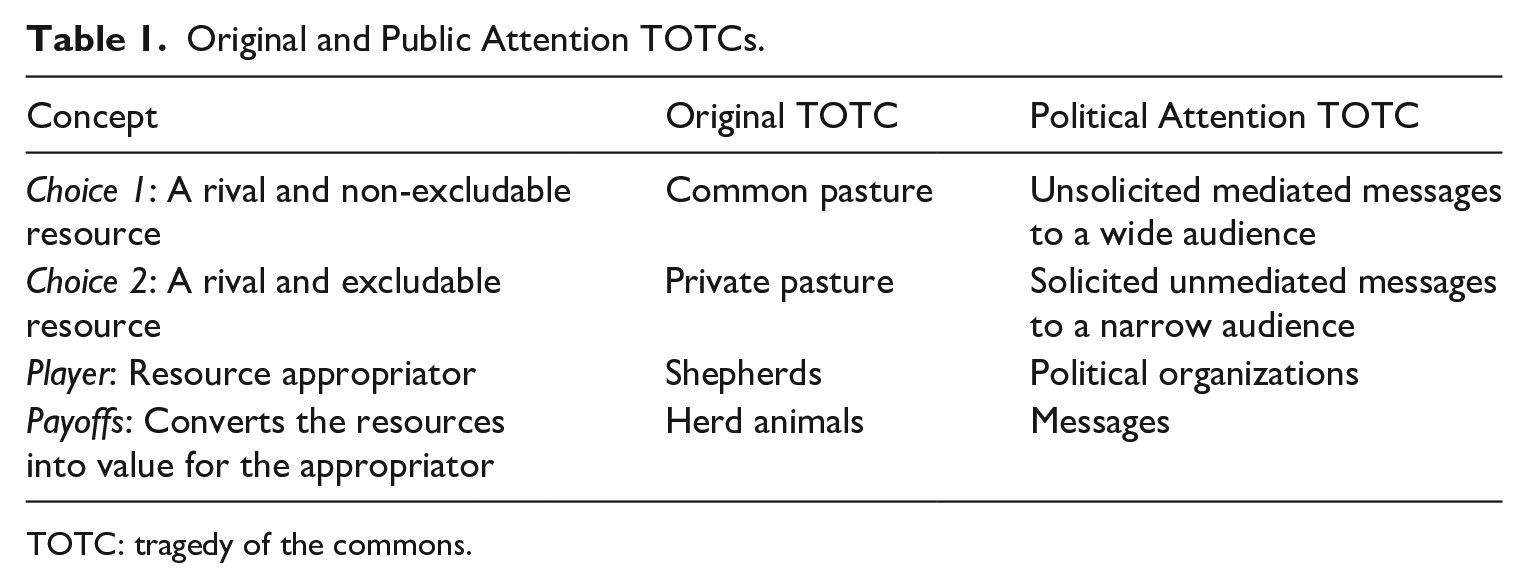
In applying this template to the public sphere, we keep the script of the tragedy the same but re-cast each role. There are three parts to re-cast: the players, the actions, and the payoffs. Instead of shepherds, we have political organizations. Instead of choosing pastures, we have them choosing communication strategies. And instead of payoffs determined by the value of the herd, we have payoffs determined by the attention a message gets. Where Hardin (1968) had shepherds putting herds of animals into a pasture, we have political organizations putting messages in front of an audience. As shepherds could choose between using a private or a common pasture, political organizations can choose between two different audiences: members, or non-members. Finally, the payoffs of this choice are determined by some technology available to the appropriators, which has different benefits/costs depending on whether it is applied to the common or private resource. These elements together specify a TOTC. Table 1 shows the various roles played in the original model and then how they are recast in our political attention model.
Original and Public Attention TOTCs.
TOTC: tragedy of the commons.
There is a wealth of empirical evidence to justify the correspondence between our model and the original concepts. Consider the first two rows of the table. Our analogy here is between pastures and audiences. Instead of two pastures, each full of valuable grass, we now have two audiences, each full of valuable attention. Importantly, Hardin (1968) introduces the distinction between the private plot and the common pasture not because the grass tastes different to the herds, but because the grass has different implications for the shepherds. 5 Both are rival resources, but one can be accessed only by a single shepherd, and the other can be accessed by any of them. To see why the same is true of people’s attention in our context, we rely on empirical research from neuroscience.
This research defines attention as a process. It is a variety of cognitive mechanisms that work together. One crucial mechanism is how mental resources are allocated to different inputs (Marcus et al., 2011; Ocasio, 2011). Top-down cognitive schema determines whether an individual will allocate sustained and sympathetic cognitive resources to a given input (Fisher et al., 2018; Ocasio, 2011; Simon, 1971; Wang et al., 2014). Evidence shows that these schemas are stable individual traits. For example, Prior (2020) finds that individuals’ average level of attention to political messages in general is an enduring disposition, settled by early adulthood. But even among this subset of individuals, attentiveness varies depending on the message-sender. The more supportive of an organization they are, the more likely they are to pay attention to its messages (Gozzi et al., 2010; Lau et al., 2017; Levendusky, 2013; Van Aelst et al., 2017). Any political organization will therefore have two potential audiences. One is receptive, consisting of individuals who not only pay attention to politics, but who also are receptive to messages from that organization. The second audience is wider, consisting of people who are less supportive of the organization and/or less interested in politics in general, and so will be less attentive to the organization’s messages. 6 The first audience is excludable, but the second audience is non-excludable. These two audiences fit the description of Hardin’s (1968) private and common resource.
This classification is also justified by recent work on political organizations, in particular, by work on political and advocacy groups—that is, interest groups and social movements (Farrer, 2017; Fraussen and Halpin, 2018). Recent research theorizes political parties as concentric circles of activists (Borucki and Fitzpatrick, 2021; Ennser-Jedenastik et al., 2021; Hooghe and Kölln, 2020; Magalhães et al., 2020; Scarrow, 2015; Van Haute and Gauja, 2015). The most loyal partisans are at the center, with fair-weather supporters on the periphery. They are effectively multi-speed organizations with different tiers of membership (Gibson, 2015; Scarrow, 2015). Similar models have a long history in political science, explaining how politicians approach different constituencies in different ways (Fenno, 1978). They have recently been used to explain party issue positions (Ennser-Jedenastik et al., 2021), internal professionalization (Bolleyer and Correa, 2020), membership demographics (Magalhães et al., 2020), and especially communication strategies (Endres and Kelly, 2018; Franklin-Fowler et al., 2021; Kang et al., 2018; Lavigne, 2021; Magalhães et al., 2020).
For example, Kang et al. (2018) found that candidates talk about a broader set of issues on television, where the audience is broader, and a narrower set of issues when communicating to their private e-mail lists. Social media ads lay in the middle of those two extremes. Franklin-Fowler et al. (2021) echo this using data on all US state-wide and federal races in 2018, finding that TV ads are longer, broader, and more negative, than social media ads. Separate studies on the US (Barberá et al., 2019; Endres and Kelly, 2018; Franklin-Fowler et al., 2021; Kang et al., 2018; Rathje et al., 2021), Australia (Ennser-Jedenastik et al., 2021), and the UK and Germany (Aldrich et al., 2016; Borucki and Fitzpatrick, 2021) have all returned similar findings. Parties adjust their communication strategies, talking about different issues and framing them differently depending on whether the likely audience is members or non-members (Benford and Snow, 2000; Franklin-Fowler et al., 2021; Kang et al., 2018). A supporter of Party X may find a deluge of e-mails from candidates in their inbox, asking, once again, for money. Non-supporters may see advertisements for Party X, but this communication is likely to have a broader issue content (Franklin-Fowler et al., 2021; Kang et al., 2018; Klinger and Svensson, 2015; Lavigne, 2021; Rathje et al., 2021).
It is also likely to be mediated through journalists, and to arrive in an unsolicited way. Political organizations communicate with non-excludable audiences in more unsolicited and mediated ways, and with excludable audiences in more solicited and unmediated ways. That is, messages to non-excludable audiences appear in “push” media and are filtered through journalists en route, whereas messages to excludable audiences appear in “pull” media without being filtered (Esser and Strömbäck, 2014; Van Aelst and Walgrave, 2017). Journalists at legacy media organizations are still important gatekeepers of push media, even though the incentives they face have been transformed by social media—as we discuss in the next section (Chadwick et al., 2018; Edgerly et al., 2016; Wolfgang et al., 2021). On the other hand, solicited communications will reach a smaller audience. But this audience is excludable, not only because of their receptive cognitive schema but also because they are easier to reach. Each party has access to its own e-mail database, its own social media followers, and its own other databases of contact information (Baldwin-Philippi, 2019; Nickerson and Rogers, 2014). Any individual can of course give their contact detail to many different parties, but they are more likely to receive and accept messages from the party that they are in the narrowest concentric circle of (Zaller, 1992). They are thus an “excludable” audience for that organization, since only that organization can effectively reach them (Hooghe and Kölln, 2020; Lavigne, 2021). This push/pull difference reinforces the classification of the two audiences as excludable or non-excludable. Together, these empirical findings justify the first two rows of Table 1.
We now move on to the third row of Table 1. Our analogy here is between shepherds, and political organizations. We define political organizations as political parties and membership-based advocacy groups, for example, interest groups and social movements (Farrer, 2017; Fraussen and Halpin, 2018). Although this definition is broad, and there is important heterogeneity within this category, the analogy works because all these organizations face similar incentives regarding attention. There is a wealth of research about how membership-based advocacy groups use mass communication to mobilize resources from members, supporters, and the public (Bolleyer and Correa, 2020; Fraussen and Halpin, 2018; Guo and Saxton, 2018; Halpin et al., 2020; Shi et al., 2017). Scholars have found that appeals to members and non-members are meaningfully different (Aldrich et al., 2016; Arnold et al., 2018; Dommett and Temple, 2017; Kang et al., 2018; Magalhães et al., 2020; Munger and Phillips, 2020). These findings demonstrate that similar to the research on multi-speed parties, interest groups share the same incentives to communicate differently with inner and outer concentric circles.
Our argument is that political organizations have an incentive to overuse the attention of their non-excludable audience. Importantly, “overuse” does not mean relative to the excludable audience; organizations may still target their base more than the public. Instead, “overuse” means a level of use above the socially optimal level. That is, many researchers show that “the base” are generally more extreme than “the moderates” (Downs, 1957; Levendusky, 2013; Mason, 2018), and so political organizations may communicate with them more, and in more extreme ways. Therefore, it may appear somewhat counter-intuitive to say that polarization and populism are occurring in political organizations’ broader communications, rather than in their narrower communications. But the TOTC can still occur even if excludable resources are used more than non-excludable resources—as long as the non-excludable resource is still used more than is socially optimal. 7 Political organizations that want to expand their support will need to send more and more sensational messages to the non-excludable audience. Since all organizations face this incentive, the result is a series of ever-expanding circles, which as they overlap create “common spheres.” The larger these overlaps grow, the greater the attention degradation.
To illustrate this, we now address the fourth and final row of Table 1. This row describes the way the payoffs are decided in the original TOTC, and how these are reflected in our version. In Hardin’s (1968) template, the payoffs are described in terms of the value to the shepherd of adding animals to the pastures. In our model, the payoffs come from the value of sending messages to the audiences. Although messages are heterogeneous, varying in terms of content, framing, and more (Benford and Snow, 2000; Druckman et al., 2019; Franklin-Fowler et al., 2021; Kang et al., 2018), 8 we focus on the quantity and sensationalism of the messages. These factors are particularly significant for the long-term health of democracy because they can lead either to disengagement and populism or to affective polarization (Aalberg et al., 2012; Blumler and Coleman, 2010; Cappella and Jamieson, 1997; Esser and Strömbäck, 2014; Van Aelst and Walgrave, 2017).
Researchers have found strong evidence for the first “boy who cried wolf” mechanism (Cappella and Jamieson, 1997; Esser and Strömbäck, 2014; Green and Zelizer, 2017; Krupnikov and Ryan, 2022; Marcus et al., 2011; Nickerson and Rogers, 2014; Prior, 2020). For example, Pierce et al. (2016) construct a lab experiment where respondents are shown a vast array of fictional news stories about fictional candidates. The headlines of those stories are randomly assigned to be presented with or without affective cues, in the form of “likes” and “dislikes.” They find that, regardless of ratio of likes to dislikes, participants search for fewer political news stories when those stories are accompanied by affective signals. Similarly, Groenendyk and Krupnikov (2022) corroborate this general “aversion” response to the presence of many attention-grabbing political messages. They conduct three laboratory experiments showing that individuals are less engaged in politics and less open to new information. Importantly, they argue that this aversion is not just to negative news, or to news that is ideologically incongruent. It is to the broader framing of politics as a battle. Recent work suggests that moderates are not without political opinions, but are simply disengaged from mainstream politics (Fowler et al., 2022). The “if it bleeds, it leads” approach to covering politics may grab attention in the short run, and it is becoming more common (Barnard, 2018), but there is both observational and experimental evidence that it is creating attention degradation in the form of disengagement in the long run (Aalberg et al., 2012; Druckman et al., 2019; Esser and Strömbäck, 2014; Prior, 2020; Soroka and McAdams, 2015; Weeks, 2015).
There is similarly strong evidence for the second mechanism, of attention degradation taking the form of affective polarization among those who follow politics more regularly (Bakker et al., 2021). Research using functional magnetic resonance imaging (fMRI) techniques has found meaningfully greater affective responses to political communications among those more interested in politics (Casado-Arando et al., 2022, Gozzi et al., 2010). 9 Moreover, Soroka et al. (2019) use a skin-conductance measure in experiments where people are shown positive, negative, and neutral news. Across 17 countries and 6 continents, they find consistent evidence that people are more aroused by negative news. Lau et al. (2017) use a lab experiment to show that if there is a lot of news, and it is highly attention-grabbing, the result is a significant increase in affective polarization. Similar studies (Levy, 2021) also suggest that too much and too sensational news can then lead to different media choices in the future (Klein, 2020). Prior attitudes dramatically influence future information search (Iyengar et al., 2012). This may seem to benefit the organizations involved, as they will have a more devoted base of supporters. However, as people become more affectively polarized, the set of messages that will be consistent with their pre-existing attitudes will become more and more constrained (Leeper and Slothuus, 2014; Marcus et al., 2011). This forces political organizations to constantly up their game in order to get the same return. This leads to attention degradation reducing the overall productivity of the resource.
For example, Mutz (2015) finds that more emotive partisan broadcasts not only lead to increased information retention in the short run but also create more affective polarization. Mason (2018) and Klein (2020) also tie affective polarization to partisan media. Munger et al. (2020), Guess (2021), and Guess et al. (2020) suggest that rather than directly affecting polarization, these attention-grabbing messages instead affect future media diets. As messages get more intense and engaging, not only does it consume attention, but it makes people less engaged with political messages in the future. The result will be an audience that can only be motivated by the most compelling content. 10
This means that our model applies to any set of organizations with overlapping supporters, because they will be forced to out-bid each other for attention. One way to see how widely the model applies is to note that although the model is labeled “the tragedy of the commons,” it is not really just about the commons: it is really a tragedy of juxtaposing a common good with a less-common good, that is, a tragedy of any two points on the excludability spectrum. The TOTC defines resources in a binary way, based on rivalry and excludability (Hardin, 1968; Hudson et al., 2019). However, these two dimensions are continuous rather than discrete, and they are socially constructed (Dardot and Laval, 2014) rather than being naturally given (Hardt and Negri, 2009). 11 But a political organization choosing between two different commons could still encounter a TOTC, as long as one common carried greater externalities than the other. Political organizations choosing between any nested concentric circles still encounter the same dilemma. 12
There is another tangential but important insight here. Once we conceptualize rivalry as a dimension rather than a simple binary, we can also see that the dimension does not stop at zero: there is also the possibility that attention can be anti-rival. Anti-rival goods are those where consumption creates a positive rather than a negative externality. This helps us address a rival possibility: that paying attention to one political story may make you more likely to pay attention to another. This possibility of anti-rivalry is often neglected in studies of CPRs, but has become more salient with the study of “knowledge” commons (Benkler, 2006; Dardot and Laval, 2014; Hess and Ostrom, 2003; Hudson et al., 2019; Strandburg et al., 2017; Weston and Bollier, 2013) and is particularly important to consider here. Two outcomes are possible from such a scenario, depending on the second dimension of the good: excludability. If attention were non-excludable and anti-rival, the result is known as a “comedy of the commons” (Rose, 1986), that is, a virtuous circle of ever-increasing consumption. If it were excludable, the predicted result would be inefficient under-utilization of a common resource if the good is excludable (Benkler, 2006; Heller, 1998). Table 2 shows this by reproducing a common 2 × 2 typology of economic goods, expanded to become a 3 × 2, to highlight these concepts as continuous rather than discrete.
Categories of Goods, With Examples.
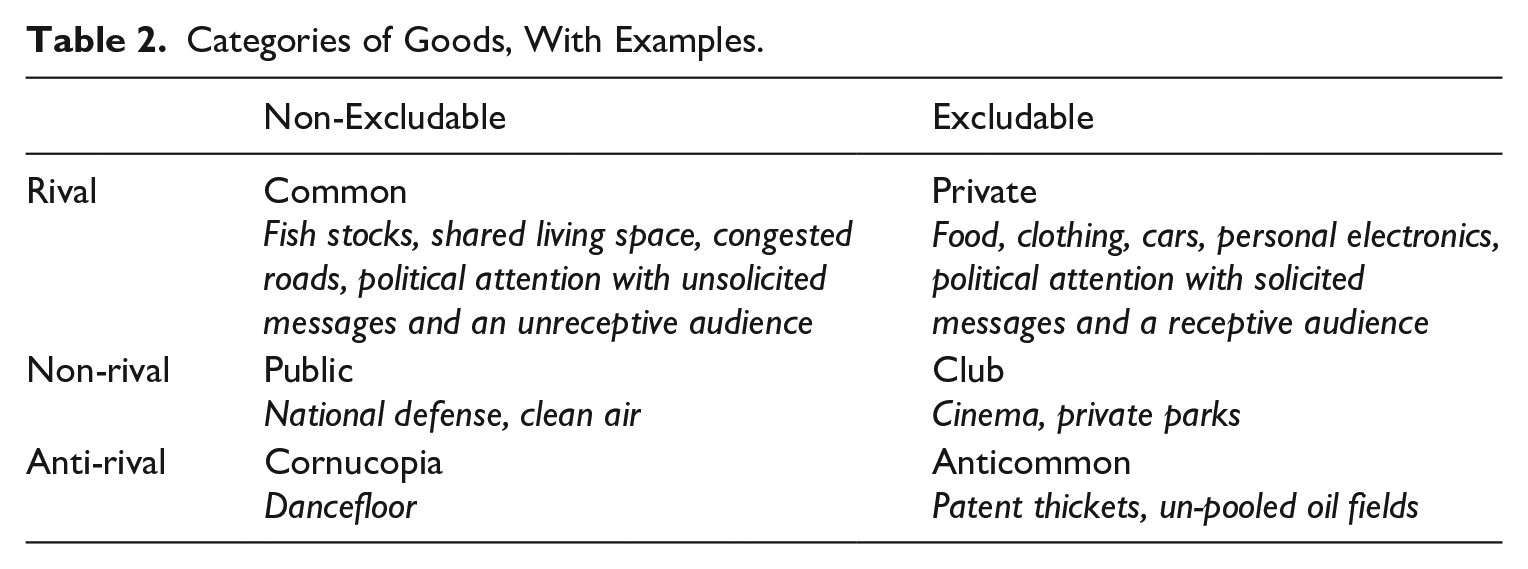
The social dilemma of overuse can occur whenever actors face a choice between goods, as long as one of them has at least some degree of rivalry and at least some degree of non-excludability. So, in Table 2, it could occur between a common and private good, but could also occur between a common good and any other type of good, or even between two common goods. The first example is the most relevant because it occurs most frequently, and it is the one that we used as the basis for Table 1. But when applying the TOTC to political attention, it is important to note that the overall dynamics of the model do not change even if some organizations are successful at turning their private good into an anti-rival good. If political organizations are able to create communications that make people more enthusiastic, without being alienated or polarized, then this “sweet spot” (Han, 2014) may seem like a way out the TOTC. However, all that it takes for the tragedy to re-emerge is for the somewhat rival and somewhat non-excludable common good to still exist. As long as communicating with these outer concentric circles still brings some positive benefit, then the organization still has an incentive to do it. Moreover, this incentive is still inflated relative to the social optimum, by the non-excludability of the good. 13 Thus, there will still be overuse of the common resource. Munger (2020) describes this as a “contestable market” for political organizations in social media. The additional possibilities represented in Table 2 therefore help confirm the validity of the simplifications adopted in Table 1.
We argue that this model contributes an important addition to existing explanations of populism (Berman, 2021) and polarization (Klein, 2020). Now that we have justified applying the TOTC, our next section extends the model to show how new technologies have changed the way both solicited and unsolicited messages operate. Modern communications technologies have manifold changes, including the number of people who can advertise, the content of those advertisements, and the logic of gatekeeping that dominates. We focus on the logic of gatekeeping (Barnard, 2018; Bimber and de Zúñiga, 2020; Esser and Strömbäck, 2014; Shoemaker and Vos, 2009; Soroka, 2012; Waisbord, 2018), and sharing through social connections, in order to draw out consequences that are crucial for the long-term health of democracy.
Technology in the Tragedy of the Commons Model
In the previous section, we used empirical and theoretical work from a variety of literatures to argue that public attention to politics—what might be termed the public sphere—is actually a common good, subject to the tragedy of the commons. In this section, we discuss how technological changes can accelerate this tragedy. There are many plausible ways social media could be included in this set up, and no single approach can fully capture every important aspect, because by its nature, digital media changes the whole system (Chadwick, 2017). Other researchers have focused on the proliferation of actors requesting attention (Chadwick and Dennis, 2013; Kim and Kim, 2021), micro-targeting (Endres and Kelly, 2018; Jungherr et al., 2020; Lavigne, 2021; Nickerson and Rogers, 2014), clickbait (Munger, 2020), fake news (Tucker et al., 2018; Waisbord, 2018), and the exposure to more people who agree and disagree (Krupnikov and Ryan, 2022). However, for understanding the long-term impact on democracy, we argue that two factors are crucial. The first is the transformation in the logic of gatekeeping (Esser and Strömbäck, 2014; Forestal, 2020; Soroka, 2012). For decades, political organizations have had to internalize “media logic” in order to attract media attention. They have self-mediatized, making themselves attractive to journalists and getting positive coverage as a result. However, this media logic also included certain journalistic norms, including objectivity and “both sides” coverage. But social media has degraded the latter norms, while leaving sensationalism in place (Barnard, 2018; Esser and Strömbäck, 2014). This has been accelerated by the spread of algorithms that prioritize attention-grabbing content (Bucher, 2018; Finlayson, 2022; Nguyen, 2021; Noble, 2018). As social media platforms use these algorithms to optimize for clicks and increase advertising profit, they create strong incentives for legacy media journalists (Vos et al., 2012), and political organizations (Edgerly et al., 2016), to adopt the same logic of these algorithms (Vos et al., 2012). This means political organizations send more, and more sensational, messages.
The second feature is the sharing of content (Bakker et al., 2021; Chambers, 2021; Coppock et al., 2016; Halpin et al., 2020; Klein, 2020; Shi et al., 2017; Tufekci, 2017; Vaidhyanathan, 2018). Sharing creates a connection between the excludable and non-excludable audiences. When appeals for attention come indirectly, via friends or family sharing content, rather than directly from political organizations, the resulting negative externalities apply to these personal relationships too. As engaged individuals express their politics on social media (Papacharissi, 2010), politics can become totalizing, meaning that there is simply no more attention for these individuals to give. This means the inner concentric circles of activists for each organization will ultimately be exhausted too as their activists’ attention budget is reached.
These two features are easily incorporated into the TOTC framework. First, technology that transforms the logic of gatekeeping essentially accelerates the rate of resource extraction. This does not change the dynamic: it only makes things go faster. Second, we can also easily incorporate technology that allows what happens in the common space to leak into the private space. The model already captures the idea that over-using the commons can lead to its degradation. When we add the possibility that this degradation will also be reflected in the shepherd’s private pastures, again the central dynamic does not change—it only goes faster. Supplemental Appendix 1 shows the full mathematical formalization of this model. But the core finding is simply that technology has exacerbated a pre-existing problem. The finding that the overall TOTC is accelerated in this way shows the importance of technological changes for commons theories in general (Farrer et al., 2017). Not only can technology create new commons, such as intellectual property around vaccines (Bak-Coleman et al., 2021; Farrer et al., 2017; Hudson et al., 2019; Strandburg et al., 2017), it can also degrade these commons by allowing them to harvest more quickly.
Conclusion
In this article, we argue for understanding public attention to politics as a TOTC. Political organizations have an incentive to send too many messages that are too sensational, and this creates externalities in the form of affective polarization and populist alienation. Consider the example of the Democratic presidential primary for the 2020 election. The public sphere can be defined as the set of individuals paying attention, that is, a relatively small subset of the population (Habermas, 1989; Prior, 2020). Within this, there are a series of concentric circles, with each candidate at the center. The circles contain more committed supporters in the inner rings and less committed supporters in the outer rings. Each organization is more worried about overwhelming their inner supporters and less worried about overwhelming their outer supporters. So, individuals in the overlapping outer rings of many different candidates might receive dozens of different fundraising e-mails on a near constant basis, each one aiming to be as compelling as possible. This may appear to be beneficial for some political organizations—but it forces them to create ever-more engaging content. 14 Without institutions to check this, the common pool of attention was degraded.
The institutions that keep this in check are largely informal, consisting of journalistic gatekeeping norms and liberal values that set the limits on acceptable political discourse. These informal institutions may have been enough in the age of traditional journalism, but under social media they proved inadequate (Bak-Coleman et al., 2021; Bucher, 2018; Dryzek et al., 2019; Esser and Strömbäck, 2014; Illing and Gershberg, 2022; Klein, 2020). From the perspective of political organizations, social media is an extractive technology, taking public attention as an input, and producing value for the organization as an output. But unlike other such technologies, it works faster, and it works deeper.
Further research should examine how different political organizations deal with this. Some evidence suggests that well-resourced organizations use digital tools more (Schradie, 2018), but may also be able to do more to maintain their base of members (Han, 2014). Future research should explore the implications of this model for how to define audiences and how to understand technological externalities (Hudson et al., 2019). This template can also be extended to include conspiracy theories such as QAnon that damage the commons. It could also cover other non-political communication commons. In people’s private lives, a confrontational e-mail conversation generates different externalities than a confrontational public post which creates a more toxic timeline or news feed for everyone (Nguyen, 2021). Overall, we argue that this model provides an insightful and parsimonious way to understand important contemporary challenges.
Supplemental Material
sj-docx-1-psx-10.1177_00323217221138414 – Supplemental material for Political Communication as a Tragedy of the Commons
Supplemental material, sj-docx-1-psx-10.1177_00323217221138414 for Political Communication as a Tragedy of the Commons by Benjamin Farrer in Political Studies
Footnotes
Acknowledgements
The author gratefully acknowledges valuable feedback from the Binghamton Advanced Research Colloquium, Michael Flynn, Andrew Guess, Darren Halpin, Kevin Munger, Rachel Torres, and Josh Zingher, as well as from the editor and anonymous reviewers.
Declaration of Conflicting Interests
The author(s) declared no potential conflicts of interest with respect to the research, authorship, and/or publication of this article.
Funding
The author(s) disclosed receipt of the following financial support for the research, authorship, and/or publication of this article: This research was supported by a US National Science Foundation grant (#1851834).

Supplemental Material
Additional supplemental material may be found with the online version of this article.
Contents A1. Formal Model Figure A1. Increasing Risk of CPR Destruction Under Changing Technologies.
Notes
Author Biography
References
Supplementary Material
Please find the following supplemental material available below.
For Open Access articles published under a Creative Commons License, all supplemental material carries the same license as the article it is associated with.
For non-Open Access articles published, all supplemental material carries a non-exclusive license, and permission requests for re-use of supplemental material or any part of supplemental material shall be sent directly to the copyright owner as specified in the copyright notice associated with the article.
