




Abstract
The consequences of migration-induced diversity for social cohesion have received significant attention, yet recent research highlights the positive influence of social trust in shaping native-born people’s views on immigration. It remains unclear, however, whether the relationship is partially driven by prosociality, which is closely associated with but distinct from trust, or other confounders. This study uses Swedish twin data to examine these relationships, employing twin fixed effects to control for confounding factors shared within families. The findings show that generalised social trust and several forms of prosocial behaviour are associated with more favourable views on immigration policy, but only the effects of trust remain robust within the identical twin subsample. The influence of trust appears independent of prosociality and primarily relates to immigrant acceptance. Overall, the findings suggest that generalised trust reflects an inclusive outlook. The results are also discussed in light of recent changes in Sweden’s sociopolitical landscape.
Introduction
Generalised trust underpins the functioning of social interaction and collaboration, spanning from dyadic interpersonal relationships to intricate systems and structures such as democracies (Cook, 2001; Warren, 1999). However, its role – both as fundamental interpersonal orientation and as social perception – in shaping how native-born people approach migration and diversity has not been thoroughly examined. This stands in contrast to the vast body of literature on negative attitudes towards immigration (e.g. Esses, 2021; Hainmueller and Hopkins, 2014) and the diversity – social cohesion link that has generated ‘a plethora of different findings’ (Dinesen et al., 2020: 442). In fact, several studies have highlighted a strong positive relationship between generalised trust, the perceived influence of migration and the approval of migrants’ social rights across European countries (Fierro and Parella, 2021; Herreros and Criado, 2009; van der Linden et al., 2017), echoing the observation that right-wing populist party voters exhibit significantly lower levels of social trust (e.g. Berning and Ziller, 2017; Keefer et al., 2019). Notably, Rustenbach (2010) shows that individual and regional-level generalised trust are the strongest predictors for immigration attitudes.
Given that trust is typically more readily extended to ingroups than to outgroups (e.g. Romano et al., 2017), these findings seem to have an optimistic implication: the favourable impact of generalised trust in strangers is not only limited to co-nationals or strangers with whom one shares more similarities but also extends to immigrants. Herreros and Criado (2009: 352) have gone further to suggest that ‘investment in social capital’ could be a policy direction to mitigate social tensions between ethnic groups in increasingly diverse societies.
However, there are significant limitations in prior research that may challenge this positive expectation of generalised trust, altering interpretations and policy implications. First, is it the intention to benefit others, rather than the willingness to trust them, that explains the observed relationship? Prosociality – the willingness to help others – could be an overlooked confounder for the relationship between social trust and immigration attitudes. Previous theoretical speculations have already proposed that trust in strangers could merge with altruism to give others ‘the benefit of the doubt’, particularly when there is little assurance and information about a stranger’s trustworthiness (Mansbridge, 1999). 1 In this context, trust in strangers can be partially grounded in the intention to benefit others.
While trust and prosociality can intersect conceptually and correlate empirically, it is essential to delineate their roles. Specifically, the trait of trying to be helpful to others could itself be a determinant of preferences for the generous treatment of immigrants, given that immigrants and refugees often are in disadvantaged circumstances. A number of studies with experimental designs have adopted a perspective centred on prosocial motives and emotions to demonstrate how they impact attitudes towards accepting refugees (Adida et al., 2018; Böhm et al., 2018). For instance, Newman et al. (2015) show that humanitarian concern – which contains a sense of concern for the welfare of other humans and results in the belief in a personal duty to help those in need – decreases support for restrictive immigration policy. Prosociality-related constructs may therefore affect attitudes on immigration policies in ways that are distinct from social trust.
A second limitation of current research is its dependence on cross-sectional data for empirical analysis, which falls short in tackling issues of endogeneity. Could socialisation, other individual dispositions or unobserved genetic predispositions be the underlying causes of the observed relationship? The issue of endogeneity is particularly pertinent for generalised trust and immigration attitudes. Generalised social trust is argued to be learned early in life, primarily from parents, and remains stable in adult years (e.g. Dinesen and Bekkers, 2017; Uslaner, 2002, 2008). 2 Similarly, recent research with panel data from the United States and countries in Western Europe demonstrates that immigration attitudes are remarkably stable for mature adults, which further underscores the role of early socialisation and the significance of stable dispositions (Kustov et al., 2021). Thus, early life experiences and dispositions related to both interpersonal trust and immigration attitudes are potential confounders that should be considered. Attachment theory research, for instance, highlights that early experiences in close relationships, such as interactions with primary caregivers during infancy and early childhood, can shape individual attachment styles that extend beyond childhood, thereby influencing patterns of expectations and behaviours in social relationships more broadly (Mikulincer and Shaver, 2007; Tropp, 2021). However, measures for such candidate factors and for factors such as childhood intergroup exposure (e.g. Brown et al., 2021) and parental socialisation (e.g. Adorno et al., 1950) are rarely available in observational research. Discerning whether social trust and prosociality cause variations in immigration attitudes requires research designs more appropriate for answering these questions.
With these gaps in mind, this study seeks to address the following research questions: RQ1: Does generalised trust explain views on immigration policies once confounding factors are rigorously accounted for? RQ2: How do the effects of generalised trust and prosociality differ? RQ3: Is the role of trust partly attributable to prosociality? The study draws on survey data (collected in 2009–2010) from a large sample of Swedish twins. This unique dataset enables the use of a discordant twin design, which essentially compares twins who differ in levels of trust and immigration attitudes while controlling for shared potential confounding factors that are difficult to measure, such as subtle aspects of early life family, school and community socialisation, unmeasured psychological predispositions and unobserved genetic influences.
The results confirm that individuals’ generalised trust exerts a robust positive effect on pro-immigration policy views in a high-trust society. Although prosociality, as measured by organ donation registration, charity contributions and voluntary work, shows positive effects in models based on all twins, these impacts become non-significant in the monozygotic (MZ) twin subsample. Across all models, the effect of social trust appears largely independent of prosociality. Further analysis reveals that the trust effect does not appear to vary with an individual’s socioeconomic status or the proportion of migrants in their occupation. Social trust is particularly significant for views on labour migration and refugee acceptance, while being less so for support for policies regarding language integration and immigrant culture preservation. The data in this study are limited to the Swedish context – a high-trust environment – during a period when immigration had not yet become as politicised as it is today. Since then, the anti-immigration Sweden Democrats (SD) have grown to be the second-largest party in parliament since 2022 and have gained considerable policy influence (Demker and Odmalm, 2022), while immigration and integration policies have become increasingly restrictive (Borevi, 2024). In light of Sweden’s high-trust environment and evolving political landscape, I reflect on the implications of the findings in the discussion.
This study indicates that generalised social trust, as a stable disposition, may serve as a moderate to strong determinant that accounts for variations in native-born people’s views on immigration. Moreover, the effect of generalised social trust should not be conflated with, nor ascribed to, prosociality. This helps to clarify the distinct role of generalised trust, differentiating it from concepts and constructs that have been perceived as partially overlapping with trust in scholarly perspectives. Consequently, this study calls for future research with an interdisciplinary perspective to continue exploring generalised trust as well as the foundations and conditions for its inclusiveness towards ethnically and culturally diverse social groups, apart from the focus on the implications of ethnic diversity on social cohesion.
In the following section, the working definitions of generalised social trust and prosociality are presented, along with theoretical explanations of their roles for views on immigration policies. The section that follows presents the sample and research design in more detail. The results are presented thereafter, followed by the discussion.
Generalised Social Trust, Prosociality and Their Links to Immigration Policy Attitudes
Generalised Social Trust
Following the most common definition, this study defines interpersonal trust as the positive expectation of another person’s trustworthiness, which leads to the willingness to be vulnerable based on that positive expectation (Hardin, 2001; Rousseau et al., 1998). Generalised social trust – as measured by the standard trust question in surveys, ‘Do you think you can trust most people in the society?’ – involves an abstract conception of ‘most people’ as trustees. Individuals with high levels of generalised trust are expected to be more confident and optimistic that others will be reliable and committed to not causing the truster harm, while those with minimal trust are likely to be cautious in social interactions. As such, generalised trust is considered to facilitate the emergence and sustainability of well-functioning social relationships in situations involving uncertainty, complexity and risk (see, e.g. Luhmann, 2017; Warren, 1999).
This study aligns with previous research in maintaining that generalised trust positively influences approval of pro-immigration policies in general. However, a more comprehensive perspective is needed to fully understand the role of generalised trust. Three main approaches to the foundations of generalised trust are relevant here. Differentiating these approaches can help us, in theory, to clarify what underpins generalised trust and what generalised trust entails for native-born people’s views on immigration-related issues and policies, which often are complex for the public to navigate.
First, generalised trust can be seen as a dispositional factor, akin to a personality trait (Rotter, 1971), that reflects meaningful individual differences underpinning relevant trust situations in daily life. In other words, people with higher generalised trust show consistency in varied relational structures with different characteristics regarding social distance and interdependence (e.g. in conflicts of interest, information uncertainty and power imbalance). 3 From this perspective, general trust in people is regarded as a core component for the construct of psychological security, which is positively related to political and social tolerance (Marcus, 2020; Sullivan et al., 1981). Specifically, trust in people has been employed as an indirect measure that ‘taps a central aspect of the authoritarian syndrome’, since an important characteristic of the authoritarian personality is considered to be ‘distrust of other people, their motives and their impulses’ (Sullivan et al., 1981: 95). While right-wing authoritarianism tends to (directly or indirectly) amplify the impact of perceived threat and competition from diversity and migration on related political attitudes (e.g. Feldman and Stenner, 1997), which is one of the most studied drivers explaining contemporary anti-immigrant sentiments (e.g. Esses, 2021; Quillian, 1995; Sides and Citrin, 2007), the positive expectation and sense of security generalised trust endows one with is expected to mitigate threat perception and foster greater tolerance.
Second, following the rationalist tradition, individuals who have high generalised trust also gain the ability to credibly discern people who are reliable and trustworthy as they enter into more interactions and gain more cooperation experiences (Yamagishi, 2001, 2011). It follows that social trusters would not rely on cues derived from racial and cultural group stereotypes but hold more equal standards when evaluating and predicting the trustworthiness of others, relative to social distrusters (e.g. Carter and Weber, 2010; Herreros and Criado, 2009). Yamagishi (2011) further notes that this attribute of generalised trust makes it clear that being trusting is not equivalent to being naïve and gullible, because when given information, trusting individuals tend to be more accurate in discerning others’ trustworthiness. Adopting this perspective, we would expect that trust makes people less prone to harbour misperceptions or to hold stereotypical and negatively biased views towards migrants, thus resulting in a relatively more positive stance on immigration.
Third, generalised trust may be seen as a socially embedded moral value and an optimistic worldview that is maintained by reciprocity, social sanctions (e.g. Mansbridge, 1999; Uslaner, 2002) and fair institutions (Rothstein and Stolle, 2008). This moralist trust perspective argues that trust in unknown people is derived from the belief that people ought to trust each other, even when prominent differences between the truster and trustee are present (Uslaner, 2002: 23). 4 It means that trusting individuals adhere to moral principles and obligations to be trusting and cooperative, while they also potentially downplay negative experiences (given optimism in interpersonal interactions in the long run), even though their trust can be breached, and people generally have an aversion to taking risks (Dunning et al., 2019). Individuals with generalised trust in this sense could have an expansive view of their community and be less biased, or only narrowly concerned, about commonly defined ingroups (Crepaz, 2008; Uslaner, 2002). 5 Based on the moralistic trust perspective, it has also been argued that trustful individuals with moral commitment would be less likely to believe that immigrants will not be cooperative and bring burden to society, thus approving more inclusive and equitable policies towards immigrants and showing respect for immigrants’ rights (e.g. Fierro and Parella, 2021: 5). Taken together, we have strong reasons to believe that generalised trust indeed leads to more supportive views on pro-immigration policies, but the exact mechanism to some extent hinges on the approach and conceptualisation of trust.
Prosociality
Broadly defined, prosociality centres on increasing others’ benefits, which sometimes can involve costly actions (e.g. Penner et al., 2005; Pfattheicher et al., 2022). Behaviours and tendencies to extend help, care and assistance to others can all be considered prosocial. These include many small deeds happening in daily life, such as children sharing toys and attempting to comfort others or volunteering and making donations, which have been studied extensively in the literature on prosocial behaviour to identify ways to foster such kindness. 6
The literature often considers prosociality and trust to be closely related. Trust in strangers is viewed as a pivotal predictor of prosocial behaviour, as it reduces the perceived risks involved in extending help (e.g. Irwin, 2009). Uslaner (2012) suggests, somewhat ambiguously, that prosocial acts such as charity donations and volunteering not only draw upon trust but also share part of the same value system and lead to greater trust in others.
When considering the respective roles of generalised trust and prosociality for native-born people’s views on immigration policies, it is critical to distinguish between the two. Given the property of being helpful, it is intuitive to expect that prosociality implies a greater compassion to want to help immigrants, given that immigrants, especially refugees, often are in less fortunate circumstances. Indeed, in relation to refugee acceptance, Böhm et al. (2018) argue that since citizens of the host country need to share public goods with refugees, accepting refugees may be interpreted as ‘the willingness to share collective resources with refugees’. Therefore, helping refugees constitutes costly prosocial behaviour, ‘as it increases the welfare of refugees without any (short-term) economic benefits to the helpers’ (Böhm et al., 2018: 7284).
One key distinction is hence that generalised trust, as a positive belief about unknown others, influences native-born people’s perceptions and evaluations of immigrant groups, thereby affecting their judgements on associated immigration policy treatments. In contrast, prosociality involves placing a higher value on beneficial treatment of others in itself.
But a question of prosociality is whom to benefit. Using charity donations in monetary games to reveal altruistic preferences, Kustov (2021) found that parochial altruists (who primarily donate prize money to national-oriented charities) and egoists (who keep prize money and do not donate) can equally be against increasing immigration, whereas universal altruists (who further donate to global-oriented charities) show support for more immigrants. This observation echoes research on ingroup favouritism: when ingroup bias is significant enough, individuals try to defend and enhance ingroup benefits at the expense of outgroup benefits, even without clear negativity towards outgroups, such as outgroup hate or negative stereotypes (Allport, 1954; Balliet and Van Lange, 2013; Brewer, 1999; Greenwald and Pettigrew, 2014). Several recent experimental studies also found significant variations in resource allocation decisions, with some participants exclusively being generous towards projects emphasising local welfare, and others prone to support projects emphasising more inclusive and global benefits. These individual-level variations in inclusiveness correlate with a range of political and sociopolitical characteristics, such as political identification (Brewer et al., 2022), electoral choice and political attitudes (Enke, 2020).
A crucial aspect of the role of prosociality is, therefore, that everyday prosociality may vary in the scope of intended beneficiaries. Unlike generalised trust, the implications of prosociality on views on immigration policies are likely more contingent on the specific form it takes. Given this consideration, more specific hypotheses concerning the effect of prosociality are introduced along with the methods of measuring prosocial behaviour.
Research Design
Sample
This study uses an adult twin sample from the Swedish Twin Registry (STR). The registry generally covers all twins born in Sweden since 1886, with reliable and validated information on the zygosity of twin pairs, that is, whether they are dizygotic twins (DZ twins, nonidentical twins) or monozygotic twins (MZ twins, identical twins) (Lichtenstein et al., 2006; Magnusson et al., 2013). From 2009 to 2010, STR administered the SALTY survey (Screening Across the Life-Span Twin Cohort Study) to twins born between 1943 and 1958. The survey covered dozens of items on social and political attitudes and behaviour, including multiple items specifically on immigration policy preferences as well as generalised trust and prosocial behaviours. In the survey, 11,372 respondents gave informed consent to have their data stored and analysed (Magnusson et al., 2013). The respondents in the survey can be linked to Swedish administrative data that records relevant socioeconomic and demographic information. The main estimation sample consists of 2384 twin pairs, including 882 monozygotic (MZ) twin pairs. Over 98% of respondents are of Swedish background. 7
Variations in citizenship regimes (Weldon, 2006) and the extent of the welfare state (Crepaz and Damron, 2009) may influence social categorisation and trust building in different ways. As one of the most extensive welfare states, Sweden’s institutional context is considered to lead citizens to be comparatively less exclusive towards immigrants and ethnic minorities. Yet, the anti-immigrant party New Democracy won seats in national elections in 1991, and the SD have been in parliament since 2010. The sample cohort experienced the labour immigration during the 1960s, the official multiculturalism programme initiated in the 1970s and the asylum seeker arrivals during the 1980s. However, as shown in Appendix Figure A.1, between 1960 and the mid-1980s, when most individuals in the sample experienced their childhood and early adult years, the proportion of foreign-born people in Sweden was lower than 8%. The proportion increased more visibly in the late 1980s and reached around 15% by the time of the SALTY survey (2009–2010). This trend suggests that compared to younger cohorts, the sample cohort had few chances to be exposed to or have substantive interactions with immigrants during their impressionable years of developing trust and political attitudes in general (e.g. Alwin and Krosnick, 1991; Sears and Funk, 1999) and the inflection period of prosocial development (Crone and Achterberg, 2022; Eisenberg et al., 2013).
Measurements
Immigration Policy Views
Four items are directly related to immigration policies in the SALTY survey. Respondents were asked about their preferences on a battery of policy proposals at five levels, ranging from ‘very good’ to ‘very bad’. The wordings of the four items on immigration policy are as follows: (1) Increase labour immigration to Sweden; (2) Introduce a language test to become a Swedish citizen (responses reverse coded); (3) Accept fewer refugees in Sweden (responses reverse coded) and (4) Increase the economic support to immigrants so that they can preserve their own culture.
I used the graded response (item response theory (IRT)) model to obtain a latent variable, which takes the ordinal feature of the responses into account. A higher index stands for more positive attitudes towards policy practices that are beneficial to immigrants. Although these items show satisfying internal consistency reliability, 8 they clearly concern distinct fields of immigration policies. Refugees and labour immigration acceptance is generally indicative of respondents’ preferences regarding policies restricting immigration, while the items about language tests 9 and economic support may concern more specific views and preferences on multiculturalism and integration. It is conceivable that one could approve high levels of immigration but prefer immigrants to be integrated in terms of language, being concerned about immigrants having a better life experience. Therefore, I also examine the results for each item, while acknowledging that individual items may be more susceptible to measurement error.
To offer an overview of the policy preferences within this twin sample, Appendix Figure A.2 shows that less than 30% of respondents clearly object to decreasing refugee numbers, which has the largest share of pro-immigration support across the four policy proposals. Conversely, less than 10% approve of giving economic support to preserve immigrant culture. 10
Generalised Social Trust
To measure generalised social trust, I used the average of responses to two standard trust items (on a 0–10 scale): (1) Generally speaking, would you say that most people can be trusted or that you need to be very careful in dealing with people? (2) Do you think that most people would try to take advantage of you if given the opportunity, or do you think that most people would treat you correctly?
Sweden is widely recognised as a high-trust society, along with its Nordic neighbours (Delhey and Newton, 2005; Holmberg and Rothstein, 2020). In cross-national surveys, it consistently shows among the highest levels of reported trust, with respondents more likely – and to a stronger degree – to agree that most people in the society can be trusted. One might therefore expect Sweden to be a favourable case for observing a positive role of generalised trust. This is a valid concern regarding the generalisability of the findings, and I elaborate on it in the discussion.
Prosociality
There are four types of prosocial behaviour asked in the SALTY survey: blood donation, organ donation registration, charity donation and volunteering.
As emphasised above, prosociality may have substantial variation in the scope of intended beneficiaries, as tapped by these distinctive prosocial behaviours. In particular, charity donation and volunteering can differ greatly depending on the organisational orientations and structures that the behaviours are involved in. If these actions involve more inclusive orientations, we would expect to see their positive influence on support for policies that benefit immigrants. But if time and money are shared exclusively for local social causes, they could have negative implications for the approval of pro-immigration policies. Since the SALTY survey unfortunately does not contain information about the characteristics of charities and voluntary associations, we can only observe the effects that are averaged across different characteristics. As a result, it is possible to observe the effects of charity donation and volunteering on immigration policy views in any direction, as well as null effects.
Blood donation and organ donation (registration) are rather different prosocial actions compared to the two more prevalent ones discussed above. Most of the time, blood donation and organ donation do not have recipients that can be predicted by the helper beforehand (unless there are acute needs that require donation); the benefits endowed by these donations may not be realised in the short-term; and these actions entail physical harm and risk for some of the potential donors, but are also decisive for the recipients’ health and life. Therefore, blood and organ donation should be regarded as costly prosocial behaviours motivated by a rather broad concern for people in need. Hence, if there are no unevenly distributed incentives or structural restrictions influencing decisions to donate, I expect that prosociality reflected in blood donation and organ donation registration have positive effects on pro-immigration policy support.
Blood donor is a binary variable. It is based on an item asking whether the respondent has donated blood before or is registered as a blood donor. Around 8% of the individuals in the sample donated blood before. Registered organ donor is also a binary variable, which is based on an item asking whether the respondent is a registered organ donor (e.g. has an organ donor card). About 25% of the sample were registered organ donors. Charity donation is a continuous variable (standardised), derived from an item asking how much money (SEK) is given to charity per year. There are seven options available, ranging from 0 to over 5000. To avoid the amounts reflecting variations in people’s earnings rather than prosocial tendencies, I replaced each option with the median or boundary-adjusted amount and then residualised this amount on individuals’ long-term earning situation. Specifically, these amounts are residualised on the respondents’ 20-year average income and its quadratic term. Since the registry data containing individual income that can be linked to the twin sample is available from 1990, 20 years is the longest possible timespan.
Volunteering is measured as how much time is devoted to unpaid voluntary work, for instance for an association. The response categories include 0, <1, 1–2, 2–5, 5–10, >10 hours per week. However, differences in the amount of time may not necessarily reflect one’s prosocial tendency. Even if one wants to volunteer actively, there may be practical constraints on how much time, in fact, can be devoted as a result of job characteristics (e.g. working hours) and family situation (e.g. having family members to take care of). Therefore, I converted this question into a binary variable based on whether one has ever done unpaid voluntary work or not, with about 45% having done voluntary work before.
Model Specification
The discordant twin design has been more widely applied in economics, medicine and psychology, but it has also been employed in recent political science research (e.g. Ahlskog and Oskarsson, 2023; Oskarsson et al., 2017; Weinschenk and Dawes, 2022). Essentially, the design examines whether differences in generalised trust and prosociality within twin pairs are associated with differences in their views on immigration policies. In practice, this is implemented by including fixed effects at the twin-pair level, which capture all factors shared within twin pairs. Twins share their genetics, 11 grow up in exactly the same cohort and very likely grow up in similar environments, leading to higher similarity in twins than in unrelated individuals. Leveraging these similarities, twin-pair fixed effects can capture confoundings that stem from shared genetic factors, familial background, socialisation, neighbourhoods, peer interactions and other relevant psychological predispositions. In the results section, I present results from both conventional between-family models – which include municipality fixed effects and a range of controls – and twin-pair fixed effects models.
The twin-pair fixed effects model with both types of twins can be specified as

where Yij is the immigration policy view for individual i (i = 1,2) in twin pair j (j = 1,2,…, N); Xij is one of the key independent variables; Cij is a vector of individual-specific control variables; Fj is for unobserved contextual factors that are shared within a twin pair; Gij is for unobserved genetic factors; ϵij is the error term.
By taking differences within twin pairs, the fixed effects model can be further specified as

in which shared Fj and Gij can be differenced out. For MZ twins, ∆Gj will be eliminated; for DZ twins, there could still be some unobserved genetic confoundings in ∆Gj, but a substantial share should be controlled away, compared with unrelated individuals. In light of this distinction, estimates from models based on both the full twin sample and the MZ twin subsample are presented below. Comparing the results can offer a glimpse and some indirect evidence regarding the influence of genetic confounding, which has been overlooked in social research based on observational data (Rohrer, 2018). This article does not aim to delve into the connections between generalised trust and prosociality, but it considers that generalised trust and prosociality can confound their respective relationship with immigration attitudes. As mentioned before, some literature characterises prosociality (behaviours) as a contributing factor to generalised trust and trust building (e.g. Ermisch and Gambetta, 2010; Freitag and Traunmüller, 2009; Mansbridge, 1999; Stolle, 1998), as well as a manifestation of trust within a community or society (e.g. Uslaner, 2002). But prosocial behaviour like volunteering may also be driven by generalised trust (Bekkers, 2012; Uslaner and Brown, 2005). Blood donation and organ donation may require some level of trust in medical professionals and institutions. The empirical analysis, therefore, focuses on generalised trust and prosociality in turn, while including the other(s) as control variable(s).
Other controls for the naïve between-family models include age and sex and their interaction terms, education, 20-year average income, income in 2009, employment status in 2009 (whether unemployed for more than 30 days) and unemployment benefits in 2009, with municipality fixed effects. In the within-family models, age is excluded since twins share age, but other controls remain the same.
The key advantage of the discordant twin design is its ability to comprehensively control for confounding factors shared by twins, but one should note that the estimates can still be biased if individual-specific confounders remain unaccounted for (e.g. Frisell et al., 2012; Sjölander et al., 2022). In addition, measurement error in the independent variable may also attenuate the estimates (e.g. Griliches, 1979; Sjölander et al., 2022), and the design is agnostic to the specific sources of within-twin differences in trust. I return to these limitations when discussing the main results.
Results
Main Results
Figures 1 and 2 show the estimates for generalised trust and all four prosociality variables from models based on all twins and MZ twins, respectively. For each variable, three estimates – from the naïve between-family model (circle), the within-family model (diamond) and the model including either trust or prosociality (square) – can be compared with one another. In the following, I report the results for trust and four prosociality variables in turn.
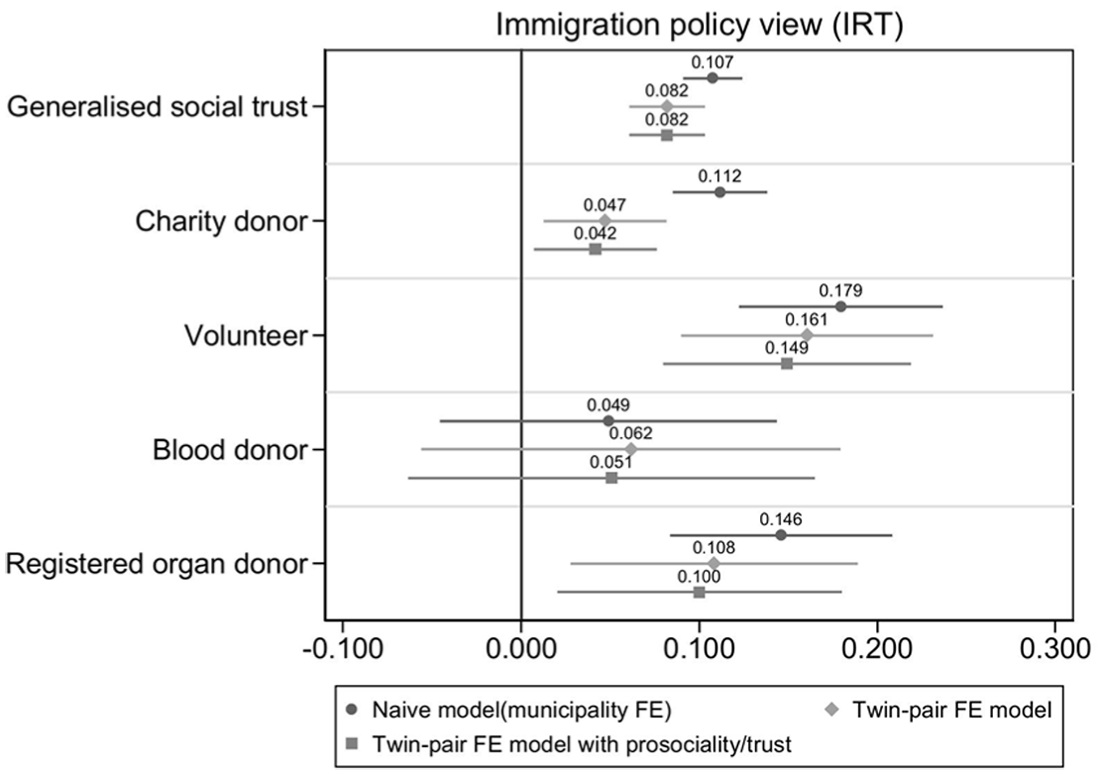
The Effects of Social Trust and Prosociality on Immigration Policy Views (All Twins).
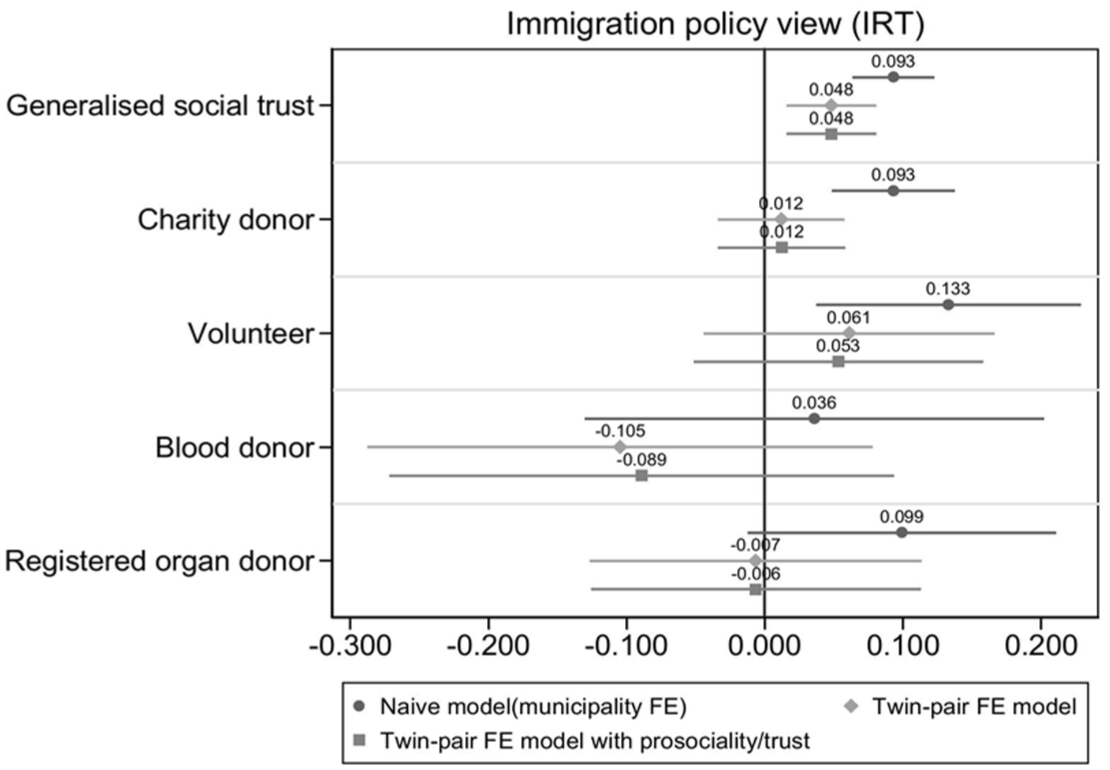
The Effects of Social Trust and Prosociality on Immigration Policy Views (MZ Twins).
Generalised trust consistently shows positive coefficients that are significant at the 99% level across all models, providing evidence for the expectation regarding its positive effects on pro-immigration policy support (RQ1). The effect size of generalised trust is meaningful, as a one-score difference in generalised trust corresponds to an increase in positive immigration policy views by 4.8–8.2% of the standard deviation, depending on the sample used. Comparing estimates from the naïve model and within-family model, the estimates for generalised trust decrease by about 23% when using the full twin sample and by nearly 50% in models using only MZ twins. It is possible that the effect size is underestimated and suggests the lower bound of trust effects, as a result of attenuation bias in fixed effects models due to measurement error (e.g. Griliches, 1979; Sjölander et al., 2022) in generalised trust.
For prosociality variables, charity donor, volunteer and registered organ donor are all significant in naïve between-family models and within-family models based on the full twin sample. Specifically, being a volunteer or being a registered organ donor, for example, means more positive immigration policy views by about 10–16% of the sample standard deviation. These estimates are slightly attenuated when generalised trust is controlled for. As for blood donors, the effects are not significant for all models. However, given that only about 8% of the current sample are blood donors, variations within twin pairs and across individuals may be too limited, resulting in wide confidence intervals.
Nevertheless, unlike the robust role of trust, none of the prosociality measures are significant or have substantial point estimates in models based on MZ twins, in which genetic confoundings are eliminated (RQ2). For charity donation and registered organ donation, the within-family estimates shrink to near zero, and for blood donation, the point estimate turns negative. These discrepancies may indicate the presence of genetic confounding. In Appendix Table A.6, I interact twin zygosity with trust and prosociality as an indirect test for zygosity-based differences, and I provide further discussion on why the more attenuated estimates in the MZ subsample can plausibly be interpreted as evidence of genetic confounding for interested readers. However, it should be noted that while analyses based on MZ twins eliminate more confounding, they also suffer from reduced statistical precision, 12 resulting in less precise estimates.
Is the role of trust partly attributable to prosociality? Importantly, across all models, the inclusion of prosociality variables has minimal influence on the effect of trust. This suggests that the role of generalised trust in shaping immigration attitudes is largely distinct from prosociality (RQ3). In other words, the reason why people who trust strangers tend to be more pro-immigration is not simply because they are more inclined to help others.
Since the sample includes some respondents with a foreign background, I also estimated the models using only respondents with a Swedish background (Appendix A.3). The results are effectively similar to those reported in the main analysis.
Additional Analysis
Variation Across Policy Items
The results regarding the general stance on immigration policies so far demonstrate the role of generalised trust. But when focusing on each policy item, seen in Figure 3, it seems that generalised trust is only consequential for policy preferences regarding refugee and labour immigration acceptance (the two figures on the top), or, in other words, tolerance and openness towards an increasing number of immigrants. However, for more specific policy areas regarding citizenship requirements and immigrant support, policy preferences may not be underpinned by trust. There are several interpretations for this more ambivalent association. First, comparatively speaking, at least until the time of the survey, Sweden was considered a representative for multiculturalism policy and branded itself as supporting multiculturalism historically; its universal welfare state regime also covers social protection and support for immigrants to a high standard. Hence, it might be the case that trust plays a limited role when respondents benchmark against the current standards to evaluate related policy areas. Second, attitudes in multiculturalism and integration also involve other values, beliefs and conceptions of and attachment to the nation (e.g. Gustavsson and Stendahl, 2020; Huddy and Ponte, 2019), which do not necessarily align with trust. The variations in the role of trust across policy items are not surprising in light of recent findings on the complexity and multidimensionality of immigration policy preferences (Helbling et al., 2024). For example, Levy and Wright (2020) argue that Americans in general hold a mix of pro- and anti-immigrant opinions, and these views can be flexible.
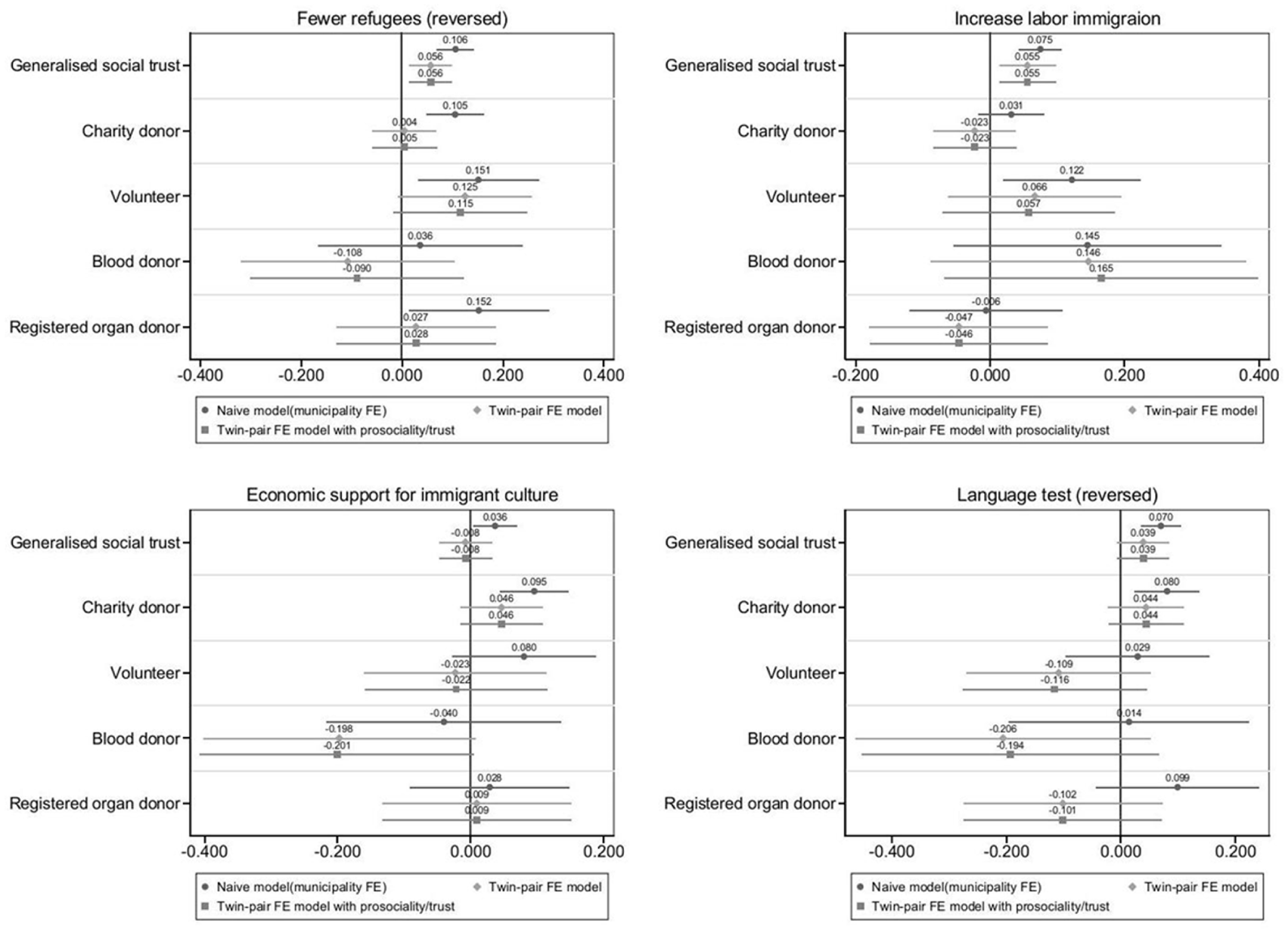
The Effects of Social Trust and Prosociality on Each Immigration Policy Item Based on MZ Twins.
The analysis also reveals that measures of prosociality do not exhibit significant effects on general immigration policy preferences, nor do they demonstrate significance for any of the specific policy items.
The Robustness of the Trust Effect
To further assess the robustness of the role of generalised trust, two additional analyses were performed. First, to rule out the influence of individual-specific confounders and to get a sense of the magnitude of the trust effect compared to other prominent predictors for immigration attitudes, I included several additional controls in the model using only MZ twins and reported the standardised beta coefficients. As elaborated in Appendix A.4, these variables are plausible confounding factors for the relationship between trust and immigration policy preferences, but variables such as left–right identification may also introduce post-treatment bias. Consequently, I have not included them as standard controls in the main analysis. Specifically, I added self-reported left–right identification, trust in politicians and self-rated religiosity (response to the question ‘How religious are you?’) from the SALTY survey, and a variable for the proportion of foreign-born individuals in the respondents’ occupations constructed from population register data as an indicator for occupation ethnic diversity.
As shown in Appendix Table A.7, several additional controls (other than religiosity) are significantly related to immigration attitudes, but the overall pattern is consistent with the main result. Based on the standardised beta coefficients, the effect of a one-unit increase in generalised trust is comparable to that of confidence in politicians and higher than that of occupation ethnic diversity, while it is lower than the effect of increasing education and self-reported left–right identification by one unit. Nevertheless, it is important to acknowledge that the effect of trust could still be confounded by environmental factors unique to each twin.
Second, I examined whether the trust effect is resilient to the impact of exposure to ethnic diversity in occupation and disparities in socioeconomic status, which often are considered key contextual factors for the presence of anti-immigration sentiments. I use population-wide register data to generate these potential moderators. Specifically, socioeconomic status is a composite index of education and long-term income percentiles, while ethnic diversity in occupation includes the proportions for employees with foreign background and non-EU background, respectively. More detailed explanations of the measurements of these variables can be found in Appendix A.5.
The marginal effects of trust with respect to diversity in occupation show positive trends, but the interaction terms are not statistically significant. 13 When it comes to the socioeconomic status, we observe a relatively consistent association between trust and immigration attitude across the socioeconomic status, as illustrated in Figure 4. 14 This is notable, especially considering that recent research in psychology (Sheehy-Skeffington, 2020) and economics (Schilbach et al., 2016) have highlighted that resource scarcity and insecurity associated with low socioeconomic status can lead to a shift of focus on more proximal needs and social distance ‘at the cost of those with whom one has no existing social bonds (e.g. outgroup members)’ (Sheehy-Skeffington, 2020: 185). This additional analysis suggests that the link between generalised trust and views on immigration remains robust to these key contextual factors.
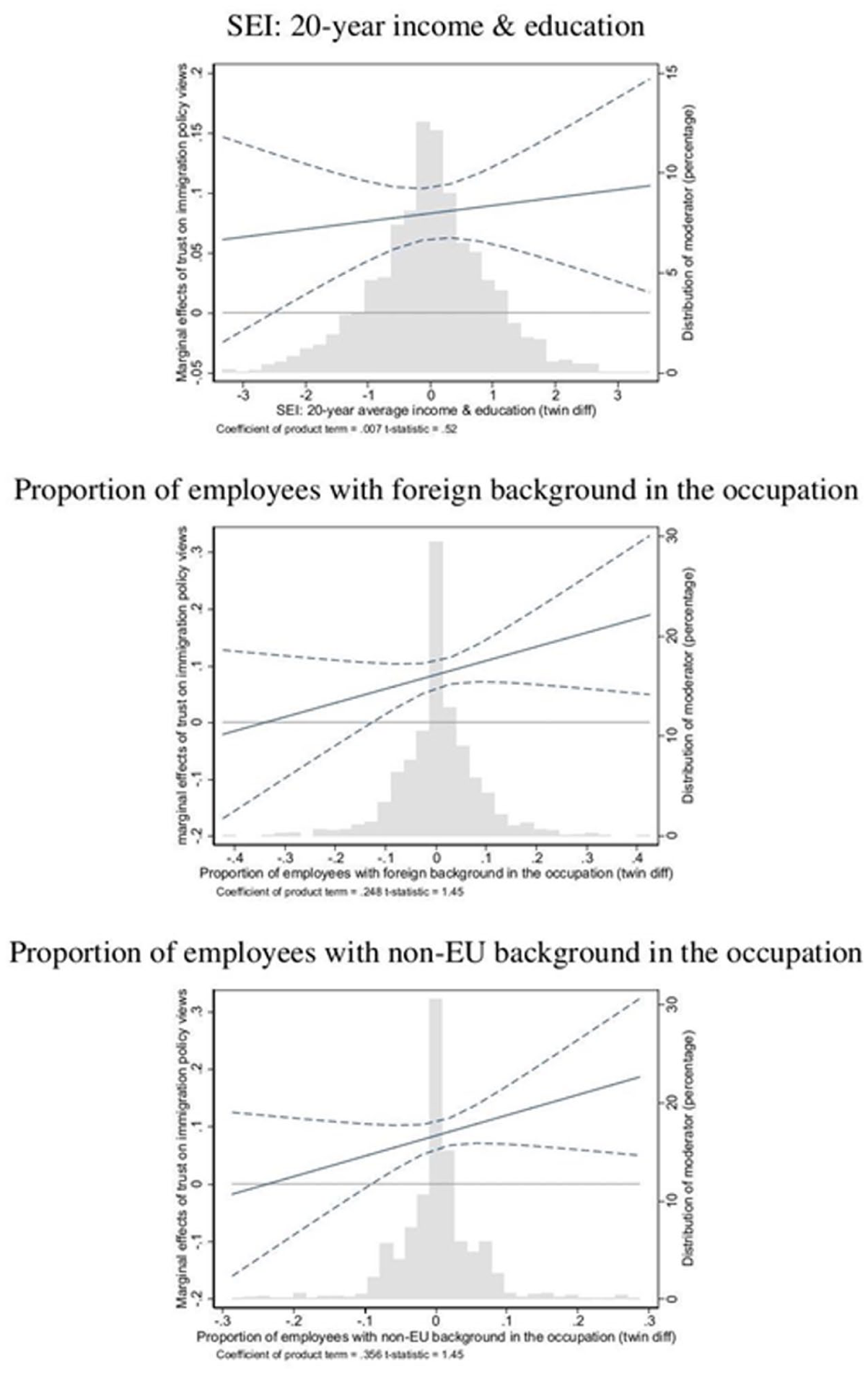
Marginal Effects of Trust With Respect to SEI and Diversity in Occupation.
Discussion
The role of generalised trust in shaping public views on immigration has received limited discussion as the focus in both scholarly research and public discourse is often instead on the consequences of immigration and changing demographic and cultural diversity for the receiving societies. This study seeks to fill this gap while also considering the potential influence of the related but theoretically distinct prosociality with that of generalised trust to clarify the foundations of support for immigration. Both generalised trust and prosociality are fundamental elements embedded in virtually all aspects of social relations, often with implicit boundaries of ‘us’ and ‘them’, leaving their implications for inclusion and treatment of outgroups ambiguous.
Analysing Swedish twin data, this study demonstrates a robust positive link between an individual’s levels of generalised trust and pro-immigration policy views. In this sense, fostering trust can lay the groundwork for greater tolerance and more inclusive attitudes on immigration. In contrast, the effects of multiple proxies for prosociality are unclear once genetic confounding is fully accounted for. It is possible that prosocial concerns for others can still be relevant for specific types of policies concerning those in humanitarian need, and prosociality in various forms (such as charity donations for communal versus global causes) may have distinct implications. Nevertheless, the finding that the role of generalised trust appears to be independent of prosociality suggests that trust may be a more general demand-side factor explaining why some people are more willing to be open and supportive of immigration. Its role is also not overwhelmed by other related influential factors, such as political orientation or confidence in politicians. Therefore, the willingness to extend ‘the benefit of the doubt’ to strangers and the readiness to accept potential vulnerability are likely to be more significant in shaping immigration policy preferences than the logic and willingness of solving others’ problems and improving others’ welfare. The latter, for instance, may be more fundamental for public support for social welfare (Aarøe and Petersen, 2014; Feldman and Steenbergen, 2001).
Of course, immigration policy is highly complicated, involving various domains and multiple dimensions (e.g. Helbling et al., 2024; Peters, 2015). Trust alone cannot fully explain views on the nuanced aspects and trade-offs in immigration policies. Future research could incorporate other approaches to measuring trust and prosociality (Bauer and Freitag, 2018; Robbins, 2022) and explore more comprehensive immigration policy options and dimensions to assess the robustness of the findings and further investigate the scope of trust’s influence.
It should also be noted that this study primarily approaches the discussion from the perspective of the native-born on immigration policy. The definition of native here is based primarily on individuals’ own and their parents’ birthplaces. Therefore, the discussions and implications presented may not apply to conceptions of native that emphasise historical connotations or social identification with a dominant or majority population. Meanwhile, the intergroup relationship implied is between the native-born and a general group of immigrants, which does not account for other social dimensions relevant to trust, such as cross-cutting intra- and intergroup relationships among both native-born individuals and migrants. For instance, for immigrant descendants who are born and socialised in Sweden but whose families experienced migration, how do their levels of generalised trust compare to those of native-born individuals and what are their views on immigration and integration policies? Such questions are pertinent for societies undergoing deepening demographic shifts, and highlight the need to move beyond broad group categories to examine trust and its implications in relation to more nuanced social backgrounds and experiences.
The findings are based on data from Sweden in 2009–2010, a high-trust society at a time when immigration had not yet become as politically charged as it is today. On the one hand, the Swedish case suggests that a high level of societal trust does not negate the importance of individual-level variation in trust, and I have provided theoretical reasons to expect that trust functions as a general explanatory factor for immigration policy attitudes. On the other hand, the development of generalised social trust is deeply embedded in historical and institutional contexts (e.g. Abramson et al., 2022; Herreros, 2023; Rothstein and Stolle, 2008), and its relevance likely varies across countries and over time. To gain some initial impression, in Appendix A.6, I use European Social Survey data, Rounds 1 and 7, to show the simple correlation coefficients for generalised trust and views on immigrants’ impacts and immigrant acceptance by country. In general, almost all countries have significant and positive correlations between generalised trust and immigration attitudes. During Round 1 (2002), the coefficient for Sweden is among the most sizable, but this is not the case in Round 7 (2014–2015), where generalised trust appears to more strongly correlate with immigration attitudes in countries like Germany, Austria, Belgium and France.
Explicating these cross-country and contextual differences would be a fruitful direction for enhancing our understanding of generalised trust and its interactive relationship with institutions and political contexts. The theoretical mechanisms of generalised trust outlined above can serve as useful guides. For example, could the mechanism linking generalised trust and immigration attitudes differ by social and institutional contexts? In a context where trusting strangers is not widely endorsed as a moral value or when one does not believe that strangers generally behave reliably, could trust function more as cognitive sophistication or as psychological security? This theoretical possibility suggests that the implications of trust are contextually variable and may stem from different underlying reasons.
Furthermore, while core immigration attitudes tend to remain stable over the long term (Kustov et al., 2021), it does not preclude the possibility that political and public discourse can influence how people reason about specific immigration issues and shape support (or backlash) for particular policies or parties. Immigration and integration are often framed in ways that highlight native–immigrant boundaries, present immigration as a cultural or pragmatic threat (Eberl et al., 2018; Helbling, 2014), or employ morally charged rhetoric (Simonsen, 2024). Such elite and media messaging may reinforce the connection between perceived social problems and policy preferences aimed at limiting immigration (Ivarsflaten, 2005). How might different rhetorical framings appeal differently to individuals with high versus low levels of trust? It is plausible that elite and media influence could shape immigration attitudes so strongly that trust becomes less relevant, but it is also likely that this influence interacts with individual trust levels. Low-trust individuals – who may be more sceptical of others, more sensitive to perceived threats and less discerning in evaluating information about outgroups – could be particularly receptive to certain negative messaging, and consequently adopt more restrictive attitudes than high-trust individuals. Thus, elite and media messaging may not override the effect of trust but rather amplify it, widening the attitudinal gap between high- and low-trust individuals.
Such political and discursive developments are particularly relevant to the Swedish context after the time of the survey and warrant empirical investigation. To be sure, Sweden continues to be one of the most open countries in Europe towards immigration and remains a high-trust society. However, the SD have shaped party coalitions and competition, and acquired substantial influence over policymaking in the recent decade (Demker and Odmalm, 2022). During and after the refugee crisis, border control and refugee rights policies became more restrictive, and mainstream political actors and public discourse sought to legitimise these changes (Hagelund, 2020; Krzyżanowski, 2018). Public opinion on refugee acceptance also exhibited a negative trend between 2015 and 2020 (Demker, 2021). Today, immigration has arguably become one of the most politicised and divided areas in Sweden, with restrictive turns in several domains of immigration and integration policy (Borevi, 2024).
What is often overlooked by international observers is that, as Holmberg and Rothstein (2020) highlight, Sweden’s overall high levels of social trust conceal internal divisions. A segment of the population exhibits distinctly lower trust, who often occupy more vulnerable positions within the welfare society and make up a significant share of SD and other minority party supporters. To the extent that anti-immigration sentiment contributes to SD support, this study offers theoretical insight into how generalised trust relates to immigration attitudes. The twin data suggest that this relationship cannot be fully explained by shared family background factors such as socioeconomic status. Moreover, Holmberg and Rothstein (2020) observe that trust among these low-trust groups appears to be declining further over time. With SD securing approximately one-fifth of the vote in the 2022 national election, it would be misleading to characterise Sweden’s social trust as unproblematic. If, as argued earlier, trust moderates individuals’ responsiveness to elite messaging, the attitudinal gap between high- and low-trust voters may be further amplified. Understanding the emergence and potential expansion of low-trust groups is therefore important to explaining recent trends in anti-immigration sentiment and support for SD in Sweden.
Finally, in contrast to the notion that intergroup contact is a crucial factor in extending trust beyond ingroups and promoting positive intergroup attitudes, the sample studied here raises an intriguing question. The twin cohort grew up during a period when Sweden was largely ethnically homogeneous, providing little opportunity for them to interact with or even superficially encounter ethnic outgroups during the impressionable years critical for developing trust and political attitudes. This suggests that intergroup contact is not an essential source for inclusive generalised trust. It also implies that other factors contributing to the conception and organisation of social cohesion, and perceptions and treatments of immigrant and other social groups, such as perceptions of fair institutions (Holmberg and Rothstein, 2020), national identity and nation-building (e.g. Banting et al., 2019; Gustavsson and Stendahl, 2020), economic equality (Rothstein and Uslaner, 2005; Uslaner and Brown, 2005), and interdependence and macrosocial structures (Baldassarri and Abascal, 2020; Portes and Vickstrom, 2011) – some of which can be conflated with increasing ethnic diversity (e.g. Larsen, 2013; Portes and Vickstrom, 2011; Sturgis et al., 2014) – represent essential layers for comprehensively understanding the widely debated relationship between immigration politics and the highly valued goal of social cohesion.
Supplemental Material
sj-docx-1-psx-10.1177_00323217251410743 – Supplemental material for Trust, Prosociality and Immigration Policy Views: Evidence From Swedish Twin Data During 2009–2010
Supplemental material, sj-docx-1-psx-10.1177_00323217251410743 for Trust, Prosociality and Immigration Policy Views: Evidence From Swedish Twin Data During 2009–2010 by Qinya Feng in Political Studies
Footnotes
Acknowledgements
The author would like to thank Rafael Ahlskog, Gina Gustavsson, Lutz Gschwind, Sven Oskarsson and seminar participants at Uppsala University, APSA 2023 and EPSA 2023 for their helpful comments.
Data Availability Statement
This research uses proprietary register data from Sweden. The data can be ordered from Statistics Sweden and the Swedish Twin Register with requisite ethics approval.
Declaration of Conflicting Interests
The author declared no potential conflicts of interest with respect to the research, authorship and/or publication of this article.
Funding
The author disclosed receipt of the following financial support for the research, authorship and/or publication of this article: This work was supported by Vetenskapsrådet (2019-00244).
Ethics Approval
This study was approved by the Uppsala Regional Ethics Board (protocol number 2017/ 083).

Supplemental Material
Additional Supplementary Information may be found with the online version of this article.
Contents
A.1. Demographic changes in Sweden, 1960–2023. Figure A.1: Proportions of foreign background and foreign-born in Sweden. A.2. Descriptive statistics. A.2.1. Descriptive statistics for the twin sample and twin differences. Table A.1: Descriptive statistics for the full twin sample. Table A.2: Descriptive statistics for twin differences. A.2.2. Immigration policy views. Figure A.2: Distributions of responses for each immigration policy item and the IRT index (all twins). Figure A.3: Distributions of responses in the Swedish National Election Study 2010. A.2.3. Twin differences in main variables. Figure A.4: Distributions of within-twin-pair differences in immigration policy views, trust and prosociality. Histograms in grey are for original distributions. Histograms in red are differences within pairs (absolute values). A.2.4. Correlations among trust, prosociality and immigration policy views. Table A.3: Correlation coefficients. A.3. Main regression results. A.3.1. Full regression results. Table A.4: Trust, prosociality and immigration policy views (all twins). Table A.5: Trust, prosociality and immigration policy views (MZ twins). A.3.2. An indirect test on genetic confounding. Table A.6: Interactions between twin zygosity and main independent variables. A.3.3. Main analysis restricted to respondents with a Swedish background. A.4. Beta coefficients with additional controls. Table A.7: Beta coefficients. A.5. Interactions with SEI and diversity in occupation. Table A.8: Interactions with SEI and diversity in occupation. A.6. The relationship between trust and immigration attitudes in the European Social Survey. Figure A.6: The relationship between generalised trust and immigration attitude items in Round 1 in 2002. Figure A.7: The relationship between generalised trust and immigration attitude items in Round 7 in 2014.