




Abstract
While populist radical right parties (PRRPs) have thrived across Europe, Scotland has so far remained an exception. This article explores the reasons behind the failure of PRRPs to gain traction, focusing on the supply side of party competition and developing a more nuanced conceptualization of polarization. It argues that, at a critical moment when PRRPs were growing elsewhere, Scotland’s political landscape was shaped by symbiotic polarization, in which two established and opposing parties – the Scottish National Party (SNP) and the Scottish Conservative Party – reinforced each other’s positions, entrenched by the Scottish independence and Brexit referendums. This dynamic constrained the emergence of PRRPs. Since 2022, however, this political balance has fractured, creating space for a disruptive polarizing force on the populist radical right. Scotland’s case highlights how patterns of polarization can inhibit or facilitate political challengers, offering broader insights into party system resilience and transformation.
Introduction
Populist radical right parties (PRRPs) have become the fastest-growing party family in Europe (Golder, 2016; Mudde, 2007), now a key and permanent feature of many European party systems. Often grouped under the ‘umbrella concept’ of the ‘far right’ (Pirro, 2022), their numbers continue to rise, with multiple such parties emerging and thriving in individual countries (Rooduijn et al., 2024). PRRPs’ electoral success has accelerated since 2015, enabling many to integrate more fully into their party systems (Zulianello, 2020) and even become ‘established’ by entering government (Albertazzi and Vampa, 2021; Crulli and Albertazzi, 2024). Countries once considered immune to the populist radical right (PRR) wave, such as Portugal, Spain, and Germany, have also witnessed the rise of strong challengers in the more radical sectors of the right (Carvalho, 2022; Dennison and Mendes, 2019; Turnbull-Dugarte, 2019; Weisskircher, 2023). Cases that remain resistant to radical right populism have therefore become increasingly rare, and their examination can inform wider scholarly debates on party system adaptation, democratic resilience, and the evolving relationship between citizens and political elites.
Scotland remains one of the few European political systems where the PRR has struggled to gain traction. While the United Kingdom has witnessed a succession of electorally significant parties to the right of the established Conservative Party – from the UK Independence Party (UKIP) to Reform UK – scholars have emphasized the ‘relative irrelevance’ of PRRPs in Scotland (Massetti, 2018). Scotland has also diverged from Wales, which, despite Labour’s dominance and ‘inclusive’ nationalism (Chaney and Fevre, 2001), has provided more fertile ground for PRRPs in devolved and state-wide elections (Bradbury, 2015; Scully and Larner, 2017; Heath et al., 2025). Yet Scotland’s picture is not static: signs of change suggest potential convergence with broader European trends.
This article situates Scotland in a comparative context, framing it as a dynamic case that illuminates the conditions facilitating or inhibiting the rise of PRR challengers. Scotland provides a unique opportunity to conduct a study with a middle-range theoretical orientation, through the development and empirical exploration of the new concept of ‘symbiotic polarization’ (SP). While operating alongside other Scottish-specific factors, SP is shown to function as a powerful systemic constraint, reinforcing party system stability and limiting the prospects for populist breakthrough.
The analysis shows that while anti-immigration and socially conservative parties gained ground in the increasingly unstructured political systems of Europe and the wider UK, competition in Scotland remained ‘frozen’ and largely closed to challengers until 2022. Party positioning during and after two pivotal referendums – the Scottish independence referendum and the Brexit referendum – shaped and cemented a polarized landscape in which two opposing camps, dominated by the Scottish National Party (SNP) and the Scottish Conservatives, sustained and reinforced each other’s dominance (hence the term ‘symbiotic’). Scotland may therefore illustrate how a particular form of polarization can inhibit the rise of PRR challengers, offering important lessons for other political systems in Europe and beyond.
After 2022, Scotland saw the breakdown of SP and the weakening of the constitutional dimension that had long structured electoral competition. Leadership crises in both major parties undermined their capacity to sustain the constitutional and territorial divides that had underpinned their dominance. This collapse, combined with the sudden rise of Reform UK in 2024–2025 within a context long considered inhospitable to the PRR, underscores a crucial point: a de-polarized political environment may be especially vulnerable to PRR advances.
In sum, through an implicitly comparative and ‘extroverted’ case study analysis that ‘employs concepts that make it possible to derive generalizations’ (Rose, 1991), this article contributes to the broader literature on polarization and the rise of PRR challengers. Scotland can also be considered an ‘extreme’ and ‘exploratory’ case (Gerring, 2017: 68), used to develop and test a refined typology of inter-party competition – highlighting the importance of ‘party relational dynamics’ in identifying different types of polarization. This typology can also be applied to other cases in Europe and beyond.
The next section contextualizes the Scottish case within the broader Western European landscape, highlighting its exceptionalism and justifying its relevance. We then develop a framework centred on the supply side of the political equation, focusing on how a polarized political environment, shaped by party positioning, may facilitate or hinder the rise of PRRPs. Next, we introduce a typology of party relational dynamics, distinguishing between three types of polarization: disruptive, symbiotic, and erosive. We argue that symbiotic polarization (SP) reinforced barriers to the success of new PRRPs.
The analysis of the Scottish case illustrates how SP unfolded and contributed to freezing the Scottish political system, while most of Europe experienced greater instability and volatility. We also examine more recent developments, showing how the collapse of SP is creating opportunities for the PRR, potentially bringing Scottish exceptionalism to an end.
In the final part of the article, we discuss the broader relevance of our theoretical and empirical insights beyond Scotland and show how our typology can be applied to illuminate political developments in other systems at different territorial levels.
The Puzzle of Scottish Exceptionalism
If we consider the recent success of PRRPs across Western Europe, Scotland clearly stands out as an exceptional case, particularly due to the pronounced weakness of this party family. In this sense, it may also be considered an ‘extreme case’ (Allarakia, 2022: 659; Gerring, 2017: 68). Figure 1 illustrates this point by showing the average vote share of PRRPs across Western Europe in the last two parliamentary elections (as of December 2024). 1
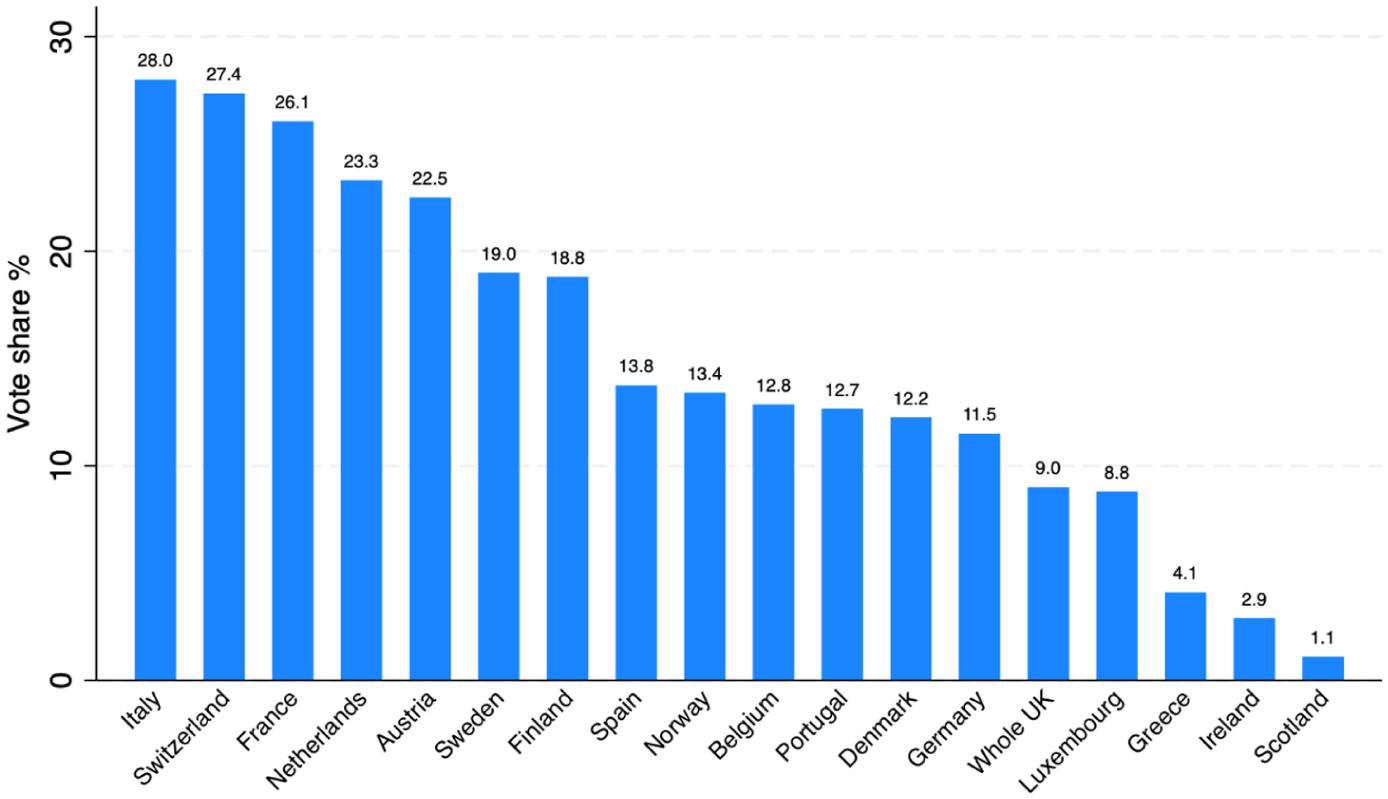
Vote share (%) of PRRPs in two most recent elections (as of December 2024): Scottish Parliament versus Western European national parliaments.
Scotland sits at the very end of the distribution, with a negligible presence of PRRPs in its two most recent parliamentary elections. At the UK-wide level, voter support for PRRPs is comparable to that of countries positioned in the middle of the distribution. The main PRR challengers in the United Kingdom have been a succession of parties from UKIP to the Brexit Party, later renamed Reform UK, all under the leadership of Nigel Farage. These parties have been severely disadvantaged in UK-wide elections by the first past the post system, despite winning more than 10% of the vote in 2015 and 2024. In theory, Scotland’s mixed voting system could have provided greater opportunities for challenger parties to secure meaningful parliamentary representation (Carter, 2002; Golder, 2003). Yet this has never materialized.
If we compare Scotland to over 80 ‘meso-level’ units (Keating, 2013) in countries with regional, devolved or federal structures in Western Europe – such as Italy, Spain, Germany, France, Austria, and Belgium – Scotland still appears ‘extreme’, at the very end of the distribution (Figure 2).

Vote share (%) of PRRPs in two most recent elections (up to December 2024): Scottish Parliament versus regional elections in Italy, Spain, France, Germany, Austria, Belgium and rest of the United Kingdom.
Another aspect of Scottish exceptionalism, linked to the absence of political challengers – especially PRR ones – is the growing stability of Scotland’s party system. Figure 3, based on data from Vampa (2024), compares trends in Scottish electoral volatility with those of 58 European regions since the early 2000s. While volatility has risen substantially across most of Western Europe – mainly due to the rise of PRRPs – Scotland has followed the opposite trajectory, with the political equilibrium established in the 2010s becoming increasingly entrenched.
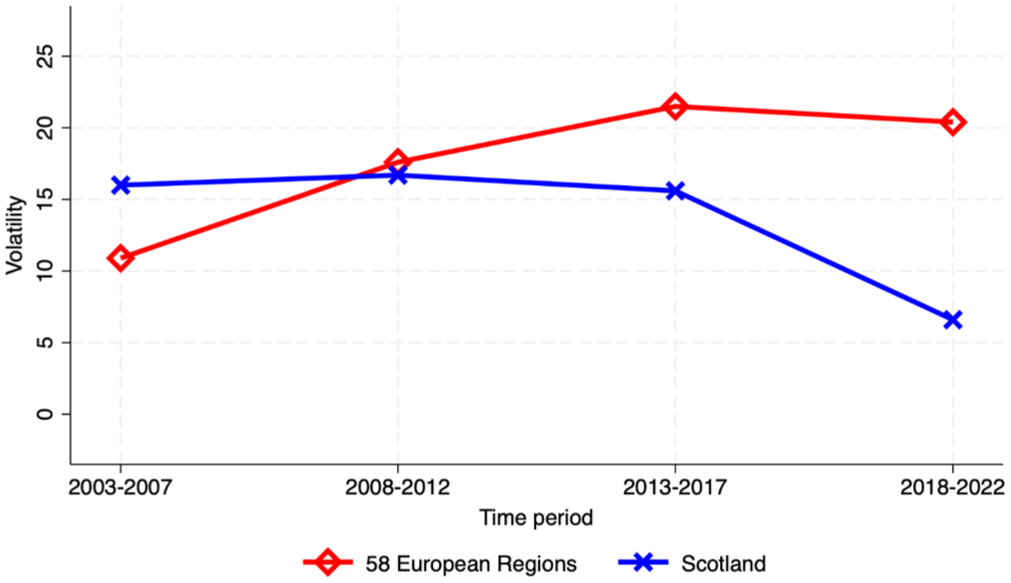
Volatility in regional and sub-state elections: comparing Scotland to 58 European regions.
Since 2010, various iterations of PRRPs have been far more successful in England (and Wales) than in Scotland, as shown in Figure 4. It was only in 2024 (when the UK general election took place) that Scotland began moving in the same direction as the rest of Great Britain – a development that may mark a significant shift in the devolved nation’s political landscape.
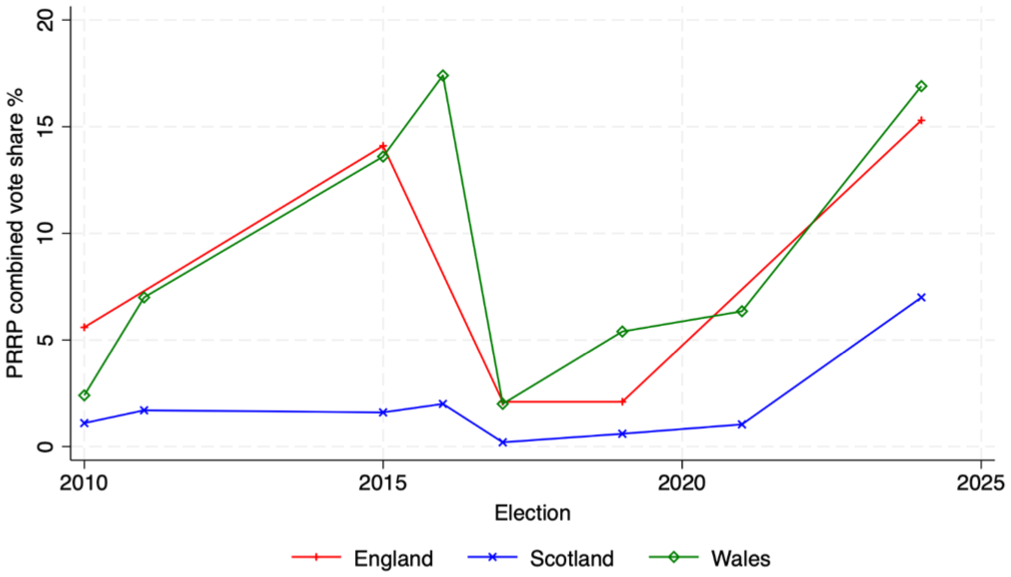
Performance of PRRPs 2 in England, Scotland and Wales from 2010 to 2024.
From a demand-side perspective, there is no clear evidence that Scotland differs significantly from other parts of the United Kingdom in the distribution of values within its population. Figure 5 compares Scotland and England, showing near-identical distributions along both the socio-economic and socio-cultural continuums. Similarly, Sobolewska and Ford (2020: 254) showed that ‘the proportion of ethnocentric voters is comparable in Scotland and England’.
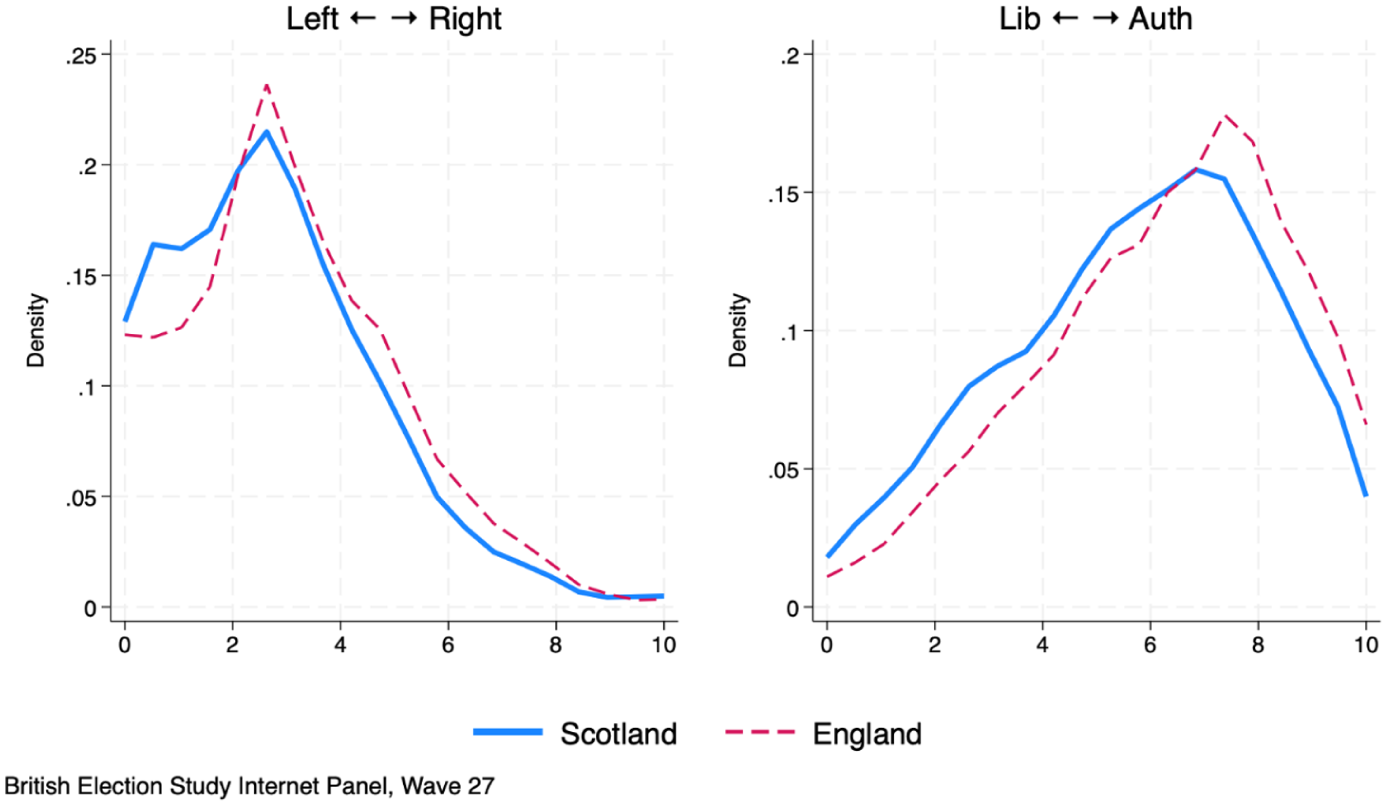
Distribution of political values in Scotland and England.
The key difference, as Sobolewska and Ford (2020) highlight, lies on the supply side. While UKIP in England successfully mobilized the ‘exit’ vote (exit from the European Union), the SNP channelled identity politics around another exit option (Scotland’s independence from the United Kingdom). As we also show in our analysis, the SNP acted as a ‘disruptive polarizer’ while UKIP was polarizing voters in England (and Wales).
Yet this is only part of the story. Following the 2014 Scottish independence referendum, the fragmentation of opposition to the SNP could have created space for a more radical (and populist) unionist alternative in Scotland. However, as our framework suggests, polarization can manifest and evolve in different ways and can even act as a party system stabilizer and a barrier to the rise of PRRPs.
Polarization and the Rise of the PRR
Before turning to an explanation of Scottish exceptionalism, it is useful to consider what the literature has said about the relationship between polarization and populism more generally.
Electoral developments within party systems are best understood as the outcome of a dynamic interaction between political demand and supply. Demand stems from societal economic and cultural concerns and aspirations, which create fertile conditions for the emergence of new parties (Golder, 2016; Mudde, 2007). On the supply side, institutional frameworks, party organizations, and elite strategies shape how these demands are articulated and translated into political action (Arzheimer and Carter, 2006; Golder, 2003; Mudde, 2007; Tarrow, 1994).
While societies may be deeply divided along socio-economic and socio-cultural lines, polarization is often driven by political supply – specifically, how parties position themselves within the political space. This positioning can reinforce existing societal divisions or generate new ones by making certain issues politically salient. As Roberts (2022: 680) argues, populism sharply increases polarization ‘by constructing an anti-establishment political frontier, politicizing new policy or issue dimensions, and contesting democracy’s institutional and procedural norms’. In this context, PRRPs are often viewed as key polarizing forces within political systems.
However, when shifting the focus from the effects of populism to the factors contributing to its success, an important question arises: does pre-existing supply-side polarization facilitate the rise of these parties? Cas Mudde (2007: 238–239), in his seminal work on PRRPs, highlights two competing interpretations of this relationship.
The first interpretation suggests that highly polarized systems hinder the rise of PRRPs, as the ideological space is already occupied by established political forces. Kitschelt and McGann (1995) argued that PRRPs tend to emerge in contexts where mainstream parties converge ideologically, leaving room for more radical challengers to exploit neglected voter concerns. In this view, it is not polarization, but rather a lack of it, that creates opportunities for populist success.
The alternative interpretation, first advanced by Piero Ignazi in the 1990s, posits that the rise of PRRPs – which he defined as ‘extreme right-wing parties’ – is facilitated by polarization. Ignazi (1992: 2) argued that ‘changes in the cultural domain and in mass beliefs . . . favoured radicalization and system polarization’, creating an environment where established conservative parties failed to address emerging societal demands. In response to Kitschelt and McGann’s convergence thesis, Ignazi (2003: 208–209) refined his argument by focusing on the sequencing of these dynamics. He suggested that the radicalization of mainstream right parties initially drove party system polarization, but subsequent convergence and de-polarization created openings for populist challengers to succeed. According to this view, the rise of the PRR follows a pattern of polarization–depolarization–repolarization, where early polarization lays the groundwork for the renewed polarization that PRRPs later capitalize on.
As Mudde (2007) argued, scholars studying the rise of the PRR in the 1990s and 2000s largely endorsed Kitschelt and McGann’s thesis, viewing convergence – rather than polarization – as an important condition for the success of new challenger parties. This perspective remained influential into the 2020s. Roberts (2022: 681), for instance, noted that while populism is a polarizing force, it ‘typically arises in contexts of mainstream party convergence with low political polarization’. Yet if this argument were entirely accurate, the continued emergence of new populist competitors in Europe’s increasingly polarized political landscape would be difficult to explain, particularly after the consolidation of the first wave of populist parties in the 1990s and 2000s. Successive waves of PRRPs over the past decade challenge the notion that polarization inherently acts as a barrier to the rise of new populist challengers by crowding the political space on the system’s fringes. Instead, the evidence points to a more complex dynamic, in which highly polarized systems provide fertile ground for even newer and more radical populist parties, which can exploit the instability and fragile political equilibriums created by polarization, sometimes going as far as challenging existing populist actors as too ‘established’ (Albertazzi and Vampa, 2021).
It has also been argued that polarization cannot be reduced to a unidimensional left-right axis, but instead may manifest in a two-dimensional space, characterized by separate socio-economic and socio-cultural divides (Roberts, 2022: 686). However, these two dimensions do not fully capture the scope of party competition. In some contexts, an additional dimension – the territorial dimension – based on the divide between the centre and periphery of a state, may significantly shape party positions and dynamics (Alonso et al., 2013; Elias et al., 2015). Territorial divides can have profound implications for the success of PRRPs. In the case of Spain, Alonso and Rovira Kaltwasser (2015) analysed the country’s cleavage structure and argued that the failure of the PRR (until 2014) was largely due to the strength of the centre-periphery cleavage. Although they did not explicitly refer to polarization, their underlying argument suggests that, in a system where established state-wide and non-state-wide parties compete strongly along a highly salient centre-periphery divide – and are thus polarized on that dimension – there is limited room for new PRR challengers.
Developments since 2014 challenge this notion. The rise of Vox, a PRRP, which capitalized on pre-existing territorial tensions that were already highly polarized (Turnbull- Dugarte, 2019; Vampa, 2020), clearly demonstrates that the centre-periphery cleavage can serve as fertile ground for PRR mobilization rather than acting as a barrier to it. Even in Catalonia, where Alonso and Rovira Kaltwasser argued that the promotion of exclusionary nationalist narratives by state-wide PRRPs would alienate most socially conservative voters, Vox achieved significant political success, alongside another pro-independence PRRP, Catalan Alliance (Martínez-Cantó, Tudó-Cisquella, 2025).
The discussion above suggests that polarization across different dimensions – including pre-existing territorial divides – does not inherently hinder the rise of new PRRPs. In this article, we argue that polarization is shaped not only by its dimensionality (socio-cultural, socio-economic, territorial/constitutional) but also, from a supply-side perspective, by relational dynamics – that is, the ways in which parties sustain and reinforce polarization through their interactions. By ‘relational’, we refer to how parties position themselves in response to their opponents, shaping the competitive space in ways that either create or constrain opportunities for new challengers.
Using Scotland as a case study, we demonstrate how these relational manifestations of polarization influence distinct pathways for PRR success or failure. Crucially, we argue that polarization itself does not block the rise of new challengers. However, it becomes a barrier when it is symbiotic: when two established parties or coalitions can mutually entrench their positions by framing each other as primary opponents, thereby reinforcing their control within a polarized system. In the following section, we further elaborate on the concept of ‘symbiotic polarization’ and situate it within a more comprehensive typology of party relational dynamics.
Symbiotic Polarization in a Typology of Party Relational Dynamics
The dynamics of inter-party interaction are central to the operation of party systems. Building on Sartori’s (2005) understanding, we adopt a relational approach that emphasizes the interplay between party behaviour and systemic outcomes. While analytically separable, the distinction between party action and system structure often blurs in practice, as patterns of competition both shape and are shaped by broader systemic configurations. Rather than examining parties in isolation, our approach focuses on how their interactions structure the competitive dynamics of the system. This aligns with Sartori’s framework, which is based not only on input characteristics – such as the number of parties, ideological distance, and the presence of anti-system actors – but also on systemic outcomes, including the stability of the system, the direction of competition (centripetal or centrifugal), and the system’s capacity to sustain democratic governance. His categories are functional types: they capture what specific configurations do to the political system. For example, Sartori’s concept of ‘polarized pluralism’ shows how high fragmentation and ideological radicalism, particularly involving anti-system parties on both flanks, can generate centrifugal dynamics, marginalize the political centre and ultimately undermine democratic stability.
We argue that patterns of competition between established parties significantly shape the opportunities and barriers that new challengers encounter in their emergence and consolidation. Rather than adhering to the simple dichotomy of convergence versus polarization, we argue that polarization itself can manifest in various forms, each carrying distinct implications for the resilience of existing parties and the prospects for new entrants.
The typology outlined below focuses on inter-party relationships within a competitive electoral context, defined by the free and fair contestation of votes. In this framework, ‘relational dynamics’ refer to the dual movement of interaction between political parties as they seek to capture – and shift – the preferences of voters in the electoral marketplace.
We can classify party relational dynamics as follows:
1.
2.
3. A.
Example: After 2010, UKIP disrupted mainstream positions on Europe and challenged the ‘LibLabCon consensus’ (Tournier-Sol 2015). Most European PRRPs, at the time of their breakthrough, can be regarded as disruptive polarizers.
B.
Example: In the early 2000s, Sinn Féin and the Democratic Unionist Party acted as symbiotic polarizers within Northern Ireland’s party system. Their mutually reinforcing antagonism and ‘intransigence’ – despite a gradual convergence in public attitudes towards the Good Friday Agreement (Mitchell et al., 2009) – helped them consolidate dominance within their respective communities while marginalizing more moderate alternatives. However, the rise of the ‘centrist’ Alliance Party, ‘which stands outside Northern Ireland’s two ethno-national blocs’ (Tonge et al., 2024: 1) may indicate a partial shift towards erosive polarization in more recent years (next point).
C.
Example: In the early 1980s, both Conservatives and Labour in the UK suffered from their shifts to more radical positions and mutual delegitimization. ‘The Labour party was widely perceived as having moved to the Left during the 1970s, but now the Thatcher government was being perceived as doctrinaire and inflexible in the other direction’ (Denver, 1983: 81). In this ‘polarised situation neither of the major parties was particularly popular’ (Denver, 1983: 81) – in fact, the Conservatives initially trailed badly behind Labour – creating opportunities for the rise of the SDP-Liberal Alliance. Even though the Conservative Party eventually recovered and won a landslide in the 1983 general election, both they and Labour saw their support eroded (−1.5 and −9.3 percentage points, respectively) in favour of the moderate Alliance (+11.6).
The categories presented above (and summarized in Figure 6) are ideal types; they may not exist in their pure form in reality, but provide a useful framework for understanding how party relational dynamics manifest and structure political developments. In this article, we argue that subcategory 3.B, SP, can act as a barrier to the rise of new challengers, including PRRPs. We do not argue that SP is the exclusive factor explaining the absence of PRRPs. Rather, in line with supply-side accounts, focusing on ‘political opportunity structures’ (Tarrow, 1994), we argue that it may reduce opportunities for far right activation even when demand-side conditions are in place. At the same time, the end of SP or the rise of different types of polarization (disruptive or erosive) may open up new opportunities for PRR mobilization even in the absence of significant ideological realignments in the electorate.
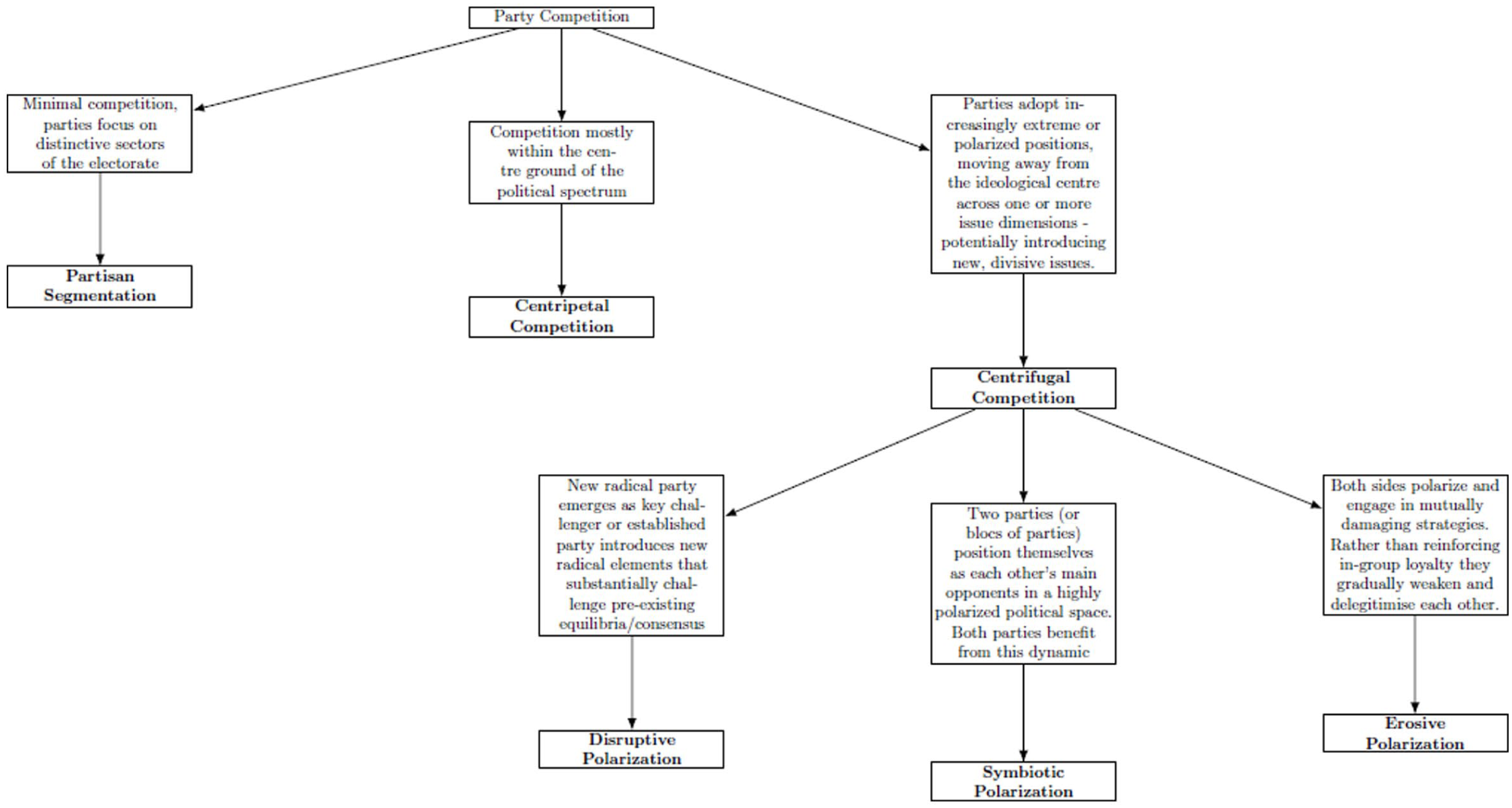
Summary of the typology of party relational dynamics.
As demonstrated in the empirical analysis below, this framework helps illuminate why, over the past quarter-century – particularly since the financial crisis – Scotland has largely remained an exception, while much of Europe has experienced significant disruption from the rise of PRRPs. It also sheds light on why this Scottish ‘exceptionalism’ now appears to be fading. The aim is not to offer a comprehensive or uniquely Scottish explanation, but rather to use the Scottish case to trace how SP unfolds, structures party dynamics, and constrains the emergence of challenger parties. Although rooted in the Scottish context, this is not a Scotland-specific study. The realities of a single case do not perfectly correspond to the ideal-typical categories outlined above. However, the study makes a mid-range theoretical contribution that builds on a rich body of Scotland-focused research – which typically offers strong internal validity and a fine-grained understanding of local dynamics, but may lack the theoretical reach to inform broader debates. This article, by contrast, aims to offer conceptual tools that, while grounded in a single case, can be applied, tested, challenged and refined across a wider comparative terrain.
Explaining Scottish Exceptionalism
The Right in Scotland
Like the rest of Great Britain, Scotland’s main centre-right party is the Conservative Party, which originally existed as a separate organization (the Scottish Unionist Party) before fully merging with the UK Conservative Party in 1965 (Urwin, 1966). The Scottish Unionist Party was ‘the most successful organisation in Scottish politics in the period from after the Great War to the mid-1960s’ (Finlay, 2012: 29). However, after the high point of the 1955 general election, the party embarked on a path of decline, which accelerated under Margaret Thatcher (Kendrick and McCrone, 1989; Seawright, 1999). At the 1997 general election, the party lost all its Scottish seats. However, it was granted a reprieve in the new Scottish Parliament in 1999, where the mixed-member proportional electoral system enabled it to gain 18 seats.
The Scottish Conservatives hovered around the same level of performance for the next 16 years. Despite being nominally the only option on the right of the Scottish party system, they struggled to break through (Convery, 2016). They suffered a long hangover from association with the UK Conservative Governments of the 1980s and 1990s. As we have already demonstrated, Scottish voters are not substantially more left wing than English voters, so that explanation cannot fully account for the Conservative weakness after 1999. Instead, a more likely explanation is that their perceived scepticism about devolution made it difficult for them to reach out beyond their core vote to Scots who thought that the Scottish Parliament should have the most influence over policies in Scotland (Curtice, 2012).
Their moment finally came in the 2016 elections to the Scottish Parliament when they won 31 seats (a gain of 16) and increased their vote share by 10 percentage points in the regional vote. 3 The Conservative surge in Scotland was even more noticeable in Westminster elections, ‘sweeping up a substantial chunk of Labour’s remaining unionists’ (Henderson et al., 2022: 139). Having never had more than one Westminster MP since 1992, the Scottish Conservatives won 13 seats at the 2017 general election. In 2021, the Conservatives reinforced their position as the main opposition to the dominant SNP in the Scottish Parliament, slightly increasing their regional vote share (Figure 7) and widening the gap with Labour.
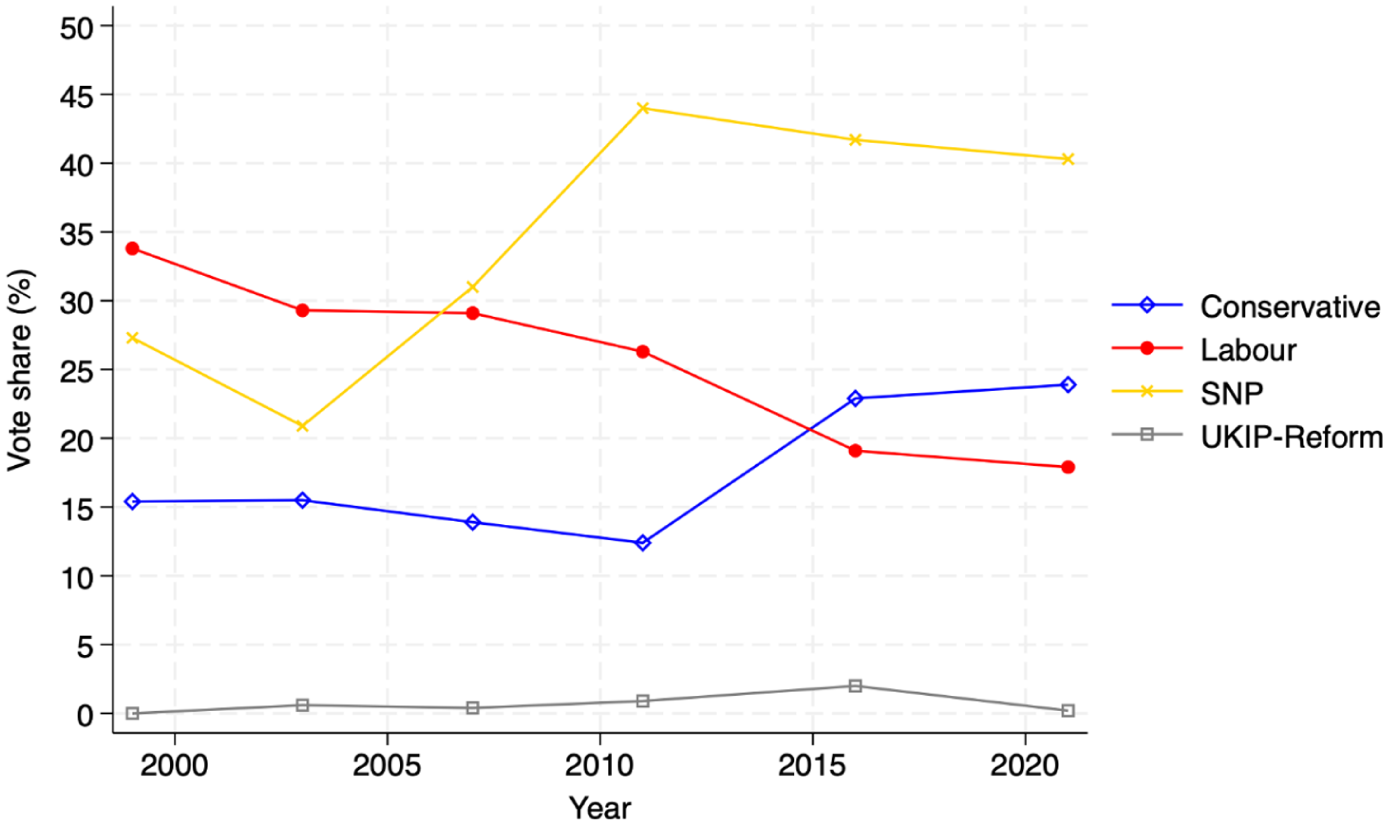
Party results and shifting equilibria in Scotland (regional vote).
As the analysis below shows, this development supports our argument that the rise of SP between the SNP and the Conservatives has defined Scotland’s political landscape since 2015. This dynamic contributed to the effective freezing of the Scottish party system. While PRRPs reshaped politics elsewhere across Europe, Nigel Farage’s various projects – from UKIP to Reform (Tournier-Sol 2021) – made inroads across much of the UK but failed to achieve a breakthrough in Scotland. The entrenched bipolar contest between the SNP and the Conservatives left little space for challengers, at least until this highly structured and polarized system began to weaken.
The Unfolding of Symbiotic Polarization in Scotland
Since the establishment of the devolved parliament, party dynamics in Scottish politics can be divided into distinct phases based on the typology outlined in this article’s framework.
Phase 1: Centripetal Competition, with Elements of Segmentation (pre-2007)
Until 2007, Scotland was characterized by centripetal competition, centred around Labour’s dominance and a pro-devolution progressive core. Parties were positioned along ideological lines in a bi-dimensional electoral space, where both the left-right and centre-periphery divides were equally relevant (Stolz, 2009; Vampa, 2016). Party positioning was relatively stable and well-defined, and one could argue that centripetal competition was mixed with elements of partisan segmentation.
The Labour Party and the Liberal Democrats both adopted a moderate unionist stance, attracting progressive voters who supported devolution as a form of self-determination that preserved the territorial integrity of the UK. Together, these parties formed a coalition that governed Scotland until 2007 (Torrance, 2019). The SNP also occupied the progressive space but championed independence, representing the only significant deviation from the constitutional consensus (Bennie and Clark 2003) and securing the support of a quarter of the electorate. Meanwhile, the Scottish Conservatives appealed to a smaller share of voters who held centre-right socio-economic positions and were both hostile to independence and sceptical of devolution. However, the Scottish Conservatives largely kept internal opposition to devolution quiet and, in practice, accepted the pro-devolution consensus (Convery, 2016).
Overall, the Scottish party system post-devolution was characterized by ‘moderate pluralism’, with multiple parties competing for power and a low degree of ideological polarization among the main political actors (Bennie and Clark 2003; Bohrer and Krutz, 2005).
Phase 2: Disruptive Polarization (2007–2014)
The 2007 Scottish Parliament election marked a pivotal turning point in Scotland’s political landscape, ushering in an era of SNP dominance – first under Alex Salmond and later Nicola Sturgeon. Initially forming a minority government, the SNP strategically leveraged its incumbency to consolidate its governing credentials and propel the issue of independence to the forefront of the political agenda.
The constitutional question became increasingly salient during the SNP’s period in government, although it does not fully explain its breakthrough. Initially, there was no substantial rise in support for independence. Instead, the SNP’s success in 2007 and subsequent electoral consolidation in 2011 are best explained by the fact that the party persuaded enough voters that it could be competent in government (Carman et al., 2014; Johns et al., 2009, 2010). In other words, the SNP spent its first few years in office strengthening its reputation for good performance on valence issues.
By acquiring a position of relative strength within the Scottish party system, the SNP was able to act confidently as a disruptive polarizer from 2011 onwards. After winning an outright majority in the Scottish Parliament, it could finally place the independence issue at the top of the political agenda. In 2012, the SNP and UK Conservative governments agreed the terms of the independence referendum, to be held in 2014. Support for independence rarely exceeded 35 per cent in the polls at the time, but the terms of the vote – with the question framed as a Yes/No proposition for change – gave nationalists some hope that their polarizing strategy might bear fruit. As polling day approached, amid unprecedented civic engagement (Breeze et al., 2017), the Yes side experienced a substantial boost in support. The pro-union side ultimately emerged victorious by 55 to 45 per cent – an uncomfortably and unexpectedly close margin (Cairney, 2015).
The political energy of the Yes campaign was quickly rerouted into party politics, with the SNP enjoying an enormous boost in membership (Bennie et al., 2020) and regaining their polling lead over Scottish Labour virtually overnight (Henderson et al., 2022: 125). This was, to a large extent, the result of previous Labour voters making the journey to the SNP via the stepping stone of the Yes vote (Fieldhouse and Prosser, 2018).
In England, in the same period, it was UKIP which mobilized nationalist and anti-establishment sentiments against the European Union and the cross-party consensus on EU membership (Sobolewska and Ford, 2020). UKIP also adopted a sceptical approach to devolution in the UK and its Scottish leader called for the abolition of the Scottish Parliament in 2021 (BBC News 2021). Despite their differing core ideologies, both SNP and UKIP acted as ‘disruptive polarizers’ within their respective contexts.
The SNP’s ascendancy and its referendum campaign fundamentally reshaped Scotland’s party system. It triggered a shift towards a more polarized system, in which the constitutional question increasingly overshadowed traditional left-right competition. The centre-periphery dimension no longer functioned as a relatively fluid continuum of options but instead crystallized into a stark, binary contest between independence and unionism. As the dominant representative of the pro-independence camp, the SNP capitalized electorally on this transformation, compressing other parties into a fragmented anti-independence bloc and making it increasingly difficult for the once-dominant Labour Party to carve out a distinctive position on Scotland’s constitutional future (Griffiths et al., 2023).
Phase 3: Symbiotic Polarization (2015–2022)
Although the independence bid was ultimately unsuccessful, the referendum itself was a profoundly polarizing moment that entrenched constitutional divisions and further consolidated the SNP’s position as the dominant force in Scottish politics (Henderson et al., 2022: 161). The anti-independence camp remained fragmented, with no party emerging in a clearly leading position. Labour, once the hegemonic force in Scottish politics, had lost its central role, contributing to a fluid and uncertain landscape on the unionist side.
The result of the 2015 UK General Election – the first electoral test in the post-referendum era – in which the SNP won 56 out of 59 seats, cemented the perception that the Labour Party was in decline in Scotland. Scots increasingly identified with their referendum ‘Yes’ and ‘No’ camps (Henderson et al., 2022: 164–165). In a context of unionist fragmentation, there was a potential opportunity for a new unionist challenger to emerge. As highlighted by Sobolewska and Ford (2020: 282), the SNP’s strategy to ‘keep ethnocentric voters focused on the ‘standing up for Scotland against England’ narrative’ encountered obstacles with older voters, who ‘broke heavily to the unionist cause’. It was not inconceivable that this ‘grey vote’ – which was pivotal to UKIP and Brexit support in England and Wales – could end up backing a similarly hard-line, socially conservative force in Scotland, one that adopted a more aggressive anti-SNP stance and further eroded support for the already weakened pro-union parties. While this remains a hypothetical scenario, the political space for such a force did exist, albeit within a constrained segment of Scotland’s electoral market.
Instead, it was the Scottish Conservatives who seized the opportunity presented by the SNP’s consolidation as Scotland’s dominant party. They positioned themselves as the unambiguous ‘standard-bearers’ of unionism (Henderson et al., 2022: 125), rallying voters around an unyielding opposition to independence and the SNP as its embodiment (Diffley, 2020: 36). This marked the beginning of polarization’s ‘symbiotic’ phase, in which the disruption caused by the SNP’s rise was ultimately capitalized on by an established, though until then marginal, party, allowing the Conservatives to reassert themselves within Scotland’s party system.
The SNP and the issue of independence became the almost exclusive targets of Scottish Conservative campaign efforts. Indeed, the SNP leader Nicola Sturgeon complained during the 2017 General Election that: ‘Ruth Davidson [the Scottish Conservative leader] is going around Scotland saying I talk about nothing other than independence. She talks about it so much that I don’t get a chance’ (quoted in Hassan, 2018: 138).
An analysis of the manifestos of Scotland’s three main parties provides insight into this dynamic. Figure 8 illustrates how frequently each party mentioned their opponents and key constitutional issues in Scottish Parliament election manifestos from the end of Labour’s dominance in 2007 to 2021. Apart from the SNP, there was a notable increase in references to political opponents and constitutional matters, aligning with the shift from a partly segmented system to a more polarized one. All three unionist parties increased their focus on the SNP and the independence issue, underscoring the disruptive role of the nationalist movement. However, this shift was particularly pronounced for the Conservatives from 2016 onward. By 2021, Labour was effectively dismissed as a serious competitor, disappearing entirely from the Conservative manifesto, which focused exclusively on the SNP and independence as its primary targets. While the Labour Party was accused of going ‘soft on independence’ (with very few mentions of this issue in their 2016 and 2021 manifestos) and was concerned not to alienate pro-independence former Labour voters, the Conservatives portrayed themselves as the only safe unionist option for Scots who did not want another independence referendum (e.g. Hayes, 2021).
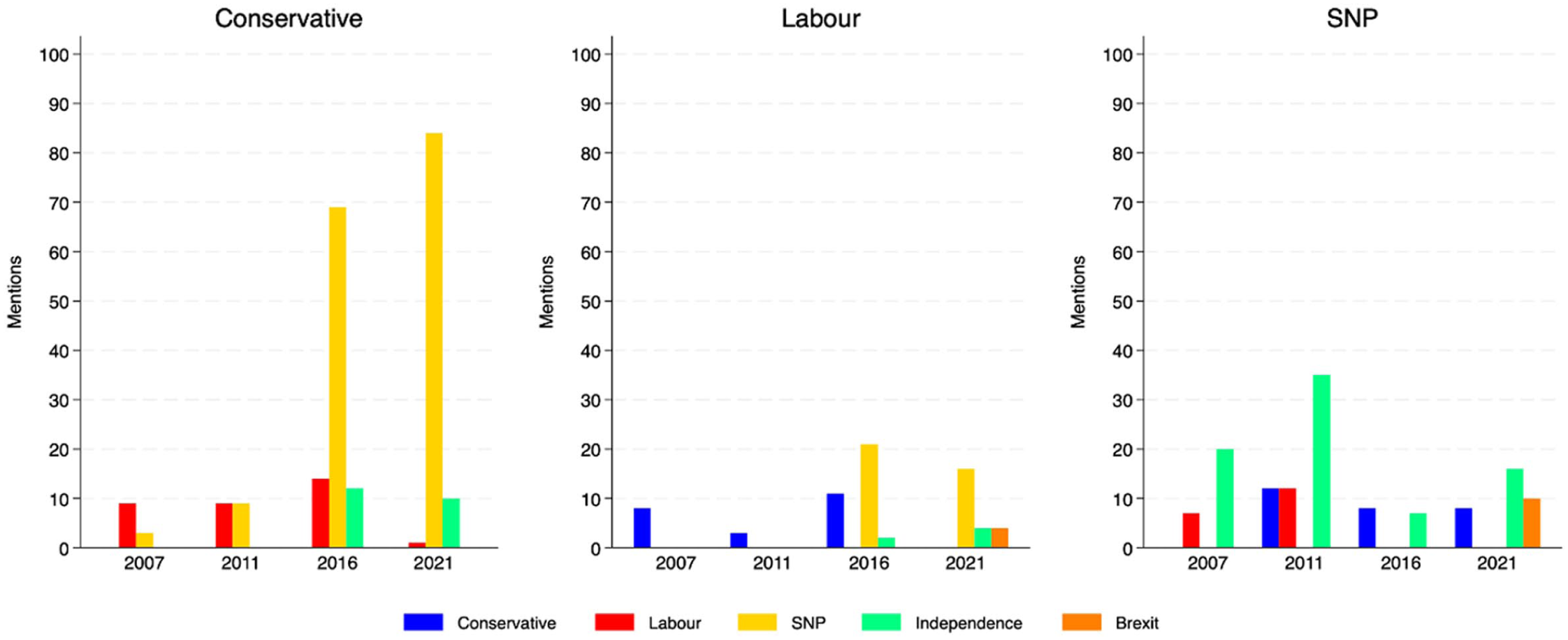
Mentions of competitors and two key constitutional issues (independence and Brexit) in the manifestos of the three main Scottish parties.
The SNP’s approach also evolved over time. In 2007, Labour still appeared in the party’s manifesto as its primary competitor, alongside a clear emphasis on fighting for independence. By 2011, with the Conservatives in government in Westminster, they too became a focal point of SNP attacks. From that point onwards, the SNP consistently framed the Conservatives as its primary opponent, while other parties faded from view. This pattern continued in 2021, when Brexit also emerged as an issue, again framed in anti-Tory terms. Thus, after the 2014 independence referendum, the 2016 Brexit referendum further cemented the SP between the SNP and the Conservatives, although Brexit was largely subsumed by the independence debate. Notably, the Scottish Conservatives adopted a markedly different strategy from their English counterparts by downplaying the Brexit card in a context that overwhelmingly voted to remain in the EU (no mention of Brexit appears in their 2021 manifesto).
To be sure, this symbiotic dynamic was not perfectly symmetrical, as the Conservatives were substantially more vocal in their opposition to the SNP than vice versa. The SNP, benefitting from an almost unassailable position as incumbent had less incentive to engage in a fully reciprocal polarizing relationship with the Conservatives. Nevertheless, framing the Tories as a key opponent served the SNP’s strategy, helping the party consolidate its dominant position. Moreover, our content analysis did not include SNP’s references to Westminster actors when they were not explicitly linked to the Conservative Party. Had we included implicit references – particularly those framing the Conservative-led UK Government as a negative out-group – the mutual targeting between the SNP and the Conservatives would likely appear more symmetric than our current data suggests. The multi-level nature of party competition further facilitated this dynamic. The Conservatives could position themselves as the anti-establishment force against the SNP-dominated Scottish government at Holyrood, while the SNP could similarly adopt an anti-Tory stance against the Conservative-led UK government.
SP functioned as a supply-side mechanism that embedded the salience of constitutional issues within the electoral arena for more than a decade. It also helped structure the electorate’s divide increasingly along Pro-Independence/Remain versus Pro-Union/Leave lines – a configuration much less evident in 2014/2016. As illustrated in Figure 9 – an alluvial chart depicting vote transfers from the 2014/16 referendums to voter preferences in 2021 – significant inflows occurred into the No/Leave and Yes/Remain groups, the former dominated by the Conservatives and the latter by the SNP (Johns, 2021).
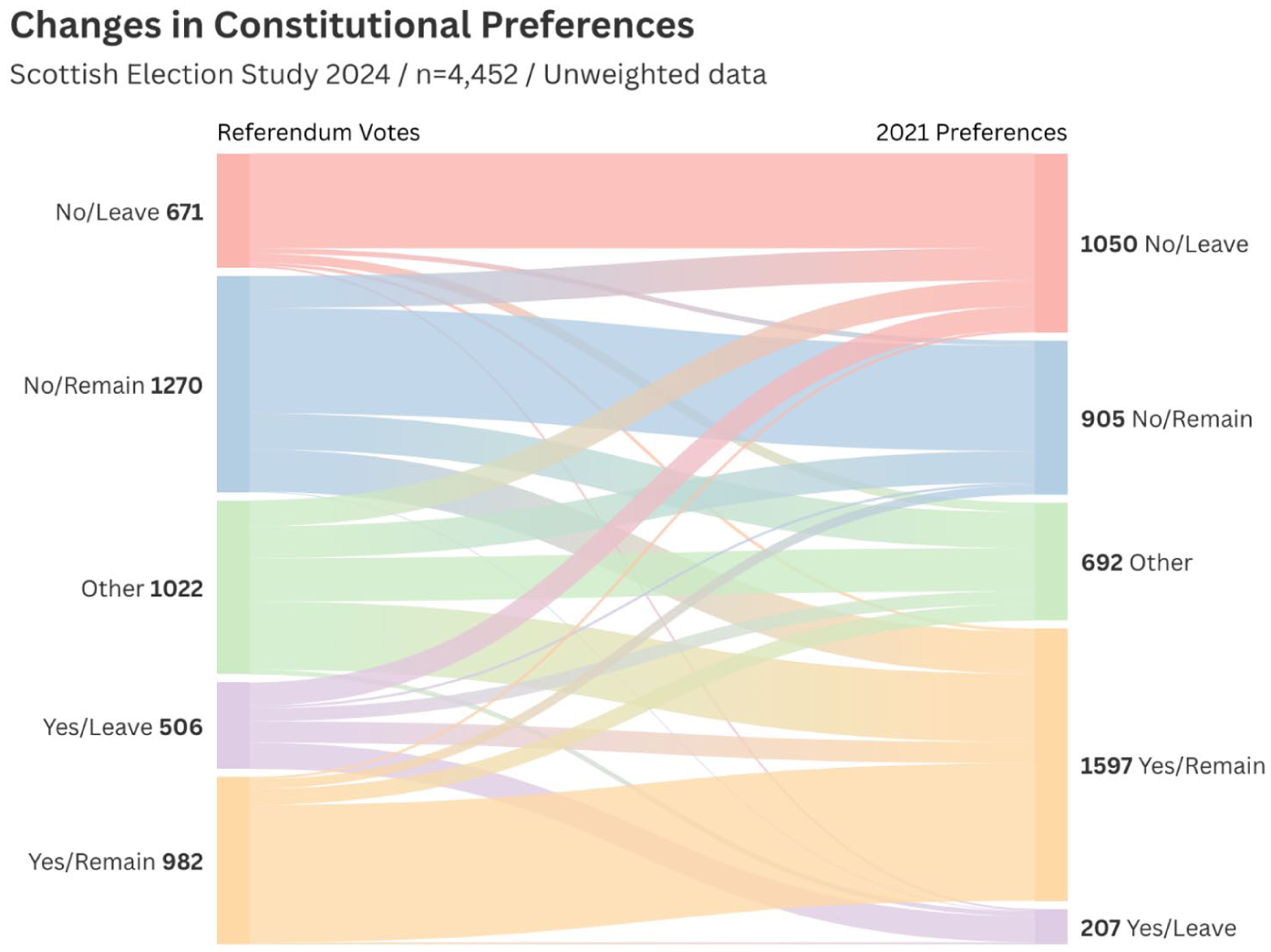
The realignment of the Scottish electorate from the 2014/2016 referendums to 2021.
Moreover, the No/Remain group, where Labour and Lib Dems held a stronger base, shrank in 2021 and was overtaken by both the No/Leave and Yes/Remain groups – demonstrating how parties and constitutional options outside the SNP-Conservative polarized system were gradually squeezed out. These patterns highlighted the constitutional realignment following both referendums and reinforced the SP that came to characterize Scottish politics during this period.
Finally, the substantial drop-off in the Yes/Leave group – which notably lacked any party representation – illustrates the critical role of supply-side dynamics in shaping the electoral landscape.
In sum, albeit partially and asymmetrically, the SNP and the Conservatives succeeded in structuring the polarized Scottish system in a ‘symbiotic’ manner that entrenched their respective positions, diminished the influence of other parties, and closed the electoral market to potential challengers – even as the rest of Europe experienced an unprecedented surge in support for PRRPs.
The End of Symbiotic Polarization
Phase 4: De-polarization (post-2022)
The polarization surrounding constitutional and Brexit issues effectively froze the Scottish party system for nearly a decade. However, after 2021, the SNP and the Conservatives gradually lost their ability to sustain the symbiotic relationship that had benefitted both parties. While the COVID-19 pandemic briefly reignited constitutional debates and tensions between Holyrood and Westminster, these issues gradually lost salience (Appendix 1 online), giving way to the rise of identity politics and culture wars – even in Scotland, which had previously appeared largely immune to such dynamics.
The fading of the constitutional issue followed the UK Government’s refusal to permit a second independence referendum. In June 2022, the Scottish Government proposed a bill to hold a consultative referendum without UK Government consent, prompting Scotland’s top law officer to refer the matter to the Supreme Court. On 23 November 2022, the Court ruled that the Scottish Parliament lacked the power to legislate for such a referendum (Casanas Adam, 2023). Therefore, the Scottish Government could not proceed without UK approval, and the UK Government had no incentive to shift its stance.
Alongside the fading issue of a second referendum, the SNP’s reputation for governing competence eroded, especially in education and health (Scottish Election Study 2024). Moreover, the defining controversy in the final months of Nicola Sturgeon’s leadership was the Gender Recognition Reform Bill, which allowed individuals as young as 16 to self-identify as transgender and obtain a gender recognition certificate. For the first time, this issue exposed deep divisions not only among SNP representatives but also within the party’s broader support base (Simpkins, 2024; Walker, 2023). Initially, the Conservatives seized on the bill as a new wedge issue to sustain their polarizing dynamic with the SNP (Simpkins, 2024). Yet this controversy – compounded by the crisis over Sturgeon’s leadership, her resignation, the subsequent investigations into SNP finances and related arrests, and the resignation of her successor Humza Yousaf – left the SNP in a significantly weakened position. This weakening, in turn, unsettled the very foundations of the SP that had structured Scottish politics.
At the same time, the Conservatives suffered collateral damage from events at Westminster, including Boris Johnson’s downfall and the turmoil of Liz Truss’s premiership. Notably, the Scottish Conservatives did not significantly adjust their strategy as defenders of the Union – a stance that had previously insulated them, at least partially, from wider UK turbulence. It worked in 2016, when the party lost ground (while UKIP surged) in the Welsh Senedd and London Assembly but nearly doubled its vote share in Scotland, and again in 2017, when the Conservatives lost 25 seats in England and Wales but gained 12 north of the border. This time, however, the same strategy offered no such protection. Crucially, this was not so much because the Scottish Conservatives changed, but because the political context did. The SNP’s crisis meant the threat of secession no longer dominated the agenda. Without a credible independence challenge, the Conservatives’ pro-Union messaging lost its electoral traction. This highlights a key insight of our SP framework: while the dynamic is not driven by coordinated strategies – or by collusion, as in cases of party ‘cartelization’ (Katz and Mair, 2018) – it depends on reciprocal reinforcement between opposing parties. After all, it takes two to sustain a symbiosis. Even if one party remains consistent (e.g. the Conservatives), the broader dynamic can collapse if the other (e.g. the SNP) falters. A relational typology must therefore account for these co-produced and contingent shifts, shaped by changing issue salience, voter fatigue, and institutional shocks.
The post-2022 period was thus marked by a de-polarization of territorial/constitutional issues, which were no longer effectively leveraged by the two main competing parties. This was replaced at the top of the agenda by bread-and-butter issues such as the cost-of-living crisis and the performance of public services on both sides of the border. This allowed Labour to turn its previously marginalized position during the height of symbiotic constitutional polarization to its advantage by appealing across this divide (McMillan, 2025). This period also saw the mainstream emergence of socio-cultural debates – such as gender identity and Net Zero – which could potentially be exploited by far-right parties.
As shown in Figure 10, which presents opinion poll trends after the 2021 Scottish Parliament election (up to June 2025), the simultaneous decline of the SNP and the Conservatives since 2022 was accompanied by Labour’s resurgence. The 2024 UK general election marked a striking comeback for Labour in Scotland after more than a decade of decline (Hassan, 2025). The party secured 37 of Scotland’s 57 seats and increased its share of the vote by nearly 17 percentage points. Given the scale of Labour’s victory, it is unsurprising that observers focused on its success, with speculation about a return to moderate, pro-devolution politics that might ease the tensions between the SNP’s assertive nationalism and the Conservatives’ increasingly muscular unionism.
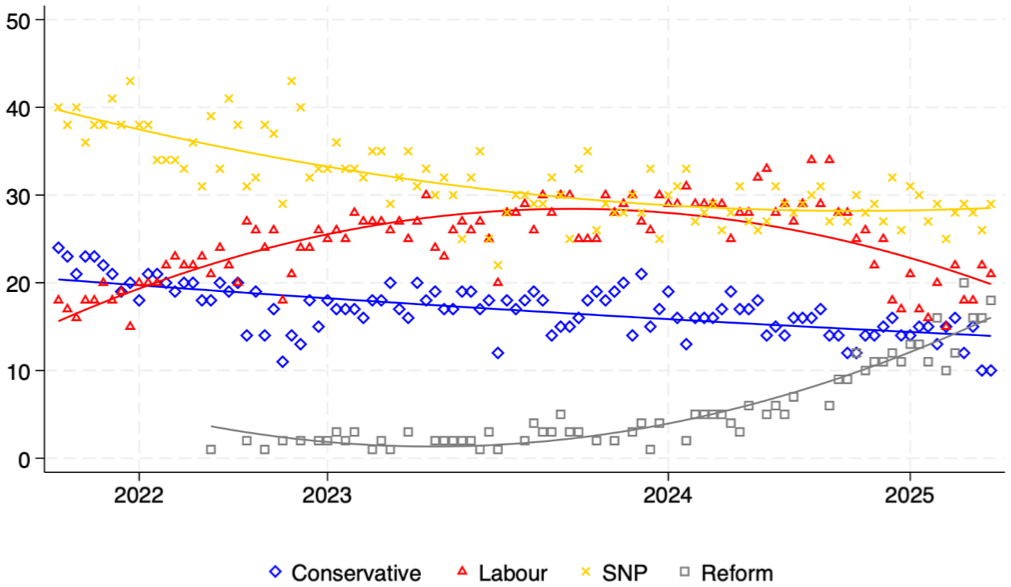
Trends in opinion polls for the Scottish Parliament election after 2021 (Regional vote).
Labour was not the only beneficiary of the shifting political landscape. For the first time in a major national election with a turnout exceeding 50 per cent of registered voters, a PRRP secured a significant share of the Scottish vote. With 7 per cent support, Reform UK demonstrated its potential to establish a lasting presence in a Scottish party system now characterized by instability. While Reform UK garnered a larger share of the UK-wide vote (14.3 per cent) (Heath et al., 2025), its performance in Scotland in 2024 was still remarkable given the party’s lack of infrastructure. In contrast, in 2015, when UKIP achieved a similar UK-wide share (12.6 per cent), it only secured 1.6 per cent in Scotland. At that time, constitutional polarization – discussed in the previous section – left little room for a far-right challenger.
PRR as the New Disruptive Polarizer?
The breakdown of the polarized system dominated by the SNP and the Conservatives led to Labour’s resurgence in 2024. However, this has not resulted in a return to the centripetal competition, mixed with elements of partisan segmentation and Labour dominance, that characterized the pre-2007 period.
As shown in Figure 10, three key electoral trends have emerged. First, both the SNP and the Conservatives have experienced a decline in support, with no indication of reversal. Second, while Labour initially benefitted from this shift, its resurgence has stalled and signs of decline are now apparent. Third, in this increasingly fluid and unstructured political landscape, the only party to record steady growth has been Reform UK. By May–June 2025, Reform UK had overtaken the weakening Conservatives and moved closer to Labour as the main opposition to the SNP.
Interestingly, while positionally pro-union, Reform UK has deemphasized constitutional issues – in some cases even showing signs of ambiguity (Young, 2025) – and is shaping its political platform around ‘anti-woke’ positions, opposition to Net Zero policies and hostility towards the ‘elites’ of Westminster and Holyrood (Farage, 2024). These themes align more closely with the traditional PRR repertoire – even anti-immigration mobilization appears to be gaining strength in Scotland (Brooks, 2025).
These developments suggest that Scotland may be entering a new phase of disruptive polarization, this time driven by the rise of a PRRP. A key indication of Reform UK’s potential to reshape the Scottish party system is SNP First Minister John Swinney’s call for unity against the PRR, warning that it represents a ‘real and present danger’ to Scottish politics (Williams, 2025).
Beyond Symbiotic Polarization?
Following our mid-range theory approach, the exploration of the Scottish case has enabled us to articulate the concept of SP and empirically illustrate it, showing how this configuration has contributed to structuring – and effectively freezing – the party system for nearly a decade. Yet political and societal dynamics are more complex than any single explanatory model can capture. It would therefore be reductive to attribute the absence of PRR mobilization in Scotland solely to the presence of SP. Rather, we argue that this form of polarization has operated as a structuring mechanism constraining the political space available to PRR actors, in conjunction with other social, cultural, and institutional factors.
On the demand side, we have already noted that Scottish voters are not markedly different from English ones in terms of values. We also question Scotland’s supposed ideological distinctiveness – including its more left-leaning self-placement and broad rejection of English-style, race-inflected right-wing politics. These cultural-political predispositions may help explain the limited appeal of UKIP and similar parties in the early 2000s. However, if ideological or cultural aversion were a sufficient explanation, we would not expect to see the sudden rise of Reform UK in Scotland from 2024 – with the same leader as UKIP and advancing a similar platform – especially in the absence of any confirmed ideological realignment in Scottish public opinion (Appendix 2 online). The fact that PRRP support remained low for so long, and then rose far more rapidly than in the rest of the UK (where Reform followed a more gradual upwards trajectory), suggests that other factors on the supply side must be at play.
While we do not dispute the importance of Scotland’s ideological profile, we argue that predispositions, issue salience, and the framing of political opponents on the supply-side interact, with SP serving as a key mechanism that structured these interactions into a highly stable system. The collapse of this mechanism – rather than any change in cultural or ideological attitudes – helps explain the recent rise of Reform UK and the end of Scottish exceptionalism. Our framework therefore captures both the period of party system stability and its current unravelling, offering a fuller explanation than cultural or salience-based accounts alone.
Related to this, the lower ceiling of right-wing support in Scotland compared to England and Wales may be historically contingent. For example, until the 1960s right-wing support was arguably stronger in Scotland than in Wales. It is also problematic to treat the Conservatives and UKIP/Reform as a single ‘right-wing bloc’ by simply adding their votes together – a broader issue when assessing mainstream parties and PRRPs. While Reform UK has gained from Conservative decline, we caution against assuming it merely mirrors or cannibalizes Conservative support, as if the structure of party competition were unchanged. With the collapse of SP, Reform may also be indirectly benefitting from the weakening of the SNP. With its more chameleonic populist appeal, Reform UK appears capable of mobilizing support beyond the traditional right. Indeed, by-election results and emerging polling data in early 2025 suggest that Reform is already making small but potentially meaningful inroads among pro-independence voters – a constituency the Conservatives have consistently failed (and, given their hard constitutional stance, not event attempted) to reach (Appendix 3 online). This reflects a crucial difference between the two parties. Unlike the Conservatives, Reform is thriving in a less structured environment, where the traditional constitutional divide is no longer effectively mobilized by the main parties.
Finally, the multi-level nature of political competition should be acknowledged. As we have already stressed, the SNP and the Conservatives could target each other as being, respectively, the ‘establishment’ at the devolved and UK-wide levels. Yet the multi-level character of party politics also means that Scotland cannot be considered a self-contained political system: developments at Westminster were likely to affect those at Holyrood. Unlike the SNP, the Scottish Conservatives are linked to the state-wide UK Conservative Party and one may argue that they also benefitted from this vertical linkage. After all, the UK Conservatives played a key role in absorbing the Eurosceptic vote, particularly under Boris Johnson’s leadership in 2019. However, the rise of the Scottish Conservatives preceded Brexit. Before the EU referendum, under Ruth Davidson’s leadership, they had already consolidated a strong role as defenders of the Union and opponents of the SNP. In fact, Johnson’s leadership proved more of a liability than an asset in Scotland, as reflected in the slight decline in Conservative support between the 2017 and 2019 general elections.
The Scottish Conservatives’ strategy, combined with the specific features of the Scottish context – especially the SNP’s post-referendum dominance – helped lay the foundations for the structuring of the party system around SP. This dynamic partly insulated them from the electoral swings observed elsewhere in the UK between 2015 and 2021. However, the fact that the Scottish Conservatives are now following similar electoral trends to their UK-wide counterparts suggests a significant shift: the Scottish party system is no longer structured primarily around SNP–Conservative polarization but has become markedly more fluid and fragmented. After a long period of distinctiveness, Scotland now appears increasingly aligned with electoral developments in the rest of the UK.
Discussion and Conclusion
This article has highlighted the political dynamics in Scotland that have constrained the rise of PRRPs in stark contrast to broader European trends. Central to this analysis is the concept of symbiotic polarization, where two established parties reinforce each other’s positions, effectively stabilizing the political system. The SNP and the Scottish Conservative Party gradually entrenched themselves as dominant forces by capitalizing on the independence and Brexit referendums, consolidating their political positions. This mutually reinforcing relationship effectively froze the political landscape, leaving little space for PRR challengers.
However, after its peak in 2021, SP has broken down due to leadership crises within both major parties and a shift in focus from constitutional to socio-cultural and socio-economic concerns. The possibility of a second independence referendum in the near future has been taken off the table. This de-polarization temporarily allowed for the Labour Party’s resurgence in 2024, but the political environment remains fluid, leaving it vulnerable to challenges from new actors, especially on the PRR. The rise of Reform UK in Scotland supports this interpretation, suggesting that new forces are exploiting the opening left by the decline of the established parties and the decline in salience of the constitutional question.
The typology of party relational dynamics developed in this article can be applied to other political contexts. A case often compared to Scotland is Catalonia, where similar political phases unfolded, pointing to the broader applicability of this framework to other regions experiencing similar territorial and identity-based political transformations.
In Catalonia, Phase 1 (up to 2010) was marked by segmentation, primarily between Convergence and Union (CiU), a moderate regionalist party (Barberà and Barrio, 2017), and the Catalan Socialist Party – affiliated with the state-wide Spanish Socialist Workers’ Party (Fabre 2011). This was followed by Phase 2 (2010-2015), a period of disruptive polarization, driven by the radicalization of CiU, which formed a pro-independence bloc with the Republican Left (Vampa and Gray, 2021). During Phase 3 (2015-2019), SP emerged as the pro-independence camp solidified its position against unionist forces led by Ciudadanos (Citizens), a new centrist party that became the primary opponent of independence (increasing its vote share from by almost 20 percentage points between 2012 and 2017). Highlighting the supply-side nature of this polarization, Guntermann and Blais (2022) defined it as ‘elite-driven’, forcing moderate voters to take sides. As in Scotland, this dynamic weakened moderately pro-devolution forces, such as the Socialists, but also constrained the rise of PRRPs in Catalonia. 4
By Phase 4 (2020-2024), constitutional debates had diminished in importance, leading to a depolarization of the constitutional divide and low mobilization on the territorial question (Franco-Guillén and Serrano Balaguer, 2024). This shift facilitated a resurgence of the Socialists, reminiscent of the Labour Party’s revival in Scotland. However, as in Scotland, this depolarization has been accompanied by the rise of PRRPs – Vox within the unionist camp and Catalan Alliance among pro-independence forces (Martínez-Cantó, Tudó-Cisquella, 2025) – suggesting the potential for a new wave of disruptive polarization.
In conclusion, the Scottish case demonstrates how SP between established parties can freeze political equilibriums. Particularly when centred around territorial/constitutional issues, SP may stifle the rise of PRRPs. At the same time, the de-polarization of territorial divides, while reducing the risk of secession, can also create space for new forms of disruptive polarization driven by PRRPs, which, though partly concerned with territorial issues, tend to place greater emphasis on socio-cultural and immigration-related concerns.
The concept of symbiotic polarization, together with the broader typology of party relational dynamics outlined here, applies beyond regions marked by deep territorial divides. It can help explain the evolution of party systems at different territorial levels and can be used to assess the trajectories – whether success or decline – of a wide range of challenger parties, beyond PRRPs. Ultimately, the Scottish case highlights the importance of how parties not only position themselves but also interact with their competitors in shaping the resilience or transformation of party systems, which are increasingly vulnerable to disruptive political forces.
Supplemental Material
sj-docx-1-psx-10.1177_00323217251410750 – Supplemental material for Symbiotic Polarization as a Barrier to Populist Radical Right Success: Scottish Exceptionalism in Comparative Context
Supplemental material, sj-docx-1-psx-10.1177_00323217251410750 for Symbiotic Polarization as a Barrier to Populist Radical Right Success: Scottish Exceptionalism in Comparative Context by Davide Vampa, Alan Convery and Fraser McMillan in Political Studies
Footnotes
Acknowledgements
The authors would like to thank all colleagues who provided valuable feedback at workshops organized at the University of Edinburgh in 2025, at the 2025 EPSA Conference in Madrid, and at the 2025 ECPR Conference in Thessaloniki. Particular thanks go to Dr Christos Vrakopoulos for his insightful comments and encouragement throughout the different phases of the manuscript. Finally, the authors express their gratitude to the anonymous reviewers and the Editors of Political Studies for the rigorous and constructive review process that preceded the publication of this article.
Declaration of Conflicting Interests
The authors declared no potential conflicts of interest with respect to the research, authorship, and/or publication of this article.
Funding
The authors disclosed receipt of the following financial support for the research, authorship, and/or publication of this article: This article is part of a wider project on the rise of the populist radical right in Scotland and other devolved contexts, which has received financial support from the Royal Society of Edinburgh [award ID: 5412].

Supplemental material
Supplemental material for this article is available online.