




Abstract
How do citizens in autocracies respond to government-provided information? While scholars have explored various forms of information manipulation used by autocrats, we still know little about how the dissemination of government statistics affects public perceptions and behavior in everyday life. In a survey experiment conducted during the COVID-19 pandemic in Kazakhstan, we investigate whether government-provided data and message influence citizens’ risk perceptions and behavioral intentions. After asking respondents to estimate the number of infections and deaths during the pandemic, we corrected their estimates using official statistics or exposed them to a message that optimistically interprets the statistics, with the information source randomly attributed either to the Kazakh government or the World Health Organization. Our findings suggest that government-provided information did not significantly alter respondents’ perceptions of the virus. These results indicate that citizens in autocracies may not always be decisively influenced by government information manipulation.
Introduction
Information manipulation has long been one of the most prominent governing strategies under autocratic rule. Traditional autocrats resorted to violence along with overt censorship and hard propaganda aimed at indoctrinating citizens (Adena et al., 2015) and demonstrating their power (Huang, 2015). In contrast, scholars documented that recent autocrats “soften” their information strategies (Carter and Carter, 2023). For instance, modern dictators often include political messages in entertainment as a form of “soft-propaganda” to cement regime support (Mattingly and Yao, 2022), engage in public communication with citizens on high performance (Guriev and Treisman, 2019; Rozenas and Stukal, 2019), and censor information deliberately and covertly (King et al., 2013).
Given the emergence of modern autocrats employing these softened information techniques, this article investigates another form of covert information manipulation that only a few scholars have thus far illuminated—the manipulation of government statistics. By manipulating administrative data such as economic growth, industrial output, and fiscal conditions in their favor, autocrats and their bureaucrats are able to portray that their regimes achieve high performance. Although the manipulation of such government-provided information may help autocrats stabilize their rule, there is also the risk of “the dictator’s dilemma,” where such information manipulation entails significant costs for dictators: By manipulating information, dictators are likely to face difficulties in collecting credible information on their countries and citizens (Wintrobe, 1998).
Importantly, less known and investigated is how citizens react to the manipulation of such information. In the absence of credible media and democratic institutions monitoring and constraining the government, more than a few citizens are likely to become suspicious about the pro-regime information that authoritarian governments disseminate, and this reduces their support for the regime (Geddes and Zaller, 1989: 319–320). In particular, in autocracies where bureaucrats and politicians are evaluated for promotion based on their performance, the credibility of administrative data tends to be low (Hollyer et al., 2018). With this fact in mind, citizens have reason to consider that government officials manipulate information in favor of the regime, and citizens may update their beliefs and adjust their behavioral intentions accordingly. How exactly do citizens react to public information disseminated by an authoritarian government?
To investigate the reactions of the public to the low-credibility administrative data in authoritarian regimes, we designed a survey experiment in Kazakhstan. 1 Post-Soviet Kazakhstan is an autocratic country where information credibility has long been an issue. As an intriguing case in which administrative data is likely to be manipulated by autocrats (Neumayer and Pl¨umper, 2022), we focused on the COVID-19 pandemic in the country and conducted an information-correction experiment (ICE) with a nationally representative sample. Through this survey experiment, we were able to explore the conditions under which government-provided information on the spread of the virus may change citizens’ risk perceptions and behavioral precautions toward the virus. In the survey experiment, we first asked respondents to estimate the number of infections and deaths. We then offered the reported official statistics of these numbers to correct their answers while randomly assigning either the Kazakh government or the World Health Organization (WHO) as the information provider. Respondents were asked to answer questions about their perceptions of and behavioral intentions regarding COVID-19. In doing so, it becomes possible to investigate how government-provided information influences citizens’ attitudes toward the virus.
The results of our survey experiment indicate that, contrary to our pre-registered expectations, citizens do not significantly alter their perceptions based on the source of the COVID-19 statistics. While some findings suggest that when the Kazakh government is cited as the information source, respondents who initially overestimated the severity of the pandemic tend to become more pessimistic about the situation, this evidence remains only suggestive. Overall, the results imply that popular opinion in electoral autocracies, where a more diverse array of information sources is often available other than government-owned media and state propaganda (Carter and Carter, 2023), may not be strongly influenced by government information strategies, particularly when it comes to the pro-government dissemination of statistics.
This study makes two important contributions. First, by exploring the causal effect of government-provided information on public reactions through a survey experiment, we illuminate the ways in which citizens deal with information disseminated in their everyday lives by authoritarian governments. Contrary to the regime-sustaining effects of propaganda organized by modern autocrats (e.g. Carter and Carter, 2023; Mattingly and Yao, 2022; Peisakhin and Rozenas, 2018), our findings suggest that, in the case of low data credibility, citizens may proactively take into account the possibility of pro-government data falsification so that they are not very sensitive to the publication of such statistics. In this regard, our results also suggest that, contrary to the assumption of “preference falsification” (Kuran, 1997), citizens may not readily express falsified preferences in favor of the government, at least under certain conditions.
Second, our article also speaks to the burgeoning literature on social scientific analysis of COVID-19 (Cepaluni et al., 2022; Cheibub et al., 2020). Beyond discussions on the determinants of variations in infections and deaths, as well as the validity of COVID-19 statistics, our survey experiment first investigates an important consequence of low-credibility COVID-19 data in autocracies—popular reaction to public information on the virus. In doing so, we illuminate the manner in which citizens deal with infectious diseases in their daily lives when information may not be adequately reliable and credible, such as in the context of authoritarian rule.
Information Credibility in Authoritarian Rule
Credible information is central to autocratic stability because it shapes the choices of rulers and citizens alike. Information deficits generate commitment problems with elites and mass public (Wintrobe, 1998). Regimes manage these problems with legislatures (Gandhi, 2008), elections (Higashijima, 2022), parties (Svolik, 2012), and selective censorship (King et al., 2013). Under weak horizontal and vertical accountability, citizens doubt official claims.
Propaganda and manipulation mold attitudes within broader contexts (Chen and Xu, 2017). Many important insights come from the cases of China and Russia. State outlets frame protests strategically, and accusatory frames raise support for arrests (Arnon et al., 2023). Anticorruption coverage concentrates on lower-level officials, and user comments do the same (Chang, 2024). Censoring criticism of the Belt and Road triggers counter-criticism among supporters (Shao et al., 2024). Regime-affiliated accounts on Douyin diffuse messages through decentralized networks (Lu et al., 2025). Russian televised responsiveness—Pryamaya Liniya/The Direct Line—boosts approval for President Putin (Wengle and Evans, 2018), and experiments show that perceived responsiveness on this program increases approval (Chapman, 2021). Russian state media highlight foreign protests, downplay large domestic ones, and link democratic protests to violence and disorder (Otlan et al., 2023). Propaganda concerning external affairs also receives attention. Threat cues raise support for military action in experiments fielded around Russia’s invasion of Ukraine (Krishnarajan and Tolstrup, 2023). Anti-Japanese and anti-American content worsens attitudes toward those countries in Chinese surveys (Mattingly and Yao, 2022). Nationalist or victimhood cues heighten support for armed unification with Taiwan (Liu and Shao, 2024). 2
Economic messaging follows consistent logics across cases. Russian state media credit gains to domestic leadership and blame losses on foreign actors (Rozenas and Stukal, 2019). When domestic conditions worsen, Russian television ties more positive stories to Putin and shifts attention abroad (La Lova, 2025). In Ukraine, Russian television affects pro-Russian voters but not those who communicate exclusively in Ukrainian (Peisakhin and Rozenas, 2018). China-focused stimuli claiming that the United States harms China’s economy push attributions toward foreign governments (Elfstrom and Li, 2025). In Turkey, reframing downturns as security issues increases support for economic policies (Aytaç, 2021). Turkish pro-government outlets emphasize foreign economic crises to cast domestic conditions in a better light (Adiguzel, 2025).
Manipulation also extends to administrative statistics and elections. Administrative data are politically pliable in autocracies (Wallace, 2016). Night-light benchmarks imply about 35% overstatement of GDP in autocracies (Martinez, 2022) and greater accuracy in democracies (Briviba et al., 2024). In China, overreporting aligns with promotion incentives (Chen et al., 2021), political concentration (Tsai, 2025), and target-meeting anomalies (Gong et al., 2025). Elections in electoral authoritarian regimes show fraud (Schedler, 2002). In Russia, vote shares cluster at multiples of five (Rundlett and Svolik, 2016). Documented fraud can reduce support (Reuter and Szakonyi, 2021), whereas mere insinuation often does not (Aarslew, 2024). Fraud can spark post-election protests (Harvey and Mukherjee, 2020), and increased public spending can dampen them (Rød, 2019).
During COVID-19, some studies reported stronger containment in autocracies (Cepaluni et al., 2022; Cheibub et al., 2020). Subsequent work ties these apparent advantages to underreporting (Adiguzel et al., 2020; Kapoor et al., 2020). Adjusting for transparency removes mortality gaps (Annaka, 2021). Excess-mortality analyses point to higher true deaths in autocracies (Jain et al., 2022; Neumayer and Pl¨umper, 2022). It has also been suggested that such underreporting may influence governance and citizens in authoritarian states. For example, Kofanov et al. (2023) report that in Russia, regions with upcoming elections for regional governors tend to exhibit greater underreporting of COVID-19 mortality data. What is particularly relevant for the present study is that such underreporting, in turn, reduces trust in official COVID-19 statistics among university-educated citizens. Furthermore, they find that in regions with greater underreporting, self-isolation as a preventive measure against infection also declined. Washida (2025) argues that in electoral authoritarian regimes, collective action related to COVID-19 is suppressed through the underreporting of death tolls.
Given the strong presence of information manipulation in dictatorships, scholars have started focusing on the effects of information manipulation on citizens’ perceptions of, and attitudes toward, their governments. 3 The findings thus far are mixed, however. Moreover, most of them focus primarily on regime propaganda and do not consider public reactions to low-credibility data, except for a few studies. Much research has found evidence showing the regime-sustaining effects of information manipulation. In addition to the studies mentioned earlier, using data covering newspapers from 30 autocracies, Carter and Carter (2023) found that pro-regime propaganda is negatively correlated with the odds of popular protests.
In contrast, other researchers point to the limitations of such regime-sustaining effects of information manipulation (Gehlbach and Sonin, 2014). Guriev and Treisman (2020)’s cross-national analysis of authoritarian popularity suggests that the effects of information manipulation on political behavior depend on the type of autocratic regime. Utilizing a student survey sample, Huang (2015) suggests that exposure to regime propaganda is not positively associated with popular satisfaction with the authoritarian government. Huang (2018) conducted survey experiments on Chinese citizens, reporting that hard propaganda could backfire and worsen popular attitudes toward the government. Using smartphone-based social media communications about a terrorist attack, Chang (2021) indicated that Chinese citizens responded immediately to government information online but physically distanced themselves from the site for safety reasons, as Kofanov et al. (2023) suggest that citizens adjust their preventive measures against COVID-19.
This article also explores the relationship between government-provided information and citizens’ behavioral intentions and attitudes. This study, however, differs from most of extant studies in several important respects. First, rather than focusing on the impact of propaganda and other information strategies on political behavior, this study sheds light on how citizens change their perceptions and behavior when exposed to government-provided statistics in the electoral authoritarian context. In doing so, it becomes possible to illuminate how citizens update their lifestyles in electoral autocracies given the possibility of pro-government (i.e. anti-popular in most cases) data manipulation. Second, to the best of our knowledge, this research is the first scholarly attempt to explore the impacts of low-credibility COVID-19 data on popular attitudes under electoral authoritarian rule with an experimental design, except for Kofanov et al. (2023), using a natural experiment. 4 By designing a survey experiment where we randomly assign an actor who is the key provider of disclosing COVID-19 statistics, we illuminate the consequences of government-provided statistics on citizens’ risk perceptions and health behavior intentions.
Popular Reactions to Data Manipulation in Electoral Autocracies
In authoritarian regimes, government officials generally have greater incentives to manipulate administrative data than those in democratic regimes (Hollyer et al., 2018). As the government is less constrained by institutionalized checks and balances and free and fair elections, it is easier for political leaders to manipulate data in their favor. Furthermore, in autocracies, bureaucrats and politicians at lower levels of government are evaluated for career promotion based on their performance, such as electoral margins (e.g. Reuter and Robertson, 2012) and local economic performance (e.g. Landry et al., 2018). Without credible monitoring mechanisms, there is a temptation to fabricate administrative data, leading to upward biases in government statistics (Magee and Doces, 2015; Martinez, 2022).
In dictatorships, citizens are not necessarily passive actors, but they often proactively decide their political and social behavior in their everyday lives while adapting to autocratic constraints (Scott, 1985). This also holds for the case of data falsification by the autocratic government. In addition to public information disseminated by the government, citizens can also obtain on-the-spot information, such as price increases, employment and wages, public goods provisions including infrastructure and electricity, and social welfare, from the world around them. In particular, in electoral autocracies, although state media is dominant, other information sources outside state-owned media are often available through social and Internet media and independent news outlets (Guriev and Treisman, 2022). Given these, if citizens recognize large gaps in those indicators between what the government has publicly announced and what they experience in their lives, citizens then begin to suspect whether published information is trustworthy and to what extent such information is manipulated to mask a reality that is unfavorable for the authoritarian government (Gehlbach and Sonin, 2014).
When citizens sense that the published data is likely to be manipulated by the government, the data may become less likely to form the basis of their attitudes toward the subject matter or have a contradictory effect. When government announcements are the only available source of information, people are likely to always discount what the autocratic government publishes because, as far as the government’s interest is concerned, government-provided information is very likely heavily biased toward the government. However, when it comes to issues related to citizens’ social lives, people can also utilize their own daily experiences as another source of information. By forming prior expectations about the issue privately, citizens can be separated into two types: “over-estimators,” who a priori believe the true figure to be higher than the government-provided information suggests, and “under-estimators,” who a priori believe the true figure to be lower than the government-provided information indicates.
The COVID-19 pandemic serves as an ideal setting to examine citizens’ responses to government-provided information. In response to the pandemic, the number of infections and deaths are updated every day with varying outcomes across countries, regions, and cities. This exceptional situation has resulted in government performance statistics becoming highly visible and thus taken as very useful indicators measuring the effectiveness of both central governments and local government officials. Given this, the COVID-19 pandemic incentivized authoritarian governments to engage in the manipulation of COVID-19 statistics (Adiguzel et al., 2020; Kapoor et al., 2020). From the citizens’ perspective, the COVID-19 pandemic also exposed citizens to exceptionally high levels of risk, and they were faced with high stakes in whether they believed in the credibility of public information provided by authoritarian governments. Furthermore, it is also reasonable to assume that citizens hold dissimilar initial perceptions of the severity of the novel coronavirus before receiving public information on the virus because they are likely to form different expectations based on information obtained from their daily lives.
Regarding the types of citizens, we can think of the aforementioned two types: over-estimators and under-estimators. Here, we first consider the types of citizens without accounting for the nature of the information provider (i.e. autocratic government or the WHO). One type of citizen may formulate a more pessimistic prospect on the severity of COVID-19 based on their daily experiences, compared to publicly provided information (i.e. over-estimators). Then, if they are exposed to the public information that is more optimistic than their prior beliefs, the usual reaction should be to reduce their concerns about COVID-19. As such, we construct the first hypothesis as follows:
Hypothesis 1 (over-estimators): If a person is exposed to COVID-19 statistics that are less severe than expected, they will reduce their concerns about COVID-19 compared to a person who is not exposed.
The second scenario is when citizens hold a more optimistic perspective than the published information (i.e. under-estimators). Here, our previous discussion on COVID-19 statistics implies that authoritarian governments have an incentive to underreport cases of infections and deaths. If that is the case, one may question whether under-estimators may exist in such circumstances. However, under-estimators could also exist in autocratic contexts (and that is indeed what we found). This is because, as discussed, it is reasonable to assume that citizens are likely to have heterogeneous perceptions of the virus situation for various reasons unrelated to government statistics, for example, due to random guessing without particular grounds, overtly optimistic personalities, and digesting on-the-spot, surrounding information indicating a less serious situation. In such cases, if under-estimators are exposed to the published information, the standard prediction is that they will increase their concerns about COVID-19. Therefore, the second hypothesis is constructed as follows:
Hypothesis 2 (under-estimators): If a person is exposed to COVID-19 statistics that are more severe than expected, they will increase their concerns about COVID-19 compared to a person who is not exposed.
In addition to COVID-19 statistics themselves, citizens occasionally receive formal messaging that interpret published data. Such a messaging is a more direct way to comfort people and is intended to ease public concerns about the pandemic. If a message is perceived to be trustworthy, it should uniformly decrease citizens’ concerns about COVID-19. As such, our third hypothesis is constructed as follows:
Hypothesis 3 (comforting message): If a person is exposed to a message that optimistically interprets COVID-19 statistics, they will reduce their concerns about COVID-19 compared to a person who is not exposed.
More importantly, there is one obvious condition that is likely to affect the aforementioned theoretical expectations. As already discussed, given that an autocratic government can bias the data in its favor, its citizens may not trust the quality of information disseminated by their government. As such, they may not necessarily update their beliefs in a direction consistent with government-provided data. In contrast, if a neutral body, for example, an independent institution separate from their government, publishes the data, citizens may see the data as more credible and change their perceptions in the directions consistent with Hypotheses 1 and 2. Rephrasing this logic, our fourth hypothesis is written as follows:
Hypothesis 4 (information sender): A person is less sensitive to statistics and messages when they are provided by an autocratic government rather than WHO.
Regarding Hypothesis 4, an alternative theoretical possibility is that we see differences in the responses of under- and over-estimators depending on the source of the information. Suppose that all citizens share the expectation that authoritarian governments not only misreport COVID-19 statistics but also underreport them. If so, under-estimators have a reason to be more sensitive to statistics when an autocratic government provides the statistics than when a neutral body does, while over-estimators remain less sensitive. The WHO is widely recognized as the leading authority in global health, regularly assessing critical health issues worldwide. In addition, it evaluates the quality of health-related data, including those concerning COVID-19. 5 For these reasons, it is likely to be considered at least more neutral than each government. When an entity that is suspected of underreporting data (i.e. the autocratic government) provides statistics that are more pessimistic, citizens may consider the actual situation to be even more serious, compared to when such an allegedly neutral international agency serves as the information provider.
It is worth noting that our theoretical arguments may apply more strongly to electoral autocracies across Central Asia and other regions, rather than to closed autocracies. For citizens to be skeptical and critical of government statistics and messaging, they must have access to alternative information sources that allow fair comparison with official accounts. In many electoral autocracies—including Kazakhstan and others in Central Asia (e.g. Kyrgyzstan and Tajikistan) and parts of Southeast Asia (e.g. Malaysia and Singapore)—such independent sources are not necessarily eliminated, enabling citizens to evaluate and respond to government-provided information. By contrast, in more closed autocracies that severely restrict media freedom, it is far more difficult for citizens to consult other information sources as reference points, likely producing different reactions than those theorized here. We return to the issues of scope conditions and external validity in the conclusion. With these in mind, the next section focuses on Kazakhstan—a representative electoral authoritarian regime and a dominant form of autocracy globally over the past several decades.
A Survey Experiment in Kazakhstan
Background: The COVID-19 Pandemic and Media Reporting in Kazakhstan
To empirically assess the hypotheses, we conducted a survey experiment in Kazakhstan, an electoral authoritarian state in Central Asia (Higashijima, 2022). Post-Soviet Kazakhstan is an ideal setting for testing the validity of our theoretical expectations for several reasons. For one, the country is an autocracy where the credibility of government-provided information has long been an issue for citizens. In particular, as discussed below, the government frequently altered the criteria for counting the number of infections and deaths in the initial stages of the COVID-19 pandemic, which made the issue of data credibility visible among the public. In fact, Neumayer and Pl¨umper (2022) report that the unexplained gaps between official COVID-19 deaths and excess mortality are as significantly large in the country as those in Belarus and Russia. That being said, Kazakhstan is also a typical electoral autocracy or “soft authoritarian” state, where extreme levels of repression and media control hardly exist. Therefore, information manipulation does not necessarily lead to strong pro-regime conforming behavior among citizens by inducing coordination motives (Little, 2017) or serving as a credible signal of government strength (Huang, 2015). Given this, citizens are likely to form and update their beliefs based on both information obtained from their daily lives and public information conveyed by the government.
Kazakhstan’s encounter with COVID-19 unfolded in several distinct phases that shaped both the course of the pandemic and the surrounding information environment. The first confirmed cases appeared on 13 March 2020, prompting President Kassym-Jomart Tokayev to declare a nationwide state of emergency 2 days later. Authorities quickly imposed strict border closures, suspended commercial activity, and banned large gatherings. This initial lockdown lasted until 11 May 2020, after which restrictions eased, though localized quarantines remained in major cities such as Almaty and Nur-Sultan. A sharp resurgence of cases in mid-June led to a second nationwide lockdown (5 July–16 August 2020), followed by a color-coded system (“green,” “yellow,” “red”) to calibrate regional restrictions. Vaccinations with Russia’s Sputnik V began on 1 February 2021, just before our survey fieldwork.
Throughout 2020, the government repeatedly altered its reporting practices, undermining public confidence in official statistics. These changes produced sudden, artificial dips and spikes in reported COVID-19 infections and deaths. For example, on 3 June, the Ministry of Healthcare began distinguishing symptomatic from asymptomatic cases, but on 2 July, it reversed course and again aggregated them (Almaty.kz, 2020). At the same time, responding to international concerns about unreported cases of unexplained pneumonia, the Kazakh government broadened the definition of COVID-19 to include patients with pneumonia (Radosavljevic, 2020), thereby inflating the official infection counts.
State-aligned television networks played a central role in shaping the public narrative during the first year of the pandemic. The onset of COVID-19 and the ensuing lockdowns even reversed a long-standing decline in citizens’ interest in television. For example, the national broadcaster Qazaqstan expanded live news coverage, aired government briefings in real time, and launched special medical programming such as Ashyq Ala´n and the talk show Teled¨ariger. To highlight the government’s effective pandemic response, the state broadcast agency featured practicing doctors as the “main heroes” answering viewers’ questions (PR-Drive, 2020). Likewise, another state-owned Khabar network—one of the country’s largest media outlets—produced roughly 300 public-service clips fronted by prominent figures to reinforce official health guidance during the spring lockdown (PR-Drive, 2020). Against this backdrop, President Tokayev publicly praised the “heroic actions” of medical workers in June 2020, awarding special honors that were widely broadcast (Astana Times, 2020).
That said, surveys of Central Asian media consumption indicate that while state television remained a dominant source, citizens—especially younger audiences—were increasingly turning to online platforms less exposed to direct state control, creating a dual information environment of state television and social media in both Central Asia generally and Kazakhstan in particular (Vesterbye et al., 2020). At the same time, independent outlets documented substantial gaps between official COVID-19 deaths and excess mortality across former Soviet states, highlighting that nightly broadcasts typically relied on government statistics without independent verification and likely leaving some citizens skeptical of the official narrative (Eurasianet, 2021). In sum, although state media continues to dominate Kazakhstan’s information landscape, citizens can access alternative sources via social and independent media, enabling them to critically—and sometimes cynically—assess the credibility of government-released statistics and messages.
Setting and Context of the Survey Experiment
Our survey targeted a nationally representative sample of 3000 respondents who were between 18 and 75 years of age. 6 After removing those with missing values for our central variables, our main analysis utilizes 2859 respondents. 7 Answers were collected through Computer Assisted Personal Interviewing (CAPI). Interviews were conducted either in the Kazakh or Russian language, and respondents themselves chose their preferred language after agreeing to be interviewed. We contracted out the sampling of respondents and face-to-face interviews to the Business Information, Sociological and Marketing Research Center (BISAM Central Asia), one of the leading polling companies in Kazakhstan. Interviews were fielded between January and March 2021.
Against the backdrop of the COVID-19 situation as of January 2021, we designed our experiment to rigorously investigate public perceptions of government-provided data. To explore the effect of government-provided information, we randomized the reported provider of the information. In addition to national governments, the WHO publishes data and assessments of the pandemic situation in each country. Technically, the WHO relies on data provided by national governments; therefore, the statistics from national governments and the WHO are identical. However, many citizens may not be aware of this. In our survey experiment, over half of the respondents did not know that the WHO is an international organization dependent on national government data. Exploiting this “seeming duality” in information sources, our experiment manipulates the source of COVID-19-related information (i.e. national government or WHO) without deception. We anticipate that in an autocratic context (i.e. Kazakhstan), WHO-provided information will be perceived as more trustworthy than that from the national government.
Given concerns about social desirability bias in authoritarian contexts, we do not directly ask respondents about their trust in COVID-19-related information or if they believe government data is manipulated. First, such questions are politically sensitive for the polling company. 8 Second, even if we could ask, many respondents might refuse to answer or claim they do not know their answers. Third, due to social desirability bias, directly asking about the trustworthiness of government-sourced information is likely to induce significant bias in responses, making it difficult to elicit truthful popular perceptions of the virus. In face-to-face surveys, strong social conformity likely makes respondents hesitant to express negative views toward the government and its information.
Therefore, we focused on respondents’ attitudinal reactions to the given information. Specifically, after presenting experimental stimuli, we asked about (1) COVID-19-related risk perceptions, (2) government policy evaluations, (3) health behavior intentions, and (4) future predictions. We expected trustworthy information to have the power to change those attitudes in a logical direction, while untrustworthy information does not and even encourages respondents to incorporate the possibility of data manipulation in deciding their attitudes and behavioral intentions.
To test the effect of COVID-19-related information, we focused on the publication of administrative data on COVID-19. This includes raw statistics of total infections and deaths. Before presenting this information, we asked respondents to guess these numbers. We then presented the actual infection and death statistics published by an information provider. If perceived as trustworthy, higher (lower) published numbers than initial guesses should increase (decrease) risk perceptions, decrease (increase) government evaluations, and increase (decrease) health behavior intentions, inducing negative (positive) future predictions. Conversely, if the information is perceived as untrustworthy, higher (lower) published numbers than respondents’ initial guesses may not change their perceptions or even lead to the opposite effect: decreasing (increasing) risk perceptions, increasing (decreasing) government policy evaluations, decreasing (increasing) health behavior intentions, and inducing positive (negative) future predictions. Given our understanding of information source trustworthiness, Hypothesis 4 predicts that statistics published by the Kazakh government induce weaker or opposite reactions compared to those published by WHO.
This survey experiment is called an “information-correction experiment.” This study is not necessarily the first study using the ICE in political science. In democratic countries, scholars have applied the ICE to study welfare (Kuklinski et al., 2000), immigration attitudes (Hopkins et al., 2019), and redistribution issues (Kuziemko et al., 2015). This article applies the ICE to popular reactions to COVID-19 in autocracies.
Experimental Procedure
At the start of the ICE, all respondents guessed how many people were infected by COVID-19 in Kazakhstan, as follows:
Just give your best guess–approximately how many Kazakhstan residents have been infected by COVID-19 as of
Next, respondents were asked to estimate the COVID-19 death toll in Kazakhstan.
Again, give your best guess—approximately how many Kazakhstan residents have died of COVID-19 as of
In each question, 56%–57% of respondents provided specific numbers. For the remaining respondents, we probed them by asking a multiple-choice question on a seven-point scale. 9 After probing, respondents with available guesses rose to 76% to 80%.
The analysis combines responses to initial and probing questions to capture perceptions of pandemic severity. For those who did not provide exact numbers, we replaced missing guesses with mid-points from their chosen category in the probing question. 10 We then took the logarithm of guesses due to heavy left skewing in their distribution. Online Appendix B.1 shows the need for this transformation by comparing raw and logarithmic guess distributions. Next, we standardized logged guesses and averaged infections and deaths. We refer to this as the outcome measure severity guess. Figure 1 illustrates the distribution of infections, deaths, and severity guesses. Interestingly, it shows that the majority of respondents underestimated the severity of the pandemic compared to official statistics. Guesses cluster heavily to the left of vertical ribbons representing these official statistics, but some respondents do overestimate severity (to the right of vertical ribbons).

The Distributions of Infections, Deaths, and Severity Guesses.
We use the continuous severity guess as the primary moderator in the main analysis.
11
In addition, we address two major concerns with this variable. First, about one-fourth of the respondents indicated that they did not know (DK) the infection or death estimates. We created an indicator variable severity guess DK (1 if DK, 0 if not) to avoid dropping those respondents completely.
12
DKs in severity guess are replaced with zero, and both severity guess and severity guess DK are included in the same model. Second, the moderating role of this variable may not be linear. Therefore, we generated a secondary measurement of categorical severity guess by categorizing respondents into four groups: “Under” estimators (
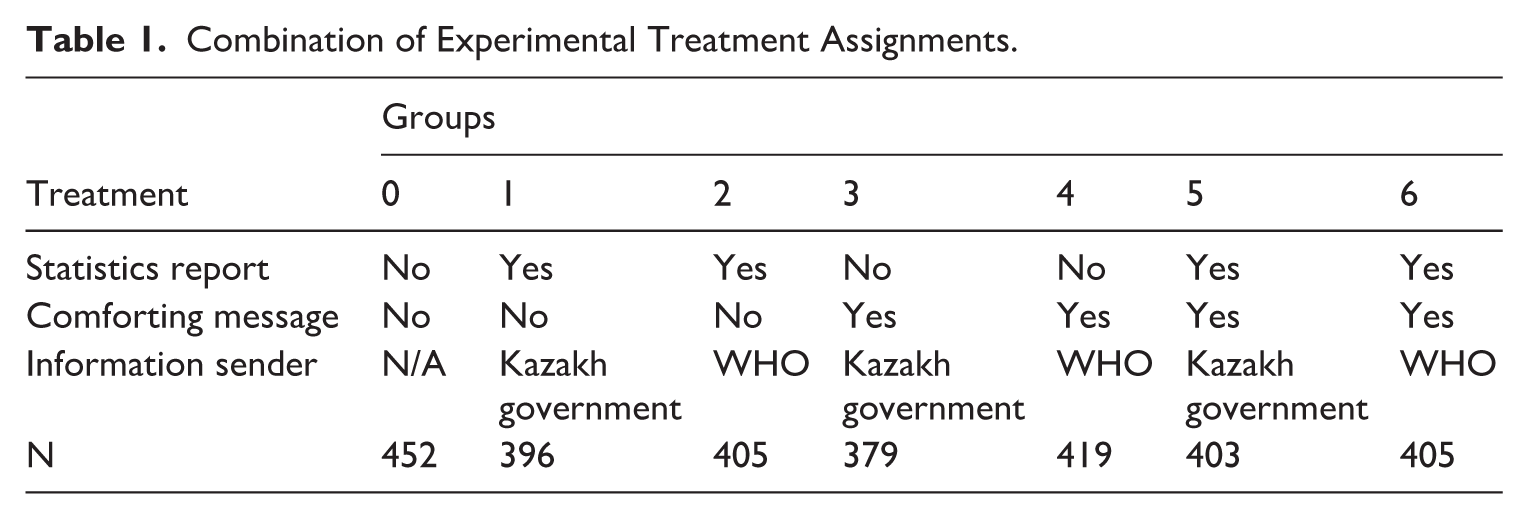
After making guesses about COVID-19 severity, respondents were randomly assigned to seven experimental groups (groups 0–6), each with about 400 respondents. Table 1 summarizes all experimental conditions.
13
In the control group (group 0), respondents were only given this clarification statement for their guesses:
Thank you. You guessed that approximately [GUESSED INFECTIONS] people were infected by and [GUESSED DEATHS] people have died of COVID-19.
In groups 1–6, each respondent received either one or both of statistics report treatment (groups 1, 2, 5, 6) or comforting message treatment (groups 3, 4, 5, 6). Later sections detail each treatment’s contents. Half of the treated respondents were informed that the information was from the Kazakh government (groups 1, 3, and 5). The other half were told that the information came from WHO (groups 2, 4, and 6). Considering ethical concerns, we ensured that all texts contained truthful information with no deception in all experimental conditions.
Combination of Experimental Treatment Assignments.
After displaying (or not displaying) reported COVID-19 statistics, we asked respondents about their perceptions, attitudes, and intentions: (1) risk perception; (2) evaluation of government policy responses; (3) health behavior intentions for the next 6 months; and (4) predictions for future COVID-19 development. Other than (1), multiple questions were asked in each category (see Online Appendix D for detailed wording). We created composite measures by averaging within each category and rescaling them to a 0–1 range for easier interpretation. Figure 2 presents the distribution of each outcome measure. Higher scores indicate greater risk perception, better evaluations of government policies, stronger behavioral intentions for health guideline adherence, and more optimism about future COVID-19 developments. The Cronbach’s alpha is above 0.75 for all composite measures, supporting the validity of combining multiple questions into one scale.

The Distribution of Outcome Measures.
Analysis 1: Information Correction and Concerns for COVID-19
Observable Implications and Estimators
In the statistics report conditions, we exposed respondents to official COVID-19 statistics. The information is allegedly from the Ministry of Healthcare of the Kazakh government (Kazakh government conditions) or the WHO (WHO conditions). Specifically, after reading the clarification statement for their guesses, the treatment respondents read the following statement ([REPORTED INFECTIONS] and [REPORTED DEATHS] were replaced with official numbers): According to official statistics of COVID-19 published by
For this experiment, we have three observable implications from our hypotheses. First, we hypothesized that individuals who overestimated the pandemic’s severity (relative to reported statistics) would express less concern for COVID-19 upon exposure to official statistics (Hypothesis 1). Second, we predicted that those who underestimated its severity would show increased concern for COVID-19 when exposed to official statistics (Hypothesis 2). Finally, we anticipated that these reactions would be less pronounced for those exposed to statistics from the Kazakh government than for those exposed to WHO (Hypothesis 4).
To test these implications, we estimated Ordinary Least Squares (OLS) regressions with severity guess, statistics report treatment, information sender, and their interactions. 14 The treatment variable is 1 if a respondent is exposed to COVID-19 statistics (groups 1, 2, 5, or 6) and 0 if not (groups 0, 3, or 4). The information provider variable is 1 if the provider is the Kazakh government (groups 1, 3, and 5) and 0 if the WHO or none (groups 2, 4, and 6). When interacting, we excluded the base term of the information provider variable because there was no information provider in the control group. For control variables, we included the comforting message treatment and its interaction with the information provider variable to isolate baseline outcome scores without exposure to the statistics report (effects of the message treatment are discussed in the next section). In addition, to increase precision, we included demographic and survey design controls (sex, age, education, employment status, service worker status, Kazakh language speakers, ethnic Kazakh, survey date). 15 The above discussion leads to the following model equation:
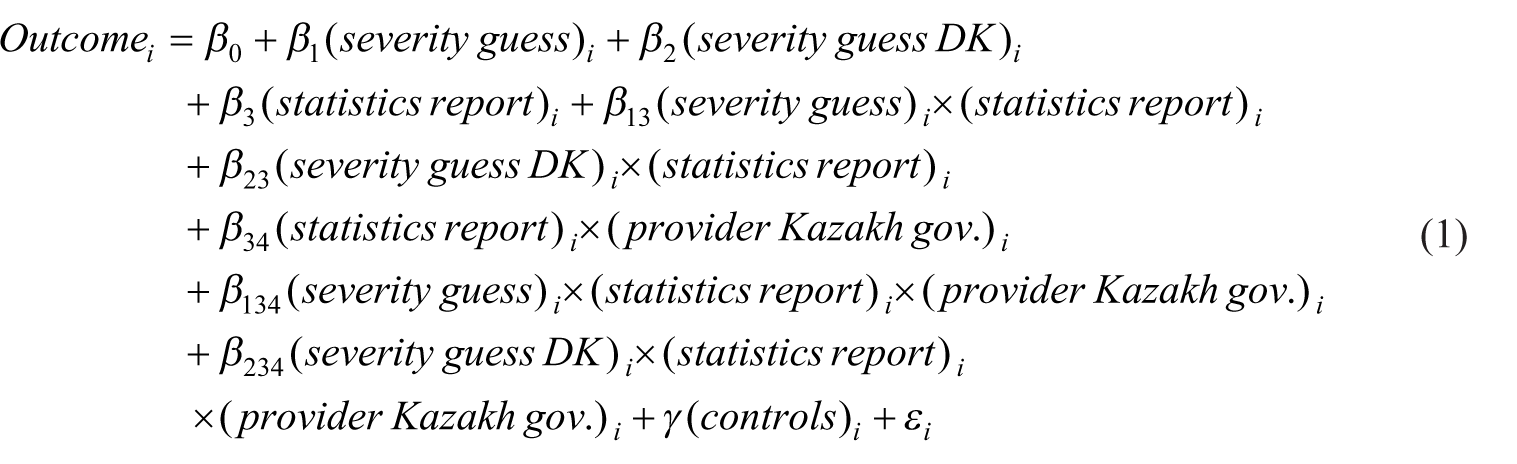
In Equation 1,
We also estimated a model with categorical severity guess to capture potential nonlinearity in its moderation role. This was done by replacing (severity guess) in Equation 1 with dummy variables for categorical severity guess. Estimation and hypothesis testing can proceed as in the model with continuous severity guesses.
Results
Figure 3 visualizes the experiment’s main results (underlying regression tables in Online Appendix E). Shaded ribbons indicate 90% confidence intervals for the marginal effects of the statistics report treatment, conditioned by the severity guess. Dotted lines indicate 95% confidence intervals. Vertical pink ribbons show severity levels of the “real” reported statistics. To the left are under-estimators, and to the right are over-estimators. Points with vertical error bars represent treatment effects conditioned by categorical severity guess, with 90% and 95% confidence intervals. The top row presents marginal effect estimates from a baseline model, that is, a model without

Conditional Effect of the Statistics Report Treatment on COVID-19-Related Perceptions, Attitudes, and Behavioral Intentions.
Second, if anything, we see a potential systematic pattern in the health behavior intentions outcome.
16
The bottom panel of the “health behavior” column shows that the shaded area and dotted lines do not cross zero for sufficiently high and sufficiently low values of the severity guess. Results with categorical severity guesses follow a similar pattern, reaching marginal significance (
Analysis 2: Comforting Messages Regarding the State of the Pandemic
Observable Implications and Estimators
In the comforting message conditions, we exposed respondents to a qualitative message. The message indicates that Kazakhstan is managing the pandemic relatively well compared to countries in North America and Europe. Like the statistics report treatment, the message is allegedly from the President of Kazakhstan (Kazakh government conditions) or a WHO medical expert (WHO conditions). Specifically, after reading the clarification statement for their guesses, the treatment respondents read the following statement:
Based on the reported statistics of COVID-19, [the
If the comforting message is effective, concerns about COVID-19 should decrease when exposed to it (Hypothesis 3). We also expect reactions to the message treatments to be weaker for those from the Kazakh government than for those from the WHO (Hypothesis 4).
To derive the estimates of the comforting message treatment effects, we recycled the model already estimated using Equation 1. This model already contains variables relevant to the analysis of this section, bundled within the set of controls, that is,

In Equation 2,
Results
Figure 4 visualizes the treatment effect of comforting messages. The left panel shows the unconditional baseline result without
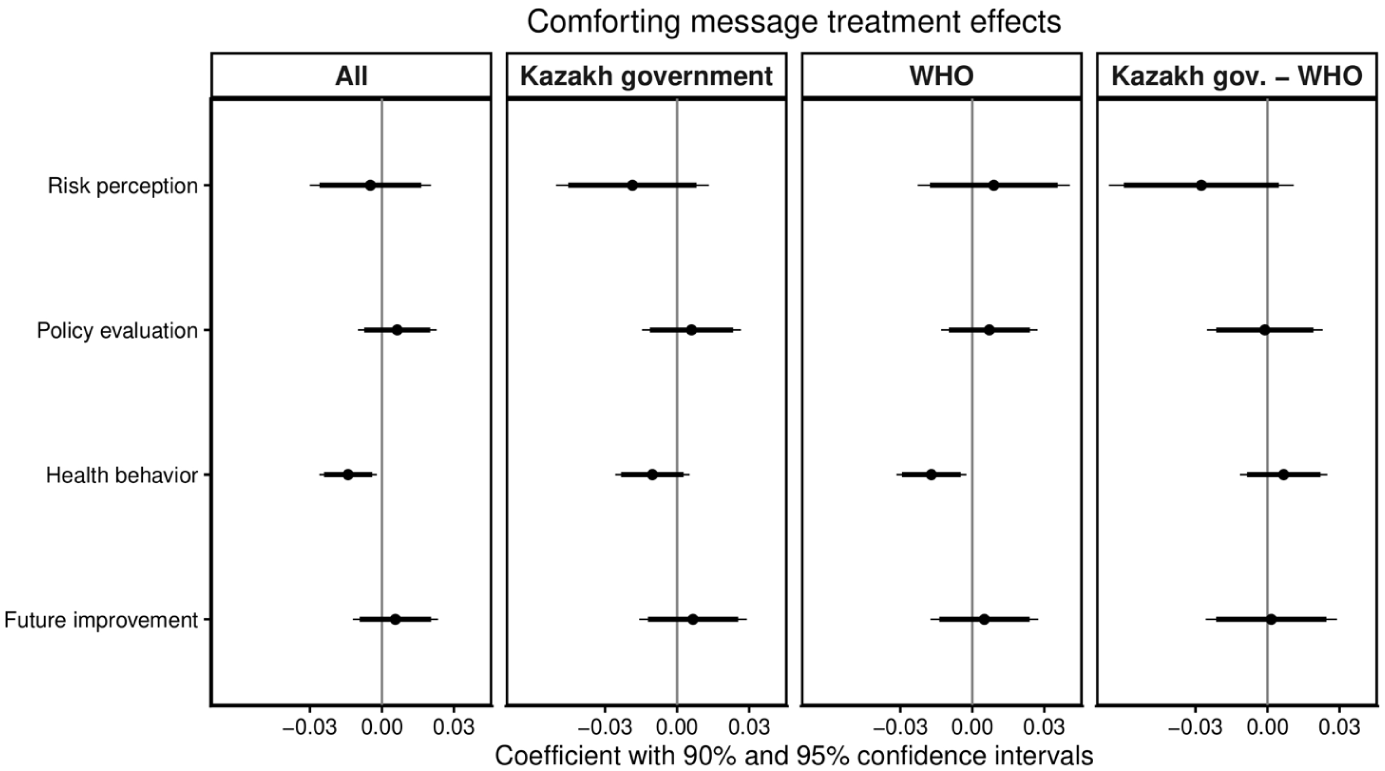
Effect of the Comforting Message Treatment on COVID-19-Related Perceptions, Attitudes, and Behavioral Intentions.
In Figure 4, we observe relatively large treatment effect coefficients for risk perception, though none are statistically significant (
Heterogeneous Effects
To deepen the understanding of the central results, we examined three heterogeneous treatment effects: knowledge of the WHO, trust in government, and ethnicity.
17
Online Appendix J presents the result for knowledge of the WHO. We generated a dummy variable that takes a value of 1 if respondents know the WHO relies on data from national governments (n = 1341) and 0 if not (
Online Appendix K assesses heterogeneous treatment effects by trust in the Kazakh government. It is made from a composite measure aggregating nine questions asking about the trustworthiness of different public institutions within the Kazakh government (Cronbach’s alpha
Finally, we consider that respondents may react more obediently to information provided by a co-ethnic leader. Here, we focus on respondents’ ethnicity, coded as 1 for Kazakh (
In sum, our results on heterogeneous treatment effects show that those who distrust the government are generally more suspicious of information from the Kazakh government (relative to the WHO). On the other hand, we find no strong evidence that those who do not know about the nature of the WHO as well as co-ethnic respondents, that is, Kazakh respondents, are more trusting of the information provided by the Kazakh government (relative to the WHO). Note that our findings here are tentative due to low statistical precision from insufficient data size. Future studies should explore which types of individuals react more strongly or weakly to information from authoritarian governments.
Conclusion
Conducting a survey experiment on COVID-19 in Kazakhstan, we explored under what conditions statistics on the pandemic have an effect on citizens’ risk perceptions and intentions of behavioral precautions toward the virus. After asking respondents to estimate the number of infections and deaths, we corrected their guesses with the official reported statistics, randomly assigning either the Kazakh government or the WHO as the information provider. The results indicate that in general, citizens do not necessarily change their perceptions of the pandemic in strong manners according to the different sources of statistics. Although we found some evidence on health behavior indicating that when the Kazakh government provides information more optimistic than they previously believed, respondents who overestimated infectious situations are more likely to strengthen their health behavior intentions, the estimation results are only suggestive. We also found no consistent evidence that COVID-19-related information affects respondent risk perceptions, policy evaluations, and future expectations.
To the best of our knowledge, this study is the first survey experiment on popular perceptions of information on COVID-19 from authoritarian governments. It suggests that face-value successes in combating the novel coronavirus advocated by authoritarian countries may not be taken as de facto performance of their governments by the citizenry. Keeping in mind the possibility that the authoritarian government fabricates publicly available information such as statistics and news, citizens need to preempt possible threats and tighten their behavioral intentions to respond to such risks in social life. Our results suggest that citizens in authoritarian regimes are not always passive actors ruled by their governments but are sensible and proactively take into account likely challenges in their daily lives under authoritarian rule. This implies that, compared to other information-manipulation techniques like propaganda and media censorship that the literature has focused on, citizens may not always be affected by the pro-regime dissemination of government statistics in forming their beliefs.
This article leveraged the case of the COVID-19 pandemic to examine popular reactions to low-credibility data in authoritarian regimes. The pandemic provided an exceptional opportunity to study how questionable government data shapes public perceptions and behavioral intentions in autocratic settings. Notably, in many aspects of popular perceptions, government-provided information did not exert strong or statistically significant effects. This article has referred to a broad range of studies examining the effects of government-provided information. Some studies report that government-provided information may lead to unintended consequences. In line with these findings, this article also highlights the limitations of government-provided information and suggests that such limitations can pose serious problems with significant implications for public health. In this regard, our results also speak to long-standing concerns for citizens’ “preference falsification” in autocracies (Kuran, 1997), that at least in our study’s specific context, citizens do not seem to exhibit tendencies to conceal their private preferences in public. Applying an information-correction experimental framework across regions, regime types, and issues of information credibility would allow scholars to explore how citizens adjust their perceptions when public information diverges from prior beliefs. In short, assessing the external validity of this study’s findings will require experiments conducted in a wider range of contexts and policy issues.
Supplemental Material
sj-docx-2-psx-10.1177_00323217261429650 – Supplemental material for Government Information and Popular Reactions in Autocracies: An Information-Correction Experiment on COVID-19 in Kazakhstan
Supplemental material, sj-docx-2-psx-10.1177_00323217261429650 for Government Information and Popular Reactions in Autocracies: An Information-Correction Experiment on COVID-19 in Kazakhstan by Susumu Annaka, Masaaki Higashijima and Gento Kato in Political Studies
Supplemental Material
sj-pdf-1-psx-10.1177_00323217261429650 – Supplemental material for Government Information and Popular Reactions in Autocracies: An Information-Correction Experiment on COVID-19 in Kazakhstan
Supplemental material, sj-pdf-1-psx-10.1177_00323217261429650 for Government Information and Popular Reactions in Autocracies: An Information-Correction Experiment on COVID-19 in Kazakhstan by Susumu Annaka, Masaaki Higashijima and Gento Kato in Political Studies
Footnotes
Acknowledgements
Susumu Annaka, Masaaki Higashijima, and Gento Kato contributed equally to this work. An earlier version of this article was presented at a 2021 session of the Asian Politics Online Seminar Series. We thank James R. Hollyer, Sarah Wilson Sokhey, Scott Radnitz, Colleen Wood, and the session participants for their helpful comments and feedback. This study is approved by the Institutional Research Board of the Graduate School of Information Sciences at Tohoku University (2020-63[1-5]). The analysis is pre-registered with the Open Science Framework (OSF; Registration DOI: 10.17605/OSF.IO/9RCW8), time-stamped on January 22, 2021.
Declaration of Conflicting Interests
The authors declared no potential conflicts of interest with respect to the research, authorship, and/or publication of this article.
Funding
The authors disclosed receipt of the following financial support for the research, authorship, and/or publication of this article: This work is supported by a JSPS grant-in-aid (17H04779, PI: Masaaki Higashijima).

Supplemental Information
Additional Supplementary Information may be found with the online version of this article.
Online Appendix A. Survey Design
A.1. Sampling Procedures
A.2. Principles of Research Ethics
Online Appendix B. Supplemental Assessment of Guess Measures
B.1. Comparison between Original and Logarithmic Guess Scales
B.2. Standardized Guess Scales with Probed Answers Treated as DKs
Online Appendix C. Experimental Design Checks
C.1. Treatment Content Recall
C.2. Balance Check of Severity Guess
Online Appendix D. Wording of Outcome Questions
D.1. Risk Perception
D.2. Government Policy Evaluation
D.3. Health Behavior Intentions
D.4. Future Improvement
Online Appendix E. Main Result Supplemental Tables and Figures
Online Appendix F. Main Results without Control Variables
Online Appendix G. Statistics Report Treatment Effects Conditioned by Severity Guess (DK if probed)
Online Appendix H. Statistics Report Treatment Effects Conditioned by Infections Guess
Online Appendix I. Statistics Report Treatment Effects Conditioned by Deaths Guess
Online Appendix J. Heterogeneous Treatment Effects by Knowledge of the WHO
Online Appendix K. Heterogeneous Treatment Effects by Trust in the Government
Online Appendix L. Heterogeneous Treatment Effects by Ethnicity
Online Appendix M. Results on Risk Perception Outcome using Ordered Logit
Online Appendix N. Pre-registration
N.1. Notes on the Discrepancy between Pre-registration and the Main Text
N.2. Pre-registration Text
Data Availability Statement
Notes
Author Biographies
References
Supplementary Material
Please find the following supplemental material available below.
For Open Access articles published under a Creative Commons License, all supplemental material carries the same license as the article it is associated with.
For non-Open Access articles published, all supplemental material carries a non-exclusive license, and permission requests for re-use of supplemental material or any part of supplemental material shall be sent directly to the copyright owner as specified in the copyright notice associated with the article.
