




Abstract
How do collective memories of war shape inter-group social attitudes in post-conflict societies? Can the legacy of wartime violence hinder reconciliation for years or even decades after the conflict ends? While prior research shows that war memories influence a range of political processes and outcomes, their effects on how members of formerly opposing groups perceive one another remain underexplored. To address this gap, I conducted a survey experiment in post-war Bosnia, investigating whether the activation of these memories affects hostility toward out-groups. The results show that making war memories salient intensifies hostility, especially among individuals who personally experienced violence during the war. These findings suggest that deeply ingrained war memories pose a significant barrier to reconciliation, but their impact may gradually diminish through the generational replacement of the wartime population.
How do collective memories of war shape inter-group social attitudes in post-conflict societies? Prior research demonstrates that these memories influence a range of political processes and outcomes, from party competition and vote choice (Glaurdić et al., 2022; Villamil and Balcells, 2021) to parliamentary debate (Dilling and Krawatzek, 2024; Martinson, 2012; Milošević, 2017) and support for democracy (Fittante, 2024; Schmidtke, 2023). Even long after the violence ends, war memories can define contemporary political life (Bieber, 2002). However, less is known about the effects of these memories on the social dimension, and in particular, whether they influence how members of formerly opposing groups perceive one another. To address this gap, this study examines how war memories affect hostility toward out-group members, a crucial issue for fostering reconciliation in post-conflict settings.
I argue that while war memories are rooted in historical events, they remain subject to interpretation and activation by political and social actors. When activated, they function as powerful inter-group cues, shaping attitudes toward out-group members by potentially increasing perceived social distance, threat, and resentment tied to the conflict. This process, in turn, can intensify hostility toward out-groups. Drawing on insights from two distinct literatures, the legacies of political violence and resonance theory, I also expect this effect to be especially pronounced among individuals who personally experienced war-related violence.
To test my expectations, I embedded an experiment in a nationally representative survey (N = 1125) conducted in post-war Bosnia. Some respondents were randomly assigned to a treatment condition where they reflected on the violence that was committed against their co-ethnics during the war, while others did not receive this prime. The results align with expectations and indicate that war memory activation significantly increases hostility toward out-groups. Moreover, I present evidence that this effect is primarily driven by individuals who personally experienced or witnessed violence during the conflict. These findings suggest that the legacy of violence is a divisive force in post-conflict societies, potentially hindering reconciliation long after the conflict ends. However, this dynamic may weaken over time with the generational replacement of the wartime population. I further elaborate on the implications and propose avenues for future research in the conclusion.
Collective Memories after Inter-Group Conflict
While individual memories are rooted in personal experiences, collective memories are shared among the members of a given social group (Olick, 2016; Olick et al., 2011). After an inter-group conflict, group members often develop a common understanding of that conflict (Kappmeier and Mercy, 2019), referred to hereafter as war memories. Although grounded in historical events, these memories are open to interpretation and can be activated by political and social actors (Kubik and Bernhard, 2014).
I expect this activation to have important consequences for inter-group attitudes. Prior work shows that even subtle cues that accentuate differences between groups can profoundly shape how individuals view out-groups (Bigler and Liben, 2006; Butler and Tavits, 2017). These cues increase perceived social distance and heighten threat perceptions, ultimately reducing empathy, compassion, and altruism toward out-group members (Heinke and Louis, 2009; Krebs, 1975). Because war memories function as powerful inter-group cues and are central to how individuals see themselves and their relationship to society, I argue that their activation leads to more hostile attitudes toward out-groups. This reasoning leads to my first hypothesis:
H1. The activation of war memories increases hostility toward out-group members.
This effect, however, is unlikely to be uniform across individuals. Specifically, I expect collective war memories to exert a stronger effect among those who personally experienced conflict-related violence. A growing number of studies on the legacies of political violence show that exposure to violence has a significant and persistent impact on social attitudes through the trauma it induces (see Walden and Zhukov, 2020 for a review). Moreover, individuals exposed to violence, either directly or through the experiences of loved ones, tend to interpret social and political cues through the lens of these events, as their past trauma more profoundly shapes how they respond to such stimuli (Dinas et al., 2021; Hall and Kahn, 2020; Wayne and Zhukov, 2022). 1 Accordingly, I expect war memory activation to amplify hostility toward out-groups especially among those who personally experienced violence, as it is likely to trigger the recall of past trauma (Cilliers et al., 2016) and prompt them to interpret contemporary inter-group relations in light of the wartime past. 2
This expectation also aligns with insights from resonance theory, which offers a complementary perspective on why the effects of war memory activation may vary across individuals. Originating in media effects research, resonance theory posits that messages have greater impact when they align with individuals’ lived experiences. For instance, residents of high-crime neighborhoods are more likely to perceive greater crime prevalence when exposed to crime-related news (Gerbner et al., 1980), and victims of crime exhibit stronger emotional and punitive reactions to crime-related content than those without such experiences (Kort-Butler and Habecker, 2018; Shrum and Bischak, 2001). Applied here, this suggests that war memories should resonate more strongly with individuals who have been exposed to wartime violence, as the activation recalls personal trauma and heightens perceptions of out-group threat. This, in turn, may provoke emotional responses such as anger or resentment, reinforcing hostility toward out-groups. Formally, this generates my second hypothesis:
H2: The effect of war memory activation is stronger among individuals who personally experienced violence.
The Bosnian Case
To assess my expectations, I conducted a survey experiment in Bosnia, a country that was deeply affected by inter-group violence during Yugoslavia’s disintegration. After years of economic crises and rising political tensions, Bosnia held its first multi-party elections in November 1990. Alarmed by the growing centralization of power under Slobodan Milošević, the Bosniak (Bosnian Muslim) and Croat leaders of Bosnia’s government staged an independence referendum in February–March 1992. Independence was widely supported by Bosniaks and Croats but boycotted by Serbs. Shortly afterward, the Bosnian War began in April 1992 and continued until late 1995, ending after an international intervention. During this time, the war featured intense inter-ethnic violence and shifting alliances, with significant fighting occurring across all three ethnic dyads.
Bosnia provides a particularly good case for studying how war memories affect inter-group attitudes for two main reasons. First, the conflict was contested along ethnic lines, a common trait of modern civil wars (Denny and Walter, 2014). This enhances the generalizability of any potential findings. Second, the war’s enduring salience across Bosnian society (Hadzic et al., 2020) ensures that memories of the violence remain accessible. Even those without direct recollection of the wartime period have likely learned about it from others in their network.
Research Design
The experiment was embedded in a nationally representative survey of 1125 adult Bosnians. Fielded in November and December 2016, the survey involved tablet-assisted, in-person interviews conducted by Prism Research, a leading local survey firm. The full survey covered several topics. For this study, I focus on the part that investigates how war memory activation affects hostility toward out-groups. A discussion of the recruitment procedures and summary statistics are presented in Sections 1 and 2 of the Online Appendix (OA), respectively. 3
Condition Assignment
The survey started with a set of demographic questions, after which respondents were assigned to a control condition or one of two treatment conditions. Those assigned to the control condition proceeded directly to the rest of the survey.
In the first treatment condition, respondents were asked to reflect on the violence that was perpetrated against their co-ethnics during the war. Given the relational nature of violence, which always involves a perpetrator and a victim, the treatment explicitly referenced an out-group committing the violence. Specifically, Bosniak respondents were asked about the violence committed against their co-ethnics by Serbs, Croats were asked about Bosniak violence, and Serbs about Croat violence. 4 I refer to this condition as the Violence Prime. 5 In drafting the prime, I made two key design choices. First, because collective memories are distinct from individual ones, the Violence Prime refers to the experiences of the respondent’s co-ethnics rather than their own personal struggles. Second, the prime emphasizes victimhood, a central theme in war remembrance (Bieber, 2002; Gödl, 2007). While no treatment can fully capture the complexity of memory activation, these design choices help align the Violence Prime with how individuals often receive information about past violence in post-conflict settings. 6
A final set of respondents was assigned to a second treatment condition that invoked group identity but did not reference violence. Respondents in this condition were asked how they celebrated an ethno-religious holiday specific to their ethnic group. Bosniaks were asked about Bajram, Croats about the Catholic Christmas, and Serbs about the Orthodox Christmas. This condition, called the Identity Prime, was included because the Violence Prime may increase the salience of ethnicity. 7 If it does and we observe a statistically significant treatment effect, this could be due to heightened identity salience instead of war memory activation. However, if there is a significant treatment effect for the Violence Prime but not for the Identity Prime, we can be more confident that this is due to war memories rather than identity salience. The wording of the treatments is provided in Figure 1.
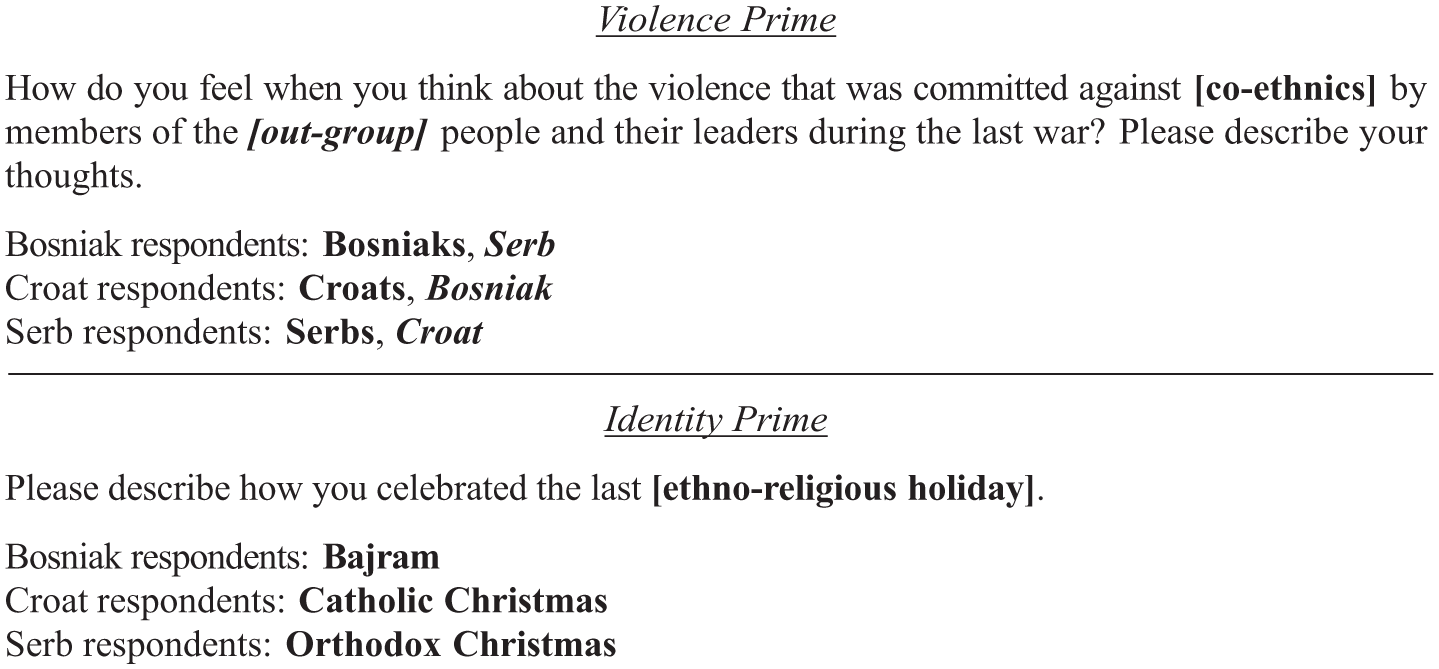
Treatments.
Measuring Hostility Toward Out-Groups
After condition assignment, respondents completed an exercise that assessed their perceptions of out-groups. They were first read a vignette that described a fictional out-group member whose ethnicity was indicated by his name. The out-group member’s ethnicity always matched that of the out-group from the Violence Prime, and so a Serb name was used for Bosniak respondents, a Bosniak name for Croat respondents, and a Croat name for Serb respondents. The vignette wording is presented in Figure 2. 8

Vignette.
After the vignette, respondents were asked three questions about the out-group member. The same 4-point scale, ranging from “strongly disagree” (1) to “strongly agree” (4), was used for all three questions. The first asked how much respondents agreed that they would like to have the out-group member as a neighbor (OG Neighbor), while the second asked how much they agreed that they would like to have him as a friend (OG Friend). These two questions assess whether war memory activation induces individuals to reject social contact with out-groups. The final question asked whether the out-group member likely shares the respondent’s values (OG Values), capturing whether war memories make respondents perceive themselves as fundamentally different from out-group members. 9 Using these questions and a factor analysis, I then created a continuous measure of attitudes called OG Scale. This scale and the three questions are employed as the dependent variables in the analysis.
Results and Discussion
Models 1 and 2 of Table 1 present the main results. In both models, OG Scale is the dependent variable, with lower values indicating greater hostility toward out-groups. Model 1 compares respondents who received the Violence Prime to those in the control condition, while Model 2 includes respondents assigned to either the control condition or the Identity Prime. Both models are estimated using OLS regression with interviewer fixed effects and controls for ethnicity, gender, age, educational attainment, marital status, employment status, and violence exposure. Robust standard errors are clustered at the interviewer level.
The Effect of War Memories on Attitudes toward Out-Groups.

The data are subset to compare experimental conditions. Models 1 and 2 present OLS regressions where OG Scale is the dependent variable. Model 1 includes respondents in the control condition (N = 301) or the Violence Prime (N = 310), while Model 2 includes respondents in the control condition or the Identity Prime (N = 314). Across the sample, the response rate was 82.22%, yielding a final sample size of 925 respondents from the initial 1125. Models 3 through 8 present ordered logistic regressions where the individual survey items are the dependent variables (OG Neighbor for Models 3 and 6, OG Friend for Models 4 and 7, and OG Values for Models 5 and 8). Models 3 through 5 include respondents in the control condition or the Violence Prime, while Models 6 through 8 include respondents in the control condition or the Identity Prime. Across the sample, response rates were 95.02% for OG Neighbor, 92.09% for OG Friend, and 83.82% for OG Values, resulting in final sample sizes of 1069 (control: 336, Violence Prime: 372, Identity Prime: 361), 1036 (325, 361, 350), and 943 (304, 317, 322) respondents, respectively, from the initial 1125. For all models, Treatment is a binary indicator identifying the experimental conditions being compared (Treated condition = 1, Comparison condition = 0). All models include interviewer fixed effects, with controls for respondent ethnicity, gender, age, educational attainment, marital status, employment status, and violence exposure. Clustered (on interviewer) robust standard errors are reported in parentheses. Models 1 and 2 omit the intercept term to accommodate interviewer fixed effects. Models 3 through 8 do not report threshold coefficients. For the full model output, please see Table OA6.1. *p < 0.10, **p < 0.05, ***p < 0.01.
The results corroborate H1. Model 1 shows that the Violence Prime has a negative and statistically significant effect on how out-groups are perceived. Because the dependent variable has a standard deviation of 1, the treatment effect is interpreted in terms of standard deviation changes. This means that with an effect size of −0.148 (p = 0.044), the Violence Prime moves respondents 0.148 standard deviations in a negative direction on the scale. Model 2 demonstrates that this effect does not simply proxy for the impact of identity salience: the Identity Prime yields no significant average treatment effect.
Since the survey questions measure two related but distinct aspects of inter-group attitudes, willingness to engage in social contact and perceived similarity, employing OG Scale as the dependent variable may mask differences in how war memories shape preferences across these two dimensions. To investigate this, I replicated the main analysis for each survey question and report the results from a series of ordered logistic regressions in Models 3 through 8 of Table 1. 10
Interestingly, these results align with the main ones, but only for the contact-related questions. The Violence Prime produces a significant average treatment effect when either OG Neighbor (−0.330, p = 0.069) or OG Friend (−0.522, p = 0.001) is the dependent variable. In contrast, with OG Values, the estimate is insignificant and noticeably smaller in magnitude (−0.268, p = 0.128). 11 Once again, these findings do not appear to be driven by identity salience. Models 6 through 8 show that the Identity Prime is always insignificant, both with respect to the contact-related questions and OG Values. 12
One interpretation of these findings is that the Violence Prime heightens feelings of insecurity or threat, thereby reducing willingness to engage in social contact with out-group members. However, this effect does not extend to perceptions of out-groups as fundamentally different in their values, suggesting that the prime influences concerns about immediate social interactions rather than broader notions of social distance. While speculative, this interpretation raises questions about psychological mechanisms for future research to explore. Specifically, further work could investigate whether feelings of insecurity or vulnerability mediate the relationship between memory activation and social avoidance.
Moderating Influence of Violence Exposure
I now turn to testing H2, which predicts that the effect of war memory activation is stronger among individuals who personally experienced violence. To measure violence exposure, respondents were asked, “[d]id you personally experience or witness violence during the war in Bosnia and Herzegovina?” Responses were recorded as “Yes” (1) or “No” (0), and I refer to this measure as Exposure. The question was placed at the end of the survey to avoid activating war-related memories across the entire sample and is therefore post-treatment. However, balance tests reported in OA3 show that the experimental conditions are well balanced across a range of respondent characteristics, including violence exposure. Moreover, because the question asks about experiences rather than attitudes or preferences, reporting is arguably more stable and less likely to be influenced by the experimental treatment. Nevertheless, since Exposure is measured post-treatment, the findings should be approached with caution.
More broadly, this part of the analysis is strictly exploratory. As Walden and Zhukov (2020: 14) note, “[s]urvey respondents more exposed to violence [. . .] may be systematically different on multiple dimensions besides exposure [. . .] These confounding factors preclude causal interpretation of the ‘exposure effect’ or any interaction between exposure and treatment.” Accordingly, the results should not be viewed as identifying a causal effect of violence exposure, but rather as showing that the Violence Prime exerts a more pronounced impact on the violence exposed than on the non-exposed. This pattern may reflect the argument proposed earlier, or alternatively, stem from other observable or unobservable differences between individuals who experienced violence and those who did not. 13
To examine how violence exposure conditions the effects of war memory activation, I estimated a series of models where I interact the treatment indicators with exposure and present the results in Table OA7.1. Model 1 includes the interaction between the Violence Prime and Exposure, with OG Values as the dependent variable. The negative and significant interaction term (−0.361, p = 0.049) indicates that respondents who experienced violence respond differently to the prime than those who did not. The disaggregated treatment effects at the bottom of the table confirm this: among those who were exposed to violence, receiving the Violence Prime significantly increases hostility toward out-groups (−0.452, p = 0.017), whereas the effect is insignificant among the non-exposed (−0.091, p = 0.183). This suggests that the impact of war memory activation is concentrated among individuals who personally endured war-related violence. Model 2, which interacts the Identity Prime with Exposure, shows no comparable pattern. The insignificant interaction term implies that respondents who were exposed to violence and those who were not respond similarly to the Identity Prime, a finding also reflected in the disaggregated effects.
To further scrutinize the findings, Models 3 through 8 present the results for each individual survey question. These results closely mirror the main ones reported in Table 1, in that the interaction between the Violence Prime and Exposure is significant only when one of the contact-related questions serves as the dependent variable. When OG Neighbor is the outcome, the interaction term is negative and significant (−1.377, p = 0.008), and the disaggregated treatment effects show that this pattern is driven by respondents who experienced violence (−1.511, p = 0.003), not those who did not (−0.134, p = 0.435). For OG Friend, the interaction is also significant (−1.058, p = 0.011), and while there remains an effect among the non-exposed (−0.373, p = 0.009), it is considerably more pronounced among the exposed (−1.431, p = 0.001).
This pattern does not hold when OG Values is the dependent variable, as all relevant estimates are insignificant, both for the interaction between the Violence Prime and Exposure (−0.251, p = 0.616) and for the disaggregated effects among the exposed (−0.478, p = 0.278) and non-exposed (−0.228, p = 0.252). There is little evidence that identity salience accounts for the results. Models 6 through 8 show that the Identity Prime remains consistently insignificant, both in its interaction with Exposure and in the disaggregated treatment effects.
In sum, war memory activation appears to increase hostility toward out-groups, primarily or perhaps even exclusively among individuals who personally experienced violence. Furthermore, this effect is reflected in individuals’ reduced willingness to engage in social contact with out-groups, but not in their tendency to perceive themselves as fundamentally different from out-group members. An important implication of these findings is that one channel through which the social significance of war memories may persist lies in the lived experiences and trauma of those who personally encountered violence. However, this dynamic may diminish over time, as the wartime generation is gradually replaced by those without direct experiences of the conflict. In turn, this could create opportunities for inter-ethnic engagement that were previously constrained by wartime legacies.
Conclusion
In this study, I present evidence that activating war memories intensifies hostility toward out-groups. Moreover, this effect appears to be concentrated among individuals who personally experienced or witnessed war-related violence. Overall, the findings suggest that deeply internalized memories of conflict continue to shape attitudes toward out-group members long after the violence ends, although their impact may gradually diminish through the generational replacement of the wartime population.
Future research can extend this study in several ways. First, the argument I present proposes several potential mechanisms by which war memory activation may induce hostility toward out-groups, including increasing perceived social distance, threat perceptions, and lingering resentment and anger. While the results are arguably most consistent with the threat perception mechanism, this experiment does not directly test these mechanisms, making it a topic for future research.
In addition, a growing body of experimental research shows that exposure to violence heightens sensitivity to social and political cues, but whether the resulting effects are pro- or anti-social varies across studies. Some interventions elicit more empathetic responses among those with personal or familial histories of violence (Dinas et al., 2021), while others produce more adversarial or exclusionary reactions (Ripley et al., 2022), including the one in this study. This raises questions about why certain cues generate pro-social rather than anti-social effects among the violence exposed. Does this depend on the subject of the intervention, for instance, whether it concerns refugees or members of groups formerly at war? Or does it hinge on message framing, such as whether it highlights shared suffering or evokes past inter-group conflict? Individuals who have experienced violence may be especially responsive to messages that evoke the past, but whether such cues foster cooperation or deepen division likely depends on broader contextual factors.
Finally, since the effects observed in this study are concentrated among individuals who personally experienced violence, the findings suggest that the influence of war memories may fade over time through generational replacement. However, those who did not experience violence directly are likely a heterogeneous group, with some having family or friends who did. Because the survey did not include questions to probe these indirect experiences, it is not possible to determine whether some among the non-exposed are nevertheless affected by war memory activation through mechanisms such as family socialization (Balcells, 2012; Lupu and Peisakhin, 2017). 14 Future research should explore how war memories are transmitted across individuals and within families, rather than persisting solely among those who directly experienced violence. Understanding these dynamics can clarify how such memories evolve over time and what factors shape their persistence or decline.
Supplemental Material
sj-docx-1-psx-10.1177_00323217261430412 – Supplemental material for Collective Memories, Personal Experiences, and Inter-Group Attitudes
Supplemental material, sj-docx-1-psx-10.1177_00323217261430412 for Collective Memories, Personal Experiences, and Inter-Group Attitudes by Dino Hadzic in Political Studies
Footnotes
Declaration of Conflicting Interests
The author declared no potential conflicts of interest with respect to the research, authorship, and/or publication of this article.
Funding
The author disclosed receipt of the following financial support for the research, authorship, and/or publication of this article: Support for this research was provided by the Weidenbaum Center on the Economy, Government, and Public Policy at Washington University in St. Louis.
Ethical Review
This project received ethical approval from the institutional review board at Washington University in St. Louis (IRB no. 201607026). All participants provided informed consent before starting the survey.

Supplemental Material
Additional Supplementary Information may be found with the online version of this article.
Figure OA1.1: Distribution of Respondents across Bosnian Municipalities. Table OA2.1: Summary Statistics. Table OA3.1: Balance Tests across Respondent Characteristics, Final Respondent Sample Used in Main Analysis of the Text. Figure OA4.1: Survey Questions. Table OA5.1: Distribution of Responses for OG Neighbor. Table OA5.2: Distribution of Responses for OG Friend. Table OA5.3: Distribution of Responses for OG Values. Table OA6.1: The Effect of War Memories on Attitudes toward Out-Groups, Full Model Output for Table 1 of the Main Text. Table OA7.1: The Effect of War Memories on Attitudes toward Out-Groups, Moderating Influence of Violence Exposure. Table OA8.1: The Effect of War Memories on Attitudes toward Out-Groups, OLS. Table OA8.2: The Effect of War Memories on Attitudes toward Out-Groups, Moderating Influence of Violence Exposure, OLS. Table OA9.1: The Effect of War Memories on Attitudes toward Out-Groups, Bosniak Respondents. Table OA9.2: The Effect of War Memories on Attitudes toward Out-Groups, Moderating Influence of Violence Exposure, Bosniak Respondents. Table OA9.3: The Effect of War Memories on Attitudes toward Out-Groups, Croat Respondents. Table OA9.4: The Effect of War Memories on Attitudes toward Out-Groups, Moderating Influence of Violence Exposure, Croat Respondents. Table OA9.5: The Effect of War Memories on Attitudes toward Out-Groups, Serb Respondents. Table OA9.6: The Effect of War Memories on Attitudes toward Out-Groups, Moderating Influence of Violence Exposure, Serb Respondents. Table OA10.1: The Effect of War Memories on Attitudes toward Out-Groups, Across Respondent Age. Table OA10.2: The Effect of War Memories on Attitudes toward Out-Groups, Across Respondent Age (Formative Years). Table OA11.1: The Effect of War Memories on Attitudes toward Out-Groups, Across Local Violence Severity (Casualties). Table OA11.2: The Effect of War Memories on Attitudes toward Out-Groups, Across Local Violence Severity (log(Casualties)). Table OA11.3: The Effect of War Memories on Attitudes toward Out-Groups, Across Local Violence Severity (Casualty Rate).