




Abstract
Corporations have increasingly turned to voluntary, multi-stakeholder governance programs to monitor workers’ rights and standards in global supply chains. This article argues that the emphasis of these programs varies significantly depending on stakeholder involvement and issue areas under examination. Corporate-influenced programs are more likely to emphasize detection of violations of minimal standards in the areas of wages, hours, and occupational safety and health because focusing on these issues provides corporations with legitimacy and reduces the risks of uncertainty created by activist campaigns. In contrast, these programs are less likely to emphasize workers’ rights to form democratic and independent unions, bargain, and strike because these rights are perceived as lessening managerial control without providing firms with significant reputational value. This argument is explored by coding 805 factory audits of the Fair Labor Association between 2002 and 2010, followed by case studies of Russell Athletic in Honduras, Apple in China, and worker rights monitoring in Vietnam.
Keywords
In January 2012, Apple became the latest major corporation to contract the services of a private monitoring organization to inspect the employment relations practices at one of its global suppliers, Foxconn in China. As such, Apple joined the likes of Nike, Adidas, and Liz Claiborne, which had, for well over a decade, turned to voluntary, privatized systems of workplace inspection to oversee workplace conditions at their suppliers. Today, garment and electronic factories from Vietnam to Honduras are often more likely to be inspected by private social auditing firms than government workplace inspectors.
These Corporate Social Responsibility (CSR) initiatives are a response to new challenges presented by economic globalization, notably corporate efforts to oversee the operations of increasingly complex global supply chains. As media exposés and social movement activists highlight extreme labor abuses in factories producing for well-known global brands, corporations have been pushed to monitor their employment relations practices through multi-stakeholder programs. 1
Yet the debate remains whether CSR is a step forward or a step backward for labor rights in the global economy. Some scholars argue that CSR contributes to greater respect for labor standards by providing a flexible way for corporations to take greater responsibility for the conduct of their contractors. 2 CSR has also been seen as a mechanism to expand multinational corporation (MNC) best practices throughout their global operations, 3 and an effective response by corporations to a perceived market for standards. 4 Critics counter that CSR is, at best, a public relations ploy by corporations and, at worst, part of a larger effort to weaken state regulation and displace labor unions. 5
This article suggests that what CSR programs do depends on how and whether different social actors participate in the establishment and implementation of the program. 6 In some CSR programs, corporations are excluded while progressive nongovernmental organizations (NGOs) and labor unions maintain influence. In most CSR programs, however, corporations play a significant role in program design and oversight. It is argued here that corporate-influenced programs are more likely to focus on the monitoring of minimal labor standards to gain legitimacy and reduce the risks of media exposés and activist campaigns. However, they fall short when it comes to monitoring the rights of workers to form independent trade unions, bargain collectively and strike—what I will refer to as freedom of association (FoA) rights—because these rights potentially weaken corporate control over their supply chains.
The distinction between FoA and other issue areas is fundamentally a difference between rights and standards. A working age of sixteen, a minimum wage of USD 1 per hour, and an overtime wage of 1.5 times the base wage are standards and can be modified as a result of government decisions or stakeholder negotiations. The formation of a union, good faith collective bargaining, and withholding one’s labor to improve terms and conditions of employment are enabling rights. They do not dictate outcomes but guarantee procedures that mitigate the inherent power imbalance in the employment relationship. 7 The attempt by CSR programs to monitor not only standards but also rights raises questions about the interests of CSR program participants, the power relations among the participants, and the sources of their authority.
Precisely because FoA is a right and not a standard, its lack of enforcement is perhaps the most noteworthy. No doubt, there are technical reasons that complicate FoA detection and remediation. Verification of FoA rights cannot be ascertained by auditing payroll and employee records or by using the equivalent of a handheld device that measures air quality or noise levels. 8 There are countless ways for employers to prevent unionization, ranging from the harassment and intimidation of union activists to the offering of promotions and generous pay increases to would-be union leaders. Detecting and documenting such actions are complex tasks. Short “social audits” are particularly ineffective since the challenge is to determine if there has been a history and pattern of employer actions which, taken together, have been used to create an antiunion atmosphere in the factory. 9 And worker trust in the people monitoring factories is crucial and takes time to acquire.
CSR programs can remedy this problem by turning to FoA experts who employ a more appropriate verification system. Yet it is argued here that corporate members of CSR programs will not give their full support to more effective FoA monitoring out of concern that greater compliance with FoA rights will lessen managerial control over supply chain operations. It is not necessary that such blockage be direct or forceful. These CSR programs depend financially on their dues-paying corporate members. And just like there is an emerging market for ethically produced goods, so too is there a market for CSR programs. Corporations are able to quit CSR programs that are too rigorous and go elsewhere, which puts pressure on the executive staff of CSR programs to avoid actions or procedures that might lead to corporate defection. This threat-of-defection dynamic is present, by definition, in all voluntary governance programs, and is a cause for their limited effectiveness in the area of freedom of association.
CSR programs are thus vulnerable to “regulatory capture,” a term used by public choice theorists to describe the process by which interest groups “capture” the agencies designed to regulate them. The theory observes that capture is possible because interest group stakes in the policy outcome are strong while the general public’s concern is more dispersed, especially over time, as the original “supportive constituency” dissipates as participants focus their energy elsewhere. 10 The possibility for regulatory capture is even greater in CSR programs for several reasons: First, they lack the authority of the state to mitigate powerful corporate interest (indeed, corporate members sit directly on the executive boards of these programs). Second, most multi-stakeholder CSR programs depend economically on corporate support. Third, the proliferation of private CSR governance schemes allows corporations to threaten to leave a given program and go elsewhere if the program is not to its liking. And fourth, while there was some initial interest on the part of labor unions in participating in CSR programs, this interest declined, thus removing a major countervailing force to corporate influence.
This does not mean that corporations do whatever they please. NGO stakeholders, activist pressure, and media exposés are mitigating factors, as are corporations’ desire to increase their legitimacy and reduce the risks of reputational damage. Corporations have a strong interest in preventing embarrassing violations of minimum wage laws and basic health and safety standards. Compliance with minimal standards provides legitimacy and lessens the potential for reputational damage. Yet a different logic holds sway when corporations face the perceived loss of control over the cost structure and operation of their supply chain as a result of strikes and pressures to increase wages and benefits via the mechanism of collective bargaining. What this suggests is that corporate-influenced programs will be more likely emphasize monitoring minimal labor standards (minimum wages, hours of work, health and safety) to increase their legitimacy, but will be less likely to emphasize the monitoring and remediation of FoA rights since these rights are perceived to lessen managerial control. This does not mean to say that corporate-influenced programs will effectively monitor violations of standards, and the data compiled for this study do not allow me to draw firm conclusions on effectiveness. But they do allow me to explore program emphasis.
In the sections that follow, I develop and probe this argument via an exploration of a corporate-influenced CSR program, the Fair Labor Association (FLA). I do so based on an original dataset I developed by coding 805 factory audits conducted by the FLA between 2002 and 2010. This dataset allows me to probe variation in detection rates by country and issue areas. It also allows me to examine remediation mechanisms and outcomes. And it allows me to compare and contrast auditing processes of third party complaints. Next, based on field research in Honduras and Vietnam, I explore the FLA approach to FoA violations through a company-case exploration (Russell Athletic) and a country-case exploration (Vietnam). I also analyze the FLA’s report on Apple’s supplier, Foxconn in China.
The Evolution of CSR
The idea that businesses should take responsibility for the social impact of their operations goes back centuries. For long periods of time, corporate “social responsibility” was understood as business philanthropy and good community relations. 11 Today’s concept of social responsibility began to develop after World War II at a time when business executives increasingly accepted that they were responsible for the consequences of their actions beyond their economic obligations to their shareholders. 12
Keith Davis, an early scholar of the phenomenon, argued “social responsibility begins where the law ends.” 13 That is, for Davis, the point was not to supplant the law, but rather to go beyond it. He writes, “A firm is not being socially responsible if it merely complies with the minimum requirements of the law.” 14 By building on the foundation set by law and ensuring higher standards, CSR should result in improvements for workers over time. Of course, this assumes that state protections of labor standards and rights at least will remain constant. Yet state protections via resources dedicated to enforcement have been in flux in many countries of the world. Indeed, as Robert Reich observed while he was the U.S. Secretary of Labor, the same corporations that were promoting social responsibility were also the ones that had aggressively lobbied to weaken labor regulation. 15
Data on the resources that the U.S. government dedicates to basic wage and hour enforcement when compared to the boom in the corporate social responsibility phenomenon reveal contrasting trends. As the budget for enforcement declined, interest in CSR escalated. Indeed, in the early 2000s, as some one thousand multinational firms had established their own codes of conduct stipulating human rights, and social and ethical standards, 16 the number of U.S. labor inspectors declined by 26 percent. 17 In regions like Latin America, even as labor laws improved following democratization and the end of civil wars, attention to enforcement lagged. 18 Indeed, the single most common argument used by corporations when explaining their participation in CSR programs is that they are simply filling a gap left by weak government enforcement agencies. This was not the original intent of CSR proponents decades earlier.
This trend is particularly prevalent in the global apparel industry. In 1992, Levi Strauss adopted one of the first voluntary codes of conduct for international sourcing in apparel after activists revealed that some workers making Levi Strauss products were treated as indentured servants. 19 More and more apparel companies began adopting their own codes as the U.S. antisweatshop movement gained momentum and increasingly exposed labor rights abuses in the apparel supply chain. 20 At the time, many of these codes did not include monitoring or enforcement mechanisms, and often they made no reference to labor union rights, preferring to focus instead on issues such as the environment, discrimination, child labor, and forced labor. 21 Yet as activist pressure and media exposés escalated, codes increasingly included FoA rights in their framework. To gain greater legitimacy, some corporations began participating in multi-stakeholder CSR programs, emphasizing that these programs where not wholly designed and implemented by corporate interests.
One group of scholars observing this trend referred to the benefits of a “market-based solution.” They envisioned CSR as developing into a system in which corporations are required to inform the public about their labor practices, and consumers use their purchasing power to punish bad corporations and reward good corporations. 22 The end result would be a “ratcheting up of labor standards.” 23 Similarly, Elliott and Freeman suggest that firms could improve their labor standards in the global economy because there is a ‘market for standards,’ meaning that there is a consumer market for goods made while respecting basic labor standards. They write: “Increasing trade with LDCs [Least Developed Countries] naturally highlights these countries’ labor conditions and thus creates consumer pressures in advanced countries for higher standards.” 24
Labor unions are highly critical of most CSR initiatives, arguing that the real goal is to replace not only the state but also the union’s role in defending workers’ interests. 25 Mark Levinson notes the limits of ethical consumerism by referencing the high product demand elasticity for worker-friendly products. Consumers may buy ethically made products, yet they will do so as long as the price does not increase too much. When prices go up, the market-based model for labor standards quickly unravels. 26 For Don Wells, the global supply chain is simply too large and geographically dispersed for any private scheme to adequately monitor and provide meaningful information to consumers. 27 Similarly, Gay Seidman argues that there is no substitute for strong, democratic states and effective national labor laws for improving labor standards. 28
This article shares these scholars’ skepticism of CSR programs, while also seeking to add more nuance to the debate. It is argued here that corporate-influenced programs will have a greater incentive to monitor minimal standards to increase their legitimacy, but they will be less enthusiastic about monitoring FoA rights since they are perceived to strengthen trade unions and lessen managerial control. Thus, it is expected that there will be greater emphasis on detecting violations of labor standards relative to labor rights. To test my argument, I first examine detection rates of labor standard violations and workers’ rights violation, and I compare those data to country level-data of independent experts. Second, I examine self-reported remediation rates of violations comparing and contrasting trends for standards and rights. My case study is the Fair Labor Association, from which I have coded 805 factory audits from 2002 through 2010. To further probe my argument through field research and an examination of primary documents, I examine three case studies: Russell Athletic in Honduras, Apple/Foxconn in China, and country-level FoA monitoring in Vietnam.
Corporate-Influenced CSR Programs
A cursory look at the vast array of CSR programs in the global apparel industry reveals that corporate-influenced programs are most common, especially those headquartered in the United States. 29 For example, one prominent program is the Worldwide Responsible Apparel Production (WRAP). WRAP was established in 2000 with the strong influence of apparel corporations. 30 Today, it has the support of twenty-five international trade associations and over 150,000 individual companies. Indeed, WRAP was founded with USD 1.3 million in funding from the American Apparel & Footwear Association (AAFA). 31
While many CSR programs are not solely controlled by corporations, most have strong corporate influence. This raises the question of corporate capture. Scholars of public policy have long noted that regulatory mechanisms are often captured by the corporations they are designed to oversee. 32 This is partly a result of a collective action problem. Since corporations are relatively few in numbers and consumers are large in number and dispersed, corporations are more likely to capture the processes that were established to control them. It is argued here that since CSR programs are voluntary and corporate representatives sit directly on governance boards and often fund over half of program operations, the possibilities of regulatory capture are even more pronounced in these voluntary governance schemes relative to state regulatory mechanisms.
As noted above, this does not mean that they are entirely unproductive. Rather, their emphasis is uneven. Where corporations stand the most to gain—notably where programs increase corporate legitimacy and reduce the risks of reputational damage—CSR programs are more likely to emphasize the detection of violations of labor standards (although remediation may be partial and temporary). Where highly rigorous monitoring and remediation will hinder corporate interests—notably via the strict enforcement of workers’ rights to organize, strike and systematically leverage for increased wages and benefits (i.e., the institutionalization of collective bargaining)—CSR program emphasis will wane. This process is compounded by the perception that the public is less concerned with freedom of association laws than whether children make their clothing or whether chemicals that are potentially harmful to consumers were used in the production process. 33 That is, the perceived reputational benefits of enforcing FoA rights are assumed to be far less than enforcing child labor rules or other standards.
To test my argument, I will examine the FLA.The FLA is one of the largest and best-known CSR programs in the global apparel industry. Unlike WRAP, NGOs make up a significant portion of its board of directors, including groups that have had a long history of antisweatshop activism. However, as we will see ahead, the FLA board does not include labor unions, and corporate financial support covers well over half of the FLA’s budget. In sum, unlike WRAP, the FLA is not a corporate controlled organization, but it is a strongly corporate influenced program.
There are three reasons for selecting the FLA as my case study: (1) Since the FLA has civil society influence, it is a harder test case for my argument than corporate-dominated programs such as WRAP. (2) The FLA is one of the largest of the CSR programs in the garment sector; thus, its success or failure has greater relevance than smaller programs. (3) The FLA has perhaps the most developed system of benchmarks for freedom of association violations, 34 which should further make it a hard test case for my argument. Moreover, although the FLA has not been willing to share its raw factory auditing data, it does post all of its factory audits online, which, after a tedious process of coding, makes an empirical analysis possible. I have coded all 805 factory audits conducted by the FLA between 2002 and 2010.
FLA: Foundation and Governance
The formation of what is now the FLA began in 1996 with a very broad array of stakeholders convened by the Clinton administration. Major corporate participants in the initial discussions included Nike, Liz Claiborne, Reebok, Patagonia, Phillips-Van Heusen, and L.L. Bean. Labor was represented by the Union of Needletrades, Industrial, and Textile Employees (UNITE) and the Retail Wholesale Department Store Union (RWDSU). A range of labor and human rights NGOs also participated. 35 Labor and several NGOs demanded that any industry code and monitoring scheme include a living wage, transparency of factory locations, a strict cap on working hours, and monitoring that was independent of corporate influence. The corporate response was that for any proposal to work, more brands and major retailers (such as Wal-Mart) would have to participate. And while they (the brands at the table) were not necessarily opposed to these labor and the NGO proposals, the proposals would not be acceptable to the rest of the industry and would have to be rejected for that reason. 36 In this instance, corporations did not use the direct threat of their defection, but rather the threat that the initiative would not grow due to its inability to attract new corporate members.
One of the biggest points of contention came when labor and NGOs attempted to incorporate a freedom of association provision. According to one labor union participant in the discussions, companies resisted inclusion of FoA rights since there were countries where it could not be enforced, notably China. 37 Following pressure from labor, companies later agreed to include FoA rights in the code, but the two sides next debated the issue of how to implement the FoA provision, particularly in countries where FoA rights were restricted by law. Labor and NGOs proposed that, if countries did not take steps to respect internationally recognized workers’ rights, then the host government should be put on notice that there could be consequences. 38 The idea was not to ban companies from doing business in countries such as China, but rather to use the leverage presented by FLA-sanctioned production to push governments to improve respect for FoA rights. The companies fiercely resisted this approach and threatened to leave the initiative should the proposal go forward. As a result, the proposal did not become a part of the FLA framework. In the view of labor, while FoA rights are included in the code, the lack of a clear plan for implementation suggested enforcement of FoA rights would be curtailed.
Labor unions and the corporations soon reached an impasse. This was the critical juncture in the formation of the FLA, the moment in which it would be decided which social actor would hold sway over the future direction of this new CSR program. The corporation members made the next move. They began talks with more moderate NGOs in the civil society group. This smaller group reached an agreement on an industry-wide code of conduct and monitoring scheme on April 14, 1997. Their code excluded the labor union demands for a living wage, monitoring systems independent of any corporate influence, and mechanisms that would encourage states to come into compliance with FoA rights. As might be expected, the labor union representatives were discontent with the agreement. They publicly denounced it and made clear that they wanted nothing to do with the new program. Several NGOs took the same position and walked out.
The corporations and the moderate NGOs moved forward, and in 1999, established the FLA. The original governing board of the FLA consisted of six corporate representatives, six NGO representatives, and one mutually agreed upon chair. Changes to the code of conduct, sourcing rules, or monitoring system would require a supermajority vote, which gives the parties veto power over any attempt to change the code or to revisit some of the proposals of the labor movement. To sustain itself, the FLA would rely on grants and the financial support of its corporate members via annual membership dues.
President and CEO of the FLA, Auret van Heerden, makes it clear that MNCs are playing a major role in the CSR program. Indeed, he emphasizes that it is precisely their role in the program that makes the FLA work since they are able to use their contractual relationship with their suppliers to impose the FLA’s code of conduct. For van Heerden, “That was a stroke of absolute genius, because what they did was they harnessed the power of the contract –private power—to deliver public goods.” Van Heerden goes on to emphasize the benefits of CSR over state mechanisms by noting: “Let’s face it, the contract of a multinational supplier, a major brand, has much more persuasive value than the local labor law, environmental regulation, the local human rights standards.” 39 The question that remains to be answered is how often, and over which issue areas will corporations choose to use the power of their contractual relations to deliver public goods. As we will see ahead, this may be common in a case of child labor, but it is extremely rare in a case of FoA rights.
The governance structure of the FLA has broadened over the years. As attention to sweatshop conditions in factories making collegiate apparel increased with growing student activism, the FLA expanded its Board of Directors to include university administrators, and the FLA also has received income from collegiate members seeking to ensure that apparel sold bearing their school logo was not made under sweatshop conditions. By 2011, the FLA Board of Directors had six members each from industry, college and university administrations, and NGOs (plus one general counsel).
The FLA refers to this as a “tripartite” structure in that there are three parties in the governing body. 40 But this is not tripartism as defined by the International Labour Organization, which consists of workers, employers, and government representatives. On the FLA board, corporations do indeed represent employers. Some sixty-five companies are dues-paying members of the FLA. In 2008, these FLA-member companies had 4,532 supplier factories in eighty-three countries with 4.2 million workers. 41 The six collegiate administrators on the board represent over two hundred colleges and universities, but they clearly do not represent or act like governments. Rather, they have a financial stake in the system and, like the employers’ group, their interest in the FLA system includes protecting their “brand” name by ensuring their products bearing school logos are made without violating internationally recognized labor standards.
The NGO (civil society) segment is the weakest of the three. NGO board members do not represent a larger group of NGOs. They have no constituency outside themselves because all six NGO participants in the FLA are on the FLA board. The NGOs also do not directly represent workers, nor are they themselves membership organizations. NGO participants at times are able to impact FLA policy and conduct in a manner that is disproportionate to their size and voting rights. For example, Lynda Yanz of the Canadian Maquila Solidarity Network (MSN) joined the FLA Board of Directors in October 2009 and has worked to improve the quality of the FLA system particularly in the area of FoA rights. The MSN has a long, activist history of campaigning for labor rights in the global apparel industry. Nonetheless, the lack of more NGO participants and, most especially, the lack of trade union participation remains a major limitation of the FLA.
Finally, the FLA remains financially dependent on corporate support. While the FLA does not publicly release a detailed breakdown of its budget income, 990 tax forms provide an indication of the scale of its corporate support. In 2010, the FLA had a total income of USD 4.35 million. Of this, USD 161,861 was from corporate monitoring fees, USD 197,675 was from corporate workshop fees, and USD 3.7 million was from membership dues. 42 Part of the membership dues comes from universities, but most of this income—approximately two-thirds—comes from corporations. Since fiscal year 2010, Apple joined the FLA and paid USD 250,000 in membership dues. Thus, the corporate share of the budget appears to be growing over time.
In sum, while the FLA is not a corporate-controlled organization, it is certainly corporate influenced. Corporations need some degree of monitoring of their supply chains to address problems before they become embarrassing media exposés. The exception is where compliance may increase other sorts of risks, such as threat of workplace disruption or the loss of managerial control from stronger union representation. Corporations prefer top-down solutions rather than those resulting from strong workplace organization. They use their influence in CSR programs to this end. It is a delicate balancing act for corporations: If there is too much perceived corporate influence, the program loses legitimacy. If there is too little corporate influence, the program may run the risk of incurring real costs on corporations by empowering the workforce in their suppliers and resulting in costly collective bargaining agreements.
This leads to the expectation that we will find greater emphasis on labor standards violations relative to freedom of association violations. In the sections that follow, I will examine the evidence.
Data and Methods
When a corporation joins the FLA, it is required to monitor its suppliers to ensure that they are in compliance with the FLA’s code of conduct. In addition, the FLA pays for the services of social auditing firms to inspect a random sample of FLA member suppliers. In a given year, the FLA audits approximately 120 factories, which amount to approximately 3 percent of the total number of factories producing for FLA corporate members. These audits list the violations detected and remediation measures taken. Audits do not provide the factory’s name or its exact location. They do indicate the brand for which the factory was producing and the country in which it was producing. 43
To gather our data, I coded every FLA audit for code violations from 2002 through 2010. 44 In many audits, there was often more than one violation in an issue area. For example, a Nike factory in Honduras in one year might have three health and safety violations, two wage and hour violations, and no child labor violations. These data were then compiled into one dataset that summarized and grouped violations by issue areas. The data also allow me to compile a country-level score based on average number of FoA violations per factory during the time period under study.
The dataset provides a unique look at patterns of violation detections and self-reported remediation success rates. But since the data are self-reported, they have obvious limitations. The FLA, for example, would certainly have an incentive to over emphasize successful remediation rates. There is no easy solution to this limitation. Since the FLA does not report on factory locations, it is not possible to conduct an independent assessment of these audit findings. Yet while there may be an incentive for over emphasizing success, there certainly should be no incentive for underemphasizing success. And as we will see ahead, a low success rate is what we find in the area of FoA rights. Moreover, the dataset I constructed for this article (what I have labeled “AnnerCF”) allows for country-level scores that can then be compared with country-level indicators compiled by independent experts. Finally, the use of case-studies and process tracing further allows me to overcome the limitations of the dataset and the quantitative analysis.
Findings
What my data reveal is that the vast majority of FLA’s noncompliance detections were in two general issue areas: health and safety (40 percent of violations detected); and wages, benefits, and hours of work (31 percent of violations). In contrast, of FoA violations make up only 5 percent of violations detected. This indicates that violations of labor standards are indeed much more frequently detected than violations of FoA rights. Indeed, the FLA is 6.4 times more likely to detect wage, hour, and benefit violations than FoA violations, and 8 times more likely to detect health and safety violations than FoA violations (see Figure 1).

Issue Detection, FLA Audits, 2002–2010 (n = 14,401)
It is highly unlikely that the reason for the low detection rate of FoA violations is a result of a selection process that results in factories that are less likely to violate FoA rights than the average apparel factory in a given country for two reasons. First, if there was a rigorous selection process based on prior adherence to the FLA’s code of conduct, then this should apply across all issue areas. Yet the high detection rate for health and safety, wage, and hour violations suggests this is not the case. The only criteria that some corporations use in the selection process are child labor and forced labor (what they call “zero-tolerance” issues). FoA violations are not “zero-tolerance” issues for the FLA or its member corporations. Second, if FoA violations were being used as a litmus test whereby the FLA would block sourcing to certain factories, then sourcing to countries where domestic laws curtails FoA rights should matter. However, sourcing by FLA companies to countries such as China and Vietnam has increased over time and now accounts for over 50 percent of all FLA member sourcing (measured in terms of employment).
It seems fair to conclude that the selection process itself does not explain why the detection of health and safety violations, or other standards, would be more prevalent than the detection of FoA violations. Why then do we find such a low detection of FoA violations? As noted above, the FLA’s list of FoA benchmarks is fairly complete and in fact is longer than the list of benchmarks for many other issue areas (see appendix). So the lack of good benchmarks cannot be the cause of the lower number of detected violations. However, a closer inspection of the data reveals that many FoA benchmark violations are never detected. To take one example, in 2004, FLA auditors did not detect a single violation of the union blacklisting benchmark in all the factories that they audited in the world. In that same year, the U.S. State Department found strong evidence of union blacklisting in apparel export zones in regions such as Central America. 45
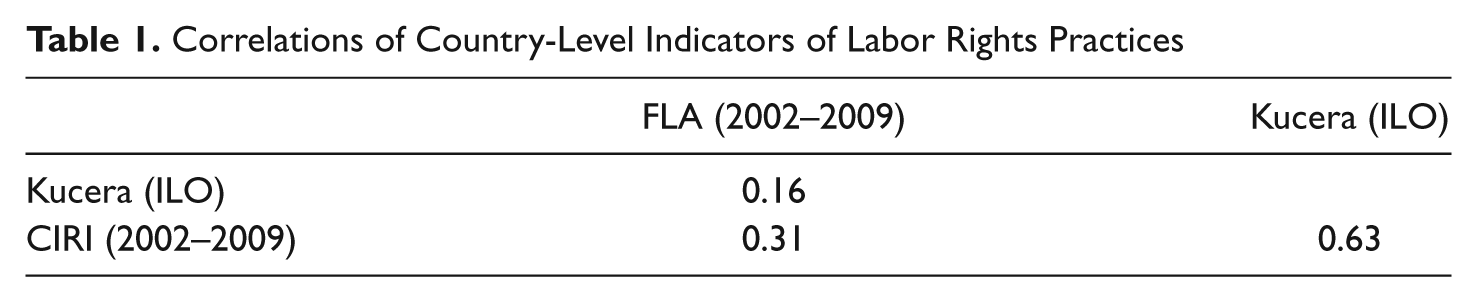
Taking a more systematic approach, we can compare FLA FoA findings with independent sources of country-level labor rights practices. To do this, I first organized my FLA’s FoA detection scores by country-years. For each year, countries were given a score that indicated the average number of FoA violations per factory audited by the FLA. I then compared this scoring with country-year level scoring by FoA experts. David Kucera of the International Labor Organization (ILO) and David Cingranelli and David Richards of Binghamton University have compiled country-specific rankings of labor practices that provide a good means of comparison. 46 This allows me to calculate the correlation of my FLA country scores with country-level scores compiled by Kucera and Cingranelli-Richards (CIRI dataset). 47
If the FLA audits adequately reflect the general context of labor rights violations in a given country, then the FLA country scores should correlate with other labor rights country scores. However, we find that the FLA country scores are weakly correlated with the Kucera and CIRI scores at well below the 0.5 level. In contrast, the Kucera and CIRI scores are more strongly correlated with each other (0.63) (see Table 1). This suggests a further indication that the FLA might not be properly documenting FoA violations.
Correlations of Country-Level Indicators of Labor Rights Practices
To provide one specific example, while both the Kucera and CIRI scores put Guatemala among the most egregious labor rights violators, the FLA audit system did not detect a single FoA violation in Guatemala since the FLA began inspecting factories there (2002 to 2010). Indeed, no FoA violations were detected in Sri Lanka, Jordan, and the Dominican Republic during this same period. On average, in most factories inspected by the FLA, there was less than one FoA violation detected per factory. In contrast, if we look at FLA monitoring of a labor standards issue, health and safety (which has a comparable number of benchmarks as FoA), we find a remarkably different pattern. Here countries like Guatemala and Sri Lanka stand out for their number of violations, as do Pakistan, the Philippines, and Indonesia. Most countries average six or more violations per factory inspection in this area (see Figure 2). 48
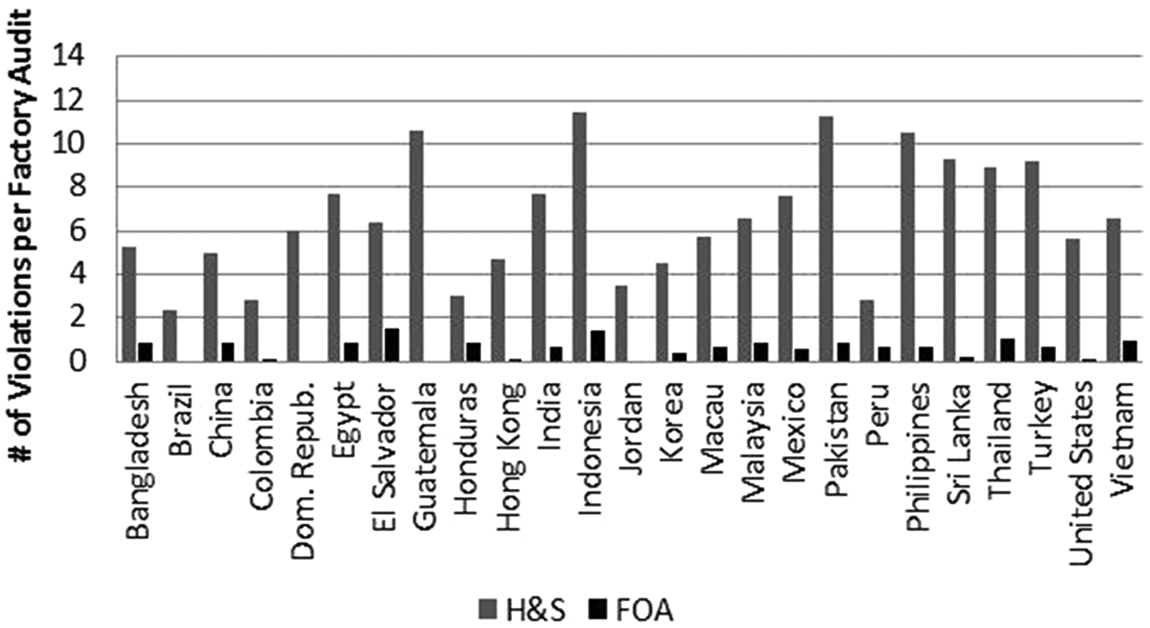
Violation Detection; FoA vs. Health and Safety, 2002–2010
FLA Third Party Complaint Mechanism
The FLA allows persons, organizations, and companies to file third party complaints in cases where there are “persistent or serious noncompliance with the FLA Workplace Code of Conduct in a production facility used by any FLA-affiliated company.” 49 After receiving a complaint, the FLA then decides whether it merits moving forward with an investigation and may assign a commission of independent monitors to investigate allegations. These third party complaints allow another means to test the quality of the FLA findings, since these are two different mechanisms for evaluating factories within the FLA system.
The FLA has investigated nineteen third party complaints between 2002 and 2010. As with the factory audits, we have coded each one of these complaints to detect patterns of violations according to issue areas. The results of this coding exercise indicate that the single greatest issue-area in these third party complaints is freedom of association, which represents 32 percent of all violations documented. This contrasts sharply with FLA audits in which only 5 percent of violations detected were FoA violations. Third party complaints were also far more likely to document harassment and discrimination (16 percent of violations), which was almost double the rate of FLA audits. In contrast, while occupational safety and health violations accounted for 40 percent of violations documented in FLA audits, they only represented 13 percent of violations in third party complaints (see Figure 3).

Violation Detections, Third Party Complaints (2002–2010)
The high rate of FoA violations documented in third party complaints suggests that when worker representatives and their activist allies take the initiative, they are more likely to detect violations of the empowering rights embodied in FoA. Third party complaints are over nine times more likely to document FoA violations than FLA audits. Of course, it is likely that the high rate of FoA violations is a reflection of worker representatives’ desire to focus on this empowering right. That is, just as corporations would like to underemphasize enforcement of FoA, worker representatives and their allies most likely emphasize it. Seen in this light, the third party complaint system balances the limitations of the audit system. Yet the third party complaint system has one major limitation: relatively few complaints have been accepted for review over the last decade, and their numbers pale in comparison to the number of factory audits; there were nineteen third party complaints versus 805 audits from 2002 through 2010. This suggests that the use of the FLA’s third party complaint system is limited in its ability to balance the FLA’s auditing system. 50
It is also true that third party complaints come disproportionately from regions where there has been a long history of transnational activism, notably Central America and the Caribbean. These countries account for 58 percent of the total number of complaints that have been selected for review by the FLA. In contrast, there have been only three complaints from China and none from Vietnam, despite the fact that these countries account for over 50 percent of FLA sourcing and have notable problems in the area of FoA rights. This suggests that there are serious limitations to the third party complaint system as a stand-alone mechanism for addressing FoA violations. When the third party complaint system is combined with transnational activism, it is more likely to prove beneficial to workers. That is, the third party complaint system appears to presuppose some degree of worker empowerment and transnational activist ties.
Remediation
Beginning in 2007, the FLA began calculating its remediation success rate. To do this, it revisited factories where in previous years violations had been detected to determine if they were successfully resolved. This is a crucial new indicator. Detection rates, after all, do not indicate if anything was done to address violations once they are documented. Remediation rates are thus a more direct indicator of the ultimate impact of a CSR program. What we find from the FLA data is that the remediation success rate for freedom of association is the lowest remediation rate of all issue areas. In the period for which data are available, 2007–2010, some 38.50 percent of FoA violations were fully remediated. 51 In contrast, the remediation success rate for all other issue areas ranged from 54.75 percent (hours of work) to 85.50 percent (child labor) (see Table 2). The average remediation rate of non-FoA violations was 72.18 percent.
FLA Self-Reported Success Rates by Issue Areas, 2007–2010

Source: FLA annual reports, 2008–2011.
Of course, there are several caveats to these data since “success” is defined and self-reported by the FLA, and the FLA has an incentive to document to its stakeholders its purported effectiveness. It is also important to note that “successes” include full and partial remediations. Thus, the rate of full remediation is lower even by FLA standards. Finally, it is also important to note that, when conducting follow-up visits to detect if previous violations were addressed, the FLA often finds new violations. For example, in 2010, the FLA reported that 126 health and safety violation remediation plans were completed and verified. Yet it also detected forty-seven new violations in those same factories, as well as thirty-six violations that had not been addressed. 52
The FLA data are useful for ascertaining patterns of self-reported success and allow us to ask the question, Why is there such a low level of remediation with FoA violations? According to the FLA, this is because FoA violations are especially complex and take a longer time to fix. Issue areas that have a straightforward “technical” solution, such as occupational safety and health violations, have a much higher remediation rate. And occupational safety and health violations are arguably the most conducive to what Locke, Amengual, and Mangla refer to as the “commitment model” in which joint problem solving, coaching and capacity building contribute to remediation. 53
Yet as Locke and his collaborators suggest, the commitment model does not work well for all issue areas. Indeed, it is important to note that issue areas with a relatively high remediation rates—forced labor and child labor—reflect violations that result in the strictest penalties, if not directly by the FLA, then by the FLA corporate members through their “zero-tolerance” compliance policies for these violations; suppliers that are found to use child or forced labor will face the immediate termination of their contract. 54
FoA violations are not subject to “zero-tolerance” policies. Most often, under the FLA system, the auditor’s remediation proposal involves policy development or training. Examining the remediation proposals from FLA audit reports between 2007 and 2009, we found that of the proposals for addressing the FoA violation, the remediation plan most often involved writing a policy and/or complete a training exercise. From our reading of the tracking charts, not once was there any penalty or disciplinary action taken based on a FoA violation in the period 2002 to 2009 (see Table 3).
Remediation Proposals for FoA Violations
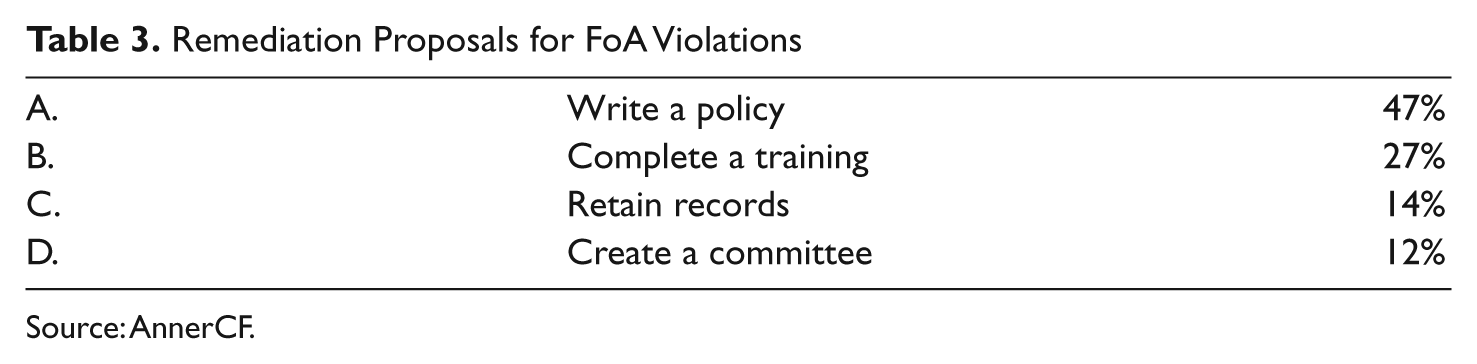
Source: AnnerCF.
Policy development and training only work, however, when the violation is a result of a lack of understanding of the law or international standards. Training is not likely to work when a violation is a result of deliberate and repeated actions by the employer designed to eliminate or weaken a union. Moreover, policy development and training employers in FoA rights will not address problems resulting from state laws that curtail FoA rights. The FLA, as noted earlier, opposes actively encouraging states to come into compliance with international FoA standards. In sum, just like detection of violations shows considerable variation by issue area reflecting stakeholder influence and power, so too do remediation patterns. Not only are FoA violations less likely to be detected in corporate-influenced programs, but they are also less likely to be successfully remediated, according to the FLA’s system of self-reporting.
The Case of Russell Athletic in Honduras
While the quantitative analysis presented above points to general trends in the area of detection and remediation, a case study approach allows for a more careful exploration of the causal mechanisms behind such trends. Russell Athletic in Honduras provides an ideal case study because several independent monitoring reports and FLA documents have been made available, which allow us to understand not only what steps were taken, but also the justification for each step. This case study analysis draws on primary documents—notably audit reports and factory inspection reports—and on field research in Honduras in May 2010.
Russell Athletic is a subdivision of Fruit of the Loom and part of Warren Buffett’s Berkshire Hathaway enterprise. In July 2008, the union and management at a Russell apparel factory in Honduras entered into a collective bargaining process. During that time, workers claimed they were subjected to harassment and threats of plant closure due to unionization. 55 By October 2008, bargaining had reached an impasse, and Russell announced it would close the plant for “economic reasons.” 56 The union, however, claimed the plant closure was due to the company’s attempt to prevent collective bargaining and rid itself of the union. That is, they argued the plant closing was a violation of their freedom of association rights.
Russell is a member of the FLA, and the FLA was asked to examine the Russell case. In October 2008, the FLA hired the Cahn Group to travel to Russell’s parent company, the Fruit of the Loom headquarters in Bowling Green, Kentucky to evaluate the rationale for closing the factory. The Cahn Group concluded, based on documents examined in Kentucky, that the plant was closed due to a decline in demand for fleece products. Cahn reached this conclusion in part because it was not able to find any written documentation at corporate headquarters that Russell closed the plant to rid itself of a union. Yet the Cahn Report also noted, “Additional investigation in Honduras will be required to provide more complete conclusions concerning allegations made against the company.” 57
The FLA turned to A. & L. Group Inc. (ALGI), one of its accredited external monitors, to examine the Jerzees case in Honduras. According to the FLA, “[ALGI] monitors did not detect or gather any tangible evidence to show beyond a shadow of doubt that JDH has performed or encouraged actions that can be regarded as discriminatory or hostile against SITRAJERZEESSH union delegates, the union federation (CGT) or any union or non-union employees.” 58 That is, the FLA’s auditors did not find evidence of a FoA violation. What this statement also indicates is that, in the FLA’s system for detecting FoA violations, the burden of proof is placed on the workers and their union. The company was not required to show beyond a shadow of a doubt that the plant closed for economic reasons. Rather, workers had to show beyond a shadow of a doubt that antiunion discrimination was the main factor motivating the closing of the plant. Yet ILO experts argue that, once employees provide a reasonable indication of a violation, the burden of proof should shift to the employer. 59 Thus, the FLA’s decision to place the burden of proof for FoA violations on workers and not the employer goes against international practices and provides further evidence as to why FoA detection rates are low in the FLA system.
International labor activists and Honduran union representatives did not accept the ALGI findings and the FLA’s endorsement of those findings. Indeed, according to the FLA, it received ten procedural challenges from labor rights organizations and the CGT labor center in Honduras regarding the impartiality of the ALGI report. 60 This activist pressure led the FLA to contact an ILO consultant, Adrian Goldin, to examine the case. Goldin not only verified violations of freedom of association but also harshly critiqued the methodology used by the ALGI for detecting freedom of association violations. Goldin writes, “ALGI’s report gives insufficient—almost nil—consideration to and evaluation of testimony by workers and their representatives.” 61 The ALGI focused on written documentation, not worker testimony. But Goldin emphasizes that workers, unlike employers, have neither the means nor the legal obligation to provide such documentation. Rather, worker testimonies are crucial forms of evidence.
According to Goldin, the manner in which the ALGI conducted interviews also goes against standard practices for monitoring FoA violations. Many of the workers were interviewed inside the factory, and thus not in an independent location. Interviews were conducted in groups, raising the fear that a promanagement coworker could report negative comments to management, and, for at least a period of time, a plant manager was present outside the door of the office where interviews were being conducted. 62
Goldin concludes that the ALGI report “has deficiencies and methodological wants. Thus, its conclusions lack rigor, are not based on adequately-gathered evidence and lack aptness to convince.” 63 Goldin, in direct contrast to the ALGI, finds, “The closure of the factory has been determined, at least to a significant extent, by the existence and activity of the union.” 64 The FLA received the Goldin Report and reviewed it together with the Cahn Group report and the ALGI report. The FLA then concluded, “Upon review of the three third-party reports and other information at our disposal, the FLA found the economic factors to be persuasive and accepts that the decision to close JDH was principally a business matter.” 65
In this case, it cannot be argued that the FLA system has a low detection rate of FoA violations because these are complex issues that are hard to uncover. The FLA had a report by a representative of the most established authority on labor rights, the ILO, which asserted FoA rights had been violated. The FLA chose to dismiss the findings of this top FoA authority and endorse the findings of a private, corporate social auditing firm that the FLA regularly relies on for its global audits. Moreover, the FLA chose to place the burden of proof on the workers, not the employers, which goes against accepted international practices for detecting FoA violations.
Eventually, as a result of student activist pressure, some 110 universities cut or failed to renew their contracts with Russell because they were convinced workers’ rights to organize and bargain had been violated. 66 This economic pressure forced the FLA to eventually rule that FoA rights had been violated. Internally, FLA board member Lynda Yanz of the Maquila Solidarity Network, put considerable pressure on the FLA. Finally, the FLA placed Russell under review, which contributed to Russell changing its conduct, reopening the factory, recognizing the union, and bargaining in good faith. What this suggests is that FoA violations were ultimately remediated, but it took a significant student-led boycott and considerable other forms of external and internal pressure to arrive at this outcome. Remediation was not the result of the normal operating procedures of the FLA’s auditing system.
Monitoring FoA in Labor Repressive States
One of the greatest challenges for any voluntary governance mechanism that attempts to detect and remediate freedom of association violations involve their operations in states where FoA rights explicitly are curtailed by law. Most notably, this includes China and Vietnam. In the case of the FLA, China and Vietnam are highly relevant because over half of the workforce employed by FLA suppliers is now located in these two countries, and this share has risen by 17 percent in the last five years, from 47 percent of FLA supplier production to 55 percent (see Table 4).
FLA Sourcing Dynamics

Source: FLA (2006, 2011).
The FLA system references ILO conventions 87 and 98 as its main points of reference for FoA considerations. And one of the FLA’s first FoA benchmarks in its code of conduct states, “Workers, without distinction whatsoever, shall have the right to establish and to join organizations of their own choosing, subject only to the rules of the organization concerned, without previous authorization.” (See the appendix for complete FoA benchmarks.) The next benchmark adds, “When the right to freedom of association and collective bargaining is restricted under law, employers shall not obstruct legal alternative means of workers association.” What this suggests is that if workers are not allowed to form an independent union, then at least they should be able to form some type of workplace committee. Yet the FLA’s FoA benchmark (no. 18) adds, “Employers can only engage in collective bargaining with representatives of unorganized workers when no workers’ organization exists.” Thus, if an official, communist party labor union is present at the workplace, the “legal alternative means of workers association” are prohibited from bargaining.
Finally, according to FoA benchmark no. 22, workers in FLA suppliers have the right to strike, by which they specify, “employers shall not impose any sanction on workers organizing or having participated in a legal strike.” Put another way, employers are allowed to sanction workers participating in illegal strikes, and all strikes are effectively illegal in China (or, at least, not legally sanctioned). Thus, the wording of FLA benchmark 22 sanctions the punishment of workers by employers for participating in strikes in China.
Vietnam
Vietnam offers an example of the challenges of the FLA’s approach to monitoring FoA. And not only is Vietnam the second largest sourcing country for FLA corporate members, but it is also the fastest growing site for FLA sanctioned production, increasing from 11 percent of factory employment in 2005 to 16 percent in 2010. Vietnam is also an important country case because, unlike China, it is covered by the ILO/World Bank’s Better Work program. Thus, it allows for a comparison between the FLA and Better Work approaches to monitoring FoA in a socialist country.
What we observe from our coding exercise of FLA audits between 2002 and 2009 is that the FLA findings for Vietnam are remarkably similar to its findings for nonsocialist countries. Health and safety, wage, and overtime violations are readily detected, whereas freedom of association (right to strike, bargain, and freely organize and conduct union tasks) score relatively low. On average, only one of the FLA’s twenty-four FoA benchmarks has been deemed violated per factory audit conducted in Vietnam (see Figure 4). Reading through the audits, we see some cases where the FLA points out that management did not meet with the union or did not sign a collective bargaining agreement. In some audits, the FoA section is left blank. While the FLA references ILO conventions in its code of conduct, early audits routinely refer only to national and local laws. In one 2007 case, of the FLA’s twenty-four FoA benchmarks, the auditors only found the Vietnam-based Adidas supplier to be in violations of two, FoA1 and FoA26 (see appendix). In the first case, the CBA was not properly registered. In the second case, the suggestion boxes in the factory had been removed for “maintenance.”
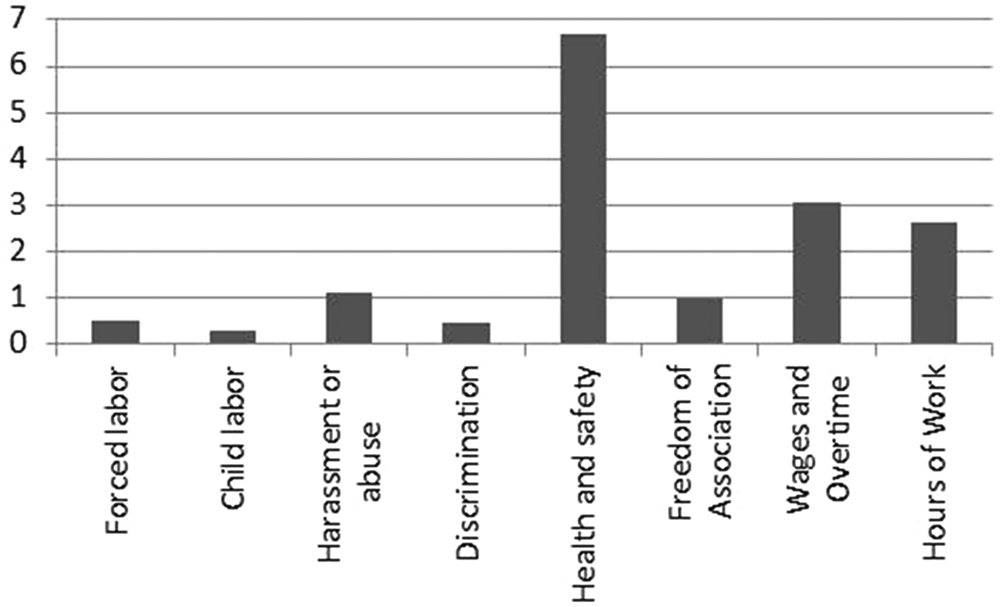
FLA Audits, Violations/Factory (2002–2009)
In recent years, we see the first reference to ILO standards. For example, in a 2008 audit of a Nordstrom supplier, the auditors write, “Vietnam’s legal framework is . . . not compatible with the ILO Principles on Freedom of Association and, as such, all factories in Vietnam fail to comply with the FLA Code standard on Freedom of Association.” This is followed by a Plan of Action, which states, “Workers should be free to join worker health and safety committees to ensure that their voices and suggestions can be shared with factory management. 67 A health and safety committee is thus deemed by the FLA to be an acceptable substitute for independent unionism and the right to bargain collectively and strike.
Like the FLA, Better Work conducts factory inspections that examine compliance with labor standards and rights. Better Work places much stronger emphasis on core ILO conventions. It began conducting assessments of worker rights and working conditions in apparel factories in Vietnam in December 2009. 68 Better Work organizes its categories of violations differently than the FLA, and it codes noncompliance distinctly, too. For example, instead of having one category for freedom of association, Better Work codes the right to strike, the right to collective bargaining, and the right to independent unionism separately. And instead of counting the number of violations in each area per factory, Better Work simply determines if a given factory is in noncompliance in a given issue area, and then displays its findings in terms of the percentage of factories in noncompliance (see Figure 5).
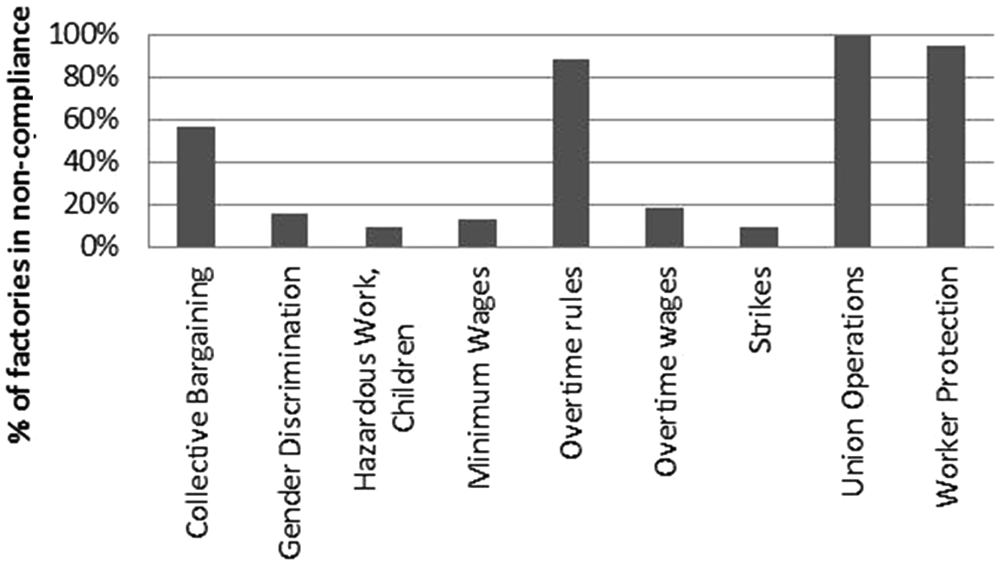
Better Work Findings, 2010
Like the FLA, Better Work finds high rates of noncompliance in the areas of health and safety (worker protection) and overtime rules. Yet unlike the FLA, Better Work documents much higher rates of noncompliance in the areas of freedom of association. Some 57 percent of factories are in noncompliance with collective bargaining rights and 100 percent of factories are ranked to be in noncompliance with FoA rights in Vietnam. Noncompliance with the right to strike is relatively low (9 percent of factories). This is because Vietnamese law, unlike Chinese law, stipulates workers’ right to strike. And since official unions do not use this right, factories are less likely to be in violation of this right. The considerable numbers of strikes that do take place in Vietnam are outside the legal framework.
In sum, Better Work—which includes the active participation of the ILO and the tripartite social actors in Vietnam—appears to offer a more accurate assessment of FoA rights than the FLA. It is still too early to determine if Better Work will be effective in addressing these problems, but by more openly acknowledging the issue, it has greater potential.
Apple and Foxconn in China
The monitoring of Apple’s supplier Foxconn in China is the FLA’s most significant case to date. Foxconn—which produces Apple products such as iPhones and iPads, as well as products for other electronic corporations including Dell, Hewlett-Packard, and I.B.M.—gained notoriety in 2010 when it was reported that thirteen workers committed suicide in the context of punishing overtime and a factory system known for “military-style drills” and verbal abuse by managers. 69 This was followed by a 2011 explosion caused by combustible dust that killed three workers and injured fifteen others at a Foxconn facility making Apple products. 70 Just over seven months later, Apple announced it was contracting the services of the FLA to conduct an investigation of its Foxconn supplier in China.
The FLA has focused on the global apparel industry, so this case is significant not only because of its scale, but also because it represents the first major consumer electronics case for the FLA. The Apple/Foxconn case in China also gives us another opportunity to examine more closely the FLA’s approach to FoA in a communist country, one that accounts for 39 percent of FLA-sanctioned global operations. Like the Russell case, the Apple/Foxconn case was a highly publicized case in which the name and the location of the factory were revealed, and the full report was released to the public, including detailed appendices with full survey results. Indeed, it is important to note that the procedures used and time spent conducting the investigation were not normal operating practices. The FLA’s report on Foxconn is 197 pages long. Most FLA audit reports are less than 16 pages in length.
The strong media attention and activist scrutiny suggests that the FLA would be extra careful to thoroughly audit all aspects of its code of conduct in this case. Thus, this should make the Foxconn case another hard test case for my argument; if there was one case where the FLA should have done due diligence, it was Foxconn. Nonetheless, based on my arguments presented in this article, I still anticipate two results in the FLA’s Foxconn report. First, the FLA will be relatively more focused on the areas of health and safety, wages, and overtime. Second, issues related to violations of freedom of association will encompass one of the weaker aspects of the report.
An examination of the report bears this out. There are many detailed findings on health and safety violations. For example, we learned that 68.7 percent of workers interviewed suffer from neck and back pain, and 40 percent of the workforce already suffers from eye pain. And we find that 43 percent of workers interviewed had experienced or witnessed accidents at the factory. We also learn that unscheduled overtime was paid in thirty-minute increments, so that twenty-nine minutes of overtime resulted in no overtime pay. The FLA provided specific instructions for addressing these concerns, while also noting that “many health and safety violations, including blocked exits, lack of or faulty personal protective equipment, and missing permits have already been remedied.” 71
At the same time, it is worth noting that, while the FLA called for full legal compliance of working hour standards, the FLA gave Foxconn until July 1, 2013 to achieve compliance. That is, the FLA—which is a U.S.-based, private organization—determined in March 2012 that it was acceptable that a major supplier continue to violate Chinese law for another fifteen months, which returns us to important questions about the sources of CSR program authority to offer remediation plans with legal implications in foreign countries. The FLA report also attempted to point to “root causes” behind the violations it detected. For example, the FLA determined that a root cause of legally excessive overtime hours is high labor turnover. No mention is made of Apple’s role in giving Foxconn short production lead times when, for example, it instructed Foxconn to install new iPhone screens on such short notice that workers were woken up at midnight, given tea and a biscuit, and thirty minutes later were sent to work on a twelve-hour shift. 72 Indeed, in this privatized system of monitoring and enforcement in which most costs are paid by corporations, it is worth observing that the sourcing practices of Apple, the corporation paying “well into the six digits” for the report, 73 were never mentioned, much less determined to contribute to poor labor practices in Foxconn.
In the area of freedom of association, the FLA had four major findings: (1) the labor union at Foxconn is dominated by upper-level staff and managers, (2) the majority of workers are unaware a union represents them, (3) most workers do not know about the existence of the collective bargaining agreement, and (4) the employee handbook states that workers are prohibited from participating in strikes. The remedial actions indicated by the FLA include (1) union leader nominations and elections should take place without management involvement, (2) new workers should receive informational material about the union, (3) workers should receive a copy of the collective bargaining agreement, and (4) management should remove the clause in employee handbooks stipulating workers cannot participate in illegal strikes.
These FLA recommendations fail to address the fundamental FoA problems. For example, the distribution of the collective bargaining agreement ignores the issue of the content of a document which was the product of “negotiations” between management and (what the FLA tells us is) a management-controlled and -run union. At no time does the FLA inform us of the content of the collective bargaining agreement, if these contents go above and beyond the law (as they should), and if any clauses in the collective bargaining agreement were ever violated. The FLA does instruct Foxconn to allow for democratically elected unions without management interference. Yet the Chinese system requires that all unions remain affiliated to the official union structure, and thus the system of state control over unions is not addressed. Finally, the FLA indicates that the no-strike clause should be removed from employee handbooks. However, as Foxconn management noted in its defense, the clause simply repeats what is already a legal reality in China. Thus, removing the clause from the handbook does not give Foxconn workers the right to strike. It merely removes an uncomfortable reference to what is in fact the legal context in China.
The question of managers on union boards is complex. By all accounts, managers should not be factory-level union leaders. But my field research in China (and Vietnam) revealed that even in democratic elections, workers often elect supervisors or managers to these positions, particularly human resource managers. Why? No doubt, there may be manipulation and pressure from management to do this. But the other reason is that some workers believe that having a manager on their leadership body will give workers certain influence that is otherwise missing due to their lack of independent collective representation and their inability to strike. (This is particularly true in terms of addressing everyday grievances; it is less true when workers’ issues entail demands for better wages and benefits.) Thus, by ordering the removal of midlevel managers from union boards while not addressing workers’ inability to strike or form an independent union may further weaken worker representation. And as my argument suggests, a weak union, in turn, will allow for the continuation of managerial control, while the FLA’s highly publicized inspection process outlining numerous health and safety, and wage and hour issues serves to increase Apple’s legitimacy as a responsible global corporation.
Discussion: Alternative Approaches
It has been argued here that meaningful and sustained improvement in working conditions in apparel supply chains are predicated on the ability of workers to establish democratic and independent unions, bargain collectively, and strike. Fundamental freedom of association rights allow workers to determine what issues need to be addressed and how they should be addressed, and afford workers the power needed to allow for meaningful bargaining. This article has highlighted the trend for apparel and, more recently, consumer electronic corporations to increasingly rely on voluntary governance mechanisms to monitor and remediate these fundamental rights. By focusing on one of the most prominent and, by some metrics, most rigorous CSR programs, we have examined myriad problems and limitations in the area of FoA.
There are alternative approaches. Notably, the Worker Rights Consortium (WRC) was founded with the support of labor unions that had left the FLA prior to its formation, and progressive NGOs and student groups. The most important support for the WRC has come from United Students Against Sweatshops, and the WRC has focused on collegiate apparel. The WRC strategy is to invite workers to present complaints, investigate those complaints, and then post the contents of its reports on its website. Unlike the FLA, the WRC posts the names of the factories it investigates.
A coding of WRC findings based on its reports posted on the Internet (much like the coding process we conducted on the FLA audits) reveals that the WRC is six times more likely to find FoA violations in factories than the FLA. What these data suggest is that stakeholder participation does matter in CSR detection rates according to issue areas. While corporate influence in the FLA results in prioritizing issue areas that give corporations greater legitimacy, labor and activist influence in the WRC results in prioritizing empowering rights. Yet what also is noticeable is that corporate-influenced programs have far greater resources and capacity to monitor factories than labor-influenced programs. Between 2002 and 2010, the FLA conducted 805 factory inspections compared to 56 conducted by the WRC. That is, this corporate-influenced program is over thirteen times more likely to monitor factories than this labor-influenced program.
Conclusions
Since the 1990s, a range of private governance—or CSR programs—have emerged to monitor, investigate, audit, and remediate respect for labor standards and rights in the global apparel industry. This article has argued that who participates in the formation and governance structures of CSR programs affects their outcomes. Due to the concentrated power of corporations and the decision of trade unions to withdraw from CSR initiatives, many CSR programs have been influenced by corporate interests. This does not mean they do not detect violations and attempt to address them. Corporations desire legitimacy and protection from the risks of reputational damage caused by activist campaigns and media exposés. Multi-stakeholder initiatives are seen as providing more legitimacy than wholly corporate-controlled programs. And seeking to address egregious wage, hour, and health and safety standards protects against damaging exposés. 74
Yet the desire for legitimacy and reputational protection are mitigated by another corporate motivator: control. Corporations, to adequately plan their activities and pursue their goals, desire a strong degree of control over the dynamics of their global supply chains. The tension between legitimacy and control plays out in CSR programs. This article argued that corporations will favor programs that enhance their legitimacy but do not hamper their control. Strong unions that are empowered to organize strikes are perceived to be disruptive to supply chains and thus debilitating to corporate control. For this reason, I expected that corporate-influenced CSR initiatives would be more focused on detecting wage and occupational safety and health violations than freedom of association violations.
This article examined one of the largest corporate-influenced CSR programs in the apparel sector, the FLA. An exhaustive coding and analysis of all 805 FLA factory audits between 2002 and 2010 revealed that the FLA was far more likely to detect and, according to FLA self-reporting, remedy wage, hour, and occupational safety and health violations relative to the right to form a union, strike, and bargain collectively.
Process tracing of one of the FLA’s most important FoA cases, Russell Athletic in Honduras, revealed that the failure to certify a FoA rights violation was not the result of the complexity of the issue or the lack of access to FoA experts. Rather, it was the result of the FLA’s decision to (1) put the burden of proof of FoA violations on workers, (2) use the highest standard for burden of proof (beyond a shadow of a doubt criterion), and (3) give preference to written over verbal evidence. An examination of the FLA’s approach to FoA violations in Vietnam and Foxconn in China reveal further weaknesses in the program’s willingness to adequately address workers’ right to form independent unions, bargain with real power, and strike in countries where independent unionism is curtailed by law. These two country cases are important because over 50 percent of FLA-sanctioned production takes place in China or Vietnam.
As anticipated, when labor participates more directly in verification processes, the results are significantly different. In both the FLA’s third party complaint system (in which worker representatives and their allies present complaints) and the labor-influenced WRC program, the detection rate of FoA violations is dramatically higher than the FLA’s auditing system. This is because labor-influenced processes have both an interest in defending FoA rights and have the trust of the workers needed to detect violations. The limitation of labor-influenced initiatives is their scope. During the period under study, there were a total of seventy-five third party complaints and WRC verifications compared to 805 FLA audits.
These findings suggest several policy recommendations. Increasing workers’ ability to present third party complaints and a willingness to accept these complaints would do much to provide greater FoA protection. This would also entail greater transparency in how and why programs accept some complaints and reject others. Enhancing the size and influence of large, representative NGOs and labor groups in the governance structures and daily operations would rectify imbalances in the governance board. FoA audits should also take worker oral testimony as a legitimate form of evidence where, after a prima facie case for a FoA violation is established by workers, the burden of proof shifts to the employer. Finally, no long-term solution of FoA violations can be found without the involvement of the state. This is because states regulate who can form unions, who can bargain collectively, and when, how, and if strikes can take place.
If CSR programs and states remain unwilling to more effectively monitor and remediate FoA violations, then lessons from the antisweatshop movement indicate that labor and its allies will be more likely to seek solutions outside formal institutional processes in the form of transnational activist campaigns. 75 The campaign that targeted Russell and resulted in its boycott by over one hundred universities provides one example of what that might look like. The massive strike waves affecting China and Vietnam provide another example. The irony is that one of the main impetuses for corporations to join CSR initiatives was precisely to avoid such unsavory activist campaigns and wildcat strikes. It seems that to circumvent such actions in the future, corporations will have to relinquish some of their desire for control by ensuring that workers’ rights to organize are more fully realized.
Footnotes
Appendix
Acknowledgements
The author thanks Miguel Martínez Lucio, Gay Seidman, and Richard Locke and other members of the MIT Institute for Work and Employment Seminar as well as and the Politics & Society editorial board for their useful comments and suggestions. The author also thanks Dong Fang and Katherine Cornejo for their research assistance in coding FLA factory audits.
Declaration of Conflicting Interests
The author declared no potential conflicts of interest with respect to the research, authorship, and/or publication of this article.
Funding
The author disclosed receipt of the following financial support for the research, authorship, and/or publication of this article: Research for this article was supported by a 2010–2012 Alfred P. Sloan Industry Studies Fellowship.