




Abstract
Varied forms of mobility are rapidly transforming communities across the world. In Africa’s cities and urban peripheries, the results of human movements include ever more diverse sets of new arrivals living alongside longer-term residents as they seek protection, profit, and passage elsewhere. Some move on and others return home, while still others shift within in search of new opportunities or security. In the absence of muscular state institutions or dominant cultural norms, these areas have become estuarial zones in which varied communities of convenience are taking shape. Unlike well-documented urban gateways or ghettos, these communities range from radical forms of exclusion to remarkable modes of accommodation that enable people to extract usufruct rights: to live in but not become fully part of the cities they occupy. Using examples from Maputo, Johannesburg, and Nairobi, this article explores the nature of these estuaries in ways that challenge the conceptual foundations typically informing debates over migrant rights, integration, and the boundaries of belonging. This means eroding clear distinctions between hosts and guests along with a call to reevaluate the relative importance of state institutions and policies. Most fundamentally, it questions new residents’ interests in localized political and social recognition and participation. The article concludes by suggesting the need to reconsider the forms and scale of community through which the newly urbanized claim rights and the nature of the rights they desire.
Keywords
The Promise and Premise of Integration
Across the global south, mobility and population growth are transforming cities as millions move to urban areas in search of profit, protection, or passage. 1 Unlike the urbanization of previous centuries, contemporary urban growth is not shaped by industrialization or accompanied by a rapid expansion of bureaucracies, public service provision, state institutions, or centralized political authority. 2 That the most rapid growth is occurring at or just past the urban edge—often beyond the regulatory reach of city planners and state institutions—raises important concerns. It not only points to a transformation of cities’ morphologies but also to the possibility of novel patterns of production, social reproduction, and the nature of political community. Typically characterized by limited social capital and zones of dense impoverishment, 3 Africa’s cities provide ready evidence for dystopian predictions of violence and atomization. 4 Their levels of novelty, fluidity, and inequality also open the possibility of emerging forms of solidarity and authority: Africa’s cities are grand experiments in social dynamics, domination, and resilience. Although there may be historical precedents elsewhere, there are reasons to believe that Africa’s economic and institutional realities are giving rise to unparalleled patterns of human organization that raise important ethical and theoretical considerations. It is these that this article begins to explore.
The nature of human mobility and emergent communities across Africa can render the standard conceptual vocabulary and assumptions about migrant rights distinctly anachronistic. With data and examples from rapidly transforming neighborhoods in Nairobi, Maputo, and Johannesburg, this article reveals some of the cracks in the ethical and empirical foundations on which debates over urban and migrant political integration—effectively rights claiming—are normally premised. The first is a clear distinction between hosts and guests: between locals and strangers. The metaphors of hospitality, welcome, and asylum are founded on this dichotomy, as are the ethics of Derrida, Kant, Taylor, and others. The second challenge comes from questioning residents’ desire to claim the kind of rights to participation and representation that enable or demand people to become part of a place-bound community. The third is the role of states, laws, and formal policies as (a) providing frameworks for rights claiming, (b) as the target of mobilization, and (c) as the guarantor of rights or as an obstacle to their practical realization.
This article aims to open space for understanding emerging forms of political and normative orders amidst apparent precarity and fluidity. Within new urban gateways 5 —novel modes of accommodation are emerging, double helix-like, with ever-evolving forms of social, economic, and political exclusion. These forms may be jarring to both participants and observers, but we must be wary of condemning their failures to meet universal standards of inclusivity and justice. Given their internal coherence and potential legitimacy, analysts must first work to understand these interactions the conditions producing them and their potential ethical consequences before judging them. 6 This article draws attention to the importance of the spatial and temporal dimensions shaping emergent political communities. 7
I argue that much as we must reconsider our language of migrants and hosts, in the face of fluidity and the frailty of formal institutions so too should we rethink our language of civic, national, or municipal belonging—cultural, economic, or political—as the basis of meaningful membership and rights. At a spatial level, we must at once pan more widely and focus more locally to reveal forms of multi-sited belonging and the complex dynamics and engagements of specific sites where people negotiate multiple, and often conflicting histories and social positions. 8 What we see there is confusing and often corresponds poorly with normative frameworks informed by liberal or communitarian understandings of rights. I hope the following discussion prompts and provokes further research that will help narrow the gap between the metrics associated with these positions and rapidly transforming global dynamics and sociopolitical subjectivities. 9
The Estuary and Making Sense of It
This article focuses on the sociopolitical formations and strategies emerging in a context of rapid demographic growth, continued mobility, and relatively weak formal regulatory infrastructure. In his 2011 book, Arrival City, Saunders draws attention to the particular gateway zones. 10 But the movements that matter are not only of those entering cities for the first time. Across Africa, the elite and well connected have evacuated inner-city neighborhoods in favor of new peri-urban estates and gated communities. 11 In their place, rural migrants, international migrants, and the ‘upwardly mobile’ urban poor converge. Elsewhere, once sparsely occupied peri-urban areas have become stations and destinations for people moving from cities and those first coming to them. Figure 1 (below) illustrates these changes’ extraordinary pace in Diepsloot, a burgeoning site just north of Johannesburg, a space that was still farmland into the mid-1990s. 12 Similar transformations are occurring on the edges (and sometimes in the middle) of Kinshasa, Luanda, Nairobi, Maputo, and elsewhere where small villages or agricultural zones have been incorporated into conurbations while remaining economically and socially connected to sites elsewhere.
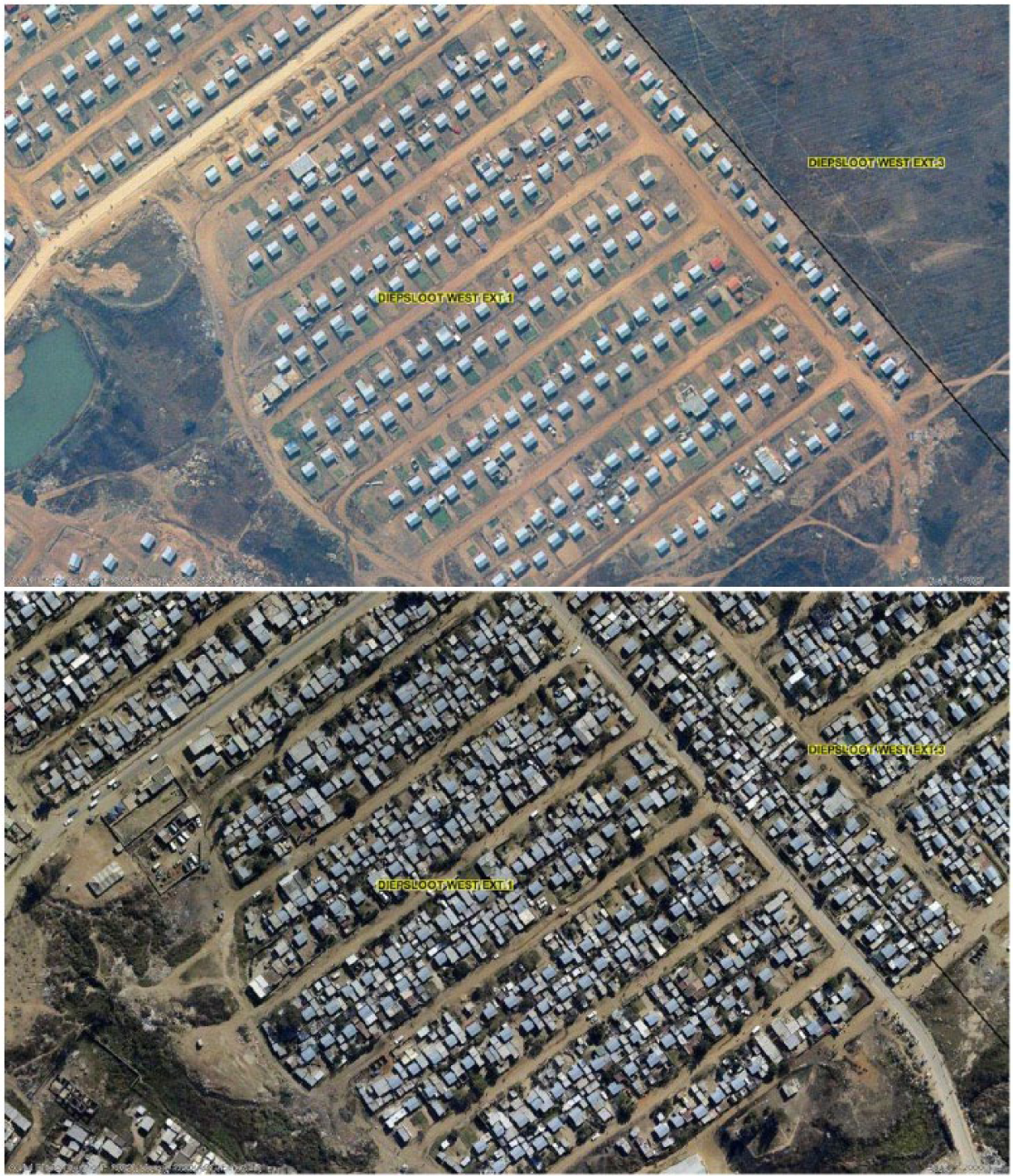
Transformation of Diepsloot, South Africa 1999-2009.
Due to failing rural economies, conflicts, material inequalities, gentrification, and other urban development programs, people are moving into, out of, and through African cities in search of profit, protection, and passage elsewhere. The urban estuaries these movements create—meeting places of multiple human flows that remain largely unregulated by states or dominant social institutions—are at once unstable and fertile grounds. 13 Much like natural estuaries where interactions between rivers and tides create uniquely dynamic ecosystems, these urban gateways generate distinct sociopolitical forms through the multiple movements and dynamics taking place within them. In these zones, cultural and linguistic heterogeneity are often empirical norms, not exceptions.
This kind of “globalization from below” reflects a potentially fundamental sociopolitical transformation. Through people’s geographic movements into, out of, and within cities, urban spaces that for many years had only tenuous connections elsewhere are now becoming nodes in national and diasporic networks of social and economic exchange. But these are not unified or stable communities, but ones being consistently reshaped by the movements of new people, events taking place elsewhere, and the interactions of those meeting on Africa’s city streets. 14 The rationality of behaviors seeming odd or confusing when viewed at the micro level often begin to make sense when translocal and diasporic social connections are considered. Table 1 illustrates the degree to which the cities in questions are, indeed, cities of strangers. Table 2 further demonstrates the fluidity of the population after arrival, a period that is often quite brief. Given the insecurity of leases, land tenure, and opportunities to earn, people often continue to move even within a given city. Coupled with high levels of social diversity, such movements work against the consolidation of classical forms of solidarity and political community. Such heterogeneity and the degree to which people are from and remain oriented elsewhere expose the fiction of claims to indigenous status in estuarial urban spaces.
Percentage of Population Resident in City by Time.
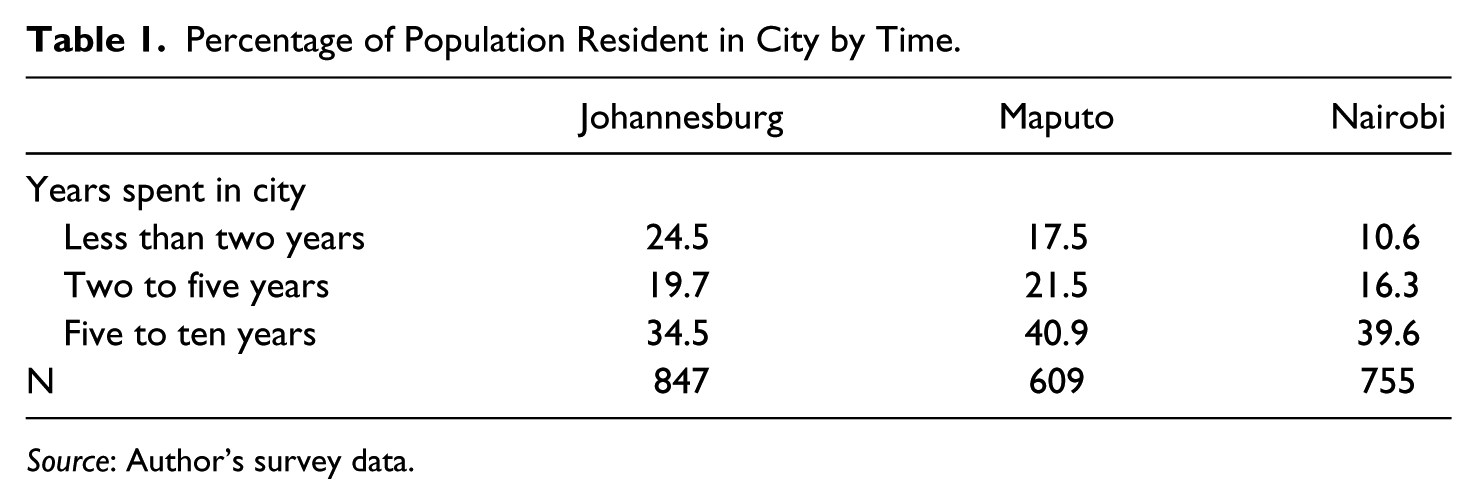
Source: Author’s survey data.
Average Number of Moves among Non-nationals since Coming to the City, 2006.

Source: Author’s survey data.
The obvious question is whether these diverse patterns of social life and regulation are themselves transient and whether they parallel previous patterns, such as the hybrid orders that characterized rapid urbanization in Europe or North America. Charles Dickens’ David Copperfield or Martin Scorsese’s historical drama Gangs of New York both depict levels of transience, inequality, and violence now seen in many African cities. Although current regimes may not stay in power, they are unlikely to settle into London or New York’s state-centric orders. Perhaps most obviously, the compression of time and space engendered by connections and regular shifts between rural (or peri-urban) and urban areas are eroding established communities everywhere. For significant numbers of domestic migrants and a smaller number of international ones, urban spaces serve more as stations in ongoing journeys than as final destinations where the goal is to extract resources to subsidize a “real” life they have or imagine elsewhere. Although new arrivals may establish (sometimes second) urban families, ethnic and political ties elsewhere work against full social integration into the communities where they reside. Intentions for rural retirement or moves elsewhere further limit financial and emotional investments. When migrants arrive seeking protection from conflict and persecution, they often return home or move on when conditions allow. This ongoing orientation to multiple peoples and places help generate a kind of permanent temporariness in which they actively resist incorporation. 15 These factors—combined with the insecurity of land tenure, the possibility of violence as well as the lack of industrial development, permanent employment or other forms of economic security—mean urban dwellers often maintain feet in multiple sites without firmly rooting themselves in any one. 16 The absence of hegemonic political institutions only heightens the likelihood that fragmented social citizenship will characterize the future of African urbanism.
Although fragmentation and fluidity may be the norm, people nonetheless form solidarities and communities in order to meet their daily needs and find rights and recognition. It is these that interest me here. This article is primarily a conceptual exercise: a means of inductively challenging presumptions about mobility and the practices of political community within these estuaries. In that sense, observers in both “north” and “south” have much to learn from Africa’s urbanization. What it describes are not the realization of any individual or group’s singular imagination, but rather the products of street level pragmatism and tactics potentially framed by supra-local discursive currents and perceived opportunities. These outcomes may not represent the future of migration and integration in Europe, North America, or elsewhere, but remarkable levels of heterogeneity, ongoing mobility and translocal loyalties, and the state’s limited authority and reach among the urban poor are not unique to Africa’s cities. One need only to look at the US ghettos, the French banlieus, or parts of deindustrialized Britain for suitable parallels. Moreover, the new politics that emerge in these spaces are unlikely to remain geographically contained. It is, after all, at the political margins where revolutionary ideologies and organizations often get their start. In a networked world, it may ultimately be the margins that will define the center.
This paper draws on an ecumenical set of data in illustrating patterns of movement and social interaction. Most of the information reflected here stems from migration-related research in southern and eastern Africa—beginning with Johannesburg and expanding to Nairobi and Maputo—undertaken between 2002 and 2010. While recognizing the severe limitations of available data on migration and urbanization in African cities, Tables 3 and 4 show that the cities are comparable on a number of axes. For one, the growth rates are similarly rapid across all three sites. There are also clear and significant differences in the human development levels of the three cities, an indication not only of wealth but a relatively effective proxy for state capacity and economic resources. The United Nations’ 2007 Human Development Index (HDI) ranked South Africa 129th, Kenya 147th, and Mozambique near the bottom at 172. Such ranking hides difference of wealth inequality: due to its wealth and historical legacy, South Africa is far more unequal than either Mozambique or Kenya. Given that apartheid-era planning has left poverty deeply spatialized, parts of the country and sections of every city—including Johannesburg—remain far poorer than the overall HDI score suggests. 17 It was in those areas where the data were collected.
Key Statistics for Research Sites, City and Country Levels.
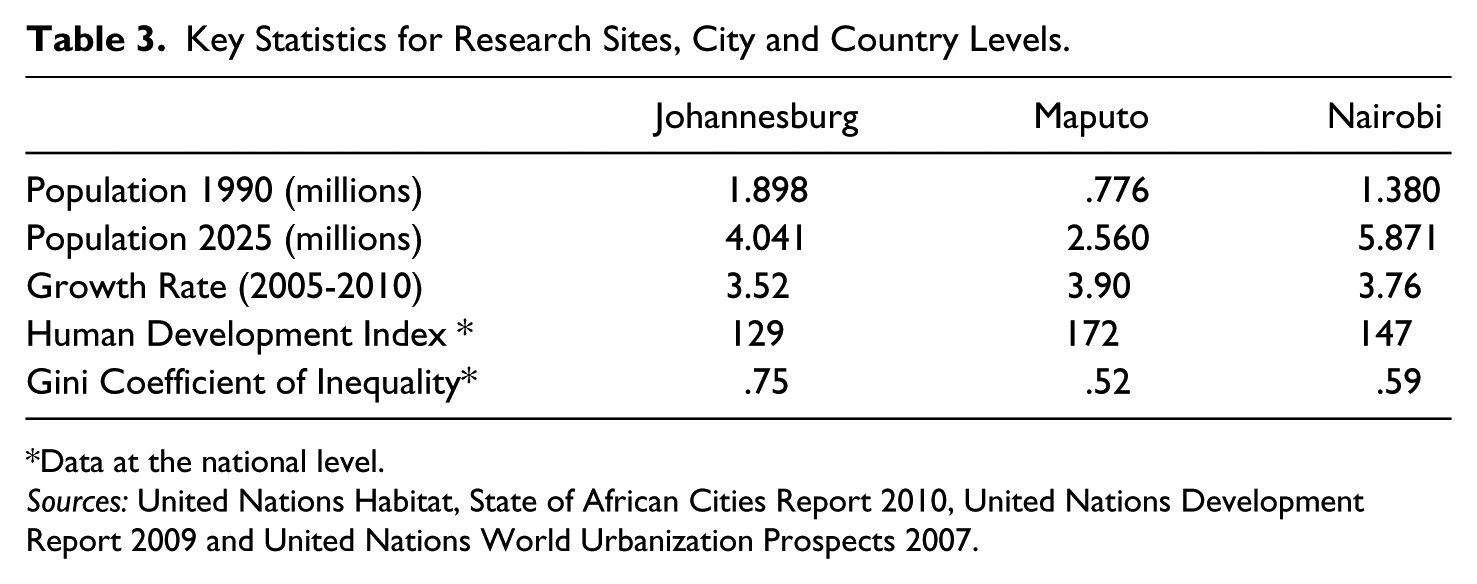
Data at the national level.
Sources: United Nations Habitat, State of African Cities Report 2010, United Nations Development Report 2009 and United Nations World Urbanization Prospects 2007.
Selected Descriptive Characteristics of City Samples (%).
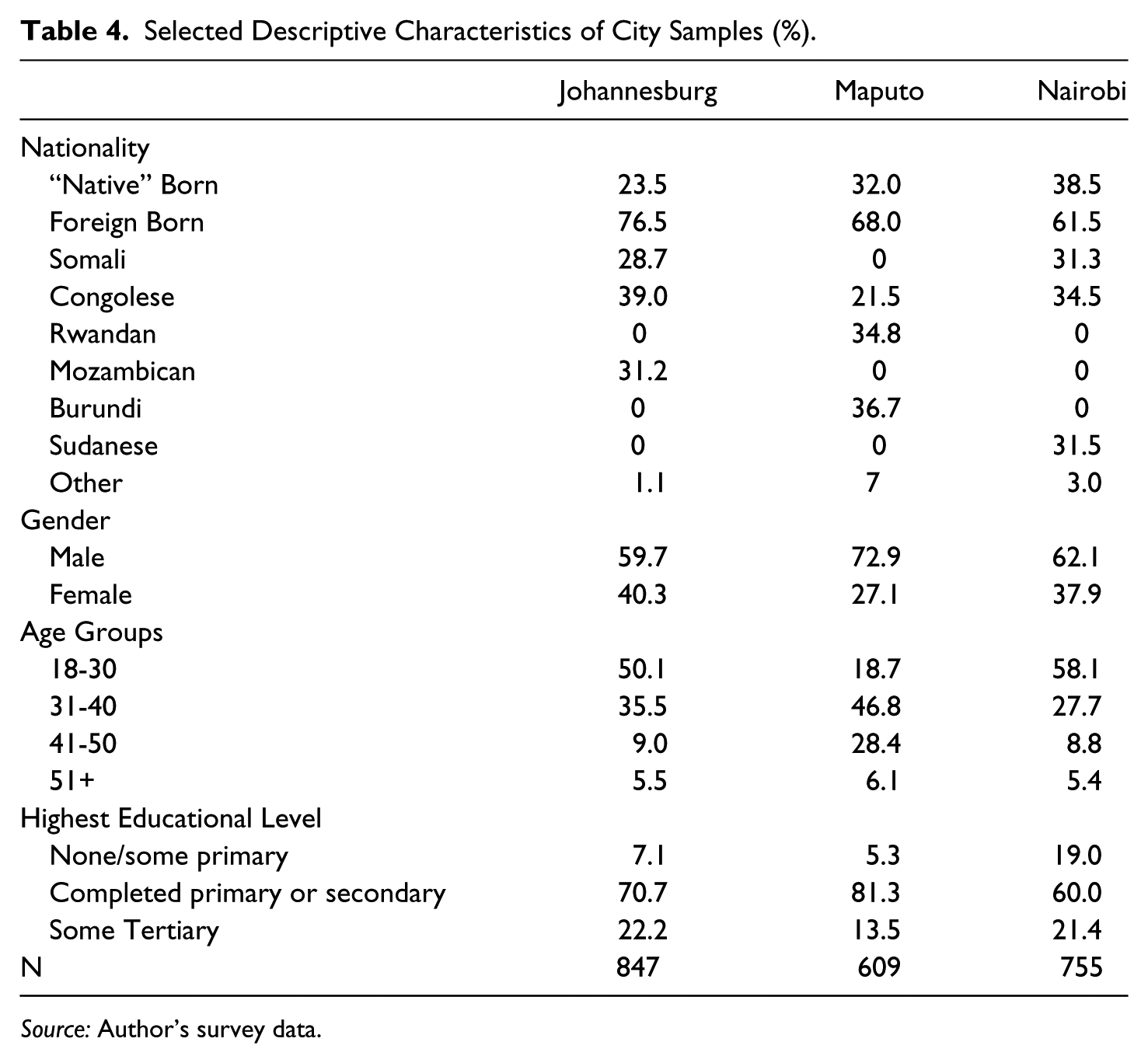
Source: Author’s survey data.
Each of the cities included here is a destination and transit point for domestic and international migration. Together they represent a range of social, economic, and political characteristics that allows for modest generalizations about trends and possibilities. That said, they are by no means representative of the continent’s urban centers and the focus on estuarial zones further limits the data’s generalizable. The appearance of such similar processes in all the cases, including the often-anomalous South Africa, further speaks to the importance of these trends and the suitability of the comparison.
The survey data used in framing my discussion stem from interviews with 2,211 people in the three cities. These data do not fully represent either the migrant or host populations in any of the sites, let alone the experience of migration and displacement elsewhere on the continent. 18 Rather, data collection targeted particular groups of foreigners categorized by nationality. With the exception of Mozambicans included in the Johannesburg survey, data were collected on selected groups—Somalis, Rwandans, Sudanese, and Congolese—that straddle the line between economic migrants and those who might be considered (in substance, if not in law), forced migrants or displaced persons. Given the poor statistics on the size of the foreign population, its composition, or, in many cases, on domestic population dynamics in any of the cities, effectively weighting the observation in the data in order to obtain a good representation of the reality is almost impossible. It is also important to note that the sampling did not cover the cities’ full geographic footprints. Given limited resources, such a strategy would have resulted in a sample far too thin to provide meaningful insights into the phenomena of interest here. To reveal these patterns, sampling concentrated in those areas with high levels of recent migrants moving to and from various geographic sites: areas that may be labeled gateways 19 or, in my terminology, estuarial zones.
The article’s final pages are drawn from qualitative fieldwork conducted in collaboration with doctoral students in Johannesburg and Nairobi. The Nairobi research has been ongoing since 2009, beginning with an initiative to understand the local governance of migration in the city and, later, to understand the formal and informal mechanisms for preventing conflict in the wake of the 2007/8 postelection violence. This article draws primarily on work in Ongata Rongai. The Johannesburg examples stem from various projects exploring, inter alia, the local governance of migration, migration and religious practice, and a doctoral project on migrant cosmopolitanism. 20
Guests and Hosts
The remainder of this article is a conversation between theoretical premises and what is often confounding (or at least confusing) empirical evidence. This dialogue moves through a number of stages, each considering one or more foundational presumptions that shape both our ethical/normative and analytical approaches to understanding migrant integration and rights claiming. The conversation begins with one of the fundamental dichotomies in theorizing “the other”: the distinction between migrants and hosts. Arendt famously argued that people are not born with equal rights, but rather that rights flow from recognition within a political community.
21
Walzer helps elucidate what this community might look like. Two points are important for the current discussion. First, he argues, political communities are “communities of character,” drawn together to practice and protect shared values.
22
Although one can question the somewhat primordialist communitarianism underlying his claim, he nonetheless points us to an important and relevant realization: for people to claim rights, they must be recognized or legible to others within a community. Without some basis of shared values, such recognition is likely to remain elusive. The second attribute he attributes to political community—the right to self-determination—is equally important. He explains that: The distinctiveness of cultures and groups depends upon closure and, without it, cannot be conceived as a stable feature of human life. If this distinctiveness is a value, as most people…seem to believe, then closure must be permitted somewhere.
23
Under such a rubric, new arrivals are allowed rights and recognition only when they adopt or at least adapt to a prior community’s values, however constituted. One can debate an ethics of closure, but that is not our concern here. The significance is in the parameters that would frame such a debate. As with much of the literature on immigrant integration—social or political—the actors are framed as new arrivals (guests) and hosts. In such accounts, government or public institutions often play an important gateway role usually on behalf of, but also sometimes shaping, the community’s will.
My argument is that the spatial dynamics in which migration and immigration occur across African cities give cause to reconsider the fundamental distinctions between guests and hosts. It also suggests that in many cases we dissolve firm distinctions between domestic migrants and those who have traveled internationally. Looking at the neighborhood level where integration and rights-claiming so often occurs—particularly in the informalized world of the global South—it may well make more sense to speak of what Kabeer 24 calls a kind of “horizontal” form of integration and rights-claiming with the most important interactions taking place between residents. But can those residents be sensibly labeled as guests and hosts based on their nationality or other specific criteria? The following paragraphs suggest why a new vocabulary is in order in the continent’s urban estuaries where mobility and multisited belonging create forms of sociality that do not lend themselves to easy dichotomies.
So where does this leave us? If Bulley is right that “hospitality requires some notion of an ‘at home’ for its possible performance,” then on what basis is political community likely to emerge in these highly fluid spaces where people maintain multiple points of orientations and where everyone can make almost equal claims to being both host and visitor? 25 Bulley suggests that where everyone is both guest and host, all are hostages as no one sets the terms of engagement and all are subject to everyone’s will. Derrida proffers the term ‘hostipitality,’ to connote the hostility such situations of coerced hospitality tend to generate. Hostility and a manifestation of spatially chauvinist rhetoric is certainly one possible outcome. Indeed, at first glance it explains what has been among the most visible reactions to immigrants and outsiders across Africa. 26 Fauvelle-Aymar and Segatti’s account illustrates the degree to which—at least in South Africa—anti-outsider violence is closely associated with high levels of mobility and sociolinguistic heterogeneity. 27 But categories of membership need not settle into dichotomies of outsider and host, nor must one group seek dominance over others. The numbers of actors involved complicate these processes and with neither incentives nor means to make exclusive claims over specific spaces and the resources within them, populations may remain striated by multiple faults and fissures. These may ultimately crystalize into firm groupings and divides, but then again, they may not.
Forging Communities in Cities of “Shifting Sands” 28
Beyond challenging the analytic utility of the host-guest dichotomy, I now turn to two further premises whose frailty empirics expose: (a) migrants’ desire to claim full rights as part of a stable, placed-bound community; and (b) the importance of formal institutions and legal frameworks in claiming rights. Immigration and migration projects throughout African cities often work against the emergence of such place-bound forms of political community while providing incentives and opportunities for gaining recognition elsewhere. Moreover, where rights and recognition can be claimed, it is often accomplished beyond or in spite of the laws and state institutions (a point discussed below). This may lead to precarity, but it also generates mechanisms through which people claim rights in multiple locations while remaining largely invisible where they reside. Rather than recognition as full political or social beings, they instead often work toward usufruct rights: not the opportunity to own, but to extract the resources needed to further their ambitions. The following paragraphs help to explain these dynamics. In so doing, they implicitly move beyond discussion of immigrant integration by calling into question the fundamental meaning of legitimacy and political community and the centrality of formal state institutions.
Cities are now often “places of flows” where rooting and local representation is not the goal. 29 For many who remain rooted in translocal or transient socialities, the burdens and binding that connections and political participation offer are often something to be avoided. 30 Given the instability associated with land tenure, the possibility of violence, and ongoing economic deprivation, people often maintain feet in multiple sites without firmly rooting themselves in any. 31 A number of factors illustrate migrants’ translocal economic and social projects while outlining why forms of estuarial sociality militate against the formation of place-bound political communities. Connections and regular shifts between rural (or peri-urban) and urban areas are critical factors. For many moving for economic reasons, the primary motivation is profit and the need to secure resources to subsidize a “real” life elsewhere. Often spouses and children live at distance while single men and women sustain them through material transfers (see Table 5). Although urban migrants may establish second urban families, ethnic and political ties to rural areas create bifurcated existences and prevent full social integration into urban communities. To maintain homebound respectability, when urban rooting occurs it may need to remain under the radar. The intention to retire in the countryside or move elsewhere further limits people’s financial and emotional investments in urban areas. Across African cities, significant numbers of the foreign-born population—or nonlocal citizens—arrive in the city seeking protection from conflict and persecution with intentions to return home or move on when conditions allow. This helps generate a kind of permanent temporariness in which they actively resist incorporation. 32
Supra-local Financial Transfers by City and Resident Status.
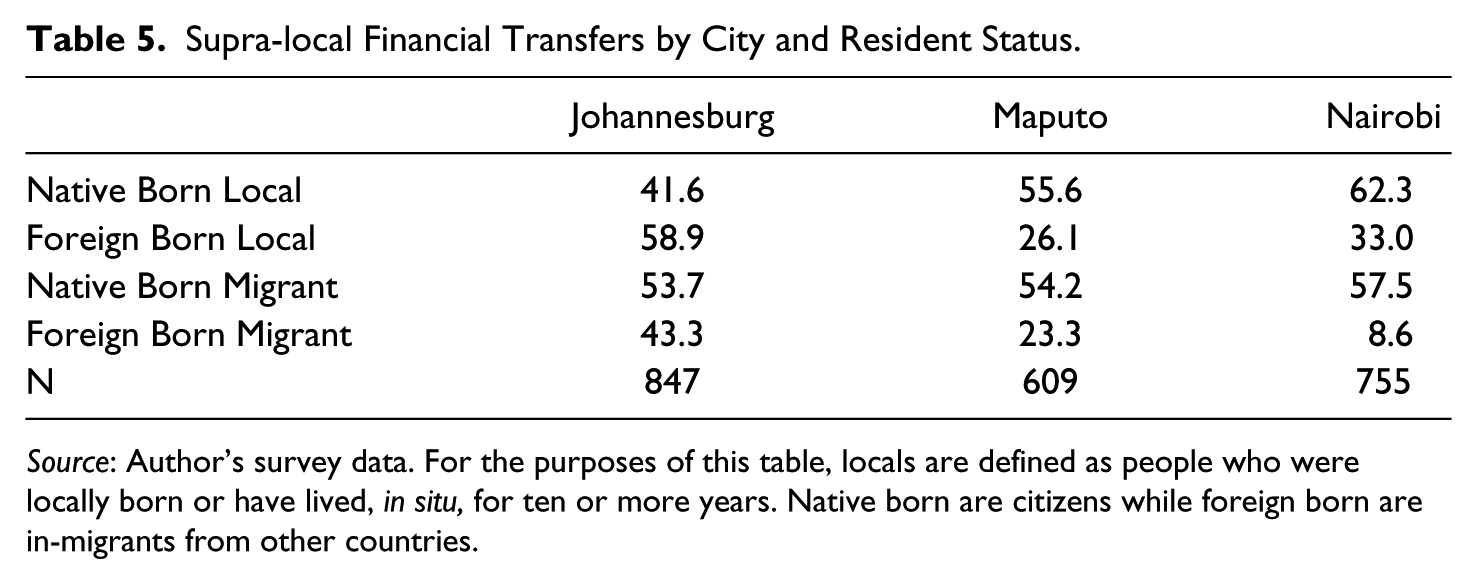
Source: Author’s survey data. For the purposes of this table, locals are defined as people who were locally born or have lived, in situ, for ten or more years. Native born are citizens while foreign born are in-migrants from other countries.
Expectation of Residence in Two Years (Percentage).
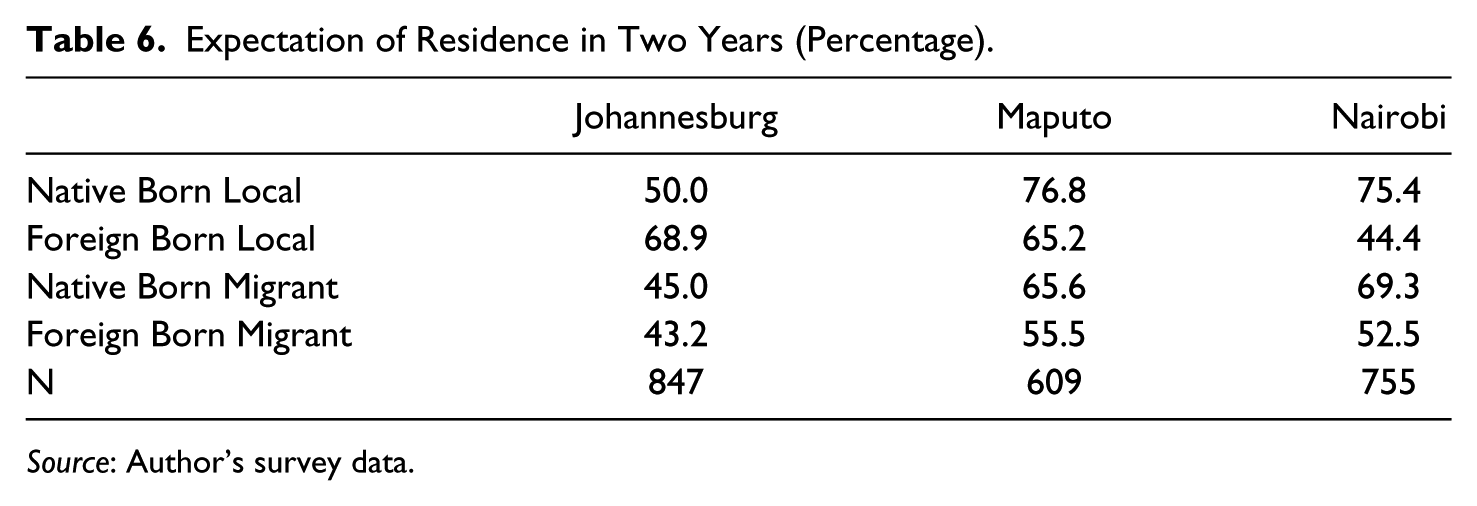
Source: Author’s survey data.
The fragmentations and fluidity described above is furthered (and furthers) a kind of social frailty. Whether it be religious, cultural, or economic, collective participation is a potentially important mechanism for inculcating a sense of common purpose and values, one of the prerequisites Walzer outlines for building community and claiming rights. Given the populations’ volatility and orientation, social networks are often spread thinly across many people and places. Indeed, our surveys show remarkably low levels of trust between ethnic and national groups. Equally important for our purposes is the limited trust and bonds within them. Even among citizens in both Johannesburg and Maputo, levels of social capital—trust of each other and public their institutions—are strikingly low. 33 Nairobi offers a slightly more trusting environment, although here too the data reflect deep tensions. Networks of clan, neighborhood, or coreligionists undoubtedly exist, 34 but these are often fragmented and functional, organized without an explicit recognition or sense of mutual obligation to those beyond familial boundaries. 35 Instead, they are often limited to assisting others only to overcome immediate risks or sharing information and tips for avoiding the police or other hazards that endanger larger subgroups. 36 Among neither migrants nor the ostensible host population can we speak of a community or set of overlapping institutions that are engaged in a collective project. These may eventually cohere into some form of widespread norms or implicit sense of a collective enterprise, but given the populations’ dynamics and the limited engagement with common institutions, such an outcome seems unlikely. Tables 7 and 8 illustrate the remarkably low levels of institutional affiliations and trust across the three cities being discussed here.
Organizational Affiliations by City and Migration Status.
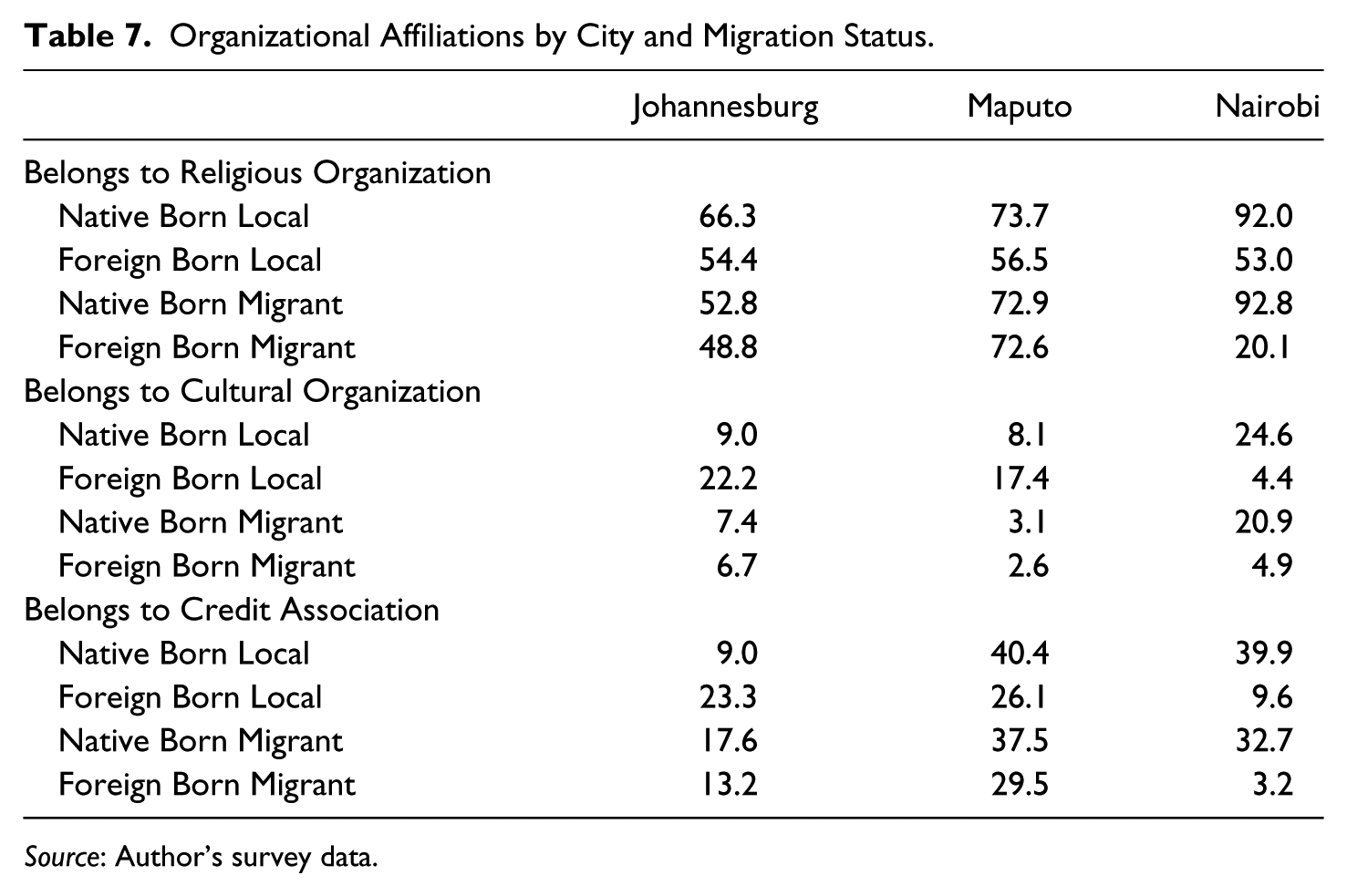
Source: Author’s survey data.
Perception of Trust.
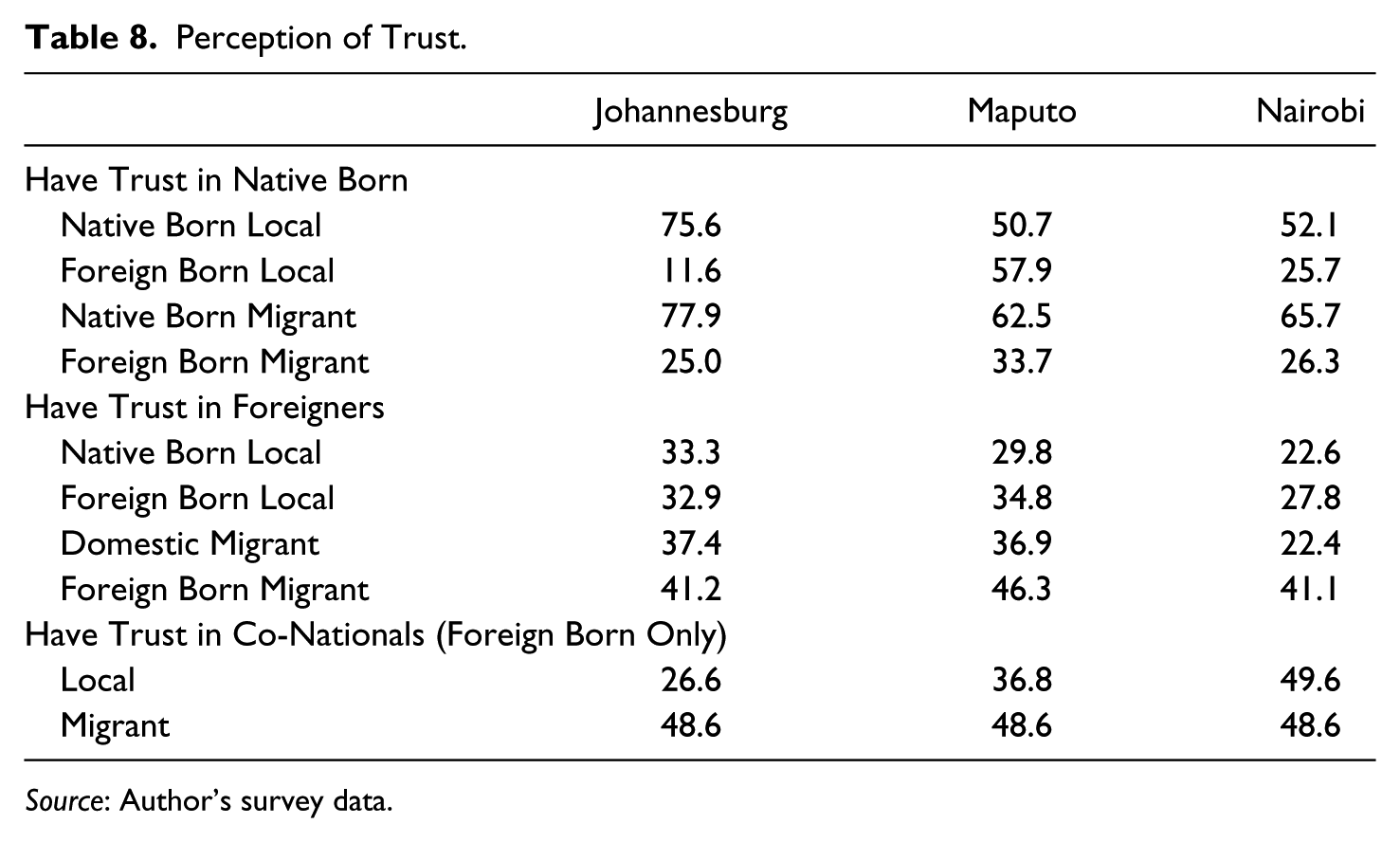
Source: Author’s survey data.
With few organizations and little in situ trust, on what basis can migrants forge the localized communities they need to mobilize for rights or build the bridges they need to claim rights from their hosts (if they can figure out who they are). This is not a situation of ethnic ghettoization or “hunkering down,” as Putnam terms it. 37 But simply because people are not claiming rights in the way Arendt or Walzer predict does not mean they are without social position or recognition. This article’s final pages help explain what I mean.
Decentering the State
Throughout much of the policy-oriented literature on promoting migrant incorporation, the state, its agents, and civil society fight, collaborate, and negotiate patterns of inclusion and exclusion. This model assumes states deeply embedded in the lives of those they ostensibly govern. Such approaches may be appropriate in Europe, North America, and some Latin American countries, where the state gradually centralized power in the hands of economic and political elites before. 38 In almost no case has this history of incorporation been replicated in Africa or, indeed, elsewhere in the former colonial world. Although Africa’s colonial and postcolonial cities have been the one geographic site where the state’s powers are most evident, an effective, centralized authority has rarely governed beyond parts of the continent’s urban centers. 39
State weakness is not usually due to centralized opposition to its rule—organized crime, revolutionary social movements, or powerful religious organs—but is instead due to the form of postcolonial political consolidation that has occurred across the continent. 40 Where there are formal laws and institutions, their power rarely extends systematically beyond the central business districts, government bureaucracies, and wealthy residential suburbs. And even here, consolidated power is often compromised and shared in ad hoc ways with private security firms and condominium committees designed to intentionally fragment and delimit rights to urban space. 41 Elsewhere, urban governance regimes are characterized by assemblages of patronage politics, irregular policing, and neglect—benign and otherwise. As noted above, the fact that so many people are new to the cities—the one space where African states have historically been visible in citizens’ daily lives—means that residents’ expectations for the state may also limit their interests in engaging with it or the skills and organizational capacity necessary to do so. Given a history with one or more of the continents’ predatory states, it is hardly surprising. Lack of finance and institutional capacity further limits states’ relative autonomy and relevance.
For these and other reasons that cannot be detailed here, the state’s position as the center of policy formation, protest, and service delivery is far from assured in Africa’s cities. Consequently, many urban residents effectively live in the “brown areas” beyond the state’s direct influence. 42 These are not necessarily spaces outside the realm of government influence, what Scott terms “nonstate spaces.” 43 Rather, they are zones where state action has only indirect or partial sway, influence that is often evident by efforts to elude or hinder policy. There we find multiple levers of change with varied and variable effects. Moreover, one cannot always be sure of what will happen if one of them gets pulled.
The argument here is not a prescriptive one although it has significant normative and ethical implications. Instead it asks us to recognize that in many places, even local government institutions are not “embedded” within the urban societies that they ostensibly protect and promote. As such, they are unlikely to achieve the kind of “bureaucratic incorporation” seen elsewhere. 44 Even where they maintain strong connections, the kind of relationships they share with the population may not be amenable to migrant mobilization. Moreover, we must not assume that officeholders see the political or economic incentives for encouraging migrant-friendly communities or have the capacity to do so. 45
Precarity, Community, and Rights
Immigrants and migrants to many African cities occupy a world loosely structured, at best, by state social policy or dominant cultural norms. The fluidity of the population and the frailty or absence of enabling formal state institutions leads us to ask: What factors allow people to claim rights and recognition and what rights do they pursue? Given the multiple overlapping and conflicting forms of sociality and morality in close proximity, these are not easy questions. While consequences may be violent, exploitative, and marginalizing, they may also include communities of convenience—some cosmopolitan, some conflictual—shaped by pragmatism rather than by coherent ethics or a grand social or political imagination. 46 It is within these forms of communities that people gain recognition—of a kind—and may claim some form of rights.
The remainder of this article schematically reviews means of building rights granting political community amid estuarial environments where regulatory environments are weak and there are few obvious, practical distinctions between hosts and guests. The following paragraphs outline two forms these communities of convenience may take: a kind of market-based liberalism and tactical cosmopolitanism. This is work in its early stages so the ideas below are speculative and not yet fully theorized.
I wish to begin by turning to religious affiliation—particularly organized religious bodies—as it continually surfaces as the one basis for forging membership amid high levels of fluidity and fragmentation. Throughout Europe and Asia, religious institutions have played central roles in binding population to each other and to place (and in excluding everyone else). 47 Where the state has faint influence, they can serve to help generate alternative subjectivities and publics. However, a combination of factors, including the increasing heterogeneity of the urban population, effectively denies the possibilities that religious institutions can serve a similar role in contemporary Africa cities. Among the Nairobi citizenry we surveyed, for example, 65.6 percent were Protestant, 30.6 percent Catholic, 2.7 percent Muslim with only 0.3 percent claiming no religion. In Johannesburg, the sample was 59.7 percent Protestant, 18.8 percent no religion, 14.1 percent Catholic, and 6.8 percent Muslim. (The foreign-born population in Johannesburg was more evenly divided, with 39 percent Protestants, 28.5 percent Catholics, 26 percent Muslims, and 6.3 percent claiming no religion.) Although many urban Africans are strongly religious, the denominational divisions within those affiliations—and the often-fractured and tense relationships among them—can serve more to divide than create a unified network with which to disseminate messages of unity and sanctions to achieve it.
Along with the sheer diversity of competing claims for religion and belonging, the liturgical content of many churches serves to further undermine the possible emergence of a territorially bound or state-centered solidarity. This is perhaps most visible in the ever-expanding pool of Pentecostal churches operating within Africa’s urban centers. At one level, these inclusive (occasionally massive) institutions offer the possibility of bridging barriers between various groups. As one Zimbabwean migrant in Johannesburg stated, “In the church, they help us in many ways, no matter where you come from, they just help you.” 48 Although the churches offer a sense of salvation in the form of “health and wealth,” many are distinctly post-territorial in their outlook. Although there is not space here to reflect the diversity of testimonies and preaching included in even one five-hour mass, many build on their strong connections to institutions in Nigeria, Ghana, Congo, and the United States. For many of the churches’ founders—who are themselves migrants—their current pulpit is merely a place where they can enter a global social universe. In the words of the Nigerian pastor at the Mountain of Fire and Miracles church in Johannesburg, “Africa is shaped like a pistol, Nigeria is the trigger and South Africa is the mouth from where you can shoot out the word of God.” 49 Although they may preach tolerance, many of these churches generate translocal and often antipolitical tenets of belonging. Their fragmentary and often questionable sources of religious authority further serve to deny the state—or indeed even a single church—the possibility of naming what is good and the direction the collective should follow.
Religion, at least as described above, provides a mechanism that allows people to be in a place but not of it: to be neither host nor guest. This it shares with what I have argued is a form of “tactical cosmopolitanism” on the part of migrants. 50 Recognizing ascendant forms or exclusion levied against them, migrants draw on a variegated language of belonging that makes claims to the city while positioning them in an ephemeral, superior, and unrooted condition where they can escape localized social and political obligations. Unlike an ethically derived, theoretical cosmopolitanism, these are not necessarily grounded in normative ideas of openness or intended to promote universal values of any form. That said, they remain evangelical as they practically and rhetorically draw on various, often competing, systems of cosmopolitan rights and rhetorics to insinuate themselves, however shallowly, in the networks and spaces needed to achieve specific practical goals. These include, pan-Africanism, human rights rhetoric, and the language of the elite cosmopolitanism: of being global players in the new age through decentered tactics that emphasize individualism, generality, and universality. 51 Although they may not fully subscribe to the values they promote in others, by positioning themselves in this way they aim to legitimize their presence. Such an approach often leaves them—as intended—“betwixt and between without being liminal…participating in many worlds without becoming part of them.” 52
In Ongata Rongai, a rapidly growing site on Nairobi’s southern periphery, we are beginning to document a remarkable means of denying simple categorization between hosts and outsiders. 53 Although administratively beyond city limits, the settlement’s proximity to main transport routes and the availability of land has made it an attractive space for migrants moving out of Nairobi as well as those moving toward it. The land’s original inhabitants were Maasai—at least as understood by almost all of the people currently living there—but they have largely evacuated the settlement, selling off their land and taking their cattle elsewhere. In their stead, groups from across Kenya have moved in. Although the Kikuyu are the plurality, they by no means dominate the space or make exclusive claims to it. Indeed, no one does. In stark contrast to sites across urban Kenya, there seems to be a remarkably high level of ethnic mixing and peaceful conviviality. Apart from Olekasasi estate, which has become the preferred destination for the Somalis (Kenyan and Somali nationals), access to residential housing and business premises appears to be determined almost completely by market mechanisms. In interviews with officials and landowners, they all spoke of the need to ensure ethnic mixing and some level of conviviality. This is not a form of integration managed by the state nor any other identifiable actor.
The story here is a response to two factors: a history of land acquisition (or, rather, how that history is broadly understood) and as a counterpoint to the factional, ethnopolitical violence that occurred elsewhere in Kenya following the 2007 presidential elections. Although many of the area’s residents are renters, those who own—residents and non-residents—have sought a means to mitigate risks to them and their property posed by ethnic violence. Through a variety of local authorities—elected, traditional, religious—marketing mechanisms and informal policing, they have actively generated a kind of liberal, market-based cosmopolitanism that legitimizes the presence of a diverse population and ownership based solely on market logics. If one pays, one can stay. One need not belong or claim rights from the state or from central political communities. Rather, a willingness to adhere to relatively egalitarian market logics is enough to enable a kind of community of strangers amid rapid growth and mobility.
In some ways these emergent communities reflect the kind of deep value recognition that Walzer demands, but they are not bounded or enclosed as he suggests. Rongai’s market-driven schema does not even rely on overt and constant coercive threats to maintain the order. Rather, recognizing the dangers of ethnic chauvinism in a space that no one group can effectively dominate, residents have developed a kind of liberal ethos that provides everyone equal access (although there are forms of policing and regulation that enforce the community’s pluralist values). Discrimination is not based one’s origins, political affiliations, or religion, but simply by a willingness to play by a kind of implicit set of rules, an ethos that is collectively propagated and reproduced beyond state regulation. In contrast to deep-seated spatio-ethnic or nationalist exclusion, they reflect the kind of liberation in the Marxist sense. By allowing people to retain ethnic, religious, or forms of extra-local loyalties—both religion and ethnicity remain highly visible in Rongai—residents may also inadvertently be generating a kind of radical multiculturalism, a “pluralisation of possibilities of being on the same territory.” 54 Were he still alive, Levinas would undoubtedly be pleased at what he would see in Ongata Rongai: if we all are sojourners, he argued, then on what basis can we exclude?
Final Notes on Rights in the Estuary
If nothing else, the paragraphs above suggest some of the possible means though which long-term residents, domestic migrants and noncitizens are simultaneously finding their ways in a new (and ever-changing) social landscape. Even domestic migrants may have as little in common with the people they find in the city as those coming from across international boundaries. The rapid expansion of urban populations—and the concentration of migration and urban growth in particular urban gateway neighborhoods–calls into question the use of the term “local” or “host” to talk about the destination areas. It also suggests that the mechanisms through which rights to space and other resources are rationed are varied. The ethics behind them—when regulatory systems are coherent enough for them to be identified—are similarly complex and deserving of careful consideration and attention.
By using such strategies of partial inclusion and rights claiming, international migrants’ illegality and continued mobility can prevent capture by the state, enabling a kind of invisibility that, though dangerous, allows them to elude obligations and, occasionally, exploit the state for resources to which they are not legally entitled. This may be in the form of public services, trading in public spaces in violation of local laws, or exploiting transnational connections to move currency and goods across state boundaries. So instead of transplantation and legibility to the society and political systems in which they live, many foreigners and domestic newcomers alike strive for a kind of usufruct rights—a form of exclusion that is at least partially compatible with social and political marginalization. Rather than integrating or assimilating, a migrant will exploit his or her position as a permanent outsider in a way that “distances him or her from all connections and commitments.” 55 They may use a variety of tactics to claim rights in their sites of residence, but we must not presume these actions reflect a desire to stay or be fully included in the urban space that they occupy.
The second point speaks to what, exactly, people are seeking or becoming included. In African cities—as elsewhere—inclusion is something more than claiming a “right to the city” or becoming part of a stable, urban community. We must avoid assuming the existence of such communities but also recognize that for many domestic and (especially) international migrants, the process of moving to the city—or toward larger, more networked cities—is also, if not primarily, a step into a global “imaginary” and spaces beyond bounded place. Through urbanization, they hope to gain access not only to a place to stay or work but also to global youth culture, new universal urban lifestyles (however understood), or, more concretely, opportunities for onward journeys. Whether they ever realize these ambitions, the city is nevertheless a space where they can access trading and travel opportunities unavailable in rural settings or even in the capital cities of less economically networked countries and communities. But for relatively poor migrants, the global cultures they wish to join are not those of the knowledge worker or financial elite. 56 Such high-flyers may color their imaginations, but the networks they join are also those shaped by their diasporas of kin, coethnics, coreligionists, and conationals.
Where integration or inclusion into a city of residence is either impossible or undesirable, membership into these decentered, socially regulated, globalized networks may represent a far more significant form of belonging and source of rights and recognition. Even when not achieved, it may continue to serve as an aspirational ideal that shapes other more localized strategies and struggles.
The diversity I describe above also has a fragmented system of political authority and rights more generally. Rather than the kind of “nested” systems Eckstein and Gurr describe, 57 formal political authority in practice is often faint, unevenly applied, and driven by competing imperatives and logics. Even in South Africa, perhaps the most technologically and institutionally sophisticated sub-Saharan African country, there is scant ability to predict, plan for, or track movements at anything but the most aggregate level, and the police often apply rules in ways that work against stated policy goals. 58 But this is not likely to be limited to Africa alone. Ironically, Europe’s effort to control and its relative ability to do so may help generate precisely the kinds of self-alienation and translocal communities I have described. In some sense this may reflect what Beck terms a “coercive cosmopolitanism.” 59 If people are not allowed to settle due to policy or perceived persecution, they may well develop strategies that work against the power of those who would exclude: a cosmopolitanism driven by necessity, not ethical commitments or desires.
Whether these eventually crystallize or bind current and future residents of given sites (or spaces affected by them) remains to be seen. But we will only be able to see them for what they are if we recognize that even the language of political and social integration we typically use evokes elements of social and political authority that, if present, may be only fleeting. We must also open space for the institutional configurations—formal and informal—that enable rights to be protected. In this we see what Derrida termed a “perpetual uneasiness” 60 for many migrants in which coming to rest, a precondition for creating bounded, site-centered communities, is all but impossible. We must also revisit any approach that sees integration as something driven by states and policies as is often the case in discussions of European policy, but as a set of practices involving migration and integration from the point of view of those on the move and those within whom they engage, be it where they live, where they are from, or where they intend to go.
Footnotes
Acknowledgements
I would like to thank the various researchers and commentators who have helped produce this article or the data that have shaped it. These include, among others, Marguerite Duponchel, Iriann Freemantle, Karen Jacobsen, Prisca Kamungi, Peter Kankonde, Caroline Kihato, Sangeetha Madhavan, Denise Malauene, Sharon Olago, Michael J. Otieno, Aurelia Segatti, and the teams who worked on the surveys under the direction of Ines Raimundo (Maputo) and Winnie Mitullah (Nairobi). David Plotke warrants recognition for his patience and multiple bouts of constructive criticism. Thanks too to Antje Ellermann and other organizers and participants in the 2012 New School workshop where this paper was first presented.
Declaration of Conflicting Interests
The author declared no potential conflicts of interest with respect to the research, authorship, and/or publication of this article.
Funding
The author(s) disclosed receipt of the following financial support for the research, authorship, and/or publication of this article: This article draws on research conducted under the auspices of multiple projects and with the support of multiple funders. These include the MacArthur Foundation, South Africa’s National Research Foundation, the South African Presidency’s Programme to Support Pro-poor Policy Development and the Andrew Mellon Foundation.