




Abstract
Scholars attribute contemporary union failure to structural factors, such as the legal decision allowing striking workers to be permanently replaced, and to globalization. This article examines the strategic choices made by New Labor’s leadership after their victory at the AFL-CIO in 1995, and the choices made by the breakaway unions that formed Change to Win. I identify the influence of Saul Alinsky in the background of many of the current New Labor leaders and attribute the strengths and weaknesses of New Labor’s organizing approach to Alinsky’s strengths and weaknesses. I argue that despite two decades of rhetoric about organizing and the difficulties presented by a hostile climate, a critical factor in labor’s decline rests with decisions within its control: to embrace corporate campaigns and narrowly defined interest-based politics—decisions that led unions away from workers and the workplace and put them at odds with unorganized workers and the community.
Unions in the United States are experiencing a profound crisis. In 1995, the biggest shake-up in the U.S. labor movement in more than fifty years took place when a new generation of unionists forced the first contested election in the history of the AFL-CIO. The victors, dominated by the service workers’ unions and often referred to as New Labor, 1 promised revitalization through aggressive new organizing. A decade and a half later, union ranks have continued to plummet to 6.7 percent in the private sector and 11.3 percent overall. 2 Why has New Labor failed to reverse the decline of union power?
In this article, I argue that although the external environment for unions is extremely hostile, the reasons for the ongoing decline of union membership lie mainly in how unions organize among their existing members as well as among unorganized workers. Most labor history and analysis focuses on external factors such as the employer offensive, hostile courts, globalization, automation, and a changing employment structure, relegating organizing methods to a “black box.” In contrast, this article connects New Labor to the legacy of Saul Alinsky, who is often referred to as the dean or father of community organizing. It identifies the influence of several strands of the Alinsky doctrine in the organizational background of many current New Labor leaders, and attributes the strengths and weaknesses of New Labor’s organizing approach to Alinsky’s own strengths and weaknesses.
I will argue that a critical factor in the unsuccessful effort at union revitalization after 1995 has been the strategic choice by key leaders of New Labor to move away from workers and the workplace. Facing hostile labor laws and unfriendly court rulings, those leaders decided that they could no longer win traditional union elections, and they shifted their strategy to securing so-called card-check and neutrality deals and fair-election-procedure accords with employers. The strategies they chose to achieve such agreements are anchored in demonstrating that they could cost the employer money through a “corporate campaign,” which might include publicity offensives against the employer’s brand, stockholder actions, and lobbying to have the many and varied public subsidies that flow into the so-called private sector cut off or decreased.
When these labor-run corporate campaigns first developed in the 1970s as a response to the degeneration of worker protections under U.S. labor law, they were designed to complement worker organizing. 3 By the early years of the new millennium, they had all but replaced it. 4 The strategy of weakening employer opposition to union organization through corporate campaigns made employers, not workers or their community, the primary focus of New Labor’s energy. Today, corporate campaigns continue to locate the fight in the economic arena by threatening to disrupt profit making, but not by workers’ withholding their labor. Instead, a new army of professional union staff wage the strike by hitting the employer’s bottom line.
In examining the change in strategic choices after 1995, I argue that the New Labor leadership’s Alinskyist origins are a causal factor in key aspects of their methodology. New Labor’s prioritization of corporate campaigns reproduced and privileged Alinsky-like “jujitsu tactics” in a “war” conducted between labor and business elites. I will argue that Alinsky’s extreme pragmatism and his embrace of “ends justify the means” tactics enabled New Labor’s leaders to rationalize accords with big business that stripped workers and their communities of the ability to defend themselves against their employers. 5 Moreover, New Labor’s adoption of Alinskyist methods stands in contrast to the organizing style at the root of many of organized labor’s great victories, which were won during a much more hostile period of industrial relations: the successful organizing of the unions of the Congress of Industrial Organization (CIO) during the 1930s. A key aspect of the CIO organizers’ craft was identifying organic worker leaders in the shop and anchoring campaigns in the “whole worker,” who was understood to be a person embedded in a range of social relationships in the workplace and in the community. 6 By contrast, Alinsky’s “people’s organizations”—what he called “O of O” or Organization of Organizations—were top-down rather than bottom-up formations, staff-driven and focused more on tactical warfare than on keeping people organized to control their own destiny. 7
The first section of this article will interrogate the origins and key differences between these two organizing models, which have existed in tension since the ascent of New Labor in 1995. One model reflects the strategies adopted by New Labor, which I argue significantly diminish the role of workers in their own emancipation and have contributed to labor’s ongoing decline. The second model reflects the origins and traditions of one local union, 1199 New England, a union still steeped in the CIO-era influences of its founders, which has won the highest nursing-home standards in the nation.
In the second section, I outline two cases of similarly situated nursing-home workers in which these two organizing models were deployed, resulting in disparate outcomes. Those workers, considered low-skilled and easy to replace, labor for some of the same national corporate owners in two “blue” states, Washington and Connecticut. In Washington, the union’s strategy was to create a partnership with the employer that resulted in the unionization of twenty-three nursing homes; 8 a small increase in pay; a constrained and limited set of worker protections, including an absolute and “permanent” prohibition of the right to strike; and virtually no difference in benefits for union versus nonunion workers. In Connecticut, in a comparable time period, the union conducted nearly sixty successful union elections, utilizing militant trade union methods including strikes, and achieved strong contracts that substantially increased pay and benefits and greatly expanded on-the-job protections, resulting in the highest standards in nursing-home contracts.
In a third section, I discuss the two cases in the context of the New Labor model versus the 1199 model. I argue that the difference in the organizing approach in each effort was far greater than any state-level factors and accounts for the difference in outcomes. I conclude with a consideration of the paradoxical legacy of the Alinskyist tradition for contemporary labor organizations and suggest that the relative strengths of the CIO-1199 model are capable of developing powerful member-led unions and finally reaching the goals New Labor announced nearly twenty years ago.
Methodology
In this article I employ mixed qualitative and quantitative methods, including semistructured interviews with current or former organizational leaders from each of the two cases and with longtime Alinsky organizers; analysis of data sets from the Federal Mediation and Conciliation Services (FMCS) work-stoppage databases from the year 2000 to present; 9 archival research on each case’s strategic planning documents; analysis of the current collective bargaining agreements of each local union; published newspaper stories and internal memos; a line-by-line content analysis of the key Alinsky texts and the organizing training manuals of numerous Alinskyist organizations; and my own participant observation of each case, first as a young organizer being apprenticed at 1199 New England and later as national deputy director for SEIU’s Healthcare Division, where I participated in numerous discussions leading up to the launch of what became known nationally as the Nursing Home Industry Alliance, which the Washington State case represents.
Distinctly Different: the Alinsky – New Labor Model and the CIO-1199 Model
But it wasn’t just, or even mainly, the infrastructure of Alinskyism that secured for Saul Alinsky a place in [Cesar] Chavez’s small pantheon of heroes; it was Alinsky’s ideas.
There are many strong links between New Labor and key strands of Alinskyist organizing. Several recent books and articles document and trace numerous leading figures across the New Labor diaspora to the Alinsky diaspora. 11 Randy Shaw’s 2008 Beyond the Fields is the most comprehensive and is partly dedicated to demonstrating the strong ties between the United Farm Workers and the leadership of New Labor, in particular UNITE HERE and SEIU. For the purposes of this paper, the national Alinsky diaspora includes the United Farm Workers (UFW), National Welfare Rights, ACORN, Citizen Action and the Midwest Academy, PICO, Gamaliel, the Industrial Areas Foundation (IAF), and the many hundreds of local, neighborhood-based organizations funded by the Catholic Campaign for Human Development, an arm of the Catholic Church established to foster Alinsky’s ideas across the United States. 12 Although there are differences among these Alinskyist groups, and among the corollary New Labor unions, I argue that they share a set of core postulates that are evident across their various organizations.
There is an equally strong correlation between Communist-led, CIO-era organizing and today’s 1199 New England. For the purposes of this article, I am referring to that particular local union and not to any other local union inside or outside SEIU, even those with “1199” in their official name. I argue that 1199 New England’s organizing model is essentially the same today as it was in 1968, the year that the New York–based union began expanding into new regions across the United States. 13
Two Organizing Models
In this section, I briefly describe the origins of each model, then move on to what I contend are the chief differences between them.
Saul David Alinsky was as much a product of the 1930s labor movement as he was a producer of the contemporary New Labor movement. Since the 1960s, Alinsky’s name has been synonymous with organizing. Though he died in 1972, shortly after the publication of his most famous book, Rules for Radicals, 14 his influence remains strong among community and New Labor organizers. I have used Alinsky’s own texts, what he himself said and wrote, as the foundation for this discussion. I conducted a line-by-line content analysis comparing his first book, Reveille for Radicals, 15 with Rules for Radicals, which I consider the defining Alinsky text. And I put a premium on his very last public words, an extensive interview conducted by Playboy magazine three months before he died, suddenly, of a heart attack. 16
Alinsky did not invent community organizing, but he did codify it into a practice. Reveille for Radicals, written in 1946, was the first book that discussed organizing as a craft devoid of ideology (and the first book on organizing published by a mainstream press). Before Reveille, organizers in the movements to emancipate those oppressed on the basis of race, gender, and class had to hide their activities or they might be murdered, jailed, or fired—and any of those outcomes would have had a disastrous effect on the movements they led. A smattering of pamphlets laid out theories of mass collective action, but these were embedded in Socialist and Communist party circles. 17 As a result, there is a scarcity of literature on the actions of those individuals. Alinsky’s books attained preeminence in part because of the sheer absence of any other books on the craft of the organizer.
In that wide-ranging, 25,000-word Playboy interview, published posthumously, Alinsky said, What I wanted to try to do was to apply the organizing skills I’d mastered in the CIO to the worst slums and ghettos, so that the most oppressed and exploited elements could take control of their own communities and their own destinies. Up until then, specific factories and industries had been organized for social change, but never whole communities.
Later in the same interview, he said, Back in the ‘30s, the Communists did a hell of a lot of good work . . . . Their platform stood for all the right things, and unlike many liberals, they were willing to put their bodies on the line. Without the Communists, for example, I doubt the CIO could have won all the battles it did.
18
This was late praise. Earlier, Alinsky’s pragmatic anticommunism had quickly separated him from the very organizers who “stood for all the right things”—like Herb March, the leader of the Chicago Communist Party at the time and in many ways Alinsky’s first teacher on the methods of organizing. When Alinsky founded his own first organization, the Back of the Yards Council, March was leader of the Packing House Workers Organizing Committee, the union that Alinsky’s Council was formed to support in its campaign to unionize the packing house plants. While Alinsky was observing March’s methods with workers there, he adopted as his spiritual leader and guru the fiery John L. Lewis. The least read of Alinsky’s three books, his Unauthorized Biography of John L. Lewis, identifies its author as a staunch Lewisite.
While March and Lewis were influencing Alinsky, Karl Marx, William Z. Foster, and the Communist Party were influencing March—and the bulk of the CIO organizing taking place at the time. Lewis, as head of the CIO, regularly hired and used Communist organizers to win union drives, only to purge them once unionization had been achieved. 19 And it was the Communists and later the Socialists who influenced the radical Jewish pharmacists who founded what eventually became District 1199, founded as an independent union in 1932.
The two individuals chiefly responsible for creating 1199 were both members of the Communist Party: Leon Davis and Elliot Godoff. Davis and Godoff were Russian-born Jews shipped to the United States to live with relatives in New York City. Both wound up in pharmacy school. Davis dropped out to start working with the Trade Union Unity League, an arm of the Communist Party. Godoff completed school and became a pharmacist, but he, too, was quickly caught up in Communist Party activism. The two men separately navigated through various splintered attempts to form pharmacist unions, bouncing and being bounced from one purge to the next. In 1957, they finally met.
Davis was already president of Local 1199 when he hired Godoff to do exactly what Godoff had long wanted to do: expand from organizing only pharmacists into general hospital organizing. William Z. Foster, head of the Communist Party during the years that Davis and Godoff were learning their craft, was churning out literature that called on followers to organize “every category of workers, not merely a thin stratum of skilled workers at the top.” In his 1936 Organizing Methods in the Steel Industry, Foster says, “Organizers do not know how to organize by instinct, but must be carefully taught” and “Chair-warmers and irresponsibles should be made to feel unwelcome in the organizing crew.” 20
The methods Davis and Godoff apprenticed in were based on a mass-collective-action, high-participation model anchored in the idea of workers themselves engaging in class struggle. Foster argued that the campaign can succeed only if thousands of workers can be organized to help directly in the enrollment of members. This work cannot be done by organizers alone. . . . Very effective are small delegations of steel workers from one town or district to another and large mass delegations of workers from organized mills to unorganized mills.
21
Among other methods of drawing in new members, music mattered, and so did “social affairs such as smokers, boxing matches, card parties, dances, picnics, various sports, etc.,” involving the workers and their wives. 22 The Communists understood that workers were embedded in an array of important workplace and nonworkplace networks, all of which could be best and, to organize on mass scale, only be accessed by the workers themselves. Foster describes the “list” and “chain” systems 23 which are 1930s lingo for building a network of the most respected workers inside and outside the workplace who will then mobilize their own networks.
Davis and Godoff were not enthusiastic about writing manuals. Davis was barely functional in written English, and in any case they believed that organizers, paid and volunteer, learned in struggle. 24 But a comparison between a fifty-one-page organizing manual 25 written by a longtime 1199 member, Bernie Mintor, and typed up in the 1980s, shows much the same core technique as Foster’s 1936 Organizing Methods, and includes some identical language. Bernie Mintor was a rank-and-file worker-leader at the Albert Einstein College of Medicine who organized the hospital into the union in the late 1960s. 26
Three sets of factors distinguish the two models: the purpose of the union, the power analysis defining the fight, and governance methods. I argue that the first factor, the purpose of the union, conditions the other two, and that each of the three factors involves a set of strategic choices individual actors make that determine which of the two models they will adhere to. These are summarized in Table 1.
Key Strategic Choice Points in the Two Models.
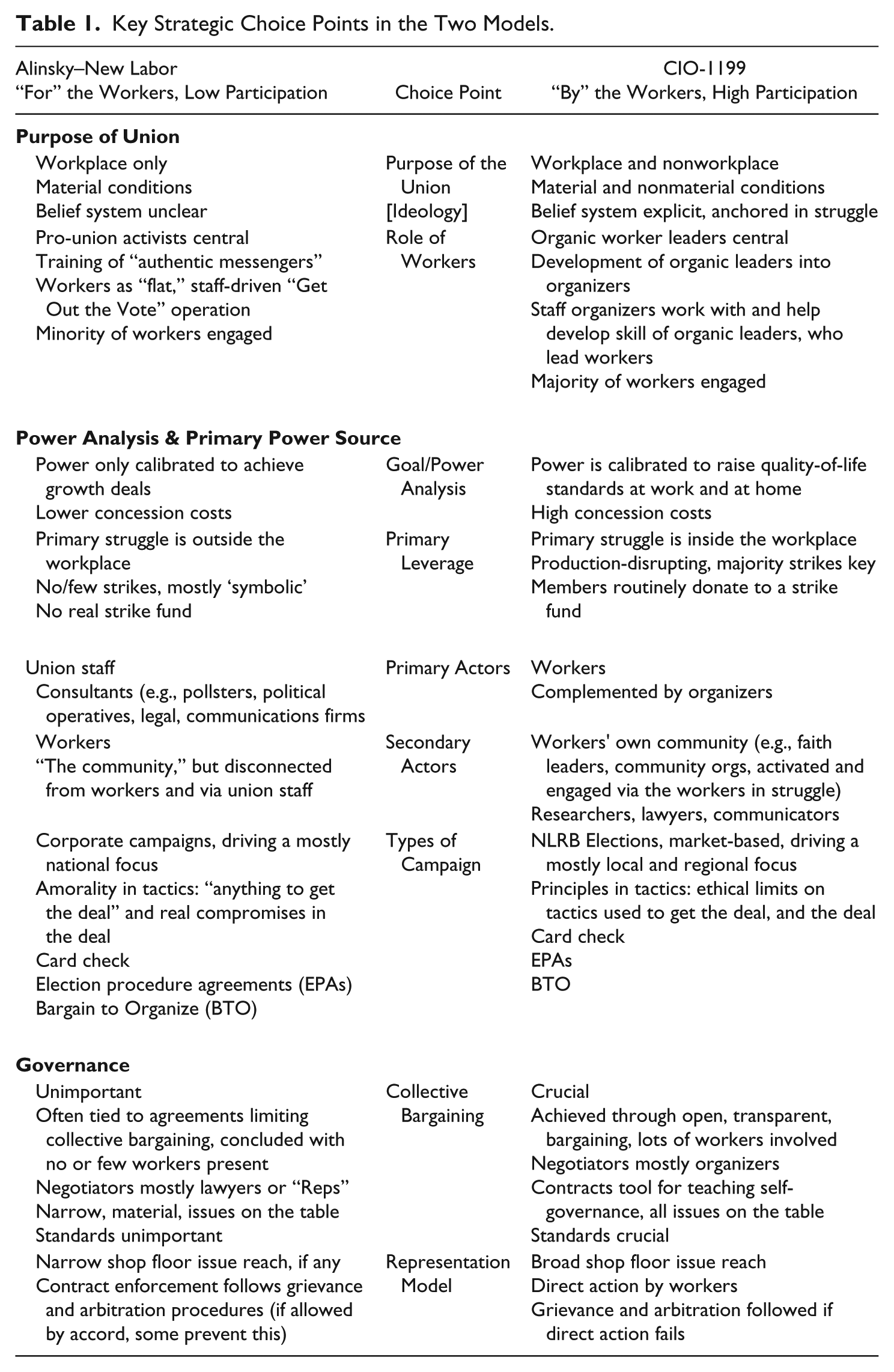
The first factor, the purpose of the union, produces very different approaches to power analysis and governance. If individual actors believe that the purpose of the union is to enable a majority of workers to engage in mass collective struggle for the betterment of themselves, their families, and their class, then in the related choice point—the role of the workers—the workers will not be mere symbols; they will be central actors in the struggle. If, however, the purpose of the union is to improve the material conditions of workers by increasing the share of profits they receive, the workers’ role will be greatly diminished; they will function as symbolic actors, not central participants. In his organizing manual for 1199, Bernie Mintor describes a variation of the two models in the section “A Union Can Go in One of Two Directions.” Direction I: “a small group of top officers decide that they know what’s best for members. They then proceed to make decisions and manipulate the decision-making process on all levels. Their primary concern is total control.” Direction II: “raising the union-consciousness level of the membership must be the main program. The union is a tool for struggle where workers learn how to struggle as a class [emphasis in original].” 27
On the question of ideology, Alinsky was caustic. He frequently quotes the French political scientist Alexis de Tocqueville. Alinsky had something of an obsession with Tocqueville’s idea of the primacy of the individual versus the omnipotence of the state. He often preached Tocqueville’s embrace of the middle class as the anchor of a “free” society, though he more commonly refers to the middle class as the “got a little, want some more” people. Fundamentally, Alinsky was not proposing class struggle or threatening the structure of the economy or of society. He wanted a fairer share of the pie for “freedom loving” people. 28 Alinsky’s worldview is virtually indistinguishable from New Labor’s and relates directly to the second factor in the model, power analysis.
Alinsky is frequently credited with helping to develop the concept of the corporate campaign. In a 1993 paper on corporate campaigns, the authors claim, “In fact, for those of us in the 40-something bracket, the classic strategic labor campaign of our formative years was the United Farm Workers Grape Boycott of the 1960s. . . . it came from Saul Alinsky and his Chicago brand of community organizing.” 29 Likewise, in an interview Ray Rogers posted on his website, Corporate Campaign Inc., Rogers proclaims the JP Stevens fight from 1976 to 1980 “the Birth of Corporate Campaigns”; he also references Alinsky. 30 The corporate campaign model directs and trains unions to see the employer from the employer’s point of view, not the worker’s.
There are many examples of flow charts and organograms that outline the corporate campaign’s focus on the employer, including on the Corporate Campaign, Inc. website. Figure 1 fairly represents the many in circulation. 31 In the figure, the workers are flat, shown as one actor in relationship to a dozen others; they are a piece of the “available leverage points” used to get the employer to agree to union demands. This power analysis has been widely accepted by New Labor and rationalizes the shift in focus away from workers as the primary source of leverage against employers to all other actors as the primary source of leverage. With workers representing only one of a dozen possible leverage points, it makes sense to rely on the other eleven just has fervently. There are so many other leverage points besides the “worker piece” that the proportion of union staff devoted to workers has been reduced while the proportion of union staff that drives toward securing “victory” in card-check and neutrality campaigns and election procedure accords has exploded in size. 32 The workers also get one twelfth-part consideration when it comes to whose interests are represented in the deal, and rarely, if ever, are they present in negotiations with employers or consulted about the terms when the deal is concluded.
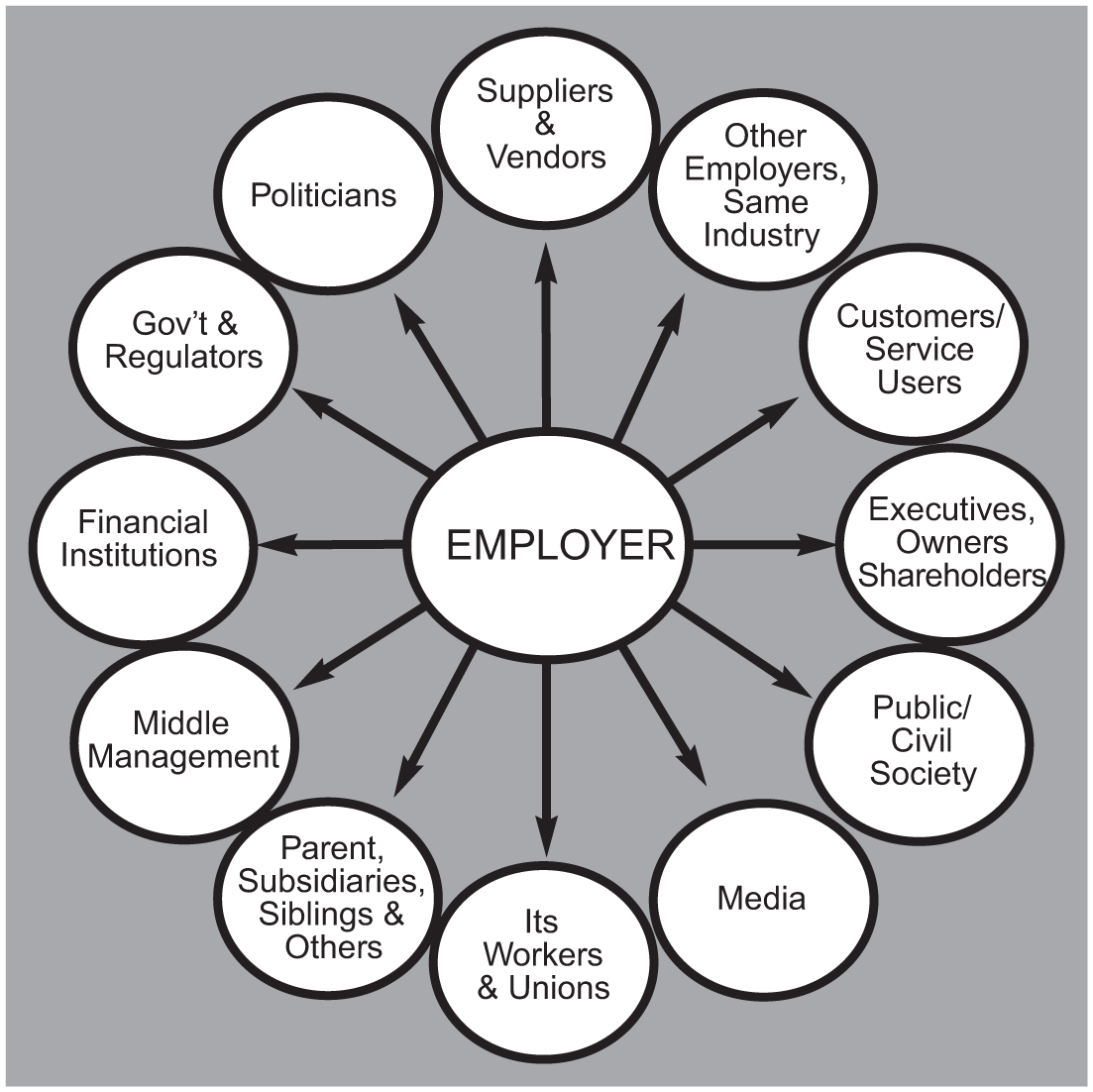
Typical Corporate Campaign Schematic.
In this power analysis, which is the dominant one today, workers play the role of what is often called the “authentic messenger.” Some workers are needed—enough to be presented to the media and to perhaps testify before legislative bodies, to diffuse and inoculate against an employer’s claims that the fight is not about workers but rather about the “union bosses.” Workers are seen as a largely undifferentiated mass, and the chief criteria for engaging them is the answer to a simple question, do they favor a union or not? From among workers who favor the union, staff will select those pro-union activists who are the most telegenic to an elite audience like the media and use them as the public face of the campaign. They will then be called “leaders.” Professional communicators will write their press and legislative statements for them and coach them in how to present well in public. In this model, union staff need not engage more than a minority of the workforce, since the real victory is achieved through one or more of the other eleven points of leverage in the corporate campaign.
This sidelining of the majority of a workforce, engaging only those already predisposed to support the union, would be impossible in the CIO-1199 model, where the union is a “tool for class struggle where workers learn how to struggle as a class.” The 1199 model is contingent on winning a majority of the workers in a workplace to the cause of the union: class struggle. Majorities are also practically necessary, since 1199 still primarily expands its base by running and winning NLRB elections. To achieve majority participation, the CIO-1199 model relies on the organizers’ ability to correctly identify and develop a network of those workers that are the most respected by their peers, whether they are initially pro- or anti-union or undecided. The key to this model are the respected worker leaders. The core to this method is the ability of the organizer to first identify the most respected workers and then persuade them to support the union.
The method for identifying the most respected workers of each employer has a name: leader identification. The methods for persuasion have names too: “Steps to Successful Organizing Conversations.” The process begins with understanding an individual organic leader’s self-interest and helping the leader come to their own understanding, through face-to-face discussions, that his or her self-interest can only be realized through collective—not individual—action; that is, through a union. If an organic leader remains undecided, the next step is taken: “Framing the Hard Choice.” The conversation continues until the organic leader shifts to a definite pro-union stance or can be clearly identified as anti-union. 33
Leader identification is the mechanism that allows union organizers to connect to worker dynamics in the workplace by analyzing the workers’ own preexisting social groups. This is done in conversation with the workers, not apart from them. Leaders have followers, and like the leftist “red” factions of the old CIO, the 1199 organizer today has a method for identifying organic worker-leaders, which is mastered through many repeated applications, like any other craft.
The basic principle behind the method is that the organic leader cannot be identified by union staff or any other outsider, but only by a majority of workers who labor in the same shift and same unit. The process is in stark contrast to the activities commonly called organizing in the Alinsky–New Labor model, where professional staff choose and anoint worker leaders based on their own observation and preference. 34
The CIO-1199 model insists that only the workers themselves can identify their leaders. Union staff in a private-sector unionization effort are legally barred from entering the private-sector workplace, which includes the parking lots and cafeterias. Thus mastering the craft of learning who the organic leaders are and persuading them to support the union, so they can persuade their fellow workers to do the same, is essential to winning the struggle. In a private-sector shop, the workers must lead their own inside campaigns, almost always in an extremely hostile climate. Conditions are different in the public sector; union organizers can blend in with the public and routinely walk into most public workplaces to meet with employees themselves, allowing staff to do the work for the workers.
Jonathan Rosenblum is an experienced observer and participant in this situation. He is a third-generation 1199 New England–trained union organizer, former staff member of the Washington State local profiled in my case study, and, most recently, campaign director of the successful SeaTac airport “Fight for Fifteen” campaign. He says, “The first, and in many respects most important, job of the 1199 private-sector union organizer is to unearth who the majority of workers identify as the most respected worker in each shift and in each unit.” 35 This takes dozens of painstaking conversations, because simple questions such as “Who is your leader?” or “Whom do you respect most” cannot be asked. The result would be incorrect leader identification, because words such as “leader” and “respect” have imprecise and variously understood meanings. Instead, an organizer must ask a series of questions as part of a longer conversation: “Whom do you turn to when you don’t know how to get something done?” and “Why?” “Whom do you consult if you are worried about something at work?” “Why?” The skilled organizer (professional or volunteer) must ask dozens of questions like these to identify and understand the organic worker leader in each work area. 36
Rarely, if ever, does a worker accurately announce himself or herself as a leader. According to union organizer Kristin Warner, a fourth-generation trained 1199 organizer, It’s almost never the workers who most want to talk with us. More often than not, it’s the workers who don’t want to talk to us and remain in the background. They have a sense of their value and won’t easily step forward, not unless and until there’s a credible reason. That’s part of the character that makes them leaders.
37
Successful union organizers, those who run and win NLRB elections or lead and win standard-setting contract campaigns or strikes in the private sector, use a method called “charting and list work” to track preexisting worker social ties as they map the power relationships among the workers. William Z. Foster used the exact same language in his 1936 book Methods for Organizing the Steel Industry. 38 The role of the CIO-1199 organizer is to correctly identify the organic leaders, persuade them to the cause of the union through one-on-one, face-to-face discussions, then teach and apprentice them through the employer fight and through the workers’ first contract battle, assuming they win their election. If a majority of the identified organic leaders per shift, per unit, and so on, are pro-union and can hold that position when faced with employer intimidation, the workers will likely succeed in forming a union, sustaining necessary tough actions, including strikes, and winning high-value contracts.
In the CIO-1199 model, strikes that cripple production are not only possible, but are seen as the highest test of whether or not worker organization in a shop is at its strongest. 39 In this model, from the opening conversation with a newly formed organizing committee in a nonunion facility—a committee made up of the organic leaders, not activists as in the Alinsky-New Labor model—one of the key subjects is being ready to strike for the first contract. This conversation about strikes is directly linked to the ability of the workers to win for themselves the kinds of contract standards that are life-changing, such as control of their own hours and schedules, the right to address workplace health and safety issues quickly, the right to increased staffing and decreased workload, the right to meaningful sick and vacation time. Compared with these gains, a mere pay raise—too often the chief goal of the New Labor model—is a very limited win.
The conversation about gaining the strength needed to strike continues in the discussion about governance, the last of the three core factors in the model. According to a typical 1199 conversation with workers, contract enforcement does not happen primarily through the power of lawyers and arbitration; it happens on the shop floor, in direct actions led by the organic worker leaders, who ideally graduate from the organizing committee to the bargaining team to a delegate’s (steward’s) post. And to cement the idea of “three sides to two”— that the union really is the workers and not a third party—a foundational principle of the union is that all workers are invited and encouraged to attend open negotiations with employers.
In the Alinsky–New Labor model, in contrast, much of collective bargaining is handled in top-down, staff-only negotiations with employers. In the negotiations for card-check and election-procedure agreements, it has become routine for union staff alone to prenegotiate certain terms, including how “bargaining” will take place, and even the actual contract terms. Alinsky was not known for his governance skills; he famously quipped in the Playboy piece (and in documentaries) that none of his organizations were any good a few years after the victory (whatever the campaign was). This Alinskyist tradition, too, has morphed into New Labor.
I argue that the Alinsky–New Labor model is a campaign and mobilizing model, whereas the high-participation model of the CIO-1199 tradition is a true organizing model. In Table 2, I contrast Alinsky’s well-known core principles for organizers, as laid out in Rules for Radicals with the core principles of an 1199 organizer. The 1199 key postulates are taken directly from what passes for “the manual” at 1199, a handwritten, dated single sheet of paper that hangs on the door of most 1199 organizers or is pinned up on a bulletin board. It is often covered with coffee stains and marker of some kind and is called simply “Advice for Rookie Organizers.” 40
Key Postulates from Texts.
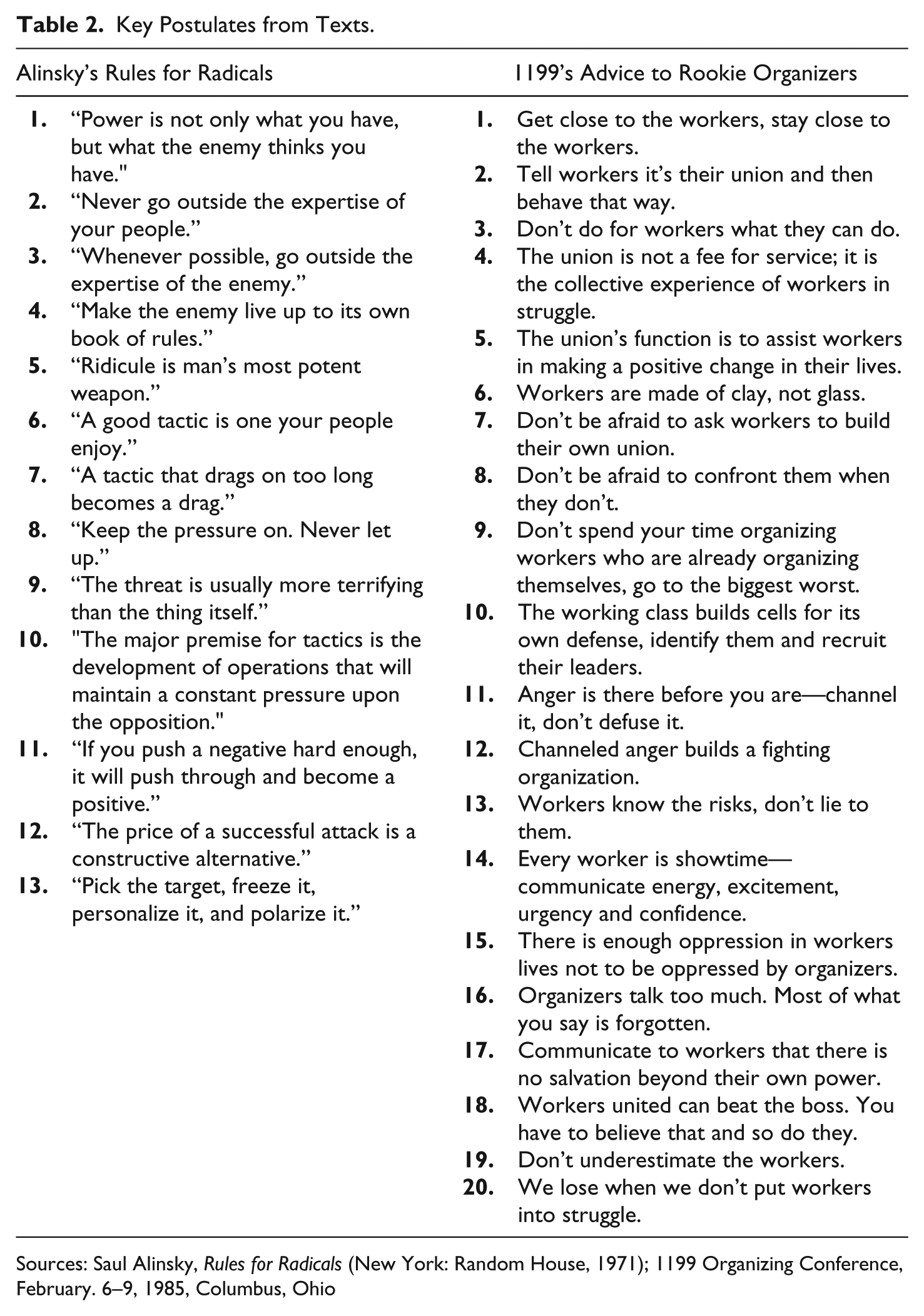
Sources: Saul Alinsky, Rules for Radicals (New York: Random House, 1971); 1199 Organizing Conference, February. 6–9, 1985, Columbus, Ohio
The 1199 Postulate #10, “The working class builds cells for its own defense, identify them and recruit their leaders,” is the foundational concept about organic leader identification. The core postulates in the 1199 model are about bottom-up worker organizing, including Postulate #2, “Tell workers it’s their union and then behave that way.” The core postulates of the Alinsky model are about strategy and tactics, and only its second postulate addresses the idea of people being organized at all.
Two Cases of Nursing-Home Organizing in the New Millennium: Washington versus Connecticut
To illustrate the difference between the two models described above, I have chosen two parallel efforts to unionize similarly situated private-sector nursing-home workers. Both were undertaken since the year 2000, and a radically different strategy was deployed in each.
Nursing-home employees are generally considered a less-skilled, more easily replaced workforce. The workers in these two cases labored for some of the same national corporate owners, in two “blue” states, Washington and Connecticut. In this section, I lay out the unionization strategies and achievements in each local union’s private-sector nursing-home jurisdiction. Each local union includes thousands of other types of workers, primarily from the public sector, and each has achieved real gains in the public sector (often considered considerably easier than the private sector).
On March 20, 2001, the largest nursing-home strike in U.S. history began. 41 The workers, overwhelmingly women of color, were members of District 1199 New England, in Connecticut. When they walked off the job, they already had the highest wage and benefit standards of any nursing-home workers in the nation, including a substantial pension (not to be confused with a 401k), an impressive self-funded health-care plan, a robust employer-paid training and upgrading fund, a two- or three-step grievance and arbitration procedure, and more workplace rights than almost any other nonmanagement employees in the United States enjoyed in 2015. 42 Jerry Brown, the now retired president for most of 1199 NE’s history, said, “The strike muscle is like any other muscle, you have to keep it in good shape or it will atrophy.” 43 Since the beginning of the new millennium, Connecticut's nursing-home workers have gone on strike every year except 2008 and 2011, for a cumulative total of over 100 strikes. The action in 2001 was a large multiemployer strike; there have also been thirty-eight work stoppages since 2002.
In Washington State, months later in the same year, on November 6, 2001, ballots were being counted on Initiative Measure 775, a referendum to create a statewide homecare authority, the first of its kind. 44 The initiative passed overwhelmingly and thus was born a new SEIU union, Local 775. The national union rearranged the structure of other locals in Washington, shifting nursing-home jurisdiction away from Local 6 and 1199 Northwest, and consolidating nursing homes and long term care into Local 775’s jurisdiction. To date, the Washington local has unionized twenty-three nursing homes under 775 contracts, and there has never been a strike in any of them. Several other nursing homes were given to Local 775 as part of the transfer of the nursing-home jurisdiction.
The workers in the majority of 775’s nursing homes were unionized through a top-down and top-secret agreement as part of a national experiment to partner with nursing-home employers in key states. In 2003, the national union staff decided to embark on an initiative with nursing-home operators aimed at increasing the pace of growth or density in nursing homes. David Kieffer, the director of nursing-home operations for the national SEIU, began a series of discussions with CEOs of national nursing-home chains to explore whether or not the corporations were interested in the initiative. 45 No workers were invited to participate in any of these discussions, nor were they aware of the meetings.
Kieffer advanced the national union leaders interest, which was growth. The employers wanted three things in return for growth deals (including card-check or election-procedure agreements). First, they wanted the union to deliver increases in Medicaid spending at the state level, the largest source of their income (often called “rate reform” in policy circles). They wanted tort reform, meaning less liability for nursing-home operators if, for example, accidents, deaths or injuries occurred in their homes. Finally, they wanted status quo management rights inside their nursing homes. In exchange, they would be willing to offer neutrality in organizing campaigns in some form, and marginal improvements in the workers’ pay and health-care benefits, assuming the union could deliver the increases in Medicaid spending to cover their increased costs. In addition, there was a caveat to the neutrality agreement: the employers would select which nursing homes could be organized during the life of the accord. If workers at nursing homes not selected by the employer called the union and wanted help forming a union, the union would be bound to decline. New Labor calls agreeing to a large area in which even if the workers want a union they have no right to form one “establishing a no-fly zone.”
When this arrangement was presented to the leaders at 1199 New England in 2004, “We told them to go fuck themselves,” says current 1199 NE president David Pickus, paraphrasing then president Jerry Brown. When I asked Brown in a recent interview what his objections were, he said, The state is a huge player in nursing homes. It would be great if we could make demands for increased nursing-home funding with the industry, to cooperate with the employer. So long as we didn’t have to give away the democratic principles of the workers running their own union. Our position was we couldn’t sell that which we didn’t own, and we didn’t own the workers’ right to make their own decisions in the future. Kieffer and Rolf were selling something they didn’t own. We refused to do that.
46
In Washington, the local union president, David Rolf, accepted the same deal immediately, though it would take another two years before the “Agreement to Advance the Future of Nursing Home Care in Washington” 47 could be ironed out; bigger states like California were a priority for the employers. 48 In 2006, the deal was finalized between local 775 and Washington State nursing-home employers. 49 That same year, Local 775 lobbied hard and secured sufficient increases in nursing-home funding to trigger the union’s ability to unionize nursing homes under the employer agreement.
But the terms of the secret accord between the union and the employers placed severe limits on the future union members' rights. The union agreed to prohibit the workers from any form of negative messaging or negative campaigning of any kind during the life of the agreement. The grievance and arbitration clauses are constrained by language stating that any problem not brought to the grievance process within fifteen days would be “null and void.” Further, in some agreements, only suspension or termination can go to arbitration, which left management as final arbitrator on all other issues, just as in any nonunion nursing home. The no-strike clause in the contracts in these agreements excluded the two words modifying most no-strike clauses, no lockout. The last section of the 775 no-strike clause is highly unusual: Upon the termination of this Agreement, this Article 25 (No Strike Clause) shall remain in full force prohibiting workers from engaging in work stoppage over labor contract disputes and the parties shall engage in prompt, binding interest arbitration to resolve the dispute. The No Strike Clause shall survive the termination of this Agreement, and, this language will automatically be included in all future contracts.
50
Workers’ wages in the Washington agreements are considerably below Seattle’s newly won minimum wage of fifteen dollars an hour.
51
And the clauses on wages in the contracts are triggered up or down based on whether or not the union can deliver specified increases in Medicaid funding from the state legislature. A typical 775 contract’s final clause includes the following language: The Operator, Union and/or Arbitrator shall not establish a collective bargaining relationship that would create an economic disadvantage to Operator by requiring increases in worker pay, benefits, staffing levels and/or shift ratios that both were not adequately reimbursed by Medicaid revenues and prevented Operator’s reasonable economic return on operation of the specific Operator-facility covered by this Agreement. Operator will not be required to provide financial records to Union or arbitrators. [Emphasis added]
Almost fifteen years after launching Washington’s new long term care local, nursing home workers have achieved little more than their nonunion counterparts.
As shown in Table 3, a nursing-home worker in New England, where the minimum wage is lower than Washington's, earns substantially more pay on her first day, in her sixth year, and in every year of her working life than her counterpart in Washington. Three quarters of 1199-unionized nursing-home workers in New England have employer-paid health care for themselves and their families, with minimal copays and deductibles. A majority also enjoy a real, defined-benefits pension. All employees have the right to take sick time that doesn’t draw from their vacation time. Finally, they retain the right to strike at the end of each contract. Nursing-home workers in New England, through sustained collective action, including the strike weapon, have transformed their workplaces and the quality of their lives.
Comparison of Contracts.
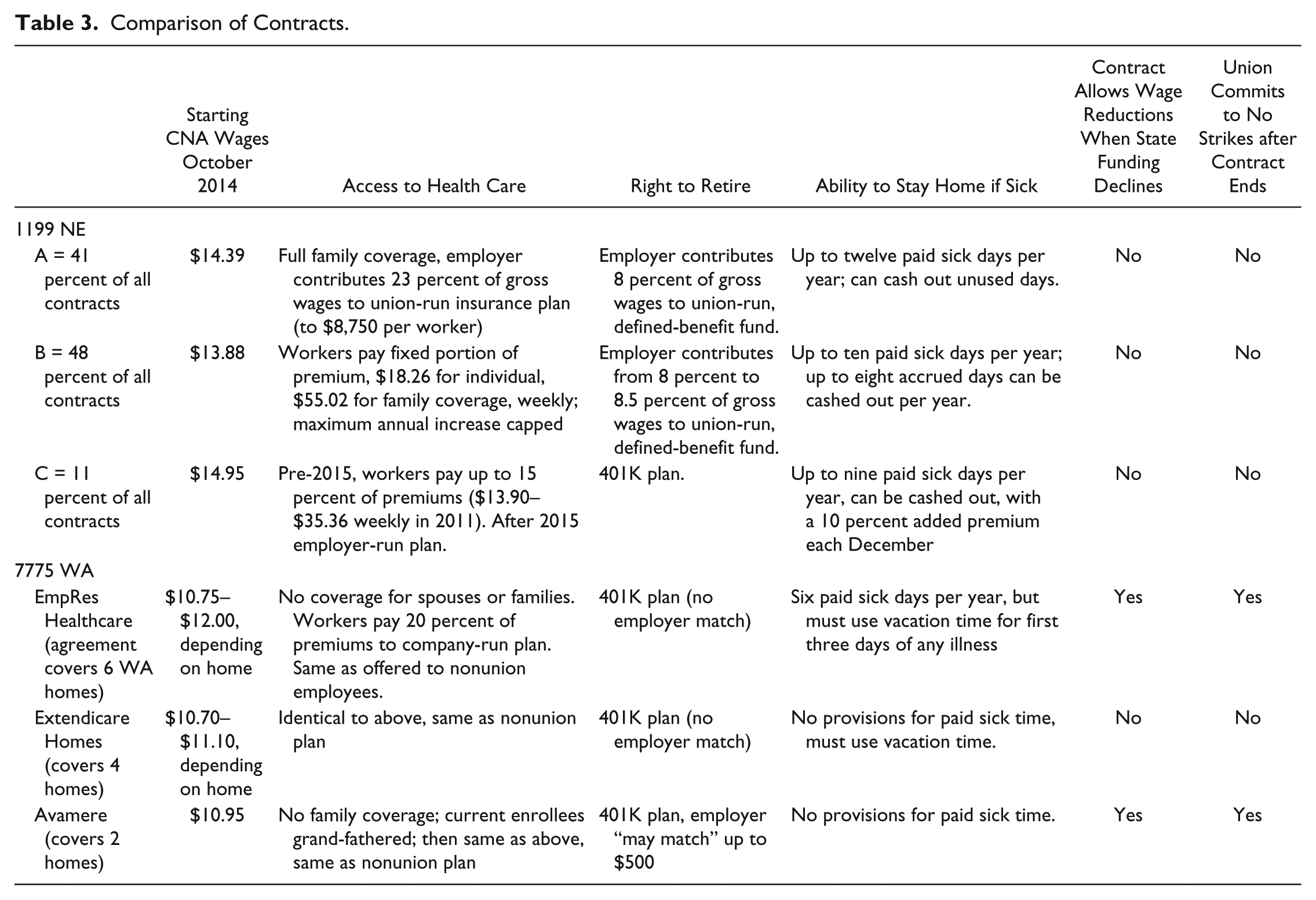
In Washington State, where the minimum wage is higher, 52 negotiated contractual wages in most nursing homes are considerably lower than in nursing homes in New England. In addition, the contract at many of Washington's organized nursing homes allows negotiated wages to be decreased when Washington decreases Medicaid reimbursement rates—guaranteeing operators a fixed percentage of revenues from the state while passing the risk of lower revenues on to the workers. Moreover, the majority of unionized nursing home workers in Washington have health-care coverage for themselves only, not for their spouses or children. These bargained-for health-care plans, as explicitly stated in the union contracts, are to be identical to those of all nonunion workers employed by the same owners. Nursing-home workers in Washington also have little opportunity to build retirement savings; they do not enjoy a pension or even an employer match on their 401K. Their contracts specify that their retirement provisions, like their health-care plans, shall be identical with those of nonunion employees working for the same operators.
In the same period, 1199 New England has run almost sixty successful elections. Like the Washington union, 1199 in Connecticut recently signed a multiemployer agreement—but one negotiated across the bargaining table, with workers in the room, in a collective-bargaining process transparent and open to all members of the union. By this process, they were able to secure a neutrality agreement covering three unorganized nursing homes, in which the workers surrendered nothing and are not bound to limitations in their contractual rights. There are no binding contract provisions, no clauses that are “automatically renewed,” and the union is not required to lobby for the money to pay the workers. The language, printed in the contracts of the workers who fought to win them, includes the following: The parties agree that the Employer will remain neutral and not conduct any campaign in any organizing drive conducted by New England Health Care Employees Union District 1199/SEIU in any unorganized center [for] long term care or assisted living owned or operated by the Employer or any of its related entities now or in the future in the State of Connecticut.
53
The agreement was reached by workers fighting to expand their union to nonunion homes, across the bargaining table, in the final days of 2012. Under its terms, if the union can present union-authorization cards from 40 percent of workers from any of the three nonunion facilities, the employer must turn over a full employee list and release a letter to all employees declaring that during the union’s campaign the employer remain neutral and will bargain in good faith. Any violation of the neutrality agreement goes to “expedited” arbitration, with the final decision resting with the arbitrator. The workers at the biggest nursing home under the agreement, St. Joseph’s Manor, successfully won their election in July 2014. Despite the neutrality agreement, the organizers approached the campaign as seriously as they would have any organizing campaign—as a struggle. Rob Baril, the organizing director of the union and the lead on the campaign, explained the process: We blitzed the home’s workers starting in February. We got a good idea of what the issues were and we began to do leader ID by work area. We talked about building to majority to fight the boss, and filed for an election with 70 percent of the workers on a petition. We had volunteer member organizers with us in every committee meeting from the same employer. They would stand up and say, “we won this for you, we expect you to now get strong, be prepared to fight and to strike because we expect you to win a common expiration with us, our standards are in jeopardy because you make $3 less than us and you don’t have the pension, our future depends on you and you better be ready to stand up and fight.”
54
Asked why this employer would give a neutrality agreement without asking the workers to surrender anything, David Pickus, the lead negotiator in the fight, explained, “We were negotiating with five other homes of theirs we already had under contract, so we said, If you don’t give us these places, we are going to strike all five homes. They knew from past experience we could cause a big problem because we had struck them successfully before.” 55
In Washington, Local 775’s alliance with the employers for a fair election process is controlled by the employers, contingent on the union making significant gains for the employer in the legislature; it places severe limits on the collective bargaining and representation process; it was negotiated with no workers in the room; it was confidential; and it has yielded less than one-half the number of organized nursing homes as the 1199 NE agreement in Connecticut. In an article in the Seattle Times, the Washington union’s president David Rolf was quoted as saying, “Wouldn’t it be something if people thought unions weren’t about creating problems but they were actually about working with management to solve problems? Where is it written that the thing we need to do most is have fights?” 56
Discussion: Two Models, Two Potentials
The central organizing strategy of the Communist-influenced CIO in the 1930s and 1940s was building high-participation organizations capable of waging a strike. This theory still informs and empowers the actions of today’s local 1199 New England. Beyond the case studies utilized in this paper, other local unions in the 1199 diaspora also reveal above average member participation and contract standards, including 1199 North West, 1199 Pennsylvania and some portions of 1199 New York (now a mega local). Because this paper’s focus is on nursing-home workers, I have excluded those locals that include a significant number of hospitals.
One serious consequence of McCarthyism was that organizers skilled in this method were driven out of the labor movement. Since then, union leaders have adopted an increasingly accommodationist method that has achieved material gains and union security by surrendering the right to strike and often all other real rights on the shop floor. Once the strikes that crippled production were abandoned, there was no longer a perceived need to build a strong organization among a majority of workers. Accordingly, wage increases and improvements in working conditions have come to a halt. Workers as the primary leverage in their own salvation has been replaced by the corporate campaign, a method of tactical warfare that takes campaign action away from the shop floor and away from the workers.
Many of the New Labor–influenced staff left the AFL-CIO in 2006 to form the rival Change to Win (CTW) Federation. The organizing department of CTW was established primarily by senior staff from SEIU, where they had learned the strategy of corporate campaigns-for-growth deals. This strategy became the key arrow in their quiver; the conversation about workers themselves was reduced to a phrase “the worker piece of the campaign.” I offer an alternative picture of what campaigns look like where the workers are the primary leverage, driving all other aspects of the campaign.
Peter Olney, longtime national organizing director of the West Coast–based International Longshore and Warehouse Union (ILWU), said in one interview, Just before the split at the AFL-CIO, the conversations [that New Labor was driving] were about how workers really got in the way of organizing. We [the national organizing directors] would actually sit in rooms, in annual meetings about the state of organizing, and the discussion would be that workers often got in the way of union growth deals.
57
It would be difficult to find a clearer statement of the leadership identification–strategy and tactics trade-off.
As the case studies in the previous section demonstrate, the 1199 tradition is about identifying preexisting worker-leaders and connecting with them, then coaching and apprenticing them through the inevitable employer fights to come. By contrast, in most strands of the Alinskyite tradition the union decides who should be a leader based more on community organizing criteria, such as likability, commitment to the organization's agenda, attendance at meetings, and the ability to follow organizational conversation, speak to the media, chair a meeting, exercise charisma, and so forth. In the 1199 model, none of those factors matter. The only factor that does is that coworkers trust and respect the worker-leader, who might not, and often does not, meet the Alinskyist community organizer’s criteria described above. The models are starkly different, and Alinsky’s model has become embedded in New Labor.
From Three Sides to Two
Today, in 2015, 1199 New England continues to run a successful NLRB election program. The workers routinely strike and win contract standards better than any other nursing-home workers in the country; they have converted lousy jobs into fairly decent ones. The only reason that 1199 New England was not placed in trusteeship in 2004—when, on being presented with the framework of the Nursing Home Industry Alliance, they told the national union “Go fuck yourselves”—is that back in 1989, when members of 1199 voted to join SIEU, they forced the national union to sign very strategic and legally airtight affiliation language. California’s health-care workers local did not have such language when their own dispute with the national union began over this very issue, the Industry Alliance, and they were placed into trusteeship. I asked Jerry Brown whether he thought his union would have been trusteed without the presence of legal affiliation and jurisdiction language that stipulated that the local union could not be placed in trusteeship without three-quarters of the elected executive board asking to be trusteed. He said: If we didn’t have strong affiliation language, we would already have been forced to merge with the New York mega local right now. The national union would have made deals with the nursing home bosses without us. They would have created a new local in Connecticut and taken our nursing home jurisdiction away. They’d rearrange everything, set up new locals, eliminate jurisdictions; they did whatever the fuck they wanted. And they were great about having votes, but they rigged every vote to work in their favor by who was allowed to vote. There’s no way we would not have been trusteed.
58
Three Sides as Three Sides
In Washington, the employer and the union and the workers are all distinct. The union remains a third party, an entity different from the workers, with its own interests being advanced through negotiations with the employer to meet the employer’s primary objectives, increased revenue and status quo management rights. The union, in turn, as a freestanding entity separate from the workers, has its primary objective met: growth. The third grouping, the workers, gets the least consideration in the negotiations. In this case, there are still three sides to the bargain, but the two whose interests lie closer together are the union and the employer. These two oppose the primary needs of the workers: stronger shop floor protections, a meaningful voice in shop rule-making (which would not be an employer-controlled grievance process), and benefits that might lift them out of poverty.
Alinskyist Origins Place Primacy on Staff as Above All Others
In 1971 in Rules for Radicals, Alinsky obscured the issue of organizer strategy. He declared that there are leaders and there are organizers, and that they are different: The organizer is a behind-the-scenes individual who is not a leader, who does not have anything to do with decisions and decision making, and who must come from outside the community. The leaders must come from the base constituency, and they make all the decisions. Yet near the beginning of his chapter “The Education of the Organizer,” Alinsky says, “Since organizations are created, in large part, by the organizer, we must find out what creates the organizer.”
59
And, further, Those out of their local communities who were trained on the job achieved certain levels and were at the end of their line. If one thinks of an organizer as a highly imaginative and creative architect and engineer then the best we have been able to train on the job were skilled plumbers, electricians, and carpenters, all essential to the building and maintenance of their community structure but incapable of going elsewhere to design and execute a new structure in a new community.
60
By “on the job” he means grassroots leaders. Outsiders are “imaginative and creative architects,” and community members are “plumbers and electricians.” 61 Alinsky’s view of the “outside organizer” has been the subject of a good deal of critical scrutiny. 62 Much of this criticism centers on the paradoxical nature of how Alinsky’s distinction between organizers and leaders diminishes the value of the very people being mobilized. This inviolable Alinskyist principle relates directly to a core strategy of the New Labor era, the distinction between organizer and leader, and the corollary between “external organizing” and “servicing.” 63 External organizing is the supreme driver, and existing worker-leaders and the shop floor are relegated to the backseat. The result is the kind of contract “negotiated” for Washington’s nursing homes, which stripped workers of basic shop floor rights.
Corporate Campaigns Drove Strategy and Tactics, Including Politics, away from Workers and the Workplace
Ironically, Alinsky’s brilliant understanding of power and tactics has morphed into New Labor’s grossly disproportionate emphasis on the corporate campaign—good rope twisted into a noose. It is not that unions do not need smart research; they do. But smart research should augment, not replace, workers as the primary source of leverage against employers. Some of the misunderstanding of the promise of the corporate campaign, which is characterized by minimal worker involvement, stems from which kind of sectors, what type of workers, and what the relative concession costs will mean to the employer. A handful of so-called authentic messengers and a minority of workers engaged might work for a Justice for Janitors campaign, where concession costs are a tiny fraction of the concession costs in a hospital campaign, or at Boeing. But for big fights, where the dollar amounts of the employer’s concessions are high, and where management is forced to concede shop floor rights to workers, majority worker power and majority strategies are required.
New Labor’s efforts at developing a more robust political program, considered a hallmark of the post-1995 era, have not made matters better, and for the same reason: the focus was away from the shop floor. The union’s chief priority was massively increasing the amount of money unions raised and coordinated for the Democratic Party. But while labor unions ponied up more and more for election coffers, mostly at the national level, big-business groups working with conservative and right-wing forces got busy on two frontal attacks that would obliterate union hopes of competing in the election spending game. They methodically plotted a legal strategy in the courts that resulted in the Citizens United and McCutcheon decisions, blowing the doors open on campaign spending. And they developed their own evangelically anti-union candidates and ran them in local and state races, an effort culminating in the 2010 election cycle, which was a disaster for workers and their communities. Tellingly, in the wake of this election, Wisconsin’s new governor, Scott Walker, provoked a showdown with the state’s public-sector unions. After stripping these workers of their collective bargaining rights, Walker faced a union-financed recall campaign. Yet in the vote fully 38 percent of union households voted to retain Walker. 64 The margin of victory for a recall existed well within Wisconsin’s union households. Unfortunately, all the union financing in the world will not matter if the union has not involved rank-and-file members in determining their own destiny enough for them to understand who is causing their problems before they go to the voting booth.
Most of Alinsky’s followers inside and outside the labor movement continued a tradition of anti-ideological pragmatism, which community organizer Steve Williams suggests greatly undermined organizing for the past four decades: Alinsky’s attempt to strip the organizing model of ideology manifests in various concrete practices, like insisting that groups should only wage winnable fights and that the organizer should refrain from bringing her political views into the organizations discourse. The ramifications render the Alinsky model impotent relative to many contemporary challenges because ideology is a central front of the rightwing, and, therefore the left must contest in this arena.
65
But beyond questions of ideology, an even deeper problem lies within New Labor’s embrace of Alinsky’s organizing model: His style of building “organizations of organizations” can only be of value when the organizations underneath the organization have some actual power. Today, the community organizing sector is weak and labor is weak, and weak plus weak does not add up to the strength that can stem the antilabor tide. Forty years of Alinsky-inspired community organizing has not done it, seventy years of business unionism has not done it, and the past twenty years of business unionism veneered as a “robust organizing plan to revitalize unions,” centered on relegating workers to one of a dozen points of leverage, has not done it either.
Conclusion
New Labor desperately needs to return to bottom-up base-building as its core strategy. This means worksite-based organizing, where workers are aided by skilled organizers, but not replaced by them—where workers themselves are the primary actors and primary leverage in their own self-organization. A renewed focus on leadership-identification and CIO-1199-style organizing is essential. At this point, we have almost no organization left among private-sector workers. Strategy and tactics matter, but we cannot “jujitsu” our way out of this mess. Furthermore, it is time to acknowledge that growth strategies and theories that rely on giving workers less say in the workplace only compound the problems of unaccountability that put New Labor and their promises of reform in power in the first place.
To be most effective, to stand a chance of achieving large-scale revitalization, unions have to return to an organizing model closer to that of the CIO-1199 tradition. It is the only route back to being capable of running an effective strike, let alone “occupying Wall Street.” Symbolic protests are helpful, but strategic power has to be built. And today, given differences in the relationship to the broader community implied by service workers versus factory production workers, the organizing model must systematically extend charting and list work into the broader community. By first identifying organic leaders in the workplace and by enabling workers to sharpen their understanding of how to win tough fights, labor can grow an army that will meaningfully engage with its own organic network in the broader community and in the political arena. This model offers a way to overcome the silos brilliantly analyzed by Ira Katznelson 66 because it structures class into the community via rank-and-file union members. This is a considerably different approach from today’s labor-community coalitions, which reinforce rather than resolve the divide Katznelson analyzed.
Unions are under pressure from extraordinary external forces. But unions are also dying from the inside out. Although many of the external factors would be difficult for unions to change, deciding to return to a bottom-up organizing that encourages and equips workers to resist the multifaceted assault on their interests inside and outside the workplace is within the decision-making control of today’s unions.
Footnotes
Acknowledgements
The author would like to thank her adviser, Frances Fox Piven, and James Jasper, Sam Gindin, John Krinsky, Jeff Goodwin, Steven Pitts, Janice Fine, Jamie McCallum, Peter Olney, Bill Fletcher, Marnie Brady, and Bronwyn Dubchuck-Land for their time and comments on this article. The members of the Politics & Protest Workshop at the CUNY Graduate Center provided helpful feedback on an early draft. I would also like to thank the editorial board of Politics & Society for their suggestions, which significantly strengthened my argument.
Declaration of Conflicting Interests
The author claims no conflicting interests in the research, authorship and/or publication of this article.
Funding
The author received no funding for the research, authorship or publication of this article.