




Abstract
Neoliberal restructuring and the feminization of export-led industries are often associated with the disempowerment of women in the workplace. Surprisingly, this disempowerment was not the case with a public textile company in Mahalla, an industrial city north of Cairo. Between 2006 and 2008, workers organized wildcat strikes involving around 24,000 workers. In contrast to the strike waves of the 1980s, women were integral to organizing the strikes and assumed leadership roles in them. This article argues that even as Egypt adopted structural adjustments in the 1990s that led to the decline of the historically leading sectors of textiles and yarn, exports of clothing increased. By the 2000s, the clothing sector was completely feminized and women in Mahalla were positioned in the most productive departments. This change empowered women by elevating their role and induced skeptical male colleagues to support women’s activism in the company and to build cross-gender solidarity.
Keywords
Neoliberal restructuring and the feminization of export-led industries in the Global South have been associated with increasing levels of exploitation and marginalization that lead to inactivity and passivity among women. This dynamic, however, was surprisingly not evident in one recent labor uprising in Egypt. Between 2006 and 2008, workers in the public Misr Weaving and Spinning Company of Mahalla, 1 an industrial city north of Cairo, organized wildcat strikes involving around 24,000 workers, of whom 5,000 were women. Over the course of the strikes, women organized the clothing departments, encouraged men to join, and participated in large numbers, many in leadership positions. To encourage their male coworkers to join the initial strike in 2006, they famously chanted, “Women are here! Where are the men?” (al-rijalah fyn? al-sitat ahwh!). The result was that male workers did integrate with women strikers and support their organizing efforts. Throughout the strikes, women’s leadership and cross-gender solidarity were thus apparent.
The developments of the 2000s should be contrasted with local gender relations in the 1980s, when women did not play a collective leading role in strikes at the plant. During that earlier period, the company was less gender segregated, women accounted for a similar proportion of the labor force, and men had in fact protested against the employment of women in traditionally “male” jobs and demanded their transfer to other departments. Why did women’s collective agency and leadership expand under the new conditions of the 2000s?
My aim is to explain this stark change in attitude and conduct. Why did women become organizers and play leading roles in the 2000s? And why did men integrate women strikers within the struggle during the 2000s, after having demanded their transfer out of “male” jobs in the 1980s?
A large body of scholarship demonstrates that the feminization of export-led industries in the Global South has increased women’s exploitation and marginalization. 2 When women are segregated in low-skill, low-paying jobs and lack other job options, they tend to be “docile.” 3 Indeed, we should expect gender segregation in the workforce to accentuate women’s subordination, both to employers who use the gender pay differentials to cut labor costs and to male coworkers who get to enjoy the better-paid jobs. This pattern is probably even more likely to hold in a hyperexploitative industry such as textiles. 4
Nevertheless, under certain conditions, women have been able to resist, albeit with great difficulty. 5 Some researchers have found that factors external to the labor process, such as women’s backgrounds (e.g., whether married or single) and expanding labor market opportunities, can empower women. 6 Others give weight to the reorganization of production, as in, for example, the transition to a less hierarchical work process that gives women more autonomy and improves their organizational capacities. 7 My findings support this research in part. They also show that changes in the reorganization of work and in the textile industry in Egypt empowered these women, allowing them to transform aspects of their subordination into tools for resisting workplace hierarchies.
Three key factors help explain women’s leading role in the 2006–8 strikes. First, the increase in clothing exports and the feminization of the clothing departments since the 1990s empowered women by improving their position within the company. Second, because of women’s location in highly valued departments of the company, men became interested in women’s organizing and leadership. Third, as official union representativeness declined in the 2000s, men searching for other routes to advance their interests were potentially more willing to forge solidarities with their female coworkers (see Fig. 1).
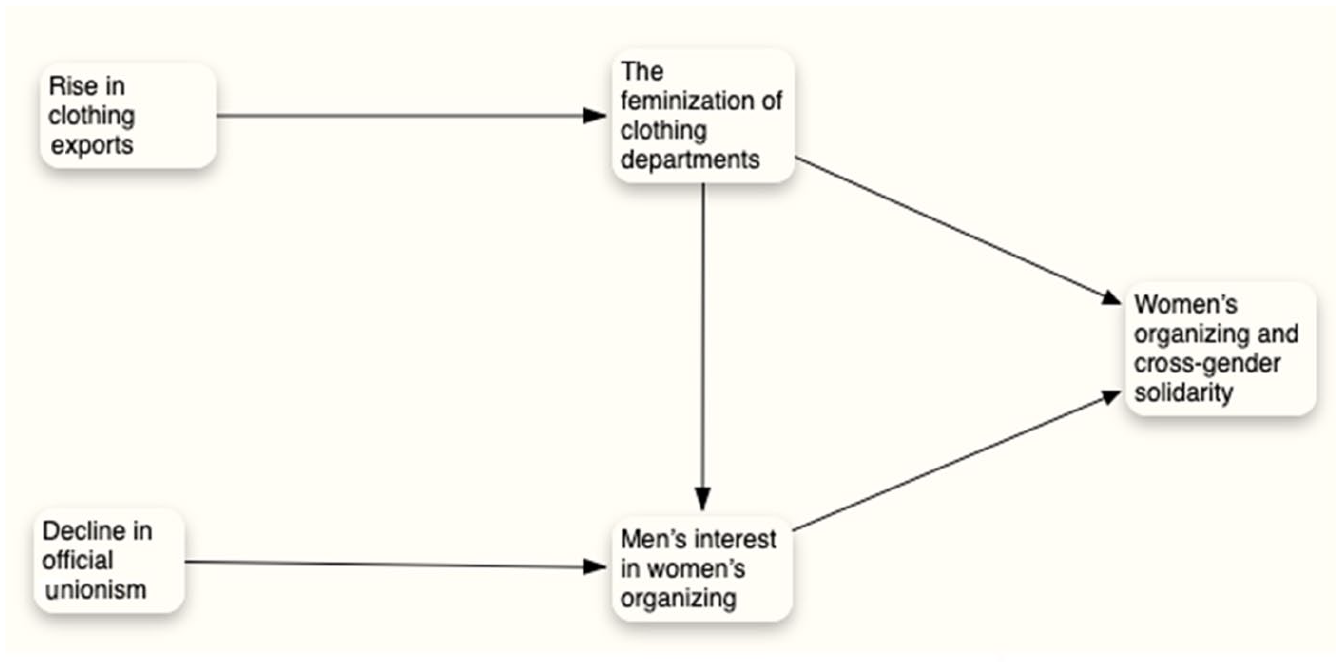
Women’s Organizing and Cross-Gender Solidarity at Mahalla.
I will now review work on women’s capacities to mobilize in Global South industries and explain how women gained workplace power in Mahalla. In the following sections, I will first describe the context in which the Mahalla strikes took place and then provide a description of the strikes of the 1980s and the 2000s. I will proceed to present the factors and mechanisms that explain the differences in women’s and men’s behavior between the two eras. I will show that neoliberal restructuring and the segregation of women in clothing led to unintended consequences. By the 2000s, as the strikes erupted, women occupied the most productive departments in the company, gaining leverage vis-à-vis both employers and male coworkers. The decline in corporatism may also have influenced men to form solidarities with their women coworkers. The feminization of clothing, women’s leverage, and cross-gender solidarity contributed to women’s agency and voice.
Theoretical Background
The neoliberal turn has generally resulted in higher levels of female labor force participation and the feminization of the expanding export-led industries in Global South countries. Cheap female labor, buttressed by an ideology that women in the Global South are “naturally skilled,” dexterous, and docile, has turned those countries into prime locations for investments in labor-intensive manufacturing. 8 A large body of scholarship has documented the increasing levels of exploitation and marginalization of women in Global South export-led zones. 9 Helen Safa explains that as women are segregated in low-wage, unskilled, or semiskilled jobs with high turnover, in which they lack both opportunities for advancement and other job options, they become “docile” and are precluded from challenging management. 10 Indeed, Naila Kabeer shows that under neoliberalism, women’s organizing has taken place mostly in the informal market and has been less likely to lead to pickets or strikes. 11 That fact, however, does not imply that women accept their exploitative conditions. In her pathbreaking work on Malayan women in export-led zones, Aihwa Ong has shown how women engage in daily resistance, albeit indirectly and on an individual level. 12
Nonetheless, in certain circumstances, women have also been able to mobilize collectively in these industries. 13 Annette Fuentes and Barbara Ehrenreich, for example, show that thousands of women from Mexico to Asia protested and halted production to demand raises during the 1970s and 1980s. 14 What are the conditions that hinder or facilitate women’s mobilizations in these industries?
Labor scholars have shown that factors both endogenous and exogenous to production influence shop-floor politics. Building on Michael Burawoy’s framework of despotic and hegemonic factory regimes, gender and labor scholars have indicated that, in addition to state policies, we must also look at gender dynamics. 15 In despotic regimes, the work process is very disciplinary and hierarchical, and women have minimal negotiating power on the shop floor. By contrast, in hegemonic factory regimes, women have more control over the labor process and more leverage to make demands on the shop floor, such as asking for sick leave. Some scholars have shown that the following factors external to the labor process can affect such dynamics: labor market opportunities, women’s communal background, and race. 16 In some cases, external factors have even helped women mobilize. Carolina Bank Muñoz shows, for example, that in a hegemonic but sexually despotic tortilla factory in Baja, Mexico, women were more able to mobilize collectively in the 1990s than in the 2000s, because of expanding labor market opportunities in the Maquiladora industry and because, in the 1990s, women workers were mainly local, with nearby networks of family and friends, whereas in the 2000s many more were immigrant single mothers. 17 Alternatively, in her work on a hegemonic garment factory in Mexico, Nancy Plankey-Videla explains women’s mobilization capacities by giving weight to changes internal to the organization of work, such as the transition from Taylorism to more autonomous teamwork. 18
What is puzzling about women’s mobilizations in the 2000s is that Mahalla is a very despotic factory regime. There were no changes in labor market opportunities—they had in fact worsened—and the workplace remained very hierarchical. By the 2000s, some women were indeed empowered by their seniority and long work experience. In both eras, however, most were recruited largely from Mahalla city, on the basis of family ties, and labored under a despotic factory regime. It is significant that with neoliberal restructuring the company had become more gender segregated and women were concentrated in clothing. What then explains the increase in women’s mobilization and leadership roles in Mahalla between the 1980s and the 2000s?
Research on the early integration of women in industries has demonstrated the effects of increasing competitiveness and the consequent reorganization of work in transforming organizing opportunities for women. 19 Yet, even when they are positioned in competitive industries, women face serious challenges in organizing, especially from unions and from men. Out of fear of competition from low-paid women coworkers, men have been observed to prevent women from organizing and actively to block them from leadership positions. 20 Recent scholarship on women’s collective action finds that the creation of women’s committees in unions and the integration of feminist leaders have facilitated women’s participation in labor organizing. 21 The integration of women staffers alongside union emphasis on reproductive rights has also encouraged cross-gender solidarity in gender-integrated workplaces. 22 Thus, in addition to women’s structural position in the industry and the reorganization of work, it is equally necessary to account for union politics and men’s interests.
Building on labor and social movement studies, I will show that three main developments help explain how women were able to transform aspects of their subordination into tools for challenging workplace hierarchies. First, neoliberal restructuring in Egypt and global transformations in the textile and garment industry since the 1990s led to internal changes in the Egyptian textile sector. For the first time, the garment sector became more competitive than the established textile sector. At the same time, the clothing departments were completely feminized in Mahalla. By the 2000s, women were positioned in one of the most productive departments in the large company. These changes had the unintended consequence of empowering women workers vis-à-vis their employers. Work did not become less hierarchical, as in Plankey-Videla’s case, but women workers did gain more power and autonomy from their new work status. Recently, scholars have shown that structural changes in the industry and the reorganization of work on the shop floor shape workers’ opportunities for organizing. 23 In addition, although segregation aims typically to subordinate women, as women were concentrated in the clothing departments, they were able to transform aspects of their subordination into resources for mobilization. Social movement scholars have shown that shared identity, the ability to form cohesive networks, and the availability of independent spaces and organizations can give marginalized groups resources to mobilize. 24
Second, these developments also gave women leverage over their male coworkers. Like women, men also understood that mobilizations in these departments had become costly and were thus crucial to the success of the strike. 25 Third, it is also possible that the crisis in state-labor corporatist relations contributed to cross-gender solidarity in the company. During Mubarak’s last years there were increasing levels of strikes, and the regime was unable to co-opt large segments of the labor force as it had in the past. Although corporatist arrangements never furnish independent representatives of working-class interest, they do deliver for formal labor. Unlike in the 1980s, men in Mahalla were no longer able to channel their grievances through official routes, and they were searching for other ways to advance their interests. This, I argue, may have facilitated the development of cross-gender solidarity at the company.
Method and Case Selection
The methodological strategy employed in this research builds on in-depth interviews and historical comparisons. The case study considers the strike waves that hit the same company in Mahalla in the 2000s. I compared the role of women in these strikes to their role in previous strike waves of the 1980s. The comparison is ideal because there is a history of labor militancy at the company and a historically equivalent proportion of women employees during the 1980s and the 2000s. In 2010, the company employed 24,000 persons, 5,000 of them women, in comparison to 33,000, including 7,000 women, in the 1980s. 26
In both the 1980s and the 2000s, women workers in Mahalla were recruited mainly through family and friend networks in the city, and the factory regime remained despotic. In the 2000s women still labored under a harsh system of penalization in the form of wage reductions, and some departments were rife with sexual harassment and favoritism. Women could have their wages docked for going to the toilet without permission, for not standing up when managers entered the room, or for being even one minute late to work. In addition, as in other public sector companies, the work process also remained very hierarchical. 27 Labor in the clothing departments is organized by individual or group piecework, and supervisors closely monitor productivity. Finally, since the 1980s, women’s labor market opportunities have narrowed. Women in Egypt are employed in large numbers in the public sector, but those options are dwindling as Egypt accelerates its neoliberal turn, and women have shown limited interest in private sector employment because of the lack of maternity benefits and job security. Contrary to what might be expected, structural adjustments in Egypt did not lead to a significant increase in women’s employment in nongovernmental work. Indeed, except for growing work opportunities in the private clothing sector since the late 1990s, which I lay out in the following sections, women’s participation in nongovernment-wage employment was higher in 1988 than in 2006, from 13 percent to 11 percent. 28 This was the case, as I will show, for most job categories, including many manufacturing jobs but excluding textiles. In addition, women’s overall labor market participation remained flat between 1998 and 2006, at 23 percent. 29 Numbers for female labor force participation in 1988 are, however, not available, as survey data collected for the 1980s used an extended definition of labor market participation that included subsistence work. 30
Research for this article was conducted over four visits to Egypt between 2009 and 2012. In the summer of 2010, I spent two months hosted by a retired Mahalla worker who was a leader of the 1980s strikes. Using the snowball method, I interviewed forty Mahalla workers, twenty-one men (including the previous head of the official union committee) and nineteen women. My interviewees have all spent a long time working for the company, on average around twenty years for both men and women. Finally, I interviewed ten researchers and civil society activists who were informed about and involved in the labor struggle in general and in Mahalla in particular.
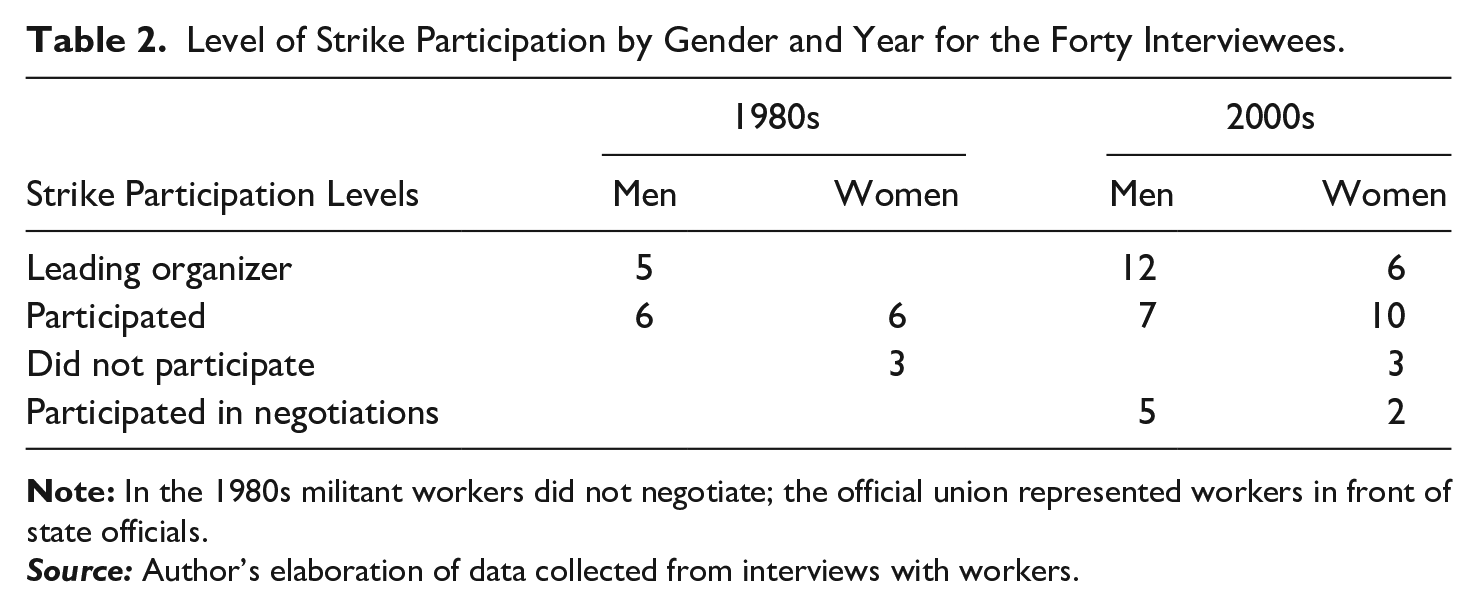
My interview sample represents the different departments in the company, which currently comprises thirty-eight factories: thirteen in spinning, fifteen in textiles, eight in clothing, one for medical cotton, and one for spinning and weaving silk textiles. 31 The interview sample also represents the largest and most active departments of the 1980s and the 2000s. Around half of both the men and the women I interviewed worked for the company during both periods: nine men out of twenty-one and nine women out of nineteen. The interviewees are from eight spinning departments, five textile departments, and all of the eight clothing factories (see Table 1 for workers’ distribution across the company and job descriptions). As for strike participation levels, my interview sample includes leaders and participants in the strikes, as well as those who decided not to participate (see Table 2).
Department Lines and Job Description for the Forty Interviewees.
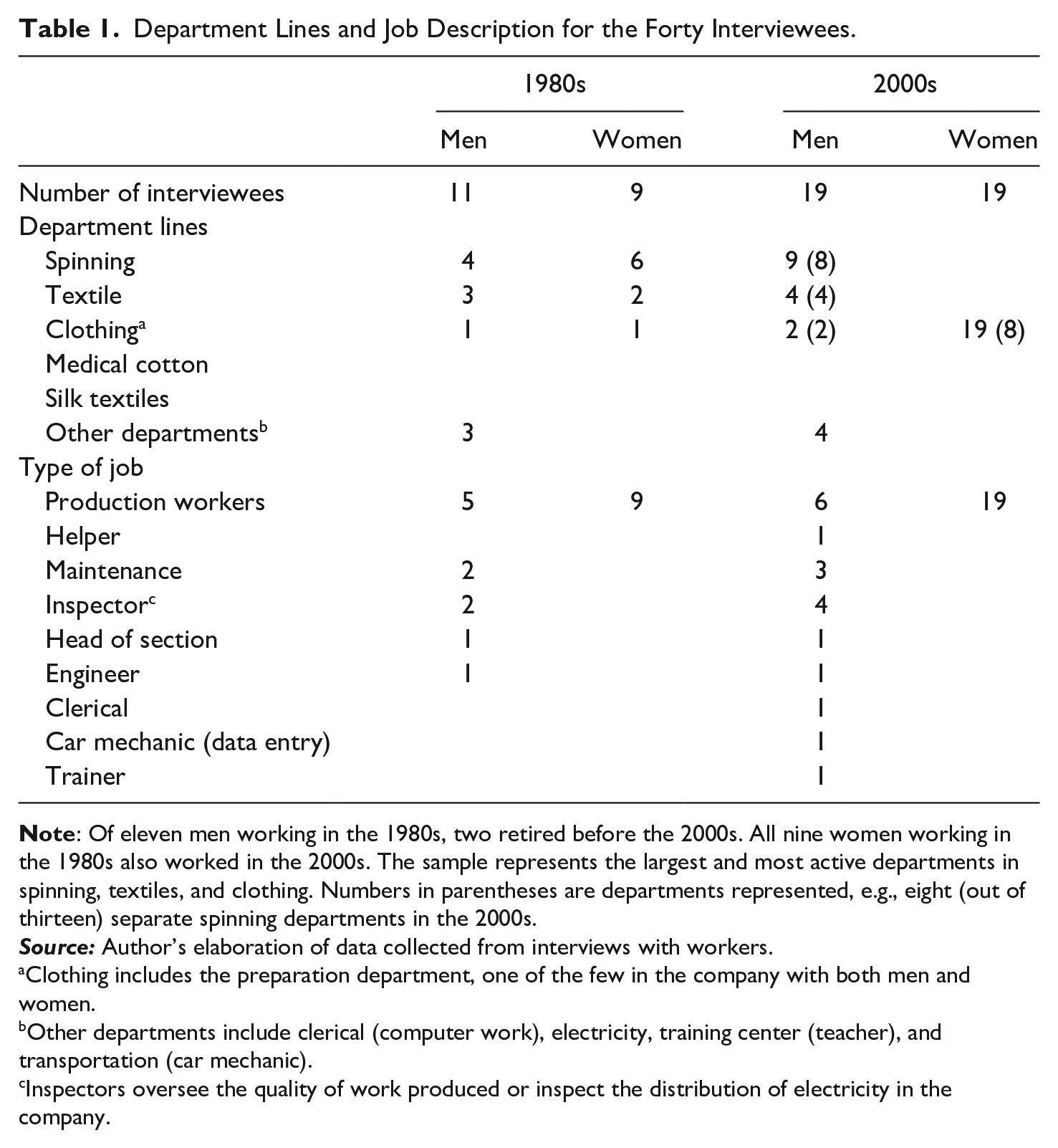
Clothing includes the preparation department, one of the few in the company with both men and women.
Other departments include clerical (computer work), electricity, training center (teacher), and transportation (car mechanic).
Inspectors oversee the quality of work produced or inspect the distribution of electricity in the company.
Level of Strike Participation by Gender and Year for the Forty Interviewees.
Questions inevitably arise about the ability of interviewees to recall events that date back twenty-five or thirty years. To counter the problem of retrospective bias, I supplemented the interview data with newspaper reporting, leaflets distributed during the strike periods, and secondary sources that discuss the strikes of the 1980s. For newspaper data from the 1980s, I looked at al-Ahram (the official state newspaper); al-Ahaly (the main left-wing newspaper covering labor issues in the 1980s, associated with al-Tajamoa, the Nationalist Unionist Party); and other online sources. 32 Finally, I looked at multiple online news sources for details about the 2000s strikes.
I also collected macroeconomic data that capture changes in the Egyptian textile industry. These data corresponded with interviewees’ testimony about the importance of clothing production, which was simultaneously associated with the segregation of women in clothing departments.
Research in Egypt was not without its challenges. The main difficulties were to gain the trust of workers and to avoid being noticed by security forces. I was lucky to be hosted by a worker retired from Mahalla. Staying with this labor leader and his family provided me with a safe space, allowed me to learn about life in Mahalla, and enriched my research experience. I arrived at Mahalla after the events of 2008 and the transfer of a number of workers who had been leading figures in the 2006–8 strike wave. Those developments left many workers unwilling to take risks and afraid to talk. With the help of my host and other human rights and labor activists in Cairo, I was slowly able to gain their trust. The interviews were conducted in Arabic and lasted between one and three hours. All worker interviewees were promised anonymity. I have thus used pseudonyms here.
I will now turn to the first empirical section of the article, which compares women’s roles in the strikes of the 1980s and 2000s.
Women in the Strike Waves of 1984–88 and 2006–8
Before the role of women is discussed, it is important to put the Mahalla strikes in context. In the 2000s, Egypt witnessed its largest wave of labor unrest in history up until the 2011 uprising, involving around two million workers, in many different sectors and industries, and making for massive social upheaval. Protests at the Mahalla company ignited labor protests across Egypt for wage increases and independent unionism. Labor reports show that the highest spike in unrest took place in 2007, following the Mahalla strike. 33 Joel Beinin argues that the victory of Mahalla workers and their ability to gain concessions in 2006 had an impact on thousands of other textile workers who advanced similar demands, and “in almost all cases the government conceded.” 34 In 2007, 49 percent of protests took place in the industrial sector, and textiles represented the largest share of them, at 18 percent. 35 Because of the industrial weight borne by the large public sector, and because of the history of militancy at Mahalla, 36 it is not surprising that the Mahalla strikes serve as a barometer for labor militancy in Egypt. 37
Other women workers took part in the more recent labor upheaval. Women in garment factories, the food industry, and in the government sector (where they represent a large share of the workforce) participated in the protests. 38 What is unique to women in Mahalla, however, is the large number who played leading roles and participated as a collective in spite of being an isolated segment of the company since the 1990s. In addition, women in Mahalla’s public sector have more job security than the large numbers of women who have been employed in the private textile sector since the late 1990s, especially in clothing. In fact, the public sector has shrunk relative to the growing private sector. In 2007 there were around 4,800 companies in the textile sector, 39 including only one remaining public sector holding company—Spinning and Weaving, Cotton, and Ready-Made Garments—with thirty-three affiliated companies, employing a total of 400,000 workers, of which 120,000 work in the public sector. 40
Unrest at Mahalla culminated in the 2008 mini-uprising. Sparked by workers, it mobilized middle-class youth in support of labor demands. People across the republic responded in small numbers to the call for protests and strikes in April 2008, but Mahalla witnessed the most contentious confrontations when residents of the city pulled down and stepped on Mubarak posters in the main square for the first time. The 2008 mini-uprising and labor unrest throughout the 2000s laid the groundwork for the 2011 Egyptian uprising that ousted President Mubarak after thirty years in power.
Until the 2000s, the 1980s saw the largest wave of labor unrest in response to state efforts to cut subsidies and workers’ benefits. Both strike waves started in response to spikes in food prices 41 and coalesced primarily around the demand for wage supplements. 42 In both periods, workers organized through informal committees, in opposition to the official union. The official union response was different in the two eras, providing less cover for workers in the 2000s. Significantly, women mobilized as a collective in the 2000s. They played central roles in the organization of the strikes, their organizational capacities and leadership roles were greater, and cross-gender solidarities developed within the company.
The 1984–88 Strikes
Starting in 1984, workers organized marches, demanding wage supplements and the democratization of unions. Workers often marched outside the company and sometimes occupied it, and the state responded with substantial force. In February 1986 workers organized a strike and requested a Friday paid day off and other wage supplements. In September 1988 protests erupted when Mubarak revoked the school grant supplement. It is noteworthy that women’s participation in the strikes between 1986 and 1988 was on an individual basis and ancillary to the strikes. The women lacked organizational capacities and a cadre of women leaders. Rather than developing solidarities with women, men had in fact protested the employment of women in what they saw as “traditionally male” departments.
I interviewed women who had worked in various departments in the 1980s. Women workers were largely concentrated in clothing, which accounted for around 1,500 out of 3,500 workers. The rest of the women were spread across the company. In one spinning department, for example, there were around 1,500 men and 100 women. 43 Women from all departments took part in the protest, but they discussed participating in the 1980s strike as individuals, not as part of a women’s collective. Manar, employed in spinning production at the time, recalled that “in the 1986 strike, workers marched while carrying a coffin for Mubarak and chanted ‘Mubarak what did you do? A kilo of rice is one pound, Mubarak what did you do? A kilo of meat is at ten pounds.’ I participated and chanted.” 44 Others heard from the guards about the strike and decided to go home.
Women in the clothing departments played a bigger role but one ancillary to the strike. They organized mostly in response to the arrest of their husbands (large numbers of couples work in the company). In 1986, after the strike, some of the men were arrested, and their wives started screaming and running after them. Husam, a retired male Communist leader of the 1980s strike, explained that after the arrest, women went to their work stations, and “the wives of the arrested workers organized a go-slow and chanted ‘release before production’ in the clothing department.” 45
Women workers, Husam said, were contacted through a Communist Party member. Women did not develop a cadre of leaders, but one woman stands out. She organized the go-slow, distributed leaflets, and helped form a “relief committee” to collect money for the families of the arrested workers. This woman leader came up with the idea of the relief committee, and opposition parties provided aid for the workers. As the workers were arrested for around forty days, their wives and children needed support. It was this one woman, then, a radical party member, who played a leading role.
Rather than bolstering their scarce organizational capacities in the second round of strikes in 1988, women became even less active. Women explained to me that they sat out the 1988 strikes, and some workers indicated that the women got used to the idea of their husbands being arrested. Fadi, another leading worker from the 1980s, told me that unlike today, in 1986 and 1988 women did not have a leading role. The majority of women who participated in the first big day in 1986 were the wives of the men in the company and mostly worked in the clothing departments. They played a role after the arrest of their husbands. During the second strike in 1988, women did not participate at all.
46
In addition, men and women did not cultivate cross-gender solidarities. In fact, in the 1980s, as Egyptian male workers started migrating to Iraq in search of better job opportunities, and women in Mahalla replaced men in the company, taking on traditionally male positions in the spinning and weaving departments and working the night shifts, male workers protested. Husam recalled that “we [the informal workers committee] used to raise this in all of our marches in the 1980s, but the management and the official union did nothing about it.” 47 Men workers argued that, by law, women were not allowed to work night shifts; it was not suitable for married women and it caused social problems, such as allegations of infidelity. Many of the male workers repeated the story of a man who had called the factory to ask about his wife, only to find out that she was not a night-shift worker. Women, however, neither mobilized against their own employment in the spinning departments nor resisted it. They proudly recalled that they used to achieve higher productivity levels (this was also confirmed by male workers); but they also affirmed that it was difficult for married women to do shift work. It is plausible that men felt threatened by the influx of women into “their” traditional departments in the 1980s, probably because management was able to enforce higher levels of productivity among the women.
The relatively low level of participation and the limited leadership and ancillary roles played by women workers in the 1980s are supported by my archival newspaper research and by secondary sources. 48 El-Shafei confirms that in 1986 women in the clothing department demonstrated and chanted “release before production” to demand the liberation of their arrested husbands. In order to avoid further labor unrest, El-Shafei explains, the company decided to release the detained workers and meet the demand for a Friday holiday. A left-wing worker group, the Workers Defense Committee, El-Shafei says, organized the 1986 strike. 49 In all these corroborating reports about the 1986 strike in Mahalla, women seem to have played a supportive role mainly by demanding the release of their husbands.
It is even more telling that neither al-Ahaly nor other news outlets that discuss the history of workers’ strikes in Mahalla mention the role played by women at Mahalla in the second strike in 1988. In one of al-Ahaly’s extensive reports on the 1988 strike, “The Winds of Bread Uprising Approach Mahalla,” the strike is described as the most heated since the bread riots of 1977. 50 There is, however, no mention of women. As my interviews indicate, women did not play any particular role in 1988. The absence of reporting on women in Mahalla in 1988 is telling: al-Ahaly consistently reported on women’s worker mobilizations in Egypt in the 1980s. For example, women workers and the wives of men workers at a carpet company in Mahalla city organized a women’s march to the company headquarters and demanded the release of their husbands in November 1986. They also chanted “release before production,” apparently in imitation of Mahalla women a few months earlier. 51 Had women in Mahalla played additional roles in the 1980s, it would have most likely been reported by al-Ahaly. The absence of reporting confirms the absence of women’s collective mobilizations in the strikes of 1988.
It is interesting that although the strikes in the 1980s were not sanctioned by the official union, the General Trade Union of Textile, Garments, and Cotton Ginning eventually demanded that the Egyptian Trade Union Federation (ETUF) intervene to stop the persecution of Mahalla workers after ten workers were transferred following the 1988 strike. 52 Thus the union can be seen to have provided workers some cover. It is important to point out that, unlike some of the men, not a single woman worker was transferred as a result of the 1980s strikes.
The 2006–8 Strikes
Interviews with workers revealed that the 2006 strike was instigated by a government document, signed by the prime minister and circulated among workers, stating that workers had the right to bonuses equivalent to two-months’ wages. The company, however, ignored this policy. Around thirty male workers in different groups and factories started discussing the possibility of a strike. Detecting widespread receptiveness to the idea, they distributed leaflets about the two-month bonus that urged workers to gather on the morning of December 7 to march toward the company headquarters and reject their underpayment. Women participated in the strikes as a group, played central roles in the strike’s commencement, developed their organizational capacities between 2006 and 2007, and generated a cadre of leading women. Further, cross-gender solidarity was apparent throughout the strikes.
Only a few men organized for this action, and participation was largely spontaneous. None of the 5,000 women concentrated in clothing were involved in prior organizing, but once they got word of it they discussed joining. Manar explained, “When we heard about the strikes we were thrilled. We know that strikes start from the men’s spinning department and we started asking about the strike leaders in order to make contact with them.”
53
As soon as they heard the first chants, women workers immediately joined in great numbers and incited men to join. Amira recalled: I do not know where I got the strength from. I took out the women from my factory and we went down and Manar was supposed to bring other women. As we left the gates we saw the men confused, standing by, unsure whether to join. We chanted: ‘Women are here! Where are the men?’ I then appealed to them by opening my hands and signaling to them to come closer and I started chanting ‘God is great’ and everybody repeated it after me.
54
The chant “Women are here! Where are the men?” sealed Mahalla women workers’ reputation for activism and bravery across Egypt. Women’s roles were central to the commencement of the 2000s strikes. They participated as a group and were the first to join in large numbers. Leading women planned to participate in advance of the strike and incited men to join as well.
The strike continued for three days before management conceded and gave workers their two-months’ bonuses. Workers accepted, but they had in the meantime made other demands, such as increases in the basic salary. In September 2007, as the Muslim holiday season of Ramadan approached and those new strike demands had not been met, workers prepared for another round of confrontation.
Women’s organizing and leadership grew following the success of the first strike in 2006. The weeklong sit-in that started on September 23, 2007, was more organized than the first strike in December, and women were central to making it happen. Only women workers had access to the clothing departments, and they organized them by leafleting in the cafeteria and explaining to their coworkers why they should strike. The organizers not only made sure that women in the clothing department were on board with the strike but also approached the men in their sections: “On the day of the strike in 2007 we went to the preparation departments [the few mixed departments to which women had access] and asked the men to stop their machines; we made sure the strike was taking place.” 55 A male strike leader recalled that women would even approach men workers and say, “Why don’t you participate? Are you not a man?” 56
One notable aspect of this strike is that women workers brought their families to the company, and around 120 women stayed there overnight with their male counterparts. In the context of Mahalla that was radical, and some of the women paid a hefty social price for it as rumors spread about misbehavior. The striking women, however, also took on the traditional roles of cooking and providing food for all striking workers. The company was “occupied” by the families of workers, and, as is often the case when women participate, the whole community became involved in the strike. 57
Significantly, women also developed a cadre of women leaders. One of the older women in the company explained that there were six prominent women leaders and around thirty women overall who played roles in the 2000s.
58
Areej’s description is revealing: There are women leaders who speak in negotiations. In factory number one everyone listened to Manar and followed her. She had a group of women that followed her, about fifty; and those fifty brought in another fifty. She knew things we did not know and explained things to us. We loved her; she is a courageous woman.
59
Thus, women leaders had gained the following of a large number of women. Although male strike leaders dominated, prominent women leaders participated in informal committees, conducted meetings at their homes, and traveled to Cairo for union meetings and negotiations as well.
Cross-gender solidarity was also apparent throughout the strike. Men often identified with women’s suffering: “Women work under severe conditions and they suffer from back problems. They also have to go back to their houses and work.” 60 Men also repeatedly told women that their participation was valuable, and they promoted women leaders. Ahmad, for example, told me that “I wanted Manar and Amira [two leading women workers] to appear in the media and participate in negotiations.” 61 Women and men workers were keen to describe how their solidarity empowered them in the face of management, and most women were confident that their participation prevented a violent response by the security forces.
The Mahalla strikes were also unique because of the groundbreaking demand workers made for independent unionism. For the first time since the incorporation of the ETUF into the state apparatus in the 1960s, Mahalla workers questioned its legitimacy by lobbying for the creation of an independent union and collecting large numbers of signatures from workers. Female leaders also collected signatures from women endorsing the idea. Although Mahalla workers did not in the end form an independent union, by 2009 their demand had paved the way for other workers in Egypt to form autonomous organizations. 62
The fact that the state did not employ repression at the outset of the 2006 strikes had an impact on the development of the strikes and the radicalization of strikers’ demands. But women played a leading role from day one, before it became clear that the state would not use force. The state nevertheless managed eventually to split the workers’ informal committee, co-opt some of the strike leaders, and then use repression against workers and the population of the city on April 6, 2008. One strike leader was dismissed, and five others, including two prominent women leaders, were transferred, suffering huge wage reductions as well. It is telling that during the 2000s the General Trade Union of Textile, Garments, and Cotton Ginning did nothing to support the workers.
Structural and Institutional Changes
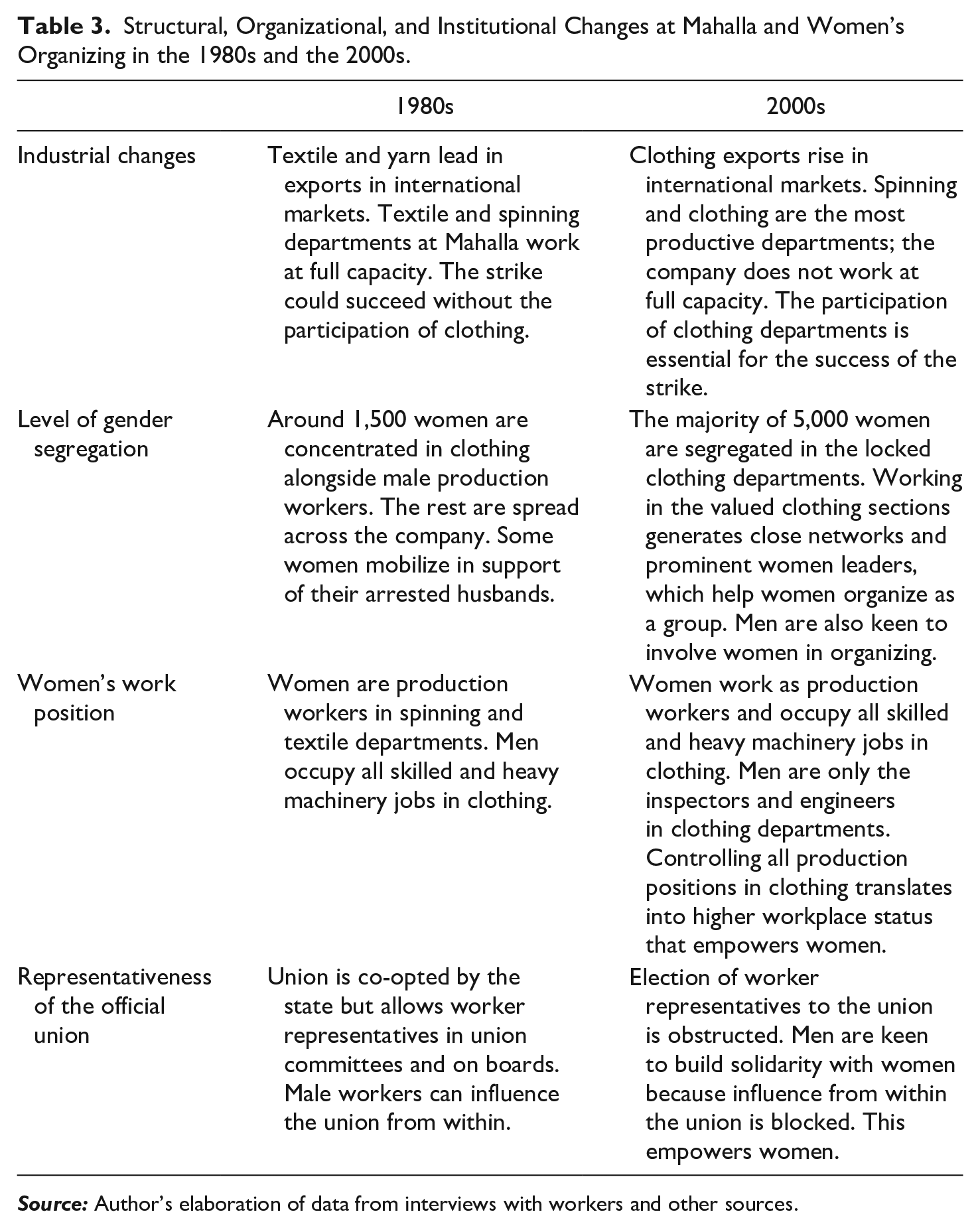
In this section I will show that by the 1990s, tighter international competition and Egypt’s adoption of structural adjustment policies had led to a turn toward the clothing sector and the feminization of clothing production. Management at Mahalla started employing an all-women labor force in the clothing department, and by the 2000s women were working in the most critical and competitive departments in the company. When the strikes erupted, women’s concentration in those departments had changed their consciousness and facilitated their agency. 63 As for men, I will show that those same industrial changes increased their dependence on women and induced them to support women’s organizing. The decline in corporatism in the 2000s may also have contributed to men’s interest in acting in solidarity with the women in the company. Table 3 describes the structural and institutional changes since the 1980s that bolstered women’s organizing and contributed to cross-gender solidarity.
Structural, Organizational, and Institutional Changes at Mahalla and Women’s Organizing in the 1980s and the 2000s.
The Growing Importance of Clothing and the Feminization of the Industry
The gradual phase-out in the mid-1990s of the Multifiber Arrangement, which secured quotas in the markets of developed countries, reduced the prices of textiles and clothing and gave an advantage to more efficient producers, such as China and India. 64 The clothing industry also faced particular competitive pressures in the 1990s, such as branding, vicious price competition, and concentration in the retail sector, which resulted in immense pressures to reduce labor costs and induced investors to relocate to Global South countries in search of cheap female labor. 65
Tighter international competition and the adoption of the Egyptian Reform and Structural Adjustment Policies (ERSAP) in the 1990s restructured the industry in the country. Restructuring led to an increase both in the export of clothing relative to textiles and in the numbers of women employed in their manufacture. Historically, the Egyptian textile industry enjoyed protections under the import substitution model, and Egypt exported mostly textiles and yarn. Until the 1980s the government-run textile industry was the main purchaser of Egyptian cotton, which was spun locally and turned into fabrics and clothing to be sold in the local markets for a social price. As Egypt neoliberalized its economy, subsidies for clothing production for the internal market were terminated, and in 1994, as the market for cotton was liberalized, prices rose, increasing production costs in the sector. As a result, larger amounts of cottons, in the form of lint, were sold in international markets instead of going into the country’s clothing value-added chain. Many local mills were idled, and the level of textile export earnings declined significantly in the 1990s. 66 Nonetheless, the industry is still very important for the Egyptian economy. For example, in 2008, the industry accounted for 26.4 percent of industrial production, its total value added was LE 33.5 billion, and it accounted for nearly 10 percent of the country’s exports. In addition, the textiles and clothing industry is the largest single employer. At around 400,000, it accounts for a quarter of the industrial labor force, the majority in private companies, as explained earlier. 67
It is significant that the decline in the exports of textiles since the 1980s was accompanied by an increase in the export of clothing. Private investors ramped up production of clothing for export, tapping into Egypt’s large reserve of cheap female labor. Indeed, according to World Trade Organization figures for the ratio of clothing exports to textiles, exports grew from around 1 percent in the 1980s to 56 percent in 1997 and 86 percent by 2006 (see Fig. 2).
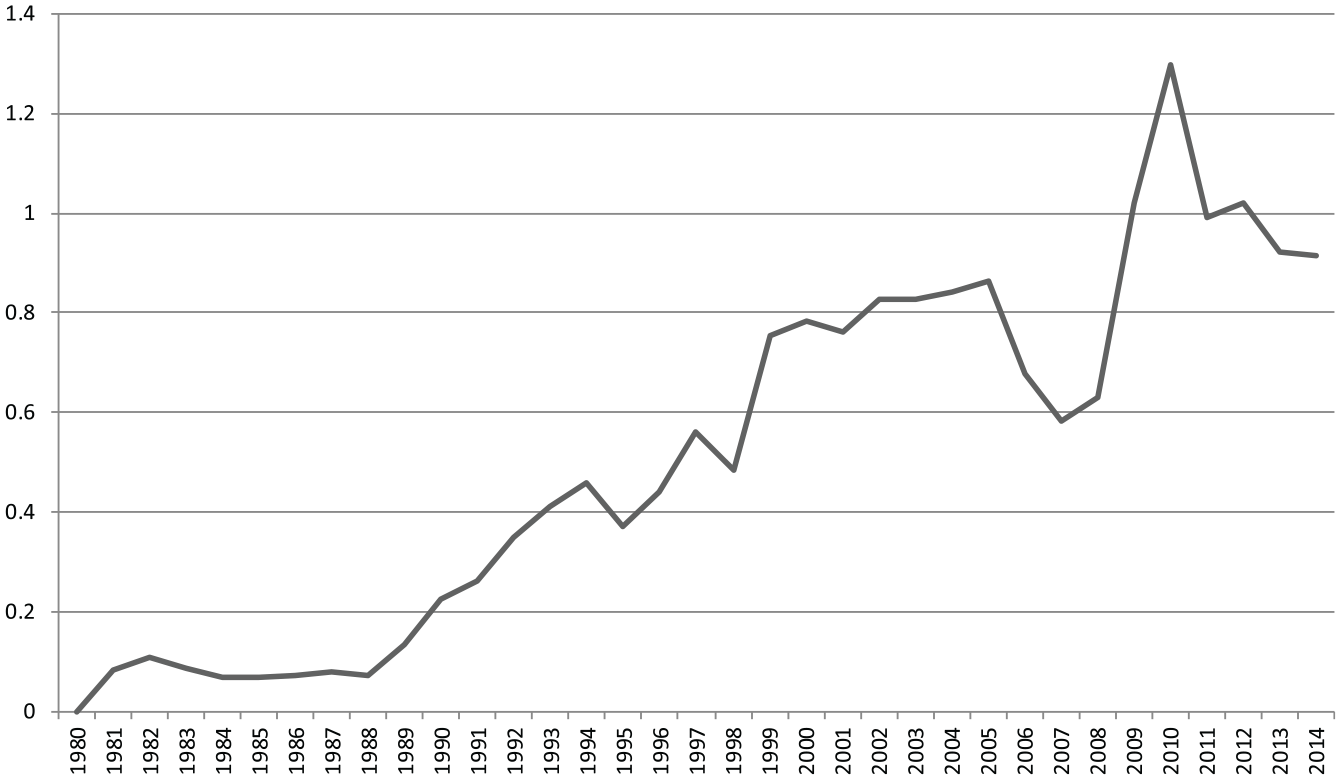
Ratio of Clothing Exports to Textile Exports, 1980–2014.
And although the state sector accounted for around 90 percent of textile and clothing production in the 1970s, its share declined to 35 percent in 2003. The state sector lagged farthest behind in the production of clothing: 14.4 percent in comparison to 85.5 percent in the private sector in 2003. 68 It is interesting that the state sector invested in clothing production equipment to a greater degree than other equipment. 69 It was, therefore, striving to catch up with the private sector in producing and exporting clothing.
Neoliberal restructuring did not initially feminize industries in Egypt. Indeed, nongovernmental-wage employment for women decreased from 13 percent in 1988 to 10 percent by 1998. 70 The process of defeminization took place in most job categories, including all manufacturing jobs but excluding textiles, in which women’s participation remained stable between 1988 and 1998. 71 However, feminization did eventually catch up, mainly in clothing. The trend started to reverse after 1998, and women’s share reached 11 percent of nongovernmental-wage employment. 72 The slight increase in nongovernmental-wage employment between 1998 and 2006 can be largely accounted for by the feminization of the textile and clothing and the food processing industries. 73 Female share in textiles and clothing doubled between 1998 and 2006, from 15 percent to 30 percent. 74 In clothing, women make up the majority of employees, earning 78 percent of men’s hourly wages in the industry. 75 The textile industry in Egypt thus responded to growing opportunities in the production of clothing for export by taking advantage of cheap female labor.
Similar to the local and global trends in the 1990s, management at Mahalla slowly started to transfer women to clothing from other departments and to transfer men out, suggesting that they were keen to have a women-only force in clothing production. In the 1980s, there were 7,000 women in the company, 1,500 of whom worked in the clothing departments alongside men. 76 In spinning, women worked on spinning machines, and, like men, they had to do shift work. By 2000, the overwhelming majority of the company’s 5,000 women laborers worked in clothing alongside a tiny minority of male engineers and mechanics. Women’s testimonies and reports on the textile industry in Mahalla confirm that, by the 2000s, no women worked in the spinning departments in Mahalla. 77 As Mahalla is a very conservative city, however, that does not mean that men and women were freely socializing in the 1980s.
It is also important to note that although there is formally equal pay for equal work in Mahalla, women earn less than men—the result of job classifications—with the real average being 450 pounds in comparison to around 600 pounds per month for men. Women’s testimonies also confirmed that management was able to exact high productivity levels from them. The women explained that they produced more per day than they were required to, that they incurred the highest penalties in wage reductions, and that because some women do not know how to read their checks, they were probably taking a pay hit.
What these changes meant, however, was that women were positioned in some of the most productive departments. The men at Mahalla explained to me that, as is the general trend in textiles industries described above, many machines stand idle, and spinning and clothing are the most productive sectors in the company.
In sum, tighter international competition for Egyptian textiles and clothing and the country’s adoption of structural adjustment policies led to a decline in the exports of textiles, prompting employers to ramp up the production of clothing for export and employing larger numbers of women to do so. In Mahalla, this transformation was associated with the transfer of men out of clothing departments and their replacement by women. Women were thus positioned in the most productive departments of the company. When the strikes of the 2000s erupted, the unexpected happened: women showed unprecedented levels of organizing. How did the concentration of women in extremely despotic departments of the company result in their increased organizing? How were they able to transform aspects of their subordination into tools for organizing their workplaces?
Women’s Organizing: Valued Sectors, Workplace Status, and Close Networks
I will show that the concentration of women in clothing empowered them to challenge management because it led to changes in women’s consciousness. First, workers in these women-only spaces became aware that occupying crucial export sectors gave them greater disruptive capacity. Second, women-only spaces translated into higher workplace status for individual women. Third, it led to the development of closer networks based on common grievances and shared identity. I will describe below more precisely how this empowerment happened.
Although the total number of women working in Mahalla has decreased because of layoffs in the state sector, when they described their work women repeatedly said, “Now we are many,” indicating that women were important and accounted for a large percentage of the labor force. In addition, throughout my interviews, women’s emphasis on the export of their garments indicated that they were aware of the importance of their production line. They said, for example, “My section is for shirts that are exported to foreign countries like the US and Europe, high-quality shirts,” 78 and “We are the best department, we export our products. Very clean work. We are known for our good quality.” 79 Women thus proudly described the importance of their exporting departments in the company.
The burgeoning market for clothing also resulted in very strong demands from the employers for increased productivity, which, I argue, also contributed to women’s motivation to join the strikes. Manar recalled that it was really painful; the pressure was very high and they were always increasing the targets for productivity. We accepted the reality as it is and agreed to everything they [management] said. We did not pray, we did not eat, we did not leave the machines at all. We had no awareness, no courage, and we were afraid to talk. Things changed after the strike, because we learned the culture of defiance.
80
Women thus were aware of the importance of the clothing departments for exports and were keen to gain power to resist the constant demands for higher output. Most women I interviewed mentioned their ability to resist productivity demands and punishments after the strikes.
Moreover, women’s involvement was crucial for the success of the strike. Women account for a quarter of the labor force and work in important and productive departments. As explained earlier, the public sector suffered from large numbers of idle mills, and workers in Mahalla confirm that spinning and clothing are the most productive departments in the factory. And although the company was vertically integrated, workers knew that there were large quantities of stored fabric in the company. The clothing departments could continue working, then, even if the spinning and textile workers struck.
Working in all-women spaces empowered women by elevating their workplace status. It meant that women controlled all the production positions and performed the skilled jobs formerly occupied by men, such as working the scissor machine. Women proudly explained, “There used to be men on the heavy iron and scissor machines. This changed since the 1990s, and it is all women who work on the iron.” 81 Higher workplace status meant more power and higher organizational capacity. Women were aware that their new position gave them disruptive power.
The all-women spaces also allowed for the development of close networks based on common grievances and a shared identity. These have been shown to benefit marginalized groups
82
and also to be important in explaining strike participation.
83
Monira told me how network building in women-only spaces contributed to their organizing: In the second strike we told each other we would not be entering the company. All seventy women eat together in one room, everything is said during breakfast. During the bus ride, our women also used to talk about the strike with women from other factories. As workers, nobody cares about us, and we did not expect that we could beat the government. I cried when I saw the scenes.
84
Women-only spaces allowed women to network and organize for the strike away from managers and other potential male competitors. Women also labored under a harsh system of penalization in the form of wage reductions, and some of their departments were rife with favoritism and sexual harassment. They understood that this was unique to their departments. Managers, women said, often wanted to be “treated like gods and to be loved.” This contributed to women’s sense of common injustice and shared identity. They often said of their relationships, “We are like one big family.” Before the strikes, women supported each other by creating informal funds (jam’ya) to support women in need. They also formed solidarities to confront abuse by managers and helped each other with productivity targets to avoid penalties. As Monira affirms, We have something called a friendship fund. We help each other in times of need. If one of us has a baby or is getting married, we support her. If someone is going on retirement, we bring her a present. We spent most of the time together. If one of the women refused to participate in the strike she would be rebuked by her coworkers. The strike is for the benefit of everyone.
85
The concentration of women in clothing helped them form a group identity, which translated into solidarity that aided women in secretly leafleting and disseminating information about strike details, encouraging them to join the strikes as a bloc. It is also very significant that the close networks in the women-only spaces and the lack of competition from dominant male leaders fostered the development of a cadre of women leaders, as described above.
Cross-Gender Solidarity: Men’s Organizational Dependence and the Decline in Corporatism
The concentration of women in competitive clothing departments facilitated the development of cross-gender solidarity. Men also understood that women now occupied important and productive departments of the company, which increased men’s dependence on women’s activism. At the same time, the growing crisis in state-labor relations in the 2000s obstructed men’s ability to advance their interest from within the union. This induced men to search for other routes of influence, and it may also have encouraged them to search for solidarities with their lower-status women coworkers (see Table 3).
The concentration of women in closed and competitive departments influenced men. As Mousa recalled: Clothing and spinning are the most productive departments in the company. I did not expect women to participate. A friend of mine called me and said clothing went down, and they are touring other departments to get workers out. When I heard that they participated I went down. This move by the women was explosive.
86
This is especially important because, as some of the men I interviewed explained, the company was not working at full capacity and many machines stood idle. Because women occupied one of the most productive departments in the company, men understood that the success of the strike depended on their participation.
In addition, all men explained that the clothing departments operated behind locked doors to which they lacked access. This made organizing a much larger challenge and increased men’s reliance on women’s organizing. As described earlier, men also encouraged women’s leadership. Farid said, “We always searched for contacts in the women’s clothing departments.” Interviews with women also revealed that men were keen on getting women involved in organizing, Soriya recalled: Men used to tell us that you have to be present with us and support us. Woman is the backbone of her man. Now the focus is on women. In fact, men said that the strike will not succeed without you, and that women in the company are braver than men; they are the ones who are men. During the first strike they asked us not to go home.
87
Manar also recalled that on the first day of the strike in 2006 “men started talking about the role of women and how men and women should support each other. They told us that, if we want the strike to succeed, we have to be serious about participating. And that if we go home, the strike will fail. This encouraged us to stay.” 88
Clearly, men were motivating women and making sure they participated. Men workers understood that women’s participation and leadership worked to their benefit. It is also significant that the 2000s women were working in important departments; some of them had become empowered and gained confidence after years of working in the company, which may partly explain why they were being treated as coworkers by men. Some of the young women who had been employed in the 1990s did take leadership roles. It is no surprise, however, that the two most prominent women leaders who took part in the negotiations were older, more experienced, and had worked for the company for over twenty years. The fact that women workers identified mainly as mothers and explained that their primary motive for working was to provide for their children did not stop them from developing working-class consciousness. 89 Men in the company often expressed conservative and patriarchal views, but they nevertheless developed solidarity with women both as mothers and coworkers. As Mousa, for example, acknowledged, “Women get tired at work, and their husbands do not have mercy on them at home.” 90 During the strike, women partly legitimized their demands on the basis of their domestic roles. But, significantly, they also developed working-class consciousness and adopted a cross-gender workers’ rights discourse. This is partly consistent with the work of Plankey-Videla and Ching Kwan Lee. Plankey-Videla finds that participation in the strike for women workers changed what it meant to be a mother. Women’s identities as mothers shifted to one of being mothers and workers, with the right to participate in both private and public spheres in order to defend workers’ rights as citizens. 91 Lee shows that when women are older and have more work experience, and labor markets are tight, their identity as “matrons” improved their shop-floor negotiating power and facilitated the development of a hegemonic factory regime. 92
In Mahalla, women faced different circumstances. Labor markets were loose, and women endured a despotic factory regime. But their long experience and higher work status did indeed have an effect on their confidence levels and on how men perceived them as well.
Women’s increasingly important roles in the company and the confidence gained after years of work may well have contributed to men’s solidarity with them. But there was another important factor facilitating that process. My interviews with men indicate that changes in union politics in the 2000s had a large impact on the strikes in Mahalla. Men were concerned that they no longer could advance their interests through official union routes, and they were searching for alternative strategies, one of which was the attempt to form an independent union. The solidarity men forged with their women coworkers might be seen as another way in which they were trying to advance their interests.
One of the cornerstones of the regime’s corporatist institutions, the ETUF, underwent significant changes in the 2000s that, scholars have shown, partly explain the rise in labor unrest in Egypt. 93 Official unionism had gone through serial transformations after Sadat’s infitah (opening-up) liberalization policies in the 1970s, but the pace of privatization and the attack on workers’ rights have intensified with the acceleration of neoliberal policies in the 2000s. 94 In fact, Agnieszka Paczynska argues that until the 1990s, the ETUF played a role in forestalling the advance of neoliberal policies. 95 Even if that is an overstatement, 96 there are significant differences between the conduct and role of the ETUF in the 1980s and in the 2000s.
By the 2000s workers’ ability to find avenues for influence and power within unions had been blocked. In the 1980s, union membership grew, even relative to the 1970s, reaching 35.8 percent of the workforce. 97 This growth enhanced the financial standing of the federation and opened opportunities for nepotism. In comparison, by 2006 union density had declined to 20.8 percent of wage workers. 98 By the early 2000s, the federation also declared its unequivocal support for the acceleration of neoliberal policies and endorsed the new Unified Labor Law of 2003. The new labor code gave employers complete freedom, allowing them for example to reduce protections against summary dismissal, 99 negating the little leverage that remained to official unions vis-à-vis employers and the state. Indeed, Fadi explained to me that in the 2000s “the official union could no longer even meet workers’ simple requests.” 100
The change in ETUF representativeness could also be inferred from union election dynamics. The official trade union structure is pyramidal in Egypt, with a general ETUF board of directors, twenty-three boards of directors for the different industries, and 1,850 local trade union committees. In the 1987 election round, Marsha Pripstein Posusney shows, the process was vibrant at the local level, and even the left increased its presence. Al-Tajamoa (the opposition party) and the independent left were able to promote 400 candidates, and nearly half of them won. The elections in the 2000s looked very different. Exclusion was severe; hundreds of candidates were banned from running in 2001 and thousands in 2006, reaching unprecedented levels. 101 Workers who represented the interest of their colleagues at the local level were completely blocked from entering the union.
These changes were reflected in the 2005 union elections, an additional factor triggering the strike in Mahalla. Mousa said that “in earlier periods one could find a couple of representatives on the union committee that supported workers’ interests, but in the recent election they did not allow any to be on the board.” 102 It was well known, workers explained to me, that fourteen of the twenty-one local union committee members were chosen by the security services and company managers. Workers were usually able to elect the remaining seven representatives. But in the 2006 elections, even that was not possible. The elections also exposed the state’s biases. Samer told me, “Since 2005 it was clear to me that the state is biased toward the business class.” 103
Male workers understood that they could no longer mount struggles from within the official state corporatist union. Most workers testified that the union elections had “a huge impact” on the commencement of the 2006 strike. In fact, a significant number of the 2006 strike leaders had been candidates in the 2005 elections who were either obstructed from running or lost.
Men lobbied for an independent union to advance their interests, but developing solidarity with women coworkers in the company may have also been an effort to gain leverage. In his work on cultures of solidarity, Rick Fantasia writes that solidarities “tend to emerge only when workers or employers circumvent routine channels and workers seek, or are forced, to rely on their mutual solidarity as the basis for their power.” 104 Ellena Van Dyke further shows that coalitions are more likely to form when groups face risks and their interests are jeopardized. 105 In Mahalla, solidarity took the form of cross-gender organizing. As Samer explained, “It was this solidarity during the sit-in and the media attention it attracted that ‘terrified management.’” 106
In sum, the same structural factors contributed to women’s organizing and to men’s support for women’s activism. The concentration of women in the clothing departments in the 2000s changed women’s consciousness and empowered them because they now worked in valued sectors, enjoyed elevated work status, and developed close networks. Men also understood the importance of the clothing departments and needed the support of women in the gated spaces in order to organize the strike. In addition, the decline in union representativeness and in the institutional role of official unions in Egypt may have helped foster cross-gender solidarity in Mahalla.
Conclusion
Neoliberal restructuring has generally undermined labor’s structural and associational power, and while women in the Global South have been drawn to the labor market in large numbers, they have been employed in low-skill and low-paying jobs and endured increasing levels of exploitation and marginalization. My case study, however, suggests that under certain conditions women can transform aspects of their subordination into resources for mobilization. In Mahalla, neoliberal restructuring and the segregation of women in clothing had unintended consequences. Women were empowered by the feminization of the rising clothing sectors, especially as it coincided with the decline of the historically leading sectors of textiles and yarn that largely employed men. Women’s control over the clothing production processes empowered them vis-à-vis management precisely because their departments became crucial for the company. Structural leverage, then, facilitated women’s agency in Mahalla.
In addition, forging close networks in all-women spaces aided the development of common grievances and a shared identity, essential for organizing. 107 Significantly, the all-women spaces and the lack of competition from male coworkers allowed the development of women leaders.
My findings also demonstrate that the same industrial changes that encouraged women’s organizing also helped women overcome another common challenge to their mobilization: alienating male coworkers. Men, too, understood that the success of the strike depended on women’s activism in the leading clothing sector, which induced them to support woman-led organizing. Simultaneously, the decline in institutional union arrangements jeopardized workers’ interests and may have also prompted the men’s newfound solidarity with the women.
Women in Mahalla played leading roles despite exceptionally difficult challenges. They had to navigate the pressures and constraints of an extremely conservative society and bear enormous domestic responsibilities. Although they enjoyed high levels of independence relative to stay-at-home mothers and had more economic agency in their households, 108 women in Mahalla did not enjoy equal freedoms in public spaces. They were, for example, prevented from meeting in cafes with men to organize for the strike. At times, women seemed to exaggerate their adherence to their husbands to conform to acceptable social norms, but they stated that they had to get permission from, and negotiate with, their husbands in order to participate in meetings, invite strike leaders to their homes, or travel to Cairo. Fulfilling all their domestic responsibilities and organizing strikes left women exhausted. Such challenges explain in part why men had predominated in leadership positions.
To understand women’s capacities for resistance in export-led industries in the Global South, some scholars have highlighted factors external to the work process, such as labor market opportunities. 109 Women in Mahalla, however, did not take greater risks in the 2000s for the sake of better job opportunities. Relative to the 1980s and 1990s, Egypt experts have noted that women do not enjoy better labor market opportunities. 110 Although the neoliberal turn has been associated with a significant increase in female labor force participation in the Global South, such a change has not been substantial in the Middle East since the 1980s. There is variation across Middle Eastern countries, and as a result of neoliberal changes the supply of job-seeking women has increased. 111 Yet women in the Middle East still suffer from a very low level of labor force participation; hovering at around 25 percent, it is the lowest of any region in the world. 112 Women in Egypt have also historically been employed in a public sector that has been downsizing since the 1990s. Under neoliberalism, nearly all job categories in Egypt have in fact been defeminized. Textiles and clothing, however, have been an exception, and large numbers of women have been employed in those sectors since the 1990s. Because private sector jobs are less accommodating to family commitments, women, especially married women, do value their work in the public sector. Finally, despite the relatively higher level of job security in the public sector, both men and women workers in those positions faced risks by participating in strikes. That is especially true since the passage of the 2003 Unified Labor Law that allowed employers to dismiss workers and encourage early retirement to reduce the labor force. Women did not take risks because of better employment options; rather, arduous conditions made the cost of their participation low.
Separate organizing, to some scholars, “implies that women identify their gender status as significant, recognize their links with other women, and act, as part of a collectivity, on their own behalf.” 113 All-women spaces did indeed facilitate the development of women’s organizing in Mahalla, but the women were empowered because they gained the organizational leverage to fight for class-based demands. Women were aware of wage discrimination because even men who worked in clothing received higher pay. Women also faced discrimination in the provision of company housing. There was, however, also considerable variation in compensation between and within genders, especially by age and education. Women workers consciously united around class-based demands that benefited everyone equally. Given the size and diversity of the worker population in Mahalla, and the difficulty of gaining concessions, it is understandable that workers would lobby for demands that unite them. 114 Nonetheless, the strike itself also had a positive impact on women. In addition to the significant wage increases they won, the strike empowered them. After the strike, women were better able to negotiate penalization and resist productivity demands; some of the women leaders even developed ambitions to participate in union politics following the strikes. It is conceivable that had the strikes not been aborted and workers severely punished, women at Mahalla might have developed further organizational capacities and possibly adopted gender-based demands.
More generally, the Mahalla labor strikes offer insights into contemporary changes in Egypt caused by economic neoliberalization and recent political transformations. These changes mobilized all segments of society, including the most socially marginalized; 115 and because some women were positioned in strategic sectors, such as clothing, they were able to play leading roles in the protests. In addition, the decline in the institutions of union corporatism mobilized the public and government sectors in which women account for large portions of the labor force. These changes partly explain the unprecedented social unrest that eventually culminated in the 2011 revolution and the large role Egyptian women played in those events.
Finally, my findings do not suggest that workplace segregation is necessary or sufficient for the development of associational bonds among women. Women’s leverage in Mahalla was an unintended consequence of segregation by sex, and specific circumstances were decisive for that outcome. What my findings do suggest is that investigating capitalist transformations could reveal important aspects of how collective agency is formed among women workers. Although management’s control strategies use gender to subordinate women and amplify workplace hierarchies, in certain circumstances women are able to resist employers by taking advantage of their structural leverage and by developing working-class consciousness. My findings also imply that in order to evaluate men’s positions toward women coworkers, we should look at the ways in which men are able to advance their interests institutionally. Further research should investigate whether men’s lack of institutional avenues enhances cross-gender solidarity in the workplace.
Footnotes
Acknowledgements
I would like first to thank Rene Rojas and Jonah Birch especially for their extensive comments and suggestions. Adaner Usmani, Suzy Lee, Jeremy Cohan, Bashir Abu-Manneh, Ahmad Al Sholi, and Erez Maggor provided extremely helpful comments. Vivek Chibber, Jeff Goodwin, Kathleen Gerson, Michael Schwartz, Ellen Lamont, and Paula England also offered their generous support and valuable comments on earlier versions of this article. Last but not least, I would like to thank the editors of Politics & Society for their very helpful comments.
Declaration of Conflicting Interests
The author declared no potential conflicts of interest with respect to the research, authorship, and/or publication of this article.
Funding
This project was funded in part by the IDRF (International Dissertation Research fellowship), a program of the Social Science Research Council that I was awarded in 2012.