



Abstract
Why do some business associations mobilize, engage in collective action, and take public stands against the populist right while others do not? This article examines business mobilization against the populist right in Germany, which is heavily export-oriented and reliant on the European and global market order. Drawing on interviews with three business associations, the article presents three key findings. First, economic self-interest is a powerful driver of business mobilization: perceived threats and vulnerability spurred two German associations to act collectively against right-wing populism. However, mobilization is driven not by declining revenues or profits but by a mixture of values and material interests. Second, business associations that mobilize stress the need to reform the system, democratize the European Union, and address those who feel “left behind.” Third, medium-size, export-oriented manufacturers are the core business constituency supporting liberal democracy and the European Union. The article shows that some business factions can play a role in defending the liberal international order against right-wing populism.
There are days in which decades happen, observed Marx. 1 On June 23 and November 9, 2016, decades happened. Brexit—the British vote to leave the European Union—and Donald Trump’s election as president of the United States dealt profound shocks to the West’s political-economic order. The Economist wrote, “History is back—with a vengeance,” and added that these events have “demolished a consensus. The question now is what takes its place.” 2 By early 2017, “the religion of the global elite—free trade and open markets”—was “under attack,” and the leaders of the global free market order were “looking into the abyss.” 3
“The Great Regression” and “The End of The End of History” came as a surprise to many observers who expected the dominance of a world order based on liberal democracy, free markets, and human rights to persist. 4 Brexit and Trump have been characterized as “profoundly and enduringly consequential happenings that transform structures,” 5 and scholars worry that we are now witnessing “how democracies die.” 6 With the rise of the antipluralist populist right, “the partisans of liberal democracy have moved from triumphalism to despair.” 7 The rise of “antisystem politics” represents a dramatic change in the political economies of advanced industrial countries. 8
Although they are no enemies of capitalism, right-wing populists threaten business interests in several ways: supporting protectionism and railing against globalization; viewing the “people” as threatened by minorities and foreigners; seeking to restrict immigration, which reduces the supply of unskilled as well as skilled workers in the labor market; and conducting politics in the name of a genuine “people” in opposition to corrupt elites, including business elites. Right-wing populists’ ethnonationalism can make it harder for businesses to recruit mobile employees in tight labor markets, and the policy agenda of populist right parties is often shrouded in uncertainty—which makes planning and investments more difficult and risky for businesses in the “real economy.” All in all, this represents a fundamental break from the business-friendly politics of center-right parties in recent decades.
As interest in populism has surged, scholarly literature on business responses to the populist right in the Brexit-Trump era is virtually nonexistent. 9 This article aims to fill the gap by examining German business mobilization against the populist right. In Germany, the shock of Brexit and Trump was particularly deep. Right-wing populists’ strong nationalism poses a significant threat to German businesses, which are heavily export-oriented and reliant on the European and global market order. In the words of Martin Wansleben, the managing director of the German Chambers of Commerce and Industry (DIHK), “For us, these developments are strong/difficult stuff [harter Tobak].” 10 Oliver Perschau, a high-level official in the Confederation of German Employers’ Associations, stated that he was “stunned” (fassungslos) by Brexit—his heart bleeds at the loss of this ally with an affinity for free trade and free markets. 11
These developments prompted Henrik Müller to observe that if we are now “at the beginning of de-globalization,” it is “highly problematic for the open German economy, because it questions Germany’s business model.”
12
Another observer asked, Where are the top managers and entrepreneurs, the presidents of business associations . . . who have strong arguments for globalization, openness and European integration? Why does hardly anyone fight for an order which forms the basis for the success of the German economy, as well as for the self-understanding of this country?
13
To answer these questions, I examine three cases of German business mobilization against the populist right. In early 2017, for the first time in their respective histories, two German associations—the Business Association of Industrial Enterprises Baden (Wirtschaftsverband Industrieller Unternehmen Baden e.V., also known as the Schwarzwald AG, hereafter WVIB) and the Mechanical Engineering Industry Association (Verband Deutscher Maschinen- und Anlagenbau, hereafter VDMA)—launched dedicated campaigns to defend liberal democracy, the European Union, and the global market order against the populist right. Spurred by the Pegida marches in Dresden, attacks on refugees, and the growing strength of the right-wing populist Alternative für Deutschland (AfD) in Saxony, a number of firms came together in 2016 to establish the Business Association for a Liberal, Open-Minded and Cosmopolitan Saxony (Wirtschaft für ein weltoffenes Sachsen e.V). Each of these is an example of business collective action against the new populist nationalism.
The article contributes to our understanding of the contextual determinants of associations’ political behavior by describing these campaigns and seeking to explain why these associations mobilized against authoritarian populism while others did not. An analysis of the member composition of the Business Association for a Liberal, Open-Minded and Cosmopolitan Saxony further helps us understand the sectoral variation in business engagement in support of liberal democracy and opposition to right-wing populism.
I maintain that business mobilization can make it harder for right-wing populists to capture, exercise, and retain political power; business can play a role in defending liberal democracy and the liberal international order against right-wing populism. In that vein, the article presents three key findings.
First, economic self-interest is a powerful driver of business mobilization. I argue that the perception of vulnerability by medium-size, export-dependent companies spurred two German associations to engage in collective action against the threat of right-wing populism. In contrast to large companies, medium-size firms, defined by the European Union as having between 50 and 249 employees, 14 do not have their own government relations people and lobbyists; they rely on associations to bundle and combine their voices. In addition, a sense of historical responsibility relating to the Nazi past motivates German business leaders to speak out against right-wing populism.
Second, businesses that mobilize against the populist right are not engaged in a straightforward conservative defense of the status quo. Instead, along the lines of “corporate liberalism”—“the movement of enlightened capitalists to save the corporate order” 15 —they take an accommodating position toward the pressures and demands engendered by populism. They embrace change and appear to condone measures to democratize the European Union and address the plight of those who feel “left behind.”
Third, export-oriented manufacturers are the core business constituency to mobilize in support of liberal democracy and the European Union.
The article draws on over forty interviews I conducted with German businesspeople from 2017 to 2020. My units of analysis are companies as well as business organizations. I selected both business associations that mobilized against the populist right and sectoral associations that did not. Since the literature on business responses to the current wave of right-wing populism is in its infancy, the article builds on fieldwork and careful observation 16 to delineate this “fundamentally novel empirical terrain” 17 and advance an explanation for business mobilization that other scholars can test using more systematic empirical evidence.
The article is organized as follows. After a brief review of the literature, I discuss two campaigns—WVIB’s Unity.Justice.Liberty and VDMA’s #europeworks. I then seek to explain why the machine-tool industry association VDMA has mobilized whereas the chemical, electrical, and auto industry associations have not. The section describing the Business Association for a Liberal, Open-Minded, and Cosmopolitan Saxony is followed by a conclusion that assesses some scope conditions for the argument and wider implications for our understandings of right-wing politics today.
Relevant Literature
Although there is a growing literature on populism and the economics of globalization, 18 and a large literature documenting small-business support for the populist and radical right, 19 relatively little is known about business mobilization against the populist right in the Brexit-Trump era. In this section, I survey four strands of relevant literature that relate, first, to business collective action; second, to the causes of business mobilization; third, to the kinds of businesses (size, sector, etc.) we expect to mobilize against the populist right; and fourth, to the variation in business responses.
Businesses often face collective-action problems. In Mancur Olson’s classic account, “A lobbying organization . . . working in the interest of a large group of firms . . . in some industry, would get no assistance from the rational, self-interested individuals in that industry.”
20
Stephen Bell finds that a daunting set of conditions must be met for business collective action to take place.
21
It is therefore not obvious that business would respond or take action in response to the rise of populism. The transformations in the political economies of advanced capitalism during recent decades have made it increasingly difficult for business to engage in collective action. Mark Mizruchi laments the “ineffectual elite” in the United States today, which has retreated into narrow self-interest, its individual elements increasingly able to get what they want in the form of favors from the state but unable collectively to address any of the problems whose solution is necessary for their own survival. . . . The American corporate elite has provided leadership in the past. It is long past time for its members to exercise some enlightened self-interest in the present.
22
Magnus Feldmann and Glenn Morgan find that the fragmentation of British business elites weakened their ability to act cohesively and effectively against Brexit. 23 In line with this literature, relatively few business organizations have initiated, founded, or funded campaigns or initiatives dedicated to addressing the dangers of resurgent populist nationalism. An undisclosed but likely significant number of businesspeople and organizations (the vast majority) continue “business as usual.”
Nonetheless, there is widespread agreement that businesses can mobilize to defend their interests when they are faced with significant threats. As David Vogel shows, American business, frustrated and on the defensive in the 1970s, responded by increasing its efforts to influence public opinion. 24 Edward Walker and Christopher Rea find that “there are clearly moments when businesses come together on particular policy issues, such as periods when foundational business interests are directly challenged. . . . Unifying threats to broad-based business interests appear to drive this.” 25 The question then becomes, To what extent is the populist right a unifying threat for German businesses, and which ones are most likely to mobilize?
Business interests are heterogeneous. Business support and opposition for right-wing populists is likely contingent on internationalization, 26 sector and firm size, and the right-wing populists’ specific political program and policy proposals. Virtually all of today’s right-wing populists are strongly nationalistic, in stark contrast to the neoliberal, multilateralist, globalist orthodoxy that has dominated center-right and center-left parties in recent decades and that has enjoyed strong support in the business community, even in nonliberal capitalist countries such as Germany and Sweden. 27 That nationalism threatens the interests of the most dynamic segments of business, which have supported globalization in recent decades, and sets them on a collision course with right-wing populists.
According to Dani Rodrik, globalization “greatly expanded opportunities for exporters, multinational companies, investors, and international banks, as well the managerial and professional classes who could take advantage of larger markets.” 28 International segments of business should then be more likely to mobilize in opposition to right-wing populism than small-business owners, or businesses in import-competing industries, or those relying primarily on domestic demand. In their new book, Torben Iversen and David Soskice suggest that the knowledge economy is a bulwark, foundation, or mainstay of support for the liberal democratic market order. 29 This implies that firms from the information and communications technology sector should play an especially important role in mobilization against the populist right—a hypothesis I explore below. Finally, there are reasons to suspect firm size matters, with small or medium-size firms perhaps feeling a heightened sense of vulnerability to disruptions in international markets.
It is important to note, however, that there may be more than pure interests involved. Constructivist political economy is based on the premise that economic actors such as firms are motivated by ideas as well as by material interests. That important insight is not new: a century ago, Max Weber recognized that “very frequently the ‘world images’ that have been created by ‘ideas’ have, like switchmen, determined the tracks along which action has been pushed by the dynamic of interest.” 30 A comprehensive review of this literature is beyond the scope of this article, but it is worth examining how German business leaders articulate what is motivating them—material or ideal interests.
What is the range of possible business responses to right-wing populism? Thomas Paster distinguishes between two strategies often used by business interest groups—confrontation, which involves efforts “to push back or to defeat initiatives by political challengers,” 31 and adaptation, which involves making concessions to the challengers. Paster suggests that business associations typically opt for a strategy of either confrontation or adaptation, but it may also be that firms deploy a mix of strategies.
Feldmann and Morgan also provide insight into possible business responses by extending Albert O. Hirschman’s “exit, voice, and loyalty” framework to identify five strategies businesses can deploy: exit, implicit loyalty, explicit loyalty, soft voice, and loud voice. 32 They apply their framework to the case of Brexit and find that “soft voice” is the predominant business response, whereas very strong public positions—what Feldmann and Morgan call “loud voice”—are quite rare. Could Germany be different, or do we see similar patterns of responses? The remainder of this article seeks to characterize and explain the responses of German business to right-wing populist movements.
Brexit, Trump, and the Mobilization of the “Business Liberals”
The next two subsections show how two German business associations mobilized in response to the threat of populist nationalism. They reacted with initial shock and disbelief to the crisis and partial collapse of the liberal-democratic-internationalist market order in 2016–17; but they quickly decided to take action. The sections furnish insight into their campaigns, which are innovative in various ways. Rather than a simple defense of the status quo, my interviewees make a rhetorical commitment to address the plight of those who feel “left behind”; they recognize the need to reform and democratize the European Union in order to defend European integration and globalization from resurgent nationalism. While interests are crucial, simple or crude materialist explanations fall short. Mobilization was driven less by declining revenues or falling profits than by the perception of threat and a complex ensemble of what Weber called “material and ideal interests.” 33
The WVIB’s Unity.Justice.Liberty Campaign
In early 2017, following the Brexit referendum and Trump’s election, and with elections approaching in the Netherlands and France, the situation was dire: “A lot is at stake. . . . Distressing signals are reaching us from everywhere. . . . The pressure on the open economic order is increasing.” 34 Two German business associations launched campaigns in response to those developments. In the southwest of Germany, the association of industrial enterprises WVIB launched the Unity.Justice.Liberty (Einigkeit.Recht.Freiheit) campaign, and the machine-tool association VDMA launched the #europeworks campaign. Although developed independently, both initiatives seek to shift public opinion and mobilize employees and voters to oppose the AfD and support the European Union, liberal democracy, and the European and global market order.
Founded in 1946, the WVIB represents close to one thousand companies with approximately three hundred thousand employees in the southwest of Germany. According to the WVIB’s managing director, approximately three hundred of these can be considered “hidden champions,” “the German Mittelstand at its best.” 35 During the course of the year 2016, the WVIB’s executive committee discussed the rise of right-wing populism, and just ten days after Trump’s election win, WVIB president Klaus Endress addressed his member companies in a speech at the association’s annual general meeting: “The world has been in disorder for some time. This disorder comes—as everyone now acknowledges—from populists, their followers, and the social developments that enable populism.” Endress endorsed the global economic order: “The world economy is our fate. . . . Trade relations have brought our world peace and wealth and international cooperation and cohesion.” But he also expressed support for values of the Enlightenment, humanism, tolerance, and democracy. Referring to the populists’ pledge to erect borders, he said, “We do not like borders at all! There is only one sort of border we never want to overcome: those are the limits of law, decency and respect for others!” 36
The gravity of the situation was clear: “Europe is under pressure as never before” and the “ideational foundations of the WVIB members’ economic success are in danger! . . . Populism has nothing in common with our values. 2016 was bad. What will 2017, the year of the Bundestagswahl, bring?”
37
Endress concluded: We need to do a better job of explaining Europe. We need to do a better job of explaining why open borders and markets are better than closed ones. . . . An open society not only has enemies, it also has friends. Which we must be, as entrepreneurs. . . . We must enable openness, explain change, encourage, support those who need help, show attitude and decency, and have humor.
38
Endress’s speech was met with a standing ovation. Both Endress and Christoph Münzer, WVIB’s managing director, recognized the seriousness of the political situation. “With the upcoming elections in the Netherlands and France, and with the AfD in Germany, it was a very open situation.” 39 Endress concurs: “We can’t let the liberal world market order be destroyed! Populists are destroying what took decades to build.” Münzer recalls that in January 2017 Endress said, “Do something! Let’s do something about this!” 40
Münzer’s personal experiences also spurred him to take action. In January 2017, involved in organizing his high school class reunion, he noticed that several of his classmates with middle-class backgrounds were openly flirting with ideas and views from the AfD. That worried Münzer a great deal and motivated him to get the ball rolling. 41 Within a short time, the WVIB’s presidium, board, and advisory board, a group of sixty companies, decided that the association had to take action. Endress recognized the gravity of the situation: “The politicians aren’t managing [die schaffen das nicht]—we’ve got to support them!” 42 Since its beginnings in 1946, the WVIB has advocated for democracy, the social market economy, and appropriate framework conditions for its member companies. It has taken policy positions regarding, for example, EU rules for posted workers. But that was the first truly political campaign in the history of the organization. 43
The WVIB’s campaign—Unity.Justice.Liberty—started in March 2017 under the leadership and direction of Klaus Endress and Christoph Münzer. The campaign’s color is blue, like the flag of Europe and the Europhile Pulse of Europe movement. The campaign was two-pronged, oriented toward both members of the public outside WVIB member companies and employees within WVIB member companies. In both cases, it sought to dissuade people from voting for the AfD in the run-up to the 2017 Bundestag election. Its innovative grassroots focus involved staff from both the WVIB and members of the public. Every Saturday, a WVIB member company advertised in a local newspaper in the region. The thinking here was that if local company owners and employees pledged support for liberal democratic values, members of the public could also be persuaded not to vote for the AfD.
One campaign poster shows six employees of a WVIB member company holding Unity.Justice.Liberty signs in the blue of the flag of Europe. The text reads, “We are just as proud of democracy and cosmopolitanism as we are of our good work.” That kind of democratic patriotism is rare in the business world—but the sentiment was necessary in the circumstances, Münzer recalls. 44 On the campaign website, eleven hundred people signed a pledge to build bridges, not walls, as well as markets, liberal democracy, and Europe. The owners and managers of WVIB member companies gave speeches and handed out flyers to persuade their employees to support liberal democracy. Supporters of the campaign posted and commented on social media. Well-known people, including political elites, professional sports figures, and university professors, also expressed their support. Such engagement for liberal democracy contrasts with the coercive, illiberal, and regressive tactics some American companies have used to mobilize their employees in recent years. 45
To gain further insight, I interviewed three businessmen engaged in the campaign. Bert Sutter runs a precision electrosurgery firm; Bernd Neugart’s company manufactures specialized gearboxes; and Jürgen Walcher’s company specializes in measurement and drive technology. All three are in agreement that protectionism or a collapse of the global liberal market order would be extremely damaging, potentially catastrophic, for their companies.
Neugart pointed out that the WVIB is not a lobbying organization and that Unity.Justice.Liberty is the organization’s first explicitly political campaign. And the campaign, he stressed, is politically neutral except for an exhortation not to vote extreme: Don’t support the AfD! Neugart pointed out that the complex problems facing societies such as Germany do not have simple solutions. Current political developments are very concerning: he drew parallels to the years 1923–33 and warned, “This has to be stopped [wehret den Anfängen]!” Neugart stated that “a diffuse feeling of being left behind” was an underlying cause of the rising support for parties such as the AfD. While some changes are undoubtedly necessary, Neugart asserted that “no one wants to shake or destabilize the fundamental system [am grundsätzlichen System will keiner rütteln].” 46
Walcher, who serves on the WVIB’s advisory board, stated that his convictions motivated him to participate. He exclaimed that with the Unity.Justice.Liberty campaign, “We took the flag back, we re-appropriated the flag!” from the populist right. With frustration, he observed that as a result of the rise of right-wing populists, “people are not receptive to arguments anymore.” However, he noted that there are also real problems that drive some people to support rabble rousers such as the AfD: people with the lowest educational qualifications, the Hauptschulabschluss, are at a serious disadvantage when it comes to getting vocational training positions. Populists provide a home for people who are rejected by mainstream German society. To take the wind from the sails of the AfD, German businesspeople and society must address these problems. A campaign such as Unity.Justice.Liberty “is hard for an association that represents economic interests. We went over existing boundaries.” Such engagement was facilitated by the composition of the WVIB, since “family owned companies are not as driven by numbers [Zahlengetrieben] as large listed companies.” 47
Sutter explained that, in general, “companies aren’t political in public in order to avoid obstructing or closing off any options.” In that respect, he noted, the campaign is innocuous, since it builds on Germany’s constitution, the Grundgesetz, or basic law. Populist parties such as the AfD have seen growing support because “citizens/voters feel that they are losing or have lost control.” Excessive executive and managerial compensation also fueled populist anger, he said. 48
Endress and Münzer stated that they “want to develop a strong unified Europe!” Regarding the political-economic developments that contributed to the rise of populism, they asserted that they should be understood as “a crisis in the system” rather than a “crisis of the system,” but they acknowledged that midwives, nurses, and daycare staff deserve a raise. As a general maxim, Endress stated that “profit is the result of good actions and not the goal.” Furthermore, rather than asking, What’s in it for me, businesspeople and citizens should ask, How can I contribute? Regarding the role of financial services in the Great Recession, Endress stated that he “would not tolerate bankers who are breaking ethical rules or standards. They were criminal and they have to go to jail.” A commitment to high-road values and corporate liberalism is discernable—this strand runs through each of the three German business associations that mobilized against the populist right.
Addressing distributional questions and the growing interest in class conflict inspired by the work of Thomas Piketty, Endress and Münzer feared that people were out to “clip the goose wings of the goose that lays the golden eggs: but we still want to have wings!” The WVIB’s campaign ended in September 2017, shortly before the German Bundestag elections. “It was a huge effort for us,” Münzer recalls. 49 In late 2017, Klaus Endress was awarded the Bundesverdienstkreuz, a national cross of merit, in recognition of his engagement for family-owned businesses, markets, and democracy, and in early 2018, the WVIB was designated association of the year for its Unity.Justice.Liberty campaign. 50 But although “the campaign has ended,” Münzer stressed that “our commitment and dedication to this cause remain.” 51
The VDMA’s #Europeworks Campaign
With roughly 3,200 member companies, the mechanical engineering association VDMA is the largest industry association in Europe and has represented a sizable part of the German economy for approximately 130 years. Although its bylaws state that it “does not pursue the goals of a specific political party,” the VDMA does have a significant political profile and presence. It has lobbied for policies such as free trade that further the interests of its member companies, as well as more general Ordnungspolitik (regulatory policy). But the VDMA had never actively campaigned for the European Union before the #europeworks campaign in 2017. This section tells the story of how the VDMA responded to the growing pressures on the liberal economic order.
In early 2017, “our membership demanded that we take a stance,” recalled the VDMA’s Johannes Gernandt.
52
“The danger that Europe will break apart is real!” exclaimed Holger Kunze, who directs the VDMA’s Europe office in Brussels. Kunze told me that Brexit was the turning point or sea change, the moment when many people realized: Europe can’t be taken for granted anymore! Farage, Wilders, Le Pen, AfD . . . [:] these forces exist in many countries. If Trump can be elected president in the United States, this is also possible in Western European countries.
53
Asked whether the VDMA had changed its position with the #europeworks campaign, Kunze replied, “In the past we did not take a position on these issues at all.” When asked whether a campaign like #europeworks would have been possible or imaginable in the mid-2000s, after the failed constitutional referenda in France and the Netherlands, Kunze replied, “Absolutely not. The stress and level of suffering [Leidensdruck] was not so high back then. Now the problems had a different quality. We stared deep into the abyss.” 54 “We must defend the EU against the new nationalism because it is dangerous for society and for prosperity,” said Thilo Brodtmann, VDMA’s chief executive.
With this campaign, we want to set a strong signal in favor of Europe. Europe is threatened by nationalists and populists, we want to counter with a positive message. . . . It is important to send such a sign right now, in order to contribute to the improvement of the relationship among the nations.
55
The WVIB’s campaign made extensive use of local newspapers and conventional print media, while the VDMA’s campaign was primarily on social media.
The Twitter hashtag #europeworks and the dedicated website www.europeworks.de went online in March 2017, which coincided with the sixtieth anniversary of the signing of the treaties of Rome, which played a foundational role in European integration. #Europeworks marked the first time that the VDMA conducted a visibly pro-EU campaign with a website, a marketing budget, and so forth. 56 As Holger Paul recalled, the VDMA made a decision to launch this initiative very quickly and without long consultation when the issue boiled up before the 2017 general election in the Netherlands. It could have gone badly. The impetus came from a very emotional discussion among the VDMA’s directors. 57
In the words of Carl Martin Welcker, VDMA president, “Business can only work together across borders if politics also works together across borders. Industry needs an EU that works. That is why the VDMA started its online campaign #europeworks a few weeks ago. We want to send a message for an open society in Europe.”
58
The following is a paragraph from the campaign website: Open borders, shared values and many friends in the region. Even if everything’s not perfect, Europe works! The people of Europe can be proud of this, and a shared commitment makes it worthwhile. As machinery and equipment manufacturers, we are taking part, because we care about Europe!
59
Friendship, freedom, ingenuity, diversity, marketplace, and the Euro are some of the themes stressed by this campaign. In 2018, the VDMA launched the second stage, Moving Europe Forward, with the themes freedom of movement, flexibility, responsibility, open-mindedness, and digital future. 60 Similar to the WVIB’s Unity.Justice.Liberty campaign, #europeworks relied on member companies to multiply and disseminate its message to employees and members of the public, in order to get them to vote for pro-EU parties and against right-wing populists. In the campaign’s first six months, #europeworks received 12.1 million views on social media, 61 and in 2018 the campaign was honored in two categories at the European Association Awards. 62
The #europeworks campaign was preceded by the paper “Ensuring the Future of the EU: VDMA Suggestions for Reforming the EU,” in January 2017. The European Union finds itself facing the deepest crisis since its foundation. . . . Brexit, the refugee crisis, the problems in the Eurozone, the continuing economic weaknesses in southern European countries and, above all, the rising nationalism in almost all countries means the European Union faces a crucial test. The breakup of the EU is no longer an unrealistic scenario. 63
In this situation, “carrying on as in the past is not an option.” The elites, including the business community, “have to provide answers. The EU has to be reformed.” The association’s rejection of the “politics of renationalization” is not surprising, but the way in which the VDMA argues for “more Europe, not less” is interesting and noteworthy.
64
The VDMA argues that further democratization of the EU is necessary: The transfer of extensive competences and above all the abolition of the veto right of EU member states must categorically go hand-in-hand with further democratization of the EU. More Europe must also mean more democracy, otherwise support for the EU amongst the population will be further eroded. Back-room deals between member states in the European Council or between the Council and the European Parliament must become a thing of the past. This will only work if the European Parliament finally assumes the role of a genuine parliament in a representative democracy.
65
The VDMA calls for strengthening the rights of the European Parliament “to make it a fully-fledged European representative body of the people.” The European Commission “must be subject to the full control of the European Parliament,” which “must also be given the right to propose legislation.” 66
Here, Colin Crouch’s analysis is relevant. Crouch states that Europeans have three options in the conflict between globalization and resurgent nationalism. They can democratize the European Union so that it can “potentially be used to gain some democratic purchase over global deregulation; accept that globalization would be beyond the reach of democratic institutions; or break from the global economy” behind tariff walls. 67 The VDMA clearly rejects the third option. The second option has been the preferred, indeed the default, choice for business representatives in recent decades, but with the rise of populist nationalism, the VDMA seems to have moved toward the first option, toward what Paster calls “accommodation.” 68
The VDMA’s president, Carl Martin Welcker, is a strong supporter of the European Project and the European Union. He points out the importance of the European Union for the German machine-tool industry, which makes approximately half its total revenues within the European Union. When I asked him what led to the current populist trend of Brexit, Trump, Le Pen, Wilders, and the AfD in Germany, Welcker attributed it to growing income inequalities that advanced industrial countries have experienced in the past decades, which have led some groups in the population to feel left behind. Those citizens searched for a valve to voice their discontentment and found it in the forms of Brexit, Trump, Le Pen, Wilders, and the AfD.
Welcker stressed, “This does not mean that we are putting into question capitalism or the social market economy—but it does mean that we need to optimize/change/adjust individual cogs of the system [einzele Räder optimieren].” Reforms of the income tax and social insurance system are necessary. “We have to bring the dissatisfied/unhappy people back on board/back into the boat.” Low-income earners must catch up: “There is a consensus that nurses and kindergarten teachers need a raise. But there is no consensus over generally binding collective bargaining agreements.” Welcker not only supports reforms to bring the “left behind” on board but also opposes a hard-line stance to Southern Europe. About the Greek sovereign debt crisis, Welcker said that Wolfgang Schäuble, German finance minister at the time, must tell the German population that it is necessary, indeed imperative, to support Greece even without IMF involvement. 69 Just a few years before, by contrast, the VDMA had warned against too much solidarity with Greece. 70
Norbert Basler, who was the VDMA’s vice-president at the time of our interview, saw “a change in the spirit of the age [Zeitgeist]” as the underlying threat: “Nationalism is en vogue again. It is a worldwide trend.” Brexit was a “wake-up call,” to which business must respond by “correcting the compass,” even if “there is no master plan” for the way forward. The importance of the European Union, not only for economic well-being but also for peace and stability, must be stressed. “A re-politicization of business would also be good.” Basler stressed that education is the “most effective means to solve the problem in the long run”
71
—which is precisely what some leading scholars recommend.
72
Basler agreed with Walker’s diagnosis and prescriptions regarding distributive conflicts and added the following: We also have to think about vocational training for people for whom existing (especially industrial) training programs have become too demanding. Companies also need reliable and committed employees for less complex tasks, for which basic learning-on-the job would be too little. . . . Although this may be unusual for a business owner/entrepreneur, I also want to plead for a strengthening of the relevant unions: when nurses, caregivers and teachers earn too little one also has to ask about the effectiveness of worker representatives. Over decades, they have allowed these employees to receive too little pay. Tax cuts do not really help here, since taxes are already very low for these groups.
73
The fact that both Welcker and Basler, who own their respective export-oriented manufacturing businesses, support increased redistribution and even a strengthening of labor unions is remarkable and seems akin to what Paster calls a “strategy of pacification.” 74 It is unclear to what extent such advocacy against the populist right and for liberal democracy and the European Union has translated into broader political activism in terms of wages or social policy. 75 In any case, leading German businesspeople seem to recognize that solutions must be found for their country’s political and economic imbalance. 76 In the current crisis, which has been exacerbated by the COVID-19 pandemic, this activism is needed more than ever.
Explaining the VDMA’s Mobilization: A Comparative Perspective
When protectionism threatens many trade-dependent firms, they will lobby collectively through trade associations. 77 But despite a common threat, not all German associations representing trade-dependent firms have mobilized against the populist right. Why did the machine-tool industry association VDMA campaign to defend liberal democracy and the European Union against right-wing populism whereas other sectoral associations, such as the VDA (automobiles), the VCI (chemicals), and the ZVEI (electrical industry), did not? My argument in this section is two-pronged. First, the member companies of the VDMA are more vulnerable to a collapse of the global liberal market order than the member companies of those other associations. Second, the VDMA’s member companies are smaller on average than the companies of the other associations, and as a result the VDMA plays a more important role in aggregating and articulating the political voices of its member companies.
One way to measure vulnerability is export orientation. The German machine-tool industry has long been oriented toward world markets. As early as 1891, a German entrepreneur who manufactured and exported printing presses wrote that the “whole world [was his] field.” 78 The VDMA states that its member companies are highly export-oriented and “massively for free markets. . . . There is a big interest in Europe among our membership.” 79 Table 1 compares the export orientation of the four largest German business associations.
Export Orientation of Firms in Sectoral Associations in 2017 (Percentage).

Source: Author’s compilation based on data received from VDMA, ZVEI, VCI, and VDA.
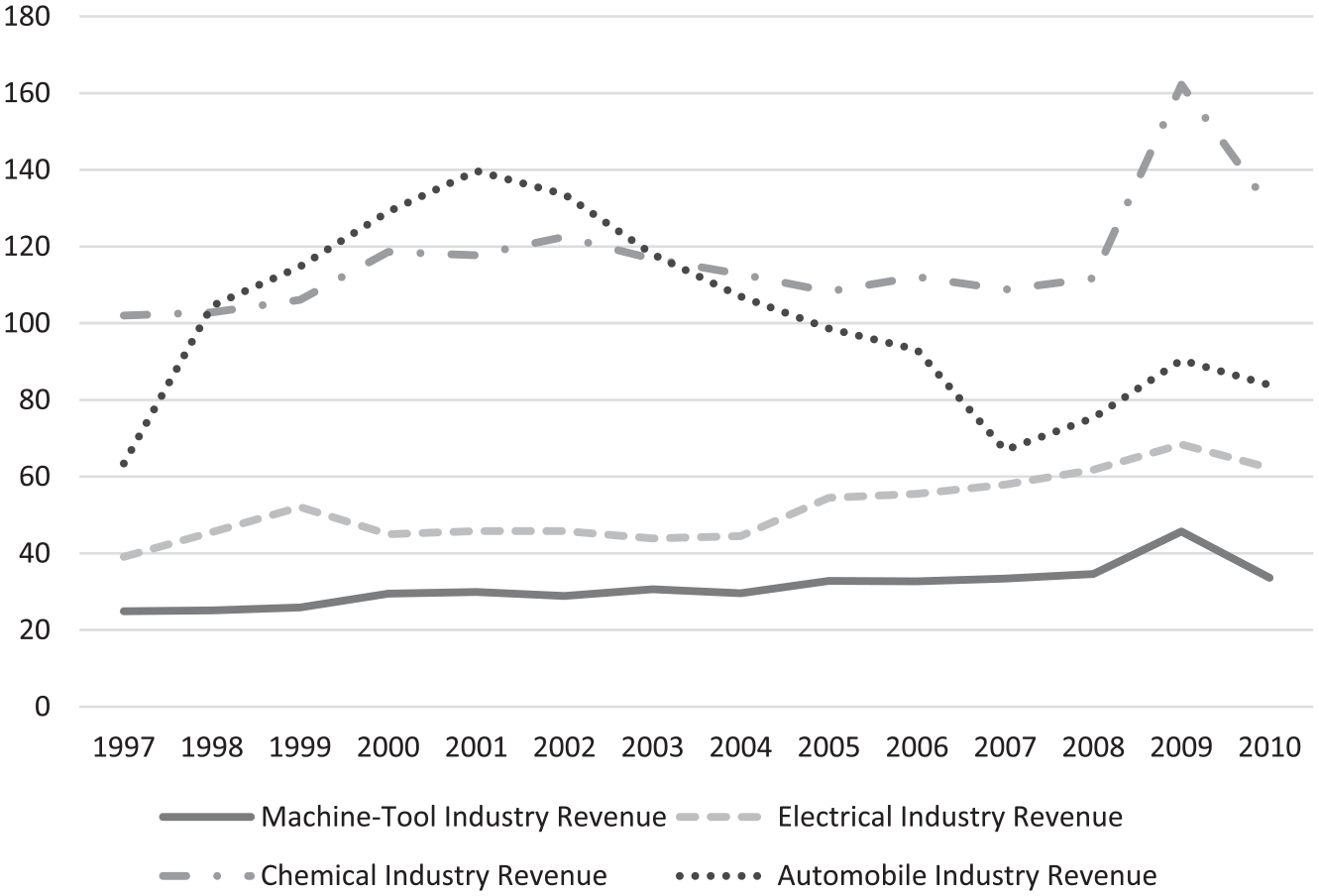
The export orientation of the automobile and machine-tool industries was virtually identical in 2017, so export orientation by itself is insufficient to explain why the machine-tool industry mobilized while the automobile industry did not. To gain a better understanding of these dynamics, Figure 1 shows the gap in firm size between member companies of these different associations.

Revenue (Million €) per Member of German Industrial Sectors, 2016.
On average, firms in the machine-tool industry are highly export-oriented but smaller than firms in the other three sectors. Approximately 87 percent of VDMA member companies have fewer than 250 employees, and only 2 percent have more than a thousand employees. 80 In addition, I suggest that the machine-tool industry’s considerably lower level of internationalization helps explain the VDMA’s greater vulnerability to protectionist and populist pressures. 81 Figures 2 and 3 show that the machine-tool industry has less productive diversification and internationalization than the other sectors. Multinational corporations with global supply chains are certainly vulnerable to protectionism and deglobalization, 82 but they are able to shift production to different jurisdictions—a firm that produces only in Germany does not have that ability.

Employees in Countries Other Than Germany as a Proportion of Employees in Germany (Percentage).
Figure 2 shows that the German chemical and auto industries have more employees outside of Germany than they do inside Germany. By contrast, the machine-tool industry employed just 37 percent as many people outside of Germany as inside, as of 2010.
Revenue from Plants in Countries Other Than Germany as a Proportion of Plants in Germany (Percentage).
In Figure 3, we see that for the machine-tool industry, factories outside of Germany account for only one-third as much revenue as factories inside Germany. For the other industries, the proportion is much higher. Together, the evidence shows the limited extent to which production in the German machine-tool industry is internationally diversified. The other industries have a higher proportion of employees in, and derive a higher share of their revenues from, plants outside Germany than the machine-tool industry.
Member companies of the VDMA tend to be medium-size and export-oriented; their production facilities and employees are more concentrated in Germany than other sectors. In addition, the scarcity of very large companies in the VDMA affects the relationship between the association and its member companies. The other three sectors contain a number of large, global firms—such as BASF in the chemical industry; Volkswagen, BMW, Mercedes-Benz, and Bosch in the automobile industry; and Siemens in the electrical industry—with their own public and government relations people and lobbyists. I expect the large German auto companies and suppliers to conduct their own lobbying, public relations, and public affairs campaigns, which may explain why the VDA has not engaged in this issue in the same way as VDMA. By contrast, few machine-tool producers have the staff, resources, and capacity to pursue those activities effectively. As Gernandt pointed out to me, the VDMA staff of several hundred in Frankfurt, Berlin, Brussels, and elsewhere “bundle up and combine the voices of small firms,” 83 which amplifies the voice of the association.
The explanation advanced for the VDMA applies to the WVIB as well: on average, the WVIB’s member companies have 230 employees and annual revenues of €49 million. Their export orientation is roughly 60 percent, and only 15–22 percent of their employees work in foreign countries. 84 Both VDMA and WVIB member companies are very vulnerable to protectionism; on account of their size, they mobilized their associations to defend the liberal democratic market order.
The Business Association for a Liberal, Open-Minded, and Cosmopolitan Saxony
In September 2015, a number of firms came together to discuss the far-right Pegida marches, which brought thousands of people to the streets of Dresden in 2015–16; attacks on refugees and refugee shelters in towns such as Bautzen, Clausnitz, Freital, and Heidenau; and the growing strength of the right-wing populist AfD in Saxony. After almost a year of discussion, deliberation, and planning, they formally established the Business Association for a Liberal, Open-Minded, and Cosmopolitan Saxony (Verein Wirtschaft für ein weltoffenes Sachsen e.V.). “There were no role models for this association,” 85 which was set up to advocate publicly on behalf of its member companies; to counter xenophobic, racist, and nativist tendencies through educational work; and to promote and support the integration of immigrants and refugees into the labor market in Saxony. Unlike Unity.Justice.Liberty and #europeworks, the Business Association for a Liberal, Open-Minded, and Cosmopolitan Saxony is not an episodic campaign pursued by an existing organization for six to twenty-four months but an organization established for the long run with the sole purpose of defending liberal democracy and an open society from the populist right. Figure 4 shows the growth of corporate membership in this organization from its founding until the present.
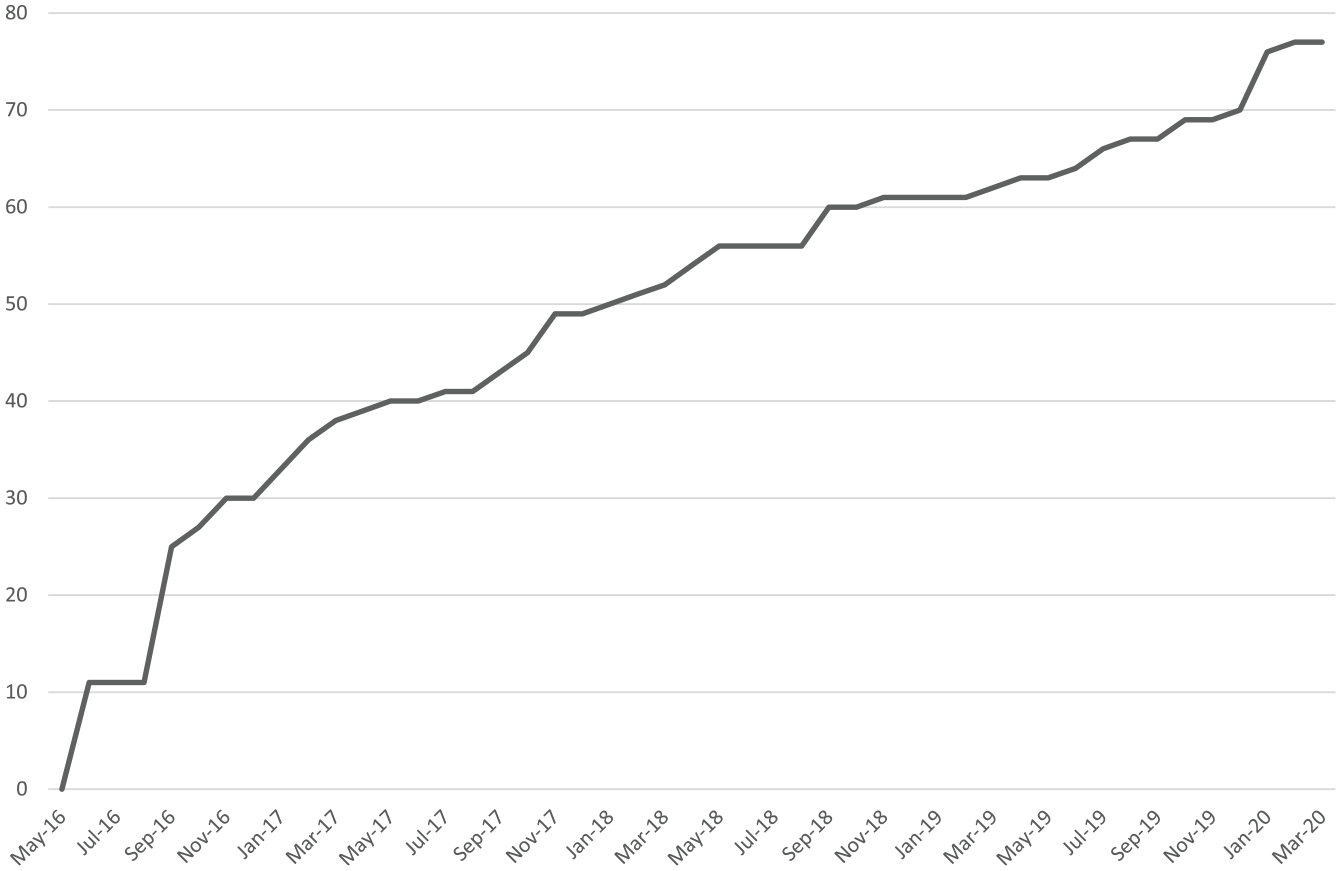
Corporate Membership in the Business Association for a Liberal, Open-Minded, and Cosmopolitan Saxony.
An exhaustive treatment of the Business Association for a Liberal, Open-Minded, and Cosmopolitan Saxon (hereafter “welcomesaxony”) lies beyond the scope of this article. This section provides a cursory overview of the association and its activities and draws on fieldwork to make three specific points. First, while all business organizations in this article are threatened by right-wing populism, the populist and radical right poses an especially acute threat for businesses in East Germany, particularly in the free state of Saxony in southeastern Germany. The Pegida marches in Dresden, for example, received substantial national and international media coverage. The resulting reputational damage became known as the “Pegida effect,” and welcomesaxony represents—in part—an attempt to improve the image of Saxony as well as counteract the underlying causes. Martin Dulig, chairman of the Social Democratic Party in Saxony (who as Saxon state minister for economy, labor, and traffic facilitated the founding of welcomesaxony), put it this way: “In 2015 the mood or sentiment in Saxony tipped, and inflicted long-lasting and sustained reputational damage to Saxony. Businesses said, ‘We have to do something!’” 86
Second, although material interests—for instance, the desire to protect and secure export markets and attract skilled employees to Saxony—are undoubtedly important, they are insufficient. Ideal interests or value orientations, more specifically a desire to defend liberal democracy, are powerful drivers of German business mobilization against the populist right. Third, a careful examination of welcomesaxony does not support the claim recently advanced by Iversen and Soskice in Democracy and Prosperity that the knowledge economy is a foundation of support for the liberal democratic order.
Welcomesaxony’s founder, Andreas von Bismarck, who served as chair of the supervisory board until his untimely death in October 2019, was CEO of Terrot, a knitting machine manufacturer in Chemnitz, a city approximately an hour away from Dresden. Concerning full employment and demographic shifts, Bismarck emphasized the difficulties firms such as Terrot face in attracting and hiring skilled employees. Pegida and the rise of right-wing populism as represented by the AfD damage the reputation of Saxony and make it even harder for companies such as Terrot to attract employees to Saxony. This provides one major business rationale for welcomesaxony. But business and economic interests are only part of the story. While politically tolerant—he stressed that he is not opposed to the AfD per se, but only to its extremist nationalistic wing—Bismarck also stressed his political responsibilities: “We have rights, but also duties: in a democracy you have a duty to speak up and weigh in on important issues” by opposing fundamentalism and xenophobia. 87
Sylvia Pfefferkorn, one of the organization’s founders and board members, stressed the fragility of democracy: Democracy is always vulnerable to attack. . . . We have seen that systems can tip and collapse. . . . I come from the German Democratic Republic. I experienced reunification. Considering that experience, it frightens me when people on the street yell “Lügenpresse” [lying/mendacious press]. If one is interested in the Third Reich, in the possibilities one has to attack and undermine democracy from within, a major concern of mine is that democratic structures can be eroded and dismantled again. That is my motivation, that is why I engage in this.
88
Ingolf Brumm runs a construction company in the city of Meißen, outside Dresden. Brumm is a member of welcomesaxony, but his most substantial engagement for a liberal, open-minded, and cosmopolitan Saxony predates the establishment of the organization. In summer 2015, Brumm was renovating a house located at Rauhentalstr. 14, which was to be leased to public authorities to house refugees. In early June, a threatening note was placed on the front door of this building, but police refused to pursue the case. On the night of June 28, the building was in flames, and as it burned some people on the streets cheered. The right-wing extremists who had set the fire and who subsequently tried to flood it eventually received prison sentences, but it was immediately clear to Brumm that he would rebuild the house for the refugees, and he said so then and there. 89
Brumm did not intend to get involved in controversial political issues, let alone receive death threats for doing so; rebuilding the house was costly and almost led him and his company to financial ruin. But it was clear to him that it had to be done. These actions and the strong value orientation that underlie them resemble Max Weber’s “ethics of conviction,” epitomized by what Martin Luther said at the Diet of Worms: “Here I stand; I can do no other.” What matters, Weber wrote, is “the trained ability to look at the realities of life with an unsparing gaze, to bear those realities and be a match for them inwardly.” 90
Frank Bösenberg, the managing director of Silicon Saxony, an association of IT companies with about 65,000 employees that have membership in welcomesaxony, states that although welcomesaxony is nonpartisan and above party lines (überparteilich), that does not mean that it is apolitical: they clearly support a liberal democratic basic order (Grundordnung), and defense of that order has independent value, being not subject to an economic cost-benefit calculus. Along these lines, Heinz Martin Esser, the president of Silicon Saxony, states that he “felt a moral obligation,” that he “had to do something to stand up against Pegida and the populist right: we’ve got to do something!” 91 What I am suggesting here is that although it is rational for many German businesspeople to mobilize against the threat of right-wing populism, crude materialist explanations for business mobilization are insufficient. Instead, following Weber, we should view these people as being motivated by both ideal and material interests.
Next, I examine which business constituencies are at the forefront of mobilization against right-wing populism. In the preceding sections of this article, we have seen that medium-size, export-oriented manufacturers engaged themselves for these ends. This section contributes firm-level data to the analysis, which allows us to assess the claim advanced by Iversen and Soskice in their recent book that the knowledge economy is a bulwark, foundation, or mainstay of support for the liberal democratic market order. 92
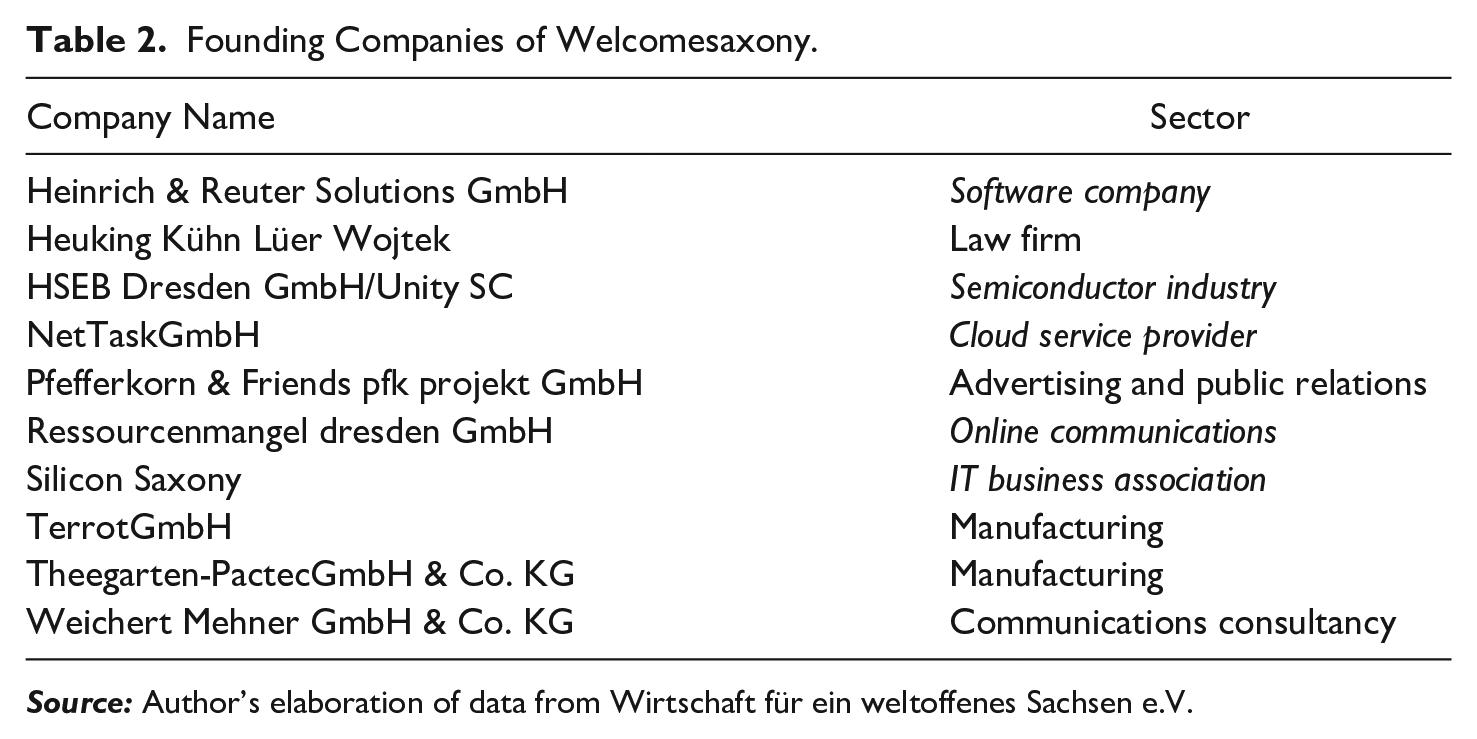
Table 2 provides a breakdown of welcomesaxony’s founding organizations by sector. To ease identification, firms that belong to the knowledge economy are italicized.
Founding Companies of Welcomesaxony.
Source: Author’s elaboration of data from Wirtschaft für ein weltoffenes Sachsen e.V.
Roughly half of welcomesaxony’s founding organizations are from the knowledge economy, including Silicon Saxony, a business association representing approximately 350 firms in Saxony’s high-tech sector.
In 2019, nearly 50 percent of welcomesaxony members belonged to the service sector. (See Fig. 5.) The smallest group, just under 10 percent of members, can be classified as nonprofit organizations and associations such as local and regional chambers of commerce. At just over 20 percent, the proportion of companies belonging to manufacturing and the knowledge economy is nearly equal.
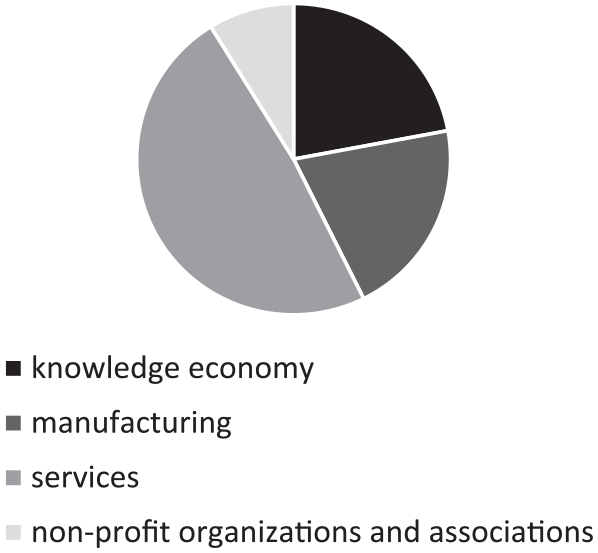
Sectoral Breakdown of Welcomesaxony Membership, 2019.
People representing firms in the knowledge economy made up half of welcomesaxony’s board of directors in 2019. Although that is a substantial share, the chair of welcomesaxony’s supervisory board has always been from the manufacturing sector. 93 More important, the association’s staff and board members, including welcomesaxony’s own knowledge-economy people, are in unanimous agreement that firms from the knowledge economy are not more active, engaged, or important to the goals of the association than other members. 94 In conjunction with the mobilization of the WVIB and the VDMA—two associations that represent export-oriented manufacturers—this suggests that Iversen and Soskice’s claim about the leadership of the knowledge economy in the defense of liberal democracy is not supported by the German evidence. Firms and business associations from the knowledge economy are mobilized against the populist right in Saxony, but not more so than other firms. Overall, firms from the knowledge economy seem less engaged in the defense of Germany’s liberal democratic order than export-oriented manufacturers.
A comprehensive analysis of welcomesaxony’s achievements lies beyond the scope of this essay, but the association has used its growing membership to flex its political muscle. In early 2019, the idea was circulating that the center-right CDU (Christian Democratic Party)—which has governed Saxony since reunification—could and should form a coalition government with the populist far-right AfD after the Landestag election in Saxony. Welcomesaxony denounced this idea in very clear terms and warned against a departure from the solid guardrails of democracy. The association’s engagement helped ensure that openness and cosmopolitanism were anchored in the coalition agreement of the parties that form the new state government of Saxony. 95
Why did business mobilization end rather quickly in Baden but persist in Saxony? Right-wing populism—not just the vote share of the AfD, but also the Pegida marches and the attacks on refugees and refugee shelters—is a greater threat to Saxony than it is for West Germany, where most of the VDMA and WVIB’s member companies are located. In addition, the other two associations’ decisions to move forward were made in a relatively short amount of time, while discussions and deliberations took place for almost a year before the establishment of welcomesaxony. In the words of Sylvia Pfefferkorn, “From the very beginning we thought long-term. Even if the motive of the association’s establishment was the rise of right-wing populism, which was relatively late to arrive in Germany in comparison with the rest of Europe, it was clear to us that long-term engagement would be necessary to successfully defend an open society.” 96
Discussion and Conclusion
A leading scholar of employer mobilization in the United States points out that “we know little about whether employer mobilization occurs in other advanced democracies in the present day. Understanding whether employer mobilization is happening in those countries and, if so, what form it is taking is likely to be an especially useful line of research.” 97 By showing how three German business organizations have engaged in collective action to defend liberal democracy and the embattled European Union from the populist right, this article advances our understanding of employer mobilization in response to the current wave of right-wing populism. The argument advanced is threefold.
First, economic self-interest is a powerful driver of business mobilization. Firms that mobilize and engage in collective action are especially vulnerable to a collapse of the European Union and the global free market order. But while material interests—for instance, the desire to counter protectionism, secure export markets, and attract skilled employees—are foundational, it is far from clear that they are sufficient. Liberal democratic values, what Max Weber called “ideal interests,” matter too.
Second, along the lines of corporate liberalism, a number of leading business officials who mobilized against the populist right stress the need to reform the system, democratize the European Union, and address the plight of those who feel “left behind.” This finding resonates with scholarship pointing to populism as a problem of “subjective social status” 98 as well as of social integration—of “people who feel that they have been socially marginalized.” 99 To overcome these problems, it will be necessary to undertake “economic measures aimed at improving the material situation of people” as well as “a sustained symbolic politics built on national narratives that accord respect to all groups and regions within the national community.” 100 As yet, it is unclear to what extent such employer advocacy has translated into broader political activism in terms of wages or social policy. Will employers be open to a new, more redistributive social compromise that could overcome problems of “dualism” and preserve the open international economic order while preserving domestic stability—much as John Gerard Ruggie described in his work on “embedded liberalism”? 101
Third, medium-size, export-oriented manufacturers are the core business constituency in support of liberal democracy and the European Union in Germany. Although large firms with global supply chains are also sensitive to protectionism and backlash against globalization, it is easier for them to relocate production, and they do not depend on associations to articulate their political priorities to the same extent as small and medium-size companies. What we have, in effect, is a curvilinear relationship between firm size and association mobilization: whereas small and medium-size firms rely on associations to bundle and combine their voices, large firms do not. Regarding sectoral variation, while firms from the knowledge economy are an important and integral part of business mobilization in Saxony, the evidence in this article does not support the claim that the knowledge economy is the sole bulwark against the new populist nationalism.
The German case shows that businesses are potentially a vanguard, a strong and loud voice in defense of the liberal international order against right-wing populism. There are nevertheless some German tradesmen and small shopkeepers (usually small or micro-enterprises) who are showing their loyalty to the populist right; Tino Chrupalla, a businessman turned Bundestag politician of the AfD party, is one prominent example. But relatively few do so openly. Along with the evidence in this article, this suggests that the Nazi past shapes the behavior of German business, and that Germany may be an “extreme” or “most likely” rather than a typical case for business mobilization against right-wing populism.
How representative is the German case? How does the German case fit into the larger universe of cases of business responses to right-wing populists? Determining whether the employer mobilization for liberal democracy described in this article is possible in other countries, or whether divisions, ambivalence, or the absence of a German-style export model or Nazi past weaken or undermine the ability of business groups in other countries to mobilize against the populist right, is an important agenda for future research. A systematic comparison with other countries would help reveal to what extent the comparatively high levels of German mobilization against right-wing populism is driven by material interests or by norms, identity, collective memory, 102 and the peculiarities of German history. One recent book suggests that business association officials from northern Italy, home to Italy’s most export-oriented manufacturers, were particularly outspoken and vocal in their critiques of the Di Maio/Salvini government. 103 But in Sweden, it was tech entrepreneurs and financiers who spoke out against the center-right alliance assuming political power with the support of the right-wing populist Sweden Democrats. 104
Feldmann and Morgan identify three key factors in the 1975 British referendum campaign about membership in the European Community and in the 2016 Brexit referendum: incentives for business involvement, the legitimacy of business involvement, and the business capacity to engage in collective action. 105 On each of these dimensions, the German business community’s engagement in collective action contrasts with the severe difficulties of the British business elite in recent years. Of course, the challenge Brexit poses for British business—in a deeply divided and polarized country—is in many ways uniquely difficult. In Germany, right-wing populists are comparatively weak, or at least at some remove from political power.
The mobilization of German business against the populist right provides an interesting contrast to the United States, where the overall picture is mixed. There is evidence of reactionary mobilization, 106 but there are also some more progressive instances. 107 Employer mobilization is easy to critique when it is illiberal, coercive, or regressive—but what are scholars to make of employers’ standing up and speaking in support of an embattled liberal democracy? That is an interesting normative question for future research.
A comparison with Hungary, where the right-wing populist Viktor Orbán has secured political domination with the loyalty and support of large parts of Hungarian business, 108 could also be fruitful. The Hungarian case can help us to understand the circumstances in which business is loyal to authoritarian populist autocrats and complicit in projects of democratic deconsolidation.
In conclusion, the rise of the populist right has made the relationship between business and politics more complicated and conflictual than it was in the heyday of neoliberal globalization. One thing is certain: more research is needed on the relationship between business and the populist right.
Footnotes
Acknowledgements
I would like to thank the editorial board of Politics & Society, and especially Kimberly Morgan, for detailed and helpful comments on earlier versions of the article. The article also benefited from insightful comments and feedback from Steffen Blings, Bart Bonikowski, Lea Elsaesser, Timur Ergen, Wade Jacoby, Ayse Kaya, Rami Kaplan, Dan Kelemen, Thomas Paster, Sidney Rothstein, Tobias Schulze-Cleven, Christopher Way, and participants at the 2017 Workshop on Rethinking German Political Economy, the 2017 Philadelphia Europeanists Workshop, the 2018 Council for European Studies meeting, the 2018 Democracy in Decline? The Challenge of Global Populism Conference at the University of Delaware, and the 2019 American Political Science Association meeting. I am especially grateful to all my interviewees for their invaluable insights. Without them, this article would never have been possible. The responsibility for errors is mine alone.
Declaration of Conflicting Interests
The author declared no potential conflicts of interest with respect to the research, authorship, and/or publication of this article.
Funding
The author disclosed receipt of the following financial support for the research, authorship, and/or publication of this article: The author is grateful for support from the Center for Global and Area Studies and from the Department of Political Science & International Relations at the University of Delaware.