




Abstract
Pepper Culpepper’s seminal Quiet Politics and Business Power has revitalized the study of when business elites can shape policies away from public scrutiny. This article takes the concept of quiet politics to a new, and surprising, set of actors: trade union leaders. Focusing on the case of Denmark, it argues that quiet politics functions through political elite networks and that this way of doing politics favors a particular kind of corporatist coordination between the state, capital, and labor. Rather than showing macrocorporatist coordination between the two classes and governments, it identifies representatives of business and labor that hold privileged positions in political elite networks. Representatives of segments are found in industries important for the Danish economy, specifically, the exporting manufacturing sector. Being at the core of the network requires not only a key position in the Danish economy but also an understanding that politics is often done best without politicians and voters. The analysis shows that trade union and business association representatives work closely on a wide number of issues through quiet politics, using their extensive network to broker and foster agreement between different stakeholders.
In this article, we argue that it is not just business that gets what it wants through quiet politics. 1 In some countries with strong labor movements, corporatist elites of which trade union leaders are a part can also exercise disproportionate influence over policy through quiet politics. In Europe, corporatism and tripartism have come under severe pressures from union decline, austerity policies, re-parliamentarization, and neoliberalism. 2 Moreover, integration through the European Union has meant that the state needs to focus on the European level rather than national political exchanges. 3 These pressures have also challenged the traditionally strongly corporatist Nordic countries. In the comparative political economy and comparative politics literature, Denmark is most often considered to be a coordinated market economy or social corporatist political system, albeit with some liberal elements. 4 The Danish political system affords considerable inclusion of interest groups into policymaking across multiple policy areas, 5 and the social partners—trade unions and business associations—to a large extent decide the terms and conditions of employment through collective bargaining. 6 Recent scholarship on Denmark debunks the argument that Danish corporatism is dead and finds strong and enduring corporatist policymaking due to strategic reorientation on the part of trade unions and business associations to cope with the challenges to corporatism. 7
Going beyond these studies, we argue that the specific Danish version of corporatism and its resilience is due to strong network interlocks of certain segments of the labor movement and business associations, forming a so-called cross-class alliance. 8 This alliance grew out of shared interests between the business association of exporting companies (the Confederation of Danish Industries, or Dansk Industri) and the metalworkers’ union (Dansk Metal), and gradually took over from the peak-level confederations of capital and labor. Trade union leaders owe their membership in the elite network to the cross-class alliance with the business association that represents companies that are vital for the Danish economy. These businesses are primarily in export-based manufacturing and employ skilled workers and engineers for high-value-added products and services.
The power of this alliance depends on quiet politics in political elite networks. Quiet politics—as defined by Pepper Culpepper 9 —often involves technical issues that voters do not care about, and because voters do not care, there is little to gain for politicians from intervening. Once an issue becomes highly salient, the cross-class alliance will have a harder time pushing its preferences through because other unions, voters, and politicians will push back. Elite networks are an ideal setting for quiet politics, because they involve a small core of actors that can deliberate on complex issues without the interference of the media, voters, and vote-seeking politicians.
We also argue that integration in the political elite network puts trade union leaders in a particular dilemma. Inclusion in the network means unparalleled ties to not only business association representations but also to corporate leaders, politicians, high-ranking civil servants, university leaders, and cultural elites. Being in these networks means being part of a political elite that sets the direction and pace of policy reforms. However, the material interests of the alliance are often at odds with unions organizing workers in sheltered sectors, most notably the public sector, construction, and parts of the service sector. 10 These unions do not experience the pressures of international competition and therefore have different interests than the metalworkers. Trade unions in the alliance thus face an often uncomfortable choice between pursuing particularistic goals of the alliance with business, on the one hand, and solidaristic goals of the worker movement, on the other. Whereas scholars have debated whether class is more important than alliance, 11 we see this as a strategic dilemma, the solution to which often depends—as Culpepper has shown—on the salience of an issue.
The article heeds the call by Glenn Morgan and Christian Ibsen (in the introduction to this special issue) that comparative political economy studies can benefit from an integration of quiet politics and elite studies. We show empirically how a historical institutionalist study of labor politics and corporatism can be combined with elite network data to provide a more nuanced and compelling account of the conditions under which certain trade unions have disproportionate power. The structure of the article is as follows. First, we integrate the theory of quiet politics and corporatism and in doing so extend its focus from business to political elite networks that include union leaders from the cross-class alliance. Second, we outline our methods and data. Third, we give a short background on Danish corporatism and labor politics. Fourth, we present the network analysis used to identify key union actors in the Danish political elite networks. Fifth, we present cases of quiet and noisy politics in Denmark to illustrate the conditions under which the cross-class alliance gets what it wants. Finally, we conclude by discussing the political dilemmas for union leaders in the political elite and the implications of our study for future research.
Theory
The more the public cares about an issue, the less managerial organizations will be able to exercise disproportionate influence over the rules governing the issue.
—Pepper Culpepper, Quiet Politics and Business Power, 177
Whereas Culpepper focused on business power and quiet politics, we argue that quiet politics is not limited to business. In some countries with strong labor movements, corporatist elites of which trade union leaders are a part can also exercise disproportionate influence over policy through quiet politics. However, we argue that only some trade union leaders can be part of these elite networks. Moreover, these leaders have to have business-friendly preferences and know how to keep politics quiet. Other studies have found that Nordic countries still have the characteristics of corporatism with interest groups in privileged positions and vibrant collective bargaining systems. 12 These studies find that trade unions and employers continue to hold privileged positions in policymaking across a wide range of areas and engage in high-level policy exchanges on important issues. In addition, collective bargaining, albeit decentralized from national to industry and company level, is still coordinated and has incorporated new topics such as pensions, education, and parental leave. Although these studies have been useful to dispel the “death of corporatism” in Denmark and other Nordic countries, they have been lacking in two regards.
The first problem is that the literature has focused on the level and nature of social partners’ activities in policy committees and social pacts or on the structure of collective bargaining, rather than asking under what conditions social partners come to decide instead of politicians. To remedy this omission, we suggest that the concept of “quiet politics” and the notion of political salience will add to our understanding of continued corporatist policymaking in Denmark. Culpepper’s original concept of quiet politics refers to rule-making processes and outcomes by business outside the attention and interruption of politicians. He studies corporate governance rules and argues that that type of regulation does not attract a lot of voter attention despite its severe impact on the distribution of wealth and power in a political economy. It is a low-salience topic. One reason for low salience is the legal-technical nature of corporate governance, which makes the issues and dilemmas hard to grasp for voters, journalists, and politicians alike. Quiet politics with low salience is often based on high levels of expertise controlled by a few actors and done in arenas that do not attract media and politicians’ attention. And—Culpepper argues—if voters do not care about a topic, politicians have little to gain from intervening. In turn, business power increases because it is left to regulate itself away from public and politician scrutiny. The ability to do quiet politics is therefore a function of the level of salience. Once an issue attains high salience, politics is taken out of the hands of the business elite and put into the hands of the media, voters, and ultimately parliament. Partisan politics becomes prominent if reforms are highly salient.
The relationship between quiet politics and corporatist structures is discussed at the end of the book, where Culpepper distinguishes between formal and informal institutions. We argue that in corporatist countries the distinction between formal and informal is blurred because regulation by social partners—for example, collective bargaining—is highly formalized, and often governments will delegate regulatory capacities to social partners. 13 Therefore, we prefer a distinction between extraparliamentary and parliamentary to distinguish between different regulatory arenas. Combining this dimension with the salience dimension, we get a 2 × 2 table, depicted here as Table 1.
Salience, Political Arenas, and Examples of Quiet versus Noisy Politics.

The power of elites over policy is greatest under conditions of low salience and in extraparliamentary arenas, that is, in private interest governance (southwest quadrant). Here, social partners in corporatist countries are left alone to decide and implement regulation, and they can do so without public attention. Some collective bargaining rounds fall in this category. Under the other conditions, corporatist elites must negotiate with either the public in high-salience collective bargaining rounds and social pacts (northwest quadrant); with bureaucrats on, for example, educational policy and regulatory policy (southeast quadrant); or with politicians on, for example, welfare, fiscal, and immigration policy (northwest quadrant). Clearly, the last quadrant is the most challenging for social partners, as they have to fight for influence over politicians with other groups and politicians will often follow voters rather than interest group resources. However, that is not to say that this quadrant is impossible: interest groups hold sway over considerable lobbying resources. By making these distinctions, Culpepper identifies the conditions under which social partners are most likely to decide instead of politicians. This is an important improvement of the current scholarship on corporatism.
A second problem in the current literature on corporatism is that it does not adequately distinguish differential status and integration into the policymaking of different groups of social partners. Trade unions and employers are often treated as monolithic blocs of labor and capital, respectively. 14 In contrast, we argue that the CPE literature on cross-class alliances has given us a better characterization of why some social partners are more important than others. 15 In Denmark, these actors come from key industries and companies for the economy, more specifically the exporting manufacturing sector. If business and political elites can incorporate “responsible” and pragmatic union leaders into the elite networks, then business can achieve some of the things they historically achieved under encompassing confederation bargaining: for example, public goods such as wage moderation in collective bargaining, public investment in education and skills, and benign industrial policies. 16 Thus, cross-class alliance theory can help us identify and explain why some actors are allowed into political elite networks and why some are marginalized or kept out. In turn, the inclusion and exclusion mechanisms can inform us about which actors and interests matter in quiet politics and which actors have to engage in loud politics to make a difference.
Going beyond Culpepper and cross-class alliance theory, we argue that quiet politics works best through political elite networks. By holding multiple positions in governance networks, certain representatives of social partners become key players across multiple policy fields. However, entering into elite networks both provides a unique access and also imposes restraints on the organizations who become embedded in the network. 17 For example, as Michael Useem argues, studying corporate interlocks, integration to the inner circle of business networks leads to the adaptation of a class-wide rationality—a form of enlightened self-interest of the entire capitalist class. 18 Dissent from the overarching consensus, in particular to follow the narrow interest of one’s own organization, is sanctioned in the network, according to Useem. Thus, union leaders who enter the core of elite circles could be regarded as part of a national power elite that sets the direction for the nation or at least an elite settlement forming a consensually united elite. 19
Following the cross-class alliance theory, the question should not be whether unions are integrated in elite networks but rather which unions are integrated. Moreover, if some union leaders are members of elite networks, they in many ways occupy a position as “structural folds,” 20 being multiple insiders in both the field of trade unions and a wider network bridging to elites in fields such as business, politics, state administration, and science. As argued by Balázs Vedres and David Stark, structural folds hold a unique strategic position with close ties to two groups. However, these positions are often fragile, as conflicts of interest and divided loyalties may occur. Therefore, multiple memberships present a dilemma. Union leaders have strong incentives to engage in salient issues—or even add to the salience of them—as they depend on mobilizing their rank-and-file members for legitimacy and long-term organizational growth. 21 However, taking an aggressive stance on one issue and “going public” endangers the privileged position in elite networks and in quiet politics. In keeping with the cross-class alliance literature, unions in manufacturing will have to balance their own preferences for employment and skills premium in wages and competitiveness—as well as strategic positions in governance structures—with the long-term working class interest in shoring up equality in the rest of the economy. 22 The intraclass allegiance is vital, because union leaders are not natural members of the elite; they have to earn their spots by being a powerful representative of a potentially revolutionary class while at the same time disciplining that class in line with the requirements of capitalism.
Methods and Data
Our empirical analysis relies on two different types of data compiled over the years by the authors. To identify the institutional trajectory and blueprint of the Danish cross-class alliance, we draw on eighty semistructured interviews with high-ranking representatives of trade unions, employer associations, and government. The interviews were conducted during the period 2010–18 on collective bargaining coordination, labor market reforms, and reforms in vocational education and training. The focus of the interviews varied thematically, but all interviews contained questions about coordination between parties and the “who gets what, when, and how” in Danish producer group politics. Moreover, the interviews were concerned about processes—about both specific policies and collective bargaining rounds and the historical trajectory of the Danish political economy more generally. Interviews lasted between one and three hours. We added media appearances (using the media database Infomedia) 23 of union leaders to gauge their political strategies and the issue of noisy versus quiet politics and did follow-up qualitative interviews with seven union leaders about their positions and strategies in elite networks.
To explore the network relations between union leaders and the rest of the Danish elite, we draw on a comprehensive mapping of the boards of all potentially powerful affiliations—state agencies, top corporations, foundations, interest and nongovernmental organizations, and parliament—collected in 2013 and 2016 (see Table 2). We use this data set to show how central union leaders are in political networks and with whom they have affiliations. Affiliations are to a large extent based on membership of boards or other governing bodies of organizations, complemented by commissions and advisory boards. Thus, members not only meet but also collaborate on decision-making, often with strong norms toward seeking consensus. In 2013, we include just fewer than 5,000 affiliations with slightly fewer than 50,000 positions held by around 38,000 individuals. In the 2016 analysis, we have extended the coverage of elite networks, in particular in central government, and now include 5,583 affiliations in total. The aim has been to create an exhaustive list of all potentially powerful affiliations, enabling us to investigate relationships within this elite network (the principles behind the collection of network data have been described elsewhere). 24 Changes between the two data points are primarily due to the establishment of new affiliations around new organizations—in particular commissions, think tanks, and advisory boards—or changing roles of government agencies. Thus, although the affiliations between individuals are not exactly the same, we still cover the same political network.
Network Data.
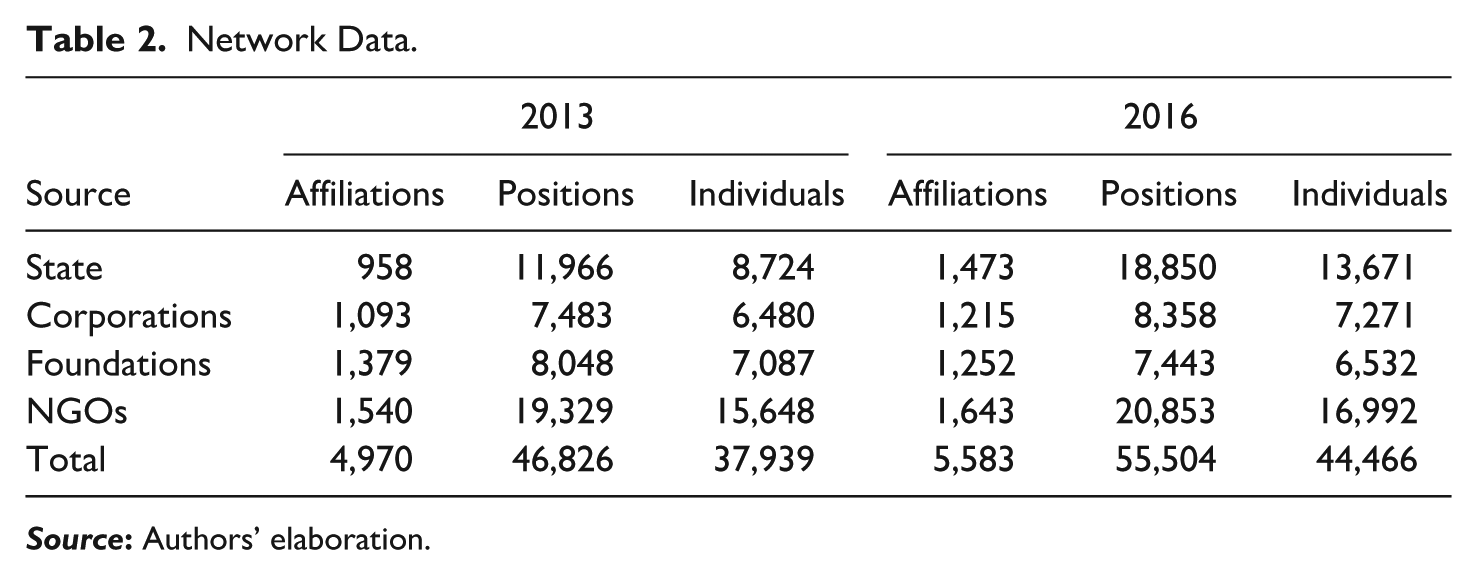
By applying a weighting scheme designed to account for the heterogeneity in the size of affiliations, it is possible to calculate the centrality of actors within this elite network. Thus, we are able to describe the number of positions or memberships held by individuals together with their number of direct ties. We use several measures of centrality in the network. 25 Closeness measures the mean distance from one individual to another in the network. This measure can be interpreted as their proximity and independence of information. Betweenness measures the extent to which an individual lies on the shortest path between other individuals in the network. Individuals with high betweenness control information passing between others that can be interpreted as their opportunity to serve as brokers. The most robust measure of centrality, however, is the reach on an individual to other linkers, that is, individuals with at least two positions in the network.
To find the most cohesive group, we use a k-core decomposition which finds the group in the network in which everyone has the highest minimum degree of affiliations to other members in the network. 26 We find that the core of our network contains a national political elite, identified by the 423 individuals having a coreness score of 199 in the weighted network. This coreness score is closely correlated (0.96) to the ranked closeness centrality of individuals. A high rank in both reach and the closeness can thus be seen as a proxy for membership of national power elite group. Furthermore, we can explore the ego-networks of individuals, for example, the union leaders, including how many leaders from other sectors they are tied to. Having a large number of ties to a high number of sectors, especially to corporate leaders and representatives from employer associations in manufacturing, combined with having central positions in the elite network as a whole, is interpreted as being a part of a cross-class elite network.
History of Danish Corporatist Political Economy and Labor Politics
Denmark is normally considered to be a highly coordinated political economy with extensive involvement of interest groups in policymaking and policy implementation. 27 Peter Katzenstein described Denmark as a social corporatist small open economy that favored negotiated adjustments of industrial policy between strong trade unions and employer associations. 28 During the heyday of corporatism after the Second World War, confederations of labor (Landsorganisationen i Danmark, or LO) and capital (Dansk Arbejdsgiverforening, or DA) would design and implement policy across multiple issues together with governments from both the left and the right, and it was almost inconceivable to pass major legislation without the consent of the major economic classes. 29 Parliaments were historically weak, and minority governments benefited from policy exchanges on wage moderation, employment policy, and fiscal policy with strong, encompassing interest groups that would take societal responsibility for economic growth and social inclusiveness. 30 Social partners sat in important policy committees and councils with de facto decision-making powers over policy. 31 Together with bureaucrats, interest groups could bring expertise and resources into policy making and produce policy proposals that governments would get parliament to pass. Moreover, large-scale incomes policies through centralized bargaining or social pacts were used to weather inflationary pressures that could hurt the current account balance. 32
An important reason for this privileged position was (and is) the extensive system of collective bargaining between employer associations and trade unions that regulate the terms and conditions of employment for the vast majority of workers in Denmark. Collective bargaining took place at the national level between LO and DA with general wage increases and working-time regulations for almost all private and public sector workers. 33 The extensive collective bargaining system was founded on expansive rights to sympathy strikes against unwilling single employers and collaborative employers’ associations, the membership of which required collective bargaining coverage. Furthermore, unions were (and are) in charge of unemployment insurance funds, which stabilizes union density at a high level because workers will normally opt for dual membership of both unemployment insurance and union membership. 34 Moreover, this so-called Ghent system gives unions a particular stronghold in employment policy.
The corporatist system came under pressure in the 1980s when the privileged access to policymaking was cut off by the incoming conservative government. Inspired by Thatcherism and New Public Management, the government related endemic unemployment and the current account deficit to wage inflation and public sector inefficiencies. Corporatist policy exchange was halting economic reforms and progress. Over the next two decades, the number of corporatist policy preparation committees declined from 188 to 39 in the period 1980–2015, 35 and the nature of inclusion also changed. Rather than producing policy proposals that parliament would pass, committees were now used in an ad hoc manner to give a point of view that governments and parliament could consider. 36 Taking away decision-making power increased government control over fiscal policy to restore public finances.
These developments did not mean, however, that corporatism died. In line with other scholars, 37 we find that corporatism in Denmark has taken a new form with more competition among a more diverse set of stakeholders, but nevertheless with a structuring logic. Specifically, we argue that peak-level corporatism was replaced by industry-level corporatism in which a strong cross-class alliance in manufacturing developed during the 1980s and 1990s. Through this alliance, Dansk Metal (the metalworkers’ union) gained a privileged position in political elite networks and became the dominant union in Denmark. Thus, during the recent three decades a strong cross-class alliance between Dansk Industri and Dansk Metal for skilled metalworkers has dominated policy. The alliance built on important shared interests in improving the competitiveness of exporting companies and making sure that governments would provide benign industrial policy. Industrial policy was understood broadly and included important public goods in terms of public funding for education, wage restraint, and support for research and development. Thus, Dansk Metal was drawn into the center of labor politics for two reasons, First, it had the “right” business-friendly interests congruent with the most powerful business associations. Second, it knew how to make deals in quiet politics. And, finally, business wanted a partner that could legitimize decisions that might be unpopular with workers from other parts of the labor movement, especially low-skilled workers and workers in sheltered sectors.
The Rise of Dansk Metal in the Wake of Peak-Level Corporatism
Parallel to the transformation of corporatist structures, collective bargaining at the peak level between LO (the labor confederation) and DA (the capital or employer confederation) was gradually displaced by industry- and company-level bargaining. The metalworking employers, Jernets Arbejdsgivere, spearheaded pushes for industry-level bargaining in Denmark, and it did so in alliance with Dansk Metal. The alliance had two goals that were instrumental to governments regardless of party color. The first was to restrain wage and pay hikes in sheltered sectors that could spill into wage-price inflation. This goal was signaled in the tripartite “Common Declaration” of 1987 in which LO unions pledged to moderate nominal wage demands, increase private savings, and thus restore the current account balance. As shown by the work of Peter Swenson and of Jesper Due and Jørgen Steen Madsen, 38 this was as much an intraclass struggle between manufacturing and construction as an interclass struggle between labor and capital. The second goal was to introduce wage and working-time flexibility that could increase returns to skills and productivity. This goal was signaled when the centralized normal wage system (normalløn) in collective agreements was gradually displaced by the more flexible minimum wage system (mindstebetaling) long preferred—and practiced—by Denmark’s skilled metalworking unions, Dansk Metal. Because Dansk Metal organizes skilled workers who have gone through advanced vocational education and training and often work side by side with graduate-level engineers, it was positive toward more wage flexibility. The first formal shift in wage structures came in 1991, when a large share of unskilled manufacturing workers previously under the more centralized wage systems was transferred to minimum wage systems. Working time was decentralized later on as well.
The impetus for forging the alliance came from organizational restructuring of employers and business associations in the 1980s and 1990s. 39 In 1991–92 a strong strategic alliance took shape on the basis of Dansk Industri. The new confederation of business was the result of two mergers—first between Jernets Arbejdsgivere and Industrifagene (the process manufacturing industries) to form Industriens Arbejdgivere, which then merged with Industrirådet (a manufacturing policy and lobbying organization). The move culminated the 1989 reorganization of DA that cut down its affiliates from 150 to 50 employer associations. Concentrating power in fewer organizations would make the move to wage moderation and wage flexibility possible. The organizational restructuring continued, and today there are only thirteen associations in DA. Within the DA family, Dansk Industri reigns supreme and organizes approximately 60 percent of the total wage sum in DA. Moreover, it dwarfs the second-largest employer association, the Danish Chamber of Commerce (Dansk Erhverv), which represents just under 20 percent of the total wage sum. 40
Trade unions within the LO movement debated whether to match the employer union’s concentration by forming industrial unions. Although unions in metalworking had long since created the bargaining cartel CO-metal, it was nowhere near matching Dansk Industri, which accounted for all manufacturing companies. The unions representing unskilled manufacturing workers—the National Union of Women Workers (KAD) and the General Workers Union (SiD)—attempted to create and lead a new manufacturing cartel within LO, but this attempt failed at the LO congress in 1991. 41 Instead, Dansk Metal mobilized other skilled unions to orchestrate the transformation of their own industry-wide cartel. Thus in 1992, CO-industri was formed between skilled and unskilled workers, the latter represented primarily by SiD and KAD, and with it a strong cross-class alliance in manufacturing—with concentrated actors on both sides—was born. The organizational restructuring put Dansk Metal in charge of the new managing council and at the same time relegated unskilled unions to a permanent minority status within manufacturing. Membership in the new bargaining cartel required giving up bargaining rights and control over agreements to CO-industri, which proceeded to cement the principle of decentralized wage systems. Thus, over the next few years, the entire wage formation system changed along the lines preferred by Dansk Metal.
By gaining a privileged position in collective bargaining in the wake of centralized bargaining, the alliance sets the pattern for regulation of wages and terms of employment. However, the position of the alliance is not restricted to collective bargaining; its interests are dominant in other broadly defined industrial policy arenas. This historical development is consistent with existing studies of cross-class alliance in Denmark, 42 but it does not account for how the alliance has built networks by which it can engage in quiet politics. We argue that strong network relations and quiet politics provide the ways in which the alliance gets to decide outside the remits of other unions, voters, and politicians. To substantiate our argument, we first turn to the network analysis and then to cases of quiet and noisy politics.
The Position of the Metalworkers’ Union Leader in Corporatist Elite Networks
The president of Dansk Metal is also the president for CO-industri and thereby the person who negotiates the pattern-setting agreement in the private sector. This is clearly an advantage in relation to creating networks because you are in touch with a lot of sectors and in many ways you are the one with the foot on the accelerator concerning how the society should develop.
—Claus Jensen, president of Dansk Metal and CO-industri
The formation of elite networks can be understood as a process of elite settlement by which fractions of the elite battling for power manage to find a modus vivendi in which they do not challenge their respective power bases, or what Roberto Michels calls the “amalgamation” of new elite groups into the established elite. 43 The foundations of such an elite settlement can be traced back to the 1899 “September Agreement” between the Confederation of Danish Employers and the Danish Confederation of Trade Unions. That agreement defined and delimited the power bases of labor unions to be respected by other elites and helped to forge an elite settlement that included unions in Denmark between 1901 and 1935. 44 However, decentralization of bargaining in the 1980s and 1990s and the new role of CO-industri in pattern bargaining changed who the key players in the Danish political economy are. Looking at elite networks allows us to ask a very precise question that typical corporatist studies do not ask: Which parts of the labor unions have become part of an elite settlement and to what extent does this overlap with the pivotal union in the cross-class alliance?
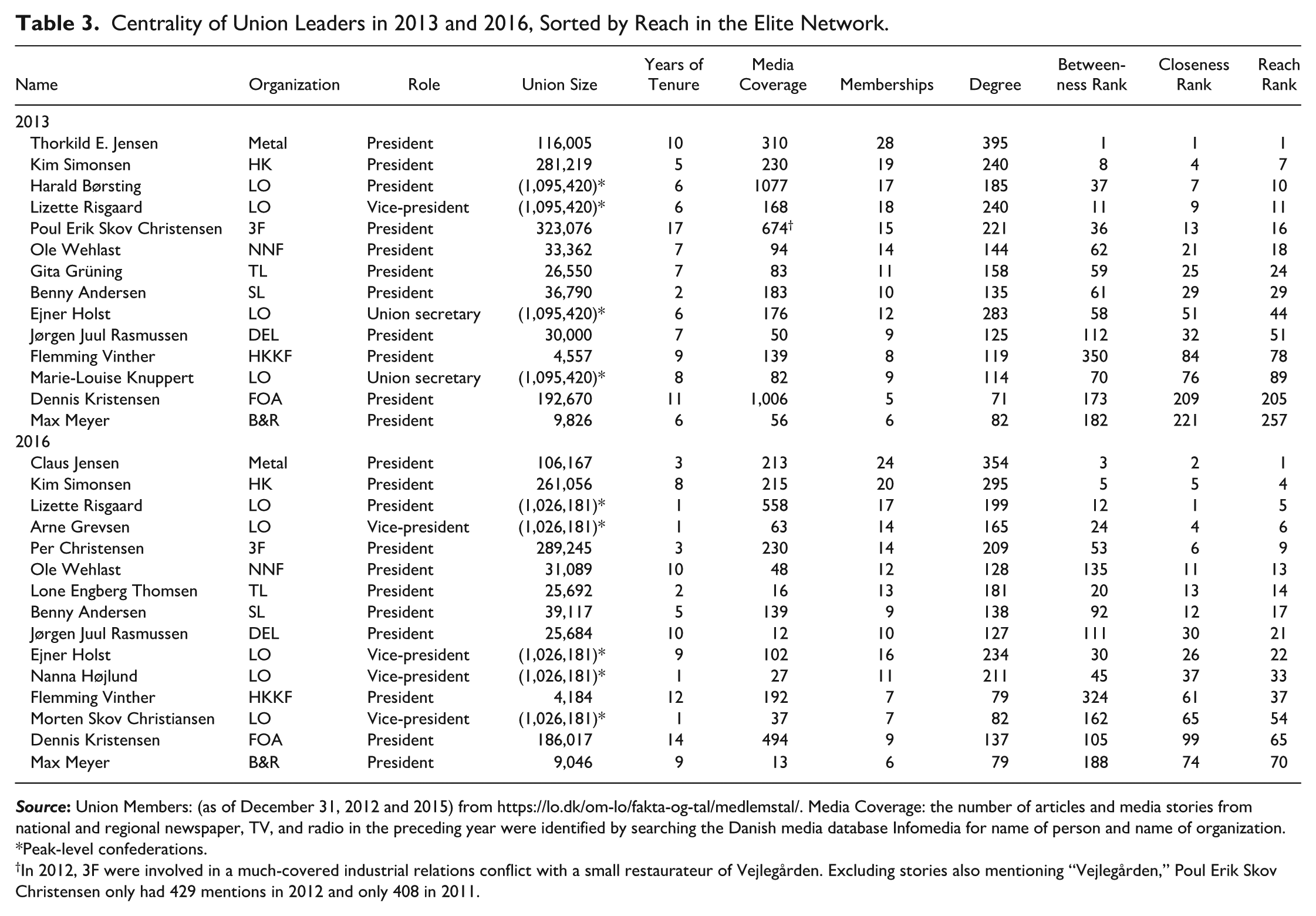
From our analysis of the Danish elite network, it is clear that the leaders of the Danish labor unions hold key positions in the Danish power structure. Union leaders are both among the most central individuals in the elite networks (see Table 3), and just under 12 percent (49) of the 423 individuals in the core of this network in 2013 are union representatives. 45 In fact, the most central individual in 2013, with regard to reach, closeness, and betweenness centrality, is a union leader, Thorkild E. Jensen, then president of Dansk Metal. Thorkild E. Jensen holds positions in twenty-eight affiliations, including four state councils and commissions, three forums tied to science and education, and the boards of two major occupational pension funds. He is directly tied to the most central leaders in politics, state, academia, business, and business associations (see Fig. 1). Although it is tempting to trace this central position to Jensen’s personal qualities and network-building capacities during his ten-year tenure as president, the network data from 2016 tell a different story. Three years after his retirement in 2016, Jensen is only the 243rd most central individual when we look at closeness centrality. Meanwhile the new president of Dansk Metal, Claus Jensen—no relation—is now the most central individual in the entire elite network when we look at reach and in the top three on closeness and betweenness centrality, after being ranked 381st in reach as a vice-president in 2013. This highlights that the centrality of the presidents of Dansk Metal is due to the unique position of the union as a broker between various organizations of various sectors. The position is therefore mostly an organizational rather than an individual property, as acknowledged below by Thorkild E. Jensen, the former president, in one of our interviews with him.
Centrality of Union Leaders in 2013 and 2016, Sorted by Reach in the Elite Network.
Peak-level confederations.
In 2012, 3F were involved in a much-covered industrial relations conflict with a small restaurateur of Vejlegården. Excluding stories also mentioning “Vejlegården,” Poul Erik Skov Christensen only had 429 mentions in 2012 and only 408 in 2011.
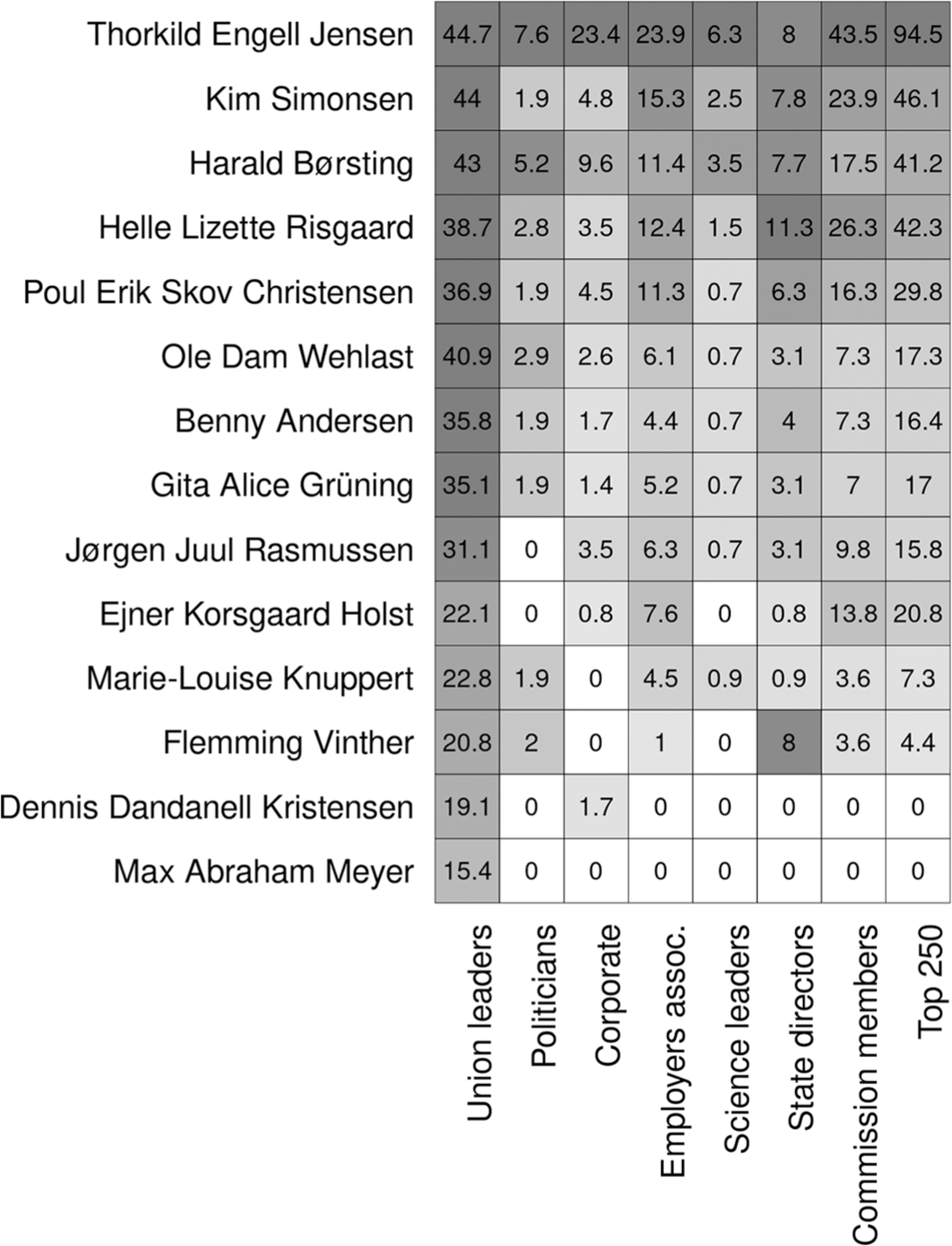
Weighted ties of the members of the steering committee of LO in 2013. Values are the sum of weighted ties to individuals holding executive positions in politics, corporate management, employers’ associations, management of universities and research centers, state government, or unions. Commission members are all nonunion individuals who participated in a commission between 2005 and 2013. Ties to the top 250 individuals show how many direct ties the union leaders have to other nonunion leaders, near the core of the elite network, as identified by being in the top 250 by closeness centrality. All ties with a distance over 1.5 are disregarded. Authors’ elaboration.
It’s something that we inherit. . . . We step into the network that previous presidents had and Claus has added more political issues into the network from being on governmental committees. . . . And so did I when I was in the Globalization Council and part of Løkke Rasmussen’s [liberal prime minister 2009–11, 2015–19] Growth Council.
The stability of the hierarchy of union leader integration into other power networks shown in Table 3 is striking. With the exception of slight movements up and down by union secretaries of LO (in 2013) and vice-presidents of LO (in 2016) caused by an organizational change in LO when a new president, Lizette Risgaard, was elected, the reach rank of the union leaders follows the exact same pattern between organizations. Thus, the order is maintained despite the fact that six of the fifteen leaders changed between 2013 and 2016 and two others hold new positions. This suggests that the centrality of union leaders in the elite network is a highly institutionalized phenomenon and the product of the long-lived corporatist legacy in Danish policymaking.
Comparing the network positions of members in the executive council of LO (Table 3), it is clear that membership of the cross-class alliances and not the number of union members is the driving force behind achieving a central position in the elite networks. While the leaders of LO both in 2013 and 2016 are quite central, especially with regard to closeness centrality, and have multiple ties to Thorkild E. Jensen and Claus Jensen, they are also dependent on the ties of Dansk Metal, as evidenced by the fact that their betweenness centrality is substantially lower than their closeness centrality. Likewise, the leaders of the counterpart to Dansk Metal, the presidents of Dansk Industri, are more central than the leaders of DA. In 2013, director of Dansk Industri, Karsten Dybvad, is thirty-first in closeness centrality, while four other Dansk Industri directors are in the top fifty. The director of DA, Jørn Neergaard, is number twenty and the only DA director in the top fifty. In 2016, Karsten Dybvad of Dansk Industri has risen to number seven, while the new director of DA, Jacob Holbrad, is number twenty-six. Thus, the cross-class alliance between Dansk Industri and Dansk Metal gives more central positions to these organizations’ leaders than the positions occupied by the leaders from LO and DA, the confederations operating at the macrocorporatist level. 46
We have a relation to DI [Dansk Industri] which we use for industrial policy and everything that concerns DI’s member companies. . . . It is important for the position that Claus has today that industrial policy means a lot of things, and if we can run it smoothly and get LO to understand that it’s manufacturing that leads this policy, then we are set.
47
Not only are the two presidents of Dansk Metal more central than the heads of union confederations, they are also more central than most other union leaders (see Table 3). Only the president of HK, a union with more than three times as many members, Kim Simonsen, holds a position in the network that is close to that of Thorkild E. Jensen or Claus Jensen. Meanwhile, the leader of the largest Danish Union, the General Workers’ Union (3F), Poul Erik Skov Christensen, is also within the top twenty in reach, ranked sixteenth in 2013, and his successor Per Christensen (no kinship relation) ranked ninth in 2016. However, much of their centrality is dependent on ties close to others, as both are ranked outside the top twenty—numbers thirty-six and fifty-three, respectively—with regard to betweenness centrality. Meanwhile, the head of 3F’s manufacturing group, which also forms part of the cross-class alliance inside CO-industri, has the most central nonpresident union member of the LO member unions: Mads Andersen from 3F, who ranked 128th in closeness centrality in 2013 and who moved up to forty-seventh in 2016.
The clearest indication that the number of union members is not key to integration into elite networks is seen by the fact that the long-serving head of the Danish Union of Public Employees (FOA), the third-largest Danish union, Dennis Kristensen, ranks below 200 in reach in 2013 and is still outside the top fifty in 2016. FOA organizes various low- to medium-skill occupations mainly in public health and social care. In other words, the material interests of FOA’s constituency are quite far from the interests of skilled metalworkers in Dansk Metal and the cross-class alliance. Being excluded from the political elite has led to a very different strategy of lobbying by FOA, mostly addressing media and mostly being “loud.”
A different kind of influence which Dennis Kristensen has been a key proponent of is seeking support from the general public, a rhetorical support. He uses—and I don’t mean it negatively—populism and tries to go public with issues that will resonate with the large population.
48
The difference in strategy is visible in the media coverage of the union leaders. During both 2012 and 2015 Dennis Kristensen has as many media appearances as the serving president of LO and ranks high above the other union leaders in general. It is interesting that Dennis Kristensen appeared in twice as many articles as the serving president of Dansk Metal in both years. His lack of engagement in the quiet politics of boardrooms is countered by a much noisier engagement in media-covered politics. Union leaders face a trade-off between seeking influence in the elite network and mobilizing members through mass media. Although the presidents of Dansk Metal are clearly more central than other union leaders—and political actors in general—we need to understand how these relationships form a political elite. To do so, we take a closer look at the network structures of individual union leaders.
The central network positions of the cross-class alliance union presidents lead to a much larger and broader social surface than other union leaders (see Fig. 1). 49 Apart from state directors, Thorkild E. Jensen has the largest number of contacts to actors from other key sectors, in particular from corporations, business associations, and science, highlighting Dansk Metal’s role as broker between various stakeholders. Note that the weighted degree between the Dansk Metal president and corporate CEOs of 23.9 is almost 2.5 times higher than that of union leaders with the second-most ties to corporate executives. Further, Thorkild E. Jensen also has 94.5 weighted ties to nonunion leaders ranked within the top 250 in closeness centrality—again more than double any other union leader. The difference between union leaders and their ties to other central individuals in the elite network is underlined by the fact that two members of the standing committee of LO, including Dennis Kristensen of FOA, which outnumbers Dansk Metal by 75,000 members, have no ties to any nonunion leader among the top 250 most central individuals compared to the 94.5 weighted ties of Thorkild E. Jensen. Interestingly, the Dansk Metal president also has the most ties to other union leaders, although on this measure the differences are only marginal. Thus, even among unions, the cross-class alliance makes Thorkild E. Jensen a more attractive actor. In his own words, “We meet a ton of corporate leaders. . . . We speak with them and hear their problems. It gives respect that we understand what is going on in their industry.” 50
The strong ties to key leaders in other sectors is seen by the ego networks of the presidents of LO, Dansk Metal, 3F, and FOA in 2013 and 2016, shown in Figures 2 and 3. It is clear that in particular the ties of FOA president Dennis Kristensen are almost exclusively with other union leaders.
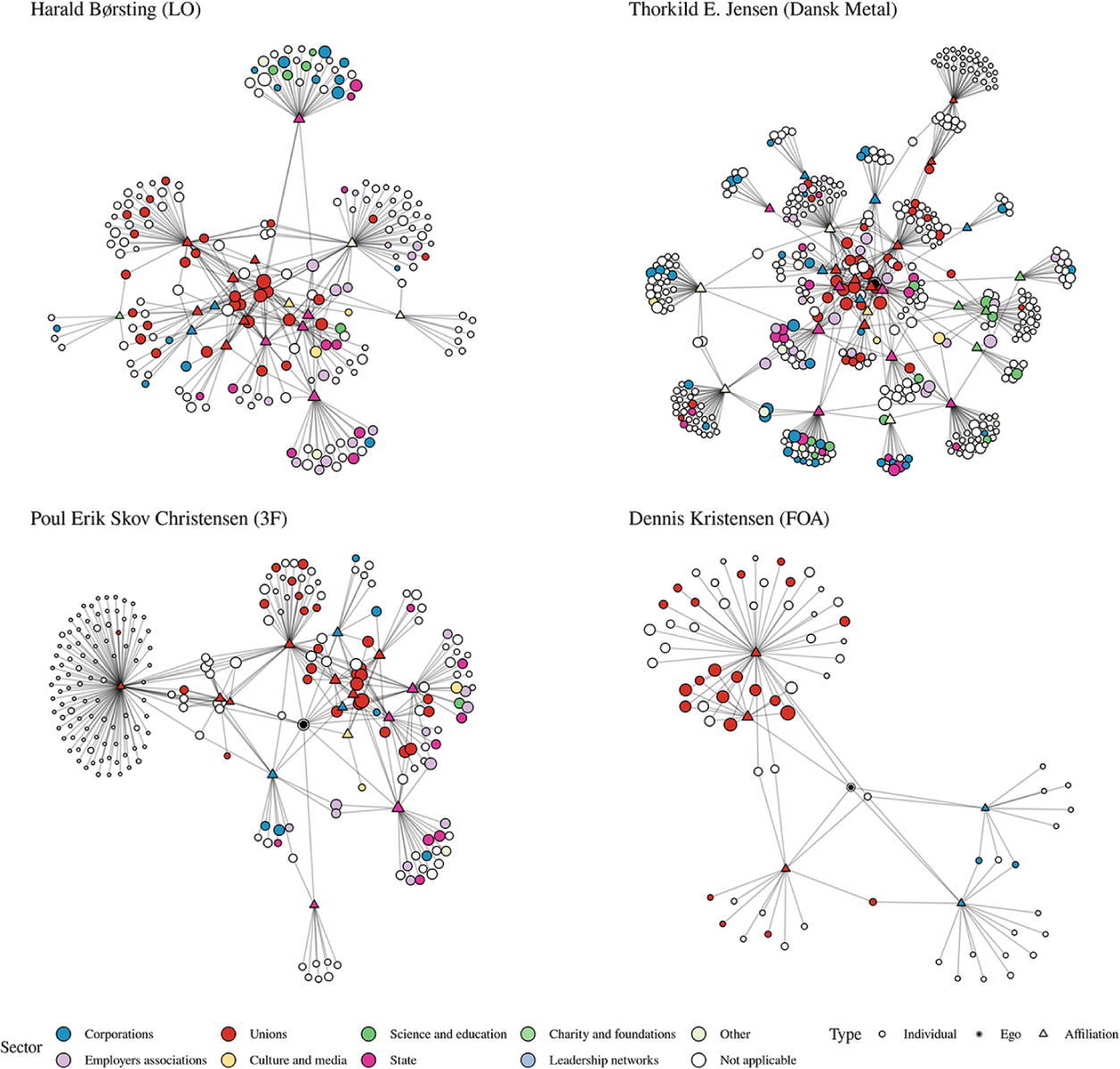
Ego networks of the presidents of LO, Dansk Metal, 3F, and FOA in 2013. Color denotes the sector of an affiliation or individual. In the latter case, color denotes that the individual holds a full-time executive position within a sector. A triangular shape denotes that a point is an affiliation. The size of a point denotes its closeness centrality in the elite network of either individuals or affiliations. Authors’ elaboration.
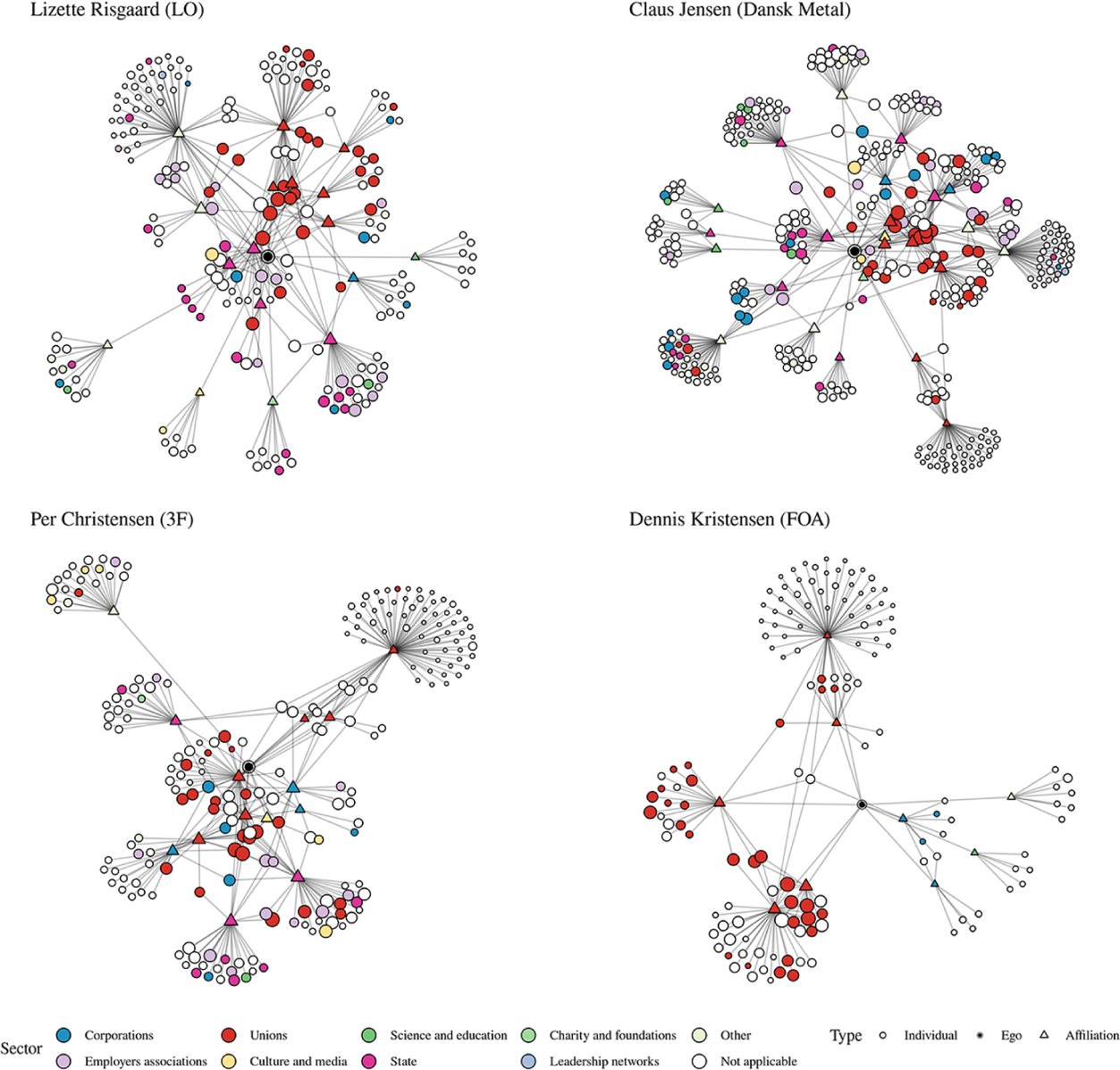
Ego networks of the presidents of LO, Dansk Metal, 3F, and FOA in 2016. Color denotes the sector of an affiliation or individual. In the latter case, color denotes that the individual holds a full-time executive position within a sector. A triangular shape denotes that a point is an affiliation. The size of a point denotes its closeness centrality in the elite network of either individuals or affiliations. Authors’ elaboration.
When we look at multiple ties—an indicator of a strong alliance 51 —the strongest ties of union leaders are not surprisingly to each other. Again, FOA president Dennis Kristensen appears to be an outsider, having a tie strength of less than 1.5 to the other union leaders. This number still represents a strong tie, but it highlights that FOA is excluded from core union networks, while the cross-class alliance makes Dansk Metal the key actor in the union networks. Hence, it does not seem to hurt Dansk Metal’s intraclass position to have strong ties elsewhere. Rather, it seems to yield cumulative advantages.
The presidents of Dansk Metal are very central in the political network, and they owe some of that centrality to their ties to the directors of Dansk Industri. Indeed, Thorkild E. Jensen suffers a 14 percent decrease in this betweenness centrality—the proportion of shortest paths passing through him in the elite network—if his ties to the Dansk Industri directors are deleted from the network. In contrast, the Dansk Industri directors are far less reliant on their ties to the Dansk Metal leaders. Karsten Dybvad, the CEO of Dansk Industri, loses only 2 percent of his betweenness centrality if his ties to members of the executive council of Dansk Metal are removed. This could indicate that Dansk Industri is far less reliant on Dansk Metal than vice versa and that the position of Dansk Metal in the cross-class alliance is more precarious.
The network analysis clearly shows the dominant position of the alliance parties and how the integration of Dansk Metal into the political elite network secures this union a privileged position. In the next section, we show how the alliance uses quiet politics to pursue its interests in collective bargaining, social pacts, and educational politics. We claim that the alliance is most successful when there is low salience of the issues involved in political processes. Conversely, when salience is high, political processes are taken out of the hands of the members of the core of the elite network and into the media and parliament. Here, intraclass conflicts may arise, and Dansk Metal will have to balance its allegiances on one hand to its class and on the other hand to its alliance partner, Dansk Industri.
Cases of Quiet and Noisy Politics
We [Dansk Metal and Dansk Industri] go public together and stay quiet if we disagree.
—Dansk Metal official
The following three cases illustrate that the alliance is most successful in getting what it wants under conditions of quiet politics. The first case is about collective bargaining and shows how the alliance is challenged when bargaining gets into the media and communication of bargaining processes and results become salient. The second case is about social pacts or tripartite agreements and shows how Dansk Metal lost control over the agenda in one round of tripartite negotiations and had to stay loyal to its class in a subsequent round of negotiations. The third case is about vocational education and training reform and shows how the alliance used network negotiations to push through a particular solution that politicians later passed. The three cases thus display varying degrees of salience and how such variation affects the alliance’s ability to decide across extraparliamentary and parliamentary institutions.
Sometimes Salient in the Extraparliamentary Arena: Collective Bargaining
Given the voluntarist tradition in Danish collective bargaining, the alliance enjoys relatively high autonomy from government in regulating terms and conditions of employment. 52 However, collective agreement renewals are highly salient and attract considerable attention from both media and the public. Moreover, governments will usually intervene if a bargaining impasse results in general strikes, putting pressure on the alliance to deliver results that are acceptable to not only workers and employers in exporting companies but also the economy as a whole. Playing quiet politics is therefore extra challenging even though politicians are formally excluded from the bargaining process.
Collective bargaining follows a cycle of two to four years, and each renewal is spearheaded by Dansk Industri and CO-industri. Before each bargaining round, lead negotiators of the two organizations consult their constituencies in various information meetings around the country. Themes are identified during these tours and brought into the political-analytical departments of each organization. Crucially at this stage, unions analyze the rank-and-file concerns and filter them to make sure that claims to the counterpart, Dansk Industri, are not disruptive for the bargaining relationship and process. Instrumental to avoiding disruption is a study trip abroad for the lead negotiators of Dansk Industri and CO-industri. The trips allow negotiators to deliberate issues in a media- and constituency-free environment. On these trips, negotiators identify potential pressure points and ways to deal with them that do not distort negotiations. Open and honest communication among the negotiators is crucial, and building personal connections help in this regard. 53 The actual negotiations are by no means a foregone conclusion, but nevertheless many obstacles to an agreement are removed during these initial interactions between negotiators.
During bargaining, top negotiators keep tight control over negotiations and communicate only with their rank and file and other unions and employer associations, respectively, in broad terms. Dansk Industri and CO-industri have institutionalized a bargaining order by which all agreements across the private sector expire at the same time and bargaining follows an ordered process. First, Dansk Industri and CO-industri settle on the labor cost norm based on minimum wage increases and improvements on nonwage issues. The total percentage increase per year in the agreement period constitutes the norm. Second, the other bargaining areas negotiate on anything but cost-driving provisions to get as ready as possible while waiting for the cost norm. Third, if the parties in other industries agree, the DA executive committee can approve or reject the agreement, and since Dansk Industri holds 50 percent of the vote, rejection by employers is extremely rare. Unions hold a nationwide ballot with their members. Rejection of a proposal requires a majority, and if less than 40 percent of eligible voters participate, then at least 25 percent of eligible voters are required to vote “no” in order to reject the proposal. Thus, individual unions that bargain for other industries cannot take industrial action because it is a nationwide ballot. The entire bargaining order is thus based on the cross-class alliance in manufacturing getting its labor cost norm spread across the other industries. 54
Once an agreement is reached, the parties of the alliance communicate the results together, making sure that interpretation of the result is not biased with respect to either side. This practice originates from the 1998 conflict, when workers voted against the agreements even though the settlement entailed the highest labor cost increases in decades. A key dividing issue was holiday entitlements, and when employers celebrated the agreement as a successful defense from the union demands, unions struggled to sell the settlement as a victory. 55
The 98-agreement was in my opinion a fantastic agreement but it was rejected by members. And it was unjustified but rumors appeared about paid time off on the 24th of December and people showed up in Santa Claus outfits to demonstrate their discontent. So, suddenly people speculated about what was actually in the agreement and they just wanted to reject it.
56
The general strike proved very costly for the exporting companies reliant on stable production and delivery to clients abroad. The alliance urged their confederations to write up a so-called Climate Agreement (Klimaaftale), which would stipulate the order of bargaining and align communication of bargaining results. As such, the Climate Agreement was a formalization of quiet politics in collective bargaining, that is, making sure that the media and the public would not get conflicting statements from bargaining parties during and after bargaining.
The quiet politics of collective bargaining was also under threat during the 2017 round. Building trade unions pushed hard for a so-called chain liability provision for when supplier companies in construction are in breach of collective agreement standards. 57 The alliance—together with construction employers—is strongly against chain liability: they see it as contrary to the principle of free collective bargaining. And as Swenson argued long ago, there is also a material cross-sector interest conflict because cheaper construction means cheaper inputs to manufacturing. 58 Seeing yet another settlement in manufacturing without chain liability, shop stewards in the building trades were successful in mounting a campaign against the settlement. Instrumental for that campaign was also a new unpopular provision allowing managers to decide overtime work if a local agreement with the shop steward could not be reached. The campaign was coined “No Thanks to 42 Hours,” despite Dansk Metal’s reassurance that the use of the new provision would be minimal. “We were doing well but someone was shouting about 42 hours [per week], and there was a campaign. . . . Then the seriousness disappears and with it the task of solving problems for Danish wage earners. . . . Now they wanted Rock ’n’ Roll.” 59
Suddenly, the bargaining round gained salience in both traditional and social media, and the looming dissatisfaction on the shop floor made the union ballot one of the tightest in decades, with 56.5 percent of members voting yes in 2017, compared to 77.3 percent in the 2014 settlement, which arguably contained far fewer concessions to workers. 60 The high salience of social dumping is the major threat to the alliance control over future bargaining.
Salient in the Extraparliamentary Arena: Social Pacts
Tripartite agreements have a long and varied history in Denmark ranging from incomes policy in the 1960s, to highly influential declarations of intent on wage moderation and pensions in 1987, to binding agreements on education and refugees in the labor market in 2016–17. 61 A failed attempt to reach a social pact in 2012 illustrates the risks the alliance faces when trying to make quiet deals in a politicized arena with high salience. The incoming Social Democratic government had carefully planned tripartite negotiations with employers and trade unions to reinvigorate the economy without additional fiscal austerity on retirement schemes. The challenge was to find an additional 15 billion DKK to fund growth-related and pro-labor initiatives. The “Columbus egg” proposed by the Social Democrats was increasing the labor supply, including working-time regulation changes, something only social partners could pass given the principle of autonomous collective bargaining. Dansk Metal was the key union actor in the preliminary negotiations, given their position in the collective bargaining arena; Dansk Industri almost could not believe their luck, as increased working time had been their top priority for decades. Leaders of Dansk Metal saw the tripartite agreement on increasing labor supply as a necessary—albeit unwanted—element in the economy recovery and in regaining power vis-à-vis the government. However, Dansk Metal specifically viewed working time as only one lever among others to find the 15 billion DKK. As Thorkild E. Jensen stated, “It was their [the Social Democrats and the Socialist People’s Party] decision to marketize the expectations about how to get the 15 billion DKK. When we discussed it, we didn’t see it [increasing working time] as the only solution.” 62
The quiet politics negotiations were efficient in getting preapproval from the various parties, and negotiations proceeded to what should have been a ceremonial process of ratification. However, after the successful election of the new center-left government, negotiations ran into troubles. The Social Democrats and the Socialist People’s Party had run campaigns about saving the economy by working a mere twelve minutes more a day. Under the slogan “If you have 12 minutes, we have a solution,” they had pitched an alternative to the previous center-right government’s solution, based on austerity measures. However, as the quotation by Thorkild E. Jensen at the end of the preceding paragraph shows, that slogan was not in line with the perception of Dansk Metal leadership, who offered other, more technical solutions such as reducing sick leave, introducing more flexibility for overtime, reducing study time of young people, and bringing more senior citizens back into the labor force. 63 Clearly, union leaders preferred a complex, quiet politics agreement, but the political parties made the process noisy with their campaign slogan.
To the chagrin of union leaders, the “12 minutes a day” campaign created a single focus on working longer and sparked immediate dissatisfaction among the rank and file. Instead of focusing on the other levers for finding 15 billion DKK and the multiple concessions that were made to unions regarding, for example, retirement, Dansk Metal shop stewards were bombarded with threats from members who would leave the union if leadership accepted the working-time increase. Similar threats were heard in other unions. However, not until Thorkild E. Jensen, president of Dansk Metal, was threatened with a veto by the governing board did Dansk Metal pull out of negotiations. Subsequent to the withdrawal, the tripartite agreement was canceled by Bjarne Corydon, then minister of finance. What seemed like a done deal in quiet politics turned out to be impossible when negotiations became noisy.
One plausible explanation for the breakdown is that union leaders accustomed to quiet politics failed in noisier arenas. As seen in Figure 4, Harald Børsting, a peak-level organization president, and the outsider FOA president Dennis Kristensen dominated the issue of “Fair Løsning” in the media. In contrast, the most central union leaders, including Thorkild E. Jensen, engaged far less in public debates about the social pact. Entering the elite networks and working in quiet politics seems to be a double-edged sword. While cross-class alliances offer certain unions a privileged position, it also hampers them in seeking influence when high-salience issues become noisy politics. It seems that organizations more attuned to pursuing agendas through mass media are able to dominate when issues enter this arena.

Media presence in 2012 in total and about 2012 social pact “Fair Løsning” (shaded black). In 2012, Poul Erik Skov Christensen and 3F were involved in a much-covered conflict with a small restaurateur of Vejlegården. When stories also mentioning “Vejlegården” are excluded, Poul Erik Skov Christensen only had 429 mentions in 2012. Similarly, he had 408 mentions in 2011. Articles and stories from national and regional newspapers, TV, and radio in the preceding year were identified through the Danish media database Infomedia, searched by person name, name of organization, and mention of the social pact “Fair løsning” (shaded black).
The lessons of the 2012 failure were clear: high-salience politics is often noisy and can create intraclass conflicts that in turn will challenge the cross-class alliance. Thus, when the incoming center-right government in 2015 announced that it wanted tripartite negotiations on refugee labor market integration and on lifelong learning, Dansk Metal was much more oriented toward the LO movement as a whole. The process of these tripartite negotiations was noisy, and Dansk Metal stuck to its class. One key issue was making sure that salaries of refugees would not undermine collective agreement standards. During the tripartite talks, proposals by neoliberal politicians and think tanks about a lower “refugee-salary” to facilitate labor market entry became front-page material in the media. On this issue, Dansk Metal primarily listened to the General Workers Union, 3F, and FOA, the members of which would be most threatened by lower refugee salaries. Despite potential demands from Dansk Industri for lower salaries that would not have threatened the jobs or wages of skilled metalworkers, Dansk Industri respected that its alliance partner had to cater to its class peers. As a consequence, trade unions’ demands to take “refugee-salaries” off the bargaining table were heard. In 2016, government and social partners concluded a tripartite agreement about inclusion of refugees on two-year apprenticeship programs during which they would receive apprentice salaries, which are negotiated through collective bargaining.
Not Salient in the Parliamentary Arena: Vocational Educational Reform
Denmark has a long history of a dual vocational education and training (VET) system with heavy government funding. 64 By alternating between apprentice-based training and school-based teaching, students acquire both firm-specific and industry-specific skills that are vital for the skill demands of high-productivity, high-wage manufacturing in Denmark. Social partners at various levels govern the VET system, and educational policies rarely become highly salient. While the track record of this system is positive, with low youth unemployment as a key indicator, there are indications of poor performances, including higher dropout rates and fewer apprentice contracts. 65 In the alliance, there has been growing discontent over the prioritization of social inclusion of “weak learners” over the skills demands of firms, and Dansk Industri and Dansk Metal therefore pushed the Danish government to reform the VET system by putting stronger emphasis on more qualified students.
The reform process was initiated in 2012 with a tripartite VET committee consisting of social partners, government officials, and school representatives. The politics inside the committee were clearly quiet and resembles what Culpepper calls “bureaucratic network negotiations.” The quiet policy process showed how the alliance yields power over the class and can overturn the confederations. The original proposals coming from the ministry were about the organizational structure of VET schools and did not include important issues about the quality of students. Nonetheless, LO and DA were ready to go ahead with the proposal. “LO and DA entered ‘agreement mode’ and wanted to make a quick deal. . . . We had to say that we can’t accept this. . . . The focus of the original proposal was completely off.” 66
Both Dansk Industri and Dansk Metal considered the proposal of the ministry and the confederations unambitious, and negotiations broke down. After getting the signals from the alliance, LO and DA published a joint paper on how to reform the VET system. 67 That paper was initiated by Dansk Metal and Dansk Industri and was significantly more ambitious than the approach by the government and the original stance of LO and DA. The alliance suggested a significant departure from social policy objectives in VET to attract better students and ensure that employers would still find VET students attractive. Particularly noteworthy about the joint paper was that it proposed the creation of admission requirements where students needed at least the minimum grade of 02 in Danish and math. This was an important departure from the prevailing equality-enhancing approach of the Danish VET system by which, if deemed ready for education (regardless of grades), any student should be able to access VET.
It was only after pressure from the social partners that the government agreed to expand their focus to also include more stringent admission requirements for VET. Because of the legacy of inclusiveness through vocational education, the left-wing parties and the Social Democrats in government were wary that these changes would cut off access to secondary education for many students who normally would choose VET. Moreover, cutting off access could mean that the stated goal of having 95 percent of a cohort obtain upper-secondary degrees would run aground. Similarly, the LO was afraid that cutting access could—on average—mean fewer workers within the domain of its affiliate low- to medium-skilled workers’ unions. However, with unskilled workers’ unions on board eventually, the government’s reform proposal presented in August 2013 was clearly in line with the joint paper by DA and LO, and it was thus possible to agree on a joint statement between DA, LO, and the government on how to reform the VET system. In Parliament, after a largely quiet process, only the left-wing Unity List did not support the reform, referring to the social downside of introducing grade requirements.
Conclusion
In this article, we find that the specific Danish version of corporatism since the 1980s is dominated by an alliance of certain representatives of labor and business. Moreover, we argue that Culpepper’s concept of quiet politics is suitable for analyzing under what conditions corporatist policymaking takes place in Denmark. We add that corporatist policymaking through political elite networks is particularly important for quiet politics. In our analysis of network data, we show that representatives of labor and business from the vital exporting manufacturing sector are at the very core of political elite networks and that this alliance works best under conditions of quiet politics. Through interviews, we show that being at the core of the network requires not only a key position in the Danish economy, but also an understanding that politics is often done best without politicians and voters. And through case studies of collective bargaining, social pacts, and educational reform that vary in salience and political arena, we are able to illustrate our argument about quiet politics.
We contribute to current scholarship on corporatism in two ways. First, the literature has focused mostly on the level and nature of social partners’ activities in policymaking and collective bargaining, rather than asking under what conditions social partners come to decide instead of politicians. Culpepper’s concept of quiet politics allows us to define these conditions using salience and political arena. Corporatist policymaking is most likely when issues are of low salience and thus under the radar of politicians. Embeddedness in political elite networks facilitates quiet politics, and being at the core of networks allows one to take a position of brokerage between multiple constituencies in quiet politics. Having a vast network and being a broker between various constituencies is vital for the kind of consensus-based policymaking and deliberative negotiation that corporatism depends on. 68 Rather than “shouting in public,” to quote the president of the Danish metalworkers, and locking your bargaining strategy to a certain position, the quiet politics of corporatism allows problem solving and broad solutions in industrial policy, writ large. However, while quiet politics seems problem-focused and consensual, this should not obscure that some interests typically prevail over others.
This issue brings us to the second contribution. The literature on corporatism does not adequately distinguish differential status and integration into policymaking of different groups of social partners. Often, trade unions and employers are treated as monolithic blocs of labor and capital. In contrast, we use cross-class alliance theory to show that Dansk Metal and Dansk Industri, which represent workers and businesses in key industries for the Danish economy, are at the core of political elite networks. This is an important lesson on small-state industrial policy 69 after the demise of peak-level corporatism: If business and political elites can incorporate “responsible” and pragmatic union leaders into political elite networks, then business can achieve some of the things they achieved under encompassing confederation bargaining, for instance, public goods such as wage moderation in collective bargaining, public investment in education and skills, and benign industrial policies. In our analysis, we show with multiple quotations and media data that the metalworking president clearly operates under a logic of quiet politics, whereas more marginal union leaders resort to shouting in public to mobilize members and voters and thereby politicians.
While the position of Dansk Metal comes with many political privileges, it also comes with multiple responsibilities and challenges. Being part of the political elite entails playing the long game in the interest of the Danish growth strategy, which is based on a careful balance of export-driven growth and a relatively high level of public and private consumption. 70 At the core of this balance is a high-wage and high-productivity nexus that undergirds competitive export companies, positive current account balances, and sound public finances. From time to time, this balance is under pressure from unions in the public sector and from low-wage services that feel squeezed by tight fiscal policy and wage restraint. Similarly, unions in the building trades have questioned free movement of labor in the European Union, as it puts pressure on minimum wage standards due to posting of workers. Dansk Metal has had to deal with these different intraclass challenges due to its privileged position, while remaining responsible for the overall principles of the Danish export-oriented growth strategy.
Part of the reason for why this position of Dansk Metal is sustainable is that other unions understand and respect the importance of a strong and competitive export sector for the rest of the economy. Going back to Katzenstein, this common understanding might originate from small-state vulnerability. Dansk Metal took leadership in the union movement around the time of current account deficits and high unemployment in the 1980s, but they could only do so because of their position in key industries for the Danish economic resurrection and—as we show—because of their tight relationship with Dansk Industri. The latter, on their part, needed a reasonable partner to promote a cross-class consensus on industrial policies for the post-Fordist economy. 71 This alliance has been quite successful in steering the Danish political economy through various governments during the last three decades and has laid the foundation for a new kind of corporatism in a time when corporatism might be withering away.
However, being part of this alliance also shows how union leaders face a double bind when their power is constructed through and based on elite networks. On the one hand, union leaders can more easily strike deals with alliance partners when politics is quiet. On the other hand, because unions derive their primary source of power in worker support and membership, leaders sometimes need issues to have salience in order to mobilize their rank and file. Keeping politics quiet allows well-positioned union leaders to protect and strengthen their position while remaining junior partners. In contrast, making politics loud invokes their paramount power resource of mobilized members and broad-based worker mobilization. However, mobilizing workers broadly might entail letting in opinions from other unions who do not accept the established consensus behind the quiet politics of the elite networks. Our analysis shows that union leaders in the alliance often have to stick to their class, rather than the alliance, when politics becomes noisy.
These insights from our article can readily be applied and tested in other countries such as Sweden, Norway, Finland, Austria, and Switzerland with similar small-state corporatist legacies. 72 However, there are also more general questions arising from our study that can inform studies of more countries. First, can we identify stable political elite networks operating under conditions of quiet politics in other countries (see Feldmann and Morgan in this issue on the fragmented British business elite)? If so, what are these networks using quiet politics for? Second, which political actors and from which sectors do we find in central positions in these political elite networks? For example, are the networks dominated by exporting companies or multinationals (see Bohle and Regan in this issue), and are union leaders or other nonbusiness leaders included at all? Third, how do these political elites shelter policymaking from public attention and scrutiny? For example, are there any particular strategies for keeping politicians, for example from nonestablishment parties, out? Answering these questions will tell us a great deal about national varieties of quiet politics and enable analysis of policymaking that typically goes under the radar of “normal” political science. Moreover, focusing on networks of actors will enable identification of key players and interests in quiet politics in a way that goes beyond what Culpepper originally promoted in his book.
Footnotes
Acknowledgements
Earlier versions of this article were presented at the University of Bristol, the Center for European Studies at Harvard University, the ILR School at Cornell University, and SASE at Université Claude Bernard Lyon I. We want to thank all the participants at these events. Special thanks go to Marco Hauptmeier (Cardiff University), Andrew Martin (Harvard University), and Glenn Morgan (University of Bristol), who gave extensive comments on our article. We also want to thank the editorial board of Politics & Society for extremely valuable comments and feedback. Special thanks to Gay W. Seidman for great editorial work. The usual disclaimers apply.
Declaration of Conflicting Interests
The authors declared no potential conflicts of interest with respect to the research, authorship, and/or publication of this article.
Funding
The authors disclosed receipt of the following financial support for the research, authorship, and/or publication of this article: This research was funded in part by the Independent Research Fund Denmark, grant 5052-00157B (to Christoph Houman Ellersgaard) and the Independent Research Fund Denmark, grant 4091-00086 (to Christian Lyhne Ibsen).
*
This is one of six articles that constitute a special issue titled “Quiet Politics and the Power of Business: New Perspectives in an Era of Noisy Politics.” Some of the articles in the issue were first presented at the SASE annual meeting at the Université Claude Bernard Lyon 1 in June 2017, organized by Glenn Morgan, Christoph Houman Ellersgaard, Stéphanie Ginalski, and Christian Lyhne Ibsen, and at a workshop at the University of Bristol funded by the School of Management and the Political Studies Association section on Labour Movements in June 2018, organized by Glenn Morgan, Christian Lyhne Ibsen, and Magnus Feldmann.