



Abstract
This article extends the theoretical discussion of counterpublics and applies the concept to an authoritarian context. The article contends that it is necessary to distinguish between the counterpublic oriented by liberal ideology that criticizes authoritarianism at an abstract level (Counterpublic I) and the counterpublics that are concerned with substantive inequality (Counterpublic II). To illustrate the approach taken, the articulation of rural migrant workers’ rights between 1992 and 2014 is documented, demonstrating that, in the 1990s and early 2000s, most public discussion on the issue tended to reduce workers’ rights to civil rights. It was not until the late 2000s that alternative forms of rights, such as social rights, were thematized. As the article argues, this was because the power balance between Counterpublic I and Counterpublic II had been changed. The empirical study explains the transformation and highlights the heterogeneity within Counterpublic II by comparing the diverse strategies employed by different actors.
Since the 1990s, the development of information technology and the loosening of state control in universities and the mass media have allowed for the flourishing of new venues for public communication in China. In newly rising NGOs, commercialized newspapers, and the internet space, people have criticized state policies and expressed various demands. Many scholars, both in China and in the West, have seen these phenomena as a sign of a rising public sphere. 1 Most studies until now have focused on how citizens have carved out space for participation vis-à-vis the authoritarian state. However, few have considered the issue of power inequality within the sphere. Have the newly rising venues privileged certain classes? To what extent are the disadvantaged groups able to make use of these venues to voice their concerns? Has the accessibility of the public sphere changed over the past three decades?
The idea of the public sphere has come to the study of politics as a normative theory. 2 It portrays an ideal speech situation in which participants reach consensus through rational-critical debates. 3 In his early work, Jürgen Habermas locates the origin of the modern public sphere in the bourgeois society that existed between the late Middle Ages and the eighteenth century. In his description, in the bourgeois conversations in salons, coffeehouses, and table societies during the transition from feudalism to capitalism, a new norm was established—one in which economic power and the prestige of public office were held in suspense and good arguments were deemed the only legitimate means of persuasion. He contends that the bourgeois public sphere performed the function of checking the absolutist state and that it laid a solid foundation for the later expansion of democracy. 4
Habermas’s interpretation has been widely criticized, both empirically and theoretically. Historical studies reveal that his analysis ignores the existence of various “plebeian public spheres,” such as those organized by peasants and the working class. These plebeian public spheres have developed alongside the bourgeois public sphere and have been in conflictual relations with bourgeois publicity. 5 Moreover, important parts of the struggle to establish some of the features Habermas describes as integral to bourgeois publicity, like freedom of the press, have largely been carried out by activists in those plebeian public spheres. 6 From a different perspective, feminist theorists hold that the bourgeois public sphere has never been as inclusive as it claims, as women are for the most part excluded. 7
In response to these criticisms, several scholars have argued for a notion of multiple public spheres. 8 Nancy Fraser’s discussion of subaltern counterpublics offers an illustrative case. According to Fraser, subaltern counterpublics are those “parallel discursive arenas” formulated by subordinated groups. 9 These counterpublics have at least two functions. On the one hand, by sheltering subordinated groups from the influence of the public at large, subaltern counterpublics facilitate the circulation of counterdiscourses. For example, in the conferences and local meetings organized by feminist activists in the United States in the late twentieth century, women invented new terms, such as the “double shift” and “sexual harassment,” to describe social reality. Armed with such language, participants were able to recast their needs and identities. 10 On the other hand, subaltern counterpublics also assume a publicist orientation and are in the long run against separatism. When the solidarity among the subordinated becomes strong and participants gain confidence, counterpublics may serve as the basis for launching agitational activities. Fraser thus contends that it is in the dialectic between withdrawal and agitation that subaltern counterpublics realize their emancipatory potential. 11
While the idea of subaltern counterpublics provides us with an approach for understanding how disadvantaged groups can be included in the public sphere, the context in which the conceptualization is based is rather parochial. Fraser’s discussion of counterpublics has been limited to late capitalist societies, where the power of the state is contained, and the freedom of speech and association is institutionally guaranteed by formal democracy. In such a context, it is the power of privileged groups in society (e.g., the white, male, propertied class) that subordinated groups intend to contest. However, in an authoritarian context, the state monopolizes consensus formation, and the freedom of speech and association is not guaranteed. It is arbitrary state repression that participants in public discussions have to guard against. In this sense, in an authoritarian regime, any communication networks that have been established for the sake of questioning the state’s monopoly of politics—no matter whether they are established by the privileged or the disadvantaged—can be seen as a kind of counterpublic.
What adds to the complexity of my analysis is that counterpublics in authoritarian contexts can exist in many different forms. Some counterpublics tend to criticize authoritarianism at a more abstract level, arguing that unchecked state power is essentially bad. These counterpublics often claim to represent the general interest—as long as the authoritarian control is dismantled, everyone will benefit. Other counterpublics are more concerned with substantive inequality and injustice. These counterpublics are often associated with socioeconomically disadvantaged groups in society. To distinguish between these two kinds of counterpublics, I will hereafter call them Counterpublic I and Counterpublic II respectively.
I contend that the relationship between Counterpublic I and Counterpublic II is contingent. In some cases, Counterpublic I and Counterpublic II merge. Notable examples include workers’ resistance in Brazil, South Africa, and South Korea in the 1970s and 1980s. Such examples of resistance have not only criticized the exploitation of workers in capitalist accumulation in late industrialized countries (Counterpublic II) but have also evolved into movements that challenge authoritarian rule (Counterpublic I). 12 But in other cases, Counterpublic I and Counterpublic II can be separated. This can be due to the fact that the major communicative venues of Counterpublic I are dominated by elites, while ordinary people have little to no opportunity to participate. It can also be that, although disadvantaged groups are formally incorporated into Counterpublic I, the internal structure of Counterpublic I is nonetheless highly hierarchical. In such a Counterpublic I, although the disadvantaged can speak, their voices tend to be marginalized, and their agenda is often labeled as of secondary importance. To address their concerns, the disadvantaged sometimes have to formulate an alternative communicative space (Counterpublic II). When that happens, Counterpublic I and Counterpublic II may even come into contestation with each other.
Central to my argument is that, when Counterpublic I and Counterpublic II do not merge, it is necessary to consider the tripartite relations between Counterpublic I, Counterpublic II, and the authoritarian state; whether the disadvantaged are able to articulate their concerns in the public sphere depends not only on the interaction between Counterpublic II and the state but also on the power balance between Counterpublic II and Counterpublic I.
I use the articulation of rural migrant workers’ rights in China’s public sphere as a case to illustrate my approach. Since China began its participation in neoliberal globalization, millions of peasants have left their rural hometowns and become industrial workers. In cities, these workers constitute an underprivileged group. As early as the 1990s, rural migrant workers organized various kinds of resistance, such as protests and strikes, to express their discontent. 13 But in the 1990s and early 2000s, there were very few discussions of labor issues in the public sphere. It was not until the late 2000s that the discourse of labor rights became prominent in public discussions. I suggest that this has to do with the transformation of the internal structure of the public sphere.
In the 1990s and early 2000s, most critical public opinions were produced by commercialized newspapers and NGOs established by intellectual elites. The communicative space created by these institutions was actually Counterpublic I, since discussions in the space were dominated by a liberal ideology that emphasized checking the state and building an independent civil society. Although major actors in this Counterpublic I claimed to represent the general interest, their understanding of rural migrant workers’ condition was rather limited. In their discussions, rural migrant workers’ rights were reduced to civil rights or the right to become free labor in the market. But in the late 2000s, social science scholars, university students, artists, and labor lawyers began to help rural migrant workers formulate alternative spaces for participation. These alternative spaces, such as community-based labor NGOs, academic conferences, salons, and advocacy campaigns, nurtured several instances of Counterpublic II that specialized in addressing rural migrant workers’ concerns.
I emphasize that together, these examples of Counterpublic II constituted a highly plural space. To illustrate this point, I compare activism led by three groups of actors: rural scholars, labor scholars, and labor lawyers. I demonstrate that these three groups had diverse ideological stances and were in different kinds of relations with the authoritarian state. Because of these variations, they chose different strategies for engaging with Counterpublic I, which had later influenced the kind of rights they thematized in public discussions. Specifically, rural scholars were highly embedded in the state and regarded the agenda of Counterpublic I as “neoliberal.” Hence, they chose to segregate themselves from Counterpublic I and established subcultural groups in rural migrant workers’ communities. Their activism tended to advocate for workers’ cultural identities. Labor scholars also criticized Counterpublic I, but they were at the same time sympathetic to the project of building civil society. They therefore chose to electively cooperate with actors in Counterpublic I. This cooperation later facilitated the thematization of workers’ social rights. Labor lawyers had almost no embeddedness in the state and chose to merge into Counterpublic I. What they eventually thematized was rural migrant workers’ collective rights in the market.
The rest of the article will be arranged in the following way. In the next section, I explain the key concepts and set up my analytical framework. This is followed by a section that introduces my methods and data. Then I discuss the rise of Counterpublic I and Counterpublic II in chronological order and analyze how the articulation of rural migrant workers’ rights has been transformed. Before the concluding section, I briefly review how various activism in Counterpublic II has evolved as the state has strengthened its control over society and suppressed activity in China’s public sphere since 2014. The concluding section elaborates the implications of this study.
Analyzing Multiple Counterpublics
The public sphere can be defined as open-ended flows of communication that enable actors to bridge social-network positions, formulate collective orientations, and generate working alliances to influence common concerns. 14 Following Habermas’s later interpretation of the concept in Between Facts and Norms, I see the public sphere as a space where actors can articulate a grievance, gain a place on the public agenda, and create pressure on decision makers. 15 These processes are also known as problematization and thematization. Not all problematization and thematization eventually lead to changes in policy. In my case, whereas some suggestions for improving rural migrant workers’ rights proposed by activists were adopted by formal political institutions, others received almost no response from the state. However, this article does not intend to elaborate why activists in an authoritarian regime are able to make the state seriously consider their demands and under what conditions they are able to do so. These are complicated questions that deserve detailed discussion in another article. In this article, I mainly focus on the formation of public discourses before the discourses are presented to the government authority.
I propose to employ a relational approach to analyze the tripartite interactions between Counterpublic I, Counterpublic II, and the state. Specifically, I suggest that we pay attention to (1) how the broader political-economic environment, especially the attitude of the state, could influence the interactions between Counterpublic I and Counterpublic II, and (2) how the ideological position of actors from Counterpublic II and their relations with the state could influence their interactions with Counterpublic I.
The State and the Counterpublics
It is not difficult to imagine that many factors in the broader environment, such as the development of communications technology and changes in the labor market, could influence the power dynamics between Counterpublic I and Counterpublic II. Among these factors, what is of particular importance is the role of the state. Extant discussions on the relations between the public sphere and the state convey contradictory messages. On the one hand, early theoretical studies regard the bureaucratic state as a potential threat to the public use of reason and argue that public discussions could only flourish in a space autonomous from the state. 16 On the other hand, empirical studies have pointed out that the state can also exert a positive influence on the public sphere by, for example, buffering the most egregious forms of social inequality and protecting underprivileged groups’ basic right to participation. 17 My empirical analysis echoes the latter argument. However, I would like to emphasize that only in certain circumstances can the “equalizing effect” of state intervention be realized.
To understand these circumstances, I suggest that we distinguish between two types of state intervention, regulatory intervention and despotic intervention. By regulatory intervention, I refer to the processes through which the state establishes rules and norms for the operation of various organizations in the public sphere. Despotic intervention, on the other hand, is the kind of intervention that is carried out with neither a basis in laws and regulations nor institutionalized negotiations with societal actors. My empirical analysis demonstrates that only when state intervention is limited to regulatory intervention can it play a positive role.
In specific terms, in the 1990s and early 2000s, the Chinese state largely withdrew its power from society. Some intellectual elites seized this opportunity and began to participate in the public sphere by establishing NGOs and expanding the space for the production of critical news. This environment actually favored the growth of Counterpublic I, because these elites were mainly interested in criticizing the authoritarian state at an abstract level. In the late 2000s, the state increased its intervention by regularizing the registration procedure for NGOs and by providing funds. Although this intervention restricted NGOs in many ways, it nonetheless offered disadvantaged groups the opportunity to establish their own organizations. In this way, the state’s regulatory intervention enabled Counterpublic II to contest Counterpublic I. However, after 2014, state intervention became more despotic. It aimed to suppress any organizations that were believed to have the potential to disturb political stability. Because many organizations that previously played crucial roles in problematizing issues surrounding rural migrant workers’ rights have been suppressed, Counterpublic II has become fragmented again.
Strategies Employed by Activists from Counterpublic II
Moreover, I emphasize that actors who try to form Counterpublic II may employ diverse strategies for coping with Counterpublic I. Rural scholars, labor scholars, and labor lawyers are the three groups of actors I highlight in the formation of Counterpublic II. The core features of these groups, the strategies they chose to deal with Counterpublic I, and the kind of rights they thematized are listed in Table 1.
Features of Three Types of Counterpublic II.
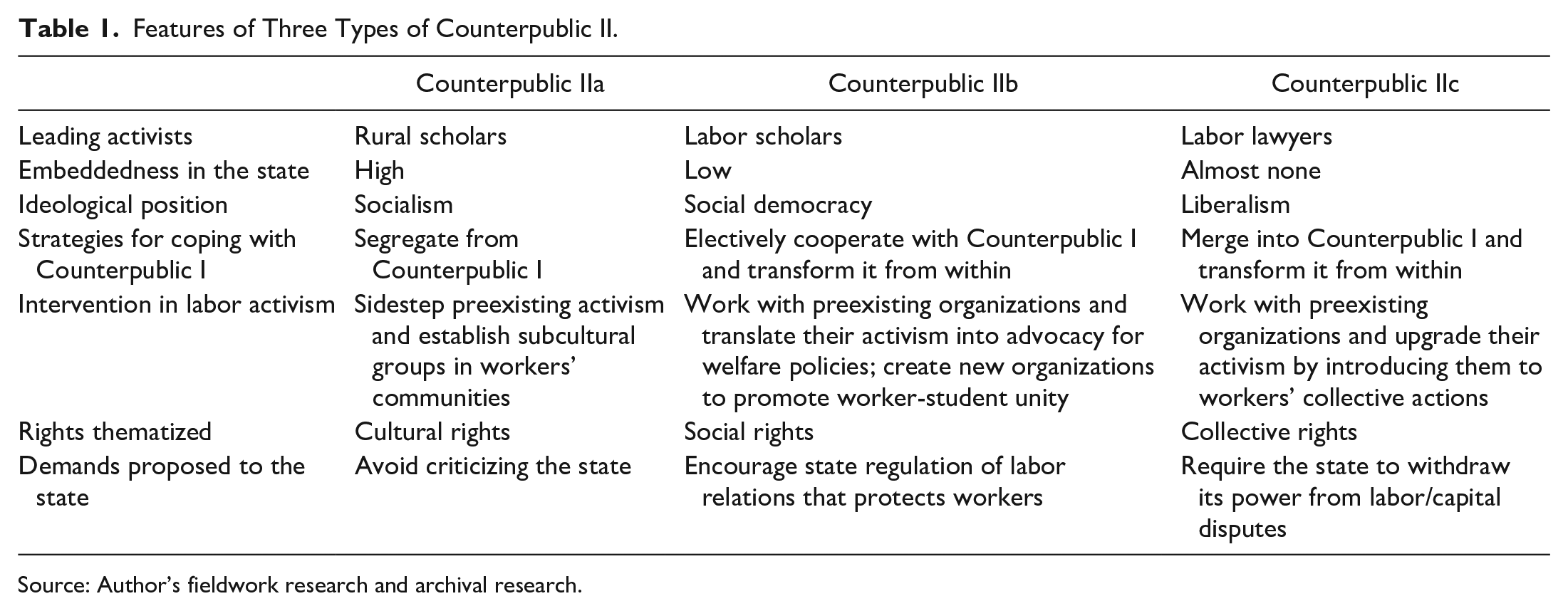
Source: Author’s fieldwork research and archival research.
The ideological position of major actors in Counterpublic II may have an impact on their strategies for coping with Counterpublic I. People’s ideological positions tend to be multidimensional or even contradictory. Moreover, the impact of ideology on political actions cannot be deterministic. But when facing choice in seeking alliance, people’s attitudes toward some critical issues matter. For example, while both rural scholars and labor scholars were highly critical of China’s involvement in neoliberal globalization, their attitude toward the remedy for this problem differed. Whereas labor scholars saw social movements as important forces that could constrain the capitalist logic of accumulation, rural scholars tended to look down upon social movements and regarded a strong redistributive state as the solution. If we are informed of this critical difference, it is not difficult to understand why labor scholars, compared with rural scholars, were more likely to cooperate with Counterpublic I.
Activists’ strategies for coping with Counterpublic I can also be influenced by their relations with the state. Here I pay attention to the concept of political embeddedness, which is defined as the positioning of political actors’ social networks in relation to the state or their proximity to the state. 18 High embeddedness in the state brings activists funding sources, channels for submitting policy suggestions, and the exemption from arbitrary repression. But to maintain such embeddedness in an authoritarian context, activists have to repeatedly express their loyalty to the state. This almost inevitably sets them apart from a Counterpublic I whose major goal is to contain state power. In contrast, those who have low or zero embeddedness in the state—which means that they probably have fewer resources—have more chances and also reasons to ally themselves with actors in Counterpublic I.
Data and Methods
This project is part of a larger project that aims to document and explain the structural transformation of the public sphere in China, with a particular focus on the rise and fall of the civil society project initiated by liberal intellectuals. Between 2011 and 2019, I carried out several rounds of fieldwork and conducted more than two hundred interviews with activist intellectuals, NGO practitioners, student activists, and protest leaders. These interviews have familiarized me with the key organizations, actors, and networks in the major social movements that have happened in China since the 1990s.
The analysis in this article relies on the following data. To understand the public discussion on the issue of rural migrant workers in Counterpublic I, I searched two commercialized newspapers, the Southern Weekly and the Southern Metropolis Daily. They were widely regarded as the country’s most critical newspapers from the late 1990s to the early 2000s, as well as major communicative institutions that advocated the liberal ideology of civil society. 19 I entered the key word “rural migrant workers” into the databases of these two newspapers and read all of the articles that were returned by those searches.
My understanding of the articulation of rural migrant workers’ rights in Counterpublic II started from an investigation of community-based labor NGOs. Between 2012 and 2018, I visited twenty-six labor NGOs in six cities (Beijing, Guangzhou, Shenzhen, Foshan, Dongguan, and Zhuhai) and conducted fifty-one interviews. In my interviews, I talked with my informants about their experience of becoming activists, the history of their organizations, and their daily activities. From these interviews, I came to understand that rural scholars, labor scholars, and labor lawyers were the key actors who had promoted the activism of labor NGOs. Hence, I carried out another round of fieldwork and conducted twelve interviews with these scholars and lawyers. In these interviews, I discussed with my informants their respective ideological positions, their political agendas, and the specific strategies they had employed in their public interventions. In this round of fieldwork, I also interviewed seven student activists who had participated in labor activism.
To understand how these actors had publicly articulated their opinions on the issue of rural migrant workers’ rights, I also assembled an archive that included the transcripts of public lectures held by scholars and lawyers, media interviews and coverage of labor NGOs’ activism, and the contents of websites and social media accounts created by student activists, along with publicized research reports and petitions and proposals on labor issues that had been submitted to the People’s Congress. By cross-validating information from different sources, I acquired a comprehensive knowledge of the dynamics and the transformation of the field.
A few words on the issue of confidentiality before we go into the details. To protect my informants, I conceal their names when I quote them. I also remove all the information that might be used to identify them. I use their real names only when the quotations come from publicly available materials, such as a public lecture or a published article.
The Articulation of Counterpublic I
The Social Conditions for the Rise of Counterpublic I
In 1978, the Chinese state began to withdraw its power from society, as the country moved away from a planned economy and embraced a market economy. In the 1980s, independent academic publishers, reading clubs, salons, and public lectures flourished. Intellectuals and university students reflected upon the Cultural Revolution, discussed the possibility of a humanitarian Marxism, and openly criticized China’s undemocratic political system. This vigorous public life eventually led to the rise of the 1989 student movement. 20 Although the movement was eventually suppressed, the withdrawal of state power had largely continued in the 1990s. In 1992, Deng Xiaoping made his now-famous southern tour and reasserted that the Communist Party would insist on market-oriented economic reforms. In the wake of his tour, public life gradually revived, albeit in different forms.
Three factors prevented the state from strengthening its control over society in the 1990s. First, during that time, the state was deeply influenced by the neoliberal idea that excessive government intervention in society was problematic. In practice, because of the cuts in welfare spending, societal organizations such as charities and community organizations became important supplements to the delivery of services. 21 Some government departments, such as the Ministry of Civil Affairs, even proactively advocated that it was good to have “small government and big society” (xiao zhengfu, da shehui). 22 The second factor had to do with the pressure from the international community. During the 1990s, while China was eager to participate in international trade so as to boost its economy, its reputation among the international community had dropped to its lowest point following the crackdown on the student movement. To redeem its reputation, the state even released many dissidents. 23 Third, as state power was decentralized during the economic reform, it became increasingly difficult for the central government to control local governments. 24 At the local level, corruption was rampant. Critical public opinions articulated by societal forces were perceived by the central government as means to check and supervise local governments. 25
In such an environment, new venues for public communication began to grow. In the 1990s, censorship in newspapers was loosened. Except for a few fundamental matters, such as the rule of the Communist Party, journalists were granted autonomy in newsgathering and reporting. 26 It was during this period that the Southern Weekly and the Southern Metropolis Daily, two Guangzhou-based commercialized newspapers, became important channels for producing critical public opinions. In the early 1990s, these newspapers were only known for their entertainment news. But in the late 1990s, they began to muckrake. 27 In this process, a group of activist journalists emerged. These activist journalists sharply criticized social problems, such as corruption, and were not afraid to challenge government authority. Their activities earned the newspapers high prestige and national influence. At their peak, the Southern Weekly’s daily circulation was 1.6 million and the Southern Metropolis Daily’s circulation was 1.2 million. 28
Other nascent communication venues included NGOs established by intellectual elites. Beginning in the late 1990s, the state began to cut spending on “public interest institutions” (shiye danwei), such as schools, research institutes, and hospitals, and encouraged these institutions to seek resources outside the state system. Facing this change, many professors, researchers, and doctors turned to profit-seeking activities in the market. 29 But a small number of these professionals made use of this opportunity and created new organizations for public intervention. With the help of international foundations, these people founded NGOs. Working on issues like environmental protection, education, and rural development, these organizations disclosed social problems and initiated public discussions.
What is worth mentioning here is that the abovementioned actors were not entirely disorganized. Communication and cooperation were widespread among them. In the early 2000s, some “central organizations” that had the capacity to reach and influence other organizations emerged. A notable example was the Institute for Civil Society (ICS) at Sun Yat-sen University. Established in 2003 by a group of scholars who were interested in promoting the NGO sector, the ICS served to mediate between international foundations and local NGOs. The scholars at ICS and journalists at the Southern Weekly also coproduced an underground magazine called Minjian (which could be roughly translated as “a nongovernmental place”). The magazine not only reported the development of NGOs in China but also discussed issues like freedom of the press. It was through the communications initiated by these central organizations that newly emerging actors began to identify with common values and goals.
The Idea and Ideology of Counterpublic I
A prominent discourse among activist journalists and NGO practitioners in the 1990s and early 2000s was the discourse of civil society. The concept of civil society was introduced to the Chinese audience in 1992 by Deng Zhenglai and Jing Yuejin, two political scientists. In the Chinese Social Science Quarterly, a privately run journal, the two scholars published an article called “Building China’s Civil Society.” In the article, they described civil society as a space consisting of a market economy and citizens’ autonomous associations and argued that such a space could check arbitrary state intervention and promote democracy. 30
While the article was controversial among the academic community, 31 it was well received among actors in the newly rising venues that engaged in public discussion. This had to do with the fact that many of the activist journalists and NGO practitioners in question had experienced the 1989 student movement. On recalling the past experience, they found the concept useful for explaining the failure of the movement: the reason why the movement was neither well organized nor capable of withstanding repression was that China lacked civil society organizations in the 1980s. 32 Additionally, many of the activists were deeply influenced by the political writings of dissident intellectuals from eastern Europe. They saw Václav Havel and Adam Michnik as their role models, and they very much hoped that something similar to Poland’s Solidarity Movement could one day happen in China. 33
As a matter of fact, quite a few people became NGO practitioners in the 1990s because they were attracted by the political ideal of civil society. Among these people, engagement with a wide range of issues was common. One might establish an environmental NGO in the beginning, turn to education two years later, and rural development thereafter. The underlying rationale was that what really mattered were the efforts to expand the space for autonomous associations, rather than the specific thematic contents of the organizations’ activities. 34
In the intersecting networks of activist journalists and NGO practitioners, the possibility of promoting democracy through the expansion of civil society was widely discussed. Minjian published numerous articles that associated NGO activism and the production of critical news with the rise of civil society in China. The ICS held a series of “capacity building programs” for NGO practitioners, where the study of civil society theories was promoted as highly important. Through these studies and discussions, “building China’s civil society” became an overarching project that brought together different kinds of activism. Equipped with this ideological focal point, the fragmented NGO activism and the production of critical news were integrated into a Counterpublic I that aimed to check state power.
Major actors in this Counterpublic I often asserted that civil society was good for all: if state power could be contained and a space for autonomous associations could be formulated, all citizens would have more opportunities to participate in politics and express their concerns. But if we scrutinize the organizational basis of this Counterpublic I, we will discover that it was far from a place where everyone could equally participate. First of all, not everyone could establish NGOs. Before the late 2000s, the registration procedure for NGOs in China was rather complicated, 35 and there were almost no domestic funding sources. This implied that only those who were rich in social and cultural capital were eligible to become NGO practitioners. Almost all founders of NGOs established in the 1990s were celebrity intellectuals who were fluent in English. Although some community-based NGOs began to emerge in the 2000s, because of the lack of resources, these organizations had to be dependent on central organizations established by intellectual elites to attract international funds.
Second, because the networks of Counterpublic I were from the beginning translocal, 36 many communications took place in the newly emerging internet space, on platforms like the Bulletin Board System (BBS). In the 1990s, most people in China got online through dial-up protocol, which was rather expensive. Even among the urban middle class, personal computers or laptops were not widespread. This meant that the real participants in Counterpublic I were limited to a very small circle of intellectual elites. Although these elites claimed that they represented the general interest, their understanding of the difficulties that the disadvantaged faced was rather finite. Their discussion of rural migrant workers’ rights illustrated this point.
The Discussion of Rural Migrant Workers’ Rights in Counterpublic I
The issue of rural migrant workers’ rights has to be understood in the historical context of China’s socialist transition. The first factor causing difficulties for these workers was China’s hukou system. The hukou system was a household registration system that defined citizens as legal residents in a certain region. It was a legacy of the socialist era. 37 While the mobility of China’s population had dramatically increased since the market-oriented economic reform, transferring one’s hukou registration across regions remained difficult, especially for those who lacked professional skills. 38 In the 1990s and the early 2000s, to legally work in cities, rural migrant workers had to obtain a temporary living permit from the police. Those who failed to get the permit could be detained by the police and returned to their rural hometowns. 39
The lack of legal protection was another factor. Labor laws in China granted workers some basic rights, such as the right to safety at work and the right to social insurance. But in practice, the rules codified in labor laws were often not implemented. Since local governments tended to prioritize economic growth over human rights, they were less incentivized to penalize corporations that violated labor laws. 40
A third factor had to do with the fact that the reconstruction of the welfare state in China had lagged behind the economic reforms. China’s welfare system was established during the socialist period, when most people worked in the same place for their whole life. Hence the system was rather fragmented, decentralized, and locally based. 41 Until the late 2000s, transferring one’s retirement pension across provinces was rather difficult. Moreover, until recent years, many public services, such as public education, were provided to residents whose hukou was locally registered only. Rural migrant workers and their children thus had very limited access to various social programs. 42
From the above discussion, we can see that there were complex factors behind rural migrant workers’ disadvantaged position. Some of these factors had to do with excessive state intervention in the mobility of labor (the hukou system), while others had to do with insufficient state regulation over the market (the weak enforcement of labor laws and the lack of welfare programs).
However, when discussing rural migrant workers’ rights, participants in Counterpublic I were almost exclusively interested in criticizing the excessive state intervention. In articles published in commercialized newspapers, journalists blamed the hukou system for obstructing the free movement of labor. They also argued that the negative impact brought by the hukou system was a vivid example showing that state intervention in the market could only harm the poor. 43 Criticism of problems caused by insufficient state regulation was hard to find. On rare occasions, participants in Counterpublic I discussed rural migrant workers’ limited access to welfare programs. But the focus of the discussion was usually on showing the exhaustion of the state and the superiority of the market. For example, commenting on the phenomenon of rural migrant workers’ children being ineligible to attend public schools, journalists at the Southern Weekly suggested that the root of the problem was the state’s monopoly on education. They also argued that as long as the state opened the education market and let different kinds of schools freely compete, the market would quickly provide enough educational resources. 44
Counterpublic I’s partial discussion of rural migrant workers’ rights was related to activists’ understanding of civil society. Being influenced by dissident intellectuals from eastern Europe, most activists at that time adopted a binary model that dichotomized the state and civil society. 45 This model not only treated the state as the antithesis of civil society and liberty but also regarded the market economy as part of civil society. Hence it tended to lead activists to ignore the positive roles the state could play in protecting citizens’ rights and the power inequality between employers and employees.
Moreover, the partial discussion was also related to the unequal organizing structure of Counterpublic I. As a matter of fact, in the early 2000s, community-based labor NGOs had already emerged in the Pearl River Delta. 46 Organized by rural migrant workers themselves, these organizations provided affordable legal services in workers’ communities. Experiencing countless defeats in arbitrations and lawsuits, many leaders of these NGOs had already recognized that, without strengthening state regulation, it was impossible to improve rural migrant workers’ condition. However, these people did not have the power to define the agenda in Counterpublic I. For example, when attending the capacity-building programs offered by the ICS, activists from labor NGOs were often discouraged from talking about issues like working-class solidarity. 47 Recalling the experience, an activist said, “We were told that civil society was a space where everybody could equally participate. Hence there was no need to emphasize your particular identity as workers.” 48 These phenomena illustrated the difficulties of articulating rural migrant workers’ rights in Counterpublic I and implied the necessity of seeking alternative ideological frames and communicative space.
The Social Conditions for the Rise of Counterpublic II
Transformations took place in the broader political-economic environment during the mid-2000s. As China entered the Hu-Wen regime (2003–12), the state began to emphasize that its development goal had now shifted to building a “harmonious society” rather than simply boosting economic growth. It was during this period that the discourse of “small government and big society” gradually disappeared from the state’s public documents. In response to increasing inequality, the central government issued many policies to alleviate poverty. In 2007 and 2008, several laws that aimed to provide better protection to workers were passed. 49 Moreover, as the manufacturing industry in the Pearl River Delta began to experience seasonal labor shortages, rural migrant workers obtained more bargaining power. 50 Around the year 2010, the public witnessed several successful strikes in the automobile industry. 51 These events aroused public concern over labor issues.
The infrastructure for public communication had also been changed. With the improvement of internet technology, the price of getting online had significantly dropped. In the early 2010s, smart phones became popular among young rural migrant workers in coastal cities. 52 The fast expansion of internet users promoted the growth of online social media services in China, such as Weibo and WeChat, whose accessibility was much greater compared to BBSs in previous years. 53 Although censorship on the internet developed almost immediately in tandem with the rise of the services, many social movement activists began to use the new media to express their concerns and demands. The emergence of these alternative channels not only offered disadvantaged groups opportunities to attend public discussion, but they also reduced the influence of the traditional paper media. Since the early 2010s, the circulation of prominent commercialized newspapers, including the Southern Weekly and the Southern Metropolis Daily, had significantly dropped. 54
More importantly, state power became increasingly intermeshed in the NGO sphere. As I mentioned above, before the late 2000s, since the registration process was too complex to complete, only a few NGOs established by celebrity intellectuals were able to make their way onto official rolls. Most community-based NGOs remained unregistered or registered as businesses. This actually made it more difficult for the state to supervise and control NGOs, because, by remaining unregistered, many organizations “disappeared” from the view of the state. 55 To solve this problem, around 2009, the state began to simplify the registration procedure and allow NGOs engaging in service provision activities to directly register with the Ministry of Civil Affairs. 56 State funds also became available through “government purchasing service” (zhengfu goumai fuwu) programs. Between 2009 and 2014, many community-based NGOs, including labor NGOs, registered with the ministry. 57 Since quite a few of these NGOs received state funds after registration, their dependence on international funds was reduced. The influence of the central organizations, which used to mediate between international foundations and local NGOs, thus also declined. Together, these transformations provided opportunities to new actors in the public sphere.
The Articulation of Rural Migrant Workers’ Rights in Counterpublic II
In this section, I will discuss how the rise of rural scholars, labor scholars, and labor lawyers promoted the formation of a Counterpublic II that specialized in addressing rural migrant workers’ issues. I will focus on how these actors chose the strategies for dealing with Counterpublic I and how their strategies had influenced the problematization and the thematization of rural migrant workers’ rights. I will talk more about the Counterpublic II initiated by labor scholars, because their dialogue with Counterpublic I was the most sophisticated and because their activism attracted the widest attention.
Reviving Socialist Culture: The Counterpublic II Led by Rural Scholars
The 1990s were a time of rampant social conflict in rural China. Initiated by issues like land appropriation, environmental pollution, and the corruption of local government officials, resistance movements among peasants frequently occurred. 58 These resistance movements attracted attention from scholars who studied rural issues in China. In the late 1990s, many of these scholars began to openly criticize the state’s rural policies. They pointed out the fact that the urban-rural gap had become increasingly wider since the 1980s and argued that the market-oriented economic reforms had favored urban regions. 59 Later, these scholars came together and formed a school called the “school of rural construction” (xiangjian pai). 60 The school’s major agenda was to oppose land privatization in rural areas. To disseminate their ideas, rural scholars held public lectures, carried out social experiments by establishing peasants’ cooperatives, and mobilized university students to attend rural development projects. 61
From the beginning, the school of rural construction was highly embedded in the authoritarian state. For example, before 2004, Wen Tiejun, one of the leading scholars in the school, served as the chief editor of a magazine called China Reform. Established by the Development and Reform Commission, a subordinate of the State Council, the magazine functioned as a think tank for the country’s top leaders. The embeddedness in the state provided the rural scholars with opportunities to submit policy suggestions. Between the late 1990s and the early 2000s, Wen and his colleagues repeatedly contended, in articles published in China Reform or in direct written communications to top leaders, that China faced “three rural problems” (sannong wenti): “peasants were miserable, rural areas were impoverished, and agriculture was risky.” 62 The state eventually responded to their entreaties. In 2003, Beijing officially adopted the discourse of the “three rural problems” and began to issue policies that aimed to alleviate peasants’ burdens. 63
In the opinion of these rural scholars, the problem of rural migrant workers was nothing but an extension of China’s rural problems: because rural migrant workers had neither stable jobs nor access to welfare benefits in cities, they had to periodically return to their rural hometowns. This illustrated that these workers had never fully ridden themselves of their status as peasants. 64 Hence the rural scholars also intervened in the activism of rural migrant workers.
Around 2004, a group of artists joined the rural scholars. The leader of these artists, Sun Heng, used to be a middle school music teacher in Anhui Province. In the early 2000s, he resigned from his job and came to the capital city. Coincidentally, he attended a public lecture held by the rural scholars. From the lecture, Sun learned that many migrant children in Beijing were studying at schools that lacked teachers. He thus began to work as a volunteer in those schools. Later, Sun and his friends formed a band and toured different construction sites in the city. The tour was very successful, and the band was eventually able to earn an income by releasing a CD called Sing for Migrant Workers. With the income, Sun and the rural scholars cofounded an organization in a rural migrant workers’ community in Beijing. The organization was initially named the Peasants’ Friendly Society and later changed to the Workers’ Friendly Society. In the community, Sun and his friends held cultural performances, while rural scholars and their students organized reading clubs and opened a primary school.
The Workers’ Friendly Society had largely segregated itself from major organizations in Counterpublic I. This had to do with the ideological stance of the rural scholars and the artists. These actors were influenced by a variety of leftist ideological doctrines, such as Marxism, socialism, and Maoism. But generally speaking, they were all quite sympathetic to China’s socialist past. Rural scholars emphasized that it was during the socialist era that China laid a solid foundation for industrialization, without which the later economic takeoff would have been impossible. They also praised socialism for the various welfare projects that had delivered medical care and education to rural areas and argued that it was not until China’s participation in neoliberal globalization that these projects began to wither away. 65 These people’s sympathy toward socialism had made it difficult for them to identify with Counterpublic I. From their point of view, the project of building civil society went hand in hand with the liberalization and privatization of China’s economy; the so-called NGOs were simply agencies of neoliberal international foundations. 66
Major organizations in Counterpublic I likewise had a strong aversion to the activism of rural scholars. In commercialized newspapers, rural scholars and their experiments were often portrayed in negative terms. Journalists described rural scholars as “a group of outdated scholars who had no idea how the market economy worked” and blamed them for “bringing a horrible revolutionary culture back to China.” 67
The choice of segregating from Counterpublic I also had to do with activists’ relationship with the state. Learning from the experience of rural scholars, activists in the Workers’ Friendly Society tended to believe that the key to helping the disadvantaged was to maintain a smooth relationship with the state. With the help of these scholars, the society was able to establish connections with some high-level state actors. In the early 2010s, the society was even able to work with the Central Committee of the Communist Youth League to organize cultural performances in migrant workers’ communities.
While obtaining more resources, the frequent interactions with the state had also imposed constraints on activists. There was a time during the late 2000s when rural scholars and the artists in the society considered the possibility of providing legal services to rural migrant workers. 68 But helping workers defend legal rights often involved confrontations with their employers and local-level state agencies. Major activists in the society did not want to present themselves as potential organizers of agitational activities, because that would cost them the trust of the state. Contemplating the risk, they canceled their plan to provide legal services and moved further away from any activism that could be regarded as disturbing.
Because of these constraints, the artists eventually decided to limit themselves to cultural criticism. Specifically, rural scholars and the artists argued that the mainstream culture in China after the economic reform had become a culture for the bourgeoisie. To fundamentally change workers’ disadvantaged position, it was necessary to revive a socialist culture that respected the value of labor. To achieve that goal, participants in the Workers’ Friendly Society began to produce numerous songs, poems, works of fiction, and plays that expressed workers’ feelings and criticized social inequality. The society also organized a series of workshops for cultivating working-class singers and writers. These workshops attracted many rural migrant workers with artistic talents. After undergoing training in the workshops, some of them left Beijing and established similar organizations in other cities, such as Suzhou, Xiamen, and Tianjin. Many of these organizations later evolved into locally based subcultural groups in the working-class community.
To sum up, through their critiques of Counterpublic I, rural scholars and their colleagues brought the discourse of socialism back to the public. Yet their embeddedness in the state prevented them from engaging in agitational activities, such as protests and strikes. These two factors led to the formation of a Counterpublic II that focused on advocating rural migrant workers’ cultural rights.
Protecting Workers’ Social Rights: The Counterpublic II Led by Labor Scholars
In the early 2000s, social science scholars specializing in labor studies began to emerge at universities and research institutes in China. 69 Most of them were sociologists and political scientists from Tsinghua University, Peking University, Sun Yat-sen University, and the Academy of Social Sciences. Among them, the most important group were sociologists from Tsinghua University. The department of sociology at Tsinghua was not founded until 2000. But immediately following its establishment, leading scholars in the department, such as Shen Yuan and Guo Yuhua, decided that the sociology of labor should be the department’s major research area. In the following years, these scholars not only advised graduate students to conduct ethnographic research on labor issues but also translated numerous Western academic works on labor into Chinese. 70 Notable examples included Michael Burawoy’s Manufacturing Consent and Hagen Koo’s Korean Workers. Many of these labor scholars were strong advocates of Burawoy’s idea of public sociology, believing that social science knowledge could be employed to make public interventions. 71
While these labor scholars agreed with the aforementioned rural scholars that inequality had increased since the economic reforms, they diverged from the latter group in important ways. First, labor scholars’ embeddedness in the state was much lower compared with that of rural scholars. Most labor scholars had positions in state-sponsored public universities. Some of them received research grants from the National Social Science Foundation. But they did not maintain an institution through which they could directly influence top leaders. When they had policy suggestions, they usually had to submit them through routine channels, such as the People’s Congress. These scholars were thus more eager to ally with various societal forces.
Second, these labor scholars did not see civil society as necessarily “neoliberal.” Many of these labor scholars also believed in the value of democracy and the need for constraints on authoritarian power. On many occasions, the labor scholars expressed that they also wanted to promote civil society in China; it was simply that their understanding of civil society was somewhat different. Specifically, these scholars emphasized that the unrestrained capitalist market was another systemic power that could produce inequality and infringe on basic rights; therefore, civil society should not only function as the antithesis of the state but also as the antithesis of the market. 72 For example, in a public lecture held at the One Dollar Commune—an organization in Beijing established for promoting communication among NGO practitioners—Guo Yuhua, the sociologist from Tsinghua University, explained to the audience, “Whereas the liberals advocate the restriction of state power, the leftists more often criticize the capitalist market. In my opinion, this kind of divergence is unnecessary, because both the state and the market need to be criticized. . . . Civil society should become a common ground.” 73
These expressions largely changed people’s impression of the leftists. In an interview, one student activist told me, “Previously, my understanding was that the liberals supported citizens to defend rights through criticizing the authoritarian state, whereas the leftists were those who tried to defend authoritarianism. But Professor Shen and Professor Guo showed me that the leftists could also make a stand for the resistance movement.” 74 The commercialized newspapers also showed a much friendlier attitude toward the labor scholars, compared with their attitude toward rural scholars. In 2007, the Southern Weekly invited sociologists from Tsinghua University to write an ongoing column on “constructing society.” In the column, the labor scholars systematically explained their political project and used plain language to introduce to the public new theoretical perspectives for understanding the concept of society, such as Polanyi’s theory of countermovement. 75 With these explanations, the boundary between labor scholars and Counterpublic I became blurred.
Since 2007, these labor scholars began to organize a series of training workshops for activists from community-based labor NGOs. Standing apart from the capacity-building programs offered by actors in Counterpublic I, in which the discussion of labor issues was discouraged, the workshops organized by the labor scholars gave prominence to labor issues. Besides familiarizing trainees with theories in labor studies, the workshops invited labor activists from abroad to talk about their labor-mobilizing experiences. The workshops attracted many community-based labor NGOs that were previously associated with Counterpublic I. Through these workshops, the labor scholars were able to build close connections with labor NGOs.
The labor scholars also established new networks alongside the existing ones. In 2009, they started a program called the New Generation Project, which aimed to introduce university students to labor movement activism. In the program, these scholars not only advised students to do research on labor-related issues, but they also helped students become interns in factories and plants. Many of the students later became activists in labor NGOs or founded their own networks for serving rural migrant workers. A notable example was a voluntary network called Safety Helmet. Organized by a group of students from Peking University and Tsinghua University, the network disseminated the knowledge of safety production among construction workers in Beijing and was occasionally involved in constructing workers’ resistance activism.
Through interactions with labor NGOs and their students’ networks, the labor scholars were informed of workers’ on-the-ground struggles. In the late 2000s and early 2010s, this cluster of actors played an important role in unifying workers’ otherwise fragmented resistance activism and in magnifying workers’ voices in the public sphere. A case in point was these actors’ intervention in workers’ struggle for social insurance.
In China, the social insurance program collects funds from both employers and employees. It is supposed to provide employees with basic security benefits, including a retirement pension, medical insurance, work-related injury insurance, unemployment insurance, and a maternity pension. But in practice, many rural migrant workers are excluded from the program. In fact, in the 1990s and 2000s, most workers tended to accept the fact that they were not eligible for the social insurance program, because they did not like the idea that the social insurance fund extracted a few hundred yuan every month from their meager income. But things started to change in the early 2010s. In the city of Shenzhen, migrant workers who had left rural areas in the 1980s gradually came to the age of retirement. Some of these workers began to consider the possibility of staying in the city after retirement. Factory-based collective struggles agitating for the inclusion of workers in the retirement pension program then rose.
Community-based labor NGOs and students’ voluntary networks quickly detected workers’ new demands. In the Pearl River Delta, labor NGOs like Little Grass, Firefly, Hand in Hand, and the Center for Migrant Workers actively intervened in workers’ collective actions. These organizations accompanied workers as the latter petitioned the municipal government and offered them advice when they decided to initiate collective bargaining with their employers. To bring together the fragmented factory-based resistance, these organizations also held salons in which protest leaders from different factories could meet and encourage each other. Through conversations in these salons, a cross-factory network focusing on the issue of social insurance was formed. Some participants in the network later became professional activists in labor NGOs. 76 To attract public attention, activists from Firefly, with the help of student activists, established on Weibo and WeChat a social media account called “Social Insurance for Everyone” (Renren You Shebao). On the account, activists posted biographies of individual workers to demonstrate their difficult situations. They also reported on workers’ petitions to various local governments and updated their followers on the progress of different negotiations.
In Beijing, although workers’ struggles for social insurance were not as proactive as those in the Delta, activists made similar interventions. In 2009, student activists from Safety Helmet conducted research on the compensation for work-related injury in the construction industry and completed a report that exposed rural migrant workers’ limited access to the work-related injury insurance. 77 To support the workers and the students, the labor scholars also held several academic conferences to discuss the issue. In those conferences, the labor scholars publicly asserted that the lack of social security among rural migrant workers was a common phenomenon and pointed out that the root of the problem was that workers had been treated as commodities rather than human beings. 78 This activism eventually alarmed the state. In 2013, some state-controlled news media also began to criticize the problem that many rural migrant workers had no social insurance. 79
Using similar strategies, in the late 2000s and early 2010s, labor scholars and labor NGOs launched advocacy campaigns respective of several other issues, such as the compensation for industrial injury accidents and migrant children’s access to public schools. While most of the activism was initiated under the framework of “building civil society,” it nonetheless expanded the meaning of rights in the public discussion. Whereas major actors in Counterpublic I saw rural migrant workers as freely moving labor power in the market, the labor scholars and the activists with whom they worked highlighted that workers were citizens who had the right to stay in cities and enjoy the benefits brought by economic growth and the development of society. In other words, the labor scholars and their colleagues had brought the idea of social rights back to the public sphere.
Moreover, since labor scholars tended to consider the possibility of promoting policy changes, they had elaborated a more sophisticated understanding of the role of the state. For example, to remedy the problem of rural migrant workers having no social insurance, the labor scholars proposed that the governance of the social insurance fund should become more centralized. In the policy suggestion they submitted to the People’s Congress, they argued that, had the central government had more power to make overall planning for the social insurance program, the cross-regional transfer of payment would have been much easier, which would have benefited those workers who were not able to settle down in one place. These scholars also proposed that the administrative power of the Ministry of Human Resources and Social Security should be expanded, because that would enable the state to penalize those enterprises that had failed to offer social insurance payments. 80 Through this advocacy, the labor scholars developed a set of critical discourses that were different from those proposed by Counterpublic I. Whereas major actors in Counterpublic I advocated the withdrawal of state power, the labor scholars suggested that to provide better protections to workers, the state had to reestablish its power.
In sum, the labor scholars’ ideological stance and their relations with the state had enabled them to play a crucial role in the public sphere. In the late 2000s and early 2010s, these scholars had on the one hand allied with major actors in Counterpublic I to criticize the authoritarian state, and on the other hand criticized the emancipatory program proposed by actors in Counterpublic I as being unfinished and parochial. In this process, they managed to bridge the project of building civil society with the project of helping rural migrant workers as a disadvantaged group. This led to the formulation of a Counterpublic II that advocated workers’ social rights.
Advocating Collective Rights: The Counterpublic II Led by Labor Lawyers
The reform of the legal profession in China since the early 1990s has granted lawyers a certain degree of autonomy. Since then, they have been allowed to act in courts as agents for litigation, obtain remuneration, and establish private law firms. 81 In the late 1990s, a small group of lawyers began to make use of this space and became involved in various kinds of human rights activism. 82 Some of these lawyers specialized in helping workers defend their rights. One of the most influential figures among them was Duan Yi, a labor lawyer based in Shenzhen. In 2005, Duan established a law firm called Laowei, which literally meant “defending labor.” The law firm insisted on providing legal services exclusively to workers. By 2009, it was already host to more than twenty certified lawyers, most of whom were young lawyers who had the ambition to use legal weapons to help the disadvantaged.
Generally speaking, these labor lawyers’ ideological stance was in many ways close to that of the major actors in Counterpublic I. The labor lawyers also opposed excessive state intervention, supported the project of building civil society, and believed that the foundation of civil society lay in the development of a market economy. Yet there were also differences between the labor lawyers and the actors in Counterpublic I. The labor lawyers criticized the fact that most actors in Counterpublic I only considered individual rights while largely ignoring collective rights. This ignorance became problematic in the labor field, because workers as individuals were extremely powerless vis-à-vis capital. On various occasions, the labor lawyers contended that, without collective rights like the right to unions and the right to collective bargaining, there was no way for workers to improve their condition. 83
In China, workers’ collective rights are by no means well guaranteed. The only legitimate unions are the All-China Federation of Trade Unions (ACFTU), which is a state-controlled organization extending its branches throughout all industries and plants. 84 These unions usually have more interest in smoothing over disputes between labor and capital than in representing workers’ interests. 85 While labor laws grant workers the right to collective bargaining, these laws also stipulate that all collective bargaining should be carried out under the guidance of the ACFTU. Therefore, effective collective bargaining rarely happens in practice. 86 Since the late 2000s, the Chinese state has carried out a series of reforms of the ACFTU. For example, plant-level unions are now encouraged to have more direct elections. But these reforms are mostly superficial, because the state has proved unwilling to allow workers to independently negotiate with capital.
To criticize this problem, around 2009, the labor lawyers at Laowei organized an effort to advocate workers’ right to collective bargaining. They designed a handbook that described how to initiate collective bargaining without the guidance of the ACFTU. The handbook told workers how to democratically elect their representatives and raise a “solidarity fund.” It also offered detailed advice on how to supervise the representatives and prevent them from being harassed or bribed by capital and its management. The labor lawyers’ rationale was that, if workers were able to demonstrate to the state that they could organize collective bargaining even without the presence of state-controlled unions, the state would be more incentivized to carry out substantive reforms of the ACFTU. 87 To disseminate their ideas, the labor lawyers held several conferences on workers’ collective rights, in which they argued that granting workers autonomy in collective bargaining was good for the formation of “smooth market relations.” 88
The labor lawyers’ criticism of state intervention and their preference for the market economy lent them an affinity with actors in Counterpublic I. What reinforced the affinity was the fact that the labor lawyers had almost no embeddedness in the state. They had neither a special institution through which they could influence state leaders nor regular connections with the government. Moreover, since these lawyers gained most of their resources from the market, they were not so afraid of losing the state’s trust and attending agitational activities. In 2010, these lawyers began to work with a community-based labor NGO called Panyu Migrant Workers. Established in the city of Guangzhou in 1999, Panyu Migrant Workers was one of the oldest labor NGOs in the Pearl River Delta. It had not only provided legal services to thousands of rural migrant workers but also trained quite a few labor activists. Many workers who had received legal aid from the organization later established similar organizations in other cities in the Delta, such as Foshan, Dongguan, and Zhongshan. With the help of Panyu Migrant Workers, the labor lawyers from Laowei were connected to a network of labor NGOs and labor activists.
Under the guidance of these labor lawyers, Panyu Migrant Workers and a few other labor NGOs in the Delta began to intervene in workers’ factory-based collective actions. Activists in these NGOs approached leaders in labor protests or strikes, building rapport with them and teaching them the organizational skills discussed in the handbook designed by the labor lawyers. In the early 2010s, these organizations made a few successful interventions. In 2011, with the help of the labor lawyers and a labor NGO in Shenzhen, more than 1,200 rural migrant workers in a watch chain plant won 15 percent pay raises through collective bargaining. In 2012, after learning organizational skills from Panyu Migrant Workers, workers in a jewelry processing plant in Guangzhou not only succeeded in establishing a social insurance account but also forced their employer to pay arrears for their social insurance. With the help of labor NGOs, workers in these cases documented their experience and posted entries on their Weibo accounts. As the successful cases accumulated, some news media began to positively report on Laowei and its agenda to promote workers’ right to collective bargaining. 89
Apart from attending workers’ on-the-ground struggles, Laowei and the labor NGOs it worked with also sought to propose policy suggestions. In 2014, when the People’s Congress in Guangdong decided to revise the provincial law on collective contracts, the labor lawyers launched an advocacy campaign. In concert with dozens of labor NGOs in the Delta, they submitted a proposal to the congress. The proposal suggested that the monopoly of the ACFTU should be curtailed and that workers should be allowed to elect their own representatives when signing collective contracts. Although these suggestions were not adopted by the provincial congress, they nevertheless publicized the idea of collective rights.
Although the labor lawyers were quite close to the major actors in Counterpublic I with respect to their ideological stance, their experience of working with rural migrant workers helped them recognize issues that had largely been ignored in public discussions organized by Counterpublic I. Moreover, their alienation from the state enabled them to become involved in agitational activities. Based on these conditions, the labor lawyers eventually promoted the formation of a Counterpublic II that advocated workers’ collective rights in the market.
A Brief Summary of Post-2014 Activism
The political and ideological environment has changed dramatically in China since 2014. On the one hand, the state has increased its regulatory intervention in the NGO sphere by issuing laws. With the passage of the Charity Law and the Law on the Administration of Activities of Overseas Nongovernmental Organizations, the state has gradually established a nationwide, unified standard for governing NGOs and reduced the interactions between international organizations and local social movement actors. On the other hand, the state’s despotic intervention in the public sphere has also significantly increased. Human rights lawyers who used to be highly praised by the state have been detained. Several prominent NGOs have been forced to close. The production of critical news has also been also largely contained.
As a result, many organizations in Counterpublic II have either been suppressed or co-opted. The Counterpublic II led by labor lawyers was hit the hardest. In December 2015, activists in Panyu Migrant Workers and a few other labor NGOs in the Delta were arrested. State propaganda quickly followed, stigmatizing these activists as “agents of overseas hostile forces.” As most labor NGOs associated with labor lawyers were disbanded, the activism for advocating workers’ collective rights was forced to go underground. In contrast, most organizations associated with the rural scholars were able to survive. To maintain their relationship with the government, these organizations usually deemphasized working-class identity and turned to service provision activism in local communities. The Workers’ Friendly Society was an exception. It now devotes itself to organic farming and is allied with activists in China’s food movement.
The transformation of the Counterpublic II led by labor scholars was the most complicated. Some labor NGOs that used to be associated with the labor scholars had also sought to become service provision organizations in communities. But because these organizations had been very active in a series of advocacy campaigns before, they were continuously harassed by the state’s security departments, even after they had quit the advocacy campaigns. Bit by bit, almost all of these organizations were disbanded. On the other side, the various programs that encouraged students to study rural migrant workers’ issues, such as the New Generation Project, were terminated. But that had not prevented students from participating in labor activism. As China’s economic growth has slowed down in recent years, it has become increasingly difficult for university students to find a decent job after graduation. In such an environment, more students have begun to feel sympathetic toward workers. They have independently organized various kinds of activities to follow workers’ issues. Some of the student activists have directly intervened in workers’ collective actions. Some have used social media to initiate public discussion on labor rights.
Compared with the situation in previous years, the organizing structure of student activism has tended to be more diffuse and decentralized. On most occasions, the organizations involved have been event-based concern groups that have emerged spontaneously, lacking formal decision-making structures. Student activism, therefore, has demonstrated some new features. First, it has been more likely for students to become radicalized. In the 2000s and early 2010s, most student activists either established their own NGOs or worked with the NGOs organized by workers. To ensure the long-term survival of these organizations, they had to think twice before employing any disturbing or subversive strategies. Thus, student activists often played subsidiary roles in labor activism in the early years, such as publishing research reports. But nowadays, students no longer expect to establish registered NGOs that receive state funds. 90 Hence the constraints went away. The employment of radical strategies is best illustrated by the Jasic Incident in 2018: to support the collective action organized by workers at Jasic, a plant producing welding machines, student activists from all over the country gathered in Shenzhen, where they organized a series of demonstrations and publicly expressed their belief in Marxism.
Second, student activism has shown more flexibility in seeking new topics for public discussion and more willingness to form alliances with other social movements. In the past few years, student activists have initiated online discussions about several labor-related topics, such as IT engineers’ long working hours and the precarity problem brought by the digital labor platforms. These activists have also joined feminist activists to problematize issues like the discrimination against women employees. These intersections have broadened the scope of the public discussion on labor rights and brought in new actors. Of course, the absence of stable organizations has also brought significant disadvantages. The student activism has often been too fragmented and ephemeral to get crystalized into an operationalizable political agenda. Unlike the rural scholars and the labor scholars, student activists nowadays are seldom able to propose detailed policy suggestions.
It is hard to predict what impact the current student activism could have on China’s public sphere. Like the activism of the human rights lawyers, activist journalists, and NGOs, student activism might be suppressed, as the authoritarian government is trying very hard these days to discipline university-based student associations. Yet what I can definitely observe is the transformation of the culture of public communication. Compared to the situation in the 1990s and 2000s, the young generation of activists are more likely to accept various kinds of leftist discourses and are more sensitive to the issue of inequality and social justice. When I did fieldwork in Guangzhou in 2012, most student activists felt ashamed to acknowledge that they had read Marx’s and Mao’s works. One of them told me, “Only those who are brainwashed by the Communist Party would become Marxists.” 91 But nowadays, more and more youth activists proudly claim that Marxism is their religion. This enthusiasm for leftist ideology could be exploited by the state to enhance the legitimacy of communist rule. But when the young generation recognizes that the so-called socialist state often fails to keep its promise to protect workers, the leftist discourses may well become weapons for undermining the state’s hegemony. This is exactly the legacy left by the contestation between different kinds of counterpublics.
Concluding Remarks
This article extends the theoretical discussion of counterpublics and applies the concept to an authoritarian context. In a democratic context, counterpublics provide a safe space where disadvantaged groups can gain confidence, invent counterdiscourses, and prepare for agitational activities. By analyzing the activism organized around rural migrant workers’ issues, I illustrate that counterpublics in an authoritarian context can perform similar functions. However, because of the threat of the authoritarian state, counterpublics have to deal with a much more complex environment. Those who want to advocate for rural migrant workers’ rights in China not only have to criticize the state but also have to articulate how their criticism of the state is different from the criticism proposed by more privileged groups in society. It is in these kinds of tripartite relations (the state, Counterpublic I, and Counterpublic II) that the function of counterpublics is established.
This study has several implications. First, it elaborates the processes that distinguish China’s counterpublics from the eastern European model. Although intellectual elites who advocated the idea of civil society in China in the 1990s were deeply influenced by eastern Europe, China’s counterpublics became internally contested before they were able to grow strong enough to overcome authoritarian rule. My analysis of the counterpublics for rural migrant workers provides a window for observing the political consequence of this divergence. On the one hand, as the participants in counterpublics become increasingly diverse, proposing multiple, or even contradicting, agendas, the hope of forming a comprehensive resistance movement becomes slim. Yet on the other hand, these contestations also facilitate the development of issue-oriented public discussions and offer opportunities for the expression of various kinds of partisan interest.
Second, this article offers a commentary on the role of the state in the development of counterpublics. I show that, between 2009 and 2014, state intervention in the NGO sphere, in the form of regulation and funding, was an important factor that enabled disadvantaged groups to voice their concerns in the public sphere. This echoes some empirical studies on public communication in state-sponsored settings in democracies. 92 But I also point out that the positive effect of state intervention diminished after 2014, as the exercise of state power became despotic. This illustrates the conundrum disadvantaged groups face in an authoritarian context: an authoritarian state by definition cannot abandon the use of despotic power. As long as the fundamental political institution remains unchanged, there is no guarantee that an authoritarian state only does the “good” part when it begins to intervene.
Third, by documenting the historical transformation of labor activism, this study also provides a new angle for understanding labor NGOs in China. In recent years, there has been a growing body of literature discussing the role of labor NGOs in China’s labor movement. Whereas some scholars highlight labor NGOs’ role in defending workers’ rights and inventing counterhegemonic discourses, 93 others warn that labor NGOs can easily be co-opted by the state and serve as “anti-solidarity machines.” 94 In my opinion, it is necessary to recognize that labor NGOs are not isolated organizations; rather, they are one of the communicative institutions in China’s public sphere as a field. Hence, the role labor NGOs play is a function of the political and ideological conditions in the field. Between 2009 and 2014, the state’s control over the NGO sphere was porous, and the ideological discourses adopted by social movement actors had become plural. These two conditions enabled labor NGOs to play a crucial role in unifying workers’ demands and initiating counterhegemonic activism. After 2014, since the first condition no longer held, labor NGO activism began to decline. But observers should not hastily generalize that the labor movement in China has also begun to decline, because workers’ discontent and activists’ criticism of inequality can be conveyed through other organizational forms.
Lastly, by analyzing how rural scholars, labor scholars, and labor lawyers organized activism, this article demonstrates how different strategies for seeking alliances in the public sphere can lead to the formation of different kinds of critical discourses. While I see all three groups of actors as making important contributions to the articulation of rural migrant workers’ rights, I would like to emphasize the fact that the labor scholars made a special contribution: by forming alliances with some of the actors in Counterpublic I and by transforming some of these actors, these scholars pushed part of Counterpublic I into Counterpublic II. From the theoretical perspective of a “Marxist sociology,” 95 between the late 2000s and 2014, the labor scholars brought together a Gramscian civil society that opposed the hegemony of the state and a Polanyian “active society” that reacted to the dehumanizing effect of the market.
Footnotes
Acknowledgements
I would like to thank Patrick Heller, Ann Mische, Dingxin Zhao, and the editors of Politics & Society for reading earlier versions of this article and providing insightful comments.
Declaration of Conflicting Interests
The author(s) declared no potential conflicts of interest with respect to the research, authorship, and/or publication of this article.
Funding
The author(s) disclosed receipt of the following financial support for the research, authorship, and/or publication of this article: This work was supported by the Yifang Foundation.