




Abstract
High incarceration rates have led to more interest in the effects of incarceration on families, especially children. Most research has focused on the relationship between incarcerated mothers and their children. This study centered on father–child relationships and potential barriers to maintaining and developing them. A sample of 185 incarcerated fathers was interviewed within a maximum security state prison in the southern United States. Multiple regression analyses indicated two family barriers (children’s mother’s attitude and children’s attitude) made a statistically significant contribution to explaining inmates’ self-reports concerning relationships with their children. Measures of institutional barriers were not found to statistically contribute to the models. Fathers’ responses to an open-ended question about relationships with their children support the quantitative findings. The research suggests that strategies for improving parent–child relationships for the male incarcerated population should focus not only on institutional barriers but also on family barriers.
Record-high incarceration rates have lead to a renewed focus on the impact of incarceration on families and communities (Bales & Mears, 2008; Clear, 2008; Hairston, 1988; Seiter & Kadela, 2003). The Bureau of Justice Statistic’s count of the state and federal prison population in 2009 was 1.6 million (Glaze, 2010). At the same time, the number of incarcerated parents of minor children has increased substantially. According to Glaze and Maruschak (2008), more than 800,000 prisoners were parents of children below 18 in 2007, and this number has almost doubled since 1991. Among incarcerated parents, the majority (92%) were fathers (approximately 744,200). The same report showed that there were more than 1.7 million children with a parent in prison or jail in 2007. Between 1991 and 2007, the number of incarcerated parents with minor children increased by 79% (Glaze & Maruschak, 2008).
The “get tough” trend of the past 30 years resulted in longer prison sentences leading to an increased number of children with incarcerated parents for extended periods of time. Prior research showed longer prison sentences could negatively impact all types of family relationships and functions (Lindquist, Hardison, & Lattimore, 2004). For instance, inmate fathers in state prisons reported they had significantly fewer visits from their children and worried about the lack of guidance and supervision for them (Hairston, 2007; Mumola, 2000). Other examples of the negative effects of parental incarceration on children include a decline in relationships with others, emotional difficulties (Maldonado, 2006), behavioral problems (Carlson & Cervera, 1991), and child poverty (DeFina & Hannon, 2010). Incarceration had more impact on father–child engagement for incarcerated Black prisoners than for Whites and Latinos (Woldoff & Washington, 2008). The finding has important implications because Black men are disproportionately represented in prisons.
Advocates of the family system approach believe the development of healthy relationships between incarcerated parents and their children supports positive offender change and reduces risks to their children (Adalist-Estrin, 1996; Hairston, 1988). Prior studies have visited the relationship between incarcerated mothers and their children (Jones, 1993; Owen, 1998; Pollock, 2002; Sandifer, 2008; Surratt, 2003). However, comparatively little scholarly work has focused on the relationship between incarcerated fathers and their offspring (Hairston, 1998; Lanier, 1993; Maldonado, 2006). Likewise, parenting programs in prison are more frequently delivered to female offenders (Hoffmann, Byrd, & Kightlinger, 2010).
Hairston (1998) pioneered research on incarcerated fathers, identifying them as “the forgotten parent.” She recorded a high level of interest in parenting among those she interviewed. Lanier (1993) surveyed incarcerated fathers in a maximum security prison, also finding a substantial interest in parenting. She reported that those who experienced poor relationships with their children were more likely to suffer from depression and suggested that depression could lead to disciplinary as well as postrelease problems. Both Hairston (1998) and Lanier (1993) recommended that prison administrators address possible barriers to maintaining and rebuilding relationships between fathers and their children. This study expands on prior research by examining the father–child relationship from the prisoners’ perspective. It investigates the relative impact of different types of barriers on father–child relationships, including the prisoner’s sentence, family-related circumstances, and institutional policies. The research has implications for the types of policies and practices that prison administrators pursue with respect to strengthening father–child relationships.
Literature Review
Social Support and Behavior
The research on incarcerated parents and their children stemmed from concerns about the well-being of children and families as well as the inmates’ adjustment to prison and reentry. In the past 10 years, studies have focused on the relationship between family ties and successful reentry experiences in particular (Kubrin & Stewart, 2006; La Vigne, Naser, Brooks, & Castro, 2005; Nevin & Stewart, 2005; Petersilia, 2003).
Underlying those concerns is the important role that social bonding with family, friends, and community plays in crime prevention and crime desistance (Bales & Mears, 2008; Cullen, 1994; Hirschi, 1969). The erosion of social support for inmates, particularly for those with long sentences, has been recognized as a major obstacle to institutional adjustment and prisoner reentry (Bales & Mears, 2008; Hairston, 1989; Lindquist et al., 2004; Shivy et al., 2007; Tewksbury & DeMichele, 2005).
Family Support and Incarcerated Fathers
Prior research shows incarcerated men and women differ in the levels of social support from family members (Jiang & Winfree, 2006; Owen, 1998; Pollock, 2002). Those differences are considered to be due in part to different socialization experiences, with women being more relationship oriented. In addition, women are more likely than men to have lived with their children prior to incarceration (Mumola, 2000). Although women were reported to have more contact with their children behind bars, Hairston (1988, 1989) noted incarcerated fathers generally have positive perceptions of their relationships with their children. In a survey of 115 incarcerated fathers in a maximum security prison, she found 80% of them expressed a willingness to strengthen and improve their parenting skills, even though most of them were serving long prison sentences (Hairston, 1989).
Lanier (1993) reported relationship measures for fathers declined substantially subsequent to incarceration. Her finding that men who felt detached from their children were depressed due to concerns about the parental relationship challenged the assumption that men are relatively unaffected by their parent–child status (Jiang & Winfree, 2006). Most of the men she surveyed (75%) reported high levels of closeness, contact, and involvement prior to incarceration. In contrast, in their study of inmate family functioning, Klein, Bartholomew, and Hibbert (2002) found inmates had high levels of disengagement and low cohesion among their family units. However, the authors reported many incarcerated fathers were open to interventions to address those limitations and to improve the lives of their children. The findings are congruent with prior research on inmates showing they often realize their family relationships prior to incarceration were imperfect and they welcomed the opportunity while in prison to address and improve those relationships (Carlson & Cervera, 1991; Klein et al., 2002).
Hairston’s (2007) more recent study found family ties had positive effects on the postrelease success of those male prisoners who consistently maintained family ties during incarceration and assumed familial responsibilities after release. Klein et al. (2002) discovered family relationships were important to prisoners and impacted individual well-being and success after incarceration. A comprehensive study of male and female inmates in the Florida prison system showed visitation reduced the probability of recidivism by as much as 30% (Bales & Mears, 2008). Increased frequency of spousal visitation was expected to contribute to reduced recidivism; however, an unanticipated and unexplained finding was the frequency of visitation by their children was associated with increased recidivism (Bales & Mears, 2008). Bales and Mears (2008) speculated more frequent visitations from children may increase strain among inmates as they are faced with their inability to support and give parental guidance to their offspring.
The Role of Institutional Policies
Prison policies have often been criticized for failing to address the needs of parents and children. Some even discourage the maintenance of family ties by restricting or limiting visitation conditions; Hairston, 1988; Tewksbury & DeMichele, 2005). Research suggests that by addressing institutional barriers to family relationships, social bonds and social support for inmates will be strengthened (Carlson & Cervera, 1991; Lanier, 1993; Tewksbury & DeMichele, 2005).
Studies identify the following barriers to a prisoner sustaining family relationships: long distances between where prisoners are housed and where their families live, inhospitable visiting arrangements and surroundings, the cost of phone calls, bureaucratic red tape, and the treatment of visitors/families by correctional personnel (Tewksbury & DeMichele, 2005). In their study of 396 visitors to a men’s medium-security prison, Tewksbury and DeMichele (2005) examined the visitors’ perceptions of their experiences. They rated the following conditions during the visit: interactions with prison staff, cleanliness and comfort of the visiting area, reasonableness of the rules, and length of visiting hours. On a 10-point Likert-type scale, visitors rated the conditions in the medium range with none of the scores below 6. Given the mid-level ratings by visitors, this particular research site seemed to make positive efforts to accommodate visitors.
In their study of correctional institutions’ correspondence, visitation, and telephone policies, Hoffmann, Dickinson, and Dunn (2007) found prison policies have changed over the past several decades. Visitation policies varied as follows: the number of visits allowed each month, the length of visits, the number of days per week visitations are allowed, and the visitation conditions. Survey results suggest visitation and communication policies have become more restrictive since 1971, while telephone polices have become more liberal. The study concludes institutional policies on visitation may have become more restrictive due to recent decisions by the U.S. Supreme Court that gave prison administrators more discretion in limiting visitation when they can articulate a legitimate safety or security reason to do so (Hoffmann et al., 2007). The authors also cite budget cuts as a possible explanation for more restrictive visitation policies. While institutional policies are assumed to have an impact on the relationship between fathers and their children, the extent to which those policies affect relationships has not been measured.
Family Barriers to Father–Child Relationships
Research suggests the relationship between inmates and family members may be influenced by their relationships prior to incarceration. Some inmates had several children with multiple partners that may influence how or whether the relationship continues after incarceration (Hairston, 1988). Some prisoners were married to the children’s mothers, others cohabited with the child’s mother, and still others never lived with the mother. Among unmarried fathers in general, research shows involvement with their children was more frequent than usually assumed, although a substantial minority fit the stereotype of the “absent father” (Waller & Swisher, 2006).
It is logical to suggest that preexisting relationships may shape subsequent ones behind bars. Mothers, foster parents, and the children themselves may choose to embrace or resent the incarcerated father. Waller and Swisher (2006) found that risky behaviors of the father, such as drug, alcohol, and physical abuse, may predispose mothers to protect themselves and their children. However, given the frequency of incarceration among the study population, mothers did not view incarceration as much of “a personal barrier to [a] father’s involvement as [they did] other risks or use this [incarceration] as a moral basis for evaluating fathers” (Waller & Swisher, 2006, p. 412). Still many mothers reported incarceration undermined their trust and placed a strain on the relationship, especially when multiple incarcerations were involved (Waller & Swisher, 2006). Not surprisingly, mothers were less likely to want to preserve the relationship of the father with their children when their own romantic relationship had ended and some worried about exposing their children to the prison environment (Waller & Swisher, 2006).
All of those factors complicate the family dynamic and impact the way the family functions during and after incarceration. Given those dynamics, it is important to consider inmate fathers’ perceptions about how their family members’ attitudes affect their relationships with their children.
The Current Study
The literature suggests that addressing institutional barriers will strengthen social bonds and social support for inmates, thereby contributing to fewer behavioral problems in prison, and ultimately to successful prisoner reentry into society (Bales & Mears, 2008; Hairston, 1989, 2007; Klein et al., 2002; Lanier, 1993). The literature further identifies preexisting family relationships as playing an important role in the development of support. Proponents of sentencing reform focus on the damage that long prison sentences do to these supportive relationships. However, there is little empirical research on the extent to which those factors influence supportive relationships with inmates’ families. This study is filling a gap in the literature by empirically evaluating the relative effects of institutional barriers, preexisting family conditions, and long prison sentences on inmate fathers’ self-reports of relationships with their children.
Method
Sample
A purposive sample of 185 men from a maximum security state prison in the southern United States was interviewed for this project. The prison is the designated site for executions in the state, hence its maximum security status. However, other than death row and administrative segregation, the men do not live in cells but instead live in five open dormitories. Only the 630 inmates in the five dorms who were fathers were eligible for participating in the study. Among these dorms, one is designated as a faith-based honor dorm (FBHD).
A simple form was distributed to inmates in the five dorms asking (a) whether they were fathers and (b) whether they would be willing to participate in the study. The form was distributed twice in an attempt to increase sample size. Of the 185 men interviewed, 41% lived in the FBHD and 59% in the general population. As honor dorm inmates comprised only 12% of the dorm population, they were clearly overrepresented in the sample. Honor dorm residents were unique in their desire to take advantage of educational and other opportunities not available to the general population and might also be more inclined to volunteer for research projects. The possible influence of honor dorm membership on inmates’ perceptions of relationships with their children was examined, and it was found that the length of residence in an honor dorm environment did not have a significant impact. The racial composition of the sample was comparable with that of the institution as a whole (75% non-White).
The data were gathered by interview rather than self-administered questionnaires to avoid problems arising from low literacy levels (Lanier, 1993) and incomplete surveys. Interviews were conducted by a team of five faculty members and one graduate student. The questionnaire was pre-tested with a group of inmates to ensure clarity of the questions. As result, two questions were modified. After the pre-test, team members met to debrief and discuss issues related to consistency in recording answers.
Measures
Dependent variables
To examine the research questions, the authors measured two dependent variables: (a) inmates’ self-reports of the amount of contact with their children while in prison and (b) inmates’ willingness to be involved in their children’s lives. For the first variable, the researchers used a Likert-type question regarding how much contact inmates thought they had with their children (1 = no contact, 5 = very much contact). Types of contact included mail, phone calls, and prison visits. The respondents were also questioned about how much they were willing to be involved in their children’s lives while they were in prison. The authors developed an 11-item questionnaire based on Denny’s (2006) study of inmate fathers’ perceptions of involvement in their children’s lives. Examples included statements such as “I have tried to find ways to reach out to my children”; “As I plan toward the future, I want to be a better dad to my children”; and “I have thought of many ways that I can show support to my children.” 1 Interviewers asked the respondents to choose a response from the following scale: 1 = strongly disagree, 2 = disagree, 3 = neutral, 4 = agree, and 5 = strongly agree. The authors created the second dependent variable by combining the answers in the instrument into a composite variable (Cronbach’s α = .79). An open-ended question was added to provide an opportunity for the fathers to more thoroughly explain their perceptions and for the researchers to gain a better understanding of their relationships. Fathers were asked, “What else can you tell us that would help us better understand the relationship between you and your children?” The qualitative data provided different points of view and aided in verifying the conclusions of the quantitative analysis (Kraska & Neuman, 2008).
Independent variables
Prior to interviewing the inmates, the authors led a focus group with several volunteer inmates who reviewed barriers previously identified by the team. Some items were added based on the inmates’ suggestions. The identified barriers were classified into two general groupings: institutional (cost of phone calls, prison visiting policies, and physical distance between the prison and family’s place of residence) and family-related barriers (children’s mother’s attitude, children’s attitude, past violence against family member(s), and lack of knowledge about parenting). The authors asked the respondents to rank the extent to which the barriers had kept them from having a better relationship with their children. The participants indicated their choice from a 5-point Likert-type response set (1 = strongly disagree, 2 = disagree, 3 = neutral, 4 = agree, and 5 = strongly agree). The analyses included five control variables: race 2 (African American = 1 and Others = 0), age (in years), education (less than high school = 1, high school or general educational development [GED] = 2, and some college or more = 3), the amount of time the inmate had been incarcerated throughout his lifetime (in months), and his current sentence (term sentence = 1, life sentence = 2, and life sentence without the possibility of parole = 3).
Data Analysis
The quantitative data analysis includes descriptive statistics for the dependent, independent, and control variable and a Pearson’s correlation matrix to assess bivariate relationships among the variables. Ordinary least squares (OLS) regression models were developed to examine institutional and family-related barriers’ perceptions and assess their contribution to explaining the incarcerated fathers’ perceptions measured by two dependent variables: (a) amount of contact with their children and (b) disposition to be involved with their children. 3 The OLS analyses for each dependent variable consisted of four models to measure the differential effect of each barrier group. 4 The first three models included control variables (demographic and sentence-related) and the institutional barriers or family-related variables. 5 The last model examined all the groups of independent variables. By comparing the models with different groups of variables, the authors were able to observe the differential contribution of each group to the model fit. In addition to the series of quantitative analyses, the researchers reviewed the responses of the fathers to the open-ended question. A small number of prisoners (14%) chose to respond to the open-ended question that did not allow for a more systematic analysis of the qualitative information. The authors used sampled narratives in the discussion of the findings as an attempt to illustrate and expand on the quantitative results.
Results
Descriptive Findings
Table 1 shows descriptive statistics for the independent and dependent variables. The ages of the surveyed inmates ranged from 22 to 74, with an average age of 42 years. Given the survey population was from a maximum security prison, most inmates had long sentences with 55% of the sample sentenced to life without parole. The men served an average of almost 218 months or more than 18 years in prison throughout their lifetime, suggesting imprisonment was an obstacle to parenting. Three fourths of study respondents were African American reflecting the racial distribution (74.7%) of the prison population as a whole. More than one third of the inmates had less than a high school degree, 42% had earned a high school degree or GED, and approximately one fifth had some college or more.
Descriptive Statistics of Independent and Dependent Variables.

Note. GED = general educational development.
For the scale rating inmates’ self-reports of contact with their children, the mean rating (3.09) showed a moderate amount of contact for the study group. Despite facing long sentences and in many cases spending a substantial amount of time behind bars, the mean rating for willingness to be involved with their children was 49.59 out of a possible 55 points.
When rating institutional factors as barriers to relationships with their children (cost of phone calls, prison visiting policies, and the distance the prison was located from their families), inmates assessed them as having moderate importance with a mean score ranging from 3.19 to 3.52. The respondents, however, ranked the items identified as influencing family relationships lower, with the mean score for the children’s mother’s attitude at 2.49 and the mean score for past violence toward family member(s) at 1.65. In the study sample, many fathers (37.8%) said they had fathered children with more than one woman (see appendix) and outside of a marriage relationship. Some fathers might have a better relationship with a child from one partner than from another based on a more positive relationship with one of the mothers. This relationship might, in turn, substantially influence the inmate father–child relationship making the interpretation of data on family relationships more complex.
While not presented, the family-related barriers had a significant correlation with the fathers’ self-reports of contacts with their children and their willingness to be involved in their children’s lives according to the Pearson correlation, even though on average, inmates rated them lower than institutional factors. The relationship between sentence length and the dependent variables was not statistically significant, and contrary to expectations, those who had a life sentence, reported greater contact with their children. Thus, in this study, sentence length is not a major negative factor influencing prisoners’ self-reports about their relationships with their children.
Regression Models
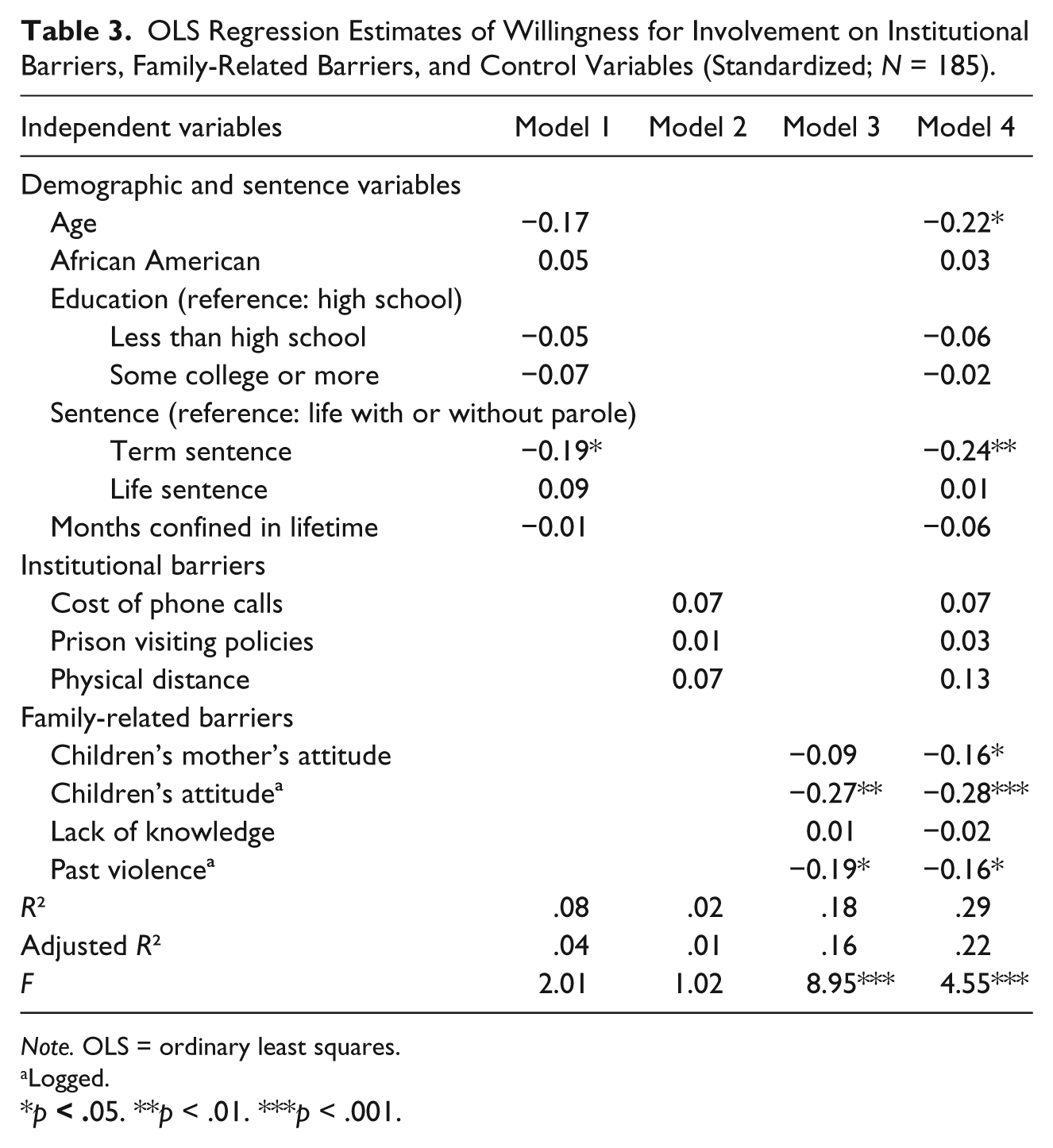
Four OLS regression models were developed to estimate the influence of the control variables and the two barrier groups (institutional and family-related) on the inmate fathers’ self-reports of contact with their children (Table 2) and their willingness to be involved with them (Table 3).
OLS Regression Estimates of Contacts With Children on Institutional Barriers, Family-Related Barriers, and Control Variables (Standardized; N = 185).

Note. OLS = ordinary least squares.
Logged.
p < .05. **p < .01. ***p < .001.
OLS Regression Estimates of Willingness for Involvement on Institutional Barriers, Family-Related Barriers, and Control Variables (Standardized; N = 185).
Note. OLS = ordinary least squares.
Logged.
p < .05. **p < .01. ***p < .001.
According to the results in Table 2, Model 1 with control variables (F = 3.10, df = 7, 175, p < .01) and Model 3 with family-related barriers (F = 5.77, df = 4, 172, p < .001) showed a significant model fit. Model 2 with the institutional barriers (F = 1.05, df = 3, 180, p > .05) did not attain a level of significance for model fit. Comparison of the adjusted R2 values also confirmed the family-related barriers (.10) explained significantly more of the variance of the fathers’ perception of contacts with their children than did the institutional barriers (.01) and control variables (.07). Model 4 indicated two of the family-related variables (children’s mother’s attitude and children’s attitude) had a significant negative relationship with the fathers’ contacts with their children. Fathers who were more likely to perceive the children’s mother’s attitude as a barrier to the relationship with their children also believed they had less contact with their children (β = −.22, p < .05). Similarly, when fathers considered the children’s attitude as a barrier, they reported having fewer contacts with their children (β = −.21, p < .05). Comparison of the size of the standardized coefficients (β) of the two family attitude barriers indicated the negative relationship between the children’s mother’s attitude and fathers’ perception of contact was slightly stronger than the children’s attitude with the fathers’ perception of contact. The fathers’ perception of the mother’s attitude as a greater influence on contact with their children seems plausible considering the mother’s influence and decision-making authority over their children. Another explanation for the findings is that it may be easier for the inmate to accept the mother’s rejection or negative attitude as a barrier than the child’s negative attitude and rejection. In contrast, none of the institutional barriers showed a significant relationship with the respondents’ reports of contact with their children. Of the control or demographic variables, African American fathers reported more contact with their children (β = .17, p < .05) than fathers of Other races. In Model 1, those who were serving a life sentence reported more contact with their children than those with a term sentence or life without parole.
According to the OLS regression results for the four models displayed in Table 3, the two barrier groups (institutional and family-related) had slightly different impacts on the fathers’ willingness to be involved in their children’s lives. In regard to model fit, Models 3 and 4 with family-related barriers attained significance. The other two models, Model 1 with control variables and Model 2 with the institutional barriers, failed to show a significant model fit. Consistent with the models for contacts with children, family-related barriers (adjusted R2 = .16) were related to the fathers’ willingness to be involved with their children’s lives more than the control variables (adjusted R2 = .04) and the institutional barriers (adjusted R2 = .01).
Three of the four family-related barriers were significantly related to the incarcerated fathers’ disposition to be involved with their children’s lives. Fathers who considered the children’s mother’s attitude (β = −.16, p < .05) and the children’s attitude (β = −.28, p < .001) as greater barriers to their relationship with their children were less willing to be involved. Moreover, the acknowledgment by the inmate of past violence against family member(s) was negatively and significantly related to the fathers’ willingness for involvement (β = −.16, p < .05). When inmate fathers identified their past violence against their family member(s) as more of a barrier, perhaps realistically, they reported less willingness to be involved in their children’s lives.
Of the four family-related variables, the perceived negative attitude of the children as a barrier showed the greatest negative relationship with the fathers’ disposition toward involvement. Institutional barriers, however, still did not deliver any significant impact. Age of the father and type of sentence also had a significant relationship with the fathers’ willingness for involvement. Older fathers and those who had been sentenced to a specific term were more willing to be involved with their children’s lives than those who were younger and had a life sentence and/or life without the possibility of parole.
Discussion
The importance of involving prisoners in their family’s lives is supported by the theoretical literature as well as empirical research. Advantages of those relationships were cited as bettering the lives of at-risk children, improving institutional behavior, contributing to crime desistance, and enhancing reentry and reintegration. This study adds to the literature by describing how inmate fathers perceive their relationship with their children as well as the factors they think that make these relationships more difficult to maintain. Even though the inmate fathers in this study face long prison sentences and many have spent substantial time behind bars throughout their lives, on average they showed an interest in being involved in a relationship with their children.
Some inmate fathers reported it was not until they went to prison and were exposed to spiritual teachings that they started to think about fatherhood and how they had failed in this role “on the streets.” A 48-year-old inmate sentenced to life without parole, said, I have taken a complete inventory of myself and it has been better since I have been incarcerated because before I didn’t know there is more to being a father than just being a father. Studying religion (not being narrow minded)—all teach the importance of family life and keeping family ties. There is nothing that can stop our relationship except me and her. We got it going and it isn’t going to stop.
Expressing a similar perspective, a 22-year-old inmate with a 40-year sentence commented, “Since coming to prison I have learned that I want to be a better father.” For these men, meaningful father–child relationships may not have been recognized or valued until they were sentenced to a long prison term and placed in a maximum security prison. Perhaps having more opportunity for reflection influences such thoughts. This finding is consistent with those of Leigey (2010) who found that among lifers, “the sample felt that they had attained wisdom, empathy, humility, and a greater appreciation of family over the last years spent in confinement” (p. 261).
Because most incarcerated fathers were unable to contribute financially to the family unit, they described other ways they could parent and “father” their children. Some fathers said their children recognized their expressions of unconditional love, while others thought their major contribution was to guide their children away from the path they themselves had taken. A 37-year-old inmate serving a long sentence contributed this comment: My son was molested in 2006. It took him a long time to discuss it with me. I gave him unconditional love and support. My daughter is in college. In 2008, she got in trouble with drugs, but was able to discuss it with me. She went through a drug treatment program.
Interviewers noted some inmates appeared to have an inflated view of their role by stating they were “great dads.” Others expressed sadness and frustration over not being able to make any contact with their children often because they had no idea where they lived. In sum, many incarcerated fathers seemed to want to be involved in their children’s lives. The finding is consistent with previous research on the subject (Hairston, 1998; Lanier, 1993).
Numerous studies have identified sentencing policies, particularly long sentences and life without parole, prison policies, and preexisting family relationships as factors that logically stand in the way of developing family ties for the incarcerated population (Bales & Mears, 2008; Carlson & Cervera, 1991; Sitren, Smith, Applegate, & Gould, 2009; Tewksbury & DeMichele, 2005). This study contributes to the existing literature by measuring the relative influence of those factors on fathers’ perceptions of their relationships with their children. Although institutional policies were frequently described in the literature as barriers to maintaining contact with family members outside the institution, these studies found institutional barriers were not enough to deter the fathers’ aspirations to be involved with their children. Nor was there a clear picture of how the severity of the sentence affects parent–child relationships. The data suggest fathers who wanted to maintain involvement and perceived relatively more contact with their children looked beyond institutional barriers and the length of their sentences and maintained relationships with one or more children over time.
The results of this study indicate the favorable attitude of the children’s mother toward the father contributes to likelihood of the father–child relationship occurring. Comments of fathers from the open-ended portion of the questionnaire illustrate the importance of the attitude of the mother, as exemplified by the following statement: I have a good relationship with my two daughters. I see them every other weekend. I write them and talk to them on the phone. This is because I have a better relationship with their mother. I married her after coming to prison.
The same can be said for the attitudes of the children. Fathers who described their children as having negative or unforgiving attitudes toward them were less likely to be involved with them. One 47–year-old man who was in prison for 23 years over his lifetime commented, “My daughter throws my incarceration up in my face. She feels that I left her and don’t care about her and only care about myself. She always complained that I didn’t spend enough time with her.”
For many inmate fathers in the sample, favorable attitudes of family members appeared to be a necessary though not sufficient condition for a father–child relationship to be present. Preexisting family relationships emerged as the most important group of factors related to willingness for involvement of inmate fathers with their children. For inmate fathers who have favorable relationships with family and contacts with their children changed institutional policies with respect to visitation, and other forms of contact may do little to improve their relationships with family members. While visitor-friendly policies might be argued on other grounds, this research does not support them as a major impediment to father–child relationships.
The negative attitudes of family members toward the incarcerated father, however, were a real barrier to developing a relationship with the children. Even though most fathers were wanting and willing to be involved in their children’s lives, some reported they had come to accept the reality that the negative attitudes of their family (mother, child, custodial adult) were a major barrier. As a result of an inmate’s wife not responding to his many contacts more than 20 years in prison, one inmate stated his hope and even his desire to make contact with his only child had subsided. In addition, those fathers who had inflicted violence on their family in the past recognized the seriousness of the barrier. The more those fathers were able to acknowledge their past violence was a real barrier, the less likely they were to think there could be a relationship.
A positive father–child relationship has been reported to have beneficial behavioral outcomes in the maintenance of social control and security within the prison institution, and, in addition, the existence of supportive relationships has contributed to potentially positive results for those eligible for parole (Bales & Mears, 2008; Carlson & Cervera, 1991; Hairston, 1988). The question, however, remains whether it is positive for the child. In child welfare practice, the guiding principle is whether something “is in the best interests of the child.” Hairston (1998, 2007) has identified the negative attitudes of some child welfare workers in regard to the maintenance of relationships of the children with their incarcerated fathers. Those fathers who have inflicted violence on their family certainly raise reasonable doubts about the value of addressing an estranged relationship. If addressing the estranged family relationship “is in the best interests of the child,” there may be value in pursuing the restoration of the relationship. Opportunities for the exchange of information, apologies, and forgiveness along the lines suggested by restorative justice approaches may be considered in a similar manner to its application to offender and victim but in the context of the family (Zehr, 2005). Under conditions where the improvement of father–child relationships appears warranted, that is, in the best interests of the child, the strategy might be pursued and prove beneficial.
As currently oriented, most prison officials would not have the organizational capacity to provide opportunities for restorative and reunification programs. Some human service and/or faith-based organizations that advocate for inmate family relationships might be in a better position and have the capacity to provide family reunification services. To the extent that family relationships are possible and important to inmate adjustment as well as reintegration partnerships might be explored between corrections agencies and other organizations. External groups could possibly assist with what in many cases is a slow developmental process. An example of the nature of this process is provided by one inmate in the sample, who stated, Initially it was a strained relationship. Over time, it improved. It’s a growing process. They don’t completely trust me yet, but they respect me. I’m hopeful and patient. I feel they love me. I love them dearly. They motivate me to change my way of life. I brought them into this world, so I try to encourage them to do the right thing: push education. It’s like climbing a stairwell, starting at the bottom. I’m optimistic.
With respect to prison policy, these findings, if confirmed elsewhere, would suggest that prison administrators be open to external groups who can assist with family reunification strategies.
The current research also suggests prison policies need to expand the traditional definition of family based on legal documents and recognize the wide range of family structures and composition. Institutional polices need to allow for families with step parents, step children, kith and kin, and others considered family members to be part of the prisoner’s support network. Fathers in this study explained the requirement to provide a birth certificate to prove paternity of children was time-consuming and difficult. Some inmates have developed relationships with their step children only to learn prison policies made it difficult if not impossible to pursue those relationships. Family relationships have become more complicated. Given that many of the men in this sample were fathers of children from different mothers, the complexity of the definition of family—or who is “family”—may be more confusing to an external observer than to the incarcerated man. Those who are part of the “family” may be clearer to the father than the institution. As one inmate said, [The]DOC [Department of Correction] is tough with letting you get support from outside. It’s hard to add to [the] visiting list. They don’t respect/honor [visitors] unless, aunts, children of a certain age. Paperwork! My stepmom couldn’t come see me. Frustrating, stressful, makes you want to give up, but I won’t.
Policies that recognize nontraditional family units but still provide adequate screening and security should be explored to allow for more inclusiveness of family members. The restoring, strengthening, and maintaining of ties with children and family members, where possible, may in turn increase the potential benefits to the institution and ultimately to community reintegration.
Conclusion
There are several limitations to this study. First, the findings are based on a purposive sample of 185 inmate fathers with long prison sentences who volunteered to participate. Due to the lack of random selection procedures, the self-reports of inmate fathers at this maximum security prison may not be representative of other incarcerated fathers particularly those in less secure facilities. Second, the findings are based on self-reports rather than objective measures. Moreover, both measures of fathers’ involvement were correlated, although the relationship was not sufficiently strong to suggest multicollinearity. Third, to get a more accurate measure of the effect of institutional barriers on father–child relationships, it would be desirable to do a comparative study among prisons whose visitation and other free world contact policies vary. Finally, it would be helpful to obtain a matched sample of inmate spouses, children, and significant others to compare their perceptions of barriers to maintaining family relationships with incarcerated family members.
What this study does show is that the assumption that institutional policies are a major impediment to maintaining family relationships needs to be examined more closely, particularly for male inmates. The identification of family-related variables is also an important factor that should be examined in future research.
The relationship of an incarcerated father with his family and children is much more complicated than the institutional barriers presented by the prison system. This study does not warrant the conclusion that institutional barriers are unimportant to building supportive relationships between incarcerated fathers and their children. However, institutional barriers are not necessarily the only or primary factor inhibiting positive relationships from occurring. Under certain conditions, estranged family relationships with the potential for being reestablished may be able to restore communication in a manner beneficial to the family members involved. The focus on supportive relationships is particularly relevant for community reentry and such issues continue to remain on the corrections agenda.
Footnotes
Appendix
Legal Relationship Between Incarcerated Fathers and the Mothers of Their Children. a
| Mother(s)
b
|
||||
|---|---|---|---|---|
| 1 | 2 | 3 | 4 | |
| Married | 23 (12.4) | 9 (4.9) | 2 (1.1) | 1 (0.5) |
| Legally separated/divorced | 33 (17.8) | 10 (5.4) | 1 (0.5) | 1 (0.5) |
| Widowed | 9 (4.9) | 1 (0.5) | 1 (0.5) | 0 (0.0) |
| Never married but lived together | 76 (41.1) | 28 (15.1) | 11 (5.9) | 8 (4.3) |
| Never married and never lived together | 44 (23.8) | 22 (11.9) | 11 (5.9) | 4 (2.2) |
| Total | 185 (100) | 70 (37.8) | 26 (14.1) | 14 (7.6) |

Percentages in parentheses.
Number of women with whom respondents had children.
Declaration of Conflicting Interests
The author(s) declared no potential conflicts of interest with respect to the research, authorship, and/or publication of this article.
Funding
The author(s) received no financial support for the research, authorship, and/or publication of this article.