




Abstract
Research has found a relationship between sexual satisfaction and psychological health in prisoners, although few studies have focused on possible moderators of this relationship. The main foci of this study of a sample of prison inmates were as follows: (a) the association between sexual satisfaction and psychological health and (b) the moderating effects of heterosexual activity level (abstinent vs. non-abstinent) and gender on the relationship between these two variables. In-person interviews were conducted with 82 males and 91 females who lived in separate modules in Spain’s Topas Penitentiary. Sexual satisfaction was a significant predictor of psychological health only for members of the sexually abstinent group. These findings point to the positive effect of sexual satisfaction on psychological health, especially for the inmates in a less favorable sexual situation (i.e., sexual abstinence).
The research to be reported in this article focused on (a) the differences in sexual satisfaction as a function of gender and the level of sexual activity (being sexually abstinent or not), (b) the relationship between sexual satisfaction and psychological health, and (c) the moderating effect of gender and level of sexual activity on this relationship. Many authors have noted that inmates suffer due to heterosexual sexual relationship deprivation in prison (Lacombe, 1997; Levenson, 1983; Maeve, 1999; Neuman, 1982; Sánchez, 1995). However, none of the authors has empirically tested whether these inmates showed less sexual satisfaction than the inmates who have had sex. The role of gender in this relationship is also unknown. In addition, some prison studies have found a relationship between sexual satisfaction and psychological health (Carcedo, López, Orgaz, Toth, & Fernández-Rouco, 2008), but there are no studies of whether this association is moderated by other variables such as gender and the level of sexual activity.
Gender, Sexual Abstinence, and Sexual Satisfaction
Female inmates have been found to show higher levels of sexual satisfaction than males (Carcedo et al., 2008). However, after controlling for age, nationality, total time in prison, actual sentence time served, and estimated time to parole and partner status, this difference was not statistically significant (Carcedo et al., 2011).
Several authors have reported negative feelings toward abstinence by both male and female inmates (i.e., Lacombe, 1997; Maeve, 1999; Neuman, 1982; Sánchez, 1995). However, only one study of prison inmates has empirically investigated the differences in the sexual satisfaction of heterosexually abstinent and heterosexually active inmates, finding much lower levels of sexual satisfaction in the sexually abstinent group (Carcedo, 2005). Gender was not taken into account in that study, although this is an important variable to consider. In the present study, sexual abstinence and gender effects will be examined together with respect to inmates’ sexual satisfaction.
Sexual Satisfaction and Psychological Health
Prison inmates have been identified as an at-risk population for poor psychological health because of the distress associated with incarceration (Toch, 1977; Zamble & Porporino, 1988). One of the possible causes of this risk is that inmates encounter difficulties in having a satisfactory sex life (Carcedo, 2005; Lacombe, 1997; Levenson, 1983; Maeve, 1999; Neuman, 1982). Linville (1981) found that approximately three quarters of a sample of 100 males in a minimum-security prison reported emotional problems because of sexual deprivation. In addition, sexual satisfaction and psychological health and other well-being-related measures have been shown to be significantly related in prison settings (Carcedo, 2005; Carcedo et al., 2008; Carcedo, Perlman, López, & Orgaz, 2012) and non-prison studies (Fegg et al., 2003; Lau, Wang, Cheng, & Yang, 2005; Nicolosi, Moreira, Villa, & Glasser, 2004; Taleporos & McCabe, 2002). Higher levels of sexual satisfaction were associated with higher levels of psychological health and other well-being related measures.
Moderating Effect of Gender and Sexual Abstinence on the Relationship Between Sexual Satisfaction and Psychological Health
The suffering and the deterioration of psychological health due to the lack of sexual satisfaction have been suggested regarding male inmates (Lacombe, 1997; Levenson, 1983; Linville, 1981; Neuman, 1982), female inmates (Pardue, Arrigo, & Murphy, 2011; Sánchez, 1995), and both genders (Carcedo et al., 2008; Carcedo et al., 2012). However, it is unknown if the relationship between sexual satisfaction and psychological health is different for male and female inmates. In a study of 118 male and 70 female prison inmates, Carcedo et al. (2008) found that sexual satisfaction significantly explained the psychological health for both genders, although 6.2% more of the variance was explained for females than males. Notwithstanding, the possible moderator effect of gender was not tested. In non-prison population studies that have strictly measured sexual satisfaction or sexual well-being, this variable has been associated with psychological health and happiness in both genders, but the relationship between sexual variables and psychological measures has been slightly stronger among women than among men (Laumann et al., 2006; Taleporos & McCabe, 2002). Thus, the possibility that gender moderates the relationship between sexual satisfaction and psychological health warrants consideration. This will also be examined in the present study.
In arguing that a lack of sexual satisfaction can negatively impact prison inmates’ psychological health, most authors (Lacombe, 1997; Levenson, 1983; Maeve, 1999; Neuman, 1982; Sánchez, 1995) were referring mainly to inmates who have not had heterosexual sexual relationships during their incarceration. Thus, these authors were implicitly confounding sexual satisfaction with sexual abstinence. Whereas sexual satisfaction reflects an evaluation of one’s current sexual life, sexual abstinence refers to the complete lack of sexual relationships during a period of time. These different concepts may delineate different situations: An inmate may have been sexually abstinent during the last 6 months, yet show reasonable high sexual satisfaction. By contrast, an inmate may have been sexually active, yet have low sexual satisfaction. In addition, the relationship between inmates’ sexual satisfaction and psychological health may be different for sexual abstainers versus sexually active individuals. No prison study has investigated this moderating effect. Notwithstanding, non-prison studies have found a stronger relationship between sexual satisfaction and general well-being for those who have been sexually deprived due to the presence of sexual dysfunctions (Lau et al., 2005; Ventegodt, 1998), physical disabilities (Taleporos & McCabe, 2002), amputations (Walters & Williamson, 1998), and having had germ-cell tumor therapy (Fegg et al., 2003). Therefore, the moderating effect of being sexually abstinent versus active in the relationship between sexual satisfaction and psychological health will be tested in this research.
According to reactance theory (RT; Brehm, 1966), any form of deprivation may increase the desire for the deprived object (Brehm & Brehm, 1981), amplifying its relevance for individuals’ psychological health. The major premise of RT is that individuals wish to operate with a freedom to choose behaviors to satisfy their needs—in this case sexual needs. If their freedom is reduced, threatened, or eliminated, individuals will become “motivationally aroused” to regain this freedom (Brehm, 1966, p. 2). Thus, psychological reactance is a “motivational state directed toward the re-establishment of free behaviors that have been eliminated or threatened with elimination.” (p. 9). With reference to this research, reactance is likely to be high among inmates whose access to heterosexual activity is thwarted by their circumstances. We believe that in enhancing the value of sex, such reactance may intensify the association between their sexual satisfaction and psychological well-being.
Control Variables
Other variables have been demonstrated to be related to inmates’ psychological health. For example, a set of socio-demographic and punishment-related variables have been found to be important. Poorer mental health has been exhibited by inmates who are younger, Caucasian (Lindquist, 2000), married (Lindquist, 2000; Lindquist & Lindquist, 1997), and who have longer sentences and a longer expected time prior to their release (James & Glaze, 2006). Due to these findings, the authors include age, ethnic group-nationality, partner status, total time in prison, actual sentence time served, and estimated time to parole as control variables when predicting psychological health. Although the relationship between these variables and sexual satisfaction has not been investigated in prison research, these variables were also included in analyzing the effect of sexual abstinence on sexual satisfaction because of their potential association with inmates’ sexual satisfaction.
In addition, masturbation has been found to be related to sexual satisfaction and well-being-related measures in non-prison studies (Das, 2007; Das, Parish, & Laumann, 2009; Langstrom & Hanson, 2006), and social loneliness has been shown to be an important predictor of prisoners’ psychological health (Carcedo et al., 2008). Taking these results into consideration, we also included the frequency of masturbation as a possible predictor of sexual satisfaction and psychological health, and social loneliness as a possible predictor of psychological health.
In sum, we set out to examine the following research questions in this study: (a) Will gender and sexual abstinence be associated with inmates’ sexual satisfaction after controlling for age, ethnic group-nationality, partner status, total time in prison, actual sentence time served, estimated time to parole, and frequency of masturbation? (b) Will sexual satisfaction be associated with inmates’ psychological health after controlling for age, ethnic group-nationality, partner status, total time in prison, actual sentence time served, estimated time to parole, social loneliness, and frequency of masturbation? (c) Will gender and/or sexual abstinence play a moderating role in the relationship between sexual satisfaction and psychological health? More specifically, will sexual satisfaction explain more variance in the psychological health among inmates in the “worse-off” heterosexually abstinent group than among inmates in the heterosexually active group? Will sexual satisfaction explain more variance in the psychological health of females than of males?
Method
Design
The data for this study were collected in two sessions. The primary variables of our study were all evaluated in the first session. These included sexual satisfaction (the main predictor variable), social loneliness and frequency of masturbation (other relevant interpersonal and sexual predictors), the moderating variables (heterosexual activity level and gender), and the control variables (age, nationality, partner status, total time in prison, actual sentence time served, and anticipated time to parole). The outcome variable (psychological health) was evaluated in the second session. Depending on the inmates’ schedules, the second session was conducted approximately a week later. The heterosexual activity status of participants (i.e., abstinent vs. heterosexually active) was obtained in both sessions. It was checked in the second session to verify that the situation of the inmates had not changed between sessions. There was no participant change.
Participants
In total, 173 medium-security prison inmates (91 men and 82 women) from a prison in the northwestern region of Spain provided data for this study during 2008. Their average age was 35.10 years, with a range from 20 to 62. Regarding nationality, 41.04% (n = 71) were Spanish, whereas 58.96% were foreigners (n = 102). While 35.26% (n = 61) had no romantic partner, 64.74% (n = 112) had a partner. The mean of total time in prison for all offenses, actual sentence time served for their current offense, and estimated time to parole were 51.35, 42.61, and 24.98 months, respectively.
With respect to the characteristics of the sample regarding sexual behavior, 46.24% (n = 80; 53 men and 27 women) of the inmates had been sexually abstinent for at least 6 months, and 53.76% (n = 93; 29 men and 64 women) had had sexual relationships in the last 6 months. Inmates reported that all their sexual relationships had been heterosexual and had included vaginal coitus at least once in the last 6 months. All these sexual behaviors were consensual except for the case of one female and one male inmate who had also had consensual sexual relationships. Finally, of the heterosexually active group, 6.59% reported having maintained sexual relationships during their furloughs outside the prison, 74.72% reported having had sexual relationships in the conjugal visits rooms inside the prison, and 24.18% reported having had sexual relationships in other areas inside the prison where men and women share different activities (e.g., at their workplace in prison, the socio-cultural module, the gym, etc.). Although some of the inmates reported having had homosexual contacts in prison, none reported having had homosexual contacts during the 6 months prior to data collection.
Participants were selected to have an equal number of men and women. After stratifying by gender, 80% of the participants were randomly selected, while 20% were selected under a “snowball” sampling scheme (Goodman, 1961). Participants were excluded under the following conditions: (a) they had been in prison for less than 6 months, the time considered necessary to adapt to prison life and develop new relationships inside the facility; (b) the estimated time to parole was less than a month, a period when inmates are usually focused on being released more than their life in prison; (c) they did not speak Spanish or English; (d) they had been diagnosed with a serious mental disorder (e.g., psychotic and mood disorders); or (e) they were not in optimal condition to be interviewed (e.g., under the influence of drugs or expressing high levels of anxiety or distrust toward the interviewer). Only eight potential participants declined or stated that they were not interested in being interviewed. Due to an interviewer error or that the inmate refused to answer, 23 participants skipped a single item from one or more scales, but they were included in the analyses using the mean of the other items in the scale that had been answered. All of the participants considered the interview as a generally positive experience, especially because it gave them an opportunity to express their personal worries and feelings.
Procedure
This study is part of a larger project that involved two interview sessions. The first author conducted in-person interviews with each participant in a private room, separated from the rest of the inmates, in the inmate’s module. Both sessions consisted of interview questions formulated specifically for this project and standardized questionnaires. Both kinds of measures were mixed in the two sessions. The time needed to complete questionnaires was kept short (approximately 30 min) to avoid participants either getting tired or experiencing an invasive sense of being questioned (i.e., an “interrogation effect”).
The first session lasted between 60 and 90 min. Before the start of the interview, the interviewer spent a significant amount of time gaining each inmate’s trust. Usually, the trust-building phase took around 20 min. However, depending on the inmate’s responsiveness, in some cases it took up to 2 hr. Before beginning the interview itself, participants were invited to read and sign the consent form. They also were asked to participate and were informed about the possibility of leaving the study whenever they wished to do so. In addition, participants were informed about the confidentiality and anonymity of their answers, which meant that any information given during the interview would not be divulged and their names would not appear in any printed reports. No names were attached to the interviews and an informed consent statement was signed by the inmate and the interviewer. Approximately a week later, the second session was conducted; it usually lasted around 30 min.
Measures
Primary predictor variable: Sexual satisfaction
To measure this construct, the Sexual Satisfaction subscale of the Multidimensional Sexual Self-Concept Questionnaire (MSSCQ; Snell, 1995) was used. A total of five items were scored on 5-point Likert-type scales that ranged from 1 (not at all characteristic of me) to 5 (very characteristic of me). The total sexual satisfaction score was obtained by summing the scored items and dividing them by the number of items answered. Possible scores range from 1 to 5 (high sexual satisfaction). Coefficient alpha for this subscale was .96.
Other interpersonal and sexual predictor variables: Social loneliness and frequency of masturbation
To measure loneliness, the five-item social loneliness subscale of the short version of the Social and Emotional Loneliness Scale for Adults (SELSA-S; DiTommaso, Brannen, & Best, 2004) was used. Items were answered on a 7-point Likert-type scale that ranged from 1 (strongly disagree) to 7 (strongly agree). The total score was obtained by adding the individual scores and dividing them by the number of items answered. Possible scores range from 1 to 7 (high loneliness). Coefficient alpha for this subscale was .81.
The following question was used to measure masturbation: “Masturbation is a normal and very common human behavior. In the last 6 months, how often did you masturbate?” The possible answers ranged from 1 (never), 2 (less than once per month), 3 (once or twice per month), 4 (once or twice per week), 5 (once per day), to 6 (more than once per day).
Moderating variables: Heterosexual activity level (abstinence) and gender
Abstinence was recorded as 0 for the inmates who had not experienced any sexual relationships in the past 6 months, and 1 for the inmates who had had at least one sexual relationship in the last 6 months. Gender was recorded as 0 for females and 1 for males.
Outcome variable: Psychological health
To assess this dimension, the short, Spanish version of the Psychological Health subscale of the World Health Quality of Life scale (WHOQOL-BREF; Lucas, 1998) was used. Six items were scored on a 5-point Likert-type scale that ranged, with different labels, from 1 (not at all; very dissatisfied; never) to 5 (extremely-completely; very satisfied; always). The Psychological Health State score was obtained by summing the individual scores and dividing them by the number of items answered. Possible score range from 1 to 5 (positive health). Alpha was .72.
Control variables
Age
Inmates were asked to state their ages, and this variable was confirmed using inmate penitentiary records to ensure accuracy.
Partner status
This item was rated as 0 for inmates without a partner and 1 for inmates in a romantic relationship.
Nationality
Nationality was split into Spaniards (0) versus foreigners (1).
Total time in prison
This variable was obtained from the sum of all time spent in a prison for previous and current offenses. It was collected by reviewing inmates’ penitentiary records and recorded in months.
Actual sentence time served
This item denotes the time spent in prison since the last entry (i.e., during the current prison term). It also was obtained from inmate penitentiary records and listed in months.
Estimated time to parole
After discussions with the legal advisors from Topas Penitentiary, we chose to take three quarters of participants’ actual sentences as the expected time when inmates would be paroled due to the fact that it was the modal parole time. This fact was familiar to the inmates, thus they were likely to expect parole around this time. Clearly, actual time to parole varies, depending on inmates’ characteristics and behavior. The estimated time to parole was the amount of time remaining before each inmate’s expected parole date. This variable was also recorded in months.
Analysis Strategy
The primary research issue addressed by this project is how the sexual satisfaction of heterosexually abstinent (male and female) and heterosexually active (male and female) inmates is related to their psychological health. Because of the presence of non-orthogonality in the design (i.e., sexual activity level is significantly associated with gender, see Table 1), the individual and combined effects of sexual activity level, gender, and sexual satisfaction on psychological health were assessed. In particular, we used the model comparisons strategy recommended by Neter, Kutner, Nachtsheim, and Wasserman (1996) who applied previous authors’ recommendations on ANOVA designs (Appelbaum & Cramer, 1974; Cramer & Appelbaum, 1980; Maxwell & Delaney, 1990) to regression designs. Following Neter et al.’s recommendations, a logical sequence of model comparisons is undertaken, beginning with the test of the higher order interaction (third order: Sexual satisfaction × Sexual activity level × Gender), proceeding to a test of lower order interactions (second order: Sexual satisfaction × Sexual activity level, Sexual satisfaction × Gender, and Sexual activity level × Gender) in the presence of the others (eliminating tests), and finally a test of each interaction in the absence of the other (ignoring tests). At the end of this procedure, the so-called conditional effects are tested. These effects are also called “main effects” in ANOVA designs (see Hayes & Matthes, 2009). Akin to the procedure used with second-order interactions, at this stage, a test of each main effect in the presence of the other main effects is performed (eliminating tests), and, finally, a test of each main effect in the absence of the other main effects (ignoring tests) is performed. Only the minimum number of tests necessary to logically determine a final statistical model is performed, allowing valid conclusions to be drawn even in the presence of highly non-orthogonal regression models (Neter et al., 1996).
Descriptive Statistics of Major Variables for Sexual-Abstinent and Non-Sexual-Abstinent Groups.
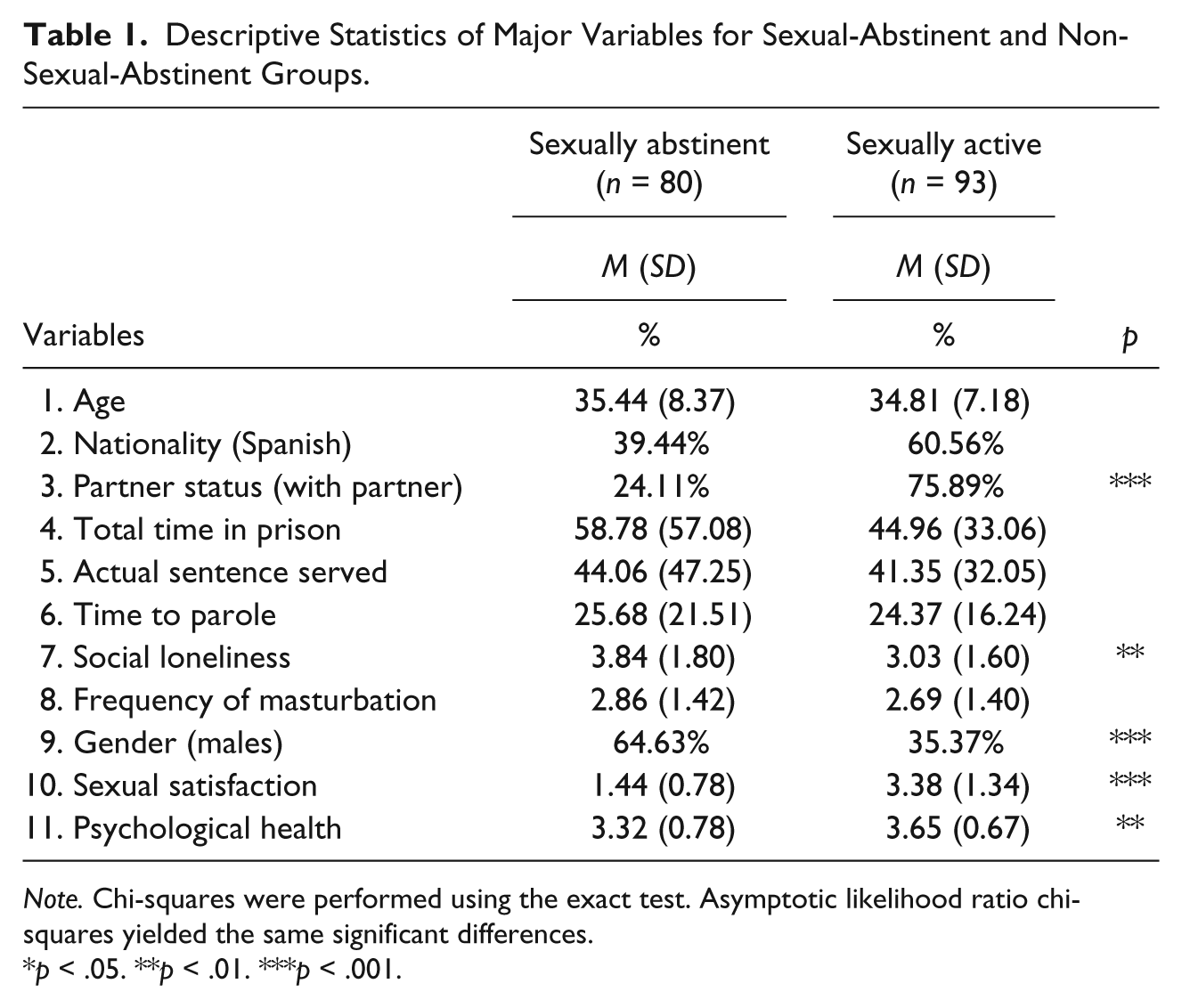
Note. Chi-squares were performed using the exact test. Asymptotic likelihood ratio chi-squares yielded the same significant differences.
p < .05. **p < .01. ***p < .001.
In all the analyses reported here, participant age, partner status, nationality, total time in prison, actual sentence time served, estimated time to parole, social loneliness, and frequency of masturbation were controlled because previous research has linked them to prisoner and non-prison psychological health (Carcedo et al., 2008; Das, 2007; Das et al., 2009; James & Glaze, 2006; Langstrom & Hanson, 2006; Lindquist, 2000; Lindquist & Lindquist, 1997). Also, participant age, total time in prison, actual sentence time served, estimated time to parole, social loneliness, frequency of masturbation, and sexual satisfaction were centered before entry into the models. Thus, the parameter estimates associated with sexual satisfaction, gender, and sexual-abstinent group are referenced to an “average” Spaniard prison inmate without a partner (i.e., one of an “average” age of 35 years, who has served an “average” 51 months of total time in prison, who has been incarcerated for an “average” 42 months during the current stay, and who has an “average” estimated 25 months remaining until parole).
As shown in Table 1, heterosexually abstinent and heterosexually active inmates are differently distributed within gender categories. Under these circumstances, asymptotic likelihood ratio tests of categorical association are likely to be inaccurate. Thus, all tests of categorical association were conducted under a permutation-based exact test statistical modeling framework (Mehta & Patel, 2002, pp. 9-39), yielding p values and conclusions that remain valid under the conditions observed.
To study how sexual abstinence and gender were related to sexual satisfaction, the same analytic approach was utilized. In this case, the logical sequence of model comparisons starts with the test of interaction (Sexual activity level × Gender), proceeding to a test of each main effect in the presence of the other (eliminating tests), and finally a test of each main effect in the absence of the other (ignoring tests).
SPSS 17.0 was used for data analysis. This program and the MODPROBE script (Version 1.2) developed by Hayes and Matthes (2009) were used for probing and plotting the interactions. The pick-a-point approach (Aiken & West, 1991; Cohen, Cohen, West, & Aiken, 2003) was utilized. This procedure selects representative values of the moderator variable (in this case, two categories: 0 for “sexual-abstinent,” and 1 for “non-sexual-abstinent”) and then estimates the effect of the focal predictor at those values.
Results
Descriptive statistics were calculated and are displayed in Table 1 separately by heterosexually abstinent and heterosexually active inmates. To examine whether there are mean differences based on sexual activity status for the study variables, t tests for independent samples and chi-square tests (exact test) were conducted.
Sexual Activity and Gender Differences on Sexual Satisfaction
An ANCOVA was performed to analyze the main and interaction effects of sexual activity and gender on sexual satisfaction after controlling for age, nationality, partner status, total time in prison, actual sentence time served, and estimated time to parole. In short, neither gender nor the control variables were significantly associated with sexual satisfaction. Nor were any significant interaction effects between gender and level of sexual activity found for sexual satisfaction. Sexual activity level, however, was significantly associated with sexual satisfaction (B = −1.805, SE = .228, R2 = .457, p < .001). After accounting for the control variables, Bonferroni post hoc comparisons were used to analyze the differences between the heterosexually abstinent and heterosexually active groups, using estimated marginal means, also called least-squares means. As was expected, the heterosexually abstinent inmates (M = 1.511, SE = .148) reported much lower levels of sexual satisfaction than the heterosexually active ones (M = 3.316, SE = .136).
Moderating Effect of Sexual Activity and Gender on the Relationship Between Sexual Satisfaction and Psychological Health
Regarding the interaction effect of Sexual satisfaction × Heterosexual activity level and Sexual satisfaction × Gender on psychological health, a series of hierarchical linear regression analyses were performed. The Type III Sums of Squares and a simultaneous entry of the variables in different steps were utilized. We used the analysis strategy described above (Neter et al., 1996). Socio-demographic and penitentiary control variables (age, nationality, total time in prison, actual sentence time served, and time to parole) were included in the first step; interpersonal and sexual variables (social loneliness and frequency of masturbation) were included in the second step; conditional effects of sexual satisfaction, heterosexual activity level, and gender were added in the third step; the three 2-way interactions (Sexual satisfaction × Heterosexual activity level, Sexual satisfaction × Gender, and Heterosexual activity level × Gender) were added in the fourth step; and the 3-way interaction (Sexual satisfaction × Heterosexual activity level × Gender) was included in the fifth step. The third-order level interaction was not significant. Then, this interaction was dropped from the final model, and we continued studying the model with the three second-order possible interactions.
Table 2 builds different sequences of hierarchical regression analyses, once the three-way interaction was dropped. Model 1 only includes the control variables. Model 2 adds interpersonal and sexual variables. Model 3 adds the conditional effects and interactions of the variables on which this study is focused. Finally, Model 4 includes only the variables and the interaction that proved to be significant in Model 3. In this last model, the parameters of nationality, social loneliness, sexual satisfaction, heterosexual activity level (in this case because it is necessary for the interaction term), and the interaction between sexual satisfaction and heterosexual activity level were estimated. In Model 1, only nationality and estimated time to parole showed to be significant. In Model 2, the significant variables that entered in the model were nationality, estimated time to parole, and social loneliness. Models 3 and 4 showed that nationality, estimated time to parole (not in Model 4), social loneliness, sexual satisfaction, and the interaction between sexual satisfaction and heterosexual activity level were significant. The contribution of explained variance by the interaction term to the Model 4 was significant (R2 = .027, p = .009). Being a foreign inmate, being lower in social loneliness, having a shorter estimated time to parole, and being higher in sexual satisfaction were associated with higher psychological health (see Table 2).
Predictors of the Prison Inmates’ Psychological Health.
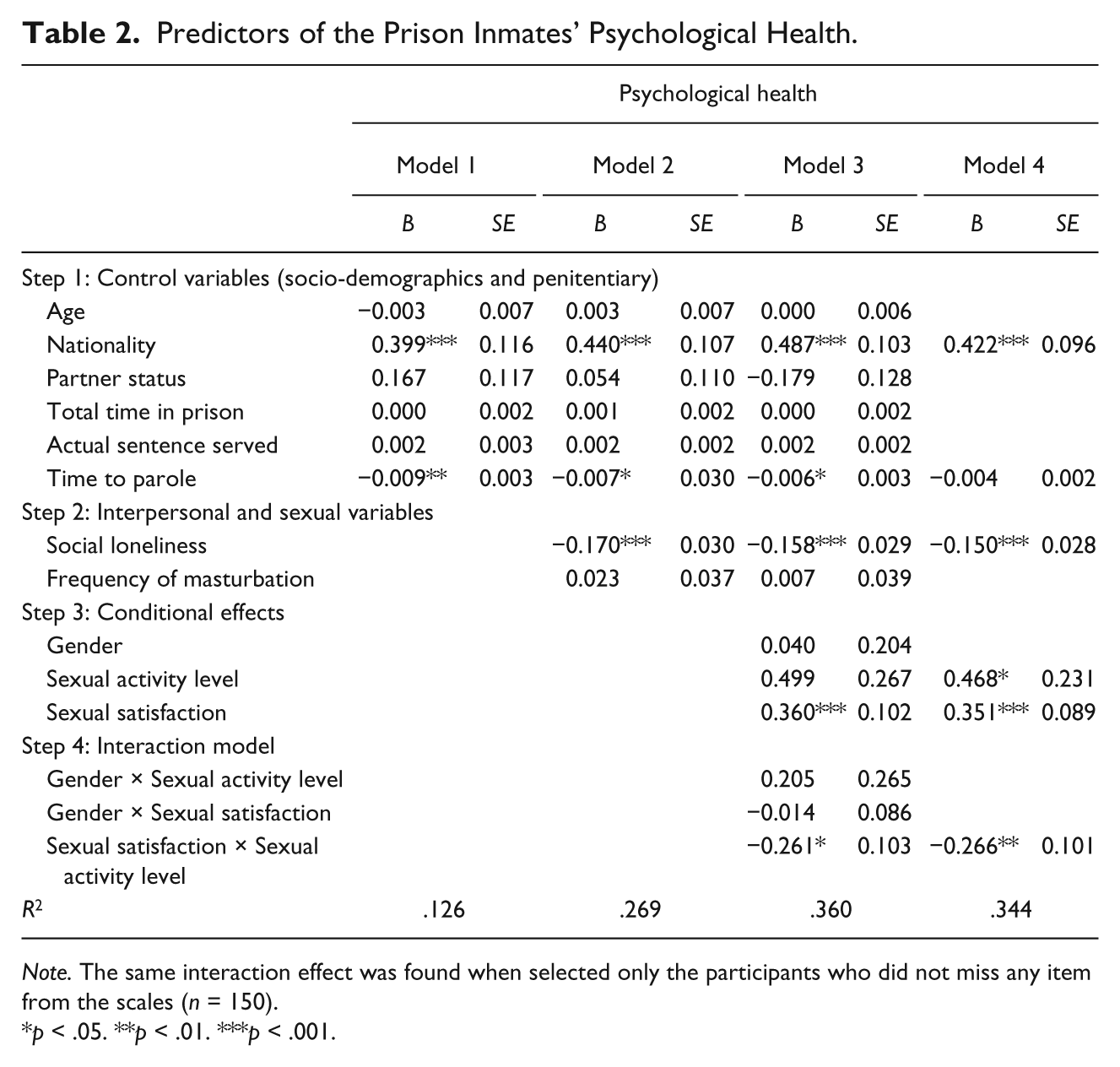
Note. The same interaction effect was found when selected only the participants who did not miss any item from the scales (n = 150).
p < .05. **p < .01. ***p < .001.
The level of sexual satisfaction predicted psychological health among the sexually abstinent inmates. The more sexually satisfied inmates were, the greater their psychological health. A similar, but non-significant trend (p = .081) was found among the non-sexual-abstinent group (see Table 3). The resulting interaction plot can be seen in Figure 1.
Conditional Effects of Sexual Satisfaction at Two Sexual Activity Levels on Psychological Health.
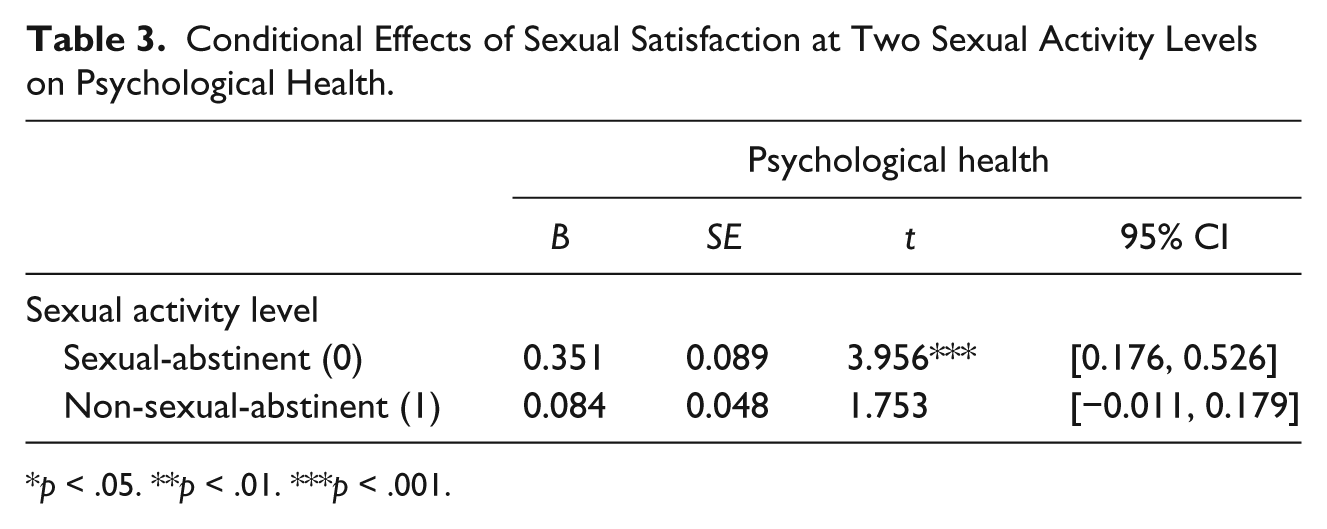
p < .05. **p < .01. ***p < .001.
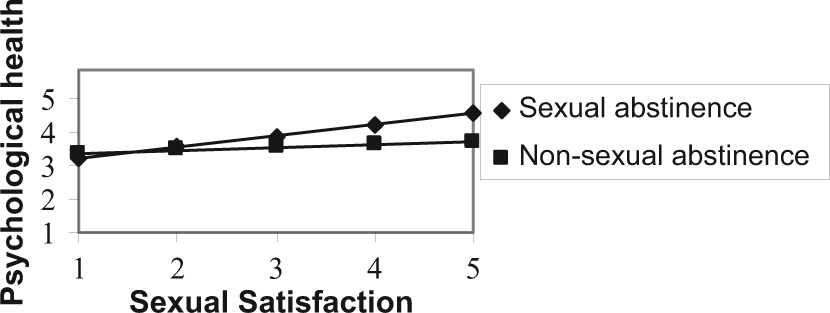
The moderating impact of sexual abstinence on the relationship between sexual satisfaction and psychological health.
Discussion
This study found two main results: (a) Sexual satisfaction was lower for sexually abstinent inmates in comparison to inmates who have had heterosexual sexual relationships in the last 6 months, and (b) sexual satisfaction was a significant predictor of psychological health but only for the sexually abstinent group.
Gender and Sexual Activity Level Differences in Sexual Satisfaction
After accounting for the control variables, no differences in sexual satisfaction scores were found between male and female inmates. This result contradicts our first two studies (Carcedo, 2005; Carcedo et al., 2008) but supports the findings of a more recent work (Carcedo et al., 2011) in which a set of control variables were included. However, no control variables were included in the other two previous studies that showed women to have a higher level of sexual satisfaction than men (Carcedo, 2005; Carcedo et al., 2008). This makes clear that when control variables are included, gender is no longer significant for inmates’ sexual satisfaction.
In addition, the heterosexually abstinent prison inmates showed lower sexual satisfaction than the heterosexually active group. This result is akin to Carcedo’s (2005) findings. In the present study, no interaction effect of gender by heterosexual activity level was found. In sum, having a sexual relationship is important for inmates’ psychological health, independent of the inmate being a male or a female.
Sexual Satisfaction and Psychological Health
Independent of gender and sexual activity level, higher levels of sexual satisfaction were associated with higher levels of psychological health. This result is consistent with other prison studies (Carcedo, 2005; Carcedo et al., 2008; Carcedo et al., 2012; Linville, 1981), other authors’ statements about prison inmates (Lacombe, 1997; Levenson, 1983; Linville, 1981; Neuman, 1982), and non-prison studies (Fegg et al., 2003; Lau et al., 2005; Nicolosi et al., 2004; Taleporos & McCabe, 2002). For all of them, higher levels of sexual satisfaction were associated with higher levels of psychological health and other well-being-related measures.
Of all the things that influence well-being, one might question the importance of sex. The 2007 Durex Global Sexual Well-Being Survey showed that the typical adult around the world only has sex once a week with foreplay and intercourse averaging a mere 36 min (Durex®, 2007; Wylie, 2009). Despite this, Kahneman, Krueger, Schkade, Schwarz, and Stone (2004) found that “intimate relations” are the most positively evaluated of all daily activities. Blanchflower and Oswald (2004) add to this that the “effect of sex on happiness is statistically well determined, monotonic, and large,” especially for individuals under age 40 (p. 411).
The Moderating Effects of Sexual Activity Level on the Relationship Between Sexual Satisfaction and Psychological Health
Sexual satisfaction was a significant predictor of psychological health but only for the sexually abstinent group. In other words, the relationship between sexual satisfaction and psychological health is significant for the group whom we believe were experiencing greater reactance due to their lack of choice in their sexual behaviors. This is the first time that this result has been encountered in prison inmates. However, this finding is consistent with RT (Brehm & Brehm, 1981) and other results found in non-prison populations whose freedom to choose has been reduced or eliminated due to constraining situations such as the presence of sexual dysfunctions (Lau et al., 2005; Ventegodt, 1998), physical disabilities (Taleporos & McCabe, 2002), amputations (Walters & Williamson, 1998), and having endured germ-cell tumor therapy (Fegg et al., 2003).
The interviewers’ observations and the data gathered from this and another of our previous studies (Carcedo, 2005) have relevance for understanding the obtained interaction. Inmates who have not had sex for a long time made more references to terms and adjectives related to sexual well-being and expressed more anger (a concept-related to reactance) than did the inmates who have had sex in the last 6 months. We suspect that what inmates discuss reflects the importance they attribute to things; that is, we believe that those who are sexually abstinent due to the conditions of prison life see sex as more crucial to their well-being than do non-sexual-abstinent inmates. Thus, flowing from these ideas and supporting our results, sexual satisfaction may be more central for the psychological health of sexually abstinent inmates. Notwithstanding, this result needs to be further investigated not only in prison inmates but also in other populations with sexual problems in relation with other individuals without these issues. The scarcity of empirical evidence regarding the heterosexual desires and behaviors of inmates makes it especially important to focus on such populations in future studies.
The stronger relationship between sexual satisfaction and psychological well-being among the sexually abstinent group also complements themes in the early prison literature. The authors of these early studies discussed the possible negative consequences of sexual abstinence for inmates’ health (Levenson, 1983; Linville, 1981; Neuman, 1982; Sánchez, 1995). As conjugal visits within prisons were even rarer than they are today, these authors presumably were referring to inmates who had not had sex for a long time. The present findings imply that it is for such sexually deprived inmates that the negative mental health consequences are most pronounced, not for inmates with greater access to and involvement in heterosexual activity.
This sexual deprivation could increase the desire for having sexual relationships, thus intensifying the impact of sexual satisfaction on psychological health, as RT (Brehm & Brehm, 1981) posits. Thus, RT can explain why higher levels of sexual satisfaction were associated with higher levels of psychological health, although only for the inmates belonging to the sexually abstinent group.
Future research pertaining to the sexual activity by sexual satisfaction interaction might go in several directions. First, in cross-sectional studies, it would be profitable to demonstrate that reactance is greater in populations such as inmates whose members are prevented from having sex and that in sexually constrained subgroups these reactance processes mediate between sexual satisfaction and psychological health. Second, longitudinal studies of the inmates going from the sexually abstinent group to the sexually active group (or vice versa) are warranted. Consider those starting in the sexual-abstinent group: It would be valuable to demonstrate on a within-subject bases (a) that prior to the transition sexual satisfaction is associated with psychological health but this association is non-significant afterward, and (b) that sexual needs are highly important prior to the transition but decline in importance after the transition. Third, it would be valuable to isolate a group of inmates who have not had sexual relationships for a long time. If our analysis is correct, there should still be a strong sexual satisfaction/psychological health association for this unique population. A final area for future research might be efforts to apply RT to other deprivations of prison life.
Some heterosexually abstinent participants in this study reported relatively higher levels of sexual satisfaction and psychological health. To fully understand this, it would be beneficial to study why some inmates adjust better than others to sexual deprivation. For instance, individuals who have had fairly negative sexual experiences in the past might not have been very interested in sex, or individuals for whom sexual abstinence is a positive value might interpret this situation in a more positive way, or some people may be generally more positive in their outlook such that they judge both their sexual situation and their well-being through positive lens. In this sense, sexual deprivation may not be considered and experienced by these individuals as necessarily negative.
The Moderating Effect of Gender on the Relationship Between Sexual Satisfaction and Psychological Health, and Control Variables
The moderating effect of gender on the relationship between sexual satisfaction and psychological health was not found, contradicting previous non-prison studies (Laumann et al., 2006; Taleporos & McCabe, 2002). An association between being more sexually satisfied and having greater psychological health was obtained, however, consistent with the only prison study of which we are aware that has dealt with this relationship (Carcedo et al., 2008). In that particular study, sexual satisfaction predicted psychological health for both genders, although the percentage of explained variance was slightly higher for women. Carcedo et al.’s study did not statistically test whether that difference was significant. However, the conditional effect of sexual satisfaction in the current investigation supports and refines Carcedo et al.’s work, since a group of control variables were analyzed simultaneously with sexual satisfaction to predict psychological health. This result is also consistent with previous RT findings, because research in psychological reactance has detected gender differences only in an insignificant portion of the reactance literature. In this sense, psychological reactance is not gender-specific (Brehm & Brehm, 1981).
Limitations of the Present Study
Although we think that the sample size is quite large for an interview study focused on an uncommon topic in prison and sexuality research, the statistical power for detecting effects, especially interaction effects, is still low. Thus caution is needed in generalizing these results to the whole prison population. Even more caution is needed in making generalizations to the non-prison population. More research is needed in this regard. In addition, in light of the uneven ratio of women to men within the two sexual activity groups, we used the model comparisons framework articulated by Appelbaum and Cramer (1974) and Maxwell and Delaney (1990) to deal with non-orthogonality. Still future research is needed to check if similar results are found using completely balanced or orthogonal designs.
Another limitation of this study is that causation is difficult to infer due to the correlational design. In a recent issue of the Journal of Sex & Marital Therapy, Balon (2008) stated that psychological health may lead to sexual satisfaction or sexual satisfaction and psychological health may have a circular relationship. However, in the same issue, Rosen and Bachmann (2008) used empirical evidence and the perspective of a positive psychology to argue for a directional relationship from sexual satisfaction to well-being.
Finally, despite the interviewer stressing the confidentiality and anonymity of the study, homosexual contacts might have been underreported by the inmates. In evaluating that possibility it is important to keep in mind that all the inmates indicated they felt very comfortable during the interview and they disclosed other sensitive information about themselves. Future researchers might employ more subtle ways of seeking information about homosexual acts to determine if their true rate is higher in Spanish prisons than was reported to the current research team.
Implications and Conclusions
Finally, these results have practical implications. Allowing inmates to have romantic and sexual relationships with other inmates in prison appears to be a valuable option for them, especially for those without a partner. Therefore, having this as a prison policy may be beneficial for inmates’ sexual satisfaction and psychological health. It may also benefit prisons: Inmates scoring higher on psychological health have lower levels of misconduct at prison (Wright, Salisbury, & Van Voorhis, 2007). Furthermore, lower levels of personal distress, a psychological health-related concept, have been significantly associated with lower recidivism rate after inmates are released (Gendreau, Little, & Goggin, 1996). Thus, we would point out that housing men and women in the same prison can be beneficial, particularly if they are allowed to start romantic relationships and maintain sexual relationships. Nevertheless, education and policies to control sexual risks (e.g., unwanted pregnancies, STDs, and sexual-partner violence) also have to be developed. For example, in the prison where this study was conducted, the prison gives condoms to inmates every month, offers some sexual education courses, tests inmates for STDs and HIV, supervises their relationships to prevent any possible sort of violence, and takes into consideration the inmates’ criminal records.
Historically, as well as now, sexuality has all too often been left in the shadows rather than illuminated. Myths, false beliefs, and fears have always surrounded this topic. If we add “prison,” the resultant equation is even more “scary,” and misconceptions are likely to proliferate. Prison systems concerned with inmates’ needs have offered some alternatives to sexual deprivation such as conjugal visits. For inmates who have no partner, however, conjugal visits are not a viable solution. Systems such as the one we studied that allow inmates to form relationships are needed.
Correctional systems focused on punishing inmates have adopted an easy solution: deprivation. Independent of the prison system and the cultural view of sexuality, the fact is that sexual satisfaction seems to be associated with psychological health, especially for those who have not had sex for a long time. We advocate for more research in this area, but if the present results are supported in the future, the implication for prison policies appears clear: Sexual activity enhances psychological health and, among those without a partner, being satisfied with one’s sexual situation enhances psychological health. The former effect appears more powerful than the latter. Rather than be guided by our own (mis)conceptions, let us be guided by tested knowledge.
Footnotes
Acknowledgements
The authors are very grateful to the regional education authority of Castilla y León and the Ministry of Education, Culture and Sports of Spain which provided two grants, one to carry out this study (ref. SA007B08), and another through the “José Castillejo” program to support the stay of the first author in the Department of Human Development and Family Studies at the University of North Carolina at Greensboro. The first author is also grateful to this department for their support and help with this project. Finally, he wants to thank Ioana Scripa for her help in preparing the manuscript.
Declaration of Conflicting Interests
The author(s) declared no potential conflicts of interest with respect to the research, authorship, and/or publication of this article.
Funding
The author(s) disclosed receipt of the following financial support for the research, authorship, and/or publication of this article: The authors received financial support for the research from the regional education authority of Castilla y León (Junta de Castilla y León, ref. SA007B08). The first author also received a grant from the Ministry of Educación, Culture and Sports of Spain to support his stay in the Department of Human Development and Family Studies at the University of North Carolina at Greensboro.