



Abstract
Midwestern state inmates were interviewed to determine how they understand and interpret staff conflict. Qualitative analysis has shown that inmates describe being ignored or disregarded because of verbal and sometimes physical fights between staff members. While others show that those occupying a nonperson status are in a powerless position, inmates explain that this highlights the fact that staff members are not paying attention to them and this engenders inmate misconduct and contributes to a culture of disrespect.
There is certainly no shortage of research about the causes of inmate misconduct in U.S. prison systems. A good deal of work examines the reasons why inmates hurt each other and the administrative response to violence. For this article, we examine inmate violence from a different perspective. We focus on how inmates interpret staff conflict and how this influences their own behavior. Specifically, we use interviews with a sample of male inmates in a Midwest prison system to determine how the observations of staff-on-staff conflict influence their own behaviors.
As we coded our interviews, two themes emerged. First, interviewees explain that staff conflict highlights a security breach, as staff members attend to interpersonal problems rather than inmate behavior. Moreover, inmates describe staff members as disclosing personal information in front of the inmates as if they are not present. These findings suggest that staff treat the inmates as the “nonperson” as described by Goffman (1959). In essence, the nonperson almost serves as an inanimate object that goes unrecognized because they have little power to discredit or disrupt the performance of those interacting before them.
Goffman (1959) warned that although nonpersons appear to be subordinate, they wield a great deal of power because they observe things that the performer would not want anyone of equal or higher status to know. Our interviewees claim that they are privy to a good deal of personal information about the prison staff. Moreover, they legitimate their own violent behavior because they believe that staff members are not paying attention to them. They explain that this behavior increases tension and disrespect in these facilities. In fact, “disrespect” was the most common cause of inmate violence in these facilities, and some inmates blame staff for increasing the level of disrespect in prison. In this sense, the inmate as a “nonperson” could increase security threats due to the conflict among employees.
While previous studies explore why inmates assault staff members (Lahm, 2009), how inmates fraternize with staff (Beck, Harrison, Berzofsky, Caspar, & Krebs, 2010; Worley, Marquart, & Mullings, 2003), or how inmates use violence as a response to administrative control (Colvin, 2007; McCorkle, Miethe, & Drass, 1995), we propose that the relationship between staff and inmates is more nuanced than previously believed. Theoretically, we argue that the prison system is a holistic social structure influenced in part by how conflict is managed by authority figures. Inmates may or may not have an amicable relationship with prison staff; however, they pay close attention to these authority figures. As Goffman (1959) pointed out, this can give power to the subordinated nonperson as they gain inside knowledge about the group of people tasked with controlling the inmate population.
From a policy perspective, our findings show the importance of conflict management among prison staff. To be sure, it is important for authority figures in all institutions to set a positive example to others. In prison, this is especially important as staff problems might instigate problems in front of the inmates. Clearly, this means that behaviors such as officer stress and conflict (Cheeseman, Kim, Lambert, & Hogan, 2011; Farkas, 2001) should be addressed. In short, staff should be aware of their influence on inmate behavior. Correctional staff should take every step to avoid undermining the authority of their peers that might provide security gaps for the inmates.
Relevant Literature
Scholars have studied the relationship between prison inmates and staff since Sykes and Messinger (1960) first discussed the “inmate code,” which forbids inmates from working with prison authorities. Accordingly, inmates avoid lengthy or cooperative interactions with prison employees. However, these two groups have no choice but to interact with one another and there are varying degrees to which they get along.
Due to the nature of their unequal social statuses, there is sometimes an adversarial relationship between inmates and correctional staff (Wortley, 2002). Therefore, a good deal of the research centers on the problems between these groups. The overwhelming majority of attacks against prison staff are nonserious and nonlethal; yet, the number of assaults increased in recent decades (Useem & Piehl, 2006). There is some evidence that inmates assault staff members spontaneously rather than planning these attacks (Light, 1991). Lahm (2009) found that younger inmates and aggressive inmates are statistically more likely to assault prison staff. Her findings held true across prison-level variables, such as security type and population size.
There is evidence that inmates use violence against staff members as a result of being told what to do. Inmates act out because they do not want to comply with a direct order (Light, 1991). This means that inmates are more likely to assault staff in lock-down units, where they are closely supervised, rather than the prison yard (Jiang & Fisher-Giorlando, 2002). Patrick (1998) found that assaults against the prison staff are connected with the inmate subculture. As inmates develop their own set of norms, staff members are perceived as a threat to this informal social structure.
Research documents that institutional factors such as security level, overpopulation, and the number of prison programs influence inmate violence (Briggs, Sundt, & Castellano, 2003; McCorkle et al., 1995). Although poor prison management may contribute to inmate violence, high levels of security do not necessarily reduce the chance of prison riots (McCorkle et al., 1995). In fact, Colvin (2007) argued that coercive measures only drive a wedge between inmates and staff and can fail to control the prison population as intended.
Other studies illustrate that those experiencing stress on the job have an increased chance of role conflict (Bolino & Turnley, 2005; Lambert, Hogan, & Griffin, 2008). Correctional staff are supposed to prevent violence, break up fights, aid in rehabilitation, and manage the inmates. If these conflicting roles cause undue stress for employees, they are less likely to put forth much effort in their job and “high levels of job stress may lead to lower commitment on the part of the individual” (Lambert et al., 2008, p. 64). Cheeseman, Kim, Lambert, and Hogan (2011) found that correctional officers experiencing stress reported lower levels of job satisfaction. This can influence how correctional staff interact with each other and the inmates. More specifically, this could alter their attitudes about the inmates. Staff members experiencing role conflict are less likely to focus on the rehabilitation of the inmates (Farkas, 2001). More importantly, “these effects stretch far beyond job performance and can also impact the employee’s health and personal relationships. The employee may very well place blame on the organization for feeling of stress” (Cheeseman et al., 2011, p. 64).
Drawing from this literature, several themes emerge. First, those studying inmates and staff focus a good deal of attention on the conflict between these two groups. What is currently needed is a study that assesses how staff deviance influences inmate behavior. Second, correctional officers and counselors experiencing stress are less likely to help inmates program through their prison sentence. Staff members occupy a higher social status than the inmates, and this status difference could prove problematic should the staff learn to ignore the inmates.
Goffman (1959) was the first to describe the low-status, overlooked person as a “nonperson” who is often ignored by those occupying a higher social status. Researchers have identified many different groups of individuals who are treated as nonpersons. Some of the classic nonpersons in society are servants (Goffman, 1959), the young and the old (Goffman, 1959; Leavitt & Power, 1989), appearance impaired children (Weiss, 1994), the handicapped or disabled (Ikäheimo, 1999), prostitutes (Heiner, 2008), and the homeless (Lankenau, 1999). For example, Heiner (2008) found that simply associating with a prostitute in South Korea placed one in jeopardy of losing personhood. Weiss (1994) reported that Israeli parents with “appearance impaired” children (facial or bodily malformations) not only treat their children as a nonperson but also banish these children to areas in the home where others were not allowed to visit.
In the classic model of dramaturgy, Goffman (1959) pointed out that we prepare for our social interactions and sometimes commit deviant behavior in our backstage arena while behaving in more appropriate behavior in the frontstage where our peers or superiors are likely to judge our behavior. Of course, this places the nonperson in the position of an unintended confidante, as others talk about personal affairs or engage in deviant behaviors in the backstage (Goffman, 1959) of social settings. In the prison setting, staff members walk around the yard, housing units, or cafeterias while superiors work in offices or administrative buildings. Correctional staff or caseworkers work directly with the inmates and are free to discuss topics they would never raise in the administrative offices of their bosses. This facilitates a situation where inmates are privy to private conversations between staff members.
Prison staff members are likely to view the inmate as a nonperson for several reasons. First, prison administrators create rules against fraternization to avoid corruption (Worley et al., 2003). Second, staff members will likely feel superior to inmates as their criminal activities lower their social status altogether. Finally, the fact that employees wear uniforms (for correctional staff) or suits (for caseworkers) delineates them from the standard prison garb worn by inmates. These “costumes” (Goffman, 1959) are used to denote the different social statuses and give the appearance of legitimate state power to those in control. What we need to understand is how do inmates interpret their status as the “nonperson” and how does this influence their own behavior? Although we know quite a bit about the conflict between inmates and staff, we know less about how these issues contribute to security issues and inmate misconduct.
Data and Method
To examine these issues, we created a qualitative case study of male inmates in a Midwest state. These data were collected over a 4-month period in 2011. Male inmates were selected from state prison rosters made available by the Department of Corrections. We used a random sampling technique to reduce selection bias that stems from allowing prison employees to select inmates. This is a qualitative study in which we are using an open-coding technique to examine themes in our case study (Charmaz, 2006). This technique has been successfully utilized in other prison research projects (see, for example, Jenness, Maxson, Matsuda, & Sumner, 2007). Six researchers conducted private interviews with inmates using a survey interview instrument created by the primary investigator. In total, 308 inmates agreed to participate. This is a total of 10% of the male prison population in this state. For this project, we also interviewed female inmates for a separate data set. Due to the fact that women reported fewer acts of violence, we focus on men for this study.
Inmates who were available (not working, transferred, or sent to administrative segregation) were led to a private interview room and met with one of six researchers who verbally read the consent form to them. At that time, they were told that participation was voluntary and were given the option to return to their cell or the yard. A total of 26 inmates refused to sign the consent form and be interviewed. Those who offered a reason for nonparticipation said that they had no time to finish the interview or they were uncomfortable answering questions.
Interviews were conducted in classrooms, visiting rooms, and staff offices. Prison employees, including security staff, were not present during the interviews, and these employees stayed outside of the interview room or away from the inmates while the interviews were conducted. This allowed inmates to answer the interview questions privately. The average time spent conducting the interviews was 43 min and ranged from 15 min to 3 hr. As per Institutional Review Board (IRB) protocol, all participants were assigned a random identification number. No names appear on the databases, and there are no direct ties from individual participants to their responses. To protect confidentiality, pseudonyms are used. We are careful to exclude any information that may identify any of the volunteers.
The legal age of majority in this state is 19. The ages of those surveyed range from 19 to 73, with a mean age of 38. The average age of male inmates in this state was 36. Within our sample, 56% were White, 29% were African American, 10% were Hispanic, 4% were Native American, and 1% identified as biracial. At the time we conducted the interviews, the racial breakdown for male inmates in this state were as follows: 55% were White, 27% were African American, 13% were Hispanic, 4% were Native American, 0.02% were “Other,” and 0.01% were “unknown.” Due to the fact that we interviewed only 10% of the male population, we are not generalizing these data to the entire prison system. However, we were fortunate to access respondents in all racial categories.
For this project, the principal investigator created interview survey questions on the daily routines of inmates, gang affiliation, interpersonal relationships they developed with inmates and staff, and their history of prison violence. The interviewer would ask the participant a set of open-ended and closed-ended questions and write down his responses. Those who admitted that they had been involved in some acts of violence were first asked to list the total number of violent encounters and then describe the context of the three most recent incidents. When they claimed to fight another inmate, we asked the following interview question: “What was this fight/assault about?” We use these data to describe, in the inmate’s own words, why they fought other inmates. We asked inmates to describe an example of staff conflict (Interview Question: “Can you give a personal example when staff did not show respect to another staff member here in prison?”). We transcribed their qualitative response to code their responses into categories based on their descriptions (Charmaz, 2006).
Their responses ranged from verbal altercations (yelling and cursing) to physical violence. We coded these data using a grounded theory technique (Charmaz, 2006) to explore how interviewees interpret disrespectful behavior between staff members. Throughout the process of coding these data, we created categories (open codes) based on the terms used by the interviewees (Strauss & Corbin, 1990). As we coded, we found that some inmates used the term “human” when describing the problems involved with staff conflict and inmate neglect. They claimed that they were treated as less than human because of the status differences between these two groups. Through this process of coding, we developed a theoretical framework that emphasizes the inmate as a nonperson and how this might influence their behavior.
Findings
There are four adult male prisons in this Midwest state. Table 1 shows the total number of inmates who reported having at least one violent encounter with another inmate while incarcerated. Approximately 49% of the interviewees experienced violence including assaults or mutual fights. The three prisons with the highest number of reported acts of violence are prisons that house male inmates in high-security facilities.
Reports of Inmate Violence at Each Facility.
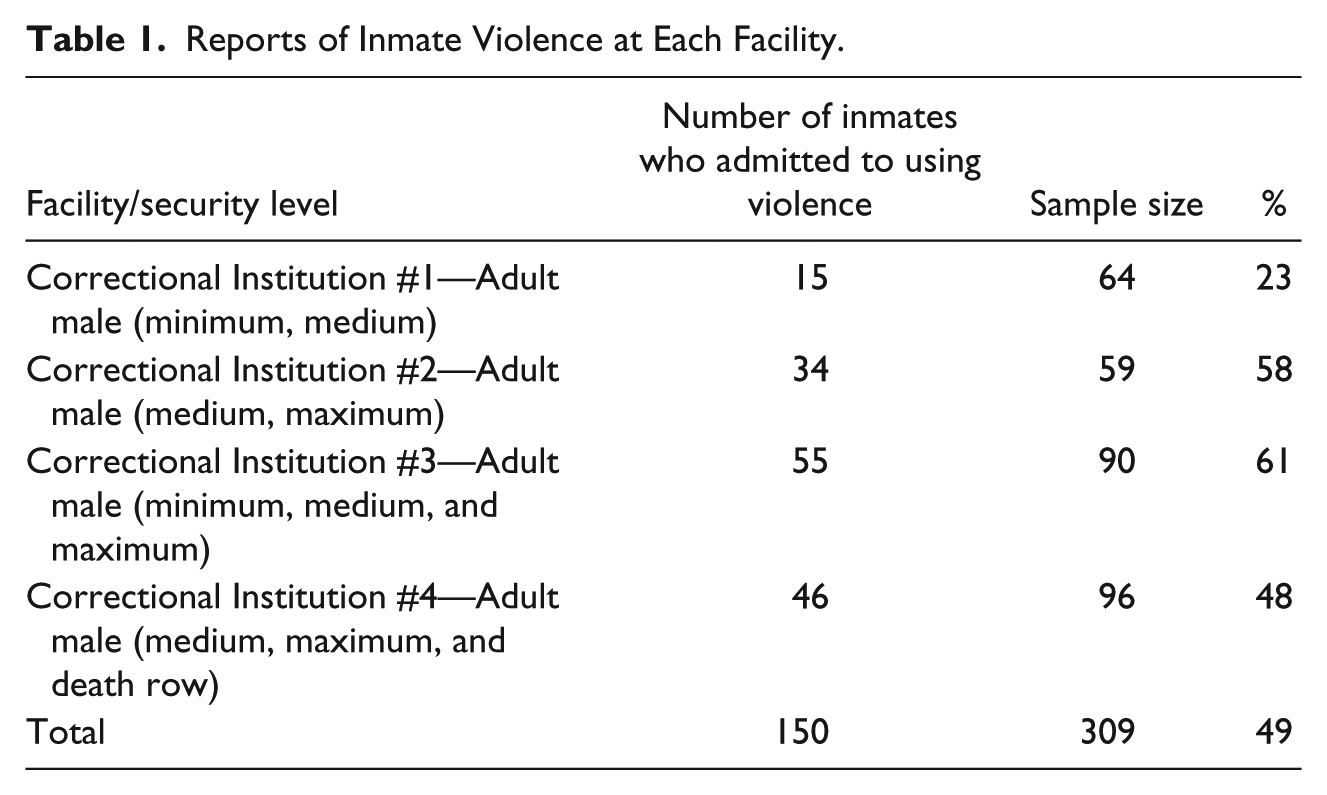
A total of 150 (49%) interviewees reported fighting. According to their reports, disrespect was the leading cause of violence in all four facilities. As outlined in Table 1, the majority of fights or assaults took place in three prisons (#2, #3, and #4). We asked interviewees if they witnessed disrespectful behavior between staff members. Coding responses into a dichotomous variable (1 = yes, 0 = no), we see that 85 (28%) of interviewees admitted to witnessing disrespectful behavior between staff members (Table 2).
Frequency of Staff Disrespect In Front of the Inmates.
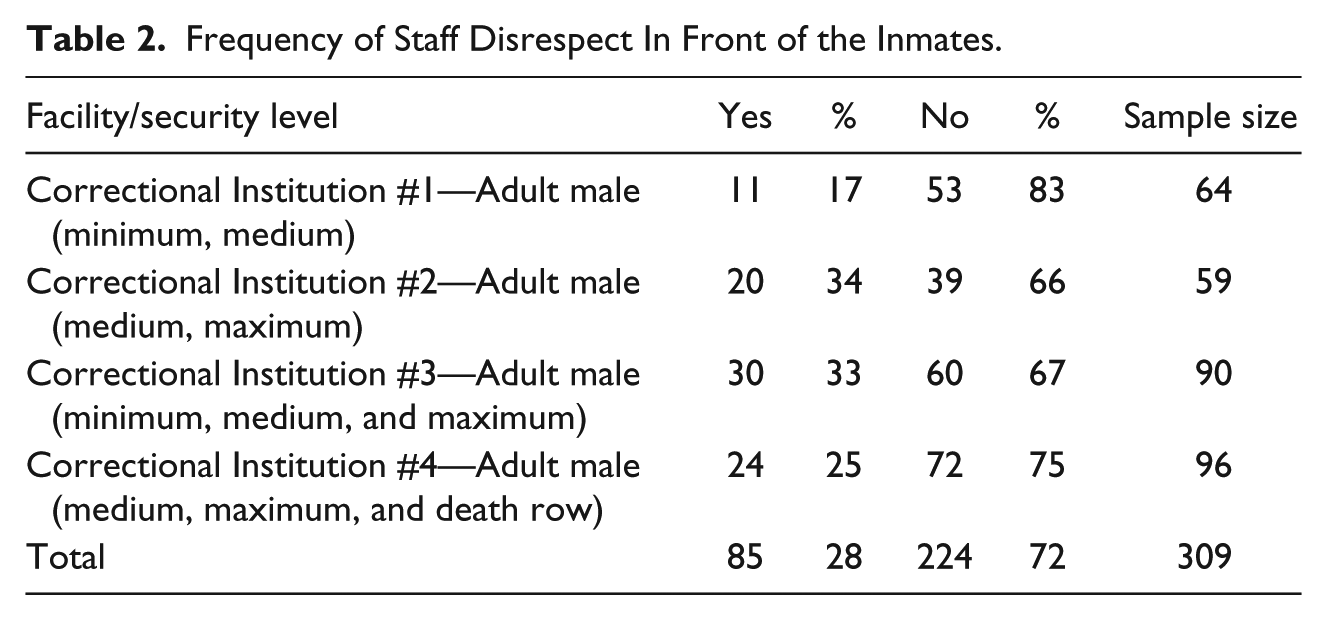
Inmates in all prisons witnessed these events; however, the majority (87%) of these incidents occurred in prisons #2 through #4. Inmates housed in high-security facilities are more of a security threat. Due to the nature of their crime, their gang affiliation, or their inclination to use violence, they require more supervision. Staff members at high-security prisons have a variety of security measures at their disposal (e.g., special housing units) to control violent inmates. The use of heightened security measures might cause interpersonal problems between inmates and staff in these facilities (Colvin, 2007).
Working with high-risk, violent inmates could result in high levels of stress for the staff and this could lead to correctional officer burnout (Cullen, Link, Wolfe, & Frank, 1985) or other problems not necessarily seen in low-security prisons. The fact that inmates witness these events influences the social dynamic between the inmates and staff. Staff disrespect is not a direct cause of inmate violence. Instead, it highlights some “gaps” in security and models inappropriate responses to interpersonal conflict.
Examples of staff disrespect include, calling each other names, airing complaints about each other in front of the inmates, verbal fights, and physical fights in front of inmates. Drawing from these interviews, we see that inmates are privy to a good deal of personal information about prison staff. According to Jesse, staff members frequently talk about each other in front of the inmates:
They fight on and off work all the time and then talk about it. They talk about each other behind their backs all the time and they think we can’t hear this stuff.
Carl stated that he knows about the extracurricular activities of the staff members:
There are a couple of guards here who party a lot. They come in hungover and I can still smell the alcohol on them. They talk to each other about who got the most drunk or who ended up going home with who. They don’t really try to be quiet about it.
Jeremy stated,
The guys, the officers, they talk to each other all the time about who they are with. You know, their partners. They talk about passing around the women in here a lot. I don’t know what to believe. I can’t believe some of these women would actually do these guys but maybe it happens. I just don’t know why they talk about it so much. I guess they are young guys who are getting laid and want to brag about it.
Inmates gain access to personal information that would probably not be discussed in front of prison administrators. Employees discuss these things in the prison yard or in the housing units and, as Carl points out, they make no effort to conceal these conversations from the inmates. Moreover, they explain that male staff members intentionally undermine the authority of female staff members. Examples include discussing their sexual exploits with female staff or calling them names such as “slut” or “bitch.” Kelly gives an example:
They talk about each other all the time. Some guys get in trouble for it. I’ve heard them talk about who they are sleeping with and who they party with. I heard a couple of guards call a female a slut once.
Martin stated,
I have personally heard them talk about who is having sex with who and who is dating who. The guards all go out and drink together and they say that they hook up with each other all the time. They say this stuff in front of us like we’re not even there. It’s like they’re talking in front of the dog or something.
Martin claims that witnessing these behaviors makes the status difference between inmates and staff especially salient. He, along with other interviewees, is quick to point out that this behavior depersonalizes the inmates. Donald told this story:
We were in line once and a male guard told the other male guards that a female guard needed to lose weight. They all laughed. One of the inmates said, “hey man, that’s not cool” and the guy said, “it’s just a joke, she’d think it was funny.” I told him “you know, I know a lot of women and I can’t think of one that would think that was funny” and they all shut up. I think I embarrassed them.
Donald’s story is especially interesting because the inmates interacted in a way that forced the correctional officers to reevaluate their behavior. These officers joked about another staff member while the inmates defended her. Donald interpreted their silence to mean that he had shamed these men. They could no longer ignore the inmates and were brought back into the reality of their job. Lankenau (1999) found that homeless people also occupy the role of the “nonperson” and try to overcome this status by intentionally engaging with people walking by in order to develop some kind of connection with them. In a way, Donald is doing the same thing as he embarrasses these correctional officers about how they are treating women. He and his fellow inmates inject themselves into a conversation in a way that forces the officers to evaluate what they are saying.
Furthermore, these examples highlight the issue of gender roles in this hyper-masculine environment. These inmates do not see or interact with women on a daily basis except for staff members. If employees point out the gender differences or brag about having sex with their coworkers, this presents female staff members as women first and authority figures second. In fact, Chester argues that the inmates harass women because they are modeling the staff’s behavior:
They have to get better training. They need to leave the women alone. One of the reasons why the inmates harass the females here is because the male guards undermine their authority. If these guys really believed that these women were capable authority figures, they would treat them like it. I learned that in the Marines. The smart guys knew that you don’t undermine a woman or everyone will follow along. The staff are role models here and they should not forget that.
Chester’s interview was quite interesting. He actually blames male staff members for the way that inmates treat the women in this prison. To be sure, inmates might harass women anyway. Also, it is highly unlikely that male staff members intentionally try to instigate sexual harassment on the part of the inmates. However, as Chester points out, their behavior might authorize other acts of improper behavior. By reducing the inmate to a nonperson status, they make the mistake of giving off too much information or modeling inappropriate behavior that could result in inmate misconduct.
In addition, interviewees provided examples of verbal and physical assaults between staff members. David described an altercation between two staff members:
There was almost a physical fight in central dining. A verbal argument, shoving. A sergeant told people to head to work assignment, then called back late and said, “no send them to the housing unit.” The corporal says, “you’re confusing me and them.” The sergeant says, “You’ll do what I fucking tell you to.” And it was in front of a hundred inmates.
Another inmate, Trent, provided an example of two guards getting into a fight in front of him. When the other guards broke up the fight, the inmate was close enough to inquire about the cause of the fight:
Two guards, both corporals. The smaller guy pushed the other guy against the wall and grabbed his throat. (Other guards) took the small guy out and I asked the other what it was about. A softball game. The bigger guy talked trash and was joking. The other guy took it seriously.
According to David and Trent, these correctional officers ignored the inmates around them and fought with each other despite the fact that they are charged with preventing inmate violence. Trent, like Donald, interjected himself into the situation but, in this case, guards actually shared information with him. Louis makes the argument that this behavior hurts the inmates:
I’ve seen the staff members tell the other guys to do their own work. They pass things off when they should do it themselves. They’re lazy. The guards fight all the time and tell each other off all the time. How can I get them to help me if they are fighting with each other?
Jones explained how these fights affect the needs of the inmates:
I knew of a caseworker that pissed off another guy and they took turns fighting and writing each other up all the time. They have zero time to help us because they want to carry out their own drama.
Louis and Jones describe being frustrated with the lack of help from the staff members. From their perspective, staff conflict lowers the level of help they receive from prison employees. Several inmates made similar claims. For example, Barry told this story:
I went to a correctional officer and asked a question, he said he’d check and he called another guy and they got into a fight on the phone. He called the other guy a bunch of names and cursed at him. I just stood there until he was done and then he said, “sorry, I don’t have an answer for you.” He was nicer to me than the guy on the other end.
Interviewees often claim that this behavior divides loyalties as inmates figure out who is helpful and who wastes their time. Anderson told this story about two female staff members. Clearly, he took sides in this fight and labeled one of the women “bitchy”:
There were these two women caseworkers who got into a fight about the inmates. One thought that the other one was being too nice to the inmates and she yelled at her to stop it. The bitchy one set the nice one up and got her fired.
Like other interviewees, Anderson resents staff members who do not help the inmates. Those who are rude to the inmates undermine the authority of those trying to do a good job”. We have no idea if Anderson’s story is accurate. However, he explains that inmates now resent this woman and are less willing to cooperate with her. In other words, he interprets this behavior as a symbol of inaction on the part of some staff members and this lowers the chance that he will cooperate with them. In another example, Mike explained that a caseworker had upset several correctional officers and inmates. When an inmate lashed out at the caseworker, the correctional staff ignored the behavior:
I saw an inmate toss a chair at a caseworker and the other staff saw it and just walked away.
Stephen explained that an inmate verbally assaulted an unpopular correctional officer and his coworkers did nothing to help him:
I saw an inmate yell and attack a staff member and the other guys just left him behind. They didn’t stick around.
Another correctional officer left his post in the dining hall because of an argument with a coworker. Aaron said that this left the correctional officer alone with the inmates during lunch:
A sergeant and corporal were bickering back and forth at each other and the Corporal said to the Sergeant, “Fuck you, I don’t want to listen to your shit anymore” and went outside. He left, but it happened in front of hundreds of inmates. They have no respect for each other and they do it in front of people. I don’t know how they expect to resolve things with inmates.
From their point of view, this creates a breach in security at these prisons. A common theme in these interviews is the fact that staff members are distracted and not paying attention to the inmates. In several cases, interviewees describe how this puts staff in jeopardy as inmates identify fissures in the united front to control the prison environment.
It is important to remember that only 28% of interviewees witnessed these events (see Table 2). Clearly, this is not a problem with all staff members in all prisons. At the same time, this behavior was mostly reported in the prisons with the highest rates of inmate violence. Inmates discuss how this increases the tension in these prisons and inmates and staff members snap at each other as the tension rises. They explain that this contributes to a general culture of disrespect in these prisons.
When we asked them about the problems associated with disrespect, they often explain that disrespect harms the prison environment by promoting conflict and reducing the chance of maintaining a controlled environment. Moreover, if the staff shows disrespect, this will model this behavior for the inmates. Roscoe stated,
They should be trained to take care of situations in a more productive manner. They need to control the environment, which makes sense. They also need to learn to control their own anger and lead by example.
Jonathan said,
They should be leading by example. They are the authority figures here and they should be respectful to us and each other. That’s how normal people do it.
Some link disrespect to violent behavior. They state that showing respect reduces the chance that inmates will use violence. This reduces the tension in prison and provides an opportunity to handle conflict in a productive manner. Ronny stated that staff disrespecting their peers and inmates only increases interpersonal problems:
They need to be retrained to understand that, if they treat us bad or act crazy, they’ll get it right back. We treat them like a mirror and they will get back whatever they give us. It’s in everyone’s best interest to get along and work with one another.
Kirk also discussed how respectful behavior reduces tension:
You reduce problems if you show respect. It brings down the tension level and lets people work on their problems instead of the daily shit that goes on.
Tim stated,
It keeps the frustration down and it keeps people from fighting. They really need some people person classes. They need to learn to deescalate the problems instead of reacting to them. Nothing gets solved if you just yell at people.
While Tim, Ronny, and Kirk discuss the benefits of reducing tension in the prison environment, others talk about how staff members serve as role models. They learn how conflict is managed in this environment, and if staff members disrespect each other, this influences the prison culture in a negative way. For example, Alexander said,
They break the rules all the time and make it known that they don’t care about the inmates. They want us to be productive but they push their own work onto others. They have to show us how to act. How am I supposed to be productive if they are not productive? If they break the rules or don’t give a damn, they guys will not be productive and they won’t give a damn either.
Clarence stated,
They should know that if we lose respect for them, we won’t work with them. When they talk to us and their coworkers like trash, I don’t want to work with them. They should talk to people with respect.
Gary explained how the staff should be teaching them better life skills:
They need to see the big picture. Most inmates will get out and if they don’t teach us to do the right thing we’ll learn bad stuff from each other. Even if someone has a long sentence, they’ll get out. They can turn us into animals or they can teach us some good life skills.
As Gary points out, inmates and staff must work together and this could be a productive relationship if both sides put in the effort. If employees and inmates are generally disrespectful, this influences this environment in a negative way. As Clarence said, this makes the inmates work against staff members they do not respect. As the level of disrespect rises, inmates choose poor coping mechanisms to deal with their problems. As Jimmy points out,
In prison, it’s a survival technique. You need respect to avoid violence.
Oliver stated,
There are consequences for not showing respect. Sometimes there is violence. They don’t get enough training. They really need to learn some people skills and work on communication skills.
Drawing from these accounts, it seems clear that inmates directly blame employees for increasing hostility and tension. In this sense, they posit the staff as authority figures who are responsible for setting the tone for the inmates. Respect is an important factor here. If they disrespect the inmates or each other, they give inmates an excuse to lash out.
In all four facilities, inmates use the term “human” to describe being ignored. Occupying the nonperson status means being treated as immaterial or unimportant. They interpret their nonperson status as a sign of depersonalization. Nick said,
They need to be taught that we are human and they need to learn to humanize their fellow man.
Ray stated,
If they treated us like humans, we would act like humans. They don’t so, we act like animals.
Arthur explained that inmates act out because of this issue. From his point of view, if they were treated better, they would respond in kind:
Lots of guys yell at them [prison staff] and call them names. It doesn’t make it right, but if the guards treat us like humans we’ll act like it. There’s a lot of disrespect on both sides of the wall.
Aiden believes that inmates lash out because of unprofessional behavior among the staff members. He also explains that this is a sign of disrespect. If you depersonalize and disrespect the inmates, violence ensues:
The staff needs to treat people like they are equals. They should realize that we are people in here and should be treated with respect. They can’t respect inmates then they shouldn’t be surprised when people stab the guards. These gangbangers will lash out if they are disrespected. It’s in the staff’s best interest to work with them and not against them.
He believes that the inmates are more inclined to behave violently and fight against the staff because they rarely get to interact with them. In other words, they cannot identify with the staff and this opens the door for violence. Kadin makes a similar claim:
The staff only has to go on the yard once in a while. They don’t have to come out and deal with interpersonal problems so they look at us on camera and then lock us down. It makes us less human to them and they don’t know what’s really going on here. Every day the guys on the yard talk about taking over the prison. I didn’t hear that at [two other prisons]. Every day the guys talk about how they have no one here and I worry about the day that they do something about it.
Kadin claims that this prison (#4 in Table 1) is especially bad because the staff ignore the inmates. He stated that he lives in fear about what the inmates are going to do because of this treatment. Jacob believes that communication between staff and inmates is key to a successful prison atmosphere:
I think getting people to talk together is one of the biggest things. It’s us and them. They don’t see us as human beings. Communication between staff and inmates would ease the tension.
According to these inmates, improving the communication between the inmates and the staff would allow these two groups to avoid negative consequences. This means that staff would have to focus on their job and tend to the needs of the inmates. Staff conflict only increases the tension and frustration felt by the inmates. Morris stated that simple human contact makes a difference in how conflict is settled:
If they [staff] want to get along with the guys in here, they need to find middle ground. They are our role models here and they should act like it. If you put a wild animal in the zoo and beat and torment it, it will attack and kill the first thing it sees when it escapes. We’re not too far from that. Staff should really think about what they are releasing to the public.
The findings detailed in this article indicate that the daily interactions between employees and inmates could influence how inmates handle conflict. Due to the fact that these inmates occupy the nonperson status, they come to learn a good deal about the prison staff. This was especially true in the three prisons with the highest levels of violence (Table 1).
Discussion and Conclusion
Although a good deal of scholarly work asks why inmates and staff fight with one another or avoid each other, we know less about what inmates learn from prison employees. Our findings suggest that inmates understand that they occupy a low status, which we identify as the nonperson status (Goffman, 1959). By occupying this position, they learn that some staff members have personal problems that lead to arguments or fights, and this highlights some gaps in security. They learn that this conflict affects them as they fail to get help from these staff members. We cannot determine the types of stress correctional staff experience because our data focus on inmate perception of staff. However, inmates describe some staff members as stressed, disorganized, and preoccupied.
More importantly, they describe these problems as creating a culture of disrespect that increases the chance that inmates use violence. This finding is especially interesting for several reasons. First, high-security prisons hold the more problem inmates who threaten the safety and security of the prison. It is likely that this increases the level of tension in these prisons and staff members who fail to control their own outbursts or ignore inmates set the tone for inmate behavior. Clearly, this does not directly cause inmate violence. Instead, it creates another level of anxiety for the inmates as they seek help from the staff. Second, “disrespect” is the leading cause of violence in all of these facilities. Others have also found that inmates commonly fight over disrespect (Butler & Maruna, 2009; Jenness et al., 2007; Owen, Wells, Pollock, Muscat, & Torres, 2008). Interviewees describe the signs and symbols of disrespect and how this increases the chance of violence. In fact, some interviewees explain that this justifies their own bad behavior because they lack appropriate role models who show them how to manage conflict. Not surprisingly, the three high-security prisons also had the highest number of inmates who witnessed these events.
Approximately 49% of inmates in this study admitted to engaging in prison violence (see Table 1). In high-security facilities, inmates were more likely to give an example of staff members disrespecting each other (see Table 2). Inmates were more likely to engage in violence because of perceived “disrespect.” These findings alone are interesting, but our qualitative data show how inmates interpret and explain the meaning behind these actions.
Scholars focus attention on how the nonperson is treated in social settings. For example, research shows that children’s emotions are often devalued and reconstructed to fit into the worldview of their adult caregivers (Leavitt & Power, 1989). Those with social or legal power learn to control the status of subordinated persons by treating them like second-class citizens (Heiner, 2008). We find that interviewees interpret these behaviors as signs of disrespect and depersonalization. Unlike the homeless (Lankenau, 1999), or the disabled (Alaszewski, 1986; Ikäheimo, 1999), adult inmates have many ways of acting out and lashing back at those who disrespect them. The inmate, as a nonperson, is dangerous in this environment.
Simply put, the inmate lives in a total institution (Goffman, 1961) where they cannot leave and are completely dependent on the staff as caregivers. Unlike children (Leavitt & Power, 1989), inmates may lash out using violence if they believe they are disrespected. In fact, several of our interviewees explain that this is exactly what they do. We update the study of the nonperson by offering an example of the nonperson who can literally fight back. In this sense, we expand the definition of the nonperson to include those who occupy a low social status but are in the position to hurt those around them. This is especially true if correctional staff is more concerned about their own interpersonal problems than inmate behavior.
Our findings indicate that we need more scholarly work focusing on the connection between staff and inmate behavior. Although previous studies research assaults (Lahm, 2009), and inappropriate sexual relationships between inmates and staff (Beck et al., 2010; Worley et al., 2003), more work is needed to examine the working relationship between these two groups. It seems clear that inmates learn quite a bit from these authority figures. It is possible that prison employees do not understand that the inmates scrutinize their actions and statements. Obviously, those working in high-security prisons should take extra care to watch the inmates.
By examining the ways that staff influence the inmates, we can also create more effective prison policies. Prison administrators should make every effort to reduce staff burnout and reduce the level of staff tension. Staff members should be aware of the effect they have on the inmates and understand that their interpersonal problems create a security gap. This puts themselves and their coworkers in jeopardy as inmates come to realize that there is no united front committed to controlling the prison environment.
Finally, scholarly work is greatly needed on the issue of sexual harassment in prison facilities. If our findings are any indication, inmates are well aware of the sexual behaviors of staff, and this opens the door to inmates on staff sexual harassment. Considering the fact that 69% of incidents of sexual misconduct occur between women staff members and inmates (Beck et al., 2010; Worley et al., 2003), research studies should examine how to maintain healthier relationships in prisons between men and women. Policies about sexual harassment between staff members need to be strengthened and enforced. Staff members should be retrained to help them understand the fact that their behavior influences the inmates. If we want women to be treated fairly in this environment, we need to focus a good deal of attention to this issue and find productive ways to reduce these problems.
Future work should focus on studying staff members such as correctional officers and caseworkers to examine these relationships from their perspective. We cannot presume that these are two adversarial groups. Their relationship seems to be more nuanced as these groups are socialized together in this total institution. Surely some friendships develop and inmates can, and do, learn productive social skills from these authority figures. In fact, our interviewees claim that they want a better working relationship with the staff and it seems clear that they do not want chaos. At the very least, they want these employees to do their job and be available to them when needed.
Footnotes
Declaration of Conflicting Interests
The author(s) declared no potential conflicts of interest with respect to the research, authorship, and/or publication of this article.
Funding
The author(s) received no financial support for the research, authorship, and/or publication of this article.