



Abstract
The current study examines the challenges of rural jail reentry including mental health issues faced by offenders returning from jails. This study compared a sample of 200 current jail inmates, 166 probation/parole officers working in rural areas, and 21 rural treatment staff working with former offenders in a treatment capacity. Overall, inmates found structural issues (e.g., employment, housing, ability to pay fines) to be more challenging while practitioners were more likely to rank personal issues (e.g., lack of motivation, temptation to reoffend) as more problematic. Various themes emerged relating to mental health issues including health insurance, medication, transportation, and co-occurrence with substance abuse. Policy implications and recommendations for the future are discussed.
Introduction
The United States is currently experiencing an incarceration crisis with more than 1.5 million citizens in state and federal prisons (Glaze & Kaeble, 2014), a rate of one in every 110 citizens (Glaze & Kaeble, 2014). The Pennsylvania Department of Corrections (2014) reports that there are 49,672 inmates in state institutions, or one in every 200 Pennsylvania residents (Bell et al., 2013). County jails hold an average of 731,200 inmates at any given time (Golinelli & Minton, 2014). Jail populations are unique with 12 million admissions and releases each year (Minton & Golinelli, 2014). Included in the inmate counts are an increasingly marginalized population of offenders with mental health issues who, with nowhere else to turn, find themselves under the jurisdiction of the criminal justice system. In recent years, the criminal justice system has emerged as the “de facto mental hospital” for individuals with mental illness (Subramanian, Delaney, Roberts, Fishman, & McGarry, 2015, p. 11).
In the decade after state hospitals for the mentally ill closed, the United States began to adopt a more punitive stance in its handling of offenders. Subsequently, a larger percentage of mentally ill individuals were admitted to jails and prisons. According to Torrey et al. (2014), there were 356,000 inmates with severe mental illness serving time in jails and prisons in 2012. In comparison, state hospitals held an estimated 35,000 inmates, a rate 10 times less than jails or prisons (Torrey et al., 2014).
Jeremy Travis (2005) addressed the problem of mass incarceration in his book, But They All Come Back. Briefly, unless an inmate dies while incarcerated, he or she will be released. A reported 95% of state prisoners will eventually be released, and nearly 700,000 individuals each year leave state and federal prisons (Carson & Sabol, 2012; Schlager, 2013). All of the jail population will either be released or transported to a state institution (Subramanian et al., 2015).
There are various obstacles inmates encounter upon release that make their transition back to society difficult. Nearly two thirds of the individuals released will be rearrested within 3 years (Durose, Cooper, & Snyder, 2014). Inmates reentering society from both prison and jail confront challenges related to employment, housing, mental health, and substance abuse issues (Lattimore, Steffey, & Visher, 2010; Petersilia, 2009; Solomon, Osborne, LoBuglio, Mellow, & Mukamal, 2008). The current study addresses the challenges rural jail inmates face when returning to their communities, focusing particularly on mental health issues. It examines the similarities and differences in perceptions of those challenges as viewed by probation/parole officers, offenders, and treatment providers.
Mental Health Issues in Institutions and in Reentry
During the past 50 years, the U.S. mental health system has experienced substantial changes that contributed to the unintended consequence of increased incarceration of mentally ill offenders. The combination of three factors resulted in the deinstitutionalization of the mentally ill from inpatient mental health facilities beginning in the 1960s: a push for community-based treatment centers, the creation of psychotropic drugs, and new or revised legislation that restricted involuntary commitment to acute mental health care institutions (Schlager, 2013). Meanwhile, as the deinstitutionalization movement progressed, correctional policy shifted from rehabilitation to a more punitive approach that emphasized accountability for one’s actions. The goal of deinstitutionalization was to enable those with mental illness to live normal lives, seeking treatment in their communities rather than in an institution.
Unfortunately, many of the community-based centers lacked the capacity to effectively serve the needs of the mentally ill (Lamb & Bachrach, 2001). In addition, the local alternative placements that were envisioned did not materialize or were unable to accommodate the population. As Fellner (2015) contends, the number of facilities designed for voluntary and residential treatment or outpatient treatment was insufficient, and that shortage persists. Communities were overwhelmed and unable to support the number of mentally ill individuals. As a result, many individuals were homeless, poor, and without medication or treatment (Schlager, 2013). These difficulties culminated in an unforeseen consequence of deinstitutionalization: the criminalization of mental illness. An alarming number of mentally ill individuals began serving time in jails and prisons (Slate & Johnson, 2008), leading to rates of serious mental illness 2 to 4 times higher in prisoners than the general population (Hammett, Roberts, & Kennedy, 2001).
According to Slate and Johnson (2008), individuals with mental illness are the most likely to have encounters with the police and correctional agencies than any other agencies that interact with the mentally ill (Slate & Johnson, 2008). Once they enter the criminal justice system, the mentally ill tend to serve more time than those who are not categorized as mentally ill (McNiel & Binder, 2007; Torrey, Kennard, Eslinger, Lamb, & Pavle, 2010), and they are more likely to be arrested for minor infractions (Cuellar, Snowden, & Ewing, 2007). While incarcerated, mentally ill offenders are more susceptible to victimization (Blitz, Wolff, & Shi, 2008). In addition, only 60% of individuals with mental illness receive treatment (Mallik-Kane & Visher, 2008; Petersilia, 2009).
In terms of descriptive data on jail populations, Subramanian et al. (2015) report that there are many disadvantaged people in jails in terms of education, race, and prior alcohol and substance abuse. However, the largest group can be characterized as mentally ill. Fellner (2015) identified and described conditions and the treatment that the mentally ill experience in jails and prisons in a report published by Human Rights Watch. These are not inconsequential. Lawsuits have been filed, the Department of Justice has conducted investigations, and offenders have suffered serious injuries or death.
In a report on mental illness among jail and prison inmates, James and Glaze (2006) identified more than 56% of incarcerated individuals who were classified as having problems with mental health. Other reports indicate that nearly one in six incarcerated individuals suffers from serious mental illness (Petersilia, 2009; Steadman, Osher, Robbins, Case, & Samuels, 2009; Travis & Waul, 2003). There are differences in the prevalence of mental illness between men and women as research suggests that incarcerated women have higher rates of mental illness than men (James & Glaze, 2006; Mallik-Kane & Visher, 2008; Pinta, 2001). For example, James and Glaze (2006) found that 31% of incarcerated women suffered from bipolar disorder, schizophrenia, or major depressive disorder compared with only 14.5% of men. In general, the rate of mental illness in jails is around 4 to 6 times higher than one would find in the general population (Subramanian et al., 2015).
Recidivism research comparing former offenders with and without mental illness is scarce but suggests that having a mental illness does not make one more susceptible to rearrests and committing new crimes. In earlier research, Feder (1991) found that mentally ill offenders were rearrested at a rate of 60%, and those without mental illness recidivated at a rate of 64%. Similarly, Lovell, Gagliardi, and Peterson (2002) compared a group of 237 mentally ill offenders with the statewide recidivism data published during the same period. They found that those with a diagnosis of mental illness were significantly less likely to commit a new crime than the general population. However, mentally ill individuals face unique barriers upon reentry. Some offenders may not qualify for parole because of the risks associated with their mental illness (Healy, 1999). Furthermore, mentally ill offenders are more likely to violate community supervision; typically due to technical parole violations rather than the commission of a new crime (Eno Louden & Skeem, 2011; Lovell et al., 2002).
The increase in technical parole violations may be related to the offender’s mental illness. As previously mentioned, only 60% of mentally ill inmates receive treatment during their incarceration. When examining treatment upon release and during the following year, Mallik-Kane and Visher (2008) report that less than 50% of these offenders are engaged in treatment. In addition, medication is a serious concern for offenders. For those who received medication while incarcerated, 74% of men and 60% of women reported continued use of medication after 2 to 3 months of release, falling to 59% of men and 40% of women after 5 to 10 months of release (Mallik-Kane & Visher, 2008). Lurigio (2001) contends that mentally ill offenders are often underidentified and at a risk for recidivism, in part, because they are more likely than those without mental illness to experience homelessness and unemployment (Metraux & Culhane, 2004), which contribute to an increased risk of recidivism (Baillargeon, Binswanger, Penn, Williams, & Murray, 2009).
Jail and Prison Reentry
Jail and prison offenders often struggle with the same issues when returning to society (White, Saunders, Fisher, & Mellow, 2012). They suffer from substance abuse and mental illness, have low educational attainment, are unskilled, and have weak family supports (Solomon et al., 2008). Within county jails, a significant portion of the surge in jail populations is derived from recidivism, as nearly 50% of jail inmates nationally are incarcerated for violating conditions of their probation or parole (Beck, 2006); in Pennsylvania, these offenders represent 40% of jail inmates (Pennsylvania Commission on Sentencing, 2013). As Subramanian et al. (2015) contend, “Jails are the gateway to the formal criminal justice system in a country that holds more people in custody than any other country on the planet” (p. 4).
Despite the similarities, there are distinct differences between jails and prisons. Jails annually have nearly 19 times the number of admissions when compared with prisons (Subramanian et al., 2015). This population includes those awaiting trial, conviction, or sentencing, and inmates convicted of a crime, as well as offenders in violation of probation or parole. The heterogeneity of the jail population makes reentry planning a challenge.
Compared with prisons, jails are characterized by short-term incarcerations, with more than 80% of jail offenders incarcerated for less than 1 month (Beck, 2006). Jail inmates frequently report problems with substance abuse, mental and physical health, housing, and employment (Solomon et al., 2008). These challenges, combined with shorter periods of incarceration, lead to less time in rehabilitation or reentry programs. If inmates are incarcerated for 6 months or less, they may miss the start of a program that could benefit them. When the program is repeated, they may have a scheduled release date that precludes them from completing it. Nonetheless, shorter terms and the transient jail population can provide practitioners with an opportunity for immediate intervention and rehabilitation that may not be available in prisons (Solomon et al., 2008).
There are several unique opportunities that the jail experience offers in the reentry process. Shorter jail sentences result in less time away from inmates’ home communities. These sentences may be less likely to interrupt relationships with family, friends, employers, and other positive social networks that longer prison sentences may inhibit (Solomon et al., 2008). The location of jails in or near the communities where inmates return is beneficial to the reentry process as it facilitates continued contact with family, treatment providers, employers, community and faith workers, and others. This contact allows for an in-reach approach that can help strengthen or establish social bonds in the community or lead to more effective continuity of treatment (Miller & Miller, 2010). Similarly, as jails are local institutions, they have a role in a community network of providers. A collaborative effort between the jail and community can facilitate interventions with high-risk individuals who may be prone to seek aid from agencies such as the Department of Health and Human Services, workforce development, and family and child welfare services (Solomon et al., 2008). Wodahl (2006) proposed that a rural perspective in reentry research is necessary and that the experiences individuals have when returning to rural areas differ from those in urban settings in important ways.
Rural Reentry Issues
Weisheit, Falcone, and Wells (2006) argue that “rural does matter” (p. 17) as a large proportion of Americans reside in rural areas, and their voices rarely are heard. As most crime occurs in urban environments, most services are implemented to serve urban offenders, and they may fail to address the distinct needs of rural residents. Wodahl (2006) contends that rural communities have unique features that make urban-based policies and programs culturally, economically, and socially ineffective in rural settings. Garland, Wodahl, and Mayfield (2011) report that rural residents are less likely to have access to private or public services, health care services, government programs, and other assistance programs that are more readily available in urban areas.
A recent study by Zajac, Hutchison, and Meyer (2014) explored rural reentry issues in Pennsylvania by interviewing state-level correctional employees. They found the most important issues facing rural offenders to be transportation, employment, housing, stigma, and program availability. Using official data of rural prison and jail inmates released to the 45 rural counties in Pennsylvania, Zajac et al. (2014) found that prison and jail releases have not only been steadily increasing in recent years but also are projected to increase at a rate of 380 per year for state inmates and 220 per year for jail inmates until 2017. Zajac and colleagues argue that as more inmates will be released to rural areas, researchers and practitioners have to address the needs and challenges ex-offenders confront.
The current study examines rural reentry with a particular focus on mental health issues. Often, rural communities economically are challenged when compared with cities (Weisheit et al., 2006), and rural communities tend to be characterized by a small tax base that may result in reduced funds for mental health and other rehabilitation programming (Wodahl, 2006). The study explored the perceptions of these challenges through the lens of multiple actors in the criminal justice system: inmates, county-level adult probation/parole officers, and treatment staff.
Current Study
The goal of this study was to identify and understand reentry issues in rural areas from the perspective of multiple actors in the criminal justice system. For inmates and probation/parole officers, data were gathered through an anonymous survey adapted from Gunnison’s and Helfgott’s (2007) survey of practitioners’ views of reentry issues. The survey included items related to rural reentry programming, perceived challenges inmates face, and successful strategies. The survey was modified to fit each particular criminal justice actor’s role. For treatment staff, semistructured interviews were used due to the small population of rural treatment providers and the exploratory nature of rural reentry programming from the practitioner’s perspective. To identify some of these potential issues, the study attempted to explore the following research questions:
Typically, geographic location is missing in any discussion of reentry. The current study was designed to identify and examine the reentry issues articulated by Wodahl (2006). Examples include rural offenders’ differing needs, availability and access to services, and the experience of stigma in their community.
To address the research questions above, a mixed-method approach was employed. An adaptation of the survey developed by Gunnison and Helfgott (2007) was disseminated initially electronically and subsequently via surface mail to all county-level parole and probation officers in Pennsylvania. Both rural and urban groups were included in the sample, but this analysis focuses on rural county parole and probation officers and rural county institutions specifically. The survey addressed practitioners’ perceptions of challenges faced by reentering offenders in the first 90 days of release.
In addition to surveying county-level parole/probation officers statewide, a more focused approach was used to explore specific challenges in rural reentry in western Pennsylvania. Surveys similar to those disseminated to probation/parole officers were administered to a convenience sample of 200 rural inmates serving sentences in four jails in western Pennsylvania. These paper-and-pencil surveys included questions regarding prior criminal behavior, prior jail sentences, previous rehabilitation program enrollment, mental health issues, and perceived effectiveness of local programs utilized in the past.
To understand the services provided to offenders returning to rural areas, semistructured interviews with treatment practitioners serving in a reentry role were utilized. Snowball sampling was employed to gain knowledge of the different “reentry-type” programming options and challenges in rural areas. Although many rural western Pennsylvania counties do not have all-inclusive programs that specialize in reentry services for jail inmates, certain programs in the community work with former inmates to acquire mental health treatment, housing, and substance abuse treatment, and they offer other support important in the reentry process. This study sought to explore these programs and gather information from service providers regarding the challenges they perceive returning offenders confront in rural areas.
Sample Selection
When combined, the three samples helped demonstrate how rural criminal justice practitioners and inmates view the needs and the challenges of jail reentry. The data were collected in Pennsylvania from July to October in 2014. In 2010, there were 12,702,379 residents in the Commonwealth’s 67 counties (Center for Rural Pennsylvania, 2014). The Center for Rural Pennsylvania’s classification of rural counties was used as county-level data were collected. In Pennsylvania, jails and probation/parole offices are administered at the county level. The Center for Rural Pennsylvania categorizes 48 of 67 Pennsylvania counties as rural (Center for Rural Pennsylvania, 2014). This classification is derived from the population density of each county compared with the population density of the entire state. There are 44,743 square miles in Pennsylvania resulting in a population density of 284 persons per square mile. According to the Center for Rural Pennsylvania’s (2014) definition, a county is rural if its population density is less than 284 persons per square mile.
The study utilized the Center for Rural Pennsylvania’s definition of rural based on county levels. Pennsylvania counties establish their own services. For example, nearly every county in Pennsylvania has its own jail and probation/parole office. Zajac and colleagues (2014) explored similar issues in the rural reentry process using the Center for Rural Pennsylvania’s county-level categorization to define rural. As this study shares similarities in scope and goals, the same definition of rural/urban was used.
The first sample was comprised of county-level probation/parole officers. In 2013, there were a total of 2,061 adult county probation/parole officers in the state of Pennsylvania (Pennsylvania Board of Probation and Parole, 2013). County-level officers differ from state probation and parole officers as they deal primarily with local inmates who are on probation or parole in the county where they reside. Pennsylvania authorizes offenders who have sentences of less than 24 months to serve their sentences in county jails. Sentences of 2 years or more result in a transfer to the state Department of Corrections. While state parole officers only serve clients who have been released from prison before their maximum sentence, county probation/parole officers have clients on probation or parole. Generally, county inmates are paroled upon completion of their minimum sentence, serving the remainder of their sentence on parole under the officers’ supervision.
The Director of the County Chief Adult Probation and Parole Officers’ Association of Pennsylvania (CCAPPOAP) provided the researcher with a list of all chief probation/parole officers. According to the Pennsylvania Board of Probation and Parole, there are 65 county probation/parole offices in the Commonwealth of Pennsylvania, and 2,061 probation/parole officers (Pennsylvania Board of Probation and Parole, 2013). Surveys were distributed to probation/parole officers using a top–down approach similar to that by Gunnison and Helfgott (2007) but utilizing an electronic survey method. Emails were sent to the supervisors of all 65 probation and parole offices in PA, and they were asked to forward the email and Qualtrics survey link to the probation/parole officers under their supervision.
The distribution of the surveys yielded a total of 493 respondents. During the data cleaning process, 82 surveys were incomplete. These surveys were not included in the final sample; a total of 411 were included in the analysis. In 2013, there were 2,061 county-level probation and parole officers (Pennsylvania Board of Probation and Parole, 2013), yielding a response rate of 20%. However, it should be noted that only 49 out of the possible 65 county probation and parole departments participated in the current study.
One of the survey questions pertained to the county where the officer is currently employed and his or her response was cross-referenced with the Center for Rural PA’s (CRPA) differentiation of rural and urban counties. Of the sample of probation/parole officers (N = 411), 166 indicated that they worked in a rural county, yielding a sample response rate of 31% of all sample probation/parole officers.
A total of 107 rural probation and parole officers were male (28.8%) and 57 were female (15.9%). Approximately one third of the officers indicated they were married (N = 119, 33.4%), 38 officers were single (10.7%), and 8 (2.5%) probation and parole officers were either single or divorced. Most officers in the sample were White (N = 161, 44.5%). No rural officers were Black, and 3 indicated “Other” (0.9%), which represented either Hispanic ethnicity or the respondent giving no further information on his or her race. Of the sample, 134 (36.7%) rural officers had a bachelor’s degree. Twenty-seven (7.4%) rural officers had a master’s degree, and 5 (1.4%) officers indicated they obtained another type of degree. The Commonwealth of Pennsylvania requires all county-level probation and parole officers to have at least a bachelor’s degree to qualify for employment. The average age of the sample of officers was 38.5 (SD = 10.8) years, ranging from 22 to 62. The average length of time the respondents reported working as a probation/parole officer was 13.1 years (SD = 12.1).
Sample 2
A total of 200 inmates were surveyed in four county jails. Out of the 63 county jails in Pennsylvania, 44 are located in rural counties (Zajac & Kowalski, 2012). Inmates in four adjacent, rural, western Pennsylvania county jails were invited to participate in the current study. With the warden’s permission, the researcher traveled to each research site to gather data. Given the exploratory nature of the study, a convenience sample of available participants was utilized to identify key issues.
Of the 200 inmates surveyed, 142 (71%) were male and 58 (29%) were female. The majority of respondents (N = 130, 65%) were single, while 25 (12.5%) were married, and 45 (22.5%) were either divorced or separated. In regard to race, 83.5% (N = 167) self-identified as White, 9.5% (N = 19) categorized themselves as Black, and 7% (N = 14) indicated “Other.” The “Other” category included Hispanic ethnicity, and/or Indian, Asian, and mixed races. Regarding education, most respondents reported they had a high school diploma or General Educational Development (GED; N = 82, 41%). While one fifth had enrolled in college (N = 41, 20.5%), only 6% completed an associate’s degree (N = 12), 3% a bachelor’s degree (N = 6), and 1% a master’s degree (N = 2). Thirty-two respondents (16%) did not complete high school, and 7 (3.5%) indicated that they had graduated from a technical school. The average age of the sample was 38.5 (SD = 10.8) and the sample respondents ranged from 19 to 59 years old. In addition, 43% (N = 85) of the inmates reported that they had received treatment for mental health issues in the past.
Sample 3
The third sample utilized in this project consisted of treatment staff within the four rural Western Pennsylvania counties. Treatment staff included counselors in the jail as well individuals who work for reentry and rehabilitative services in the counties. A snowball sampling technique was used in which contacts made in the local jails referred the researcher to treatment staff from the community who work with returning offenders. Due to the small number of “reentry” programs and services available within the four rural Pennsylvania counties, semistructured interviews were utilized. The researcher interviewed 21 service providers to explore the issues of rural jail reentry from practitioners’ perspectives.
Of the 21 staff interviewed, 8 were male (38.1%), and 13 were female (61.9%). Most participants were married (81%), and 5 were either single or divorced. Twenty of the 21 treatment staff were White, with an average age of 41.2 (SD = 11.8) years, and they ranged in age from 23 to 59 years. For education, almost half (N = 10) had completed a bachelor’s degree (47.6%), 8 (38.1%) attained a master’s degree, 2 (9.5%) had a high school diploma, and 1 participant had a doctorate degree. The mean number of years the sample worked in the field or in this position was 11.5. The sample included 8 substance abuse counselors, 5 jail counselors, 2 mental health counselors, 3 reentry service providers, 1 case manager, 1 state parole supervisor, and 1 faith-based minister.
Perceived Challenges Scales
The survey was distributed to probation/parole officers and inmates to determine the challenges they perceive jail inmates face in the first 90 days after release. The items were adapted from Gunnison and Helfgott’s (2007) evaluation of community corrections officers’ perceptions instrument. Originally a 12-page survey, it was reduced to 43 items to bolster the response rate.
The survey asks, “What challenges do offenders face in the first 90 days of release?” Respondents indicated to which degree these challenges were perceived on a scale from 1 to 4. A response of 1 equated to not very challenging, 2 is somewhat challenging, 3 is moderately challenging, and 4 was extremely challenging.
Qualitative Items
In addition to the items described above, probation/parole officers and inmates were asked open-ended questions designed to identify the rural-specific issues in the reentry process. Questions explored the particular resources their agency provides to assist in inmates’ reintegration, area-specific challenges associated with reentry, and factors that contribute to successful reentry. For example, probation/parole officers were questioned about the opportunities or specialized services their agency offers offenders, what they believe should be done in their area to deal with those returning from jail to the community, and what contributes to successful reentry in their area. Inmates’ questions focused on what they recommend could be done in their area to help individuals being released from jail.
The semistructured interviews with treatment staff included the following items: “How frequently do you interact with offenders?” “Based on your experience with jail inmates, what do you believe are the main challenges that former offenders face when released from jail?” “Why do you believe that some jail inmates are able to be released from jail and not return?” The interview not only covered many of the topics in the survey for inmates and probation/parole officers but also addressed the specific services each program offers former inmates.
Results
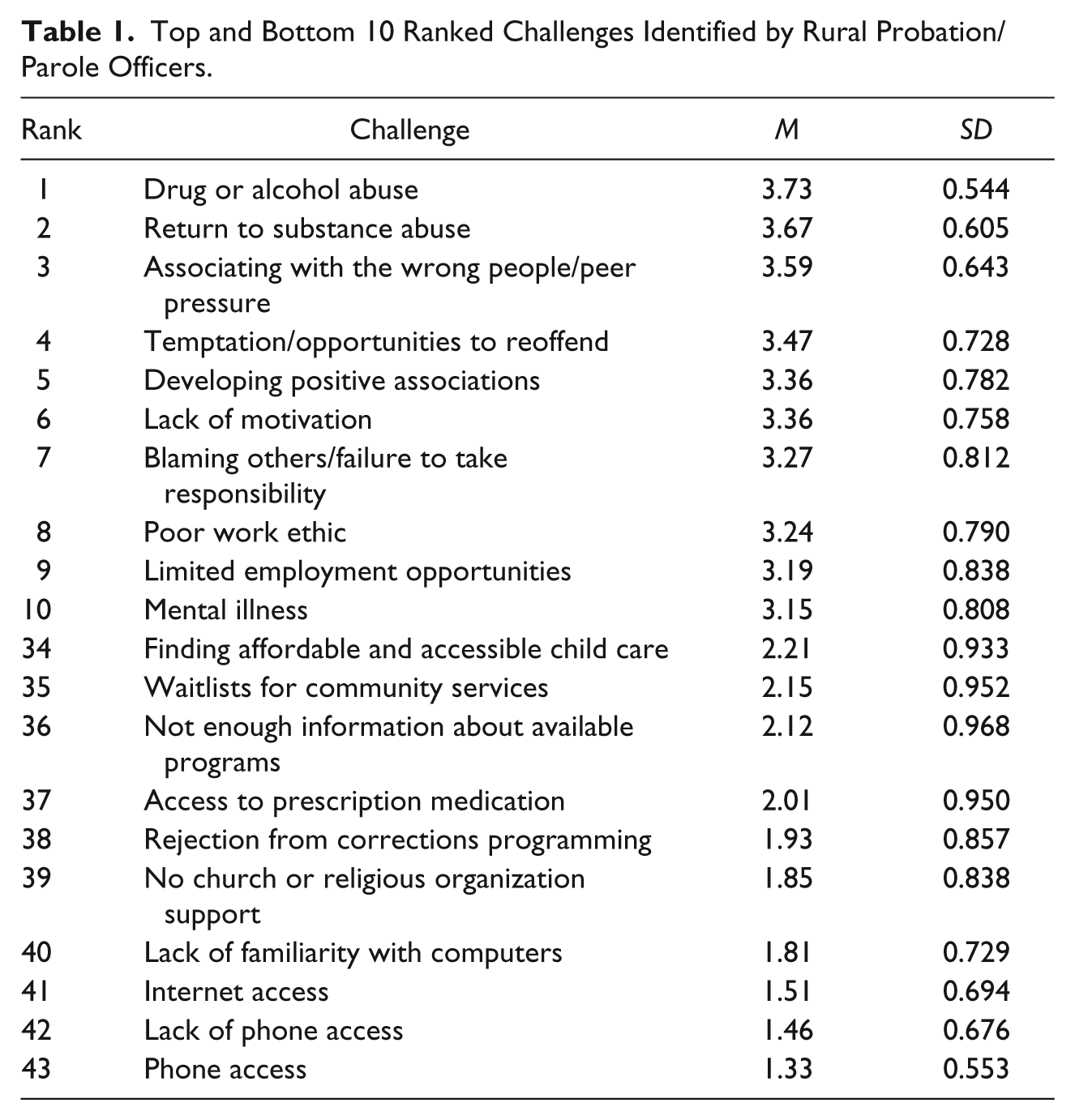
The most prominent challenges perceived by probation/parole officers and inmates, that is, those that they ranked at the top and those that they ranked at the bottom are identified in Tables 1 and 2. Substance abuse was (or substance abuse issues were) the top concern among rural probation and parole officers. Other top-ranked challenges included personal factors such as associating with the wrong people, lack of motivation, developing positive associations, poor work ethic, blaming others, and mental illness. As indicated in Table 1, mental illness was ranked 10th in the challenges that probation/parole officers perceived.
Top and Bottom 10 Ranked Challenges Identified by Rural Probation/Parole Officers.
Top and Bottom 10 Ranked Challenges Identified by Current Inmates.

The top-ranked challenges among rural inmates included financially based issues and limited employment opportunities. Similarly, ability to pay court fines or fees, low wages, inability to return to former employment, and poor credit rating were also among the top 10 challenges. Substance abuse (i.e., drug or alcohol abuse) was also rated as a primary concern. However, mental illness was not among the inmates’ perceived top 10 challenges.
For both groups, some of the perceived challenges were identical, particularly those that were ranked less critical. For example, officers and inmates rated items relating to technology (e.g., phone, computer, and Internet access) and religious support to be more minor challenges. However, the officers and offenders slightly diverged in their perceptions of the greatest challenges. In this sample, rural probation/parole officers rated drug or alcohol abuse, return to substance abuse, and associating with the wrong people/peer pressure as the top 3 of the greatest challenges. Inmates viewed these 3 as part of the top 10, ranking return to drugs as 4th, associating with the wrong people/peer pressure as 5th, and drug/alcohol abuse as 6th in terms of the greatest challenges they would confront. Although the ranking differed between the two groups, these preliminary data suggest that there is some similarity between the two samples.
However, inmates ranked limited employment opportunities, ability to pay fines or court fees, and low wages as more immediate or their top 3 challenges. Only 1 of these, limited employment opportunities, was listed in the top 10 challenges that probation/parole officers ranked, and it was the 9th. These perspectives suggest that there may be differences in probation/parole officers’ and offenders’ views regarding their most pressing or critical challenges during reentry. Offenders view their needs as immediate, and the challenges that they ranked in the top 10 reflect their perceptions of the difficulties they confront: They have to find employment, arrange to pay fines and court costs, realize that jobs they will secure are likely to be low paying, recognize that they cannot return to a former job and that they have a poor credit rating, and deal with transportation problems. The views that offenders and professionals have of the reentry landscape suggest there may be considerable differences in terms of most pressing challenges.
As noted above, associating with the wrong people was viewed as a challenge by both probation/parole officers who ranked it third, and by inmates who ranked it fifth. This particular problem may be exacerbated in a rural area where opportunities for social interaction may be more limited, and the ability to reunite with previous acquaintances is more likely than in an urban environment where offenders have access to a larger social network of people.
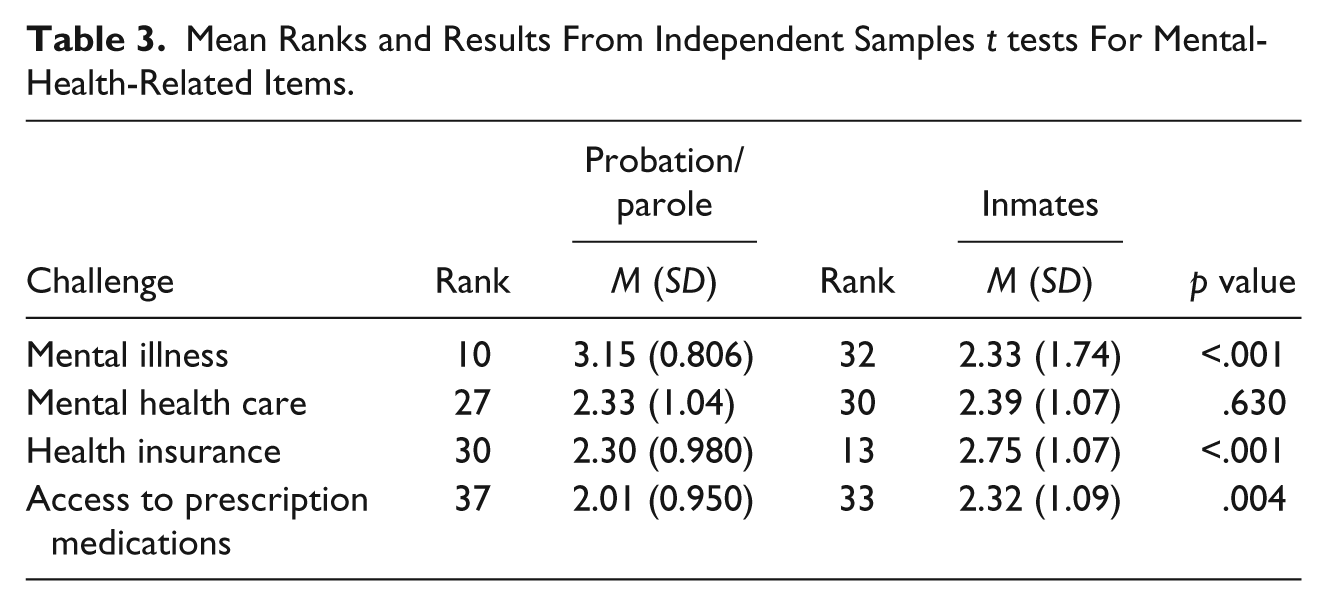
The survey also included four items relating to mental health challenges inmates may face: mental illness, mental health care, health insurance, and access to prescription medications. Four independent sample t tests were run to examine if rural probation/parole officers and inmates rated the mental health items differently (see Table 3). Mental illness was ranked 10th among rural probation and parole officers (M = 3.15, SD = 0.806), but it ranked 32nd among inmates (M = 2.33, SD = 1.74). A t test yielded a statistical significance between the two groups as mental illness was perceived as a greater challenge by probation/parole officers than inmates, t(351.94) = −4.26, p < .001. Access to prescription medication was ranked 37th by probation/parole (M = 2.01, SD = 0.950) and 33rd by inmates (M = 2.32, SD = 1.09). It also yielded a statistically significant difference, t(362.91) = −2.90, p = .004. Health insurance, which was rated 30th by probation/parole (M = 2.30, SD = 0.98) and 13th by inmates (M = 2.75, SD = 1.02), also yielded a statistically significant difference, t(364) = −4.27, p < .001. Mental health care was ranked 27th by probation/parole (M = 2.33, SD = 1.04) and 30th by inmates (M = 2.39, SD = 1.07), and it yielded no statistical significance between groups.
Mean Ranks and Results From Independent Samples t tests For Mental-Health-Related Items.
Thematic Analysis
Thematic analysis, utilizing NVivo, was employed to review the qualitative responses within the surveys of probation/parole officers and inmates and the interviews with treatment staff. Several themes emerged relating to mental health issues of inmates released to rural, western Pennsylvania Counties. These included challenges relating to health insurance, mental health medication, transportation, and self-medication.
Health insurance
A challenge identified by many jail counselors during the semistructured interviews included access to health insurance after inmates leave jail. According to the counselors, if sentenced to serve time in jail, inmates terminate their private health insurance and are enrolled in the county jail’s health plan. Upon discharge, offenders must reenroll in their own health plan, or fill out an application to receive any Pennsylvania State benefits.
Mental health medication
Multiple jail counselors, mental health counselors, and substance abuse counselors identified a lack of medication as a major challenge in the reentry process. When offenders are released from the county jail in Pennsylvania, inmates with mental illness are given a 3-day supply of mental health medication. In rural areas, individuals seeking mental health care are limited in their options and the availability of mental health clinicians. Some counselors explained that there is a 2- to 3-week waiting period for appointments for recently released offenders to obtain prescription medication. During this time, any medication they were using would have run its course, leaving individuals susceptible to decompensation and at high risk of recidivism. They contended that this interruption in service occurs through lack of oversight in the reentry process. Jail inmates are often released without any type of reentry plan, and sometimes quite suddenly. Treatment staff related cases where inmates were released in the middle of the night with no ride into town and no place to stay.
Treatment staff in two counties discussed a program that not only helped offenders schedule appointments for substance abuse and mental health treatment while the individual was incarcerated but also provided transportation to the appointments once the offender is released. While jail and substance abuse counselors in two of the four counties were familiar with the program, the other mental health counselors interviewed were unaware of it. Although promising, during the period of data collection, it appears that the funding for the program ceased, and this program currently is suspended. Counselors identified another issue that involved high turnover rates of volunteers in the program. It appeared throughout the interviews with treatment staff that a solution to the medication problem was possible but that there were no initiatives that they were aware of underway.
Transportation
Both inmates and treatment staff identified issues with transportation. However, this was not an issue identified in the top 10 challenges by probation/parole officers. In rural areas, public transportation is limited. Although some counties have a bus system, service is not regularly available to areas around the county center. Most towns within each county did not have bus routes, and those that did had service once or twice a day. As one practitioner explained, “If a client had to make a meeting with probation in the afternoon, they would have to get on the morning bus, wait around all day for a half-hour meeting, then wait for the only bus home at night” (TS001).
In rural areas, programming is often located in remote areas that would be unreasonable to consider walking distance. As public transportation is not an option, former offenders must rely on private or personal transportation. If they do not have a license or access to a car, it is difficult to get to appointments. As programming may be part of the conditions of parole, lack of transportation options can result in a technical violation.
Self-medication
A reoccurring problem with inmates is the co-occurrence of mental illness and substance abuse. Inmates who do not have access to prescription medication may opt to self-medicate with illicit drugs. All three samples of this study identified difficulty with substance abuse as a major challenge. As one practitioner states,
Seventy to 80% have addiction problems so of course they are going to have cravings when they get out. They are going to want to use. So that’s a huge challenge. And then if they don’t have medical assistance or any type of coverage they are not likely to seek or stay in treatment. (TS012: Substance Abuse Treatment Staff)
Within the past 8 years, opiates have been recognized as a major problem within rural Western Pennsylvania. Multiple practitioners identified that many of the blue-collar jobs, once abundant in the area, have diminished, leaving illegal drug markets as a form of income in areas with high unemployment. Along with the emergence of new drugs or the resurgence in popularity of older drugs, specifically opiates and heroin, there has been an increase in the demand for substance abuse services.
Multiple practitioners suggested that the use, sale, or abuse of drugs was a primary reason for the inmate’s incarceration. If not the primary reason for arrest, crimes committed were likely associated with drugs (e.g., theft of goods to obtain drug money). As one practitioner states,
I could probably say that at least over half of the people in [this Western Pennsylvania] county prison are in for opiates or addiction. Most of the people in this town on probation . . . They may have a retail theft but it’s because of their addiction. (TS018: Reentry Services)
A reentry initiative that was utilized in two counties matches certain offenders with case managers. The offenders are identified via risk assessments and screened based on their offense and number of previous incarcerations. If the offender is determined to have a substance abuse problem, the case manager offers him or her various types of help, both in and out of jail. One practitioner explained the program and tasks involved for case managers:
A case manager will go in and do a [drug and alcohol] assessment. If they need a residential level of care, then one of our certified recovery specialists goes in and fills out the COMPASS application for them to get medical assistance. So that on the day they leave jail, if they are eligible, their medical assistance will turn on, and our case manager arranges for them to go directly from jail to an inpatient treatment facility. So if they’re not home, they’re not out getting into their old habits or using. In our old system, we used to just give them an appointment to have them come to have an assessment maybe a week to two later. If even that soon—if we could get them in. A lot of them within that time would fail or relapse then reoffend. (TS009: Substance Abuse Treatment Staff)
The program, which began in September 2012, is in its early phases of implementation; and it may soon expand throughout the state of Pennsylvania. Although not formally evaluated, practitioners view the program as successful in helping addicts recover and refrain from crime.
Discussion
These data suggest both consensus and difference in perceptions across the three groups. While all three groups recognize and ranked alcohol/drug abuse or returning to substance abuse issues as some of the greatest challenges, offenders viewed employment opportunities, the ability to pay fines and court fees, and low wages as their top three challenges. It is likely that offenders know that failure to find employment, pay fines and/or fees, and low wages are not only related to each other but that these specific challenges also directly affect their return to incarceration. These are structural challenges, and they are real. Prior research supports the offenders’ perceptions that there may be few, if any, employment prospects and that their wages will be low (Visher, Debus, & Yahner, 2008). Furthermore, these two challenges may render payment of fines and fees problematic. Probation/parole officers ranked limited employment opportunities ninth, but they did not perceive low wages and the ability to pay fines and court costs as significant hurdles based on the rankings assigned to these challenges.
It is possible that offenders view their situation from a more structural perspective, and probation/parole officers have a more global view of offenders. In the sample of rural probation/parole officers, the mean was 13 years of experience as a probation/parole officer. That level of experience suggests that the officers were familiar with previous offenders and the difficulties that they confront in reentry. They may be more likely to rely on their “global view” based on many case histories, offenders’ experiences, and offenders’ lack of success when they discuss current challenges for offenders.
Conversely, offenders have immediate and individual concerns. While probation/parole officers viewed lack of motivation, blaming others/failure to take responsibility, and a poor work ethic in the top 10 challenges for offenders, inmates ranked these challenges considerably lower. These differences may be related to the social distance between probation/parole officers and offenders as explained by Gunnison and Helfgott (2011). In brief, it is unlikely that probation and parole officers are dealing with a lack of employment opportunities, court fines, and low wages simultaneously and that they would have the same scarce resources that offenders have. It is unclear whether rural probation and parole officers in this sample have a somewhat limited view of structural issues or if offenders focus almost exclusively on structural issues and minimize their personal difficulties.
Despite the fact that probation/parole officers ranked mental illness in the top 10 challenges offenders confront, they ranked access to health insurance as 30th. For inmates, mental illness was not ranked in the top 10 or the bottom 10 challenges; they ranked mental illness as 37th. As noted in the findings section, this was statistically significant. For officers, access to prescription medication was ranked as 37th in the list of challenges, and for inmates, it was ranked 34th, and it also achieved statistical significance. In the interviews with treatment staff, respondents repeatedly stressed to the interviewer that the medication problem for offenders was critical and that the system had not resolved how best to ascertain that offenders have sufficient medication, follow-up treatment and prescriptions, and monitoring of their conditions.
A related challenge concerns health insurance, which would appear to be related to treatment and medication. In this sample, rural probation/parole officers ranked it 30th. By contrast, offenders ranked it 13th. This was statistically significant (p <.001). As noted in the previous section, treatment providers described a program that recently ceased to operate in two of the counties, which helped offenders make appointments for mental health treatment and to arrange for transportation prior to their release. In two other counties, counselors described a new program to match case managers and offenders where offenders are enrolled in health care prior to their release. The treatment providers were enthusiastic about this program and contended that it helped offenders refrain from drug or alcohol abuse or relapse. However, there were no statistical data available to evaluate it.
There may be a relationship between perceived access to health insurance and prescription medication. In brief, offenders may assume that they cannot have prescription medicines without health insurance. These data suggest that rural probation/parole officers viewed mental illness as a major challenge, but they do not appear to perceive health insurance as a hurdle or relate it to that condition. It is not obvious why there is a lack of congruity between the officers’ perceptions of mental illness and their view of health insurance. Perhaps it can be explained by lack of information or knowledge. Based on these data, it is not clear if offenders know how to acquire health insurance or gain access to it, and/or if probation/parole officers assume that offenders know about health insurance or if they (the officers) are unaware of this dilemma. The findings suggest that greater awareness and sensitivity to this issue merits further consideration and that all counties might benefit from the program that was offered in two of the county jails that enrolled offenders in health insurance prior to release.
As the findings demonstrate, a return to substance abuse was an important factor that both probation/parole officers and offenders cited in their list of top challenges. Similarly, treatment providers cited drug or alcohol abuse and relapsing as challenges for inmates. Treatment specialists also noted that offenders “self-medicate” with such substances. For probation/parole officers, this may be categorized simply as drug or alcohol abuse or a return to substance abuse rather than the “self-medication” characterization that treatment professionals noted. Nonetheless, drug or alcohol issues remain a critical part of the offenders’ successful reentry.
Conclusion
There are limitations to the current study. The focus on rural Pennsylvania limits the ability to externalize the study’s findings to other rural areas. This is further hindered by low response rates from probation/parole officers and convenience samples of inmates and treatment staff. In addition, this study focused exclusively on jail reentry issues. Offenders returning from prisons may face different challenges than their jail counterparts based on the extended period of time they were incarcerated. Research should incorporate rural prisoner reentry challenges as well.
Several recommendations emerge from these data. First, comprehensive case management is a theme that resonates among treatment providers and in the literature. It is imperative that offenders work closely with a counselor to develop a reentry plan and to include mental health services in it. In addition, the counselors and the probation or parole officers have to cooperate and communicate with the offender to identify and address challenges associated with prescription medication and health insurance. Examples include expanding rural county programs that enroll offenders in health care prior to release, matching offenders to case managers who are familiar with their cases, and ascertaining that offenders have sufficient medication until their appointments. These are humane and cost-effective strategies.
Developing a collaborative effort in rural communities with mentors or other adults who are willing to work with offenders prior to and during release is also essential. This model has been successfully adopted by Alcoholics Anonymous with “sponsors” as mentors, and it can be emulated or modified in rural areas with offenders (see Jonson & Cullen, 2015). Similarly, rural organizations could schedule events that are designed to assist offenders in their re-immersion into the community. These might include church functions and/or coffee hours to meet with offenders, local business leaders volunteering to contact offenders to discuss employment options and/or offer advice, and public health and educational institutions scheduling courses or training to assist them.
Increased awareness and sensitivity to mental health issues merit greater concern. Training for probation/parole officers can focus more on the consequences of incarceration and specifically on two issues that emerged in this study: medication and medical insurance. In doing so, probation/parole officers might inform offenders of these difficulties and work to address them prior to and immediately after release.
Training and treatment programs might also examine the differing perceptions that offenders and probation/parole officers have. As noted, probation/parole officers view offenders’ challenges as individualistic and personal. By contrast, offenders view the challenges as more structural. It is unclear whether these differences are a result of experience in the field, social distance, a more formal approach to offenders and their personal histories, or a view that is more consistent with studying aggregated cases versus individual offenders. Nonetheless, it would be helpful to inform probation/parole officers and offenders about the differences and attempt to enhance understanding between them.
Furthermore, recent research on probation officer interpersonal skills in working with offenders in the Channel Islands suggests that good skills can help reduce recidivism (Raynor & Vanstone, 2015). The officers’ ability to engage in problem solving, empowerment, and collaboration, and to conduct motivational interviews and offer encouragement helped offenders succeed. Research and practice in these areas might explore strategies to improve communication between probation/parole officers and offenders and their successful reentry.
Programs to assist offenders with transportation issues in rural areas are important. Repeatedly, transportation was cited by offenders and treatment providers. Rural residents are adversely affected by a lack of transportation to appointments for treatment, probation/parole officer visits, and employment. Access to transportation networks has to be instituted and available. This could be a van or other similar local service, but counselors and probation/parole officers can work together to secure it.
At the very least, county jails in rural areas can arrange to transport offenders on the day of release to a central town in the county where they can secure lodgings or transportation to other areas. Administrators and staff have limited resources, but they need to review and address release procedures in jails. Too often, it seems offenders are released when there is no family or friends to meet them at the institution. The result is that offenders are forced to walk or hitchhike for long distances on the day of their release. Jail counselors should be authorized to ensure that the offender has contacted a mentor or friend and that there is an arrangement to meet the offender at the institution and transport him or her to a temporary or permanent residence.
In addition, offenders must be issued identification cards. As Subramanian et al. (2015) noted in the Vera Institute Report on jails, offenders who are being released from jails have to have valid and current identification cards. Without such cards, applying for jobs, medical insurance, federal or state benefits, and housing can be affected. To enable offenders to obtain and continue their medications, identification cards are essential.
The National Association of Counties and the Council of State Governments announced a new initiative to deal with the mentally ill in jails in 2015. By collaborating with local facilities, the two organizations plan to offer technical assistance by determining the number of offenders with mental health needs, the county’s capability in delivering services, the development of a planning and tracking research component, and the engagement of community leaders (Ban, 2014). In brief, there is progress in creating collaborations between agencies and developing evidence-based policy.
Finally, we would be remiss if we did not reiterate that reentry is not a “one size fits all” model. Offenders are diverse, and their needs are unique (Jonson & Cullen, 2015). There is knowledge about what works and it can inform practice. Rather than engaging in reentry initiatives for mentally ill offenders in a shortsighted way, there are studies and meta-analytic literature that can guide practitioners and offenders (Ndrecka, 2014).
Increased and specialized training in mental health issues for probation/parole officers and other correctional staff is critical. As research has documented, offenders have higher incidences of mental illness than the general population. Rural county jails cannot ignore mental illness or minimize its significance. Fortunately, jail administrators, staff, probation/parole officers, and reentry counselors are uniquely positioned to change the course of rural reentry and to improve it.
Footnotes
Declaration of Conflicting Interests
The author(s) declared no potential conflicts of interest with respect to the research, authorship, and/or publication of this article.
Funding
The author(s) disclosed receipt of the following financial support for the research, authorship, and/or publication of this article: Support for writing this paper and for the meeting from which these materials were developed was provided by the John D. And Catherine T. MacArthur Foundation.