



Abstract
Using data from the Serious and Violent Offender Reentry Initiative evaluation, this study measures the effects of perceived levels of emotional and instrumental family support on the likelihood of self-reported criminal activity and new arrests in the 15 months following release from state prison. Logistic regression models using both listwise deletion and multiple imputation are employed. Findings indicate that higher levels of emotional support are associated with a significant reduction in reoffending. Higher levels of instrumental support do not significantly predict reoffending. The findings have implications for policies and practices within the corrections system as well as post-release supervision agencies.
Introduction
With more than 2.2 million individuals incarcerated (Glaze & Herberman, 2013), the subsequent return of formerly incarcerated individuals to their communities poses a serious challenge. Approximately 95% of all inmates will be released (Hughes & Wilson, 2003), and more than 630,000 individuals will return to their communities from state and federal prisons annually (Carson & Golinelli, 2013). Returning citizens are often in need of a variety of social services, including housing (La Vigne, Shollenburger, & Debus, 2009; Metraux, Roman, & Cho, 2008), education (Harlow, 2003; Visher & Lattimore, 2007), employment (Visher & Lattimore, 2007), substance abuse treatment (Arrestee Drug Abuse Monitoring, 2003; Belenko & Peugh, 2005), as well as mental and physical health care (Mallik-Kane & Visher, 2008; Visher & Lattimore, 2007). In addition, the pains of the prison experience (Sykes, 1958) can also reduce the likelihood that formerly incarcerated individuals reenter society on a path to desistance (Maruna & Toch, 1999). As such, research documenting high recidivism rates is perhaps not surprising (Langan & Levin, 2002; Pew Center on the States, 2011). Among state prisoners released from 30 states in 2005, nearly 68% were rearrested within 3 years and nearly 77% were rearrested within 5 years (Durose, Cooper, & Snyder, 2014). Many people also cycle in and out of prison multiple times (Clear, 2007; Langan & Levin, 2002).
Considering high recidivism rates, research seeking to understand successful reentry is certainly valuable. Several criminological theories, particularly social support (Cullen, 1994), offer explanations for why family support may influence reoffending, but research that actually measures the extent of the relationship is lacking. The current study explores the influence of two types of support from family members on recidivism. Emotional support represents the affective relationship and instrumental support measures the extent to which family helps with finances, housing, employment, and similar reentry challenges. This research is thus the first to quantitatively measure the independent effects of perceived levels of both emotional and instrumental family support on self-reported reoffending and new arrests for both male and female releasees.
Literature Review
Conceptualizing Social Support, Social Ties, and Social Bonds
This investigation of family support is rooted in a larger literature on social support, social ties, and social bonds. Considering that these concepts have sometimes been used interchangeably and that measures of these concepts are often similar, reviewing research on all these concepts is relevant. Nonetheless, support, ties, and bonds can represent distinct social processes. Social ties can be conceptualized as a necessary, yet insufficient, precondition for supportive relationships to be developed or maintained. Not all ties provide support and some ties may provide different types of support in different situations (see Wellman & Wortley, 1990). In addition, social bonds entail some measures of attachment and commitment, which often overlap with measures of individual-level social support.
Considering the family measures available in the data set used for this project, the concept of social support was the primary focus. Sociologist Nan Lin (1986) provided a comprehensive explanation of social support as “the perceived or actual instrumental and/or expressive provisions supplied by the community, social networks, and confiding partners” (p. 18). Whereas some research on social support in criminal populations has used one social support construct with items for both instrumental and expressive (or emotional) support combined (Ghazarian & Roche, 2010; Gutierrez-Lobos et al., 2001; Hochstetler, DeLisi, & Pratt, 2010), other work has used a construct composed solely of items related to emotional support (Listwan, Colvin, Hanley, & Flannery, 2010; Meadows, 2007; Wright & Cullen, 2001). In addition, the limited research on family support and reentry has focused predominately on emotional support or used measures of family support encompassing aspects of both or either type(s) of support (Nelson, Deess, & Allen, 1999; Sullivan, Mino, Nelson, & Pope, 2002; Visher, La Vigne, & Travis, 2004). Considering that the social support literature in other disciplines demonstrates the potential for differential effects by support type (Dean, Kolody, & Ensel, 1989; Yates, 1995), the current research fills an important gap in prior reentry research by investigating the potentially differential effects of the two types of support (for an exception, see Barrick, Lattimore, & Visher, 2014).
Theoretical Processes
A variety of criminological theories detail processes that may explain a link between family support and reoffending. First, as a central concept for criminological theory (see Cullen, 1994), much work has focused on the relationship between social support and crime at the cross-national level (Altheimer, 2008; Pratt & Godsey, 2002, 2003). As summarized by Pratt and Godsey (2003), high levels of social support may encourage appropriate coping mechanisms in response to straining life events (Agnew, 1999), aid in earlier desistance from crime over the life course (Sampson & Laub, 1993), function as a necessary requirement for effective social control (Braithwaite, 1989), or increase the likelihood of effective parental monitoring and care (Currie, 1985; Wright, Cullen, & Miller, 2001). These mechanisms may also provide an explanation for how social support from family members may influence reoffending at the individual level.
Although research on social support for prison releasees continues to develop, a solid body of research confirms a relationship between social support and individual antisocial behavior in other contexts. Among juveniles, social support from parents is associated with a reduction in delinquency (Alarid, Montemayor, & Dannhaus, 2012; Meadows, 2007; Wright & Cullen, 2001). In addition, when mothers perceive higher levels of social support, they are more likely to be engaged in their children’s lives and the likelihood that their children become delinquent is reduced (Ghazarian & Roche, 2010). Some limited evidence also suggests that higher levels of social support are associated with a reduction in rule infractions among inmates (Jiang & Winfree, 2006). Among recent releasees, social support has been found to increase psychological well-being (Listwan et al., 2010) and minimize the effect of prison discomforts on feelings of hostility post-release (Hochstetler et al., 2010). Overall, there are strong theoretical reasons to believe that family support, as a specific source of social support, should matter for recent releasees.
In addition, much of the desistance literature offers an explanation for how family members can play a role in reducing the likelihood of criminal offending. Laub and Sampson’s (2003) and Sampson and Laub’s (1993) age-graded theory of informal social control suggests that recently released individuals who are closely involved with and supported by family members will be less likely to reoffend. Receiving support increases the likelihood that the returning citizen will feel obligated to family and perceive the costs of crime as greater. Family involvement also alters routine activities and decreases time spent with criminal peers. Family members can also provide direct social control over returning citizens. Although Laub and Sampson’s work explains why family involvement may be associated with desistance from crime, it does not directly address the distinct concepts of family support. Emotional and instrumental support from family members may be associated with other distinct processes than those described above.
Other work suggests that family support can promote desistance by playing a role in the certification process of individuals as former offenders. Meisenhelder (1982) found that family provided releasees with a “significant group of close associates that could overtly testify to [their] noncriminality and trustworthiness” (p. 148). When family welcomes them as “noncriminal” (p. 141), this welcoming is displayed to others who can then welcome the releasee as a noncriminal also. As family members and others embrace the individual as a noncriminal, the individual is then more likely to internalize this identity (see also Maruna, LeBel, Mitchell, & Naples, 2004). In the framework of emotional and instrumental family support, either type of support may signal to releasees that their family believes them to be noncriminal and worthy of support.
Descriptive Accounts of Family Support and Reentry
Much of the existing research on families and reentry has come from the Urban Institute’s Returning Home studies, in which researchers surveyed 400 incarcerated individuals in four cities 1 month prior to their release and then interviewed a portion of these individuals at varying points following their release. The Baltimore study measured family support and family relationship quality (Visher et al., 2004). 1 Levels of family support were fairly high, with mean levels above 3 on a scale of 1 to 4. Mean levels of family relationship quality were even greater than levels of family support. More specifically, other research has shown that family members can offer instrumental support to returning citizens by providing a variety of needs, including housing (La Vigne et al., 2004; Nelson et al., 1999; Visher et al., 2004), substance abuse treatment (Nelson et al., 1999), and employment (Farrall, 2004; Nelson et al., 1999). It thus appears that families offer a good deal of support to releasees, presumably with the intent of helping them reintegrate successfully.
Despite such assistance, many family members also struggle with their own problems. Approximately 60% of the Returning Home respondents had at least one family member who had been convicted of a crime. In Chicago, approximately 30% of respondents had a family member who was currently incarcerated (Visher, La Vigne, & Travis, 2004).
Family Support and the Likelihood of Reoffending
Although distinct from family support, understanding the influence of family ties on reoffending may help to at least partially explain a potential relationship between family support and reoffending. Various efforts devoted to maintaining family ties during incarceration, primarily through family visitations, are associated with better post-release outcomes, including lower recidivism (Bales & Mears, 2008; Duwe & Clark, 2013; Hairston, 1988) and parole success (Holt & Miller, 1972).
Berg and Huebner (2011) used data from the Level of Service Inventory–Revised (LSI-R) for approximately 400 male releasees to investigate the relationship between family social ties, employment, and the likelihood of arrest in the 46 months post-release. Models revealed that ties to relatives (but not ties to intimate partners or parents) significantly reduced the likelihood of rearrest. However, controlling for employment washed out the effect of ties to relatives on rearrest. Although this work represents one of the most methodologically rigorous investigations of family and reoffending to date, the current study builds on this work in two key ways. First, self-reported measures of reoffending are used in addition to arrest data. Second, the measure of social ties in Berg and Huebner’s work may tap into a number of different social processes all represented by one construct labeled “ties,” which was collapsed into only two categories: unsatisfactory or satisfactory ties. This measure appears to include several distinct processes ranging from frequency of contact to emotional quality to satisfaction with relationships. Although Berg and Huebner offer insightful interpretations based on their work, more specific policy implications may be gained by differentiating the different family processes in the tie measure.
Focusing more specifically on family support and reoffending, in the Chicago Returning Home study, after controlling for other predictors of recidivism, regression analyses revealed that individuals who reported higher levels of family support before they entered prison were less likely to be reconvicted in the 6 months following release (La Vigne, Visher, & Castro, 2004). The Baltimore Returning Home project offered a much more comprehensive analysis, but was limited by fairly severe respondent attrition (Visher et al., 2004). Using both self-report and official records as measures of recidivism, mean levels of pre-prison family support, pre-prison family relationship quality, and post-release family support were slightly higher for non-recidivists compared with recidivists; however, none of these were statistically significant differences. Visher (2013) used a sample from Ohio and Texas and found that men with higher levels of pre-prison family support had higher levels of attachment to children; attachment to children was subsequently associated with a reduction in reoffending in the 2 months following release.
Also examining family support and recidivism, a Vera Institute study of 49 releasees in New York conducted some basic bivariate correlations between perceived levels of family support and a variety of outcomes (Nelson et al., 1999). Based on how each participant defined family support for himself or herself (emotional and/or instrumental), participants were asked to rate their level of family support on a scale from 1 to 5. Family support ratings were combined with items measuring family cohesion, family members’ involvement with drugs, and the extent to which family members accepted phone calls from the incarcerated individual to develop a family strength index. Higher family strength scores were correlated with a lower likelihood of drug use and a lower likelihood of criminal offending.
Sullivan et al. (2002) compared a group of 90 substance abusers under criminal justice supervision and their families who were enrolled in the La Bodega de la Familia program with a comparison group. The La Bodega program offered case management and social services to entire families. The results revealed a decline in substance abuse in the La Bodega group, but the exact mechanisms creating this outcome were unclear. The La Bodega group was not more likely to participate in treatment or stay in treatment longer. In addition, based on the Medical Outcomes Study (MOS) Social Support Survey (Sherbourne & Stewart, 1991), the La Bodega group actually reported reduced levels of support during the 6-month study period. The researchers hypothesized that family counseling and intensive family case management may initially cause family disruption “as a consequence of having the issues surrounding drug abuse out on the table and having to deal with them openly” (Sullivan et al., 2002, p. 51).
The most relevant research to date on family support and recidivism has been conducted on a sample of female offenders. Barrick et al. (2014) found that both emotional and instrumental family support were associated with a reduction in the likelihood of reincarceration in the 5 years following release. In addition, lower levels of support were associated with shorter times to incarceration. While using the same measures of family support and a related data set, the current research seeks to build on Barrick and colleagues’ work by using a sample of both males and females, multiple imputation to handle missing data, and self-report data to measure recidivism.
Conversely, some work has revealed a relationship between family reunification or involvement and increased criminal activity. Based on interviews with recovering drug addicts in a therapeutic community, it appears that families can have a negative effect on reintegration when family members do not value the importance of treatment and when tensions arise between newly reunited spouses (Gideon, 2007). Furthermore, research on male recidivists in Ontario found that interpersonal conflicts, especially with romantic partners, are often substantial problems post-release (Zamble & Quinsey, 1997). Research based on interviews with female ex-offenders also draws attention to the potential criminogenic effects of females reuniting with spouses or boyfriends, who may be involved in drugs or crime (Leverentz, 2006).
In sum, the small body of research that has empirically investigated the relationship between family support and reoffending has yielded mixed results. Whereas some work has found that higher levels of family support are associated with lower rates of reoffending (Barrick et al., 2014; La Vigne et al., 2004; Nelson et al., 1999), other research has failed to identify a clear relationship (Sullivan et al., 2002; Visher et al., 2004). Existing research has largely relied on fairly small sample sizes, short post-release follow up periods, inconsistent conceptualizations of family support, and the possible confounding of different types of family support.
Current Study
The current research fills such limitations of past work by using a much larger, nationally representative data set that allows for the analysis of the effects of two conceptually distinct measures of family support on recidivism for up to 15 months post-release. As detailed further below, emotional support represented the extent to which recent releasees reported feeling close to family members, loved by family, and so forth. Instrumental support indicated the extent to which releasees indicated that they had family members to assist with housing, employment, transportation, substance abuse problems, and financial assistance.
After controlling for other predictors of recidivism, it was hypothesized that both emotional and instrumental support from family members would independently reduce the likelihood of recent criminal activity. Considering prior research on the importance of employment (Laub & Sampson, 2003; Uggen, 2000) and housing (Makarios, Steiner, & Travis, 2010) for reducing recidivism, instrumental support was expected to have a stronger effect on the likelihood of reoffending than emotional support.
Data and Method
A data set that was collected between 2004 and 2008 as part of the evaluation of the Serious and Violent Offender Reentry Initiative (or SVORI) was used to test these hypotheses. To evaluate SVORI, participants in 12 programs were selected along with a group of similarly situated individuals also coming out of prison. A data set that combined both SVORI participants and the comparison group was used. Interviews were conducted with both groups 30 days prior to release as well as 3, 9, and 15 months post-release, even if participants had been re-incarcerated. Interviews at Wave 1 (30 days prior to release) were conducted with nearly 1,700 males and more than 350 females. Although there was attrition over successive interview waves, more than 80% of participants participated in at least one of the post-release interviews (see Lattimore & Steffey, 2009; Lattimore & Visher, 2009, 2011, for more on the SVORI data set).
Measures
All analyses were conducted with two measures of reoffending—one based on self-report and one based on official arrest data. At Waves 2, 3 and 4, participants were asked to report their engagement in various types of criminal behavior since their last interview (or in the last 6 months if the prior interview was missed). These items constituted the any self-reported reoffending variable. The SVORI evaluation also used administrative data from state Department of Corrections/Probation and Parole agencies and the National Crime Information Center (NCIC). These data were used for the other measure of reoffending: whether or not any new arrest occurred during each of the three time periods.
Table 1 shows the rates of respondents who engaged in criminal activity during each of the three time periods. Highlighting the importance of using both self-reported and official measures of reoffending, 23% of respondents indicated that they had engaged in some type of crime during the first 3 months, but only 16% had been arrested.
Descriptive Statistics.
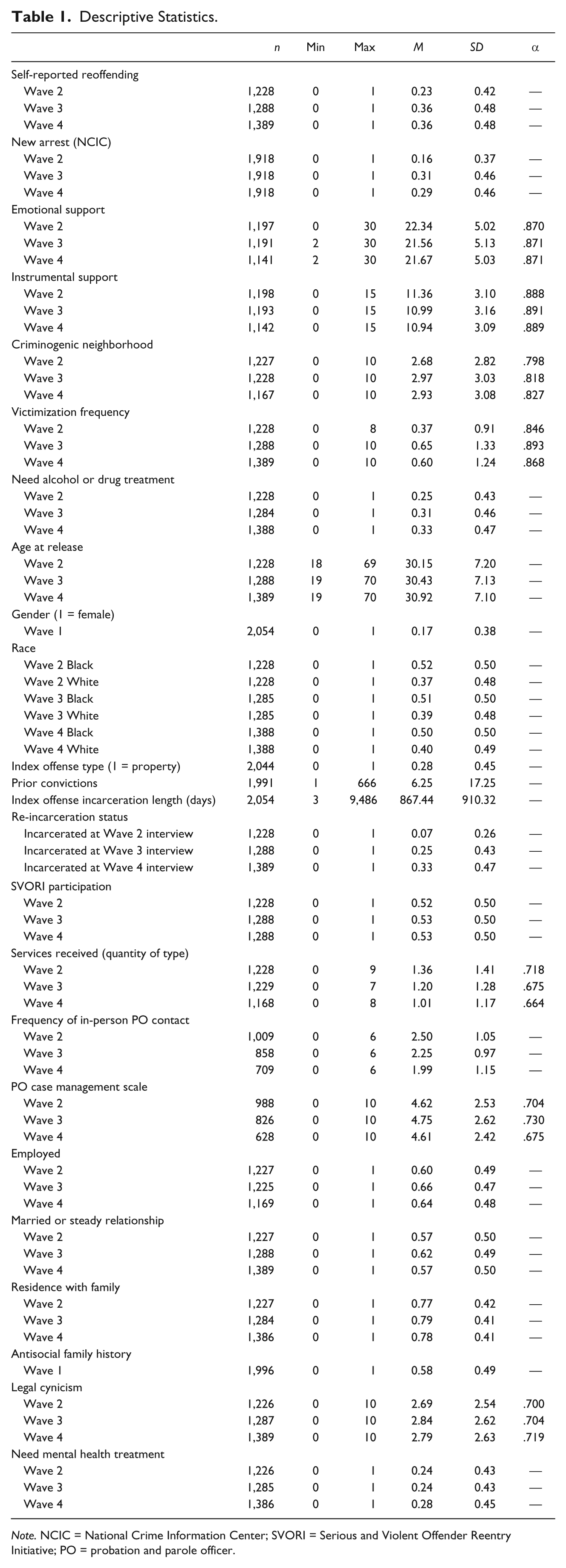
Note. NCIC = National Crime Information Center; SVORI = Serious and Violent Offender Reentry Initiative; PO = probation and parole officer.
Descriptive statistics for all independent variables are also displayed in Table 1. Emotional family support was measured with a 10-item index of questions. On a 4-point scale of strongly agree to strongly disagree, respondents were asked at all four interview waves to indicate their current feelings about the following items: (a) I feel close to my family, (b) I want my family to be involved in my life, (c) I consider myself a source of support for my family, (d) I fight a lot with my family members, (e) I often feel like I disappoint my family, (e) I am criticized a lot by my family, (f) I have someone in my family to talk to about myself or my problems, (g) I have someone in my family to turn to for suggestions about how to deal with a personal problem, (h) I have someone in my family who understands my problems, and (i) I have someone in my family to love me and make me feel wanted. The emotional support scale ranged from 0 to 30, with higher values indicating higher levels of support.
Also on the same 4-point scale, instrumental family support was measured based on the extent to which respondents agreed that they have someone in their family who would provide (a) help or advice on finding a place to live, (b) help or advice on finding a job, (c) support for dealing with a substance abuse problem, (d) transportation to work or other appointments if needed, and (e) financial support. This scale ranged from 0 to 15 with higher values indicating higher levels of support.
Although space does not permit a thorough in-text description of all control variables, 2 three variables that emerged as particularly consistent predictors of reoffending do merit brief description here. In terms of the victimization frequency measure, respondents were asked about five different types of physical victimization and instructed to indicate the frequency with which they had experienced such victimization since the last interview (or in the past 6 months for those missing the previous interview). Variation in the severity of each of the five types of victimization was taken into account when calculating the victimization scale. The scale ranges from 0 (no victimization) to 10 (all victimization types experienced several times a week).
Five items were used to generate a measure of the extent to which a respondent lived in a criminogenic neighborhood. Respondents indicated their level of agreement with the following items: (a) It is hard to stay out of trouble in your neighborhood, (b) drug selling is a major problem in your neighborhood, (c) you think your neighborhood is a good place to live, (d) you think your neighborhood is a good place to find a job, and (e) living in your neighborhood makes it hard to stay out of incarceration. The scale ranged from 0 (no indication of a criminogenic neighborhood) to 10 (indication of a criminogenic neighborhood on all items).
The measure of need for alcohol or drug treatment was a dichotomous measure based on respondents’ self-reported need for either alcohol or drug treatment.
Direction of Relationships in Logistic Regression Models
Levels of family support reported at Wave 2 (3 months post-release) are used to predict reoffending in the first 3 months after release, after controlling for other predictors of recidivism (that were reported at Wave 2 and reflect conditions during the 3months since release). The same is then done for the following two time periods. While respondents were asked to indicate their current levels of family support at each interview wave, respondents were asked to reflect on their experiences throughout the previous period for some other interview items. Thus, some control variables are representative of current conditions whereas others represent conditions in the previous period. The following variables reflect current conditions at each interview point: emotional and instrument family support, employment status, being married or in an intimate relationship, residence with family, living in a criminogenic neighborhood, legal cynicism, the self-reported need for mental health treatment, and the self-reported need for substance abuse treatment. In contrast, the following variables are reflective of conditions throughout the previous period: reoffending (self-report and new arrest), the number of services received, the frequency of contact with a probation or parole officer, the level of case management from a supervision officer, and the frequency with which the respondent experienced victimization. 3
Missing Data
Two strategies were employed to handle missing data in these models. First, all analyses were conducted using listwise deletion. When data are missing at random, using listwise deletion is less problematic (Allison, 2002). However, the comparison of characteristics of missing and non-missing cases revealed that data were not missing at random or missing completely at random. There were some significant differences between those who completed a particular wave and those who did not in terms of levels of family support at future waves and reoffending behaviors. Little’s test confirmed that the data were not missing completely at random (available in the Missing Values module of SPSS).
As a result, multiple imputation in SPSS was used to impute values for independent variables with missing values at different time points (see Treiman, 2009, for a description of Bayesian multiple imputation). Values were imputed for nearly all independent variables in the data set. Considering that some measures were collected at Wave 1 and that there are fewer than 10 cases with missing data on any one of these variables, the following variables were safely assumed to not vary throughout the 15-month study period, and were thus not imputed: age at release, gender, race, and index offense type. However, these variables that were not imputed (along with all variables that were imputed) were used as predictors of imputed values. Values were imputed for all other independent variables, including family support. Although the “precision of the inference is reduced if a large amount of information is missing” (Zhang, 2003, p. 583), imputing values for key independent variables of interest is generally acceptable (see Schafer & Graham, 2002). In addition, to improve the accuracy of imputed values, minimum and maximum values were set for each of the imputed values based on the minimum and maximum values of observed data points. The number of imputation iterations was set at five and an average of these values was used in the analyses.
Results from the analyses using listwise deletion as well as results from the analyses using multiple imputation are reported below. Although multiple imputation is an appropriate procedure for analyzing data in which missing values are not missing completely at random, the extent of missing data (as a result of attrition over interview waves) in this research was a concern. For example, the models predicting reoffending in the 9- to 15-month time period include approximately 480 cases when using listwise deletion, but approximately 1,380 cases (for self-reported reoffending outcomes) or 1,900 cases (for arrest outcome) when using multiple imputation. Findings consistently observed using both methods should carry greater credibility.
Results
Table 2 shows that higher levels of emotional family support were associated with a significant reduction in any self-reported reoffending behavior in all three time periods when using multiple imputation and in the first 3 months and 9 to 15 months post-release when using listwise deletion. A one unit increase in emotional support reduced reoffending between 6% and 9% across the time periods. Interestingly, higher levels of instrumental support did not have a significant effect on reoffending in any of the models. However, several of the control variables had significant effects. Residing in a more criminogenic neighborhood increased the likelihood of reoffending by 7% to 18%. A 48% to 65% increase in the likelihood of reoffending was associated with experiencing more frequent victimization. And, needing alcohol or drug abuse treatment increased the likelihood of any reoffending by 198% to 485%.
Logistic Regression Models Predicting Any Self-Reported Crimes.
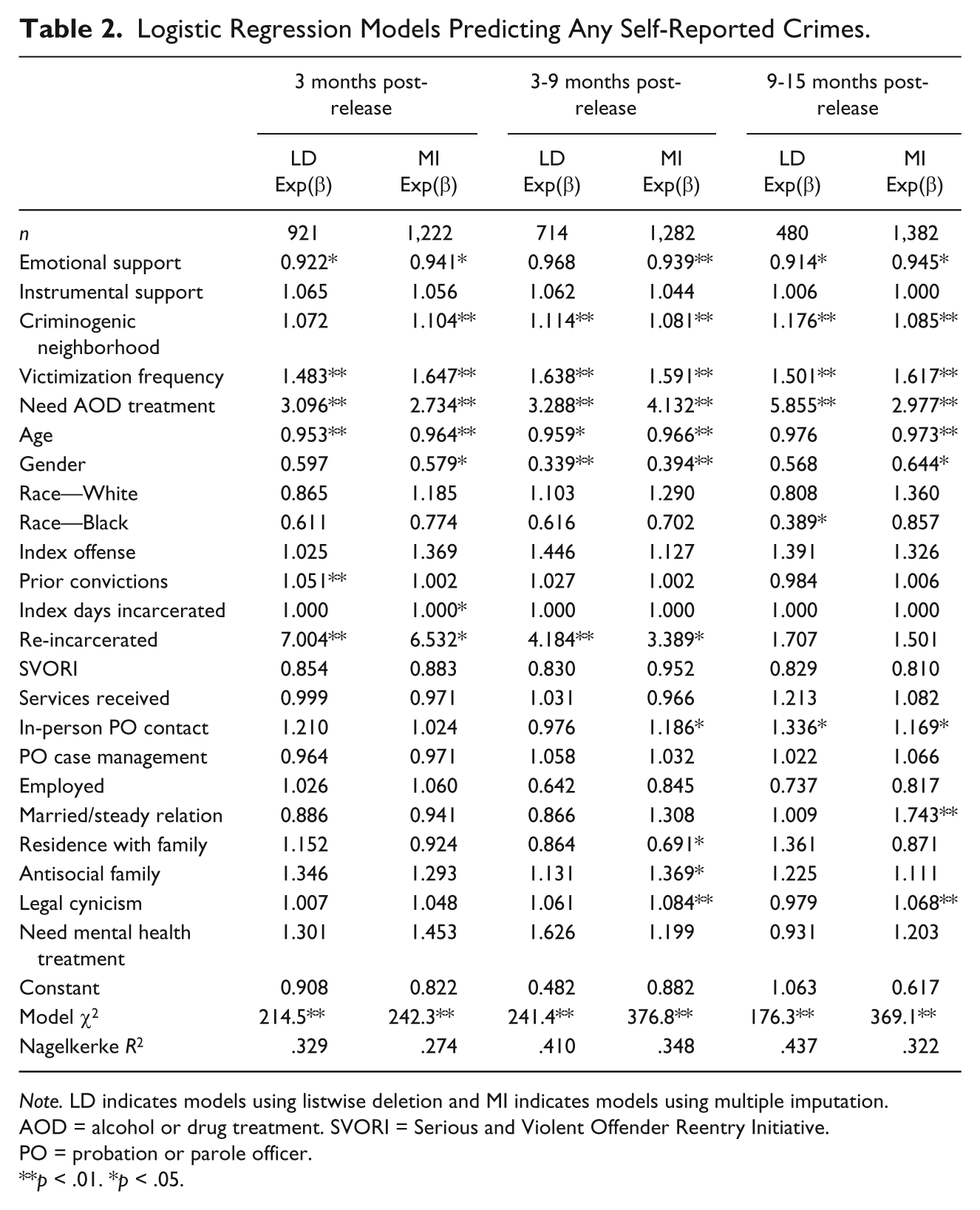
Note. LD indicates models using listwise deletion and MI indicates models using multiple imputation. AOD = alcohol or drug treatment. SVORI = Serious and Violent Offender Reentry Initiative. PO = probation or parole officer.
p < .01. *p < .05.
Table 3 features the results for the models predicting the measure of reoffending from official arrest records. Higher levels of emotional support were associated with a significant reduction in the likelihood of arrest in the 3- to 9-month period when using multiple imputation and in the 9- to 15-month period for both analysis strategies. The likelihood of arrest was decreased by 4% to 14% for each unit increase in emotional support. Once again, residing in a more criminogenic neighborhood, experiencing victimization more frequently, and needing substance abuse treatment all increased the likelihood of arrest in some circumstances.
Logistic Regression Models Predicting Any Arrest (NCIC).

Note. LD indicates models using listwise deletion and MI indicates models using multiple imputation. NCIC = National Crime Information Center; AOD = alcohol or drug treatment.; SVORI = Serious and Violent Offender Reentry Initiative; PO = probation or parole officer.
p < .01. *p < .05.
Discussion
Interpretation of Findings
Although it was originally hypothesized that individuals with higher levels of emotional family support would be less likely to reoffend, results indicate that this relationship varies according to different measures of reoffending and by different time periods. In sum, higher levels of emotional support significantly reduced the likelihood of reoffending in eight of the 12 models (two outcomes by three time periods with two analysis strategies for missing data). Such findings are consistent with the processes proposed by social support, age-graded informal social control, and decertification, and are also consistent with previous empirical research on the importance of social support for antisocial behavior (Ghazarian & Roche, 2010; Jiang & Winfree, 2006; Meadows, 2007; Wright & Cullen, 2001) and family support for recidivism (Barrick et al., 2014; La Vigne et al., 2004; Nelson et al., 1999).
Considering research that has identified employment (Laub & Sampson, 2003; Uggen, 2000), housing (Makarios et al., 2010), and substance abuse (Andrews & Bonta, 2006) as critical determinants of recidivism, it is surprising that the hypothesized relationship between instrumental support and reoffending was not observed. Although some prior research has found a relationship between family support and recidivism when using a measure of family support that includes some aspects of instrumental support, these same measures have also included items on emotional support (Sullivan et al., 2002; Visher et al., 2004). The null effects of instrumental support found in this study draw into question how much instrumental support may matter. One explanation for the null effects may be related to the measure of instrumental support, which was based on perceptions of support and not the actual provision of support. Respondents may have perceived family members as willing to help, but there is no way to know the quality or quantity of support actually received. It is possible that many family members may have been struggling with the same challenges as the returning citizens and their ability to provide support was limited.
Conversely, perhaps perceptions of support did represent the provision of support. If recent releasees perceive family members as a reliable option to repeatedly provide essential assistance, such as housing or money to pay their bills, then they may feel like they can continue to get into trouble without problematic consequences. In other words, family members may not be creating healthy or appropriate boundaries in the level of assistance they are willing to provide.
Although not the central focus of this project, it is also appropriate to highlight the fact that residing in a criminogenic neighborhood, experiencing more frequent victimization, and needing substance abuse treatment all emerged as particularly consistent predictors of reoffending with fairly large effect sizes as well. Although emotional family support was shown to influence reoffending, these three control variables appeared to have an even greater effect.
Limitations
As with most longitudinal studies, particularly with difficult-to-reach populations, respondent attrition over successive waves of data collection is a limitation. Whereas more than 80% of respondents completed at least one interview at either Wave 2, 3, or 4, only 42% of males and 55% of females participated in all three post-release interviews (Lattimore & Steffey, 2009). Although attrition is a serious concern, it is perhaps less of a concern for the current findings as a result of the examination of three distinct time periods. For example, predicting family support’s effect on reoffending between Waves 1 and 2 (the first 3 months post-release) does not require data for Wave 3 or 4. Nonetheless, future reentry research should make it a priority to minimize attrition to more confidently confirm these findings.
Although this research project examined the effect of family support at a given point in time on reoffending in the previous period, it is also possible that support is responsive to reoffending in the previous period (although there was no significant change in levels of family support across waves within individual respondents). Reoffending in the first 3 months following release may influence levels of family support reported at Wave 2. Current levels of family support that are reported at Wave 2 could also be predictive of future reoffending behavior between Waves 2 and 3. Investigating these additional relationships in greater detail would be an important step for future research, particularly if future work can minimize respondent attrition.
Policy Implications
The findings regarding emotional support offer support for several policies within the corrections system. Prior research has confirmed that existing ties to family can break down during incarceration (Holt & Miller, 1972; Schafer, 1994). Efforts to maintain family ties, primarily through visitations from family members during incarceration, are associated with better post-release outcomes, including recidivism (Bales & Mears, 2008; Hairston, 1988) and parole success (Holt & Miller, 1972). As such, justice system agencies should implement strategies to maintain and strengthen family ties during incarceration to increase the likelihood that emotionally supportive relationships will be in place following release. Further eliminating the use of exploitatively priced collect calls (Hallinan, 2003; Irwin & Owen, 2005), increasing the use of videoconferencing or Skype to supplement and not replace in-person visits (as also suggested by Christian, Mellow, & Thomas, 2006), providing assistance to family members traveling long distances for visits, extending visiting hours, and relaxing restrictions on visitors (see Christian, 2005; Clear, Rose, & Ryder, 2001) may help to keep family members better connected. Although some reforms have been made, such as the Federal Communications Commission’s cap in 2014 on prison phone call rates and the increased use of videoconferencing, there is still much work to be done to eliminate the physical, financial, and emotional barriers that separate family members and their incarcerated loved ones.
Improving the quality of relationships may also increase the likelihood that families can provide emotional support. Programs within correctional facilities could offer counseling services to assist with mending disrupted family units, building positive relationships, and formulating plans to assist the incarcerated individual following release (see Lindforss & Magnusson, 1997). Recreational events, such as sporting events or banquets, could also offer opportunities for the preservation and improvement of family relationships.
Shifting the focus to post-release strategies, it may prove beneficial for probation and parole officers to expand their efforts to secure emotional support for individuals under correctional supervision. Supervision officers would first need to accurately assess the level and quality of emotional support that family members are capable of providing. For individuals with potentially supportive family members, officers could encourage individuals to reach out to these family members and perhaps facilitate contact. Individuals with limited access to emotional family support could be provided additional services (such as therapy or mentoring) to at least partially compensate for the lack of support.
Considering that many family members express concerns about the return of a formerly incarcerated family member and that the return can strain family relationships (Christian & Kennedy, 2011; Breese, Ra’el, & Grant, 2000), probation and parole departments might also benefit from offering family counseling services. Supervision officers could explain to family members the importance of their support for the individual’s reentry (Farrall, 2004).
In addition, social services could be targeted to a returning citizen’s entire family, which may help family members feel capable of and prepared to offer emotional support. A restorative justice approach may help families repair the harms attributed to the releasee’s past involvement in crime, the harm caused by family separation during incarceration, and the challenges of the reentry experience for all family members (see Bazemore & Erbe, 2004).
Conclusion
Revealing the importance of emotional support contributes to our understanding of the boundaries between informal and formal social control. Although punitive responses from the formal justice system dominate current crime control approaches, findings have revealed the importance of informal social control (via family members) as a worthwhile approach. Many families often feel helpless and out of control while a loved one is involved in the criminal justice system. The current findings might serve as a source of empowerment for families. The knowledge that their love and support matters for a recently released individual may help families to cope with the absence of a loved one during incarceration and feel inspired to provide emotional support upon the loved one’s return home.
Footnotes
Declaration of Conflicting Interests
The author(s) declared no potential conflicts of interest with respect to the research, authorship, and/or publication of this article.
Funding
The author(s) received no financial support for the research, authorship, and/or publication of this article.