




Abstract
The main purpose of this study, based on research conducted in two randomly selected maximum-security prisons in Israel, is to explore the effectiveness of Bibliodidactics, a unique teaching reading method. The research found Bibliodidactics significantly improves the levels of technical reading among nonnative illiterate and poor-reading prisoners of Hebrew. The method is also significantly more efficient for nonnative illiterate prisoners, both in reading comprehension and in technical reading. The authors conclude that literacy instruction for struggling readers benefits from a focus on emotional processing of text, providing meaningful contexts to learning materials that motivate and sustain the readers’ interest.
Introduction
Western educational and social scientists have recognized literacy as a key social opportunity feature, including vocational training and subsequent employment (Clark & Dugdale, 2008). The failure to obtain reading and writing skills has been found to affect integration into the normative adult world (Keith & Mccray, 2002; Malmgren & Leone, 2000). Moreover, the inability to read and write well is frequently correlated with unemployment, underemployment, antisocial or delinquent behavior in adolescence, and high levels of recidivism (Coulter, 2004; Davies, Lewis, Byatt, Purvis, & Cole, 2004). For example, 60% of American prison inmates are illiterate or suffer from major difficulties in basic literacy skills (Raynor, 2010), 65% of Canada’s prison population have less than a Grade 8 education or level of literacy skills (White & Escobar, 2008), approximately 70% of Israeli Jewish prison inmates suffer from major difficulties in reading and writing (Einat & Einat, 2008), and the majority of all U.K. prisoners have poor writing (80%) and reading (50%) skills (Lumb, 2011).
In light of these research findings, some educational and social science researchers have pointed to the need to improve reading instruction methods among incarcerated and nonincarcerated offenders (Vacca, 2004). Yet, quiet surprisingly, little research has been devoted to the study of effective reading and writing techniques in prison (Coulter, 2004). Moreover, the few studies that did focus on corrective reading methods among incarcerated populations were conducted almost exclusively in English-speaking populations and concentrated solely on techniques incorporating explicit, fast-paced, phonics-based forms of reading instruction by means of speech sounds (e.g., phones and phonemes) and sound structures, and their meaning (Allen-DeBoer, Malmgren, & Glass, 2006).
The main purpose of this study, based on research conducted in two randomly allocated maximum-security prisons in Israel, is to explore the effectiveness of a unique teaching method for reading Hebrew, Bibliodidactics, among nonnative 1 illiterate or poor literate adult prisoners. In particular, the research examines whether the Bibliodidactics program is advantageous to teaching illiterate or poor literate nonnative inmates over the more conventional phonetic method, and whether such an advantage is conditional on the initial reading skill level of the students. 2
Bibliodidactics is a teaching technique for reading which takes into account students’ interests and needs while attending to the challenges of living in an information-based economy during a time when the bar has been raised significantly for literacy achievement (Alvermann, 2002). The method incorporates five instruction philosophies and strategies which were found to have a direct or indirect impact on reading levels of students: participatory approaches to reading instruction, critical pedagogy, semiotics, subtext strategy, and narrative therapy (see Alvermann, 2002; Clyde, 2003; Morgan, 2000; Norris, 2003; for a detailed description of the technique, see Appendix B).
Participatory approaches to reading instruction initiated, developed, and implemented by Paulo Freire in the late 1950s in various rural areas of Brazil (Freire, 1993) are based on constructivist or sociocultural views of learning and teaching. Texts are viewed as cultural tools that shape people’s knowledge and ways of learning, and text use and learning are designed to expand the cultural tools to which students have access. In this line of reasoning, students are viewed as active constructors of their own knowledge and interpretations of texts as well as authors of their own texts (Pain, 2004). Specifically, and in contrast to transmission classrooms (where texts are viewed as dispensers of knowledge and are often based on curriculum), students in participatory classrooms use a wide range of texts, presentations, and oral discourse drawn from their personal experiences as tools for learning and constructing new knowledge (Wade & Moje, 2001).
Critical pedagogy is a teaching method for literacy based on the concept that adult learning programs should contextualize instruction within a framework of social activism and societal transformation (Freire, 1993; Quigley, 1997). According to this approach, instruction programs should be designed around the backgrounds, needs, and interests of students, and encourage democratic relationships between teachers and students. Consequently, students will be able to use their developing literacy skills to critically analyze their place in society and learn how to challenge the status quo. Hence, critical adult education programs do not simply teach literacy but, rather, show students how they can use those skills to transform their lives and the society in which they live (Bartolomé, 1996; Lankshear & McLaren, 1993).
Practically, Critical Pedagogy incorporates various universal instruction technologies such as simulation, psychodrama, role-plays, and scenarios (Hromek & Roffey, 2009). A student who discusses what a character in a story feels, or what emotion a piece of music or art conveys, is actively developing emotional understanding (Mayer & Cobb, 2000). Reading and discussing stories where the characters have to confront dilemmas with a wide range of feelings, or addressing emotions through role-plays, provide students with a repertoire of responses to real-life situations (Norris, 2003).
Semiotic theory (1958) relates to verbal and nonverbal communication and posits that artistic sign systems have similar potential to linguistic ones in their power to facilitate learning and form new experiences and concepts (Pierce, 1958). According to this view, readers use artistic representations to construct a reality and create and respond to “story worlds” (Wilhelm, 1995), merely through signs and in contexts that validate the use of the signs. The use of mental imagery is thus perceived as essential and critical to the enjoyment, comprehension, and recall of any text and without it, reading or even thinking are realized as impracticable (Siegel, 2006).
Central to this approach is what is known as Subtext Strategy—a technique aimed at enriching students’ literacy learning by combining visual literacy with drama and imagination of the characters’ thoughts (Morgan, 2000). Integration of drama with reading assists struggling readers with composing emotional dialogues and creating subtext, based on personal stories and their careful reading (Smith & Herring, 2001). This technique also assists readers in making personal connections, develop inference skills, empathize with characters, and understand perspectives different from their own (Clyde, 2003).
A final significant and innovative approach, which constitutes the theoretical framework of Bibliodidactics, is narrative therapy. The central premise of narrative therapy is that the stories we tell, themselves and that are told about us, shape our identities, experiences, and meanings of life (Beaudoin & Taylor, 2009; Biggs & Hinton-Bayre, 2008; Elderton, Clarke, Jones, & Stacey, 2014; Morgan, 2000). Hence, narrative therapists are interested in joining with people to explore the stories they have about their lives and relationships, their effects, their meanings, and the context in which they have been formed and authored. When negative or problem-saturated stories dominate or are privileged over more positive, affirming, and hopeful narratives, problems will occur. More specifically, its aim is to (a) assist clients in separating their identities from their experiences of problem (deconstruction and externalization) and (b) open possibilities for them to articulate and access preferred experiences of self (re-authoring; White, 2007). Once discovered, discourses about abilities, competencies, values, talents, hopes, and commitments are supported, extended, and enriched, which may lead to change in the nature of a person’s relationship with a problem or difficulty (Drewery, Winslade, & Monk, 2000; Morgan, 2000).
To understand the impact of Bibliodidactics on reading proficiency among nonnative illiterate prisoners and inmates with poor-reading skills in Hebrew, four hypotheses were offered:
Literature Review
Most studies about reading and writing techniques among incarcerated populations have focused on Corrective Reading methods and concentrated almost exclusively on English-speaking populations (Allen-DeBoer et al., 2006; Coulter, 2004).
Foley (2001) emphasized the achievement gains that can be attributed to instruction techniques for students with and without disabilities receiving educational services in correctional settings (Allen-DeBoer et al., 2006). A short-term, one-on-one tutoring program in Southern Colorado using low-cost materials proved to be successful in increasing reading performance for 12 adjudicated youth. Tutoring was based on proven strategies, sufficient time on task, and effective implementation. Students improved reading performance by 9 months of instruction during 1 month of instruction on two subtests of the Gray Oral Reading Test (GORT-3). However, students who received a minimal number of tutoring sessions did not improve reading performance (Coulter, 2004).
Malmgren and Leone (2000) demonstrated that significant improvement of reading skills for low-achieving juvenile delinquents is possible with a relatively brief intervention. The researchers found that academic skills of 45 incarcerated youth were improved after an intensive 6-week summer reading program. This intervention combined 3 hr of direct instruction and language reading activities per day. The juveniles in this sample showed overall gains in each of the four subtest areas of reading. Nonetheless, the gains on the comprehension subtest were not statistically significant suggesting those comprehension skills are more resistant to change.
Horng, Hong, Chan-Lin, Chang, and Chu (2005) revealed a connection between effective teaching strategies of reading and writing and usage of real-life contents. Such methods helped Taiwanese students to develop an ability to textually express and realize what they learn in daily life, find real-life examples, and relate what they learn to life experiences.
Finally, Schutt, Deng, and Stoehr (2011) evaluated the success of a unique probation program in Massachusetts, “Changing Lives through Literature,” in rehabilitating probationers. The program, which incorporated groups of five to 25 probationers, teacher-facilitators, probation officers, judges, and community volunteers included weekly discussions of books or short works of fiction and memoirs relevant to the lives of the probationers. An evaluation of this program showed that the reconviction rate of the program’s first 30 participants was 19%—compared with 45% of their 40 counterparts, who were found to match the study group in terms of level of supervision, time frame, age, gender, race, and risk assessment scores.
Method
Design
To explore the effectiveness of Bibliodidactics on the reading level of prison inmates, a case-control design study was established. Two groups of 65 prisoners (32 inmates in the experimental group and 33 in the control group) from two different randomly allocated maximum-security prison facilities in Israel were simultaneously exposed to two different 5-month courses of reading in the Hebrew language: The first group (i.e., experimental group) was subjected to the Bibliodidactics reading method whereas the second group (i.e., control group) was subjected to a standard/conservative teaching method.
Procedure
Approval to administer the study was received from both the Israeli Prison Service (IPS) Head of Educational Unit and the IPS Head of Research Unit. Two maximum-security prisons were randomly allocated to the study. The inmate population in both prisons was similar. Before the initiation of the program, the researchers met with the heads of the educational units in the two maximum-security prison facilities arbitrarily allocated to the study (i.e., experimental and control groups), and introduced the research, its rationales, and its objectives. During the next stage, all participants from both prison facilities performed a screening test to assess their overall reading performance in Hebrew and sort them to two groups according to their reading skills: (a) Illiterate readers or functional illiterate readers (respectively)—individuals who cannot read at all or individuals who have basic reading skills but cannot apply them to accomplish tasks 3 that are necessary to make informed choices and participate fully in everyday life (Cree, Kay, & Steward, 2012). The criteria applied in this study was identification of less than 50% of the Hebrew letters or lack of word-level reading skills even when recognizing more than 50% of the Hebrew letters; (b) poor literate readers—individuals who exhibit limited ability to engage in activities 4 that require either critical thinking or a solid base of literacy skills (Amerson, Hall-Clifford, Thompson, & Comninellas, 2014).
The criteria for this study was the identification of more than 50% of the Hebrew letters and ability to combine them into a collection of syllables (rather than a whole word) while lacking reading comprehension. Such classification is in accordance with the guidelines of the validated diagnostic battery for reading processes in Hebrew (Shalem & Lachman, 1998), accepted and regularly exploited by the Israeli Ministry of Education (Einat & Einat, 2007). In the course of the following month, after the assessment, the researchers met the inmates from both groups. Inmates who were assigned to participate in the Bibliodidactics reading course (i.e., experimental group) received a brief explanation of the nature and objectives of the study, and were requested to voluntarily participate. These inmates were guaranteed anonymity. Willing prisoner participants signed an informed consent form serving as an official agreement provided by the Israel Prison Service. This agreement included a statement from the inmate declaring his voluntary participation agreement and acknowledging the ability to withdraw at any time. Inmates who were allocated to take part in the standard reading technique (e.g., control group) received a brief clarification of the aims of the method and were asked to willingly participate. These inmates were guaranteed anonymity. Similar to their counterparts from the experimental group, all prisoners signed an informed consent form declaring their voluntary agreement to participate and acknowledging their ability to withdraw. During the next 5 months, a full implementation of the Bibliodidactics and the standard reading courses was executed (for a detailed description of the Bibliodidactics and the standard reading programs, see Appendixes A and B). The courses incorporated five meetings per week (4 hr per day) and were performed at the same time (08:30 a.m -12:30 p.m) and in identical classrooms.
Research Tools
To assess participants’ reading performance (e.g., reading comprehension and technical reading capability), a validated diagnostic battery for reading processes in Hebrew (Shalem & Lachman, 1998), accepted and frequently used by the Israeli Ministry of Education in a variety of research contexts for wide range of age groups, was used. These screening tests were administered to all inmates assigned to a reading course in both prison facilities, prior to the beginning of the Bibliodidactics or the standard reading courses. Only inmates diagnosed as illiterate or as obtaining poor literacy skills were selected to the study. These inmates (e.g., experimental and control groups) were diagnosed once more promptly after the termination of both courses by the same screening tests.
Subjects
Seventy-one inmates were selected to participate in the study based on their diagnosis as illiterate or as obtaining poor literacy skills. Nonetheless, six inmates, diagnosed as illiterate or as having poor literate skills, were excluded from the study by heads of the education units in both prisons due to behavioral or security reasons. Overall, 65 nonnative adult prisoners (32 prisoners from the experimental group and 33 from the control group) participated in this study.
The prisoners from both groups were imprisoned a maximum of 7 years and shared similar criminal background and identical daily routine. Moreover, participants’ age, prison sentence (M = 30.3 months for the experiment group vs. M = 28.8 months for the comparison group), and prison time served (M = 17.4 months for the experiment group vs. M = 16.6 months for the comparison group) were not statistically different.
The first group of inmates (e.g., experimental group) was instructed by IPS teachers who were qualified to execute the Bibliodidactics program, whereas the second group of prisoners (e.g., control group) was instructed by IPS teachers who were qualified to teach a standard IPS Hebrew reading program in prison (see Appendix A).
Data Collection and Analysis
A case-control design quantitative study was used to investigate the program’s success. Two screening tests for literacy skills in Hebrew for adults (Shalem & Lachman, 1998) were used to measure both reading comprehension and technical reading independently. Results of each measurement were coded into one of three levels of literacy skill: (a) illiteracy/inadequate reading skill level (=1), (b) partial control/poor-readers (=2), and (c) adequate reading skill level (=3). 5 All participants from both prison facilities performed the screening test both before the start of the courses and promptly after their termination. Prisoners from both groups who exhibited adequate reading levels in the pretest were excluded from the study.
Comparison of the pretest and posttest results for each participant and of the experimental group results to the control group results incorporated the following tests: First, the dependence of improvement in reading on the teaching method was tested using a chi-square test for independence. The analysis examined improvement in technical reading and reading comprehension separately. The starting level of the student might affect the effectiveness of the teaching method. To explore this aspect of learning, the effectiveness of the teaching method was tested for each pretest level using a similar chi-square test (see Appendix C). To compensate for multiple comparisons (two different transition matrices were tested—technical reading and reading comprehension—for each pretest level), the Bonferroni method was used.
Teacher Training
Eight experienced teachers from both prison facilities, with master’s degree in education, extensive knowledge in the area of Hebrew reading and writing instruction (e.g., 8 years or more), and at least 3 years of work at one of the maximum-security prison’s education wing, were recruited for the study. In accordance with the study’s random allocation of the prison facilities, four teachers were selected to administer the Bibliodidactics program and four teachers were selected to administer the standard reading course. Two weeks before the beginning of the program, the Bibliodidactics teachers received two comprehensive workshop sessions, each lasting approximately 3 hr, carefully introducing them to the course. The workshops were given by two of the researchers who are experts in the Bibliodidactics technique and included information about the program’s theory, its particular teaching procedures, and guided practice. Specific elements that were included in the training were selection of reading material, correction procedures for errors, oral reading strategies, and progress monitoring.
Results
Participant age of both cases and control groups was found to be similar (cases M age = 35.3 years, SD = 12.7; control group M age = 39.4 years, SD = 12.7) and was not subsequently analyzed. The effect of natives versus nonnatives and the effect of nationality, and subsequently native speakers versus nonnative speakers were not further analyzed due to too few participants.
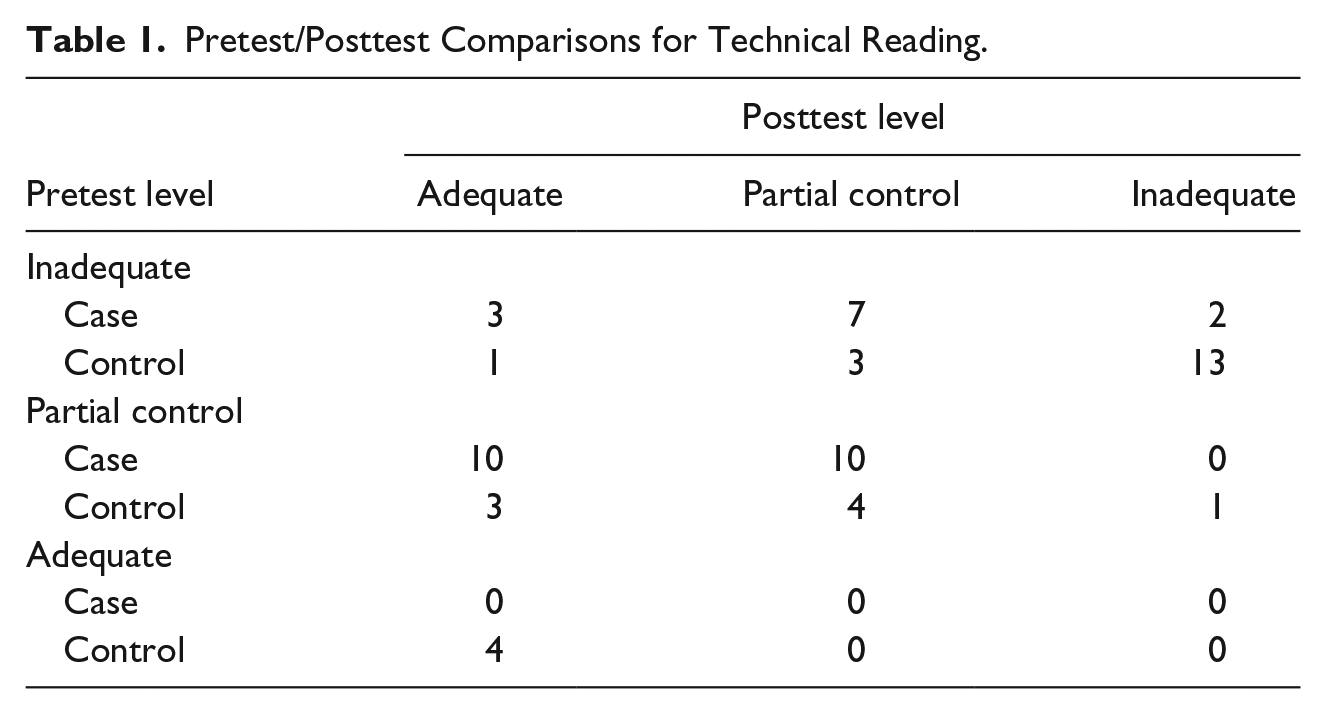
To test teaching methods against each other, each participant’s pretest and posttest results were compared (see Tables 1 and 2). First, all participants demonstrating an adequate level of skill on one of the measurements (reading comprehension or technical reading) on the pretest could not register an improvement in score on the posttest because they reached the highest possible score already. Therefore, they were removed from further analysis of the measurement. Two participants registered deterioration between pretest and posttest. They were removed from analysis, assuming such deterioration is due to measurement error. Subsequently, we performed a corrected chi-square test (see a detailed description in Appendix C).
Pretest/Posttest Comparisons for Technical Reading.
Pretest/Posttest Comparisons for Reading Comprehension.

Overall, more participants from the experimental group showed improvement in technical reading during the course of the study as compared with participants from the control group (63% improved vs. 29% in control group) χ2(3) = 10.9, p < .02. This effect was found based on a large significant improvement of illiterate inmates (83% improvement vs. 24% for control), χ2(2) = 10.8, p < .01. Nevertheless, insignificant difference in improvement was found in technical reading between inmates with poor-reading skills from both groups (50% vs. 43%), χ2(1) = 0.1, p > .9. Improvement in reading comprehension was not significantly different in the test group compared with the control group overall (74% of cases improved vs. 46% of the control group), χ2(3) = 5.4, p < .15, as well as specifically for both illiterate inmates (71% improvement vs. 39% for control), χ2(2) = 4.5, p < .11, and prisoners with poor-reading skills (77% vs. 57%), χ2(1) = 0.83, p = .61.
Next, a planned comparison between the teaching methods was performed separately for each pretest level, to find whether the differences between the methods are significant for illiterate inmates and for inmates with poor-reading skills. A similar chi-square test mentioned above was performed, implementing the Bonferroni method to compensate for multiple comparisons (two comparisons were performed per measurement: reading comprehension and technical reading). The new teaching method (e.g., Bibliodidactics) was found significantly better for illiterate prisoners, both in reading comprehension (71% improvement vs. 39% for control), χ2(2) = 26.0, p < .001, and in technical reading (83% improvement vs. 24% for control), χ2(2) = 18.5, p < .001, but not for prisoners with poor-reading skills (77% vs. 57%), χ2(1) = 3.8, p < .15, for reading comprehension, and 50% vs. 43%, χ2(1) = 1.4, p < .37, for technical reading.
Discussion
The main purpose of this study was to examine the effectiveness of Bibliodidactics on reading comprehension and technical reading among illiterate nonnative adult inmates. This technique incorporates effective reading strategies including subtext strategy (Clyde, 2003), narrative therapy (Morgan, 2000), bibliotherapy (Clark & Dugdale, 2008), and storytelling (Carroll, 1999) through cognitive processing of emotions. We assumed that incorporating personal stories and their emotional processing into reading would create a strong effect on the success of the program. We also anticipated that the new teaching method would have a significant impact on initial levels of reading comprehension and technical reading among inadequate-level students and partial-control level students.
The results of the study demonstrate that the Bibliodidactics tutoring program substantially affected the overall reading performance (e.g., reading comprehension and technical reading) of nonnative adult inmates. Inmates in the experimental group achieved a significant improvement in posttest results for both technical reading (word recognition and reading speed) and reading comprehension (efficiency with which readers can identify words and encode them into working memory) compared with the group assigned to learn reading using the conventional method. The progress in their overall reading performance is especially impressive given that these adults had clearly experienced only minimal growth in their reading skills during their entire lives (if at all). This finding suggests that literacy instruction of struggling readers should possibly focus, among other things, on emotional motives and background.
In respect of Bibliodidactics tutoring program to the reading performance of illiterate inmates or inmates with poor-reading skills, the findings of the study reveal that both groups show overall a more significant improvement in their technical reading compared with their reading comprehension. These findings conform with Muth’s (2007) study, which revealed that nonnative prisoners in the U.S. prisons tended to perform better on print tests (technical reading) than on meaning test (reading comprehension), and supports Malmgren and Leone’s (2000) research findings, which demonstrated that direct reading instruction of incarcerated youth led to more powerful results with regard to technical reading (e.g., fluency) as compared with reading comprehension.
A third key finding of the study relates to the significant improvement of nonnative illiterate adult prisoners in reading comprehension, due to exposure to emotional processing of text rather than to typical direct instruction. Emotional processing of text actively involves students in their own learning practice and treats meaningful texts as tools for learning rather than as repositories of information to be memorized (Alvermann, 2002). The method, largely grounded in the bibliotherapy philosophy (Schutt et al., 2011), maintains that personal stories in their flexible and experiential language, help students to verbalize their suppressed feelings by mirroring the emotions, fantasies, conflicts, and defense mechanisms. Such dialogues, often referring to a fictional character and not necessarily to themselves, reduce anxiety and provide an opportunity for each talker (e.g., reluctant reader) to process his or her emotions according to his or her strengths and needs (Taylor & McAtee, 2003). For example, Wilhelm (1997) documented how integrating drama with reading assisted struggling readers’ understanding of text. It thus appears as if emotional processing of text could [and should] significantly support illiterate nonnative learners or learners with poor-reading skills in their literacy development, regardless of age or situation (Taylor & McAtee, 2003).
An additional significant topic uncovered by the research findings relates to inmates’ welfare inside the prison facility and after release. Prisoners must often fill out forms to make requests, pursue different jobs in prison that require literacy skills, write letters to maintain vital link with the outside world, and pass the time behind bars by reading (Vacca, 2004). Moreover, as the majority of working places and society demand literacy proficiency (Alvermann, 2002), obtainment of reading and writing skills increase inmates’ likelihood of gaining a job after release and, ultimately, reenter society successfully (Tuastad & O’Grady, 2013). For example, nonreader inmates who became readers had an employment rate 18% higher than the employment rate of nonreaders after release, and employed ex-prisoners from both groups had a 20% lower 2-year recidivism rate than those who were unemployed (Fabelo, 2002). Thus, in line with the research findings, the current study emphasizes the highly significant value of Bibliodidactics—a multifaceted, intense, and adapted teaching method—to highly diverse nonnative illiterate or poor-reading inmates. By designing and using a unique Hebrew reading and writing instructive strategy based on personal stories written and discussed by nonnative inmates, Bibliodidactics manages to provide meaningful contexts to learning materials and, thus, motivate and sustain the readers’ interest. Thus, Bibliodidactics is not only an opportunity to gain reading skills that are transferrable from inside prison to the outside world but also essential to make a functional difference in the lives of incarcerated adults and their reintegration back to society.
Finally, it should be stressed that research concerning the use of emotional processing of text as a method for reading instruction among illiterate adults is in its infancy. Hence, due to the explorative nature of this study, more research is needed with regard to the effectiveness and implementation of the Bibliodidactics method for nonnative adult literacy learners, both incarcerated and free.
Limitations of the Study
The limitations of this study are two:
Sample size: The study was performed on a relatively small sample of prisoners (N = 65). Hence, and to validate our results and generate predictors for future implementation, the researchers recommend continuing testing the efficacy of this approach with other configurations of students and on a larger scale.
Unmeasured characteristic of the research: The teachers who participated in our study are IPS-qualified teachers who were especially trained by the researchers to teach prisoners using the Bibliodidactics technique. These teachers may have experienced an empowerment and were more motivated to try a new innovative approach rather than the standardized methods for teaching literacy in jail. We can only assume that this motivation could have affected the students and had a potential affect over these meaningful results. Hence, future research should include teachers who are experts and highly experienced in the field of Bibliodidactics (or other innovative teaching methods for Hebrew reading).
Despite these limitations, the results of this preliminary and exploratory study add to the existing knowledge base about effective literacy teaching of nonnative prisoners in prison. The effectiveness of Bibliodidactics in granting or improving both reading and writing proficiencies among illiterate or poor-reading nonnative inmates may provide academicians, criminologists, educators, and prison authorities with an instructive tool which will improve prisoners’ quality of life inside the prison and promote desistance from crime after release.
Footnotes
Appendix A
This is a detailed description of the current instruction technique used by the Israeli Prison Service (IPS) to teach illiterate adult inmates reading.
Appendix B
This is a detailed description of the Bibliodidactics technique.
Appendix C
The data consisted of a transition matrix for each measurement (technical reading and reading comprehension). First, all participants with adequate-level pretest were removed from analysis, because our measurements could not register their improvement, and therefore their test results were uninformative. Deterioration in skill measured was assumed to be an error of measurement (it was registered only once in lower than adequate-level students), and was therefore removed. To compare the cases to the control group, we first analyzed each pretest level separately, using Likelihood Ratio Chi Square Test to test whether the pattern of improvement was dependent on the method of teaching. Because of too small expected values in some cases, we corrected the chi-square test results using Mehta and Patel’s (1983) network algorithm to calculate the exact test. After computing the exact p values for each pretest level and each measurement, we used Bonferroni method to correct for multiple comparisons (two independent comparisons for each of the two measurements).
As both levels are chi-square distributed under the null hypothesis, and
then, the sum of the chi-square values calculated for each pretest level, which is the overall chi-square value, is also chi-square distributed. We used that summation to test the overall effect.
Declaration of Conflicting Interests
The author(s) declared no potential conflicts of interest with respect to the research, authorship, and/or publication of this article.
Funding
The author(s) received no financial support for the research, authorship, and/or publication of this article.