




Abstract
The United States is home to the world’s largest correctional system where the majority of released ex-convicts reoffend. Consequently, accessing successful methods of reducing recidivism has become tantamount, with education as the most powerful predictor of decreased recidivism. This research found gendered differences in educational program usage based on group membership. Participation in prison parenting groups was found to be a greater predictor of college and vocational educational program usage for women than for men. For male inmates, membership in any type of organized group activity was found to predict greater educational program usage in college and vocational education programs.
The U.S. correctional system now incarcerates more individuals than another system on earth. Access to programs and resources in correctional facilities may have a powerful effect on the incarcerated person’s chances of success upon their societal reentry. Notably, this study found that taking part in prosocial activities offered within a correctional facility has an impact. Research supports that participation in social groups and, subsequently, vocational and college education leads to a significant reduction of recidivism rates. Correctional education as a tool for recidivism benefits the inmates themselves, their families, and society (Hall, 2015). The Rand Corporation report (Davis, Bosick, Steele, Saunders, & Miles, 2013) on the effectiveness of correctional education points to a 43% reduction in the odds of returning to prison within 3 years for inmates who participated in correctional education versus those who did not participate. Esperian (2010) explained that education is the primary stabilizing agent in the lives of the felons, leading to stable employment and an appreciation for learning. In addition, higher education within prison has recently received renewed political attention, as former President Obama moved to reinstate access to Pell Grants for Federal prison inmates (U.S. Department of Education, 2015), citing benefits to society such as reduced rates of recidivism.
Prior research demonstrates that education has myriad benefits to incarcerated people. Moeller, Day, and Rivera (2004) and Knepper (1989) showed that college education was effective in helping inmates adjust to society upon release from prison, possibly lowering recidivism rates while increasing good behavior within prisons (Gaes, Flanagan, Motiuk, & Stewart, 1999; Palmer, 2012). For these reasons, it is important to identify predictors of educational attainment in prisons.
The rate and number of incarcerated women in U.S. prisons has increased dramatically in recent years (Acoca & Raeder, 2000; Mauer, 2013). In fact, there has been a much higher increase in women incarcerees compared with men since 1978. Women’s state prison populations grew 834% over these 40 years—more than double the rate of male inmate population advances (Sawyer, 2018). Importantly, between 2009 and 2015, the number of women in state prisons fell by only 0.29%; the rate of decline for men was 5% (Sawyer, 2018).
Past research suggests that access to social capital—the formation of and access to positive networks of people—leads to higher educational outcomes. Bathmaker, Ingram, and Waller (2013) found that membership in social groups is positively associated with postsecondary education attainment among university students in the United Kingdom. In this article, we extend this line of research to consider whether involvement in prison programs (social capital) leads to greater use of educational programs in the United States. Prior research shows that incarcerated women tend to use social capital in ways that are unique compared with male inmates (Case, Fasenfest, Sarri, & Phillips, 2005). This article investigates the role of gender differences in the relationship between social group membership and education enrollment in prison.
Literature Review
The Power of Social Capital
The general study of social capital focuses on networks of social connections, such as friends, family, professional relationships, and acquaintances. Coleman (1988) provided this definition:
Social capital is defined by its function. It is not a single entity but a variety of different entities, with two elements in common: they all consist of some aspect of social structures, and they facilitate certain actions of actors . . . (p. 98)
Social capital is a beneficial form of capital that can be comprised of corporations functioning as actors (macro perspective) or individual persons (micro perspective). Yet, in his research, Coleman emphasized microgroup social capital dynamics. Unlike other forms of capital, Coleman (1988) explained the key element of social capital existed entirely, “. . . in the structure of relations between actors and among actors” (p. 98). Thus, social capital is not entirely comprised of the actors themselves or the products of their interactions, but in the network structures that exist between the actors, and the benefits that accrue because of this. Putnam (2000) and Gamm and Putnam (1999) noted that a unique characteristic of social capital is that it possesses qualities similar to a public good. Furthermore, social capital would exist to serve a prosocial function, consequently improving society for the masses. Lin (1999, 2001) found that social inequality is replicated through differential access to social capital. Consequently, lack of access to educational programs or viable educational programs for U.S. prisoners may serve as a mechanism to further social inequality.
Rehabilitative prison programs that primarily focus on human capital (e.g., job skills, education) while neglecting social capital (e.g., providing important social connections) often have little success. Brown and Ross (2010) reported that approximately 80% of U.S. jobs are never advertised. As a result, many jobs are discovered through word of mouth, and personal knowledge of such opportunities, underscoring the importance of reentry social connections and social networking skills to access educational potential. This has multiple implications for ex-offenders, who, from the point of entry into the system until their eventual release back into society, face social stigmas that often limit opportunities to acquire positive social/human capital (Winnick & Bodkin, 2008).
Research supports furthering prison programs to develop positive social capital that result in prosocial outcomes of improved life chances for the formerly incarcerated. As Coleman (1988) explained earlier in this section, the connections that are forged in the creation are not entirely comprised of the actors themselves or the products of their interactions, but in the network structures that exist between the actors, and the benefits that accrue because of this. A study of social inclusion of U.K. inmates found such factors determine the extent of access for groups and individuals to health care, leisure, employment, and education (Caie, 2011). Similarly, scholars have argued that schools in prison can serve as spaces that serve to build social capital with implications for citizenship and prisoner relations (Wright & Gehring, 2008). In contrast to the “prison as a crime school” hypothesis (Aizer & Doyle, 2013; Hutcherson, 2012; Pritikin, 2009), prisoners who engage in positive social capital building activities are potentially insulated from the socially negative effects of prison (prisonization).
Gender Differences
Women inmates are often undereducated and impoverished (Ellis, McFadden, & Colaric, 2008). As single parents, they are likely to be affected negatively by the discontinuation of family roles, such as wife and mother (Adams, 1992). Women in state prisons have higher average levels of education than do men (36.5% of whom never graduated high school compared with 40.2% of men who never graduated high school; Ewert & Wildhagen, 2011). Yet, female inmate prison programs are often based on male models, and, thus, are less likely to focus on gender-specific issues (i.e., loss of children, lack of family relationships; Covington & Bloom, 2007).
After decades of nearly complete invisibility of women in criminological research, the feminist movement of the 1970s and growing women’s prison populations fueled scholarly interest on punishment’s impact on women (Haney, 2010; Kruttschnitt, 2010). Although research has advanced to address gender differences in various aspects of the penal system such as sentencing (Etienne, 2010; Raeder, 1993), executive clemency (Jacobsen & Lempert, 2013; Rapaport, 2000), risk assessment (Manchak, Skeem, Douglas, & Siranosian, 2009; Vose, Lowenkamp, Smith, & Cullen, 2009), prison substance abuse treatment (Messina, Grella, Cartier, & Torres, 2010; Prendergast, Messina, Hall, & Warda, 2011), and recidivism (Lovins, Schweitzer, & Sullivan, 2013; Rettinger & Andrews, 2010), the U.S. prison system has not, for the most part, adopted extant research. Overall, prison programs and research remain male-centric. As noted by Case et al. (2005), because the U.S. prison system is predominantly male, prison education programs and postrelease environments ignore women facing special risks which leave them unprepared for release when they exit prison.
Especially pertinent, research on prison programs has found gender to be an important predictor of participation. For instance, research conducted by Belenko and Houser (2012) suggested that women were more likely than men to participate in drug treatment during their incarceration. The benefits of participation also appear to be gendered. A recent study by Crittenden and Koons-Witt (2017) found women’s prisons were more likely to offer programs, and that women were more likely to participate in comparison with male inmates. A randomized experimental study found incarcerated women who participated in gender-responsive treatment had better outcomes (lower future arrest rates, better psychological well-being) compared with participants in standard prison therapeutic community treatment (Messina et al., 2010). Similarly, a systematic review of the effects of correctional programs for female prisoners documented that substance abuse treatment and psychologically oriented prison programs reduced reoffending for women (Tripodi, Bledsoe, Kim, & Bender, 2011).
In addition to its important relevance to prison program research, gender has important implications for the social capital of incarcerated persons. Research on a national sample of both male and female U.S. prisoners found that incarcerated women tended to have more social support than their male counterparts (Jiang & Winfree, 2006). The study also indicated that women may have greater social support needs, with such support aiding their adjustment to incarceration (Asberg & Renk, 2014; Jiang & Winfree, 2006). Furthermore, men and women experience prison differently. Incarcerated women tend to be more family- and children-centered, seeing themselves in traditional roles as mothers and wives and striving to remain connected to their lives outside of the institution. In contrast, incarcerated men tend to value toughness, individual strength of character, and personal independence, often cutting social ties outside (Colwell, 2007; Haney, 2013; Owen, 1998). A study of female prisoners in Victoria, Australia (Brown & Ross, 2010) found that women recognized social capital (defined broadly, including participation in civil society) as a need for successful reentry. In a meta-analysis conducted by the Rand Corporation (Davis et al., 2013), women who participated in correctional education were far less likely to return to prison. Interestingly, Reisig, Holtfreter, and Morash (2002), in an examination of one form of social capital—social networks—reported that incarcerated women have a varied distribution of social network size and social network resources. More broadly, a recent quantitative study of female probationers concluded that social networks forged one of three pathways to incarceration; women who face challenges in family support, self-efficacy, and education, and experienced dysfunctional relationships, in turn, had difficulties in employment and financial stability, leading to later incarceration (Salisbury & Van Voorhis, 2009).
Despite these findings, it is still the case that U.S. prison systems operate primarily to serve men. Women may be less invisible to scholarly inquiry than they once were, but male-structured programs remain dominant, and male facilities have had greater availability of prison programming historically (Clark, 2009). As Carlen (2013) pointed out,
Always seen but darkly through the distorting mirror of male criminality, issues relating to women and punishment have been extremely difficult to extricate from the long shadows cast by the much larger male penal estate. Thus, although women have been punished routinely in several different ways to men, it has been a frequent criticism (especially in relation to the design of prisons and custodial regimes) that they have also been punished as if they are men. (pp. 4-5)
Recidivism Reduction Through Education
Enabling ex-convicts to successfully access higher education and then apply the education “to good use” through gainful employment is beneficial to the whole of society. Current research (Davis et al., 2013) strongly supports that correctional education greatly reduces rates of recidivism. Uneducated ex-offenders have higher rates of recidivism compared with those with college diplomas, and, according to Pettit and Western (2004), are more costly to re-incarcerate than to educate.
The most common form of U.S. correctional education is the vocational track, with state and federal inmate participation rates at 31.6%, followed closely by General Equivalency Diploma (GED)/high school course participation at 23.2% (U.S. Department of Justice, Bureau of Justice Statistics, 2003). It is apparent that while a little over half of incarcerated persons are receiving some form of education, the rate of recidivism is still high. A unique trait of the prison population is that it is constantly changing as new inmates are processed into correctional facilities and other inmates complete their sentences. Thus, the problem of recidivism is large in scale and complex.
Palmer (2012) believed that college degree programs within prisons are the key to reducing recidivism. Specifically, an inmate’s ability to attain a useful degree and/or certificate provides a sense of accomplishment and the opportunity to access useful human capital for improving life chances upon release from prison. Presently, 6% of the U.S. prison population is enrolled in postsecondary programs (Gorgol & Sponsler, 2011). Rates of postsecondary educational enrollment in prisons have not reached the levels (double digit percentages) that were available before 1994, even as educational opportunities within prisons have been increasing in recent years (Palmer, 2012). In addition, a study by O’Neill, MacKenzie, and Bierie (2007) explained that the type of correctional facility in which a prisoner is confined can affect educational success. Inmates in lower security “boot-camp” settings are often more successful with GED completion in small group learning community settings than prisoners in higher security medium- and maximum-security prisons. Suggestions have been made to provide more educational resources to implement small group educational models to inmates in higher security prisons, thus potentially mediating the educational discrepancies that exist between such institutions.
This research hypothesizes that participation in forms of social capital building leads to greater likelihood of prison-based educational program usage and that these differences are related to gender. The “Results” section of this article shows that gendered differences in educational program usage based on social group participation do exist.
Data and Method
The Survey of Inmates in State and Federal Correctional Facilities (SISFCF) was the data source. The most recent inmate data for the SISFCF, commonly cited in current research on U.S. inmate populations (e.g., Glaze & Maruschak, 2008; Pettit & Western, 2004; Rose & Rose, 2014), were collected in 2004. 1 The sample for this survey was conducted in a two-stage design, with prisons selected in the first stage and inmates in the second stage. We limited our data to state prison inmates because the majority of prison inmates are from state prison systems. We excluded federal inmates because there are differences in how state and federal prisons are structured which could potentially influence our results. For example, there are more comprehensive educational programs in federal prisons because of more consistent funding. We used two dichotomous variables to measure educational attainment in state correctional facilities. 2 We assessed whether or not inmates enrolled in vocational or college education programs during their incarceration. Each of these variables was coded as dummy variables with (1) indicating enrollment in the education program and (0) indicating that the inmate was not enrolled in each respective program. For analyses involving college enrollment as a dependent variable, we limited our sample to inmates with a high school diploma or GED equivalent (those who would have been eligible to enroll in college programs).
We used membership in prison group programs as our focal independent variables. These variables were coded (1) for inmates who report membership and (0) for those who reported not being a member of each respective group. There were eight groups for which respondents could report membership: Bible study groups, race organizations, assistance groups, other help groups, employment counseling, parenting groups, other release programs, and life skills programs. 3 We also constructed an additive index that measured the cumulative number of memberships in all groups during incarceration. The index was scaled from zero group memberships to four or more group membership; there are very few respondents who are members of five or more social groups.
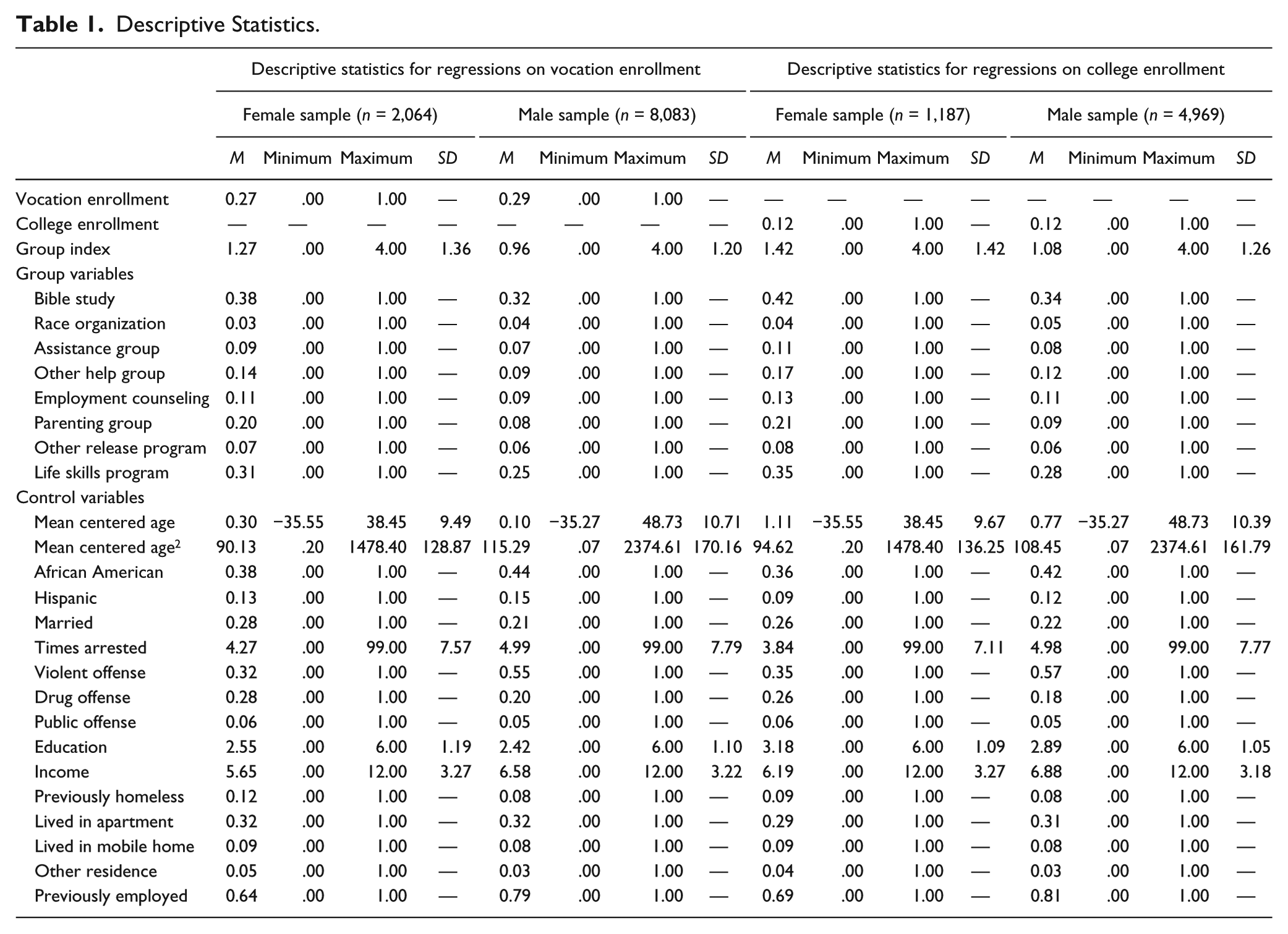
We included several control measures. Age was measured in years, centered on the mean. Age2 was included when statistically significant to account for the potential nonlinear effect of age. Race was measured with dummy variables for African Americans and other non-White races with White as the reference category. Marital status was a dummy variable for whether or not a respondent reported being married. We included several variables related to the inmates’ criminal histories—a continuous variable to assess the number of times an inmate recalled being arrested—type of offense with dummy variables for violent offenses, drug offenses, and public offenses, with property offenses as the reference category. Socioeconomic status was measured with several variables. Education level at time of incarceration was a seven-category variable ranging from “less than high school” to “graduate or professional level.” The 13-category income variable indicated the self-reported individual income in the month prior to arrest and ranged from no income to more than US$7,500. We also included a dummy variable for whether or not a respondent was homeless at the time of incarceration. We assessed the type of residence at the time of incarceration with dummy variables for living in an apartment, mobile home, or other residence with living in a house as the reference category. Finally, a dummy variable was used to indicate whether or not a respondent was employed at the time of incarceration. Descriptive statistics for all measures are displayed in Table 1.
Descriptive Statistics.
Analytic Strategy
Data were analyzed using separate samples for female and male inmates. We assessed the effects of group membership on enrollment in vocational and college education programs with binary logistic regression models. Binary logistic regression models report the effects of independent variables on dichotomous dependent variables in terms of logged odds (Menard, 1995). We began by regressing the effect of membership in any group on education enrollment. Then, we include regression models that reported the effect of individual group membership on education enrollment. We show baseline models with the direct effect of the focal independent variables on education enrollment as well as subsequent fully controlled models.
Results
Enrollment in Prison Vocational Programs
Table 1 shows that 25.9% of female inmates reported enrolling in a vocational program while incarcerated. Results from Model B in Table 2 demonstrate the odds for female inmates’ vocational enrollment was 60% greater for each additional membership in prison groups. Model D reports the effects on enrollment in vocational programs for specific prison groups. Female inmates who were members of other help groups showed a 53% increase in vocational enrollment. Female inmates in employment counseling were more than 2½ times more likely to be enrolled in vocational programs. Those who reported being in parenting groups were 60% more likely to enroll. Female inmates who were in life skills programs were 56% more likely to also report enrollment in vocational programs. Membership in Bible study groups, race organizations, assistance groups, and other release programs did not significantly correlate with enrollment in vocational programs for female inmates.
Logistic Regressions for Enrollment in Prison Vocational Program.
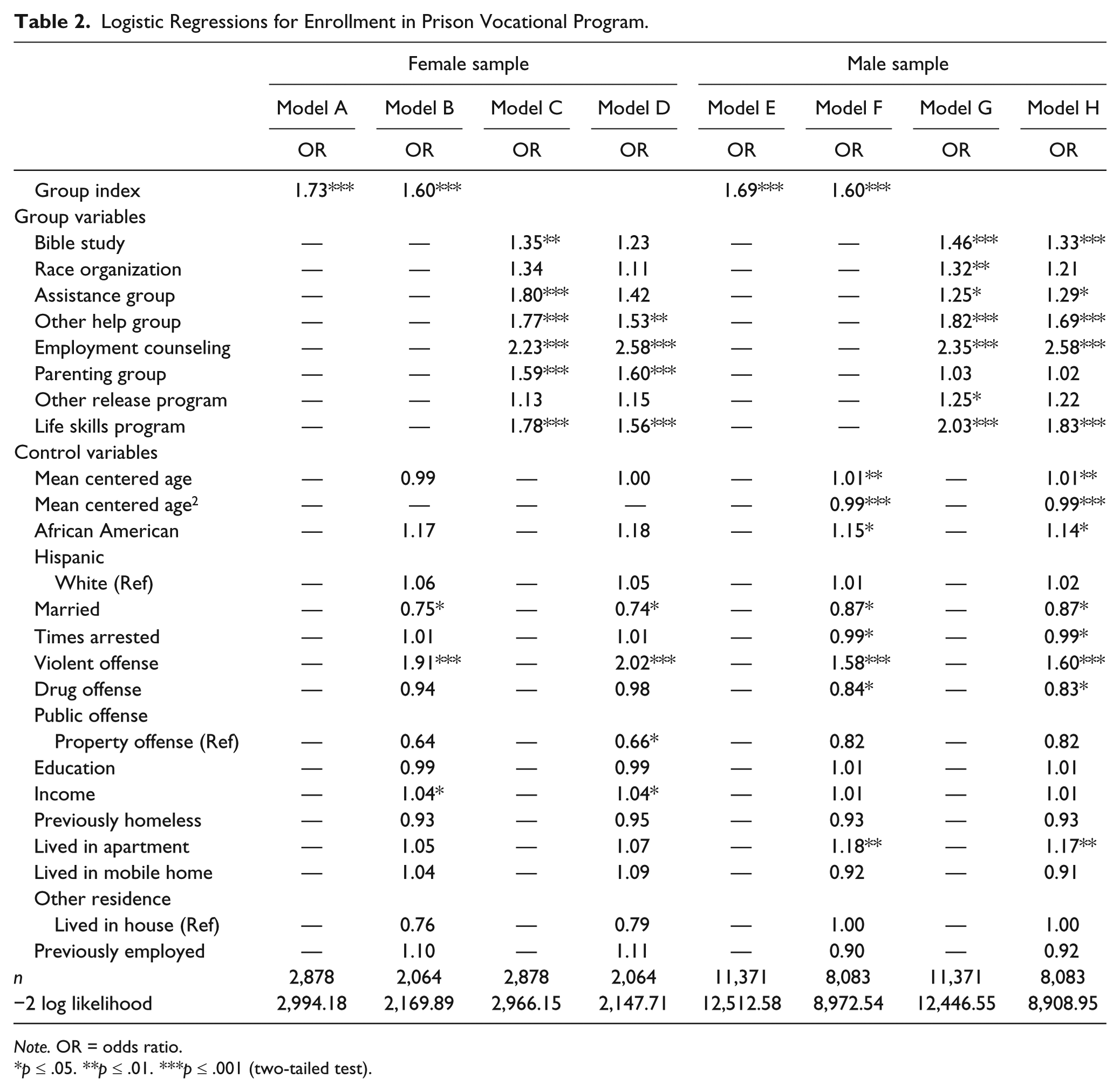
Note. OR = odds ratio.
p ≤ .05. **p ≤ .01. ***p ≤ .001 (two-tailed test).
Next, we report results for enrollment in vocational programs for male inmates. Table 1 illustrates that 27.8% of male inmates reported enrollment in prison vocational programs. Results for Model F in Table 2 showed that the odds of vocational enrollment increased by 60% (OR = 1.60) for each additional group membership for male inmates. This effect appeared to be nearly identical to that of the female sample.
The effect of membership in specific prison groups on vocational program enrollment for male inmates is shown in Model H of Table 2. Male inmates who were members of Bible study groups were 33% more likely to enroll in vocational programs than those who were not. Men reporting membership in assistance groups were 29% more likely to enroll in vocational programs. Membership in other help groups demonstrated a 69% increase in vocational enrollment. Men who sought employment counseling were more than 2½ times more likely to enroll in vocational programs. In addition, male inmates in life skills programs were 83% more likely to enroll in vocational programs. Membership in race organizations, parenting groups, and other release programs were not significant predictors of vocational programs for the male sample.
An interesting finding was that employment counseling was the strongest predictor of vocational enrollment for both female and male inmates, and results from both samples showed nearly identical odds ratios (OR = 2.58 for both women and men). Also, participation in parenting groups was a significant predictor of vocational enrollment for women but not men. Bible study and assistance group membership were important predictors of vocational enrollment for men but not women.
Enrollment in Prison College Programs
In this section, we report findings for enrollment in college programs while incarcerated, first for female and then for male inmates. Results from Table 1 showed that 14.5% of eligible female inmates had enrolled in a college program. Results from Model B in Table 3 showed that the odds of enrolling in college courses increased by 61% for each additional membership for female inmates.
Logistic Regressions for Enrollment in Prison College Program.
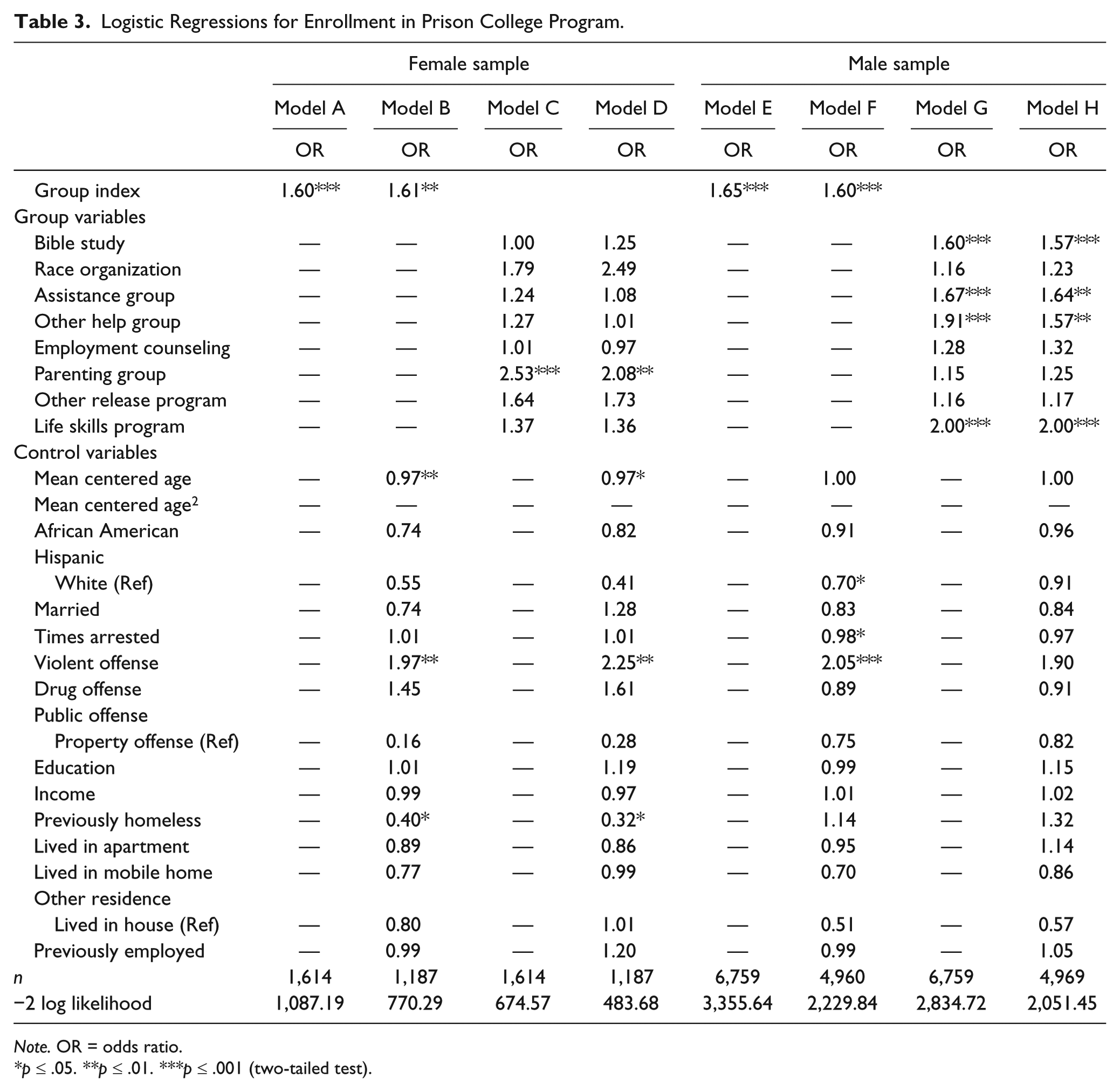
Note. OR = odds ratio.
p ≤ .05. **p ≤ .01. ***p ≤ .001 (two-tailed test).
Model D of Table 3 illustrates the effects of membership in specific prison groups on the odds of enrolling in college programs for females. The only statistically significant predictor of college enrollment for female inmates was membership in parenting groups. The odds of enrollment in college were more than twice as great for female inmates who were members of parenting groups.
Next are the findings on male inmate college program enrollment. Table 1 indicates that 12.2% of eligible men were enrolled in college programs. Model F in Table 3 demonstrates that college enrollment for male inmates increased by 60% for each additional group membership, which was nearly identical to that of the female inmates and vocational enrollment results.
Model F in Table 3 highlights odds of enrollment in college programs for membership in specific prison groups for male inmates. Males in Bible study groups were 57% more likely to enroll in college programs. The odds of college enrollment were 64% greater for men in assistance groups. Similarly, the odds of college enrollment were 57% greater for men in other help groups. Finally, male inmates in life skills programs were about twice as likely to be enrolled in college programs compared with those who were not. For male inmates, membership in race organizations, employment counseling, parenting groups, and other release programs did not significantly affect enrollment in college programs.
An interesting finding is that while membership in parenting groups was the only significant predictor of college enrollment for female inmates, male inmates in parenting groups were not more likely to enroll in college programs. This finding was consistent with results from vocation enrollment. Also of interest is that employment counseling was the strongest predictor of vocational enrollment, yet was not a significant predictor of college enrollment for both men and women.
Discussion and Conclusion
The United States currently has more people imprisoned per capita than any other country, with 2.3 million incarcerated across all types of correctional facilities (Prison Policy Initiative, 2016). The cost of incarceration is substantial. In 2015, the Department of Justice enacted budget was US$26.2 billion (U.S. Department of Justice, Bureau of Justice Statistics, 2016). Scholars and policy makers alike have theorized that the prison population can be gradually decreased through policies that effectively reduce recidivism. Prior research has found that correctional education leads to a significant reduction in recidivism (Davis et al., 2013). Understanding what promotes educational participation can help shape prison policy decisions and organizational infrastructure in the effort to reduce recidivism. Social capital theory (Brown & Ross, 2010; Coleman, 1988; Lin, 1999, 2001; Putnam, 2000) suggests that people who are engaged in at least one type of social capital are more likely to engage in other forms of social capital.
In this article, we investigated the hypothesis that participation in prosocial prison groups will be positively related to educational program participation in prison, but the mechanisms may vary by gender. In general, we found support for this hypothesis. For both men and women, the odds of enrolling in vocational and college programs increased by about 60% for each additional group membership. This is consistent with social capital research that suggests prosocial behaviors lead to other prosocial behaviors.
When examining prosocial group involvement, gender differences in vocational training emerged. For women, but not men, attending parenting classes increased the chances of enrolling in vocational training. For men only, enrolling in Bible study and assistance groups increased their likelihood of attending vocational training courses. However, some of the same prosocial groups predict participation in vocational training for men and women. For example, employment counseling was the strongest indicator of vocational enrollment for both female and male inmates.
The type of prosocial group participation also differs for men and women in relation to college course participation. There was only one type of prosocial group that was related to college course enrollment for women—attending parenting classes. Parenting group membership, however, was not a significant predictor of college course participation for male inmates. For men, Bible study, assistance groups, life skills programs, and other help groups increase the odds that men will enroll in college courses. Interestingly, while employment counseling was the strongest predictor of vocational enrollment for men and women, it was not a significant predictor of college enrollment. An explanation for this finding is that the employment counseling focuses on jobs that are more vocational in nature.
The findings of this study can inform correctional facility policies by supporting the availability of prosocial groups that are most effective in increasing educational program usage. For example, female inmates are more likely to participate in educational programs if they also are attending parenting classes. When focusing on men, Bible study and assistance groups are important prosocial programs that relate to utilization of correctional education programs.
We were interested in education as the outcome variable because of the associated reductions in recidivism. We found that some types of prosocial group participation were related to educational usage; however, we cannot rule out the possibility that educational usage leads to prosocial group participation. Future research may wish to examine how the label of “ex-convict” and/or the possession of a prior criminal conviction may affect subsequent development of the social capital necessary to attain postincarceration employment.
Footnotes
Declaration of Conflicting Interests
The author(s) declared no potential conflicts of interest with respect to the research, authorship, and/or publication of this article.
Funding
The author(s) received no financial support for the research, authorship, and/or publication of this article.