




Abstract
This article draws on research conducted with Canadian provincial correctional officers who have experience with youth in closed-custodial settings since the enactment of the 2003 Youth Criminal Justice Act. In Canada, where attempts to avoid a full embrace of the punitive turn seem to be persistent, we examine youth justice as the “last bastion” of the rehabilitative ideal as mediated by youth correctional officers. Our findings reveal that while officers retain a clear commitment to the ideal of rehabilitation and a desire to “save” young people, they are increasingly under siege by the changing context of prison, shifting managerial priorities, and the paradox of trying to help convicted youth in an inherently punitive environment.
Keywords
Introduction
Rehabilitation, while battered and bruised within cultures of control, remains resilient in terms of the rhetorical fuel it provides to criminal justice policies, as well as to the practices and decision-making patterns of penal elites (e.g., judges, lawyers) and criminal justice workers on the front lines (Lynch, 2000; Robinson, 2008; Werth, 2013). Punishment scholars have assembled an historical arc that chronicles a general shift away from a period of penal welfarism, where the “rehabilitative ideal” was a central guiding principle of criminal justice, to one where rehabilitation has become folded within emergent logics such as risk, crime control, and justice (Feeley & Simon, 1992; Garland, 2001).
Best thought of as an ideal type, the rehabilitative ideal refers to the idea that a primary purpose of penal treatment “is to effect changes in the characters, attitudes, and behavior of convicted offenders, so as to strengthen the social defense against unwanted behavior, but also to contribute to the welfare and satisfaction of offenders” (Allen, 1981, p. 2). This is undergirded in society by a strong belief in “human malleability” (Allen, 1981, p. 11) along with confidence in institutions and staff, such as the police and correctional officers (COs), to transform and rehabilitate those in conflict with the law. It is this confidence in systems of justice to enable character transformation and ex-prisoner community reintegration that stood with such prominence during most of the 20th century, including during the penal welfare period where “penal measures ought, where possible, to be rehabilitative interventions rather than negative, retributive punishments” (Garland, 2001, p. 34). Youth justice is theoretically interesting especially given the expectation (perhaps among academics as much as other social groups) that rehabilitation and welfare remain, to this day, central pillars despite the eroding tendencies of punitive and actuarial tempests. The question here is not whether rehabilitation survives but the manner through which it has become appropriated and mediated alongside competing criminal justice paradigms.
Criminological debates regarding the development of a “punitive turn,” at least as it applies to many occidental nations, center on questions about the nature of the transformation (i.e., whether it can be characterized as a sudden punitive break from old social welfare patterns or more fluid and continuous) or the degree of global applicability (i.e., examining differences both across national and intranational contexts; Brown, 2005). Scholars have contextualized such debates through empirically situated analyses; however, more research is still required. Brown (2005) argues “it may be a useful exercise to engage in a more detailed and specific, empirically based assessment of both transformations and continuities in the penal practices of particular jurisdictions” (p. 28). This insight readily applies to scholarship on how rehabilitation “works” through the perceptions, experiences, and actions of criminal justice personnel, who are charged with negotiating competing organizational mandates and operate within the confines of limited time and resources (Lynch, 2000). Criminologists of late modern punishment recognize the frequent disjuncture between crime control rhetoric, political cultures, and penal practices, where “law and order” rhetoric that is emotively salient at the discursive level may have negligible effects on the “front lines” of the criminal justice system (Brown, 2005). Brown (2005) adds that overplaying the “pervasiveness of punitiveness” may neglect “the empirical, the nondiscursive, the particular to time and place, lost in the exciting generalities and transportability of discourse analysis” (p. 42). To examine adaption by practitioners on the ground, broad structural changes related to crime control should be analyzed in reference to the “micro” experiences and actions of members within the system (Garland, 2001).
In this article, we examine the perceptions and experiences of Canadian provincial COs working in youth prisons since the implementation of the Youth Criminal Justice Act (YCJA; 2003/4) to shed light on how they have adjusted to the transformation of late modern rehabilitation within the traditionally welfarist Canadian penal climate, and how broader penal cultures are produced through the sedimentation of micro social processes and encounters. Specifically, we first show the persistence of the “child saving” role, which some COs situate as opposed to the encroachment of actuarialism in adult corrections. Second, we address how this child saving role “crashes” against the ironic inevitability of custodial regimes—here too rehabilitation survives as punishment. To situate our analysis, we outline extant debates regarding late modern rehabilitation, with a focus on youth correctionalism and situate youth corrections within the Canadian context. The discussion underscores the value of further refining empirically driven comparative criminology and puts forth some policy implications of our findings.
Late Modern Rehabilitation: Embedded Continuities and Mutations
Despite debates over causes and related effects, there is general agreement with Garland’s (2001) influential account of the transformation in western nations (particularly the United Kingdom and the United States) from the modernist penal welfare period (dominant from the 1890s to the 1970s) toward the ascendency of neoconservative crime control and neoliberal risk-based responses to crime. Persuasive accounts of the rise of a “new penology” has at its epicenter an actuarial, managerialist framework where rehabilitation and treatment are subjected to calculations of risk, themselves beholden to limited resources and constraining institutional arrangements (Feeley & Simon, 1992; Garland, 2001; Robinson, 2008). Correctional work now targets public protection, where individual treatment is a resource distraction at best, or seen as stymying this goal at worst (Garland, 2001).
There is also, however, a fair degree of consensus that rehabilitation was never eradicated entirely but, instead, sidelined (e.g., to the hinterland of restorative justice) and subordinated to other competing and simultaneously aligned goals (i.e., retribution, incapacitation, and especially, risk management; Garland, 2001). Rehabilitative sanctions have entered a “new discursive alliance with punitiveness,” essential to their ongoing legitimation (O’Malley, 1999; Robinson, 2008, p. 435). Empirically driven research has examined how criminal justice practitioners have adapted to these transformations. Robinson (1999), for instance, documents how probation officers’ assessments of “what works” have become beholden to risk classification. In later work (2008), she also underscores how rehabilitation no longer serves the interests of individual offenders but more the general public, who require protection from the risk of crime. Other research on parole agents suggests that rehabilitation, as a concept, has become little more than “lip service” paid to what in practice is animated most by control and coercion (Lynch, 2000). Similarly, in his study of parole officers in California, Werth (2013) highlights how practitioners interpret and manage the multiple and ostensibly competing mandates for maintaining public safety while facilitating the reentry of former prisoners. Law enforcement and social work roles are fused, shaped by presumptions regarding both parolees taking responsibility for their desistance from crime and remaining “potentially dangerous and unlikely to change and, therefore, in need of intensive supervision and regulation” (Werth, 2013, p. 220). A “punitive, ‘tough love’ approach” (Werth, 2013, p. 221) is embraced by parole officers, as it is deemed efficacious in reintegrating parolees under their supervision. In California, it is parole agents’ punitive orientation that permits idealized rehabilitative goals to be “folded” within punitive practices.
Examination of how welfare practices have evolved and retain salience with Canadian penality is still emerging, with some arguing an overall “volatile and contradictory” patterning (Moore & Hannah-Moffat, 2005; O’Malley, 1999). On one hand, there operates a “liberal veil” which draws on Canada’s reputation as a “peaceable kingdom” and one which retains faith in the rehabilitative ideal, yet masks coercive practices on the ground (e.g., in drug courts and through “therapeutic justice”; Meyer & O’Malley, 2005; Moore, 2011; Moore & Hannah-Moffat, 2005). On the other hand, in Ontario, Canada, treatment for prisoners has been deemphasized in rhetoric, but, as Moore and Hannah-Moffat (2005) note, this was not reflected in the ongoing therapeutic programming found in many provincial institutions over a decade ago when they conducted their study (Moore & Hannah-Moffat, 2005). This stands alongside evidence that punitive rhetoric about youth crime and justice (e.g., in the media, in statements from Conservative Party of Canada politicians) serves a symbolic, penal populist function that does not reflect correctionalist goals and practices within the youth justice system (Bala & Carrington, 2016; Doob & Sprott, 2006). There is also evidence for broad public support in Canada and other Anglo-western nations for rehabilitation (Meyer & O’Malley, 2005; Roberts, 2004), especially in relation to young offenders and “child saving” (Barber & Doob, 2004; Moon, Sundt, Cullen, & Wright, 2000; Piquero & Steinberg, 2010).
Youth Correctionalism and Late Modern Rehabilitation
If there exists a general sentiment that crime in general (rates and quality) is worsening, and that the criminal justice system is no longer able to effectively respond (Garland, 2001), there is arguably lower punitivity expressed toward young offenders who, even in the present, are often accorded greater desistance potential due to their youth: there is “still time to save them” (see Umamaheswar, 2013, p. 1168). There still resides in youth corrections a concern over the “offender” and his or her self-esteem and amenability to treatment, rather than strictly a concern for how rehabilitation of a young person serves to ameliorate risk and protect the public from crime (see Garland, 2001).
Although, in certain nations, punishment, in the realm of youth justice, has evidenced increasing exclusion and retribution fueled by penal populism (see Muncie & Goldson, 2006), it remains geared to bringing back into the fold young people as conditional citizens, albeit with the augmented goal of self-responsibilization and self-regulation of one’s character transformation (Vaughan, 2000). Many western nations have experienced drops in youth crime rates over the last decade, or at least stable rates of relatively low-level trends (Muncie & Goldson, 2006), alongside ongoing efforts to implement restorative justice options (Van Ness, 2005). Nevertheless, here too the relatively prominent positioning of rehabilitation should not be interpreted as displacing social control. As Muncie and Goldson (2006, p. 35) argue, regarding youth justice in England and Wales, “welfarism never replaced the punitive but rather acted to expand the range of interventions and disposals available to the court,” with early intervention used “against” youth deemed at-risk. Indeed, neoliberal interventionism targets pre-delinquency on the basis of what youth “have done, but [also] what they might do, who they are or who they are thought to be” (Muncie & Goldson, 2006, p. 41).
A number of studies internationally have demonstrated that, despite a general “turn” toward actuarialism and risk, youth justice practitioners retain faith in the rehabilitative ideal and an ethos of welfare in response to the needs of individual young offenders (uit Beijerse & van Swaaningen, 2006). However, while Muncie (2006) cogently argues that modern youth justice continues to hybridize the competing paradigms highlighted above without any one framework maintaining dominance, he “also suggests the possibility of continual negotiation, struggle and subversion” (pp. 787-788). Youth probation officers in Toronto, for instance, balance ostensibly conflicting care and control roles by animating their ability to help young probationers through their authoritarian role (Umamaheswar, 2013). In a recent and significant study of Youth Offending Service (i.e., probation) practitioners in England and Wales, Briggs (2013) details not only a resilient rehabilitative ideal resting alongside organizational risk objectives, but strategies whereby practitioners reappropriate risk/need tools to maintain rehabilitative goals. While acknowledging practitioners feel subordinate to organizational objectives emphasizing actuarial assessment of young offenders, Briggs (2013, p. 23) documents their desire to “look deeper” than risk factors, and circumvent the system where possible (e.g., scoring youth higher on a risk scale to trigger rehabilitative services). Here, risks are reappropriated as needs. In this way, these practitioners retain agency in both resisting actuarial organizational mandates and faith in young offender’s reform potential. These studies suggest that scholarship regarding a punitive turn, while attending to complexities and contradictions at the macro level of analysis, has only started to address how practitioners are appropriating as well as resisting the hybridized youth justice paradigms they work within (Bateman, 2011).
Situating Canadian Youth Justice
Mirroring international trends, Canada moved sharply away from the penal welfare judicial context of its Juvenile Delinquents Act (1908-1984) toward a mixed justice and crime control model under the Young Offenders Act (YOA; 1984-2003; Doob & Cesaroni, 2004). Under the YOA, Canada’s youth incarceration rate surpassed that of the United States, albeit for short durations due largely to a rapidly increasing number of breach of probation charges. The 1990s also matched international trends tied to penal populist “law and order” legislative amendments designed to respond to public concerns over rising rates of youth crime and the severity of youth violence (Bala, 1994; Smandych, 2006). The high rate of youth custody was due, in part, to how youth sentences at the time were not required to be proportionate to offense severity, most notably how “youth courts sometimes imposed very intrusive sentences on young persons who committed relatively minor offences in an effort to address psychological or social needs” (Bala, 1994, p. 252). This contributed to a “real ambiguity about the significance of rehabilitation as a guiding concept for a juvenile justice law” under the YOA (Bala, 1994, p. 252).
The current YCJA, implemented in 2003, places greater emphasis on proportionate responses (i.e., related to the severity of the offense), and directs police and other practitioners to engage youth in extrajudicial measures (which cannot result in a charge despite if a youth complies) and extrajudicial sanctions (which can result in a charge with failed compliance) including restorative justice programs where possible (Bala, Carrington, & Roberts, 2009). Observers tend to agree that, since its implementation, the Act has proven to be a “qualified success,” with significant reductions in the number of youth charged by the police and the per capita rate of custodial sentences (Bala & Carrington, 2016; Bala et al., 2009). For example, in 2002, the year prior to the YCJA’s implementation, 3,889 youths were in custody, while in 2013, on an average night, an estimated 1,395 youth were in custody (Public Safety Canada, 2013; Statistics Canada, 2015b). To contextualize such numbers, in 2013, 94,100 youth were apprehended by police as possible suspects in a crime, of whom 48% were formally charged (Allen & Superle, 2014). The other 52% were diverted through extrajudicial measures or sanctions or screened out by prosecutors (depending on the province). Furthermore, only a small number of youth end up in custody. For example, in 2013, only 15% (3,357) of youth were sent to either open or closed custody and, of these youth, only 286 were given sentences of more than 6 months (Public Safety Canada, 2013; Statistics Canada, 2015a). Incarceration rates are low for youth, and lower than statistics suggest given youth serve two thirds of their “custody and supervision” orders in custody. Boyce (2015) points out that “since the implementation of the Youth Criminal Justice Act in 2004, the rate of youth dealt with by other means has continued to be higher than the rate of youth formally charged, although this difference has been narrowing since 2009” (p. 22). Moreover, what this means for those few youth in closed custody remains a lacuna in extant research and scholarship.
Despite this relatively new emphasis on “defining deviancy down,” youth in prisons and the community are increasingly managed through actuarial measures of risk profiling which, alongside the emphasis the YCJA places on the protection of public safety, may act to further subordinate goals of individual rehabilitation and desistance from crime (Smandych, 2006, pp. 25-26). Moreover, the former penal populist (majority) Conservative Government’s amendments to the YCJA, enacted in 2012, may eventually lead to more youth being sent to closed custody and for longer periods of time. Among the changes are clauses for “holding youth accountable” for a broadened range of “serious” offenses and adding individual deterrence and denunciation as sentencing principles for youth, which undercuts the modus operandi of having a separate youth justice system (see Bala & Carrington, 2016).
Even with the former Conservative government’s attempts to “toughen” the YCJA, there is reason to believe the amendments are more symbolic than substantive. Judges and other practitioners retain discretion on how to deal with youth in conflict with the law, restrictions on the use of custody are still in place, and there remains a lack of reference to general deterrence, which suggests these amendments will likely not affect rates of custody (Bala & Carrington, 2016). It must also be underscored that Canadian youth prisons are discursively pitched as rehabilitative or treatment centers, not “prisons” or “jails” (see Adorjan, 2009). The YCJA stipulates that “a youth court ‘shall not’ use custody as a substitute for a child protection, mental health, or other social measure” (Bala et al., 2009, p. 148). Nevertheless, ambiguity persists when considering how the state intervenes in the most serious cases of youth crime. In cases of homicide, for instance, as Roberts (2004) argues, “the degree of state intervention in these offenders’ lives must be considerable; not because these individuals have demonstrated their ‘adulthood’ but for reasons of proportionality and rehabilitation” (p. 317). In line with the international developments noted above, the use of custody for serious youth offending is often justified as the best manner through which intensive programming can be provided and youth rehabilitated and reintegrated back into their communities.
Although a relatively small number of youth receive custodial sentences, not enough is known about the “penal regimes” youth experience, from both the perspective of youth themselves and the COs who mediate their experience. In this article, we examine the perceptions and attitudes of COs working with youth in custody toward the goal of rehabilitation. Although a number of empirically grounded examinations of Canadian prisons exist (e.g., Hannah-Moffat, 2001; Ricciardelli, 2014), few center on COs per se. Instead, their focus is on prisoners and questions of policy. The research explicated here issues a qualitative examination of COs with employment experience in Canadian youth facilities after the implementation of the YCJA, which we argue symbolically marks a movement toward reduced rates of youth incarceration and a more rehabilitation ethos around youth custody in Canada. We focus on CO experiences with this incarcerated population and seek to grasp how COs understand their role in relation to the goal of rehabilitation given challenges “on the ground” in youth custody.
Drawing from interviews with 62 COs, we argue that COs retain agency in deciding which youth are more likely to benefit from their efforts toward “rehabilitation” versus when it is sufficient to invest only the minimum energies needed to fulfill their occupational obligation of incapacitating youth who are deemed incorrigible. Our findings are among the first to explore how COs are experiencing and reacting to the transformation of rehabilitation in youth corrections in Canada. We show that COs’ attitudes and actions are greatly impacted by the evolution of rehabilitation in Canadian penality, which embeds disciplinary practices within a long-standing welfare ethos that targets youth in conflict with the law. Although this is the inverse of other studies indicating how rehabilitative practices have become “folded within” more control-oriented ones (e.g., Werth, 2013), we highlight the lived experiences and orientations toward rehabilitation among Canadian COs to underscore two salient features: (a) a still dominant child saving ethos, albeit one that now rests alongside ongoing ambiguities regarding the impact of custodial sentences for youth imposed for their “best interests,” and (b) an interest in public protection. CO orientation toward rehabilitation matters given the likely connection between orientation, patterns of interaction, and the treatment of young prisoners under their charge (Whitehead & Lindquist, 1989). Understanding their experiences is critical in building knowledge informing not only correctional policy but also best practices toward successful community reintegration.
Method
Provincial or territorial COs from most of Canada participated in semi-structured in-depth interviews. Participant recruitment varied depending on if an agreement was in place with the provincial or territorial ministry. In jurisdictions with supportive ministries, an advertisement was circulated by email that informed COs about the study, provided them with researcher contact information, and instructions about how to participate, such as details about when the interviewer would be visiting their facility. In provinces without formal ministry support, word-of-mouth recruitment was used as persons with knowledge about the study, including COs, passed information about the study to COs. In either case, COs after interviewing would speak to colleagues about the experience, rendered it largely benign and, perhaps unintentionally, helped solicit more participants.
For the purpose of our study, the sample is restricted to the 29 male and 33 female COs (n = 62) who have worked with imprisoned male or female youths. Of these male officers, 28 had worked with male youths and 25 with female youths. Some male COs had experiences working in exclusively male spaces, while all 33 female COs had worked with male and female youths (in some provinces, closed-custody youth facilities are co-joined with adult facilities). Given our interest in the orientation of COs working with youth under current Canadian legislation, we have focused our analysis on discussions about working with incarcerated youth since the implementation of the YCJA—a marked and clear change given youth incarceration rates decreased tremendously. Inclusion criteria focused the study on COs who have worked with youth prisoners in close-custody secure facilities. Recognizing the potential for variations in findings based on the gender of the CO and/or that of the youths in custody, we have highlighted any discernible differences by gender when reporting the findings.
Some key demographic features of our sample, by gender, are summarized as follows:
Demographic Overview.
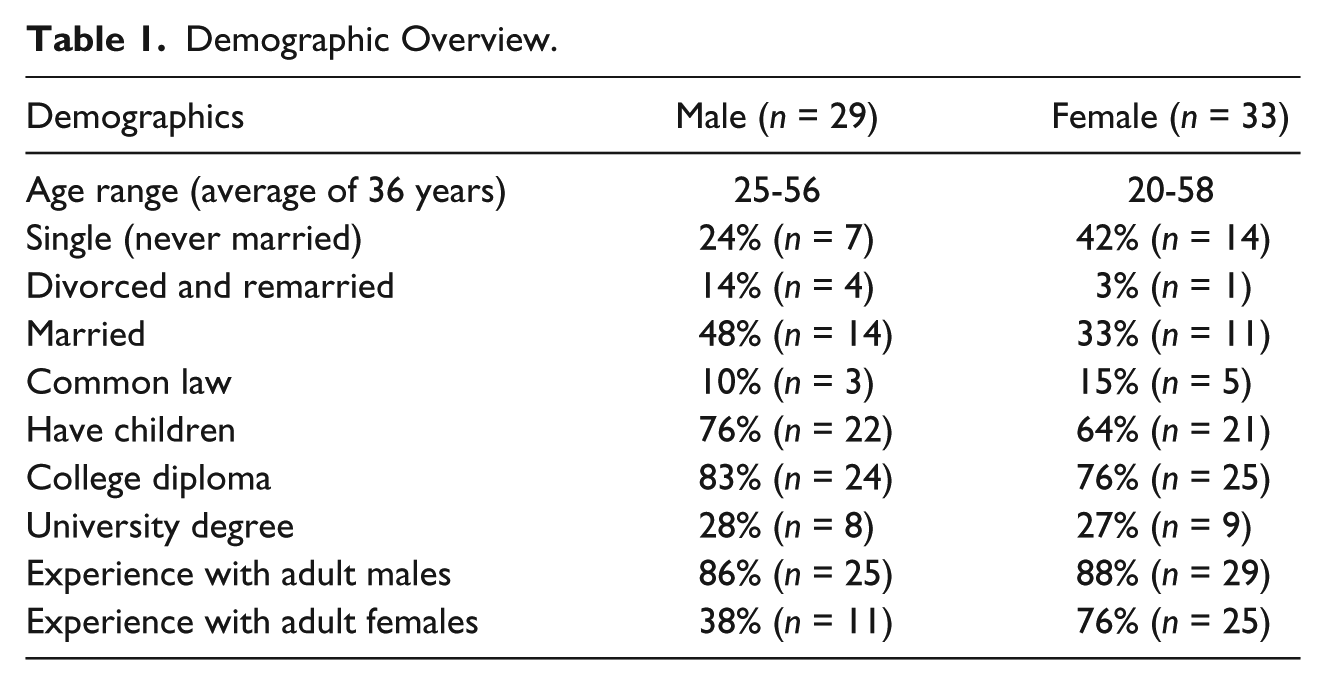
Interviewees all self-identified as White, with occupational experience ranging between 6 months and more than 18 years. Of the 46 COs who reported their employment status, 31 (67%) were in full-time positions and 13 (28%) were term or casual employees (note that not all provinces have casual positions). The overwhelming majority of interviews occurred on-site (i.e., in prisons) between October 2011 and September 2014. Interviews were in-depth, lasting for up to 3 hr (averaging an hour in duration) and participants were asked about their employment history. A brief demographic survey, completed verbally by each participant, followed each interview. Field notes were taken that included documenting time spent with staff in the prisons (eating meals, “breaking” in the staff lounge, or simply chatting) as the realities and insights learned in such experiences help contextualize the data presented.
Interviews were all conducted in a private space and an open-item interview guide was available to be used, if necessary, during interviews. Although employed to begin many interviews, the guide was abandoned as conversation flowed. Said another way, the trajectory of the interview followed the conversational path put forth by the participant; although, questions were asked to ensure specific topics of interest were discussed in each interview.
All interviews were imported into NVivo; analyses proceeded by identifying general themes through open coding or “widely open inquiry” (Berg, 2004, p. 278). The theme of “innate criminality” emerged relatively early in the analysis; it was divided into references made to prisoners in general versus youth specifically. These comments were then operationalized as instances where COs refer to prisoners as if they were “born” criminals. The next salient emergent theme was “negotiating custody and control,” which we subdivide by officer gender, followed by the themes of “prison as rehabilitation” and “prison as punishment.” The general coding frames were then re-analyzed, using axial coding or “intensive coding” (Berg, 2004, p. 280) to pinpoint more specific themes related to corrections work with youth. A total of 60 themes emerged, although those most relevant for our study include, but are not limited to, “powerlessness to help youth,” “consider prison a detrimental environment,” “child saving,” “immaturity,” “belief in personal agency to change,” “stricter with youth than adults,” “school of crime,” “revolving door of recidivism,” and “ability to help only in the short term.” Coding proceeded until data saturation was reached (i.e., interview passages no longer rendered novel directions and permutations related to the themes explored here).
Following the interviews, each was transcribed verbatim and anonymized. In reporting of any direct quotations in this article, participants’ words are edited for speech fillers and grammar with the intention of assisting with comprehensibility without altering the respondents’ use of jargon, profanity, or their vernacular. Pseudonyms are used in reference to interviewees, provinces, and facilities.
Care Over Control: A Tonic Working Through the “New Penology”
COs working with youth aim to prevent recidivism, or persistent offending patterns, which is combined with the tasks of surveillance and, if necessary, disciplining youth for transgressing the rules of correctional facilities (Crawley, 2004). Scholars studying probation and parole officers’ (Fulton, Stichman, Travis, & Latessa, 1997; Ward & Kupchik, 2010) and COs’ (Crawley, 2004; Liebling & Crewe, 2012) occupational orientations suggest some are geared toward social welfare/social work while others control/law enforcement in their approach (Werth, 2013). Nevertheless, despite these competing roles, practitioners may be less inclined to reject the social work component of their daily tasks (Crawley, 2004).
The majority of COs in our sample saw their role as orientated toward rehabilitation. A number made either explicit reference to or described what may be dubbed a “child saving” ethos, which was most prominent across juvenile justice systems in Canada and the United States during the early to late 20th century (Bullen, 1991). Like the Toronto-based youth probation officers studied by Umamaheswar (2013), Canadian COs emphasize the importance of remaining nonjudgmental to secure the trust of young prisoners and care for all the youth. Put succinctly, a 45-year-old female CO commented that regardless of their crime, which may include molestation and rape, “they’ve already been judged [and] I can’t judge them anymore. I’m here to keep them safe.” This involves displacing the formal disciplinary role of COs: “You take yourself out of the . . . situation . . . you’re the CO. You’re first their hopefully mentor . . . They need to be treated first as kids.” To further embrace this ethos, COs recognize the challenging social and environmental circumstances faced by youth as well as their idiosyncratic mental and emotional problems. A 50-year-old female CO saw her correctional goals as “trying to take [youth] out of the situation they were in” and “showing them a different side of life that doesn’t have to be put down all the time.” These excerpts reveal the perceived role of the CO as a “mentor” and provider of safety, rather than exclusively punitive authority figures. COs here reveal they care and use strategies, such as refraining from judging youth, to maintain their child saving perspective.
This general role positioning of COs as child savers is not to suggest that the challenges inherent to dealing with young prisoners were not acknowledged. Nearly half of the COs interviewed made reference to obstacles faced by youth immaturity. Many highlighted how youth immaturity is tied to challenges in “getting through” and connecting with youth in a way amenable to treatment and “rehabilitation.” These challenges, however, did not corrode the “child saving” ethos these COs retain. Immaturity is interpreted as evidencing naiveté, impressionability, and a lack in basic socialization and skills that behooved extra efforts at resocialization.
Many youth COs saw young prisoners as having made bad choices, but not as bad persons. A 39-year-old male CO, echoing others, stated, “I believe in youth rehabilitation. I think if kids are young and they are stupid and they make a poor choice then they can learn from it and move on.” As evinced here in this CO’s words, COs believed in the potential for positive change among these youth as long as someone is willing to patiently lead them. As a 28-year-old female CO states, . . . they don’t have the comprehension level to understand rules . . . well with a lot of the kids, they come in here and they don’t have any social skills or, or even just basic knowledge about everyday things like laundry and cooking and things like that. I find that is a big part of it; to send them back out with a little more knowledge than they came in.
This CO’s words show how many youth are thought to lack basic skills, including those tied to psychosocial development and basic comprehension. COs also refer to taking more time to explain the purposes of punishment when necessary, as opposed to working with adults where detailed explanations were not as forthcoming. A 23-year-old female officer thus stated, “I think with the kids you have to, well I like to explain myself more as to why I am giving a punishment so they understand why they’re getting it and hopefully learn from it for the next time.” As her words suggest, patient explanations in light of individual need are crucial to the CO role, particularly when involving the management of appropriate stances of care versus control.
The practical need to impose consequences did impact some COs, specifically those who point to a punishment orientation as an inevitable—albeit a “last resort”—response to incorrigible youth. A 39-year-old officer, who positioned himself as strongly believing in rehabilitation, later acknowledged: . . . a lot of officers, if they secure youth for horseplay or swearing, they’ll tell the youth to go to the door and then the kid will say: “Go fuck yourself.” Well then they [will] want to extend it . . . And they say okay well you were going to be locked till two now you’re locked till nineteen hundred . . . And then the kid will say; “Well, I’ll get you!” And then they’re going to lock them until the next day.
As this excerpt suggests, interacting with blatantly oppositional or disrespectful youth, despite feeling oriented toward rehabilitation, may trigger a CO to engage in more punitive acts, perhaps as a way to exert some semblance of authority.
Furthermore, the more welfare rather than punitive stance was seen by some COs as deflecting against the encroachment of techniques targeting youth self-responsibilization. One female CO, age 42 years, commented that by the time youth in the system mature to adulthood they have even less services. Because once they cross the line of 18 . . . 19, they’re left on their own . . . and everything is attributed to “you’re making choices,” “you’re on your own.” When they’re youths you’re trying to save them.
This statement not only exemplifies the child saving ethos for COs working with youth but also suggests that some COs see the youth justice system as a haven from the adult system which is thought to have less rehabilitative efficacy due to more dominant managerialism.
Observers of adult corrections have noted the general rejection by prison authorities of their ability to rehabilitate prisoners while in custody (Garland, 2001). At a minimum, COs increasingly see their role as oriented to incapacitation, if not punishment, and not to rehabilitation. In youth corrections as well, the agency for individual transformation and desistance from crime is projected strictly at youth themselves, who may, with help, appreciate their potential to change, but who need to follow through and take responsibility on their own (Gray, 2007; Muncie & Goldson, 2006). This pragmatic evolution of the rehabilitative ideal was found among some of the COs interviewed. For instance, a 33-year-old male officer expressed that, despite best efforts, he is only able to help a small percentage of the youth he supervises: “[COs] per se can help make the positive choices, maybe by talking to [imprisoned young persons]. But I’m saying that only 15 per cent of ’em, want to talk to ya anyway.” His words reveal how personal change cannot be forced upon youth; instead, youth must be willing and interested. Such experience suggests that, when faced with the challenges of dealing with particularly unruly youth, incapacitation (i.e., locking them up) and focusing on those “worth” saving—a small percentage of those amenable to the best efforts of COs—are the pragmatic realities underlying discourses of child saving. While the child saving role is not displaced among Canadian COs, although some explicitly distanced their role from the managerialism they witnessed maligning the adult system, the rehabilitative ideal survives through a pragmatic adjustment that anticipates failure among perhaps even the majority of young prisoners. Those who are successful, from this perspective, are successful of their own accord.
Debased Agency: The Irony of Animating Rehabilitation Through Custody
Although the majority of our sample express strong, if not qualified, endorsement for child saving and rehabilitation, frustration and cynicism are also evident, leading some COs away from a strong identification with child saving as their primary role. Comparable with the California parole officers examined by Werth (2013), some of the COs we interviewed drew upon past experiences and assumptions about the history and projected future of the young prisoners under their supervision to render them “deserving” of sympathy or condemnation. Some COs thus began to “see” emerging patterns of life-course persistent offending during their initial encounters with youth (Moffitt, 1993). They emphasize how indistinguishable some youth are from adult prisoners in their criminal behavior, physical stature, and disposition. For instance, a 21-year-old female officer, and recent graduate, commented on how the job “gets frustrating” and sometimes can feel like more of a “punishment [oriented] job,” which causes her stress. However, she advocates for punishment to be emphasized over rehabilitation, explaining that “some of the youth have done crimes that are just as bad as the adults. It doesn’t matter if you’re 12 years old or if you’re 40. If you hurt someone, you hurt someone.” She adds that some of the incarcerated youth “were as big as adults” and “looked like they were grown men,” making her work “harder” as working with youth “we had to be more careful to how we touch them and how we bring them down. But we still had to punish them, just the same because sometimes punishment is a good thing really.” Her words demonstrate parallels between some youths and adults in custody, and how a punitive stance is undergirded based on what Postman (1994, cited in Schissel, 2006, p. 137) signals as the “contemporary dissolution of the distinctions between children and adults.” In the same vein, a 33-year-old male CO expresses confidence in his ability to “spot” future adult prisoners: I look at four or five of the inmates that I dealt with on a regular basis in youth, and you can almost pick them out. I could write names down right now, I could write four names, right off the top of my head that I guarantee will sexually abuse someone when they get older. Or they probably have already and maybe never got caught for it, yet . . . it’s a vicious cycle, and how do you stop it?
Adult appearance here then signals adult intention and merits punitive responses reinforced by the perceived futility of rehabilitation. This feeling of helplessness presents a particularly salient form of precarity that affects COs working with youth that is not just expressed from junior practitioners. One 33-year-old male CO who now works with adults claims that 95% of the youth he supervised a decade before in youth custody have ended up in the adult facility where he now works, or in another federal institution or on the street being monitored by police. He concludes, “rehabilitation for young offenders is very very slim to none.” It is important to note that the rejection of rehabilitation by these COs is directed to more “hardened,” recalcitrant youth who are seen as, in essence, adults, despite being as young as 13 years of age.
These experiences gel with Werth’s (2013) interviews with California parole officers, where some felt that the reality “in the trenches” was far removed from organizational rehabilitative directives. Some officers, for example, spoke of “breaking the spirit” of parolees who were compared with “wild horses.” Indeed, sending parolees back to prison was described as the best way to “motivate” and “help” them. While only a few of the interviewees expressed a preference for crime prevention as “jailing youth is really never going to work,” a number of COs commented on the irony of rehabilitation being triggered through punitive custodial responses: Part of rehabilitation is punishment I believe. Because there’s always cause and effect. In order to make you realize the errors of your ways. For instance locking somebody up for 23 hours a day, well you did something that was wrong. I don’t want you to do that again. I’m going to show you the consequence of it, and then I’m going to teach you ways to fix the behavior. I think you need both. I think straight rehabilitation doesn’t teach anything. It doesn’t teach consequence. It teaches you were bad and we rewarded you with all of this training. (emphasis added)
This 22-year-old male CO is criticizing the “old school” of rehabilitation, which he dubs “straight rehabilitation,” arguing that this paradigm is not capable of providing the transformative and pedagogic experience youth require. As noted by Muncie (2005) regarding international trends in youth justice, “the punitive and the preventive may sit uneasily together but their combination suggests a broadening and deepening of regimes of surveillance, inspection, regulation and control” (p. 41). In this same context, a 32-year-old female CO points to the complexities of running programming within youth facilities asking, “how do you take a voluntary program . . . and make [it] a mandatory thing? It doesn’t work, it doesn’t function.” This paradox exemplifies the “teeth” that rehabilitative programming may garner within such facilities (Robinson, 2008); an ironically enforced volunteerism suggests coercive lacing underlies well-intentioned treatment initiatives.
Some COs even found the challenges of engaging youth in treatment programs greater than those faced with adults. The reasons behind this view illuminate the central irony of late modern rehabilitation in the context of youth justice. Given the majority of the COs interviewed have experience working with both youth and adults, some COs describe a need to be more strict with youth than adult prisoners in response to the challenge of balancing care and control. For instance, a 61-year-old male recalls, discipline in youth [custody] was kind of the same as adult. It was basically a 24 hour lock-up. Any disrespect, or anything they shouldn’t do—that’s one thing between adults and kids is when I worked at the youth centre you were a lot more strict, I was anyway with the youth than with adults. So they’re held to almost a higher standard than the adults, which was kind of weird, but they are. And if you’re caught, let’s say . . . well they couldn’t have more than one bowl of cereal . . . So if a guy would take two bowls, you’d warn him or you’d take it away, and if he cussed at you, or swore at you—you’d lock him away for 24 hours . . . (emphasis added)
Rather than suggesting an overriding punitive framework that “infects” a rehabilitative orientation, here an intensified rehabilitative drive is demonstrated that creates the ironic “kind of weird” effect of having recalcitrant youth subject to exponentially severe punitive responses. These are not circumstances where lives are placed in immediate danger or involving arguably serious insubordination or rebellion; they are simply a response to rather typical adolescent disrespect. Other COs refer to “locking up” youth for 24 hr if they “bug” or “annoy” them, further evidencing how rather mundane but defiant behaviors can trigger punitive reactions. One of the ironies of contemporary youth corrections is the use of higher level intensive services directed at youth who are deemed a higher risk for recidivism (see Robinson, 2008). Ironically, as Muncie (2006) notes, “some of the most punitive regimes of incarceration have also repeatedly been reserved for the young. The anomaly is somewhat ‘solved’ by clouding youth incarceration in a welfarist treatment discourse” (p. 784). Although a 24-hr lock-up is clearly an intensely punitive response to relatively minor transgressions, the irony here is that the level of punitivity is motivated by the “need” for a more intensive rehabilitative response. As Robinson (2008) argues, “although the notion of ‘rehabilitative punishment’ is clearly not new, the idea of rehabilitation as punishment arguably is” (p. 436, emphasis in original). We thus find evidence for this within Canadian youth corrections.
Discussion
Although the crafters of the YCJA tried to legislatively resolve ambiguity regarding the role of rehabilitation within the youth justice system by making it most pronounced in the law, those working on the front line of the youth correctional system still try to negotiate what constitutes rehabilitation in their daily interactions with imprisoned youth. While Ward and Kupchik (2010) argue that “treatment and punishment are flexible orientations taken on a case-by-case basis rather than firm ideologies shaped by static factors” (p. 57). They add that within a relatively punitive juvenile justice discourse and policy context, criminal justice workers may need “a greater dose of personal will to emphasize treatment rather than punishment . . . insofar as this orientation runs against the normative grain” (Ward & Kupchik, 2010, p. 58). Indeed, for Canadian COs, assessments of the moral character of young prisoners seem to be a central driving force behind their rehabilitative orientation. A child rehabilitative ethos is retained overall, with some resistance against adult system encroachments, though the pragmatic realities of interacting with youth in custody lead these COs to covet a rehabilitative ideal only for the few likely to receive it. This seeming tautology suggests the direct impact of late modern youth rehabilitation: save those who want to be saved. For those who transgress even in minor ways, especially in ways that disrespect officers, the punitive “lock down” responses engendered are ironically more intensive than the adult system. This is also due to a viral mutation of rehabilitation embedded in assemblages of moral regulation and surveillance.
Although globalization has engendered a measure of uniformity across national contexts regarding youth crime policies and governance (e.g., neoliberal “governing at a distance”), this study responds to Muncie’s (2005) insight that comparative criminology should rest at a level of analysis that “recognizes that the global is only realized in specific localities and through which it will inevitably be reworked, challenged and contested” (p. 56). Diversity among COs working with youth is illuminated through their variegated appropriations of the correctional role and projections of the young offender identity.
Criminal justice policy debates and media representations tend to emphasize the role of treatment in custody, since that is simply where (limited) resources are directed. Rehabilitation here is ironically “triggered” through the formal deployment of technologies animated within the iron cage of correctional systems. This focus, of course, blurs other options such as noncustodial and community sanctions, as well as (significantly more cost-effective) crime prevention—all of which possess a low political valence. Working within this system, parole officers and COs, including those who work with youth, are less likely to consider the wider social and structural factors that influence offending patterns and stymie efforts at desistance from crime (Gray, 2007; Lynch, 2000; Werth, 2013). Although a number of Canadian COs continue to strive to consider these wider contexts of victimization, it remains to be seen whether Canadian youth justice practice will eventually mimic the “progressive minimalism” identified in practitioner attitudes in England and Wales, whereby adherence to the principles of rehabilitation and diversion eventually ebb in adaptation to a “new penology” (Bateman, 2011, p. 124).
Policy Implications
Although the number of youth incarcerated in Canada is rather low, these youths are in need of assistance and supports if they are to desist from crime. To assist these youths, those front line workers who have the most contact with youth—the COs—must be in position where they are able to hold, embody, and apply a rehabilitative orientation to their interactions with youth. Assessing the extent to which COs working with youth self-identify with rehabilitative goals and their views of youth prisoners is invaluable then, particularly given research highlighting the challenges of managing violence between youth while in custody, especially violence between youth and COs themselves (see Cesaroni & Peterson-Badali, 2010). Furthermore, the fact that welfare initiatives may be interpreted by youth themselves as punitive must not be neglected (Cesaroni & Peterson-Badali, 2010; Pösö, Kitinoja, & Kekoni, 2010). As Pösö et al. (2010) insightfully argue, “when something is called ‘care’ it is far less likely to be interpreted as infringing on individual rights” (p. 254).
Generally, the COs who retain a sense of agency regarding how they adopt and apply rehabilitative tenets are less likely to quit their positions, or transfer elsewhere within the criminal justice system. Although some studies have indicated that COs with a rehabilitative orientation are more likely to “burn out” (see Mitchella, Mackenziea, Styvea, & Govera, 2000), further research should be centered on COs dealing with youth and actively balancing perennial roles of care and control.
Ameliorating the hard edge of rehabilitation triggered by youth criminal justice response can be facilitated through the enhancement of broader social welfare policies targeting crime prevention, community development, and ex-prisoner desistance from crime and community reintegration. Like anywhere, these solutions are often not salient politically or fiscally. In Canada, despite a different political climate under the new Majority Liberal government, it is hoped that practitioners on the ground and penal elites will help counter penal populism, which may further malign rehabilitation in the service of draconian punishment (cf., Nelken, 2006)
Footnotes
Declaration of Conflicting Interests
The author(s) declared no potential conflicts of interest with respect to the research, authorship, and/or publication of this article.
Funding
The author(s) received no financial support for the research, authorship, and/or publication of this article.