




Abstract
This article provides a critical historical analysis of the formation and proliferation of some of the earliest and most well-known prison gangs in the California Department of Corrections and Rehabilitation (CDCR) and the conflicts between them. This analysis provides an alternative explanation for prison gang formation that contrasts with existing pathological perspectives on prison gangs by examining the role of the prison staff and administration in the formation and proliferation of prison gangs and the provocation of conflicts between them. The historical narrative and analysis is constructed from existing literature, qualitative research using both formal and informal interviews, and descriptive data acquired from CDCR Annual Reports.
Introduction
Since the first attempt to apply positivist research methodologies to the issue of crime (Lombroso-Ferrero, 1972), the idea of criminal pathology has persisted in the field of criminology. As Brotherton (2015) recounts, despite widespread condemnation, pathological perspectives found particular traction in criminological research on gangs, especially among positivist-oriented researchers who cast gangs as inherently violent and criminogenic groups (Klein, 1995; Miller, 1980; Yablonsky, 1963). This pattern has recurred in much of the academic literature on prison gangs, which rely exclusively on positivist research methodologies and portray prison gangs as inherently violent, criminogenic, and incorrigible (Buentello et al., 1991; Camp & Camp, 1985; Fleisher & Decker, 2001; Fong, 1990; Fong et al., 1992; Gaes et al., 2002; Knox, 1999, 2012; Pyrooz et al., 2011; Trulson et al., 2008; Pyrooz and Decker, 2019).
These pathological perspectives are mirrored in publications on prison gangs intended for law enforcement and the public as well (Adams, 1977; California Department of Corrections and Rehabilitation [CDCR], 2012; Morrill, 2005; Orlando-Morningstar, 1997; Porter, 1982). One of the most often cited publications describes prison gang members as, “psychologically amoral and psychopathically oriented” (Camp & Camp, 1985, p. 39). Two of the most prolific prison gang researchers described prison gangs as “vicious, ruthless, violent, dangerous, anti-authority, terroristic” (Fong et al., 1992, p. 66). The pathological perspective has persisted in contemporary research, with gang researchers declaring the “key psychological attributes” of prison gang members to be “Oppositional, intimidation, control and manipulation” (Pyrooz et al., 2011, p. 14).
This article aims to provide an alternative narrative and critical analysis of prison gang formation and conflict, in contrast to existing pathological perspectives, by exploring how formal and informal policies and practices implemented by prison staff and/or administration have repeatedly played a historical role in creating the circumstances that led to the emergence and proliferation of prisons gangs and the conflicts between them. In contrast to pathological perspectives that situate prison gangs as inherently violent and criminogenic, this critical historical analysis resituates prison gangs as products of an environment over which they have little formal control, subject to constant manipulation and provocation on the part of prison staff and administration.This argument is not dissimilar from Goodman (2008) and Lopez-Aguado’s (2018) argument that racial sorting practices by correctional staff play a significant role in the perpetuation of racialized gang factions, both in carceral settings and in the hyper criminalized communities inmates hail from. However, where they err is in implying that racial sorting practices by correctional staff is primarily responsible for the existence of racialized prison gang factions in California’s carceral contexts. They are correct in surmising that correctional staff and administrative practices and policies played a significant role in the formation and trajectory of prison gang factions and the conflicts between them, but those interventions occured far earlier than the type of racial sorting that Goodman and Lopez-Aguado document in their rather contemporary ethnographies of carceral settings in California. This article presents the historical foundation of prison gang formation and conflict that compelled carceral staff and administrators to implement racial sorting as a policy in the first place, rather late in the game so to say. Racial sorting is but a contemporary example of a long line of policies and practices historically implemeted by carceral staff and administration that perpetuate conflict between racialized prison gang factions in California’s carceral environments.
Methodology and Subject Population
The historical analysis is constructed from a multitude of sources that include the existing academic, law enforcement, and popular literature on prison gangs, my own formal and informal interviews with formerly incarcerated gang members, and descriptive statistical data logged and analyzed from California Department of Corrections and Rehabilitation (CDCR) Annual Reports. California prisons are an important case study in prison gangs and have often been the subject of academic analyses of prison gangs because the earliest U.S. prison gangs originated in California, these prison gangs have been exported around the country to other state prison systems and the Federal Bureau of Prisons system, and because of their continued relevance in carceral environments throughout California, other states, and the Federal Bureau of Prisons.
A total of 87 formerly incarcerated gang members were formally interviewed for a larger project on interracial gang violence. The least amount of time served was 1 year or less; the longest inmate time served was 36 years. The average time served was 9.66 years. The 87 respondents had a combined total of 857 prison years served, an impressive depth of carceral experience from which to draw.
Ten respondents had served time in the Security Housing Unit (SHU) program at Pelican Bay State Prison and/or Corcoran State Prison. Their responses were particularly important for the construction of this historical analysis, based on their senior age, depth of prison experiences, and knowledge of inmate oral histories imparted to them by founders and senior gang members who personally participated in the early formation of the major California prison gangs. All of them had been validated as members or associates of prison gangs by CDCR gang intelligence officers, and each had spent extensive time in the same living quarters as the senior members and founders of the California major prison gangs. Their oral histories are integral to the narratives produced in this article. Most of these respondents were re-incarcerated at various times over the tenure of this research project. Several of them were indicted on a 2015 Federal Racketeer Influenced and Corrupt Organizations Act case alleging their involvement in a conspiracy on behalf of the Mexican Mafia, and one of them was murdered in 2016.
While any research subject population have their own biases, formal and informal interviews with gang members have been widely recognized research methodologies employed with both street gangs (Brotherton, 2004; Duran, 2013; Hagedorn, 1988; Moore, 1978) and prison gangs (Davidson, 1974; Goodman, 2008; Jacobs, 1977; Simi et al., 2008; Trammell, 2009, 2012). This article continues that methodological tradition. The extended access for over half a dozen years with multiple incarcerated respondents who had been involved with prison gangs offered the unique opportunity to interrogate them on multiple occasions. Furthermore, I utilized these informal interviews to verify the consistency of the narratives, as well as to cross-check them with other respondents. This is a much more reliable methodology than constructing a history of prison gangs from law enforcement and secondary sources alone, as is the case in existing academic literature (Buentello et al., 1991; Camp & Camp, 1985; Fong, 1990; Fong et al., 1992; Skarbek, 2014), or by relying on a single source who had “dropped out” of a prison gang (Blatchford, 2008; Fuentes, 2003; Mendoza, 2012). Although members and associates of prison gangs are loathe to discuss prison gangs in formal interviews, the six years of extended research access to these respondents provided multiple opportunities to discuss prison gangs “off the record.” Therefore, while direct quotes concerning prison gangs from formal interviews are limited, the historical narrative and analysis presented in this article are informed by countless informal interviews over the research period.
The historical and qualitative data are supplemented with descriptive statistical data logged into Microsoft Excel from CDCR 1955–2009 Annual Reports, providing the source of this article’s Figures and which are used to verify respondents’ narratives and to illustrate the historical analysis. Unfortunately, the CDCR Annual Report changes the format and variables included in the data periodically, making a more comprehensive analysis elusive for some issues. Another limitation of the data is that they represent figures for all CDCR facilities combined, rather than disaggregating the data on prison violence by race, gender, or facility, for example.
Origins of the Mexican Mafia
The Mexican Mafia aka La Eme was originally founded in 1957 by a group of teenage Chicano youths from barrios throughout Southern California on a juvenile yard in the Deuel Vocational Institution (DVI) in Tracy, California (Blatchford, 2008; Camp & Camp, 1985; Fleisher & Decker, 2001; Hunt et al., 1993; Mendoza, 2012; Orlando-Morningstar, 1997; Rafael, 2007; Skarbek, 2014). The idea of members of Southern California street gangs banding together under the “Mexican Mafia” name is credited to one Mr. Luis “Huero Buff” Flores, who was 16 years of age at the time. His teenage cohort of founding members consisted of little more than children, then aged 14 to 17 years old (Blatchford, 2008; Mendoza, 2012; Morrill, 2005). The boys banded together for their mutual defense after having been victimized by other larger cliques of boys from other neighborhoods who outnumbered them individually at DVI.
Two of my respondents in their 50s were members of one of these cliques, the “Spiders,” who were the predecessors to the Mexican Mafia cited by Morrill (2005, pp. 45–46). One of them describes the clique form of social division in California prisons prior to the hegemony of the major prison gang factions today: “There was never none of this South Sider and Northerner stuff like it is now. It was only the clickas homes, you know what I mean.” Thus, the idea to found a federation among the original members of the Mexican Mafia was in response to the threat the original members of the Mexican Mafia faced as individuals in the juvenile facility at DVI at the hands of other youngsters (Moore, 1978).
It is important to consider that the founding members were all State-raised children who had been wards of the State when they founded the group (Moore, 1978). This fact clearly places the responsibility on the State for having run a juvenile program where children’s security was so compromised that they had to form a mutual defense pact to survive in the State’s custody. The boys were not pathologically violent and incorrigible. Rather, their forming a mutual defense federation was a reasonable response to their circumstances and experience of lack of security as imposed by the State of California. Thus, the responsibility and blame for the formation of such a group is not borne solely by what were at the time a group of children, but by the State juvenile justice system that placed them in such egregious circumstances, leading to their resorting to violence to deter their own victimization.
As their initial vulnerability evolved into predatory behavior like the fictional band of boys in the classic novel of the same time period, Lord of the Flies, the CDCR administration, in 1961, decided to teach the boys a lesson by intentionally splitting them up, transferring them to notorious California prison yards where it was assumed they would be victimized by hardened adult convicts (Mendoza, 2012; Skarbek, 2014). Placed into situations of vulnerable victimization in the adult system, the boys felt they had to engage in serious violence to guarantee their personal and collective security, and that is exactly what they did (Mendoza, 2012; Skarbek, 2014). Retired prison gang task force detective Robert Morrill (2005) imparts one such episode regarding founding Eme member and later martyr Rudolfo “Cheyenne” Cadena: As he was walking across the “lower yard,” a big Black inmate, about 6′5″ tall and weighing about 300 pounds, grabbed Cheyenne and kissed him. The Black inmate told Chy that from this day forward that Cheyenne was going to be his “bitch” (punk). Joe Morgan, who was also on the yard, had seen what was going on and since he knew Cheyenne from past acquaintance, he gave him a “shank” (prison made knife) and told Chy he knew what had to be done. Cheyenne walked up to the unsuspecting Black inmate and killed him right on the spot. (pp. 56–57)
The retaliatory and preemptive attacks the boys carried out on adult convicts made an immediate impression on the existing inmate population, as that level of CDCR system violence was extremely rare up to that point. Indeed, inmate-on-inmate assaults with a weapon were so rare then that CDCR did not even include statistics on their occurrence in their Annual Report until 1975, when there was a total of 196 inmate weapon assaults statewide. Even that number was a significant increase over previous years; in 1970 there were only 79 inmate weapon assaults across the CDCR system (Porter, 1982). Lacking data on inmate weapon assaults prior to 1970, we cannot know for sure, but I would hazard an assumption that inmate assaults with a weapon were even less common in the early 1960s, and certainly not the kind of vicious stabbings that the first generation of Emeros carried out when they entered the adult prison system in the 1960s.
When considering the emergence and proliferation of the Mexican Mafia throughout the California prison system, it is also important to note the population and demographic balance in CDCR facilities during that period, which contributed to the vulnerability of original Mexican Mafia members when they first entered adult yards in San Quentin, Soledad, and Folsom prisons. As Figure 1 shows, the combined population of CDCR facilities in the late 1950s and early 1960s was about one tenth what it is today. However, more importantly, as Figure 2 illustrates, the racial demographics of CDCR populations were also radically different from today. In 1955, Hispanics were the smallest racial group in the CDCR system at around 16%. They were deeply outnumbered at the time by White inmates who made up more than 60% of the CDCR population, and Black inmates who made up more than 20% of the CDCR population. Furthermore, they enjoyed no particular support from the existing Chicano inmate population at the time, as Chicanos were fractured along competing cliques.
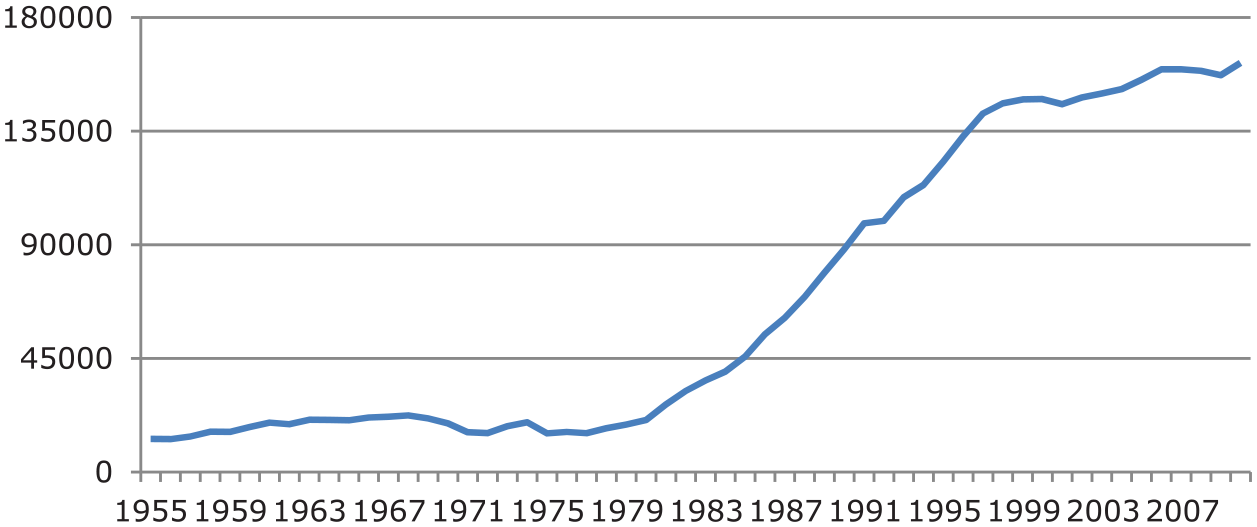
CDCR male inmate population 1955–2010.

CDCR male population by race 1955–2010.
Thus, the prison administration had as a matter of policy intentionally placed the boys in peril, leaving them with the option of becoming either the victims or the perpetrators of violence. They clearly chose the latter to deter their own victimization at the hands of veteran convicts who both outweighed and outnumbered them, and raising the threshold for violence to new previously unseen levels in the California prison system. Therefore, rather than interpret their violent behavior as pathologically incorrigible and the group they formed for mutual defense as inherently criminogenic, their violent behavior is better interpreted as an understandable response to precarious circumstances that had been imposed on them by prison administration as a matter of official policy.
The CDCR-pioneered policy of separating the boys and spreading them around the prison system, euphemistically named “bus therapy,” was a disastrous policy for dealing with prison gangs that was later exported, literally and figuratively, to prisons throughout the nation (Camp & Camp, 1985; Morrill, 2005; Porter, 1982), an obvious model of Merton’s (1936) classic framework of unintended consequences. Indeed, prison officials have acknowledged that transferring gang members was an imprudent and counterproductive strategy (Fong et al., 1992). However, a decades-later national survey of prison administrators found that over half of carceral institutions in the nation still used this self-defeating strategy (Knox & Tromanhauser, 1991).
In the early 1970s, in response to the growing political radicalization of inmate groups and increasing violence in CDCR facilities, particularly against staff, CDCR Director Raymond Procunier moved away from the primary policy of prison gang displacement to an equally ill-considered policy—sequestering prison gang members in dungeon-like “Administrative Control Units” that were replaced later with “Security Housing Units” in the 1980s (Camp & Camp, 1985; Carlson, 2001; Cummins, 1994; Davidson, 1974; Porter, 1982). However, contrary to Director Procunier’s intentions, this policy created a new opportunity for prison gang members to consolidate their authority; they were essentially being granted a monopoly on the administrative segregation units that were used to punish inmates. Inmates sent to these units by staff and administration were suddenly at the mercy of prison gang members, giving them the ability to project their authority over the entire CDCR inmate population by the threat that they would be attacked if they would ever be sent to the “hole”—an extremely likely prospect for most inmates.
Origins of the Black Guerilla Family (BGF)
The history of the emergence and proliferation of the BGF is not much different, as the circumstances that led to the creation of the group were fostered significantly by formal and informal policies and practices implemented by prison staff and administration. In 1967, Black inmates at San Quentin State Prison, George L. Jackson and W. L. Nolen, formed a radical leftist revolutionary study group among Black inmates at San Quentin State Prison known as the “Wolfpack,” or the “Black Family,” which evolved into the vanguard organization to protect the interests of Black inmates, the BGF (Berger, 2014; Cummins, 1994; James, 2003; Morrill, 2005).
A common fallacy repeated in prison gang literature is that the Aryan Brotherhood (AB) formed in response to unprovoked aggression by the BGF (Fleisher & Decker, 2001; Jaffe, 2006; Lobdell & Hanley, 2006; Orlando-Morningstar, 1997). There is never any source or citation given for this claim, and it does not make much sense when one considers the era’s prison racial demographics and racist guard favoritism for White convicts. However, suggesting that Black convicts were the aggressors conveniently absolves CDCR staff of the very direct role they played in the bloody emergence of the BGF. As Figure 2 shows, White inmates held a large majority in the CDCR system through the 1950s and 1960s, a numerical dominance that did not end until the early 1980s. Rather than being the victims of Black aggression, it was most certainly the other way around, a point on which my respondents unanimously agrees and which is supported by the existing literature (Cummins, 1994; Durden-Smith, 1976).
White convicts who were overwhelmingly racist and reactionary in their political perspectives (Irwin, 1980) had long victimized Black inmates with impunity, particularly the (at the time) avowedly White supremacist AB, which emerged as the vanguard organization for White convicts in the mid-1960s (Cummins, 1994; Durden-Smith, 1976). This dynamic resulted in an untenable situation for Black inmates, compounded by overwhelmingly White prison staff and administration that at the least condoned the racist behavior of White inmates, often supporting and/or provoking it. This is not to suggest that all prison staff were racist, but that at least some of the staff were racist, and they intentionally subjected Black inmates to significant maltreatment by racist White inmates and by their own hand (Berger, 2014; Cummins, 1994; Davidson, 1974; Durden-Smith, 1976; Irwin, 1980). It is also important to recognize that these provocations by racist staff conveniently coincided with the expansion of educational programming in the CDCR system in the 1960s, which motivated a political consciousness among CDCR prisoners, the likes of which they have never known before or since (Berger, 2014; Cummins, 1994).
The initial catalyst for the consolidation of the BGF in opposition to the AB was a purported race riot at San Quentin in January of 1967. This incident was directly provoked by a racist White guard who intentionally denigrated Black inmate Melvyn Ayers by sticking his fingers in Ayers’s cup of milk in the cafeteria (Cummins, 1994). The White guard’s malicious action triggered a localized strike by a dozen Black kitchen staff that expanded into a facility-wide strike of over one thousand Black inmates. After White inmate William E. Walker was murdered in the racially charged atmosphere the next day, hundreds of White and Black inmates, who were herded into yards by prison staff, armed themselves with whatever they could and faced off on San Quentin’s upper yard for several days (Cummins, 1994; Davidson, 1974). The embers of a wider conflict between Black and White inmates had been ignited by the staff and administration, hoping to use the incident to suspend San Quentin’s educational programming that they perceived as partly responsible for the inmates’ politicization (Cummins, 1994).
In 1969, Jackson and Nolen were the recipients of “bus therapy” and transferred from San Quentin to Soledad Valley State Prison. Encountering exacerbated maltreatment there from racist staff, Nolen and four other Black inmates filed a lawsuit against warden Cletus Fitzharris and a number of his subordinates, including corrections officer (CO) J. R. Dykes, alleging that they had collaborated with White convicts to harass and assault Black convicts in O Wing, the Adjustment Center at Soledad State Prison (Durden-Smith, 1976). On January 13, 1970, almost 3 years to the day from the San Quentin incident, Sergeant R. A. Maddix and CO J. R. Dykes released Nolen and his confederates into the exercise yard with a group of AB members, with the obvious intention that a fight would occur (Durden-Smith, 1976). According to White trustee John Martin, Maddix allegedly instructed CO Opie G. Miller, who was staff on the catwalk that day, “Keep your eyes open . . . and if Edwards, Nolen, Meneweather or any of those Black bastards raise their hands, shoot them” (Durden-Smith, 1976, pp. 175–177). As staff intended, a fight broke out immediately between the two groups. According to AB member Robert “Chuco” Wendekier, as soon as the fight started, so did the shooting (Cummins, 1994). CO Miller opened fire with a rifle from the catwalk as instructed and killed Nolen, Cleveland Edwards, and Alvin “Sweet Black Jug” Miller (Cummins, 1994; Durden-Smith, 1976; James, 2003).
The physical evidence of the location of the shooting was washed away with a water hose within hours. In the ensuing days, warden Fitzharris, in an implausible public statement, defended the shooting deaths of multiple unarmed inmates as warranted to break up a simple fist fight (Durden-Smith, 1976). While there is no evidence to suggest that the Warden was privy to the staff’s setting up of inmates to be shot, as Irwin (1980) points out, prison administrators, “almost without exception, have refused to investigate these cases vigorously or to take action against guards guilty of these acts” (pp. 14–143).
CO Miller was cleared by a local grand jury of any wrongdoing, but just three days later, George Jackson and BGF comrades John Clutchette and Fleeta Drumgo allegedly, in retaliation for the killing of Nolen, Edwards and Miller, beat rookie CO John Mills unconscious and threw him off the third floor tier to his death (Cummins, 1994; Durden-Smith, 1976; Irwin, 1980). The press dubbed the three accused “The Soledad Brothers,” who became the focal point of an intense Bay Area activist prisoner rights movement that identified with radical revolutionary Black inmates (Berger, 2014; Cummins, 1994).
Before Jackson could be tried for the murder of CO Mills on August 21, 1971, the events set in motion almost 5 years earlier at San Quentin came to a climax when Jackson was killed in a purported escape attempt. Along with other BGF members, and notably with the assistance of two Mexican Mafia members, Louis “Bala” Talamantes and Louie Lopez, Jackson and his confederates gained control of the Adjustment Center at San Quentin and took a number of guards and White trustees’ hostage (Berger, 2014; Cummins, 1994; Durden-Smith, 1976). The combined BGF/Mexican Mafia cohort of convicts allegedly stabbed and shot their hostages, leaving COs Paul Krasenes, Frank Deleon, and Jere Graham dead, and COs Kenneth McCray, Charles Breckenridge, and Urbano Rubiaco grievously injured. As well, two White inmates, John Lynn and Ronald Kane, were stabbed to death with their throats slit. After gaining control of the Adjustment Center, Jackson and his BGF comrade-in-arms Johnny Spain ran from the cell house and attempted to make it across the adjacent yard. It remains unclear where they intended to go, as the wall surrounding the yard was impossibly high to be scaled. Jackson was shot dead on the spot, while Spain was allowed to surrender (Andrews, 1999; Berger, 2014; Cummins, 1994; Durden-Smith, 1976).
Emergence of Interracial Prison Gang Warfare
As animosities between the BGF and AB escalated in the early 1970s, retaliatory hits between members of the two organizations occurred with increasing regularity. The war between them would eventually draw in their confederates among the Chicano convict population and as Figure 3 illustrates, by the mid-1980s, CDCR facilities would see an explosion of inmate weapon assaults, reaching a peak in 1984.
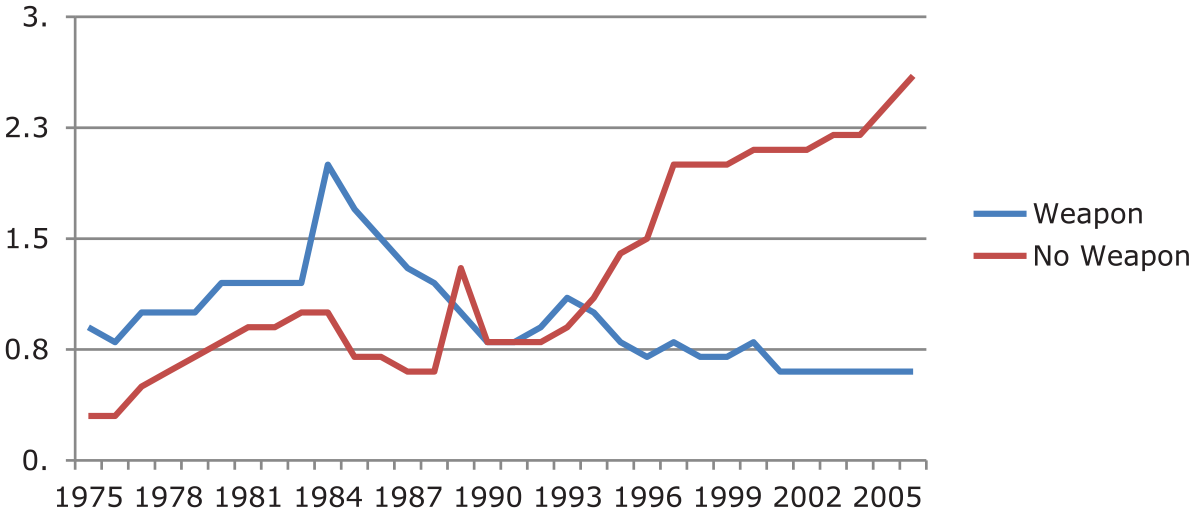
CDCR inmate on inmate assault rate per 100 Average Daily Population 1975–2006.
According to my respondents who had served time in the Pelican Bay and Corcoran SHU programs with prison gang members who were active during the 1970s, despite CDCR staff clearly favoring the AB, by the late 1970s the BGF had gained the upper hand in the ongoing war, threatening the continued functional existence of the AB as an organization. As Figure 2 suggests, the success of the BGF in their war against the AB could be attributed to demographic shifts in the CDCR system as much as to the fighting prowess of BGF members. The White population in CDCR facilities had been on a steady decline over the 1960s and 1970s, and AB members increasingly found themselves outnumbered by non-White inmates, shifting the demographic balance of power away from the AB despite the favoritism afforded them by racist prison staff.
Significantly at the time, collusion between corrupt staff and AB members made AB members the primary narcotics distribution source for White and Chicano convicts. One of my most experienced and trustworthy respondents, who spent well over a dozen years with founding prison gang members as his neighbors and cell mates in the Pelican Bay SHU, reported that a senior AB member would regularly receive packages of narcotics from corrupt COs who would smuggle the drugs into the prison, and, as such, were a particularly valuable asset for those whose yard drug retail operations were being supplied by him, including those benefiting the Mexican Mafia. If the BGF took out AB at the time, the CO’s drug smuggling as their source of income would be threatened. So, to protect their interests in the narcotics trade, the Mexican Mafia decided to back the AB and declared war on the BGF.
The contention that corrupt prison staff bring narcotics and other contraband into prisons is not a controversial claim. While literature that relies on law enforcement for data suggests that visitors are the primary source of narcotics in prisons (Camp & Camp, 1985), the literature on prisons and prison gangs is replete with references to and examples of prison staff serving as couriers for narcotics, cash, and other contraband (Camp & Camp, 1985; Davidson, 1974; Fong, 1990; Jacobs, 1977; Mendoza, 2012; Moore, 1978; Morrill, 2005; Skarbek, 2014). While the fact that prison staff engage in smuggling narcotics and contraband into prisons has been dismissed as attributable to the acts of corrupt individuals, CDCR policy that does not subject staff to any substantive search of their persons or effects makes it possible to this day. Thus, though visitors do manage to smuggle narcotics into prisons, I contend that the inmate narcotics trade is substantially supplied by staff members related to lax CDCR staff search policies.
It is also important to consider that for men who have grown up in the system and often lack friends or family on the outside to support them, the trade in narcotics and contraband is the best and only source of income to function in a carceral environment. This was especially true for inmates from Southern California in the 1970s, because all of the prison facilities at the time were located in Northern California, far from any friends or family who would have been able to provide any modicum of support (Davidson, 1974). It is, therefore, understandable that losing the source of income that a valued narcotics connection represented was a serious threat. Thus, it is inaccurate to suggest simplistically that this war was one fought for control over drug markets (Cummins, 1994; Quinones, 2014). In reality, it was not the market for drugs that was in contention, but rather it was protecting the source of the narcotics needed to supply those markets at the time that was threatened by the possibility of the BGF taking out the AB and cutting off the CO/AB “dope” connection. The fact that the source of the narcotics was corrupt prison staff is testimony that even informal practices like smuggling contraband into CDCR facilities can play a role in provoking and perpetuating conflict between prison gangs.
The war between the Mexican Mafia and the BGF over the future existence of the AB was not the first time the Mexican Mafia had engaged in violence with BGF members. A prime example is the April 1968 murder of BGF member Clarence “Dopey Dan” Causey, who was intentionally released by staff into the Soledad Prison O Wing recreational yard with a half dozen Mexican Mafia members after months of Adjustment Center verbal provocations between them (Durden-Smith, 1976; Mendoza, 2012). These prior attacks were for individual “personal beefs” and not part of a larger conflict between the Mexican Mafia and the BGF. Of course, the murder of “Dopey Dan” was but another example of racist staff members setting up inmates to be attacked by other inmates. The obvious evidence that these previous attacks were not part of a larger war between the Mexican Mafia and the BGF at the time is the previously mentioned involvement of Mexican Mafia members Luis “Bala” Talamantes and Louie Lopez with BGF members in the murder of three guards and two White trustees during the purported escape attempt that resulted in the death of George Jackson at San Quentin in 1971 (Berger, 2014; Cummins, 1994; Durden-Smith, 1976). In fact, Talamantes and George Jackson had a very close personal relationship, sharing a common interest in radical literature, no doubt to the dismay of reactionary staff and administrators, and having been co-plaintiffs in a federal lawsuit filed in January of 1971 challenging the death penalty for prisoners serving life sentences (Berger, 2014).
In the wake of the killings of politically conscious leaders in the Mexican Mafia and BGF who could have potentially found common cause, like Rodolfo “Cheyenne” Cadena and George L. Jackson, the war between the Mexican Mafia and the BGF started in the late 1970s and peaked in the mid-1980s, tapering off toward the end of the decade. This is related to the short window of Black demographic dominance being eclipsed by the influx of Latino prisoners due to extensive California and Southwest Latino immigration in the 1980s and 1990s (see Figure 2). As the war erupted and the prison population exploded, the numbers of early 1980s inmate-on-inmate assaults escalated, from several hundred incidents per year in 1975, to more than 5,000 in 2006, the last year data are available at the time of this writing (CDCR, 1955–2006).
An examination of CDCR data separating inmate-on-inmate with/without weapon assaults provides an even clearer reflection of the Mexican Mafia/BGF war of the1980s. When examining the rate of with/without weapon assaults in Figure 3, we see that there is a period in the mid-1980s where assaults with a weapon eclipsed assaults without a weapon, correlating perfectly with the peak years of the Mexican Mafia/BGF war. The mid-1980s sharp rise in assaults with a weapon reflects the most violent years for prison gang war control over CDCR facilities. As Los Angeles Times reporter Sam Quinones points out, it was during these years that a new generation of Emeros “made their bones” and earned their reputations among their cohort of allies and enemies as the violence in California’s prisons spiraled out of control (Quinones, 2014).
A respondent from an East Los Angeles housing project gang who went to prison for the first time with a life sentence in the late 1970s confirmed this narrative in a formal interview. He described the environment upon arrived in prison for the first time as such: “There was a war going on when I went in between Blacks and Mexicans, in the early 80s, but it was BGF/Mexican Mafia, things like that.” The rate of inmate-on-inmate assaults in Figure 3 confirms his recollection, as the first decade or more of his incarceration was served during an era of unprecedented CDCR system violence. It could not have been a better time for ambitious gang members entering the prison system to “earn their stripes,” carrying out hits on rival prison gang members and associates throughout the system.
To add fuel to the fire as prison administration did consistently, CDCR was in a period of unprecedented building expansion as the State’s prison facilities grew from five in the early 1980s to over 30 by the mid-1990s, providing fertile ground for the expansion of prison gangs (Gilmore, 2007). As each new prison facility opened and inmates entered each new yard for the first time, a pitched battle was fought in each to determine which prison gang faction would take control of particular telephones, day rooms, benches, workout areas, handball courts, basketball courts, and facilities on the yard. My respondents unanimously report that South Siders, the foot soldiers of the Mexican Mafia, won virtually all of these battles and remain firmly in control of the preferred facilities in almost every prison throughout the State to the present day. Convicts who “earned their stripes” in those battles refer to these conflicts as “opening up” a prison. It should be obvious that by opening new facilities and dumping members of rival factions into new yards, prison administration and staff must have known that violence would result just as they did when they dumped early prison gang members into the O Wing yard at Soledad Prison back in 1970. As another of my respondents, a physically intimidating man even in his 50s proudly recounts, I’ve been from Susanville to Jamestown to High Desert to Tehachapi to Corcoran to Folsom to I mean I been all over up and down. I just don’t go down South, I always go up North. Ha haha! They always send me to war! The administration says, “You wanna be a tough guy huh?” so I’m like, “OK where you gonna send me now?” I opened up High Desert, and when you open up a prison man its fuckin crazy man. It’s crazy . . . I mean you’re killing people because this is my handball court or this is my bench. You’re fighting for what area you’re gonna get. And that’s what I’m saying, we established High Desert, and still to this day it’s still like that. You know, there was a lot of bloodshed for that.
In the wake of the war lost to the Mexican Mafia and with most of their members either killed, in protective custody, or housed permanently in the SHU program, the BGF was apparently never able to achieve hegemony over the Black inmate population. Every formerly incarcerated Crip and Blood gang member I have interviewed, formally and informally, denies, to the man, that Black inmates enjoy anything like the overarching structure that governs Sureno-affiliated gang members in carceral environments in California. Black inmates are ever the minority in the overall CDCR population since the early 1990s, and all indications are that they lack the kind of systemic organizational structure that Mexican Mafia–affiliated South Sider inmates enjoy. In contrast, the Mexican Mafia emerged from the war with the BGF with virtually unchallenged and universally recognized dominance over an ever-expanding Latino inmate population, most of whom identify as South Siders, a numerical superiority that continues to expand through the present day.
Conclusion
As the historical analysis presented here demonstrates, prison staff and administration have played an undeniable historical role in the emergence and proliferation of prison gangs in California and the conflicts between them. In some cases, these interventions were formal policy implemented by CDCR administration; in others, they were informal practices on the part of staff. In some cases, they were obviously intentional, even malicious it would be fair to say, but in others, it seems that the results were entirely plausibly inadvertent, a classic model of Merton’s (1936) framework of unintended consequences. Of course, setting up inmates to attack one another and colluding with them in distributing contraband on prison yards has never been a formal policy within CDCR. Yet, it cannot be doubted that these very intentional but informal practices engaged in by prison staff facilitated conflicts between prison gangs. In contrast, transferring prison gang members from one yard to another, with the intention of splitting them up and/or setting them up for violence, is a very intentional and formal policy engaged in by administrators, although the unintended consequence of spreading the influence of the organizations was assumedly not the intention of the administrators who made these decisions. As Merton’s (1936) classic framework of unintentional consequences theorizes, inadvertent effects often abound in the wake of poorly conceived policy.
As numerous other scholars have, we must also consider the possibility that the emergence of conflict between prison gangs and the assassination of prison gang leaders who attempted to create bonds of solidarity across race and gang lines was an intentional conspiracy on the part of staff and administration intended to expedite conflict between various inmate factions to undermine inmate solidarity (Foucault et al., 2007; Reiter, 2014). Although there is no hard evidence of such a conspiracy, we must consider that in the years leading up to the assassinations of Rudolfo “Cheyenne” Cadena and George Jackson and the emergence of conflict between the Mexican Mafia and the BGF, the Federal Bureau of Investigation (FBI) was implicated in infiltrating and provoking conflicts between leftist political organizations like the Black Panther Party and the US organization, including the political assassinations of radical civil rights activists like Alprentice “Bunchy” Carter and Fred Hampton, in which the FBI was directly implicated (Blackstock, 1975; Churchill & Wall, 1988, 1990; Tackwood, 1973). We must have the prescience to recognize that, whether the result of intentional policy or even conspiracy, or merely the result of inadvertent and/or unintentional policies and practices on the part of staff and administration, the formation and proliferation of prison gangs and the conflicts between them ultimately served to provide reactionary staff and administrators with the justification they needed to bring an end to educational programming and, with it, the political consciousness that education engendered in California’s prison population at the time (Cummins, 1994).
In retrospect, we have to recognize that the limited agency that inmates do exercise, sometimes for better, sometimes for worse, is constrained not only by the walls that surround them, but by the circumstances imposed on them by prison staff and administrators who can intervene at will to affect the circumstances inmates face and, by extension, the trajectory of their lives. As Durden-Smith (1976) puts it, “since it is the guard who regulates the adit and exit of every prisoner, it is he, the cockpit-master, the puppeteer, who controls the race war” (p. 181). As critical scholars, we need to recognize that it is in the interest of prison staff and administrators, the agents of the State, to disseminate narratives that pathologize prison gangs and their members as inherently violent and criminogenic by placing the agency for their violent behavior exclusively on the inmates themselves, thereby absolving prison staff and administration of culpability for the often poorly conceived, perhaps intentional and in some cases clearly malicious policies and practices in which they engaged that encouraged, facilitated, and/or provoked the formation of prison gangs and the conflicts between them.
We should not underestimate the ability of prison staff and administration to manipulate, provoke, and facilitate prison gang proliferation and conflict in carceral environments, whether formally or informally, intentionally or inadvertently, and we need to consider the motives that could prompt them to do so in the first place. Inversely, we should not either overestimate the agency that prison gang members and their confederates have in affecting the trajectory of the groups they belong to, and their very lives for that matter. Prison gang members are not merely “psychologically amoral and psychopathically oriented” as Camp and Camp (1985) suggested (p. 39). They are a product of their environment, victims of circumstances that were beyond their control, which compelled them to resort to extreme violence to guarantee their collective survival in one of the most perilous environments on the planet. If we as a society are to ever find our way out of this morass, we must recognize, appreciate, and come to terms with the role that State actors have played in the emergence of prison gangs in California prisons and the conflicts between them, so that we can find solutions to these conflicts that are properly informed by and grounded in the history of their emergence.
Footnotes
Declaration of Conflicting Interests
The author(s) declared no potential conflicts of interest with respect to the research, authorship, and/or publication of this article.
Funding
The author(s) received no financial support for the research, authorship, and/or publication of this article.