




Abstract
This study explored how men recently released from prison conceptualized successful reentry. Qualitative analysis of 12 in-depth life history interviews with formerly incarcerated men revealed that they defined success beyond the literature’s typical focus on criminal behavior avoidance and future criminal justice system contact. The study found several interconnected definitions of success. Central to participants’ conceptions were connection to legitimate employment, ownership, or entrepreneurship, using past experiences to assist other former offenders or recovering addicts with their problems, and the achievement of heteronormative masculine expectations. The implications of these findings for future research and practice are discussed.
Introduction
Because most of those incarcerated will be released (Travis & Visher, 2005), mass incarceration has resulted in a steep rise in the number of individuals reentering society. More than 600,000 individuals are released from state and federal prisons annually (Carson, 2018). Most research examining reentry focus on a single outcome—recidivism, measured as new justice system contact, such as a technical parole violation, arrest, conviction, or incarceration (for a discussion, see Ruggero et al., 2015). But, “reentry is more than recidivism” (Lynch, 2006, pp. 405–406). Lack of recidivism as the sole indicator of “successful” reentry overlooks human and social factors such as physical and psychological well-being, relationships with others, occupational and educational goals, and other prosocial engagements (Bowman & Travis, 2012). Furthermore, using recidivism as the only outcome indicator diminishes the importance of factors that are significant for positive reintegration (Petersilia, 2004; C. A. Visher & Travis, 2003) and reduces the individual to a single incident post-release while essentially erasing prosocial progress toward reintegration.
This study takes a holistic approach to understanding successful reintegration for men. Through structured interviews with formerly incarcerated men, we examined what success following incarceration means to those navigating the reentry process. Our analysis gives voice to an often voiceless population and expands our knowledge around their specific goals and needs. Below, we outline previous empirical work that goes beyond classic recidivism outcomes, and we highlight the need for a holistic exploration of men’s perceptions of successful reentry.
Success Beyond Recidivism
Although recidivism is the predominant outcome of interest in the reentry literature, several scholars have incorporated other established risks and needs into their assessments of reentry and desistence. Barriers to successful reentry, including access to education, employment, housing, and social services, have received extensive assessment (e.g., Petersilia, 2003, 2004; C. A. Visher et al., 2017), with some scholars giving voice to incarcerated people’s perceptions of their needs for a successful transition (e.g., Morani et al., 2011; C. Visher et al., 2007). For example, Cobbina (2010) highlighted women’s perceptions of their needs for successful return to their communities, such as family support, supportive probation/parole officers, and access to post-release networks (see also Doherty et al., 2014). Similarly, Denney and colleagues (2014) interviewed formerly incarcerated men and women about what influenced their successful reintegration. Participants discussed social services to obtain basic needs, social support from family and friends, and the ability to adapt to the unstructured life on the outside.
Hlavka et al. (2015) broadened this scope by investigating the narratives of successful reintegration for formerly incarcerated men and women. Respondents highlighted faith and devotion to a “higher power,” reconnection and renewed commitment to loved ones, and the ability to be a role model as reasons for not returning to a criminal lifestyle. This research highlights the importance of providing participants a voice in scholarly research. Yet, despite providing voice to formerly incarcerated individuals and expanding knowledge regarding the factors influencing reentry, most extant research centers on the factors that prevent individuals from recidivating. What is missing from the literature is an understanding of what formerly incarcerated individuals define as success for themselves.
Heidemann et al. (2016) are the only scholars to address this gap, focusing on formerly incarcerated women. They revealed that women perceive successful reintegration in multifaceted ways, well beyond avoiding recidivism. First, women defined success as having a home of their own, either “a place of one’s own (by herself) or a place on one’s own (paid for by herself)” (p. 35, emphasis in original). Each represented a desire for independence and autonomy. Second, women identified helping others, either financially or through guidance and support, as another important indicator of reentry success. Women in this study also defined success in relation to their own perseverance. Consistent with the literature documenting the challenges faced by many incarcerated women (e.g., Messina & Grella, 2006), the participants struggled with victimization, mental illness, and substance abuse. Many women conceptualized success as coping with such challenges and continuing to make positive choices and changes in their daily lives. Women also recognized having a “normal life” as an indicator of their success, although due to their life circumstances, this was difficult for them to define or achieve. Finally, women saw freedom from the criminal justice system as success. However, for them, this was more than a lack of recidivism. It was the choice to change one’s lifestyle, live autonomously, and be free from criminal justice entanglements.
The current study advances reentry research in several ways. Although prior studies document that formerly incarcerated women define success beyond traditional measures of recidivism, missing from the literature on reentry experiences (e.g., Liem, 2016; Maruna, 2001; Petersilia, 2003; Travis, 2005; Travis & Visher, 2005) is an examination of how men released from prison conceptualize successful reintegration. Furthermore, although recent studies have actively solicited girls’ and women’s perceptions of their incarceration and reentry needs and experiences (e.g., Heidemann et al., 2016; O’Brien, 2001; for a review, see Chesney-Lind et al., 2008), fewer studies have empowered former male offenders to “voice” their perceptions of their reentry needs, desires, and aspirations (for some exceptions, see Maruna, 2001; Morani et al., 2011; C. Visher et al., 2007). 1 We aim to fill this gap. Specifically, we analyzed in-depth interviews with formerly incarcerated men to examine how they conceptualized successful community and family reintegration processes.
Method
Participants were recruited using a purposeful maximum variation sampling strategy of adult men who were formerly incarcerated in South Carolina prisons. Purposeful sampling involves intentionally selecting research participants who can inform an understanding of the phenomenon under study (Creswell, 2013). The maximum variation approach to purposeful sampling consists of deliberately selecting a sample with heterogeneity under the logic that “any common patterns that emerge . . . are of particular interest and value in capturing the core experiences and central, shared dimensions of a setting or phenomenon” (Patton, 2015, p. 281). Participants were recruited from a sampling pool of eligible individuals generated by reentry program staff who assisted researchers in selecting and contacting potential interviewees. We used the maximum variation strategy to select participants who varied by age, racial/ethnic group, the nature of their most recent offense, and criminal history. The final sample consisted of 12 formerly incarcerated men.
Data were collected via face-to-face interviews, with those recruited choosing the locations for meetings (most meetings took place in a private location [e.g., out of earshot of others] in either a local library or fast food restaurant 2 ). Each interviewee was provided with a written consent form and a statement of the study’s purpose. The confidential and voluntary nature of the interview was explained verbally. Interviews followed an exploratory semistructured life history format (Atkinson, 1998, 2002) that provided the opportunity for the men to reveal rich and descriptive information about their lives. Interview topics included life before incarceration, justice system experiences, and postrelease life navigating reintegration with their families and into the community and labor market. Questions most relevant to the current analyses covered men’s perceptions of their own identities, explanations of gaps in programs and services for incarcerated and formerly incarcerated men, and future short- and long-term goals—although participants’ descriptions of success might have come from elsewhere in the interview instrument. Interviews lasted between 45 min and 2.5 hrs and were audio recorded. Each man received a US$50 Visa gift card incentive and reimbursement for any incurred bus/travel fare. Data were collected between October 2016 and September 2017. Approval was obtained from the University of South Carolina Institutional Review Board.
Audio-taped interviews were transcribed verbatim and entered into NVivo, a qualitative data management and analysis software. The authors collaboratively developed a coding frame and analysis protocol. Using initial open-coding techniques, which involved assigning labels to sections of transcripts (Strauss & Corbin, 1998), we independently read and coded the first four interview transcripts with respect to the participants’ descriptions of successful reentry. We then met to examine the codes and their respective interview excerpts to develop a preliminary codebook, including major codes, their definitions, and examples of interview excerpts assigned to each code. Next, each coder independently recoded the transcripts and coded three additional transcripts per this synthesized coding frame before again meeting to compare coding and amend the codebook as needed. This process of multiple coding was repeated until agreement was established and all the transcripts were coded according to the collaboratively developed codebook. Finally, we collapsed the descriptors of successful reentry into conceptual themes. For our purposes, a theme “is an abstract entity that brings meaning and identity to a recurrent experience and its variant manifestations. As such, a theme captures and unifies the nature or basis of the experience into a meaningful whole” (DeSantis & Ugarriza, 2000, p. 362). Themes that did not apply to a sufficient number of participants (40% or more) were not considered in the findings. 3
To ensure that the study’s findings are credible, we engaged in several additional standard methods for establishing validity and maintaining reflexivity in qualitative research. First, we maintained an audit trail (Creswell & Miller, 2000; Lincoln & Guba, 1985), which documented our inquiry and decision-making processes. Next, we employed triangulation methods using multiple interview questions that tapped the same concepts and triangulation among members of the research team to foster a reflexive dialogue across multiple perspectives (Lincoln & Guba, 1985). Finally, rigor was supported during coding and analysis using multiple coders (Barbour, 2001; Creswell, 2013), examining and explaining negative evidence and the meaning of outliers (Miles & Huberman, 1994), and connecting the study’s findings to theory and prior research (Patton, 2015).
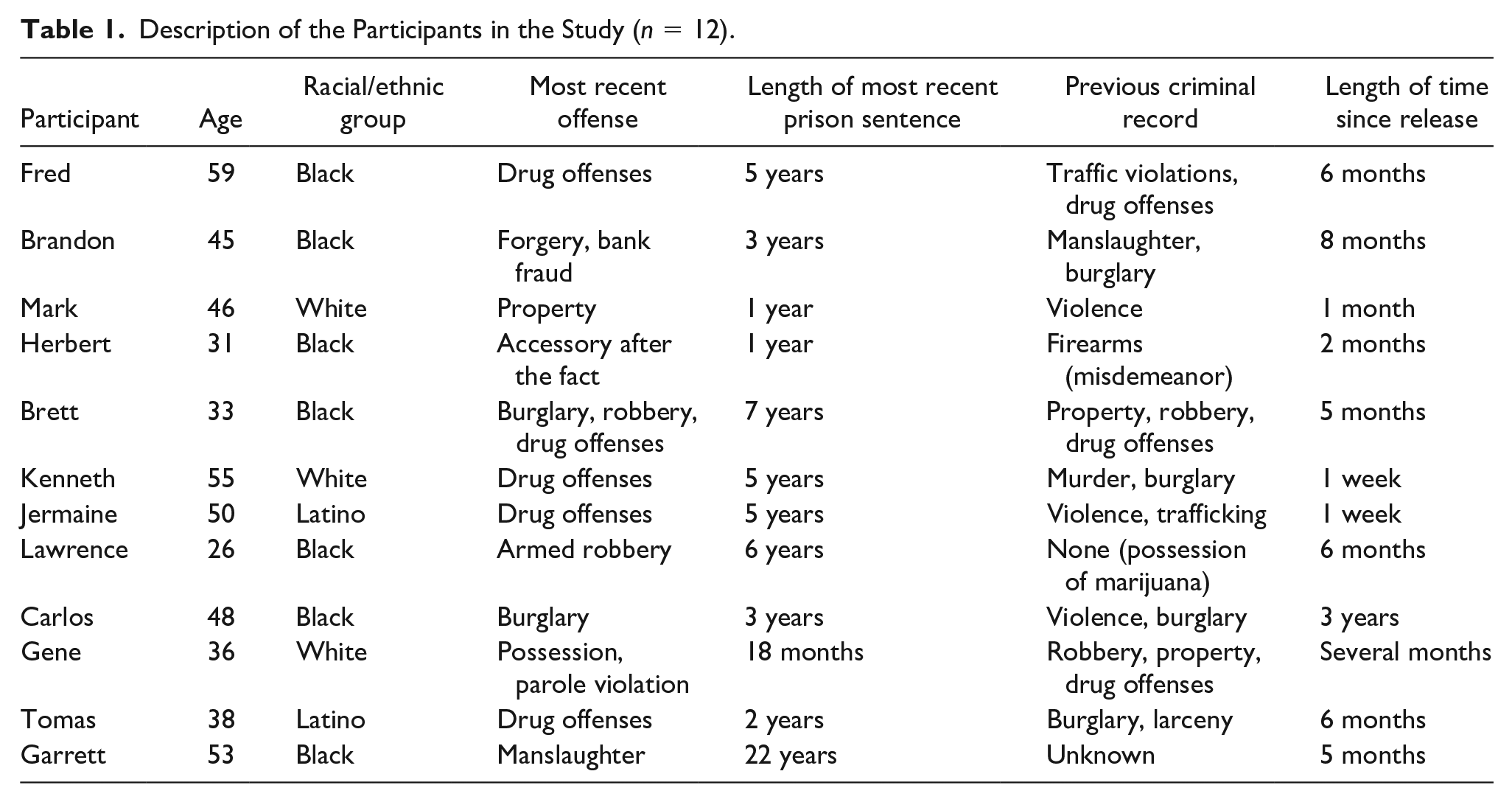
The final sample of participants was heterogeneous with respect to age, racial/ethnic group, the nature of their most recent offense, and criminal history (see Table 1). Participants’ average age was 48, with ages ranging from 26 to 59 years. 4 Most of the men identified as Black or African American (7 men; 58%), three as White (25%), and two as Hispanic or Latino (17%). Six of the respondents had most recently served time for a drug offense (50%), four for a violent offense (33%), and four for a property offense (33%). One had most recently served time for a parole violation (8%). 5 Interviewees’ time living in the community since release ranged from 1 week to 3 years. At the time of the interview, most men were employed (7 men; 58%) and residing in permanent housing (10 men; 83%). Two thirds reported that they were single, separated, or divorced (8 men; 67%), and most had children (9 men; 75%). Of all the participants with minor children (6 men; 50%), only one reported that he was residing with his children (8%).
Description of the Participants in the Study (n = 12).
Findings
The four conceptual themes that emerged in the analysis of formerly incarcerated men’s conceptions of success were (a) success is an honest day’s work, (b) success is ownership, (c) success is helping others, and (d) success is being a “real man.” For convenience, we present these themes separately, although in practice they did not occur in isolation. Their various conceptions of successful reintegration often overlapped, and participants’ life histories often revealed interconnected and interwoven aspects of success. For example, only one man described one conceptualization of success (8%), and most of the others described three or more indicators of success (7 men; 58%).
Success Is an Honest Day’s Work
Most study respondents (8 respondents or 67%) equated successful reentry with stable, legitimate employment and becoming a contributing member of society. For these men, conceptualizations of successful reentry were inextricably tied to their desire for financial independence. For example, Fred,
6
a 59-year-old Black man who was interviewed approximately 6 months following his release from prison for a drug offense, spoke at length about the importance of obtaining legitimate employment and paying taxes. At the time of the interview, he was employed at a nonprofit organization that provided rehabilitative and prevention services to former offenders. Fred emphasized the importance of conforming to society’s rules and his desire to, “get back into society as society is meant to be.” It’s not about get over, it’s about doing the right thing. Get yourself above, you know, the crime line. . . . Incorporate the things that make it work right. Like, don’t be a repeat offender. Pay taxes, go get a job.
Later in the interview, when asked about his long-term goals for the future, he further emphasized his desire to become a “tax-paying member of society.”
Brett, a 33-year-old Black man, also expressed the importance of legitimate employment. For him, legitimate employment was inextricably connected to his sense of self-efficacy and emotional well-being. “Get you a job, and everything else will work out. . . . You just have to go with the first thing that’s available. You know what I mean?” Pride in his work was particularly important to him and represented a cognitive shift from his reentry experiences following previous incarcerations, “I always knew to work, but I never took pride in doing it. So that was my big perspective. For whatever job you have, just take pride in doing it.” For Brett, his connection and pride in his work appeared to play a central role in his reintegration journey. He expressed not taking pride in his work before his most recent incarceration and being mostly focused on obtaining money through whatever means necessary, often illegally. Furthermore, for Brett, his work gave him the solitude and peace necessary to self-reflect and work toward reestablishing himself in his relationships with loved ones, “That’s what I’m thinking. Like, the most comfortable place you could ever imagine, you [are] at work. Comfortable, you got you by yourself. You can think. You know what I mean?”
Participants also described barriers to achieving independence through legitimate employment, including frustration with correctional and reentry programming that did not provide adequate vocational training or instrumental support for reentering offenders seeking employment. For example, Herbert, who was currently unemployed, was critical of prison-based programming for not providing connections to employment opportunities postrelease. He expressed a desire to complete a fork lifting certification course to ameliorate the negative impact of his “fresh” criminal record and allow him to obtain a job that paid a living wage.
Carlos also spoke at length about his need to provide for both himself and his children post-release and the significant barriers he faced to finding stable employment because of his past criminal convictions, I’m free, but I still feel as though I’m in prison. . . . I can’t really provide for myself. I got children I can’t provide for. Every time I mention to a potential employer that I’m just out of prison, the look alone tells you it might not be much of a chance of me getting employed here. . . . At least give me the opportunity at a job. Now, if I mess that up, that’s on me. . . . I just want to be happy, and I know that in order for me to be happy, I have to have peace in my life. . . . Is this what I have to endure just to find a little happiness? Why? You won’t give me this job because I got a burglary charge 10 years ago, [but] what about what I’m doing today? I’m not asking you to give me anything except for an opportunity to prove myself. . . . I just want to live and be comfortable and just be the best me I can be, however you define that.
Kenneth echoed this sentiment. His short-term goal was to apply for a job at a local automotive supply manufacturer, where he believed he would be able to earn a living wage. However, in contrast to his previous reentry experiences after serving prison sentences in the 1990s, he described experiencing a much harder time obtaining employment postrelease.
It’s hard, but . . . can’t hardly find anybody that will hire me with my record now. You know? They be sounding like the job is mine, and then they—my record is so long—They just don’t want to do it.
Thus, to the formerly incarcerated men in our sample, finding employment and engaging in “an honest day’s work” signified success by providing them with a sense of independence and self-efficacy, particularly by earning a legitimate wage to care for themselves and their loved ones.
Success Is Ownership
The formerly incarcerated men in our study also identified ownership as another important indicator of success (seven men; 58%). For many of the men, the epitome of successful reintegration was commonly rooted in either their desire for homeownership or entrepreneurship. Three of them expressed a desire for home ownership. Fred wanted to “reestablish myself as a homeowner, tax payer, and all that stuff, leave a legacy for my daughter.” For Garrett, success was, “trying to get a bigger house with a bigger backyard.” Similarly, Kenneth, who was in recovery for addiction, described hoping for the stability that comes with homeownership and sobriety. When he was interviewed in the weeks following his release from serving a 5-year prison sentence for drug offenses, he was residing with his sister in his deceased parents’ home. He expressed the following: That’s my major long-term [goal]. . . my sister and I are going to sell the home, and I want to get a place of my own that is comfortable, have somewhere that I can call home. You know I mean?. . . something of my own and just keep it up, live these last however many years I got left comfortably without worrying about the next shot and the law. As long as I don’t have to do that—actually, that’s all I want in life now.
Perhaps because of the barriers to obtaining stable employment described above, many men in this study defined success in relation to owning a business. As Tomas, a 38-year-old Latino man, described, “to me, that’s what I believe [is] the American Dream. You own the place you work at. You don’t mess your life up.” Similarly, Brett, a 33-year-old Black man who was interviewed 5 months following a 7-year prison sentence, described wanting to own his own cleaning company. Like others, ownership was also rooted in Garrett’s definition of success. He expressed a long-term desire to own his own food truck, which would give him the financial stability necessary to start a family. Other men in the study expressed a desire to own property and enter the real estate market. As Lawrence put it, In 5 years . . . employment-wise, you know what I want to do in life is I wanna learn how to build houses. Then I want to get into real estate. . . . that way I know how to work on a house. You know? I’m doing roofing right now, so that I have the roofing—I will have the roofing down, but I would like to get into the real estate side of things. Then the next five years I would like to be on my way—hopefully, you know, be good with the roofing—then be able to move onto construction, so I actually learn how to build houses, and, um, get really good with that, and pretty soon be on my way to buying houses.
Brandon (45-year-old Black man) shared this perspective. When asked about his long-term goals for the future, Brandon responded, I need to have a job where I can own something one day. I mean a skill job. I got this little [fast food] job . . . but that’s not really where my heart at. I like having my own business. . . . Real estate, own some stuff. Own some stuff, man. Some properties. You know what I mean? Businesses.
For our sample, ownership—whether of a home or business—was a tangible signifier of success and their achievement of the American Dream, the idea that in America, anyone can achieve a comfortable life through hard work and determination (LeBel et al., 2017).
Success Is Helping Others
Many formerly incarcerated men (9%–75%) indicated that their conceptualizations of success were tied to a desire to turn their past experiences into something positive by dedicating themselves to helping others, most often, children, other former offenders, or recovering addicts. As one participant (Brett) noted when asked about his day-to-day goals, “I strive to be a positive role model for young kids. . . There’s so much going on with the world today. That’s what I strive to do” (33-year-old Black man). A similar example came from Lawrence, a 26-year-old Black man, who described missing out on the birth and early childhoods of significant family members. He spoke about the importance of families and communities and his desire to have a positive influence on the lives of others, including his family and through connections to others through meaningful employment, I finally got out . . . and I just reflect. . . . Our families and communities, you know, and how important it really is. I make sure that our family—I make sure I make the time count. I make sure that I have some type of effect, a positive effect, upon them . . . with my family, with employment. You know, just everything.
Like many other participants, Jermaine, a 50-year-old Latino man, described a desire to help other former offenders dealing with similar struggles. He expressed regret for missing the last decade of his 28-year-old daughter’s life because of his previous incarcerations and their resulting estrangement. He described wishing that he had repaired his relationship with his daughter years ago, rather than waiting until his most recent release from prison. Given his experiences, he expressed a desire to provide advice to men who were experiencing a similar estrangement from their families as a prison volunteer: How do you get somebody to understand that? You know what I mean? Unless I were to go back for some reason. Then I could relay some of these experiences with somebody, but we don’t want that either. So, you know, how do you get people to go back through and give their experiences afterwards [post-release]?
Although, at the time of the interview, only one of the study participants had found employment in a helping profession with an organization providing services to former offenders, several expressed a long-term desire to pursue occupations related to helping others. Brandon, a 45-year-old Black man, illustrated this phenomenon with his desire to become a caseworker for formerly incarcerated individuals, Cause the experience I done went through. I can talk to people. I can pre-judge them and read them and—you know, just me going through the experience, I could help somebody else now. You know what I mean? Spend time with them, show them that it ain’t the way to do this here and that there.
Similarly, Kenneth, a formerly incarcerated 55-year-old White man who struggled with an addiction to heroin, expressed a deeper commitment to work than simply making money. In describing his desire to become an addictions counselor and “help people,” he described the low-paid nature of the job: “It’s not a lot of money, but it’s just—I’m not worried. The money is not the issue. I just need to help people that have the same problem I have.”
One subtheme was evident among those whose conceptions of success were tied to a desire to help others. Many men were concerned that focusing too much on other people might jeopardize their success. For example, “I don’t need—I’m not in the right place, because if I can’t take care of myself, I very well can’t take care of the next person too” (Gene, 36-year-old White man). Another formerly incarcerated man (Lawrence, a 26-year-old Black man) echoed this sentiment when asked what his biggest obstacles would be in the future: My biggest obstacles—That’s a good question. I think my biggest obstacles would be—I would say, just trying to do too much, you know, for other people. Trying to put others before myself. Doing that—too much—there’s nothing wrong with putting others before yourself sometimes, but you’ve got to be careful to not do it too much.
As a third example, Carlos, a 48-year old Black man, interviewed approximately 3 years following release, exemplified this sentiment and expressed a desire to dedicate himself to helping other young men change their lives. When speaking about his long-term goals, he answered, “I would like to help somebody else, because someone helped me.” He later elaborated, describing his desire to give advice to young men in similar situations, I see those young guys out there now doing it. I tell them—I said, ‘I’m going to give you one little piece of advice. . . Those the dues you have to pay. . . Lost my family, lost two families behind it. The streets, it’s greedy.’ I’ve had to go through so much in order just to get that one simple understanding.
Despite his desire to use his experiences to help others, Carlos expressed his need to first focus on himself before devoting himself to helping others, I’m still a work in progress. I’m still learning. I’m still growing, and I still have aches and pains. . . . Right now, my main concern is trying to get me where I need to be. If I can accomplish that then I can turn around and do a whole lot of things for a whole lot of people, but I also got to be mindful that I don’t run a risk of jeopardizing myself again.
Therefore, many of the men defined success as turning their negative experiences into positive ones by helping others to avoid the mistakes they had made. By sharing their regrets and loss, they hoped to help others not to follow the same path as well as to make up for lost time with their own loved ones.
Success Is Being a “Real Man”
A final overarching theme that emerged from the men’s life histories was the emphasis on becoming a “real man.” Underlying their discussion of employment, ownership, and helping others were elements of orthodox heteronormative masculinity. Many formerly incarcerated men (5%–42%) equated successful reintegration with traditional ideals of fatherhood. This theme was especially prominent when formerly incarcerated men discussed their relationships with their significant others and children. For participants, the ability to care for their families was a particularly salient facet of their own ideals of masculinity. As one man (Carlos) described his journey toward achieving masculine ideals, I might not be the man I’m supposed to be, but I’m definitely not the man I used to be. Until I can get my shit together . . . and be able to hold my head up, like a man, and face myself, my children, society, I got to be a little selfish. I need to focus on me. . . . I only have two [goals]. One is—and I’m trying to reach both of them—one is to simply be the best me that I can be. The other is, simply being the best father that I can be. If I can achieve those two goals, everything else isn’t relevant.
Interviewees’ attempts to achieve normative masculinity were often rooted in their desire to financially provide for themselves and their families. Beyond gaining independence, self-efficacy, and pride—all central traits of orthodox masculinity—from legitimate employment and ownership, many participants sought the role of provider. For example, in describing his relationship with his children, Tomas noted, “I dream so many things that I want to be in front of them . . . and most of it is just a dream, because financially it’s not there.”
This theme was also illustrated throughout the interview with Herbert, a 31-year-old Black man, who was interviewed 2 months following a 1-year prison sentence. Describing these ideals, he referred to his live-in partner’s father, who he viewed as the “definition of a man” because he, “makes sure everybody straight, cause that’s his job as a man.” Successful reentry to him was conceptualized as “transforming [himself] into the man [he] needs to be—mentally, emotionally, physically.” When asked about his long-term goals for his future, he described familial and financial stability as integral to his conceptualization of success. Of particular importance to him was eventual reunification with his 4-year-old son who resided out-of-state and his desire to be the “father [he] never had.” He also hoped to marry his partner and described a desire to be the “great husband to her that she needs.” He expressed a desire to be “a great dad—foundation, stability, security—and a great father.” Unemployed at the time of his interview, Herbert described the attainment of stable employment as instrumental for his accomplishment of normative masculinity. As he described succinctly, “that’s what I’m supposed to do as the head [of a family].” When asked about the programs and services formerly incarcerated men need to successfully reintegrate into society, he further elaborated, They just need to . . . make some money and be able to take care of they family. . . if I was coming home to $15 dollars an hour, $17 dollar an hour, $18 dollar and hour, $19 dollars an hour, $20 dollars an hour, I wouldn’t think a damn thing about doing nothing illegal. I’m making good money. I’m not about to mess this up. I’m not doing it. I’m not doing that at all. I would never do that because I don’t want to go back through [prison] again—I’m making enough money where I can take care of me, my wife, my kids, house payments, and take care of everything that a man is supposed to do—to take care of the people around him. I’m making enough money to do that. A lot of people don’t understand. They don’t talk to inmates or talk to us about why we do what we do. Because sometimes we have no choice. You ain’t got no financial crutch. You ain’t got nobody. You on your own. You gotta fucking do that. You can’t get a job. You gonna do what you gotta do to stay afloat and make money, period. That’s a chance nobody should have to take when you paid for your crimes already. You went to prison. You did your time. Why I gotta come home and do the same exact thing that put me in? Because I can’t get no job or get a situation to where I can make good money and be alright?
For our sample, being a “real man” means being the breadwinner, rule-maker, and backbone of a traditional household. Through legitimate employment, ownership of one’s own home or business, and giving back to others, men could redefine themselves as successful men embodying the traits of provider and family head as defined by normative masculine ideology.
Discussion and Conclusion
The current study examined formerly incarcerated men’s conceptualizations of successful reentry using qualitative in-depth life history interviews with previously incarcerated men. Prior literature on offender reintegration has either focused almost exclusively on recidivism as the primary indicator of success or imposed researcher-generated definitions of success after incarceration (for exceptions, see Heidemann et al., 2016; O’Brien, 2001). In an attempt to shed light on how recently incarcerated men conceptualize successful reentry, this project explored how they defined success for themselves. Participants’ responses revealed that the avoidance of future criminal behavior and justice system contact were not overtly salient to men’s conceptions of success. Rather, research findings highlighted four interconnected and interwoven themes that would be hindered by further entanglement with the justice system. Men conceptualized success as (a) obtaining stable, legitimate employment and becoming a contributing member of society, (b) homeownership or entrepreneurship, (c) dedicating themselves to helping others, and (d) achieving their own expectations of masculinity.
Consistent with recent research (e.g., Giordano et al., 2002; Paternoster & Bushway, 2009) on the role of cognitive identify transformation among former offenders, we illustrate men who are beginning the reintegration process following incarceration use employment as an avenue for constructing a new identity. The study participants perceived employment in a manner conducive to the cognitive transformation that occurs when individuals “begin to fashion an appealing and conventional ‘replacement self’ that can supplant the marginal one that must be left behind” (Giordano et al., 2002, p. 1001). However, as Giordano et al. (2002) describe, both “exposure to a hook and one’s attitude toward it are important elements of successful change” (p. 1001). Whereas men in our study defined employment as fundamentally beneficial and incompatible with future offending, most lacked the exposure to the hook (i.e., an honest day’s work) due to the considerable barriers they experienced attempting to secure legitimate employment. The importance of homeownership or entrepreneurship to men’s conceptions of successful reentry also illustrates that men strive for tangible evidence of this “replacement self” and conventional signs of social standing and success.
Our results are also consistent with the research literature documenting the importance of helping other formerly incarcerated individuals’ reintegration processes. Indeed, rather than an intentional “knifing off” from their past lives (Laub & Sampson, 2003; Maruna & Roy, 2007), our analysis supports a cognitive transformation consistent with the redemption scripts identified in Maruna’s (2001) study of former offenders. Maruna (2001) found that many former offenders adopted the role of change agent, what he called “the generative role of the wounded healer,” and felt compelled to turn their past experiences into something positive and help other former offenders or recovering addicts with their problems (p. 102). Wounded healers then become role models for others and “use their wealth of criminal experience for prosocial ends” (Maruna, 2001, p. 120). Like the individuals in Maruna’s (2001) study (also see Carlsson, 2013; Heidemann et al., 2016; LeBel, 2007; LeBel et al., 2015; Maruna & Roy, 2007), individuals in our study did not necessarily break away from their past lives. Rather, they sought to craft new generative identities and conceptualized successful reentry as using their past experiences to assist ex-offenders and others in similar situations as themselves. Men’s conceptions of success were tied to role transformations that involved assimilating their past lives into new identity scripts for the future that involved helping others change their lives.
These findings also highlight the gendered nature of men’s conceptualizations of successful reintegration following prison. As theorized by numerous gender scholars, gender is not a biological reality as much as a cultural “script” for behavior; therefore, how one presents one’s self in a given situation may be thought of as “doing” gender, to the extent one behaves within the framework of certain gender norms. In other words, doing gender is how one declares their masculinity or femininity to the society (Connell, 2005; Messerschmidt, 1993; West & Zimmerman, 1987). “Doing masculinity” (Messerschmidt, 1993, 1997, 2000, 2004, 2012), therefore, is how one acts out one’s masculine self in relation to gender normative beliefs and in contrast to femininity. For instance, to be “masculine” is to be dominant, independent, aggressive, sexually promiscuous, and unemotional—traits that are praised in men and punished in women (Connell, 2005; Kimmel & Messner, 1995; West & Zimmerman, 1987).
Participants’ replacement selves involved reconceptualizations of their masculinity either explicitly or implicitly. The most valued masculinity traits vary depending upon one’s age and social status. Whereas risk-taking, rebelliousness, and sexually promiscuity are celebrated in adolescences and young men, adult men are praised for being financial providers, leaders, and in monogamous relationships (Spector-Mersel, 2006). To be successful at masculinity in adulthood, one must demonstrate independence, autonomy, control, and rationality (Messerschmidt, 2000; Spector-Mersel, 2006). Thus, although our respondents varied in age, it is likely that their incarceration experiences may have changed their attitudes around masculinity and their perceptions of what it means to be a “real man” upon reentering society. For many, fatherhood was an opportunity to “do masculinity” in a new way. They most often expressed their masculine expectations in relation to their significant others and children, and the desire to financially provide and care for their partners and children was particularly salient in their descriptions of their future goals and processes of successful reentry. The men’s connections to their partners and children provided opportunities, or the hooks, to enact their shifts in attitudes around being a “real man” (see Giordano et al., 2002).
Beyond explicit discussions of manhood, normative masculine beliefs were implicitly found in our other themes as well. The desire to secure stable, legitimate employment and engage in an “honest day’s work” demonstrated their desire for independence and self-reliance. In addition, achieving legitimate employment would provide the means to be providers for loved ones and caretakers for others. Furthermore, homeownership would exhibit their independence, autonomy, and control. In this manner, ownership means not answering to authority or having to ask permission from others and also serves as tangible evidence of managing social responsibilities. Finally, men’s definitions of successful reintegration included a desire to dedicate themselves to helping other similarly situated individuals and become a role model, mentor, or father-figure to others, which further exemplifies the importance of norms of positive prosocial masculinity to participants (see also Carlsson, 2013). To the individuals in our study, adopting the role of a “wounded healer” (Maruna, 2001) may have been grounded in their normative beliefs about masculinity and desire to demonstrate the valued masculine traits of leadership, rationality, and stability.
While the men in this study engaged in cognitive transformations (Maruna, 2001) and identity shifts (Giordano et al., 2002), this occurred through a masculine lens (Carlsson, 2013). That is, formerly incarcerated men’s definitions of successful reintegration parallel, but are distinct from, that of formerly incarcerated women (Heidemann et al., 2016). Like their female counterparts (Heidemann et al., 2016), their definitions of success extended far beyond their basic needs upon reentry, such as housing, transportation, and employment, or the avoidance of recidivism. Rather, such were necessary means to their greater desire for independence, autonomy, and the achievement of societal expectations for masculinity. Furthermore, much like formerly incarcerated women (Heidemann et al., 2016), the men in our study desired to help and become a positive influence on others, most often children, other formerly incarcerated individuals, or recovering addicts. However, while women spoke explicitly of their goals in relation to themselves and their families (Heidemann et al., 2016), the men in our study used more general language about fatherhood and what it means to be a “real man” rooted in their perceptions of masculinity and status (also see Carlsson, 2013).
Despite these findings, this study has several limitations. First, the results of this study should not be used to understand the conceptualizations of successful reentry experiences for all men. This analysis focused on one group of men who were recently incarcerated in South Carolina prisons and were recruited by program staff at a voluntary reentry program. Therefore, the findings may not generalize to men who either chose not to participate in reentry programming or those who were incarcerated in other jurisdictions. Also, because of the recruitment method used (i.e., the research staff only received the details and contact information for men who were contacted by reentry program staff and agreed to hear about the study), we possibly missed potential participants who lacked permanent telephone numbers/contact information, lived on the streets, or were reinstitutionalized. Formerly incarcerated men characterized by more extreme disadvantage may construct reentry success in a manner not currently illuminated by our analyses. Thus, future research should consider alternative sampling strategies such as snowball sampling, sampling the general prison population, or sampling through nonprofit agencies that serve vulnerable populations.
As with qualitative research more generally (Ravitch & Carl, 2016), while the findings cannot be used to generalize to a broader population of formerly incarcerated men, our rich, in-depth exploration of how men define successful reentry is best used to discover the meaning men attach to the success of their reentry experiences, identify new avenues for research, and unpack new and existing theoretical concepts. Therefore, this study suggests that future research should focus on further unpacking the role of gender (as well as race and other status characteristics) on the experience of reentry for all formerly incarcerated individuals. More studies, such as this, which provide voice to the often voiceless, are needed to humanize the experience of reentry as well as better craft assisted pathways back into society.
Beyond the importance of recidivism to successful reentry, serious consideration must be given to understanding and examining alternative conceptualizations of success that incorporate formerly incarcerated individuals’ strengths, desires, and social relationships. As we demonstrate, the men’s conceptions of successful reentry take many forms. Municipalities, practitioners, and scholars should strive to develop strengths-based conceptions of reentry that move beyond approaches that focus exclusively on successful reentry as the absence of negative behaviors and future justice system contact. Understanding how formerly incarcerated individuals define successful reintegration can more efficiently and effectively help service providers meet individual needs and honor the uniqueness and complexity of their lives.
Footnotes
Acknowledgements
We wish to thank Kelsey Collins, Mark Sellers, and the supporters of our crowdfunding campaign. This project was enhanced by their interest, expertise, and generosity.
Declaration of Conflicting Interests
The author(s) declared no potential conflicts of interest with respect to the research, authorship, and/or publication of this article.
Funding
The author(s) disclosed receipt of the following financial support for the research, authorship, and/or publication of this article: This project was supported by University of South Carolina funds and an  crowdfunding campaign. We wish to thank Kelsey Collins, Mark Sellers, and the supporters of our crowdfunding campaign. This project was enhanced by their interest, expertise, and generosity.