



Abstract
The purpose of the current study was to determine whether a change in criminal thinking or a change in perceived certainty mediates the putative criminogenic effect of incarceration. A path analysis of 1,170 male delinquents revealed that incarceration prior to age 19 produced a negative rather than positive effect on offending behavior at age 20, although it did predict an increase in proactive criminal thinking (PCT) from age 18 to age 19. PCT, in turn, predicted a rise in past year offending. Perceived certainty of punishment, on the other hand, failed to mediate the effect of incarceration on future offending.
Keywords
Introduction
Deterrence theory holds that incarceration, by increasing the cost of crime, serves as a deterrent to future offending. This is an assessment, however, with which not all offenders agree. Kolstad (1996) surveyed a small group of prison inmates (N = 36) and discovered that only 19% alleged that prison had a strong deterrent effect, with another 44% indicating that it had a weak or partial deterrent effect. Over one-third of the sample (36%) believed prison had no deterrent effect at all. Further analysis revealed that nearly half the sample (44%) considered themselves more hostile or critical as a consequence of their prison experience, and all but a handful (92%) viewed prisons as universities of crime where offenders learn attitudes and techniques that increase their propensity to commit crime upon release. After spending 6 months in prison, control participants in a Maryland study who had been randomly assigned to prison rather than to a boot camp displayed significant decrements in self-control and anger management and significant increments in criminal attitudes and behaviors. By contrast, participants randomly assigned to the boot camp experienced minimal change except for a small reduction in self-control (MacKenzie et al., 2007). These findings suggest that incarceration may create a criminogenic effect in addition to or instead of its presumed deterrent effect.
The Criminogenic Effect of Incarceration
In an early study on the putative criminogenic effect of incarceration, Vieraitis et al. (2007) determined that an increase in the number of state prison releases predicted an increase in the overall crime rate. Vieraitis et al. (2007) interpreted these findings to mean that incarceration augmented future offending. Reviewing a number of the other early studies in this area, Nagin et al. (2009) concluded that the effect of incarceration on future offending was either null or criminogenic. Weatherburn (2010) uncovered evidence of a criminogenic effect for incarceration in 406 matched pairs of offenders convicted of non-aggravated assault and assigned to either prison or probation. Those assigned to prison were significantly more likely to recidivate upon release than those assigned to probation. Contrasting offenders who were sentenced to prison or probation by judges who differed in their propensity to imprison defendants, Harding et al. (2017) discovered that those sentenced to prison were significantly more likely to be arrested within 3 years of release than those sentenced to probation, although the effect was restricted to offenders found guilty of a technical probation or parole violation rather than those convicted of a new felony. Most recently, Caudy et al. (2018) noticed that imprisoned male and female offenders were more likely to recidivate than male and female offenders placed on probation, although in this case, the effect was strongest for higher risk offenders.
In one of the largest studies to examine the putative criminogenic effects of incarceration, Bales and Piquero (2012) compared 79,000 felons sentenced to state prison to 65,000 offenders sentenced to community control in Florida. The results showed a criminogenic effect for incarceration in the form of significantly higher rates of recidivism for inmates released from prison. In a second study using some of these same data, Mears et al. (2016) ascertained that serving more time increased recidivism at first, decreased it after a year, and produced a null effect after 2 years. Studies employing a person-rather than variable-centered approach to the question of recidivism in response to imprisonment also show proof of a criminogenic effect, although the criminogenic pattern appears to be restricted to a minority of inmates. Bhati and Piquero (2007), for instance, observed a deterrent effect that was ten times more prevalent than the criminogenic effect (40% vs. 4%) in a large group of released state prisoners. Walters (2016b) witnessed a somewhat higher proportion of criminogenic profiles in a group of medium security federal prison inmates before, during, and after incarceration, but deterrence profiles still predominated (72% vs. 28%).
Cognitive Mediation of the Incarceration–Future Offending Relationship
The inconsistent results obtained in research on incarceration and future offending suggests that a mediational mechanism may be at work. Mediation variables help explain potential causal relationships by identifying a mechanism that links the independent and dependent variables. We need look no further than the previously reviewed Kolstad (1996) and MacKenzie et al. (2007) studies for clues as to potential mediators of the incarceration–offending relationship. Both studies found that negative peer associations and exposure to antisocial attitudes were common occurrences in prison. These experiences, it would seem, dovetail with the criminal thinking dimension of proactive criminal thought process, based on research showing that delinquent peer associations are linked to proactive (planned, calculated, callous) criminal thinking (Walters, 2016a). Walters (2003) likewise observed a time-dependent rise in proactive criminal thinking in novice (no prior prison terms) as opposed to experienced (at least 5 years spent in prison) inmates. Deterrence theory offers an alternate view: that is, prison inhibits future offending by increasing the perceived severity and certainty of punishment in those whose antisocial behavior is followed by incarceration (Beccaria, 1986). Because research indicates that the certainty of punishment is a much stronger deterrent than the severity of punishment (Nagin, 2013) and serious questions have been raised about the deterrent value of prison (Nagin et al., 2009), perceived certainty served as the mediator of a pathway, against which the predictive efficacy of a pathway mediated by proactive criminal thinking was compared.
The Present Study
The gap the current study was designed to fill is one which spans the distance between incarceration and subsequent offending. Measures of proactive criminal thinking and perceived certainty of punishment were positioned between measures of prior incarceration and future offending to determine whether one or both offer a consistent model of criminogenic influence. To control for factors deemed important in research on criminalization and incarceration—that is, age, sex, race, criminal history (Nagin et al., 2009), and prior peer influence (Harris, 2015)—an all-male sample of serious juvenile offenders was examined across age, using race, age at first arrest, and peer delinquency as control variables. Because most of the participants in this study were incarcerated in their late teens to early twenties, an attempt was made to assess incarceration as proximally to criminal thinking and offending as possible. Thus, while there was proper temporal order between variables (i.e., the period of incarceration began before criminal thinking and certainty were assessed and criminal thinking/certainty were measured before offending was measured), there was overlap between the independent variable (incarceration) and both the mediator (criminal thinking and perceived certainty) and dependent (future offending) variables. It was hypothesized that proactive criminal thinking would demonstrate a significantly better ability to mediate the relationship between incarceration and future offending than perceived certainty of punishment.
Method
Participants
Participants were 1,170 male offenders from the Pathways to Desistance study (Mulvey, 2012). Each participant had been adjudicated delinquent or convicted of a crime between 2000 and 2002 when they were 14 to 18 years of age. Sampling took place in Phoenix, Arizona and Philadelphia, Pennsylvania. A baseline interview was scheduled within several months of initial contact, and follow-up interviews were conducted every 6 months for the first 3 years of the project and every 12 months for the final 4 years of the project. Data for the Pathways study was originally collected in waves but were organized into age bands for the purposes of the current investigation. The three age bands used in the present study were age 18, age 19, and age 20. All participants had been arrested at least once prior to the start of the study, with initial arrests occurring between the ages of 9 and 18 years (M = 14.86). The racial/ethnic breakdown of the sample was 19.2% White, 42.1% African American, 34.0% Hispanic, and 4.6% other.
Measures
Independent variable
The independent variable for this study was incarceration. The sole measure in the Pathways study that assessed incarceration was a single item that asked interviewers to indicate where the interview took place. If the interview took place in jail, prison, or a detention facility, the individual was classified as incarcerated. If the interview did not take place in jail, prison, or a detention facility, the individual was classified as not incarcerated. The interview used to classify participants as incarcerated or not incarcerated took place when the individual was 19 years of age. It was assumed for the purposes of this study that the individual was present in the facility prior to the actual interview for a period of at least 1 day, and that they remained in the facility after the interview for a period of days, weeks, or months.
Mediator variables
Proactive criminal thinking and perceived certainty of punishment served as mediator variables in this study. Proactive criminal thinking (PCT) was assessed with Bandura et al.’s (1996) Moral Disengagement (MD) scale, a 32-item measure designed to assess moral justification, euphemisms, advantageous comparisons, displacement of responsibility, diffusion of responsibility, distortion of consequences, misattribution of blame, and dehumanization. Each item (e.g., “It is alright to fight to protect your friends”; “Stealing some money is not too serious compared to those who steal a lot of money”) is rated on a three-point scale (1 = disagree, 3 = agree), from which an average score is derived. The MD scale achieved excellent internal consistency in the Pathways study (α = .90–.92: Mulvey, 2012) and loaded heavily onto a latent PCT factor in a study by Walters and Yurvati (2017).
Perceived certainty of punishment was measured with the Certainty of Punishment (Self) scale from the Social and Personal Costs and Rewards of Crime (SPCRC: Nagin & Paternoster, 1994). Respondents completing the SPCRC are asked to rate each of seven different criminal or antisocial acts (i.e., fighting, robbery with a gun, stabbing someone, breaking into a store or home, stealing clothes from a store, vandalism, and auto theft) on an 11-point scale (0 = no chance of being caught, 10 = absolute certainty of being caught) in terms of their perceived likelihood of getting caught and being punished should they commit any of these criminal or antisocial acts. The mean rating across the seven offenses was calculated and served as the measure of perceived certainty of punishment in the present study. The Certainty of Punishment scale displayed strong internal consistency in the current sample of participants (α = .85–.92).
Dependent variable
The total offending variety score from Huizinga et al.’s (1991) Self-Reported Offending scale (SRO) served as the dependent variable in this study. The SRO addresses 22 categories of crime, to include damaging property, setting fires, breaking in to steal, shoplifting, buying or receiving stolen property, illegally using a check or credit card, stealing a car or motorcycle, selling marijuana, selling other drugs, carjacking, driving drunk or high, being paid by someone for sex, forcing someone to have sex, killing someone, shooting someone, shooting at someone, taking by force with a weapon, taking by force without a weapon, causing serious injury, participating in a fight, beating someone up as part of a gang, and carrying a gun. The number of crime categories the individual reported engaging in over the course of the past year was then divided by the total number of possible categories (i.e., 22) to produce a variety score that could range from 0 to 1.00. The SRO was assessed during the age 20 interview for the purposes of the current investigation. Sweeten (2012) notes that variety scores tend to have psychometric and statistical properties that make them superior to dichotomies and frequency scores.
Control variables
There were three control variables included in the present study: race, age at time of first arrest, and peer delinquency. Given the fact that all participants in this study were male and of the same age, there was no need to control for sex and age. Race, on the other hand, differed between participants and was controlled (White = 1, Non-white = 2). Self-reported age at time of first arrest was assessed and served as an indicator of prior criminality. Peer delinquency also served as a control variable, using the combined score from the Antisocial Behavior and Antisocial subscales of Thornberry et al.’s (1994) Peer Delinquent Behavior scale. This measure is scored by having the respondent estimate the proportion of friends (1 = none of them, 2 = very few of them, 3 = some of them, 4 = most of them, 5 = all of them) who participate in various delinquent acts (e.g., “purposely damaged or destroyed property that did not belong to them”) and who encourage the respondent to engage in antisocial activity (e.g., “how many of your friends have suggested that you should sell drugs”). The 19-item Peer Delinquent Behavior scale achieved good internal consistency in the Pathways study (α = .88–.92: Mulvey, 2012).
Cole and Maxwell (2003) recommend that prior levels of the mediating and dependent variables be controlled whenever a mediation analysis is performed. Hence, prior levels of PCT and certainty assessed at age 18 were included as covariates in the regression equations predicting age 19 PCT and certainty, respectively, and age 18 offending was included as a covariate in the regression equation predicting age 20 offending. The inclusion of these precursor measures in the analysis also helped establish the causal order and direction of the independent, mediating, and dependent variables. Even though the independent (incarceration) and mediating (PCT, certainty) variables and independent (incarceration) and dependent (previous year’s offending) variables overlapped, there was no overlap between the mediator (PCT, certainty) and dependent (offending) variables. Because the recall period for the age 20 interview varied from 8 to 16 months, time at risk was controlled when offending was predicted.
Research Design
The study employed a three-wave longitudinal design with partial overlap between the independent variable, on the one hand, and the mediating and dependent variables, on the other hand. The independent variable (incarceration) preceded the mediator variables (PCT, certainty), and the mediator variables preceded the dependent variable (offending); but because incarceration began before and persisted beyond the age 19 interview, it traversed the mediator (assessed during the age 19 interview) and dependent (covering a 1-year period between the age 19 and 20 interviews) variables. Whereas the overlap between variables may violate the causal order assumption of mediation analysis, it was reasoned that it was still better than using a more distal measure of incarceration (e.g., age 18 interview), given how many male members of the Pathways study were incarcerated during one or more interviews (73.4%) and how important it was for the three variables to be measured proximally. Furthermore, evaluating changes in criminal thinking and perceived certainty from age 18 to 19 and a change in offending from age 18 to 20, instead of a stable estimate at one point in time, strengthens the causal direction assumption upon which mediation analysis is based. A supplemental analysis was performed to test the limits of the results from the main analysis. In this supplemental analysis, incarceration at age 18 served as the independent variable, PCT and perceived certainty at age 18 served as mediator variables, and offense variety at age 19 served as the dependent variable.
Data Analytic Plan
A path analysis was performed on data from the Pathways study organized into three age bands (<19 years, 19 years, and 20 years). Analyses were conducted using MPlus 8.1 (Muthén & Muthén, 1998–2017) and a maximum likelihood (ML) estimator. Bootstrapping (5,000 replications) was used to construct bias-corrected bootstrapped 95% confidence intervals. A confidence interval that does not include zero is considered significant. Research has consistently shown that bias-corrected bootstrapping is superior to normal theory approaches in modeling the non-normality of indirect effects and controlling for non-normality in the dependent variable (Hayes, 2013; Rucker et al., 2011).
The sequential ignorability assumption (Imai et al., 2010) holds that omitted variables do not account for the results of a mediation analysis. A sensitivity test using Kenny’s (2013) “failsafe ef” procedure—(rmy.x) x (sdm.x) x (sdy.x)/(sdm) x (sdy)—was performed to test the sequential ignorability assumption. The “failsafe ef” generates a coefficient that signals how well a covariate confounder would need to correlate with the mediating and dependent variables, after controlling for the mediator and independent variables in the case of the latter, to eliminate a significant coefficient along the b path of the indirect effect. Because conditioning on a precursor can create a collider effect and inflate path coefficients by way of endogenous selection bias (Elwert & Winship, 2014), a second sensitivity analysis was conducted in which the precursor measures for the three regression equations were removed from the analysis.
Missing Data
Three-quarters of participants had complete data on all 11 study variables (76.1%). Another 3.3% were missing data on one variable, 10.9% were missing data on two variables, 6.0% were missing data on three or four variables, and 3.7% were missing data on five to eight variables. Three variables had more than 10% missing data: Age 19 Certainty (12.1%), Age 20 Offending (12.8%) and Time at Risk (12.6%). Missing data were handled with full information maximum likelihood (FIML), which estimates model parameters and standard errors from analyses performed on all non-missing data. FIML is robust to violations of its basic assumptions (Collins et al., 2001), and has been found to produce results that are significantly less biased than those generated by more traditional missing data procedures like simple imputation and listwise deletion (Allison, 2012).
FIML rests on two assumptions: (1) that data are missing at random (MAR), and (2) that data are multivariate normal. MAR is normally untestable because the data required to evaluate the MAR assumption are, by definition, missing. Hence, if participants with high levels of criminal thinking systematically refuse to answer a criminal thinking inventory, this would be a violation of the MAR assumption. Although there was nothing to suggest violation of the MAR assumption, neither could it be ruled out. Multivariate normality was tested by comparing standard errors obtained with an ML estimator and standard errors attained using a maximum likelihood with robust parameters and standard errors (MLR) estimator (Muthén, 2010). The results revealed that the two sets of standard errors were virtually identical (average difference of 1.5% with a range of 0% to 12.5%), providing evidence of multivariate normality.
Results
Main Analysis
Descriptive statistics for the 11 variables included in the present investigation, along with variable inter-correlations, are listed in Table 1. As the results in this table indicate, nearly half the correlations achieved significance using a Bonferroni-corrected alpha level. Incarceration achieved a significant inverse correlation with future offending (r = −.07, p < .05), that became non-significant when subjected to Bonferroni correction. There was no evidence of multicollinearity between predictor variables in any of the regression equations included in the present study (tolerance = .661‒.992, variance inflation factor = 1.009‒1.512).
Descriptive Statistics and Correlations for the 11 Independent, Dependent, Mediator, and Control Variables.
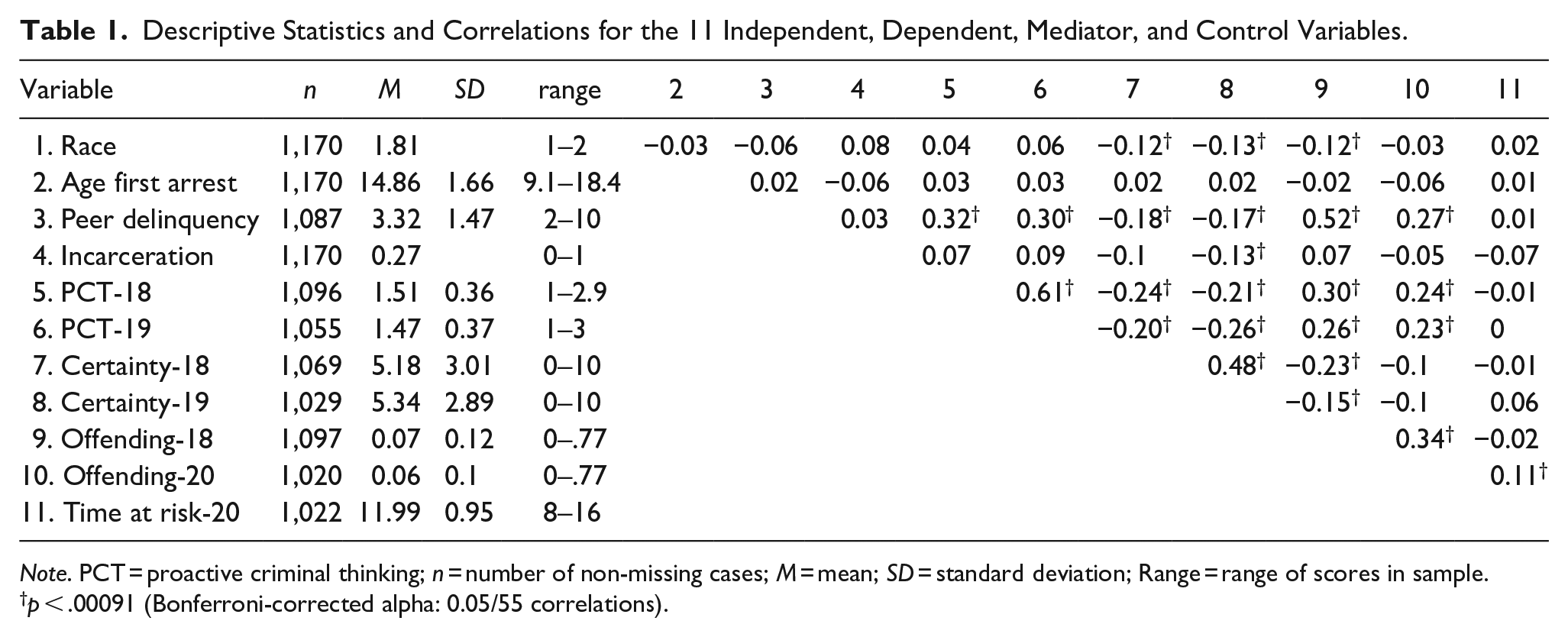
Note. PCT = proactive criminal thinking; n = number of non-missing cases; M = mean; SD = standard deviation; Range = range of scores in sample.
p < .00091 (Bonferroni-corrected alpha: 0.05/55 correlations).
The results of a path analysis of the incarceration → PCT/certainty → offending relationships are summarized in Table 2 (see also Figure 1). Two out of the four path coefficients (a path coefficient from incarceration to certainty and b path coefficient from PCT to offending) were significant, but the a path coefficient from incarceration to certainty was negative, suggesting that incarceration reduced perceived certainty of punishment. A third path coefficient (a path coefficient from incarceration to PCT) approached significance (p = .07). The total indirect effect of the PCT-mediated pathway was significant, the indirect effect of the certainty-mediated pathway was non-significant, and the difference between pathways was non-significant (see Table 3). The direct effect (from incarceration to future offending) was significant and the negative valence implies a deterrent effect.
Maximum Likelihood Path Analysis of the Incarceration−Offending Relationship.

Note. PCT = proactive criminal thinking; Outcome = outcome variable for that particular regression equation; with = covariance; b (95% CI) = unstandardized coefficient and the lower and upper limits of the 95% confidence interval for the unstandardized coefficient (in parentheses); β = standardized coefficient; z = Wald Z test; p = significance level of the Wald Z test; N = 1,170.

Maximum likelihood (ML) path analysis of the mediating effects of proactive criminal thinking and perceived certainty on the incarceration-offending relationship from before age 19 to age 20 in the Pathways to Desistance study.
Total, Direct, and Indirect Effects for Pathways Running from Incarceration to Offending: Main Analysis.
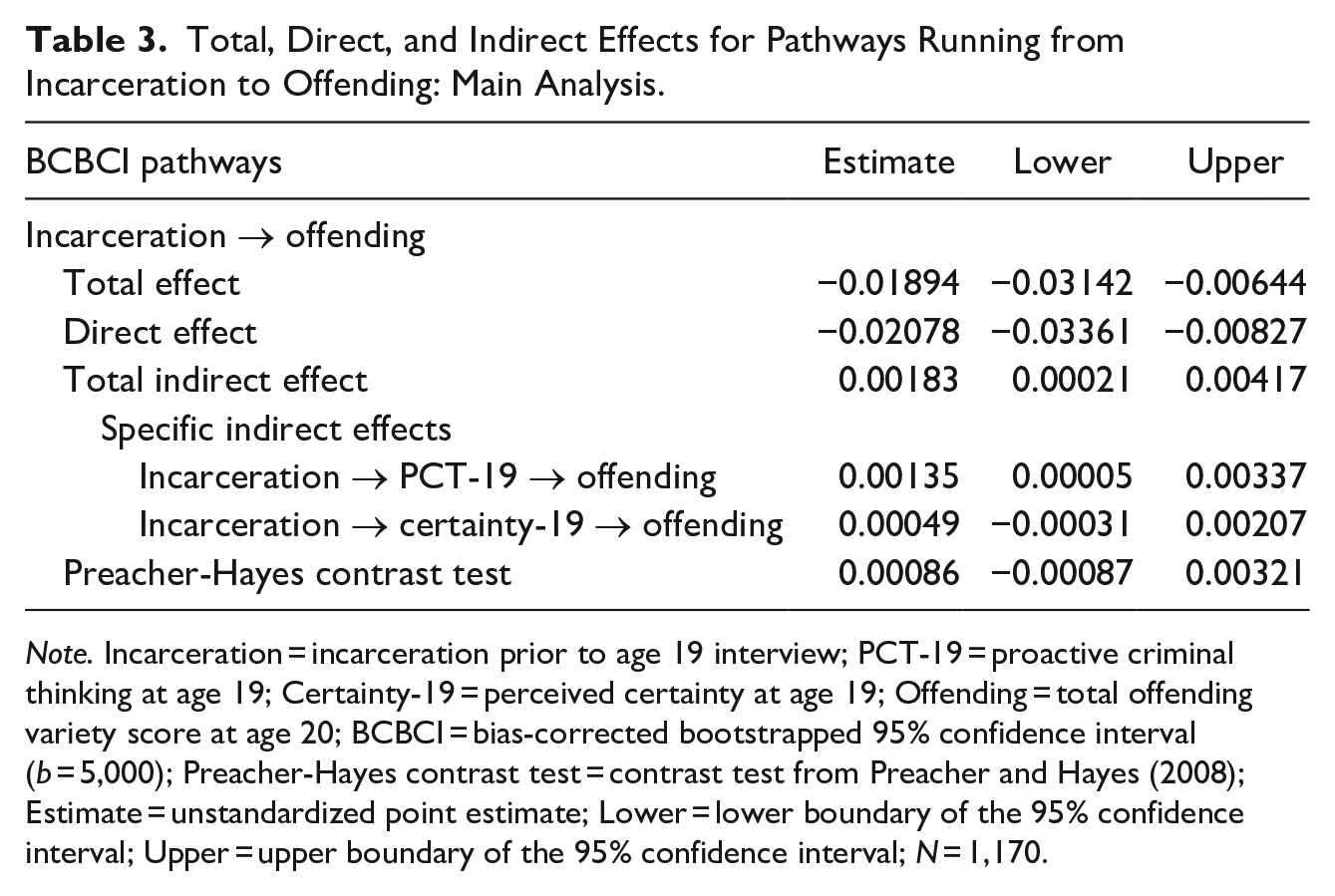
Note. Incarceration = incarceration prior to age 19 interview; PCT-19 = proactive criminal thinking at age 19; Certainty-19 = perceived certainty at age 19; Offending = total offending variety score at age 20; BCBCI = bias-corrected bootstrapped 95% confidence interval (b = 5,000); Preacher-Hayes contrast test = contrast test from Preacher and Hayes (2008); Estimate = unstandardized point estimate; Lower = lower boundary of the 95% confidence interval; Upper = upper boundary of the 95% confidence interval; N = 1,170.
Sensitivity testing was performed using the “failsafe ef” procedure, with results showing that a covariate confounder would need to correlate .22 with the mediator (PCT) and .22 with the dependent variable (offending), controlling for incarceration and PCT in the case of the dependent variable, to eliminate the significant b path coefficient for the PCT-mediated indirect effect. Because path coefficients increased rather than decreased when precursor measures were removed from the regression equations, there was no evidence of a collider effect in this study.
Supplemental Analysis
A supplemental analysis was performed on variables measured a year before the variables from the main analysis. Hence, incarceration was assessed at age 18 instead of 19, the two mediator variables were measured at age 18 instead of 19, and the outcome measure was appraised at age 19 instead of 20. A path analysis conducted on these supplemental data showed that three out of the four path coefficients were significant: the a and b paths of the PCT-mediated pathway and the b path of the certainty-mediated pathway (see Figure 2). Again, the indirect effect of the PCT-mediated pathway was significant, the indirect effect of the certainty-mediated pathway was non-significant, and the two pathways were not significantly different from one another (see Table 4).

Maximum likelihood (ML) path analysis of the mediating effects of proactive criminal thinking and perceived certainty on the incarceration-offending relationship from before age 18 to age 19 in the Pathways to Desistance study.
Total, Direct, and Indirect Effects for Pathways Running From Incarceration to Offending; Supplemental Analysis.
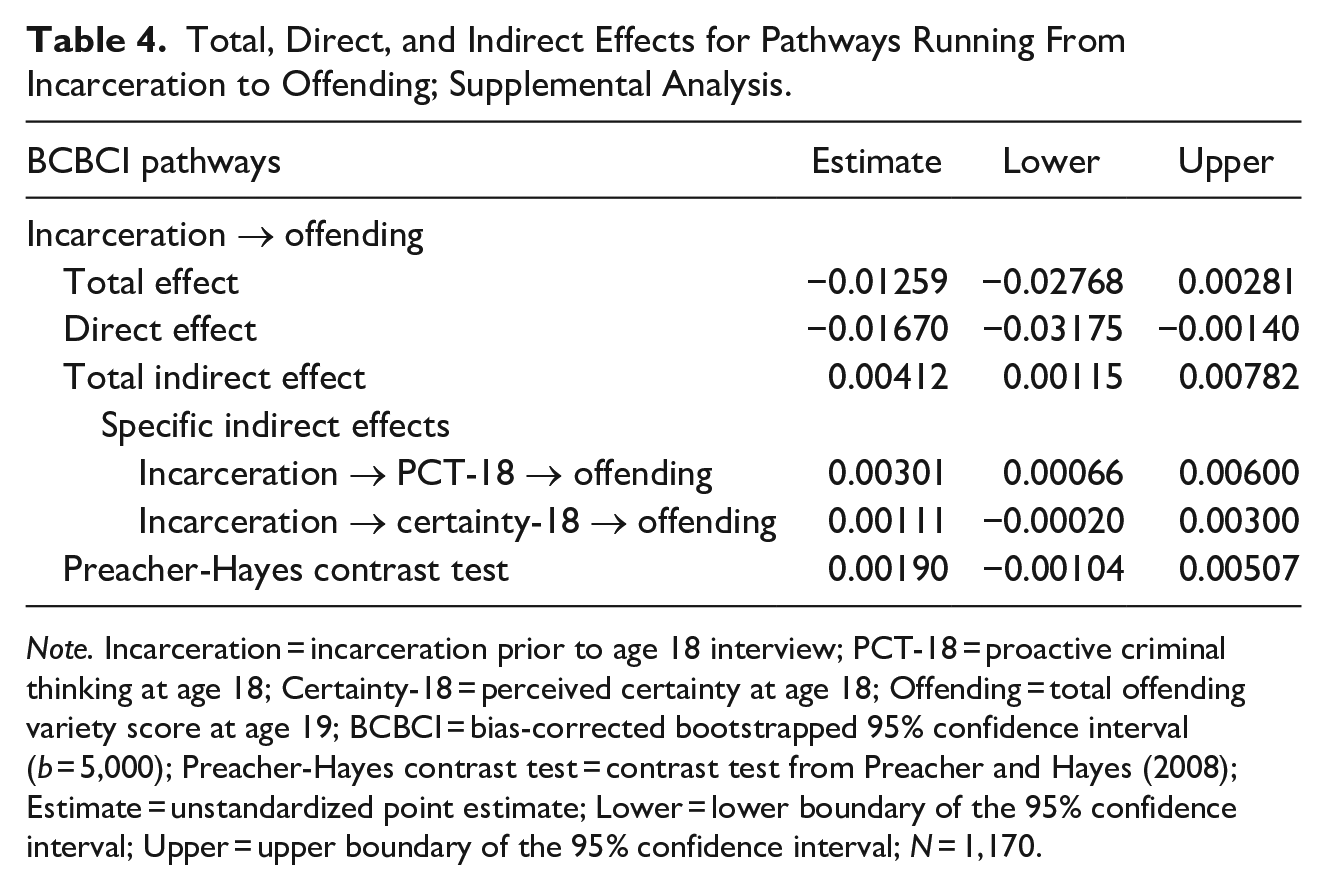
Note. Incarceration = incarceration prior to age 18 interview; PCT-18 = proactive criminal thinking at age 18; Certainty-18 = perceived certainty at age 18; Offending = total offending variety score at age 19; BCBCI = bias-corrected bootstrapped 95% confidence interval (b = 5,000); Preacher-Hayes contrast test = contrast test from Preacher and Hayes (2008); Estimate = unstandardized point estimate; Lower = lower boundary of the 95% confidence interval; Upper = upper boundary of the 95% confidence interval; N = 1,170.
Sensitivity testing using the “failsafe ef” procedure revealed that an unobserved covariate confounder would need to correlate .25 with the mediator variable (PCT) and .25 with the dependent variable (offending), controlling for incarceration and PCT in the case of the dependent variable, to erase the significant coefficient along the b path of the PCT-mediated pathway that arose in this supplemental analysis. In addition, when the three precursor measures were removed from the regression model used to test the limits of the main analysis, each of the coefficients increased rather than decreased, which is inconsistent with a collider effect.
Discussion
The hypothesis tested in this study predicted that proactive criminal thinking would do a significantly better job than certainty of punishment in mediating the relationship between incarceration and future offending in a multiple mediator regression model with two parallel mediators. Using a well-validated measure of moral disengagement—Bandura et al.’s (1996) MD scale—as a proxy for PCT and a measure of perceived certainty of punishment as mediators, a path analysis was performed. The results of the path analysis, in which partially overlapping longitudinal data were evaluated against bias-corrected bootstrapped confidence intervals, showed that incarceration prior to age 19 predicted a change in PCT from the age 18 interview to the age 19 interview, and PCT at age 19 predicted a change in offending from the age 18 interview to the age 20 interview. Certainty of punishment, on the other hand, failed to mediate the incarceration–offending relationship. In fact, contrary to predictions from deterrence theory, incarceration reduced rather than enhanced perceived certainty of punishment. A significant PCT-mediated indirect effect and non-significant certainty-mediated indirect effect were again observed when the same variables measured a year earlier were analyzed. Sensitivity testing revealed that these results were moderately robust to the effects of omitted variable bias and that endogenous selection bias had no apparent effect on the results.
Findings from this study also suggest that the independent and dependent variables need not correlate with one another for there to be a significant mediating effect. The first step of Baron and Kenny’s (1986) causal steps approach is to test the total effect of the independent variable on the dependent variable. If the independent and dependent variables are not meaningfully correlated, then it is assumed there is no indirect effect. The reasoning behind this decision is flawed, however. Because the total effect is the sum of multiple direct and indirect effects, opposing sign indirect effects could cancel each other out (Hayes, 2009). By highlighting one or two indirect effects it is possible to obtain a more precise estimate of the independent-dependent variable relationship. In the present study, identifying one criminal thinking mechanism that links incarceration to future offending helped clarify the positive relationship between the two variables. Other variables, such as deterrence or maturity, could produce a negative relationship between incarceration and future offending, which when combined with the positive relationships achieved via PCT could produce a null sum total effect or a small negative effect such as the one observed in the present study.
Limitations
A principal limitation of this study is that the independent variable, incarceration, completely overlapped the mediator variables and partially overlapped the dependent variable. This is because the independent variable was assessed at the age 19 interview. It was assumed that the age 19 interview was neither the first day nor the last day of confinement for participants in the incarcerated group. Hence, the temporal order of variables went from independent variable, to mediator variables, to dependent variable, as it should in a causal mediation analysis, but unlike the typical mediation analysis, the independent and mediator variables overlapped, as did the independent and dependent variables. Such overlap was necessary, however, to generate a precise test of the hypothesis. In a study where 75% of the sample had been incarcerated during at least one interview and an unknown portion of the remaining 25% could have been incarcerated between interviews, it was necessary to keep the independent, mediator, and dependent variables in close proximity to one another, even if that meant using overlapping time periods. Using a change in criminal thinking from age 18 to age 19 and a change in offending from age 18 to age 20 as the outcome measures instead of static outcomes at ages 19 and 20 helped establish partial variable temporal direction and partly protected the internal validity of the results.
In addition to the threats to internal validity created by overlapping time periods in assessing the independent, dependent, and mediator variables, there were also several threats to external validity. First, the sample was restricted to male participants. Prior research suggests that males and females respond differently to incarceration, such that the criminogenic effect of imprisonment may differ by gender (Mitchell et al., 2017). Second, participants were serious delinquents with extensive histories of prior criminality and an average age of first arrest of 14.86 years. More research is required to determine whether the current results apply to less seriously delinquent populations. Third, whereas use of the MD scale as a proxy for proactive criminal thinking has been established through correlational, factor analytic, and latent variable analyses (Walters & Yurvati, 2017), replicating the current results using the original proactive and reactive scales from the PICTS would seem advisable. Finally, there was no way to assess length of incarceration or identify prior incarcerations in the Pathways study. Given the likely relevance of these variables to the incarceration‒future offending relationship, investigators should consider including length of incarceration and prior incarcerations as variables in future research in this area.
Implications
The mediating effects observed in the current study touch on several theories. Proactive mediation of the incarceration‒future offending relationship, for instance, relates best to differential association (Sutherland, 1947) and social learning (Akers, 1998) theories. The mechanism in this case is the learning of antisocial attitudes and actions through daily contact with other lawbreakers, some of whom are even more criminally oriented than the individual themselves. This is further supported by studies showing that proactive criminal thinking mediates the peer influence effect (Walters, 2016a). A similar but perhaps more accelerated process occurs in prison where individuals are confronted by criminal attitudes, beliefs, and behaviors on a near-continuous basis. Although the a path coefficient for the significant PCT-mediated pathway was small, this is not uncommon in mediation research (Walters, 2019), and was replicated in an analysis of data from the previous year. The failure of perceived certainty to mediate the incarceration–offending relationship is inconsistent with rational choice and deterrence theories, or at least with the view that incarceration serves as a deterrent to crime. A negative zero-order correlation did surface between incarceration and subsequent offending, and there was a modest negative direct effect for incarceration on subsequent offending in the mediation analysis. This suggests that incarceration may have both a criminogenic and deterrence-like effect, the latter of which is not mediated by perceived certainty. Additional study is required to determine the mechanism for this deterrent-like effect.
The current results identify two potential targets for intervention and policy change. First, there is the incarceration experience itself. Greater use of community sanctions in lieu of incarceration is one recommendation, particularly for first-time, non-violent, and younger offenders. In situations where incarceration is unavoidable, care should be taken to keep the sentences reasonable and conditions humane so as not to sow any more hostility or resentment then already exists in incarcerated offenders, most of who will eventually be released. A second target is proactive criminal thinking. Given the role of peer influence and cognitive errors in the development of proactive criminal thinking, peer resistance skills training (Wright et al., 2004) and cognitive behavior therapy (Feucht & Holt, 2016; Landenberger & Lipsey, 2005)would appear to be helpful in protecting youthful offenders against negative peer influences and the false premises that support proactive criminal thinking. It is noteworthy that incarceration and peer delinquency had nearly identical effects on PCT and certainty in both the main (see Table 2) and supplemental analyses. This suggests that the criminogenic effect of incarceration may, in part, be a reflection of the concentrated negative peer effect of serving time with other law-breakers, many of whom continue to engage in antisocial behavior while confined. A policy initiative would be to expand the security level system beyond the traditional minimum‒medium‒maximum levels so that offenders can be housed with individuals whose criminality is more commensurate with their own.
Closing Remarks
When person-level analyses have been conducted on imprisonment and future offending, the results have shown that only a small percentage of incarcerated offenders can be classified as experiencing a distinct criminogenic effect from prison; the figure has been found to range somewhere between 4% and 28% (Bhati & Piquero, 2007; Walters, 2016b). Rather than focusing on these percentages, however, it may be more fruitful to investigate the conditions under which the criminogenic effect is strongest and the mechanisms by which the effect is transferred from prison/jail to future offending. Prior research indicates that the criminogenic effect of incarceration is strongest in males (Mitchell et al., 2017), higher risk offenders (Caudy et al., 2018), and persons returning to prison for technical violations (Harding et al., 2017). Results from the current study denote the presence of a mechanism running from incarceration to PCT to future offending, which according to the results of at least one study (Walters, 2003), are more prominent in novice than experienced inmates. Empirical tests of this and other possibilities are required to provide a more thorough understanding of incarceration’s role in future offending.
Footnotes
Declaration of Conflicting Interests
The author declared no potential conflicts of interest with respect to the research, authorship, and/or publication of this article.
Funding
The author received no financial support for the research, authorship, and/or publication of this article.