




Abstract
Imprisonment can be an intensely stressful experience, and efforts to limit distress are critical to prevent adverse events such as suicide. This study examined whether time spent in prison predicted psychological distress in young adult and adult prisoners, and whether coping style moderated this relationship. While time spent in prison was not associated with distress, the use of avoidance coping was associated with higher levels of prisoner distress. Seeking social support was associated with lower levels of distress, but only for older adult prisoners. These results can be drawn upon to guide psychological treatments designed to lessen prisoner distress.
Keywords
Overview of Inmate Distress
Spending time in prison can be an inherently stressful experience (Skowroński & Talik, 2018). While incarcerated, inmates are faced with a range of challenging and often unpredictable events (i.e., physical assault, sexual assault, isolation, boredom, legal processes) that may cause or exacerbate psychological distress (Armour, 2012; Brown & Ireland, 2006). In numerous carceral populations, high levels of psychological distress have been identified, with many studies revealing associations between psychological distress and a range of negative health outcomes (Skowroński & Talik, 2018). Specifically, inmate distress has been associated with high levels of self-harm (Dear et al., 2001), suicide (Baidawi, 2017), anxiety, depression (Ireland et al., 2005) and substance use disorders (Fazel et al., 2006). However, despite widespread recognition of high levels of distress among the incarcerated, little is known about the personal and social factors that are associated with this distress, particularly those that are potentially modifiable and which may then become a focus of treatment.
Factors Associated With Inmate Distress
Individual factors, such as time spent in prison and age, are thought to play an important role in the development of inmate distress (Walker et al., 2014). For instance, some researchers have suggested that individuals in prison may experience “entry-shock” (Liebling et al., 2005), where distress is elevated upon facility entry but decreases over time (Walker et al., 2014). However, others have failed to observe such a relationship (see Brown & Ireland, 2006; Van Harreveld et al., 2007), instead finding that distress levels remain constant or even increase across the length of sentence.
Although results are mixed, what appears to be clear from the existing research is that the relationship between time spent in prison and psychological distress is likely complex and possibly influenced by additional factors. For example, it has been suggested that young adult incarcerees’ tendency to manage stress poorly may, over time, culminate in vulnerability to negative psychological health outcomes (Ireland et al., 2005). There is also evidence to suggest that older inmates typically experience a higher level of distress, as age-related psychological and physical difficulties can compound the effect of stressors faced during imprisonment (Wooldredge, 1999).
There are few studies to date that have examined the relationship between inmate age, length of time in prison, and distress. Moreover, research that has examined the impact of time in prison and age in relation to prisoner distress has investigated these effects in isolation. As such, it is still unclear whether these variables may interact with each other in a way that impacts inmate distress. For example, a younger offender who has spent less time in prison may experience a higher level of distress than an older individual who has been incarcerated for a longer time. A key aim of the current study is to determine whether time spent in prison and age, in isolation and in combination, predict psychological distress.
Coping Style and Inmate Distress
Associations between coping style and psychological distress have been delineated across various settings and populations (Tamres et al., 2002). Coping style includes cognitive and behavioral strategies that are used to manage a stressor, and the emotional responses to a stressor (Lazarus & Folkman, 1984). Coping is shaped by situational demands, whereby the effectiveness of various coping strategies varies according to context (Amirkhan & Auyeung, 2007). For example, research has suggested that when an individual experiences distress in response to an event that cannot be altered, such as the death of a loved one, coping strategies aimed to alter emotional responses to the situation may be most effective (Lazarus & Folkman, 1984). However, the use of strategies aimed to remove or undo the cause of distress may not be as effective in such a circumstance (Gullone et al., 2000; Lazarus & Folkman, 1984). Since many of the stressors encountered by those in prison are unique to this environment and beyond their control, it is important to understand which coping styles are effective here and which are maladaptive. Moreover, it is important to note that coping strategies that are effective in the community may not be as useful within a prison setting. These are important questions to address, as psychological treatments aiming to enhance coping should be sensitive to the carceral context; otherwise, they may be ineffective or counterproductive.
A review of the research literature that explores coping in prison finds there is still a level of ambiguity regarding which coping strategies are most effective in reducing psychological distress and, further, whether age impacts their effectiveness. For instance, avoidance coping, which includes active attempts to avoid the stressor, has been associated with higher levels of psychological distress among inmates (Ireland et al., 2006). However, the benefits of avoidance coping have also been reported. For example, Gullone et al. (2000) argued that avoidance coping strategies were associated with lower levels of anxiety in imprisoned adults. These researchers also reported that the use of emotion-focused coping strategies aimed at reducing and managing negative emotions surrounding a stressor were associated with a decrease in psychological well-being in adult inmates. In contrast, Van Harreveld et al. (2007) found that inmates who employ coping styles aimed at dealing with the emotions surrounding a stressor tended to experience greater well-being. They argued that this was due to a limited capacity to control the prison environment.
In both incarcerated young adults and adults, seeking social support from others has been regarded as an effective coping style (Biggam & Power, 1997; Van Harreveld et al., 2007). Specifically, receiving practical advice and comfort from others may act as a buffer against distress in inmates (Shulman & Cauffman, 2011), reducing depressed mood (Van Harreveld et al., 2007) and enhancing psychological adjustment to prison (Wooldredge, 1999).
A small body of research has explored the relationship between coping styles and distress during imprisonment in young adult and juvenile offender populations. Extant results suggest that the effectiveness of various coping styles may differ according to inmate age. For instance, results from some studies suggest that young and juvenile incarcerees who engaged in avoidance (Grennan & Woodhams, 2007) and emotion-focused coping (Brown & Ireland, 2006) noted higher levels of psychological distress. However, Ireland et al. (2005) failed to observe a relationship between inmate distress and avoidance coping. They concluded that this was a consequence of the prison’s physical restrictions, resulting in reduced opportunities to remove oneself from the stressor and having to rely on available coping strategies. They also found that problem-focused coping styles, which involve directly dealing with the stressor, were associated with lower levels of distress in both juvenile and adolescent offenders (Ireland et al., 2005).
The Present Study
Although associations between coping style and inmate psychological distress have been identified, no research has explored how length of time in prison and age may impact these relationships. This is important since the effectiveness of some coping styles may differ with age and, also, there may be particular times during imprisonment that are particularly distressing, necessitating greater support and treatment. The current study aimed to address this limitation by exploring the nature of the relationship between time spent in prison and psychological distress in young adult and adult inmates. Secondly, this research sought to determine whether coping style moderates the relationship between time spent in prison and psychological distress. Finally, addressing the paucity of research and lack of consensus on how coping style and distress may differ across inmate age groups, two research questions were specified:
RQ1: Does the relationship between time spent in prison and psychological distress differ for young adult and adult inmates?
RQ2: To what extent does coping style moderate the association between time spent in prison and psychological distress for young adult and adult inmates?
Method
Participants
The sample comprised 366 male inmates in a maximum-security metropolitan prison in Victoria, Australia. Participants were between 18 and 79 years of age, with an average age of 34.67 years (SD = 9.93). The length of time participants had spent in prison ranged from 1 to 2,922 days, with a mean of 223.70 days (SD = 374.09).
To investigate the influence of age, participants were divided into two age groups: (1) young adults, those aged 18 to 30 years; and (2) adults, individuals aged 31 to 79 years. A cut-off at age of 30 was deemed appropriate, as individuals in their late 20s have only recently completed emerging adulthood (i.e., 18–25 years). They may still be viewed as young adults who are typically exploring possible directions in love, work, and worldview, while those in their 30s and older are more concerned with adult lifestyles, such as family and career (Arnett, 2000). Other studies have made similar age comparisons using recruits from the community (i.e., 18–30, 31–59, 60 and over; Lawton et al., 1993). As the current sample included only eight participants over 59 years of age, the decision was made to include them in the adult group. The final sample consisted of 138 young adult prisoners (mean age—24.45 years), and 228 adult prisoners (mean age—40.25 years).
Individuals were recruited through a range of methods: (1) invitations were placed on bulletin boards in prison units, factories, kitchens, educational, and rehabilitation program spaces; (2) research team members approached inmates in their units or workplaces with “plain language” information statements. Research team members explained the study’s purpose, its voluntary nature, and how to participate. Individuals in the intellectual disability and acute psychiatric units were excluded from engagement.
Measures
Demographic variables
Participants were asked their age and the length of time they had spent in the current prison (measured in days).
The Kessler Psychological Distress Scale (K10)
The K10 (Kessler et al., 2002) is a 10-item self-reported measure of nonspecific psychological distress based on anxiety and depressive symptoms experienced in the last 30 days. Each item is rated on a five-point Likert scale ranging from 1 (None of the time) to 5 (All of the time). A total aggregate score is yielded, ranging from 10 to 50, with higher scores indicating a higher level of psychological distress (Andrews & Slade, 2001). The K10 is a reliable measure of psychological distress (Cronbach’s α = .93), and is widely noted for its ease of use, high predictability, and high factorial and construct validity (Ibrahim et al., 2015; Kessler et al., 2002).
The Brief COPE Scale
The Brief COPE (Carver, 1997) is a 28-item self-reported measure of how respondents have coped with stress over the past month. Each item is rated on a four-point Likert scale ranging from 1 (I haven’t been doing this at all), to 4 (I’ve been doing this a lot). The Brief COPE provides total scores for 14 subscales of coping, each consisting of two items. A total aggregate score for each subscale is computed, ranging from 2 to 8, with higher scores indicating more frequent use of each coping strategy. Consistent with previous studies (Beijersbergen et al., 2014), the items were adapted to appropriately address a carceral population. For example, item 19 was changed from the original item, “I’ve been doing something to think about it less, such as going to movies, watching TV, reading, daydreaming, sleeping, or shopping,” to omit “going to the movies,” and “shopping.” The Brief COPE is a valid (Beijersbergen et al., 2014) and reliable (Cronbach’s α = .50–.90) measure of coping in response to stress (Carver, 1997).
Paulhus Deception Impression Management Subscale (PDS-IM)
The PDS-IM (Paulhus, 1998) is a 20-item measure of the tendency to respond to self-reported survey items in a socially-desirable way. This scale was used as a data-screening measure to evaluate the honesty of responses. Items were rated on a 5-point Likert scale ranging from 1 (Not true) to 5 (Very true). Participants were scored a “1” if they reported a 4 or 5 on each item and “0” if they reported a 1, 2 or 3. A total aggregate score was then computed, ranging from 0 to 20. Those who scored greater than 12 were deemed to be “faking good,” while respondents who scored less than 1 were deemed to be “faking bad” (Paulhus, 1998).
Procedure
The current study’s survey was administered as part of a larger inmate well-being project. Ethical approval was obtained from the Justice Human Research Ethics Committee and Swinburne University Human Research Ethics Committee.
A team of provisional and registered psychologists administered the survey. Given the various recruitment methods, some participants completed the survey individually (e.g., in their cell) or in groups of 10 to 30 prisoners (e.g., in their workplace). The psychologists remained present to assist those with queries regarding the survey’s purpose or its completion. With a pen-and-paper format, the survey took up to 50 minutes to complete. To ensure anonymity, measures were distributed with an envelope so that the completed surveys could be sealed for submission. Survey responses were then entered into a data file and analyzed using SPSS and AMOS Version 25.0.
Statistical Analysis
The data were analyzed utilizing structural equation modeling (SEM). While there is little consensus regarding the minimum sample size required for SEM, there is agreement that the minimum SEM sample size depends on the complexity of the model (Nevitt & Hancock, 2001). Some have indicated that a minimum sample size of 100 participants, or a ratio of 10:1 sample size to the number of estimated parameters, is adequate (Kline, 2011). Given the relatively small number of estimated parameters in this study, the sample sizes of 138 young adults and 228 adults were deemed sufficient for SEM analyses.
A two-stage model specification approach was used to identify and address measurement issues before examining the structural models (Anderson & Gerbing, 1988). First, a one-factor confirmatory factor analysis (CFA) was conducted on the K10 to determine whether the scale was unidimensional and to identify items that did not fit the measurement model. Items that did not adequately fit were omitted, with the goal to reduce measurement error in the structural model. Second, the Brief COPE was examined using an exploratory factor analysis (EFA) to determine its factor structure. The decision to use an EFA was based on the lack of previous research demonstrating a consistent factor structure in a prison population. Lastly, structural models were specified for young adults and adults separately. A non-significant χ2 statistic indicated an excellent model-fit, though the following approximate fit indices and criteria were used when a significant χ2 statistic was observed: CFI >.90, RMSEA <.08, and SRMR <.05 (Ullman, 2006).
Results
Data Screening and Assumption Testing
Prior to statistical analysis, data were screened to identify any out-of-range values, outliers, and missing values. Frequency statistics revealed no out-of-range values. Seven univariate outliers were identified (z-scores ±3.29, p < .001), and seven multivariate outliers were recognized based on Mahalanobis distance values (at df = 4, p = .001). However, all statistical outliers were retained since all participants were members of the target population.
Seventy cases were identified and removed listwise on the basis that they had more than 10% missing data (Kline, 2011); an additional 24 cases were discarded because they had more than 50% missing data within a single scale. Thirty-three cases were removed due to “faking good” or “faking bad” on the PDS-IM (Paulhus, 1998). Finally, a Missing Value Analysis using Little’s MCAR test revealed the remaining missing data not to be missing completely at random (χ2 (2006) = 2,163.709, p = .007). However, as there was very little missing data and the p-value was approaching significance, the Expectation Maximization algorithm was utilized to replace missing values (Tabachnick & Fidell, 2013). This left 366 cases available for analysis.
To assess univariate normality, skewness and kurtosis analyses were conducted, and probability plots with standardized residuals and histograms were visually inspected. The K10 was found to be normally distributed, while time in prison, support and avoidance coping were positively skewed, and acceptance coping was negatively skewed. To address univariate normality violations, non-parametric statistics were applied to the appropriate variables. Furthermore, the non-parametric resampling method, the Bollen-Stine Bootstrap with 2,000 iterations, was also used to address multivariate non-normality in each structural model (Kline, 2011).
Measurement Models
A one-factor CFA was conducted to determine whether the K10 scale was unidimensional. The one-factor model revealed a poor fit to the data (χ2 (34) = 112.704, p < .001, CFI = .921, RMSEA = .103, SRMR = .049). Upon examination of the standardized residuals, it was determined that items 3 and 6 indicated a degree of inter-item redundancy with items 2 and 5 respectively. Therefore, items 3 and 6 were omitted. The revised model provided an adequate fit to the data, χ2 (20) = 95.404, p < .001, CFI = .962, RMSEA = .101, SRMR = .034.
To assess the factor structure of the Brief COPE scale, an EFA with Principle Axis Factoring (PAF) estimation was conducted. As the data did not meet the assumption of multivariate normality and the purpose of the EFA was to explore the latent factors underlying the Brief COPE, PAF estimation was deemed the most appropriate extraction method (Kahn, 2006). Furthermore, Direct Oblimin rotation was applied as it was expected that the Brief COPE factors would be correlated. Upon initial inspection, the value of Kaiser-Meyer-Olkin measure of sampling adequacy was .57, approaching the recommended threshold of .60 (Kaiser, 1974). Bartlett’s test of sphericity was significant (χ2 (15) = 462.40, p < .001), indicating that there were significant correlations among the Brief COPE subscales. Accordingly, the data were deemed appropriate for factor analysis. Table 1 displays the factor loadings for the Brief COPE.
Factor Loadings for the Brief COPE Scale.
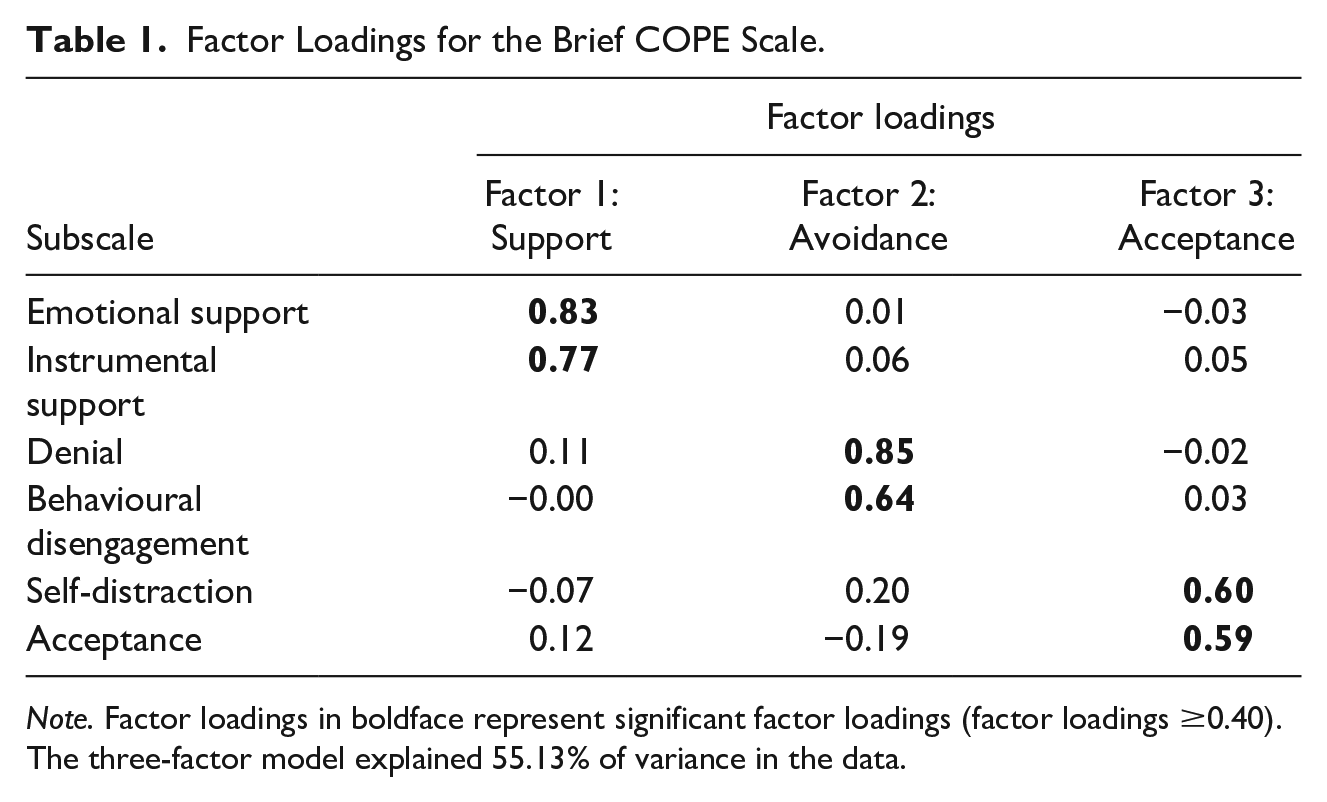
Note. Factor loadings in boldface represent significant factor loadings (factor loadings ≥0.40).
The three-factor model explained 55.13% of variance in the data.
Descriptive Statistics
Table 2 displays the means, standard deviations, coefficient alphas, and mean comparisons for both age groups. The intercorrelations between variables are displayed in Table 3. Both young adults and adults reported engaging in moderate levels of support and avoidance coping strategies, and higher levels of acceptance coping strategies. The coefficient alpha values indicated acceptable internal reliability for the K10, support coping and avoidance coping measures, with values above .70 (Nunnally, 1978). The acceptance coping measure displayed low internal reliability.
Variable Coefficient Alphas, Means, Standard Deviations and Mean Comparisons for Young Adult and Adult Prisoners.
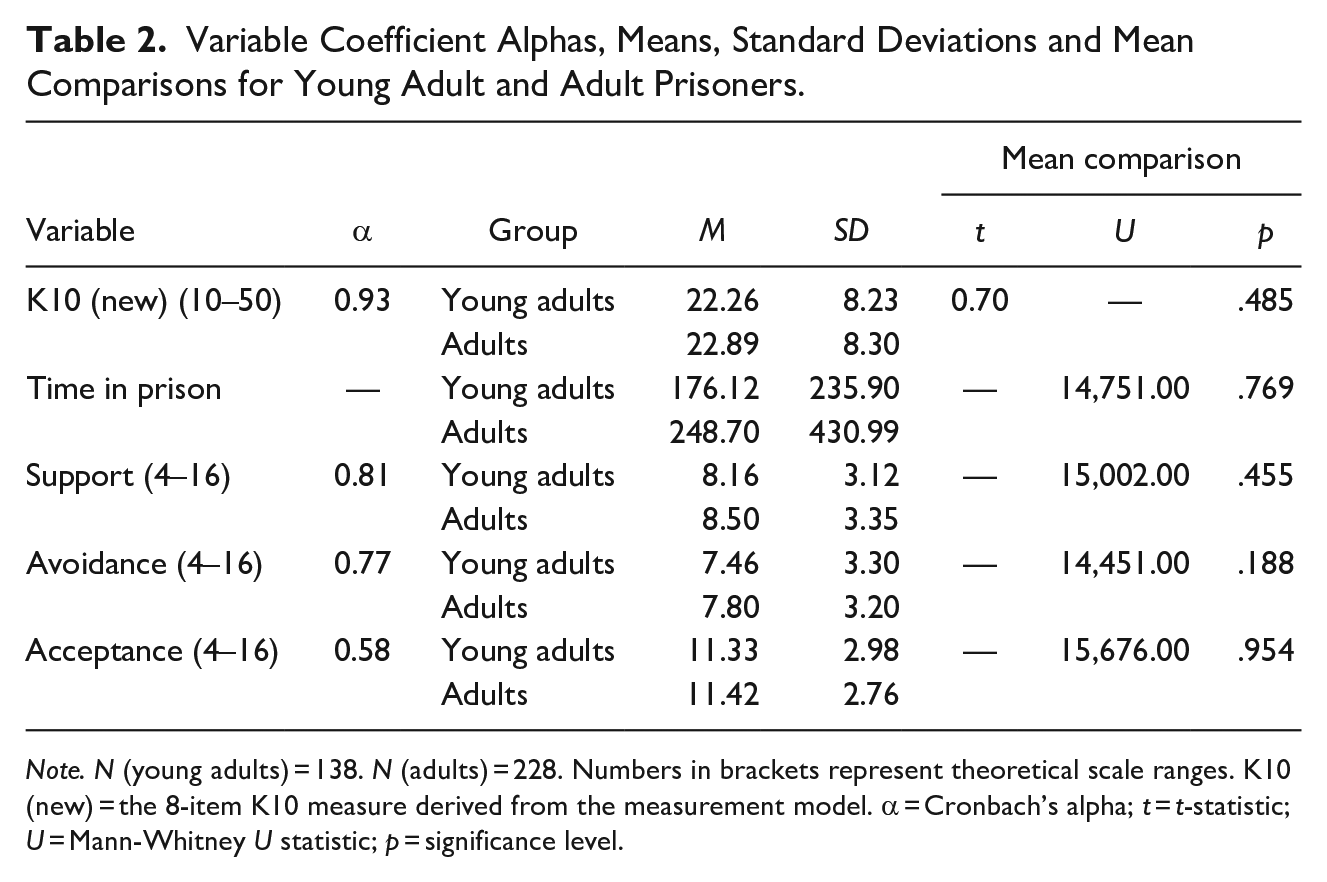
Note. N (young adults) = 138. N (adults) = 228. Numbers in brackets represent theoretical scale ranges. K10 (new) = the 8-item K10 measure derived from the measurement model. α = Cronbach’s alpha; t = t-statistic; U = Mann-Whitney U statistic; p = significance level.
Bivariate Correlations for the Study Measures.
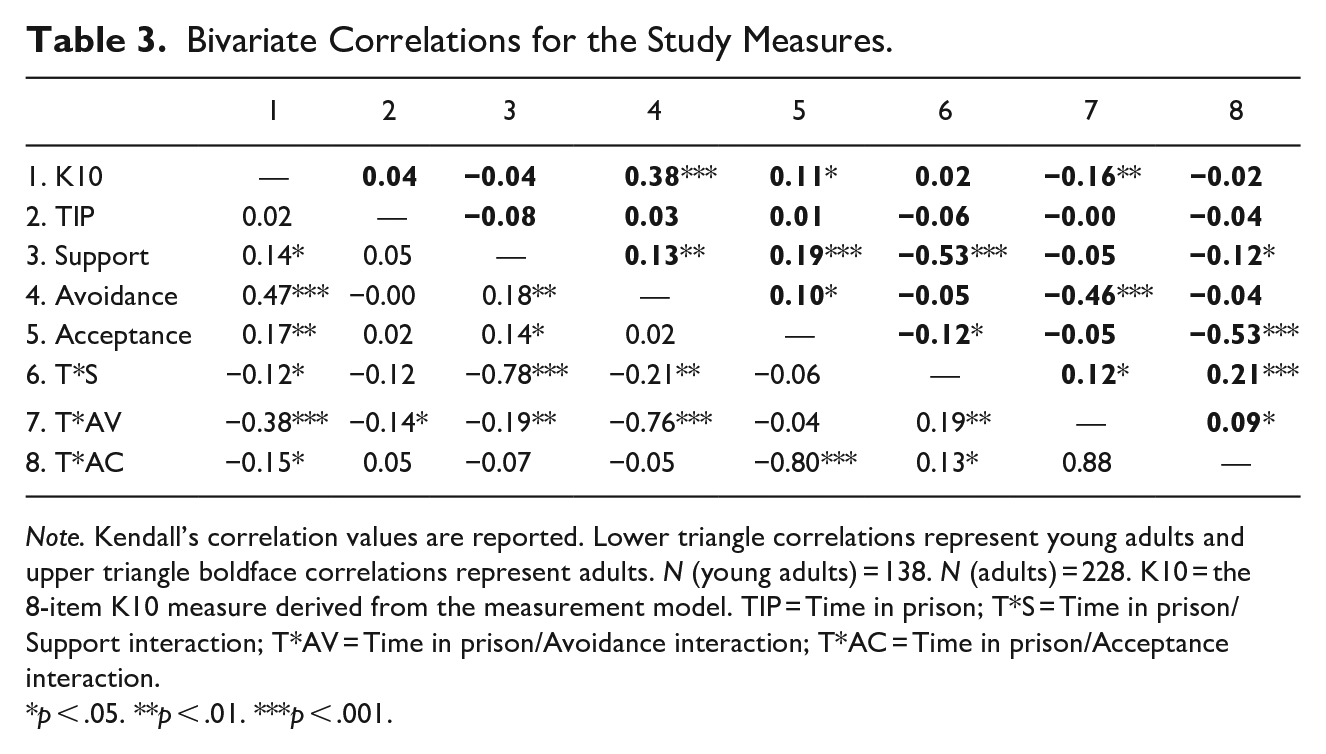
Note. Kendall’s correlation values are reported. Lower triangle correlations represent young adults and upper triangle boldface correlations represent adults. N (young adults) = 138. N (adults) = 228. K10 = the 8-item K10 measure derived from the measurement model. TIP = Time in prison; T*S = Time in prison/Support interaction; T*AV = Time in prison/Avoidance interaction; T*AC = Time in prison/Acceptance interaction.
p < .05. **p < .01. ***p < .001.
Mean comparisons were conducted to determine whether there were significant differences in time spent in prison, each coping style and psychological distress between young adults and adults. A non-parametric independent samples Mann-Whitney U test was conducted for all skewed variables. As depicted in Table 2, no significant differences were identified between young adult and adult prisoners on any of the study measures.
As illustrated in Table 3, for young adults, positive, weak correlations were observed between psychological distress and support and acceptance coping, and a positive, moderate strength association was found between psychological distress and avoidance coping. This suggests that young adult inmates who engaged in support, avoidance, and acceptance coping styles tended to report higher levels of distress. For adults, a positive, weak correlation was observed between psychological distress and avoidance coping, and a positive, albeit extremely weak correlation was observed between psychological distress and acceptance coping. This suggests that adult incarcerees who engaged in avoidance and acceptance coping styles tended to report higher levels of psychological distress. No significant relationship between support coping and psychological distress was observed for adults.
For young adults, psychological distress was not associated with time spent in prison; however, it was negatively associated with each of the interaction terms. For adults, psychological distress was not associated with length of time in prison; however, it was negatively associated with the avoidance coping interaction term. All variables in Table 3 were included in the SEM analyses.
Structural Models
Two structural models were specified to investigate the relationship between time spent in prison, coping style, and psychological distress in young adult and adult inmates. Maximum Likelihood estimation was used to estimate each structural model. Notably, before specifying the structural models, centered variables were computed by subtracting the appropriate mean score from each variable to simplify interpretation of the relationships and to avoid collinearity with the interaction terms (Tabachnick & Fidell, 2013). Furthermore, the decision was made to model each coping style as an observed variable rather than a latent variable in order to maintain consistency within the structural models. Thus, all predictor variables were defined as observed variables within the structural models.
First, a structural model for young adults was produced and provided an excellent fit to the data (χ2 (69) = 112.474, Bollen-Stine p = .241), explaining 48% of variance in psychological distress (Figure 1).
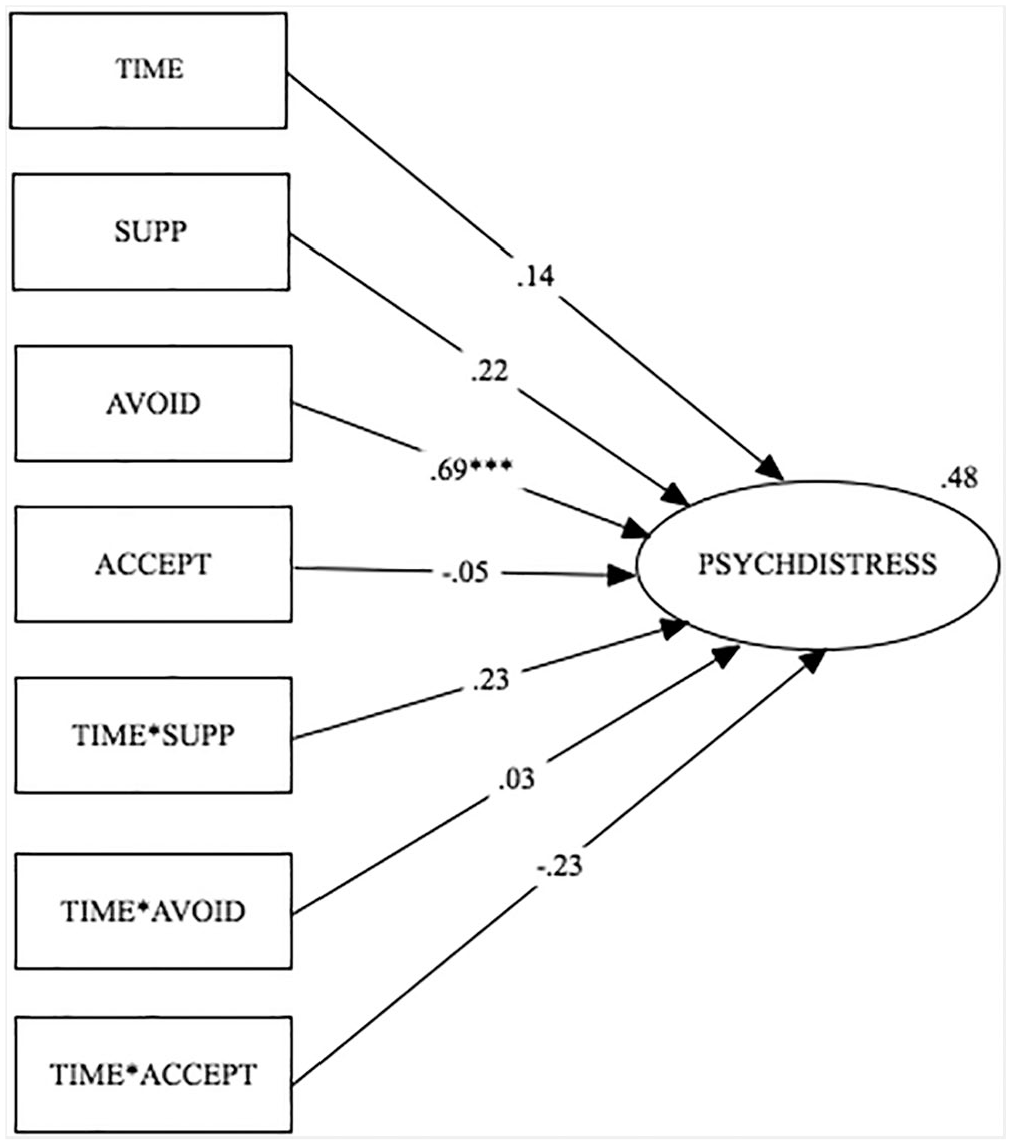
A structural model and parameter estimates for time spent in prison, coping styles and interaction effects in young adults.
For young adults, a significant direct effect was observed between avoidance coping and psychological distress (Figure 1). However, the relationships between psychological distress and time in prison, each interaction term, support coping, and acceptance coping were not significant. In sum, young adults who reported higher levels of avoidance coping tended to present with higher levels of psychological distress. Avoidance coping style was the strongest predictor of psychological distress in young adults.
Second, a structural model for adults was produced and provided an adequate fit for the data (χ2 (69) = 138.209, Bollen-Stine p = .032, CFI = .953, RMSEA = .066, SRMR = .038), explaining 32% of variance in psychological distress (Figure 2).
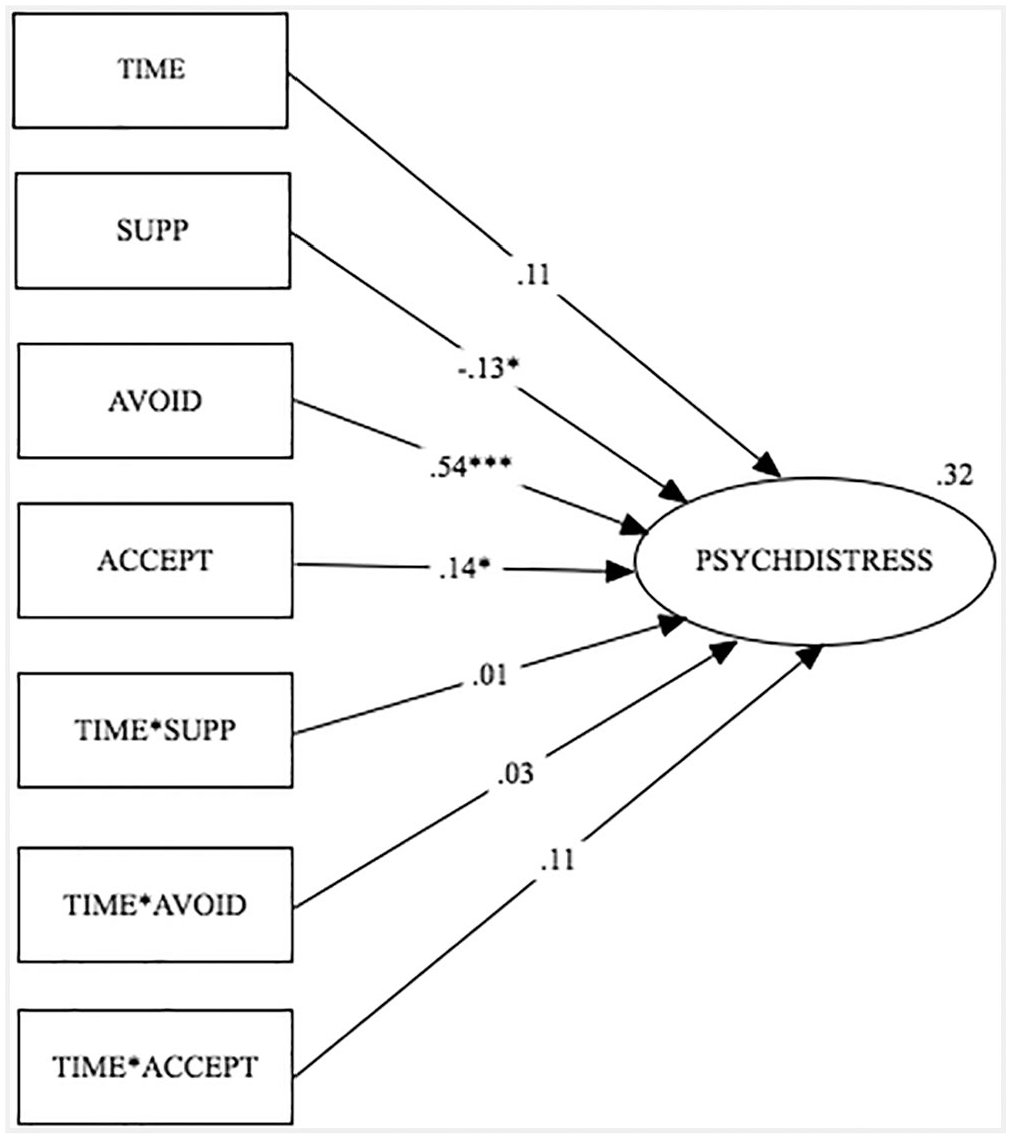
A structural model and parameter estimates for time spent in prison, coping styles and interaction effects in adults.
For adults, no significant relationships were observed between time spent in prison and psychological distress as well as each of the interaction terms and psychological distress (Figure 2). Significant positive relationships were revealed between avoidance coping and acceptance coping and psychological distress, while a significant negative relationship was observed between support coping and psychological distress. Thus, adults who reported higher levels of support coping tended to present with lower levels of psychological distress, while those who reported higher levels of avoidance coping and acceptance coping tended to present with higher levels of psychological distress. Like young adults, avoidance coping was the strongest predictor of psychological distress in adults.
Discussion
This study explored the association between time spent in prison and psychological distress in young adult and adult males in prison. Its goal was to provide a deeper understanding of how coping styles employed by young adult and adult inmates are related to psychological distress. Results revealed that time spent in prison was not associated with psychological distress, and there was no evidence to suggest that coping style moderated this relationship. Instead, the structural models indicated that the nature of the relationship between coping style and psychological distress differed between young adult and adult inmates, irrespective of time spent in prison.
Time Spent in Prison and Psychological Distress
Consistent with previous studies (Brown & Ireland, 2006; Van Harreveld et al., 2007) the amount of time prisoners spent in prison was unrelated to psychological distress in both young adult and adult prisoners. One plausible explanation is that the relationship between time spent in prison and psychological distress is not linear. That is, prisoners may experience varying levels of distress throughout their time in prison, such as heightened levels of distress upon entry to prison (Liebling et al., 2005), and peaks in distress levels in response to situational-specific stressors experienced throughout their sentence (e.g., at the time of court appearances, moves within prison, or the presence and behavior of other inmates or staff). As such, a cross-sectional examination of distress may not provide a complete test of the relationship between time spent in prison and psychological distress.
Coping Style and Psychological Distress
Coping style did not moderate the relationship between time spent in prison and psychological distress for either young adult or adult respondents. Instead, the results revealed that for both groups, coping style had a direct influence on inmate distress irrespective of the amount of time they had spent in prison.
Support coping style
Consistent with previous research (Van Harreveld et al., 2007; Wooldredge, 1999), adult inmates who sought advice and emotional comfort from others reported lower levels of psychological distress. No significant relationship was observed between support coping and psychological distress in young adults. This is particularly surprising since many studies have suggested that social support is associated with lower levels of distress in both juvenile and young adult prisoners (Biggam & Power, 1997; Shulman & Cauffman, 2011). One possible explanation is that social support received from various sources (i.e., family, other inmates or prison staff) may have different impacts on distress (Shulman & Cauffman, 2011). For example, social support from incarcerated peers may not be useful in altering feelings of distress, particularly if one’s peers are also distressed, lack emotional maturity, or if there is a risk the individual may be victimized when seeking emotional assistance from others. Investigation of the different sources of social support sought by young adult and adult inmates and their impact on distress is an important consideration for future research. Specifically, a more nuanced analysis regarding the perceived quality of these relationships and the nature and frequency of the social contact may improve clarity around the age differences in support coping observed in the current study.
Avoidance coping style
Avoidance coping was the strongest predictor of psychological distress for both young adult and adults surveyed. Specifically, the findings suggest that in both groups, employing avoidance coping strategies, such as denying the presence of the stressor and giving up attempts to deal with the stressor, was associated with greater levels of distress. This is consistent with previous research that has shown that young adult (Grennan & Woodhams, 2007) and adult incarcerees (Ireland et al., 2006) who engage in avoidance coping styles tend to report higher levels of psychological distress. However, it was inconsistent with research indicating that avoidance coping has no effect on distress (Ireland et al., 2005), or is beneficial for inmate well-being (Gullone et al., 2000). It may be that denying the stressor and refusing to cope with it may reduce initial anxiety, while at the same time prolong and potentially worsen psychological distress in the long-term.
Acceptance coping style
Acceptance coping was positively associated with psychological distress in the adult respondents, suggesting that a coping style characterized by accepting the stressor and distracting oneself from the stressor was associated with greater levels of distress. One explanation may be that the acceptance coping measure was reflecting a type of “resignation-acceptance” (Nakamura & Orth, 2005), in which an individual abandons actions to address the stressor and turns away from the situation, thereby increasing distress. In young adults, no significant relationship between acceptance coping and distress was found, indicating that a resignation was neither counterproductive nor helpful in these younger men.
Notably, both the young adult and adults surveyed reported a higher mean score for acceptance coping than avoidance and support coping styles. This may be explained by the “fall-back hypothesis” (Rothbaum et al., 1982), which suggests that when initial attempts to cope are unsuccessful, an individual “falls back” on alternative (usually maladaptive) coping strategies. Thus, men in prison may “fall back” on accepting the stressor and turn away from the situation when initial, alternative coping attempts were unsuccessful in reducing distress.
Limitations and Opportunities for Further Research
There were some inherent limitations in the study that warrant acknowledgement. First, the cross-sectional design limited both the generalizability of the results and the ability to draw causal conclusions. Future research should employ a longitudinal design for a clearer understanding of the relationships between the assessed variables, and how coping style and distress levels may vary over the length of imprisonment. Furthermore, as the sample was comprised of adult male prisoners from a single Australian institution, care should be taken when generalizing these findings to other carceral populations, particularly females, individuals with intellectual disability or mental illness, and inmates from low and medium-security prisons.
A second limitation relates to modeling the coping variables as observed variables, when they are in fact latent variables. This decision was made in order to remain consistent with how time spent in prison was represented in the model, as well as to allow the researchers to compute interaction terms between time in prison and coping styles. Accordingly, this meant that the measurement error for each coping variable was not accounted for in the model. Finally, modeling age as a dichotomous variable is an additional limitation, as this may have increased the probability of a Type II error, thereby reducing the internal validity of the findings (Streiner, 2002).
Future studies could also explore the influence of specific stressors on inmate distress and coping styles. For instance, the preferred means to cope with distress associated with substance addiction may differ from those associated with violence victimization. Exploring the relationship between specific stressors, distress and coping could highlight how coping style may be shaped by or directed toward prison-specific stressors, as well as an inmate’s ability to adapt coping responses to address various distress sources.
Implications
The study has some important implications for incarcerated populations, correctional organizations, and researchers. Importantly, the findings may inform the development and implementation of psychological treatments designed to assist incarcerees to utilize adaptive coping strategies. Specifically, the finding that avoidance coping was associated with greater inmate distress, irrespective of age, suggests that programs should specify the unhelpful effects of avoidance coping. Further, the negative association between support coping and adult inmate distress suggests that encouraging adults in prison to seek social support and increasing social support opportunities may assist them in reducing distress.
Finally, there are some useful theoretical and methodological implications to be drawn from the analyses. First, given the observed age differences in coping style and distress, researchers should consider a wider range of age categories. This study could be replicated with larger sample sizes and alternative ways to parse age. Second, research is warranted to investigate the nature and quality of social support in prisons and how these are associated with inmate distress. Finally, there may be merit in investigating psychological distress and coping styles in response to situation-specific stressors, and exploring how both distress and coping may change over the length of imprisonment.
Conclusion
This study provides valuable insights into the relationship between age, time spent in prison, coping style, and psychological distress in Australian inmates. It clarifies how the relationship between coping style and psychological distress may differ between young adult and adult inmates. Further, it reveals a link between avoidance coping style and psychological distress in both young adult and adult males in prison, thereby highlighting how social support and acceptance relate to psychological distress. These findings have important implications for the development of interventions to assist men in prison in coping with the inevitable stressors in this environment.
Footnotes
Declaration of Conflicting Interests
The author(s) declared no potential conflicts of interest with respect to the research, authorship, and/or publication of this article.
Funding
The author(s) disclosed receipt of the following financial support for the research, authorship, and/or publication of this article: This work was supported by the Australian Research Council under Grant LP140100397. Data from the study are available from the corresponding author.