




Abstract
Non-suicidal self-injurious or deliberate self-harming behavior is a significant mental health issue, particularly among vulnerable incarcerated people experiencing the psychological stresses of imprisonment. Drawing on a database search strategy focused on 15 years of qualitative research on self harming in the forensic setting, this narrative synthesis study integrates the findings of views on self harming by inmates and prison management staff and develops the Yin-Yang of Self-Harming Behavior in Prison model to illustrate the duality. The findings support the need for intensive prison staff training in the management of self-harmers and the development of inmate programs geared towards awareness and promotion of mental health.
Keywords
Introduction
Non-suicidal self-injury (NSSI), also known as deliberate self-harm, has become an emergent clinical and public health concern (Cipriano et al., 2017). It is a behavior that refers to the intentional self-inflicted destruction of body tissue without suicidal intent (Hooley & Franklin, 2018; Masana et al., 2020) as in the incidence of self-cutting and self-burning (Green et al., 2018). Addressing the issue in 2018, the International Society for the Study of Self-injury excludes socially accepted behaviors such as body piercing, tattooing, and cultural or religious rituals; risky behaviors that may result to injury such as engagement in extreme sports; behaviors that do not directly cause harm like food restriction, as the detrimental effects appear after quite some time; and suicidal thoughts and behaviors, in which the persons purposely aim to end their lives. Moreover, the Diagnostic and Statistical Manual of Mental Disorder, 5th Edition (DSM-5) has categorized this behavior under a new diagnostic entity in Section 3 as “condition for further study“ (Hooley & Franklin, 2018), making it a distinct entity from Borderline Personality Disorder and Suicidality (Liljedahl & Westling, 2014). Clinical studies, however, suggested that self-harming behavior is comorbid with some mental disorders. Some of these include bipolar disorder (Andover et al., 2017), major depression and psychotic illness (Fazel et al., 2016), and post-traumatic stress disorder (Arthurs & Tan, 2017). Additionally, previous studies have indicated that these deviant behaviors are caused by feelings of frustration, guilt, rage, abandonment, emptiness, loneliness, low self-worth, and self-blame (Chen & Chun, 2019); negative affect, negative emotionality, deficits in emotional skills and self-derogation (Green et al., 2018), trauma, stress, familial or interpersonal strife (Mann et al., 2019), and maladaptive coping mechanisms (Oxley et al., 2017).
Persons deprived of liberty display higher rates of self-harming behavior (Winicov, 2019). Chammah and Meagher (2015) found that upon initial detention, jail inmates usually experience heightened distress. The experience in jail is found to be traumatic to inmates (Winicov, 2019). This contributes to self-injurious behavior being the most persistent problem (Wakai et al., 2014) and most common reason for mental health treatment within correctional settings (Dixon-Gordon et al., 2012). NSSI is a complex act that calls for action (Smith et al., 2019) as it poses a serious threat to the safety and well-being of detained offenders (Power et al., 2016). Research literature, specifically in the United Kingdom and United States of America, has explored much on these behaviors in the correctional setting (e.g., Kaba et al., 2014; Reid & Listwan, 2018; Winicov, 2019). Undoubtedly, an integration of the similarities and differences among the findings of these studies is both relevant and timely, as literature reviews on this topic are extremely limited (Shelton et al., 2017). The integration of descriptions and definitions which characterizes this penal system behavior is a much needed analysis. Hence, this narrative synthesis study conducted in the context of self-harming behavior in carceral settings is geared towards integrating the findings of qualitative studies by highlighting the important perspectives of both self-harmers and their caregivers to better understand the behavior in terms of its nature, functions, and management within correctional sytems over the last 15 years.
Narrative synthesis is perceived as an effective way to recognize the “story” behind a distinct body of evidence by providing reviewers a strategy to develop themes that bring unity to previously presented data (Briner and Denyer, 2012; Popay et al., 2006). Essentially, this study will focus primarily on forensic mental health. In this seminal undertaking, the integrated psychological concepts that will emerge will be a valuable aid in understanding the complex and challenging behavior of self-harmers in correctional facilities. Findings from this narrative synthesis will offer vital input for policy making on handling, assisting, and treating those who self-injure through the initiation of programs to enhance and promote inmate mental health and psychological well-being as well as improve the training of prison staff and professionals who are front-line in the management of self-harmers.
Method
The review was conducted using five databases, namely: APA PsycArticles, ProQuest, PubMed Central, EBSCOHost (Psychological and Behavioral Collection), and Emerald Insight aimed at examining the self-harming behavior in incarcerated environments. The search terms were “self-harm,” “self-injury,” “non-suicidal self-injurious,” “self-mutilation,” “non-fatal deliberate self-harm,” “correctional,” “inmates,” “detainees,” “prison,” “jail,” “forensic sample.” To be included in this review, research had to be: (i) Written in the English language; (ii) Qualitative in design and published from 2005 to 2020; (iii) Presented in a visual or narrative model or framework related to self-harming behavior of detainees and/or prisoners; (iv) Presented in a model or framework that is original; and (vi) able to be printed or downloaded. The protocol for the review was preregistered in the PROSPERO database (CRD42020207481).
In addition, the review process was guided by the PRISMA (Preferred Reporting Items for Systematic reviews and Meta-Analyses) Statement Guidelines, a structured approach to reporting systematic reviews and meta-analyses (Moher et al., 2009). The process followed these steps: (1) creating a protocol with clear and focused topic on what to review; (2) choosing the databases for a structured search; (3) developing a search strategy by carefully choosing what word to consider; (4) running and recording search by keeping accurate records of previous searches; (5) managing the results; (6) evaluating the results against the set inclusion criteria; and (7) synthesizing the results.
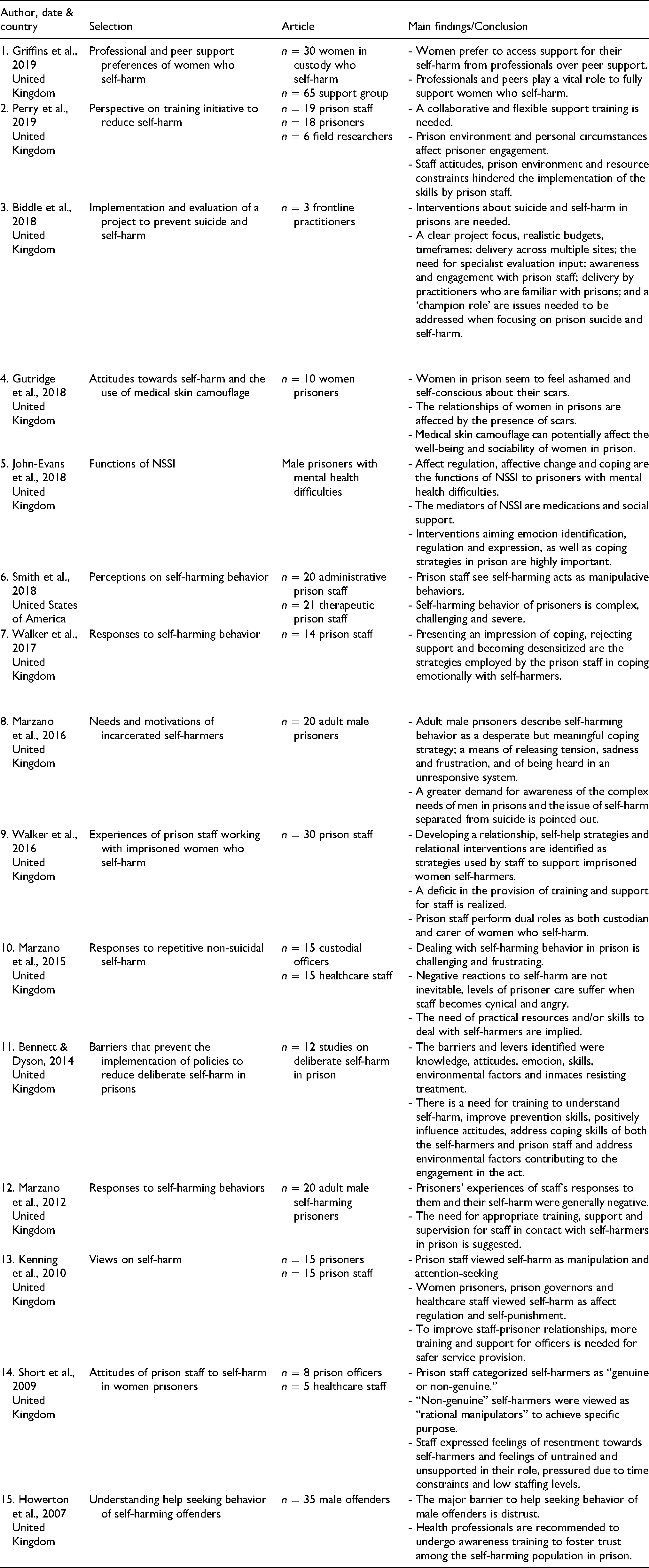
The search elicited 339 potential articles, of which 13 articles were excluded for duplication. The remaining articles were screened by title and abstract, and 300 were excluded because they were studies of self-harming behavior in general, and not related to penal system self-harming behavior. Using the eligibility criteria, the remaining 26 full-text articles were further assessed, of which eleven (11) were excluded due to the inability to meet the stated inclusion criteria. The remaining fifteen (15) articles were judged to be eligible. Data were obtained by following the three stages of narrative synthesis: (1) developing an initial synthesis; (2) investigating relationships within and between researches; and (3) assessing the strength of the synthesis (Leamy et al., 2011). In carrying out narrative synthesis on existing interpretations from the authors of the original papers and in the course of synthesizing their elucidation, there is a possibility that some details were overlooked that may reduce the richness of the findings and might silence some experiences. To safeguard against this, cross-validation with a qualitative research expert and a practicing clinician, with academic, clinical, and forensic background was conducted. In response to the experts’ recommendations, the literature on self-harming behavior in incarceration was revisited. Some subcategories were repositioned within the themes and some categories were changed. Overall, the expert consultation process provided added validity to the content and robustness of the findings (Figure 1).

PRISMA flowchart of the record selection process.
Findings
Capitalizing on the promises of narrative synthesis, data from the 15 articles were analyzed following an interpretive integration of qualitative findings. Through the narrative synthesis process, the Yin Yang of Self-harming Behavior in Prison (see Figure 2) was developed. This model offers two interesting and complementary views of self harm from inmates and prison management staff. Based on the Chinese philosophy of Yin Yang, the perspectives of both were assimilated to represent the concept of dualism. This symbol is used to describe how opposing or contrary views may actually be complementary, interconnected, and interdependent related to self-harming behavior in the forensic setting, and how these views may give rise to each other as they interrelate to one another.
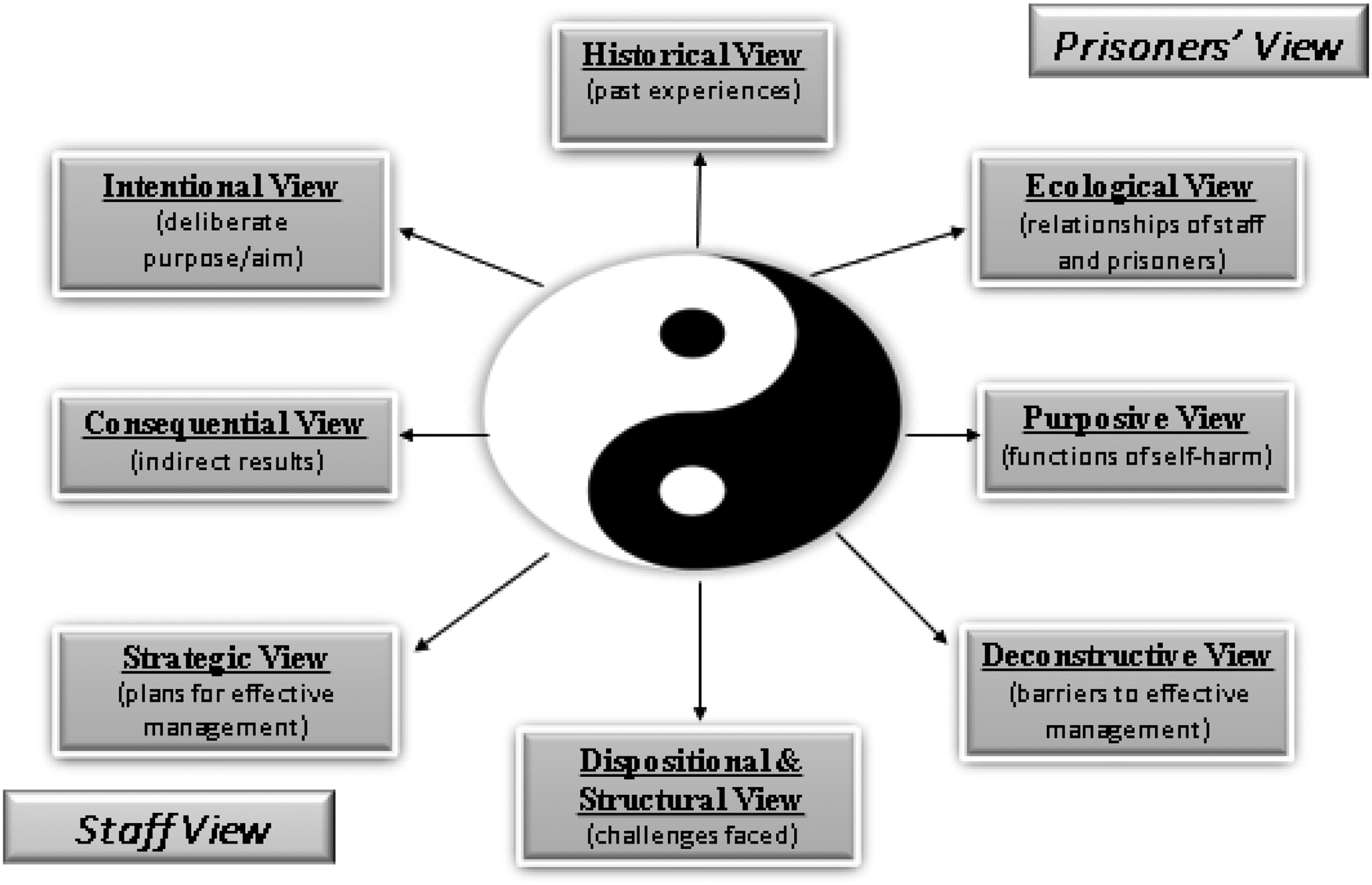
The Yin Yang of self-harming behavior in prisons.
Theme 1: The Prisoners’ View
In this study, the first perspective on self-harming behavior came from the inmates engaged in self harming. The theme “prisoners’ view” refers to the perspectives from self-harmers. Specific perspectives classified under this view were generated to further understand the essence of self-injurious acts from the viewpoints of the self-harmers themselves.
Historical View
Included articles identified the overwhelming impact of a personal history of inmates’ past struggles. Reflecting on what they had been through, the self-harming inmates narrated turbulent personal histories characterized by chaotic and dysfunctional families, family neglect and troubled life events, identifying these as some of the factors associated with their use of NSSI. I think it stems from when I was younger and all that ‘cos my upbringing wasn’t the best of upbringings really. (Howerton et al., 2007, p. 3)
When I was getting down and that I was thinking about the past and stuff that is happened. (John-Evans et al., 2018, p. 33)
Findings from eligible studies also reported that self-harming inmates were victims of different types of abuse and these increased their urge to engage in self-harming acts. Mine (sexual abuse) was worse sort I think. Which makes it quite understandable that I grew up with few disorders. (Marzano, et al., 2016, p. 161)
My mum and stuff like that, what my father used to do to us. I was abused when I was a kid, everything like that just gets on top of me. (John-Evans et al., 2018, p. 33)
Ecological View
From the scientific notion of ecology, where the relationship between living things and their environment is crucial to survival, this study's ecological view yielded the self-harmers’ motivations in relation to the prison environment and its management. Within this context, harmonious relationship is sought by the self-harmers, and judgmental attitude and hostile reactions are perceived as not helping in what they are going through. They’re cold in their voice, they’re cold in the way they speak to you, they’re cold as in when you’re crying they just shut the door in your face. (Kenning et al., 2010, p. 280)
I get no help whatsoever…they bring me downstairs. They bandage me up and they put me back in my cell. (Marzano et al., 2012, p. 6)
Additionally, the lack of faith and confidence in the system and its environment made it more challenging for self-harmers to overcome tumultuous experiences while in custody. Based on the analyzed articles, troubling environment, distrust of the system, unhelpful officers’ and healthcare staffs’ responses to their unusual behavior were contributory factors to their urge to self-harm and to their struggles for recovery. It is not a great place to be, it do tend to make you worse, you do it more in here. (John-Evans et al., 2018, p. 33)
I don’t have trust in the system. I don’t trust the system one bit, I hate the system. All they’ve ever done is shit on my life. Why should I trust them? Probation, they’ve shit on me… course they shit on you, everybody shits on you. So, I don’t trustnothing or no one. I don’t trust my missus, I don’t trust my own mum and if I don’t trust my own mum I ain’t going to trust no one. (Howerton et al., 2007, p. 3)
Purposive View
The purposive view relates the function of self-injurious acts in inmates’ attempts to manage their overwhelming emotion during incarceration. Specifically, it is their uncontrollable and intense feelings of anger, pain, sadness, tension, and frustration that are often turned inwards, triggering the act of hurting themselves. I start getting agitated and getting angry and then I start thinking to self-harm, that is the trigger. (John-Evans et al., 2018, p. 32)
I still have little moments where I scratch to try and get the pain out, it is frustration like…it is my way of getting those feelings out. (John-Evans et al., 2018, p. 33)
Themes from the qualified studies also described the deviant act as a coping strategy to relieve several negative emotions felt while adapting to the forensic setting. It also serves as a way to punish themselves for the perceived misdeeds they have committed—stating that they deserve to get hurt. In summary, self-harming behavior functions as an affect regulation device, coping strategy, and self-punishment act for the self-injuring inmates. It's the way to cope. It's the way I adapted to cope, anyway (to) the situations that I’ve been in my life since I was a kid. (Marzano et al., 2016, p. 163)
I’ll just sit there thinking about my past, you know, how I’ve come to prison in the first place, I’ve let my kids down, you know, and then I just really, really, worked up and then I just have to see blood too, you know, relieve the pain. (Kenning et al., 2010, p. 278)
Deconstructive View
The deconstructive view is an examination of the barriers to effective management of self-harming behavior in prison which were revealed by inmates from the included studies. This intends to show system flaws and inconsistencies, the effect of negative staff reactions—such as being ignored or not taken seriously—which contributed to the difficulties faced by the imprisoned self-harmers. In here they don’t see it as serious. They think you might be playing with them; you are playing tricks on their mind or something…to draw attention; to make them do something…They don’t see like what is in your mind, or what you think. (Marzano et al., 2012, p. 6)
Because it's disgusting, the way they treat people on the mental health side of things. It's a joke. It really is a joke. No wonder there is so much suicide and self-harming in these places- not just this place, in all of them. Do you know what I mean? You can’t believe the way that they treat you. (Marzano et al., 2016, p. 162)
Shortage of skills needed to implement self-harm policies, lack of communication skills—particularly active listening—and social support—such as the dearth of self-help groups—were also some of the findings highlighted, emphasizing the obstacles to the effective management of these unusual acts. Staff need to be skilled in communication, in particular in active listening. (Bennett & Dyson, 2014, p. 19)
I’m really just screaming out to see a doctor. I just want a little bit of help.(Marzano et al., 2016, p. 165)
Furthermore, this view also uncovers the difficulties encountered by the prisoners in the management of their own deviant behavior. Some of these are: fear of the social and individual consequences of diagnosis of mental illness; resisting treatment and medication; attitude and knowledge about self-injurious behavior. I have not done it too much until recently, I am not sure why. I have started medication; they have said they might make you worse at first. (John-Evans et al., 2018, p. 34)
Like I say… it seems people are scared of mental illness. That's one of their worst fears, actually being diagnosed as mentally ill you know. (Howerton et al., 2007, p. 4)
It's like me, I get called, ‘a weirdo’ because I cut myself. (Gutridge et al., 2019, p. 174)
Theme 2: The Staff View
The theme “staff view” refers to the second perspective that emerged from the narrative synthesis which exist outside or beyond the boundaries of the self-harmers. Views were identified as part of the “outside the wall” interpretations of self-harming inmate behavior coming from the staff, healthcare workers, officials, and other support staff in prison. To further elucidate this perspective, four related views were identified.
Intentional View
The intentional view illustrates how the prison management staff view self-harming behavior. In the articles reviewed, prison staff and officials believed that inmates intend to use this behavior as a coping strategy, as an act to manipulate the system, and for attention seeking. As a coping strategy, the prison staff see self-harming behavior as a desperate but meaningful way for prisoners to process overwhelming emotion and adjusting in living with the stressors while serving their sentence. It may well be their way of relieving that stress and that tension. Though talking can be helpful, drop-in centers can be useful, seeing psychologists can be useful, it may well boil down to the fact that cutting yourself and seeing blood oozing out is a much more visual representation of a relief of tension than talking to somebody. (Kenning et al., 2010, p. 279)
Some women will tell you that they will self-harm to get the attention of the nurse, to get the attention of the doctor. (Short et al., 2009, p. 413)
Alongside these views, they also realize that, in some instances, the act is an intentional manipulation to try to get control of situations and influence the prison environment. They also see it as an attention-seeking move to gain recognition and have their needs served over those of other inmates: They know they’ve got us over a barrel. ‘If you don’t do that then, I’ll cut myself.’ That annoys me. Because that's a blackmail. They are blackmailing into doing things like that I say: that's your choice, if that's what you want to do. (Marzano et al., 2015, p. 247)
It's a way of manipulating the staff to get something they want or to get better treatment than someone else. (Short et al., 2009, p. 413)
Consequential View
As viewed by the people managing the prisons, self-injurious acts have secondary results or indirect consequences for the entire facility. When prisoners engage in self-harm, it gives the staff a feeling of resentment, as they have already classified genuine and non-genuine acts. By genuine, they refer to self-harmers who need authentic care and attention: The ones that I feel genuinely do have real problems and a genuine self-harm issue. I don’t mind spending time with people who genuinely need help. I can’t be doing with the time- wasters… (Kenning et al., 2010, p. 280)
I suppose it is a cry for help…they do want attention because like it is saying ‘look I can’t, obviously cope. I’m having to do things to myself to get somebody to come to me, to help me out. (Short et al., 2009, p. 415)
In contrast, the non-genuine self-harmers intend to have a purpose of manipulating the system through getting more than what they should receive or as a response to being denied of something. Some will come up to you and ask four officers for something and we will be like ‘no, you’re not entitled’ and they will go to the management and ask, management will give in and make us look like idiots by giving it to them because they threatened to cut up. (Short et al., 2009, p. 416)
Non-genuine self-harmers make the prison staff feel a subverted power relationship in the forms of feeling helpless and having low job control for assisting the inmates, stopping the behavior, and being able to decide how to respond. My experience of working (with repetitive self-harm), it's quite frustrating obviously. It's a very frustrating experience, because you will find that there is not, there is not a great deal of ehm, I just think I would approach it differently. I don’t know where, which way I’d like to go with them, but the way we are going now is not working, because of, constantlyrepeating it. You know, self-harm. So, either we are doing it and we are not doing it right. (Marzano et al., 2015, p. 247)
Further, self-injurious acts contribute to the depletion of facility limited resource as they require staff and medical attention. For an understaffed facility, attending to the self-harmers will consume time and, hence, cause divided attention to the multiple tasks assigned to them. Medical treatment also consumes financial resource; more so, repeated self-harm as challenging, frustrating, and stressful as it is, drains prison staff patience in the face of resource issues like overcrowding and limited personnel. The impact on staff is predominantly in costs. Inmates who do self-injurious behaviors cost a lot. There is the cost of traveling by ambulance, emergency room, the surgeon, also there are guys who get infections after cutting, and they can be resistant to the antibiotics given. The cost for a single hospital trip can be $85, 000–100, 000.(Smith et al., 2018, p. 13).
It affects security staff and medical staff because it slows down the daily routine for everyone. Initially it (self-harm) gets to you, then you become detached, maybe sometimes too detached… The only way to deal with inmates who do self-injure is to follow the cardinaltenant; that is, ‘I cannot take responsibility for what an inmate does…I can only take precautions. (Smith et al., 2018, p. 13).
Strategic View
Although bombarded with obstacles in the management of self-harm, prison officials and support recognize strategies to ease this rampant problem. The eligible articles yielded a strategic view by prison management staff, premised on building a prison environment where trusting relationships are honed, collaborative works are performed and non-judgmental attitudes are shown. It (listener scheme) is the most valuable scheme in the prison service, it does save lives and help staff cut our workload significantly. (Griffins et al., 2019, p. 117)
Having me there…means that they (imprisoned women) feel supported, and it's being consistent and not promising something that you can’t possibly do.(Walker et al., 2016, p. 177)
In this view, managers also see the need for a “champion role,” a leader who initiates and develops interventions, self-help strategies, reflective practice, prisoner engagement, and professional relationships. It just needs somebody to be there if on an evening, or something you’ve got a problem, you know someone who can go to and say, look, I’m having this problem with this, any advice on it? ‘Supported by a peer mentor, …which is fine, maybe that's… theway forward, I don’t know, but it… it did seem that like we’re being…that was just recovering stuff that we… we have already covered in the past. (Perry et al., 2019, p. 10)
Dispositional/Structural View
In the forensic setting, a number of difficulties are confronted on a daily basis, not only by the inmates themselves, but also by prison management staff. In crafting an efficient way to handle NSSI in custody, it is essential to analyze the dispositional and structural hurdles met by the caregivers of self-injuring prisoners. The dispositional view as disclosed by the assessed eligible studies posits the prevailing management challenges faced by officials and other support staff in supervising self-harmers. The staff expressed their view on prolific self-harmers and their negative feelings about the added burden of having to perform dual roles of both securing custody and providing care. A lot of the problems with the people on here are mental health problems, which is something we can’t really do a lot about. (Kenning et al., 2010, p. 279)
When you get someone self-harming, continuously, it just messes up the whole regime. An then makes your job so much harder. (Marzano et al., 2015, p. 247)
Prison staff attributed these negative feelings based on the uncertainty of appropriate response from perceived mixed, insufficient, and/or lack of appropriate training. Most of it (training) is probably trial and error and support from people who are around you,..staff, the prison officers, and…the mental health team. (Walker et al., 2016, p. 180)
Training is mixed. There is a common belief that staff would benefit from more in-depth training about self-injuriousbehaviors;suicide prevention training is just too generic. Staff need training that is specially aimed at female inmates who self-injure. Right now, we are operating off the top of our heads, we use the internet to look for solutions (Smith et al., 2018, p. 12)
Furthermore, the structural views are the challenges encountered by the prison staff in relation to the entire prison system. These are the issues disclosed by participants in the studies reviewed: resource constraints; prison/institutional environment; collaborative and flexible training to cope with the job; and project funding, focus, roll-out, and evaluation. Resource constraints affect the management of self-harmers, and any program needs proper and sufficient funding in order to be well executed. A lack of time and resource…Again, logistical nightmare. As it is always in the prison service. It's dealing in crisis management. (Perry et al., 2019, p. 6)
Because she's done this you won’t be able to that or three jobs for somebody else, so its time constraints, time consuming and yes, I suppose a little bit resentful and that sounds awful, and I probably wouldn’t say it to anybody else but that's sometimes how you feel. (Short et al., 2009, p. 417)
Additionally, the overcrowded and understaffed prison/institutional environment is perceived to be another obstacle, since prison staff are conflicted regarding whether to perform their custody roles or their care roles. You can’t have a prison officer being a mental health nurse as it's a conflict of interest because one minute you have to sit down and counsel them and the next minute they might throw a punch at you and you’ve got to put them in locks and put them behind their doors. (Short et al., 2009, p. 416)
‘We can safeguard them and stop them from dying because that's what we are trained for…but we’re just not trained as counselors to sit there and listen to their past and their problems. (Short et al., 2009, p. 417)
Therefore, collaborative and flexible training to cope with the job is seen as a solution to reconcile the difficulties and facilitate system operations, with self-harmers not being ignored and prison staff not being neglected. We are simply not equipped for dealing with self-injurious behaviors in inmates. We need a place for the ‘cutters’. A place that is not in this facility…that will have the resources to address the behavior, with more intensive therapy. People who engage in this behavior should be totally separated from the main prison population. Keep them in a program instead of moving them around from unit to unit. (Smith et al., 2018, p. 12)
I think more awareness around what self-harm is, why people self-harm, how we (prison staff) can manage it, ways of coping and ways to help participant…How staff can off load if they need to if they’re feeling frustrated or it's (witnessing self-harm) upset them. (Walker, et al., 2017, p. 820)
Lastly, programs also need support for the dissemination of information for stakeholders to obtain success and evaluate if the goals were met. Prison staff perceived that programs must also be focused and coherent, with reflections on understanding the relative importance of the project. Bringing together some tools that don’t need to come directly from mental health is good and to raise understanding of what these tools can do for people. (Biddle et al., 2018, p. 9)
We should really have planned for the evaluation part of it. What we were going to look at, how we were going to evaluate it and that should have been embedded first. (Biddle et al., 2018, p. 9)
Discussion
The primary intent of this narrative synthesis is to integrate qualitative research studies on the engagement of prisoners in self-harming behavior. The aim is to highligh the perspectives of both correctional setting self-harmers and their caregivers to better understand the behavior in terms of its nature, functions, and management from investigations of the last 15 years.
Fifteen eligible articles were reviewed that enabled the integration of the two views on self-harming behavior in the penal setting. The analysis yielded key insights on the various causes, functions, and consequences of this behavior from self harmers and frontline responder viewpoints. As shown by the Yin-Yang model of self-harming behavior, a duality of perspectives from inmates and prison management staff was found to be complementary, interconnected, and interdependent; each view plays a vital role in elucidating definitions, descriptions, and management of the behavior in carceral environments.
NSSI or self-harming is a complex, deviant behavior that is prevalent in the forensic setting. Self-harm is more complicated than it is perceived and calls attention when language is unable to translate feelings. Current findings confirm that self-harming is not only complex, but it is also a challenging behavior for both self-harmers and caregivers. It is indeed a prevalent and dangerous occurrence (Kaba et al., 2014) within correctional settings. Although the behavior is said to be without suicidal intent (International Society for the Study of Self-injury, 2018), repetitive self-harm is an important risk factor for suicide (Fazel et al., 2013; Hawton et al., 2014)and poses danger to the individual and distress to prison staff and officials.
In the inmates’ view on self-harming behavior, findings from the eligible articles highlighted their perspectives on the significance of their past traumatic events which became precipitating factors of the urge to self-mutilate in prison, on the importance of living harmoniously inside the facility, on the functions of self-harming behavior in the prison population, and regarding the barriers for the effective management of these acts.
Many inmates experience dysfunctional and chaotic family life, where the incidents of abuse and neglect date back to childhood. As adults, these disturbing memories are incorporated into their lives inside custody. The traumatic experiences of imprisonment coupled with problems of overcrowding, insufficient resources, loss of sense of humanity, and feelings of powerlessness and hopelessness trigger stress, making it more difficult to adapt to prison life. Consistent with previous literature, the motivations to engage in self-injurious behavior are engendered by pre-existing histories of trauma (Reyes et al., 2019), which inmates have little chance to “process.” Therefore, negative emotions are left unsettled, and conflict with the law worsens the feelings.
Living harmoniously inside the facility became a fundamental concern, with the issue of genuine care overlooked. Implied in the findings are a distrust of the system, the troubling prison environment, and the unhelpful staff responses to their self-harming behavior. Linked to their traumatic experiences, persons deprived of liberty are unable to trust other inmates and staff inside the facility. This was expressed by generalized negative beliefs of suspicion and lack of faith and confidence that someone would be there to adddress their needs and welfare. In addition, they reported challenges in adjusting and coping with the prison environment. Individuals who self-injure believed that the lack of social support and artificial comradeship between and among inmates and staff contributed to the build-up of negative emotions. Unhelpful staff responses to the self-harming behavior seemed like adding “fuel to the fire” of existing difficulties in dealing with childhood trauma, coping deficits, and unsettling environment. When staff became cynical and resentful to them, it cultivated frustration, anger, and depression that, in turn, intensified the need to self-harm.
Injuring oneself serves important purposes for these incarcerated men. Similar to some studies, affect regulation and environment manipulation (Power et al., 2016); coping mechanism (Smith & Power, 2015) as well as self-punishment (Arcelus et al., 2016); and separation from social supports (Wakai et al., 2014) contribute to high rates of self-injury among inprisoned people. Linking past problems to present difficulties in prison, the act of self-harming functions as a relief, relaxation, and tension-reduction of the overwhelming emotions that causes psychological distress.
Moreover, the key findings classified under staff views posit how the prison management staff perceive what self-harming behavior is, its secondary results or indirect facility-wide consequences, and the prevailing obstacles experienced in the management of self-harm in terms of both dispositional and structural views.
The incongruence of how prison staff perceive self-injuring acts compared to what it means to the self-harmers underscores the conflict regarding the management of the behavior. For the self-harmers, these are annihilating negative emotions which they seem unable to properly communicate. Whereas, for prison management staff, the behavior is perceived as acts of manipulation, attention-seeking, and avoidance. For them, these inmates just want to get more than what other inmates receive in terms of attention, resources, and basic needs. They also viewed their hurting themselves as tactics to avoid tasks, to be assigned to other chores, or to be re-located to another prison cell. Unless both views are taken into careful consideration, there will be an inablity to resolve conflicts stemming from the engagement in self-mutilating behavior. Yet, both the self-harmers and the prison staff construe self-injuring acts as a coping strategy to survive a life inside custody. Similar to the Yin-Yang Philosophy of interconnectedness and interdependence, two parties may perceive one thing differently. However, with closer investigation, the consistencies and relationships of the interpretations can give rise to a more efficient understanding and management of this behavior in prisons.
The findings also elucidated the indirect consequences of self-harming behavior. Self-harmers, especially the prolific ones, deplete facility limited resources; the cost of hospitalization adds to the difficulties of extending finances to support the necessities of the entire facility. In a similar vein, a self-harming incident disrupts the institution's daily operational routines, including those of non-self-harmers. Prison staff are impacted as they must both supervise the execution of their daily tasks and that of other inmates while attending to the incident of self-harm. These added job burdens leave prison staff feeling resentment, with subverted power relations among self-harmers, especially ones seen as non-genuine attention-seekers and system manipulators. As a result, this caregiver antipathy adversely influences the self harmers’ help-seeking behavior, interfereing with their willingness to engage treatment and, consequently, making their supervision more challenging.
With intentions of addressing these issues of prison staff challenges and frustration in the execution of their jobs, the development of a strategic plan was emphasized in the reviewed studies—one that is basically built on trusting relationships, self-help strategies, and procedural interventions. Prison staff recognized the need for open and empathetic communication and professional relationships to bridge the gap created by differences in staff-inmate views. Ideally, a collaborative safety plan where prisoner engagement is encouraged is aimed to lessen, if not eliminate the occurrences of injury. As perceived strategically, having relational-based care is paramount to the effective management of the behavior. Considering the “heavy load” of prison staff work, it is emphasized that self-help strategies be part of training for those with close contace with self-harmers. Additionally, utilizing immediate psychological debriefing for those who witness the injury will protect these frontline responders from exhaustion and emotional trauma.
Besides relational-based mediation, procedural interventions were also encouraged. These include the review of in-place protocols that might need revision and tailor-fitting to the unique needs of self-harming inmates. Importantly, there is also the need for training specifically focused on self-harming behavior, apart from suicide prevention. These findings run parallel to other studies that found most prison staff felt unsupported and lacking in appropriate training (Ramluggun, 2013); prison protocols (Mangnall & Yurkovich, 2010), and interpersonal and behavioral strategies (Sousa et al., 2019) as frontline responders to self-injuring prisoners. Indeed, the research literature has documented a dearth of programs designed specifically to assist prison staff assigned to deal with self-harmers. Further, the existing protocols are assessed to be ill-suited to support caregivers in the management of the behavior inside the facility.
The dispositional view revealed the prison staff challenges related to their outlook about the behavior. Participants recognized both the need for a more positive and caring attitude toward the self-harmers and the implications of the labels attached to them. Negative responses, reactions, attitude and practices about NSSI are common in prison. They affect both staff and inmates, wth the problem perceived as an irritating disturbance in the facility very much influencing the way it is managed. Besides these dispositional challenges, structural difficulties account for carceral environment and program conflict related to the behavior. Participants expressed the need for a specific place for “cutters” that was separate from the general prison population, so that the behavior could be appropriately addressed. However, due to lack of resources, staffing, and funding, self-harmers were transferred from one cell to another for medical attention,without receiving proper psychological interventions. Furthermore, the studies highlighted the need for suitable programs that are not punitive in nature. Again, the ideal is a collaborative safety plan that not only supports self-harmers, but also reconciles the conflicting dual roles of the prison staff as both security and care providers. In the light of these findings, programs that do not solely rely on existing suicide protocols are also envisioned. The need to increase awareness and ability to distinguish suicidal acts from NSSI must be given priority.
Clearly, the understanding of these views could serve as a framework in designing more relevant and meaningful programs geared toward the mental health awareness and psychological well-being of incarcerated self-harmers. The inmates will benefit from more structured and detailed mental health programs that address their needs, incorporating their views as reflected in this study's results. Equally important is the inclusion of adequate, continuous, and systematic training for frontline prison staff to equip them to manage their dual roles of security and care.
Notably, there are limitations to the current research which future studies may consider. Included papers ulitlized to synthesize the inmates’ views differed on the specific experiences of a particular prison population. Some studies obtained their findings from self-harmers with comorbid mental health conditions, some from repetitive self-harmers undiagnosed of mental health problems, while other investigation differed related to the gender of their participants. Correspondingly, the focus of the eligible studies used to integrate the staff views came from the responses of varied prison staff responders—some were from the medical field, others from the security department, and some were prison officials. Future research may delve into an emphasis of the needs and experiences of a more specific group of self-harmers and their caregivers, with emphasis on job roles, gender, and ethnicity.
Conclusion
In view of the analysis of the included studies, findings of this current research reiterate the need for a comprehensive understanding of the complex behavior of self-injuring, its nature, causes, functions and consequences, not just for the self-harmers, but also for the frontline prison staff responders. As implied from the views of both the inmates and the staff, mental health protocols and programs must be directed towards support, treatment, and psychoeducation of prisoners. When inmates experience overpowering emotions while incarcerated, they should be directed to the appropriate well-trained mental health professionals. There are low levels of psychiatric training and numbers of registered mental health professionals across correctional systems. This lack of required skills and confidence to manage mental health issues inside prison facilities need to be addressed (Forrester, et al., 2018). The act of self-injuring is a complex behavior that requires specific interventions which can only be delivered by trained mental health professionals. Importantly, some of these interventions should include but not be limited to cognitive behavioral therapy, dialectical behavioral therapy, and/or reality therapy.
Lastly, since prison management staff act as first responders who have the most contact with self-harming prisoners, it is equally important to craft programs and training geared towards capacity building, psychological and emotional wellness, and investments in practical resources that lessen the hurdles faced in the supervision of self-harming incarcerated people. Similarly, the addition of mental health professionals to prison support staff is highly recommended, as they will act as the psychological de-briefers to those who came in contact with the self-injuring prisoners (Table 1)
Included Papers in the Narrative Synthesis.
Footnotes
Author Note
Julie Ann R. Clemente-Faustino, Department of Psychology College of Social Sciences and Philosophy, Bulacan State University, Guinhawa, City of Malolos, Bulacan, Philippines.
Declaration of Conflicting Interests
The authors declared no potential conflicts of interest with respect to the research, authorship, and/or publication of this article.
Funding
The authors received no financial support for the research, authorship, and/or publication of this article.