




Abstract
Contraband negatively affects the safety and security of correctional institutions. Extant research has relied on descriptive analyses or limited measures of contraband. Drawing upon established theories of institutional misbehavior—the deprivation model, importation model, and management perspective–the study examines facility-level and correctional population characteristic correlates of contraband in 301 prisons across six U.S. states. Findings confirm the relevance of individually examining risk factors by type of contraband, including drugs, cellphones, weapons, and total contraband. Lower security prisons, prisons providing substance use treatment, and those employing more women staff had fewer contraband drugs, weapons, and cellphones. Providing outside work opportunities and work-release programs also reduced contraband weapons.
Introduction
Prison contraband includes materials or items that are “unauthorized by the formal prison administration” (Kalinich & Stojkovic, 1985, p. 440). Peterson et al. (2023) further differentiated between contraband items that are (a) prohibited in most settings (e.g., illicit drugs); (b) specifically prohibited in correctional facilities (e.g., cellphones, cigarettes, alcohol, money); (c) prohibited in certain parts of a correctional facility (e.g., tools taken out of a prison industry building); and (d) prohibited when modified in a way that threatens the safety or security of the institution (e.g., materials turned into weapons or used to make alcohol; see also Lincoln et al., 2006; Shukla et al., 2021). Many of these items can be used by an incarcerated resident to enact violence against staff or other residents, create illicit economies, reinforce power dynamics, and facilitate criminal activities inside and outside the facility (Centre for Social Justice, 2015; Dillon, 2001; Dittmann, 2019; Gore et al., 1995; Grommon et al., 2018; Kalinich & Stojkovic, 1985; Peterson et al., 2023; Pyrooz & Decker, 2019; Shukla et al., 2021; Swann & James, 1998; Turnbull et al., 1994; Wolff et al., 2007). It is therefore critical for correctional policymakers to understand the prevalence of prison contraband, as well as the factors that may influence its levels within prisons and jails.
Despite its importance, there is limited empirical data and scholarly research on prison contraband. Extant research tends to be based on partial data and descriptive analysis (e.g., Lincoln et al., 2006; Peterson et al., 2023), lacking sufficient information about what characteristics of the facility or the resident population may explain contraband levels. In addition, studies have typically examined a single type of contraband, or combined contraband types into a single measure, ignoring the differences between distinct contraband categories (e.g., Berghuis et al., 2022; Bosma et al., 2020; Bucerius et al., 2023; Dittmann, 2019; Grommon et al., 2018). For example, certain population or environmental features may be conducive to the smuggling of drugs, while other features may make it easier for inmates to create weapons from materials inside the facility. Identifying which facility and population characteristics are associated with different types of contraband would better inform policy decisions regarding contraband interdiction, creating safer and more secure correctional environments.
To address these knowledge gaps, this article offers one of the first investigations of prison-level risk factors associated with various types of contraband. Drawing upon established theories of institutional misbehavior as the foundation for the analytic models, the findings have theoretical significance for understanding the prevalence of contraband in correctional facilities and offering practical implications for policy and practice.
Contraband Prevalence and Risks
There are currently no national, systematic data collection efforts on any category of U.S. prison contraband, making it difficult to determine the full scope of the problem nationally. Still, information can be gleaned from previous domestic and international studies to better understand the prevalence and risks associated with prison contraband. Much of this research has examined a single measure of contraband, drawing data from administrative records, drug tests of incarcerated people, or self-reports from surveys and interviews (Bell & Leese, 2020; Berghuis et al., 2022; Bosma et al., 2020; Clement et al., 2021; Dittmann, 2019; Nguyen et al., 2021; Peterson et al., 2023; Reisig & Mesko, 2009).
In this section, we will center the discussion on three distinct types of prison contraband: drugs, alcohol, and cellphones. These items are of critical importance to correctional officials and policymakers as they pose a substantial risk to institutional safety and security (Bell & Leese, 2020; Clement et al., 2021; Grommon et al., 2018; Lincoln et al., 2006; National Institute of Justice, 2023; Shaffer et al., 2023; Shukla et al., 2021). These types are also the most frequently recovered contraband items, with one study estimating that weapons, cellphones, and drugs comprise 70% of all contraband recoveries (Peterson et al., 2023).
Contraband drugs are widespread and present unique dangers to correctional environments. Bell and Leese (2020) estimated that drug use may be nearly nine times more likely among people entering U.K. prisons compared to those in the community; positive random drug tests also increased by 50% in U.K. prisons between 2012 and 2017. This example illustrates that acquiring, transporting, and consuming contraband drugs is an important part of the lives of incarcerated individuals (Bucerius et al., 2023). Drugs can create or perpetuate unregulated economies in correctional facilities by fueling the demand for extra resources to pay for contraband, leading to unmonitored transactions, debts between incarcerated individuals, and power struggles between gangs and other social groups (Centre for Social Justice, 2015; Lankenau, 2001; Pyrooz & Decker, 2019). Inmates who participate in informal economies are also at an increased risk of violent victimization (Copes et al., 2010).
Incarcerated individuals use contraband drugs to develop or exacerbate existing substance use problems (Andersen et al., 2023; Centre for Social Justice, 2015; Dillon, 2001; Gore et al., 1995; Swann & James, 1998; Turnbull et al., 1994). The global opioid crisis has heightened this problem, as opioids are uniquely dangerous to people in prison (Scott et al., 2021). Fentanal has resulted in more inmate overdoses and increased fears about exposure to the substance among correctional officers (Bucerius & Haggerty, 2019). Offenders who used other drugs before prison often switch to opioids during incarceration (Andersen et al., 2023). Notably, opioids have also become more accessible and are relatively easy to smuggle into prisons (Shukla et al., 2021).
Like drugs, cellphones pose a significant risk to the safety and security of prisons and jails. A recent study found that across 20 states, prison authorities recovered 25,840 cellphones in their facilities over a single year (Shukla et al., 2024). Incarcerated people have used cellphones to organize criminal activities inside and outside of prisons (e.g., escapes, riots, assaults, contraband smuggling, e.g., homicides, kidnapping, drug trafficking, fraud, extortion, witness intimidation, harassment, child pornography) (Burke & Owen, 2010; National Institute of Justice, 2023; Russo et al., 2019, 2022; Wiltz, 2016; US Government Accountability Office, 2011). In California, for example, dozens of prison gang members were charged with homicides, drug smuggling, and other crimes facilitated by contraband cellphones (Garrell, 2019). An examination of contraband cellphone usage patterns confirms that incarcerees rely on these devices for criminal enterprise as well as for everyday activities, such as communicating with family members and friends and participating in social media (Grommon et al., 2016).
Weapons as contraband are also a detriment to institutional safety, where they may be used to injure other incarcerated residents or correctional staff. A survey of state prison systems estimated that, over a 12-month period, contraband weapons were used at a rate of one assault against staff and 4.6 assaults against other residents per 1,000 incarcerated individuals (Peterson et al., 2023; see also Lincoln et al., 2006; Wolff et al., 2007). Incarcerated residents also used contraband weapons to facilitate their escape from prison (Peterson & Mellow, 2023).
Limitations of Prior Contraband Research
It is apparent from the research literature that contraband is widespread and poses numerous safety and security challenges. However, extant contraband research is limited. Studies typically report data from a single jurisdiction and therefore lack generalizability. Prior studies have also centered on identifying or confirming the existence of the contraband problem, rather than investigating its causes and contexts. These limitations have hindered the formulation of sound conclusions about: (a) what types or levels of prison are most at risk for contraband and (b) what are the associated impacts of contraband on the safety and well-being of facility staff and residents.
Clearly, it is desirable to identify facility characteristics that are associated with contraband. For example, incarcerees typically manufacture weapons from materials readily available inside the facility (Lincoln et al., 2006; Shukla et al., 2021). It is possible, then, that older prisons or those offering residents more access to these materials may have more contraband weapons. Conversely, drugs and cellphones are brought into the facility by incarcerated residents, correctional staff, visitors, or others from the outside. Thus, facilities with corrupt staff, contact visitation, work release programs, or perimeters susceptible to drone incursions or “throwovers” may be at a greater risk for these types of contraband (National Institute of Justice, 2023; Shukla et al., 2021). Understanding these risk factors can help correctional administrators identify and address vulnerabilities, creating safer and more secure institutions.
Theories of Institutional Misbehavior
To develop a systematic understanding of the facility-level correlates of contraband, this study applies three established theories of institutional misbehavior—namely, the deprivation model, importation model, and management perspective. These theories have long served as explanatory frameworks for understanding deviance behind bars, including contraband-related misconduct. For example, the deprivation model, rooted in the early works of Clemmer (1940) and Sykes (1958), asserts that institutional misbehavior emerges as a response to the various deprivations endured during incarceration—the loss of liberty, goods and services, heterosexual relationships, autonomy, and security. Thus, correctional environments that are stressful and traumatic, particularly those that deprive individuals of autonomy and safety, are likely to have higher levels of misbehavior.
The deprivation model readily applies to various contraband types. For example, incarcerated individuals may be more likely to manufacture and carry weapons for self-preservation in facilities with higher levels of physical violence (Wolff et al., 2007). As well, drug use can serve as a coping mechanism to deal with prison life deprivations (Bucerius et al., 2023). Similarly, the loss of human connections can manifest in efforts to obtain a cellphone to connect with loved ones, engage in social media, or consume/create digital content for entertainment (Dittmann, 2015; Grommon et al., 2016; O'Hagan & Hardwick, 2017).
In contrast, the importation model posits that people bring into jail or prison their own life experiences, social and intellectual insufficiencies, and criminal values, rather than being molded by their carceral environment (Farrington, 1992; Irwin & Cressey, 1962; Jacobs, 1976). That is, incarcerated people import their proclivity to engage in facility deviant behavior with them from the community. For example, those who participated in the drug market prior to incarceration may be more likely to smuggle, deal, and use substances in prison (Andersen et al., 2023). Likewise, the propensity to create and use contraband weapons among those incarcerated for violent offenses may be an extension of their preexisting inclinations toward violence (Lincoln et al., 2006). Finally, incarcerated people may obtain and use contraband cellphones to facilitate criminal enterprises, such as drug trafficking, fraud, witness intimidation, harassment, and child pornography (Burke & Owen, 2010; Dittmann, 2015; National Institute of Justice, 2023; O'Hagan & Hardwick, 2017; Russo et al., 2019, 2022; US Government Accountability Office, 2011; Wiltz, 2016).
The third model, the management perspective, suggests that institutional misbehavior results from deficient or ineffective correctional management practices (DiIulio, 1989; Goldstone & Useem, 1999; Useem & Kimball, 1989). This is directly relevant to the study of contraband in that correctional administrators have employed a variety of technological and nontechnological interdiction strategies to combat all types of contraband (Peterson et al., 2023; Russo et al., 2022). While the efficacy of these measures remains largely underresearched, some studies demonstrate their potential impact. For example, drug testing and treatment programs have shown the potential to enhance the safety and well-being of people in prison (Clement et al., 2021; Holsinger, 2002; Prendergast et al., 2004). Facility age and design, which impact effective management strategies, have also been found to affect prison contraband economies (Lankenau, 2001). Relatedly, it is conceivable that older and less secure facilities would be susceptible to instances of contraband “being thrown over the fence” (Centre for Social Justice, 2015).
Although these theoretically substantiated and empirically supported perspectives have not been directly applied to contraband, they provide a framework for the study of contraband (Steiner, 2018) related to facility-level factors (e.g., overcrowding, the operation of the facility, facility age, facility design, visiting policy, staffing levels, security level, and involvement in programming—from both the deprivation model and management perspective), and the characteristics of the facility population (e.g., sex, age, and prior criminal involvement—from the importation model; Bosma et al., 2020; Cao et al., 1997; Jiang & Fisher-Giorlando, 2002; Kigerl & Hamilton, 2016; Lahm, 2009; Leigey, 2019; McCorkle et al., 1995; Tewksbury et al., 2014; Thomas, 1977; Useem & Kimball, 1989; Zhao et al., 2020).
Current Study
This study seeks to address the paucity and limitations of prior research on prison contraband. Specifically, the analytic model of this study draws upon the theories of institutional misbehavior described above. Past research suggests that the most important and common types of contraband are drugs, weapons, and cellphones, and that each of these items may be affected by different characteristics of the prison environment or inmate population. Accordingly, the analysis separately examines how these theoretically derived covariates can explain these three contraband categories, as well as a prison's total levels of contraband.
Data
Study data are derived from the National Survey of Correctional Contraband (NSCC; Peterson & Kim, 2018). The NSCC aimed to estimate the prevalence and types of contraband known to prison administrators, determine the methods by which contraband is introduced to these facilities, quantify the occurrence of contraband-related violence and misconduct, and understand the implementation of various interdiction strategies. Relevant to the current study, the NSCC included several questions related to facility characteristics, counts of incarcerated residents and prison staff, facility programs, contraband recoveries, and interdiction strategies.
The NSSC includes data from six state departments of corrections (Arkansas, Florida, Oregon, Tennessee, Texas, and Wyoming). Survey responses were provided for each prison within the agency, resulting in a total analytic sample of 301 facilities across the six state prison systems. This sample represented approximately 20% of U.S. state prisons at the time of data collection, making the NSCC more comprehensive than any previous data collection effort focused on correctional contraband.
Study Measures
Dependent Variables
The NSCC asked respondents to report the number and type of contraband recoveries that occurred in their facilities between January 1, 2018 and December 31, 2018. Recoveries were defined as any incident where staff found or recovered contraband items, regardless of whether an individual was disciplined for the infraction. The instructions also asked respondents to count each type of recovered items separately. For example, if staff recovered a weapon and a cellphone at the same time, each of these would be reported in the NSCC. Using these data, four outcomes are examined for this investigation: total contraband recoveries (including all types of contraband items), drug recoveries, weapon recoveries, and cellphone recoveries.
Independent Variables
Independent variables account for the characteristics of the prison and its environment. For example, area measures whether the facility was in a suburban or urban area (with rural serving as the reference category). Private facility indicates whether the facility was operated by a private contractor (with a government operator serving as the reference category). Security level categories include minimum/low (reference category), medium, maximum/high, or other (including administrative facilities with no specific classification level and facilities with multiple classification levels). Campus design indicates whether the architectural design of the prison is made up of several buildings spread across a large area, like a campus (with other types of designs serving as a reference, including radial, telephone pole, and courtyard prisons). Facility size was created using the facility's rated capacity, with categories including small (capacity under 500; reference category), medium (capacity between 500 and 1,000), large (capacity between 1,000 and 2,000), and mega (capacity over 2,000). Percent capacity is the average daily population (ADP) divided by the rated capacity. Finally, facility age is the number of years between the facility's original construction and the year 2019.
Other independent variables are based on the characteristics of the staff and correctional populations. Male facility indicates that the facility held male residents (with female facilities serving as the reference category). Resident-officer ratio is a measure of the facility's ADP divided by its total number of security staff (defined as correctional officers of all ranks). A measure of percent female staff was also created—that is, the percentage of all staff (including security and nonsecurity staff)—reported to be female. This measure was included because of its implications for the management perspective. That is, some literature suggests that incarcerated people, particularly men, may attempt to establish inappropriate relationships with female employees to facilitate the introduction of contraband (Kelly & Potter, 2023; Worley & Worley, 2011). To the extent this occurs, it clearly undermines the efficacy of a prison's management structure. Conversely, correctional decision-makers have sought to increase the number of women working in and managing prisons because of their potential to improve the management and care of incarcerated individuals (MTC Institute, 2008).
Next, several measures were created related to each facility's programming and vocational services. Industry work is a dichotomous indicator of whether the facility allows residents to work in prison industries (e.g., creating license plates, wood products, textiles, etc.). Outside work is a dichotomous indicator for facilities that provide work outside the facility (e.g., road work, cleanup crews, or other public maintenance work). Work release program is a dichotomous indicator of facility work release, educational release, or treatment release programs where inmates are in the community unsupervised by staff during the day. Substance use treatment program is a dichotomous indicator of inmate enrollment in a substance use or addiction treatment program at year-end 2018. A contact visit is a dichotomous indicator of contact visitation policy for all facility residents.
Given the lack of prior information on the efficacy of contraband interdiction strategies and their connection to the theories being tested here, it was important to account for this. The NSCC asked respondents to indicate which of the following 12 contraband interdiction strategies they use on four distinct groups (security staff, nonsecurity staff, visitors, and residents): walk-through metal detectors, x-ray, body scanners, regular pat searches, random pat search, random drug test, statewide contraband interdiction team, contraband interdiction team at the facility, K9 unit, surveillance cameras, mass spectrometry, and staff-initiated investigation and intelligence. Respondents were additionally asked if they use regular strip searches, random strip searches, cell shakedowns, and Body Orifice Scanning System chairs on incarcerated residents. Using these data, an indicator of the number of interventions was created—which is an additive scale of each intervention used across these groups. This indicator has a maximum total value of 52 (i.e., 12 possible interventions for security staff + 12 for nonsecurity staff + 12 for visitors + 16 for residents). Thus, higher values on this variable indicate facilities that employed a more comprehensive approach to contraband interdiction.
Drawing upon the “not-so-total institution” concept (Farrington, 1992), the last set of independent variables focuses on the attributes of the prison’s surrounding areas, with particular emphasis on economic conditions. This concept, which is often tested alongside importation theory, acknowledges that the prison's local community economic prosperity or challenges can exert an influence on disorder inside the institution because a significant portion of the correctional staff or incarcerated population may be from the local community (McCorkle et al., 1995). Merging NSCC data, which included addresses of each facility in the dataset, with data from the Census Bureau's American Community Survey 2018 5-year data, two measures were created related to the economic conditions of the counties in which facilities were located: county median income and county unemployment rate.
Analytic Approach
Each of the four outcome variables is counted with evidence of skewness and overdispersion, indicating that linear regression would not be appropriate for the analysis. Comparing various models suitable for count data, including Poisson, negative binomial, and zero-inflated models, the negative binomial distribution was determined to offer the best fit for the data (Long & Freese, 2006). The analyses thus employed the nbreg command in STATA Version 18 for model estimation. Because the number of contraband recoveries in a particular facility is certainly linked to the number of individuals housed there, ADP was included as an exposure variable in the count models. In practice, this converts the outcome from a count to the rate of contraband recoveries by the facility's population. Furthermore, to account for unobserved differences across the states, all models included state-level fixed effects.
The models report the incidence rate ratios (IRRs) for each independent variable, which are easier to interpret than the unstandardized coefficients produced by count models. For example, if maximum-security prisons recovered contraband at a rate of 12 per 100 residents and minimum-security prisons recovered contraband at a rate of four per 100 residents, the IRR would be 12/4 = 3.0, suggesting that maximum-security prisons have a threefold higher likelihood of contraband recovery (or 3 times more recoveries) compared to minimum-security prisons. Additionally, if female prisons had four recoveries and male prisons had 12 recoveries, the IRR will be 4/12 = 0.33, suggesting that, for female prisons, the rate at which contraband is recovered would decrease by a factor of 0.33 compared to male prisons. When appropriate, the predicted margins of the variables are reported. This is to provide a more straightforward interpretation of the results by estimating the average number of contraband recoveries in NSCC facilities based on the covariate of interest.
Results
The descriptive statistics of the dependent and independent variables are presented in Table 1. Among NSCC respondents, there were an average of 28 drug recoveries, 34 weapon recoveries, and 31 cellphone recoveries per facility in 2018. There was substantial variation across prisons, with some recovering several hundred of these contraband items. These items alone account for nearly 80% of the 118 total contraband recoveries tracked and reported by participating facilities over the reporting period. Other contraband items contributing to this number include alcohol, cigarettes, cash, and modified or altered property.
Descriptive Statistics of n = 301.

aReference category in the analytic models.
Table 1 also indicates that nearly three-fourths of facilities were in rural/frontier areas, only 7% of agencies were operated by a private company, and about half were classified as maximum or high security. Most facilities held male residents (84%). Just under two-thirds had a campus design, and they ranged in size from small (31.6%), medium (19.6%), large (35.9%), and mega (13%).On average, the prisons were around 33 years old, under-capacity (92%), and had staff comprised of 42% female employees. There was an average of about six residents per officer in these facilities, although one facility had as many as 15.5 residents per officer. Many of the facilities allowed residents to work in prison industries (29%) or outside work programs (38%), provided work release (14%), enrolled residents into substance use treatment programs (38%), and supported all residents with contact visitation (72%). In terms of interdiction interventions, facilities implemented an average of 30 different strategies to mitigate contraband in their facilities. Finally, the economic conditions of the counties in which NSCC facilities were located varied, with unemployment rates ranging from 1.4 to 15.5% of the county's labor force.
Correlates of Contraband
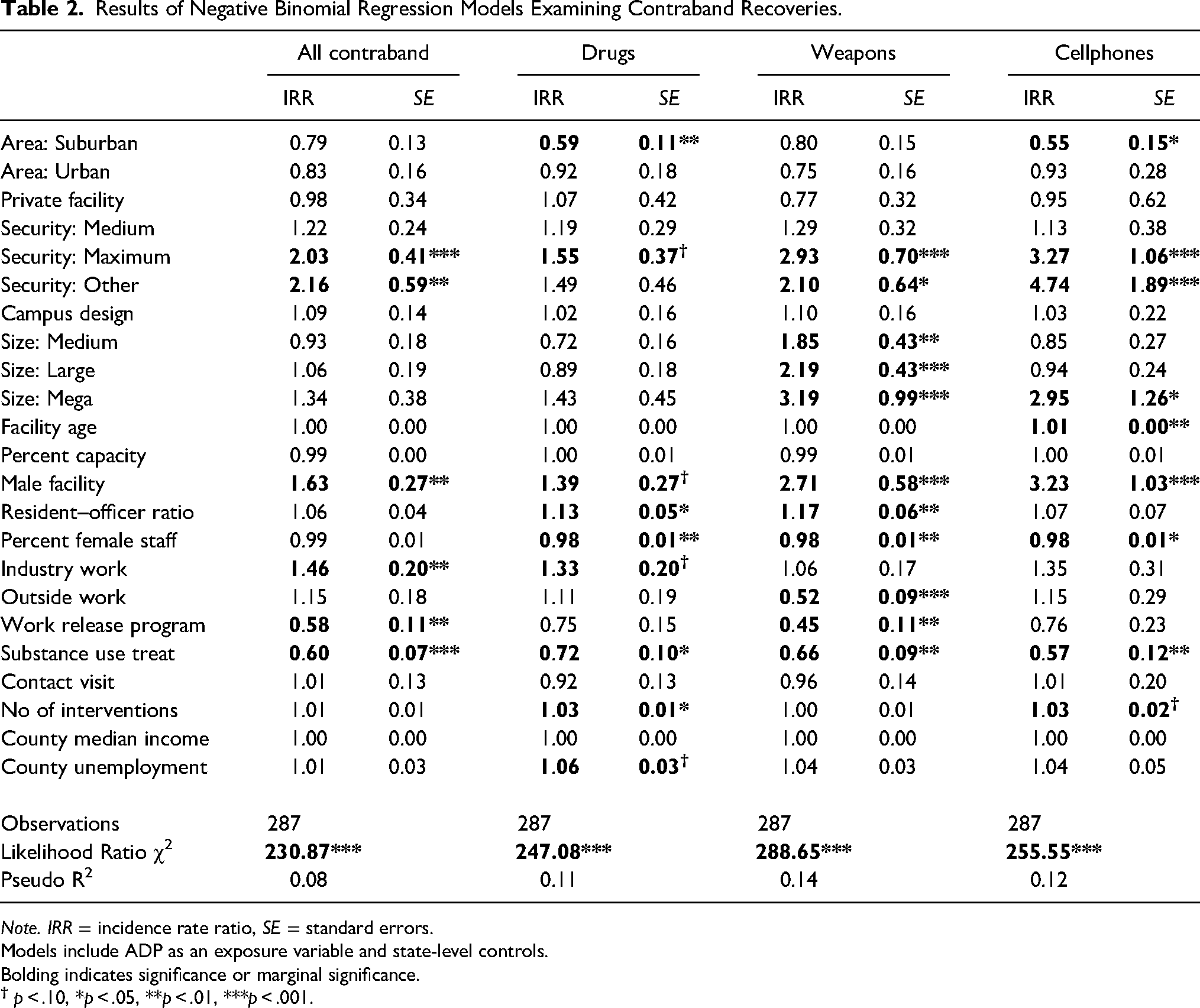
Results of the negative binomial models are provided in Table 2. All four models were statistically significant (indicated by the Likelihood Ratio χ2). Of note, the three models examining specific categories of contraband (drugs, weapons, and cellphones) have better overall model fit and explanatory power than the model examining all contraband recoveries. Moreover, while certain findings remain consistent across models, there are also discernible nuances among the three contraband types in terms of how various independent variables explain their occurrences. This prompts the need to examine correlates of contraband separately for the three distinct types. Therefore, the discussion of results is organized based on these different models.
Results of Negative Binomial Regression Models Examining Contraband Recoveries.
Note. IRR = incidence rate ratio, SE = standard errors.
Models include ADP as an exposure variable and state-level controls.
Bolding indicates significance or marginal significance.
All Contraband
The security level is significantly correlated with total contraband recoveries. Maximum security (IRR = 2.03, p < .001) and other (IRR = 2.16, p < .01) prisons have more than twice the estimated number of contraband recoveries than minimum security prisons. Male facilities also have approximately 63% more contraband recoveries than female facilities (IRR = 1.63, p < .01). Notably, there are differences across the types of work and programs offered to residents and how these are associated with contraband levels. For example, allowing residents to work in prison industries increased contraband recoveries by nearly 50% (IRR = 1.46, p < .01). Residents working in these settings would have greater access to tools and materials which could be classified as contraband if discovered outside their workplace premises. Their workstation or workplace can also be used to conceal contraband items.
Conversely, having work release or substance use programs is associated with a 40% reduction in the rate of contraband recoveries. This is particularly noteworthy because work release also creates opportunities for residents to access and smuggle contraband into their facilities. Given the eligibility of work release programs, however, it is conceivable that the work release program indicator could reflect facilities that primarily house individuals at lower risk of rule violations. Those facilities could also have extra screening protocols for work release program participants entering and exiting the facility daily. Such organizational dynamics might not be adequately captured by the control variables included in our models.
Drugs
There were 41% fewer contraband recoveries in facilities located in suburban areas compared to those located in rural areas (IRR = 0.59, p < .01). Based on the marginal effects, we would predict fewer than 20 drug recoveries from suburban facilities, compared to 33 drug recoveries from rural facilities, holding all other covariates constant. There were also two notable findings related to staffing. First, higher resident–officer ratios were associated with an increase in drug recoveries, such that each additional resident per officer resulted in a 13% increase in recovered drugs (IRR = 1.13, p < .05). Second, with each percentage point increase in the proportion of female staff in a facility, there was a 2% decrease in the number of drugs recovered (IRR = 0.98, p < .01). We also found that facilities enrolling residents into substance use treatment programs had nearly 30% fewer drug recoveries than those without such programs (i.e., 27 vs. 37 predicted drug recoveries; IRR = 0.72, p < .05). Finally, we found a significant, positive relationship between the number of contraband interventions implemented in a facility and the number of drug recoveries (IRR = 1.03, p < .05).
Weapons
Many of the findings from the weapons model were consistent with one or both of the previous two models. For example, we found that maximum security (IRR = 2.93, p < .001), other security (IRR = 2.10, p < .05), and male facilities (IRR = 2.71, p < .001) had higher levels of weapon recoveries, while those offering work release (IRR = 0.45, p < .01) and substance use programming (IRR = 0.66, p < .01) had fewer weapon recoveries. We also found, consistent with the drug recovery model, that a higher resident–officer ratio increased weapon recoveries (IRR = 1.17, p < .01), while the proportion of female staff (IRR = 0.98, p < .01) significantly reduced these recoveries. Other findings in this model were unique. For example, medium, large, and mega prisons had between 85% and 220% more weapon recoveries than small prisons. As a reminder, these models include ADP as an exposure variable, suggesting that weapons may be directly related to a prison's size, even after controlling for its population. We also found that facilities allowing their residents to work outside the prison, such as to perform public maintenance, had significantly fewer weapon recoveries (IRR = 0.52, p < .01).
Cellphones
The results in the final model, which examined cellphone recoveries, were also consistent with some of the results from the other three models. For instance, it was again found that contraband cellphones were a bigger problem in maximum versus minimum security facilities (IRR = 3.27, p < .001) and in male versus female facilities (IRR = 3.23, p < .01), but less of a problem in facilities with higher levels of female staff (IRR = 0.98, p < .05) and in facilities providing substance use treatment (IRR = 0.57, p < .01). Mega-sized facilities also had more cellphone recoveries than small facilities (IRR = 2.95, p < .05); facilities in suburban areas had fewer cellphones than those in rural areas (IRR = 0.55, p < .05). Unique to this model, older facilities had significantly more recovered cellphones—such that each year increases the predicted number of recovered cellphones recovered by just over 1% (IRR = 1.01, p < .01).
Discussion
This investigation is unique as the first empirical study of a national scope to examine correlates of prison contraband, contributing to both scholarly and applied fields of corrections. Applying three theoretical models of institutional misbehavior to the explanation of the levels of prison contraband, the study further offers a comprehensive analysis of contraband types across facility type and level and correctional population correlates. Several lessons are worth highlighting.
First, although there were some consistent results emerging across all four models, including drugs, weapons, cellphones, and all contraband types combined, the findings confirm the relevance of examining the factors that explain each contraband type individually. For example, some covariates significantly predicted only one or two types of contraband, which has important implications for policy. Suburban facilities had higher levels of contraband items coming from outside the facility (i.e., drugs and cellphones) compared to rural facilities. Yet, this difference was not significant in the weapons and all contraband models (i.e., contraband that often comes from items already inside the facility and has been illegally modified). One possible explanation is that rural facilities have perimeters that are more susceptible to outside penetration via drones or “throwovers.” Shukla et al. (2021) describe how prisons near large, wooded areas provide cover to people who seek to throw or fly contraband over a prison's perimeter. Other research has similarly shown that improving perimeter and physical security can reduce drugs in prisons (Bell & Leese, 2020).
Some other findings complicate the perceived link between contraband and outside sources. For example, visitors are often perceived as conduits for contraband, particularly items like drugs and cellphones (Berghuis et al., 2022; Peterson et al., 2023; Shukla et al., 2021). However, this investigation found no significant difference in contraband levels, of any type, between facilities that offered contact visitation to all residents and those that restricted visitation in some way. This contradicts some previous research, which has found that contraband levels increase immediately after visits and then gradually decline (Berghuis et al., 2022; Siennick et al., 2013). Other research, however, suggests that visitors are less likely to engage in contraband-related violations than staff, and that the perceived risk associated with visitors among correctional administrators may be overstated (Peterson et al., 2023; Shukla et al., 2024).
Similarly, allowing residents to work outside the facility or to leave the facility on work release had null or negative impacts across all models. In fact, these covariates were found to be strong and meaningfully protective factors against certain types of contraband, such as weapons. Using marginal probabilities, it is predicted that facilities offering both work release and outside work programs would have only 10.3 weapon recoveries per year, compared to 43.8 weapon recoveries in facilities with neither program. As noted previously, this likely reflects the fact that prisons offering work release and outside work programs typically hold residents who are less at risk of engaging in all kinds of institutional misbehavior, including contraband introduction. Still the findings are noteworthy; contrary to the notion that such programs make it easier for residents to smuggle contraband into facilities, they may improve institutional safety and security.
Even when findings were consistent across models, unique dynamics were uncovered that would have been unknown without the joining of contraband type analyses. That is, maximum security and male prisons had significantly or marginally significantly more contraband recoveries than minimum security and female prisons across all models. These results are aligned with prior research on institutional misbehavior (Allard et al., 2008; Goetting & Howsen, 1986; Harer & Langan, 2001; McCorkle et al., 1995; Steiner et al., 2014). However, the separate examination of contraband types illustrates that the strength of these relationships varies across models. The influence of security level is relatively weaker for drugs (1.55 times) and stronger for weapons (2.93 times) and cellphones (3.27 times). Likewise, the positive relationship between male facilities and contraband recoveries is less pronounced for drug recoveries and considerably more pronounced for weapon and cellphone recoveries.
An important and consistent finding across most of our models was that female staff reduced contraband levels. While this is a novel variable to include in a study of institutional misbehavior, its importance is linked to the management perspective and the correctional literature on staff boundary violations (Worley & Worley, 2011). From this body of research, there is a commonly held belief that incarcerated individuals seek to develop inappropriate relationships with staff so that they can manipulate staff into bringing contraband into the facility. This has been noted as a particular concern when it comes to the relationships between incarcerated men and female prison staff. In fact, a recent review of the staff boundary violation literature found that a common policy recommendation is to restrict cross-sex staff employment in carceral facilities (Kelly & Potter, 2023).
Results from this study's analyses contradicted these notions. Rather, NSCC prisons with a greater proportion of female staff had fewer drug, weapon, and cellphone contraband recoveries. Over the past 3 decades, there has been a concerted effort to increase the representation of women employed in correctional facilities, with advocates arguing that women offer unique and complementary skills that can improve correctional culture and enhance the management and care of residents (MTC Institute, 2008). There is some merit in this argument, at least as it pertains to contraband interdiction. Overall, the findings here suggest that ongoing efforts by correctional administrators to diversify their workforces may benefit safety and security.
Only one covariate significantly decreased contraband recoveries in all four of the models—whether facilities provided substance use or addiction treatment to residents. Several other studies have found that prison-based substance use treatment, especially when implemented in coordination with other interventions, can improve care, reduce drug overdoses, and mitigate violence within the facility (Clement et al., 2021; Holsinger, 2002; Prendergast et al., 2004). In addition to the rehabilitative contribution of such programs, prior research has shown that they reduce the demand for contraband at both the federal (US Government Accountability Office, 2011) and state level (Holsinger, 2002). Based on this finding, it is strongly encouraged that correctional administrators offer and expand the use of substance use programs (see Leukefeld & Tims, 1992).
Another goal of this research was to determine the suitability of prominent theories of institutional misbehavior in understanding contraband levels. There is mixed support for all three of the theories tested. The negative association between several of our contraband measures and outside work, work release, and substance use programs provides some empirical support for deprivation theory. That is, each of these initiatives may mitigate the pains of imprisonment (Sykes, 1958) and, in turn, reduce levels of contraband. It was also shown that maximum security facilities, which by design are more depriving, had higher levels of contraband. However, there was no relationship between crowding (percent capacity), a key measure of deprivation in previous studies, and contraband. The age and design of a facility were also not associated with most measures of contraband, even though newer campus-style prisons were designed to improve rehabilitation (Grant & Jewkes, 2015).
Second, there was some support for the importation theory. For example, male facilities generally had higher levels of contraband. Moreover, maximum security prisons, which presumably hold people convicted of more serious crimes, had more total contraband, weapons, and cellphones than minimum security facilities. Little support was found for the related “not-so-total institution” concept (Farrington, 1992; McCorkle et al., 1995). Neither measure of the prison's local community economic condition predicted contraband, although county unemployment was marginally significant in the drug model (p < .10).
Additionally, there is some support for the management perspective. As noted above and related to the findings regarding female staffing levels, facilities with higher resident–officer ratios (i.e., a greater number of incarcerated residents per correctional officer) had significantly higher levels of contraband. Although previous studies examining the relationship between similar measures and other forms of prison misconduct have produced mixed results (Bierie, 2012; Lahm, 2009), this result is consistent with the assumptions of the management perspective. As the ratio of residents to officers increases, it becomes more difficult for each officer to effectively monitor and manage the incarcerated population. This, in turn, affects their ability to keep contraband out of the facility.
Finally, there were mixed results related to the measure of the number of contraband interdiction interventions. This measure was only significant in the drugs model, and marginally significant in the cellphones model. In these models, the number of interventions a prison employed increased the number of contraband recoveries. Of course, because the goal of contraband interdiction is to keep contraband out of the institution, these findings may seem contradictory. However, it is likely these interventions helped staff find more contraband, thus increasing recoveries (see Clement et al., 2021). Moreover, it is likely that facilities struggling with high levels of contraband implement more interdiction strategies to remedy the problem; thus, we run into the proverbial “chicken and egg” dilemma with these cross-sectional data.
Limitations and Conclusion
There are some limitations to this study. Although the NSCC included over 300 prisons, the sample is not representative of all U.S. prisons. Furthermore, there is a measurement issue with using contraband recoveries for our outcome variables. That is, NSCC respondents provided information on the number of contraband items they recovered in their facilities, but some proportion of contraband would not have been detected, recovered, or known to administrators. While such measurement error is problematic for nearly all administrative criminal justice data, this may be particularly germane to the study of contraband (Bosma et al., 2020). Although it is impossible to estimate the “true” amount of contraband, given the lack of credible alternative estimates of contraband, Grommon et al. (2018) estimated that only a fraction of total contraband cellphones in a facility were eventually confiscated.
Another limitation is that study data covered contraband recoveries in 2018—before the COVID-19 pandemic. However, to our knowledge, these are the only data currently available that include such comprehensive information on contraband recoveries and prison-level characteristics. Moreover, despite the time between data collection and this investigation, it is believed the findings are equally relevant in today's context. The COVID-19 pandemic introduced and exacerbated several critical issues in prisons and jails that have made it difficult for administrators to effectively manage their institutions and maintain safety, including increased population turnover, disruptions to programming and services, and staffing shortages (Carson et al., 2022; Felix et al., 2022).
Despite these limitations, this research yields important implications for prison administrators and other policymakers regarding the mitigation of a prison's contraband-related risks. For example, providing substance use treatment and diversifying staff may reduce overall levels of drugs, weapons, and cellphone contraband. Providing more outside work opportunities and work-release programs may protect against contraband weapons. This study also has implications for future scholarship. The cross-sectional data does not support conclusions about the causal relationships between prison-level covariates and contraband. Researchers should create and assess longitudinal data that would allow for a more nuanced study of how changes in these covariates impact contraband over time. Future research should also replicate and explore the findings regarding female staff and contraband levels. This is to suggest a better effort at understanding the mechanisms through which a more gender-diverse workforce affects contraband (e.g., are female correctional officers more effective at managing incarcerated populations, or are they less effective at finding and recovering contraband?). Lastly, the additive measure of contraband interdiction interventions was limited—future research should evaluate whether specific interventions can increase recoveries or reduce different types of contraband.
Footnotes
Declaration of Conflicting Interests
The authors declared no potential conflicts of interest with respect to the research, authorship, and/or publication of this article.
Funding
The author(s) disclosed receipt of the following financial support for the research, authorship, and/or publication of this article: This work was supported in part by the National Institute of Justice [grant number 2015-IJ-CX-K001]..