



Abstract
In a forced compliance situation, Scheier and Carver have shown that making high private self-consciousness salient through exposure to a mirror inhibits the arousal of dissonance and the subsequent attitude change. Based on these results, the aim of our study is to examine an alternate theoretical interpretation of the absence of attitude change. From our point of view, the mirror could have the status of a misattribution cue, thus maintaining the arousal. To test this hypothesis within the induced hypocrisy paradigm, participants first completed the private self-consciousness scale. Then they took part in one of the following conditions: (1) no mirror/no hypocrisy, (2) no mirror/hypocrisy, and (3) mirror/hypocrisy. Behavioral change and psychological discomfort were measured. Results indicated that participants in the mirror/hypocrisy condition were the most inclined to change and reported the greatest psychological discomfort. These results revealed that participants experienced dissonance when exposed to the mirror and support the hypothesis of misattribution.
Introduction
Since Festinger’s (1957) seminal work, the theory of cognitive dissonance has become a pivotal theory in social psychology (Harmon-Jones & Mills, 1999). Cognitive dissonance is defined as an aversive state of psychological discomfort—called dissonance—aroused when a person holds at least two cognitive elements, which are mutually inconsistent. As this psychological conflict has motivational properties, the person experiencing dissonance is motivated to reduce it, by changing or altering at least one of the cognitions. In most research, dissonance is reduced by a change in attitude (cf. forced compliance paradigm, Festinger & Carslmith, 1959).
Mirror: Arousing private self-consciousness
As Morin (2011) pointed out, self-focusing attention could be experimentally induced in many ways: mirrors, cameras, an audience, and recordings of one’s own voice (Ickes, Wicklund, & Ferris, 1973). However, these self-focusing stimuli do not affect the same dimensions of self-attention: the mirror induces private self-consciousness, whereas the camera induces public self-consciousness (Davies, 2005).
At the beginning of the 80s, Scheier and Carver (1980) conducted a series of experiments in which they explored the role of self-attention directed on the process of dissonance reduction. They hypothesized that making participants self-focused would heighten the resistance of the attitude, inhibiting the dissonance effect (i.e., attitude change). Participants were invited to voluntarily write an essay advocating as convincingly as possible that students should have little or no control over the kinds of course offered by the university. Some of them were self-focused: they were exposed to a mirror (dissonance-mirror condition) while performing the counter-attitudinal behavior, whereas the others were not (dissonance/no-mirror condition). In a control condition (no-dissonance condition), participants were not given the choice of performing—or not—the counter-attitudinal behavior. Results replicated the classical effect of dissonance: attitude change was greater for participants in the dissonance/no-mirror condition than for those in the no-dissonance condition. On the other hand, when participants were in front of their own reflection, no change in attitude occurred. From Scheier and Carver’s point of view (1980), the presence of the mirror focused the participants’ attention on the private and covert dimensions of the self. Private self-consciousness is supposed to reflect an awareness of private aspects of the self, such as privately held attitudes. The authors concluded, “self-attention is an important determinant of resistance to change” (Scheier & Carver, 1980, p. 394). Based on this reasoning, facing the mirror should increase private self-consciousness. Thus, private self-consciousness should mediate the mirror-attitude change relationship (Scheier & Carver, 1980, p. 395). Surprisingly and to our knowledge, this potential relation of mediation was not experimentally investigated even though Scheier and Carver (1985) had developed a self-consciousness scale.
Mirror: Misattribution cue
The lack of attitude change in the dissonance-mirror condition could also be understood as a misattribution effect (Zanna & Cooper, 1974, 1976). Based on Schachter’s two-factor theory of emotional state (Schachter, 1962; Schachter & Singer, 1964), misattribution illustrates the attributional process by which people attribute their aversive state of dissonance (psychological discomfort) to an external source. Zanna and Cooper (1974) applied misattribution to the forced compliance paradigm. First, they asked participants to ingest a pill purported to make them feel tense, relax, or to have no side effects. Second, all the participants were asked to freely write a counter-attitudinal essay (dissonance induction). As expected, no attitude change was observed among participants who were told that the pill would make them feel tense (misattribution effect). Conversely, attitude change was observed among participants who were told that the pill would have relaxing effects or would have no side effects (dissonance effect). The misattribution effect had been replicated with different external sources (i.e., noise, fluorescent lamps, placebo drug, erotic photographs, ultrasound, bogus pipeline, and so on). The misattribution process is often considered to be an indirect mode of dissonance reduction that involves activities which reduce psychological discomfort (i.e., dissonance) without resolving cognitive inconsistency.
Some dissonance theorists do not share this point of view (Fointiat, 1996; Fointiat, Somat, & Grosbras, 2011; Joule & Martinie, 2000; Stults, Messé, & Kerr, 1984), and they maintain that the lack of dissonance effect (i.e., no attitude change) cannot be equated with the absence of dissonance experience. If misattribution inhibits attitude change, it leaves the aversive state of dissonance unresolved, which in turn can be reduced by an alternate mode of reduction: behavior change (Beauvois, Joule, & Brunetti, 1992; Fointiat, 1996). In any case, the theoretical status of the mirror remains ambiguous. Taking into account these theoretical perspectives led us to consider a competitive hypothesis. If the mirror leads to self-focus attention, the attitude becomes resistant to change. Thus, there is no more motivation to change. If the mirror is a misattribution cue, the motivation to reduce dissonance is still present. Thus, we hypothesize a change in behavior (behavioral rationalization). The aim of the present research was to test this competitive hypothesis in a specific paradigm of cognitive dissonance giving a prominent role to self-concept.
Induced hypocrisy: Arousing dissonance by threatening the self
Induced hypocrisy is one of the newest paradigms of cognitive dissonance. It is based on the reinterpretation of the dissonance phenomenon in terms of self-consistency (Aronson, 1968; Thibodeau & Aronson, 1992). The induced hypocrisy paradigm (Aronson, Fried, & Stone, 1991) emerged at the beginning of the 1990s and combines two factors: normative saliency and recall of counter-normative behaviors. The first factor “consists of advocating the importance of behaving in a pro-social manner” (Fointiat et al., 2011, p. 466). The second factor consists of making the participant aware of instances when he/she did not behave in line with the advocated standards. The discrepancy between pro-normative advocacy (e.g., “I know what I have to do”) and past counter-normative behaviors (e.g., “my own failures to behave in a normative manner”) arouses an aversive state of psychological discomfort (i.e., dissonance). The individual is motivated to reduce this psychological discomfort by modifying his/her subsequent behaviors in line with the prior advocacy. Thus, “practicing what was preached would reduce dissonance without changing the perception of what constitutes appropriate and reasonable behaviors” (Stone, Wiegand, Cooper, & Aronson, 1997, p. 55). The induced hypocrisy effect (i.e., behavior change) has been demonstrated through a set of three experiments (Aronson et al., 1991; Dickerson, Thibodeau, Aronson, & Miller, 1992; Stone, Aronson, Crain, Winslow, & Fried, 1994). For instance, Aronson et al. (1991) and Stone et al., (1994) asked (or did not ask) participants to videotape speeches advocating the systematic use of condoms (normative saliency). Afterward, participants were asked (or were not asked) to recall their past transgressions, namely times in their own recent past when they had failed to practice safe sex (recall of counter-normative behaviors). Dissonance was predicted in only one of the four experimental conditions: the condition combining the two factors. As hypothesized, hypocritical participants showed an increase in their intention to use condoms (Aronson et al., 1991), but also an increase in their actual purchase of condoms (Stone et al., 1994). In a conceptual replication, Dickerson et al. (1992) also demonstrated that hypocrisy induction was effective in leading to actual behavioral change. The theoretical interpretation is based on the self-consistency theory (Aronson, 1968; Thibodeau & Aronson, 1992). From this point of view, cognitive dissonance is not only an inconsistency between beliefs and behaviors, as proposed originally by Festinger (1957), but also a threat to self-concept and self-integrity. In line with the self-consistency theory, cognitive dissonance is defined as the desire of an individual to perceive him/herself as a moral person. Thus, the individual is motivated to reduce dissonance in order to alleviate this threat to the self. Making an inconsistency between what people have preached (normative saliency) and their own past transgressions (recall of counter-normative behaviors) salient threatens self-concept. The easiest way to restore self-integrity is to engage in subsequent pro-social behaviors. Hence, modifying his/her future behavior or behavioral intentions enables the restoration of an individual’s self-concept as a moral, rational, and competent person. For instance, Fointiat (2004) demonstrated that threatening self-concept led to a strong hypocritical effect (i.e., behavioral change) whereas strengthening self-concept inhibits the change in behavior.
Experiment
The following experiment was conducted to clarify the status of the mirror in a specific situation of dissonance. First, from Scheier and Carver’s perspective, it could be hypothesized that the effect of the mirror on dissonance reduction is mediated by self-focus attention (H1a). If so, attitude becomes resistant to change and the motivation to reduce dissonance is inhibiting. Alternately, from the misattribution theorists’ perspective, we can also consider the mirror as a misattribution cue. In such a case, the arousal of dissonance is not reduced (Fointiat et al., 2011; Joule & Martinie, 2000). Thus, we hypothesized that hypocritical participants facing the mirror would be more inclined to reduce their dissonance than no-hypocrisy participants and no-mirror hypocritical participants (H1b). Consequently, hypocritical participants facing the mirror will experience more psychological discomfort than the others (H2).
Participants and design
Sixty non-psychology students (43 women and 17 men proportionally assigned to one of the experimental conditions, M = 21.63, SD = 2.29) were recruited individually for this study. They were randomly assigned to one of three experimental conditions in a one-way between-participants factorial design: hypocrisy-mirror condition, hypocrisy-no-mirror condition, or no-hypocrisy/no-mirror condition. The one-way design was chosen so as to replicate the Experiment 2 of Scheier and Carver (1980). 1
Procedure
Participants were recruited to take part in an experiment on environmental communication without any financial compensation. On their arrival at the laboratory, all participants completed the private self- consciousness scale adapted from Scheier and Carver (1985). Then each of them was asked (Fointiat & Grosbras, 2007) to freely write a pro-normative essay in favor of the protection of the environment (normative saliency). In line with the research conducted on the paradigm of induced hypocrisy (Aronson et al., 1991), the experimenter emphasized the consequences of this action. At this point, participants were assigned to one of the three experimental conditions.
In the hypocrisy-no-mirror condition, the participants completed a questionnaire making their transgressive behaviors salient (recall of counter-normative behaviors). The questionnaire was adapted from the procedure used by Dickerson et al. (1992); Fointiat, (2004); and Fointiat, Priolo, Milhabet, and Saint-Bauzel, (2013). They completed a series of open-ended questions (e.g., “I have already failed to sort my rubbish. When was the last time? Which product?”). The measures were collected immediately after the induction of hypocrisy: the measurement of psychological discomfort-then-target-behavior (i.e., taking part in the organization of an action day for raising consciousness of the environment). The participants who agreed to volunteer also indicated the number of minutes they were willing to spend.
In the hypocrisy-mirror condition, the experimental procedure followed that of the hypocrisy-no-mirror condition in all respects, except that the participants were positioned in front of a mirror from when they entered the laboratory until they left.
In the no-hypocrisy/no-mirror condition, measures were taken immediately after participants had written the pro-normative advocacy.
Material
Following the Govern and Marsch (2001) and Selimbegovic and Chatard (2013) procedure, the mirror reflected the participant’s head and shoulder. This dimension seems to be appropriate for inducing private rather than public self-consciousness.
Measures
Private self- consciousness
The revised private self-consciousness scale (Scheier & Carver, 1985, French version Pelletier & Vallerand, 1990) consists of nine items (e.g., “I continually try to understand myself,” see Appendix 1) ranging from 0 (not like me at all) to 3 (completely like me). This dimension refers to an individual’s tendency to think and pay particular attention to the hidden and more intimate aspects of the self.
Psychological discomfort
Based on the study by Elliot and Devine (1994), psychological discomfort has been previously used as a measure of dissonance arousal (Fointiat et al., 2013; Gosling, Denizeau, & Oberlé, 2006; Matz & Wood, 2005). The scale includes five items (i.e., uneasy, uncomfortable, embarrassed, bothered, and annoyed with oneself). For each of them, the participants gave their position on a 7-point scale ranging from 1 (does not correspond at all to what I feel at this precise moment) to 7 (corresponds exactly to what I feel at this precise moment).
Results
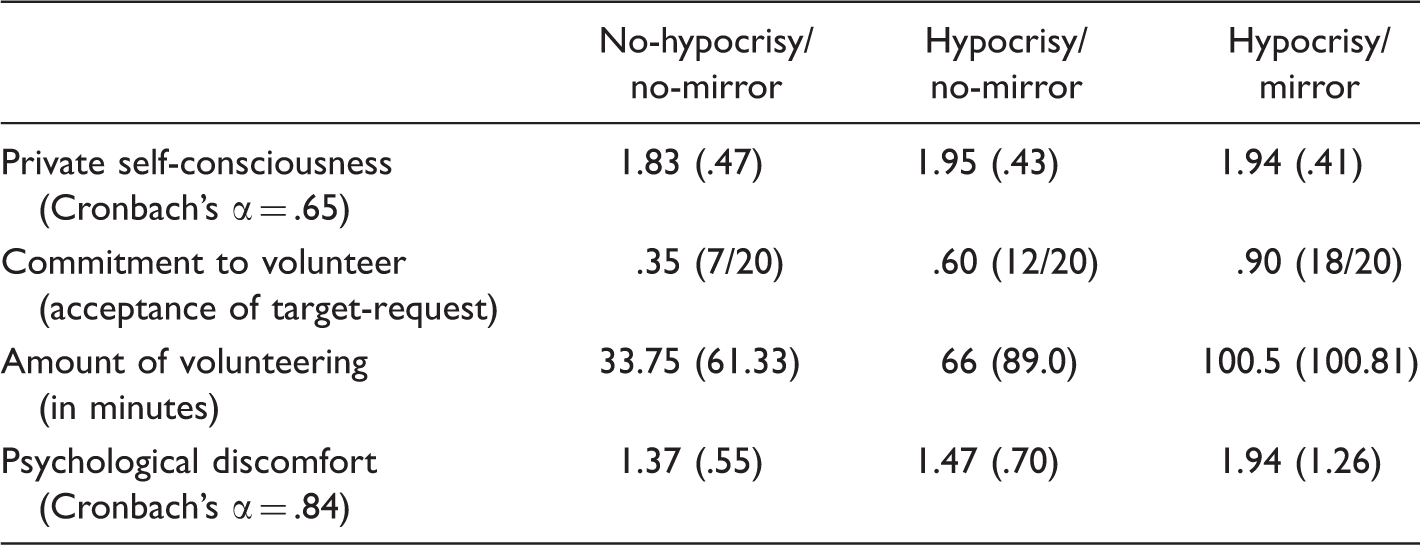
Private Self-Consciousness Scores, Commitment to Volunteer (Ratio), Amount of Volunteering in Minutes (SD) and Psychological Discomfort Scores (SD) Among the Three Experimental Conditions.
Private self-consciousness
First, according to Scheier and Carver’s (1980) reasoning, facing a mirror during the arousal of dissonance makes people self-focused, minimizing change. From this perspective, the mirror is supposed to make self-consciousness salient. Thus, we tested the mediation effect of private self-consciousness on the relationship between the mirror and the reduction of dissonance. No effect of the mirror on private self-consciousness was observed, rendering the mediation analysis out of date, F(1, 38) < 1, ns.
Mirror as a misattribution cue
Considering the dichotomous nature of the target behavior acceptance measures, data were analyzed using Pearson’s chi-square test. Concerning the measures of the amount of volunteering and psychological discomfort, data were analyzed using contrast analyses, as recommended by many authors (Abelson, 1995; Brauer & McClelland, 2005; Judd & McClelland, 1989; Rosenthal, Rosnow, & Rubin, 2000). The use of contrast analyses allows us to test specific hypotheses more efficiently than omnibus tests: “omnibus tests with multiple degrees of freedom test relatively vague questions whereas most hypotheses that we derive from our theoretical models make quite precise predictions” (Brauer & McClelland, 2005, p. 273). Before concluding that a given contrast is a parsimonious description of the observed means, two conditions have to be satisfied. First, the main contrast has to explain a significant part of the variance. Second, the residual variance has to be non-significant.
Target behavior
In accordance with hypothesis 1b, the results showed that the participants in the hypocrisy-mirror condition were more inclined to accept the target behavior (.90) compared with the hypocrisy-no-mirror and no-hypocrisy conditions, considered together (.47), χ2 = 10.19, p = .001, ϕ = .41. Moreover, no difference was observed between the two latter conditions, respectively, .35 and .60, χ2 = 2.51, p = . 11, ϕ = .25.
Amount of volunteering
Given the abnormal distribution of the number of minutes and the large differences of this measure (from 0 to 450), we applied a logarithmic transformation (Log10) to correct the problem with normality. This transformation only changed the unit of measurement and did not change the relationship between the variables. First, Helmert contrasts comparing the hypocrisy-mirror condition to the hypocrisy-no-mirror condition and no-hypocrisy condition considered together were significant, F(1, 57) = 5.94, p = .017. This explained 75.76% of the variance. Second, the difference between the two latter conditions was non-significant, F(1, 57) = 1.90, p = .17, ns, and explained 24.23% of the variance. The two conditions were satisfied: the participants in the hypocrisy-mirror condition agreed to spend more time in volunteering than did participants in the other conditions.
Psychological discomfort
A similar pattern of results was observed for the index of psychological discomfort (H2). First, Helmert contrasts showed a higher psychological discomfort in the hypocrisy-mirror condition (MHypocrisy-mirror = 1.94) compared with the hypocrisy-no-mirror condition and no-hypocrisy condition considered together (MHypocrisy-no-mirror = 1.47 and MNo-hypcrisy = 1.37, F(1, 57) = 4.45, p = .03, respectively). This main contrast explained 97.3% of the variance. Second, the contrast comparing the latter two conditions was not significant, F(1, 57) < 1, ns, and explained 2.70% of the variance Thus, the two conditions were satisfied leading to the conclusion that hypocritical participants facing the mirror experienced more dissonance than the participants in the no-hypocrisy and hypocrisy-no mirror conditions.
Discussion and conclusion
First, the results replicated the hypocritical effect: participants recalling their transgressions were more willing to accept the target-behavior than were participants in the no-hypocrisy condition. These results are in accordance with previous research. Making participants mindful of their own failures after making them aware of the norm arouses psychological discomfort. Hypocritical participants are motivated to reduce the dissonance through a behavioral change consistent with the previously advocated norm. The behavioral change (i.e., hypocrisy effect) reduces dissonance by restoring the self-concept threatened by the recalled transgressions (Aronson et al., 1991; Stone et al., 1997).
The study was designed to test Scheier and Carver’s intuition that when people experience dissonance, the presence of a mirror makes them self-focused. Surprisingly, this assumption has never been explored. Unexpectedly, the results showed the mirror did not affect the private self-consciousness dimension. It becomes difficult to consider that self- consciousness mediated the relationship between the mirror and the reduction of dissonance. Thus, the absence of dissonance reduction (as the witness of an aversive psychological state) cannot be considered as equal to the absence of dissonance arousal.
Considered together, our results are in favor of a misattribution status of the mirror. When hypocritical participants are exposed to their own reflection, they reported high psychological discomfort; they were also more willing to accept the target request. These results indicate that hypocritical participants facing a mirror are still experiencing dissonance, an aversive state that must be reduced. Far from making private self-consciousness salient, and thus inhibiting any arousal of dissonance, the mirror seems to leave psychological inconsistency unreduced. This conclusion is in line with previous research. In a series of studies (Fointiat, 1996; Joule & Martinie, 2000), it was demonstrated that in a misattribution context no attitude change occurs, but dissonance is still experienced. In such a case, participants reduced dissonance using an alternative mode of reduction, such as behavioral change. Thus, the mirror inhibits attitude change—as Scheier and Carver concluded—but it leaves the aversive state of dissonance unresolved—as demonstrated here.
Limitations and perspectives
Based on Scheier and Carver’s (1980) reasoning, we expected an effect of the mirror on private self-consciousness reports. However, no statistical difference was observed between participants in the hypocrisy conditions, that is, whether they were exposed or not to the mirror. It could be possible that the mirror makes self-awareness salient, rather than self-consciousness. As indicated by many authors (e.g., Fenigstein, Scheier, & Buss, 1975), self-focus can be dispositional or situational. The first one is referred to as self-consciousness, whereas the second is referred to as self-awareness (Froming, Walker, & Lopyan, 1982), defined as the capacity for self-reflective thoughts. Future research could investigate the impact of private self-awareness (Govern & Marsch, 2001) through exposure to a mirror on the arousal and reduction processes of cognitive dissonance.