




Abstract
Background
Mindfulness is a state of nonjudgmental attentiveness to moment-to-moment experiences. Interest in implementing mindfulness-based interventions is growing.
Objective
We investigated the benefit of a short mindfulness exercise for mindfulness novices in a performance situation.
Method
Participants (N = 97) engaged in a mindfulness or relaxation exercise and subsequently worked on an achievement test.
Results
Participants in the mindfulness condition had fewer distracting evaluative thoughts during and experienced less negative affect after the achievement test. Participants also exerted less self-control (vagal withdrawal measured via heart rate variability) during the mindfulness exercise than on the relaxation exercise. In a subsample (n = 84), selected on the basis of serious involvement in the exercise, mindfulness eliminated the negative association between distracting evaluative thoughts and performance. Furthermore, beneficial effects of mindfulness on distractive thoughts were found for participants low but not high in trait mindfulness. The mindfulness exercise did not influence performance.
Conclusion
In performance contexts, even brief mindfulness exercises may have beneficial effects for mindfulness novices and people low in trait mindfulness.
Keywords
Introduction
Mindfulness is a state of nonjudgmental attentiveness to moment-to-moment experiences (Bishop et al., 2004; for a list of definitions, see Dane, 2011). A growing body of literature supports the view that mindfulness increases psychological well-being and cognitive functioning (Brown & Ryan, 2003; Chiesa, Calati, & Serretti, 2011). Like other psychological interventions, mindfulness interventions are based on the assumption that their positive effect is derived from extensive and regular practice across weeks or months (Vettese, Toneatto, Stea, Nguyen, & Wang, 2009). However, on the basis of postulated mechanisms of mindfulness (Farb, Anderson, Irving, & Segal, 2014; Shapiro, Carlson, Astin, & Freedman, 2006; Teper, Segal, & Inzlicht, 2013), experimental research including mindfulness exercises (Erisman & Roemer, 2010; Papies, Barsalou, & Custers, 2012; Verplanken & Fisher, 2014; Vinci et al., 2014), and findings on priming self-regulation strategies (Bargh & Morsella, 2010; Dorris, 2009; Fujita & Trope, 2014; Parkinson & Haggard, 2014; Smith, 1994; Williams, Bargh, Nocera, & Gray, 2009), we propose that practicing mindfulness directly before a stress-producing event will offer beneficial consequences for coping with performance demands even when a person has no preexisting experience with mindfulness. The present research was designed to test the effect of a mindfulness exercise in a performance situation. In the following, we will elaborate on the concept of mindfulness and why performing a mindfulness exercise directly before an achievement task can have an immediate positive influence on cognition and affect.
Mindfulness
Being mindful comprises observing and describing but not judging and reacting to present experience (awareness and acceptance; Baer, Smith, Hopkins, Krietemeyer, & Toney, 2006). Although nearly everyone has the capacity to be mindful, a mindful state is not the default setting for most people. In fact, reaching a state of mindfulness is effortful because one has to override the immediate and automatic inclination to judge one’s current internal and external situation and to react with the aim of correcting the situation according to standards (Carver & Scheier, 1982; Eisenberg, Smith, & Spinrad, 2011). Self-control occurs when a person attempts to change the way he or she would otherwise think, feel, or behave and involves overriding or inhibiting competing impulses (Muraven & Baumeister, 2000). An example for mindfulness enabling acceptance of the (aversive) present state was reported by Verplanken and Fisher (2014). They found a positive effect of a mindfulness exercise on tolerance for viewing distressing images among habitual worriers. An example for inhibition of automatic reactions by mindfulness was reported by Papies et al. (2012). They found that the spontaneous approach reaction elicited by attractive food was eliminated for participants who mindfully attended to pictures of attractive food compared to participants who immersed themselves in these pictures. However, it is not clear whether to be mindful demands less self-control, because one does not change the state one is in, or more self-control, because one has to override the immediate and automatic inclination to judge and react. We explore this research question in the current study. Finally, not only do individuals differ in their habitual tendency to adopt a mindful state (trait mindfulness). State mindfulness can also vary within persons because it can be sharpened or dulled by a variety of factors (Brown & Ryan, 2003).
The cognitive benefits of mindfulness
Mindfulness can be viewed as a regulatory strategy that operates by deploying attention (Farb et al., 2014; Shapiro et al., 2006). In line with this idea, preliminary evidence suggests that mindfulness training is associated with significant improvements in attention (Chiesa et al., 2011). For example, mindfulness meditation training but not relaxation meditation training decreased the dysfunctional on-task allocation of attentional resources to task-irrelevant emotional stimuli (Ortner, Kilner, & Zelazo, 2007; for a critical evaluation, see Jensen, Vangkilde, Frokjaer, & Hasselbalch, 2012). Taken together and applied to the situation of interest in the present study, we expected a preceding mindfulness exercise to help direct attention toward the task at hand and away from distracting evaluative thoughts in a subsequent achievement situation. In addition, we expected that an attitude of acceptance (Baer et al., 2006; Farb et al., 2014) would prevent iterative judgment processes and thereby lessen the burden of distracting evaluative thoughts for working memory capacity (Jha, Stanley, & Baime, 2010). Thus, we expected the impact of a mindfulness exercise to be twofold: First, we expected mindfulness to actually reduce distracting evaluative thoughts by increasing individuals’ task focus; additionally, we expected mindfulness to moderate the impact of distracting thoughts should they occur. Assuming that a state of mindfulness concurs with greater tolerance towards distracting thoughts, mindfulness should buffer against a potentially detrimental effect of distracting evaluative thoughts on performance.
The affective benefits of mindfulness
State mindfulness has been shown to be beneficially associated with negative and positive state affect (Brown & Ryan, 2003; Jislin-Goldberg, Tanay, & Bernstein, 2012). The benefits of mindfulness for negative affect may occur because mindfulness increases sensitivity to negative affective cues, which signal the need for control and energize its execution, which in turn may promote the effective down-regulation of negative emotions (Teper et al., 2013). More precisely, contrary to a common misconception, mindfulness does not empty the mind of thoughts and emotions but fosters attentional deployment to the primary affective experience. Models of control highlight the involvement of quick affective reactions in the initiation of executive control (Inzlicht, Bartholow, & Hirsh, 2015; Inzlicht & Legault, 2014). Thus, mindfulness may improve executive control and consequently improve emotion regulation. Compatible with this view, in their account of mindful emotion regulation, Farb et al. (2014) postulated that mindfulness can be situated in an early stage of processing, even prolonging this stage by redeploying attention, thereby promoting the generation of appraisals and adaptive responses. Likewise, Vinci et al. (2014) reported a decrease in negative affect immediately following a mindfulness exercise. Additionally, Erisman and Roemer (2010) reported that participants who had listened to a mindfulness exercise experienced less negative affect after viewing an affectively mixed clip compared to participants who had listened to neutral educational information.
The benefits of mindfulness for positive affect, on the other hand, may occur because increased sensitivity to positive affective cues may directly enhance positive affect. For example, an induced state of mindfulness was shown to enhance positive affect in response to a positive film clip (Erisman & Roemer, 2010). Thus, although mindful attention and awareness is nonjudgmental and non-preferential (not toward or away from positive or negative affect; Kabat-Zinn, 2003), it may nevertheless potentiate the experience of positive affect. This is because awareness and attention to positive emotions makes people savor positive affect (Tugade & Fredrickson, 2007). Putting these ideas together, we expected that a mindfulness exercise would positively influence negative and positive affect in a performance situation.
Mindfulness exercises
Experimental lab research has found that brief mindfulness exercises can increase state mindfulness by affecting the processing of subsequent stimuli (e.g., Erisman & Roemer, 2010; Papies et al., 2012; Verplanken & Fisher, 2014; Vinci et al., 2014). In contrast to most previous research (e.g., Erisman & Roemer, 2010; Papies et al., 2012; Vinci et al., 2014), in the present research, we did not instruct participants to learn a particular style of processing and consciously apply this new cognitive style to a subsequent achievement task. Instead, we aimed to influence the way participants processed information through procedural or mindset priming. In procedural priming, a particular set of cognitive operations is activated, and these operations may then carry over to subsequent unrelated tasks (Dorris, 2009; Fujita & Trope, 2014; Parkinson & Haggard, 2014; Smith, 1994). The idea behind procedural priming is that nonconsciously operating goals can produce the same outcomes as when those same goals are consciously pursued (see review in Bargh, Gollwitzer, & Oettingen, 2010). Extending this principle of nonconscious operation of higher mental processes to the domain of self-regulation, it can be expected that nonconscious self-regulation goals successfully regulate experience (Bargh & Morsella, 2010). For example, priming the strategy of reappraisal (i.e., changing the meaning of an emotional stimuli before experiencing the emotion) via a scrambled sentence task was found to lead to less physiological reactivity when participants subsequently engaged in an anxiety-eliciting task (Williams et al., 2009).
Furthermore, in contrast to previous research, instead of investigating the effect of mindfulness on impulsive responses in processing affective information (Erisman & Roemer, 2010; Papies et al., 2012; Verplanken & Fisher, 2014), we investigated the effect of mindfulness on impulsive responses while processing task information. Congruously, we focused not only on affect but also on the impact of dysfunctional thoughts on performance.
The present research
To recap, we tested the hypotheses that a preceding mindfulness exercise would (a) lead to lower levels of distracting evaluative thoughts while working on a subsequent achievement test, (b) moderate the association between distracting evaluative thoughts and work efficiency, (c) lead to less negative affect, and (d) lead to more positive affect after working on an achievement test. We compared the effectiveness of a mindfulness exercise to a general relaxation method of the same duration. We chose this contrast because we postulated that the mechanisms that impact cognition and affect (i.e., direction of attention, sensitivity, and acceptance) are specific to mindfulness and go beyond the aspects that mindfulness shares with relaxation (Jensen et al., 2012; Ortner et al., 2007). We did not expect a mindfulness exercise to influence performance. Although positive associations of mindfulness with performance have been reported, effects were found for mindfulness trainings spanning four to eight weeks (e.g., Jha, Stanley, Kiyonaga, Wong, & Gelfand, 2010; Zeidan, Johnson, Diamond, David, & Goolkasian, 2010) and for trait mindfulness (Anicha, Ode, Moeller, & Robinson, 2012). We did not expect a brief and subtle manipulation of state mindfulness like in the present study (see Method section below) to be equally effective.
We tested the effects in a sample of people who were novices with regard to mindfulness practice or meditation methods. As the effects might be more pronounced among individuals with strong habitual tendencies for mindful behavior, we additionally explored whether trait mindfulness would moderate the effect of the mindfulness exercise on distracting evaluative thoughts and affect.
As stated above, it was not clear whether to be mindful—which implies acceptance of the present state—would demand less self-control, or rather more self-control than relaxing because of the necessity to override the immediate impulse to judge and react (Carver & Scheier, 1982; Muraven & Baumeister, 2000). Therefore, we analyzed whether mindfulness and relaxation differed in their demands for self-control. To quantify participants’ self-control efforts, we assessed vagally mediated heart rate variability (HRV). HRV refers to the interval between heart beats, which varies from beat to beat. According to the Neurovisceral Integration Model (Thayer & Lane, 2009), HRV is linked to inhibitory activity in prefrontal neural structures and neural feedback mechanisms between the central nervous system and the autonomic nervous system. This central autonomic network is assumed to adjust physiological arousal to changing situational demands and thus to support goal-directed behavior and adaptation (Thayer, Hansen, Saus-Rose, & Johnsen, 2009). A plethora of evidence has shown that HRV is associated with processes that are involved in self-control (e.g., Althaus, Mulder, Mulder, Van Roon, & Minderaa, 1998; Thayer et al., 2009). Thus, HRV can serve both as an index for the dispositional, trait-like capacity for self-control (Appelhans & Luecken, 2006), and as a process measure of exerted self-control in a given situation (Geisler, Kleinfeldt, & Kubiak, 2016; Segerstrom & Solberg Nes, 2007). 1 Informed consent was obtained from all participants.
Method
Participants
We tested 118 students recruited on campus who participated for course credit or 5 Euros. Participants were included in the main analyses only if they were mindfulness novices (i.e., participants who, according to their self-reports, did not regularly practice any kind of spiritual or mental exercise, any kind of yoga, or any form of meditation). Hence, there were 21 excluded participants who were compared to the novices on trait mindfulness but were not used in any further analyses.
We tested our hypotheses with all mindfulness novices randomly assigned to conditions (mn-sample: N = 97; n = 46 in the mindfulness condition; n = 51 in the relaxation condition; 68% female; Mage = 22.56, SD = 2.72; 49% psychology students). We additionally conducted the analyses in a selected subsample (per protocol-sample; pp-sample) in which participants were included only if, according to their self-reports, they had been able to seriously get involved in the audio exercise (pp-sample: N = 84; n = 38 in the mindfulness condition; n = 46 in the relaxation condition; 69% female; Mage = 22.56, SD = 2.71; 46% psychology students). Validity of the conclusions drawn from the analyses based on the pp-sample may be compromised, as participants self-selected into conditions. However, we aimed to test the hypotheses under the condition that participants seriously performed the mindful and relaxation exercise.
Independent variables
Mindfulness exercise
The exercise lasted 8 minutes. It was composed and recorded by the third author who is an experienced meditation instructor. The instructions were as follows (translated excerpt): Sit upright and comfortably so that you can breathe freely. Please remember that it does not matter if you are good at this exercise or not. Just go along as you can. Start to realize that you are breathing. Imagine your attention as a spotlight. Direct your attention spotlight toward your breathing. Be an open and curious observer of your breathing. If your attention happens to drift away from your breathing, do not fight it but just register and accept it. Simply adjust your attention spotlight again and direct it back to your breathing.
Relaxation exercise
Participants were instructed to listen to relaxing instrumental music for 8 minutes (Bekker, 2005).
Manipulation check
We tested whether the mindfulness exercise lead to a higher level of state mindfulness during a subsequent achievement task than the relaxation exercise. These analyses were performed with an additional sample to make sure that by assessing state mindfulness we did not manipulate participants’ state mindfulness when testing our hypotheses. Asking for their state mindfulness after performing the exercise might be an intervention to accidentally bring participants in the relaxation condition on a par with participants in the mindfulness condition regarding their state mindfulness (Pedhazur & Schmelkin, 1991). We tested 49 participants. Two participants were excluded because they had experiences with a form of meditation. Participants (N = 47; 77% female; Mage = 22.15, SD = 5.01; 85% psychology students) were randomly assigned to the mindfulness (n = 24) versus relaxation condition (n = 23) and tested individually or in groups of up to three. They listened to the audio intervention (mindfulness vs. relaxation) via head phones and then worked on two creativity tasks taken from the Berliner Intelligence-Structure-Test (Jäger, Süß, & Beauducel, 1997) for approximately 8 minutes. The first task consisted of completing as many different sentences as possible including three given words. The second task consisted of completing a simple figure to form as many different objects as possible. Finally, participants applied a six-point scale ranging from 1 (very seldom or never) to 6 (very often or always) to six items in order to rate the occurrence of state mindfulness during a task they had just completed. We adapted the items from the acting-with-awareness scale from the Kentucky Inventory of Mindfulness Skills (KIMS; Baer, Smith & Allen, 2004; German translation, Ströhle, Nachtigall, Michalak, & Heidenreich, 2010). An example item is “While working on the task, I was completely absorbed by it and thought of nothing else.” (Cronbach’s α = .94, M = 4.84, SD = 1.02, skewness = −0.96, SE = 0.33, kurtosis = −0.24, SE = 0.65). We log-transformed the non-normally distributed state mindfulness values. As expected, participants in the mindfulness condition (M = 1.61, SD = 0.15) reported higher levels of state mindfulness while working on the achievement tasks than participants in the relaxation condition (M = 1.48, SD = 0.33), t(30, 60) = −1.73, p = .04 (one-tailed), d = 0.51. Thus, manipulation of mindfulness was successful. Experimental condition had no influence on the number of produced sentences and objects, t(45) = −.17, p = .86 (two-tailed), d = 0.05.
Trait mindfulness
The KIMS (Baer et al., 2004; Ströhle et al., 2010) also served to measure trait mindfulness. It is a 39-item self-report designed to measure four mindfulness dimensions: observing (e.g., “I notice changes in my body, such as whether my breathing slows down or speeds up”), describing (e.g., “I have trouble thinking of the right words to express how I feel about things”—reversed), acting with awareness (e.g., “When I’m doing something, I’m only focused on what I’m doing and nothing else”), and accepting without judgment (e.g., “I believe some of my thoughts are abnormal or bad, and I shouldn’t be thinking that way”—reversed). The KIMS was designed for individuals without prior mindfulness-related training. Items are measured on a five-point Likert-type scale ranging from 1 (very rarely true) to 5 (almost always true). One overall mindfulness score was computed by averaging across all items (Cronbach’s α = .87). Higher scores indicate higher mindfulness.
Dependent variables
Work efficiency
We implemented the email task from the Wilde-Intelligence-Test 2 (Kersting, Althoff, & Jäger, 2008). The task measures the ability to differentiate relevant from irrelevant information. It requires the handling of complex information of comparably low levels of difficulty with continuous concentration. Thus, on a conceptual level, the test assesses working memory capacity. The test comprises 42 short emails to be processed according to recipient, urgency, content, and sender (each with two categories). Following a specified set of rules combining the above information, participants have a total of 8 minutes 30 seconds to decide how to process each email out of six alternatives (i.e., processing as internal or external mail by answering, forwarding, or saving). Efficiency is operationalized through the simultaneous optimization of working speed and accuracy and is indexed via the number of correct responses in the given time slot. Thus scores range from 0 to 42. With a nine-month retest reliability of .59, one can assume that performance is determined by not only stable ability factors but also unstable state factors.
Distracting evaluative thoughts
Participants applied a seven-point scale ranging from 1 (not at all) to 7 (extremely) to rate the extent to which they thought about (a) how well they were doing and (b) what their performance said about their ability while they were working on the task. Although these thoughts can serve an important feedback function, it is dysfunctional to have them during the performance. They also rated (c) the extent to which they had distracting thoughts while they were working on the task (cf. Geisler & Kubiak, 2009). The scale score was computed by averaging across the three items (Cronbach’s α = .65). Considering that the scale covers a broad range of distracting evaluative thoughts, and given the deflation of alpha with a small number of items, the low internal consistency seems acceptable.
Affect
Positive affect and negative affect were assessed with scales from the German version of the Positive and Negative Affect Schedule—Extended (Grühn, Kotter-Grühn, & Röcke, 2010; Watson & Clark, 1994). Participants applied a seven-point scale ranging from 1 (not at all) to 7 (extremely) to rate how they felt at that exact moment. Ten items assessed negative affect (Cronbach’s α = .84), and 10 items assessed positive affect (Cronbach’s α = .86). Scale scores were computed by averaging.
HRV
Heart rate was monitored with the heart rate monitoring system Polar RS800CX (Polar Electro Oy, Kempele, Finland, 2008). 2 Measurements occurred with a beat-to-beat precision that allowed for the computation of interbeat intervals (IBIs). We preprocessed sequential IBIs for artifacts with the Polar Precision Performance™ Software (filter settings: ±250 ms). A visual screening for artifacts followed. Irregular IBI courses were deleted from the IBI sequence without any substitution. A slower beating heart (higher IBI values) is associated with a more relaxed state. We then processed sequential IBIs (heart rate) to gain HRV. We used the HRV Analysis program (Niskanen, Tarvainen, Ranta-aho, & Karjalainen, 2004) to apply a frequency-based technique of power spectral analysis to extract the high frequency component (HF-HRV, 0.15–0.4 Hz), which primarily reflects vagal activity (Deepak, 2011). A rise in HF-HRV (compared with a baseline measure) is the result of the advance of vagal activity and is considered to reflect exerted self-control. A drop in HF-HRV (compared with a baseline measure) is the result of the withdrawal of vagal activity and is considered to reflect retracted self-control. HF-HRV values (absolute value of power, ms2) were log-transformed. We computed HF-HRV for four 180-second intervals: Baseline (the first half of the audio intervention starting 42 seconds after the audio began; no mindfulness specific instructions were given at this point in the mindfulness audio), the audio intervention (starting 222 seconds after the audio began), the first half of the task (starting with the presentation of the third item), and the second half of the task (starting 180 seconds after the presentation of the third item). 3
Procedure and design
Participants were tested individually and were randomly assigned to the mindfulness versus relaxation condition. Upon arrival, participants attached the chest strap for the heart rate measurement and were handed a sheet with instructions for the achievement test. Participants read the instructions and worked on three example items by themselves (approximately 10 minutes). Afterwards, the investigator reviewed the example items with the participant and answered any questions. Then the participants were seated in front of a computer, and the investigator left the room. All further stimuli representation and response recording was carried out via computer. After a 4-minute rest, participants listened to the audio exercise (mindfulness vs. relaxation) via headphones (approximately 8 minutes). Then the instructions for the achievement test were repeated, and participants were requested to work as quickly and as thoroughly as possible. According to the test standardization specifications, the time for the achievement test was limited to exactly 8 minutes 30 seconds. Afterwards, affect, distracting evaluative thoughts, and whether participants were able to seriously get involved in the audio exercise were assessed via self-reports (forced choice “yes” or “no”). Subsequently, the investigator returned and handed the participants the KIMS to measure trait mindfulness.
Results
A two-way analysis of variance with the independent variables mindfulness novice (yes vs. no) and seriously involved in the exercise (yes vs. no) revealed an association of mindfulness novice status with trait mindfulness, F(1, 114) = 4.79, p = .031, η2 = .04: Participants who regularly practiced mindfulness-related activities (n = 21) had significantly higher trait mindfulness than the novices (n = 97; M = 3.59, SD = 0.43 vs. M = 3.28, SD = 0.36). Participants who did versus did not seriously get involved in the exercise during the study did not differ in trait mindfulness, F(1, 114) = 0.68, p = .41, η2 = .01. The interaction of these two factors was not significant, F(1, 114) = 0.02, p = .90, η2 = .00. The mindfulness vs. relaxation exercise significant influence on trait mindfulness values, t(95) = −0.14, p = .89, d = 0.03.
In the following, unless otherwise specified, the results are calculated from the mn-sample, and pattern of results found in the mn-sample, and the self-selected pp-sample did not differ.
Intercorrelations between variables.
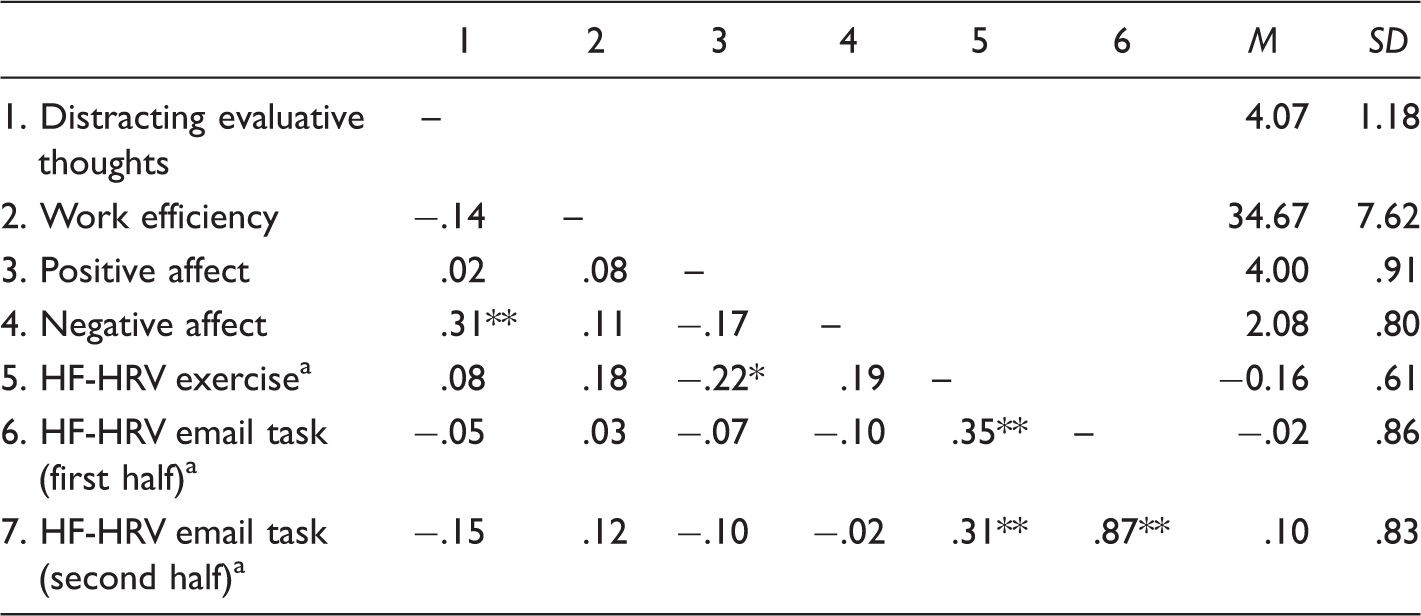
HF-HRV: high frequency-heart rate variability.
Note: Computed from the mindfulness novices sample (N = 97).
Computed by subtracting the baseline HF-HRV value.
p < .05, **p < .01.
A comparison of the conditions.
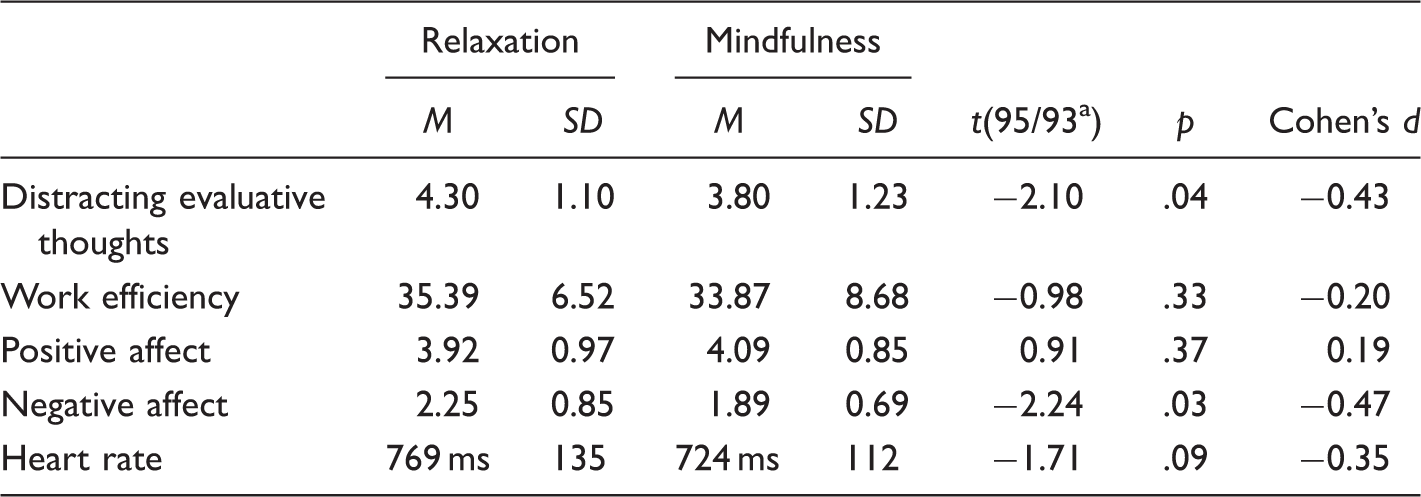
Note: Computed from the mindfulness novices sample (N = 97).
n = 95 heart rate measurements available for analysis.
As hypothesized, participants in the mindfulness condition were significantly less plagued by distracting evaluative thoughts. Also, as hypothesized, they experienced significantly less negative affect than participants in the relaxation condition. No significant differences were found for positive affect between conditions. However, the trend was in the expected direction of higher positive affect in the mindfulness condition. No significant differences were found for work efficiency.
Hierarchical regression analyses predicting work efficiency from condition and distracting evaluative thoughts.
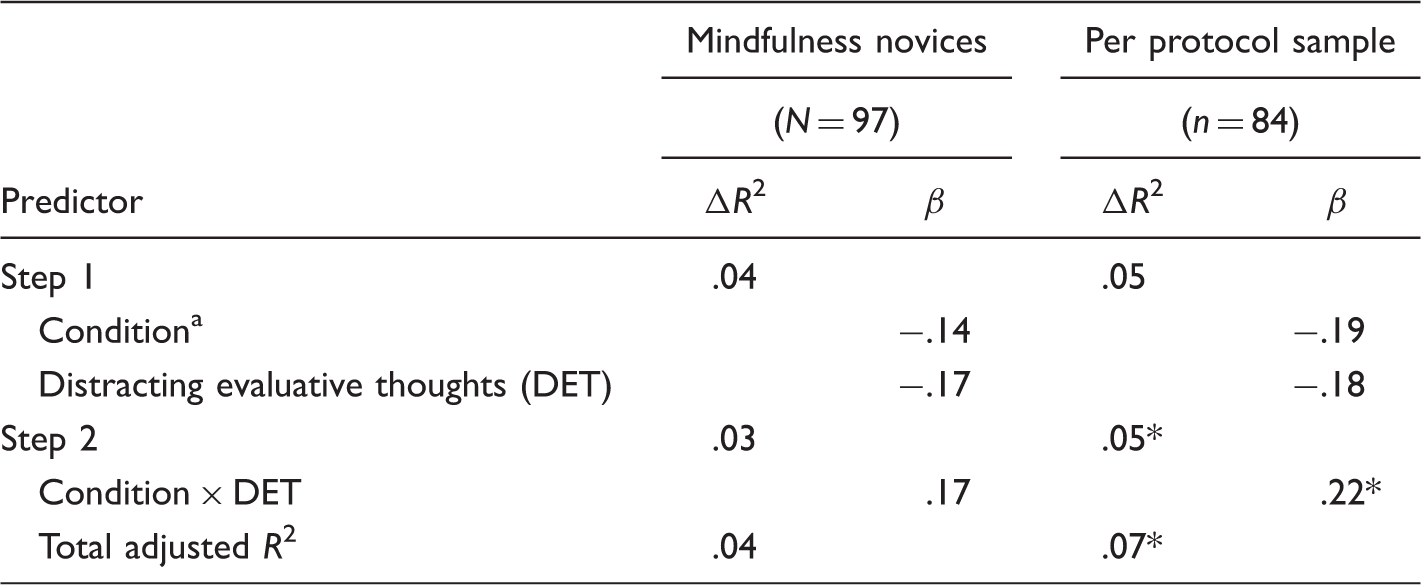
Relaxation = −1, mindfulness = +1.
p < .05.
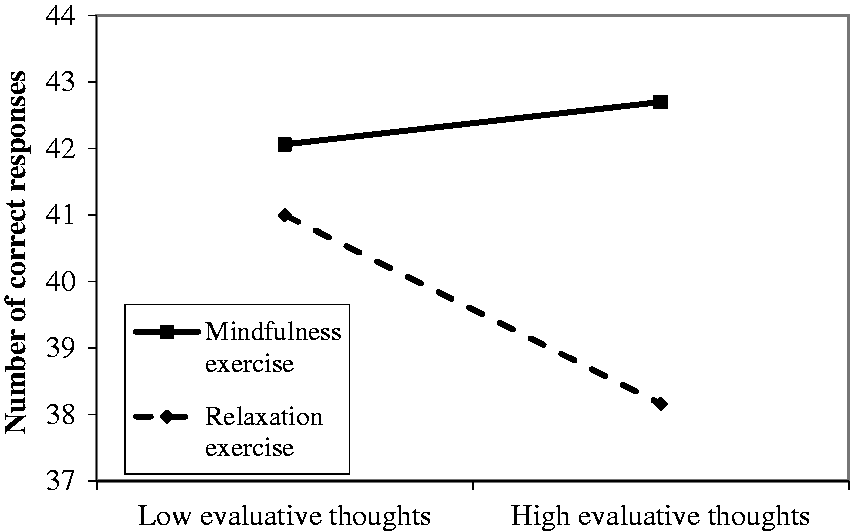
Work efficiency (number of correct responses) as a function of condition (mindfulness vs. relaxation exercise) and distracting evaluative thoughts. Computed from the per protocol sample (n = 84).
Trait mindfulness
Hierarchical regression analyses predicting distracting evaluative thoughts (DET), positive affect (PA), and negative affect (NA) from trait mindfulness (TM) and condition.
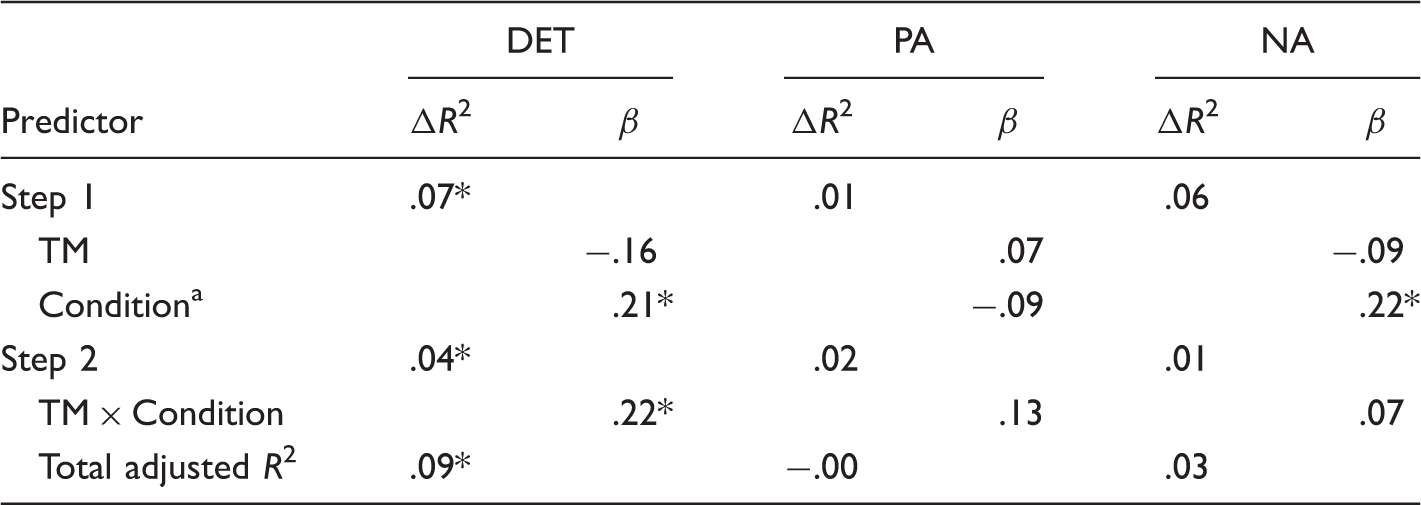
DET: distracting evaluative thoughts; PA: positive affect; NA: negative affect; TM: trait mindfulness.
Note: Computed from the mindfulness novices sample (N = 97).
Relaxation = −1, mindfulness = +1.
p < .05.
Heart rate variability
Descriptive statistics for HF-HRV (log-transformed) were Mbaseline = 5.18, SD = 1.24; Mexercise = 5.02, SD = 1.35, Mtask first half = 5.16, SD = 1.18, Mtask second half = 5.28, SD = 1.20. HF-HRV did not differ between conditions at baseline, t(93) = .48, p = .63, d = .10. We subtracted the baseline from the other three time points and performed a 3 (time) × 2 (condition) analysis of variance revealing a significant change in HF-HRV over time, F(2, 92) = 5.35, p = .006, η2 = .10, and a significant effect of condition, F(1, 93) = 8.65, p = .004, η2 = .09. The interaction was not significant, F(2, 92) = 0.28, p = .756, η2 = .01 (for HF-HRV development by condition see Figure 2).
High frequency heart rate variability (HF-HRV_ln, log-transformed) during the exercise and the achievement task depicted as the difference relative to the baseline measure. Figure computed from the per protocol sample (n = 84).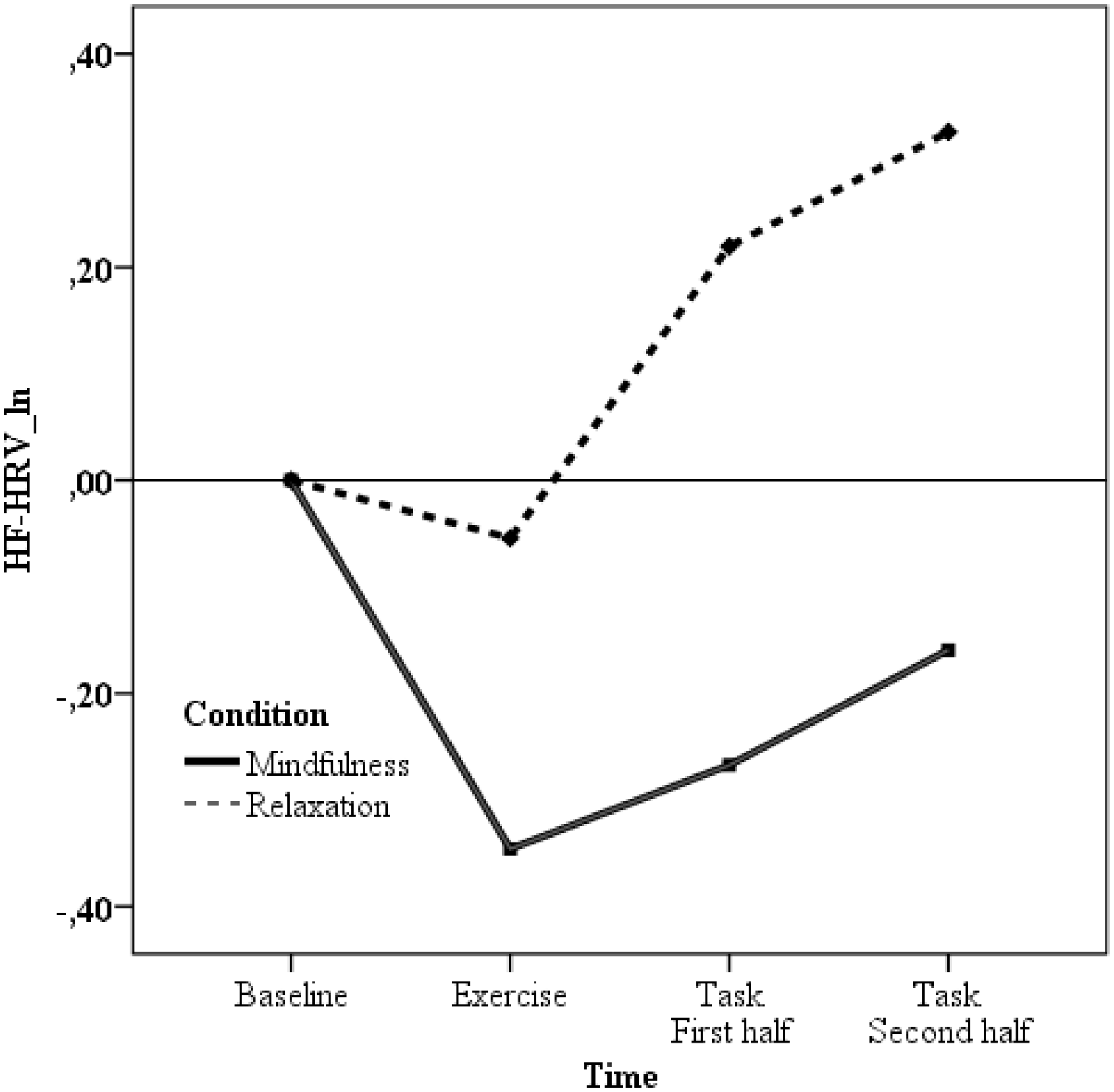
We conducted regression analyses predicting HF-HRV during the exercise and the email task (with separate analyses for the first and second halves) from HF-HRV at baseline and condition, thereby controlling for individual differences in HF-HRV at baseline. To control for alpha inflation in the analyses, we applied the Bonferroni–Holm method (Holm, 1979). During the mindfulness exercise, HF-HRV was lower than during the relaxation exercise, Adjusted R2 = .81, F(2, 92) = 196.90, p < .001; HF-HRV at baseline: β = .88, p < .001, condition: β = −.11, p = .018. Furthermore, after the mindfulness intervention, HF-HRV was lower during the email task in the first and second halves than HF-HRV in the relaxation condition, Adjusted R2 = .59/.62, F(2, 92) = 68.06/76.06, ps < .001; baseline: β = .74/.76, ps < .001, condition: β = −.19/−.19, p = .006/.003 (first half/second half). These results show that participants in the mindfulness condition were less engaged in self-control than participants in the relaxation condition.
Discussion
The aim of the study was to test the beneficial effects of a brief mindfulness exercise for cognitive functioning and affect in a performance situation. As hypothesized, after the mindfulness exercise, participants were less plagued by distracting evaluative thoughts while working on an achievement test than participants who engaged in a relaxation exercise. Notably, these effects were achieved with novices in mindfulness practice. Among those who seriously got involved in the mindfulness and relaxation exercise, mindfulness was superior to relaxation with regard to the diminishing effect of distracting evaluative thoughts on performance: While cognitive performance of participants who just relaxed before the achievement test suffered depending on the amount of distractive thoughts during the test, mindfulness inoculated participants against the adverse effects of distractive thoughts. Apparently the mindfulness exercise primed cognitive operations that enabled the participants to enter a short-lived state of attentiveness to moment-to-moment experiences (Bishop et al., 2004; Dane, 2011). On the basis of the literature, we suggest that the state of mindfulness may have improved their deployment of attention (Chiesa et al., 2011) and therefore reduced the adverse impact of distracting evaluative thoughts. Those who seriously got involved in the mindfulness exercise may have acquired a perspective of acceptance (Baer et al., 2006), which helped them to remain unaffected by their distracting thoughts. Indeed, the mindfulness literature suggests that acceptance reduces self-elaboration (Farb et al., 2014) and thereby may have prevented distracting evaluative thoughts from impairing cognitive performance by freeing working memory capacity (Jha et al., 2010). Thus, while the awareness aspect of mindfulness may reduce distracting evaluative thoughts, the dissociation of distracting evaluative thoughts and performance may depend on the mindfulness aspect of acceptance. These results have to be viewed with caution because they pertained to a select sample of participants who reported that they had been seriously involved in the mindfulness exercise. The practical implication is that further research needs to clarify the conditions which enable participants to seriously get involved in mindfulness practice.
Furthermore, as hypothesized, participants in a mindful mindset experienced less negative affect after the achievement test than participants who had engaged in the relaxation exercise. Unexpectedly, participants in a mindful mindset did not experience more positive affect after the achievement test than participants who had engaged in the relaxation intervention. A possible explanation for the different effect of the mindfulness exercise on the affective dimensions in our study is that distinct mechanisms engender the effect of mindfulness on negative and positive affect. Sensitivity to negative cues can initiate the down-regulation of negative affect by signaling the need for control and energizing its execution (Teper et al., 2013). In addition, a reduction in distracting evaluative thoughts can free up working memory capacity, thus promoting the effective down-regulation of negative affect (Teper et al., 2013). Positive cues, on the other hand, may have been too sparse in the context of a laboratory environment for the sensitivity to positive cues to have an effect.
Notably, exploratory analyses revealed that trait mindfulness moderated the effect of the mindfulness exercise on distracting evaluative thoughts: Only participants low in trait mindfulness experienced lower levels of distracting evaluative thoughts after the mindfulness exercise compared to participants in the relaxation condition. This contradicts the previously reported findings that participants with higher levels of pretreatment dispositional mindfulness had profited more from an eight-week mindfulness training and from a brief experimental mindfulness induction (Laurent, Laurent, Nelson, Wright, & Araujo Sanchez, 2015; Shapiro, Brown, Thoresen, & Plante, 2011). However, our result is in line with previous investigations in which priming effects were most pronounced for individuals for whom the primed concepts were not chronically activated (see Gardner, Gabriel, & Lee, 1999; McClure, Bartz, & Lydon, 2013). In particular, the effect of priming the self-regulation strategy of reappraisal was shown to be most pronounced for those who did not habitually use reappraisal strategies (Williams et al., 2009). The idea is that the repeated pursuit of a particular self-regulation goal should lead that goal to become automatically associated with those situational settings the strategy can be applied to. Therefore, for individuals who habitually adopt a mindful state (high trait mindfulness), the activation of the mindful self-regulation goal of being aware and accepting should occur automatically when the person is faced with an opportunity to apply without needing temporary priming to be put into operation. For those who do not habitually adopt a mindful state (low trait mindfulness), on the other hand, mindful priming should have a more pronounced effect because, for these individuals, the mindful self-regulation goal is not chronically accessible. Additionally, non-consciously activated goals (initiated by habitual association with situational settings or by priming) may operate more efficiently and better under challenging conditions compared with deliberately activated goals (Williams et al., 2009). Thus, priming a mindful mindset before a critical situation without instructing people to be mindful may be especially effective for individuals with a lower tendency to mindfully engage in their activities (low trait mindfulness). Instructions on how to mindfully approach a critical situation, on the other hand, may be more suitable for individuals who are predisposed to be more mindful (high trait mindfulness). In this respect, it is noteworthy that trait mindfulness neither influenced participants’ willingness nor ability to seriously get involved in the exercise.
In line with the interpretation of a rise in HF-HRV indicating exerted self-control, increases in HF-HRV were associated with less positive affect during the exercise. Also, HF-HRV further increased during the achievement task. The amount of exerted self-control differed between conditions: Participants performing the mindfulness exercise exerted less self-control (drop in HF-HRV) than participants performing the relaxation exercise before the achievement task. Mindfully accepting the state one is in when expecting to conduct an achievement test and not changing this state may have freed the participants from self-regulation and therefore may have cost less self-control (Muraven & Baumeister, 2000; Verplanken & Fisher, 2014). Interestingly, in non-performance-related situations, several studies have found an increase in vagal activity indexed by HRV during meditation (e.g., Ditto, Eclache, & Goldman, 2006). This contradiction may signify a differential effect of a mindfulness exercise when performed as a stand-alone exercise or before a challenging or threatening situation. Further research could also clarify whether less self-control during a mindfulness compared to a relaxation exercise in a performance context holds for all, or whether for some to override the automatic inclination to change the state one is in before an achievement test is so strong that being mindful may actually cost more self-control. Participants in a mindful mindset were also less self-controlling during the achievement test than participants in the control condition. This is noteworthy insofar as performance did not differ between conditions. Hence, a mindful mindset may have enabled the same level of performance while taxing self-control less.
Limitations
There are some limitations of the present study that warrant further investigation. First and foremost, sample size was small. Thus, it was not possible to establish the presence or absence of smaller expectable effects, such as the effect of distracting evaluative thoughts on work efficiency or the association of rise in HF-HRV with work efficiency and negative affect (Appelhans & Luecken, 2006; Geisler & Kubiak, 2009). Second, we cannot rule out the possibility that, besides differing in mindfulness, the mindfulness and relaxation conditions may also have differed in other potentially effective aspects related to the processing of words (mindfulness exercise) or music (relaxation exercise), for example, distraction. Third, a related question is what aspects of mindfulness have to be included in a mindfulness exercise to attain a certain effect. It could be the case that the mindfulness facet acceptance but not awareness has beneficial consequences (de Bruin, Topper, Muskens, Bögels, & Kamphuis, 2012; Fisak & von Lehe, 2011). Alternatively, it might be that mindfulness is only effective as an integrated whole (Rosch 2007; Williams, 2010). This question could be addressed by contrasting audio-based exercises composed of words that include one aspect of mindfulness, a combination of aspects, or no aspect (i.e., a word-based exercise) in a follow-up study. Fourth, we refrained from assessing affect before the achievement test. Thus we cannot rule out differences in affect before the achievement test despite of randomization. Finally, how stable is the priming effect of a mindfulness exercise? Both studies showed the effect of 8 minutes of priming for the subsequent 8 minutes. It is unclear for how long the effect of one mindfulness exercise can last and whether the reapplication of mindfulness exercises will have a cumulative effect. Clarifying these points is important for designing the implementation of mindfulness exercises in an achievement context.
Conclusion
In a state of mindfulness, one intentionally directs attention toward the present moment with an attitude of acceptance (Bishop et al., 2004). In the present study, a short mindfulness exercise primed a mindful state with benefits for cognitive functioning, affectivity, and expended self-control in a subsequent achievement situation. Notably, this was true for mindfulness novices and for individuals low in trait mindfulness. Thus, the saying “Whoever has will be given more” does not apply to mindfulness: A mindfulness exercise before a stress-producing event can even benefit those who have not (yet) habitually cultivated it.
Footnotes
Acknowledgment
The research was conducted at Ernst Moritz Arndt Universitaet Greifswald, Institut fuer Psychologie.