




Abstract
Prior work has indicated that female adolescents mature more quickly than males with regard to the various personality dimensions. From the developmental perspectives, this study aimed to explore gender differences in the relationships between resilience and the Big Five personality traits in Japanese adolescents. Middle school students (N = 310, 155 females, age range = 14–15 years) participated in an online survey. The results demonstrated that females had higher Conscientiousness than males. Stepwise regression analyses indicated that Neuroticism was the most influential predictor of resilience in females, whereas Extraversion was the most important predictor in males. Multigroup path analysis demonstrated that the effect of Neuroticism on resilience was greater for females; however, the effects of all other variables did not differ across genders. Considering gender differences is important to understand the relationship between resilience and the Big Five dimensions among adolescents.
Introduction
Adolescence has been represented as a developmental and transitional period that is characterized as “storm and stress” (Arnett, 1999, p. 317; Hall, 1904, pp. 555–589). In this period, adolescents experience various developmental changes physically, psychosocially, and biologically, but they also experience other life events such as changes in family structure and school transitions (Dumont & Provost, 1999). Usually, these experiences become stressful and they affect adolescents’ mental health and well-being. Adolescents therefore are required to adapt successfully to these difficulties. The present study focuses on the relationships between resilience and the Big Five personality traits, which are thought to develop during adolescence. However, these relationships remain understudied.
Resilience in adolescence
Resilience refers to the personal attribute or ability to “bounce back” (Smith et al., 2008, p. 194). This concept constitutes the ability to maintain a relatively stable, healthy level of psychological functioning, despite experiencing serious adversity during adaptation or in the developmental processes (Bonanno, 2004; Masten, 2001). Thus, resilience may serve as a protective factor that leads to good outcomes even when adolescents are exposed to high-risk situations. Many studies have supported this view of resilience as a protective factor. For example, resilient adolescents who were highly exposed to family adversity during childhood and yet did not evidence any behavioral problems such as substance abuse or school problems showed higher IQ, lower affiliations with delinquent peers, and lower rates of novelty seeking than did adolescents with lower levels of resiliency (Fergusson & Lynskey, 1996). Moreover, resilient adolescents who are characterized by low depression with a high level of stress had higher self-esteem than did vulnerable peers who show high depression under high stress levels (Dumont & Provost, 1999). In summary, studies have confirmed that resilience serves as a protective factor during adolescent development.
Resilience and the Big Five personality dimensions
Resilience correlates with self-esteem (Lee et al., 2013) and depression (Hu, Zhang, & Wang, 2015) but also with personality traits. The Five-Factor approach (see Block, 2010, for a review) to personality, which refers conjointly to the lexical Big Five traits (Goldberg, 1990) and the Five-Factor Model questionnaire approach (Costa & McCrae, 1992), has been widely used and provides a framework to further understand personality during adolescence. In this framework, individual differences are described using five broad personality trait dimensions—Neuroticism (i.e., absence of Emotional Stability), Extraversion, Openness to Experience, Agreeableness, and Conscientiousness.
Generally, resilience positively relates to Extraversion, Openness to Experience, Agreeableness, and Conscientiousness, and negatively relates to Neuroticism in adults (Campbell-Sills, Cohan, & Stein, 2006; Friborg, Barlaug, Martinussen, Rosenvinge, & Hjemdal, 2005). However, relatively few studies have examined such relationships among adolescents, despite the possibility that such relationships could inform our understanding of individual differences in adolescent resilience. Available research, although limited, has revealed that highly resilient late adolescents are characterized by high Extraversion, Openness to Experience, Agreeableness, and Conscientiousness, although for this population there was no relationship between resilience and Neuroticism (Shi, Liu, Wang, & Wang, 2015). Furthermore, another investigation found that middle-to-late highly resilient adolescents were characterized by high Emotional Stability (i.e., Neuroticism), Openness to Experience, Agreeableness, Conscientiousness, but not by high Extraversion (Fayombo, 2010). These studies suggest that the relationships between resilience and the Big Five personality traits may be inconsistent between adolescents and adults.
The present research
One possible reason for these inconsistent findings may be due to the role of gender in development. There are adolescence-specific gender differences. Because females mature earlier and more quickly than do males in adolescence, some gender differences have been reported in the Big Five personality traits during adolescence (Klimstra, Hale, Raaijmakers, Branje, & Meeus, 2009; Weisberg, DeYoung, & Hirsh, 2011). Females show higher levels of Neuroticism, Agreeableness, and Openness to Experience during adolescence. From the developmental perspectives, gender differences may contribute to resilience–personality associations. Some studies have reported that females have a lower level of resilience than males (Rodríguez-Rey, Alonso-Tapia, & Hernansaiz-Garrido, 2016; Smith et al., 2008; Stratta, et al., 2013); this may be explained by gender differences in personality traits. For example, given that females have a higher level of Neuroticism than males in adolescence (Klimstra et al., 2009), could we consider gender differences to contribute to females’ low resilience?
However, little research (Fayombo, 2010; Shi et al., 2015, reviewed above) has considered gender differences when examining the relationships between resilience and the Big Five personality traits. In addition, resilience–personality associations have been mainly examined using the data from Western countries (e.g., Campbell-Sills et al., 2006; Fayombo, 2010; Friborg et al., 2005), and evidence regarding the associations in Eastern countries were somewhat limited. Studies conducted in China (Shi et al., 2015), for example, showed that Emotional Stability (i.e., lower Neuroticism), Extraversion, Openness to Experience, Agreeableness, and Conscientiousness were positively correlated with resilience among Chinese adolescents, although gender differences were not examined. From the cross-cultural perspectives, reporting knowledge in Eastern culture not only China but Japan would have strength to better understand the relationship between resilience and personality.
The present study explored whether the effects of personality on resilience would differ between females and males among a sample of Japanese middle adolescents. We could not make a specific hypothesis about the gender differences in the relationships because no studies have tested the relationships while controlling for gender. However, we hypothesized that females would have higher Neuroticism, Openness to Experience, Agreeableness, and Conscientiousness than males, similar to previous findings (Klimstra et al., 2009; Weisberg et al., 2011).
Method
Procedure and participants
This research was conducted in March 2016. Informed consent was obtained from both adolescents and their caregivers (Mother = 132, Father = 178, mean age = 46.11 years, SD = 4.53 years, 5% unmarried). A total of 310 students—155 females, with an age range from 14 to 15 years, ninth grade in middle schools, and attending the schools throughout Japan—participated in and completed an online survey anonymously. Caregivers received points from the investigation company which they could change into money after participating in the survey; Students did not receive any compensation for participation. There were no missing data in the sample, and therefore, all data were used for statistical analyses.
Statistical analyses
Data were analyzed using R, version 3.3.1, and its interface R Studio, version 0.99.893. After calculating descriptive statistics and bivariate correlation coefficients, stepwise regression analysis was conducted to examine influential predictors of resilience. Gender differences in these path coefficients were then tested using multigroup path analysis.
Measures
Resilience
The Japanese version of the Brief Resilience Scale (BRS-J; Smith et al., 2008; Tokuyoshi & Moriya, 2014) was used to measure resilience. The BRS is one of the most frequent measures used for assessing resilience in adolescents in Western cultures (Pangallo, Zibarras, Lewis, & Flaxman, 2015). The BRS-J consists of six items (e.g., “I tend to bounce back quickly after hard times”), with items two, four, and six being negatively worded. Items are rated on a five-point scale from 1 (strong disagree) to 5 (strong agree), such that BRS scores range from 6 to 30. The internal consistency of the scale was α = .75.
Big Five personality traits
The Japanese translation of the Ten Item Personality Inventory (TIPI-J; Gosling, Rentfrow, & Swann, 2003; Oshio, Abe, & Cutrone, 2012) was used. The TIPI is one of the most widely used brief indicators of the Big Five personality dimensions (Hofmans, Kuppens, & Allik, 2008). It consists of 10 items (e.g., “I see myself as: Extraverted, enthusiastic”) and includes two items for each dimension, with one positive and one negative item for each of the five traits. Items are rated on a seven-point scale ranging from 1 (disagree strongly) to 7 (agree strongly). As values for internal consistency, facets of each factor showed positive correlations ranging from .53 to .75. These values were not high; however, a scale with a few items, such as the TIPI, is generally developed emphasizing validity and thus lower internal consistency did not become critical problems (e.g., Kawamoto et al., 2015; Oshio et al., 2012).
Results
Descriptive statistic of resilience and the Big Five personality dimensions.
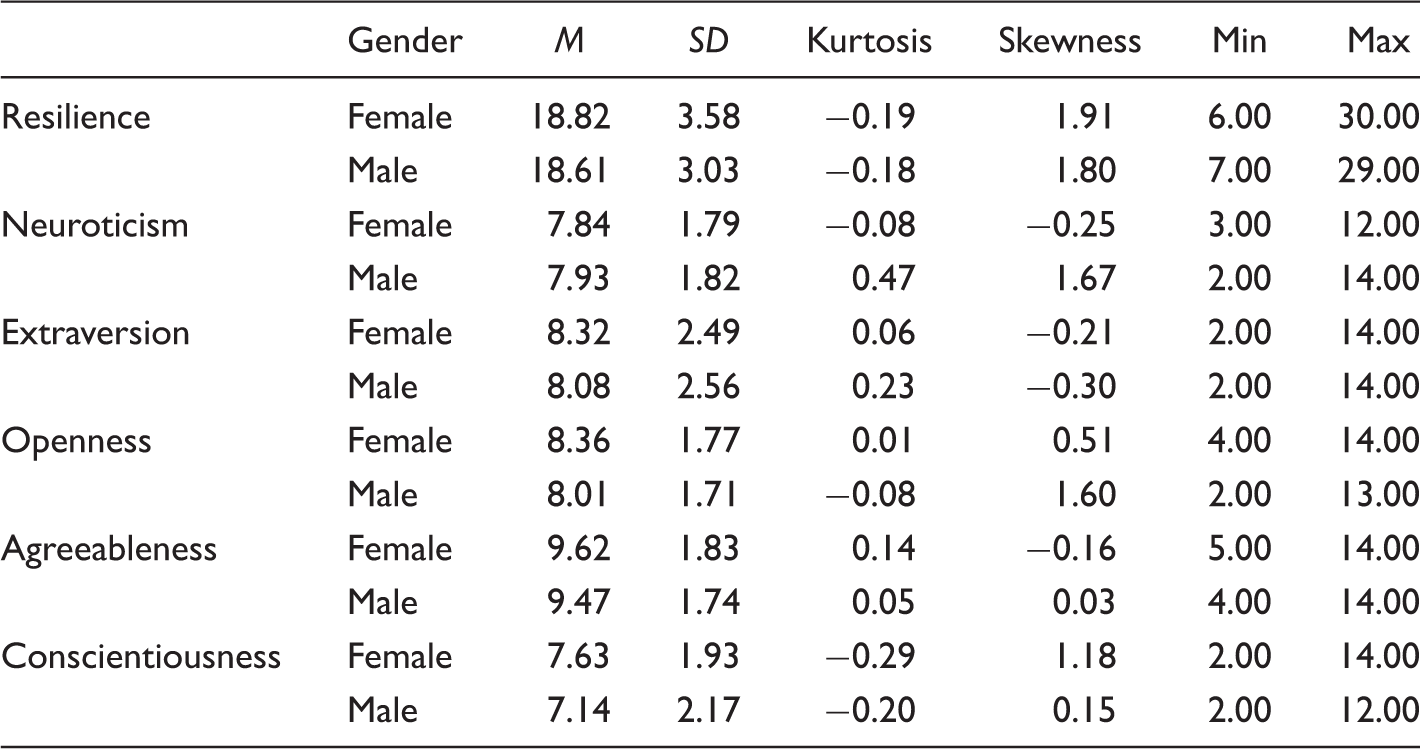
M: mean; Max: maximum value; Min: minimum value; SD: standard deviation.
Correlation coefficients between resilience and personality traits.
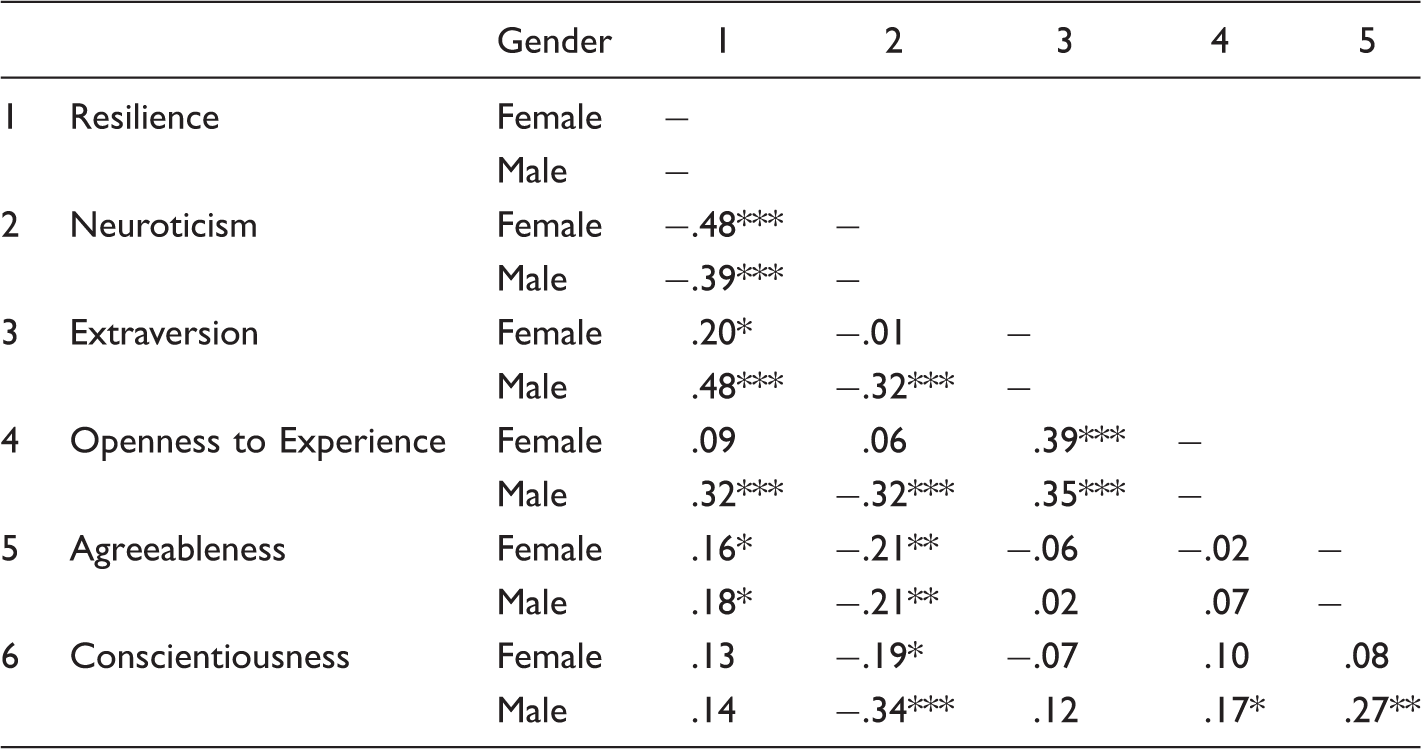
p < .05; **p < .01; ***p < .001.
Stepwise regression analysis predicting resilience.
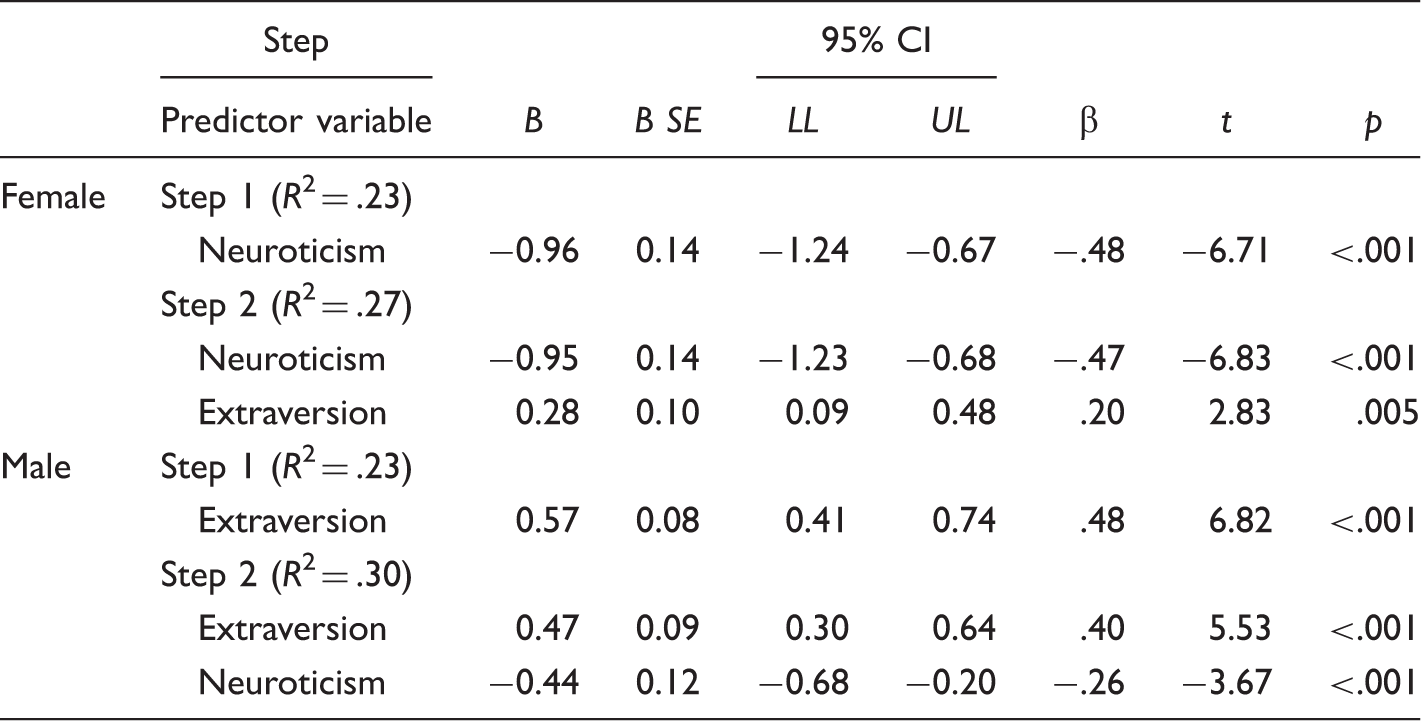
B: unstandardized coefficients; B SE: standardized errors; CI: confidence interval; LL: lower limit; UL: upper limit; β: standardized coefficients; t = t-value.
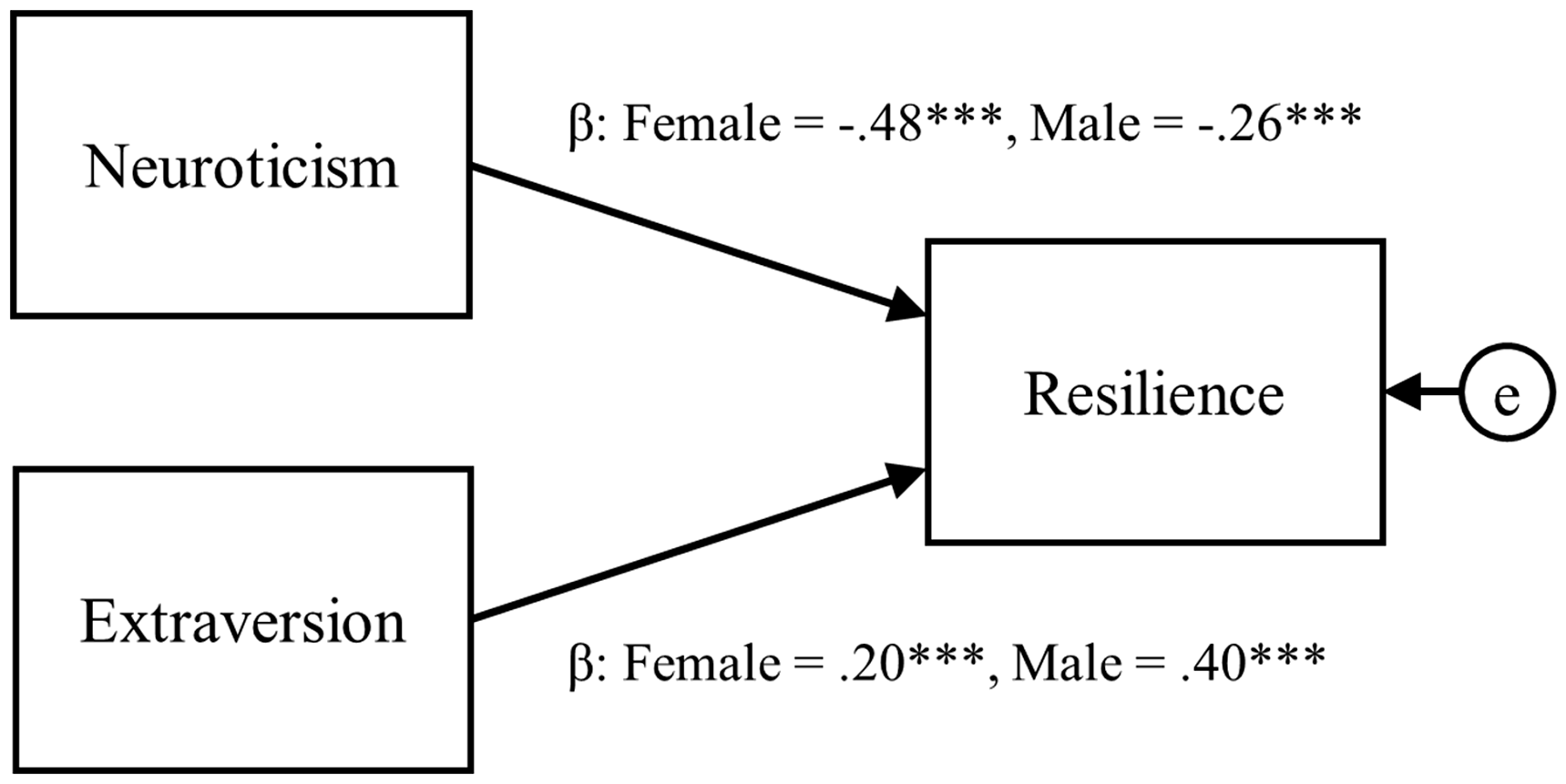
Gender differences of path coefficients in Neuroticism and Extraversion. ***p < .001.
Discussion
The present study was the first to examine gender differences in the relationships between resilience and the Big Five personality traits in Japanese adolescents. Females displayed higher levels of Conscientiousness than males but the other four personality traits (as well as resilience) did not show any gender differences. Emotional Stability, Extraversion, and Agreeableness were positively correlated with resilience in females and males, whereas positive correlation between Openness to Experience and resilience was found only in males. Neuroticism was more influential in resilience for females than males, whereas for males it was Extraversion that showed this pattern.
The gender difference in Conscientiousness is consistent with previous findings for adults (Klimstra et al., 2009). As Klimstra et al. (2009) discussed, Conscientiousness seems important to maintain positive interpersonal relationships, and thus it may be more evolutionally emphasized in females than in males. The present study has provided new evidence that gender differences are likely to emerge even in middle adolescence. Surprisingly, other personality traits such as Neuroticism did not show gender differences in the present study. This may be because some dimensions of personality (e.g., Conscientiousness) are more likely to be explained from evolutionary perspectives, with other dimensions (e.g., Neuroticism) being more explained by enculturation and socialization processes.
Agreeableness and Conscientiousness were positively correlated with resilience, whereas Neuroticism was negatively correlated with resilience, regardless of gender. These results are consistent with the findings of Fayombo (2010). Agreeable adolescents may be better able to access social support, which in turn may lead to resilience. More Conscientious adolescents should be able to organize and make a plan, and thus they may be able to be more mindful, which may lead to resilience. Adolescents with a high level of Neuroticism tend to see life difficulties as insurmountable problems, which makes the development of resilience challenging.
The present study found that Neuroticism had a greater impact on resilience in females than males, even though the mean level of Neuroticism was not different between the genders. Adolescents with a high level of Neuroticism tend to be anxious and easily upset, experiencing greater stress responses and taking more time to recover when faced with adversity than adolescents with low Neuroticism. One possible reason why the impact of Neuroticism on resilience was higher in females is that there may be other factors that should predict male resilience, such as masculinity.
Extraversion was also a significant predictor of resilience. Adolescents who have high Extraversion are characterized as enthusiastic and outgoing; thus, they are likely to obtain social support (Swickert, Rosentreter, Hittner, & Mushrush, 2002) to overcome adversity. Our findings are consistent with a study of Chinese adolescents (Shi et al., 2015) but not Caribbean adolescents (Fayombo, 2010). Given that Japanese culture is similar to Chinese in many ways, such a replication makes sense. However, seeking construct equivalence is difficult when studying resilience, given that different individual and cultural meanings can be involved when defining this construct (Ungar, 2008).
Because only a few studies have examined the relationships between resilience and personality in adolescents, it is difficult to conclude why there were gender differences in relationships between resilience and only some of the personality traits. Perhaps, gender differences are explained not only from the perspectives of maturation or biological development but also from the perspective of culture. There is great variation across cultures and contexts in what resilience (or even personality) means. “Through the iterative process of the research design, implementation and analysis, resilience has been shown to be a culturally and contextually sensitive construct” (Ungar, 2008, p. 234). Considering not only developmental maturation but also cultural background may be required to further interpret the relationship between resilience and personality during adolescence.
Finally, the present study has several limitations: First, the obtained findings were based on a cross-sectional design. Although we conducted regression analysis to determine the predictors of resilience, causal relationships should not be overestimated. Future studies should use a longitudinal design to assess personality traits in childhood in order to see how they predict resilience in adolescence. Second, although resilience–personality relationships were directly examined from the perspective of gender, the relationships could be affected by other variables including life stressor (Stratta et al., 2013). Examinations that controlled other variables will be needed. Third, because this study focused on resilience as ability and provided knowledge regarding relationships with personality, the findings cannot be generalized when defining resiliency as other forms (e.g., traits, process, or outcomes). Finally, homogenous sample may limit generalizability of our findings because gender differences in Neuroticism are moderated by both age and ethnicity (Weisberg et al., 2011).
Despite several limitations, this study adds empirical evidence to the area of adolescence research from the perspective of gender differences. In this regard, this report strengthened the existing knowledge by providing findings from non-Western culture. It will help to further understand individual differences regarding the ability to bounce back from adversity among adolescents during the developmentally transition period.