




Abstract
This study investigated the relationships among resilience, social anxiety, and procrastination in a sample of college students. Specifically, structural equation modeling analyses were applied to examine the effect of resilience on procrastination and to test the mediating effect of social anxiety. The results of this study suggested that social anxiety partially mediated the relationship between resilience and procrastination. Students with higher levels of resilience reported a lower frequency of procrastination behavior, and resilience had an indirect effect on procrastination through social anxiety. The results of this study clarify the current knowledge of the mixed results on resilience and procrastination behaviors and offer practical learning strategies and psychological interventions.
Introduction
A notable surge of interest in procrastination has been reported in the past two decades. Procrastination is a serious concern for societies that increasingly employ modern information technology and implicitly promote immediate gratification (Rozental & Carlbing, 2014).
During the 1970s, the prevalence of self-reported procrastination was 4%–5% in the adult population, compared with 15%–20% in the most recent report (Steel, 2012). The prevalence of procrastination in the general population was reported to be approximately 20% (Steel, 2007).Worldwide, 20%–25% of adults report chronic procrastination tendencies in the domains of work and personal lives (Balkis & Duru, 2007; Ferrari & Díaz-Morales, 2014). Most procrastinators see their delaying behaviors as inappropriate, problematic, and in need of change (Skowronski & Mirowska, 2013). Procrastination is associated not only with negative consequences for the activity being delayed but also with decreased psychological well-being and performance and increased distress (Rozental & Carlbring, 2014; Sirois, 2007; Stead, Shanahan, & Neufeld, 2010).
Procrastination is particularly common among college students. A study estimated that approximately 80% of college students are procrastinators, and procrastination was identified as one of the most common problem behaviors requiring improved management (Steel & Ferrari, 2013; Walker & Stewart, 2000). Procrastination is generally defined as a purposeful voluntary delay in task completion (Steel, 2007). Studies have reported a variety of factors contributing to procrastination, including individual and task characteristics. Individual factors relating to procrastination can be at the cognitive, emotional, and self-perception levels, including depression (Steel, 2007), anxiety (Kamran & Fatima, 2013), irrational belief (Pychyl & Flett, 2012), self-esteem (Steel & Ferrari, 2013), self-efficacy (Hen & Goroshit, 2014), and fear of failure (Steel & Ferrari, 2013). In addition, the characteristics of the task can affect some individuals’ propensity for procrastination. Task characteristics associated with the timing of rewards and punishment encourage individuals to avoid the assignments that they are supposed to implement. Factors pertaining to procrastination have been examined as self-contained mechanisms; thus, procrastination has been systematically examined at an intrapsychic level, but factors related to interaction with others have been largely omitted.
Resilience and procrastination
Resilience is a vital characteristic associated with procrastination in the context of social interaction. Resilience is traditionally viewed as a protective mechanism deployed when facing external distress (Sullivan, 2001). In addition, resilience can represent the dynamic processes that involve interactions with family, school, and community (Aspinwall & Stauginer, 2003; Greene, 2002). Chen (2014) referred to resilience as the ability that enables an individual to overcome or adapt to adversity and create positive outcomes across the duration of the interaction with their environment. Resilience essentially represents the effects of a personality that facilitate healthy adaptation to challenging environments (Luthar, 2006) and is an indicator of positive mental health and work outcomes (Kotzé & Lamb, 2012). However, studies have reported mixed results regarding the relationship between resilience and procrastination. Some studies have indicated that resilience is positively related to procrastination. For example, Öksüz and Güven (2013) reported that individuals with high psychological resilience tend to procrastinate more than individuals with low resilience. They suggested that individuals with higher resilience procrastinate more because they believe that they can solve problems with higher self-efficacy. However, negative associations between resilience and procrastination have also been reported. For example, Shin and Kelly (2015) reported that individuals with higher resilience showed fewer procrastination behaviors at all stages of the career decision-making process. They considered resilience to reflect on individuals’ personal resources and suggested promoting resilience as a strategy to reduce career difficulties. These inconsistent results may be due to the various aspects of resilience. Tusaie and Dyer (2004) indicated that the definition of resilience varies among study objectives and theoretical developments; thus, the mixed results might reflect this variation and require further clarification. The aim of the current study was to further illustrate the relationship between resilience and procrastination. We adopted resilience as an adaptive indicator of external environments and procrastination as a failure of self-regulation that reflects maladaptive outcomes. Procrastination is empirically associated with poor health and academic performance and thus does not reflect positive adaptation to environments. However, resilience represents increased adaptation and can affect health, success, and life quality through reaction to obstacles (Windle, Bennett, & Noyes, 2011). Thus, it is theoretically reasonable to assume that individuals with resilience possess more resources to solve problems and are less likely to report procrastination.
Resilience and social anxiety
Studies have indicated that resilience can be viewed as a stress coping ability (Connor & Davison, 2003) and reported that individuals with resilience have the tendency to exhibit well-adjusted social behaviors (Wagnild, 2003) and positive emotions. The relationship between resilience and anxiety has been documented in several studies (Steel, 2007). As a defense against adversity, resilience was found to be negatively associated with anxiety (Beutel, Glaesmer, Wiltink, Marian, & Brähler, 2010). The relationship between resilience and general anxiety has been examined, but there has been little discussion about the specific relationship with social anxiety (Yngve, 2016).
Schlenker and Leary (1982) suggested that social anxiety as “a dominant, persistent anxiety that leads individuals to avoid a variety of social situations.” When individuals with social anxiety interact with others, they exhibit avoidance behaviors and attempt to escape from situations that involve external feedback and evaluation. Turner, Beidel, Dancu, and Keys (1986) reported that social anxiety affected individuals’ academic and work performance. For example, individuals with social anxiety may possess an irrational fear to express opinions during meetings or be reluctant to join social activities related to their job and even career promotion. Overall, people with social anxiety are extremely anxious and worry about being negatively evaluated in actual and imagined experiences. However, individuals with resilience can help to reduce social anxiety because they possess greater resources, not only through individual adaptation but also from family and community. For example, Chen (2014) reported that primary school students with higher resilience tend to experience less social anxiety.
Social anxiety and procrastination
Studies have identified a significant relationship between general anxiety and procrastination (Bilal, 2009; Farran, 2004; Glick, Millstein, & Orsillo, 2014). Rahardjo, Juneman, and Setiani (2013) examined the relationship between anxiety and academic procrastination among social science college students and reported that individuals with higher anxiety tend to engage in more academic procrastination when using computers. Similarly, in a study of intermediate science students in Pakistan, Kamran and Fatima (2013) revealed that increased anxiety was followed by increased procrastination among female students. Overall, studies have confirmed the relationship between anxiety and procrastination; however, the mechanism of anxiety remains unclear.
In particular, the objective of this study was to examine social anxiety, because this aspect of anxiety involves potential interactions with others and is relatively dynamic in social contexts compared with other symptoms of anxiety. The relationship between social anxiety and procrastination can be conceptualized through self-presentation theory. Self-presentation theory suggests that social anxiety increases when people are motivated to make an impression on real or imagined listeners, and when they perceive or imagine disappointing feedback from audiences (Schlenker & Leary, 1982). Thus, individuals with social anxiety tend to rate themselves more negatively and attempt to control their self-image due to fear of failure. Therefore, their motivation for procrastination differs considerably from that of individuals with general anxiety. Individuals with social anxiety are more concerned with evaluation in a social context than with doubting their capacity to complete a task. Thus, as a mediator in a social context, social anxiety represents further intervention to the outcome variable. For example, Manes et al. (2016) examined social anxiety as a mediator in the relationship between attachment and depression by noting that an attachment style is formed through interactions with significant others.
Purpose of the current study
The aim of the present study was to further clarify the relationship between resilience and procrastination by examining social anxiety as a mediator. We hoped to fill the gap in current research caused by mixed results regarding the relationship between resilience and procrastination and extend the current understanding of resilience in the context of interactions with others. We hypothesized that resilience is negatively associated with procrastination through the effect of social anxiety and that social anxiety is positively associated with procrastination behaviors.
Method
Participants and procedure
The participants were students in Taiwan (N = 321). Male and female students accounted for 29.3% and 70.4%, respectively, with 62.4% aged <20 years and 35.5% aged 21–25 years. The cohort comprised freshman students (40.8%), sophomore students (21.5%), junior students (32.1%), senior students (3.4%), and graduate students (2.2%). The data were collected through convenience sampling, and the questionnaire was in two sections. The first section included demographic details such as gender, age, education, college, and years. The second section asked participants to rate their personal situation.
Measures
Resilience: Connor-Davidson Resilience Scale (CD-RISC; Conner & Davidson, 2003)
The Chinese version of CD-RISC is used to assess the construct of resilience (Wang, 2015). The CD-RISC consisted of 25 five-point Likert-type items, ranging from “rarely true (=0)” to “true nearly all of the time (=4).” The total score ranges from 0 to 100 with higher scores reflecting greater resilience. The CD-RISC scale was composed of five subscales: personal competence, trust/tolerance/strengthening effect of stress, acceptance of change and secure relationships, control, and spiritual influences. In the previous research, the reliability measure alpha was .89 (Connor & Davidson, 2003) and .953 (Wang, 2015). In this study, the alpha values were .90 for the resilience.
Social anxiety: Social Interaction Anxiety Scale (SIAS; Mattick & Clarke, 1998)
The SIAS was used to measure social anxiety in this study. The SIAS is a 20-item five-point questionnaire with response from “Not at all (=0)” to “Extremely (=4)”. Mattick and Clarke’s (1998) research showed that the high internal as seen in reliability coefficients of SIAS scale was .94. In this study, the Chinese version of SIAS scale was used (Yang, 2003), and the coefficient of the overall social anxiety was .92 in the current research.
Procrastination: General Procrastination Scale (GP-S; Lay, 1988)
The GP-S was used to measure procrastination and consists of 20-item Likert scale, ranging from “strongly disagree (=1)” to “strongly agree (=5). Higher numbers of total scores indicate higher level of procrastination. Several research showed the 20-item GP-S alpha coefficient as .82 (Lay, 1986), .85 (Lay, Edwards, Parker, & Endler, 1989), and .78 (Ferrari, 1991a). In present study, the alpha coefficient of overall procrastination was .85.
Results
Descriptive and bivariate analyses
Descriptive statistic of observed variables.

Note: N = 321. M: Mean; SD: standard deviation. CDRISC_PC: Items Total for Personal Competence of Resilience from CD-RISC scale; CDRISC_TTS: Items Total for Trust/Strengthening effect of stress of Resilience from CD-RISC scale; CDRISC_AC: Items Total for Acceptance of change and secure relationships of Resilience from CD-RISC scale; CDRISC_CON: Items Total for Control of Resilience from CD-RISC scale; CDRISC_SI: Items Total for Spiritual influences of Resilience from CD-RISC scale; CDRISC_T: Items Total for Resilience from CD-RISC scale; SIAS_T: Items Total for Social anxiety from SIAS scale; Pro_T: Items Total for Procrastination from GP-S scale.
Intercorrelations among observed variables.
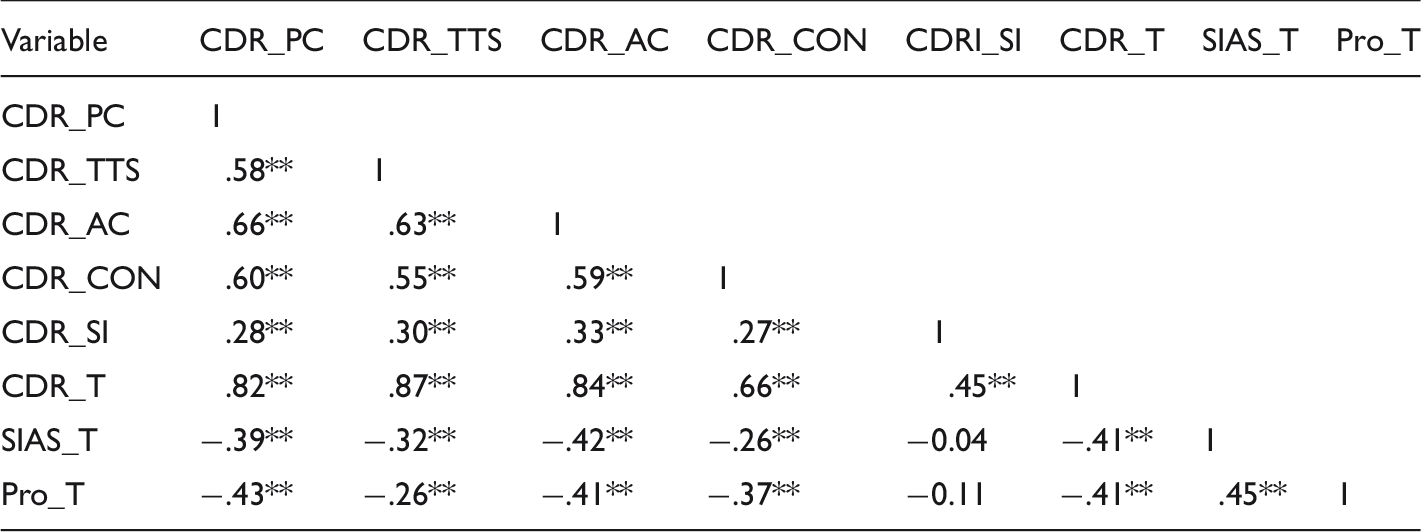
Note: N = 336. CDRISC_PC: Items Total for Personal Competence of Resilience from CD-RISC scale; CDRISC_TTS: Items Total for Trust/Strengthening effect of stress of Resilience from CD-RISC scale; CDRISC_AC: Items Total for Acceptance of change and secure relationships of Resilience from CD-RISC scale; CDRISC_CON: Items Total for Control of Resilience from CD-RISC scale; CDRISC_SI: Items Total for Spiritual influences of Resilience from CD-RISC scale; CDRISC_T: Items Total for Resilience from CD-RISC scale; SIAS_T: Items Total for Social anxiety from SIAS scale; Pro_T: Items Total for Procrastination from GP-S scale.
p < .05, **p < .01, ***p < .001.
Structural equation model analysis
Measurement model analyses
Factor loadings for the measurement models.

Note: N = 321.
p < .001.
Structural model and mediator analysis
The indices for the hypothesized structural model exhibited excellent fits (e.g., χ2 (62, N = 321) = 112; χ2/df = 1.81; CFI = .98; GFI = .95; RMSEA = .05, p < .01; Figure 1). Resilience negatively predicted procrastination (β = −.36, p < .001) and social anxiety (β = −.45, p < .001), whereas social anxiety positively predicted procrastination (β = .31, p < .001).
Structural model of resilience, social anxiety, and procrastination.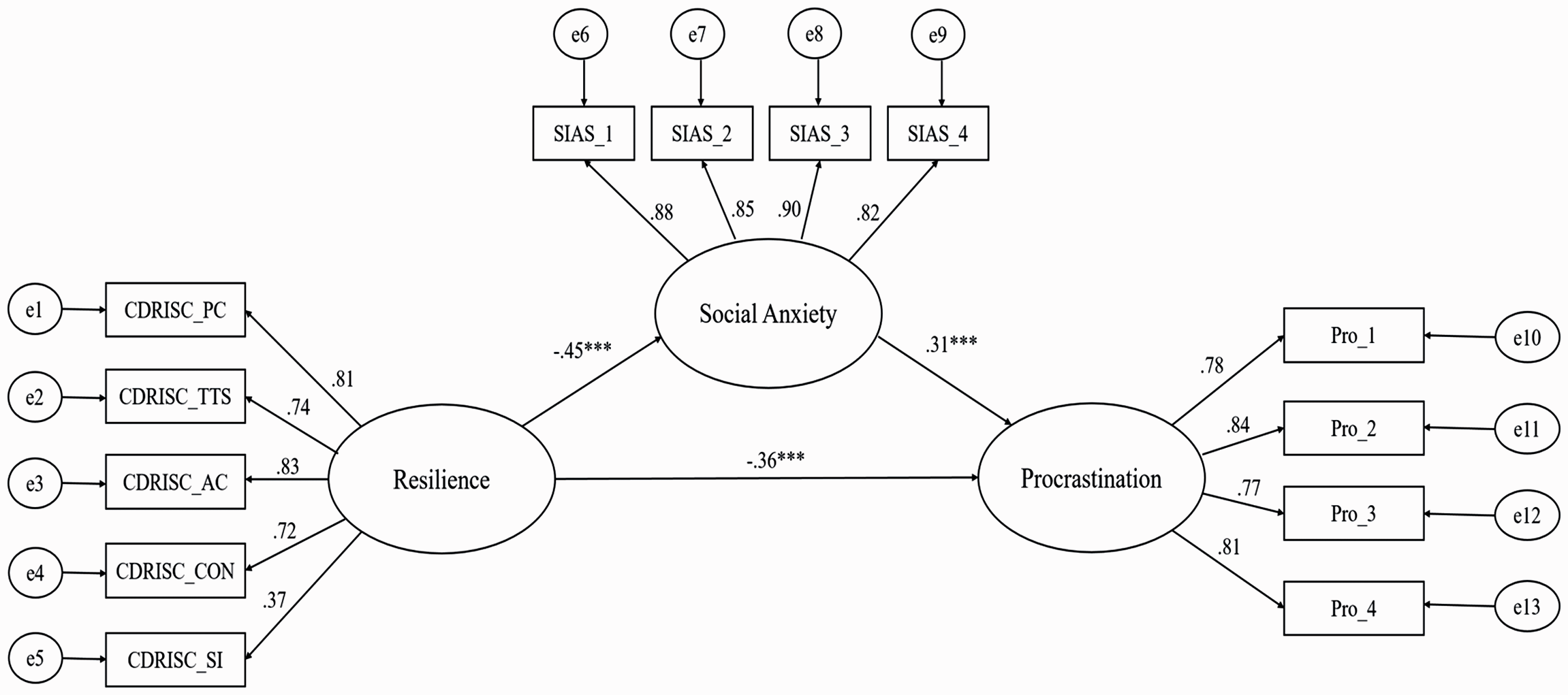
Mediator analyses
The standard path coefficients for the paths from resilience to social anxiety, social anxiety to procrastination, and resilience to procrastination in the overall model (β = −.45, p < .001; β = .31, p < .001; and β = −.36, p < .001, respectively) satisfied the conditions established by Holmbeck (1997) for examining the mediation effect. The path between resilience and procrastination was restricted to zero in the fully mediated model. The differences among the chi-square values, degrees of freedom, and Akaike information criterion (AIC) statistics for each model were compared in the partially mediated model. The results showed that the partially mediated model had a closer fit than the fully mediated model with a lower AIC statistic. Moreover, the difference between the two models was significant (Δχ2 (1, N = 321) = 29.967, p < .001); the partially mediated model was a closer fit for the data. Resilience directly affected procrastination, and it also indirectly affected procrastination through social anxiety.
Discussion
The purposes of this study were (a) to examine the relationships among resilience, social anxiety, and procrastination and (b) to test the mediating effect of social anxiety. The results indicated that social anxiety serves as a partial mediator. Individuals with higher levels of resilience reported lower procrastination, and resilience had an indirect effect on procrastination behaviors.
First, we expected that resilience would negatively predict procrastination and that resilient individuals would be less likely to procrastinate. This result agrees with the concept of resilience as a promoter of self-regulation and a positive adaptation to environments (Gardner, Dishion, & Connell, 2008). Previous studies have indicated that when individuals lack confidence to finish tasks and fear the outcome of failure, they will tend to procrastinate instead of completing the task (Ellis & Knaus, 1977). Some individuals attempt to avoid the situations that make them feel unpleasant or uneasy, which may cause procrastination when they have tasks to complete. Ferrari (1991b) asserted that procrastination can be caused by the individual doubting their ability to accomplish a task, and then the fear that they would be poorly evaluated by others. However, resilient individuals usually believe in their own ability to achieve the task or manage the situation, and they possess the belief that “This is not difficult; I am going to make it.” This belief is reflected in resilient individuals reporting less fear of failure and reductions in their tendency to delay tasks. In addition, Friborg, Barlaug, Martinussen, Rosenvinge, and Hjemdal (2005) suggested that resilient individuals are more organized, follow rules more easily, and have a clearer path to their goals, which could help them to persist until their task is completed despite unpleasant states or moods. Resilient individuals have a positive self-view and are confident in their strengths and abilities, which could explain their lower tendency to procrastinate.
Second, resilience is negatively associated with social anxiety. The current results indicated that resilient individuals experience lower levels of social anxiety, which is consistent with the finding of past studies (Chen, 2014; Yngve, 2016). A possible explanation is that, in social situations, resilient individuals tend to evaluate themselves positively, believe in their decisions, be confident in their performance, express opinions often, and have a low expectation of failure, which may decrease the anxiety that derives from the fear of failure in social situations. Furthermore, resilient individuals are reported to have good social skills and can communicate well with others. Lacking social skills is regarded as a major contributor to social anxiety. Poor social skills could lead to poor interpersonal relationships, and thus cause social anxiety. Moreover, resilient individuals have strong social skills and can interact and converse with people in social situations and react appropriately to them, which may decrease the possibility of poor self-evaluation (Clark & Wells, 1995; Creed & Funder, 1998; Leary & Kowalski, 1995; Liebowitz, 1999; Rapee & Heimberg, 1997).
Finally, social anxiety is positively associated with procrastination. The results revealed that individuals who suffer higher social anxiety procrastinate more. A possible explanation is that individuals tend to procrastinate to avoid aversive conditions or unpleasant states as well as when they fear failure or poor evaluation. People with higher social anxiety fear poor evolution, failing to reach expectations, and disapproval and therefore might attempt to postpone making telephone calls, discussing difficult issues at work, scheduling health appointments, and completing other tasks that involve interacting with people. Resilience indirectly affects procrastination with social anxiety as a mediator.
Implications of this study
Our findings have valuable implications for learning practices. We highlight the importance of focusing on interpersonal aspects in the understanding of procrastination. Because procrastination negatively affects work and academic study, training and learning programs have been developed in schools. Traditionally, time management training was proposed as an effective intervention for reducing procrastination and improving learning outcomes (Häfner, Oberst, & Stock, 2014). The results of this study can provide insight for the construction of resilience training programs for effective learning to enable students to manage difficulties appropriately. For example, the Penn Resiliency Program equips individuals with a set of practical skills that strengthen their ability to overcome adversity (Brunwasser, Gillham, & Kim, 2009). During the training, abilities such as emotional control, solution finding, self-belief, creating support, and realistic positivity are developed. Focusing on promoting resilience capacity is analogous to teaching a person how to fish so that they can eat for a lifetime. When resilience is improved, behaviors that are linked to positive adaptation to environment are reinforced and negative behaviors such as procrastination will be less likely to occur.
Although resilience has been reported to be a crucial factor contributing to procrastination, it is not the only element that must be addressed in a treatment setting. Steel (2007) suggested various interventions to target the difficulties experienced by an individual. Therefore, other treatment methods should be considered for reducing procrastination. For example, cognitive behavioral therapy has been proven to be an appropriate treatment for reducing procrastination, and it has been reported to result in positive outcomes (Balkis & Duru, 2007; Rozental & Carlbring, 2013). The benefit of cognitive behavioral therapy is that it helps clients to concentrate on replacing inflexible thought patterns with behavioral skills and teaches them to modify patterns of delaying behavior (Rozental & Carlbring, 2013).
Limitations and future research
Two limitations should be noted in this study. First, we measured general procrastination behaviors. The results might vary if specific types of procrastination are assessed instead. Corkin, Yu, and Lindt (2011) asserted that active delay is a distinct aspect of procrastination and can be associated with desirable academic outcomes. It may be productive for future research to investigate the different types of procrastination in relation to academic and emotional outcomes. Second, the sample was restricted to university students in Taiwan and the results should be generalized with caution. Several studies have shown that Asian participants self-report higher social anxiety than European participants (Norasakkunkit & Kalick, 2002; Okazaki, 2000). Factors such as individualism, collectivism, and perception of social norms contribute to the higher social anxiety experienced by individuals from collectivistic cultures (Hofmann, Asnaani, & Hinton, 2010). The pressure to follow social rules and to maintain group harmony also contributes to higher anxiety (Heinrichs et al., 2006). Future studies targeting validation of the results should consist of larger and diversified cultural samples. We believe that despite these limitations, the current study advances understanding of the relationships among resilience, social anxiety, and procrastination. This study successfully conceptualized procrastination from social and interpersonal perspectives and suggested practical intervention to reduce procrastination behaviors.