




Abstract
The purpose of this study was to examine the cross-cultural differences in vocational identity between American and Korean university students using the Vocational Identity Status Assessment. A total of 881 university students in both the United States and South Korea were sampled in this study assessing vocational identity. We compared means of latent variables (six dimensions of Vocational Identity Status Assessment in the present study) using latent mean analysis. The results indicated that Korean students showed higher scores on Career Self-doubt and Career Flexibility, whereas American students showed higher scores on In-breadth Exploration, In-depth Exploration, Commitment Making, and Commitment Identification. These results indicated the components of vocational identity that should be considered while providing career guidance to college students from diverse backgrounds. Implications for understanding the cultural differences of college students’ vocational identity and the need for conducting cross-cultural comparison studies to provide insights about the vocational development of college students in cross-cultural settings are discussed.
Introduction
In the past, Super (1980) emphasized the importance of career development in one’s life. Among various components related to one’s career development, vocational identity is essential because it is closely and positively associated with individuals’ job and life satisfaction (Hirschi, 2011; Luyckx, Schwartz, Goossens, & Pollock, 2008). Harren (1979) also emphasized the importance of vocational identity as a main component for the career decision-making process. Vocational identity refers to the goals, interests, and talents related to one’s career (Holland, Gottfredson, & Power, 1980).
Vocational identity develops over a lifetime and individuals can change their career choices through interactions with their environment (Smart & Peterson, 1997; Vondracek, Lerner, & Schulenberg, 1986). Vocational identity can begin to develop during the adolescent stage and continue through adulthood (Kroger, Martinussen, & Marcia, 2010), and it is the most challenging part of identity formation during this transition (Erikson, 1959). That is, vocational identity assumes a critical role in the general process of forming an identity (Kroger, 1986). Porfeli, Lee, Vondracek, and Weigold (2011) developed the Vocational Identity Status Assessment (VISA), which identifies six vocational identity statuses based on the four identity statuses purported by Marcia (1966, 1993), namely, achieved, foreclosed, moratorium, and diffused identity status. Porfeli et al. (2011) added two other statuses, searching moratorium and undifferentiated, to Marcia’s four identity statuses. In order to identify these six statuses of vocational identity, the VISA (Porfeli et al., 2011) uses the following six dimensions: (a) In-breadth Career Exploration, (b) In-depth Career Exploration, (c) Career Commitment Making, (d) Commitment Identification, (e) Career Self-doubt, and (f) Career Flexibility. In-breadth Career Exploration means that a person searches for career widely, while In-depth Career Exploration is related to intensity. Career Commitment Making indicates the level of confidence regarding a vocational decision. Commitment Identification refers to the degree of engagement in the chosen occupation. Career Self-doubt signifies the extent of certainty a person has about his/her vocational plan. Finally, Career Flexibility refers to the possibility of transition of a person’s career decision or personal interest. In-breadth and In-depth Career Exploration are two dimensions of career exploration, while the career commitment dimension contains Career Commitment Making and Commitment Identification. Career Self-doubt and Career Flexibility together make up the dimension of career reconsideration. For all dimensions, a greater score reflects a higher status.
With an increasing need for the conceptualization of individuals’ career behavior patterns within a specific cultural context, historically, many researchers have focused on cultural differences in vocational psychology (Dillard & Campbell, 1982; Mau, 2000; Sheffey, Bingham, & Walsh, 1986; Westbrook, Sanford, & Donnelly, 1990). For instance, as the minority populations increased in the United States, many researchers conducted cross-cultural research on the vocational development of different ethnic groups. Fouad and Byars-Winston (2005) collected previous cross-cultural studies related to vocational choices and then conducted a meta-analysis on the influence of race and ethnicity. They found that there were no significant differences in vocational aspirations/choice and decision-making/exploration. However, the mean effect sizes for the differences in vocational expectations/barriers were statistically significant, indicating a race-based cultural difference in vocational expectations/barriers. However, because this finding was based on outdated research, it is necessary to take a closer look at the cultural difference in the vocational development process.
Internationally, Mau (2000) examined the differences between Americans and Taiwanese participants with reference to career decision-making styles and self-efficacy. It was found that the Taiwanese tend to exhibit lower career self-efficacy scores than Americans, suggesting that Taiwanese cultural tendencies toward self-criticism may play an active role in their subjective career outlook. According to Kitayama, Markus, Matsumoto, and Norasakkunkit (1997), Asians have a self-criticism tendency while Americans tend to follow self-enhancement, which is mostly attributed to socially constructed and shared different standards for success. The different standards can influence the vocational identity status of each race group, because as an individual evaluates oneself positively, he or she is more likely to develop a more concrete vocational identity (Koumoundourou, Kounenou, & Siavara, 2012).
In addition, effort have been made to explain the cross-cultural differences between Asians and Westerners (Huang, 1971; White & Chan, 1983). These studies showed that Chinese students tend to report lower self-ratings than Whites do. Likewise, in their cross-national study, Kitayama et al. (1997) found that Asians have more self-criticizing tendencies than Americans do, and Americans have more self-assured characteristics. Differences between Asians and Americans in terms of valuing personal independence and feeling a sense of responsibility to in-groups are also explained using the concept of collectivism and individualism (Oyserman, Coon, & Kemmelmeier, 2002; Triandis, 1995; Triandis & Singelis, 1998). Collectivism and individualism have often been used to explain cross-cultural differences (Triandis, 1995); individualism in the context of a vocation refers to the tendency to solve one’s vocational problems independently of one’s family, while collectivism refers to the tendency to decide one’s vocational path depending on the interests and purposes of one’s family or the organization he or she belongs to (Gysbers, Heppner, & Johnston, 1998). In this sense, collectivism and individualism are revealed to influence vocational variables such as problem-solving behavior and work-style (Workman, 2001), commitment to career (Noordin, Williams, & Zimmer, 2002), and vocational values (Soh & Leong, 2002).
J. G. Lee (2002) posited that the differences in individuals’ vocational development may stem from the differences in the career development programs provided in Eastern and Western countries. For example, in the United States, it is common that universities provide specialized career development programs or one-stop career counseling service for their students (J. G. Lee, Kim, & Kim, 2007). Approximately 60% of the college students use these programs and among the students, 80% reported the service was helpful (Gallup-Purdue Index, 2016). In contrast, in Korea, even though an increasing number of universities have attempted to develop career development programs and assist undergraduate students in vocational development (Shim & Kim, 2015), still most of the students do not use this program. Approximately, 15% of the students reported they have used the career development center at their universities. Out of 85% of students who did not take advantage of the career development programs, 20% said they did not know they existed (Jang, Jeong, Kim, & Ryu, 2017).
In addition, in the United States, career development guidance is provided in elementary and secondary schools through comprehensive and developmental career guidance programs (American School Counselor Association, 2012). However, in South Korea, career development programs are not yet implemented systematically in elementary and secondary schools, which could contribute to the lack of vocational awareness among many Korean college students. In reality, delivering vocational education as part of school curriculum is an extreme conundrum in a Korean elementary school (K. Lee, 2007). Lim and Jeong (2010) pointed out that the concept of career education is yet to be clearly defined in South Korea. As such, Korean teachers tend to equate career development services to vocational training or consultation with students and their parents in relation to school choices for college entrance. Meanwhile, many western cultures including the United States, Australia, and European Union take a more specified approach discriminating each concept of career counseling, career education, and career information, positing career development as a superordinate concept (C. G. Min, 2013). Previous research has revealed that comprehensive career development programs can contribute to individuals’ career exploration, career-related efficacy, career decision-making status, and career maturity (J. A. Lee & Choi, 2008; Maguire, 2004; Taveira & Moreno, 2003). Taken together, Korean students would be less likely to explore their career and more likely to be at a lower career development level as compared to American students owing to the dearth of resources for career development in Korea.
Although some studies have contributed to the progression of cross-cultural studies in vocational development among college students with different foci (F. T. Leong, 1991; Stambulova & Alfermann, 2009; Tams & Arthur, 2007), there is a dearth of research examining the differences of vocational identity among culturally different ethnic groups. Understanding vocational identity in diverse cultures is critical in providing an effective career counseling service in that the establishment of vocational identity serves as the basis of making successful vocational decisions (Super, Savickas, & Super, 1996), and culture has influence in developing vocational identity (Fouad & Kantamneni, 2008; Porfeli et al., 2011). To be more specific, most Korean adolescents tend to defer their vocational exploration until they become undergraduates, striving to concentrate on studies to get into the upper ranks of universities in Korea, as grade point average and the rank of universities they belong to are the key factors of one’s vocational choice and entry into the job market in Korea. In other words, it is not until many Koreans become university students that they start to explore their vocation, which is one of characteristics of the moratorium status (Ahn et al., 2015; A. Park, 2004). On the other hand, American adolescents are expected to have confidence in their vocational decision-making process, since vocational decision-making has been traditionally considered as a logical and linear activity in the United States (Baruch, 2004; Stebleton, 2007).
Thus, the purpose of the present study was to examine the cross-cultural differences in the vocational identity of college students in America and Korea using the VISA. We hypothesized that American students would score higher than Korean students on In-breadth Exploration, In-depth Exploration, and Commitment Making, and they would score lower than Korean students on Career Self-doubt and Career Flexibility.
Method
Participants
The total sample was 881 students comprised of 297 American and 584 Korean college students, and both male and female students were recruited. Among American students, the grade levels were diverse, and their ages ranged from 17 to 46 years. In terms of gender, 21.9% were male (N = 65), 73.4% were female (N = 218), and 4.7% of the students failed to report gender (N = 14). Most of the American participants responded that they belong to middle-class socioeconomic status (n = 229, 77.1%); 151 American participants (50.8%) answered that they do not have any employment experience, 125 participants (42.1%) reported employment experience, and 21 participants (7.1%) did not answer; 67 Korean participants (11.5%) answered that they did not have any employment experience and others reported employment experience. Among Korean students, all were college seniors (N = 584) and their ages ranged from 23 to 44 years. Further, 54.8% were male (N = 320), 40.4% were female (N = 236), and 4.8% failed to report gender (N = 28); 230 Korean participants (39.4%) reported their socioeconomic status as middle class. By applying power analysis, we estimated that as few as 175 participants per group (American and Korean college students) would be needed to detect a small to moderate effect size (d = .30) with p ≤ 0.05 (two-tailed) and 80% power for five subscales of VISA. Although the American sample was smaller than the Korean sample, this difference did not cause any statistical issue to be addressed based on normality.
Data collection
Institutional Review Boards of the two US and Korea universities approved the study before distributing the surveys in 2013. Survey data were collected through mainly two mediums. First, e-mail invitations were sent to course instructors on each campus to encourage their students’ participation in the study. Students who expressed their interest in participating by sending an e-mail to researchers were either provided with a survey packet or a link to the web-based survey tool, Survey Monkey. Each packet contained an informed consent form, demographic questions, and one copy of the VISA. The American sample data were collected at a university located in the southeastern region of the United States as well as across the nation through Survey Monkey. In detail, participants in this campus were from Alabama, Georgia, Florida, Texas, Tennessee, California, Maryland, and others. In South Korea, the Korean sample data were collected at four universities from all over the country in which the participants could represent the average Korean university students.
Measures
Vocational identity status assessment
The Korean version (Oh, 2013) of the VISA (Porfeli et al., 2011) was employed. It contains 30 items, 10 for each of its three dimensions of career exploration, commitment, and reconsideration. Each dimension comprises two subscales that contain five items each. All items are evaluated on a 5-point Likert scale ranging from 1 (totally disagree) to 5 (completely agree). Career exploration comprises the In-breadth Career Exploration and In-depth Career Exploration subscales. Sample items are as follows: In-breadth Career Exploration, “learning about various jobs that I might like”; and In-depth Career Exploration, “trying to find people that share my career interests.” Commitment comprises the Career Commitment Making and Commitment Identification subscales. Sample items are as follows: Career Commitment Making, “I know what kind of work is best for me”; and Commitment Identification, “My career will help me satisfy deeply personal goals.” Reconsideration comprises the Career Self-doubt and Career Flexibility subscales. Sample items are as follows: Career Self-doubt, “I doubt I will find a career that suits me”; and Career Flexibility, “My work interests are likely to change in the future.”
According to Lee, Jung, and Lee (2014), the direction and strength of the correlation between the tool My Vocational Situation and the Korean version of the VISA (VISA-K; Oh, 2013), and the Extended Objective Measure of Ego Identity Status and VISA-K have demonstrated that the VISA-K has optimal discriminant and convergent validity. The VISA proved to be a proper fit according to the organized criteria (Hu & Bentler, 1999), with the internal consistency reliabilities of the VISA ranging from .76 (Career Identification) to .84 (Commitment Making; Porfeli et al., 2011). Further, the Cronbach’s
Results
Descriptive statistics
Correlations and descriptive statistics among the dimensions of the Vocational Identity Status Assessment.
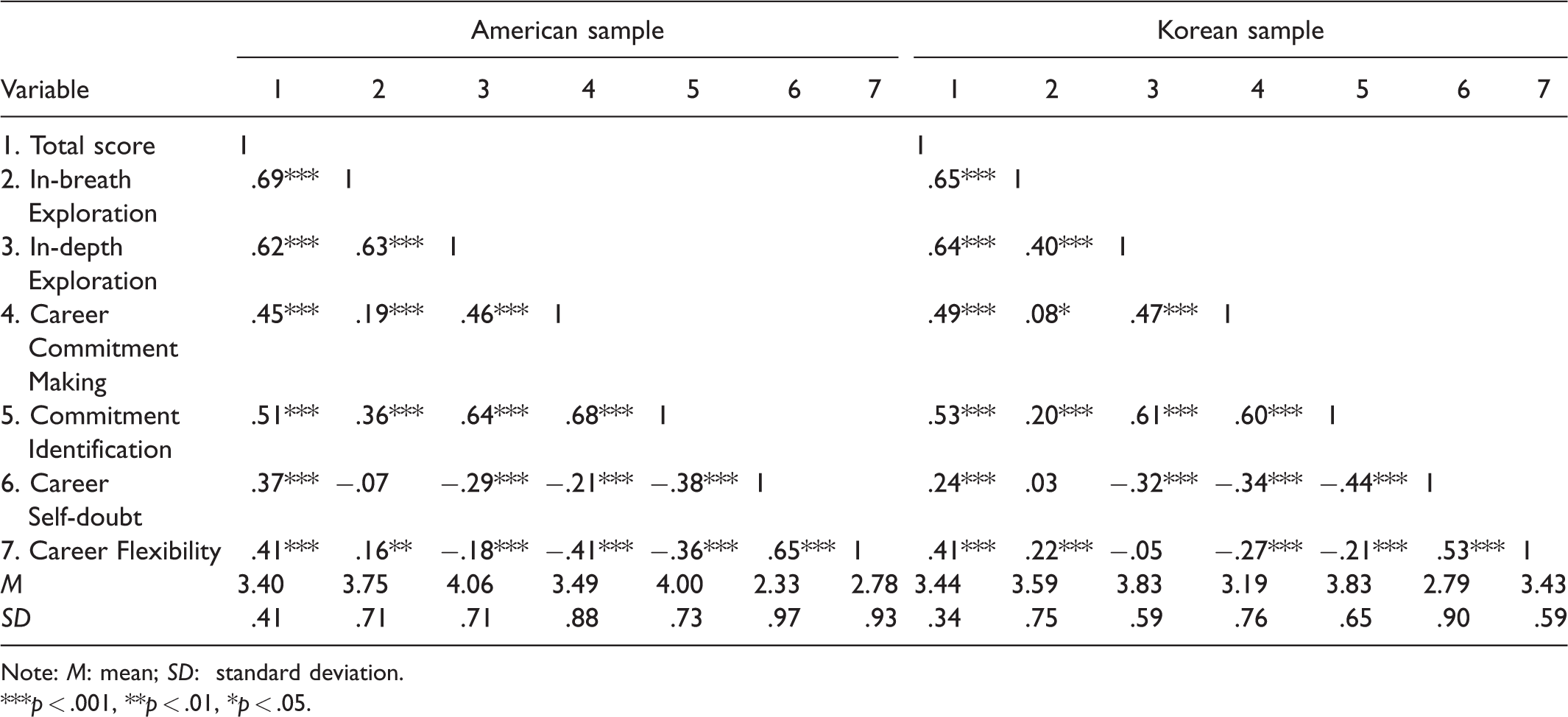
Note: M: mean; SD: standard deviation.
***p < .001, **p < .01, *p < .05.
Test of invariance
In order to compare American students to Korean students, we built a model composed of six latent variables, namely, the six dimensions of the VISA. To compare the means of the latent variables among groups, they should be on the same scale across all groups. Therefore, to apply a multigroup Latent Mean Analysis (LMA), configural invariance should be sufficient (Baumgartner & Steenkamp, 1998). That is, it was necessary to confirm that each data set fits the research model first to conduct the LMA for mean comparisons between the American and Korean samples. In general, fit index for continuous data is suitable when the following criteria are met: Non-Normed Fit Index (NNFI, also known as TLI) >.90, confirmatory factor index (CFI) >.90, and root mean square error of approximation (RMSEA) <.08. Each model fit index for the invariance test of LMA has been presented in Table 2. The test was conducted separately for each of the two cultural groups. As shown in Table 2, results revealed that both data fit the research model well. After this preliminary analysis, a configural invariance test was conducted. This confirmed good model fit indices. The factor loading invariance test appropriately showed that the factor loading was equal across groups. However, the intercepts were not fully invariant across the two groups. The intercepts invariance test revealed statistical significance for the χ2, RMSEA, TLI, and CFI. As such, a partial intercepts invariance test was conducted using the Modification Index. Items 27, 28, 30, 29, 19, 24, 3, and 14 were not set as invariant between the two ethnic groups because the items had larger effects on the model fit indices. Through relaxing the constrained items, the partial intercepts invariance became suitable. The differences in the fit indices between the invariance of factor loadings and of intercepts were insignificant, that is, ΔCFI ≤ −0.01 (Hu & Bentler, 1999), showing that the equality across groups was statistically satisfied.
Model fit statistics across American and Korean samples.
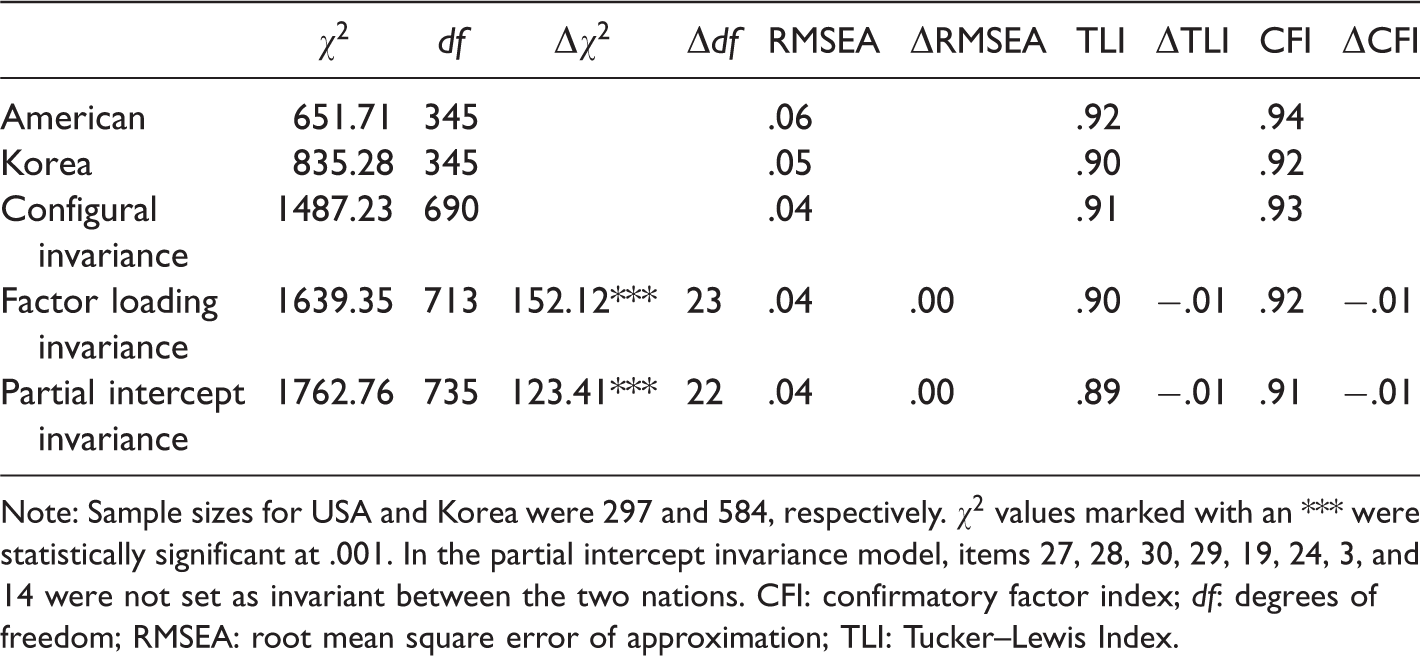
Note: Sample sizes for USA and Korea were 297 and 584, respectively.
Latent variable mean differences
After conducting the invariance tests, using LMA, latent variable mean comparisons were conducted by fixing the Korean sample as a reference group. LMA is estimated by fixing the mean of each factor for one group as 0, which allows the latent means to reflect the distinction between groups. As shown in Table 3, in five of the six dimensions, except for Commitment Identification, the mean differences were statistically significant between the American and Korean samples. The American sample mean scores were higher than the Korean sample mean scores in the dimensions of In-breadth Career Exploration (Cohen’s d = 43), In-depth Career Exploration (Cohen’s d = 70), and Commitment Making (Cohen’s d = 50). Conversely, the Career Self-doubt (Cohen’s d = −49) and Career Flexibility scores (Cohen’s d = −1.15) of the Korean sample were higher than those of the American sample.
Latent variable mean differences and effect sizes between American and Korean Samples.
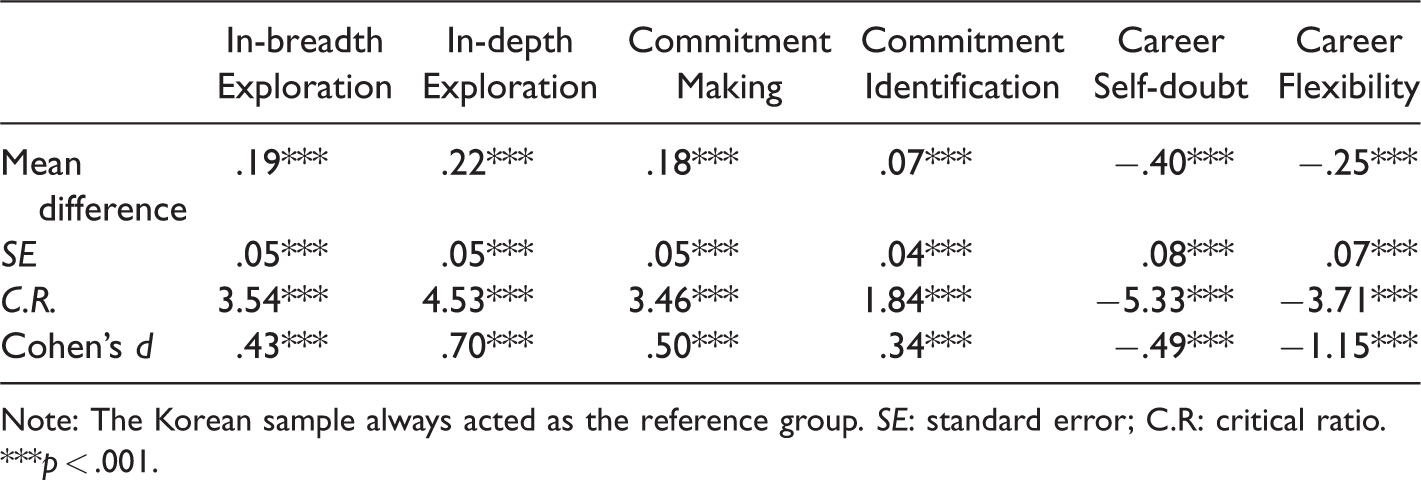
Note: The Korean sample always acted as the reference group. SE: standard error; C.R: critical ratio.
***p < .001.
Discussion
The main purpose of this study was to examine the meaningful differences in vocational identity between American and Korean university students with a new assessment tool called the VISA. The present results indicate that American college students invest more into career exploration activities (In-breadth and In-depth Career Exploration), and commit themselves more to making career decisions (Commitment Making) as compared to Korean college students. This finding is consistent with those of the study by Mau (2000), which found that Taiwanese students scored lower on career development as compared to American students, and many other studies that have reported cross-cultural differences between Asians and Westerners (Huang, 1971; Kitayama et al., 1997; White & Chan, 1983).
Many potential reasons causing the differences were discussed in the earlier literature. One reason could be that American college students tend to exercise autonomy and be independent when it comes to exploring vocational identity and career decision-making. S. M. Kim and Sim (2006) compared the level of self-authorship for career decisions between the two countries, and found that American students showed higher levels of career decision-making autonomy as compared to Korean students. F. T. L. Leong and Tata (1990) indicated that Chinese students tend to focus on collectivism, valuing self-realization less than the students highly acculturated into the American culture and having individualistic orientations in decision-making. S. M. Kim and Sim also pointed out that many Americans tend to show a relatively lower tendency of jumping on the socially famous job bandwagon as compared to Koreans. Additionally, Americans show a higher tendency of making career decisions based on one’s preference and aptitude.
It is also speculated that the differences between the two countries may be caused by differences in child-rearing practices as well as the career services available for the students in higher education settings. Many Korean college students tend to live with their parents during college and often stay until they get married, and their parents play a considerable role in their career decision-making (S. G. Park & Lee, 2002). In addition, J. G. Lee (2002) speculated that career counseling services widely provided to college students in the United States may have provided American college students with greater opportunities to seek broad and in-depth career exploration, and as a result, to make decisions on their career path.
Furthermore, in Korea, career preparation for college students is heavily influenced by the major conglomerates’ employing practices. Due to their emphasis on external qualifications of an applicant, such as the reputation of universities, standardized test scores (e.g., Test of English for International Communication), and multiple licenses, Korean college students spend little time exploring their career interests and aptitudes in-depth. Rather, they invest their time in receiving private tutoring to achieve higher scores on English proficiency and licensing tests. According to H. R. Min (2003), 48.9% of the Korean college students surveyed received private tutoring to prepare for employment, and the national annual mean score of total costs reached approximately 12.61 million won (approximately $12,600).
On the other hand, in the present study, Korean students showed higher scores on the dimensions of Career Self-doubt and Career Flexibility. This finding of higher self-doubt in career decision-making among Korean students echoes the findings of Kitayama et al.’s (1997) previous cross-national study. According to them, Asians are more likely to exhibit higher levels of self-criticizing tendencies when compared to Americans. Other researchers found that the high level of self-doubt in career decision-making among Asian students can be attributed to their low tolerance for ambiguity (Hsieh, Shybut, & Lotsof, 1969; F. T. L. Leong, 1985). In the current study, Korean students’ high scores on Career Flexibility may reflect their indecisive attitude toward setting career goals. Such attitudes may provoke a sense of anxiety among Korean students when they think about the uncertainty of their future career path. Because Korean students are heavily exposed to hierarchical relationships, highly structured social systems, and assessment-based academic and career guidance, uncertainty in decision-making situations can be intimidating and they can provoke a feeling of doubt (A. R. Lee, 2013).
Although the present study helps understand the differences between American and Korean college students in terms of the nature of their career identity development, it has some limitations. First, the survey used in this study was carried out only using self-reported questionnaires. As many studies have pointed out, the findings of a self-reported questionnaire survey are limited due to the inherent unreliability of self-reported inputs. Second, the present study could not utilize cluster analysis techniques to compare the differences in the career identity development status between the American and Korean college students. Though the VISA is designed to measure the level of vocational identity status by utilizing clusters, we could only conduct latent variable mean comparisons using the six subscales. Third, some variables that may have caused the vocational identity differences between American and Korean college students, such as collectivism and individualism (F. T.L. Leong & Tata, 1990), self-efficacy (Mau, 2000), career maturity (K. H. Lee, 2001), self-authorship (S. M. Kim & Sim, 2006), were not explored in this study. As such, any discussion addressing the potential causes of differences between the two samples were drawn mostly relying on previous research. Fourth, we did not carry out any additional analysis with other instruments, and relied only on the VISA. Hence, the findings of the present study may not be innovative for some people who may have preferred it to include additional scales or other methodological strategies. Therefore, we think that it would be beneficial if future research is conducted with additional data (other existing instruments) alongside the VISA.
Implications
Despite these limitations, however, the present study has several meaningful implications. First, because there has been little to no research addressing the differences in the vocational identity of American and Korean college students, the present study may contribute to the insufficient empirical literature on the comparative study of vocational identity and career development of American and Korean college students. Second, this study provides further utilization and application of a relatively new research tool, the VISA. Considering the fact that vocational identity exploration is an important step in a person’s career development, the present study may facilitate future related research using the VISA. Third, this study confirms that there are significant cultural differences in vocational identity between American and Korean university students. However, factors contributing to these differences were not empirically explored. As such, this study will be able to instigate the desire to explore those factors among career researchers and counselors. Fourth, the results of this study suggest that the dimensions of vocational identity be considered when career counselors work with college students from diverse backgrounds. For instance, career counselors dealing with American and Korean university students need to be aware of how different one’s vocational identity would be according to one’s nationality. It would help counselors build personalized career interventions for college students, and would aid the latter achieve better self-understanding (e.g., a Korean college student client attending an American university and his or her career counselor may understand that his or her relatively lower levels of Career Self-doubt or Career Flexibility are not very serious problems from a cross-cultural point of view). Last, this study highlights the role that social and cultural environments play in the shaping of career perspectives and the formation of vocational identities. This cross-cultural examination presents implications for parenting education, individual counseling, as well as career counseling and guidance.