




Abstract
Life History Theory posits early-life adversities affect personality development partway through sensitizing individuals to certain environmental cues, thus influencing the person’s responses to different stressors. We therefore hypothesized that life history strategy affects perceived distress and self-efficiency in coping through certain personality traits. The concept of the Dark Triad describes specific forms of personalities found to be associated with faster life strategies and perceived stress. Hence, the aim of our study was to examine the possible mediator role of the Dark Triad traits on the relationship between life strategies and perceived stress. A sample of 432 (133 males) under- and postgraduate students (aged between 18 and 34 years, M= 23.4, SD = 3.9) answered the Short-Form of the Arizona Life History Battery, the Mini-K, the Perceived Stress Scale, and the Short Dark Triad. Multiple linear regression and subsequent mediation analyses showed significant mediation effects of Dark Triad traits on both perceived distress and perceived coping. Our results indicate that these personality traits are part of the process in which faster life strategies predict higher level of perceived stress and lower levels of coping ability.
Introduction
An evolutionary theory, Life History Theory provides a framework for understanding and describing the different strategies individuals develop for allocating available resources (e.g., energy, time, etc.) into their own survival and reproduction. Since resources are limited, individuals are unable to expand the full potential of their development to maximize survival and reproduction, and hence, the allocation of resources is needed to be prioritized through a series of decisions (trade-offs). The different patterns of trade-offs in resource expenditure are represented by Life History (LH) strategies (Chisholm, 1999; Kaplan & Gangestad, 2005). LH strategies are flexible, because the most adaptive allocation strategy varies according to circumstances (Ellis, Figueredo, Brumbach, & Schlomer, 2009). For example, in terms of survival and fitness, sexually immature individuals might benefit more from investing resources in their growth and development to achieve maturity, while sexually mature individuals investing resources in their reproduction (i.e., producing or supporting offspring) might be more favorable. Accordingly, LH strategies are condition-dependent in the sense that behavior can be adapted to the conditions and environmental circumstances that the organism encounters (Bjorklund & Ellis, 2014; Chisholm, 1999; Ellis et al., 2009; Kaplan & Gangestad, 2005). Trade-offs covered by LH strategies are primarily determined by two environmental determinants: unpredictability and harshness (Brumbach, Figueredo, & Ellis, 2009; Ellis et al., 2009). Unpredictability is defined as the predictability of change in the environment, whereas harshness is a function of the availability of resources and morbidity–mortality rates. The allocation of resources depends on the harshness and unpredictability of the individual’s environment (Ellis, et al., 2009).
According to Life History Theory, specific personality traits, together with various behavioral strategies, regulate behavioral adaptation to environmental conditions (ecological and/or social) encountered during childhood (Brumbach et al., 2009). While unpredictable conditions tend to facilitate fast strategies, more predictable conditions may facilitate slow strategies (Kaplan & Gangestad, 2005). Fast strategies are viewed to favor a strong tendency to prefer immediate returns over delayed outcomes, whereas individuals with slow strategies might generally adopt a more future orientated and controlled behavior (Buss, 2009).
LH strategies are related to early-life experiences, which may also sensitize individuals to adversity, influencing how they respond to adversity in later life. Conversely, an individual’s reactions to environmental stressors (i.e., indicators of harsh or unpredictable environments) vary according to their childhood experience of adversity (Griskevicius, Delton, Robertson, & Tybur, 2011; Griskevicius et al., 2013; White, Li, Griskevicius, Neuberg, & Kenrick, 2013.). Various disadvantageous conditions such as the lack of parental support or low family income can be considered as indicators of unpredictability and harshness enhancing childhood stress (Belsky, Schlomer, & Ellis, 2012; Brumbach et al., 2009; Ellis et al., 2009; Griskevicius et al., 2011). These early-life adversities might influence cognitive appraisal and the subjective evaluation of subsequent stress experiences (Lovallo, 2013). In line with this, negative experiences during childhood have been found to affect the individual’s coping style manifesting, for example, in avoidance of problems or wishful thinking (Leitenberg, Gibson, & Novy, 2004). Moreover, other behavioral indicators of fast LH strategy may occur, such as opportunistic or exploitative behavior, hostile attitude, and poor social skills (Belsky et al., 2012; Brumbach et al., 2009; de Baca, Wahl, Barnett, Figueredo, & Ellis, 2016).
Based on the strong associations between LH strategies and stress experiences, we assume that LH strategy affects perceived distress (PD) and self-efficiency in coping. More specifically, we predict a positive association between indicators of a “faster” life strategy and perceived stress measured by self-reports. As pointed out earlier, childhood adversity has been demonstrated to be a key factor in the development of personality dysfunctions and disorders through the negative influence it exerts on interpersonal competences and sociocognitive and emotional functioning (Bjorklund, 2015; Brumbach et al., 2009; de Baca et al., 2016; Jonason, Zeigler-Hill, & Baldacchino, 2017). Several studies suggest that unpredictable and harsh environmental cues experienced in childhood are associated with elevated risk-perception, a more hedonistic attitude, relatively poor social skills, and with hostile and antagonistic interpersonal styles (Brumbach et al., 2009; de Baca et al., 2016; Hurst & Kavanagh, 2017). Accordingly, life strategies do not affect perceived stress directly, rather through the sociocognitive developmental processes regulated by these strategies. To be able to adapt to certain environmental conditions, individuals develop corresponding cognitive and affective characteristics, which determine the evaluation of stressors and the ability to cope with them. These mechanisms, however, are strongly related to personality traits (Vollrath, 2001), and consequently, we assume that these personality features mediate the effect of LH strategies on perceived stress and on coping ability. Specifically, of the many potentially relevant personality traits, we predict that Dark Triad (DT) personalities might especially be influential on the relationship between LH strategies and perceived stress (Csathó & Birkás, 2018).
The DT construct is a personality framework dedicated specifically to malevolent or hostile traits referring to three interrelated constructs of Machiavellianism, subclinical psychopathy, and subclinical narcissism (Paulhus & Williams, 2002). Machiavellianism is a “manipulative” personality trait characterized by a cynical view of others and by utilizing manipulative and exploitative behavioral strategies (Christie & Geis, 1970; Paulhus & Williams, 2002). On the subclinical level, psychopathy includes high levels of impulsivity and selfishness along with low level of empathy, whereas narcissism represents the behavioral grandiosity and perceived entitlement of an individual (Paulhus & Williams, 2002; Vize, Lynam, Collison, & Miller, 2018). Recent studies have shown a significant association between negative childhood experiences (e.g., parent–child relationship and family functioning) and the presence of DT traits (Jonason, Lyons, & Bethel, 2014; Láng & Birkás, 2014; Láng & Lénárd, 2015). Consequently, the DT has a strong positive association with a fast LH strategy (e.g., Gladden, Figueredo, & Jacobs, 2009; Jonason & Tost, 2010; McDonald, Donnellan, & Navarrete, 2012). However, DT traits do not fully overlap (Vize et al., 2018) and differ in regard to the psychosocial environment (e.g., familial and romantic relationships) associated with their life strategies (Jonason, Li, & Czarna, 2013). Correspondingly, narcissism can be characterized with a friendly dominant interpersonal style and a higher degree of self-control. In contrast, Machiavellianism has been found to be associated with a hostile-submissive interpersonal style and low self-control. Finally, psychopathy is a trait associated with a hostile-dominant interpersonal style and low self-control (Jonason & Tost, 2010; Rauthmann & Kolar, 2013; Szijjarto & Bereczkei, 2014). Self-control, dominance, and hostile attitudes had been shown to affect coping strategies (Campbell-Sills, Cohan, & Stein, 2006; Englert, Bertrams, & Dickhäuser, 2011) suggesting that the different DT personalities might be associated with distinctive patterns of perceived stress and coping ability.
Additional support for this hypothesized association is provided by some former studies. First, Rim (1992) examining coping preferences found that emotional coping strategies were favored by Machiavellian individuals. More recently, individuals with grandiose narcissistic traits were found to dispose of better coping flexibility as compared to vulnerable narcissists (Ng, Cheung, & Tam, 2014). This ability to utilize adaptive coping strategies of the grandiose narcissistic individuals is suggested to be an important mediator between their life satisfaction, perceived levels of stress, and narcissistic personality traits. Moreover, DT traits differ in their coping preferences (Birkás, Gács, & Csathó, 2016), defense mechanisms, and the level of perceived stress (Richardson & Boag, 2016). In particular, in contrast to Machiavellianism and narcissism, psychopathy appears to be not related to self-perceived stress (Richardson & Boag, 2016) as well as to adaptive coping (Birkás et al., 2016). In addition, unlike Machiavellianism, narcissism is associated positively with task-oriented coping strategies (Birkás et al., 2016) and with lower levels of perceived stress (Richardson & Boag, 2016).
Based on former findings highlighted above, we hypothesized that Machiavellianism is positively associated with perceived stress and negatively with coping ability. On the contrary, narcissism was expected to be associated negatively with perceived stress and positively with coping ability. In line with former findings, between psychopathy and perceived stress or coping ability were no associations assumed.
In line with the above, in the present study, we tested how DT traits mediate the associations of LH strategies with perceived stress and coping ability. More specifically, we assumed that DT differentially mediates the associations between LH strategies, perceived stress, and coping ability: While Machiavellianism and narcissism might have a mediator role, psychopathy is unexpected to show a mediation effect.
Method
Participants
Participants were 432 (133 males) under- and postgraduate European-Caucasian students aged between 18 and 34 years (Mean: 23.41, SD: 3.92). All of the participants provided written consent.
Measures and procedure
The Mini-K Short Form (Mini-K; Figueredo et al., 2006) is commonly used to substitute for the entire Arizona Life History Battery (Figueredo, 2007). It consists of 20 items, and participants have to indicate how much they agree (–3 = strongly disagree; +3 = strongly agree) with certain cognitive and behavioral indicators of LH strategy (e.g., “While growing up, I had a close and warm relationship with my biological mother”). High scores indicate a “slow” LH strategy on the “fast-to-slow” continuum.
The Perceived Stress Scale (PSS-14; Cohen, Kamarck, & Mermelstein, 1983) is a 14-item, 0 to 4 Likert-scale self-report instrument designed to assess current levels of experienced stress and, additionally, the extent to which participants perceived their life-situation as unpredictable, uncontrollable, and overloading. Former studies suggest two separate dimensions of PSS-14 (e.g., Lavoie & Douglas, 2012; Martin, Kazarian, & Breiter, 1995): The first, PD factor reflects to overall feelings of general distress based on evaluations of straining life circumstances (e.g., “In the last month, how often have you been upset because of something that happened unexpectedly?”). The second, perceived coping (PC) factor captures perceived self-efficacy to manage life stressors (e.g., “In the last month, how often have you felt that you were effectively coping with important changes that were occurring in your life?”).
The Short Dark Triad questionnaire (Jones & Paulhus, 2014) was used to assess the DT construct. The Short Dark Triad is a 27-item, 1 to 5 Likert-scale self-report instrument that measures Machiavellianism (e.g., “Avoid direct conflict with others because they may be useful in the future”), psychopathy (e.g., “I like to get revenge on authorities”), and narcissism (e.g., “I have been compared to famous people”) with nine items for each subscale.
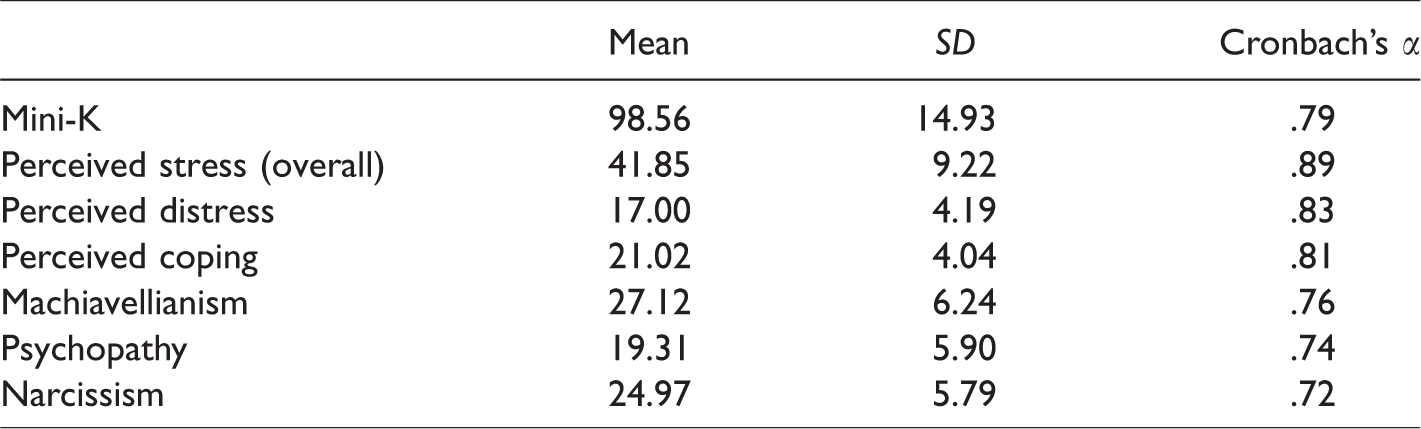
Table 1 summarizes the descriptive statistics and Cronbach’s alphas for all scales used in the present study.
Descriptive statistics, Cronbach’s alphas for all variables.
Results
After performing bivariate correlations between the measured variables, we conducted two multiple linear regression analyses to probe the unique contribution of the LH strategy and DT traits predicting PD and PC (see Table 2). In particular, PD and PC were separately regressed on the Mini-K and DT traits (for PD, F(5, 426) = 8.91, p < .001; for PC, F(5, 426) = 21.30, p < .001). Former studies indicated gender differences in scores on the DT traits and in perceived stress (see Jonason, Koenig, & Tost, 2010; Lavoie & Douglas, 2012); therefore, each regression analysis was also controlled for gender.
Correlations and regression coefficients (in brackets) between the Mini-K, the Dark Triad, and the two factors of the Perceived Stress Scale.
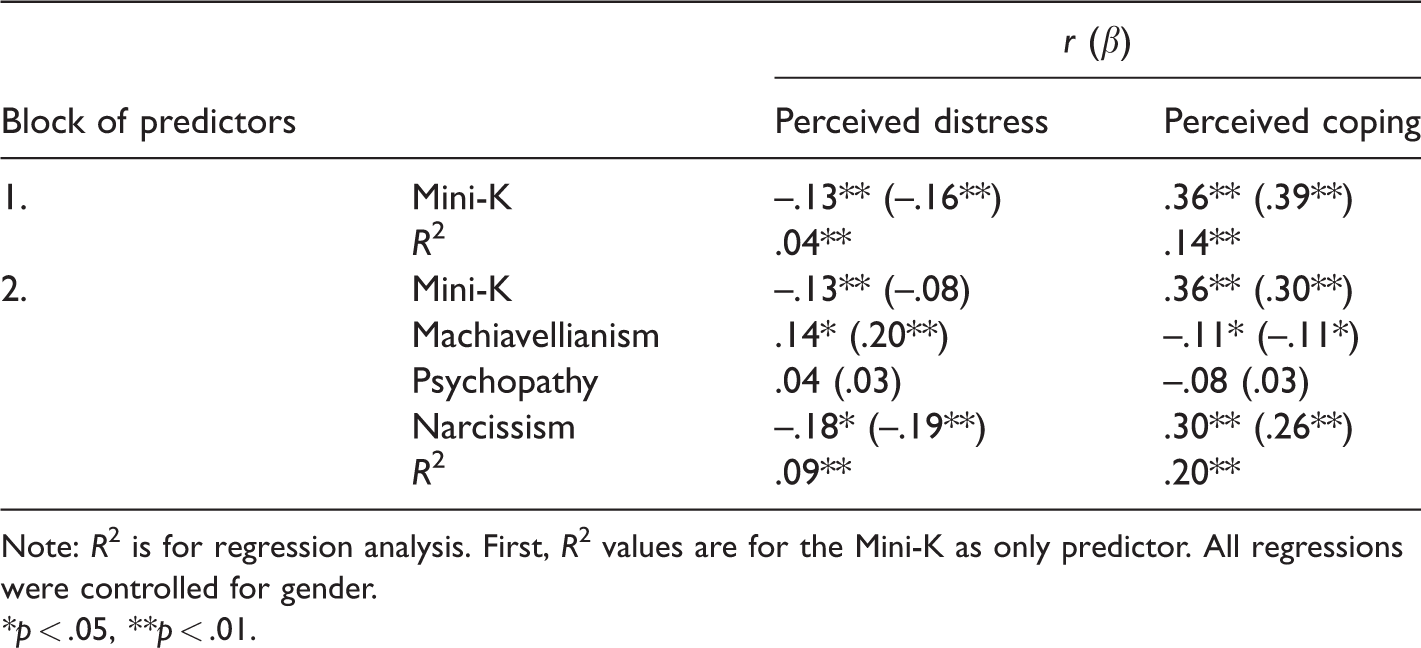
Note: R2 is for regression analysis. First, R2 values are for the Mini-K as only predictor. All regressions were controlled for gender.
*p < .05, **p < .01.
PD showed a positive association with “faster” life strategy (i.e., lower Mini-K scores), whereas PC was found to be associated negatively with faster life strategies. Furthermore, in accordance to former findings, Machiavellianism was related positively with PD and negatively with PC, while narcissism showed an opposite pattern of relation to both PD and PC. Psychopathy showed no relationship to the PSS factors.
The decrease of the Mini-K’s regression coefficient (for PD from –.16 to –.08; for PC from .39 to .30) supported our prediction about the mediation effect of DT traits between life strategies and the two factors of PSS-14 (see Table 2). To test this prediction directly, we conducted a mediation analysis using Process Procedure Macro for SPSS (Model 4) by Hayes (2013) to examine the mediating role of DT traits. In line with former suggestion (Gladden et al., 2009; Jonason & Tost, 2010; McDonald et al., 2012) that fast LH strategy predicts an elevated likelihood of the development of DT traits, Mini-K score was entered as the independent variable and the PSS-14 factors as the outcome variables, while DT traits were inserted simultaneously as mediators. Gender was used as a covariate. We performed analyses separately for PD and PC, the results are shown in Figure 1(a) and (b).
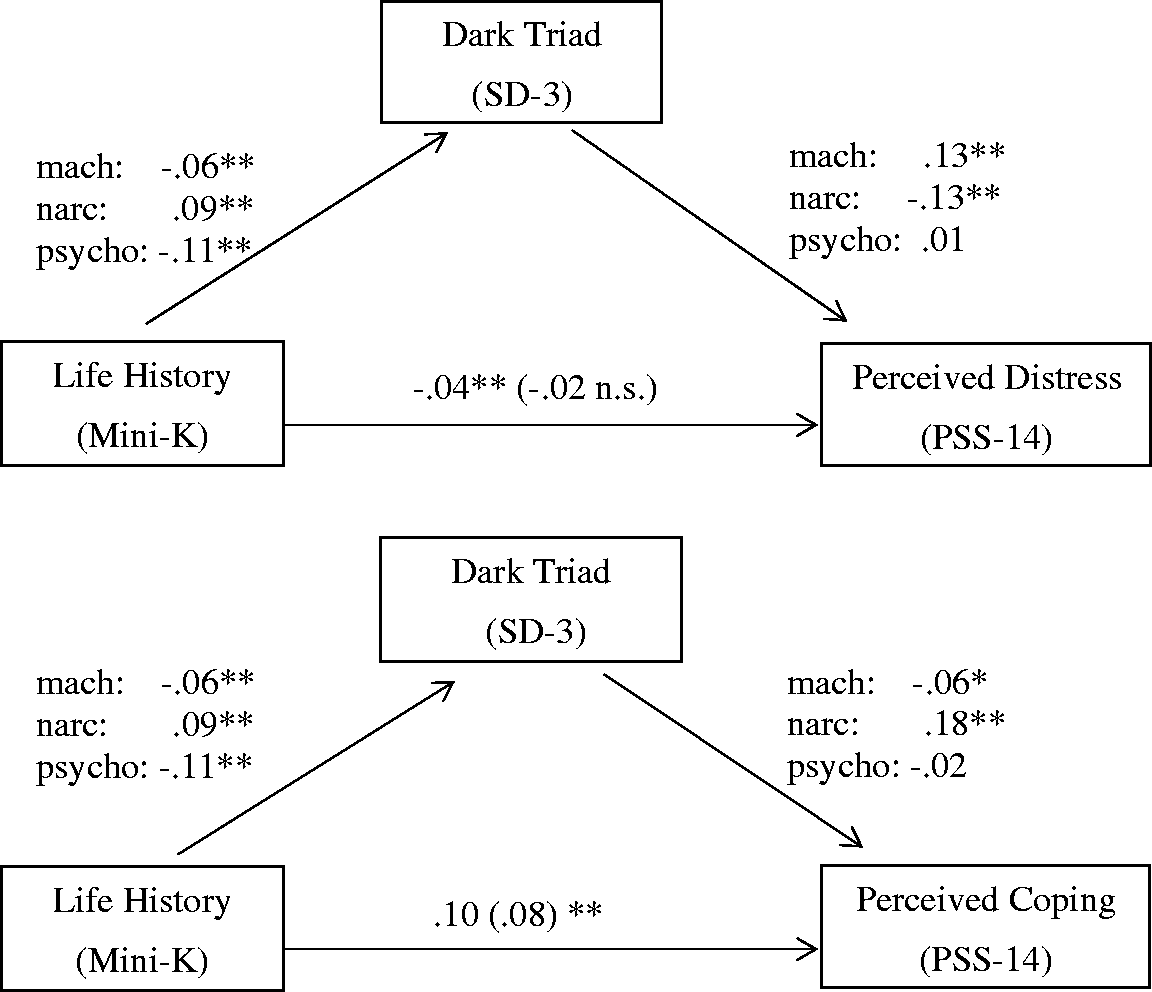
Effect (Beta values) of life strategy indicator on perceived distress (a) and perceived coping (b) mediated by Dark Triad traits. mach: Machiavellianism; narc: narcissism; psycho: psychopathy; PSS: Perceived Stress Scale; SD3: Short Dark Triad. All mediation analyses were controlled for gender. *p < .05, **p < .01.
We found evidence for the full mediation effect of DT traits on the association between LH strategies and PD (see Figure 1(a)). The coefficient between Mini-K and PD went from –.04 to –.02 with a ΔR2 of .04, F(2, 429) = 9.03; p < .01. Machiavellianism and narcissism as mediator variables significantly predicted PD, while the Mini-K no longer predicted PD suggesting that the effect of life strategy on PD is significantly mediated by these two DT traits. Sobel’s Z scores were –2.42 for Machiavellianism (p < .05, κ2 = 0), –2.92 for narcissism (p < .05, κ2 = –.01), and –0.41 for psychopathy (p = .60, κ2 = 0).
For PC, a partial mediation effect of the DT traits was found (Figure 1(b)). The coefficients between Mini-K and PC were changed from .10 to .08 with a ΔR2 of .14, F(2, 429) = 35.45; p < .01. Sobel’s Z scores were 1.71 for Machiavellianism (p = .80, κ2=0), 3.61 for narcissism (p < .01, κ2 = –.01), and .5 for psychopathy (p = .61, κ2 = –0). This finding indicates that narcissism partly mediates the association between life strategy and PC ability, whereas the other two DT traits not.
Discussion
Our study examined associations between the DT, the indicators of fast LH strategy, level of perceived stress, and coping ability. We also tested the mediator role of DT traits between LH strategies, perceived stress, and coping ability.
Taking our findings together, faster life strategy was found to be positively related to PD, whereas it was negatively associated with PC. Although the effect sizes were small, the findings indicate that early experiences with stressors can enhance the level of subjectively experienced stress in latter stages of life. Furthermore, early-life adversities might create a self-perceived lack of coping abilities. These new findings are in line with former studies suggesting that individuals with faster LH strategy perceive themselves as enduring more stress, accessing less resources, and possessing more disadvantageous traits (Figueredo et al., 2012).
However, the significant association between DT traits and the two factors of PSS appeared to be important in understanding the relation between LH strategies and perceived stress. The significant indirect effects of DT traits on both factors of PSS indicate that these personality traits are part of the process in which faster life strategies predict higher level of perceived stress and lower levels of coping ability.
For PD, we found a clear mediation effect of DT traits suggesting that early socioecological circumstances affect the perception of current stress through personality traits shaped by these early stressful experiences. In particular, Machiavellianism was positively associated with PD, whereas narcissism was negatively associated with PD suggesting that individuals possessing these traits react to stressors in different ways. While Machiavellianism is related to a more negative view of stressful situations, narcissism was associated with less concerns about life stressors. For Machiavellianism, this association might reflect on the cynical, exploitative social attitude of Machiavellians (Christie & Geis, 1970). Thus, individuals high in Machiavellianism might tend to evaluate stressful situations as potentially harmful based on their assumption, that they can be exploited from others if they not manipulate them first. Furthermore, as mentioned above, DT traits share some early-life adversities (Jonason et al., 2014; Láng & Birkás, 2014; Láng & Lénárd, 2015) but show distinctive coping preferences (Birkás et al., 2016) and perceive differently the level of stress (Richardson & Boag, 2016). Accordingly, Machiavellians might experience more intense stress in a certain situation accompanied by less adaptive or effective coping ability which enhances the level of perceived stress. In contrast, the egoistic enhancement characteristic of narcissists’ self-perception (Paulhus & John, 1998) might reduce the level of perceived stress through the unrealistic but enhanced view of coping ability. Former findings might support this idea showing that narcissism was positively associated with coping strategies aimed at altering or solving the stressful situation (i.e., task-oriented coping or problem solving; see Birkás et al., 2016).
The indirect effect of DT traits on the association between Mini-K and PC was less robust, but it reached significance. Although Machiavellianism was significantly and negatively associated with PC and the Mini-K, the indirect pathway from LH strategies to perceived stress over Machiavellianism remained non-significant. Only narcissism had a significantly indirect effect on PC suggesting that individuals possessing this trait tend to evaluate their coping ability more positively. Again, these findings are in line with former studies showing that unlike Machiavellianism, narcissism is associated with a preference for problem-focused actions in stressful situations (Birkás et al., 2016). Although narcissism was a significant mediator, the direct effect of LH strategy on PC remained significant suggesting that facing early-life stressors eventuate in a more disadvantageous self-perception of coping ability. This suggests that the association between LH strategies and self-evaluated coping skills may be mediated by other personality-related characteristics (e.g., self-esteem, trait optimism, and resilience) independent from DT traits.
We did not found any significant relationship between psychopathy and the two factors of the PSS. However, this is in good agreement with previous studies highlighted earlier suggesting that psychopathy is not related neither to self-perceived stress (Richardson & Boag, 2016) nor to adaptive coping (Birkás et al., 2016).
Despite the contribution of this study, some limitations should be noted. First, only self-report questionnaires were used to examine the predicted associations. Observing subjects’ reactions in real-world setting, and collecting more sociodemographic data about their rearing environment might lead to more valid results. Second, both for PD and PC, the effect sizes were significant, but small suggesting that besides LH strategy indicators and the DT, other relevant and impactful variables influence the level of perceived stress and coping ability. Moreover, the cross-sectional design limits the causality of our results. Future studies should consider other study designs or real-world settings to examine the associations between life strategies, perceived stress, and the DT.
In summary, the current study reveals how life strategy indicators (measured by the Mini-K) are associated with actual PD and coping ability. Moreover, our findings, first in the literature, show that DT traits differentially mediate the effect of life strategy on perceived stress and coping. Our findings support existing work and may accelerate future studies examining the links between malevolent personality characteristics and mental health relevant outcomes. For example, some studies suggested different patterns for Machiavellianism, psychopathy, and narcissism in regard to developing depression (Al Aïn, Carré, Fantini-Hauwel, Baudouin, & Besche-Richard, 2013; Orth, Robins, Meier, & Conger, 2016; Willemsen, Vanheule, & Verhaeghe, 2011). Moreover, other studies examined the potential health correlates of the DT (Jonason, Baughman, Carter, & Parker, 2015) showing distinguishable associations between life expectancy and the DT traits. Therefore, future studies might also need to clarify further how individuals with certain personality characteristics process psychological distress in ways that appear to be distinctive and lead to different health-related outcomes. On the other hand, the role of early-life adversities on personality development and mental health should be analyzed more detailed in terms of LH strategies. Including evolutionary psychological aspects may enable a more comprehensively understanding of the adaptive nature of several socially aversive or malevolent characteristics and behavioral strategies.