



Abstract
This study aims to explore the relationships among social anxiety, social networking sites (SNS) addiction, and SNS addiction tendency and further to examine the moderating role of state attachment anxiety and state attachment avoidance. A sample of Chinese young adults (N = 437, Mage = 24.21 ± 3.25, 129 males) participated in this study, the data were collected through self-reports. Results revealed that participants’ social anxiety was positively associated with SNS addiction and SNS addiction tendency. State attachment anxiety moderated these two relationships after controlling gender, age, and state attachment avoidance, while state attachment avoidance showed no significant moderating effect. Specifically, the positive relationships between social anxiety and SNS addiction (tendency) were restricted to individuals with low state attachment anxiety. While for individuals with high state attachment anxiety, social anxiety was no longer associated with SNS addiction or SNS addiction tendency. This study contributes to a deeper understanding of state attachment’s moderating role in terms of the relationships between social anxiety and SNS addiction (tendency).
Keywords
Introduction
Over the past decade, the field of social networking sites (SNS) addiction has attracted a large number of investigators (e.g., Pontes, 2017; Pontes, Taylor, Stavropoulos, 2018; P. Wang et al., 2018). SNS addiction refers to individuals’ being overly concerned about SNS, driven by a strong motivation to use it and devoting much time, energy, and effort to it (Andreassen & Pallesen, 2014). SNS addiction consists of four core symptoms: conflict, withdrawal, relapse, and salience. In this line, some researchers suggest that withdrawal, salience, and loss of control are indicative of SNS addiction tendency, which is defined as addictive tendencies toward SNS use (Wilson, Fornasier, & White, 2010). Although the DSM-5 does not formally recognize SNS addiction (tendency) as a psychological disorder (American Psychiatric Association, 2013), they share many similar characteristics with other behavioral addictions (e.g., gambling addiction, computer and video games addiction, and online auction websites addiction; Lemmens, Valkenburg, & Gentile, 2015; Turel & Serenko, 2012).
Individuals trapped in SNS addiction suffer from a series of emotional, relational, and health-related problems (Ryan, Chester, Reece, & Xenos, 2014). Therefore, it is a matter of importance to explore the factors associated with SNS addiction (tendency). Theoretical models have suggested that SNS addiction can be fostered by dispositional factors, for instance, social anxiety (Andreassen, 2015). Social anxiety is defined as individuals’ feeling anxious when faced with real or imagined social situations (i.e., conversation, meeting new people, and public speaking) where they can be observed or evaluated by others (Schlenker & Leary, 1982). People with high social anxiety often feel distressed in these situations and fear others’ observation and evaluation (American Psychiatric Association, 2013).
Many empirical research works have also accordantly found that social anxiety increases the risk of SNS addiction. For example, in a sample aged between 14 and 29 years, Wegmann, Stodt, and Brand (2015) found that participants’ social anxiety, operationalized by interpersonal sensitivity, directly predicted SNS addiction, higher social anxiety leading to greater SNS addiction. Recently, Lee et al. (2017) also found that participants’ self-report SNS addiction tendency could be positively predicted by social anxiety. Specifically, social avoidance, a sub-factor of social anxiety, had a direct and positive influence on the sub-factors of SNS addiction tendency (i.e., immersion and regulation failure). In real social situations, socially anxious people often expect to be negatively evaluated and interpersonally rejected by others. To avoid this, they immerse themselves in SNS where they feel less anxious (Blasi et al., 2015). However, if things continue in this way, they are predicted to be SNS dependent and even SNS addicted (Andreassen, 2015).
This can also be understood from the social compensation hypothesis (Valkenburg & Peter, 2010). In real social situations, people with social anxiety always anticipate social threats, which bring them a great deal of distress. However, these social threats and distress will not appear in SNS where they can get a relief and feel more comfortable. For example, they report less fear of negative evaluation in SNS interactions than face-to-face interactions (Yen et al., 2012). In order to seek compensations and obtain gratifications, they may use SNS excessively and compulsively (Pierce, 2009). Consequently, they are easy to develop into SNS addiction, while SNS addiction tendency may be reinforced as well (Cerniglia et al., 2016; Griffiths, Kuss, & Demetrovics, 2014; Monacis, Palo, Griffiths, & Sinatra, 2017b).
However, in terms of the relationships between social anxiety and SNS addiction (tendency), there may exist individual differences. One factor assumed to be the potential moderator in these relationships is the state attachment. State attachment is a dynamic system where different attachment styles (i.e., security, anxiety, and avoidance) can be temporarily activated by specific life events and contextual factors (Gillath, Hart, Noftle, & Stockdale, 2009; Gillath & Shaver, 2007). With respect to the influence on individuals’ expectations, perceptions, and behaviors, state attachment even overwhelms the power of trait attachment, which is a stable disposition (Gillath, Selcuk, & Shaver, 2008).
As Mischel and Shoda’s (1995) cognitive-affective personality systems model posits, some personality features, like social anxiety, may interact with the activation of attachment system to differentially influence people’s behavior and behavioral tendency (Bowles & Meyer, 2008). Therefore, the state attachment moderation hypothesis is grounded in claims that relationships between social anxiety and SNS addiction (tendency) may change as one’s state attachment momentarily fluctuates. In line with the recent attachment models, this study focuses on the role of state attachment anxiety and state attachment avoidance. The state attachment anxiety reflects individuals’ constant worries about being rejected by significant others, extremely requiring the interpersonal closeness, and anxiously seeking for social connectedness and relatedness with others (Mikulincer & Shaver, 2007).
Prior research has shown that state attachment anxiety moderates the relationship between one’s cognitive-affective belief and subsequent behavioral tendency. For example, Finkel, Burnette, and Scissors (2013) found, for college students who experienced state attachment anxiety (manipulated by an experimental priming), their increased destiny beliefs predicted decreased forgiveness tendencies. While for those experiencing state attachment security, this prediction was no longer significant. Drawing from this line, relationships between social anxiety and SNS addiction (tendency) may be contingent upon the level of state attachment anxiety. Once activating state attachment anxiety, people are likely to use a hyperactivating strategy. In this case, people show energetic attempts to seek for the proximity and support from others (Mikulincer, Shaver, & Pereg, 2003). To get these resources satisfied, people with high attachment anxiety tend to be immersed in SNS interactions, in turn getting into SNS addiction (Monacis, Palo, Griffiths, & Sinatra, 2017a). Hence, high state attachment anxiety may cover the relationships between social anxiety and SNS addiction (tendency). In other words, no matter people hold high or low social anxiety, they may show a similar level of SNS addiction (tendency). In contrast, for people with low state attachment anxiety, higher social anxiety may be associated with higher SNS addiction (tendency).
Nevertheless, state attachment avoidance may not show a moderating effect on these two relationships. Attachment avoidance reflects individuals’ reluctance to trust others, low tolerance for interpersonal intimacy, and defensively striving to maintain behavioral and emotional independence (Mikulincer & Shaver, 2007). Once activating state attachment avoidance, people use a deactivating strategy and isolate themselves from others (Mikulincer et al., 2003). In this case, even with social anxiety, they may avoid SNS interactions and are far from SNS addiction. Hence, as people’s state attachment avoidance fluctuates, the relationships between social anxiety and SNS addiction (tendency) may not vary.
To sum up, the primary purpose of this study is to examine the relationships between social anxiety and SNS addiction (tendency) and further explore whether these relationships vary in individuals with different levels of state attachment anxiety and state attachment avoidance. Social anxiety is hypothesized to be positively associated with SNS addiction and SNS addiction tendency, which may be moderated by state attachment anxiety but not state attachment avoidance. Specifically, these two relationships are hypothesized to be restricted to individuals with low state attachment anxiety. However, such relationships may not exist for those with high state attachment anxiety. Given young adults are main users of SNS (Baker & Moore, 2008; Raacke & Bonds-Raacke, 2008), this study focuses on this group.
Method
Participants
Four hundred fifty-nine Chinese participants using SNS were recruited by Sojump, which is a professional online survey platform in China (https://www.wjx.cn/). They come from 30 provinces (mainly from Beijing, n = 102 and Gansu, n = 55) and overseas universities (n = 4). Nineteen participants were excluded due to excessively short response time (less than 10 seconds) and a regular responding pattern (e.g., answer “1” in all items), their answers may be untrue. While one’s response time was too long (more than 10 minutes) with over 50% missing data. He did not complete the online survey and was also excluded. Two middle school students aged 12 years were excluded as well because this study only focuses on young adults over 16 years. Therefore, the final sample was comprised of 437 participants (129 males; aged from 16 to 30 years, M = 24.21, SD = 3.25), who were mainly college students (n = 274) and office workers (n = 79).
Measures
Social anxiety is measured by a short-version Social Phobia Scale (SPS; Peters, Sunderland, Andrews, Rapee, & Mattick, 2012), which has been revised in China (Ye, Qian, Liu, & Chen, 2007). It consists of six items (e.g., “I get nervous that people are staring at me as I walk down the street,” α = .81; χ2/df = 3.27, p < .01, comparative fit index (CFI) = .98, Tucker-Lewis index (TLI) = .97, root mean square error of approximation (RMSEA) = .07). Responses were given on a four-point scale (1 = not at all true of me, 4 = extremely true of me). Average was computed, with higher scores reflecting higher social anxiety.
State attachment anxiety and avoidance are measured by State Adult Attachment Measure (SAAM; Gillath et al., 2009), which has been revised and validated in China (Ma et al., 2012). It is designed to assess one’s momentary fluctuations in attachment, and how they think right now rather than general thoughts about attachment relationships (anxiety subscale, seven items, e.g., “I wish someone would tell me they really love me,” α = .87; avoidance subscale, seven items, e.g., “I feel alone and yet don’t feel like getting close to others,” α = .88) (χ2/df = 4.49, p < .001, CFI = .91, TLI = .89, RMSEA = .09). Responses were on a seven-point scale (1 = strongly disagree, 7 = strongly agree). Average was computed, with higher scores reflecting higher state attachment anxiety and avoidance.
SNS addiction is assessed by a short-version Social Networking Websites Addiction Scale (SNWAS; Turel & Serenko, 2012). It has five items (e.g., “When I am not using social networking website, I often feel agitated,” α = .81; χ2/df = 2.07, p = .08, CFI = .99, TLI = .99, RMSEA = .05) and measures core symptoms of addiction (i.e., conflict, withdrawal, relapse, and salience). SNS addiction tendency is assessed by Social Networking Sites Addiction Tendency Scale (SNSATS; Wilson et al., 2010). It has only three items (e.g., “I find it hard to control my use of a social networking site,” α = .85; loadings ranged between .71 and .91) and measures core symptoms of addiction tendency (i.e., withdrawal, salience, and loss of control). Given its confirmatory factor analysis (CFA) model is just identified; therefore, the model fit cannot be estimated (J. Wang & Wang, 2012). SNWAS and SNSATS were adapted from English by five independent translators: an English professor, a psychology professor, and three psychology PhD students. All translators translated the measures and discussed all discrepancies until finding a satisfactory solution. On this basis, a professional bilingual translator then back-translated the Chinese version, this procedure proved to be identical in content with the original version. Responses of both scales were on a seven-point scale (1 = strongly disagree, 7 = strongly agree). Average was computed, with higher scores reflecting higher SNS addiction (tendency).
Particularly, these two scales are designed to assess SNS addiction (tendency) as a continuous construct instead of simply classifying people as “addicts” vs. “not addicts.” For one thing, there has been no acceptable cut-off criteria (Block, 2008; Turel & Serenko, 2012). For another, using a continuous measure can increase the statistical power of analyses and provide a stronger test of hypotheses. Therefore, this study examines SNS addiction (tendency) as a dimension ranging from not at all addicted (tendency) to extremely addicted (tendency). In addition, these two scales can be used to count symptoms of SNS addiction (tendency). If counting a symptom when a person scores a 5, 6, or 7 (on a 7-point scale) for an item, 5.95% (n = 26) participants exhibit all four symptoms of SNS addiction, while 29.06% (n = 127) exhibit all three symptoms of SNS addiction tendency.
Procedure
Participants were provided with a link that directed them to a webpage hosting the online survey. After being given the informed consent, participants provided their demographic information and successively responded to SAAM (anxiety and avoidance subscale), SNWAS, SNSATS, and SPS. Finally, they were debriefed and thanked for their participation.
Results
Descriptive and correlational analyses
Based on independent-samples t-tests, females (M = 2.32, SD = .71; M = 5.48, SD = 1.03) showed higher scores on both social anxiety (marginally significant) and state attachment anxiety than males (M = 2.18, SD = .77; M = 4.97, SD = 1.17; t = 1.77, df = 435, p = .08, Cohen’s d = .19; t = 4.52, df = 435, p < .001, Cohen’s d = .46). There were no significant gender differences in SNS addiction, SNS addiction tendency, and state attachment avoidance. Descriptive and correlational findings were presented in Table 1, social anxiety was positively associated with SNS addiction and SNS addiction tendency.
Descriptive and correlational analyses among major variables (N = 437).
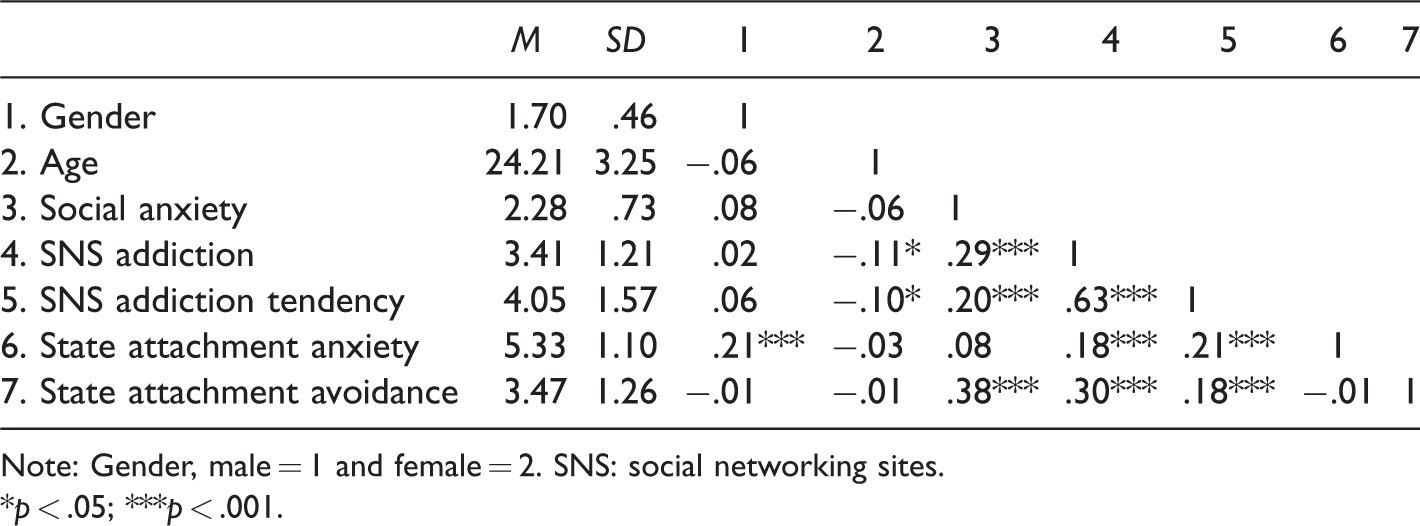
Note: Gender, male = 1 and female = 2. SNS: social networking sites.
*p < .05; ***p < .001.
Moderation analyses
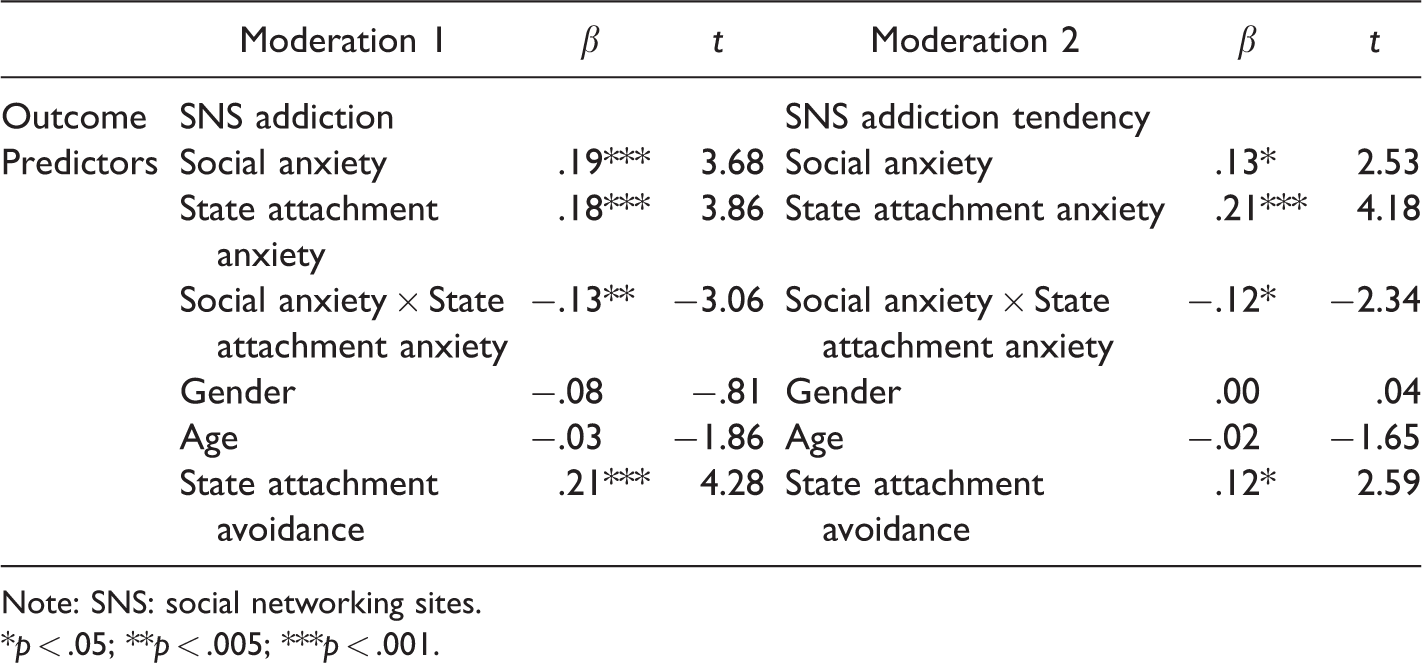
To examine whether state attachment anxiety and state attachment avoidance moderated the relationships between social anxiety and SNS addiction (tendency), moderation analyses with PROCESS 2.16 (model 1) suggested by Hayes (2013) were conducted. Analyses found that state attachment anxiety significantly moderated these two relationships after controlling gender, age, and state attachment avoidance (see Table 2). However, state attachment avoidance did not significantly moderate these relationships after controlling gender, age, and state attachment anxiety (β = −.06, p = .22; β = −.05, p = .37).
Moderation analyses of state attachment anxiety.
Note: SNS: social networking sites.
*p < .05; **p < .005; ***p < .001.
The interaction of social anxiety and state attachment anxiety negatively predicted SNS addiction and SNS addiction tendency, accounting for additional 2.09% and 1.57% variance, respectively. The pattern of two moderations was presented in Figure 1. It showed that the positive relationships between social anxiety and SNS addiction (tendency) were restricted to individuals with low state attachment anxiety (−1 SD), higher social anxiety was associated with higher levels of SNS addiction (βsimple slope = .32, p < .001) and SNS addiction tendency (βsimple slope = .24, p < .001). In contrast, for individuals with high state attachment anxiety (+1 SD), social anxiety was no longer associated with SNS addiction (βsimple slope = .06, p = .39) or SNS addiction tendency (βsimple slope = .02, p = .77).
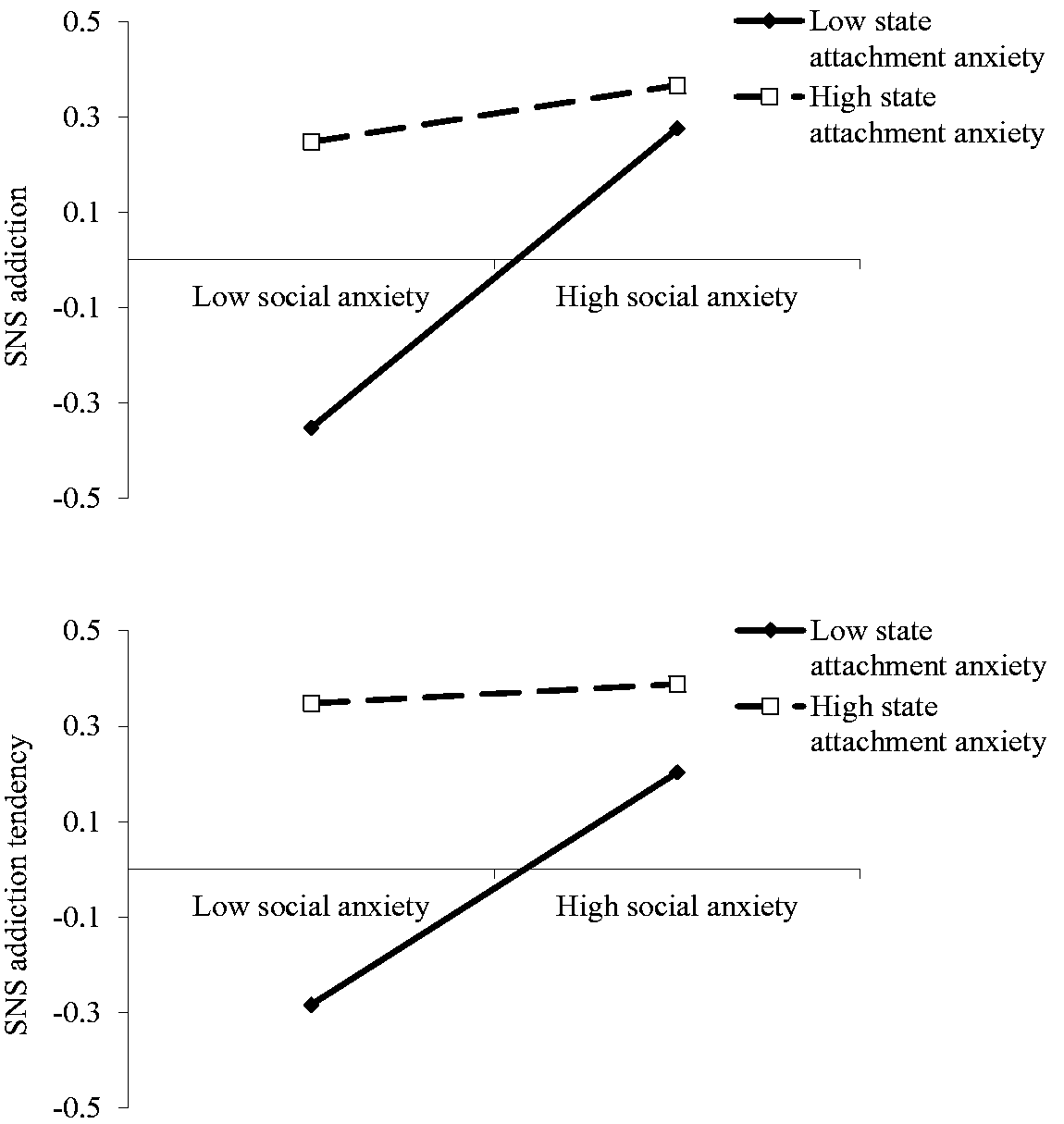
The standardized moderating pattern of state attachment anxiety. SNS: social networking sites.
Discussion
This study aims to explore the relationships between social anxiety and SNS addiction (tendency) as well as the moderating role of state attachment anxiety and state attachment avoidance. Compared with traditional research works investigating the relationships in a changeless perspective, this study is the first to place these relationships into a changing and fluctuating social context. Social anxiety has been found to be prospectively associated with SNS addiction and SNS addiction tendency, people use SNS to reduce their social anxiety. This study has also detected an important boundary condition of these relationships, which exist only among individuals with a low level of state attachment anxiety.
Socially anxious people tend to get into SNS addiction, this can be understood and interpreted by the connection desire (Allen, Ryan, Gray, Mcinerney, & Waters, 2014; Maslow, 1970). In real social situations, these people’s connection desire cannot be well satisfied because they always feel uncomfortable in face-to-face interactions and process social information in a biased way. For example, they may perceive normal social clues as threats and anticipate others’ evaluations and interpersonal feedbacks to be negative and rejective. Conversely, they can satisfy this desire in SNS where they can interact with others more comfortably. For them, SNS has been regarded as a more secure place (Erwin, Turk, Heimberg, Fresco, & Hantula, 2004). To escape from real social situations and gratify the connection desire, they spend much more time on SNS (Roberts, Smith, & Clare, 2000). Their risk of getting into addiction increases at the same time. However, they can hardly get what they have expected in SNS and fail to compensate for social inadequacies in real situations. For instance, people who want to satisfy this desire through SNS are more likely to experience negative outcomes (Caplan, 2007), such as lower self-esteem and more depression symptoms (Weidman et al., 2012). After all, SNS is a virtual social world where socially anxious people cannot benefit there because they always have to face the real social world.
This study also found a significant moderating effect of state attachment anxiety (but not avoidance) in the relationships between social anxiety and SNS addiction (tendency). Specifically, individuals experiencing low state attachment anxiety were associated with more SNS addiction and SNS addiction tendency when they exhibited high social anxiety. However, individuals experiencing high state attachment anxiety showed no reliable relationships between social anxiety and SNS addiction (tendency). For people with attachment anxiety, they seriously rely on others for the proximity and support (Mikulincer et al., 2003). In real social interactions, they may regulate emotion by suppressing their negative feelings and ignoring social threats they perceive. When their high state attachment anxiety is activated, the relationships between social anxiety and SNS addiction (tendency) may be suppressed as well, whereas in the case of low state attachment anxiety, these relationships are not affected and still pronounced. However, state attachment avoidance may not function as a moderating role in terms of these relationships. Individuals with state attachment avoidance think highly of their own power, ability, and independence (Mikulincer & Shaver, 2007). They usually rely on themselves but not others to regulate emotion, which may block the moderating effect of state attachment avoidance.
In addition, some findings need to be commented. Correlational analysis indicated a moderate correlation between social anxiety and state attachment avoidance. To some degree, it is in line with Eikenæs, Pedersen, and Wilberg’s (2016) study, which compared differences of attachment styles in patients with avoidant personality disorder and social phobia. Eikenæs et al. found that the two diagnostic groups did not differ in levels of attachment avoidance. Socially anxious people may exhibit the same level of attachment avoidance as those with an avoidant personality disorder. Similarly, the correlation between state attachment avoidance and SNS addiction was stronger than the correlation between state attachment anxiety and SNS addiction. Compared with attachment anxiety, one’s attachment avoidance may better predict SNS addiction such as Instagram addiction (Ershad & Aghajani, 2017). However, some researchers suggest that individuals who are both anxious and avoidant may use SNS more than those who are solely avoidant (Baek, Cho, & Kim, 2014). One’s attachment avoidance is correlated with SNS addiction only when they are also high in attachment anxiety. For these people, SNS can be a choice to obtain the interpersonal relatedness and social connectedness, but they do not need to actually engage in real social interactions (Nitzburg & Farber, 2013). This may help explain why people with high state attachment anxiety show a higher SNS addiction tendency.
Several limitations of this study should be noted. First, this study is cross-sectional in nature; therefore, it should be careful when interpreting the results in terms of the causality. Future researchers can conduct longitudinal and experimental designs (e.g., Lange, Allart, Keijsers, Rinck, & Becker, 2012) to achieve a more comprehensive understanding from a causal perspective. Second, some researchers argue that the anxiety subscale of SAAM cannot assess all features of the attachment anxiety. Its state attachment anxiety focuses more on one’s need to be close to others but neglects one’s fear of rejection (Mikulincer & Shaver, 2007). Future studies may adopt a better measurement of state attachment anxiety or directly conduct a priming experiment to manipulate it (Hudson & Fraley, 2018; Wilkinson, Heath, & Rowe, 2013). Finally, this study paid much attention to the relationships between social anxiety and SNS addiction (tendency) as well as individual differences, without considering the specific process of these relationships. This process may involve various social and psychological factors. For example, based on the framework of self-determination theory, it has been found that individuals experiencing need dissatisfaction or frustration hope to satisfy this need in SNS. As a result, they are more likely to be dependent and addicted to SNS (Wong, Yuen, & Li, 2015). It is possible that socially anxious people excessively use SNS aiming to meet their unsatisfied basic needs, such as the relatedness need. Namely, motivation to meet relatedness needs may mediate the positive relationships between social anxiety and SNS addiction (tendency).
The most pertinent implication for the findings of this study is that as one’s state attachment anxiety fluctuates across moments and situations, the relationships between social anxiety and SNS addiction (tendency) change as well. State attachment, a fluctuation of the attachment, has been proved to be independent of the dispositional trait attachment in Davila and Sargent’s (2003) study. They found that participants’ perceptions of interpersonal loss were positively associated with their day-to-day attachment insecurity, but the trait attachment did not moderate this relationship. State attachment can be conceptualized and represented as a cognitive-affective structure, which contains a network of memories, beliefs, and goals. These attachment representations are context dependent and can be automatically activated in response to the attachment-related social clues (Baldwin, Fehr, Keedian, Seidel, & Thompson, 1993). Therefore, future research works are encouraged to expand and enrich the field of state attachment and consider its potential dynamic influence on the relationship between one’s cognitive-affective system and behavioral system.