




Abstract
Awe is the emotion experienced when people confront stimuli so vast and novel that they require accommodation. Dispositional awe, in contrast, captures individual differences in the tendency to experience awe. Previous research has found that state awe could predict life satisfaction; however, no study has focused on the indirect effects of dispositional awe on the relationship between personality traits and subjective well-being. Previous studies have found that both openness to experience and extraversion were significant predictors of subjective well-being. Both openness to experience and awe involve cognitive flexibility. Awe can also arise from engaging in social events. Previous research has found that those who are higher in dispositional awe tend to be more extraverted and open to experience. Therefore, the main purpose of this study is to test the mediating role of dispositional awe among openness to experience, extraversion, and subjective well-being. To test this hypothesis, a total of 332 Chinese college students were invited to complete an anonymous survey using a cross-sectional design. The results of structural equation modeling showed that openness to experience and extraversion predicted higher levels of dispositional awe, while dispositional awe predicted higher levels of subjective well-being. Moreover, dispositional awe mediated the effects of openness to experience and extraversion on subjective well-being. The findings of this study suggest that openness to experience and extraversion may invite more experiences of awe and thus promote subjective well-being.
Introduction
Psychology research has traditionally focused on repairing mental illness and suffering. In contrast, positive psychology focuses on “what makes life most worth living” (Seligman, 1999, p. 562). Positive psychologists Seligman and Csikszentmihalyi (2000) suggest that the mission of positive psychology is to understand and improve the psychological factors that lead individuals, communities, and society to flourish. Positive emotions are one of the main topics in the study of positive psychology (Seligman, 2012; Seligman & Csikszentmihalyi, 2000; Seligman, Steen, Parl, & Peterson, 2005). The emotion of awe has an important influence on subjective well-being (Rudd, Vohs, & Aaker, 2012). In this study, we explore the possible mediating role of dispositional awe between personality traits and subjective well-being.
The definition of awe
Although awe is increasingly drawing interest among positive psychologists, it has only just recently begun to undergo empirical investigation (Chirico, Yaden, Riva, & Gaggioli, 2016), and it has become a “hot” topic in contemporary psychology (Schneider, 2017). Awe is defined as an emotion that is experienced when people confront stimuli so vast that their current knowledge structures cannot fully assimilate it (Keltner & Haidt, 2003; Shiota, Keltner, & Johns, 2006). Accordingly, vastness not only refers to the physical size but also to social size, such as fame and prestige. The other core characteristic is a need for accommodation, that is, the challenges faced by our mental schemas with this perceived vastness and the difficulty in assimilating the new experience into our mental structures (Keltner & Haidt, 2003; Razavi, Zhang, Hekiert, Yoo, & Hewell, 2016). The state awe is the momentary experiences of stimulus-focused, self-diminishing, and state need for cognitive accommodation (Shiota, Keltner, & Mossman, 2007). The dispositional awe is the experiences of awe so chronically that individuals become accustomed to the psychological consequences associated with the state awe and had a low need for cognitive closure (Valdesolo & Grahm, 2014).
Since the operational definition of awe given by Keltner and Haidt (2003), there has been an increasing number of studies about awe. Some studies explore the effect of awe on human cognitions (Griskevicius, Shiota, & Neufeld, 2010; Piff, Dietze, Feinberg, Stancato, & Keltner, 2015) and behaviors (Prade & Saroglou, 2016; Rudd et al., 2012) by triggering a momentary experience of awe in laboratory settings. State awe can be triggered by watching awe-inducing videos or images (Piff et al., 2015; Valdesolo, Park, & Gottlieb, 2016) or by recalling an event that induced a feeling of awe (Prade & Saroglou, 2016). The aim of other research, which regards awe as a dispositional variable, was to the type of people who experience awe more frequently and to identify the relationship between awe and other psychological variables such as Big Five personality and attachment style (Shiota, Keltner, & Johs, 2006). Dispositional awe means that some people are more prone to experience awe than others. Shiota et al. (2006) developed the Dispositional Positive Emotion Scales (DPES) in which one of the subscales measure dispositional awe. The other subscales measure joy, contentment, pride, love, compassion, and amusement. The dispositional awe scale of the DPES is most widely used in studies regarding dispositional awe (Razavi et al., 2016).
The relationship between awe and subjective well-being
The broaden-and-build theory of positive emotions suggests that, relative to negative emotions and neutral states, positive emotions can broaden people’s scope of attention, thinking, and actions and can build physical, intellectual, and social resources (Fredrickson, 1998, 2001). The cumulative experience of positive emotions during an individual’s life tends to lead to higher levels of ego resilience (Aspinwall, 1998; Folkman & Moskowitz, 2000; Fredrickson & Joiner, 2002). Because resilience is related to many important life outcomes such as better interpersonal and intrapersonal adjustment (Klohnen, 1996) and less depression after tragedy (Fredrickson, Tugade, Waugh, & Larkin, 2003), positive emotions tend to increase life satisfaction by building resilience (Cohn, Fredickson, Brown, & Mikels, 2009). Therefore, the function of positive emotions is to build an individual’s resources for survival and increase social bonds (Fredrickson, 2013).
However, an increasing number of studies suggest that positive emotions should be perceived as discrete (Lench, Flores, & Bench, 2011; Linley, Dovey, Beaumont, Wilkinson, & Hurling, 2016). A discrete emotion perspective suggests that not all positive emotions are the same (Lench et al., 2011). Based on emotion-specific thought-action tendencies and resources accrued (Fredrickson, 2003), each positive emotion is discrete in the sense that it has unique elicitors, action tendencies, processes, and cognitive and behavioral outcomes (Lench et al., 2011; Prade & Saroglou, 2016; Tong, 2015). Some empirical studies support that awe can also enhance the prosocial thoughts and behaviors better than other positive emotions. For example, inducing state awe tends to increase participants’ intentions of generosity and willingness to help people compared to the induction of amusement or a neutral condition (Prade & Saroglou, 2016). State awe also tends to expand people’s perception of time compared to happiness (Rudd et al., 2012). Therefore, there appears to be something unique about awe compared to other positive emotions.
The definition of subjective well-being by Diener and Lucas (1999) is people’s evaluation of their lives. The evaluation includes “both cognitive judgments of one’s life satisfaction in addition to affective evaluations of mood and emotions” (p. 213). According to Steel, Schmidt, and Shulz (2008) and Seligman (2011), positive affect and negative affect are usually considered to be aspects of subjective well-being; thus, it is necessary to distinguish awe and positive affect. The Positive and Negative Affect Schedule (PANAS; Watson, Clark, & Tellegen, 1988) is one of the most widely used measures of positive and negative affect (Forgeard, Jayawickreme, Kern, & Seligman, 2011). Positive affect reflects “the extent to which a person feels enthusiastic, active, and alert” (Watson et al., 1988, p. 1063). The PANAS assesses a number of different positive emotions such as pride and interest. Awe is not included as a measure of positive affect in the PANAS. Despite this, it is also important to compare awe with other affects such as amusement, contentment, interest, pride, love, and joy. The core relational themes, expressive displays, and physiological index are different among awe, amusement, contentment, interest, pride, love, and joy (see Campos, Shiota, Keltner, Gonzaga, & Goetz, 2013). The core relational themes of amusement, interest, and joy are “awareness of incongruity in a situation” and feeling “playful with others in the environment,” “attention absorbed by novelty” and “felt they could explore,” and improvement “in resources” and “increase in positive energy” separately. In contrast, the core relational themes of awe are “situation-challenged worldview” and “felt smallness relative to something greater than oneself.” For expressive displays, amusement, contentment, love, pride, and joy are associated with a smile, while smiling rarely appears in the posed displays of awe. Interest displays raised and contracted brows, lip presses, and head tilts; however, awe displays typically include parted lips, dropped jaw, raised inner eyebrows, and raised eyelids. For the potential biological pathway for the association between positive emotions and health, awe is the strongest predictor of lower levels of pro-inflammatory cytokines compared with the other six position affects (Stellar et al., 2015). Based on the above analysis, there is something unique about awe in comparison with other affects. Therefore, awe can be considered distinct from subjective well-being.
Awe can make people view themselves as part of something much greater than themselves (Bai et al., 2017; Piff et al., 2015; Shiota et al., 2007). Inducing state awe can expand the scope of an individual’s attention on a broader scale and cause people to pay less attention to themselves (Piff et al., 2015). This suggests that awe can be regarded as a self-transcendent emotion (Van Cappellen & Saroglou, 2012). According to extended-now theory (Vohs & Schmeichel, 2003), focusing on the present moment elongates time perception. Therefore, in the experience of awe, people feel that they have more time available and are less impatient. This leads to that people view their lives more positively and are more satisfied with their lives (Rudd et al., 2012). The extended subjective experience of time plays a mediating role between state awe and life satisfaction. Bussing et al. (2014) also find that state awe and gratitude can help people draw their attention away from disease to the more beautiful things in life. Krause and Hayward (2015) find that people who are in awe of God feel more intensely connected with others, and the connectedness with others mediates the relationship between awe of God and life satisfaction. Therefore, we can propose Hypothesis 1 (H1): Dispositional awe predicts higher levels of subjective well-being.
The association between openness to experience, extraversion, and awe
The previous research has largely focused on induced awe and its psychological effects such as time perception and life satisfaction (Krause & Hayward, 2015; Rudd et al., 2012). The relationship between awe and personality traits is also an important topic. However, previous studies have not come to agreement on the relationship between personality factors and awe (Pilgrim, Norris, & Hackathorn, 2017; Shiota et al., 2006; Silvia, Fayn, Nusbaum, & Beaty, 2015). Most studies supported that openness to experience linked to awe (Shiota et al., 2006; Silvia et al., 2015). However, Pilgrim et al. (2017) found that individuals high in openness to experience experienced awe only when they also preferred reflective and complex music (Pilgrim et al., 2017). Shiota et al. (2006) and Silvia et al. (2015) also found the opposite results on the relationship between extraversion and awe. Although the awe experience is thought to be universal, the extent to awe experiences may vary among individuals (Pilgrim et al., 2017). Some people experience awe more frequently than others. Personality differences may affect a person’s ability to experience awe more generally (Pilgrim et al., 2017), especially openness to experience and extraversion. Therefore, based on previous studies (Pilgrim et al., 2017; Shiota et al., 2006; Silvia et al., 2015), the current study continues to investigate the possible individual differences about openness to experience and extraversion.
Openness to experience and extraversion are two dimensions of the Big Five personality traits. Shiota et al. (2006) explore the relationship between the Big Five personality traits and positive emotion dispositions including dispositional awe. They find that the association between dispositional awe and other personality traits is not significant except for openness to experience and extraversion. Those who are high in openness tend to have a wide range of interests and tend to be creative and imaginative (McCrae & Costa, 1991). Furthermore, such individuals have an attitude or mind-set that is open to new ideas and opinions, and they tend to be curious about new things (Kaufman, 2013). In addition, people who score high in openness to experience are open to new experiences, aesthetically imaginative, and sensitive, and they appreciate beauty and the arts (Kaufman, 2013). Moreover, research has found that awe is negatively related to the need for cognitive closure (Shiota et al., 2007; Van Cappellen & Saroglou, 2012). It reflects cognitive flexibility and openness. Keltner and Haidt (2003) also suggested that the need for accommodation is a central feature of awe. When facing new challenges, people can adjust their mental schemas and reconstruct their psychological processes. Rudd et al. (2012) find that the state of awe can inspire people’s desire to acquire new knowledge; Shiota et al. (2006) similarly determine that dispositional awe has medium to high positive correlations with openness to experience. Individuals who are more open to experience are more curious about things. These individuals are likely to broaden their schemas and search for stimuli and changes. Thus, they have a greater potential to experience awe. Silvia et al. (2015) also support this opinion. They find that openness to experience can predict a tendency to experience state awe when people watch pictures of nature. Based on the above analysis, we propose Hypothesis 2 (H2): Openness to experience predicts higher levels of dispositional awe.
Extraversion is defined as “representing the quantity and intensity of interpersonal interaction, the need for stimulation and the capacity for joy” (Piedmont, 1998, p. 86). Individuals who are high in extraversion are more active and are better at expressing themselves in social interactions (Watson & Clark, 1997). Extraverts are talkative, cheerful, and optimistic, and enjoy change and excitement in their lives (Watson & Clark, 1997). According to Watson and Clark (1997), early concepts of extraversion identified by Guilford, Zimmerman, and Guilford (1976), Eysenck and Eysenck (1975), and Cattell, Eber, and Tatsuoka (1980) strongly emphasize the social/interpersonal aspects of the dimension. Contemporary concepts of extraversion increasingly focus on the positive emotional aspects along with the social/interpersonal aspects (Watson & Clark, 1997). Extraversion from Costa and McCrae (1992) is composed of six primary facets, including warmth, gregariousness, assertiveness, activity, excitement seeking, and positive emotions. Although most items on extraversion scales asked about social activities and dominance, the scales measuring positive emotions loaded on the same factor (McCrae & Costa, 1991). Watson and Clark (1997) suggest that extraversion should be relabeled as positive emotionality from the broad dimension. Although positive emotional experience plays an important role in extraversion, McCrae and Costa (1987) still keep lively sociability (the enjoyment of others’ company) in the core of the dimension. Besides, extraversion and subjective well-being are commonly treated as different constructs by researchers (e.g., Furnham & Cheng, 1997; Steel et al., 2008). Therefore, extraversion and positive emotions are separate constructs.
The behavioral activation system (BAS) and the behavioral inhibition system are two proposed systems that guide our behavior (Gray, 1982; Van & Abrams, 2017). The BAS is sensitive to the signals of reward (Carver & White, 1994), which is considered to be responsible for the experience of positive emotions (Carver & White, 1994; Gray, 1994). Reward orientation or responses to opportunities in the environment may be a common feature in extraversion, and they may be directly related to positive emotions (Carver & White, 1994; Fredrickson, 1998; Watson & Clark, 1997). Studies have found that extraversion can have a positive relationship with an individual’s global positive emotions and experiences (Costa & McCrae, 1980; Gross, Sutton, & Ketelaar, 1998; Prade & Saroglou, 2016; Shiota et al., 2006; Watson & Clark, 1997; Wilson & Gullone, 1999). Awe, amusement, contentment, gratitude, interest, joy, love, and pride are all positive emotions (Campos et al., 2013). Although awe is a more distal emotion than joy and pride, which are considered concrete rewards, we still contend that extraversion has a positive relationship with awe based on the shared underlying components of BAS. For example, Razavi et al. (2016) find that people in the United States report higher scores on dispositional awe than people in Iran. They hypothesize that higher levels of extraversion among American versus Iranians may explain this difference. In addition, Prade and Saroglou (2016) find that state awe can enhance an individual’s prosocial nature and connection with society. Individuals who experience awe of God are more likely to feel connected with others, which leads to individuals who feel more satisfied with their lives (Krause & Hayward, 2015).
Some empirical studies have explored the relationship between extraversion and awe. However, the results of Shiota et al. (2006) and Silvia et al. (2015) are inconsistent. Shiota et al. (2006) find that dispositional awe has low to medium positive correlations with extraversion. Conversely, Silvia et al. (2015) do not find evidence that extraversion predicts state awe. One reason for this discrepancy may be the different definitions of awe in their studies. Dispositional and state awe have different impacts on individuals’ life (Shiota et al., 2007; Valdesolo & Grahm, 2014). For example, state awe elicits feelings of certainty and control and increases the intolerance for uncertainty (Valdesolo & Grahm, 2014), while dispositional awe is associated with a greater tolerance for uncertainty (Shiota et al., 2007) because individuals become accustomed to the psychological consequences associated with the state awe (Valdesolo & Grahm, 2014). As for the results of the relationship between extraversion and awe, Shiota et al. (2006) measure dispositional awe as an individual trait. However, state awe measured by Silvia et al. (2015) is induced by pictures of nature and music. Awe is described as a stimulus-oriented emotion that can be elicited by physical elicitors (such as music or a tornado), cognitive elicitors (such as a grand theory), or social elicitors (such as someone’s achievement or a powerful leader) (Keltner & Haidt, 2003). Because openness to experience is associated with aesthetic experiences and appreciations (Conner & Silvia, 2015), it is reasonable to examine the relationship between openness to experience and state awe through the physical elicitors of nature and music. However, social elicitors, such as one’s achievement or social events, can also trigger state awe; state awe can also arise from the perceived moral virtue of others, notably others’ benevolence toward third parties (Horberg, Oveis, & Keltner, 2011; Keltner & Haidt, 2003), and a charismatic leader’s moving speech also inspires state awe (Razavi et al., 2016).
Recently, Bai et al. (2017) find that interpersonal events and nature are the most common elicitors in people’s daily lives both in China and America. More specifically, state awe is experienced more frequently by socially engaging events in collectivistic cultures. However, state awe is experienced more frequently with respect to personal events in individualistic cultures. Bai et al. find that Chinese people experience awe more frequently in response to another person (e.g., a friend who excels on an exam). However, Bai et al. find that Americans experience awe more frequently in response to themselves (e.g., doing better on an exam than expected). Moreover, Bai et al. find that awe strengthens the closeness of social ties more strongly in Chinese people than American people. Bai et al. also argue that there is methodological bias such that most of the published research on state awe uses nature as an elicitor. Thus, to study the relationship between extraversion and awe, it may be more suitable to use social elicitors, as extraverts may experience awe more frequently when communicating with others during social events because they have greater opportunities to encounter moral paragons or learn about others’ achievements, especially in collectivistic cultures such as China. Because lively sociability is the core of extraversion McCrae and Costa (1987), extraverts are more active in socially engaging events than introverts. Hence, during this process, they extraverts experience awe more frequently than introverts. Based on this analysis, we propose Hypothesis 3 (H3): Extraversion predicts higher levels of dispositional awe.
Awe as a potential mechanism
Personality traits are one of the most important factors that affect subjective well-being, even more important than the impact of the environment (Steel et al., 2008). Based on a meta-analysis, Steel et al. find that extraversion measured by the Neuroticism-Extroversion-Openness (NEO) Inventory is a significant predictor of positive affect, happiness, overall affect, life satisfaction, negative affect, and quality of life. Openness to experience measured by the NEO is a significant predictor of happiness, positive affect, and quality of life. Other empirical research also finds that openness to experience and extraversion may be possible predictors of subjective well-being (Chen & Li, 2014; Furnham & Cheng, 1997). The survey of 3192 subjects of different age groups by the Chinese researchers Chen and Li (2014) shows that there is a significant correlation between the Big Five personality traits and subjective well-being. Openness to experience is found to be a significant predictor of subjective well-being across different age groups. The association between extraversion and subjective well-being is found across most groups in China, except for the age-group from 50 to 59.
Previous studies have examined some possible mediators among openness to experience, extraversion, and subjective well-being, such as social support and interpersonal trust (J. R. Zhang, Sun, & Yang, 2010), emotional regulation (Gross & John, 2003; Z. Q. Li, Wang, Zhang, & Liu, 2010), and coping style (J. Li, Yao, & Liu, 2014). However, no study has considered awe as a possible mediator among openness to experience, extraversion, and subjective well-being. Based on H2, we assume that individuals with higher levels of openness to experience may experience awe more frequently because the two traits involve cognitive flexibility. According to H3, we assume that individuals with higher levels of extraversion may experience awe more frequently because the two traits are associated with the BAS. Furthermore, based on H1, dispositional awe can positively affect subjective well-being. One potential causal pathway is that those who exhibit higher levels of openness to experience and extraversion are more likely to experience awe, which will improve their level of subjective well-being in the future. Whereas most studies regard awe as a state experience, it is an innovative perspective from which to explore the mediating role of awe as a trait among openness to experience, extraversion, and subjective well-being. Therefore, considering the relationships among openness to experience, extraversion, dispositional awe, and subjective well-being, as well as the age of the sample in the current study, we propose Hypothesis 4 (H4) and Hypothesis 5 (H5): Dispositional awe plays a mediating role between openness to experience and subjective well-being and Dispositional awe plays a mediating role between extraversion and subjective well-being.
The main purpose of this study is to explore the possible relationships among openness to experience, extraversion, and subjective well-being using dispositional awe as a mediator. Dispositional awe may play a mediating role between personality factors and subjective well-being. In addition, although there has been some progress on the topic of awe, most of the research has focused on Western cultures. Accordingly, an additional purpose of this study is to expand the focus of the research on awe in Chinese culture.
Method
Participants
A convenience sample of 332 undergraduate and graduate students (91 males and 241 females) was recruited from psychology courses at the Zhejiang University of Finance and Economics, Zhejiang, China. The mean age of the sample was 21.68 years (standard deviation (SD) = 1.61). Their majors included human resource management, marketing, law, economics, and English. Voluntary consent forms were provided to all of the participants to complete. The study was approved by the Ethics Committee of the Graduate School at Shenzhen at Tsinghua University.
Measurements
Dispositional awe
We used the dispositional awe subscale obtained from the DPES developed by Shiota et al. (2006). It is a seven-point Likert-type scale that includes six items (e.g., “I feel wonder almost every day;” 1 = strongly disagree, 7 = strongly agree). A blind translation/back-translation method was used (Sahin, Iyigun, & Acikel, 2015). The questionnaire was independently translated into Chinese by the two authors and one psychology postgraduate student. Then, the translations were combined and prepared as a single text before being back-translated into English by a bilingual Chinese scholar who has earned a master’s degree and is working on her PhD in psychology in the United States. Last, the translations were corrected by the first and second authors together. In this research, the Cronbach’s alpha for all items was .73.
Openness to experience and extraversion
The measurements regarding openness to experience (O) and extraversion (E) were derived from the 60-item NEO Five-Factor Inventory (NEO-FFI, Costa & McCrae, 1985, 1992). Liu (2012) translated the Chinese version and found that the validity and reliability were acceptable. The openness to experience and extraversion subscales each included 12 items (e.g., “I’m curious about a lot of things” for the openness dimension; “I really enjoy talking to people” for the extraversion dimension) and were measured using a five-point Likert-type response format (1 = strongly disagree, 5 = strongly agree). In the present research, the Cronbach’s alpha was .67 for all items on the openness to experience subscale and .76 for all items on the extraversion subscale.
Subjective well-being
The Index of Well-Being Scale developed by Campbell, Converse, and Rodgers (1976) was used to measure people’s feelings about life during the past month. The seven-point scale included nine items and was divided into two components. The first component was the general affect index about life that included eight semantic differential items (e.g., “boring-interesting,” “empty-full,” “disappointing-rewarding”). The second component was the single-item measure of overall life satisfaction (e.g., “satisfactory-unsatisfactory;” 1 = complete dissatisfaction, 7 = complete satisfaction; Robinson, Shaver, & Wrightsman, 1991). The scale is psychometrically sound for application to Chinese college students (J. Li & Zhao, 2000). In the present research, Cronbach’s alpha for all items was .81.
Procedures and data analysis
The participants completed the questionnaires during class. Voluntary consent forms were provided to all participants to complete. The participants then responded to the dispositional awe, openness to experience, extraversion, and subjective well-being measures. The demographic information was collected at the end of the survey. Mplus7.4 (Muthén & Muthén, 1998; 2013;2015) was used for data analysis.
Results
Confirmatory factor analysis for construct discrimination
Confirmatory factor analysis (CFA) using structural equation modeling (SEM) was conducted to discriminate the four constructs. 1 To quantify item quality, the items whose factor loadings were below .40 were deleted (Ford, MacCallum, & Tait, 1986). In this study, one item (“I often feel awe”) in the awe scale was deleted. Robust Cronbach’s alpha was .80 after deleting that item (Z. Y. Zhang & Yuan, 2016). 2 Robust McDonald’s omega was .80 (McDonald, 1970; Z. Y. Zhang & Yuan, 2016). In this study, five reversed coded items (e.g., “It is difficult for me to imagine freely”) in openness to experiences subscale and four reversed coded items (e.g., “I usually avoid situations where there are many people”) in extraversion subscale were deleted. 3 Then, two items (e.g. “I like to waste my time daydreaming”) in openness to experiences subscale and four items (e.g., “My life is very fast”) in extraversion subscale were deleted because of their low factor loadings. There remained five items in the openness to experience subscale and four items in the extraversion subscale. Robust Cronbach’s alpha was .67 in the openness to experience subscale 4 and .77 in the extraversion subscale after deleting these items. Robust McDonald’s omega was .68 in the openness to experience subscale and .78 in the extraversion subscale. One item (“painful-happy”) in the Index of Well-Being Scale was deleted. Robust Cronbach’s alpha was .93 after deleting one item. Robust McDonald’s omega was .93.
After deleting the low loading of items and negative items, the measurement model of the four constructs provided acceptable fits, χ2 = 353.69, df = 203, χ2/df = 1.74, p < .001, root mean square error of approximation (RMSEA) = .05, confirmatory factor index (CFI) = .92, SRMR = .05 (Hinkin, 1995; Hu & Bentler, 1999; Yuan & Bentler, 2000).
Common method bias analysis
Because of the potential problem of common method bias, we used procedural techniques such as anonymity and reverse-scored methods for control as well as statistical techniques. We controlled the unmeasured latent method construct and compared the fit indices of five-, four-, three-, two-, and one-factor models (Podsakoff, MacKenzie, Lee, & Podsakoff, 2003). After controlling for the unmeasured latent method factor (i.e., all of the items were loaded on another latent variable representing common method bias), the fits of five factor models were not acceptable (see Table 1). This indicated that there was not a substantial amount of common method variance in this research. The four-factor model showed the best fit relative to the three-factor, two-factor, and one-factor models. Therefore, we retained the four-factor model.
The results of confirmatory factor analysis.

Note: Three-factor model (awe, openness + extraversion, well-being) is tested in order to discriminate the two constructs of openness to experience and extraversion because both constructs are personality dimensions. Three-factor model (awe + well-being, openness, extraversion) is tested to discriminate awe from subjective well-being as awe can be considered a positive emotion and positive affect is an aspect of subjective well-being. Three-factor model (awe, openness, well-being + extraversion) is tested to discriminate extraversion from well-being as positive emotionality sometimes loads onto the factor of extraversion. Two-factor model (awe + well-being, openness + extraversion) is tested to discriminate openness from extraversion as both are personality dimensions, and to discriminate awe from well-being as awe can be considered a positive emotion and positive affect is an aspect of subjective well-being. Two-factor model (awe + extraversion + well-being, openness) is tested to discriminate between awe, extraversion, and well-being as positive emotionality sometimes loads onto the factor of extraversion, awe can be considered a positive emotion, and positive affect is an aspect of subjective well-being. One-factor model is tested to examine whether all the constructs belong on one individual trait construct. The latent variables are scaled by setting the factor loading of one of the items for each latent variable to 1 and the intercept of one of the items for each latent variable to 0. CMV: common methods variance; CFI: confirmatory factor index; RMSEA: root mean square error of approximation; SRMR: Standardized Root Mean Square Residual.
Mediation analysis
The means, SDs, and zero-order correlations for the observed variables 5 can be seen in Table 2.
Means, SDs, and zero-order correlations.
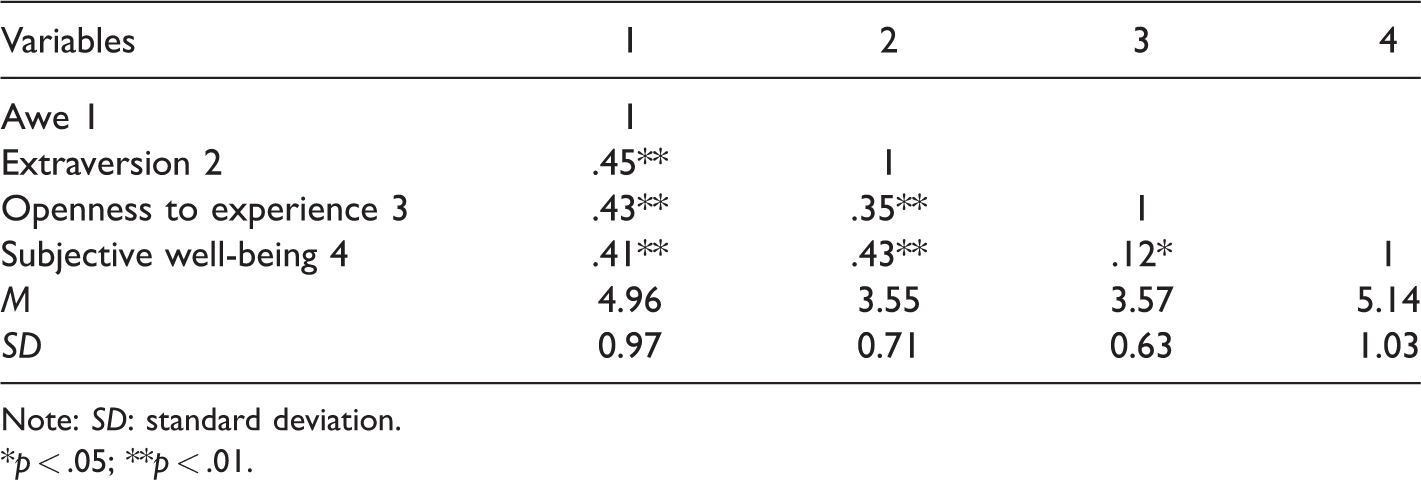
Note: SD: standard deviation.
*p < .05; **p < .01.
We analyze the mediation models separately for openness to experience and extraversion. The mediation model for openness to experience provides acceptable fit, χ2 = 262.41, df = 132, χ2/df = 1.99, p < .001; RMSEA = .06; CFI = .92; SRMR = .05. Openness to experience predicts higher levels of dispositional awe, b = .59, standard error (SE) = .08, p < .001. Dispositional awe predicts higher levels of subjective well-being when openness to experience is controlled for, b = .54, SE = .11, p < .001. The direct effect 6 of openness to experience on subjective well-being is not significant when controlling for dispositional awe, b = −.16, SE = .11, p = .15 (see Figure 1).

Model of openness to experience, awe, and subjective well-being. ***p < .001. See Appendix for more details.
The mediation model for extraversion provides acceptable fit, χ2 = 232.91, df = 116, χ2/df = 2.01, p < .001; RMSEA = .06; CFI = .93; SRMR = .05. Extraversion predicts higher levels of dispositional awe, b = .55, SE = .08, p < .001. Dispositional awe predicts higher levels of subjective well-being when extraversion is controlled for, b = .25, SE = .09, p = .01. The direct effect of extraversion on subjective well-being is significant when controlling for dispositional awe, b = .35, SE = .09, p < .001 (see Figure 2).

Model of extraversion, awe, and subjective well-being. **p < .01; ***p < .001. See Appendix for more details.
Discussion
The mediating role of awe
Awe is a positive emotion that has a beneficial effect on people’s cognitions and behaviors (Griskevicius et al., 2010; Rudd et al., 2012). As such, awe may increase an individual’s prosocial behavior, protect an individual’s immunity system against chronic and cardiovascular disease, cause an individual to experience more happiness, and incite an individual to invest more in their spiritual life (Krause & Hayward, 2015; Piff et al., 2015; Rudd et al., 2012; Stellar et al., 2015; Van Cappellen, Toth-Gauthier, Saroglou, & Fredrickson, 2016). The results of this study indicate that dispositional awe predicts one’s subjective well-being. These results are consistent with previous findings whereby state awe can increase life satisfaction (Rudd et al., 2012). This study further supports the positive psychological benefit of awe. Awe may allow a person to experience more pleasant and emotionally moving events in life and to more frequently experience the beauty of life. Another possible reason for the psychological benefit of awe may be that those who are high in dispositional awe may experience the same events as those who are low in dispositional awe but react to them differently. Facing a vast event or challenge, those who are high in dispositional awe may be more likely to accommodate the new experience and change their mental structures. The feelings of smallness and transcendence could be experienced before, during, or after this process. Varieties of self-transcendent experience, including self-transcendent positive emotions such as awe, are often associated with subjective well-being (Yaden, Haidt, Hood, Vago, & Newberg, 2017). Thus, it is concluded that experiences of awe are important for people’s quality of life.
Who is more likely to experience awe? Shiota et al. (2006) find that the association between openness to experience and dispositional awe is significant. Silvia et al. (2015) find that openness to experience can predict the degree of state awe with respect to natural images and music. The results of this study indicate that openness to experience predicts dispositional awe, and they support the conclusions of previous studies regarding the relationship between openness to experience and dispositional awe. It is further suggested that awe is more likely to be experienced by individuals whose knowledge structures are less fixed given that one core characteristic of awe is the need for accommodation. Open individuals have a preference for variety and are intellectually curious (Costa & McCrae, 1992). They are likely to broaden their schemas to search for new stimuli and change. During the process, an open person may be more likely to experience awe (Shiota et al., 2006). In Shiota et al.’s (2006) study, extraversion has low to medium positive correlations with dispositional awe measured by the dispositional awe subscale obtained from the DPES. In Silvia et al.’s (2015) study, extraversion is not found to predict state awe responses to nature and music. In the current study, we find that extraversion can predict the higher levels of dispositional awe. The reason may be found in the elicitors of awe and the measurement of awe. In Silvia’s study, they did not find the evidence that extraversion predicts state awe. However, in Silvia et al.’s (2015) study, state awe is triggered by physical elicitors, not by social elicitors, such as natural images and music. Silvia et al. mainly measure state awe in two ways. One is to obtain the physiological responses to some special situations such as chills or goose bumps, while another is to directly obtain self-reported emotional responses to awe. This discrepancy may be the result of the employed methodology, especially from the types of elicitors. Bai et al. (2017) find that awe is more frequently caused by socially engaging events in China than in the United States. Thus, it is suggested that to explore the relationship between extraversion and awe, social elicitors may be especially relevant, at least in China. Bai et al. has shown that awe increases during collective engagement and promotes integration into social groups. Thus, extraverts may be more likely to experience awe in their social lives. Accordingly, it is necessary for future research to explore the relationship between extraversion and awe by considering different sources of inducement and various measurement methods.
Based on the previous studies, this study discusses the relationship among openness to experience, extraversion, dispositional awe, and subjective well-being. The data reveal that variations in openness to experience and extraversion predict the variations in dispositional awe, which in turn predict the variations in subjective well-being. People who report greater openness to experience and extraversion are more likely to experience awe in life. Dispositional awe, in turn, predicts greater subjective well-being. These results support the hypothesis that dispositional awe plays a mediating role among openness to experience, extraversion, and subjective well-being.
Cultural variations in the expression of awe
Most of the studies of awe have been conducted in Western contexts. Few studies have focused on non-Western cultures. Razavi et al. (2016) first validate the factor structure of 16 items from DPES intended to measure awe, amusement, and pride in four countries, including the United States, Iran, Malaysia, and Poland. Razavi et al. (2016) find that the item “I seek out experiences that challenge my understanding of the world” does not have significant loading for the Iranian and Polish samples. Nevertheless, they find that the scales of awe, amusement, and pride, as three unique emotions are structural invariant (including factor loadings, variance, and covariance) across all countries after excluding the problematic item. In addition, they also find that the mean score of dispositional awe in the United States is higher than in Iran. However, the Chinese culture is not included in these cross-cultural studies.
Bai et al. (2017) find that the elicitors of awe differ in collectivistic and individualistic cultures. In the present study, the results of CFA reveal that the item “I often feel awe” does not demonstrate good loading for the current Chinese sample. Although the experience of awe is not limited to Western cultures, there may be differences about the expression of awe between Chinese people and Western people. In the extant research, only one item of the dispositional awe subscale explicitly mentions “awe.” The concept of awe may be more abstract for the Chinese than for Westerners. Awe can have a positive and/or a negative valence depending on how the individual appraises his or her experience (Chirico et al., 2016; Keltner & Haidt, 2003). Chirico et al. (2016) claim that the existing research focuses on positive rather than on negative awe experiences. However, the term “awe” in Chinese means both “respect” and “fear” simultaneously. In Chinese, the word “awe” is written as “敬畏,” which is a compound word in modern language. A statement regarding awe emphasizes “fear” more often in the Chinese culture than it does respect, such as “Fear of Heaven’s decree, fear of great men, and fear of sage’s words” (畏天命, 畏大人, 畏圣人之言), in The Analects of Confucius. Schneider (2017) emphasizes in his qualitative study that awe is perceived as a mixed feeling that incorporates thrill, anxiety, humility, and wonder. All of the items on the dispositional awe scale describe a specific feeling about awe except for one item. It is necessary to develop a Chinese version of the dispositional awe scale that involves more negative aspects of awe. The indirect effect of awe may remain significant but decrease. Further research should more carefully compare the measurements and characteristics of awe between the Chinese and the Western contexts, particularly with respect to the negative valence of awe.
Limitations and future direction
There are some limitations in the present study. First, the sample is limited to one university. It is also limited to a single cultural context and a fairly young age-group of university students. Whether these results will generalize to other cultures in the broader community is unknown. Future studies should expand the range of sampling, such as working adult samples and middle age and older adult samples. Second, because the hypotheses in the current study are inferred from the shared underlying components of cognitive flexibility between openness to experience and awe, and another possible mechanism of BAS between extraversion and awe, other pathways, such as awe increasing openness to experience/extraversion or even bidirectional relationships, are possible. Besides, the data were collected at the same time and from a single source. We are unable to confirm the causal relationship between and among variables. Because the data come from a common rater, common scale formats, and measurement context (Podsakoff et al., 2003), future studies could strive to design longitudinal research to provide stronger evidence for a causal direction and use different response formats, media, locations, raters, and measurement times. Third, although the correlation between extraversion and openness to experience is relatively high when compared to what was found in Steel et al.’s (2008) meta-analysis, it is similar in magnitude to what has been found in other studies with this age-group in China (e.g., X. N. Zhang, 2012). Fourth, the current study did not control for other dispositional positive emotions. Thus, it is not clear whether the tendency to experience awe has a unique role in the relationship between extraversion and/or openness and subjective well-being or whether it is caused by the tendency to experience positive emotions in general. Finally, although the dispositional awe scale (Shiota et al., 2006) is most widely used in studies regarding dispositional awe (Razavi et al., 2016), the items do not take into account social and cognitive components of awe in an explicit way in the scale. Further, since the item 5 mentions nature, the rest of the items could be anchored to it (regarding beauty, wonder, etc.) and therefore be though as disposition to experience beauty, wonder, and patterns in the nature—which also could explain some effects on well-being being due to restoration experiences in nature. Future studies should include more than one item mentioned other generally social and cognitive elements of awe such as the great leader and the grand theory because awe also can be elicited by social elicitors and cognitive elicitors (Piff et al., 2015; Pizarro et al., 2018).
Conclusion
Awe is a transcendent and profound emotion. State awe has a potential positive impact on an individual’s level of satisfaction with life (Rudd et al., 2012). Considering the different impacts on individuals’ life between dispositional and state awe, we test the positive influence of dispositional awe on individuals’ subjective well-being in the current study. Our study finds that dispositional awe also affects individuals’ subjective well-being. The people who are open and extroverted are more likely to experience awe frequently in their daily lives. Therefore, dispositional awe plays an important mediation role among openness to experience, extraversion, and subjective well-being.
Appendix
Retained items from the awe scale
A2: I see beauty all around me.
A3: I feel wonder almost every day.
A4: I often look for patterns in the objects around me.
A5: I have many opportunities to see the beauty of nature.
A6: I seek out experiences that challenge my understanding of the world.
Retained items from the openness to experience scale
O1: I love to immerse myself in fantasies and to explore all things that is possible.
O2: I like to cultivate and develop new hobbies.
O3: I am fascinated by the beauty of nature and art.
O4: When I read a poem or enjoy a piece of art, I sometimes feel very excited.
O5: I am curious about a lot of things.
Retained items from the extraversion scale
Ex1: I like to have a lot of friends around me.
Ex2: I often feel energetic.
Ex3: I am an outgoing person
Ex4: I am an active person.
Retained items from the subjective well-being scale
S1: Boring—interesting
S3: Useless—valuable
S4: Lonely—animated
S5: Empty—full
S6: Hopeless—hopeful
S7: Disappointing—rewarding
S8: Life has not given me any chance—life is too good for me
S9: Satisfactory—unsatisfactory