




Abstract
Objectification at work reflects instrumentality and denial of humanness in work relationships. These relationships have deleterious consequences for workplace health. One of the consequences of this type of relationship is self-objectification in which the self is perceived as a non-person or as an object. This phenomenon leads to perceiving oneself without mental states (i.e., dementalization) or as an instrument (i.e., instrumentalization) and as a nonperson (i.e., loss of humanness). However, few studies have considered how to reduce these consequences. In this study, we examine the protective role of meaning at work against the consequences of objectification. A total of 153 employees answered an online questionnaire which measured objectification, meaning of work, mentalization, and instrumentality/humanness. The results highlight an impact of objectification on instrumentality and humanness but not on mentalization as in previous studies. There is also a moderation effect of the meaning of work on the relationship between objectification and humanness. These results lead us to consider instrumentality, humanness, and dementalization as separate constructs accounting for self-objectification.
Introduction
Objectification is a form of dehumanization which occurs in a variety of contexts including in the workplace (Haslam, 2006; Nussbaum, 1995; Volpato & Andrighetto, 2015). Objectification is composed by different facets. First objectification refers to the view of a person as deprived of humanity, that is, passive, without autonomy or subjectivity (Nussbaum, 1995). Second objectification also expresses relationships at work based on perception of the person as a thing, that is, something that can be used, regarded as interchangeable and a possession of the organization. Finally, objectification expresses relationships between people where they are perceived solely from the point of view of their appearance, their body, and as an object, as something of a silencer without the ability to express themselves (Langton, 2011).
One of the consequences of objectification is self-objectification. Self-objectification is thought to take place through dementalization, that is to say, a perception of the self as being incapable of feeling or thinking about work, an instrumentalization, that is to say a perception of oneself as a tool or an instrument, and loss of humanness, that is to say a perception of oneself as a nonperson. In this case, the person internalizes the views of others by considering themselves as an object, and incidentally, by seeing herself/himself as deprived of humanity. This phenomenon occurs in the workplace (Baldissari, Andrighetto & Volpato, 2014) or more generally when considering the relations between men and women (Fredrickson & Roberts, 1997; Wollast, Puvia, Bernard, Tevichapong, & Klein, 2018).
Most of the studies on objectification are concerned with either the possible origins of the phenomenon or the consequences of the phenomenon (Auzoult & Personnaz, 2016). Most of the time, the consequences are perceived as negative. This type of relationship is thought to partly account for bullying (Gervais, Wiener, Allen, Farnum, & Kimble, 2016) and lead to occupational burnout (Baldissari et al., 2014; Caesens, Stinglhamber, Demoulin, & De Wilde, 2017). At the same time, few studies have focused on the regulation of the process for moderating these negative effects. Specifically, we are interested in the protective role of the meaning of work. Many studies highlight the fact that that building meaning in the workplace would protect health. In this study, we postulate that the meaning of work could halt the process leading from objectification to self-objectification at work. Before presenting our hypotheses, we return to the explanation of the phenomenon of objectification and its consequences for health at work.
The origins of objectification
Three types of explanations have been advanced to account for objectification at work. Objectification is thought to be a mechanism that reduces complexity and coping with uncertainty. From this point of view, objectification would be a means of facilitating social interactions (Landau, Sullivan, Keefer, Rothschild, & Osman, 2012). This type of explanation is put forward in the medical field where objectification is conceived as a consequence of the context (anonymity, reduction to disease) and as a defense mechanism which is established when faced with the difficulty of delivering care (Haque & Waytz, 2012; Timmermans & Almeling, 2009).
In addition, management of the subject is underpinned by a view of the employee as a resource, that is, an object for the organization (Cheney & Carroll, 1997, Rochford, Jack, Boyatzis, & French, 2016, Shields & Grant, 2010). This leads to a second explanation that objectification is associated with the exercise of power (Gruenfeld, Inesi, Magee & Galinski, 2008). Formal power, in particular, which is based on strict respect for authority and rationality of procedures, is associated with self-objectification (Auzoult & Personnaz, 2016).
A third explanation puts forward the idea that objectification is a corollary of the industrial organization of work activity (Durkheim, 1893; Fromm, 1956; Marx, 1944). Objectification takes place when activity is repetitive, fragmented, and under an external source of control (Andrighetto, Baldissarri, Gabbiadini, Sacino, Valtorta, & Volpato, 2018; Andrighetto, Baldissari, & Volpato, 2017; Baldissari, Andrighetto, & Volpato, 2017). This process occurs as much when it comes to observing others as to observing oneself (Baldissari, Andrighetto, Gabbiadini, & Volpato, 2017).
Consequences for occupational health and the prevention from objectification process
In the workplace, objectification is associated with several negative health consequences. Studies in this field highlight the fact that objectification is associated with “cognitive deconstructive” states (Bastian & Haslam, 2011; Christoff, 2014) which translates into feeling numb and lethargic. Objectification is also associated with an increased risk of occupational burnout (Baldissari et al., 2014; Caesens et al., 2017; Szymanski & Mikorski, 2016) and sexual harassment (Gervais et al., 2016; Wiener, Gervais, Allen, & Marquez, 2013). Similarly, objectification is associated with a loss of perceived human traits such as warmth, competence, morality, and uniqueness for those who are considered as objects (Loughnan, Baldissarri, Spaccatini, & Elder, 2017) and a decrease of job satisfaction (Szymanski & Feltman, 2015). Finally, objectification leads to dementalization, that is, a feeling of having lost the ability to think or feel emotions (Auzoult & Personnaz, 2016; Baldissari et al., 2014).
Even though working relationships can be partly modified and certain activities are limited, it seems difficult to eliminate objectification at its source (Budesheim, 2014). At the same time, it is the transition from objectification to consequences for health which appears to be harmful. Auzoult and Personnaz (2016) have demonstrated that the relationship between objectification and mentalization is moderated by the level of private self-consciousness, that is, the level of self-focus attention. For employees, the fact of being objectified leads to dementalization if their level of private self-consciousness is low or average. This result confirms the protective effect of self-focus attention for health at work (Andela, Auzoult, & Truchot, 2014; Ghorbani, Cunningham, & Watson, 2010; Mullen & Suls, 1982; Suls & Fletcher, 1985). This study also highlights the fact that objectification decreases when organizational culture is based on flexibility, participation, and cooperation (Auzoult & Personnaz, 2016).
Meaning at work
May, Gilson, and Harter (2004) define the meaning of work as “the value of the goals and objectives of work in relation to the standards and ideals of the person who works” (p. 4). The meaning is therefore based on the match of work objectives with personal life goals, that is, justification of the meaning and on the degree of meaning that is associated with work activities, that is, level of meaning or loss of meaning (i.e., meaningfulness).
Rosso, Dekas, and Wrzesniewski (2010) distinguish four types of sources of meaning in the workplace: the self, other people, the work context, and spiritual life. Values, individual beliefs, and more generally the concept of self can contribute to the perception of meaning at work. The origins of the meaning of work can be found in the activity or in labor relations (Chalofsky, 2003; Dimitrov, 2012; Kahn, 1990). Work is thought to make sense when it allows the development of personal potentialities and the foundation of satisfactory interpersonal relationships. Job characteristics and organizational goals also determine the meaning of work. Finally, the meaning of work is constructed more broadly in relation to what gives meaning to life for the person.
The possibility of enhancing the meaning of work has several consequences for work and health (Schnell, Höge, & Pollet, 2013). The level of meaning of work is positively associated with performance (Hackman & Oldham, 1980; Wrzesniewski & Dutton, 2001) and occupational health (Baumeister, 1991; Hill & Turiano, 2014; Knoop, 1994; Ryff & Singer, 1998). Meaningful work contributes to the value of life (Ryff & Singer, 1998), helps to raise the level of well-being (Baumeister, 1991), and reduces suffering at work and especially stress (Knoop, 1994).
Overview of research
Meaning of work should have a protective effect on health and prevent the negative consequences of objectification. Meaning helps to maintain mental states at work and therefore is likely to prevent the person from perceiving themselves as being unable to feel affects. In the same way, the meaning of work is based on the fact that work behavior is finalized and expresses intentionality (Rosso et al., 2010). From this point of view, the fact that work makes sense implies that the person can make decisions, express wishes, and plan his or her work activities. Thus, the elevation of the meaning of work should lead to opposite effects to those generated by objectification, namely, the fact that the person can perceive himself/herself as capable of reasoning and feeling affects at work.
Thus, the elevation of the meaning of work should lead to opposite effects to those generated by objectification, namely, the fact that the person can perceive himself/herself as capable of reasoning and feeling affects at work (Andrighetto et al., 2017). This lead us to hypothesize that meaning at work should have a moderating effect between the perception of objectification and self-objectification (Figure 1). Specifically, we considered the three above-mentioned dimensions of dementalizations (hypothesis 1), instrumentality (hypothesis 2), and loss of humanness (hypothesis 3).
Method
Participants and procedure
The study was conducted by volunteers (Mage= 34.4 years, N = 101 females and N = 52 males). The participants worked in the health/social, trade/service, industry, civil service, transport and building, and public works sectors. Participants were invited to complete an online questionnaire accessible via a URL sent to their addressees via internal distribution lists. The questionnaire allowed us to measure the study variables and participants’ characteristics. The answers were anonymous and once data were completed and results processed, respondents received a report of the study’s main results by email.
Measures
Objectification
Objectification was measured using the Auzoult and Personnaz’s scale (2016). The scale includes behaviors falling within the scope of objectification: instrumentalization (e.g., My boss and/or my colleagues appreciate me even when I am not useful to them. (R)), reduction to appearance (e.g., At work, my boss and/or my colleagues only consider me on the basis of my physical appearance), denial of autonomy (e.g., My boss and/or my colleagues never ask if I would like to work in a different way), denial of subjectivity (e.g., At work, my boss and/or my colleagues act as if my private life was of no importance and shouldn’t be taken into account), passivity (e.g., At work, my boss and/or my colleagues reflect back the image of someone who is subject to events and incapable of taking the initiative), interchangeability (e.g., At work, my boss and/or my colleagues, give me the impression that my work could be replaced by that of a machine), violability (e.g., At work, my boss and/or my colleagues act as if my health was of no importance and should not be protected), possession (e.g., I sometimes have the impression that I am the possession of my employer and that I will easily be transferred or sold to another company), reduction to body (e.g., For my boss and/or my colleagues, what I feel or what I think is of little importance, what counts is that I am physically able to work), and reduction to silence (e.g., My boss and/or my colleagues do not listen to what I have to say about my work). Participants responded using seven-point scales ranging from “not at all” (1) to “quite” (7). We averaged the 26 items’ scores to account for objectification (α = .91).
Meaning of work
The meaning of work was measured using the translation of the May et al.’s scale (2004). The scale includes six items (e.g., The work I do is very important to me). The scores were collected using a seven-point scale ranging from 1 (not at all) to 7 (quite). We averaged the six-item scores to account for meaning of work (α = .93).
Mentalization
Mentalization was measured using the Self-Mental State Attribution Task by Baldissari et al. (2014). This scale is based on 19 items allowing the attribution of different mental states during a working day (e.g., feeling or reasoning). Participants responded using seven-point scales ranging from “not at all” (1) to “quite” (7). We averaged the 19 items’ scores to account for mentalization (α = .90).
Instrumentality and humanness
Perceptions such as instrument-like or as a human being were measured using the Andrighetto et al.’s (2017) scale. The scales allow participants to describe themselves as a human person using five words (human being, person, individual, subject, and guy) or as an instrument using five words (instrument, device, tool, thing, and machine). Participants responded using seven-point scales ranging from “not at all” (1) to “quite” (7). We averaged the five items’ scores to account for instrumentality (α = .84) and humanness (α = .76).
Results
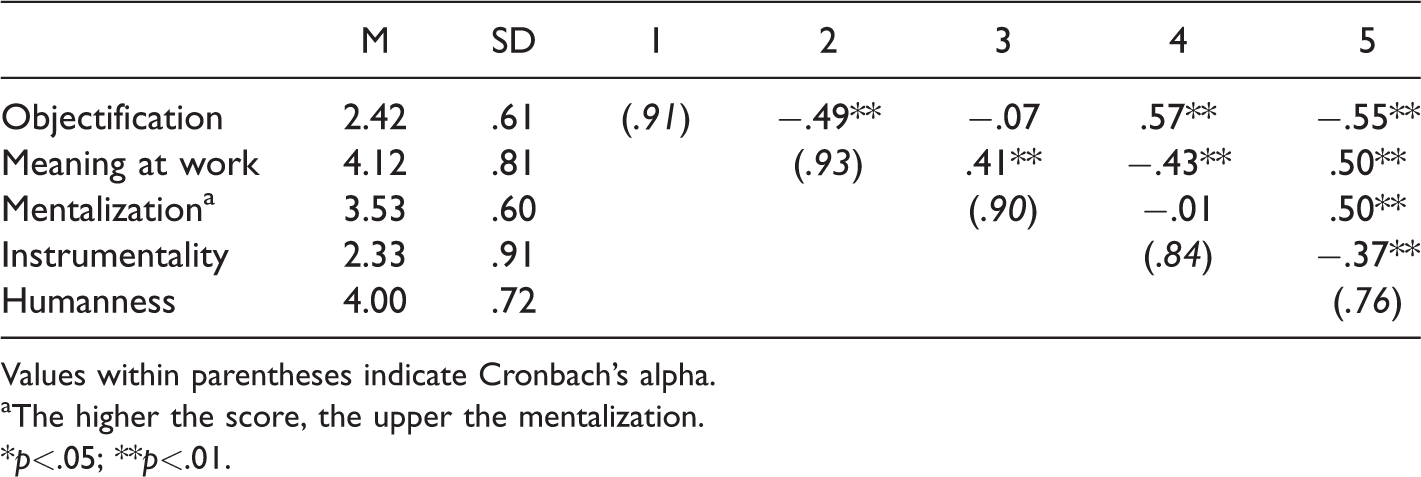
As all the coefficients of internal consistency were sufficient (>.70), we averaged the different indicators and corrected the correlations for attenuation (Osborne, 2003). The mean and standard deviations of the variables are shown in Table 1.
Descriptive statistics and intercorrelations between all variables.
Values within parentheses indicate Cronbach’s alpha.
aThe higher the score, the upper the mentalization.
*p<.05; **p<.01.
Objectification is associated negatively with the level of meaning of work (r= −.49) and with the level of humanness (r= −.55). Objectification is associated positively with instrumentality (r= .57) but not with mentalization. The level of meaning of work is associated with mentalization (r= .41) and humanness (r= .50) and negatively with instrumentality (r= −.43). The level of humanness is positively associated with mentalization (r=.50) and negatively with instrumentality (r= −.47).
We conducted a moderation analysis using the Hayes PROCESS procedure (Hayes, 2013) and a bootstrapping method (50,000 resamples; level of confidence 95%) with an analysis model (model 1) an Objectification × Meaning of work → Mentalization/Instrumentality/Humanness relationship. We did not observe a moderating effect of the meaning of work between objectification and mentalization (B= .06, SE= .08 t= .76, p= .44) nor a moderating effect of the meaning of work between objectification and instrumentality (B= .13, SE= .11 t = 1.19, p= .23). In this case, we observed a lack of effect of objectification on mentalization whatever the level of meaning of work. On the other hand, there was a positive impact of objectification on instrumentalization regardless of the level of meaning of work. The analysis of the global model (R2= .29, F(3,147)= 20.35, p= .0001) highlighted a moderation effect (B= .22, SE= .08 t = 2.52, p= .01) of the meaning of work between objectification and humanness (Figure 2). The introduction of the interaction contributed significantly to increasing the explained variance of the model (ΔR2= .03, F(1, 147)= 6.38, p=.01). Objectification reduced humanness when the meaning of work was low (M = 3.30; Effect = −.52; SE= .10, t= −5.05, p=.0001) or medium (M = 4.11; Effect = −.34; SE= .09, t= −3.68, p=.0003). For the high level of meaning of work, the relationship between objectification and humanness disappeared (M = 4.92; Effect = −.16; SE= .13, t= −1.25, p=.2101).
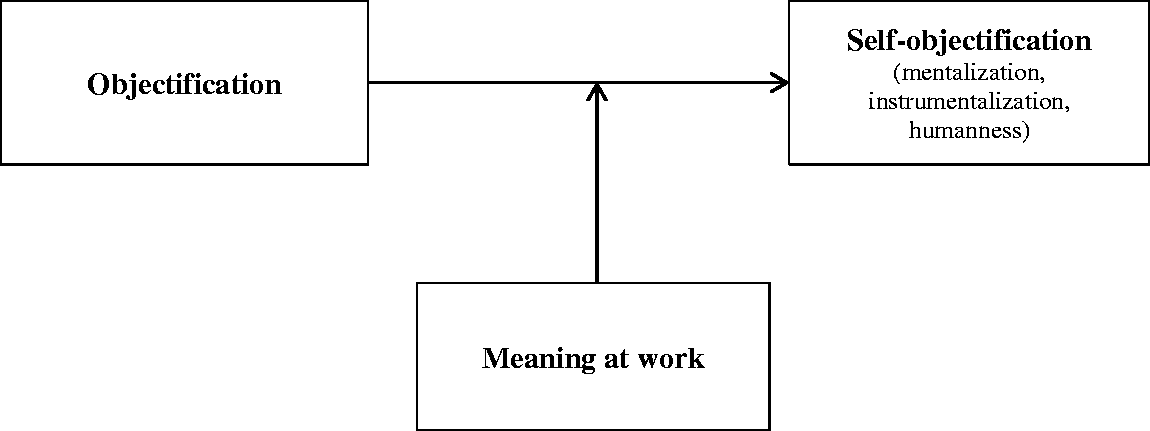
The moderating role of meaning at work.
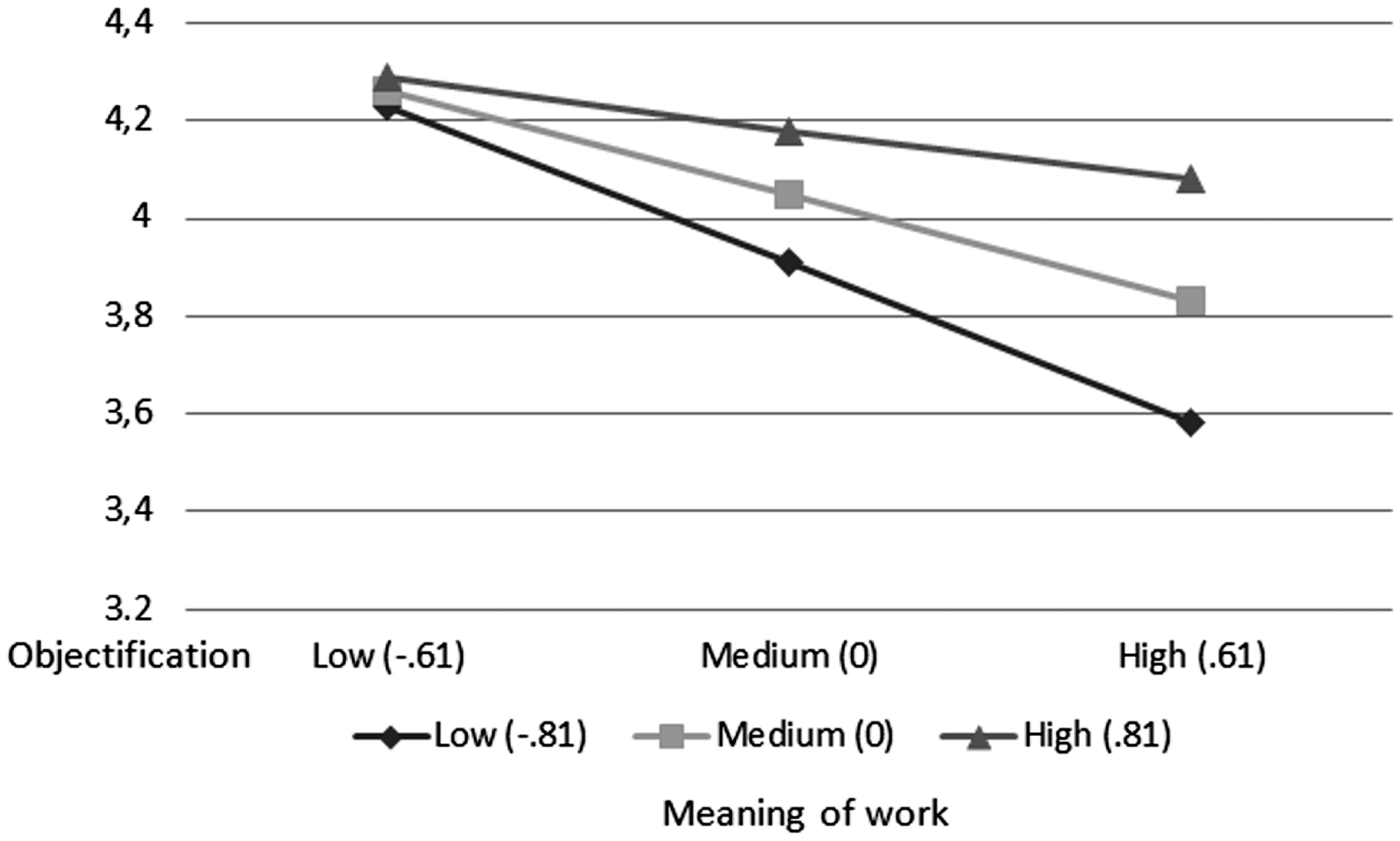
The moderation by meaning of work of the relationships of humanness with the mean objectification.
Discussion
In this study, we were interested in the protective role of the meaning of work on the consequences associated with objectification. Specifically, it was expected that whatever the level of objectification, the rise of the level of meaning at work would prevent the establishment of self-objectification at work. The results highlighted a relationship between the three indicators of self-objectification. Perceiving oneself as a person was associated with mentalization and the fact of not perceiving oneself as an instrument. However, we did not observe any relationship between mentalization and instrumentality. The relationship between these three indicators did not appear as unambiguous as the previous studies suggested (Andrighetto et al., 2017; Baldissari et al., 2017). At the same time, the perception of being objectified by others was associated with perceiving oneself as an instrument and a loss of humanness but was not related to the level of mentalization at work. The hypothesis of the protective role of the meaning of work was verified only at the level of the relation between objectification and humanness. When the meaning of work was high, perceiving oneself as being objectified by others did not translate into a loss of the feeling of being a person. In all cases, objectification was associated with instrumentality, that is, with a perception of oneself as an instrument in the service of others. Moreover, contrary to previous studies (Auzoult & Personnaz, 2016; Baldissari et al., 2014), objectification did not lead to dementalization.
Mentalization, instrumentality, and humanness are three indicators of self-objectification that maintain logical relationships. Perceiving oneself as an instrument is incompatible with perceiving oneself as a person and perceiving oneself as feeling or thinking (mentalization). However, unlike the other two constructs, dementalization is a phenomenon that is associated with occupational health loss, namely, occupational burnout (Baldissari et al., 2014; Caesens et al., 2017; Szymanski & Mikorski, 2016) and harassment (Wiener et al., 2013). From this point of view, mentalization is a higher order process that takes into account both perceptions and affects to account for psychological states at work. On the contrary, instrumentality and loss of humanness appear as quite basic perceptual processes which express a representation of oneself and others on the register of humanization, that is to say as possessing or not possessing specifically human attributes (Baldissari et al., 2017; Haslam & Bain, 2007). The processes actualize at different levels and our results suggest that the consequences of objectification occur more easily at basic psychological functioning levels. This may explain the difficulty in observing a relationship between objectification and dementalization, a relationship that remains very weak in studies that mention this result (Auzoult & Personnaz, 2016; Baldissari et al., 2014). Finally, our study offers an invitation to investigate the relationships between mentalization and instrumentality/humanness more closely.
Our study includes several limitations. Our study is cross-sectional and our data were self-reported and collected from the same source. These methodological choices can be at the origin of an inflation of the correlations and observation of relations between the variables which would be artificial. Other methodological choices, including the use of a longitudinal study, may limit this method bias (Podsakoff, MacKenzie, Lee, & Podsakoff, 2003).
Conclusion
Some studies have shown that objectification has the effect of decreasing resources for the self-determination of one’s own behaviors (Baldissari et al., 2017; Volpato, Andrighetto, & Baldissari, 2017). This study helps us to understand the phenomenon of objectification at work and its consequences for the health of employees. It also helps us to understand how the latter can develop levels of autonomy faced with the constraints which operate through working relationships and activity. Meaning of work is likely to reduce the consequences of objectification in the workplace, here the loss of humanness. Our results and those of Auzoult and Personnaz (2016) encourage us to study reflexivity at work from the point of view of process and thought content. Reflexivity tends to initiate protective regulations for occupational health. Our study suggests that the process of being protected from objectification is also based on the development of content that refers to the meaning of work. Overall, the consequences of objectification diminish in organizational contexts favoring participation, decision-making, reflexive focus on the self (Auzoult & Personnaz, 2016), and through the elaboration of the meaning of work. Empowerment therefore appears as a process that can be put in place through the objective conditions that impact the work (i.e., the context) but also through the process of self-focus and sensemaking.