



Abstract
In this article, we expand on aspects of autobiographical memory initially laid out in our earlier exposition of the sociocultural developmental model. We present a developmental account of the integration of an extended subjective perspective within an extended narrative framework both of which are mediated through language and shared cultural narratives that culminate in autobiographical consciousness. Autobiographical consciousness goes beyond simple memories of past events to create a sense of extended self through time that has experienced and reflexively evaluated events. We argue from philosophical, evolutionary, and developmental psychological perspectives that narratives are a critical form of human consciousness, and that this form is learned through everyday social interactions that are linguistically mediated. Language has “double-duality” in that it is both outward facing, allowing more explicit, organized and differentiated communication to and with others, and language is also inward facing, in that language provides tools for organizing and differentiating internal consciousness. Although consciousness itself is multifaceted, we argue that language is the mechanism without which this particular form of human autobiographical consciousness would not develop.
Keywords
Introduction
When asked for a self-defining memory, described as a memory that is meaningful and that helps define who you are as a person and how you arrived at your current identity, 35-year-old Pamela (pseudonym) responded (from Grysman, Fivush, Merrill, & Graci, 2016): The strongest memory I have that I believe defines who I am is the first time my newborn son fell asleep on my chest. This happened about 10–12 years ago but when I think about it the feelings are still strong today and I know this little event is what made me who I am today. I was never particularly interested in being a mother. I was not excited to find out I was pregnant and hated every aspect of the entire pregnancy. I just wasn’t sure it was what I needed in my life at the time. My partner encouraged me constantly and talked positively of all the great experiences we would have but I still wasn’t 100% convinced. When my son was born I cried and loved him but it still didn’t feel like he was mine. I felt no different, definitely not like a mom how I imagined I would. About 2 weeks after taking him home he was having trouble sleeping in his crib. I got up to get him, propped up some pillows for my back and half lay down with him on my chest. He fell asleep quickly with his hand tightly gripping one of my fingers. I instantly felt overcome with emotion. I felt happiness, calm and peace. I felt clarity, like this is who I am, this is where I’m supposed to be. I knew that my life had meaning.
First, Pamela integrates her internal experiences with external events, providing a seamless account of how inner life is both cause and consequence of external actions. In fact, the majority of this account is about Pamela’s inner life, which brings us to the second major point—Pamela describes an extended subjective consciousness, describing not just her thoughts and feelings at the particular self-defining moment of holding her child, but an extended subjective awareness of what she was thinking and feeling before and during her pregnancy, the first few weeks after the birth, and into the present moment. The temporal horizon of Pamela’s subjective consciousness is clearly extended, and she is able to hold multiple and often inconsistent, subjective perspectives in mind simultaneously—what she was feeling then, what she is feeling now, and how and why it has changed over time. Thus, the precise self-defining moment is placed within a clear awareness of a temporally extended subjective consciousness that both leads up to, and stems from, this moment of clarity. Third, this interweaving of inner and outer takes the form of a canonical narrative, and the narrative itself is extended in time. Although asked to provide a specific event, Pamela places this one moment of self-defining clarity within an extended temporal horizon that organizes experiences across months and years (Fivush & Waters, 2019). Narrative structure informs how specific actions and episodes are linked coherently into larger narrative frameworks that define a life (Conway & Pleydell-Pearce, 2000; Fivush, 2010b; McAdams, 2001) as well as providing the cultural backdrop of assumed shared knowledge between the teller and the listener. Shared cultural knowledge, in the form of master narratives, such as the canonical cultural U.S. narrative about pregnancy and birth as joyous experiences (Callister, 2004), provides both structure and content, informing both what is told and how it is told (Hammack, 2008; McLean & Syed, 2015). The integration of an extended subjective perspective within an extended narrative framework, both of which are mediated through language and shared cultural narratives, forms what we are calling autobiographical consciousness. As individuals adopt and adapt the narrative structures and frameworks in which they are socially and culturally embedded, these narrative frameworks begin to define individual understanding, such that externally provided culturally mediated narrative forms become the internalized form of human autobiographical consciousness.
In the remainder of this article, we explicate how this kind of complicated, nuanced autobiographical consciousness develops in deeply embedded social and cultural interactions that define the forms and functions of recalling the personal past. More specifically, we argue that this form of extended subjective autobiographical consciousness has its foundations in early parentally scaffolded narrative interactions, and these narrative interactions shape individual human consciousness in particular ways (Damasio, 2012; Eakin, 2008; Fivush, 2019). Two aspects to this argument must be emphasized.
First, we are not arguing that autobiographical memory is linguistically based. Memories themselves are certainly multimodal, sensory reconstructions of previous experiences (e.g., Dudai, 2004; Rubin, 2005), but language provides a tool or mechanism, for reconfiguring these unmediated sensory experiences into culturally mediated, coherent, communicable forms that allow us both to organize these experiences in particular ways for ourselves and to share these experiences in particular ways with others. Second, consciousness, itself, is multifaceted (e.g., Damasio, 2012). We assume that all primates, and likely most animals, have some form of conscious experiences, as do preverbal infants (see, e.g., Byrnit, 2006; De Waal & Ferrari, 2010), but we further argue that language allows for an additional form of consciousness that transforms the way individuals remember, and ultimately, the way individuals experience the world and the mind as narratively structured (Bruner, 1991; Damasio, 2012; Eakin, 2008).
Thus, we argue for the “double-duality” of language; language is simultaneously in the mind and in the world and as such it both reflects and constructs experience. Language is both a tool for expressing the mind, creating a way to externalize the internal world of the individual, and a tool for transforming the mind, creating a way for the external world to provide new forms of structure and meaning for the individual. In this way, we argue that language is the tool by which humans create a new, uniquely human form of consciousness, namely, autobiographical consciousness. This is a fundamentally developmental argument, in that we are not arguing that it is the communication of any given specific memory that matters, but rather that participating in everyday interactions in which memories are shared transforms the process of human remembering across childhood, whether these specific experiences are actually shared with others or not. Language becomes a crucial medium through which we both experience and understand the shape and meaning of our experiences whether or not these experiences are ever explicitly expressed through language. It is not that language defines or delimits what can be remembered, but that once we are language users, language shapes what we remember, even if what we remember is not in language. We note that whereas language is a cultural universal, the form of language and narrative structure may be culturally variable and thus the form of autobiographical consciousness may be variable as well (see Wang, 2016, for a review), but the process of developing autobiographical consciousness through everyday socioculturally mediated language interactions is universal.
This is a large claim and requires a bit of background in order to present the developmental arguments. Thus, in the first section, we set the stage by explicating the role of narratives in human understanding, drawing from philosophical, cognitive, and evolutionary theory. We then turn to the problem of individual child development that must be solved to understand human cognition more generally and the development of autobiographical memory, namely, the mechanisms by which change occurs. Based on both evolutionary and developmental arguments, we show how language is a critical mechanism of transformative change. Turning more specifically to the question of autobiographical consciousness, we begin with an exploration of early understanding of intentionality and how the development of language fundamentally transforms understanding of intentional human action through the development of what is now called “theory of mind” (Tomasello, 2009). Once we lay out the arguments for language as a mechanism for transforming understanding of mind, we turn to the more specific arguments about the role of narratives in structuring a temporally extended subjective perspective. We show how early parent–child narrative interactions begin to transform children’s understanding of their own personal past in ways that promote a narratively organized subjective perspective and the formation of autobiographical consciousness.
Narratives as ways of world-making
In 1991, Bruner argued persuasively that human thought was narratively organized. Although humans are certainly capable of multiple forms of thought, including paradigmatic, expository, and descriptive, at base, we understand ourselves and our worlds through narrative modes of thinking. Narratives provide both a story structure or narrative arc and an integration of the landscape of actions with the landscape of consciousness, making sense of human action through intentions, motivations, and emotions that lead to dramatic stories with social and emotional consequences. The difference between Oedipus sleeping with his mother before and after he knows her identity is palpable even though the external actions are the same. Arguably, narratives provide templates for how to be a person, and how to live in the world, in ways that provide not just scripts for what to do but morality tales for how and why we do these things (Chafe, 1990; Freeman, 2007). From nursery rhymes in the crib through to Tolstoy’s War and Peace, narratives provide one critical way of understanding who we are, how the world works, our place in it, and how we should behave (Herman, 2007).
From an evolutionary perspective, there is little doubt that our human ancestors told stories about successful and unsuccessful hunts, about gods and great men, and about everyday occurrences. The fossil records indicate that stories were an integral part of human interaction from time immemorial (Donald, 1991). Boyd (2018) argues persuasively that these stories knot people together into groups, arising from preadapted needs for sociality and information-sharing that was critical in our evolution. With the advent of language, the forms of this communication changed precipitously because it is only through language that we can gain access to other people’s minds (Dor, 2014). Stories become more than tales of what happened in the world; they become psychological thrillers—who thought what and why and how, and how and why did they act on it? Language allows the possibility of entry into other minds, and with this, narratives became a primary means of understanding others. Intriguingly, as this became part of human interaction, these narratives also became ways of understanding self. That is, language, in the form of canonical narratives, provided templates for understanding human motivation, intentions, and actions, and these templates were used to both understand others and also turned inward, to understand our selves (Fivush, 2019; McAdams, 2019). Narratives provided a fundamentally new way to think about one’s own internal life.
The linguistic structure of narrative provides fairly specific templates for structuring experience and therefore consciousness (Damasio, 2012; Eakin, 2008; Labov, 1982). First, narratives provide structures for dividing the unremitting flow of lived experience into meaningful chunks that define human units of action (Ricoeur, 1991). Although narrative time is quite complicated and may even be culturally variable (Abbott, 2008), narratives are universally concerned with connections and causal and coherent linkages among events, often favoring psychological over physical causes. Thus, narrative time is flexible in terms of its temporal linearity or adjacency. So “When I was a child, I played a lot by myself and now I am an avid reader” makes narrative sense even though the “causal” event was years in the past, whereas “Yesterday I played basketball and today I am an avid reader” leaves the listener puzzled—perhaps the narrator will somehow connect these but this linking of actions, even though close in time, make no narrative sense. In this way, narratives create a form of human time that is often nonlinear, and narratives provide connections between and among multiple time frames simultaneously. We see this in Pamela’s narrative where multiple timelines are embedded within each other: the longer life periods from before pregnancy to the present (“I was never particularly interested in being a mother” and “ … this little event made me who I am today”), within which the pregnancy is embedded (“… hated every aspect of the entire pregnancy”), within which the moments of birth are embedded (“When my son was born I cried”), and, of course, the moment of clarity that is the point of the whole story and is, in fact, a completely internal event. So we have specific moments embedded in longer timelines that are themselves embedded in even longer timelines. Pamela’s narrative creates coherence through her subjective perspective on her motivations, her beliefs, her emotions, and ultimately her values. Importantly, we see reflection and reflexivity about how her beliefs and values changed over time, with Pamela holding multiple subjective perspectives in mind simultaneously, providing a narrative of how and why they changed. Thus, the integration of temporal and subjective extended perspectives creates ways of thinking about the world and one’s place in it as meaningful.
Indeed, narratives may actually proscribe how to make meaning from a human perspective (Bruner, 1991; Gottschall, 2012; Habermas, 2007). Narratives not only provide a particular structure to human experience, but narratives also provide specific cultural frames, ways of understanding the world. These kinds of master narratives provide particular narrative arcs and express both universal and culturally specific evaluative frameworks by which to understand the world (Hammack, 2008; McLean & Syed, 2015). For example, a classic master narrative in American culture is the redemptive narrative (McAdams, 2004). This is the American myth of both country—the Pilgrims escaped persecution and came to a harsh environment but through hard work and perseverance, succeeded—and the ideal of the American individual—the classic immigrant story of rags to riches. Redemptive narratives pervade U.S. cultural understanding of the world and of individuals, from manifest destiny to Oprah Winfrey. Other master narratives may be more specific to particular people or roles. Again, Pamela’s narrative is told against the U.S. master gendered narrative of the bliss of having a child and the immediacy of the mother–child bond. Pamela’s says, “I felt no different, definitely not like a mom how I imagined I would” alluding to the expected narrative arc of the story. Similarly, U.S. adolescent males asked to tell about a traumatic event tell “John Wayne” stories, stories about overcoming hardship through brute force, whereas adolescent girls tell “Florence Nightingale” stories, stories about the tragedies of others, and creating caring communities (Thorne & McLean, 2002). Master narratives define cultural ways of world-making (Goodman, 1978); individual narratives may not conform to the master narratives, but when they do not they are always marked as such, as deviating in specified ways (Fivush, 2010a; Hammack, 2008). Master narratives may be invisible in some sense, but they provide the unwavering backdrop to all the individual stories told, defining the culturally shared evaluative frameworks of sense-making (McLean & Syed, 2015). Certainly, master narratives can change, as we have seen over the last few decades in narratives of the civil rights movement and the gay rights movement in the United States, but they change through redeveloping a new master narrative against the old one (Hall, 2005; Hammack, 2008). Thus, autobiographical consciousness, as partly structured through culturally canonical master narratives, will be both universal, in being narratively based, and culturally specific.
The argument, then, is that language, and more specifically, canonical linguistic narratives, provides new forms of human consciousness. Across evolution, humans began to structure and evaluate their personal experience in ways that reflected the external stories that were shared, stories that made common sense of the world—common in multiple meanings, both common in that they were shared in common, and common sense in that they were accepted as sensible ways of understanding and evaluating the world and the people in it (Boyd, 2018; Donald, 1991; McAdams, 2019). Through narratives, humans began to understand themselves, each other and the world in fundamentally new ways, as intentional motivated beings with goals, and with individual histories that explained both persons and behaviors. Narratives are the interface of internal and external; they structure our cognitive understanding of the external world, and they structure our subjective consciousness. Cultures and stories coevolved, each reciprocally defining the other, and in the process defining selves (McAdams, 2019). Thus, we argue that linguistic narratives are a critical cultural tool for creating a specific form of human consciousness, namely, autobiographical consciousness.
The arguments thus far are fairly abstract and perhaps philosophical. But they raise intriguing questions about the development of autobiographical memory in individuals. If shared cultural narratives are instrumental in shaping human consciousness, then we should be able to see this process unfold in childhood, as infants and children come to tell their own personal narratives within social cultural interactions that frame human behaviors and understanding within evaluative narrative structures that provide templates for extended subjective perspective. To evaluate this claim, we first delineate the problem of development more broadly, that is, the question of how development occurs at all. We then turn specifically to the development of subjective perspective, from prelinguistic understanding of intentionality to developing understanding of an extended subjective perspective through shared narrative interactions. We draw mainly on research with broadly middle class white, Western families, and acknowledge that this represents a small fraction of the world’s population (Henrich, Heine, & Norenzayan, 2010). As already argued, we think that the forms of narrative and therefore of autobiographical consciousness may be culturally variable, but we also argue that the process of coming into this form of consciousness is culturally universal. Our argument is that without sharing linguistically based narrative interactions, humans would not come to the form of autobiographical consciousness that we see in narratives such as Pamela’s. All cultures studied thus far engage in reminiscing and the developmental outcomes of mother–child reminiscing, in particular, have been shown to be remarkably consistent across quite diverse cultures (Schroder et al., 2013)
The problem of development
A key question about human development that has been discussed in philosophy and psychology for hundreds of years (see, e.g., Miller, 2002; Sameroff, 2010) remains almost impossible to answer: how does something more come from something less? Models that focus on either endogenous changes in the individual, such as neurological and cognitive developments, provide important information about the increasing differentiation and complexity of mind, but are often unable to provide specified mechanisms, other than maturation, by which these changes occur. Similarly, models that focus on external factors, such as socialization pressures, parental behaviors, and social demands such as schooling and peers, provide accounts of the ever increasing complexity of the worlds in which children must operate but have difficulty explaining how external interactions in the environment get “into the head” and create changes in the internal workings of the mind other than invoking vague notions such as “socialization” and “internalization.” Whereas virtually all developmental scientists agree that development proceeds through bio-social-cultural developmental processes that are increasingly complex, increasingly organized, and increasingly interactive (e.g., Sameroff, 2010; Smith & Thelen, 2003), the actual developmental process is underspecified and difficult to describe in its full complexity (Nelson, 1996, 2009; Smith & Thelen, 2003).
We argue that development more broadly, and the development of autobiographical memory more specifically, develops within dialectical interacting systems that encompass changes both within the child and in the evolving environment within which the child interacts, such that development is a process of increasing organization and integration of the internal (mind) and external (world). This process begins with the parent–child attachment bond and moves into larger and larger social interactive experiences. This is similar to Bronfenbrenner’s (1979) ecological developmental system, whereby individual characteristics of the child reciprocally develop within ever-expanding circles of social and cultural influence. At all points, neural and cognitive developments are influenced by and influence the forms of social cultural interactions in which the child is embedded. Both internal and external changes mutually inform each other. Development occurs neither “in the head” nor “in the world” but at the points where the head and the world meet in ever increasing spirals of organization and complexity.
From this perspective, language becomes a mechanism of development (and possibly the most critical mechanism of development, e.g., Vygotsky, 1978) because language sits at the intersection of internal and external (Dor, 2014). Language is both outward facing, allowing more explicit, organized, and differentiated communication to and with others, and language is also inward facing, in that language provides tools for organizing and differentiating internal consciousness (Nelson, 2001, 2003a; Nelson et al., 2003). Moreover, language operates at this intersection dialectically, simultaneously facing inward and outward. It is in this sense that we argue that language has double-duality—it integrates the internal and external worlds and, in doing so, provides the reciprocal mechanism by which internal becomes external and external becomes internal. Without language, we argue, humans would not come to understand “mind” of self and other in the way that they do. Through its very structure, language provides access to recursive and reflexive ways of constructing knowledge, that allow human understanding to become both iterative and self-reflective. Language allows individuals access to other minds that is simply not possible outside of language, and this linguistically mediated understanding of mind undergirds the development of a narratively structured extended subjective perspective, that is, autobiographical consciousness, as illustrated in Pamela’s narrative at the beginning of this article. Again, we underscore that consciousness is multifaceted, and humans engage in multiple types of conscious thought (e.g., Damasio, 2012). Our argument is not that language is necessary for consciousness, but rather that this particular form of consciousness that we call autobiographical consciousness is not possible outside of a language using community.
To explicate this argument, we first elaborate our arguments about language as a mechanism of development. We then discuss early beginnings of consciousness in human infancy through the lens of intentionality. To be clear, human infants (and most likely all primates and many other animals) understand behavior as motivated and, probably, as intentional. Thus, we set the stage by reviewing this evidence. With this as the foundation, we argue how language fundamentally transforms this early understanding of intentionality in three ways: (a) understanding differences between one’s own mind and others’ minds in terms of beliefs, desires, emotions and thoughts, what has come to be called “theory of mind” (Premack & Woodruff, 1978; Wellman, 2018); (b) understanding that mind extends over time such that earlier beliefs, desires, emotions and thoughts may still influence current behavior for both self and other, and also that individuals’ beliefs, desires, emotions and thoughts may change over time; and (c) internalization of narrative forms as ways to understand the interface of internal and external world through motivated human agents acting in specific external environments to achieve specific goals (Herman, 2007; Hutto, 2012). Again, all of these are illustrated in the simple narrative that Pamela provided at the beginning of this article yet represent complex and sophisticated cognitive achievements that take years to develop.
Language as a developmental mechanism
Regardless of the evolutionary arguments about the transformative role of language in human history (e.g., Boyd, 2018; Dor, 2014), it remains deeply controversial in cognitive psychology whether language expresses cognition or transforms cognition (e.g., Boroditsky, 2001). Taking a developmental perspective suggests that the very form of this question is problematic in that both must be true. Developing cognitive abilities no doubt provide the basis for the development of language acquisition, but there is equally no doubt that as individual children acquire language, their cognitive abilities change as well (Astington & Baird, 2005; Harris, 2002; Nelson, 1996, 2003b, 2009). Language acquisition fundamentally changes infants’ abilities to understand their inner life, their thought and emotions, as well as the inner life of others, forming the basis of what will become autobiographical consciousness. This type of understanding begins in infancy, prelinguistically, with basic abilities to understand intentionality, and becomes more complex with increasing language skills, as children become capable of understanding the concept of mind, and that both they and others have minds, internal lives brimming with desires, beliefs, thoughts, and emotions, that endure across time (see Wellman, 2018, for a review). Essentially, this is the foundation for understanding that each individual has their own autobiography.
Prelinguistic foundations of understanding mind
In the first six months, infants interact with others, develop clear expectations about the forms and functions of these interactions, and respond in emotionally appropriate ways to these interactions. We see this in early attachment related behaviors, such as crying when in discomfort, but soothing as soon as a parent begins to approach, anticipating a positive response to the discomfort before any actual physical response is made (Ainsworth, 1979). Similarly, in the still face paradigm, infants’ express distress when adults with whom they are socially interacting suddenly stops responding and shows a neutral expression (Rochat, Striano, & Blatt, 2002). These kinds of social anticipations and expectations indicate that human infants understand the rhythm of social interactions and behave accordingly. Still, it is not until the second half of the first year, at about 9- to 11-months of age, that infants begin to show clear evidence that they understand that others act intentionally in the sense of having internally generated motivations to intentionally communicate with others. This is seen in multiple changes in infant behavior that all indicate a nascent understanding of shared attention (Tomasello & Carpenter, 2007), including pointing, following eye gaze, and engaging in give-and-take games such as peek-a-boo. All of these seemingly easy tasks rely on a basic understanding that the person with whom you are interacting has a mental intention—for you to look at something, for you to take a proffered object (or not), and for you to respond in a particular way. Intriguingly, nonhuman primates do not engage in these behaviors as ubiquitously or as easily as human infants do across cultures, and seemingly without instruction (Call & Tomasello, 2008; Tomasello, 2009). This is not to argue that other animals do not understand any form of intentionality—clearly they do (e.g., De Waal & Ferrari, 2010), but rather that human infants develop an integrated understanding of the mind of the other quickly and easily in the first year of life. By the end of the first year, human infants live in a world in which they understand that they and others act on mental intentions that cannot be seen directly but can be ascertained through external actions.
Language transforms understanding of mind
Over the course of the preschool years, this early developing understanding of another’s intention in the moment expands to an understanding that self and other have extended intentions over time, essentially that one acts out of at least minimally enduring desires and beliefs. Not only does Mommy want to play with me right now, but Mommy generally enjoys playing with me—a sense of the other as having sustained preferences and proclivities. At the same time, there is dawning awareness that general propensities are variable in the moment—Mommy may generally like to play with me but she is not feeling well now. This kind of ability to hold two mental representations of another in mind simultaneously is quite a cognitive achievement and is not achieved until the third year of life (DeLoache, 2004). More specifically, three major developments occur in children’s understanding of their own and others’ minds across the preschool years (see Wellman, 2018, for a detailed and excellent review). First, one- and two-year-olds begin to understand enduring desires that different individuals have different likes and dislikes and act accordingly. Thus, there is an initial separation not just of physical beings from each other but mental beings from each other—not everyone likes the same things. Second, not everyone has access to the same information. The preschooler who comes home and just assumes that mother will know everything that happened at school works with an understanding of mind that assumes uniformity across people—if I know something, you must know it as well. The idea that my knowledge comes from my unique access to certain information develops at about three to four years of age. The hallmark of theory of mind, the understanding of false belief, occurs even later, at five to six years of age. This is an understanding that a person can believe something that is not true about the external world—for example, if Anne hides her chocolate bar in her toy box, and Sally takes the chocolate bar without Anne being present to see this action, Anne will still “truthfully” believe the chocolate is in her toy box and not in Sally’s pocket. That is, one can have a false belief about the actual state of the world. Thus, across the preschool years, we see the emerging ability to separate internal and external as different but interacting realms within which human action unfolds. Whereas infants and toddlers seem to assume that what is in the world is also in the mind and vice versa, essentially a “copy theory” of information as transparently visible across internal and external, by the end of the preschool years, children are beginning to understand that internal mind and external world may not be identical. Even more intriguing, we see the beginnings of understanding that internal worlds are unique to each individual—just because I desire something, believe something, or even absolutely for sure know something, does not mean that your internal world will be the same.
Another avenue into the question of the role of language in developing theory of mind is studying nonhuman primates. It remains highly controversial exactly what aspects or form of theory of mind nonhuman primates do and do not exhibit (Byrnit, 2006; Call & Tomasello, 2008; Tomasello, 2009). Research is mixed on the extent to which nonhuman primates easily follow points and gestures, or eye-gaze, perhaps suggesting a limited understanding of internal intentions flagged by these behaviors. There is little evidence that nonhuman primates fully understand false belief, although there is some suggestion they understand deception (De Waal & Ferrari, 2010). What does seem to be clear is that nonhuman theory of mind is more limited than what human children develop. These findings suggest that being born into a language-using community provides an early and possibly necessary foundation for the development of understanding certain aspects of mind, both of self and other. But it does not address exactly what it is that language provides.
As already presented, we argue that language is a mechanism of development through its double-duality; by sitting at the interface of internal and external, language transforms thought. More specific to theory of mind, and especially the extended theory of mind necessary for autobiographical consciousness, we argue that language provides a fundamentally new way of understanding mind and behavior through canonical linguistic narrative forms.
The development of extended mind
Just as stories pervaded human history, stories pervade individual lives. Infants are born into storied worlds. From the moment of birth, infants hear nursery rhymes and lullabies, are read story books and poems, and adults begin telling stories of the family to this new little one, where they came from and who they will be (Fiese, Hooker, Kotary, Schwagler, & Rimmer, 1995). We marinate in stories all our lives—we are surrounded by books, media, stories told orally, through song and dance, through pictures and photos (McLean & Breen, 2015). And within this larger milieu, we are surrounded by personal and family stories, stories of what we did today and what we did last year, and stories of Great Grandma Louise and Crazy Uncle Joe. We understand the rhythm of life through these stories, and through these stories we create the story of our own life, the story of “me” (Barnes, 1998). As personal as this story may feel, we argue that this kind of personal story, or autobiographical consciousness, is constructed through linguistically mediated social interactions that provide the frameworks without which this form of consciousness would not develop.
Children begin to engage in talking about the past virtually as soon as they begin to talk. Adults, mostly parents, draw them into everyday conversations about what happened and what they think about it, although at this early stage, children barely participate, offering a word or two in response, with the parent fleshing out the story, as in this example between 19-month-old Anna and her mother talking about going to see lambs and sheep on a ranch the previous week (from Reese, Yan, Jack, & Hayne, 2010): Mother: how many lambs were there? Anna: [coughs] do do do. Mother: two of the little baby lambs. Mother: Gertie and George. Anna: heee. Mother: and they had little tails, didn’t they? Mother: what did their tails do? Anna: wave. Anna: ah. Mother: yeah they wiggled and wiggled. Mother: and what did Anna give to the lambs? Anna: fayah. Mother: baby lambs. Mother: what did you give to the lambs? Anna: is a baa a ah. Mother: baby lamb. Mother: did you give them a bottle? Anna: ayes. Mother: you did!
First, narratives provide a coherent organizational structure for experiences. Anna might very well recall the sights and smells of the farm visit, but Anna’s mother creates a new representational format for these fragments that creates a whole that expresses the boundaries and the coherent flow of the experiences, and importantly, a format that brings Anna in as an intentional agent. Second, as Dor (2014) argued about the evolution of language, putting experiences into language allows us to share those memories with others, and it is very difficult to ascertain how this kind of sharing could occur outside of language. This holds for the developing child as well. One could point to something one saw previously, even gesture emphatically and emotionally, but it is difficult if not impossible to imagine how two individuals who experienced the same event could reminisce about what each recalls or does not recall, how each felt about the event, similar or different, and how to resolve these difference into a communal story—or perhaps to agree to disagree about what that story meant.
Moreover, it is only in sharing the story with others, that one can learn that others may have a different take on what happened, a different interpretation, a different set of meanings, and this can be negotiated, or negated, or collaboratively reconstructed. Without language, there is no reason to question our memories as representations; we simply take them at face value as reality. With language, reality itself starts to wobble. How can different people remember different things about the ostensibly same experience? This is both for the facts of what happened but also for how one thought or felt about an event. Did Anna enjoy feeding the lambs or was she scared? How does this get narrated and how does the narration change her understanding of the event? Memory itself becomes something to be reflexively examined. As memories are shared through language, we develop not just memories of what happened but negotiated accounts of what this event means for self, other, and the world. We begin to develop the idea that memories, themselves, are subject to change, that memories are representations and rerepresentations of the past. Memories become objects of reflection and are open to recursive reinterpretations.
We obviously do not see all of this yet in Anna’s story; without her ability to contribute linguistically to a shared narrative, it is very difficult to tell if and what Anna actually remembers or what she thought or felt about the event when it occurred or in the present moment. Still the mother is clearly conveying a story in which Anna was brave in feeding the lambs and had a good time. In telling this story about a shared experience with (or at this developmental point maybe to?) her child, this mother is beginning to transform Anna’s unmediated sensory experiences into a coherent, communicable account that seamlessly integrates Anne’s internal subjective experiences with actions in the world. As Anna begins to participate more fully in shared reminiscing, we see the narrative structures expanding to include more perspectives, more integration, as in this excerpt between Anna and her mother 21/2 years later, when Anna is 51-month-old: Mother: what did you do, when y- when you got your hair cut? What happened? Anna: I only had a short turn though. Mother: mm. Why was that? Anna: cos I had longer hair and we only wanted a wee bit off cos I liked having long hair. Mother: mm, it’s made the ends look really nice, hasn’t it? Anna: mm. Mother: so what did the lady do, when she was going to cut your hair? Anna: she cutted it. Mother: did you have to wear anything? Anna: I had a picture with all the things they need for a hairdresser. Mother: I’d forgotten about that picture, all the things that the hairdresser needed. It was fun, wasn’t it? And because you were such a good girl, what happened at the end? Anna: I got a lollipop. Mother: mm. Mother: cos you were very good. Anna: cos I was very shy as well. Mother: she said that you sat very still … she was quite pleased with you.
Of note, much of this narrative, even at this young age, is about Anna’s subjective perspective—that she likes her hair long, that it was fun, that she was good, and maybe even shy. And this too is part of the shared narrative coconstruction—Anna’s internal mind is being externalized, an object of discussion and negotiation between mother and daughter, and in this way, Anna’s most private experiences become subject to external reformulation through the shared narrative. In the earlier narrative about the lambs, before Anna could actually share her internal perspective, the mother simply expressed this perspective for Anna; now, Anna’s perspective becomes negotiated.
There are also points where the mother indicates the variability of memory that not everything is remembered by everyone (the mother says, “I had forgotten about that picture”) and checking on a shared evaluation (“It was fun, wasn’t it?”). The narrative ends with what someone else thought about Anna—ending on a coda that brings in what other people thought, and emphasizes others’ evaluations. In this small give-and-take about a mother–daughter excursion, Anna and her mother are creating an evaluative narrative about who Anna is as a person, what the relationship between mother and daughter is like, and how Anna thought and felt about the event. We see similar process in this excerpt between four-year-old Porter and his mother discussing the previous weekend’s events: Mother: Who was keeping you (from going to the museum)? Porter: Alan (Porter’s younger brother) Mother: Alan kinda overslept on his nap, right? Porter: Yeah. Mother: And by the time he got up it was late, so we didn’t have time to really get lunch before. Porter: And I had an accident. Mother: You had an accident. You’re right. And we didn’t wanna go to (the museum) if you were having an accident. And do you know what else there was? Porter: What? Mother: What’d Daddy really want to do yesterday? Porter: I don’t know. Mother: What did Daddy do all afternoon? Porter: Daddy wanted to watch football. Mother: Daddy really wanted to watch the football game didn’t Daddy? (Chuckles) Was it kinda fun watchin’ with Daddy? Porter: Yeah. Mother: Yeah, but it made us sad that we didn’t get to go.
This kind of shared narrative coconstruction of personal experiences that blends the internal thoughts and desires of the various actors both with each other and with the external event is simply not possible outside of language. Table 1 describes the multiple complicated social and cognitive accomplishments that are on display even in these simple early reminiscing conversations (Fivush & Nelson, 2006), all of which can be seen in Porter’s narrative (and can be seen in Anna’s later narrative as well). First, Porter and his mother negotiate aspects of what happened. This is not a simple recitation of a list of facts, but a series of events that occurred because of the complexity of integrating multiple family members’ needs and wants. Although Porter and his mother never quite disagree about what happened, there is a give-and-take, multiple pieces, several things that come into play that need to be considered. In these kinds of give-and-take interactions, children are learning that the past is not a simple set of facts, but has multiple interwoven pieces, all contributing to an overall whole. The past is not given but reconstructed. Second, even in this very brief excerpt, there is discussion about the landscape of consciousness—people’s emotions and desires—both the child’s own and those of others. Weaving this into the narrative helps children understand the temporally extended nature of mind. The wants and desires of Sunday are tied to what happened on Sunday and these particular internal states may or may not continue into the present. Certainly, they were all sad that they could not go to the museum, but they are not sad today in telling the event. And even understanding, the internal state of sadness is complicated because, although sad, it was also fun to be with Daddy, a more enduring underlying emotion. This kind of discussion and negotiation about internal states, noting their causes, consequences and complexities, helps children understand that both they and others have temporally extended minds, and that these minds are unique—not everyone has the same subjective perspective across time because different people have experienced different things. All of this is embedded within a narrative framework, a set of actions put into motion by human needs and intentions, that led to particular outcomes, but ultimately reaching resolution (even after all the mishaps, we did have fun).
Relations between parent–child reminiscing, child’s cognitive processing, and child’s developing understanding of self and other.
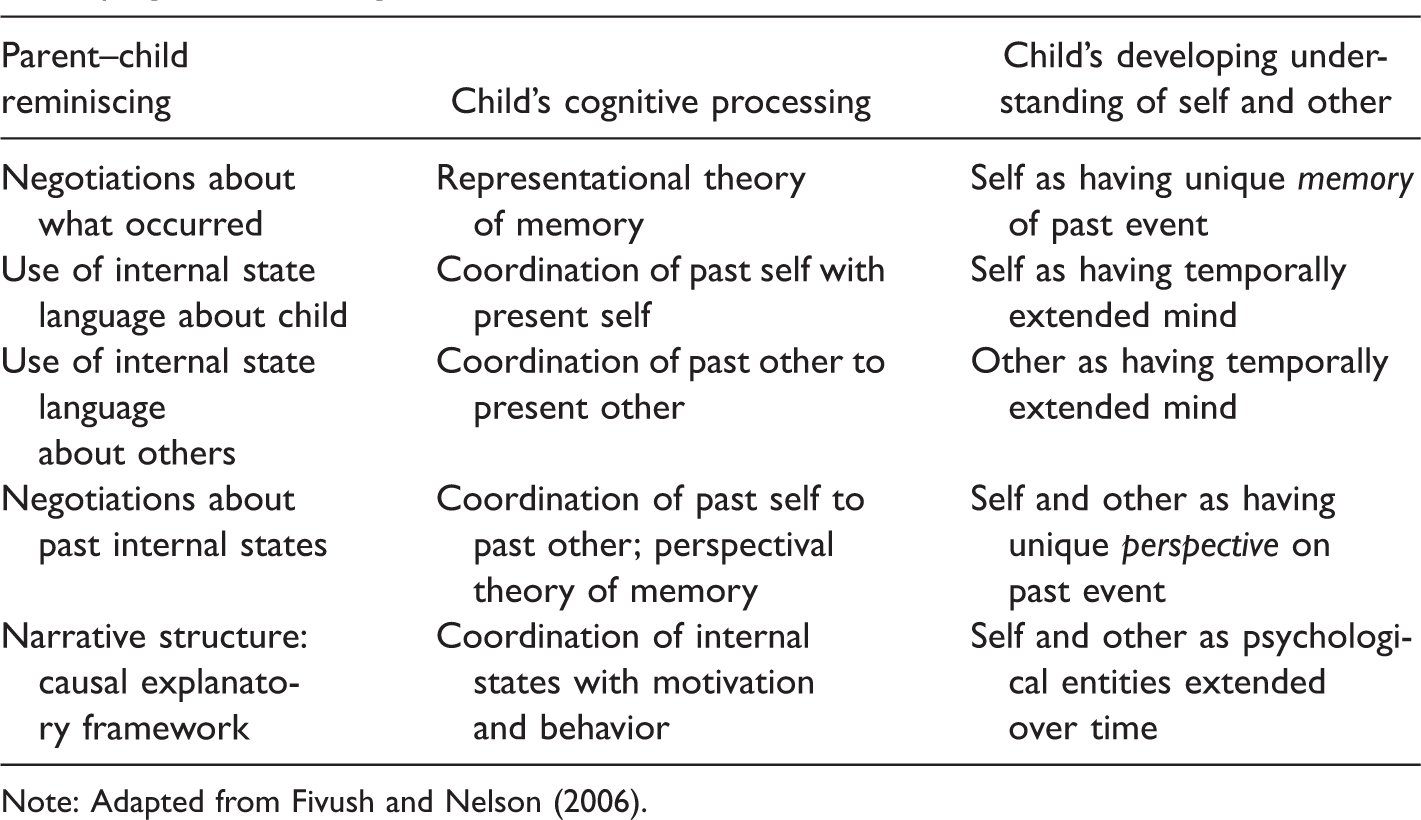
Note: Adapted from Fivush and Nelson (2006).
It may seem overstated to claim that so much psychological processing is going on in this simple everyday conversation, but the point is that these kinds of conversations happen literally all the time. In recorded conversations in homes, in self-reports, in diary studies, people and families talk about past events multiple times an hour (Bohanek et al., 2009; Pasupathi, McLean, & Weeks, 2009; Rime, 2007). Children are not learning all of this in one conversation but across hundreds of conversations that occur on a daily basis. These coconstructed narrative conversations present worlds in which individuals have extended minds, intentions, and desires that led to particular behaviors, that different people have different viewpoints, and that the same person can have changing viewpoints over time. Indeed, more elaborated coherent mother–child reminiscing about the past is linked to children’s developing theory of mind (Nelson et al., 2003; Reese & Cleveland, 2006). In all these ways, coconstructed narrative reminiscing conversations create a form of consciousness that links past to present through an extended subjective consciousness through time.
Moreover, these small stories are embedded in larger stories, larger stories of family and of culture that come to inform individual narrative perspective. Even these early coconstructed narratives are imbued with the cultural narratives within which they are embedded. One is gender roles. In Anna’s narrative, the event chosen for reminiscing is about gong to the hairdresser, an event that Anna had clearly prepared for (she brought pictures) and thought about (she likes to wear her hair long). In contrast, Porter and his mother talk about Daddy wanting to watch football (and the mother even chuckles about this). So the activities engaged in are gender-typical. Anna’s mother describes her as “a good girl” and Anna describes herself as shy, again against a backdrop of gender-typed femininity. Anna’s narrative ends with her mother stating how someone else evaluated Anna—that the hairdresser was “pleased”—alluding to the cultural narrative of females being caring and communal. In Porter’s narrative, there is little reference to individual family members enduring traits, but it is told against the cultural narrative of family life, that it is important and fun to do things together as a family. Granted, these cultural narrative backdrops are very implicit, perhaps vague, but they provide the unspoken framework for putting these small experiences into larger family and life contexts.
Autobiographical consciousness
These early coconstructed narratives are the beginnings of a long developmental process that culminates in the kind of autobiographical consciousness we see in Pamela’s narrative. These narrative forms learned through everyday social interactions beginning early in development both rely on language and allow for the expression of our inner worlds in particular ways. Thus, language is both outward and inward facing. By integrating the internal landscape of consciousness with the external landscape of action through language, these narrative forms provide structures for how one reflects on and understands one’s own personal experience; narrative forms become a predominant form of consciousness itself.
In the early coconstructed narratives, we are already seeing how internal worlds are being structured, how evaluative frames for how and why people act as they do is being explicated, often along culturally defined roles and stereotypes. With development, these linguistic narrative forms become the water we swim in; they are so ubiquitous that they become invisible as the shared backdrop for understanding self, other, and the world. This is illustrated in this narrative provided by Carla, a 19-year-old college student, when asked for a significant life experience (from Fivush & Marin, 2018): Coming into college was what I thought, just a “fun” time. The beginning, was all about drinking, partying and being away from home. As the weeks passed on, drinking 3–4 nights a week was only normal. But with each night of partying came new bad decisions. It seemed acceptable as a freshman to be promiscuous, but in terms of the way I was raised and brought up religiously, it was definitely was not. But I continued to party, and make horrible decisions, usually waking up and justifying it as, “it’s normal, I am a freshman.” As winter break came around, I went home for a month, realizing with all the guys I had been with, none mattered or cared about me. That break I sat and reflected on my first semester. Till this day-I have no regrets, but often don’t share the horrible details of those drunk nights. [During] the break, I also met my boyfriend. He, is very different to say the least, but accepted my past and never judged me for it. Now, 2 years later I see nothing but a good future for us.
Thus, both language and narrative allow a form of reflection and recursivity, a turning on itself, that is difficult to imagine outside of language. And, of course, language used in this way is not simply “in the head” but also “in the world” between and among people. Language and narrative sit at the interface of internal and external. In narrating our personal past, we make the past an object of reflexive reflection, an object that both self and other shape together. The personal past is a socially constructed object, and our internal extended subjective perspective, our autobiographical consciousness, as a process, is the product that this reflexive reflection produces.
Conclusions
We have argued in this article that language and linguistically mediated cultural narratives are the mechanism by which humans develop autobiographical consciousness. In the early mother–child narrative reminiscing conversations, we see the emergence of this form of understanding of self and other, a form of understanding that moves beyond a prelinguistic understanding of intention, to integrated multiple perspectives, across people, and across the internal and external landscapes. These early abilities develop and coalesce across childhood and adolescence to culminate in reflective, reflexive, extended subjective perspective on lived experience, an autobiographical consciousness. Although other forms of consciousness may not depend on language, we argue from evolutionary and developmental evidence that language is the mechanism without which this form of human consciousness would not develop. Autobiographical consciousness goes beyond simple memories of past events to create a sense of extended self through time that has experienced and reflexively evaluated these events. In the words of Pamela, whose narrative we presented at the beginning of this article, autobiographical consciousness allows us to say “I knew my life had meaning.”