




Abstract
Our memories can come to mind either voluntarily—after we intended to retrieve them—or, involuntarily—without our intent. Studies often rely upon subjects themselves to classify their memories as voluntary or involuntary. But how well do subjects perform this task? There is reason to suspect that subjects sometimes base these classifications of intent on feelings of fluency—that is, ease of retrieval—leading them to misclassify their memories. In four experiments, we investigated the extent to which making an experience of voluntary retrieval feel fluent leads subjects to ascribe involuntary attributes to that retrieval. Our findings provide the first experimental demonstration that when subjects intentionally, yet fluently, bring a memory to mind, they may mistakenly judge that the retrieval occurred without intent.
Introduction
Our memories can come to mind either voluntarily or involuntarily. The crux of the distinction between these two classes of memories is whether or not we intended to retrieve a memory before it came to mind (Berntsen, 1996; for reviews, see Berntsen, 2009, 2010; Mace, 2010). Studies have examined properties of involuntary memories, often in contrast with those of voluntary memories, using a variety of methods (e.g., Barzykowski & Staugaard, 2016; Berntsen & Rubin, 2008; Holmes, James, Coode-Bate, & Deeprose, 2009; Rasmussen & Berntsen, 2011; Rasmussen, Johannessen, & Berntsen, 2014; Rubin & Berntsen, 2009; Schlagman & Kvavilashvili, 2008). But across these studies, subjects themselves classify their memories as voluntary or involuntary, and so the validity of what scientists know about involuntary memories rests upon the validity of this task. How well do subjects perform this task, then? Here, we show that, at least under certain circumstances, the answer is not very well. In the set of experiments we report, we present evidence that subjects come to report voluntary memories as involuntary when those memories feel surprisingly easy to bring to mind.
Several methods are commonly employed to study memories recalled involuntarily (and compare them to those recalled voluntarily). Typically, subjects learn a definition of involuntary and (or) voluntary memories and then are asked to report on memories that fit the definition(s). There are variations, of course. For instance, the memories of interest may be about personal experiences or experimental materials; they may be retrieved during daily life or some experimental task, and subjects may report a memory by making a diary entry, pressing a key, or responding to a prompt (e.g., Holmes et al., 2009; Rasmussen et al., 2014; Rubin & Berntsen, 2009; Schlagman & Kvavilashvili, 2008). Sometimes, researchers themselves further classify the memories according to subjects’ ratings (e.g., Barzykowski & Staugaard, 2016). But in every case, subjects are monitoring their mental contents, weighing how that content measures up against the definitions or ratings the experimenter has presented, and deciding whether or how to report that content. In other words, even when subjects are not explicitly faced with a forced choice between “voluntary” and “involuntary,” they are still being asked to classify their own retrievals. How might subjects make their classifications?
According to theoretical accounts, voluntary and involuntary memories typically differ in several ways, because our antecedent intention (or lack thereof) to retrieve a memory has two key consequences (Berntsen, 2009, 2010; Mace, 2010). First, forming the intention to retrieve a memory means that we then deliberately search for it, often using strategic processes. By contrast, when we do not have any intention to retrieve a memory then we do not search for it; but if it arises, it does so as a result of automatic processes. Second, and rather obviously, retrieving voluntary memories then tends to feel mentally effortful, whereas retrieving involuntary memories feels mentally effortless. That is, voluntary and involuntary memories are distinguishable not only by our prior intention—their hallmark—but also according to the retrieval process engaged, and the degree of mental effort we feel.
If the attributes of prior intention, retrieval processes engaged, and degree of mental effort felt are trustworthy signals of one another, then the implications for research are clear: Subjects could use them interchangeably to classify their memories as voluntary or involuntary, and be correct. But to the extent that these attributes are not trustworthy signals, the possibility of systematic misclassification arises. There is indeed evidence that retrieval process and effort are not trustworthy signals of intent. That is, although a feeling of ease, automatic retrieval processes, and a lack of prior intent are all attributes of involuntary memories, only lack of prior intent is an attribute unique to involuntary memories.
This evidence comes from several experiments in which subjects saw a series of cue words and were instructed to bring to mind an autobiographical memory in response to each cue (Barzykowski & Staugaard, 2016; Harris, O’Connor, & Sutton, 2015; Uzer & Brown, 2017; Uzer, Lee, & Brown, 2012). For each, subjects then reported how the memory had come to mind—either after a strategic and effortful search (sometimes called a generative retrieval process), or suddenly and effortlessly (sometimes called a direct retrieval process). Even in the context of this intentional retrieval task, subjects reported that as many as two-thirds of their memories came to mind suddenly and effortlessly—that is, in the same, direct way as involuntary memories. In other words, these findings show some voluntary memories share attributes with involuntary memories. Therefore, were subjects to rely on attributes such as process and effort—rather than intent itself—to distinguish among their voluntary and involuntary memories, then those subjects could be biased to mistakenly classify some voluntarily retrieved memories as involuntary.
Which attributes, then, do subjects rely on to classify a memory as voluntary or involuntary? The answer is not clear. But there are at least three reasons to suspect that, when subjects are asked to classify their memories, they might well draw not on intent but on effort. The first reason comes from the research on hypnosis, which shows that we can carry out intentional acts, yet judge those acts as unintentional (for reviews, see Kirsch & Lynn, 1995, 1999). The second reason comes from the research on mind wandering, which shows that we can have conscious thoughts without noticing those thoughts in the moment (e.g., Schooler, Reichle, & Halpern, 2004; Takarangi, Strange, & Lindsay, 2014; see also, Seli et al., 2017, for evidence of a dissociation between noticing thoughts and intending them). Presumably, these unnoticed thoughts would be difficult to remember once the moment had passed (Naveh-Benjamin, Craik, Perretta, & Tonev, 2000). Subjects could, therefore, intend to retrieve a memory yet not have noticed their intention, and not be able remember that intention afterward. These two lines of research suggest that when subjects are asked to classify their memories on the basis of intent, they might be mistaken, and even unable to draw on their intent. And what would subjects do then?
One possibility is to be found in the third reason, from the large body of cognitive and social-cognitive research: Here, much work suggests subjects might draw on effort in order to judge intent (for reviews, see Alter & Oppenheimer, 2009; Schwarz & Clore, 2007; Unkelbach & Greifeneder, 2013). Why? Because we often draw on feelings of relative mental ease, or fluency, that arise from processing a target in order to make various judgments about that target (Alter & Oppenheimer, 2009). We draw on these feelings because experience teaches us that the relative fluency of a target predictably covaries with other attributes of that target (Unkelbach, 2006, 2007). Eventually, we come to learn that more fluently processed targets are likely to be (for instance) more credible, closer, more frequent. The problem with then relying on this covariance is that when rogue factors increase how fluent targets feel, we mistakenly judge those targets “true,” “close,” or “frequent” (Alter & Oppenheimer, 2008; Tversky & Kahneman, 1973; Unkelbach, 2006).
Take one study for example: Subjects saw (fictitious) names of wineries featuring obscure words (say, Little Wherry; Cardwell, Newman, Garry, Mantonakis, & Beckett, 2017). Some of those names appeared with a photo of the noun in the name (here, a picture of a small boat). Some subjects were asked how each wine had fared in a competition, and others tasted and evaluated the wines. In both cases, subjects were more likely to say the positive claim was true of a wine when its name appeared with the related photo. Of course, photos do not change the quality of wines, but they do make obscure names feel easier to process by helping subjects bring to mind related information. In these experiments, then, subjects unwittingly relied on their learned association between fluency and truth, leading their judgments about various attributes of the wines to be biased by the photos (for a similar demonstration, see Newman, Garry, Bernstein, Kantner, & Lindsay, 2012).
Against this backdrop, it seems reasonable to propose intent as another attribute we judge (and may be biased to misjudge) on the basis of fluency. That is, if experience teaches us that a feeling of ease predictably accompanies memories that come to mind unintentionally, whereas a feeling of effort sometimes accompanies memories that we bring to mind intentionally, then we learn a covariance between fluency and intent. As a result, we can intentionally yet fluently bring a memory to mind and mistakenly judge it “unintended.”
If subjects tasked with classifying their memories mistakenly judge intended but fluent memories as “unintended,” then why would it matter? One idea is that to investigate a phenomenon of interest, we must be able to define it and find it. For instance, in order to learn about the characteristics of involuntary memories, or when and why they are retrieved, we must be sure that we are in fact studying involuntary memories and not merely voluntary memories that came easily to mind. But if research on involuntary memories relies on fuzzy categories that contain indeterminate mixtures of voluntary and involuntary memories, then what can any of us conclude? It is therefore important to identify mechanisms by which such misclassifications might occur.
To address these important issues, we first set out to investigate the extent to which making an experience of voluntary retrieval feel fluent leads subjects to ascribe involuntary attributes to that retrieval. In four experiments, we showed subjects a series of unfamiliar nouns and asked them to bring related information to mind, from memory. We paired some of these nouns with related photos, to make retrieval feel more fluent (Cardwell et al., 2017; see also Wilson & Westerman, 2018). Then, we asked subjects to judge how the retrieved information came to mind. Across these experiments, we found consistent evidence that fluency leads people to judge a voluntary retrieval occurred in a manner characteristic of an involuntary memory and—in our final experiment—in a manner unique to involuntary memory.
Experiment 1
The purpose of this experiment was to provide a “proof of concept,” by demonstrating a method for making an experience of voluntary retrieval feel more or less fluent. Accordingly, we modified an established paradigm in the fluency literature, similar to that used in the “wine” experiments (Cardwell et al., 2017; Newman et al., 2012). In this paradigm, pairing information with a related photo helps subjects to retrieve thoughts, images, and feelings about that information. That is, the pairing creates feelings of fluency, which subjects mistake for evidence of truth (Cardwell et al., 2017; Newman et al., 2012; Wilson & Westerman, 2018). We modified this paradigm by asking subjects to judge not the truth of the information (for instance, that a wine was high quality), but rather their experience of retrieval.
Method
Subjects
A total of 190 Mechanical Turk workers (MTurkers) completed the experiment in exchange for US$.25. We based this sample size on prior work with these materials, but increased the size in anticipation of needing to exclude some subjects for failing our attention and compliance checks (Cardwell et al., 2017; see also Oppenheimer, Meyvis, & Davidenko, 2009). These subjects ranged in age from 18 to 75 years, Median = 31, M = 35.34, 95% Confidence Interval (CI) [33.51, 37.18]; 59% identified as female, 41% as male; 93% reported they were U.S. citizens, while 7% reported they were of another nationality; and 97% reported English was their first language, while 3% reported it was not.
Design
We used a simple two-condition design, manipulating presence of photo (photo, no photo) within subject.
Procedure
In this experiment, and each that follows, subjects indicated their consent to participate by ticking a box. We told subjects the purpose of the experiment was to “examine visual and verbal learning” so as to disguise its true purpose. We instructed subjects to complete the experiment under lab-like conditions (for instance, to complete the experiment in a single session, and work in an environment free of distractions).
We administered the experiment using Qualtrics survey software (Qualtrics, Provo, UT). We first instructed subjects that “In a moment you will see a series of item names. Each item name will appear with a photograph, or without a photograph,” and then showed them an example of each. We further instructed subjects that As you read each item name, you should try to bring to mind information related to that item. It will feel easy to bring to mind information about some of the items, and it will feel difficult to bring to mind information about some of the items. For each item name that appears on the screen, your task is to decide if it feels easy or difficult to bring to mind this related information. To respond that it feels easy to bring to mind this information related to the item name on screen, select the box below the word “Easy.” To respond that it feels difficult to bring to mind this information related to the item name on screen, select the box below the word “Difficult.” It is important that you respond as quickly as possible, but not so quickly that you start making errors.
Subjects then saw a series of 30 item names, consisting of an adjective and an unfamiliar (that is, low frequency) noun (e.g., “Rich Dais”), presented one at a time, in random order. Some of these item names appeared with a photo of the noun, but other item names appeared alone (see Cardwell et al., 2017, for further information about the development of these materials). These materials were designed so that each item name is relatively disfluent, and it should therefore feel difficult to bring to mind related information, but when an item name appears with a related photo, it feels relatively fluent, and it should therefore feel easier to bring to mind related information (see also Wilson & Westerman, 2018). To potentiate this feeling of fluency, we made the photos relatively rare, pairing only one-third of item names with a photo (Westerman, 2008). For each item name, subjects made a two-alternative forced-choice (2AFC) decision about how it felt to retrieve some related information, clicked either “Easy” or “Difficult” accordingly, and then advanced to the next page of the survey to view the next item name. We counterbalanced across subjects both which third of item names appeared with a photo, and whether “Easy” appeared on the left of the screen and “Difficult” on the right or vice versa; subjects were randomly assigned to one of the six resulting counterbalances.
Once subjects had seen each of the 30 item names, they saw an additional four attention check items. 1 These items visually resembled the previous ones but were designed to elicit a specific response from subjects who were taking the task seriously (Oppenheimer et al., 2009).
Finally, we asked subjects some exploratory, open-ended questions about the experiment (which we do not consider further), various questions to establish if they had complied with our instructions about the conditions under which they should complete the experiment, if they had used a search engine to look up any of the item names, and basic demographic questions. We also debriefed subjects as to the true purpose of the experiment.
Results and discussion
Before addressing our research question, we first checked to make sure most subjects had complied with our instructions about the conditions under which they should complete the experiment. As Table 1 shows, they had. In the results that follow, the pattern is the same whether we included or excluded subjects who did not fully comply with these instructions or pass all attention checks; we therefore retained all subjects for analysis.
Percentage of subjects who complied with instructions and passed checks, classified by experiment.
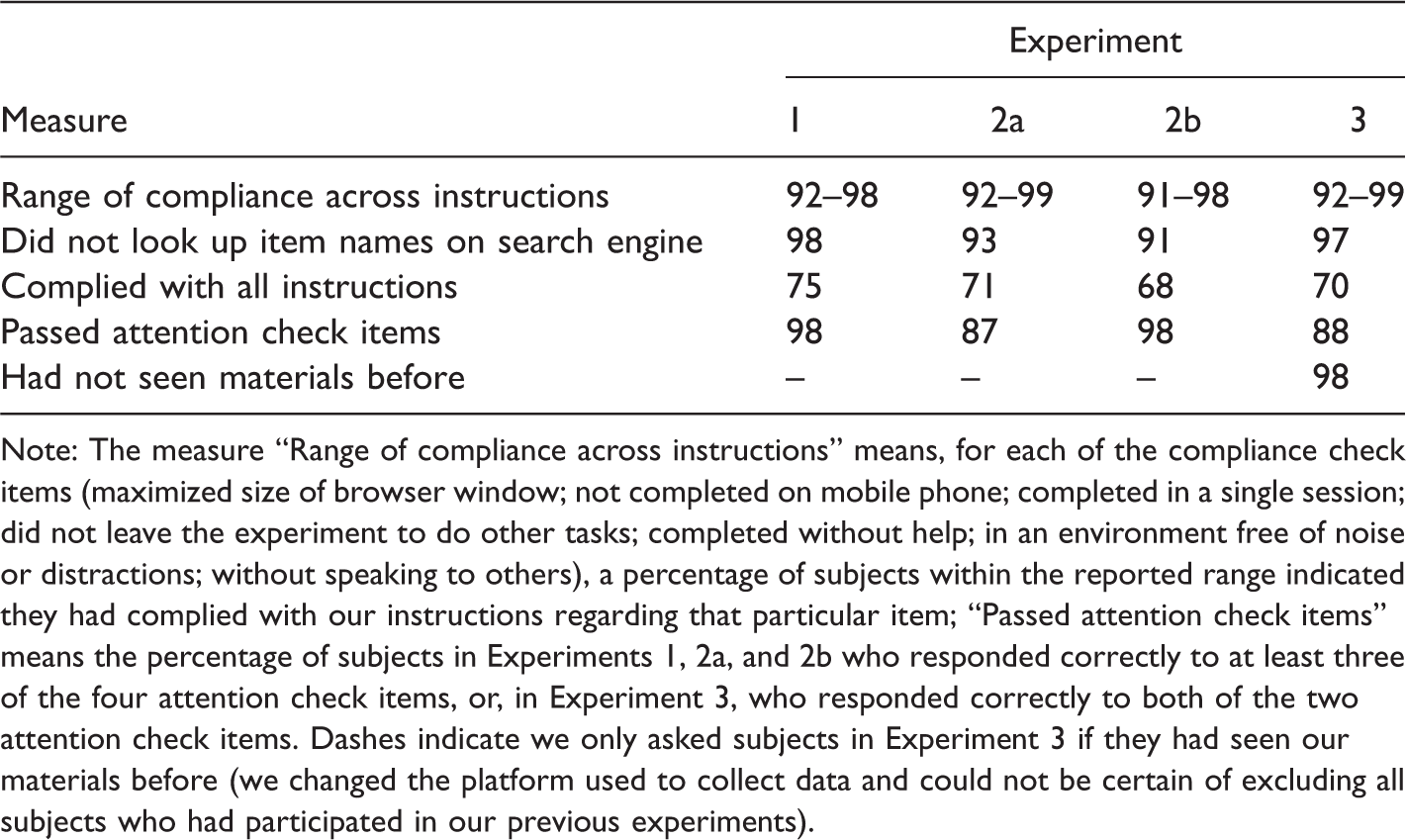
Note: The measure “Range of compliance across instructions” means, for each of the compliance check items (maximized size of browser window; not completed on mobile phone; completed in a single session; did not leave the experiment to do other tasks; completed without help; in an environment free of noise or distractions; without speaking to others), a percentage of subjects within the reported range indicated they had complied with our instructions regarding that particular item; “Passed attention check items” means the percentage of subjects in Experiments 1, 2a, and 2b who responded correctly to at least three of the four attention check items, or, in Experiment 3, who responded correctly to both of the two attention check items. Dashes indicate we only asked subjects in Experiment 3 if they had seen our materials before (we changed the platform used to collect data and could not be certain of excluding all subjects who had participated in our previous experiments).
We now turn to our research question. We first calculated, for each subject, two values: The proportion of the 10 item names they saw presented with a photo for which they chose the response “Easy,” as opposed to the response “Difficult,” and the proportion of the 20 item names they saw without a photo to which they responded “Easy.” Next, we took these values and, for each subject, subtracted one from the other to calculate a photo-no photo difference score. We then took the mean of these difference scores to calculate the overall effect for the presence of a photo.
As predicted, we found that when unfamiliar item names appeared with a related photo, subjects far more often judged it felt easy to retrieve information about those item names, Mdiff = 0.43, 95% CI [0.38, 0.47], dunbiased = 1.75, 95% CI [1.50, 2.01] (also known as Hedge’s g, calculated using the average standard deviation across each condition; see Cumming, 2012). In null hypothesis significance testing (NHST) terms, there was a significant effect of photo, t(189) = 19.04, p < .001.
This experiment demonstrates that, unsurprisingly, retrieving information about unfamiliar item names feels easier when those item names are paired with related photos. Having established a method for reliably creating the experience of fluent, yet voluntary, retrieval of information, our next step was to determine the extent to which having such a fluent experience of retrieval would lead subjects to ascribe other attributes of involuntary retrieval to it.
Experiments 2a and 2b
Recall prior work shows subjects report that some voluntarily retrieved memories come to mind after an effortful and strategic search, whereas others come to mind effortlessly and suddenly (Barzykowski & Staugaard, 2016; Harris et al., 2015; Uzer & Brown, 2017; Uzer et al., 2012). In Experiment 1, we showed that our photo manipulation could push around subjects’ reports of effort. In Experiments 2a and 2b, we sought to show that photos would likewise push around subjects’ reports about their use (or not) of retrieval strategy. The purpose of Experiments 2a and 2b, then, was to determine the extent to which retrieving information fluently leads subjects to judge that the information was retrieved suddenly, rather than after a strategic search—that is, in the manner of an involuntary memory. If we found that subjects tended to report fluent retrievals happened suddenly, it would be further evidence in line with two ideas: One, voluntary memories can have “involuntary” attributes, and two, subjects sometimes make judgments about the attributes of their retrievals on the basis of fluency.
Method
Subjects
A total of 180 MTurkers completed Experiment 2a. These subjects ranged in age from 18 to 74 years, Median = 33, M = 37.14, 95% CI [35.37, 38.91]; 64% identified as female, 36% as male; 94% reported they were U.S. citizens, while 6% reported they were of another nationality; and 98% reported English was their first language, while 2% reported it was not. Similarly, 188 MTurkers completed Experiment 2b. These subjects ranged in age from 18 to 74 years, Median = 32.5, M = 36.06, 95% CI [34.23, 37.90]; 63% identified as female, 37% as male; 93% reported they were U.S. citizens, while 7% reported they were of another nationality; and 98% reported English was their first language, while 2% reported it was not.
Procedure
Experiment 2a followed the same method as Experiment 1, except as noted. We adapted wording from prior work (Uzer et al., 2012), and instructed subjects that As you read each item name, you should try to bring to mind information related to that item. For some items, related information will come immediately to your mind. For other items, related information will not come immediately to mind, and so you will find yourself actively searching for it. For each item name that appears on the screen, your task is to report how this related information came to mind.
Experiment 2b followed the same method as Experiment 2a, except that we added a second factor, manipulating familiarity of item name (unfamiliar, familiar) within subject. Subjects saw a series of 60 item names, in random order, 30 of which were the same unfamiliar item names as before and 30 of which were familiar item names consisting of an adjective and a high frequency noun (see Cardwell et al., 2017). We added this condition because some work suggests that people experience greater feelings of fluency when the target information is unexpectedly easy to process (Unkelbach & Greifeneder, 2013). For example, photos bias judgments more when paired with unfamiliar rather than familiar item names (Cardwell et al., 2017; see also Newman et al., 2012). We therefore expected that, to the extent our subjects based their judgments on a feeling of fluency (rather than, say, the mere presence of a photo), the effect of photos would be smaller when they made judgments about familiar item names.
Results and discussion
Before addressing our research question, we first checked to make sure most subjects had complied with our instructions about experimental conditions and passed our attention checks. As Table 1 shows, they had. Again, in the results that follow, the patterns are the same whether we included or excluded subjects who did not fully comply with these instructions or pass all attention checks; we retained all subjects for analysis.
We now turn to our research question. We first calculated, for each subject in Experiment 2a, two values: The proportion of the 10 unfamiliar “photo” item names for which they chose the response “information came to mind immediately” (hereafter “immediately”) as opposed to the response “information came to mind after actively searching,” and the proportion of the 20 unfamiliar “no photo” item names to which they responded “immediately.” Next, we took these values and, for each subject, calculated a photo-no photo difference score. We then took the mean of these difference scores to calculate the overall effect for the presence of a photo.
As predicted, we found that when unfamiliar item names appeared with a related photo, subjects far more often judged they had retrieved information about those item names immediately, rather than after an active search, Mdiff = 0.39, 95% CI [0.34, 0.44], dunbiased = 1.53, 95% CI [1.29, 1.78]. In NHST terms, there was a significant effect of photo, t(179) = 15.84, p < .001. In other words, by using photos to encourage subjects to experience fluent retrieval, we also encouraged them to report an experience of voluntary retrieval as having attributes of involuntary retrieval.
We performed these same calculations for the “unfamiliar” item names in Experiment 2b, as well as their counterparts for the “familiar” item names. These calculations yielded two mean photo-no photo difference scores: The overall effects for the presence of a photo on judgments about [1] unfamiliar item names and [2] familiar item names.
As predicted, we found that for unfamiliar item names, photos led subjects to far more often judge they had retrieved information about those item names immediately, rather than after an active search, Mdiff = 0.31, 95% CI [0.27, 0.36], dunbiased = 1.13, 95% CI [0.93, 1.34]. But for familiar item names, photos had a weaker effect, Mdiff = 0.08, 95% CI [0.05, 0.10], dunbiased = 0.43, 95% CI [0.29, 0.57]. In NHST terms, there was a significant main effect of photo, F(1, 187) = 169.09, p < .001, a significant main effect of familiarity, F(1, 187) = 951.37, p < .001, and a significant interaction, F(1, 187) = 104.54, p < .001. These results replicate and extend those of Experiment 2a.
Recall that we set out to determine the extent to which retrieving information fluently leads subjects to judge that the information was retrieved suddenly, rather than after a strategic search—in the manner of an involuntary memory. Our results suggest that, indeed, retrieving information fluently often does just that. But of course, these subjects might well be making correct judgments: Information about “photo” items probably does come to mind more easily, and with less searching than information about “no photo” items. And so a critic might rightly charge we still have not demonstrated that subjects would be swayed by an experience of fluency to make incorrect judgments about the hallmark of involuntary retrieval: a lack of intent. We addressed this issue in our final experiment.
Experiment 3
The purpose of this experiment was to determine the extent to which a fluent experience of retrieval leads subjects to judge that the information was retrieved without intention. We preregistered this experiment (see https://aspredicted.org/6xy5t.pdf).
Method
Subjects
A total of 181 MTurkers completed the experiment. These subjects ranged in age from 19 to 72 years, Median = 34, M = 38.27, 95% CI [36.30, 40.24]; 63% identified as female, 36% as male, and 1% as gender diverse; 93% reported they were U.S. citizens, while 7% reported they were of another nationality; and 96% reported English was their first language, while 4% reported it was not.
Procedure
Experiment 3 followed the same method as Experiment 2b, except as noted. We instructed subjects that As you read each item name, you should try to bring to mind information related to that item. For some items, you will bring this related information to mind deliberately, searching for it in a way intended to bring that particular information to mind. For other items, this related information will come into your mind spontaneously, without you intending to bring that particular information to mind. For each item name that appears on the screen, your task is to report how this related information came to mind.
Results and discussion
Before addressing our research question, we first checked to make sure most subjects had complied with our instructions about experimental conditions and passed our attention checks. As Table 1 shows, they had. Once again, in the results that follow, the patterns are the same whether we included or excluded subjects who did not fully comply with these instructions, pass all attention checks, or had seen the materials before; we retained all subjects for analysis.
We now address the purpose of this experiment. We first calculated, for each subject, four values: The proportion of the 10 unfamiliar “photo” item names for which they chose the response “the information came to mind without intent” (hereafter “without intent”) as opposed to “the information was brought to mind intentionally,” the proportion of the 20 unfamiliar “no photo” item names to which they responded “without intent,” the proportion of the 10 familiar “photo” item names to which they responded “without intent,” and the proportion of the 20 familiar “no photo” item names to which they responded “without intent.” Next, we took these values and, for each subject, calculated an “unfamiliar” photo-no photo difference score and a “familiar” photo-no photo difference score. We then took the mean of each of these difference scores to calculate the overall effects for the presence of a photo on judgments about [1] unfamiliar item names and [2] familiar item names.
As predicted, we found that for unfamiliar item names, photos led subjects to more often judge they had retrieved information about those item names without intent, rather than intentionally, Mdiff = 0.12, 95% CI [0.06, 0.17], dunbiased = 0.41, 95% CI [0.22, 0.60]. But for familiar item names, photos had a trivial effect, Mdiff = 0.01, 95% CI [–0.03, 0.06], dunbiased = 0.05, 95% CI [–0.11, 0.21]. In NHST terms, there was a significant main effect of photo, F(1, 180) = 8.13, p = .005, a significant main effect of familiarity, F(1, 180) = 107.01, p < .001, and a significant interaction, F(1, 180) = 25.17, p < .001.
The results of this experiment suggest that when retrieval feels fluent, subjects are more likely to judge that the retrieval occurred without intention. In other words, retrieving information fluently leads subjects to incorrectly report an experience of voluntary retrieval as having attributes of involuntary retrieval—including the hallmark lack of intent.
General discussion
Across four experiments comprising 739 subjects, our results converge on a central finding: Making an experience of voluntary retrieval feel fluent often leads subjects to ascribe involuntary attributes to that retrieval. In Experiment 1, we adopted an established photo manipulation to make subjects experience voluntary retrieval of information as fluent. Next, in Experiments 2a and 2b, we used that manipulation to show that having such a fluent experience of retrieval would lead subjects to judge that the information was retrieved suddenly, rather than after a strategic search, that is, in the manner of an involuntary memory. In Experiment 3, we then showed that such a fluent experience of retrieval would also lead subjects to judge that the information was retrieved without intention—the key distinguishing attribute unique to involuntary memory. What is more, in Experiments 2b and 3, we provided converging evidence for the role of fluency in these judgments by manipulating a factor to vary the size of the photo effect. As a package, these experiments support the conclusion that when subjects intentionally, yet fluently, bring a memory to mind, they may indeed mistakenly judge that memory as “unintended.”
Of course, there are at least two obvious caveats to our conclusion, because we do not know the boundary conditions of this effect. First, we do not yet know the extent to which people base their judgments of “involuntariness” on fluency under other circumstances. But even though our subjects were told to retrieve information, they sometimes reported information came to mind without their intending it—a finding in line with the idea that feelings of fluency are a compelling factor in how subjects judge their prior intent. Indeed, if subjects were able to disregard feelings of fluency and, as instructed, simply judge intent, then we should have seen subjects reported all their retrievals as intentional, and no systematic effect of the photos. Nevertheless, it is possible that people rely less on feelings of fluency in paradigms commonly used to study involuntary memories.
Second, we do not know the extent to which our findings generalize from our study, in which we asked subjects to retrieve “information from memory,” to situations in which we instead ask them to retrieve autobiographical memories. What we do know is that subjects can bring to mind many types of information, such as words and photos (as well as autobiographical memories), either voluntarily or involuntarily (Berntsen, Staugaard, & Sørensen, 2013; Kvavilashvili & Mandler, 2004). Put another way, there is reason to suspect that regardless of what type of information subjects retrieve, they will base their judgments of “involuntariness” in part on fluency. Both these questions—about the circumstances under which people are more or less likely to base judgments about intent on fluency, and about what happens when subjects are specifically asked to retrieve autobiographical memories—are empirical ones and suggest interesting next steps for future research.
Our results fit with a literature showing that voluntarily retrieved memories can come to mind with some “involuntary” attributes (Barzykowski & Staugaard, 2016; Berntsen, 1996, 2009, 2010; Harris et al., 2015; Mace, 2010; Rasmussen et al., 2014; Uzer & Brown, 2017; Uzer et al., 2012). But we extend that literature in two ways. First, we varied the likelihood that voluntarily retrieved information would come to mind with those attributes by manipulating how fluently subjects experienced its retrieval. And second, we demonstrated that subjects would make these fluency-based judgments not only about the effort or strategy which they retrieved information, but also about their very intent to retrieve it. More broadly, this second result also fits with work showing that subjects can incorrectly judge the intentionality of things they do (Kirsch & Lynn, 1995, 1999).
Our results also fit with a literature showing that subjects draw on how fluently they processed a target to make judgments about many attributes of that target (Alter & Oppenheimer, 2009; Schwarz & Clore, 2007; Unkelbach & Greifeneder, 2013). Our findings suggest that subjects similarly draw on fluency when the target is a retrieval, and the attribute being judged is intent. Future work might investigate to what extent subjects draw on fluency to judge other, related attributes. For instance, one could speculate that subjects would be less likely to judge that a memory was “intrusive” on the basis of increased fluency, because feelings of fluency are usually associated with positivity (Cardwell et al., 2017; Schwarz & Clore, 2007).
Taken together, prior work and our work here suggest that retrieval process and effort are not trustworthy signals of intent; experiences of voluntary retrieval comprise a heterogeneous class. They further suggest that, even when subjects are asked to classify their memories on the basis of intent, subjects—at least some of the time—draw on effort, and mistakenly classify some of their voluntary memories as involuntary. At least two implications flow from these suggestions.
The first implication is the possibility that prior work in which subjects classified their own memories as “involuntary” inadvertently examined a mixture of misclassified voluntary memories and true involuntary memories. Such an occurrence would create the dual problems of inflating the reported frequency of involuntary memories, while diluting the reported phenomenological properties that are uniquely pronounced for involuntary memories. These problems would be exacerbated if subjects’ tendency to misclassify their memories interacted with other factors under examination, because differential rates of misclassification could give rise to spurious differences between conditions in an experiment. A second implication is that we need to consider how we operationalize involuntary memories. Ideally, we would develop new ways to define and measure involuntary retrieval that circumvent this possibility of subjects’ misclassification. Alternatively (and perhaps more realistically), if we continue to rely on subjects to judge whether target memories were “unintended,” then we should try to elicit those memories in ways that minimize subjects’ tendency to make those judgments based on fluency. Future work should therefore investigate factors that may increase or decrease this tendency, so that we know how best to move forward as a field.