



Abstract
Despite the pervasive use of computer-mediated communication, relatively little is known about its implications for emotional adjustment. Recent studies suggest that a preference for computer-mediated communication over other types of communication is associated with emotional vulnerabilities, and its active forms (e.g., direct communication) confer psychosocial benefits compared its passive forms (e.g., browsing Facebook). In this study, we simultaneously examined quality, quantity, and preferences for computer-mediated communication in relation to emotional competencies (emotion detection and regulation) and emotional well-being (self-report of mood and anxiety symptoms). In Study 1, participants (N = 123) completed a facial morphing task, a computerized assessment of the speed and accuracy of emotion detection, and the Social Media and Communication Questionnaire assessing quantity and preferences to communicate via computer-mediated communication versus face-to-face. More use of computer-mediated communication along with preferring it for casual communication, was associated with faster and more accurate emotion detection. More use of computer-mediated communication, along with preferring it for positive communication and expressing distress, was associated with more difficulties with emotion regulation. Study 2 (N = 32) added a task-based assessment of active and passive Facebook use in relation to measures of emotional functioning in Study 1. More active Facebook use was associated with greater emotional well-being, whereas more passive Facebook use was associated with less emotional well-being. Active and passive Facebook use was not significantly associated with self-report of broader computer-mediated communication preferences. Together, results suggest that greater use and preference for computer-mediated versus face-to-face communication may be related to heightened emotional sensitivity and more problems with emotion regulation, yet active versus passive use may serve to bolster emotional well-being.
Introduction
The past decade has witnessed an exponential increase in the use of computer-mediated communication (CMC), ranging from social media platforms (e.g., Facebook and Twitter), to digital forms of communication (e.g., texting and instant messaging). Despite the pervasiveness of CMC, its emotional impact remains unclear. In the realm of emotional health and well-being, for example, some evidence suggests that greater CMC use is associated with negative social-emotional outcomes, such as psychosocial distress and social isolation (Caplan, 2003). The American Academy of Pediatrics (O'Keeffe & Clarke-Pearson, 2011) has even proposed that frequent social media use could lead to “Facebook depression.”
While some studies provide support for this negative association (Blease, 2015; Kraut et al., 1998; Stepanikova, Nie, & He, 2010), several studies have found no association between frequency of CMC use and depression among adolescents (Ohannessian, 2009; Primack et al., 2011; Selfhout, Branje, Delsing, ter Bogt, & Meeus, 2009) or adults (Jelenchick, Eickhoff, & Moreno, 2013). Furthermore, CMC use has also been related to positive social-emotional outcomes such as greater connection with friends and family (Kraut et al., 2002), greater levels of extraversion (Ross et al., 2009), increased self-esteem, and decreased loneliness and depressed mood (Shaw & Gant, 2002), suggesting that for some individuals, or in some contexts, CMC may represent a healthy way to meet social-emotional needs through interpersonal connection (McKenna & Bargh, 2000; McKenna, Green, & Gleason, 2002). Given the increasingly ubiquitous presence of CMC in our daily lives (Caplan, 2003), clarifying the impact of CMC on emotional functioning is a crucial research goal, and is the focus of the current studies.
Methodological issues concerning the measurement of CMC have contributed to the gaps in our understanding of the links between CMC and social-emotional functioning (Carpenter, 2012; DeAndrea & Walther, 2011). Much of the extant research has focused on global metrics of CMC, such as number of hours spent using CMC (Paul, Baker, & Cochran, 2012; Wilson, Fornasier, & White, 2010), while neglecting more nuanced factors related to individual differences (DeAndrea & Walther, 2011) including preferences and motivations for using CMC (Babkirk, Luehring-Jones, & Dennis-Tiwary, 2016; Carpenter, 2012).
First, several studies suggest that high levels of emotional expression—both positive and negative—via CMC may have broad negative consequences because the social-emotional feedback provided may lack immediacy resulting in a relatively “impoverished” form of social communication and support seeking (McKenna & Bargh, 2000; Seltzer, Prososki, Ziegler, & Pollak, 2012). Moreover, using CMC to share emotional experiences may reduce opportunities for face-to-face (FTF) social exchanges (Caplan, 2003) or may be used more frequently as a compensatory strategy when an individual has persistently unsatisfying FTF interactions. Yet, prior studies had failed to measure an individual’s motivation or preference for CMC relative to FTF. In contrast, Babkirk et al. (2016) showed that a preference for communicating emotions—especially positive emotions—via CMC rather than via FTF interactions was related to more depressive symptoms and emotion regulation difficulties and to limited and unsatisfying social support in daily life. This highlights that while, in general, social sharing of positive events, termed capitalization (Gable & Reis, 2010), may have broad psychosocial benefits, a preference or exaggerated motivation to use CMC to express positive emotions may not. In this study, we will test whether a CMC preference for social communication, especially positive, is associated with disruptions is emotional functioning.
A second important gap in the research concerns how use of CMC relates to discrete, behavioral components of emotional competence, rather than general self-reported mood and well-being. For example, emotion detection is a key component of emotional competence because this ability to understand, express, and regulate emotions is highly dependent on the foundational ability to discriminate and recognize emotional signals like facial expressions of those around them (Rosenthal et al., 2011). Indeed, detection of emotional content in visual stimuli is particularly relevant when considering engagement with CMC, due to the largely visual nature of social media (e.g., French, 2014; Murray, 2015). Moreover, changes in emotion detection, such as heightened sensitivity to and detection of negative facial expressions, are associated with a range of social-emotional disruptions (Gibb, Schofield, & Coles, 2009; Kirsh, Mounts, & Olczak, 2006). Children (Pollak & Kistler, 2002) and young adults (Hare et al., 2008) who experienced significant early-life stress are more likely to show heightened sensitivity to angry and other negative faces measured by faster identification of facial emotion (Gibb et al., 2009). Exaggerated sensitivity to both negative and positive emotional facial expressions is also characteristic of anxiety disorders (de Jong & Martens, 2007; Mullins & Duke, 2004; Philippot & Douilliez, 2005) and of personality disorders (Bucks, Garner, Tarrant, Bradley, & Mogg, 2008; Rosenthal et al., 2011).
If individuals showing heightened emotional detection also experience more psychosocial distress, they may prefer CMC if it is perceived as less emotionally risky compared to FTF communication (Bargh & McKenna, 2004; Caplan, 2003; Madell & Muncer, 2007; McKenna & Bargh, 1999, 2000). Consistent with this view, adults showing enhanced neurocognitive responses to emotional images also reported preferring CMC over FTF for social communication (Babkirk et al., 2016). No studies to date, however, have examined emotion detection in relation to CMC preferences and use.
A third research gap is that a growing body of evidence suggests that the types of activities in which users engage via CMC contribute to positive and negative social-emotional outcomes. For example, active direct communication (e.g., writing private messages, status updating, searching out specific information) versus passive “consumption” of social information (e.g., viewing photos, reading friends’ conversations) on Facebook is associated with less loneliness, less depressed mood, and more social capital (Burke, Marlow, & Lento, 2010; Tandoc, Ferrucci, & Duffy, 2015), an effect that was confirmed in a direct experimental manipulation of active and passive Facebook use (Deters & Mehl, 2013). Wise, Alhabash, and Park (2010) further found that while passive social browsing, active social searching, and direct message communication described the majority of Facebook time, only active social searching was associated with autonomic indices of emotional positivity and reduced arousal, suggesting a positive emotion regulatory effect (Wise et al., 2010).
Taken together, growing evidence suggests that the use of CMC for social communication and expression of emotions may be associated with worse social-emotional functioning, except if that usage is active. Yet, gaps remain in our understanding of how specific aspects of emotional competence, such as emotion detection and emotion regulation, relate to broad preferences and goals for CMC and relate to patterns of active or passive CMC use.
The current studies
To address these empirical gaps, we report on two studies. Study 1 examined goals and preferences in CMC usage in relation to targeted measures of emotional functioning, including emotion detection. Study 2 examined active versus passive Facebook use in relation to these same measures.
Both studies included the Social Media and Communication Questionnaire (SMCQ) (Babkirk et al., 2016), which asks respondents to report their preferences for meeting communication goals (positive communication, express distress, casual communication) via digital technology versus FTF interactions, consistent with the goal of capturing underlying goals and preferences for using CMC (Pai & Arnott, 2013). We also obtained global measures of CMC similar to methods used in previous research (Paul et al., 2012; Pierce, 2009), including hours of CMC used in a typical week and the variety of CMC applications used, to allow comparison with prior studies (Caplan, 2003; Mehdizadeh, 2010; Nie, 2001; Stepanikova et al., 2010). Both studies also used a facial morphing task (FMT), an approach which has been widely used in social cognition research (e.g. Kessels, Montagne, Hendriks, Perrett, & Haan, 2014) to effectively track subtle individual differences in emotion detection by assessing the speed and accuracy with which facial emotion expressions are identified.
Study 1
While prior research has linked CMC with social-emotional outcomes, we understand little about the role of an individual’s motivation or preference for CMC relative to FTF and how CMC relates to discrete, behavioral components of emotional competence in the form of emotion detection. The goal of Study 1 was to explore whether greater use and preferences for CMC over FTF interactions for social communication—particularly for emotionally-positive communication—would be associated with heightened emotional detection measured via the FMT and with more disruptions in emotion regulation and emotional well-being. The exploratory hypotheses were that greater use and preference for CMC versus FTF would be associated with (1) greater emotion regulation difficulties and reduced emotional well-being and (2) faster and more accurate emotion detection. This is based on the rationale that CMC may provide a low-barrier, low-risk opportunity for social engagement specifically for those with emotional vulerabilities and hightened emotional sensitivity.
Method
Participants
One hundred twenty-three adults (86 females) aged 18 to 47 years (M = 20.07, SD = 4.06) were recruited from an urban university and surrounding community. 1 Racial and ethnic composition of the sample was as follows: 7.3% (n = 9) African-American; 15.4% (n = 19) Hispanic; 28.5% (n = 35) Caucasian; 36.6% (n = 45) Asian; 1.6% (n = 2) Pacific Islander; and 10.6% (n = 13) reported other.
Materials
Emotion detection
The FMT was developed by the researchers (adapted from Kessels, et al., 2014) to measure emotion detection. A visual emotion detection paradigm was used to mirror the visually dominant nature of CMC. Stimuli for the FMT consisted of pairs of neutral and emotional (i.e., angry, fearful, happy, and sad) facial expressions using images taken from NimStim Face Stimulus Set, a standardized stimulus set of actors displaying emotional facial expressions (Tottenham, Borscheid, Ellertsen, Marcus, & Nelson, 2002; Tottenham et al., 2009). In the present study, four actors (two females and two males) were selected for inclusion in the stimuli pairs (01F, 11F, 20M, and 39M). To create each pair, important facial features (i.e., corners of the mouth, nose, and eyebrows) were manually matched on two photographs of the same actor—with the first photograph displaying a neutral expression and the second displaying an emotional expression—and then, a real-time 20-slide morphing sequence of neutral-emotional facial expressions was generated using Morpheus Photo Morpher Standard software (Morpheus Development, LLC; Howell, MI).
In total, the task contained 120 randomly presented trials, consisting of 30 trials for each emotion condition: angry, happy, sad, and fear. On each trial, following a 2500 ms centered fixation cross, participants viewed a neutral facial expression morphing into one of the four types of emotional expressions (Figure 1). Participants were instructed to press the space bar to indicate the moment they detected an emotion in the facial morphing sequence. Each morphing sequence consisted of 20 slides maximum, depending on when the participants responded. Once the participant responded to each morphing sequence, they were then prompted to identify the type of emotion presented as quickly and accurately as possible from a multiple choice list of the four possible emotions. After the subject identified the emotion type, there was an inter-trial interval jittered between 100 ms and 300 ms.

Example of trials from the facial morphing task. Trials begin with a fixation 2500 ms fixation cross, followed by a displaying of a neutral facial expression that is morphed into an emotional expression.
Two scores were generated as indices of FMT task performance: (1) accuracy: refers to the number of trials wherein the emotion was correctly identified and (2) latency: refers to the mean slide within the morphing sequence (slides 1–20) in which correct responses were made.
CMC use and preferences
The SMCQ (Babkirk et al., 2016) is a 27-item questionnaire which assesses participants’ preferences to accomplish social communication goals via CMC (e.g., Facebook updates, text messages, blogging) or FTF interactions (including video chat online that occurs in real time but excludes phone calls) over the past six months. Communication preferences are assessed on a Likert-type scale ranging from 1 (Only CMC & Never FTF communication) to 7 (Never CMC & Only FTF communication). Scores correspond to a preference for FTF communication relative to a preference for online communication, with scores greater than four indicating a stronger FTF preference and scores less than four indicating a stronger CMC preference. Thus, due to the scale structure, negative correlations with CMC preference scales would indicate a greater association with a preference to communicate via CMC.
The SMCQ consists of three subscales: Positive Communication (e.g., get to know people, keep in touch with people), Expressing Distress (e.g., communicate worry, have a disagreement), and Casual Communication (e.g., communicate interest, communicate boredom). All three scales showed acceptable to good internal consistency (α = .70 to .86).
In addition, participants were asked to report the frequency with which they spend interacting via CMC and FTF on a weekly basis, as well as the number of social media sites frequently used. Participants also reported the overall number of people available to them for social support, as well as their satisfaction with the quality of that social support. These scales pertaining to frequency of use and social support were structured such that greater values indicate more use and greater support, respectively.
Emotion regulation and emotional well-being
A battery of self-report questionnaire measures was used to assess various aspects of social-emotional functioning, including measures of depression, anxiety, and emotion dysregulation.
Difficulties in Emotion Regulation Scale
The Difficulties in Emotion Regulation Scale (DERS) is a 41-item questionnaire that measures the degree to which emotion dysregulation typically impacts an individual (Gratz & Roemer, 2004). Participants responded to each item on a 1 (Almost Never) to 5 (Almost Always) Likert-type scale indicating the frequency with which these emotional difficulties are present currently. The DERS yields a total score as well as scores on six subscales indexing problems in various aspects of emotion regulation, including nonacceptance of emotional responses, inability to engage in goal-directed behavior, poor impulse control, lack of emotional awareness, lack of accessibility to effective emotion regulation strategies, and lack of emotional clarity. Higher scores reflect greater levels of emotion dysregulation.
Beck Depression Inventory
The Beck Depression Inventory (BDI) is a 21-item questionnaire that broadly measures symptoms of depression (Beck, Steer, & Brown, 1996). For each item, participants are instructed to respond with the statement that best describes their subjective experience over the past two weeks using a Likert-type scale. Each item is summed to yield a composite index of one’s current level of depression, with higher scores indicating greater depressive symptom severity.
State Trait Anxiety Inventory
The State Trait Anxiety Inventory (STAI) is a 40-item questionnaire that assesses state (20 questions) and trait (20 questions) anxiety symptom severity (Spielberger, 1983). Respondents are asked to indicate the degree to which each statement reflects how they feel right now and in general using a Likert-type scale ranging from 1 (Not at all) to 4 (Very much so). The STAI yields total scores on two scales: State Anxiety (STAI-State) and Trait Anxiety (STAI-Trait).
Big Five Inventory
Participants completed a 44-item version of the Big Five Inventory (BFI), a self-report measure of personality traits (John, Donahue, & Kentle, 1991). Two scales were included in analyses which represent traits linked to psychosocial functioning (John & Srivastava, 1999), rated on a five-point scale: Extraversion (reflecting sociability, assertiveness, emotional expressiveness, and excitability) and Neuroticism (reflecting emotional instability, moodiness, irritability, anxiety, and sadness).
Procedure
After consent procedures, participants completed the computer-based FMT for 15 to 20 minutes. Participants sat approximately 65 cm away from a 17″ IBM computer monitor, on which, stimuli were presented using E-Prime version 2.0 (Psychological Tools; Pittsburgh, PA). They were read the following directions out loud: For this task, you will see images of neutral faces that are morphing into a face that expresses an emotion. As soon as you can identify what emotion is shown, please press the spacebar. Then, a screen will appear asking you which emotion you saw. Try to respond as quickly as you can, but also as accurately as possible. Do you have any questions?
Results
Descriptive statistics
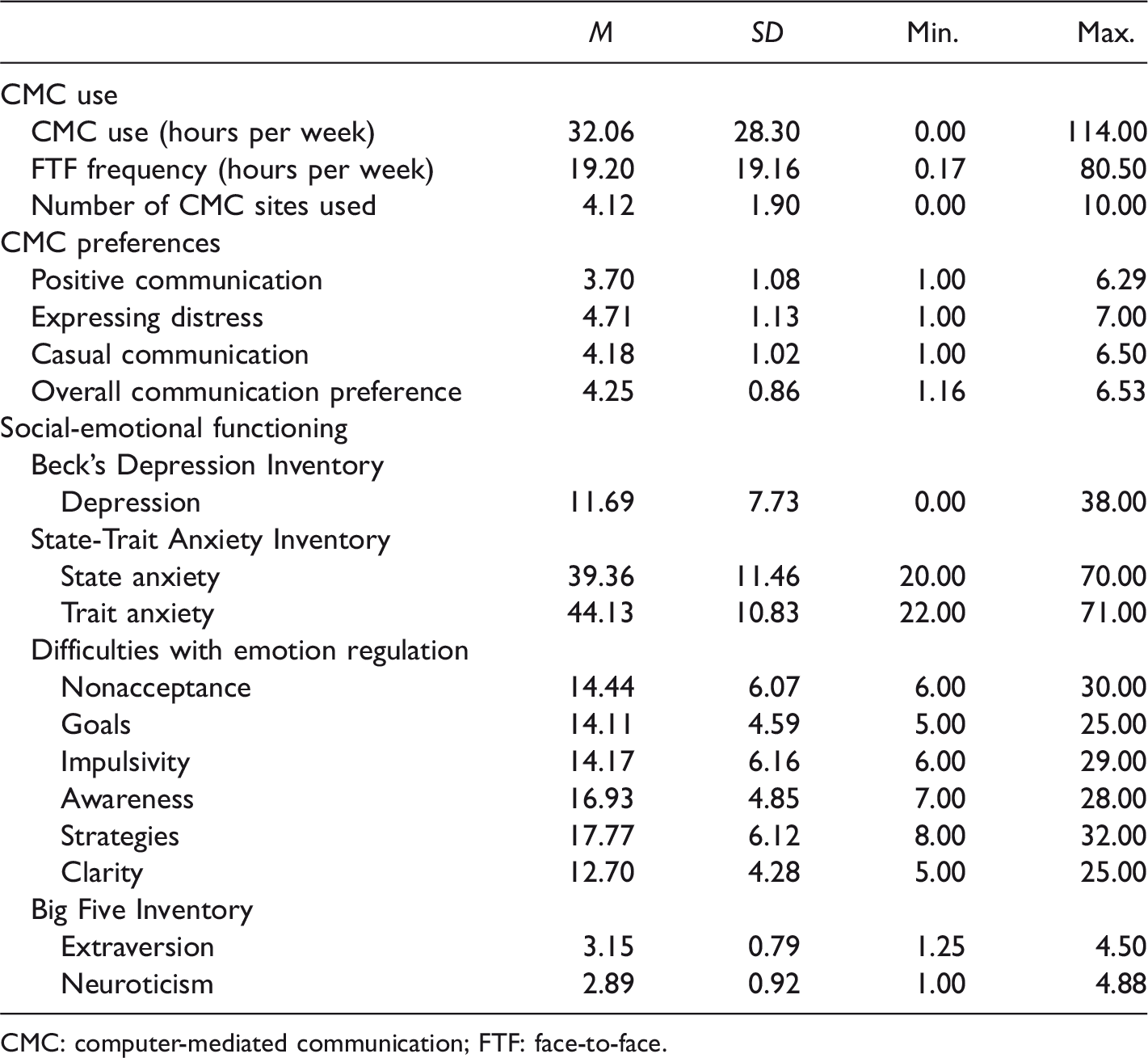
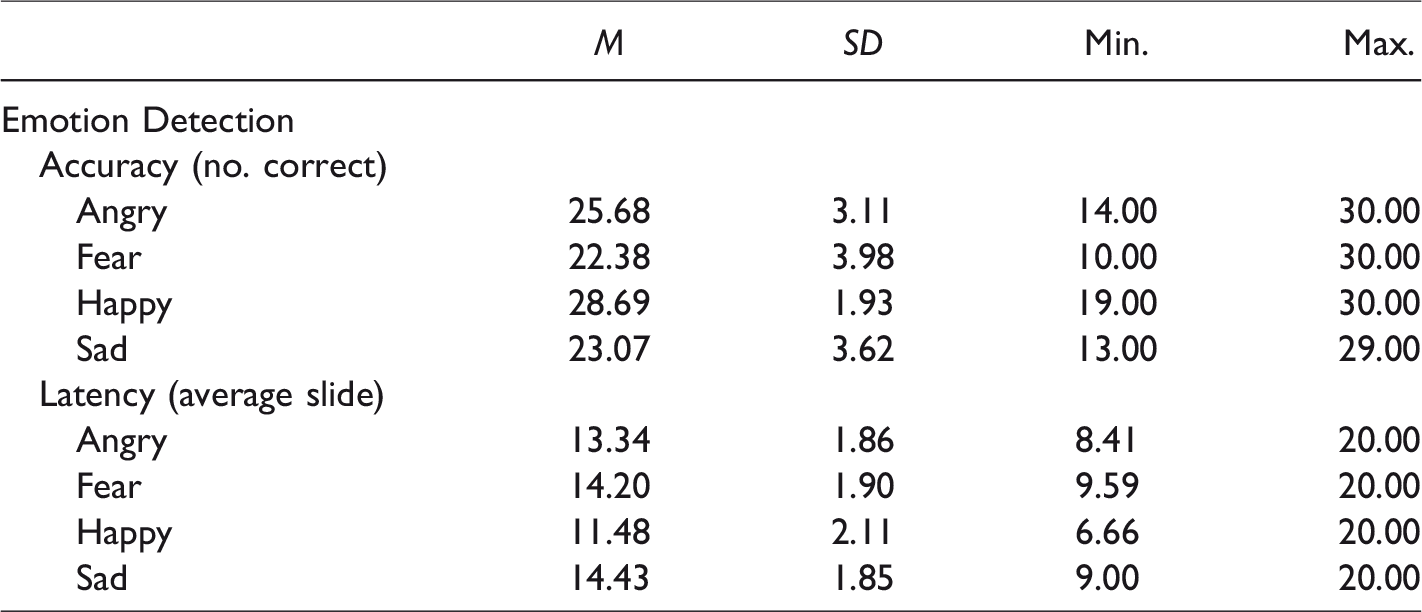
Means, standard deviations, and ranges for all study variables are summarized in Tables 1 and 2.
Descriptive statistics for Study 1 CMC and social-emotional variables.
CMC: computer-mediated communication; FTF: face-to-face.
Descriptive statistics for Study 1 facial morphing task variables.
Age
To explore whether there were any age differences on all of the primary variables of interest (i.e., those related to social media use and preferences and performance on the FMT), bivariate correlations were conducted. Greater age was related to slower latency to detect fear (r = .20, p = .03) and sad (r = .21, p = .02) faces. Older participants reported using social media less frequently (r = −.18, p = .04), and also socializing FTF less frequently (r = −.26, p = .004) each week. No other correlations with age reached significance for any of the remaining SMCQ variables.
Gender
Gender differences were also investigated in all of these same primary variables using independent samples t-tests. 2 Compared to males, females reported using more social media sites (M = 4.42, SD = 2.01 vs. M = 3.43, SD = 1.42), t(94.59) = −3.09, p = .003; spending more time using social media (M = 37.25, SD = 30.39 vs. M = 19.99, SD = 17.91), t(109.34) = −3.92, p < .001; and engaging in FTF interactions more frequently (M = 21.64, SD = 20.95 vs. M = 13.53, SD = 12.68), t(107.45) = −2.64, p = .01. No other gender differences reached significance for any of the FMT variables or remaining SMCQ variables.
Since gender was unevenly distributed in this sample, with significantly more females compared to males, and gender was also related to social media use patterns, this variable was included as covariates in subsequent analyses.
Emotion detection
We also conducted partial correlations to control for gender while examining associations among indices of emotion detection. Accuracy was not significantly correlated with latency, regardless of the emotion condition, suggesting independence between these FMT metrics of emotion detection (all p’s > .10). Significant positive correlations were found among all of the accuracy variables (all p’s < .05) and among all of the latency variables (all p’s < .001).
CMC use and preferences
We conducted partial correlations to control for gender while examining associations among CMC use and preference variables and among indices of emotion detection. Regarding quantity of CMC use, those who reported using a greater number of social media sites engaged in CMC more often each week (r = .412, p < .001). Regarding preferences to use CMC over FTF communication, greater time spent using social media per week was related to a greater preference to use CMC for positive social communication (r = −.189, p = .038). In contrast, there was no significant correlation between time spent using CMC or number of social media sites used and time spent engaging in FTF communication (p’s > .10). No other association between CMC use and the preference subscales (i.e., expressing distress and casual communication) reached significance.
CMC preferences were related to aspects of social support in daily life. Greater preference to use CMC overall was related to fewer people available for social support (r = .182, p = .046), whereas a greater CMC preference for positive communication was related to lower levels of satisfaction with social support (r = .189, p = .037).
Summary
In summary, greater CMC use frequency was related to more social media sites used and linked to a greater preference to use CMC versus FTF for positive communication. Also, greater CMC use and preference to use CMC for positive communication was linked with unsatisfactory social support. Importantly, CMC use and FTF communication frequency were not significantly correlated, suggesting that these scales index aspects of communication habits that go beyond just general patterns of sociability.
Main analyses
We tested the hypothesis that greater preference to use CMC over FTF interactions for social communication—particularly positive social communication—would be associated with heightened emotional detection measured via the FMT (shorter latencies and greater accuracy) and reduced emotion regulation ability and emotional well-being.
We took two analytic approaches. First, we conducted a series of linear regressions with gender entered as a covariate, and CMC use variables (e.g., frequency of use; number of social media sites) as the predictors, separately for each outcome variable. Second, we conducted analyses of covariance with communication preference group (CMC preference versus FTF preference, separately for each subscale) as the between-subject variable, and gender as a covariate, separately for each outcome variable. We did not quantify CMC preference on a continuum because the subscales (positive social communication, expressing distress, casual communication, and overall communication preference) included natural dividing points (score of 4 indicating no preference), and variance was low (mean coefficient of variation = 0.16) 3 among respondents on either side of this dividing point. Thus, CMC preference subscales were treated as categorical such that participants with scores above 4 were assigned to the FTF preference group, and those with scores below 4 were assigned to the CMC preference group.
To control for multiple comparisons in each section later, the Benjamini-Hochberg (B-H) correction (Benjamini & Hochberg, 1995) was applied. This procedure involves ranking p values and takes the number of tests conducted in each family (e.g., CMC use compared to all ER subscales) into account. Although the B-H correction is less stringent than other more commonly used corrections for multiple comparisons (e.g., Bonferroni correction), it is recommended for exploratory investigations to avoid missing potentially important effects with over-stringent correction. All p values reported below are raw, and were significant using a false discovery rate criterion of 0.20, which is recommended for exploratory analyses (Benjamini & Hochberg, 1995). Based on these parameters, raw p values less than approximately .097 were considered significant.
CMC and emotion detection
CMC use
More time spent using CMC was related to faster identification of happy (β = −.231, t(120) = −2.505, p = .014), fearful (β = −.157, t(120) =−1.678, p = .096), angry (β = −.170, t(120) = −1.815, p = .072), and sad (β = −.227, t(120) = −2.487, p = .014) faces. There were no significant associations between CMC use and emotion detection accuracy.
CMC preferences
For positive communication, participants with a CMC preference showed lower accuracy for fearful faces (M = 21.95, SD = 4.19) compared to those who preferred FTF (M = 23.19, SD = 3.47), F(1, 120) = 2.830, p = .095, ηp2 = .023. In contrast, those who preferred CMC versus FTF for casual communication were significantly more accurate (M = 22.97, SD = 4.02 vs. M = 21.75, SD = 3.87) to identify fearful faces, F(1, 120) = 2.883, p = .092, ηp2 = .023. In addition, those who preferred CMC for casual communication were significantly faster to identify all emotional faces compared to participants who preferred FTF communication (see Figure 2; happy (M = 11.14, SD = 2.20 vs. M = 11.48, SD = 2.11), F(1, 120) = 3.116, p = .080, ηp2 = .025; fearful (M = 13.84, SD = 1.81 vs. M = 14.60, SD = 1.93), F(1, 120) = 4.686, p = .032, ηp2 = .038; angry (M = 12.95, SD = 1.94 vs. M = 13.77, SD = 1.66), F(1, 120) = 5.919, p = .016, ηp2 = .047; and sad (M = 14.05, SD = 1.90 vs. M = 14.83, SD = 1.72), F(1, 120) = 5.016, p = .027, ηp2 = .040). There were no significant associations between a CMC preference for expressing distress and emotion detection.
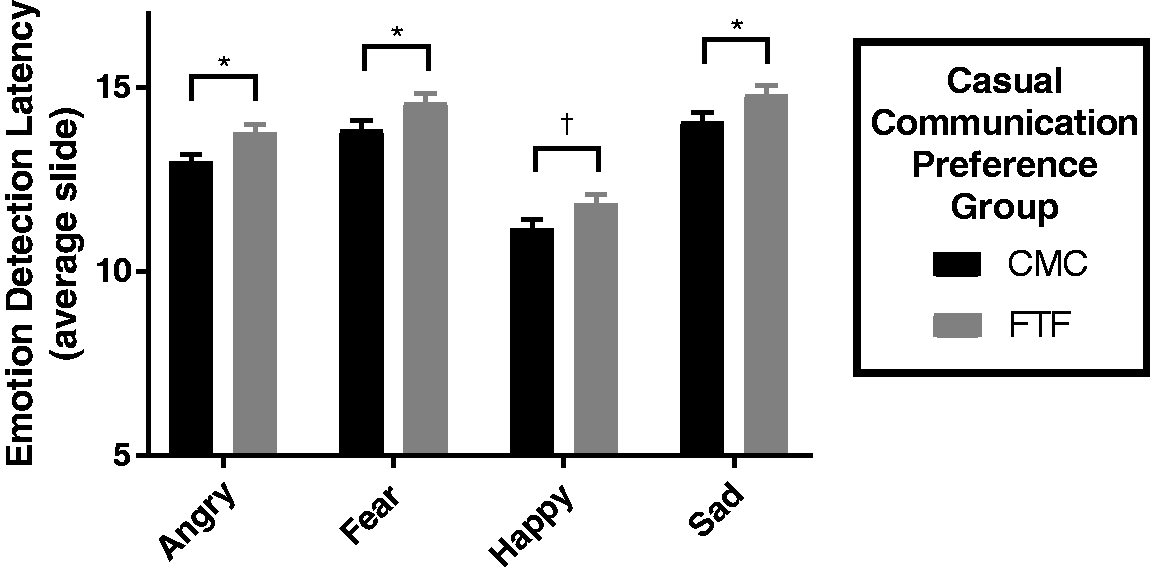
Those with a CMC preference for casual communication showed faster detection of all emotional face types compared to those with a FTF preference for casual communication. †p < .10; *p < .05.
CMC and emotion regulation and emotional well-being
CMC use
Utilization of more social media sites was associated with greater lack of emotional clarity (β = .205, t(120) = 2.272, p = .025). More frequent CMC use was also related to greater lack of emotional clarity (β = .227, t(120) = 2.494, p = .014), as well as, more nonacceptance of emotional responses (β = .177, t(120) = 1.937, p = .055), greater lack of emotional awareness (β = .166, t(120) = 1.786, p = .077), and overall greater emotion regulation difficulties (β = .155, t(120) = 1.688, p = .094).
CMC preferences
CMC versus FTF preferences for communicating emotions were related to a range or ER difficulties and vulnerabilities. Individuals with an overall CMC preference (M = 12.78, SD = 7.50) reported greater difficulties with emotional awareness compared to those with an overall FTF preference (M = 9.67, SD = 7.84), F(1, 120) = 3.445, p = .066, ηp2 = .028 (Figure 3, top).

A CMC versus FTF preference was related to a range of emotional difficulties. Individuals with an overall CMC preference reported greater difficulties with emotional awareness compared to those with an overall FTF preference (top). More specifically, those with a CMC preference for positive communication reported greater depression (bottom, left). Finally, those with a CMC preference for expressing distress reported greater difficulties with awareness of emotions (bottom, right).
More specifically, those with a CMC preference for positive communication reported greater depression (M = 12.78, SD = 7.50 vs. M = 9.67, SD = 7.84), F(1, 120) = 3.445, p = .066, ηp2 = .028 (Figure 3, bottom left); more difficulties with nonacceptance of emotions (M = 15.22, SD = 6.28 vs. M = 13.01, SD = 5.44), F(1, 120) = 2.892, p = .092, ηp2 = .024; higher levels of impulsivity (M = 14.94, SD = 6.34 vs. M = 12.74, SD = 5.62), F(1, 120) = 3.447, p = .066, ηp2 = .028; and greater emotion regulation difficulties overall (M = 106.20, SD = 24.91 vs. M = 97.29, SD = 23.90), F(1, 120) = 2.868, p = .093, ηp2 = .023, compared to those who preferred FTF for positive communication.
Finally, those with a CMC preference for expressing distress reported greater difficulties with awareness of emotions (M = 18.43, SD = 4.36 vs. M = 16.26, SD = 4.93), F(1, 120) = 5.647, p = .019, ηp2 = .045 (Figure 3, bottom right) and using emotion regulation strategies (M = 19.21, SD = 6.57 vs. M = 17.13, SD = 5.84), F(1, 120) = 3.082, p = .082, ηp2 = .025, compared to those who preferred FTF communication for expressing distress.
Summary
CMC use and preferences were significantly related to emotion detection. While more time spent overall using CMC was related to faster emotion detection, preferences for CMC versus FTF to communicate revealed more nuanced patterns of association: Greater CMC preference for positive communication was linked to reduced accuracy for fearful face detection, while a CMC preference for casual communication was related to greater accuracy for fearful faces. Furthermore, CMC preference for casual communication was related to faster detection of all emotional face types.
CMC use and preferences were also related to emotion regulation ability and emotional well-being. Overall, greater CMC use was linked to greater emotion dysregulation. Similarly, a preference for CMC versus FTF for positive social communication and expressing distress were related to more difficulties with emotion regulation.
Discussion
Taken together, results of Study 1 partially support our exploratory hypotheses. Specifically, findings suggest that a stronger preference for and more frequent use of CMC are associated with reduced emotional well-being, namely, difficulties with emotion regulation, as well as heightened emotional sensitivity, namely faster emotion detection. Although no causal inferences can be made, these findings suggest that those with heightened sensitivity to emotional cues may be drawn to CMC due to low-barrier opportunities to elicit engagement from others and reduced immediate burden of processing the emotions of others and themselves. These are important hypotheses to test in future, experimental research.
Furthermore, this study was an exploratory initial step toward identifying patterns of links between CMC and emotion detection, and in future, more stringent hypothesis-driven work should aim to replicate and clarify these findings. For instance, while a CMC preference for casual communication was linked to heightened emotion detection speed across all emotions, accuracy was only enhanced for fearful faces. This demonstrates the independence of speed and accuracy measures of emotion detection. This is important because prior studies of emotional sensitivity and reactivity (e.g., de Jong & Martens, 2007; Gibb et al., 2009) highlight the clinical relevance of speed of detection rather than accuracy. Interestingly, while CMC preferences for casual communication showed the strongest associations with emotion detection measures, these preferences were not significantly associated with self-report of emotion regulation difficulties. Although this may be in part due to method variance, this points to the need for further examination of the links among measures of CMC preference, use, emotional sensitivity and well-being.
An important limitation to this study was that specific types of CMC activity were not measured. For example, prior studies (Wise et al., 2010) demonstrate that lab-based assessment of behavior during social media use provides granular information about whether CMC use is active versus passive. Study 2 added this method.
Study 2
While preferences for CMC versus FTF communication were linked to greater emotional reactivity and reduced ER ability in Study 1, it is unclear whether the specific active and passive activities in which users engage are related to CMC preferences, and how they are associated with specific aspects of emotional competence such as emotional detection. To build upon the findings of Study 1, Study 2 included a subset of Study 1 participants who completed a task-based measure of social media use in which they accessed their Facebook accounts in the lab and tracked the use of active (e.g., communication) and passive (e.g., browsing) activities during a browsing session.
Since previous studies have shown that active CMC relates to positive adjustment (Kowert, Domahidi, & Quandt, 2014; Pea et al., 2012), we hypothesized that a greater percentage of time spent on active Facebook activities will be associated with greater emotional well-being and adaptive emotion regulation, while the opposite pattern will be observed for passive Facebook activities. Second, we explored whether greater engagement in active versus passive Facebook activities would be associated with heightened emotion detection in the FMT. The exploratory hypothesis was that a greater percentage of time spent on active Facebook activities will be associated with greater emotion detection speed and accuracy, while the opposite pattern will be observed for passive Facebook activities. This was based on the rationale that if individuals with enhanced emotional sensitivity use CMC as a tool to regulate their emotions (Babkirk et al., 2016), they may also be using Facebook in a variety of ways to actively seek social support.
Method
Participants
Thirty-two 4 (20 female) individuals were recruited from an urban university and surrounding community and compensated either course credit or $25 for their participation. Five participants were excluded from analyses for Study 2 since they did not have a Facebook account and therefore could not complete the task-based observation of Facebook activity. Thus, 27 adults (17 females) aged 18 to 47 years (M = 22.93, SD = 6.16) were included in analyses. Racial and ethnic composition of the sample was as follows: 48.1% (n = 13) Asian, 29.6% (n = 8) Caucasian, 11.1% (n = 3) Hispanic, 7.4% (n = 2) African-American, and 3.7% (n = 1) who identified as “Other”.
Materials
Emotion detection
Participants completed the same FMT described in Study 1, as a measure of emotion detection. Again, two scores were generated as indices of FMT task performance: (1) accuracy: refers to the number of trials wherein the emotion was correctly identified and (2) latency: refers to the mean slide within the morphing sequence (slides 1–20) in which correct responses were made.
Facebook browsing task
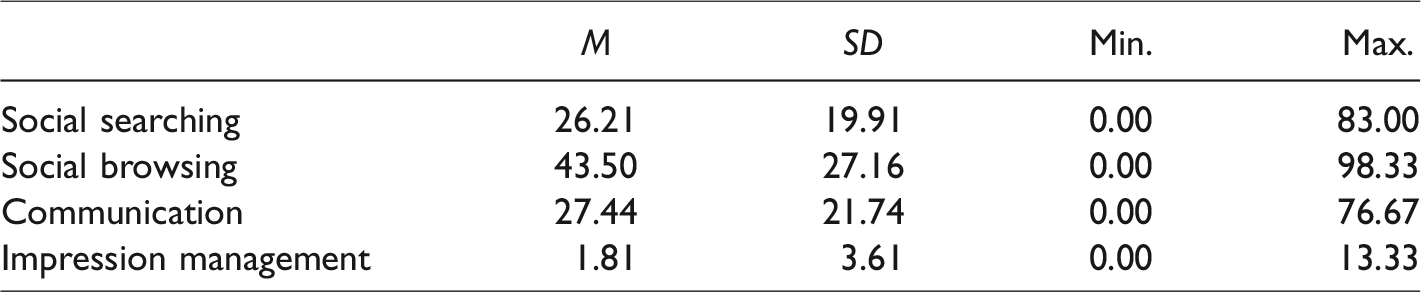
At three time-points (beginning, middle and end) over the course of the 3-hour lab visit, participants were asked to browse their Facebook page as they normally would (without leaving the website) for 5 minutes. After each browsing period, participants were asked to indicate the percentage of time spent on specific Facebook activities using a checklist of items based on Facebook activities described by Wise et al. (2010). Each activity fit into one of four categories: Social searching (e.g., reading a friend’s wall posts, going through a friend’s photo albums), social browsing (e.g., looking at the news feed, looking at fan pages), communication (e.g., sending messages to a friend, posting on a friend’s wall), and impression management (e.g., updating your Facebook status, tagging or un-tagging photos). For participants who did not have an activated Facebook account (N = 5), this task was skipped. Average percent of time spent in each category across all three browsing periods was calculated and used in analyses later.
CMC use and preferences
Social Media and Communication Questionnaire
Participants completed the same SMCQ (Babkirk et al., 2016) described in Study 1.
Emotion regulation and emotional well-being
Participants completed the same measures described in Study 1, which include the following: DERS (Gratz & Roemer, 2004); STAI (Spielberger, 1983); BDI (Beck et al., 1996); BFI (John et al., 1991).
Results
Descriptive statistics
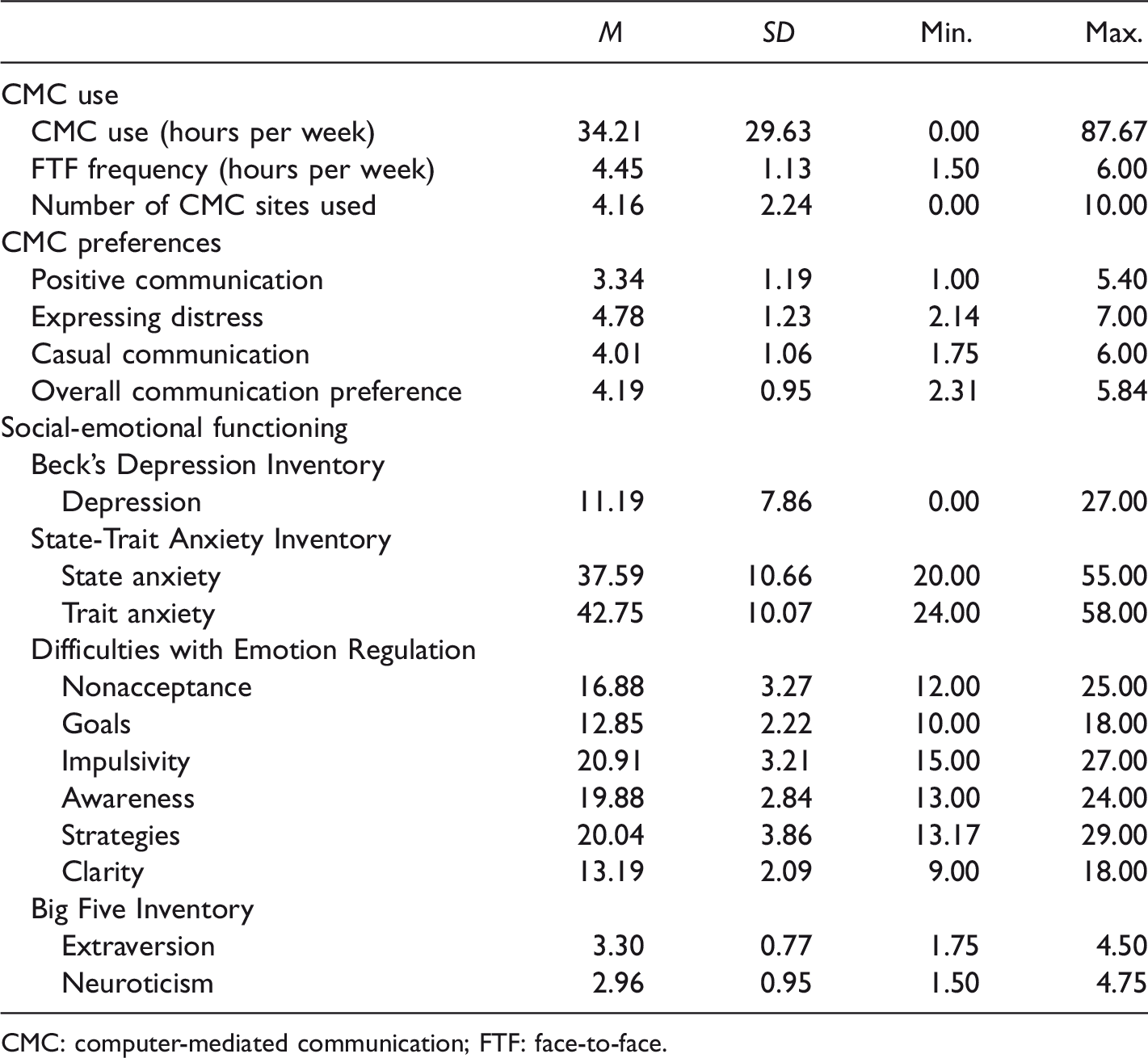
Means and standard deviations for CMC measures (Facebook task, CMC preference, and amount of use) are presented in Tables 3 and 4. No gender, race/ethnicity, or age differences emerged for average percentage of time spent on the various activities during the Facebook Browsing Task. Since gender proportions remained uneven for this subsample, gender was entered as a covariate in all analyses reported later.
Descriptive statistics for Study 2 CMC and social-emotional variables.
CMC: computer-mediated communication; FTF: face-to-face.
Descriptive statistics for study 2 Facebook browsing task variables.
Associations between active and passive Facebook activity and CMC preferences
Patterns of Facebook activity during the lab visit were not related to self-reported preferences for communicating via CMC versus FTF (p’s > .10), indicating that this single-time-point, lab-based procedure indexed aspects of CMC use distinct from self-report of overall preferences.
Main analyses
First, we tested the hypothesis that percentage of time spent on active (e.g., communicating) versus passive (e.g., browsing) Facebook activities will be associated with more adaptive social-emotional functioning. Second, we explored patterns of activities during the Facebook Browsing Task in relation to emotion detection as measured by the FMT. We conducted a series of linear regressions with gender as a covariate, Facebook activity engagement as predictors, and emotion detection, emotion regulation ability, and emotional well-being as the outcome variables. Since some activities were engaged in by fewer than 25% of participants within each session (T1–T3), Facebook activities were examined as averages across the three sessions. As in Study 1, to control for multiple comparisons in each section below, the Benjamini-Hochberg (B-H) correction (Benjamini & Hochberg, 1995) was applied.
Facebook browsing task and emotional well-being
As predicted, active (communication) compared to passive (social browsing) Facebook activities were associated with more adaptive social-emotional functioning. Specifically, greater percentage of time spent in communicating was associated with more positive self-reported well-being (Figure 4, top) as evidenced by lower levels of state anxiety (β = −.441, t(120) = −2.429, p = .023), trait anxiety (β = −.340, t(120) = −1.802, p = .084), and neuroticism (β = −.406, t(120) = −2.321, p = .029). In contrast, a greater percentage of passive social browsing (Figure 4, bottom) was associated with less satisfaction with social support (β = −.308, t(120) = −2.016, p = .055) and greater neuroticism (β = .319, t(120) = 1.799, p = .085); and greater impression management was related to greater difficulties with nonacceptance of emotions (β = .428, t(120) = 2.350, p = .027).

A greater percentage of time spent communicating was associated with more positive well-being including lesser trait anxiety and neuroticism (top), while a greater percentage of passive social browsing (bottom) was associated with more negative well-being, namely low satisfaction with social support and greater neuroticism. Note that partial regression plots represent associations between variables with gender entered as covariate.
Facebook browsing task and emotion detection
A greater percentage of time spent on passive social browsing was related to reduced accuracy for detection of sad faces (β = −.557, t(120) = −3.309, p = .003). A greater percentage of time spent on active social searching was related to greater accuracy for sad faces (β = .484, t(120) = 2.693, p = .013) but reduced accuracy for fearful faces (β = −.464, t(120) = −2.539, p = .018). No other correlations reached significance.
Discussion
Results of Study 2 showed that active versus passive CMC use was associated with emotional strengths and vulernerabilities, respectively. Using a novel combination of task- and report-based methods, results, though correlational, lay the groundwork for future research examining the potential for CMC to both support and detract from social-emotional adjustment and emphasize the critical importance of using specific, rather than global, measures of CMC.
In the Facebook browsing task, as predicted, a greater percentage of time spent in active Facebook activities such as sending messages to a friend or posting on a friend’s wall were associated with greater emotional well-being including reduced anxiety and neuroticism. In contrast, a greater percentage of time spent in passive social browsing or impression management was associated with social-emotional vulnerabilities including less satisfaction with social support and greater emotion regulation difficulties. These correlations support the hypothesis that more active communication in social media like Facebook reflects a pattern of use that is more likely to reap the emotional benefits of increasing social connection. This interpretation is bolstered by previous findings showing that experimentally increasing Facebook status updates—an active communication strategy—reduced loneliness (Deters & Mehl, 2013) due to deepened feelings of connection.
Such findings help to explain why in our study, more passive social browsing—which is less likely to promote feelings of connection—was a more frequent activity of those who were less satisfied with their current social supports and endorse more emotionally negative and unstable thoughts and emotions. Although exploratory, we also found associations between behavior during the Facebook browsing task and emotion detection, partially supporting our predictions. Passive browsing was associated with less accurate detection of sad faces, whereas active social searching was associated with more accurate detection of sad faces but less accurate detection of fear faces. This finding suggests that those who engaged in passive Facebook activities may selectively withdraw from emotions related to sadness and vulnerability, whereas those who tend to be more active Facebook users may selectively withdraw from social signals of threat and fear. Thus, social-affiliative strengths may be related to active versus passive Facebook use, with active engagement in particular, reflecting an attempt to connect with others. It is relevant to note that, contrary to predictions, Facebook active and passive use was not related to the speed of emotion detection, which has most often been linked to risk, vulnerabilities, and problems with emotional adjustment (e.g., de Jong & Martens, 2007; Gibb et al., 2009; Pollak & Kistler, 2002). Thus, active and passive CMC use may be more closely related to social-affiliative motivations rather than emotional well-being broadly defined.
Several issues should be considered when interpreting results of Study 2 given that this behavioral task only targeted Facebook use. While Facebook is the single most popular social networking application, implementation of a wider range of CMC applications (e.g., instant messaging or photo-sharing applications like Snapchat or Instagram) may have revealed distinct patterns of results. Furthermore, this study targeted type of Facebook browsing reported by participants and did not independently measure spontaneous moments when participants would have chosen to use Facebook on their own, which could have reduced ecological validity of the measure. Finally, the relatively small sample size not only limits the conclusions that can be drawn from the results of Study 2 specifically but also attests to the strength of the association detected between specific goals of Facebook use and individual differences in emotional competencies.
General discussion
Taken together, findings from both studies provide a further step toward understanding links between CMC use and emotional competencies and well-being. Although hypotheses were exploratory and only partially supported, the multi-method approach used is a strength of this study and also allowed us to examine how distinct measures of CMC use and preferences did (and did not) converge. For example, actual use of Facebook within a single lab visit was not correlated with overall patterns of CMC preferences and goals, suggesting the need for longitudinal assessments to track patterns of use and preference and how they might change or remain stable over time. While we had no direct evidence that CMC was used to support emotion regulation attempts, it was telling that those with more emotional vulnerabilities evidenced a preference for CMC. As previously suggested, CMC may present inherently fewer social-emotional risks compared to FTF interactions (Bargh & McKenna, 2004; Madell & Muncer, 2007; McKenna & Bargh, 1999, 2000) and thus provide an appealing outlet for emotional expression and seeking of social support. Individual differences in the potential costs and benefits of using CMC for social and emotion regulatory support is a crucial question for future research to address.
There were several limitations in both studies. First, Study 2 consisted of a subsample of Study 1, which precludes any assertions about replication of results across these studies. Coupled with the small Study 2 sample size, this limitation underscores that the current findings should be interpreted as largely exploratory and as a foundation for future research. Furthermore, the current sample consisted of considerably more women than men, likely due to the disproportional gender distribution in the psychology undergraduate population at the institution where data were collected. However, despite gender differences regarding CMC use frequency in the current sample, the patterns of association among the main variables of interest (CMC use, emotion detection, and social-emotional vulnerabilities) remained significant even when gender was entered as a covariate. This suggests that patterns of CMC use are related to emotion detection and well-being beyond the variability in these domains introduced by gender differences.
Future research should use experimental paradigms to examine whether CMC use and goals causally influence social-emotional functioning and to include measures reflecting competencies in the context of CMC (e.g., accuracy of emotional text interpretation). Also, while links emerged between CMC use and emotion regulation difficulties, emotionally functioning in the current sample was within the typical range. Future studies should also target individuals with clinically relevant emotion regulation difficulties to examine how CMC use may be either detrimental to emotion well-being or a tool they employ to help overcome potential regulatory deficits.
It will also be important for future studies to utilize experimental and longitudinal designs to better tease apart whether patterns of CMC use have a causal effect on adjustment, whether an individual’s social-emotional well-being determines how CMC is used to meet key our social needs and goals, and/or whether CMC use patterns and social-emotional vulnerabilities are mutually reinforcing. Examination of emotion regulation difficulties in clinically anxious individuals would also provide an important opportunity to assess how CMC use may be either detrimental to emotional functioning, or a tool one employs to help overcome potential regulatory deficits.
The present studies capitalized on a multi-method, theoretically informed approach to document that greater use and preference for CMC versus FTF were related to heightened emotional sensitivity and reduced emotional well-being, although active versus passive use of CMC was associated with positive emotional well-being. Importantly, the current studies highlight the need to index CMC preferences beyond simple frequency of use and to capture the active versus passive nature of users’ online activities. Findings set the stage for future research examining how CMC is used to communicate, the degree to which it serves goals of emotion regulation, and the immediate and long-term effects of distinct types of CMC use on emotional functioning.