




Abstract
This research examined the relationships between leader motivating language and employee task and contextual performance using the psychological mechanism of feedback quality. We obtained a sample of 237 supervisor–subordinate dyads. Our research findings showed that feedback quality had a positive mediating role in the relationship between leader motivating language and contextual performance. The relationship between leader motivating language and task performance was statistically significant; however, feedback quality had little effect in mediating the direct relationship between leader motivating language and task performance.
Keywords
Introduction
Prior studies have demonstrated the importance of leader motivating language (LML) in the effective human resource (HR) management of an organization and thus developed a theoretical framework of LML to aid understanding of the dynamics and effectiveness of leadership speech behavior within an organization. The LML theoretical framework explains how leadership speech and communication behavior can have a positive impact on subordinates and how subordinates make strategic sense of their organization (Madlock, 2013; Mayfield & Mayfield, 2018; Sullivan, 1988). Leaders can use language to convey management intentions, vision, incentives, strategic planning, and organizational actions, and thus influence their organization in following a top-down process (Mayfield & Mayfield, 2016, 2018). The language and communication skills of leaders demonstrate their management styles and, as social interactions, can significantly influence implementing organizational goals through embedded motivational components in speech messages (Brower, Fiol, & Emrich, 2007). Specific motivational components of leaders may be an effort to help employees understand the meaning and responsibilities of their job, to stimulate initiatives, and to help employees gain emotional support (Mayfield & Mayfield, 2012; Sullivan, 1988). Within an organization, subordinates are likely to agree with the presentations of leaders who can develop emotional commitments and mutual understanding (Brower et al., 2007). The increase in emotional commitment and mutual understanding further enhances and motivates subordinate performance and behavior.
To our knowledge, prior studies have mainly examined the impact of LML on different job outcomes. Examples include employee performance (Mayfield, Mayfield, & Kopf, 1998), job satisfaction, organizational commitments (Madlock, 2013), retention intentions (Mayfield & Mayfield, 2007), self-efficacy (Mayfield & Mayfield, 2012), employee absences (Mayfield & Mayfield, 2009), and employee decision-making (Mayfield & Mayfield, 2015). These prior research findings offer a solid theoretical background for understanding the significant relationship between LML and the concerned outcomes. However, language refers to a communication process between both sides, such as that between leaders and employees. Thus, prior studies have not revealed the underlying causal mechanism that drives the observed relationship between LML and outcomes. For example, in cases where organizations have established active communication channels between leaders and subordinates, few studies have clarified whether the influence of LML on employee performance depends on communication information. To fill this gap using the theory of social information processing (Salancik & Pfeffer, 1978), we developed a mediating model that introduces feedback quality into the relationship between LML and employee performance to examine how LML influences employee performance through communication information (Figure 1).
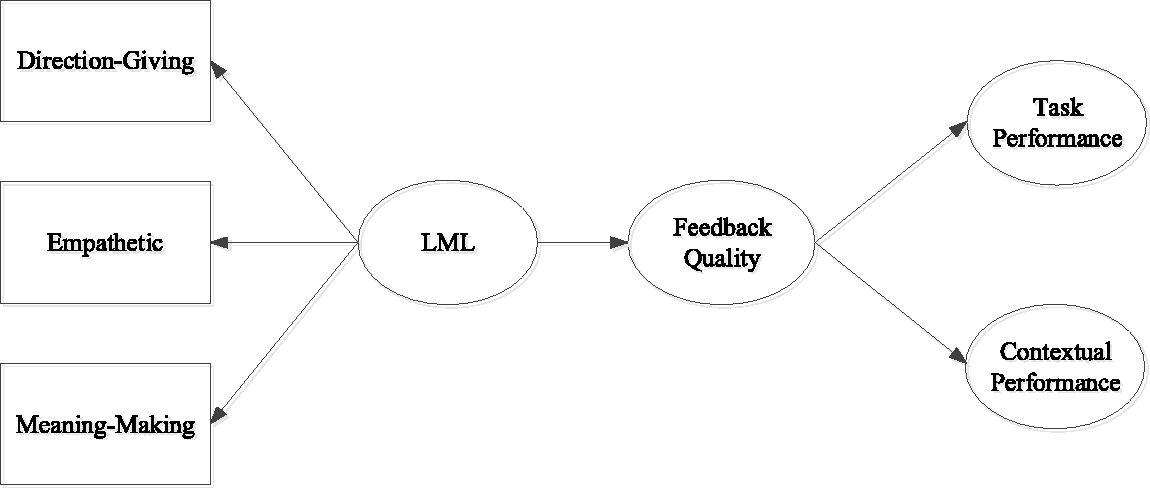
Research model. LML: leader motivating language.
Theory and hypotheses
LML, task, and contextual performance
Motivating language is an important part of leader communication. The term “motivating” means that the spoken words of a leader can nurture high-level motivation among employees toward improving their job behavior and attitudes (Mayfield & Mayfield, 2018; Sullivan, 1988; Van Quaquebeke & Felps, 2018) such as job satisfaction and performance. LML development is rooted in motivational theories, including the model of job characteristics (Hackman & Oldham, 1976; Oldham & Fried, 2016), the theory of goal setting (Locke & Latham, 1990), the model of task- and people-oriented leadership (Yukl, 2012), and sense-making theory (Weick, 1995). Sullivan (1988) proposed three critical categories of leadership speech acts: conveying information to reduce uncertainty, referred to as “direction-giving language”; building the meaning of the organizational environment through employee mental models, referred to as “meaning-making language”; and establishing emotional bonds with employees through social reciprocity and trust, referred to as “empathetic language.” First, direction-giving language reflects the tendency of a leader to reduce ambiguity by providing clear messages and information for followers who want to perform their jobs well (Mayfield & Mayfield, 2018; Sullivan, 1988). This form of talk aims to ensure that an organization clearly expresses its vision and goal setting, effectively achieves informational transparency, and offers timely performance feedback (Mayfield & Mayfield, 2018). Thus, the essential facets of direction-giving language are associated with the theory of goal setting (Locke & Latham, 1990) and the model of task-oriented leadership (Yukl, 2012). Second, meaning-making language of leaders considers the expression of organizational goals, cultural values, mental models, work values, and task significance to followers through oral communication (Mayfield & Mayfield, 2018; Sullivan, 1988). As a system of interactive symbology, linguistic meaning reflects the process by which leaders influence how their followers understand their roles and the significance of their work for the focal organization (Mayfield & Mayfield, 2018; Oldham & Fried, 2016). The meaningfulness and significance of the work represent a vital job design factor that motivates employees to achieve high-level job performance (Oldham & Fried, 2016). Meaning-making language helps followers experience better meaningfulness and a sense of responsibility from the oral communications of their leaders. The motivational foundation of this language is derived from the model of job characteristics (Hackman & Oldham, 1976; Oldham & Fried, 2016) and sense-making theory (Weick, 1995). Finally, empathetic language intends to establish emotional connections between leaders and followers through oral communication, and leaders use empathetic language to support and assist followers in various work situations (Mayfield & Mayfield, 2018; Mayfield et al., 1998; Sullivan, 1988). Without emotional bonds, followers feel that their organizations show them less care and concern, and followers are thus less likely to take the initiative to work hard. Strategies in which leaders positively manage emotion will benefit the well-being and proactive behavior of their employees (Schraub, Michel, Shemla, & Sonntag, 2012). The motivational facets of empathetic language are derived from the people-oriented leadership model, the emotional intelligence theory, and the positive psychological theory (Dutton, Workman, & Hardin, 2014; Mayfield & Mayfield, 2018; Yukl, 2012).
Following prior studies and the theory of LML (Mayfield & Mayfield, 2018; Sullivan, 1988), we included the three dimensions of LML (direction-giving language, meaning-making language, and empathetic language) into our model. The synergistic nature of LML indicates that these three language types are interlinked and produce more energetic effects than simply the sum of each category (Mayfield & Mayfield, 2018). We propose that coordinating these three language types can lead to maximum intrinsic motivation toward improving job performance. The proposed model identifies two performance variables: employee task performance and contextual performance. Task performance is defined as the degree to which an employee performs the tasks of their job to achieve organizational goals (Bachrach, Wang, Bendoly, & Zhang, 2007; Borman & Motowidlo, 1997; Campbell, McHenry, & Wise, 1990). Task performance describes an in-role work behavior required in a job description and consists of a series of operations that transform employee efforts and actions into organizational goods and services (Johnson, 2001). Contextual performance refers to a voluntary extra-role behavior that is not included in the employee’s job responsibilities or reward system (Borman & Motowidlo, 1997; Christian, Garza, & Slaughter, 2011). Contextual performance creates organizational, social, and psychological situations for mission and vision of employees toward their organizational goals (Christian et al., 2011; Lin & Peng, 2010). Therefore, we developed the first two hypotheses:
The mediating role of feedback quality
Feedback is indispensable in the daily supervisor-to-subordinate exchange process. Value information delivered via leader feedback can inform employees of how well they are achieving their performance goals (Rosen, Levy, & Hall, 2006; Steelman, Levy, & Snell, 2004). Feedback usually contains informal behavioral expectations that leaders desire from their subordinates and unambiguous performance evaluations of the subordinates (Kluger & DeNisi, 1996). Several facets of feedback messages have been proposed in previous studies (Rosen et al., 2006; Steelman et al., 2004), including feedback quality, feedback availability, source credibility, and feedback delivery. These feedback facets indicate the utility of informally providing feedback in the organizational context and have been shown to positively impact job behavior and performance, such as task performance, organizational citizenship behavior, learning behavior, and feedback-seeking behavior (Lam, DeRue, Karam, & Hollenbeck, 2011; Peng & Chiu, 2010; Rosen et al., 2006; Whitaker & Levy, 2012).
In this study, we included feedback quality as a mediating variable to explore the psychological communication mechanism that forms the relationship between LML and performance outcome variables such as task and contextual performance. Feedback quality is an important part of the interpersonal communication between leaders and followers (Steelman et al., 2004; Whitaker, Dahling, & Levy, 2007). Following prior research, we defined feedback quality as consistency and usefulness of a feedback message in a feedback environment (Steelman et al., 2004). We argue that high-quality feedback can provide consistent and useful information on employees’ specific tasks and contextual performance because the informational value of the feedback can encourage intrinsic work motivation among employees (Peng & Chiu, 2010). For example, employees can perceive a high degree of recognition from feedback messages from their leaders. With this recognition and feedback, intrinsic motivation can emerge in employee work behaviors.
We propose that LML may positively influence employee performance by offering high-quality feedback. First, a motivational speech is an effective organizational communication strategy and represents a good information exchange and emotional connection between leaders and subordinates (Mayfield & Mayfield, 2018; Van Quaquebeke & Felps, 2018). Leaders who express motivational words are likely to offer feedback to their employees because highly motivating language can improve employee beliefs and expectations for the process of leader–follower communication in which high-quality feedback also exists. Previous studies have proposed that the organizational feedback environment is positively correlated with employee task performance, organizational citizenship behavior, and job satisfaction (Anseel & Lievens, 2007; Peng & Chiu, 2010; Whitaker et al., 2007). That is, feedback quality provides information that can improve the task and contextual performance of employees. Specifically, leader feedback is the source of employees’ access to social information, and leadership constitutes a part of the employees’ work circumstances. Employees obtain high-quality information from leadership speech and feedback to guide their tasks and form their job attitudes toward the organization. Therefore, we developed the following two hypotheses:
Research methods
Data collection
We conducted this study with a sample of 237 supervisor-subordinate dyads in 16 organizations in the Yangzi delta area, which has a population of approximately 100 million and represents the most vibrant economic region in China. Shanghai is the main terminus for the delta. Our questionnaires were completed and collected with the assistance of HR managers on site. At each company, HR managers helped randomly select supervisor/subordinate dyads for this survey. Three hundred fifty sets of questionnaires were distributed to supervisors and subordinates, and 237 sets of valid questionnaires were obtained with a return rate of 67.71%. To reduce potential common method bias, we adopted the multisource reporting strategy to ask questions suggested by Podsakoff, MacKenzie, Lee, and Podsakoff (2003). Specifically, our questionnaires included two parts: one for a supervisor and one for his or her subordinates (Online Appendix). The supervisor section consisted of the focal supervisor evaluating their subordinates’ task and contextual performance and his or her demographic characteristics. The employee section included the employee’s perceptions of the motivating language feedback quality of their leader and their demographic characteristics. The matching ratio between supervisors and subordinates was 1:2.3. The subordinate sample was 51.1% males, with an average age of 29.65 years (SD = 5.69). The average tenure was 5.78 years (SD = 4.51). Most subordinates (92.8%) had attended high school, junior college, or undergraduate studies (25.2%). The average age and tenure of the supervisors were 36.03 years (SD = 7.05) and 11.55 years (SD = 6.91), respectively, and 51.9% were males. The average department size was 22.64 employees (SD = 22.40; range, 3 to 85). Company ownership was mainly either privately owned (51.5%) or foreign owned (48.5%).
Measuring items
We adopted well-validated scale measurements used in previous studies when possible. All items were reported on a five-point Likert-type scale (the response of LML scale ranging from one = “very little” to five = “a whole lot”; the response of other scales ranging from one = “strongly disagree” to five = “strongly agree”). Following the back-translation procedure recommended by Brislin (1980), measurement items were translated into Chinese first, then independently back-translated into English by two bilingual researchers. We ensured that each item statement in Chinese was clear and equivalent to the original English version.
Leader motivating language
We used a nine-item scale adapted from Mayfield and Mayfield (2007). Three measurement items assessed the dimension of the direction-giving language, such as My supervisor gives me clear instructions about solving job-related problems; three measurement items assessed the dimension of empathetic language, such as, My supervisor shows me encouragement for my work efforts; and three measurement items assessed the dimension of the meaning-making language, such as My supervisor offers me advice about how to behave at the organization's social gatherings. The fit indexes for the construct validity of a second-order model of LML fell within an acceptable range (χ2(24) = 59.42, p < .001, χ2/df = 2.48, comparative fit index (CFI) =.97, Tucker–Lewis index (TLI) =.95, root mean square error of approximation (RMSEA)=.08, standardized root mean square residual (SRMR) =.04). Cronbach’s alpha for LML was 0.89. Cronbach’s alphas for direction-giving language, empathetic language, and meaning-making language were 0.84, 0.78, and 0.83, respectively.
Feedback quality
Following Steelman et al. (2004), we used a five-item scale to measure feedback quality. Two sample items were My supervisor gives me useful feedback about my job performance and The performance feedback I receive from my supervisor is helpful. The fit indexes for the construct validity of feedback quality fell within an acceptable range (χ2(5)=28.53, p < .001, χ2/df = 5.71, CFI=.95, TLI=.90, RMSEA=.14, SRMR=.04). Cronbach’s alpha was 0.74.
Task performance
We adopted a five-item scale to measure employee task performance. This scale was originally from Williams and Anderson (1991) and was adapted into a Chinese version by Bachrach et al. (2007). Sample items were This employee adequately completes assigned duties and This employee fulfills responsibilities specified in the job description. The fit indexes for the construct validity of task performance fell within an acceptable range (χ2(5)=9.52, p=.09, χ2/df = 1.90, CFI=.99, TLI=.98, RMSEA=.06, SRMR=.02). Cronbach’s alpha was 0.86.
Contextual performance
We used four items from Lin and Peng (2010). Sample items included This employee helps the newcomers even without my asking and This employee assists new colleagues in adjusting to the work environment. The fit indexes for the construct validity of contextual performance fell within an acceptable range (χ2(2)=6.39, p=.04, χ2/df = 3.20, CFI=.99, TLI=.98, RMSEA=.09, SRMR=.02). Cronbach’s alpha was 0.89.
Strategic analysis
We used the structural equation model (SEM) to test the proposed model. SEM is a popular, classic method in current research on mediating mechanisms because of its excellence in estimating the suitability of the actual data and the conceptual model and the test of the mediating effect (Iacobucci, Saldanha, & Deng, 2007; MacKinnon, 2008). Moreover, SEM both measures and evaluates the multidimensional level of the LML and determines the fundamental relationship between the multidimensional construct and other constructs. The traditional regression model analyzes the relationship between the concept of single dimension or average and other concepts through the decomposition of multidimensional structure, lacks the overall evaluation of the measurement and structural model, and cannot accurately analyze the measurement error of the focal concepts.
Using the analysis procedures of previous research, this study first examined the concept of aggregation validity and discrimination validity. Confirmatory factor analyses validated the concept structure and obtained the correlation index of validity. This work presented four-factor structural models as hypothetical models (LML, feedback quality, task performance, and contextual performance) and compared the matching degree differences between the model and other alternative models to obtain the test evidence of the discrimination validity (Table 1). The mediation model of the study was then tested, and the fit index of the complete mediating model and partial mediating model was compared to make a selection. The bootstrapping method was also used to estimate the mediating effect of the model, and the 95% confidence interval (CI) is provided. Bootstrapping can better determine indirect effects, compared with the traditional method of a normal distribution; for example, the Sobel test has a better statistical effect (MacKinnon, 2008). We used the software Mplus (Version 7.4; Muthén & Muthén,1998/2012) to test and compare the SEM. Mplus can test the latent variable model thoroughly and estimate the mediating effect with the bootstrapping method. The model fit indices mainly use the chi-square value, the chi-square degree of freedom ratio (χ2/df <2), the CFI (>.90), the TLI (>.90), the RMSEA (<.05 or. 08) and the SRMR (<.05 or. 08). To eliminate possible disruption to the results of the demographic variables of the respondents in this study, general linear regression analysis was used, and demographic variables (gender, seniority, and educational level) were used as control variables to test our hypotheses. Our research showed that demographic variables did not significantly affect the main results; therefore, the demographic variables were entered when the formal structural equation modeling was adopted.
The result of model comparison.
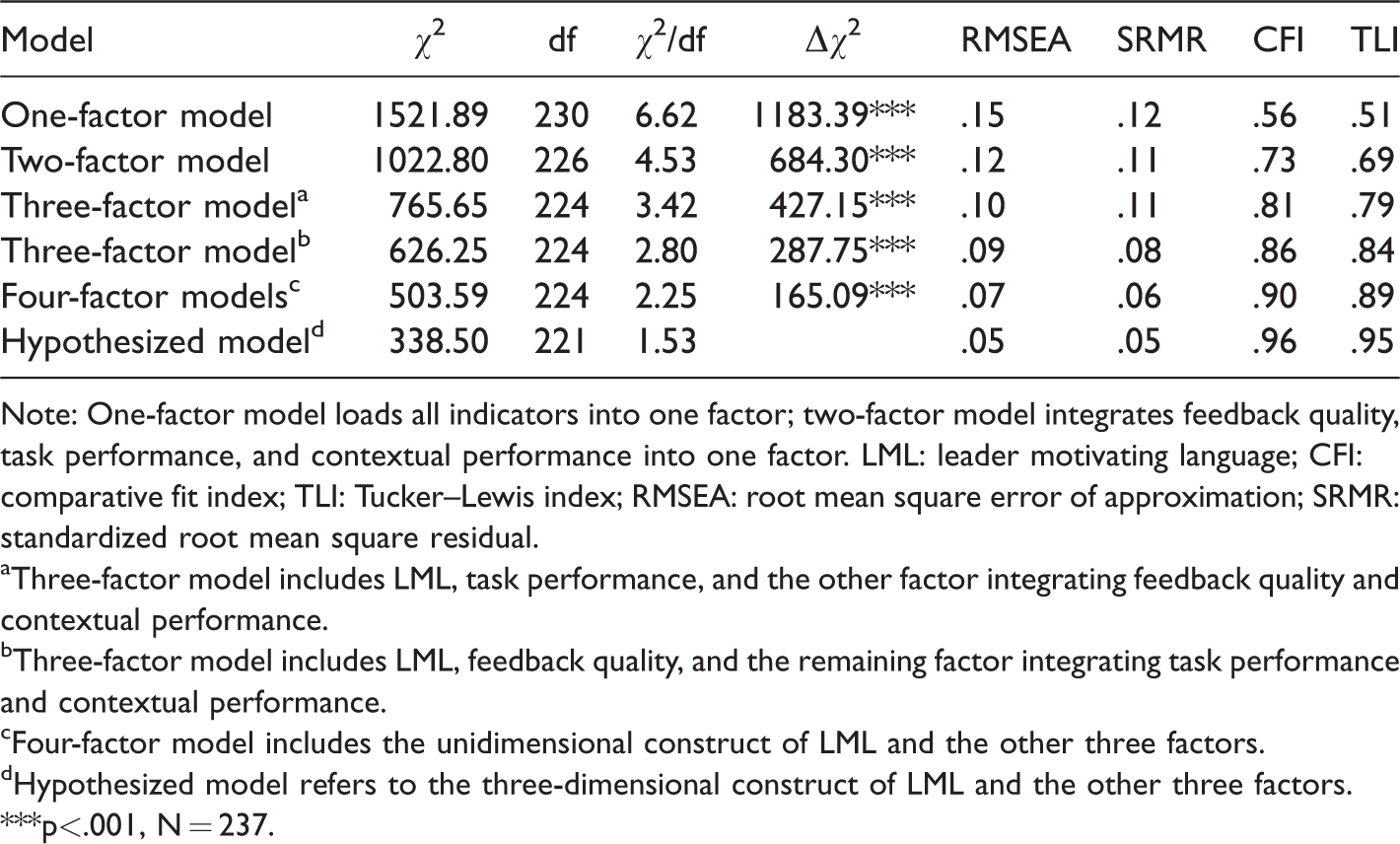
Note: One-factor model loads all indicators into one factor; two-factor model integrates feedback quality, task performance, and contextual performance into one factor. LML: leader motivating language; CFI: comparative fit index; TLI: Tucker–Lewis index; RMSEA: root mean square error of approximation; SRMR: standardized root mean square residual.
aThree-factor model includes LML, task performance, and the other factor integrating feedback quality and contextual performance.
bThree-factor model includes LML, feedback quality, and the remaining factor integrating task performance and contextual performance.
cFour-factor model includes the unidimensional construct of LML and the other three factors. dHypothesized model refers to the three-dimensional construct of LML and the other three factors.
***p<.001, N = 237.
Results
Our results showed that the research model had better fit indices than did the alternative models (χ2(221) =338.50, p < .001, χ2/df = 1.53, RMSEA=.05, SRMR=.05, CFI=.96, TLI=.95; Table 1). Thus, the model’s fit level was significantly better than that of the four-factor model containing unidimensional LML (Δχ2(3) =165.09, p < .001), the three-factor model (Δχ2(3) I = 427.15, p < .001; Δχ2(3) II = 287.75, p < .001), the two-factor model (Δχ2(5)=684.30, p < .001), and the single-factor model (Δχ2(9)=1183.39, p < .001). The results showed that research concepts had good discriminant validity, and LML, as a multidimensional construct, has a useful distinction from other concepts.
Table 2 shows the descriptive statistical analysis. Significant correlations were found between LML and feedback quality (r=.49, p < .01), task performance (r=.68, p < .01), and contextual performance (r=.34, p < .01).
Mean, standard deviation, and zero-order Pearson correlation coefficients.
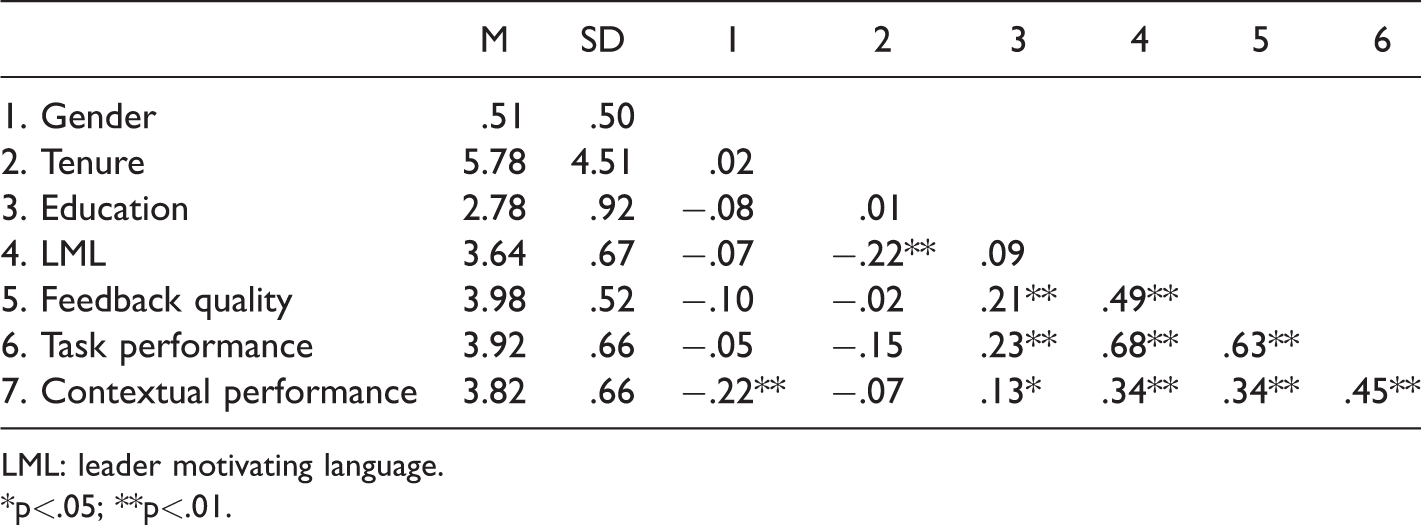
LML: leader motivating language.
*p<.05; **p<.01.
This study developed a mediation model showing a direct effect of the independent variable, LML, on the two dependent variables, task performance and contextual performance. The fit indices for the median model were χ2(221)=338.50, p < .001, χ2/df = 1.53, RMSEA=.05, SRMR=.05, CFI=.96, and TLI=.95. This mediation model has good and acceptable fit indices. LML had a significant direct effect on task performance (β = 0.39, p < 0.01) but a nonsignificant path coefficient from feedback quality to task performance (β = 0.11, p > 0.05). Thus, feedback quality does not have a significant mediating effect between LML and task performance. A nonsignificant direct effect was found from LML to contextual performance (β = 0.14, p > 0.05). Feedback quality had a complete mediating effect between LML and contextual performance (Figure 2).
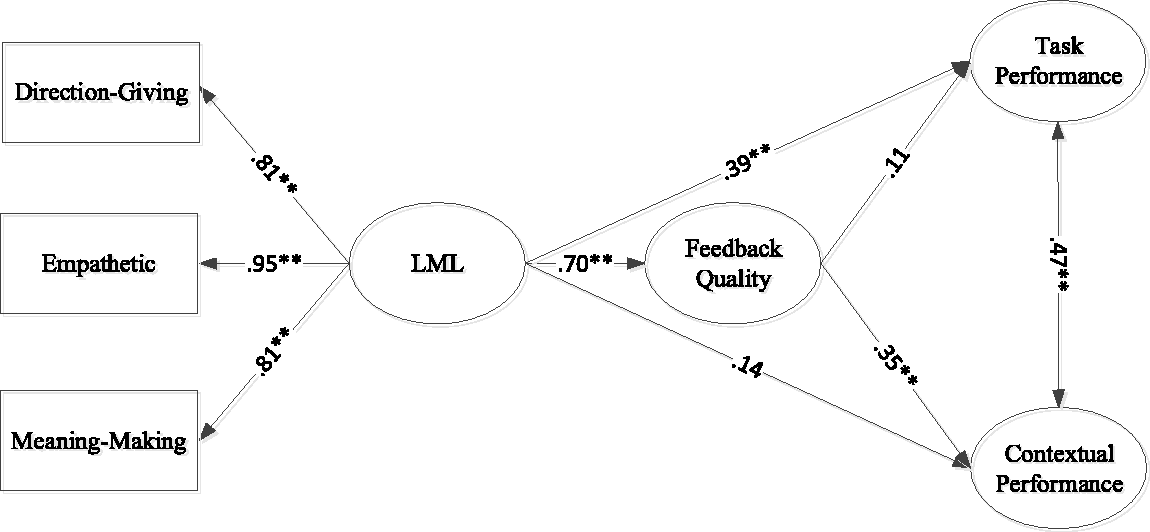
Research model with results. LML: leader motivating language.
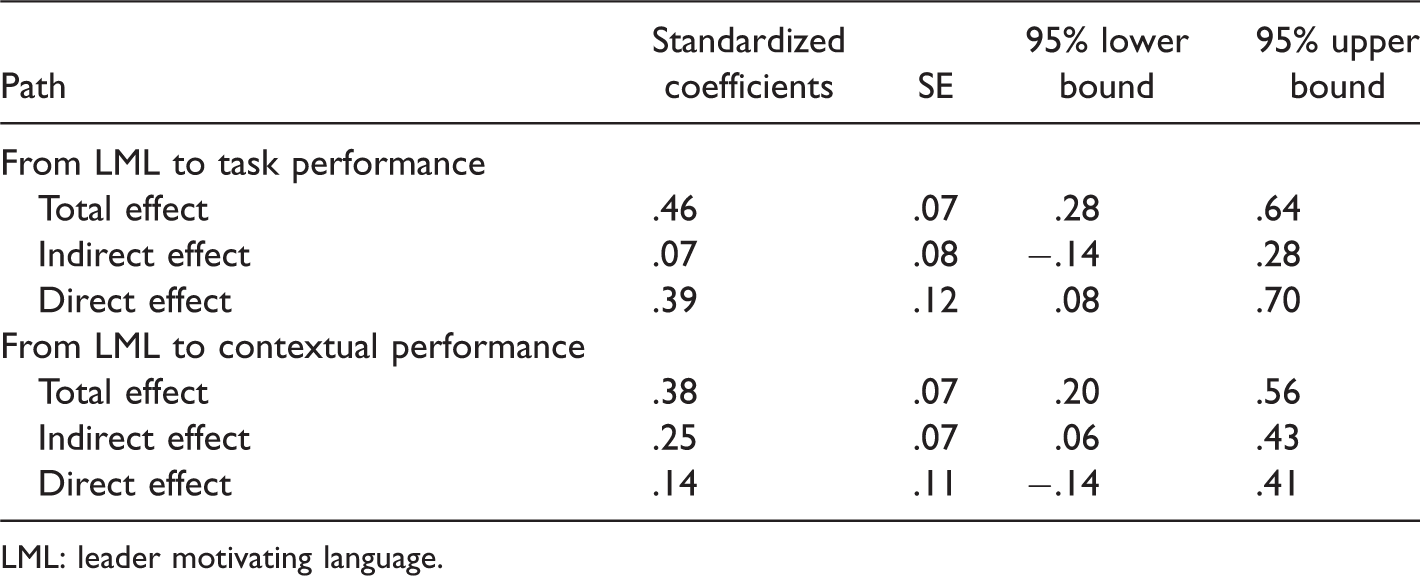
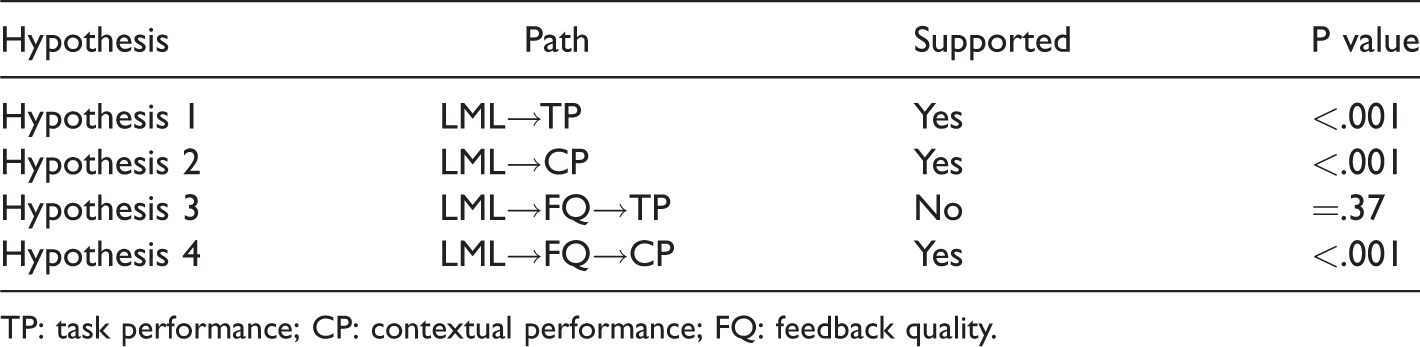
This study used the bootstrapping method (samples = 1000) to estimate the total effect, indirect effect, and direct effect of the above mediation model, with a 95% CI. Table 3 shows that LML had a significant total effect on task performance (βtask performance=.46; 95% CI: .28–.64) and contextual performance (βcontextual performance=.38; 95% CI: .20–.56), indicating that LML significantly positively influenced task performance and contextual performance, thus supporting H1 and H2. Feedback quality did not have a significant indirect effect on the relationship between LML and task performance (β=.07; 95% CI: −.14–.28). Thus, H3 was not supported. However, feedback quality had a significant indirect effect between LML and task performance (β=.25; 95% CI: .06–.43), thus supporting H4. Table 4 summarizes the hypotheses test results.
The bootstrapping results of total effects, direct effects, and indirect effects.
LML: leader motivating language.
Summary of research findings.
TP: task performance; CP: contextual performance; FQ: feedback quality.
Discussion
Similar to prior studies, our research findings also showed that LML positively impacted employee task and contextual performance (Tables 3 and 4). Thus, by using motivational speech, leaders can promote subordinates to improve their task and contextual performance. For example, a leader may say I would like to express very sincere gratitude for your hard work and very valuable contribution to our company to promote intrinsic work motivation among their employees. Leaders can also motivate employees by saying There are three kinds of staff: those who let it happen, those who make it happen, and those who wonder what happened. My belief is that all of us here are concerned, caring and eager to make things happen. You are eager to make things happen because you continue to be a part of those who want to contribute towards our dream of “A better life for all.”
Second, our research findings showed the mediating role of feedback quality in the relationship between LML and contextual performance, while the mediating effect of feedback quality on the relationship between LML and task performance was not statistically significant. These situations may be explained in terms of the distinctions between contextual performance and task performance. Task performance measures the effectiveness of how a person performs on a given task. That is, an employee must do his or her given job duties effectively to maintain a high-level task performance and avoid failure in annual task performance assessments. Failing to pass annual task performance assessments means that the employee will be warned and face the high risk of dismissal. Thus, employees will likely always try their best to achieve good task performances and LML can strengthen their intrinsic motivations; however, feedback is not a necessary condition for stimulating intrinsic motivations. Conversely, contextual performance demonstrates the degree to which employees are expected to go above and beyond the requirements of their job descriptions. Examples of contextual performance include volunteering for additional work and assisting colleagues. These activities are not listed in their job requirements and thus are not assessed by the HR department annually. Thus, an individual craves positive feedback or recognition from leaders when they perform extra job activities. When leaders fail to recognize employees for their extra effort, the employees will evaluate their resource allocation to maximize personal benefits and only focus on finishing given job duties.
Practical implications
The findings of this study provide practical suggestions for organizations to enhance the contextual performance and task performance of employees by encouraging LMLs and creating high-quality feedback in the leader–follower daily work process. First, LML was found to be an effective managerial practice in enterprise HR work systems and a favorable strategy to generate intrinsic motivation for work by followers. The importance of LML indicates that organizations should emphasize and improve the training and development of leadership language skills. Training courses must consider the three language facets—direction-giving, meaning-making, and empathetic language—synthetically. Because each language type has a unique part in supervisor-to-subordinate communication and should not be replaced by another language type, training in these three languages can produce a maximum benefit for organizational effectiveness.
Second, this study supported interpreting feedback quality to enhance the internal mechanism of leadership speech performance, which reflects the positive evaluation of leadership speech performance and recognition of interpersonal interaction. In practice, failure in the leader-to-follower feedback process may make leadership language invalid and discourage employees from work. Our research provides favorable evidence for the benefits of improving feedback quality especially when encouraging followers to perform citizenship behavior in the workplace. Construction of management communication channels and feedback mechanisms must be considered in HR management. For example, from the perspectives of leaders, an organization may consider offering motivational language training courses for junior managers who lack communication experience. They may also encourage senior managers to serve as teachers to mentor junior managers on how to give feedback or one-on-one talks in an appropriate and energizing manner.
From the employee perspective, an organization should consider implementing a flat organizational structure that eliminates all layers of management. Consequently, leaders and employees can communicate directly with one another in a flat structure. This not only improves communication efficiency but ensures clear and understandable communication because no intermediaries are involved in the communication process. Leaders can also consider deploying an enterprise social communication and collaboration platform such as Yammer and Slack. These platforms are built on the cloud computing Web 2.0 infrastructure to help firms improve rapid and agile online collaborations.
Limitations and future directions
This study had several limitations that create avenues for future research. First, our study was based on a cross‐sectional research design, while LML dynamics should ideally be examined in a longitudinal design. Second, this research was conducted with Chinese companies; thus, the findings may not be supported in other countries with different cultural backgrounds because cultural differences can influence the expression of motivational language. We recommend a cross-cultural comparison method as a tool to investigate the different possible functions of LML in developing individual employee and group behavior. Third, other mediating mechanisms underlying the relationship between LML and task performance must be further examined. For example, employee feedback that seeks motivation and perceived trustworthiness from leader language may provide other alternative explanations for better understanding the underlying process between LML and employee outcomes. Finally, we recommend that future research adopt multiple methods to explore the potential antecedents and outcomes of LML in interpersonal situations, which may contribute to LML literature. Experimental design can be used to manipulate the motivational language of leaders in a field or a lab condition, which benefits the causal inference in LML research. Multilevel design can be used to explore and find the potential contextual effect of LML or build a higher level construct of motivating language (e.g., group-level motivating language and organization-level motivating language).
Conclusion
In summary, this study provides empirical evidence for two important views: that LML is a powerful force in follower tasks and contextual performance and that feedback quality significantly mediates only the effect of LML on contextual performance but not on task performance. This suggests that language used by leaders can motivate employee work performance behavior. Work motivation can be nurtured via leader-to-follower communicative acts. Moreover, integrating motivating language with high-quality feedback can provide a better understanding of the antecedent and psychological mechanisms of employee work behaviors (i.e., citizenship performance). This may attract more attention to developing motivating communicative behavior among leaders and an effective channel for leader-to-follower feedback.
Supplemental Material
Supplemental material for Effects of Leader Motivating Language on Employee Task and Contextual Performance: The Mediating Role of Feedback Quality
Supplemental Material for Effects of Leader Motivating Language on Employee Task and Contextual Performance: The Mediating Role of Feedback Quality by Yue Guo Business School, Hohai University, Nanjing City, ChinaKing’s Business School, King’s College London, London, UK Bin Ling Business School, Hohai University, Nanjing City, China in Psychological Reports
Footnotes
Article Notes
References
Supplementary Material
Please find the following supplemental material available below.
For Open Access articles published under a Creative Commons License, all supplemental material carries the same license as the article it is associated with.
For non-Open Access articles published, all supplemental material carries a non-exclusive license, and permission requests for re-use of supplemental material or any part of supplemental material shall be sent directly to the copyright owner as specified in the copyright notice associated with the article.
