



Abstract
Unemployment has been associated with adverse mental health outcomes including depression and suicide. In the last decades, unemployment rates have increased substantially in Turkey; yet, factors and mechanisms that play a role in experiencing psychological symptoms among unemployed individuals are not well understood. The aim of this study was to investigate the role of personality characteristics on psychological symptoms among unemployed Turkish adults and to test the mediating role of rumination as a dysfunctional cognitive strategy. The sample consisted of 217 unemployed Turkish adults who completed self-report measures on neuroticism, external locus of control, rumination, and psychological symptoms. The results of the structural equation modeling indicated that rumination partially mediated the relationship between personality variables (i.e., neuroticism and external locus of control) and psychological symptoms, thus verifying the hypothesis of the study. The direct paths from trait neuroticism and external locus of control to psychological symptoms were also significant. Results revealed that a tendency to attribute future outcomes to external factors and an increased tendency to experience negative emotions are associated with engaging passively in rumination, which in turn predicts psychological symptoms. Interventions are suggested to focus on effective coping strategies along with increasing individuals’ perceived control over life and future.
Introduction
There is considerable evidence indicating that unemployment has adverse effects on psychological and physical well-being (McKee-Ryan, Song, Wanberg, & Kinicki, 2005; Paul & Moser, 2009). To illustrate, the loss of one’s job has been associated with a variety of negative outcomes such as poor health (Bambra & Eikemo, 2009), psychosomatic symptoms (Viinamäki, Koskela, Niskanen, Arnkill, & Tikkanen, 1993), marital dissolution (Hansen, 2005), decreased life satisfaction (Kassenboehmer & Haisken-Denew, 2009), and death by suicide (Blakely, Collings, & Atkinson, 2003). Studies demonstrate that certain factors play a role in the decreased well-being of the unemployed individual, thus resulting in the development of psychological problems in some unemployed individuals more than others (Creed & Bartrum, 2006). For example, in a sample of long-term unemployed adults, Grossi, Åhs, and Lundberg (1998) found that personality characteristics (e.g., negative affectivity) were related to an increased reactivity to stress during unemployment. Furthermore, in a sample of unemployed Venezuelan adults, Sojo and Guarino (2011) showed that coping mediated the relationship between unemployment-related stress and well-being. An examination of these vulnerabilities seems crucial in determining who is more likely to suffer psychologically from the negative consequences of unemployment, which may guide us in designing interventions to decrease the emotional burden of job loss (Extremera & Rey, 2014). Therefore, this study aimed to extend our knowledge of factors associated with the decreased psychological well-being among unemployed adults.
Personality characteristics may be a factor that shapes individuals’ perception of job loss and their psychological reactions to being unemployed. More specifically, some personality traits may exacerbate psychological distress among unemployed individuals. Furthermore, personality characteristics may alter the process of finding a job by effecting the intensity of job search and the probability of receiving and accepting a job offer (Uysal & Pohlmeier, 2011). Among various personality dimensions, neuroticism appears to be especially relevant given its relationship with problematic coping strategies and poor mental health outcomes (Connor-Smith & Flachsbart, 2007). As defined by Costa and McCrae (1992), neuroticism is a tendency toward emotional instability and negative affect. Research indicates that neuroticism is associated with elevated levels of psychological distress (Schaufeli, 1992) and a variety of psychological disorders including mood and anxiety disorders (Degraaf, Bijl, Tenhave, Beekman, & Vollebergh, 2004; Griffith et al., 2009), Internet addiction (Zhou, Li, Li, Wang, & Zhao, 2017), and posttraumatic stress disorder (Kotov, Gamez, Schmidt, & Watson, 2010).
Research has generally confirmed the negative effects of neuroticism on psychological well-being in unemployed samples. To illustrate, in a longitudinal study of 75 unemployed men, Payne (1988) found that neuroticism had a prospective and strong negative effect on mental health. Furthermore, there is evidence that high neuroticism diminishes the effectiveness of job search and interview success for unemployed individuals (e.g., Crossley & Stanton, 2005), which might be an indirect reason why their unemployment persists. However, to our knowledge, neuroticism among unemployed individuals has not been tested in Turkish samples. In this study, we hypothesized that increased neuroticism would be associated with greater psychological symptoms among unemployed individuals.
Locus of control (LOC) is another personality factor which may affect individuals’ reactions to unemployment, as well as, their process of job search. According to Rotter (1966), people with an external LOC believe that they have little or no control over future outcomes, and assume that external factors such as fate, luck, and chance determine their lives. On the other hand, individuals with internal LOC believe that their behaviors can cause the desired consequences, and they attribute future outcomes to internal factors such as ability (Rotter, 1966). A considerable number of studies indicate that internal LOC is positively associated with psychological well-being and positive job-related outcomes, including increased use of problem-focused coping (Arslan, Dilmaç, & Hamarta, 2009), lower levels of depression (Gray-Stanley et al., 2010), and increased job satisfaction (Judge & Bono, 2001). On the contrary, previous research has linked external LOC to negative outcomes such as psychological distress (Carter, Larry, Mollen, & Smith, 2014), hopelessness (Rubinstein, 2004), and depression (Bjørkløf et al., 2016).
Existing research suggests that having an internal LOC may be related to relatively more functional reactions to unemployment. To illustrate, unemployed people with an internal LOC reported lower levels of depressive and anxiety symptoms and higher levels of self-esteem and life satisfaction when compared to those with higher external LOC (Cvetanovski & Jex, 1994). Furthermore, Caliendo, Cobb-Clark, and Uhlendorff (2015) reported that unemployed individuals with an internal LOC search for jobs more extensively. Based on previous evidence, it appears that an increased feeling of control over one’s environment is associated with decreased psychological symptoms and more successful coping attempts with unemployment.
Interestingly, there is evidence that one of the dimensions of external LOC known as fatalism is a very common belief system in Turkey (Acevedo, 2008; Nordfjærn, Şimşekoğlu, & Rundmo, 2012). According to the results of a cross-cultural study, the rate of believing that people can change the flow of their lives was only 28% among the Turkish respondents, whereas this rate was remarkably higher among American, Canadian, and Norwegian participants (Çarkoğlu & Kalaycıoğlu, 2009). Çarkoğlu and Kalaycıoğlu (2009) argued that, among Turkish individuals, increased fatalism and decreased perceived control over one’s life can be partially explained by high rates of belief in God. This is highly plausible considering the Islamic belief that the future is largely determined by God’s will (Nordfjærn et al., 2012). Moreover, individualism has been associated with an internal LOC (e.g., Spector et al., 2001), whereas Turkish individuals have traditionally been considered to have collectivistic values. Thus, the tendency toward collectivism may also play a role in the decreased attributions of personal control among Turkish individuals. Even though fatalism is common in the Turkish population, findings from Turkey generally support the evidence that an external LOC is associated with less positive outcomes (e.g., Arslan et al., 2009). Yet, external LOC among unemployed individuals in Turkey is yet to be studied. In this study, we expected that an external LOC would be associated with psychological symptoms in our unemployed sample.
Concerning coping with job loss, rumination may be a cognitive coping strategy which increases the likelihood of experiencing psychological symptoms during unemployment. Nolen-Hoeksema (1991) defines rumination as focusing and thinking repeatedly about possible causes and consequences of negative events and emotions. Individuals who ruminate focus on the negative content in a passive way rather than actively seeking solutions for their problems (Nolen-Hoeksema, Wisco, & Lyubomirsky, 2008). This repetitive pattern of thinking has been shown to increase negative affect while decreasing active coping attempts (Lyubomirsky & Nolen-Hoeksema, 1993). Prior research has indicated that rumination plays a role in the onset and maintenance of a wide range of psychological problems including depression (Lyubomirsky & Tkach, 2003), posttraumatic stress disorder (Michael, Halligan, Clark, & Ehlers, 2007), alcohol-related problems (Nolen-Hoeksema & Harrell, 2002), and social anxiety disorder (Modini & Abbott, 2016).
Considering its contribution to elevated levels of negative affect and decreased problem-solving, it is likely that rumination may worsen individuals’ emotional distress during unemployment and may hinder active coping attempts. Interestingly, rumination among unemployed individuals has attracted limited research interest. In one of the few studies, Extremera and Rey (2014) found that among unemployed Spanish men, decreased rumination was associated with better mental health outcomes. Furthermore, in a study with Canadian high-tech workers, for both employed and unemployed participants, increased rumination, increased emotional expression, and increased self-blame and blaming of others were associated with elevated subjective experience of stress (Mantler, Matejicek, Matheson, & Anisman, 2005). In the light of these initial findings, we hypothesized that rumination would be associated with increased psychological symptoms among unemployed Turkish adults.
Besides its direct negative effects on psychological well-being, rumination may also be a factor that mediates the relationship between other risk factors and psychological symptoms during unemployment. To illustrate, there is evidence for an association between neuroticism, an increased tendency to ruminate and decreased psychological well-being. In a study with college students, Roberts, Gilboa, and Gotlib (1998) found that a ruminative response style mediated the relationship between neuroticism and dysphoria. Likewise, rumination mediated the relationship between neuroticism and depressive symptoms in a sample of adolescents (Kuyken, Watkins, Holden, & Cook, 2006) and elderly adults (Chen, Pu, Shi, & Zhou, 2017). Moreover, using two mediational models, researchers revealed that rumination and worry mediated the effect of neuroticism on anxiety and depression in a sample of undergraduates (Muris, Roelofs, Rassin, Franken, & Mayer, 2005). It appears that individuals with an inclination toward intense experience of negative emotions during upsetting events are more likely to process these emotional states repeatedly (Hervas & Vazquez, 2011), therefore leading to psychological symptoms. We believe that rumination may be one of the mechanisms linking neuroticism and psychological symptoms among unemployed adults as well, but this argument is yet to be tested.
It is also plausible that unemployed individuals who believe that future events and possibilities depend on external and uncontrollable factors, but not on factors under their control, may be more likely to engage in passive rumination, which in turn may increase their likelihood of experiencing psychological symptoms. However, research exploring the relationship between external LOC and rumination is limited. Evidence from a single study suggests that rumination is positively correlated with an external LOC (Abdolmanafi, Besharat, Farahani, & Khodaii, 2011). In this study, we hypothesized that rumination would be a mechanism linking external LOC to psychological symptoms among unemployed adults.
The current study
There is consistent evidence that unemployment has negative effects on psychological well-being (Polat & Bacak, 2018; Wanberg, 2012). However, psychological mechanisms that explain decreased well-being during unemployment are not well-understood. This study was an attempt to enhance our understanding of the factors associated with psychological symptoms among unemployed individuals so that interventions targeting these factors can be tailored. For the present research, the study sample was selected from unemployed Turkish adults. As a developing country, Turkey has experienced several economic crises in the 1990s and the 2000s (Rodrik, 2012). Unemployment rates have remained high since then, with an official rate of 14.7% in 2019 (Turkish Statistical Institute, 2019). Although unemployment negatively affects a considerable proportion of Turkish adults, to our knowledge no studies have tested personality characteristics and cognitive strategies which may play a role in the development of psychological problems among unemployed individuals. Thus, this study was also an attempt to fill this gap.
In this study, we aimed to explore the role of external LOC, neuroticism, and rumination in the level of psychological symptoms among unemployed adults. There were two latent variables in the proposed model: external LOC and psychological symptoms. The external LOC latent variable was hypothesized to have four indicators: belief in luck, futility of trying, fatalism, and belief that the world is unfair. The latent variable for the psychological symptoms was hypothesized to have five indicators: anxiety, depression, somatization, hostility, and negative self-concept. Using a mediational model, we hypothesized that increased neuroticism and external LOC would be positively associated with psychological symptoms among unemployed Turkish adults, and rumination, as a maladaptive cognitive strategy, would mediate this relationship.
Method
Participants
The sample of this study consisted of 217 unemployed Turkish adults between 18 to 48 years of age (M = 25, SD = 4.52) who were actively searching for a job for at least 6 months. Detailed demographic information can be seen in Table 1.
Distribution of demographic variables in the study sample (N = 217).

Materials
Locus of Control Scale (LCS)
LCS (Dağ, 2002) is a comprehensive self-report measure of LOC in Turkish which measures individuals’ beliefs about controllability of the environment and future reinforcements. The LCS consists of 47 items and five subscales, namely, internal LOC, belief in luck, futility of trying, fatalism, and belief that the world is unfair. Participants rate the extent to they agree with each statement on a five-point rating scale (1 = Very untrue of me, 5 = Very true of me). Cronbach’s alpha coefficient of the LCS was found as .92 and the test-retest reliability was .88 over a one-month period (Dağ, 2002). Furthermore, Cronbach’s alpha coefficients of the subscales were reported as .87 for internal LOC, .79 for belief in luck, .76 for futility of trying, .74 for fatalism, and .61 for belief that the world is unfair (Dağ, 2002). The scores from the scale correlated with measures of personality, psychological symptoms, and paranormal beliefs, indicating convergent validity (Dağ, 2002).
Dağ (2002) stated that belief in luck, futility of trying, fatalism, and belief that the world is unfair subscales represent an external LOC. In this study, we used these subscales to determine participants’ level of external LOC. The Cronbach’s alpha coefficient in the present sample was found as .76 for belief in luck, .78 for futility of trying, .75 for fatalism, and .66 for belief that the world is unfair subscale.
Big Five Inventory (BFI)
The BFI was developed by John, Donahue, and Kentle (1991) and John and Srivastava (1999) to assess individuals’ predisposition toward five dimensions of personality (i.e., Openness, Conscientiousness, Extraversion, Agreeableness and Neuroticism). BFI consists of 44 items and is rated on a five-point Likert-type scale (1= Strongly disagree, 5= Strongly agree). Cronbach’s alpha coefficients were found between .75 and .90 and test–retest reliabilities ranged from .80 to .90 in the United States and Canadian samples (John & Srivastava, 1999).
BFI was adapted into Turkish by Sümer & Sümer (2005). Cronbach’s alpha coefficients of five subscales were found as .80 for Neuroticism, .79 for Openness, .78 for Conscientiousness, .82 for Extraversion, and .65 for Agreeableness. A study by Sümer, Lajunen, and Özkan (2005) showed that personality dimensions as measured by the Turkish version the BFI predicted aberrant driving behaviors, demonstrating evidence for predictive validity.
In this study, neuroticism subscale of BFI was utilized in order to assess participants’ level of trait neuroticism. Cronbach’s alpha coefficient of the subscale was .82 in the present sample.
Brief Symptom Inventory (BSI)
BSI was developed by Derogatis (1992) and is a widely used instrument that measures psychological distress and psychopathological symptoms on nine different dimensions in both clinical and nonclinical samples (Derogatis & Savitz, 2000). BSI consists of 9 subscales, namely, obsessive-compulsive, hostility, phobia, psychoticism, somatization, interpersonal sensitivity, depression, anxiety, and additional items. Cronbach’s alpha coefficients of the subscales ranged between .71 (psychoticism) and .85 (depression), and test–retest reliability over two weeks ranged between .68 (somatization) and .91 (phobia) (Derogatis, 1992).
BSI was adapted into Turkish by Şahin and Durak (1994). Turkish version of the scale consisted of 53 items and is rated on a five-point rating scale (0 = Not at all, 4 = Always). The Turkish version of BSI consists of five subscales, namely, anxiety, depression, hostility, negative self-concept, and somatization. Cronbach’s alpha coefficients were found as .88 for depression, .84 for anxiety, .74 for negative self-concept, .70 for somatization, and .73 for hostility subscales (Şahin, Durak Batıgün, & Uğurtaş, 2002). The scores from BSI correlated with clinical measures of depressive symptoms, stress, submissiveness, and loneliness, indicating evidence for construct validity (Şahin & Durak, 1994).
In this study, BSI was used to assess psychological symptoms on five dimensions. Cronbach’s alpha coefficients were found as .92, .91, .86, .83, and .91 for anxiety, depression, somatization, hostility, and negative self-concept subscales, respectively.
Ruminative Response Scale (RRS)—Short Form
The RSS was developed by Nolen-Hoeksema and Morrow (1991) which was originally a subscale of Response Styles Questionnaire. This version contained 21 items, but 11 of them were highly similar to depressive symptoms. By removing 11 items, Treynor, Gonzalez, and Nolen-Hoeksema (2003) created a 10-item short version of the RRS. This version includes two factors, namely, reflection and brooding. Each factor has five items and is scored on a four-point rating scale (1 = Never, 4 = Always). Cronbach’s alpha was reported as .89 for the total scale (Nolen-Hoeksema & Morrow, 1991).
The short version of the RRS was adapted into Turkish by Erdur-Baker and Bugay (2012) and was found as reliable and valid in the Turkish sample. Authors reported a Cronbach’s alpha coefficient of .85 and the scale correlated with measures of rumination and depressive symptoms, indicating convergent validity (Erdur-Baker & Bugay, 2012).
In this study, the short form of RRS was used to measure ruminative tendencies of participants. Cronbach’s alpha coefficient for the total scale was .87 in the present sample.
Procedure
Before data collection, ethical permission was received from Çankaya University Scientific Research and Ethics Committee. Invitations to the study were posted to several social media platforms and online forums related to job search and unemployment. Interested participants signed an online informed consent form and completed an online survey. Participation to the study was entirely voluntary.
Data analytic strategy
For the main analysis, structural equation modeling (SEM) was utilized on the data by using AMOS Version 23 (Arbuckle, 2014). To evaluate the model fit, the maximum likelihood Chi-square statistic (χ2) which measures the difference between the hypothesized model and the actual data was used. Therefore, a nonsignificant χ2 indicated a good model fit. However, based on χ2’s sensitivity to sample size, the following fit indices were used as the criteria for a good model fit: χ2/df < 2, comparative fit index (CFI) ≥.95, root mean square error of approximation (RMSEA) < .06, standardized root mean square residual (SRMR) < .09 (Hu & Bentler, 1999). Furthermore, as suggested by Browne and Cudeck (1993), CFI values above .90 and RMSEA values below .10 were taken as the criteria for an adequate model fit.
Results
Before the analyses, the assumption of univariate normality was tested using a skewness/kurtosis index of ±2 and none of the study variables required transformation.
Bivariate correlations
Bivariate correlations between study variables can be seen in Table 2. As expected, neuroticism was positively correlated with rumination (r = .47, p < .01) and all dimensions of psychopathology, with correlation coefficients ranging from .49 (negative self-concept) to .59 (hostility), p < .01. Rumination correlated positively with all psychological symptom dimensions, with correlation coefficients ranging from .59 (somatization) to .77 (depression), p < .01. Furthermore, rumination correlated positively with all dimensions of external LOC, with correlations ranging from .19 (fatalism) to .36 (belief that the world is unfair), p < .01. Finally, all dimensions of external LOC, except fatalism, correlated positively with psychological symptoms, p < .01. Fatalism correlated positively with depression and hostility, p < .05.
Correlations among study variables (N = 217).

SC: self-concept; BWU: belief that the world is unfair.
*p < .05; **p < .01.
Measurement model analyses
Before the SEM analysis, preliminary measurement analyses were applied to check if the latent variables would fit the data well. Psychological symptoms, as measured by BSI, had five indicators; namely, anxiety, depression, negative self-concept, somatization, and hostility. Measurement analysis showed that psychological symptoms latent variable fit the data inadequately, χ2 (5, N = 217) = 20.57, p < .01, χ2/df = 4.11, CFI = .99, RMSEA = .12, SRMR = .016. Modification indices were investigated and a covariance was added between the error terms of anxiety and somatization, which resulted in a good fit to the data, χ2 (4, N = 217) = 3.05, p > . 05, χ2/df =.76, CFI = 1.00, RMSEA = .00, SRMR = .01. All five variables had significant loadings onto the psychological symptoms latent variable (p < .001) with standardized factor loadings of .93, .93, .93, .79, and .84 for anxiety, depression, negative self-concept, somatization, and hostility, respectively.
External LOC latent variable was composed of four indicators: belief in luck, futility of trying, fatalism, and belief that the world is unfair. The fit of these variables onto the external LOC latent variable was tested. Preliminary measurement analysis showed that external LOC latent variable showed an overall inadequate fit to the data, χ2 (2, N = 217) = 8.36, p < .05, χ2/df = 4.18, CFI = .96, RMSEA = .12, SRMR = .037. Based on the modification indices, a covariance was added between the error terms of belief that the world is unfair and fatalism. The modified model showed a good fit to the data, χ2 (1, N = 217) = 1.27, p > .05, χ2/df = 1.27, CFI = 1.00, RMSEA = .04, SRMR = .016. All four variables significantly loaded onto the LOC latent variable (p < .001) with standardized factor loadings of .68, .66, .59, and .70 for belief in luck, futility of trying, fatalism, and belief that the world is unfair variables, respectively.
Structural model analyses
Figure 1 shows the hypothesized associations between neuroticism, external LOC and psychological symptoms, and the mediator role of rumination. The overall model proposing the mediator role of rumination in the relationship between neuroticism, external LOC, and psychological symptoms exhibited an adequate fit to the data, χ2 (39, N = 217) = 86.72, p < .001, χ2/df = 2.22, CFI = .97, RMSEA = .075, SRMR = .070. All indicators fit significantly on their hypothesized latent variables (p < .001).
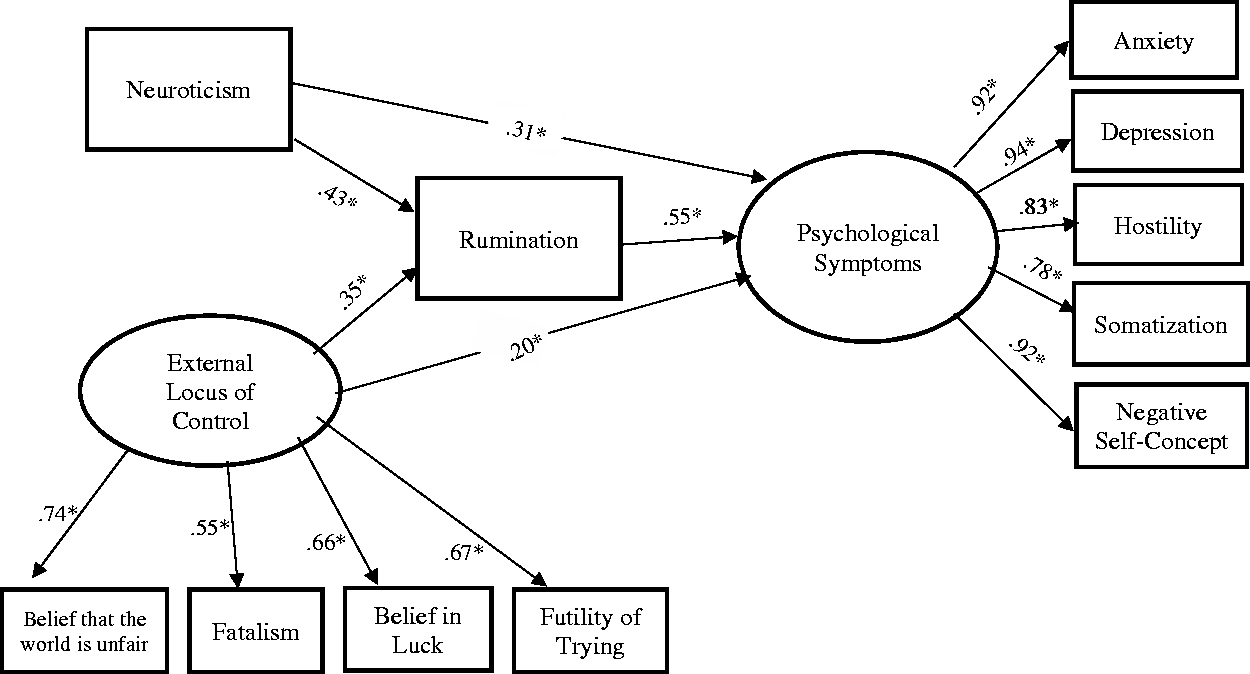
Standardized factor loadings for the structural model indicating the hypothesized associations between external locus of control, rumination, neuroticism, and psychological symptoms.*p < .001.
As hypothesized, an external LOC was associated with increased rumination (β = .35, p < .001), and so did neuroticism (β = .43, p < .001). As expected, rumination was significantly associated with psychological symptoms (β = .56, p < .001). The direct path from external LOC to psychological symptoms was also significant (β = .20, p < .001). Finally, the direct path from neuroticism to psychological symptoms was also significant (β = .32, p < .001). Therefore, rumination partially mediated the relationship between neuroticism, external LOC, and psychological symptoms.
Finally, an alternative model was tested in which rumination, external LOC, and neuroticism predicted psychological symptoms. That is, rumination was longer a mediator in the alternative model. The model showed an inadequate fit to the data, χ2 (41, N = 217) = 166.88, p < . 001, χ2/df = 4.07, CFI = .92, RMSEA = .119, SRMR = .158. A χ2 difference test revealed that the proposed model was significantly a better fit to the data as compared to the alternative model,
Discussion
This study aimed to examine personality and cognitive factors that may play a role in experiencing psychological symptoms in a sample of unemployed Turkish adults. More specifically, we tested a mediation model to investigate the role of rumination in the relationship between personality variables (i.e., neuroticism and external LOC) and psychological symptoms. To the best of our knowledge, this study was first to explore psychological mechanisms associated with psychological symptoms among unemployed Turkish adults.
In line with our expectations, neuroticism among unemployed individuals was associated with psychological symptoms both directly and indirectly via its effects on rumination. This is consistent with substantial evidence indicating that neuroticism is associated with psychological symptoms, and poor coping and problem-solving skills (e.g., Degraaf et al., 2004; D’Zurilla, Maydeu-Olivares, & Gallardo-Pujol, 2011). Furthermore, our findings suggested that unemployed individuals with high neuroticism have an increased tendency to ruminate, which seems to exacerbate their psychological symptoms. Prior research has revealed that increased attention to and enhanced memory of negative events and repetitive processing of negative information among neurotic individuals make them vulnerable to rumination (Ryckman & Lambert, 2015). It is likely that perceived stress related to unemployment is more pronounced for individuals with a tendency toward experiencing negative emotions, which activates repetitive thinking on the causes and consequences of one’s negative affect and job loss. One possibility which has not been tested in this study is that, just as neuroticism increases the likelihood of rumination; rumination, with its contribution to heightened negative affect (Lyubomirsky & Nolen-Hoeksema, 1993), may also contribute to a tendency toward negative affectivity. Therefore, future studies may test the possible bidirectional link between rumination and neuroticism by employing longitudinal designs.
Supporting our hypothesis, we found that an external LOC was associated with psychological symptoms directly and indirectly through its effects on rumination. This finding is consistent with previous evidence indicating a positive association between external LOC and negative mental health outcomes (e.g., Bjørkløf et al., 2016) and increased vulnerability to stress (Schmitz, Neumann, & Oppermann, 2000). Interestingly, despite higher levels of fatalistic orientation observed among Turkish individuals (e.g., Acevedo, 2008; Nordfjærn et al., 2012), believing that future events are uncontrollable and unchangeable was associated with psychological symptoms in the present sample and appeared to be an unhelpful way of perceiving unemployment. The association between external LOC and psychological symptoms might be even stronger in individualistic and/or less religious societies and in societies which have less fatalistic beliefs.
Surprisingly, there is limited previous research on the relationship between LOC and rumination. Thus, an important contribution of this study was the exploration of this relationship. In this study, an external LOC was related to increased rumination among unemployed individuals. Moreover, bivariate correlations showed that rumination was positively associated with all dimensions of external LOC. These findings indicate that the tendency of unemployed individuals to believe they do not have control over their future was related to passive and repetitive thinking on negative events and their negative emotions. This is in line with previous research on perceived control and rumination. To illustrate, in a sample of survivors of adverse events, individuals’ perceived control of the events was associated with decreased intrusive rumination (Brooks, Graham-Kevan, Lowe, & Robinson, 2017). For unemployed individuals with an external LOC, rumination may be an attempt to regain control over their negative life circumstances by repetitively thinking about them. However, this cognitive strategy seems to decrease psychological well-being.
We believe that the results of this study may have implications for clinical practice. One of these implications is that it might be possible to decrease or prevent psychological symptoms among unemployed individuals by targeting rumination. It is widely agreed that rumination is a dysfunctional coping strategy which results in negative affect, hopelessness, poor problem-solving, and a reduction in social support (Nolen-Hoeksema et al., 2008). Therefore, supporting unemployed individuals to recognize and stop the rumination process and to adopt more adaptive coping strategies which involve active coping and problem-solving may improve their psychological well-being. Research indicates that distraction and mindfulness strategies alleviate rumination (Hilt & Pollak, 2012), which could easily be integrated into intervention programs for unemployed individuals. Furthermore, given our findings on the contribution of external LOC to rumination and psychological symptoms, modifying beliefs regarding uncontrollability of future outcomes may be an important area of intervention. Increasing internal LOC may also improve people’s job search process and probability of re-employment (Caliendo et al., 2015). In addition, our results have highlighted the role of neuroticism in psychological symptoms among unemployed individuals. Although neuroticism has generally been accepted as a stable temperamental trait, there is preliminary evidence that it could be addressed via psychological treatment protocols. For example, a cognitive behavioral therapy intervention that targeted temperament traits of adults with anxiety disorders resulted in a decrease in neuroticism and behavioral inhibition (Carl, Gallagher, Sauer-Zavala, Bentley, & Barlow, 2014). Therefore, targeting neuroticism may be a potential area of intervention to improve the psychological well-being and adaptive coping of unemployed individuals.
Nevertheless, our findings should be interpreted considering the following limitations. First, the present data were collected at a single time point and the relationships demonstrated between the study variables do not imply causality. For instance, although external LOC was assumed to be a relatively stable construct in this study, there is evidence that long-term unemployment prospectively reduces young women’s beliefs of personal efficacy (Goldsmith, Veum, & Darity, 1996), a result that would have not been captured by studies conducted at a single point in time. Therefore, longitudinal studies are needed to better understand the long-term consequences of unemployment on psychological variables and the causal pathways contributing to psychological symptoms. Furthermore, our study sample consisted mostly of young, unemployed women with an undergraduate degree who did not have financial responsibilities to others, which may limit the generalizability of results to the general unemployed population. There is evidence that, in comparison to women, being unemployed has more profound effects on the mental health of men (Artazcoz, Benach, Borrell, & Cortes, 2004). This gender difference can be explained by the traditional role of men being the primary caretakers and having responsibilities to take care of the family (Artazcoz et al., 2004). Therefore, it is possible that psychological symptoms would be more pronounced in a sample with more financial responsibilities and with a more balanced distribution of gender. Moreover, research indicates that women are more likely to engage in rumination than men are (Nolen-Hoeksema et al., 2008). Given the gender disparity in the present sample, it seems necessary to explore whether rumination is an important contributor to psychological symptoms among unemployed men as well. Nevertheless, we suggest future studies to recruit more representative samples based on gender, education, and financial responsibility. In addition, the present model provided a very individual perspective to unemployment, which is a large-scale and social problem. Many important variables, such as financial strain, that might decrease the well-being of unemployed individuals were not considered in this study. We suggest that future studies include social and environmental factors that may negatively affect mental health during unemployment. Given that religious conservatism is relatively common in Turkey (as cited in Nordfjærn et al., 2012), the role of religiosity in responses to unemployment among Turkish individuals might be especially relevant for future research.
In conclusion, this study showed that neuroticism and external LOC were associated with psychological symptoms among unemployed Turkish adults, and that rumination partially mediated the relationship between personality variables and psychological symptoms. We believe that this study enhanced our understanding of personal mechanisms associated with a decrease in psychological well-being of individuals during unemployment. Our findings indicated that the personality characteristics of unemployed individuals and their cognitive coping strategies have an important impact on their psychological well-being. Results from this study can guide psychological interventions designed for unemployed individuals by highlighting the importance of targeting LOC, rumination, and the tendency of individuals experiencing negative emotions.
Footnotes
Acknowledgement
We would like to thank Fahrettin Can Mekikoğlu and Gizem Rabia Karayiğit for their contributions in the data collection process.