




Abstract
This research investigates the phenomenon of “friendly” sexist teases (FSTs), which we define as playful intergroup teases that are based on the negative gender stereotypes that devalue one’s gender group. We first employed a diary study to explore the prevalence of FSTs in college students’ everyday life and found that this type of teasing tends to occur in social situations and often between close others. In a second study, we experimentally manipulated perceived closeness with the teaser. We predicted that individuals teased by someone with whom they shared a perceived closeness would interpret FSTs as playful fun; therefore, the tease would not have a negative psychological effect. We further predicted that those teased by someone less close would likely focus on the literal content of the sexist tease, resulting in negative consequences to gender self-esteem. Results supported these predictions and provided insight into the phenomenon of FSTs.
Introduction
“You haven’t heard a single word I’ve said! Oh, wait, I forgot. You’re a guy, and everyone knows guys never listen. Ha! Just kidding!” For many people, it is relatively easy to recall a time when they were teased with a playful jibe. What makes teasing a particularly interesting behavior is, in large part, due to its paradoxical nature. Teases, or “permitted disrespect,” comprise both negative and positive qualities, being both potentially irritating and playful. Taken literally, teasing remarks can be insulting or demeaning; however, it is the playful aspect of the tease that allows it to be treated lightly. The word itself is indicative of its paradoxical nature. As pointed out by Pawluk (1989), the definition of teasing derives from the Anglo-Saxon word taesan (to tear apart) and the French word attiser (to fuel a fire). Thus, as Pawluk notes, the word’s origin implies both “cutting down” and “firing up” of the person being teased. Those who playfully tease often accompany their remarks with eye winks or smiles or altering the tone of their voice to signify that it is intended as humor. Moreover, this type of teasing has been found to be common between friends and close others (Baxter, 1992, Keltner, Capps, Kring, Young, & Heerey, 2001; Kowalski, 2004; Miller, 1997; Wessler & De Andrade, 2006). Bullying, on the other hand, is malicious and hostile with the sole purpose to hurt and emotionally harm another (Smith & Thompson, 1991); such malevolent teasing is not the focus of the present research. Instead, we focus on “friendly” and “playful” sexist teases between men and women.
Playful teasing
Playful teasing can be described as a means to express affection or strengthen social bonds by way of indirectly expressing affection and sharing in laughter (Alberts, 1992; Baxter, 1992; Keltner, Young, Heerey, Oemig, & Monarch, 1998; Kruger, Gordon, & Kuban, 2006). Playful teasing conveys an understanding of shared liking and implies that individuals feel close enough to engage in teasing behavior. Keltner et al. (1998) found that fraternity members who were teased by other fraternity members rated their impressions of the teasers more positively than they rated the fraternity members with whom they did not interact. These results suggest playful teasing serves to increase solidarity and solidify social bonds.
Although there has been considerable research on the nature of teasing behavior (Alberts, 1992; Graham, 1995; Keltner et al., 1998; Kruger et al., 2006), there has been little attention given to the concept of intergroup teasing, specifically intergroup gender teasing. Anecdotal evidence suggests that people use negative gender stereotypes as fodder for playful teases. For example, a man might tease a woman by saying, “I don’t know why you’re studying, after all you’re a woman and the only thing you need to know is how to cook and clean. Just kidding!” Or a woman might tease a man by saying, “I can’t believe your apartment is so clean, after all you’re a guy and everyone knows that guys can’t keep a room clean to save their life. Ha!” We term these teases as friendly sexist teases (FSTs). In other words, FSTs are playful teases applied to one’s gender group. Although by their very nature teases incorporate a negative literal aspect, they are nonetheless intended as good-natured banter between individuals that are not meant to cause hurt or harm. Evidence suggests that this teasing phenomenon occurs in social situations between men and women; therefore, it is important to understand these types of teases and their potential consequences, especially in light of existing research that indicates sexist jokes can have harmful effects. Previous research finds that individuals who experience discriminatory behavior based on their gender report negative effects on psychological well-being, including lowered self-esteem (LaFrance & Woodzicka, 1998; Swim, Hyers, Cohen, & Ferguson, 2001).
The social groups to which people belong are important to their social identity and can serve to develop and maintain their self-concept and social behavior (e.g., Tajfel, 1982; Tajfel & Turner, 1979, 1986). In other words, the more highly people identify with and value the groups to which they belong, the more positive their collective self-esteem (CSE), which is derived from one’s group memberships. Just as people want to feel good about themselves as individuals, they also want to feel proud of the groups to which they belong. As such, a remark that derogates one’s in-group, even when made in jest, could result in feelings of being devalued, which may subsequently affect CSE. Personal self-esteem, on the other hand, is a more generalized view of one’s self as an individual and can be described as an overall positive or negative attitude of oneself (Rosenberg, 1965). Although personal self-esteem is important in one’s self-concept, the focus of the present research is to explore the phenomenon of FSTs and the potential psychological consequences as they relate to CSE based on gender.
Friendly sexist teasing
Considerable research has investigated the effects of sexist jokes (e.g., Abrams & Bippus, 2011, 2014; Ford, Woodzicka, Triplett, & Kochersberger, 2013; Greenwood & Isbell, 2002; LaFrance & Woodzicka, 1998; Mallett, Ford, & Woodzicka, 2016; Woodzicka & Ford, 2010).
Ford and Ferguson (2004) found that people are more likely to tolerate sexist humor and perceive sexist remarks as acceptable when presented in the guise of humor and further explain that when people use demeaning jokes (e.g., racist jokes, sexist jokes) there is an unstated conversational norm dictating that the derogatory jest is to be perceived as light-hearted fun (Ford, Boxer, Armstrong, & Edel, 2008). The use of humor invites the listener to shift to a nonserious mind-set; consequently, the listener is expected to disregard the literal disparaging aspect of the joke. In this way, jokes activate an implicit norm of levity. Compared to sexist comments, sexist jokes are more likely to be dismissed and less likely to be regarded as offensive or problematic (Woodzicka, Mallett, Hendricks, & Pruitt, 2015).
What sets the present research apart from the existing research on sexist jokes is that we specifically investigate playful sexist teases. Although FSTs are similar to sexist jokes in that they both utilize a form of humor, jokes are narratives told to amuse an audience, which are often accompanied by a punch line. FSTs, on the other hand, are unique in that they specifically target the listener and the listener’s gender group by incorporating negative literal content based on gender stereotypes and are delivered in a playful manner. Because such a tease is used within a playful context, it is reasonable to believe that people will merely laugh it off. However, accepting or normalizing the negative gender stereotypes implied by the tease could lead to greater tolerance of discrimination which can have individual and societal consequences. Experiencing interpersonal discrimination, such as in the workplace, can result in high levels of stress, which, in turn, can have negative effects on physical health and can lead to poor job performance (O’Brien, McAbee, Hebl, & Rodgers, 2016). On a societal level, tolerating discrimination can serve to justify negative perceptions and behaviors toward marginalized groups. This can lead to greater societal group prejudice, subsequently normalizing widespread acceptance of inequality (Ford, 2000; Ford et al., 2008; Jost & Kay, 2005; Woodzicka et al., 2015).
Consequences of FSTs
If people feel they are a member of a devalued social group, in order to maintain positive self-esteem and feel good about themselves, it is possible that they will cognitively dissociate from their group, especially if membership in the targeted group is an important source of their self-esteem (Doosje & Ellemers, 1997). Applying this to FSTs, if people are teased about their gender with a sexist tease, they might psychologically distance themselves from their targeted gender group as a way to maintain positive self-esteem. Consequently, their CSE (i.e., identity as a group member) might diminish. Lending support to this idea, previous research shows that when gender identity is threatened, women tend to view themselves as individuals, independent from their gender group (Branscombe & Ellemers, 1998; Hodson & Esses, 2002).
When people perceive themselves as belonging to a disparaged and devalued in-group, they may engage in strategies to cognitively distance themselves from that group (Pronin, Steele, & Ross, 2004). For example, Steele and coworkers (Steele & Aronson, 1995; Steele, Spencer, & Aronson, 2002) found that members of a negatively stereotyped group experience performance-related anxiety, which is enhanced when their membership in the stereotyped group is made salient. Moreover, repeated experiences of stereotype threat can negatively affect self-esteem and result in collective threat whereby “individuals are concerned about the potentially stereotype-confirming acts of other members of their group” (Cohen & Garcia, 2005, p. 566). Collective threat can motivate people to distance themselves (physically and psychologically) from the stigmatized group to which they belong. Applying these concepts to sexist teases, the derogatory aspects of FSTs could serve to make the recipient’s membership in a negatively stereotyped group salient within the social context resulting in collective threat. That is, because FSTs comprise negative gender stereotypes that suggest to the teased person that others in her or his gender group behave in stereotype-confirming ways, in an attempt to maintain a positive self-concept, the individual might cognitively step back from her or his gender in-group.
Relationship with the teaser
Perceived closeness to the teaser could be a critical factor in determining how people perceive and react to FSTs. People tend to be more tolerant of teasing by close others than by others who are less close (Keltner et al., 1998, Kruger et al., 2006). Additionally, relationship closeness increases the likelihood that the tease will be perceived positively (Gorman & Jordan, 2015). In the case of FSTs, although the literal content of the sexist tease is demeaning and disparaging toward a gender group, if the teaser is a friend or close other, then individuals will likely perceive the teases as being playful and benevolent in intent. We predict that an individual who perceives greater psychological closeness with the teaser will focus on the playful aspect of the FST instead of the literal aspect that focuses on the negative gender stereotype. Such a strategy allows targets to interpret the sexist tease in a positive light, which may explain why people are more tolerant of teases made by close others than teases made by those who are considered less close (Keltner et al., 1998). However, if the teaser is someone with whom an individual perceives little to no psychological closeness, we predict individuals will focus on the negative aspect of the sexist tease that makes salient their membership in a devalued group, leading to psychological distancing from their targeted gender group.
Overview of the present research
The present research explores the phenomenon of FSTs from the target’s perspective. Because friendly sexist teasing is a newly investigated phenomenon, we first employed a daily diary procedure in Study 1 to explore the prevalence of FSTs in college students’ everyday lives. We expected to find that people would report being teased with FSTs by individuals they considered to be close others (e.g., friend, romantic partner) rather than those who they considered to be less close (e.g., acquaintance, stranger).
In Study 2, we used an experimental manipulation to investigate potential consequences for recipients of FSTs. We predicted that those teased with an FST would report lowered CSE related to their gender group and that the perceived closeness with the teaser would moderate this effect. Because prior research indicates that college students use teasing behavior to express affection and strengthen social bonds (e.g., Beck et al., 2007; Keltner et al., 1998), we chose to investigate a similar sample. We predicted that college students who are teased by a close other would perceive FSTs as friendly banter and would not report negative effects. Additionally, we predicted that individuals teased by a person whom they do not consider close might instead focus on the negative aspect of the gender tease evidenced by lower collective gender self-esteem.
Study 1
Study 1 examined FSTs using a daily diary procedure to investigate the occurrences of such teases in college students’ lives. This methodology has been successful in identifying everyday experiences related to gender (Swim, Cohen, & Hyers, 1998; Swim et al., 2001). During a one-week period, participants were asked to keep a detailed account of all gender-related comments that they experienced and their relationship to the person making the comment. The daily diary method enables participants to report everyday experiences as soon after they occur as possible. Using this event sampling procedure is beneficial because it allows us to assess the frequency of FSTs among all gender statements and to assess participants’ relationship and closeness with the person making the comment.
Method
Participants
Seventy-two participants (38 women, 34 men) were recruited from an Introductory Psychology subject pool at a large Midwestern university and received partial course credit for their participation. No other demographic information was collected.
Procedure
Participants were informed that we were investigating everyday comments relating to gender, and they received the following instructions both verbally and in writing: Many studies have examined people’s experiences with comments regarding their gender, but much of the information collected in the past has focused on extreme cases that result in lawsuits or media coverage. However, people do experience comments based on their gender every day, which are often overlooked in day-to-day life. One way to gain a better understanding of these everyday comments is to keep a record of such instances as they happen. Therefore, we would like you to keep a daily diary and record any comments directed toward you personally that relate to your gender in any way.
Verbal and written instructions were given to participants, and they were provided with a notebook consisting of daily diary forms and were asked to complete a form as soon as possible after they experienced any gender-related comment. Instructions on the diary forms asked participants to include as much detail as possible about the interaction and to record their relationship with the person who made the comment by indicating stranger, acquaintance, friend, family member, or romantic partner and then to rate their subjective closeness to the person who made the comment by circling a number on a scale from 1 (not at all close) to 7 (very close). Participants were instructed to return their completed forms three days after the initial instruction session and then again at the end of one week.
Results
Entries
Three people did not return their daily diary forms, leaving 69 participants (36 women, 33 men). Eight participants (four women, four men) did not report any gender-related incidents during the week (11.6%). Overall, a total of 262 entries were written: 142 written by women and 120 written by men. The number of entries written by women (M = 3.94, SD = 2.53) did not differ significantly from the number written by men (M = 3.64, SD = 2.26), t(67) = .53, p = .60, d = .13.
Types of entries
Entries were coded for content using a coding scheme that included five categories: (1) statements that included hostile or mean content directed toward the participant were coded as Hostile (“You are such a whore. Why don’t you just close your legs already”); (2) entries that included flattering statements directed toward the participant that the participant perceived to be intended as a compliment were coded as a Compliment (“I was at work and I was told by a gentleman that went through the checkout line that I was too pretty to need a job”); (3) matter-of-fact gender statements directed toward the participant were coded as a Neutral (“Someone held the door open for me and said, ladies first”); (4) statements, positive or negative, that used the word “all” when describing the participant’s overall gender group were coded as Overall gender group statements (“We were in the lobby and [she] said all men are nothing but dogs”); (5) finally, the category of main interest included statements directed at the participant perceived as a good-natured tease were coded as FSTs (“He walked in on me attempting to change my own oil in my car. He laughed obnoxiously loud and said, ‘Woman please. This is not your room. Go wash your hands and bake me a pie!!’”).
One male and one female research assistant coded each comment into one of the five categories. Intercoder reliability was computed as the percentage of agreements across all comments. Reliability was excellent, with an average of 93.5% agreement across categories (kappa = .91, p < .001). Discrepancies were resolved between the coders after further discussion delineating category criteria.
Percentages for type of entry and reported relationship
Sixty-nine participants wrote a total of 262 entries. Of the 262 entries reported, 7.7% (n = 20) statements came from strangers, 12.5% (n = 33) from acquaintances, 64.8% (n = 170) from friends, 4.6% (n = 12) from family members, and 10.4% (n = 27) from romantic partners. Of the total entries, 2.3% (n = 6) were categorized as Hostile; 3.9% (n = 10) were categorized as Compliment; 34.7% (n = 91) were categorized as Neutral; 23.7% (n = 62) were categorized as Overall gender group statements; and 35.4% (n = 93) entries were categorized as FSTs, presenting evidence that FSTs at the very least do occur in everyday life. Men and women reported a similar number of entries in each category (see Table 1). Chi-square analysis revealed there was not a significant difference in the number of entries reported by men and by women, χ2 (1, N = 262) = 2.05, p = .843.
Study 1: Frequency of gender-related comments.

Note. n = 262.
Friendly sexist teases
A total of 93 FSTs were recorded with 46 teases reported by female participants and 47 teases reported by male participants; thus, women and men reported an approximately equal number of FSTs. Of the 69 participants, 42 wrote at least one entry describing an FST (Mmale = 2.35, SD = 1.35; Mfemale = 2.09, SD = 1.51), t(40) = .58, p = .56, d = .18.
Based on previous teasing literature, we expected to find that participants would report a greater incidence of FSTs from friends and close others compared to strangers and less-close others. Our results support this idea. Participants reported a majority of FSTs from close others such as friends (60.2%), followed by romantic partners (15.1%), acquaintances (12.9%), strangers (6.4%), and family members (5.4%), suggesting that closeness plays a part in sexist teasing in college students. Additional analyses revealed an interesting effect between the gender of the participant and the gender of the teaser, χ2 (1, N = 93) = 16.86, p < .001. Women described being teased by men in 40 of the 46 entries (87%), χ2 (1, N = 46) = 25.13, p < .001, indicating that women experienced sexist teases mostly from men. On the other hand, men described being teased by women in 25 out of the 47 entries (53.2%), χ2 (1, N = 47) = .19, p = .66, suggesting that men experienced sexist teases equally from men and women.
Discussion
Findings from this study broaden understanding of the phenomenon of FSTs by presenting evidence that FSTs do occur in college students’ day-to-day life and that sexist teases are reported by men and women, suggesting that FSTs are not dependent on gender group membership. Moreover, the frequency of teasing is related to the perceived closeness with the teaser. Most sexist teases were reported by friends, which is consistent with the idea that closeness is associated with FSTs. Because participants in this study were college students at a residential campus, many of them likely spend the majority of their time and day-to-day interactions with friends and romantic partners and less time with family members. This could explain the lower percentage of teases reported by family members. It is also possible that FSTs might simply be less typical among family members compared to friends and romantic partners.
Women reported a greater number of instances of gender teasing from men than from women. Perhaps because men enjoy a higher status in society, FSTs could serve to reinforce and maintain a sense of patriarchal power over women. Although we describe FSTs as friendly and playful in nature, there is a possibility that some men might misuse the gender teases to mask a more malevolent intent; for example, to make clear to women that they should “know their place.” Previous research lends support to this idea. For example, studies find that men experiencing a threat to their masculinity may react by engaging in behaviors to establish their dominance, including subjugating women (Dahl, Vescio, & Weaver, 2015; Hoover, Hack, Garcia, Goodfriend, & Habashi, 2019; Overall, Hammond, McNulty, & Finkel, 2016). The use of FSTs by men in such situations would certainly be an interesting avenue for further study.
On the other hand, men reported being teased equally by men and women. This result reflects the often inconsistent findings concerning gender differences in teasing. Several studies find that men verbally tease more than women (e.g., Beck et al., 2007; Bell, Buerkel-Rothfuss, & Gore, 1987; Lampert, 1996), whereas other studies find no gender differences in verbal teasing (e.g., Baxter, 1992; Bell & Healy, 1992). Our research suggests there is a sex difference in gender teasing; however, this difference appears to be true for female targets only. In other words, it was not common for women to report being gender-teased by other women; however, men did report gender-teasing by other men. One explanation for this difference is that men tend to monitor and regulate other men’s masculine behavior more so than women monitor and regulate other women’s feminine behavior. This behavior has been explained by the idea that there is greater societal pressure for men to adhere to gender roles than there is for women; moreover, boys and men receive harsher punishment for gender atypical behavior compared to girls and women (Blakemore, 2003; Levy, Taylor, & Gelman, 1995). Thus, one function of FSTs might be to serve as a playful means for men to keep other men in line. Another possible explanation for the difference in same-sex teasing may stem from research that suggests women tend to use politeness tactics more so than men in conversational interactions and that concern for displaying approved social attributes may be greater for women than men (e.g., Baxter, 1984; Holmes, 1989). Therefore, compared to men, women may be less likely to tease one another using FSTs.
An obvious limitation of this study is that gender was the only demographic information collected in Study 1. Having a more complete description of social categories would certainly enable a clearer understanding of FSTs. Perspectives related to race, age, sexual orientation, gender identity, and cultural identities could influence how people perceive and react to FSTs. Still, Study 1 provides insight into the prevalence of FSTs in the lives of college students.
To further understand FSTs, we conducted Study 2 to investigate potential consequences of sexist teases. According to social identity theory, in-group members can enhance and boost their positive CSE by identifying and focusing on negative attributes of the out-group (Tajfel & Turner, 1979). One way to accomplish this is through the use of stereotypes that categorize out-group members and promote the perception that out-group members are “all alike” (Haslam, Oakes, Turner, & McGarty, 1995; Quattrone & Jones, 1980). Because FSTs comprise such stereotypes, individuals teased by an FST might experience a threat to self-concept, which could adversely affect their gender self-esteem.
Study 2
Study 1 revealed that FSTs are not uncommon in everyday life; however, is this type of teasing just harmless fun? Or, are there consequences for the target of the tease, and does relationship closeness affect perceptions of the tease? To investigate these questions, we experimentally manipulated whether college students were exposed to an FST or a gender-neutral humorous comment. In addition, we manipulated perceived closeness to the teaser. Although intended to be friendly banter, FSTs could have unintended psychological effects that would be evidenced by lowered self-esteem associated with belonging to one’s gender group.
We utilized Luhtanen and Crocker’s (1992) CSE scale to assess FST effects on different aspects of CSE related to group membership. Although previous research finds that CSE is positively correlated with psychological well-being and adjustment (Crocker, Luhtanen, Blaine, & Broadnax, 1994), if one’s in-group is perceived in a negative light, such as being negatively stereotyped by a sexist tease, this could harm CSE.
To the extent that FSTs devalue and make salient the negative stereotypes related to one’s gender group, such teases would be expected to negatively affect Public CSE, which is linked to perceptions of how others evaluate one’s in-group. Targets of FSTs could also be motivated to engage in psychological processes to maintain positive sense of self. If so, we would expect recipients of FSTs to respond with lower identity self-esteem, indicating that identifying with their gender group has less importance to their self-concept than individuals who were not teased.
Method
Participants
One hundred and sixty-seven participants (83 women, 84 men) were recruited from the Introductory Psychology subject pool at a large Midwestern university and received partial course credit in exchange for their participation. Participants’ age ranged from 18 to 30 years (M = 19.80, SD = 2.86). Self-reported race included 77.8% White, 6% Black, 3.6% Hispanic, 11.4% Asian, and 1.2% Other.
Dependent measures
Perceived closeness
After an online interaction with a confederate, participants completed the Inclusion of Other in the Self (IOS) scale to describe their perceived closeness with the confederate. This measure is designed to assess perceived closeness with others (Aron, Aron, & Smollan, 1992) and has been used and validated in multiple studies (e.g., Aron & Aron, 1986; Aron, Aron, Tudor, & Nelson, 1991; Morry, 2005). The IOS has been used across diverse populations, including children in Italy (Vezzali, Drury, Versari, & Cadamuro, 2016), undergraduates in the United States (Lewandowski, Nardone, & Raines, 2010), and African-American grade schoolers (Davis, Gabelman, & Wingfield, 2011). The scale is a pictorial measure of closeness indicating the degree of inclusion of the other in the self, consisting of seven pairs of circles varying in levels of overlap from 1 (no overlap) to 7 (large overlap). The less the two circles overlap, the less the perceived interconnectedness between the self and other; the more the two circles overlap, the more the perceived sense of interconnectedness. Participants were instructed to select the pair of circles that most accurately represented their level of closeness with their interaction partner. Participants also responded to a single item asking, “How close do you feel to the person you just interacted with?” on a 7-point scale, with higher scores indicating greater subjective closeness. Responses to this item and the IOS were highly correlated, r = .77, p = .01, so they were averaged to a single perceived closeness index.
Gender CSE
Participants responded to the 16-item gender version of the Collective Self-Esteem Scale modified to specify gender group (CSE; Luhtanen & Crocker, 1992), which incorporated four subscales. For our sample, scale reliability analyses for each subscale include the following: Membership, which measures people’s perceptions of how well they function as members of their gender group (α = .76); Private, which assesses people’s private evaluation of their gender group (α = .84); Public, which measures people’s belief regarding other’s evaluation of their gender group (α = .63); and Identity, which measures the role of gender group membership in people’s self-concept (α = .68). The mean interitem correlations for each subscale ranged from .30 to .57, suggesting that each subscale measured a single construct and that each item correlated with the subscale overall (Clark & Watson, 1995; DeVellis, 2003). This scale has been used with diverse samples, including blue-collar workers (Dionisi & Barling, 2018), gay and straight cisgender men (Anderson, 2018), and college students in China (Chen & Anderson, 2017).
Participants indicated the extent to which they agreed with each statement by responding on a scale ranging from 1 (strongly disagree) to 7 (strongly agree). Example questions include, “I am a worthy member of my gender group” (Membership); “In general, I am glad to be a member of my gender group” (Private); “In general, others respect my gender group” (Public); “The gender group I belong to is an important reflection of who I am” (Identity).
Procedure
Participants were greeted by the experimenter and seated individually in private rooms. The experimenter explained to participants that the purpose of the study was to examine how people interact and get to know one another when communicating online. The experimenter further informed participants that they would be interacting with another participant (i.e., confederate) who was in a separate room and that they would be using an online instant messenger that enables people to “talk” to each other by typing their responses back and forth via the Internet.
Before participants engaged in the online interaction, the experimenter familiarized them with the instant messenger program and then asked participants to answer several questions about themselves (i.e., first name, year in school, gender, and age) by typing their responses onto the instant messenger screen and then sending the information to their “online interaction partner.” Once the participant sent the information, the experimenter left the room to ostensibly familiarize the participant’s interaction partner with the instant messenger program. Using a computer in a separate location, the confederate followed a script and responded to the participant. Because we were interested in intergroup gender teasing, if the participant was a woman, the confederate used the male alias “Mark,” and if the participant was a man, the confederate used the female alias “Lisa.” All other information sent by the confederate followed the same script for each participant.
After the participant and confederate exchanged the initial demographic information, the experimenter returned to the participant’s room with three envelopes marked as Set I, Set II, and Set III. Each envelope contained 12 separate slips of paper stapled together in order, each with a written question. Participants were randomly assigned to the friend or acquaintance condition. Participants in the friend condition received slips of paper with questions designed to generate closeness between themselves and the confederate by encouraging gradually escalating self-disclosures and expressions of mutual appreciation (e.g., “Take a few minutes and tell each other your life story in as much detail as possible”). This manipulation has been found effective in experimentally creating levels of perceived closeness between two people who have never met regardless of whether the dyads are same-sex or cross-sex (e.g., Aron, Melinat, Aron, Vallone, & Bator, 1997; Mallen, Day, & Green, 2003). Confederates were instructed to interject one statement when appropriate during each set of questions (i.e., “By the way, I really like what you said about that last question. That’s so true!”; “Great answer on that last question!”; “You seem really honest”) to communicate mutual appreciation.
Participants in the acquaintance condition received questions designed to elicit superficial or trivial information including minimal personal information designed to minimize self-disclosure (e.g., “What are the advantages and disadvantages of artificial trees”). In each condition, the participants and confederate exchanged answers to the questions, alternating who typed the next question. They were instructed to go through the stapled slips, one at a time, and to answer them in order. The instructions also emphasized that they were to ask only the questions written on the slips and that they would have the opportunity to chat with each other online later in the study. To standardize confederates’ answers, all responses to the questions were scripted.
Participants were instructed to do their best and answer all of the questions thoughtfully and thoroughly but not to spend too much time on any one question. They were told that they would be notified via intercom when 15 minutes had elapsed so that they could move on to the next envelope containing a different set of stapled questions. The experimenter informed participants that their interaction partner had been randomly assigned to type the first question and that the interaction would begin as soon as their partner sent the first question.
After the experimenter left the room, the confederate began by typing the first question followed by her or his answer. Participants then typed their answer to the same question and then typed the second question followed by her or his own answer, which was then answered by the confederate alternating the order for each question. To strengthen participants’ belief that they were interacting with another participant, confederates were instructed to use occasional text speech and to make occasional spelling and grammatical errors.
Participants were allowed 15 minutes to exchange answers in each set of questions. After answering the questions in all three envelopes, participants were notified via intercom that they were finished with the first part of the study. The experimenter then entered the room and provided participants with a folder containing the scale designed to measure their perceived closeness with their interaction partner. Participants were told that their interaction partner would be given the same questionnaire and were assured that their responses would remain confidential and would not be viewed by their interaction partner. Participants were informed that when both they and their interaction partner were finished with the survey, they would be given further instructions.
After a few moments, the experimenter reentered the room to collect the survey and explain to the participant that the next part of the study would require a few minutes to set up in another room. Before leaving the room, the experimenter suggested that in the meantime the participant and her or his interaction partner could go ahead and chat online for a few minutes until the experimenter returned and notified them that the study was ready to proceed. During the “free chat” session, to get conversation going the confederate typed the following questions to the participant, “I kinda like this study. Do you?” “How many more experiments do you have to do?” and “Do you spend a lot of time on the Internet?” The confederate waited for the participant to respond to each question before asking the next one. After the participant answered the third question, the confederate typed and sent the FST (or gender-neutral humorous comment).
If the participant was randomly assigned to receive an FST, the confederate typed the gender tease. If the participant was a woman, the confederate typed: “So, how are your grades? Oh wait, you’re a girl. All you have to do is toss your hair and make kissy faces for an A. Just kidding!” If the participant was a man, the confederate typed: “So, how are your grades? Oh wait, you’re a guy so they probably suck. Why don’t you do like most guys and beat your girlfriend into doing your work for you? Just kidding!” The literal content of the male FST targeted the negative stereotype of men as abusive, and the literal content of the female FST targeted the negative stereotype of women as using their sex to gain advancement. The sexist teases were pilot tested with a separate sample of undergraduate participants (36 women, 24 men) to ensure that the teases were rated similarly in literal offensiveness. Participants rated on a 4-point scale the offensiveness of different teases from 1 (not at all) to 4 (extremely). Men rated the male tease, and women rated the female tease. The two teases chosen for this study were based on their similar offensiveness; the male tease (M = 2.67, SD = .96) and the female tease (M = 2.61, SD = .90), t(58) = .23, p = .82, d = .07. If the participant was randomly assigned to receive the gender-neutral comment, the confederate typed the comment: “So how are your grades? Oh wait, I just realized that I could have a V-8!” The comment was from a commercial frequently televised in the area designed to be humorous.
After typing the tease or gender-neutral comment, the confederate allowed 60 seconds for the participant to respond. Regardless of whether or not the participant responded, there was no further communication from the confederate. The experimenter then entered the participant’s room and explained to the participant that the first part of the study was completed and that there would be no further interaction with the other participant either online or in person. Participants were then asked to complete a computerized questionnaire. Computerized instructions stated the researchers would like to collect some background information to get a better understanding of the people participating in the study. To measure aspects of participants’ CSE related to their group membership, they were presented with the gender CSE. To boost the cover story, participants were also asked to complete a short filler 10-item personality scale and then to rate on a scale from 1 (not at all) to 7 (very much) to what extent they thought that their interaction partner was flirting with them. Upon completion of the computerized measures, the experimenter began the oral funneled debriefing to explain the deception. The experimenter probed for suspicion by asking participants whether they believed they were interacting with another participant and whether they believed the responses they read on the instant messenger were made by their interaction partner. Lastly, they were thanked for their time and dismissed.
Results
Missing values
Analysis of the patterns of missing data revealed that less than 2% of all items for all cases were missing, and 69.2% of the items were not missing data for any case. Considering individual cases, 96.4% of participants had no missing data. Finally, no item had .21% or more of missing values.
Suspicion probe
Three people indicated that they did not believe they were interacting with another participant, and one person disallowed use of the data. These four participants were excluded from analyses, resulting in a final sample of 163 participants.
Closeness manipulation check
To assess whether the closeness manipulation effectively instilled greater perceived closeness in the friend condition, an analysis of variance was conducted with type of interaction (i.e., friend/acquaintance) and participant gender (male, female) as independent variables and perceived closeness as the dependent variable. Results indicate a main effect such that participants in the friend condition reported a significantly greater sense of perceived closeness to their interaction partner (M = 3.59, SD = 1.24) than those in the acquaintance condition (M = 2.59, SD = 1.11), F(1, 159) = 30.21, p < .001, ηp2 = .16, indicating that the manipulation to instill perceived closeness was effective. Participant gender had no main (p = .46) or interactive (p = .22) effect.
Tease manipulation check
The FST was the last statement typed by the confederate during the online interaction. To determine whether participants recalled the gender tease, participants were asked to recall the last statement written by their interaction partner; all participants recalled the tease.
Responses to the tease
Reactions to the FST were determined by participants’ typed responses immediately after the tease. Of the 80 participants who were teased, 1 participant provided no response, and 14 participants (17.5%) typed neutral responses unrelated to the tease (e.g., mentioning classes or academic major). Positive responses to the FST included typed laughter (e.g., “Haha,” “LOL”) and/or joking back to the teaser (e.g., “Why would I do that when your girlfriend does such an amazing job already, hahaha, kidding”). Confronting responses included statements in which the participant clearly indicated that she or he considered the tease to be unacceptable (e.g., “psh! Not cool!” or “We, as in girls, have to work just as hard as you guys do!”). One male and one female undergraduate research assistant coded the data. Intercoder reliability was excellent with 96.4% agreement.
A dichotomous variable was created for positive responses to the FST; 1 indicating typed laughter/joking, and 0 indicating no typed laughter/joking. Of the 80 participants who were teased, 61.3% (n = 49) reacted with levity to the FST by laughing or joking back. A chi-square analysis of independence compared the frequency of positive reactions by men and women to the FST. Results indicated that women were more likely to respond with laughter/joking, 63.3% (n = 31) compared to men, 36.7% (n = 18), χ2 (1, N = 80) = 7.31, p = .007. Further frequency analyses of only those who reacted to the tease by laughing or joking back (n = 49) revealed similar reactions for men when teased by a friend, 37.5% (n = 9), or acquaintance, 36% (n = 9). Likewise, women reacted similarly when teased by a friend, 63.3% (n = 15), or acquaintance, 51.6% (n = 15), χ2 (1, N = 49) = .01, p = .913. Thus, although women had an overall higher frequency of positive reactions (compared to men), of those who responded positively to the FST, there was no gender differences when interacting with a friend or acquaintance.
Additional analyses explored reactions that confronted the teaser. Of those who were teased with an FST, the majority of participants (n = 63) did not confront the teaser (78.8%). Of those who did confront the teaser, 21.2% (n = 17), there was no significant difference between men (n = 7) and women (n = 10), χ2 (1, N = 80) = .49, p = .481. Moreover, there was no gender difference in confronting responses when participants were teased by an acquaintance (n = 11) or friend (n = 6), χ2 (1, N = 80) = 1.87, p = .172.
Gender CSE
Analyses were conducted to determine whether FSTs affected aspects of targets’ gender CSE and whether this effect would be moderated by the perceived closeness to the teaser, operationalized as interacting with a friend (close) or acquaintance (not close). A 2 (tease, no-tease) × 2 (friend, acquaintance) × 2 (male, female) between-participants analysis of variance was conducted with mean responses to each gender CSE subscale submitted as the dependent variable.
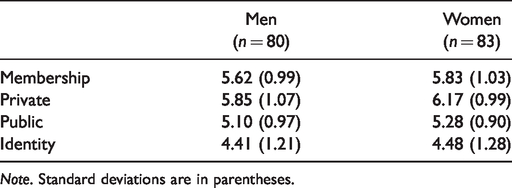
Means of each subscale for men and women are reported in Table 2. Specific means of each subscale for those teased (or not) by a close or not close other are reported in Table 3 for men and Table 4 for women. For the Private component, there was a main effect for participant sex such that women reported stronger private gender CSE than men, F(1, 163) = 4.08, p = .045, η p 2 = .03. For the Public component, a significant interaction emerged between teasing and closeness, F(1, 163) = 5.83, p = .017, η p 2 = .04 (see Figure 1). Those teased by less-close others (i.e., acquaintance condition) reported lower Public gender CSE (M = 4.88, SD = .90) than those not teased (M = 5.42, SD = .99), t(80) = 2.61, p = .011, d = .57, or those teased by a close other (i.e., friend condition; M = 5.31, SD = .90), t(78) = 2.15, p = .035, d = .48. However, Public CSE did not differ for those who interacted in the friend condition and were teased (M = 5.31, SD = .90) and not teased (M = 5.16, SD = .89), t(79) = .71, p = .479. For those who were not teased, there was no difference in Public CSE regardless of interaction partner closeness (M friend = 5.16, SD = .89; Macquaintance = 5.42, SD = .99), t(81) = 1.24, p = .217. Finally, for the Identity component, there was a main effect for teasing such that those who were teased reported lower Identity gender CSE than those who were not teased, F(1, 163) = 6.73, p = .01, ηp2 = .04. No significant findings emerged for the Membership subscale.
Study 2: Means of collective self-esteem subscales for men and women.
Note. Standard deviations are in parentheses.
Study 2: Mean collective self-esteem values for men as a function of condition.

Note. Standard deviations are in parentheses.
Study 2: Mean collective self-esteem values for women as a function of condition.

Note. Standard deviations are in parentheses.
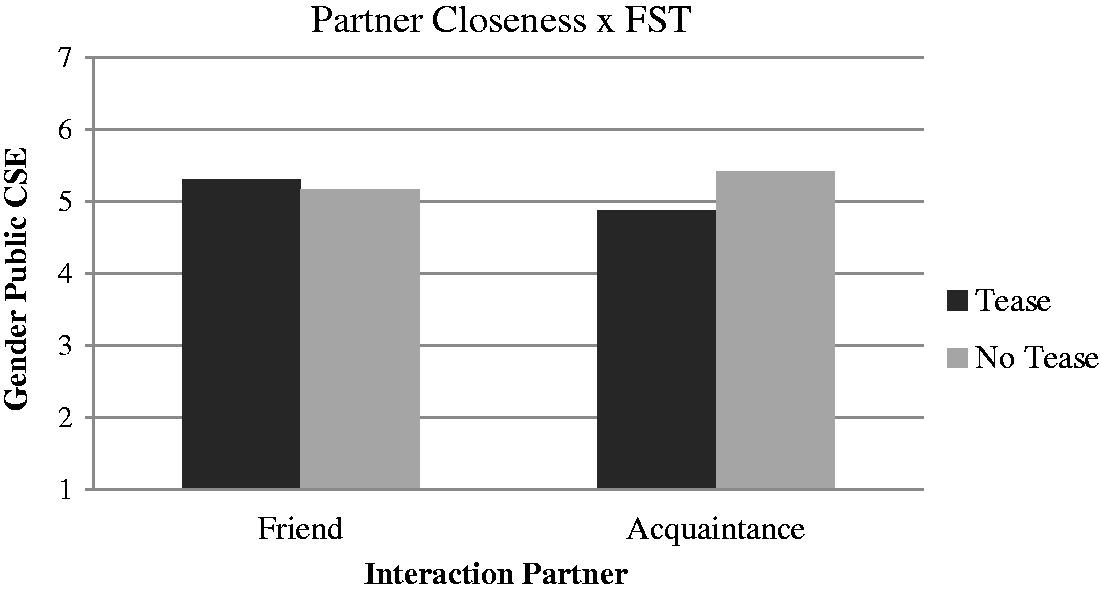
Significant interaction between partner closeness and FSTs for gender Public CSE.
Discussion
The fact that FSTs target the negative aspect of gender stereotypes (albeit in a playful manner) might suggest that women’s CSE would be affected to a greater degree than men’s because women belong to a lower status, more devalued gender group. However, our findings did not support this idea; teasing did not differentially affect men’s and women’s responses. In fact, the only gender difference found was a main effect for Private collective gender self-esteem; overall, women (compared to men) reported greater self-esteem related to their gender group. Women were more likely to report that they personally respected and felt good about belonging to their gender in-group. This finding is consistent with prior research that reveals a gender difference in automatic in-group bias such that women tend to like women more than men tend to like men (Rudman & Goodwin, 2004).
Also noteworthy is the finding that Identity CSE was affected by FSTs; however, this was not moderated by relationship closeness (i.e., friend, acquaintance) or gender. Those who were teased indicated that their gender group had lesser importance to their identity compared to those who were not teased with an FST, suggesting that FSTs carry some psychological consequences.
Not surprisingly, results of the Public CSE further suggest that recipients of FSTs were differentially affected by the perceived closeness of the interaction partner (i.e., friend, acquaintance). FSTs focus on negative gender stereotypes associated with one’s gender group. When participants were teased about their gender by individuals with whom they do not share a close relationship (i.e., an acquaintance), the FST likely brought to light the fact that their gender was being disrespected by someone who was not allowed the “permitted disrespect” of playful teasing (Pawluk, 1989). Consequently, the component of gender self-esteem that incorporates how others evaluate one’s gender group was negatively affected. However, gender teasing and perceived closeness to the teaser did not affect male and female participants differently, which suggests that the consequences of FSTs are not gender-specific.
We find it interesting that women were more likely to respond with laughter and levity to the FST compared to men, which is consistent with the notion that women are socialized to be “nice” and to focus on maintaining a sense of harmony within relationships (e.g., Leaper, 2000; Maccoby, 1998). As such, this could explain why women, more so than men, engaged in a conversational norm to respond in a positive manner after being teased.
We also found that relatively few men and women confronted the teaser, which is consistent with prior research that stresses the importance of situational contexts and perceived costs in confronting an offensive remark (Swim & Hyers, 1998). Because teasing by its very nature comprises both positive and negative qualities, people may sometimes be uncertain of the teaser’s intent (Pawluk, 1989; Shapiro, Baumeister, & Kessler, 1991) and be especially hesitant to confront FSTs. This may be particularly true in contexts whereby people are unfamiliar with the teaser. As such, recipients may feel a social pressure to react positively to the remarks and may believe that reacting in a negative manner (i.e., confronting) would be a violation of a social norm, resulting in aversive interpersonal consequences (Dodd, Giuliano, Boutell, & Moran, 2001; Kaiser & Miller, 2003; Shelton & Stewart, 2004). Such perceptions actually may be grounded in truth. Studies find that when tease recipients take offense and express their displeasure, they are often met with the words, “I’m just kidding!” or “Lighten up! It’s only a joke!” (Johnson, 1990; Keltner et al., 2001; Kowalski, 2000; Kruger et al., 2006).
Overall discussion
The present research explored the phenomenon of FSTs and investigated potential psychological consequences as a function of subjective closeness with the teaser. Results of Study 1 indicate that FSTs are not uncommon among close others (i.e., friends, family, romantic partners), which is consistent with the literature showing that teasing is a function of familiarity (Baxter, 1992; Keltner et al., 2001; Kowalski, 2004; Wessler & De Andrade, 2006). However, participants also reported experiencing FSTs with less-close others, such as acquaintances and strangers. In fact, about 20% of the FSTs that people reported occurred from those with whom there was little to no perceived closeness. This finding is consistent with the idea that sexism, particularly in its subtle but highly consequential ways (Moss-Racusin, Dovidio, Brescoll, Graham, & Handelsman, 2012), continues to be commonplace (Swim et al., 2001).
Importantly, Study 2 demonstrated that FSTs had a negative effect on the Identity component of gender CSE, suggesting that recipients of such teases responded by lessening importance of gender in their self-concept. Moreover, perceived closeness with the teaser played a critical role in determining effects of FSTs on Public CSE such that people who were teased by someone with whom they felt no connection were most likely to distance themselves from their targeted gender group.
These findings are important because according to social identity theory (Tajfel, 1982; Tajfel & Turner, 1979, 1986), humans strive to maintain a positive healthy self-esteem. One way in which this can be satisfied is through psychologically connecting with valued groups that are important to one’s self-concept, which can have implications for psychological well-being. For example, Luhtanen, Blaine, and Crocker (1991) found a negative correlation between CSE and depression, suggesting there are psychological benefits associated with having high CSE. Additionally, all CSE subscales are positively correlated with well-being measures and are related to decreased hopelessness and decreased depression (Crocker et al., 1994).
In contrast, when people were teased by someone with whom they felt at least somewhat close, the FST had no impact on aspects of their gender CSE. This suggests that when people are teased with FSTs by a friend or close other, they are likely to attribute benevolent intent on the part of the teaser. In this way, our results are consistent with prior research that finds teasing between close others, such as friends, appears to be a way of expressing affection and camaraderie (Keltner et al., 1998; Kruger et al., 2006). Indeed, our data suggest that FSTs between close others might simply be playful harmless fun, which do not have a negative effect on CSE. However, when teased by someone not close, people appeared to focus on the negative literal content of the tease that targeted their gender group and they tended to pull away, or distance themselves psychologically from their gender group. Although there was a significant difference in Public gender CSE for those who were teased by someone not close compared to those who were not teased, mean levels on gender CSE still remained relatively high and stayed above the midpoint of the scale. Thus, the single teasing incident did not cause gender Public CSE to drastically plummet, although repeated FSTs might well have such an effect.
If people are exposed to multiple FSTs in their social environment, psychologically distancing might be one strategy to protect self-esteem from the negative implications of being associated with a devalued group (Branscombe & Ellemers, 1998; Hodson & Esses, 2002). Or, repeated FSTs might have a leveling effect. For example, Abrams and Bippus (2011) asked men and women to read varying numbers of gender jokes and then to rate the degree to which they believed the jokes were more typical of their own gender or the “opposite” gender. They found that the number of jokes had an effect on the joke’s perceived gender typicality. In other words, after repeated exposure to gender jokes, participants were less likely to rate the jokes as typical of a gender group. The researchers suggested this might have been the result of the jokes’ novelty wearing off. This same process might be in effect for repeated exposure to FSTs. Perhaps being repeatedly exposed to sexist teases from someone with whom people feel little connection would result in desensitization, and, therefore, perceived collective threat that would lead to a psychological distancing from the targeted gender group. This would be a fruitful avenue of research for individuals studying the effects of teasing.
Another important result from the current study is that cognitive interpretation of “teasing” matters. Our results suggest that when the tease comes from a close other, teasing is perceived as playful fun; in contrast, people teased from less-close others are less likely to perceive FSTs as good-natured. Previous research finds that social context matters in perception of sexist humor (Gray & Ford, 2013). With a progressively increasing use of online communication and social media platforms that instantly connect nonclose people (e.g., Twitter, Facebook, Instagram), our findings can be especially relevant. In an online environment, recipients of FSTs might be more likely to misperceive the teaser’s intent as mean-spirited especially if there are no markers, such as emoticons or emojis to relay emotion in text (e.g., smiley face, winks). Indeed, previous studies have found that adding positive emoticons or emojis in ambiguous messages can influence readers’ perceptions of the author’s intent (Lo, 2008) and increase positive emotion in the reader (Derks, Bos, & von Grumbkow, 2008; Luor, Wu, Lu, & Tao, 2010). Future research could explore online environments to investigate the use (or nonuse) of emotion markers to determine their role in people’s perceptions of FSTs “crossing the line” from playful teasing to nonfriendly teasing.
A limitation of Study 2 is that we did not formally pilot test the gender-neutral comment. Although a separate poll of undergraduate students indicates that they perceived the comment to be humorous, we did not assess the study participants’ perceptions of the comment (e.g., did they consider the comment to be humorous). Additionally, we cannot say with certainty what people thought or felt about the FST. Did they actually perceive it as light-hearted fun? Or, were they choosing to simply respond in a socially polite manner? Because we did not ask participants to report their perceptions about the teaser’s intent, we cannot be sure that individuals inferred the teaser’s intent as a playful jibe. Additionally, all targets of the tease were afforded the opportunity to respond to the teaser. Hyers (2007) found that assertively responding to gender prejudice can enhance feelings of self-satisfaction. Therefore, it is possible that people who are prevented from responding to the FST might report lowered levels of affect and collective gender self-esteem. Future research should consider situations where the target is actively prevented from responding, as the emotional and psychological consequences might be different compared to the conditions used in this research.
An important strength of our research is the experimental manipulation of closeness, which allowed us to isolate the causal role that subjective closeness played in people’s reactions to FSTs. Although this is an excellent way to identify potential factors related to gender teasing, future research should examine FSTs in established relationships and investigate whether the results parallel our findings. Future research might also explore whether intergroup teasing based on negative versus positive stereotypes have similar effects on gender CSE. For example, would the same effects occur if a woman were teased about being especially nurturing or kind because of her gender? Previous research would predict that this might not be the case. Czopp (2008) found that people who used positive stereotypes during interactions were more disliked by targets compared to people who did not use positive stereotypes. Other research indicates that positive group-level compliments, when stereotype-relevant, lead to negative emotional responses (Garcia, Miller, Smith, & Mackie, 2006). Intergroup teasing based on positive stereotypes would likely have the same negative effects for recipients’ emotions and gender CSE particularly if the teasing occurs among those who are not close rather than close others. Examining the valence of FSTs would be an interesting avenue to explore in future studies to further our understanding of sexist teases.
Another future avenue of study would be to explore other types of intergroup teasing, such as “friendly” racist teasing. In adolescents, teasing behavior based on race/ethnicity occurs with some frequency between close peers and friends, and they do not perceive such teases negatively because of their assumed playful nature (Douglass, Mirpuri, English, & Yip, 2016). Adults, however, tend to perceive racism as a more serious offense than sexism (Czopp & Monteith, 2003) even if expressed in jokes (Woodzicka et al., 2015); as such, intergroup teasing that targets a negative stereotype associated with race between adults may not be perceived as friendly banter, perhaps even between close others. To the extent that friendly intent is not assumed, or an ulterior motive is lurking underneath, we expect the focus on the literal content of the tease to have the same negative effects on CSE as we observed for FSTs.
As noted by Crandall, Eshleman, and O’Brien (2002), some prejudices are considered more acceptable than others. Indeed, researchers find that people tend to perceive racism as a more serious offense than sexism (Cowan & Hodge, 1996; Czopp & Monteith, 2003; Rodin, Price, Bryson, & Sanchez, 1990), in part because the social norms surrounding racism and sexism differ in society (Fiske & Stevens, 1993). Because racial bias is perceived as less acceptable than gender bias, a friendly racist tease from an outgroup member (e.g., Whites teasing African Americans) may be perceived more negatively than a friendly sexist tease, resulting in greater discomfort for the target and greater negativity toward the teaser.
Equally interesting to explore is how FSTs might differentially affect men and women belonging to a racial minority or other marginalized group. For example, several studies find that women of color experience racist and sexist comments relatively often (DeBlaere & Moradi, 2008; Matteson & Moradi, 2005), which can carry an increased risk for poor health and low well-being (Perry, Harp, & Oser, 2013). Although racism and sexism can both contribute to psychological distress, sexism has been found to be the stronger predictor for African-American women (Moradi & Subich, 2003; Szymanski & Stewart, 2010). Szymanski and Stewart explain this by suggesting that women of color must deal with racism from racial out-group members; however, they must deal with sexism from both their racial in-group and out-group members.
Related to psychological distress are microaggressions. Racial microaggressions are everyday subtle messages that denigrate people based on their racial group membership (Capodilupo et al., 2010; Sue, 2010; Sue et al., 2007), and gender microaggressions are defined as “intentional or unintentional actions or behaviors that exclude, demean, insult, oppress, or otherwise express hostility or indifference toward women” (Basford, Offermann, & Behrend, 2014, p. 341). Friendly racist or FSTs could have an unintended effect of being perceived as microaggressions. Adding the level of complexity experienced by individuals when they identify with more than one marginalized or minority group, friendly racial and gender teases might be more likely to be perceived as microaggressions. For example, Lewis and colleagues (Lewis, Mendenhall, Harwood, & Browne Huntt, 2016) found that African-American women reported experiencing microaggressions based on stereotypes related to their gendered racial group (e.g., angry Black woman). As such, it would be a worthwhile area of study to investigate the consequences of FSTs for individuals who possess multiple stigmatized identities.
Practice implications
According to a recent report by the Employment Law Alliance (2018), language, jokes, and teasing were rated as the most prevalent type of sexual misconduct in the workplace today. Most harassment policies define harassment as behavior that is unwelcome or includes inappropriate behaviors. The current findings highlight that Human Resource professionals should explore including sexist teases in organizational policies. These playful, unintentionally harmful comments may make the target believe that the teaser holds negative perceptions of the gender group she or he belongs to. In the workplace, an environment filled with acquaintances and strangers, this lowered sense of CSE may have effects similar to the effects of sexual harassment for victims—lowered job satisfaction and increased job stress (Fitzgerald, Drasgow, Hulin, Gelfand, & Magley, 1997). Based on this possibility, it would be prudent for Human Resource professionals and counselors to incorporate FSTs into harassment trainings and gender discrimination policies.
Teasing is also common in K-12 school settings. Girls teased about their gender by boys, even by other girls, may restrict their own behavior; for example, they may be less likely to engage in school sports and physical activity (Lopez, 2019). Additionally, childhood teasing has the potential to increase the risk for lower self-esteem in both boys and girls (Gregg, Somers, Pernice-Duca, &Van Dale, 2016). Therefore, it is crucial that parents, teachers, and school counselors recognize and intervene when teasing is having adverse effects on a child, even if the tease is intended as good-natured fun. Children and teens who are targets of teasing may benefit from working with a therapist, counselor, or clinician to help develop strategies for coping with teasing.
Conclusion
The present research is an important first step in understanding the phenomenon of friendly intergroup teasing, and it suggests a variety of interesting directions for future research. Our findings provide evidence that gender is used as fodder for friendly teases and that the levels of perceived closeness that recipients feel with the teaser can influence whether there are psychological effects of FSTs. Therefore, at least in some cases, teasing—even if intended as harmless fun—may not be so harmless after all.
