



Abstract
In two studies, we investigated the role of self-regulatory behavior in terms of achievement goals and goal progress for work engagement. Study 1 (N = 205) revealed that trait learning goals were positively related to work engagement and performance-approach and performance-avoidance goals were unrelated to work engagement. In a second study, employees were asked to either set a (state) learning, performance-approach, or performance-avoidance goal for the upcoming work week. Goal progress and work engagement were measured one week later (N = 106). Learning goals at the trait and state level were associated with higher work engagement and performance-avoidance goals were unrelated to work engagement. We found a positive relationship of goal progress with work engagement, in particular for employees who pursued learning or performance-approach goals. Our studies contribute to theory building by delineating the (combined) role of goal orientations (trait), state achievement goals, and goal progress for work engagement, as well as generating practical implications for the design of effective interventions to enhance work motivation in organizational practice.
Achievement goals and goal progress as drivers of work engagement
The motivational construct of work engagement, defined as “an active, positive work-related state that is characterized by vigor, dedication, and absorption” (Bakker, 2011, p. 265), has taken a prominent role in research and practice to explain work performance and sustain occupational well-being (Bakker et al., 2014). The Job-Demands-Resources Theory (Bakker & Demerouti, 2014) helps to understand, explain, and predict work engagement. In the original conception of this model, only work characteristics were outlined as resources (e.g. autonomy, social support) that lead, due to their motivational potential, to employee engagement. Numerous research findings have demonstrated that job-related resources act indeed as drivers of work engagement (for an overview, see Schaufeli & Taris, 2014). In the meantime, an important model extension has been made with the specification of also personal resources. They are defined as “aspects of the self that are generally linked to resiliency and refer to individuals’ sense of their ability to control and impact upon their environment successfully” (Xanthopoulou et al., 2007, p. 123f.). However, the role of resources on the side of the individual person seems theoretical less well understood than other resources (Schaufeli & Taris, 2014). In line with this unclear role, a recent meta-analysis about approaches to stimulate work engagement in practice demonstrated high variability in effects of interventions stimulating such personal resources (Knight et al., 2017).
Therefore, there is a need to better understand the motivational role of personal resources at work. By building on the important role of goals as a central element of work motivation (Diefendorff & Lord, 2008; Kanfer et al., 2017), we answer the call for more research on the link of self-regulation and work engagement (Bakker et al., 2008). With two empirical studies, we aimed to contribute to the understanding of the role of self-regulatory behavior in terms of goal focus and goal progress as drivers of work engagement in two important ways. First, we investigated besides the role or trait goal orientations also the effects of state achievement goals that are currently pursued, to provide much-needed causal evidence of which achievement goals function as antecedents of work engagement. Second, we investigated if progress towards the attainment of specific state achievement goals strengthens the motivational process even further, leading to enhanced work engagement.
Antecedents of work engagement
Based on the integration of the job stress and work motivation literature, the Job-Demands-Resources (JD-R) model or theory (Bakker & Demerouti, 2008, 2014) has received broad attention and empirical support in the last decades. In the motivational process, the model outlines that especially resources (at the job, e.g., autonomy, social support; or personal, e.g., intrinsic motivation, self-efficacy) facilitate positive work-related states, such as work engagement, leading to positive outcomes. For example, Young et al. (2018) demonstrated that personality traits may function as personal resources as they help with the “management of energy” (Young et al., 2018, p. 1331) at work. In their meta-analysis, personality traits explained up to 48% of the variance in work engagement. In line with the idea that resources help to build more resources (e.g. in terms of a resource caravan; Hobfoll, 2002), recent research supports that the link of personality traits to work engagement can, for example, (partly) be explained by generating other (job or personal) resources through job crafting (Bipp et al., 2019; Tims & Akkermans, 2017). Furthermore, also motivational constructs such as self-efficacy have been shown to drive work engagement (Xanthopoulou et al., 2007). However, a clear, overarching theoretical framework for explaining the (motivational) effects of personal resources within the JD-R model is currently lacking.
Given the motivational role of resources, it seems surprising that the integration of goals into the JD-R framework to explain the motivational process leading to work engagement has rarely attracted research interest (e.g., Poortvliet et al., 2015). Different work motivation theories emphasize that goals are central in self-regulatory behavior, for example, by affecting the allocation of time and energy at work (e.g. Klein et al., 2008), which targets the core of the work engagement construct (Christian et al., 2011). In line with this reasoning, motivational theories have been suggested to provide a high fit with approaches to explain and predict work engagement (Bakker et al., 2008). However, prior studies provide only limited insights into the effect of achievement goals, based on one of the best-validated achievement motivation theories (VandeWalle et al., 2019), on work engagement. Researchers have, for example, mainly focused on dominant or on selected achievement goals in terms of traits (e.g., De Lange et al., 2010; Poortvliet et al., 2015). However, to support the design of effective individual-based interventions, there is also the need for a causal test of (state) goals as antecedents of work engagement (Bakker & Demerouti, 2008). Therefore, we investigated how different (trait and state) achievement goals affect work engagement. Extending research in this area, we also looked at the motivational role of progress towards goal attainment for work engagement.
Achievement goals and work engagement
To investigate the role of goal-directed behavior for work engagement, we relied on goal orientation (GO) theory that specifies GO as a motivational construct that refers to the specific goals people pursue in achievement situations (VandeWalle et al., 2019). Although there are different conceptualizations (Elliot, Murayama, et al., 2011), there is broad support for the so-called trichotomous framework (DeShon & Gillespie, 2005) that distinguishes learning (the goal to develop one’s own competence by increasing skills), performance-approach (the goal to demonstrate competence by outperforming others and to gain favorable judgments), and performance-avoidance goals (the goal to avoid showing a lack of competence and to avoid negative judgments). Besides a trait approach in which GO are seen as individual disposition, achievement goals have also been conceptualized as the adoption of specific goals in a particular achievement situation (DeShon & Gillespie, 2005; Van Yperen et al., 2015). Various approaches have been developed to activate these goal states, by emphasizing for a particular task either the opportunity to learn or the proof of ability and the use of normative standards (Chen & Mathieu, 2008).
We suggest that the effect of achievement goals on work engagement can be explained by extending the role of (personal) resources in the JD-R model by core elements from GO theory. In detail, we expect that work engagement depends both on the focus of goals (trait, state, and their combination) that is being pursued and on the progress that is made towards the successful pursuit of these goals (Figure 1). First, we expect trait GO (particularly learning goals) to act in a similar way as personal resources in terms of personality traits (e.g. positive affectivity; Young et al., 2018). Persons with a high learning goal orientation have been demonstrated to show effective self-regulatory behavior (Cellar et al., 2011). Therefore such a goal orientation should help to identify, build, or make use of resources at work and therefore sustain work engagement (Tims & Akkermans, 2017). Second, we suggest that self-regulatory behavior in pursuing specific work-related state-level achievement goals and experiencing progress towards attaining them also has a fundamental motivational potential within the JD-R model. Setting and pursuing specific goals should – in line with the suggestion for the effect of personal resources at work – support employees “to control and impact upon their work environment successfully” (Bakker et al., 2008, p. 214). Although achievement goals and goal progress are not included in the JD-R model (yet), these motivational variables have been shown in prior research to be linked to established resources, such as goal clarity, feedback, or positive emotions (Schaufeli & Taris, 2014). Third, definitions of state achievement and trait goal orientations show high overlap, and the meta-analysis of Payne et al. (2007) provided support for a strong association of achievement goals at different levels. Therefore, we expect the effects of trait and state goals to be largely similar (and even support each other, see below).
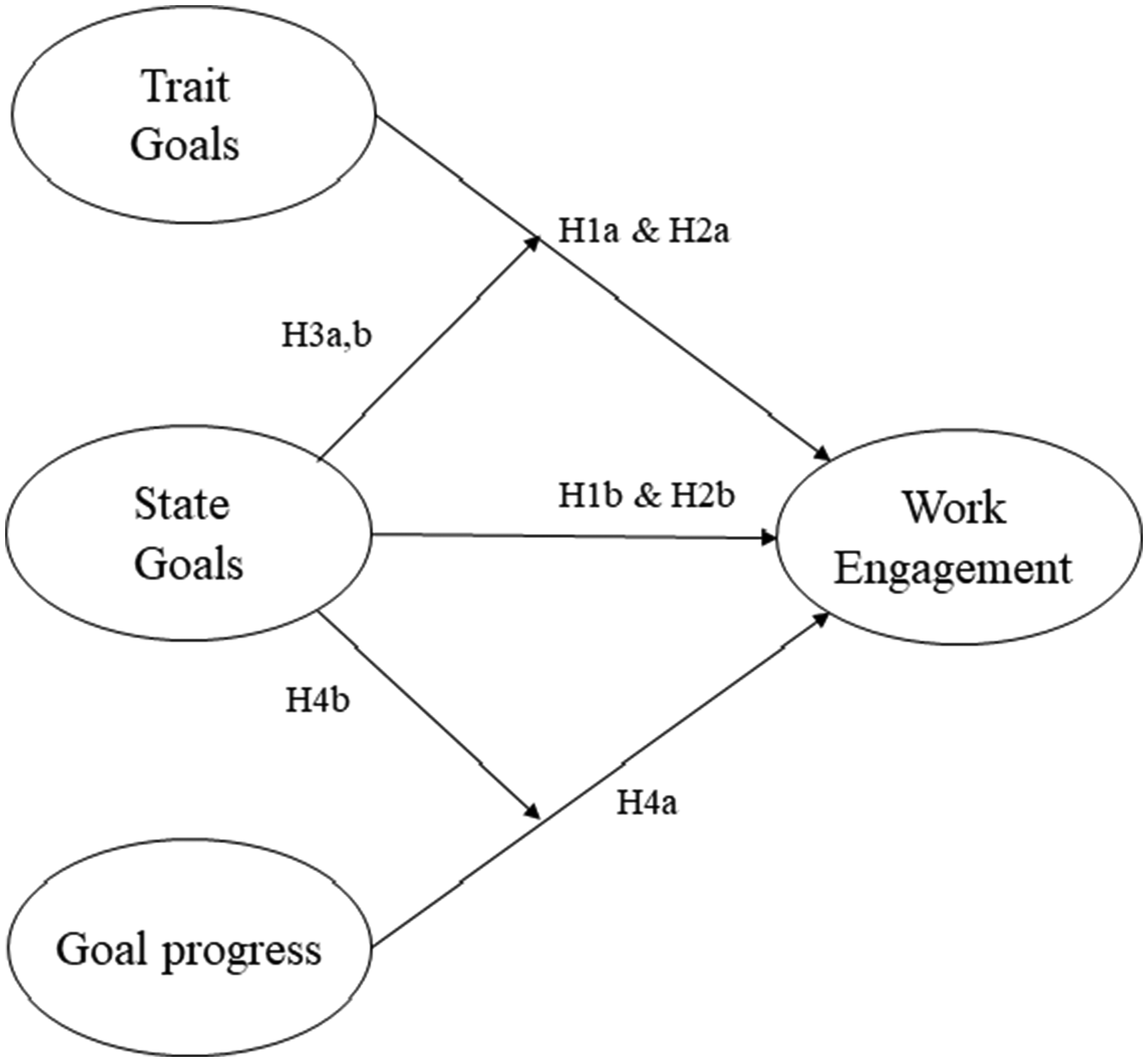
Research model.
In detail, as resources in the JD-R model are intended, amongst other things, to “stimulate personal growth, learning, and development” (Bakker & Demerouti, 2008, p. 211), we expect especially learning goals to sustain work engagement. On the one hand, motivated to increase one’s competence and to develop oneself, persons scoring high on trait learning goal orientation seek out learning opportunities and challenging tasks (VandeWalle, 1997). Prior research has found a positive relationship of this dimension with work engagement (e.g., Adriaenssens et al., 2015; Poortvliet et al., 2015), supporting our assumption of trait learning goals as a personal resource. On the other hand, also situational goals focusing on developing oneself and learning at work should create challenges and help to build resources and therefore foster engagement. Indirect support stems from Hyvönen et al. (2009), who found that developmental goals set by managers were associated with high work engagement.
Second, concerning performance-avoidance goals, research points towards a negative impact on self-regulatory processes, which may inhibit work engagement. Individuals holding performance-avoidance goals have been shown to focus on avoiding failures, a lack of competence, and negative outcomes (Elliot, Thrash, et al., 2011; Oertig et al., 2013). An avoidance focus requires substantial attentional and self-regulatory capacities (e.g., continuous comparison with others, or negative thoughts) that can diminish a person´s energy resources. Indeed, avoidance goals are negatively related to (meta-) cognitive self-regulation (Vrugt & Oort, 2008), or self-regulatory resources (Oertig et al., 2013). Meta-analytic findings support that persons with a high performance-avoidance GO report lower self-efficacy beliefs or less feedback-seeking (Cellar et al., 2011; Payne et al., 2007), which are resources from the JD-R model. Consequently, Adriaenssens et al. (2015) found a negative relation between trait performance-avoidance goals and work engagement. Also, the (current) pursuit of avoidance-oriented goals has been shown to lead to depletion of resources (Oertig et al., 2013) and to be negatively related to well-being (Elliot et al., 1997).
Goal progress
Given that for effective self-regulatory behavior, not only properties of the goals but also the striving towards them (evaluating goal progress, e.g., via feedback loops) is central for the motivational process ( Kanfer et al., 2017), we expect that also the extent to which progress is made towards successful goal attainment affects work engagement. We focused on goal progress in the current study, as research has provided evidence that for subjective well-being the perception of moving towards goals is more important than, for example, the actual attainment of goals (Klug & Maier, 2015). In line with the assumption that the progress towards goals satisfies personal needs and impacts emotions positively, various studies have shown that making progress towards (or attaining) a goal is associated with, and the driver of, positive affect, higher work satisfaction, and engagement (Judge et al., 2005; Koestner et al., 2002; Wheeler et al., 1990; Wong et al., 2017). Klug and Maier (2015) found in their meta-analysis a robust positive relation between successful goal striving and subjective well-being. Therefore, we expect a positive relation between making progress towards (state) goals and work engagement.
Furthermore, given that GO theory allows for linking goals to achievement emotions (Pekrun et al., 2009), we expect that the relationship between goal progress and work engagement depends on the specific goals being pursued. First, especially learning (mastery) goals have been linked to performance outcomes via positive emotions, such as joy (Pekrun et al., 2009). Meta-analytic research in education supports a positive relationship of such goals to positive emotions (e.g., Huang, 2011), and also at work, substantial relationships of learning goals with positive self-reactions have been identified (Cellar et al., 2011). Therefore, we expect that when learning goals are pursued the progress towards reaching such goals should be positively associated with work engagement. Second, although performance-approach goals can impose additional demands on employees especially when they are not met, meta-analytic results suggest that performance-approach goals can also lead to positive self-reactions (Cellar et al., 2011; Huang, 2011). If people are able to perform better than others (progress towards the attainment of a performance-approach goal) they should experience positive achievement emotions (Pekrun et al., 2009). Therefore, we also assume for these goals a positive link between goal progress and work engagement. Third, the pursuit of performance-avoidance goals has consistently been shown to be associated with negative affect or reduced well-being (e.g., Elliot et al., 1997; Huang, 2011). We expect the negative emotions stemming from currently pursuing avoidance goals to overrule the positive effect of goal progress, and therefore did not expect for these goals a substantial relationship of goal progress with work engagement.
Study 1
We first tested our hypotheses regarding the link of trait GO with work engagement (H1a, H2a) in a cross-sectional online survey among international employees. Given that meta-analytic evidence suggests an effect of age on work attitudes (Ng & Feldman, 2010), we controlled for this variable in all our following analyses.
Method
Participants and procedure
Participants were English-speaking international employees, recruited via students of an international master’s program at a Dutch university. 1 Data were collected online and all measures were presented in random order, to prevent sequencing effects. No incentives were provided for study participation. During the five-week period of the data collection, 591 persons clicked on the start page. Complete data for our hypotheses were obtained from 205 employees (81 female), with most respondents coming from Europe (81%). Ages ranged from 21 to 64 (M = 34.96) years old. All participants were at least part-time employed in a wide variety of jobs (e.g., teacher, pilot). They worked on average 41.23 hours per week (SD = 11.49) and had 13.06 years of work experience (SD = 10.87).
Measures
Goal orientations
We used the work domain goal orientation questionnaire (VandeWalle, 2001). Four items each assessed learning (“I am willing to select a challenging work assignment that I can learn a lot from”; Cronbach’s α = .79), performance-approach (“I try to figure out what it takes to prove my ability to others at work”; α = .70), and performance-avoidance goals (“I prefer to avoid situations at work where I might perform poorly”, α = .76). Items were rated on a 6-point Likert scale (1 = strongly disagree, 6 = strongly agree).
Work engagement
We administered the 17-item long version of the Utrecht Work Engagement Scale (UWES, Schaufeli, Bakker, & Salanova, 2006), which includes six items for vigor (“At my work, I feel bursting with energy”, α = .80), five items for dedication (“I am enthusiastic about my job”, α = .90), and six items for absorption (“I get carried away when I’m working”, α = .81). Items were rated on a seven-point Likert scale (1 = Never, 7 = Always/Every day).
Results and discussion study 1
Table 1 presents the descriptive statistics and intercorrelations of the study variables. Learning goals were positively correlated with all three subscales of work engagement. Performance-avoidance goals correlated negatively with the overall scale (in particular with vigor on the subscale level), and performance-approach goals showed no significant correlations with any of the work engagement scales. Structural equation modeling in AMOS21 was conducted to test the anticipated relationships of goal orientations and work engagement at the latent level. Given the sample size, we modeled the measurement models as follows: The subscales vigor, dedication, and absorption were used as indicators of work engagement. Two parcels with two randomly chosen items each were modeled as indicators of GO, which were allowed to correlate in the model test.
Means (M), standard deviations (SD), and zero-order correlations between central variables (Study 1).
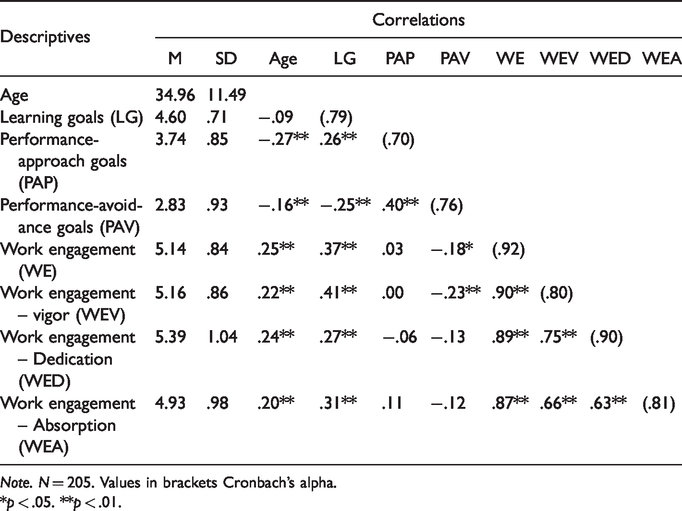
Note. N = 205. Values in brackets Cronbach’s alpha.
*p < .05. **p < .01.
The standardized solution for the latent model is illustrated in Figure 2. The proposed model provided an adequate fit to the data: χ2(29) = 57.27, p = .00; χ2/df = 1.97; CFI = .96; RMSEA = .07, and the model variables accounted for 33% of variance in work engagement. Age and learning goals (H1a) exerted a significant, positive prediction weight for work engagement. However, we found no clear support for the expected negative relation of performance-avoidance goals with work engagement (H2a) as the bivariate negative association of performance-avoidance goals with vigor did not convert into a significantly negative relationship with work engagement in the latent model test. An alternative model test without age as control variable, lead to comparable results (again with only one significant path from GO to work engagement for trait learning goals: .56, p < .01; 25% of variance in work engagement explained).
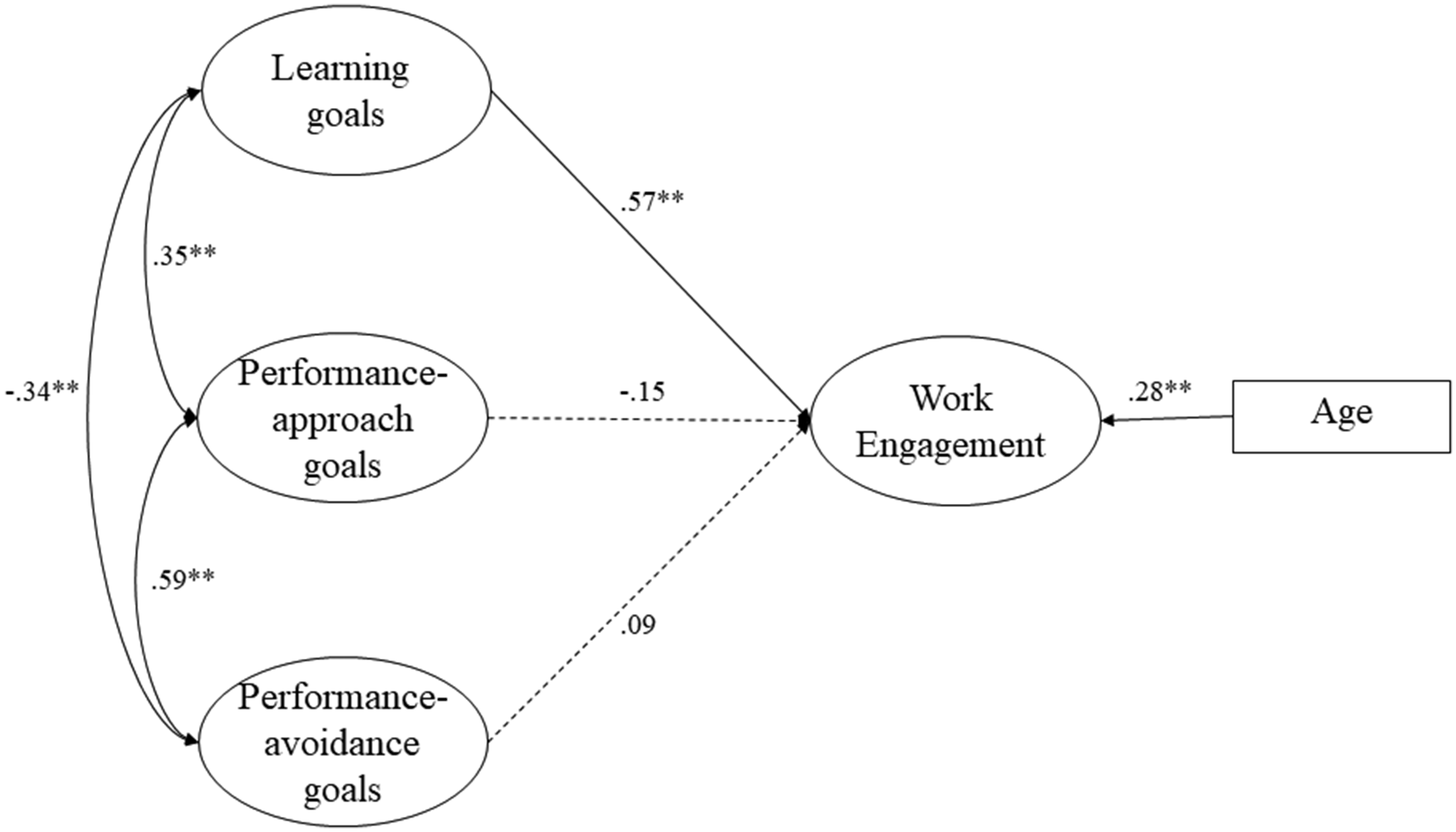
Standardized solution for latent model (Study 1). **p < .01. Non-significant path coefficients in dashed lines.
In sum, the findings of our first study support already the anticipated role of trait learning goals for work engagement based on the motivation process of the JD-R model. To our knowledge, our results are the first to show such a relationship in an international sample of employees at the latent construct level using a comprehensive GO model.
Study 2
As the use of cross-sectional data in Study 1 precluded causal conclusions, we conducted a second study in which we experimentally manipulated state achievement goals of employees (three state-goal conditions, t1) and investigated their effect on work engagement, one week later (t2). We thus tested the robustness of our prior results regarding trait goals and investigated in addition to trait and state interactions how the progress towards attaining different achievement goals affects work engagement.
Method
Participants
Participants were Dutch and Belgian employees recruited via email by the authors and six research assistants, each accessing their own employee network. Participation was voluntary and no incentives were provided. In all, 449 people accessed the survey, with 163 employees completing part 1 of the study. Complete data from both time points was obtained from 128 employees (73 female, 101 Dutch; 29% of persons accessing the survey). Age varied from 20 to 66 (M = 44.42) with an average of 24.37 years of work experience. All participants were at least part-time employed (minimum: 18 hours/week) and held a wide variety of jobs in different sectors (top three: education 19.5%, health & care 16.4%, government 12.5%).
Experimental design and procedure
After completing background questions and goal orientation scales, participants were randomly assigned to one of three experimental conditions: learning (LG), performance-approach (PAP), or -avoidance goals (PAV). We manipulated state achievement goals via a variation of existing manipulations of achievement goals for specific tasks or settings from other researchers (e.g., Van Yperen et al., 2009). Participants were asked to list a personal relevant, specific, challenging but attainable, work-related goal for the upcoming work week in accordance with the experimental conditions and to describe briefly how they planned to achieve their goal (implementation intentions; Koestner et al., 2002).
In detail, the manipulation was realized as follows. The goal focus of the corresponding condition (LG : Learning goals−development of yourself; PAPG : Performance-approach goals−achieving success; PAVG : Performance-avoidance goals−avoiding failure) was added in bold to the header of the instruction page. Participants first read a short introduction about the relevance of achievement goals for the workplace. They were instructed that the goal they chose to pursue should be personally relevant for them and that, to be effective, the goal should be specific, realistic to reach, and challenging. Then, participants read a short description of the particular goal according to the condition (e.g., LG: develop and improve your skills, master a situation, PAP: demonstrate skills, perform better than others; PAV: not perform worse than others, avoid that others see that you are not good at something) and examples were provided. At the end, participants were informed that in the follow-up questionnaire one-week later they would be asked again about the personal goal they had set.
Manipulation check
Two independent raters categorized the goals listed by participants to verify whether they were in accordance with the instruction of the corresponding condition (example goals listed: LG: “learn how to use the new administration system”; PAP: “finalize long term deal with a customer”; PAV: “try to avoid that others see that I am not handling enough cases”). Participants were excluded if the two raters agreed that the goal was not consistent with the instruction or was not specific (e.g., “do my work as usual”). Initially, the two raters agreed that 10 participants had to be excluded. The goals of the remaining participants were discussed until consensus was reached, leading to 12 more exclusions, resulting in 22 exclusions overall (6 in LG, 5 in PAP, and 11 in the PAV condition). Therefore, the final sample consisted of 106 participants. 2
Measures
Goal orientations (t1)
We used a Dutch version of VandeWalle’s (2001) GO questionnaire (based on Bipp et al., 2017). Twelve items were rated on a 7-point Likert scale (1 = strongly disagree, 7 = strongly agree), four items each assessing learning (“I am willing to select a challenging work assignment that I can learn a lot from”, α = .82), performance-approach (“I try to figure out what it takes to prove my ability to others at work”, α = .66), and performance-avoidance goals (“I prefer to avoid situations at work where I might perform poorly”, α = .70).
Goal progress (t2)
We measured goal progress with two translated items (forward-backward translation) from Judge et al. (2005). We asked participants if they had made progress toward attaining their goals, and if they had accomplished what they had set out do to with their goals (5-point Likert scale: 1 = completely disagree, 5 = completely agree, α = .85).
Work engagement (t2)
Current work engagement was measured with the Dutch version of the 9-item UWES (de Bruin & Henn, 2013; Schaufeli et al., 2006) at t2. Using a 7-point Likert scale (1 = never, 7 = always/every day), three items each assess vigor (“At my work, I feel bursting with energy”), dedication (“I am enthusiastic about my job”), and absorption (“I get carried away when I’m working”). Cronbach´s alpha for the overall scale was .92.
Results and discussion study 2
Descriptives
Table 2 displays the descriptives and intercorrelations of the variables. At the descriptive level, work engagement was highest in the LG condition; n = 35, M = 4.80, SD = .97, closely followed by engagement of participants in the other two conditions; PAP: n = 35, M = 4.75, SD = .94; PAV: n = 36, M = 4.68, SD = .83. An ANCOVA in the full design comparing the mean values of work enagement in the three experimental conditions (controlled for age, trait GO, goal progress), lead to a marginally significant difference between the conditions; F(2, 98) = 2.54, p = .08, η2 = .05. The effect was similar when age was excluded as control variable (p = .10)
Means (M), standard deviations (SD), and zero-order correlations between study variables (Study 2).
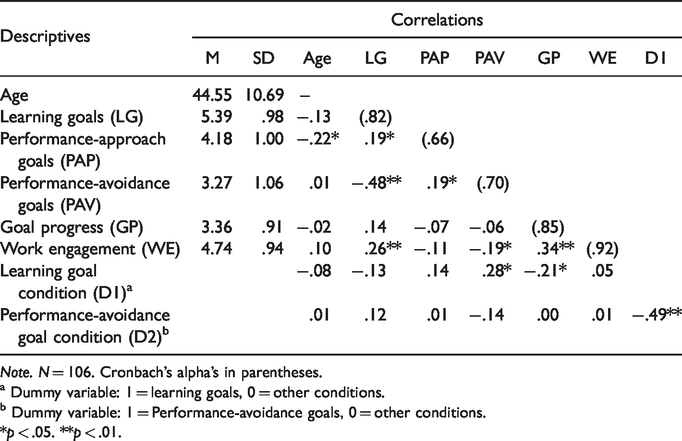
Note. N = 106. Cronbach’s alpha’s in parentheses.
a Dummy variable: 1 = learning goals, 0 = other conditions.
b Dummy variable: 1 = Performance-avoidance goals, 0 = other conditions.
*p < .05. **p < .01.
Main effects
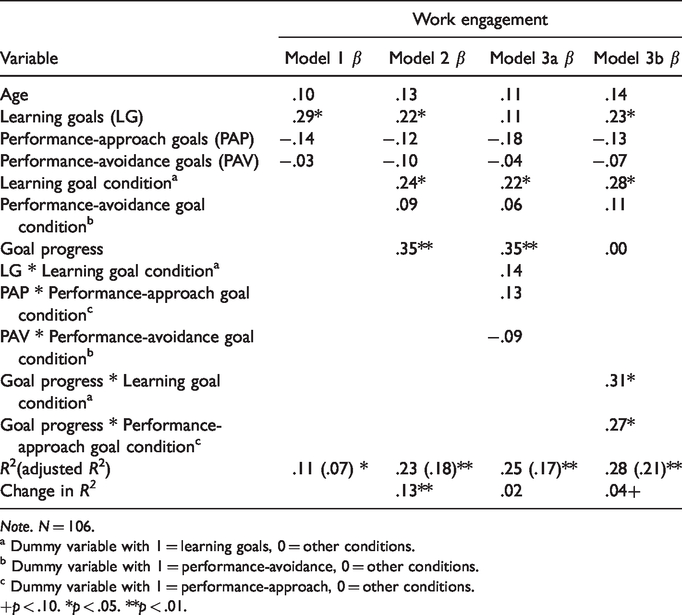
To test our hypotheses, we performed moderated regression analyses (Table 3). Comparable to Study 1, we controlled for age and entered this variable first into the prediction, together with trait GO (Model 1, R2 = .11). Trait learning goals positively predicted work engagement (H1a supported) and performance-avoidance goals were unrelated to work engagement (H2a not supported). To test our hypotheses about the main effects of state goals and goal progress, we subsequently added the experimental conditions (as dummy-coded variables, coding the learning goal condition vs. rest, and performance-avoidance goal condition vs. rest), and goal progress to the prediction. The amount of explained variance improved substantially (Model 2, ΔR2 = .13), and the variables explained 23% of the variance in work engagement. Besides the effect for dispositional learning goals, a significant effect of the experimental conditions was visible for learning goals, supporting H1b: Participants in the learning goal condition reported significantly higher engagement compared to participants in the performance-avoidance goal condition. Additional ANCOVA results sustain the effect of state learning goals on work engagement; F(1, 99) = 4.40, p = .04, η2 = .04: Participants in this condition reported higher work engagement (M = 4.80, SD = .94) compared to participants in the other two conditions (M = 4.71, SD = .92). However, we found no support for a negative effect of state performance-avoidance goals (H2b). As expected (H4a), goal progress was a significant, positive predictor of work engagement across the experimental conditions.
Outcomes of the hierarchical regression analysis for variables predicting work engagement (Study 2).
Note. N = 106.
a Dummy variable with 1 = learning goals, 0 = other conditions.
b Dummy variable with 1 = performance-avoidance, 0 = other conditions.
c Dummy variable with 1 = performance-approach, 0 = other conditions.
+p < .10. *p < .05. **p < .01.
Interaction effects
To test our hypothesis about the congruence of state and trait goals (H3), we added in a next regression step the interaction terms for all three GO based on standardized scores and dummy codes for the respective experimental condition (Model 3a). Results indicated no increase in the amount of explained variance in work engagement, and none of the interaction terms reached a meaningful significance level (H3a, H3b not supported). An additional regression analysis carried out without age as a control variable did not result in a significant prediction step for these interactions, either (p = .46).
To prevent distorting effects, we included in a separate analysis the interaction terms between goal progress (standardized scores) and two dummy codes for the experimental conditions according to H4b (learning & performance-approach goal condition vs. rest). Model 3b marginally improved the prediction for work engagement (ΔR2 = .04, p =.06). The main effect of goal progress disappeared, and instead, both interaction terms were significant. Results of an additional regression analysis carried out without age as control variable did lead to comparable results for the additional value of this regression step for the prediction of work engagement (p = .08). Inspecting the results pattern in the three experimental conditions to interpret the interaction effect supports our expectations: goal progress was positively related to work engagement in the LG (r = .58, p < .01) and PAP condition (r = .48, p < .01), but unrelated in the PAV condition (r = .02, p = .90).
General discussion
Successfully combining core elements from GO theory and the motivational role of (personal) resources outlined in the JD-R model, the results of our two studies provide support for the role of self-regulatory behavior in terms of goal focus and goal progress for work engagement and thus highlight the possibilities of (and boundaries to) sustaining work engagement via achievement goals. In particular, our results of Study 2 for state goals provide much-needed causal evidence for the effect of different types of achievement goals (VandeWalle et al., 2019) on work engagement, and specify the role of goal progress for the motivational process at work.
First, our results support the expected connection of learning goals at the trait and state level to work engagement. Therefore, they sustain previous findings that have demonstrated relationships for learning goals and work engagement on the trait level, for example, in specific samples of employees or at the daily work level (De Lange et al., 2010). The connection of learning goals to work engagement can be theoretically explained by linking achievement goals − in line with the suggested resource caravan (Xanthopoulou et al., 2007) − via self-regulatory processes (Cellar et al., 2011) to the building and maintaining of energy, and therefore to (job and personal) resources from the JD-R model (Schaufeli & Taris, 2014). Prior research supports, for example, that resources identified in the JD-R model (such as self-efficacy, feedback) mediate the effect of trait GO on work outcomes (e.g., Porath & Bateman, 2006). In line with our suggestion to combine achievement goal theory and the motivational process for personal resources of the JD-R model, Poortvliet et al. (2015) already successfully linked (trait) learning goals to work engagement via the job resource social support.
For performance-avoidance goals, our results seem to contradict findings (mainly obtained in non-work settings) that avoidance-oriented goals lead to the depletion of resources or are negatively related to well-being (e.g., Elliot et al., 1997). However, other studies in the work context could not demonstrate a direct relationship with work engagement either (e.g., Bipp et al., 2017), or corroborated that such goals moderate the effects of other factors on work engagement (Bakker et al., 2020). An explanation built on the JD-R model may be that performance-avoidance goals only indirectly affect the resource-driven motivational process, as they might act more as personal demands at work and therefore have a stronger impact on the health-impairment process, leading, for example, to higher burnout. Indirect support stems from Adriaenssens et al. (2015), who found in a sample of nurses that the positive relationship of performance-avoidance goals with burnout was stronger than the negative relationship with work engagement. The fact that we did not identify a systematic connection of performance-approach goals with work engagement in both of our studies is in line with the inconsistent role of these goals for self-regulatory behavior or work outcomes identified in other studies (Cellar et al., 2011).
Second, our results of Study 2 did not confirm the postulated effect for the match between state and trait goals on work engagement. While such interactions have previously been demonstrated for prevention focus (Petrou et al., 2015), our findings reflect the inconsistent results in the achievement goal literature (Chen & Mathieu, 2008) that call for a deeper investigation of state-trait interactions in the work domain.
Third, by not only separating the effects of different goal types or GO dimensions but also specifying the impact of progress towards goal attainment on work engagement, our results contribute to combining theories on self-regulatory behavior and work motivation from the JD-R model. Besides a main effect, we found some indication that the type of achievement goal that was set moderates the relationship of goal progress with work engagement. Only the progress towards successful goal pursuit of learning or performance-approach goals led to higher levels of work engagement.
Therefore, our results have both theoretical and practical implications. First, by investigating goals not only at the trait level but within an experimental study also at the state level, our results allow for integrating learning goals as causal antecedents of work engagement into JD-R theory (Bakker & Demerouti, 2014). Second, our results form the basis for designing effective interventions to support work engagement of employees via goals. Besides interventions focusing on adapting demands and resources (Bakker, 2014), our results point towards an effective way to employ achievement goals and goal progress to stimulate work engagement. Existing interventions that include goal-setting assignments (e.g., Ouweneel et al., 2013) should be adapted to explicitly stimulate the pursuit of and progress towards learning goals. This may include fostering the systematic development of work-related skills or knowledge, providing opportunities to seek and accomplish new or difficult tasks, or promoting and supporting seeking of developmental feedback. However, stimulating such goals in practice could be a challenge, as goal setting in the work context mainly focuses on standards that have to be obtained, often in comparison to others, with potential adverse effects (Welsh et al., 2019). Our results also indicate that progress towards performance-approach goals positively affects work engagement. Therefore, if performance-oriented goals are set, they should be approach-oriented and not be set too high to retain a realistic chance of reaching them (Kerr & Lepelley, 2013). Managers and organizations should actively support their employees to pursue and reach such goals so that progress is made and resources are built that sustain work motivation. However, before specific goal-based interventions targeting especially learning goals and supporting goal progress are widely applied in practice, a high-powered test of the effectiveness of such programs is advised, implementing a study design with full pre-post measures and control groups.
We have to acknowledge certain limitations of our study. First, our results are based on same-source data and are therefore susceptible to the problem of common method variance. Second, our sample size in Study 2 is not large enough to detect small effects, which forms a limitation especially for the expected interaction effects. Third, although in the second study our manipulation of state goals was based on successful approaches reported in the literature, given that we do have not explicitly measured state goals after the manipulation, we can not completely be sure that the goals participants listed really reflected the intended goals. Future research is urged to test optimized goal instructions and also provide insights into long-term or potential interactional or reciprocal effects of (state and trait) goals and work engagement, as well as the potential moderating role of other goal properties, such as goal difficulty (Wicker et al., 2005). Fourth, the generalizability of our findings might be limited due to the chosen three-dimensional GO model in both of our studies. Also, in our second study, Cronbach´s alpha as an indicator of internal consistency was rather low, particularly for the performance-approach goal subscale (.66). Although this might have masked some of our expected effects for this dimension, our value obtained seems consistent with relatively low values of Cronbach´s alpha in Dutch versions of measurement instruments for performance goals (e.g., Bipp et al., 2017; Van Yperen, 2004). Fifth, while we based our expectations about the connection of goals to work engagement on theoretically derived connections via self-regulatory mechanisms, we cannot be sure which particular job or personal resources were built by the different achievement goals or during the process of goal pursuit. Also, the goal-setting literature (e.g. Locke & Latham, 2002) suggests various mediating or moderating variables (e.g., strategy development, goal difficulty) that might contribute to an in-depth explanation about the relations and effects identified in our study.
Therefore, future research is urged to identify the various resources and processes that are stimulated by goal focus and goal progress at work. Starting points could be mediating mechanisms suggested for the effect of other personal resources on work engagement, for example, in terms of perceptual, behavioral, or developmental paths (Tims & Akkermans, 2017) or the suggested role of achievement emotions. Sorting out the causal mechanisms amongst variables at the personal and job levels seems necessary, given that several possible effects of personal resources have been suggested in the JD-R model (Schaufeli & Taris, 2014). In this respect, research is also needed to investigate the ‘caravan of resources’ (Hobfoll, 2002) linking goals to work engagement, from the more distal ones (e.g. trait learning GO) to the more proximal ones (e.g. self-regulation, positive emotions).
To conclude, our studies contribute to the integration of motivation theories and work engagement by specifying self-regulatory processes in terms of goal focus and progress as (personal) resources that enhance work engagement, as well as generating practical implications for the design of interventions to stimulate work engagement.
Footnotes
Acknowledgements
We thank Mirthe Craens, Richie Baten, and Liesbeth Willekens for their help collecting the data. An earlier version of this paper was presented as a Poster at the 31st Annual Society for Industrial and Organizational Psychology Conference (April, 2016; Anaheim).
