



Abstract
Foreign languages blunt emotional reactions to moral dilemmas. In this study, we aimed at clarifying whether this reduced emotional response applies to the emotions related to the self, empathy, or both. Participants were presented with moral dilemmas, written in their native or foreign language, in which they could sacrifice one man or themselves in order to save five lives (or do nothing and therefore leave five people to die). They were more willing to sacrifice themselves when processing the dilemmas in their foreign language. Also, empathy scores were reduced when responding in the foreign language, but were no reliable predictors of participants’ responses to the dilemmas. These results suggest that processing a foreign language reduces emotional reactivity due to psychological and emotional self-distance.
Introduction
Several studies have demonstrated that bilingual speakers are less sensitive to moral norms when responding to moral dilemmas in their foreign language (Costa et al., 2014). This phenomenon has been replicated with different native and foreign languages, showing that it is not limited to specific languages or cultures (Cipolletti et al., 2016; Geipel et al., 2015a, 2015b, 2016; but see also Brouwer, 2019, and Ĉavar & Tytus, 2018, for evidence that high proficiency in (or use of) the foreign language, and/or a high degree of immersion in both cultures, may inhibit the phenomenon). More recent research corroborated that foreign languages reduce sensitivity to consequences and moral norms when responding to moral dilemmas (Białek et al., 2019; Hayakawa et al., 2017; Muda et al., 2018). These observations have been interpreted in different ways: on the one hand, foreign languages may blunt emotional reactions associated with the violation of deontological rules (such as killing a person, even when it brings the greatest good for the greatest number of people; Hayakawa et al., 2017); alternatively, reduced inclinations to avoid both harming one person and maximizing overall outcomes may indicate that people are less concerned about all potential victims when reading dilemmas in their second language (Muda et al., 2018). Therefore, the evidence so far suggests that the moral foreign language effect (M-FLE) is caused by reduced emotional reactivity when processing dilemmas in the foreign language (Costa et al., 2014; Hayakawa et al., 2017). However, previous literature has not directly addressed whether this reduced emotional response applies to the emotions related to the self (e.g., increasing self-distance, resulting in feeling less emotionally involved in the dilemmas; Corey et al., 2017, Costa et al., 2014), to emotions towards the others involved in the dilemmas (e.g., empathy towards the other characters involved; this potential mechanism was pointed out by Corey et al., 2017), or both. In the present study, we aim at clarifying this issue.
In their seminal study, Costa et al. (2014, Experiment 2) presented Spanish-English and English-Spanish bilinguals with different versions of the trolley dilemma, where an on-coming train is about to kill five people, and the only way to stop it is by killing an innocent bystander. In the “footbridge” version of the dilemma (where participants decide whether to push a man off a footbridge in front of the train or not), only 18% of the participants decided to kill one person in order to save five when using their native language, but 44% of them chose that option when using their foreign language. However, in the “switch” version of the dilemma (where participants choose whether to flip a switch to move the trolley or not to another track where it would only kill one man) participants preferred to divert the train, killing one person to save five, both in their native (81%) and foreign (80%) language. These results were consistent with the authors’ assumption that a foreign language may increase emotional distance in emotionally aversive scenarios (i.e., the “footbridge” version, where the thought of pushing someone to his death is more emotionally salient), but not that much in scenarios where the response is less emotionally aversive (i.e., the “switch” version, where the thought of hitting a switch that will cause a trolley to produce similar consequences is less emotionally salient) (Costa et al., 2014; Greene et al., 2001; but see also Geipel et al., 2015b, for evidence suggesting that the M-FLE is not always explained by an attenuation of emotions, but rather by reducing access to social or moral norms).
In fact, independent research has shown that processing a foreign language usually elicits milder emotional responses than processing the native language (Caldwell-Harris, 2014, 2015; Pavlenko, 2012). Also, processing a foreign language reduces electrodermal responses to swear and taboo words (Harris et al., 2003), and elicits less activation in brain areas related to emotional processing when reading emotionally charged passages (Hsu et al., 2015). These observations may be explained by the fact that, in most cases, foreign languages are learned in emotionally-poor, structured, and impersonal academic settings (e.g., Caldwell-Harris, 2014), and that foreign languages are not normally used in everyday situations, which reduces their emotionality (Degner et al., 2011).
Interestingly, the emotional distance experienced when processing a foreign language may be caused by self-distance. Different studies have shown that self-bias effects (where stimuli associated to the self are perceived as more salient than those associated with others) are reduced when processing a foreign (vs. native) language (Ivaz et al., 2016, 2019; Shin & Kim, 2017). In the self-bias paradigm, participants are presented with neutral geometric shapes (i.e., triangles, circles, and squares) matched to labels related either to the participant (i.e., “you”), a close relative/friend (i.e., “mum”), or a stranger. Usually, the fastest and most accurate responses in this paradigm are those to self-related stimuli in matching trials, but presenting the labels in a foreign language reduces this effect (Ivaz et al., 2016, 2019; Shin & Kim, 2017). Thus, the presentation of a foreign language may trigger psychological and emotional distance, and the resulting lowered emotional reactivity may be at the core of the foreign language effects (Ivaz et al., 2016, 2019).
Hence, a tentative explanation for the M-FLE may be that processing a foreign language triggers self-distance, increasing psychological and emotional distance (Costa et al., 2014; Ivaz et al., 2019), and resulting in lowered emotional reactivity when reading moral dilemmas. Nevertheless, to the best of our knowledge, no research has directly explored this hypothesis.
On the other hand, some studies have found that neural and behavioral responses in Theory of Mind (ToM) and empathy tasks vary depending on whether bilingual participants are processing their native or foreign language (although the literature on the topic is rather scarce). For instance, the neural correlates of ToM are language-dependent in adult bilinguals, which may suggest that bilinguals recruit different linguistic and cognitive resources depending on the language used to process ToM (Kobayashi et al., 2008). Furthermore, bilinguals seem to experience an enhanced empathetic response to other people’s pain when they are using their foreign (vs. native) language, possibly resulting from an increased sustained attention in the foreign language context (Wu et al., 2020). Therefore, an alternative explanation for the M-FLE may be that the empathetic response towards the characters involved in the dilemmas is language-dependent (a possibility discussed by Corey et al., 2017; see also Choe & Min, 2011). Again, this secondary explanation has not been tested.
In our study, Spanish-English late bilinguals were presented with the switch or footbridge version of the trolley dilemma, written in their native or foreign language. We explored the self-distance and empathy explanations (and the possibility that both play a significant role) for the M-FLE. In order to do so, we included a third response option in the moral dilemmas (“Self-sacrifice”) and measured affective and cognitive empathy (by using the Basic Empathy Scale in Adults, BES-A; Jolliffe & Farrington, 2006). We predicted that, if processing a foreign language increases psychological and emotional distance (Costa et al., 2014; Ivaz et al., 2016), participants would be more willing to sacrifice themselves when processing the moral dilemmas in their foreign language. Additionally, we expected to replicate the finding that processing a foreign language increases utilitarian (and reduces deontological) responses in the footbridge, but not the switch dilemma (Costa et al., 2014). Also, if the linguistic context influences empathetic responses (Wu et al., 2020), we may observe differences in the empathy scores when participants responded in their native or foreign language; for instance, increased sustained attention levels in the foreign (vs. native) language context may render enhanced empathetic responses (Wu et al., 2020). Finally, if empathy plays a significant role when responding to the dilemmas, empathy scores may be reliable predictors of participants’ choices (i.e., increased empathetic responses could cause a reduction in the preference for “sacrificing one to save five”, and an increase of deontological or self-sacrificing behaviors (or the opposite pattern for decreased empathetic responses), as discussed by Corey et al., 2017).
Method
Participants
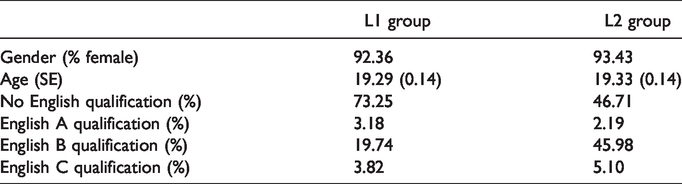
We collected data from 300 Education students from the Autonomous University of Madrid and the University of Valladolid. The students were not familiar with the tasks and concepts addressed in the investigation. Following the exclusion criteria used in other research on the foreign language effect (e.g., Vives et al., 2018), participants who lived for a year or more in an English-speaking country were discarded (N = 294; 273 female, M age = 19.30, SD = 1.70). All participants were late learners of English (i.e., started learning English formally at school from the age of 6) who did not grow up speaking it at home. 60.9% of participants reported having no English language qualifications; 2.7% reported having a Cambridge English A qualification or similar; 32% reported having a Cambridge English B qualification or similar; and 4.4% reported having a Cambridge English C qualification or similar (see Table 1 for further details on the sample characteristics).
Sample characteristics.
Materials
Moral dilemmas were translated from Spanish to English and back-translated for comparability (Brislin, 1970). The materials included the classic footbridge and switch versions of the trolley dilemma (Thomson, 1985), ending with the question “What should you do?”. In the footbridge version, three options were available: 1) Nothing; 2) Push the stranger onto the track; and 3) Jump onto the track. In the switch version, other three options were available: 1) Nothing; 2) Flip the switch to the right; and 3) Flip the switch to the left. In the main text of the switch scenario, it was made clear that flipping the switch to the right would make the train to kill an innocent bystander, and that flipping the switch to the left would make the train to kill the participant.
The BES-A (Jolliffe & Farrington, 2006) is a 20-item scale in which participants provide their responses on a 5-point Likert scale (from 1 = Strongly Disagree, to 5 = Strongly Agree). It measures two factors: affective empathy (the ability to feel an appropriate response when confronted with the mental state attributed to another person; e.g., “after being with a friend who is sad about something, I usually feel sad”), and cognitive empathy (undertaking another person’s affective state; e.g., “I can understand my friend’s happiness when she/he does well at something”). Participants who were presented with the Spanish version of the moral dilemmas were also presented with the Spanish version of the BES-A (Villadangos et al., 2016). Cronbach’s alpha for the affective empathy factor were .63 and .66 for the English and Spanish versions of the scale, respectively. The corresponding values for the cognitive empathy factor were .69 and .61.
Procedure
The study was conducted in classrooms of 35 to 70 students. Participants were asked to complete the task voluntarily at the end of a lecture. The research conformed to the principles of the Declaration of Helsinki and the code of ethics of the General Council of Psychology of Spain. We obtained participants’ informed consent before collecting the data, and they were reminded that they may leave the questions unanswered if they wanted to, at any given time. Participants were given a code in their response sheet should they wish to withdraw their data up to two weeks after data collection. No participants refused taking part or returned empty sheets.
Participants were randomly allocated to the footbridge or switch version of the trolley dilemma, and to the Spanish or English group (that is, each participant only read a version of the dilemma, either in Spanish or English). After answering to the dilemma, they were presented with the BES-A, which was written in the same language as the moral dilemma (i.e., participants who read the dilemma in English were also presented with the English version of BES-A).
Results
Data and R code used for analyzing the data are available at the Open Science Framework (https://osf.io/y8exb/).
In this section, we first present the analyses on the responses to the moral dilemmas (“Do nothing”, “Sacrifice-other”, “Self-sacrifice”), evaluating whether responses were affected by language (native, foreign) and/or scenario (switch, footbridge). We analyzed the data using Pearson’s Chi-Square tests and employed Cramer’s V as an index of effect size; post-hoc comparisons were calculated by obtaining the Chi distribution for squared adjusted residuals. Then, we display analyses on whether the affective and cognitive empathy scores of the BES-A varied as a function of language. As a control to check that scores did not vary randomly between participants, we also explored whether the empathy scores differed as a function of the scenario participants were presented with, or their response to the moral dilemmas. Finally, we display the results from the cross-validation procedure (using the ‘xvalglms’ R package in RStudio version 1.3.1056-1; de Rooij & Weeda, 2020; RStudio Team, 2020) for selecting the most appropriate predictor models, and logistic regressions, to examine what factors predicted participants’ responses to the moral dilemmas.
Both frequentist and Bayesian statistics were used in the analyses. Frequentist statistics were run in IBM SPSS version 26, and Bayesian statistics in JASP version 0.13 (JASP Team, 2020), using default priors (for contingency tables, we used the Poisson sampling scheme, as each cell count was random; Jamil et al., 2017). Bayes factors (BFs) were interpreted following Lee and Wagenmakers’ (2013) classification scheme. P values for the post-hoc tests of the Chi-squares tests and ANOVAs were adjusted for multiple comparisons using the Benjamini and Hochberg adjustment method (Benjamini & Hochberg, 1995, as cited by Jafari & Ansari-Pour, 2019).
Responses to moral dilemmas
Responses to the dilemmas varied significantly depending on whether participants were presented with the English or Spanish version of the dilemmas, Χ2 (2, N = 294) = 7.10, p = .029, V = .15 (Figure 1(a)). A test of association produced a BF = 3.44 (moderate evidence in favor of a relationship between linguistic context and responses to the moral dilemmas). Processing the foreign language (vs. the native tongue) increased the ratio of “Self-sacrifice” responses (p = .042). Also, processing the foreign language reduced the ratio of “Do nothing” responses (p = .042). However, the language context did not impact on “Sacrifice-other” responses (p = .920).

(a) Effect of language on participants’ responses to the moral dilemmas. (b) Language effect in the switch scenario. (c) Language effect in the footbridge scenario. *p < .05.
In addition, responses varied significantly depending on whether participants were presented with the switch or footbridge scenario, Χ2 (2, N = 294) = 65.53, p < .001, V = .33. A test of association produced a BF = 7.562e+13 (extreme evidence in favor of a relationship between scenario and responses). “Do nothing” responses were much more frequent in the footbridge (57.14%) than switch dilemma (15.64%; p < .001). On the contrary, “Sacrifice-other” responses were much more frequent in the switch (61.9%) than footbridge dilemma (20.41%; p < .001). Finally, “Self-sacrifice” responses were equally frequent in the switch and footbridge dilemmas (22.45% in both dilemmas; p = 1).
Then, and following Costa et al.’s (2014) Experiment 2, we analyzed the choices for the switch and footbridge scenarios separately. In the switch dilemma, language context influenced participants’ responses, Χ2 (2, N = 147) = 7.15, p = .028, V = .22 (Figure 1(b)). A test of association produced a BF = 5.27 (moderate evidence in favor of a relationship between linguistic context and responses to the switch dilemma). Processing the foreign language increased the ratio of “Self-sacrifice” responses (p = .021). Nevertheless, language context did not affect the ratio of “Do nothing” and “Sacrifice-other” responses (p = .483 and .133, respectively).
In the footbridge dilemma, responses were also affected by language context, Χ2 (2, N = 147) = 7.60, p = .022, V = .23 (Figure 1(c)). A test of association produced a BF = 7.41 (moderate evidence in favor of a relationship between linguistic context and responses to the footbridge dilemma). Processing the foreign language reduced the ratio of “Do nothing” responses (p = .025) and increased the ratio of “Sacrifice-other” responses (p = .025). However, language context did not have an effect on the ratio of “Self-sacrifice” responses (p = .548).
BES-A
8 participants from the final sample left some items from the affective empathy sub-scale unanswered, and 6 participants left some items from the cognitive empathy sub-scale without reply. Data from these participants were not included in the following analyses (N = 286 and 288 for the analyses of affective and cognitive empathy scores, respectively). The BES-A scores ranged from 1 (lowest empathy score) to 5 (highest empathy score).
First, we conducted factorial ANOVAs, with language (native, foreign) and scenario (switch, footbridge) as independent variables, and affective and cognitive empathy as dependent variables. Both affective empathy (F(1,282) = 6.67, MSE = 0.18, p = .03, η2 = .023) and cognitive empathy (F(1,284) = 10.32, MSE = 0.16, p = .006, η2 = .035) varied as a function of language. Bayesian ANOVAs confirmed these effects, with BFs = 3.13 (moderate evidence of an effect of linguistic context on affective empathy scores) and 17.20 (strong evidence of an effect of linguistic context on cognitive empathy scores) respectively. Participants who responded to the BES-A in their foreign language showed lower scores in both factors (Table 2). Neither the main effect of scenario nor the interaction between language and scenario predicted empathy scores (Fs < .081; BFs < .43).
Scores for the affective and cognitive empathy factors of the BES-A.

Note: *p < .05.
Secondly, we conducted frequentist and Bayesian one-way ANOVAs to examine whether the empathy scores varied depending on the participants’ responses to the dilemmas. No significant differences were obtained for any of the empathy factors (Fs < 1, all ps > .87; BFs < .07).
Finally, we run correlation analyses (Pearson’s r) to explore whether affective and cognitive empathy scores were related. We found that the scores were related, both when taking into account all responses (r(282) = .26, p < .001; BF = 1210.17, which shows extreme evidence in favor of the relationship), and when the two language groups were considered independently (L1, r(154) = .21, p = .008, BF = 3.15, which shows moderate evidence in favor of the relationship; L2, r(128) = .27, p = .002; BF = 10.44, which shows strong evidence in favor of the relationship).
Regression analyses
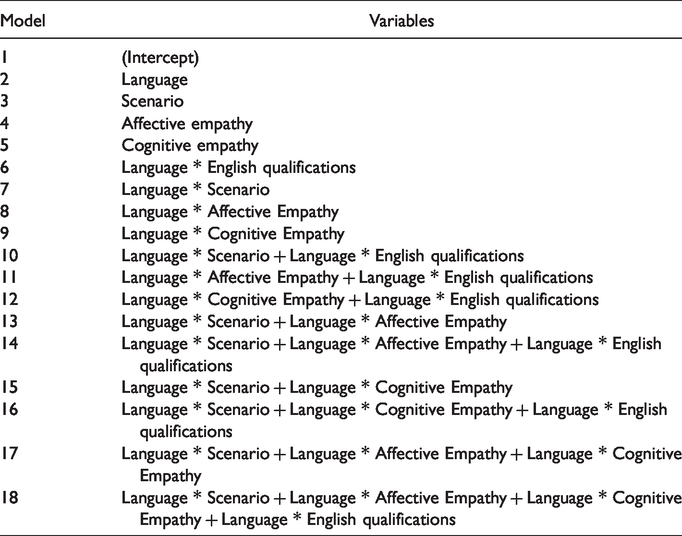
Since we collected categorical responses in the dilemmas, cross-validation and logistic regression analyses were conducted for each possible response (i.e., “Do nothing”, “Sacrifice-other”, and “Self-sacrifice”), which were coded as dummy variables (e.g., in the analysis of “Do nothing” responses, “Do nothing” were coded as 1, and “Sacrifice-other” and “Self-Sacrifice” were coded as 0; see also the
Models compared in the cross-validation procedure.
The cross-validation for “Do nothing” responses showed that model 7 (including the interaction between language and scenario as the only predictor) won 93% of the times (Figure 2(a)). The logistic regression analysis was significant, χ2(292) = 49.08, p < .001, Cox & Snell R2 = .154 (B = .81, SE = .12, Wald’s χ2 = 43.16, df = 1, p < .001). Post-hoc analyses were run by using frequentist (Pearson’s Chi-square test) and Bayesian contingency tables. In the switch dilemma, “Do nothing” responses did not vary as a function of language, χ2(1) = 0.56, p = .455, V = .062 (BF = 0.38, supporting the null hypothesis). However, “Do nothing” responses to the footbridge dilemma varied as a function of language, being more frequent in those participants who responded in their native language, χ2(1) = 6.15, p = .013, V = .205 (BF = 8.41, showing moderate evidence for the alternative hypothesis).
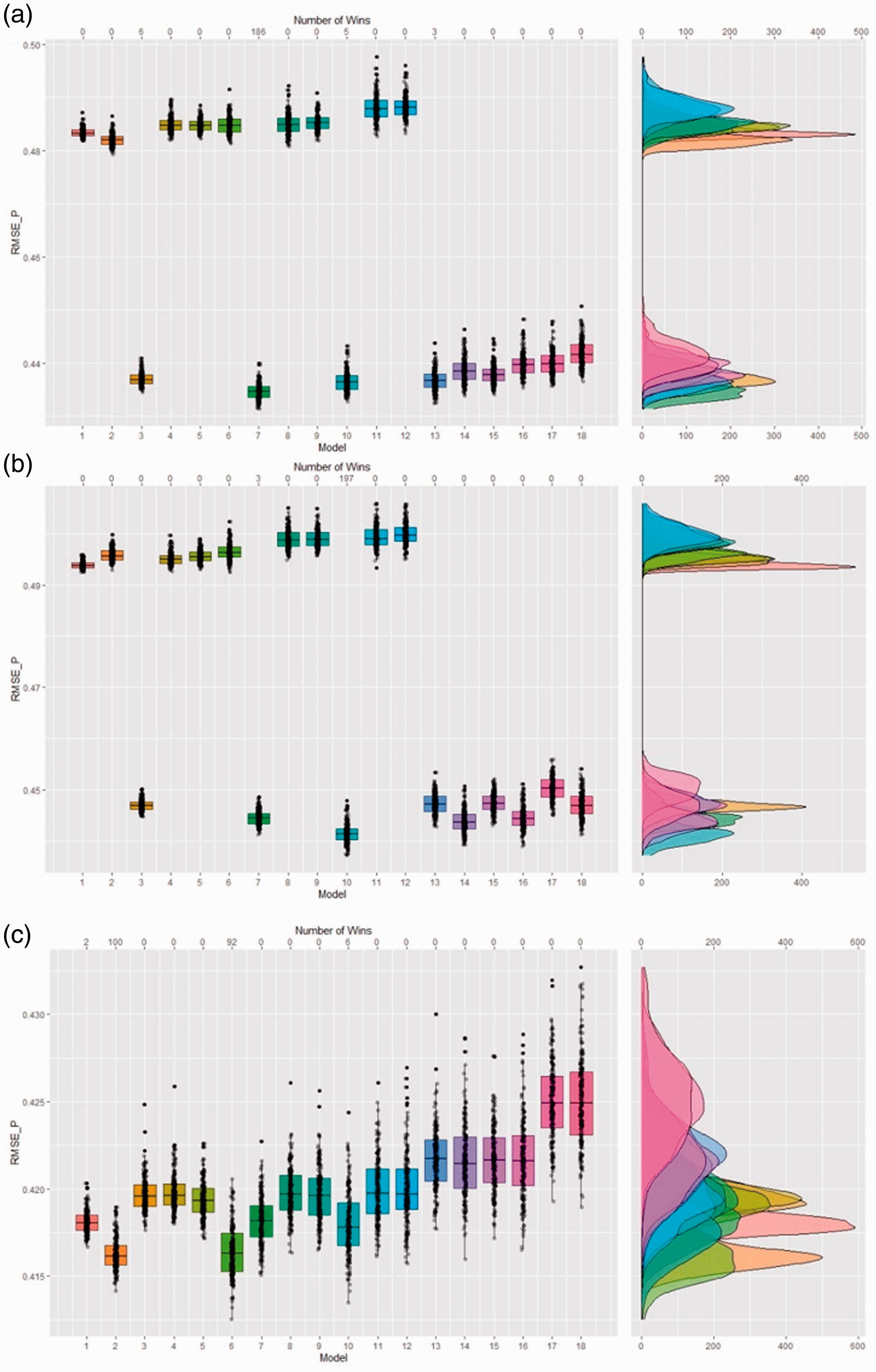
Output of the cross-validation procedure for (a) “do nothing” responses; (b) “sacrifice-other” responses; and (c) “self-sacrifice” responses. The panel on the left shows boxplots for the 18 models’ prediction error (root mean square error of prediction). The panel on the right shows the density estimates for the prediction errors of the 18 models.
For “Sacrifice-other” responses, model 10 (including the interactions between language and scenario and between language and English qualifications as predictors) won 98.5% of the times (Figure 2(b)). The logistic regression analysis was significant, χ2(291) = 36.03, p < .001, Cox & Snell R2 = .115. Whilst the coefficient for the interaction between language and scenario was significant (B = .70, SE = .13, Wald’s χ2 = 28.21, df = 1, p < .001), the coefficient for the interaction between language and English qualifications was not (B = .06, SE = .08, Wald’s χ2 = 0.48, df = 1, p = .488). Post-hoc analyses of the interaction between language and scenario showed that “Sacrifice-other” responses did not vary as a function of language in the switch dilemma, χ2(1) = 3.01, p = .083, V = .143 (BF = 1.73, anecdotal evidence in favor of the alternative hypothesis). Nevertheless, “Sacrifice-other” responses to the footbridge dilemma varied as a function of language, being more frequent in those participants who responded in their foreign language, χ2(1) = 5.89, p = .015, V = .200 (BF = 5.93, showing moderate evidence for the alternative hypothesis).
Finally, for “Self-sacrifice” responses, model 2 (including language as the only predictor) won 50% of the times, and model 6 (including the interactions between language and English qualifications as the only predictor) won 46% of the times (Figure 2(c)). Whilst the logistic regression analysis for model 2 was significant, χ2(292) = 5.34, p = .021, Cox & Snell R2 = .018 (B = .65, SE = .28, Wald’s χ2 = 5.25, df = 1, p = .022), the one for model 6 was not, χ2(292) = 0.01, p = .926, Cox & Snell R2 < .001 (B = .01, SE = .09, Wald’s χ2 = 0.01, df = 1, p = .926). A Bayesian contingency table confirmed that participants were more likely to choose the “Self-Sacrifice” response when processing the dilemmas in their foreign language (BF = 3.39, showing moderate evidence for the alternative hypothesis).
In summary, language was the only significant predictor for participants’ responses to the moral dilemmas. “Self-Sacrifice” responses were more frequent when participants processed the dilemmas in their foreign language. “Do nothing” and “Sacrifice-other” responses, on the other hand, only varied as a function of language in the footbridge dilemma (with participants processing the footbridge dilemma in their foreign language choosing more frequently the “Sacrifice-other” response, and less frequently the “Do nothing” response).
Discussion
In this study, we explored whether self-distance, empathy, or both, played a significant role in the M-FLE. Briefly, our results showed that: Participants were more willing to sacrifice themselves (vs. doing nothing or sacrificing other) when processing the moral dilemmas in their foreign language. Participants who responded to the BES-A in their foreign language had lower affective and cognitive empathy scores than participants who responded in their native language. The empathy factors did not predict participants’ responses to the dilemmas.
In accordance with previous studies (e.g., Costa et al., 2014; Hayakawa et al., 2017; Muda et al., 2018), our results support the reduced emotional reactivity account for the M-FLE. Moreover, the increase of “Self-sacrifice” responses when processing the dilemmas in a foreign language (and the lack of an effect of empathy scores on participants’ responses) suggests that the reduced emotional response experienced when processing a foreign language applies exclusively to those emotions related to the self. This explanation is consistent with past research showing that the self-bias effect is reduced when processing a foreign (vs. native) language (Ivaz et al., 2016, 2019; Shin & Kim, 2017). It also extends previous findings on the M-FLE that suggested that it reflects mitigated emotional reactions (e.g., Costa et al., 2014; Muda et al., 2018), by demonstrating that the diminished emotional reactions are related to the self. Thus, processing a foreign language would trigger self-distance, increasing psychological and emotional distance when dealing with moral dilemmas.
It is important to highlight that we replicated Costa et al.’s (2014) original results on the M-FLE with Spanish-English bilinguals, with an increase of “sacrifice one to save five” responses when processing the dilemmas in the foreign (vs. native) language, but only in the more aversive scenario (the footbridge version of the trolley dilemma). However, the increase of “Self-sacrifice” responses when processing the dilemmas in the foreign language was more robust when dealing with the switch scenario (although we have to stress that the model that only included the main effect of language as a factor was the most accurate for predicting “Self-sacrifice” responses). What made it more acceptable for participants to sacrifice themselves in the switch vs. the footbridge dilemma? A tentative explanation is that the “Self-sacrifice” option becomes more acceptable (or, at least, easier to accept) the less emotional the scenario is (such as in a “threshold” explanation, where lowering emotional reactivity allows participants to see the “Self-sacrifice” option as acceptable). Hence, the reduced emotional reactivity experienced when processing the foreign (vs. native) language made it easier for participants to choose the “Self-sacrifice” response, and the reduced emotionality of the switch (vs. footbridge) dilemma (Greene et al., 2001) made it even easier for participants to choose the “Self-sacrifice” response in the switch dilemma. Alternatively, the M-FLE might be caused by reducing the mental accessibility of social and moral rules, rather than by mitigating emotional reactions (Geipel et al., 2015b). Thus, processing the dilemmas in a foreign language could make the action of self-sacrifice seem less “taboo” than when processing the dilemmas in the native language, and more so in the switch dilemma, since there are no moral rules prohibiting flipping switches, but we have moral standards that prevent us from jumping off a bridge.
It is also noteworthy that, even though the evidence for the effects outlined above was moderate, we replicated the main results of the study using different tests (i.e., Chi-square tests and logistic regression analyses) and methods (frequentist and Bayesian statistics). This fact supports that the M-FLE may render moderate but consistent differences when participants respond to moral dilemmas in their foreign vs. native language.
Regarding empathy, our results indicated that affective and cognitive empathy varied as a function of language context. This is congruent with previous research showing that language context influences bilinguals’ empathetic responses (Wu et al., 2020). Nevertheless, whilst Wu et al. (2020) observed that functioning in a foreign language increased empathetic responses, we found that processing a foreign language reduced empathy scores. The main difference between Wu et al.’s (2020) and our paradigm is that whilst they used an implicit manipulation of language (i.e., native or foreign words primed pain-related pictures), we used an explicit one. Therefore, participants in Wu et al.’s (2020) study may be increasing their sustained attention when primed with foreign words, which led them to feel more empathy towards others’ pain. However, in our study, we directly tested participants’ responses to an empathy scale presented either in their native or foreign language. Additionally, whilst Wu et al. (2020) used a within-subjects design, we used a between-subjects one, which may also explain some of the variance between the two studies. Future studies may clarify in which way language context (and the within- or between-subjects manipulation of this factor) influences empathetic responses.
Even though we observed that responding in the native or foreign language affected empathy scores, these were not reliable predictors of participants’ responses to the moral dilemmas. Again, this supports the claim that the lowered emotional reactivity experienced when processing a foreign language (possibly due to the acquisition of foreign languages in emotionally-poor and impersonal settings; Caldwell-Harris, 2014) mainly affects those emotions related to the self.
It is important to acknowledge some potential limitations of the study. First, Cronbach’s alpha levels for the affective and cognitive empathy factors ranged from .61 to .69. Although these reliability levels are not infrequent when using the English or Spanish versions of the BES-A (e.g., Llorent et al., 2020; Riccio et al., 2020), the moderate reliability of the scale might cast some doubts (for a broader discussion on this issue, see Hussey & Hughes, 2020). Also, and despite the fact that social context can have moderating influences on personality traits (see e.g., Robinson, 2009), it might be interesting to use measures of state rather than trait empathy in future studies (such as the Measure of State Empathy; Powell & Roberts, 2017). By measuring state empathy, researchers might be able to capture the situational influences of language on empathy in a more informative way. Thus, future studies on this topic should look for more reliable measures of empathy, and/or explore the role of state empathy on the M-FLE.
In addition, future research might further consider how foreign language proficiency modulates the presence and magnitude of the M-FLE, by evaluating the responses of different groups of participants with varying levels of foreign language proficiency (or by using control/comprehension questions; see Turri et al., 2015). Previous studies have shown that the more proficient participants are in the foreign language, the more likely it is to find minimal differences between native and second language speakers’ responses to moral dilemmas (Costa et al., 2014, 2017; but see also Corey et al., 2017, where it is shown that language proficiency does not account for a large proportion of the M-FLE). Although we explored the role of participants’ English qualifications on their responses to the moral dilemmas, this may not be an accurate measure of proficiency (e.g., participants reporting having no English qualifications did never take an official English language test, and therefore the level of proficiency of this group might be very diverse). Hence, the current observations regarding self-sacrifice might be complemented with studies exploring the role of language proficiency in this effect. At this point, we cannot exclude the possibility that the higher proportion of “Self-sacrifice” responses when responding to the moral dilemmas in a foreign language might be due to low English proficiency levels in the sample. Nevertheless, we believe that this option is unlikely, as we replicate effects found in previous literature (e.g., Costa et al., 2014), and previous research on the topic has concluded that a lack of comprehension driving random responding would predict similar effects across dilemmas (e.g., switch vs. footbridge; Corey et al., 2017).
Finally, future studies exploring the M-FLE and the interaction between language context and empathy might want to consider the potential modulatory effect of the former on social desirability biases when responding to moral dilemmas and questionnaires (e.g., Crowne & Marlowe, 1960; Ferrando & Chico, 2000). Additionally, future research on the topic should consider exploring whether the M-FLE is reproducible in more varied samples of participants (and, therefore, more representative in terms of age or education, for instance). We must recognize that the generalizability of our results could be limited, since all our participants were university students, and most of them were women. Therefore, it is important that future studies on this topic use more representative samples, in order to generate more generalizable results.
To conclude, we showed that people are more willing to sacrifice themselves when processing moral dilemmas in their foreign than native language. Although affective and cognitive empathy scores were lowered when processing the foreign (vs. native) language, these traits did not predict participants’ responses to the dilemmas. Altogether, our results suggest that processing a foreign language triggers self-distance, thus increasing psychological and emotional distance when dealing with moral dilemmas.
Supplemental Material
sj-pdf-1-prx-10.1177_0033294120967285 - Supplemental material for Would You Sacrifice Yourself to Save Five Lives? Processing a Foreign Language Increases the Odds of Self-Sacrifice in Moral Dilemmas
Supplemental material, sj-pdf-1-prx-10.1177_0033294120967285 for Would You Sacrifice Yourself to Save Five Lives? Processing a Foreign Language Increases the Odds of Self-Sacrifice in Moral Dilemmas by Carlos Romero-Rivas, Raúl López-Benítez and Sara Rodríguez-Cuadrado in Psychological Reports
Footnotes
Article Notes
Declaration of Conflicting Interests
The author(s) declared no potential conflicts of interest with respect to the research, authorship, and/or publication of this article.
Funding
The author(s) received no financial support for the research, authorship, and/or publication of this article.

References
Supplementary Material
Please find the following supplemental material available below.
For Open Access articles published under a Creative Commons License, all supplemental material carries the same license as the article it is associated with.
For non-Open Access articles published, all supplemental material carries a non-exclusive license, and permission requests for re-use of supplemental material or any part of supplemental material shall be sent directly to the copyright owner as specified in the copyright notice associated with the article.
