




Abstract
We describe a two-dimensional model of activation of the behavioural systems according to which four prototypical activation styles can be identified within a system by positioning an individual on two main dimensions. A functional style, characterized by primary strategies of activation, a hyperactivated style, by hyperactivation strategies, an inhibited style, by deactivating strategies, and a fourth style, the problematic style, characterized by coexistence of hyperactivating and deactivating strategies. Here, we focus on the problematic style representing a dysfunctional expression of the behavioral systems leading to chaotic and unpredictable behaviors, and also relating to higher rates of psychopathology and reduced ability to participate to therapy. The present model could help the clinician to identify problematic behavioural activations undermining the therapeutic process.
Introduction
Adult attachment is a personal orientation reflecting individual differences in using specific patterns of behavioral strategies for affect regulation (Mikulincer & Shaver, 2019; Mikulincer et al., 2003). Differences in this systematic pattern of relational expectations, emotions, and behaviors can be represented within a continuous two-dimensional space. Dimensional models of adult attachment converge in identifying two main dimensions: attachment anxiety and attachment avoidance (Fraley et al., 2015; Figure 1). People who are low on these two dimensions seek an attachment figure for comfort and support when distressed and engage themselves in constructive problem-focused ways of dealing with distress; they are generally secure and tend to employ effective and functional strategies (Simpson & Karantzas, 2019). People with high avoidant attachment mainly rely on deactivating strategies, avoid proximity-seeking of the attachment figure when distressed, and inhibit and suppress distress (Simpson & Karantzas, 2019). At variance, people with high attachment anxiety tend to rely on hyperactivating strategies by excessive proximity-seeking of the attachment figure and heightening distress (Simpson & Karantzas, 2019). People who are high on both avoidance and anxiety dimensions use deactivating and hyperactivating strategies in a haphazard and disorganized manner and, when distressed, they seek closeness with the other but with fear of rejection (Simpson & Karantzas, 2019).
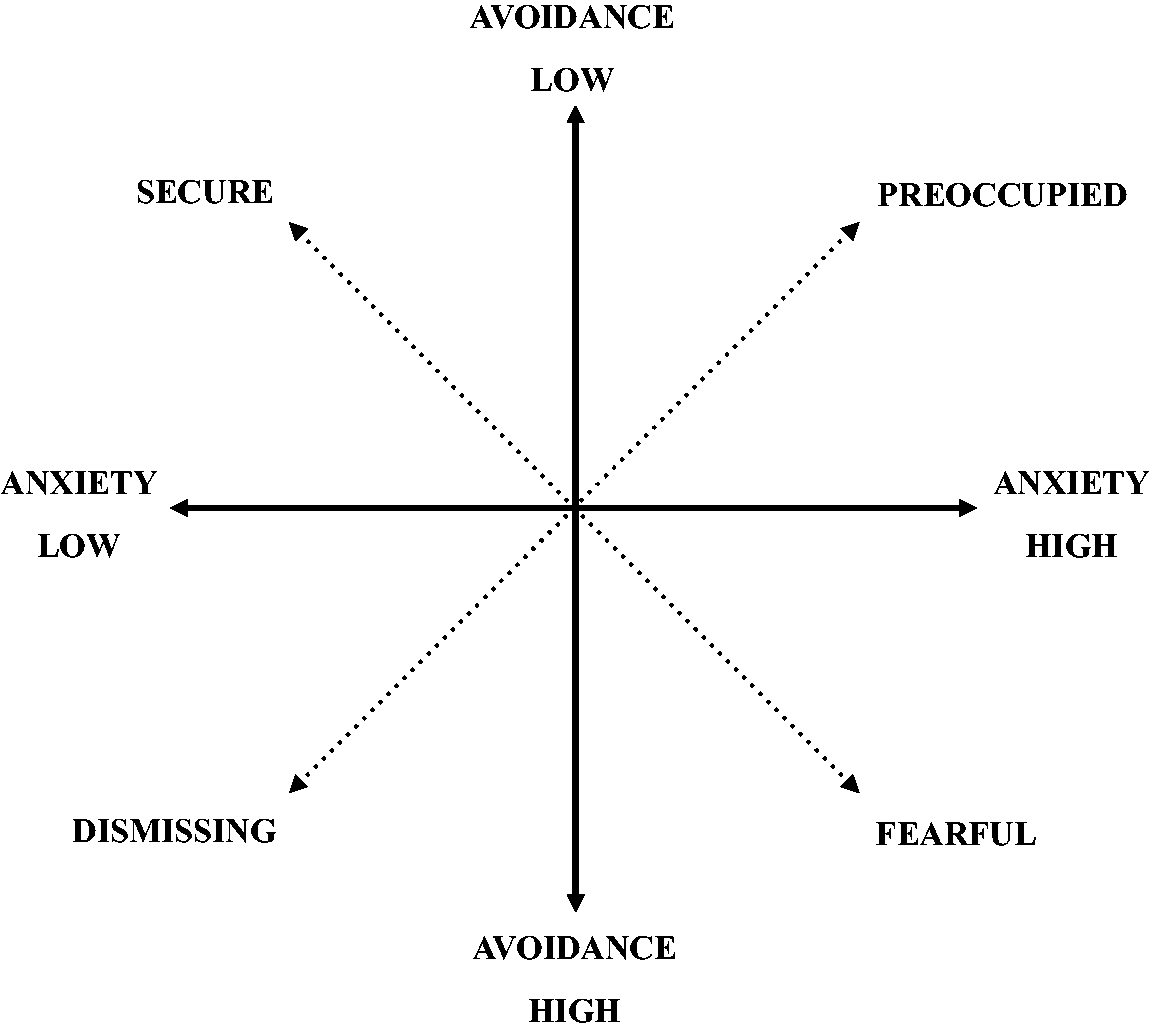
The two-dimensional model of the Attachment system (Fraley et al., 2015).
While this dimensional approach conceptualizes attachment by relying on a continuum representation of anxious and avoidant attachment (Fraley et al., 2015) rather than referring to distinct categories, both in research and in clinical settings (Shi et al., 2014) it is often preferred to refer to the four attachment categories as well as to the anxious/avoidant dimensions (Woodhouse et al., 2015).
The four-category model (Bartholomew & Horowitz, 1991) allows to reach a good synthesis of the categorical and the dimensional models since it allows to define categories by relying on the combination of the levels of the two dimensions (Fraley et al., 2015). In this perspective, the secure attachment is conceived as a relative absence of both attachment anxiety and avoidance; the dismissing attachment is conceived as a combination of high attachment avoidance and low anxiety; the preoccupied attachment is conceived as a combination of high attachment anxiety and low avoidance; and the fearful attachment is characterized by high attachment avoidance and anxiety (Bartholomew & Horowitz, 1991; Fraley et al., 2015).
Two-dimensional model of behavioral systems
Following the four-category model of adult attachment, here, we present a two-dimensional model of activation of the behavioural systems according to which four prototypical categories deriving from the combination of two continuous dimensions can be identified for each behavioural system (Bartholomew & Horowitz, 1991; Fraley et al., 2015).
Starting from a clinical perspective, one main problem when categorizing variables that are continuous is the lack of precision in the measurement of a given variable, with relevant consequences in those contexts in which providing accurate assessment is a priority for diagnosis, treatment and monitoring of changes (Fraley et al., 2015). Although such problem is less challenging for persons who have extreme positions on a dimension, it becomes more critical for people who can be placed at less extreme or intermediate positions on the dimension. In this view, when a middle intensity activated dimension combines with high/low intensity activation of the other dimension, then the high/low dimension is crucial to capture the core nature of the individual’s style of activation, while the middle intensity dimension contributes to complete the functional description of the activation style of the behavioral system.
In the present paper, we focused on the caregiving, the power, the sex and the cooperative system, at variance with literature on personality and individual differences that instead applied the principles of the attachment theory to exploration (Mikulincer & Shaver, 2012), caregiving (Meneghini et al., 2018), sexual (Birnbaum et al., 2014) and power (Mikulincer & Shaver, 2012) systems. Attachment, caregiving, power, sexual and cooperative systems are the so-called social motivational systems that regulate interactions with conspecifics; in particular, the cooperative system, regulating egalitarian relationships between subjects, is considered a key ingredient of the therapeutic alliance in psychotherapy (Cortina & Liotti, 2014; Tschacher et al., 2014), thus we took into account the cooperative system instead of the exploration one.
From the above considerations, here, we outline the general organization of two-dimensional model of behavioral systems and describe the principles that allow to identify the four prototypical activation styles (Figure 2). Then, we apply the two-dimensional model to caregiving, power, sexual and cooperative systems.
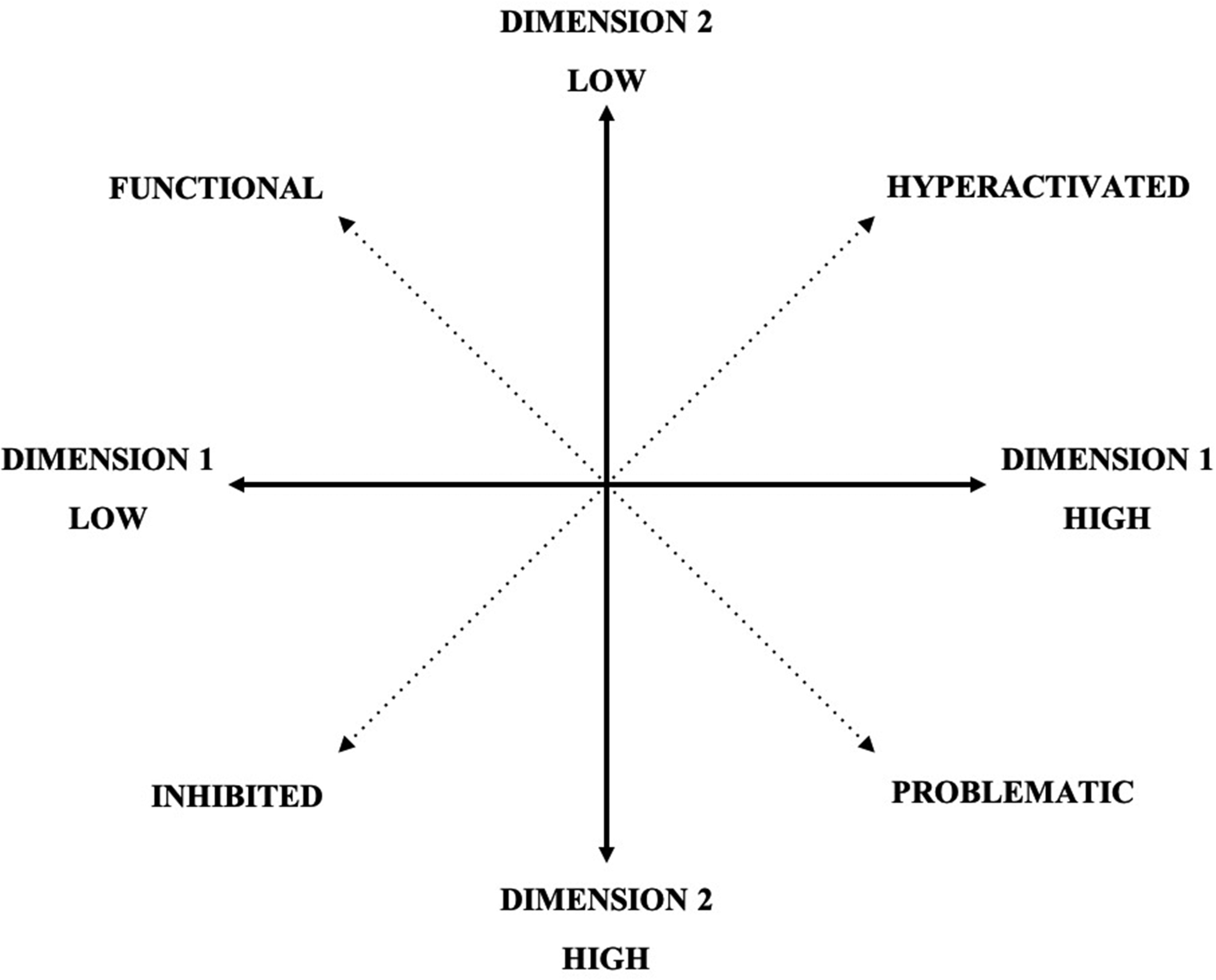
The two-dimensional model of Behavioral systems.
In the first activation style, the behavioral system resorts to primary strategies of goal attainment as it is mainly activated by goal relevant stimuli and it is deactivated by stimuli or outcomes signalling the achievement of the desired goal. In this case, the two dimensions are low; we label this activation style functional.
In the second activation style, the system relies on hyperactivating strategies. Indeed, the system is frequently activated, even in the absence of the relevant stimuli, and its deactivation is no more achieved, even when the attainment of the desired goal is signalled. The first dimension is high while the second is low; we label this activation style hyperactivated.
In the third activation style, the behavioral system is ruled by deactivating strategies as its activation is systematically reduced, even when facing relevant stimuli. Thus, deactivation represents the default mode, even if the goal has not been achieved yet. The first dimension is low while the second is high; we label this activation style inhibited.
The fourth activation style is characterized by the coexistence of both hyperactivating and deactivating strategies producing an incoherent and confused way of coping. Such a combination of strategies leads to chaotic and dysfunctional behavioral sequences. In this case, the two dimensions are high; we label this activation style problematic.
In the attachment system, the problematic activation corresponds to the fearful type representing the most severe form of attachment insecurity (Adams et al., 2017). People with fearful attachment concurrently desire to approach and avoid the attachment figures, and their behaviour under stress can be an incoherent blend of contradictory and unsuccessful approach and avoidance conducts (Simpson & Karantzas, 2019). Theoretical controversies can be found in literature relating to the specificity of this disorganized pattern of behaviour (Rholes et al., 2016) but results of empirical studies converge in demonstrating that persons with fearful attachment show severe problems in regulating emotions and in dealing with interpersonal relationships (Favez & Tissot, 2019). Indeed, the fearful attachment style is the most prevalent style in psychosis (Carr et al., 2018), it is the most strongly related to PTSD (Woodhouse et al., 2015) and is prevailing in women affected by perinatal depression (Meuti et al., 2015). Moreover, persons with fearful attachment style seem to be the hardest to engage in any form of therapy, because of the conflict between wanting to reach closeness and being afraid of rejection (Millings et al., 2019).
Since the fearful attachment style has the most relevant impact in clinical settings, by analogy, the corresponding problematic style can represent the most clinically relevant style of activation of the other behavioral systems as well. For this reason, we focused on the problematic style of activation of the following behavioural systems.
The caregiving system
The caregiving system is involved in activation of prosocial behaviors devoted to providing care to others who are suffering or are in need (Shaver et al., 2019).
The primary strategy of the caregiving system is an empathic attitude towards the other person’s needs implying both sensitivity and responsiveness. Sensitivity is the capacity to adequately perceive the careseeker’s signals of distress or need, and responsiveness is the capacity to respect the troubled person’s needs and actually implement caring behaviors fitting them (Meneghini et al., 2018).
The two dimensions characterizing the activation styles of the caregiving system are control and indifference.
Control corresponds to the implementation of the hyperactivating strategies of the system causing overly controlling and poorly timed behaviors, not fitting with the other’s needs but rather aiming at making oneself essential to the other or allowing oneself to feel competent or commendable as a caregiver. These goals derive from exaggerated appraisal of the other’s needs and from adopting a hypervigilant attitude towards other’s needs or troubles, forcing the other to accept one’s caregiving efforts and paying too much attention to the other’s needs at the expense of one’s own (Meneghini et al., 2018).
Indifference corresponds to the implementation of the deactivating strategies of the system implying inadequate empathy, lack of desire to help and withdrawal from caregiving, with the propensity of offering partial assistance and keeping emotional distance, even when the other person requires closeness and comfort (Meneghini et al., 2018).
According to the two-dimensional model, by combining the dimensions of control and indifference we can distinguish four types of activation of the caregiving system (Figure 3).

The two-dimensional model of the Caregiving system.
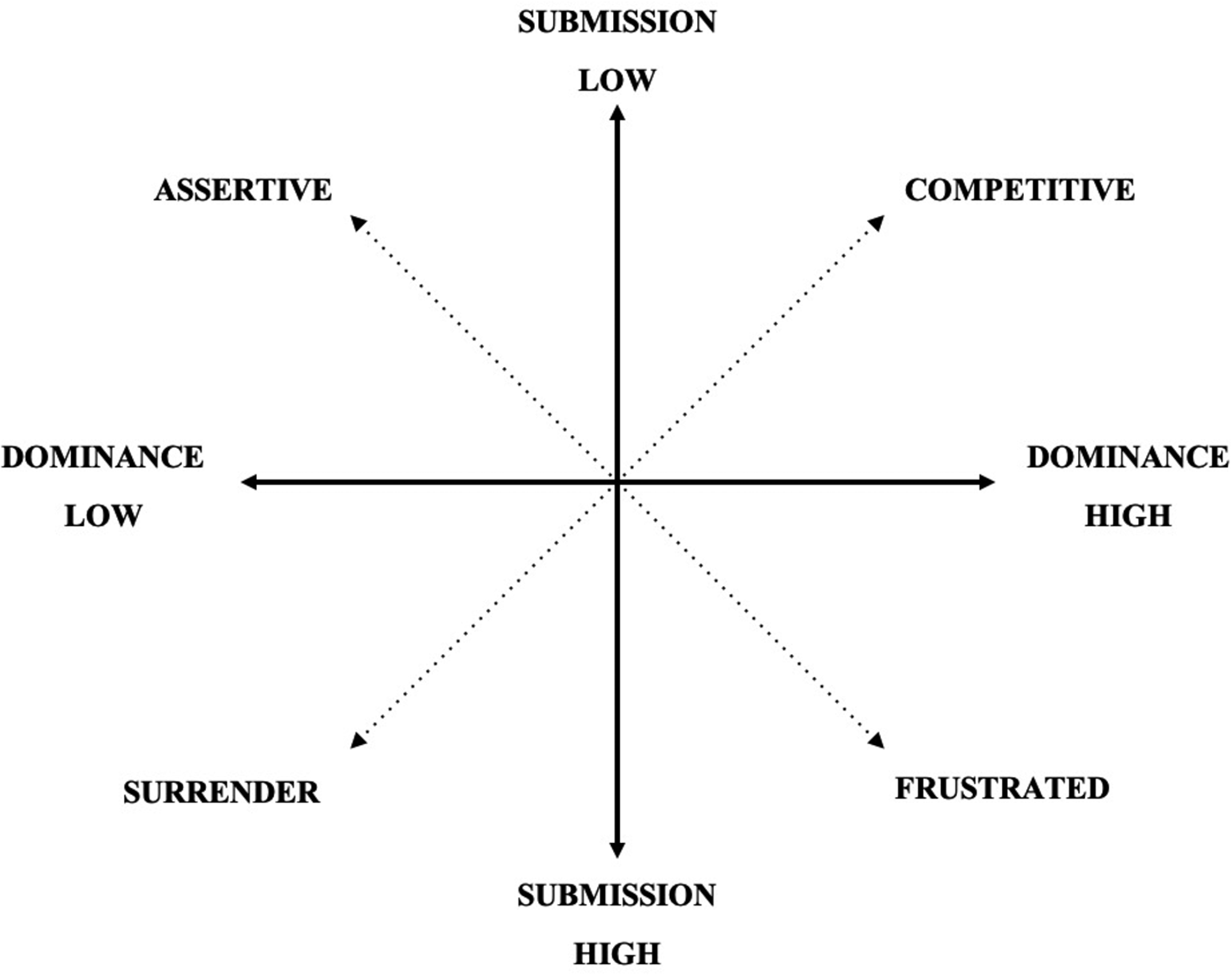
The two-dimensional model of the Power system.
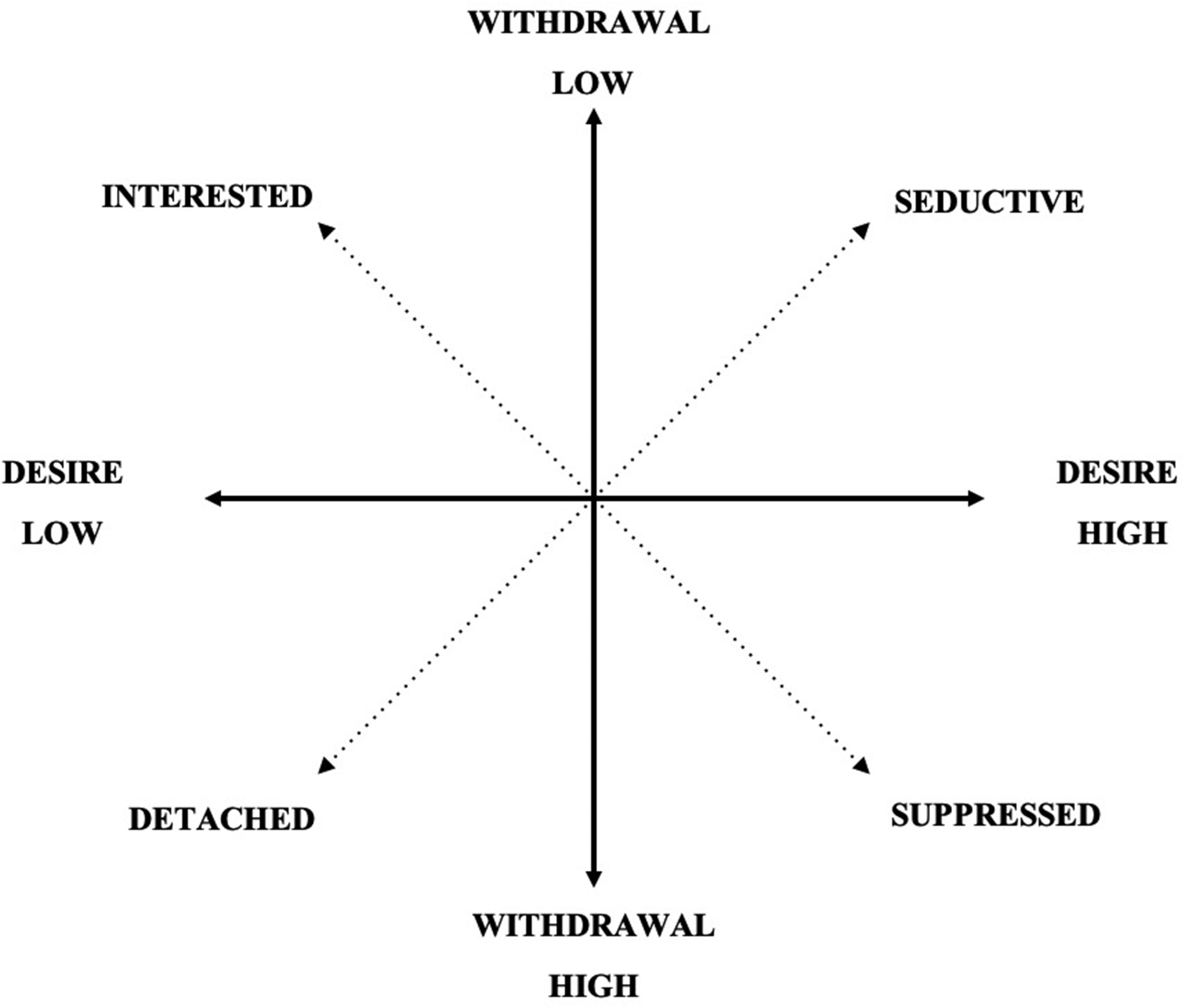
The two-dimensional model of the Sexual system.
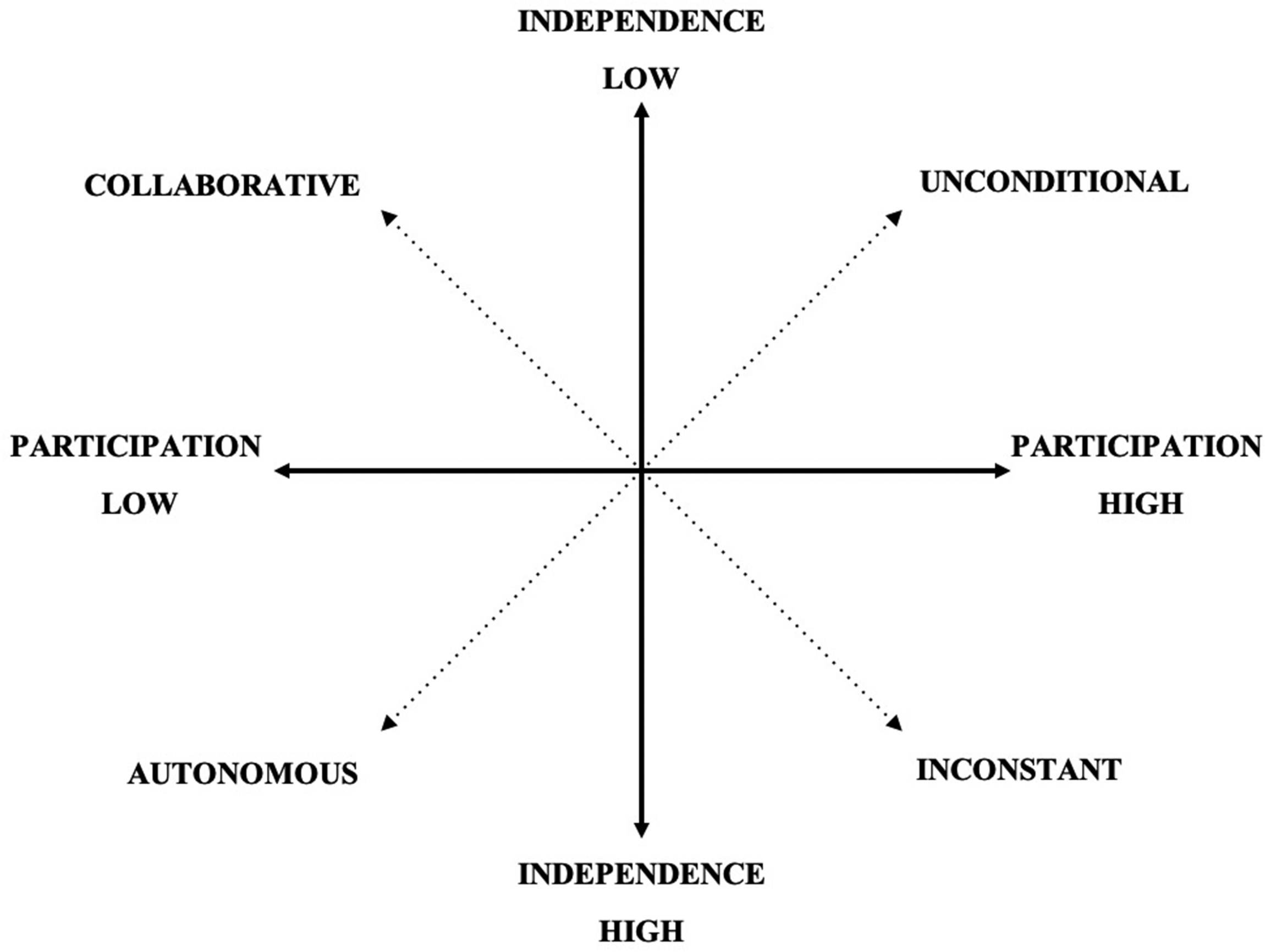
The two-dimensional model of the Cooperative system.
The functional activation style refers to persons who are both sensitive and responsive to the other’s needs (low indifference) but are also able to withdraw from caregiving when the other person does not require care or closeness anymore (low control). We label this pattern of activation the responsive type.
The hyperactivated activation style refers to persons who are always ready to help others (low indifference) but through an intrusive stance toward the other’s needs (high control). We label this pattern of activation the intrusive type.
The inhibited activation style refers to persons who are not able to adopt an empathic stance towards the other’s needs (high indifference) and tend to withdraw from caregiving by avoiding situations in which the other person requires care and support (low control). We label this pattern of activation the rejecting type.
The problematic activation style refers to persons who unpredictably shift from hypervigilance and intrusiveness (high control) to emotional detachment and withdrawal (high indifference). We label this pattern of activation the confused type.
The power system
The power system (Mikulincer & Shaver, 2012), or dominance system (Leedom, 2014), is conceived as a system allowing the individual to acquire and control psychological or physical resources that are important to increase the chances of survival. The power system is activated when resources are limited, and people compete to control them or when an event or a social interaction is perceived as a threat to the person’s power (Leedom, 2014).
The primary strategy of the power system is to activate a pattern of behaviors aimed at protecting or restoring the sense of power or dominance. These behaviors involve: asserting one’s authority, rights, or competence; expressing confidence in one’s values and opinions; exerting control over one’s resources or deterring others from competing for gaining resources; verbally or physically attacking (or threatening to attack) others until power is restored (Mikulincer & Shaver, 2012).
The dimensions characterizing the activation styles of the power system are dominance and submission.
Dominance corresponds to hyperactivating strategies characterized by strong efforts to restore the sense of power when an extreme fear of losing power is elicited. This condition results in aggressive and hostile behaviors towards anyone who is perceived as a potential rival; a strong propensity to attack can also be observed in conditions where only minimal or ambiguous signals of threat are perceived by the person (Mikulincer & Shaver, 2012).
Submission corresponds to deactivating strategies implying giving up on the possibility of using the system’s primary strategies of defence against threats and potential damages to one’s sense of power; such deactivation results in responses such as submissiveness, self-abasement, and the tendency of avoiding from using the power strategies, even in the presence of explicit assault or provocation. Deactivation also involves avoiding situations that call for assertion of one’s rights, values, or opinions, such as competitions, arguments and actual fights (Mikulincer & Shaver, 2012).
According to the two-dimensional model, by combining the dimensions of dominance and submission we can distinguish four types of activation of the power system (Figure 4).
The functional activation style identifies persons who are able to face a challenge and figh to affirm their power (low submission) but they are also able to stop fighting and accept the defeat (low dominance). We label this pattern of activation the assertive type.
The hyperactivated activation style refers to persons who activate strategies of dominance even in the absence of overt signals of threat (high dominance) and have difficulties in accepting the defeat or stopping fighting when the competition becomes disadvantageous (low submission). We label this pattern of activation the competitive type.
The inhibited activation style refers to persons who tend to avoid situations that call for assertion of one’s rights and opinions, like competitions, arguments, disputes, and interpersonal conflicts (high submission); these persons tend to accept defeat with resignation, without trying to fight even in the presence of clear-cut signals of threat or provocation (low dominance). We label this pattern of activation the surrender type.
The problematic activation style refers to persons who perceive themselves as constantly involved in an unfair comparison. They tend to avoid competing against others due to fear of losing (high submission) while strongly wishing to win. They can also unpredictably adopt aggressive and dominant behaviors (high dominance). We label this pattern of activation the frustrated type.
The sexual system
The main goal of the sexual system is achieving through sexual interaction the sexual pleasure and the reproductive success (Birnbaum et al., 2014; Leedom, 2014). Thus, when the person meets a sexually suitable partner, the system is activated and goal-directed behavioral strategies for achieving sexual access are implemented (Birnbaum et al., 2014).
The primary strategy of the sexual system is typically to approach the desirable partner, seduce and engage her/him in sexual intercourse. The behaviors characterising the primary strategy include highlighting one’s sexual interest and staying focused on the partner’s signals. Effective activation of the sexual system also implies a steady increase in physical and emotional closeness (Birnbaum et al., 2014).
The dimensions characterizing the activation styles of the sexual system are desire and withdrawal.
Desire corresponds to hyperactivation of the sexual system and implies strong sexual desire and need of achieving the sexual satisfaction through impulsive and invasive sexual behaviors. Hyperactivation is also related to overestimation of the importance of sex in social relationships and, at the same time, is related to worries about sexual desirability and performance (Birnbaum et al., 2014).
Withdrawal corresponds to deactivation of the sexual system and it is related to suppression of sexual needs and rejection of sex as source of pleasure. In order to prevent from sexual frustration, people relying on deactivating strategies tend to diminish the importance of sex in their relationships, experience sexual unresponsiveness, and avoid erotic stimuli, including sexually desirous partners (Birnbaum et al., 2014).
According to the two-dimensional model, by combining the dimensions of desire and withdrawal we can distinguish four types of activation of the sexual system (Figure 5).
The functional activation style identifies persons who activate the sexual system when encountering a sexually appropriate partner (low withdrawal), and who can be engaged in sexual relationships perceived as important but not indispensable to the personal well-being (low desire). We label this pattern of activation the interested type.
The hyperactivated activation style refers to persons who usually show inappropriate sexually oriented behaviors (high desire), and also engage in sexual relations independently from feelings of affection (low withdrawal). We label this pattern of activation the seductive type.
The inhibited activation style refers to persons who consider the sexual aspects of a relationship as irrelevant (low desire) and don’t look for sexual intercourse (high withdrawal). We label this pattern of activation the detached type.
The problematic activation style refers to persons who suppress their sexual behaviors and apparently display indifference towards sexual interactions (high withdrawal) but they deeply need to be involved in sexual intercourse, as revealed by occasional and unexpected exhibition of sexual-oriented behaviors (high desire). We label this pattern of activation the suppressed type.
The cooperative system
The cooperative system refers to the activation of mutual and socio-reciprocal behaviors based on equality and symmetry among the individuals involved in the interaction in order to achieve shared advantages. Thus, the cooperative system is activated when two or more group members share a common goal that can be reached by cooperation (Cortina & Liotti, 2014; Tomasello & Vaish, 2013).
Classical literature on the activation strategies of behavioral systems did not take into account the cooperative system that, instead, is a central issue in the economic literature revealing that individual differences in the motivation to cooperate for contributing to common good play a key role in cooperation. Different personality profiles can be distinguished: the egoist (selfish player) who does not participate and never contributes to common goods; the unconditional cooperator (altruistic player) who systematically contributes to the public account, independently from the other person’s behavior; the conditional cooperator (reciprocator) who, although showing a propensity to cooperate, responds to cooperative behaviors with cooperation and to non-cooperative behaviors with retaliation against the unfair individual (Burton-Chellew et al., 2016). Within this framework, it can be suggested that the primary activation strategy of the cooperative system is that described for the conditional cooperator who collaborates with the other in order to achieve the common goal but taking into account the reciprocal degree of generosity. Therefore, the dimensions characterizing the activation styles of the cooperation system are participation and independence.
Participation represents the hyperactivating strategy of the system and corresponds to the unconditional cooperator who systematically shows cooperative behaviors even in the absence of equal participation and contribution among the group members, and independently from the nature of the common goal.
Independence represents the hypoactivating strategy of the system that is systematically used by the egoist who avoids reciprocal collaboration and shows indifference towards the common goal.
According to the two-dimensional model, by combining the dimensions of participation and independence we can distinguish four types of activation of the cooperative system (Figure 6).
The functional activation style refers to persons who are autonomous (low participation) but can also act cooperatively when collaboration seems advantageous for all group members (low independence). We label this pattern of activation the collaborative type.
The hyperactivated activation style refers to persons who tend to be involved in social interactions where a common goal is lacking and tend to expect reciprocity even in non-reciprocal situations (high participation) because they cannot well distinguish their own from others’ goals (low independence). We label this pattern of activation the unconditional type.
The inhibited activation style refers to persons who refuse cooperation even when it would be useful to goal attainment (high independence); moreover, they don’t get involved in reciprocal interactions even when it would be functional and advantageous (low participation). We label this pattern of activation the autonomous type.
The problematic activation style refers to persons who tend to unpredictably shift from withdrawing from reciprocal and collaborative situations (high independence) to engagement in collaborative and reciprocal social interactions (high participation). We label this pattern of activation the inconstant type.
Conclusions
In the present paper, we develop a two-dimensional model of activation of the behavioral systems according to which four styles of activation can be identified by combining the two dimensions along which the behavior of the person can be represented within the system. Starting from the attachment system (Fraley et al., 2015), we applied the two-dimensional model to caregiving, power, sexual and cooperative systems, and identified for each system four activation styles: functional, hyperactivated, inhibited and problematic.
A dysfunction of the behavioral systems related to hyperactivating and deactivating strategies can increase the risk for emotional problems (Mikulincer & Shaver, 2012), with large effects on affect regulation processes (Mikulincer et al., 2003). Accordingly, it has been underlined that the conceptualization of hyperactivating and hypoactivating attachment-related strategies has important implications for psychotherapy suggesting that the main therapeutic goal would be to facilitate the formation of security-based strategies of affect regulation (Mikulincer et al., 2003).
Within the attachment framework, the attachment system is primary, comes first in development, and can represent either a well-grounded or an unstable basis for the functioning of the other behavioral systems (Mikulincer & Shaver, 2012). Fearful attachment is thought to be related to severe problems in regulating emotions and dealing with interpersonal relationships, both in infancy and adulthood (Mikulincer & Shaver, 2012; Simpson & Rholes, 2002). For instance, in adults the fearful attachment is related to high levels of anxiety and avoiding behaviors (Simpson & Rholes, 2002). Accordingly, persons with fearful attachment are more prone to verbal and physical aggression in intimate relationships (Dutton et al., 1994), less caregiving activity in romantic relationships (Carnelley et al., 1996) and more difficulties in building therapeutic relations (Eames & Roth, 2000). These findings suggest that fearful attachment can represent a vulnerability factor leading to a deranged development of the other systems. On this basis, here, we hypothesize that the presence of a problematic attachment style might be related to a problematic development and activation of the other behavioral systems. As recalled above, one main point of the present model is that the problematic style of activation system represents a dysfunctional expression of the behavioral systems leading to chaotic and unpredictable behaviors and relating to higher rates of psychopathology. Our model would underscore that to find dysfunctionality one should look not only at hyper- or hypo-activations of the systems but at the problematic activation as well, and that the possible problematic activation should be searched not only in the attachment systems but also in the other ones.
Each system has its own function, triggers and responses. However, the systems do not work in isolation, but they rather interact with each other and jointly influence the person’s behavior (Gillath et al., 2016). By capitalizing on evidence on the interactions of the attachment system with the other systems (Davis et al., 2004; Gillath et al., 2016; Irons & Gilbert, 2005), the present model would suggest that dysfunctionality within a behavioral system can interfere with both development and actual activation the other systems. In particular, we propose that the problematic style of activation could represent the style of activation most interfering with activation of the other systems. Although the way through which such interference is achieved merits direct investigation, we can suggest that mapping the behavioral systems to possibly find the problematic activation is a central issue in a clinical perspective since it can allow to detect behavioural activations potentially undermining the therapeutic process. Indeed, when activated, the problematic activation style has the potential to challenge the therapeutic process not only in the case of the attachment system but also in the case of all the above considered systems.
While, here, we aimed at defining the conceptual framework of the two-dimensional model of activation of the behavioural systems, empirical studies are warranted to directly test the predictions stemming from the clinical implementation of the model.
Footnotes
Declaration of Conflicting Interests
The author(s) declared no potential conflicts of interest with respect to the research, authorship, and/or publication of this article.
Funding
The author(s) received no financial support for the research, authorship, and/or publication of this article.
